Poems for Brothers

The 15 poems for brothers, by 9 poets, ranked by third-party data. How poems are ranked

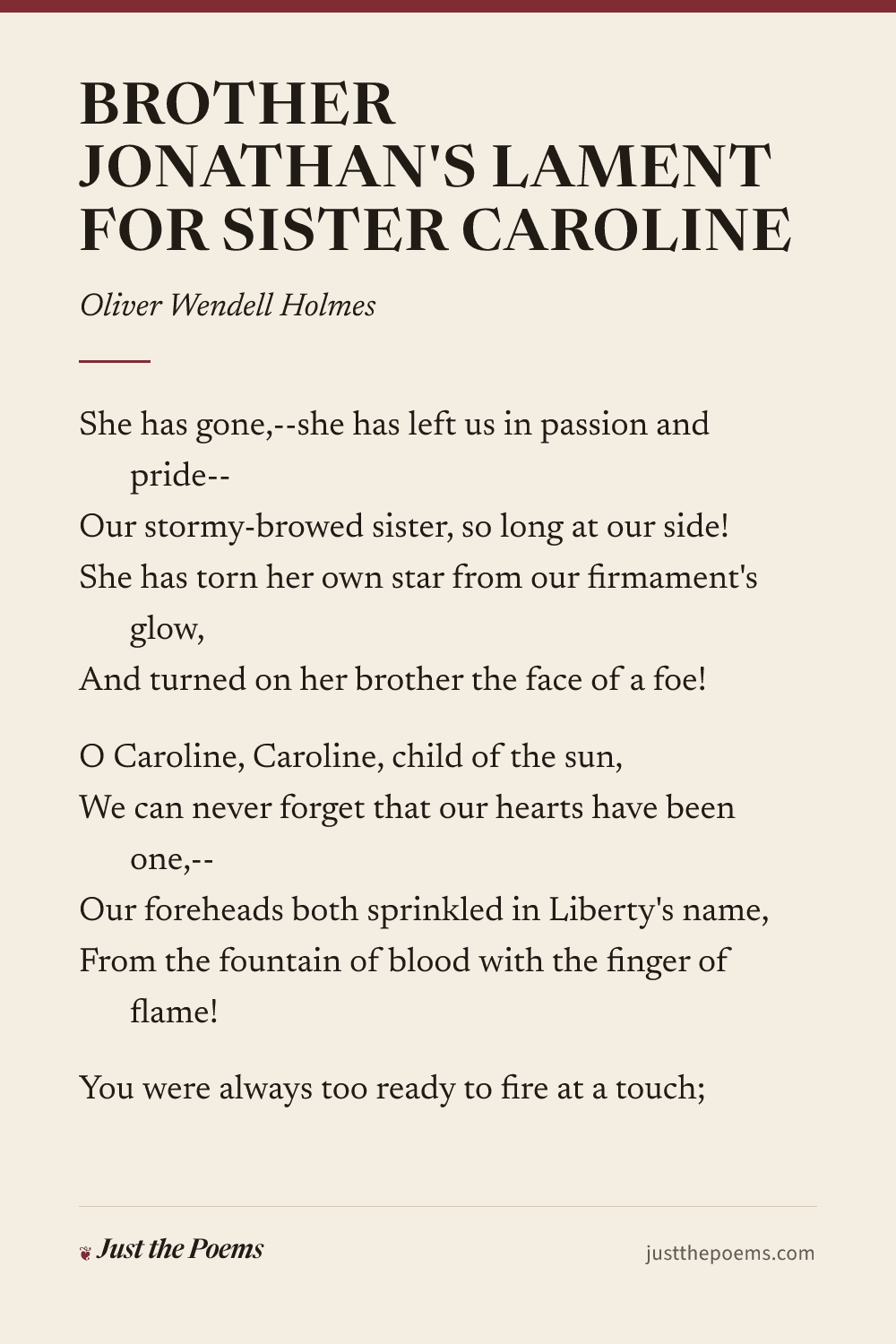
BROTHER JONATHAN'S LAMENT FOR SISTER CAROLINE

Oliver Wendell Holmes

In 0 Wikipedias 1 anthology Poet in 37 Wikipedias

She has gone,--she has left us in passion and pride--Our stormy-browed sister, so long at our side!She has torn her own star from our firmament's glow,And turned on her brother the face of a foe!

O Caroline, Caroline, child of the sun,We can never forget that our hearts have been one,--Our foreheads both sprinkled in Liberty's name,From the fountain of blood with the finger of flame!

You were always too ready to fire at a touch;But we said: "She is hasty--she does not mean much."We have scowled when you uttered some turbulent threat;But friendship still whispered: "Forgive and forget."

Show all 36 lines 24 more

Has our love all died out? Have its altars grown cold?Has the curse come at last which the fathers foretold?Then Nature must teach us the strength of the chainThat her petulant children would sever in vain.

They may fight till the buzzards are gorged with their spoil,--Till the harvest grows black as it rots in the soil,Till the wolves and the catamounts troop from their caves,And the shark tracks the pirate, the lord of the waves:

In vain is the strife! When its fury is past,Their fortunes must flow in one channel at last,As the torrents that rush from the mountains of snowRoll mingled in peace in the valleys below.

Our Union is river, lake, ocean, and sky;Man breaks not the medal when God cuts the die!Though darkened with sulphur, though cloven with steel,The blue arch will brighten, the waters will heal!

O Caroline, Caroline, child of the sun,There are battles with fate that can never be won!The star-flowering banner must never be furled,For its blossoms of light are the hope of the world!

Go, then, our rash sister, afar and aloof,--Run wild in the sunshine away from our roof;But when your heart aches and your feet have grown sore,Remember the pathway that leads to our door!

Source

The World's Best Poetry, Vol. VIII, ed. Bliss Carman, 1904

Filed under
  • Named in the title

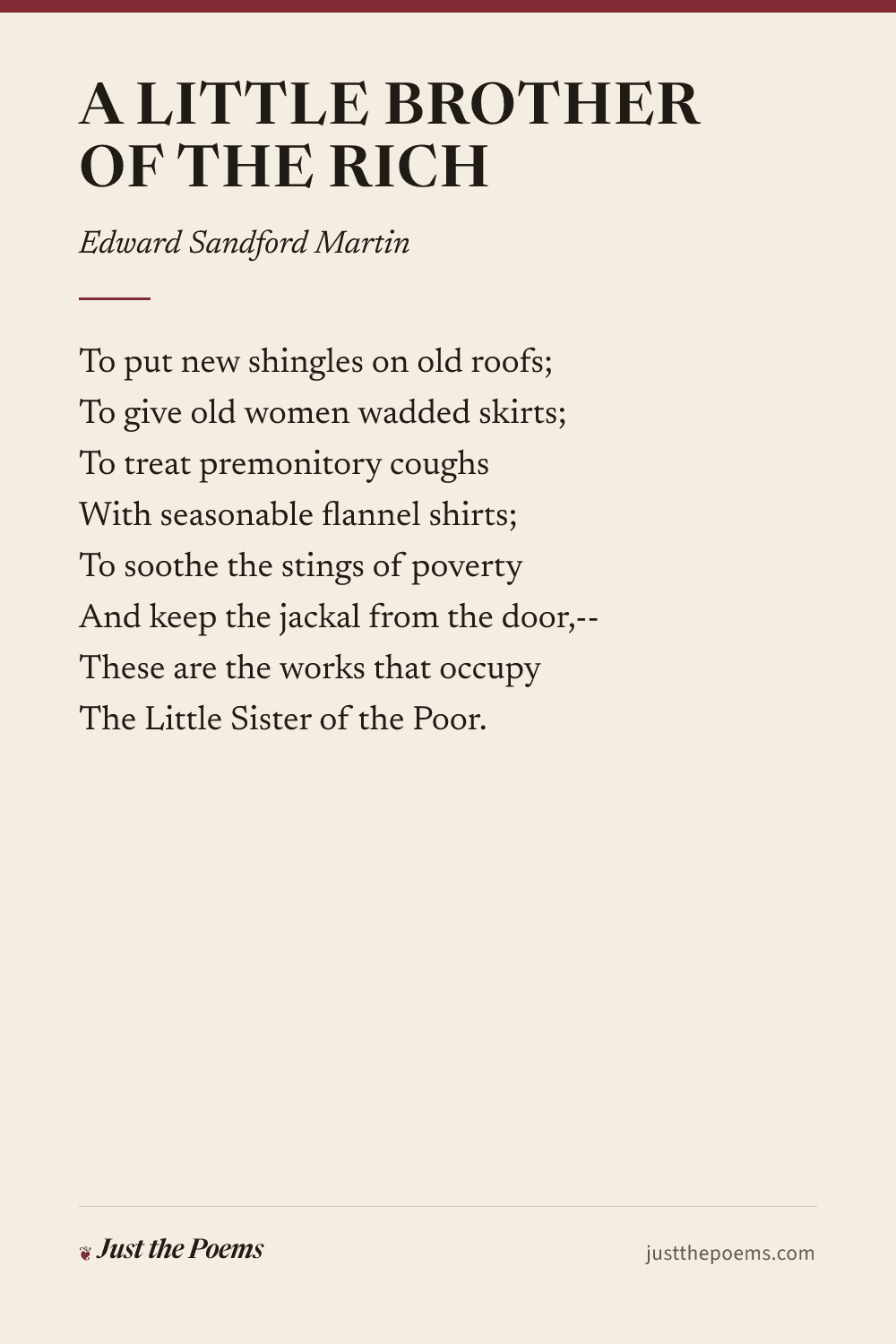
A LITTLE BROTHER OF THE RICH

Edward Sandford Martin

In 0 Wikipedias 1 anthology Poet in 1 Wikipedia

To put new shingles on old roofs;To give old women wadded skirts;To treat premonitory coughsWith seasonable flannel shirts;To soothe the stings of povertyAnd keep the jackal from the door,--These are the works that occupyThe Little Sister of the Poor.

She carries, everywhere she goes,Kind words and chickens, jams and coals;Poultices for corporeal woes,And sympathy for downcast souls:

Show all 40 lines 28 more

Her currant jelly, her quinine,The lips of fever move to bless;She makes the humble sick-room shineWith unaccustomed tidiness.

A heart of hers the instant twinAnd vivid counterpart is mine;I also serve my fellow-men,Though in a somewhat different line.The Poor, and their concerns, she hasMonopolized, because of whichIt falls to me to labor asA Little Brother of the Rich.

For their sake at no sacrificeDoes my devoted spirit quail;I give their horses exercise;As ballast on their yachts I sail.Upon their tallyhos I rideAnd brave the chances of a storm;I even use my own insideTo keep their wines and victuals warm.

Those whom we strive to benefitDear to our hearts soon grow to be;I love my Rich, and I admitThat they are very good to me.Succor the Poor, my sisters,--I,While heaven shall still vouchsafe me health,Will strive to share and mollifyThe trials of abounding wealth.

Source

The Home Book of Verse, ed. Burton Egbert Stevenson

Filed under
  • Named in the title

I. TO MY BROTHER GEORGE.

John Keats

In 0 Wikipedias 0 anthologies Poet in 97 Wikipedias

Many the wonders I this day have seen: The sun, when first he kist away the tears That fill'd the eyes of morn;--the laurel'd peersWho from the feathery gold of evening lean:--The ocean with its vastness, its blue green, Its ships, its rocks, its caves, its hopes, its fears,-- Its voice mysterious, which whoso hearsMust think on what will be, and what has been.E'en now, dear George, while this for you I write, Cynthia is from her silken curtains peepingSo scantly, that it seems her bridal night, And she her half-discover'd revels keeping.But what, without the social thought of thee,Would be the wonders of the sky and sea?

Source

Poems 1817, 1817

Filed under
  • Named in the title

Advertisements

TO MY BROTHER GEORGE.

John Keats

In 0 Wikipedias 0 anthologies Poet in 97 Wikipedias

Full many a dreary hour have I past,My brain bewilder'd, and my mind o'ercastWith heaviness; in seasons when I've thoughtNo spherey strains by me could e'er be caughtFrom the blue dome, though I to dimness gazeOn the far depth where sheeted lightning plays;Or, on the wavy grass outstretch'd supinely,Pry 'mong the stars, to strive to think divinely:That I should never hear Apollo's song,Though feathery clouds were floating all alongThe purple west, and, two bright streaks between,The golden lyre itself were dimly seen:

Show all 143 lines 131 more

That the still murmur of the honey beeWould never teach a rural song to me:That the bright glance from beauty's eyelids slantingWould never make a lay of mine enchanting,Or warm my breast with ardour to unfoldSome tale of love and arms in time of old.

But there are times, when those that love the bay,Fly from all sorrowing far, far away;A sudden glow comes on them, nought they seeIn water, earth, or air, but poesy.It has been said, dear George, and true I hold it,(For knightly Spenser to Libertas told it,)That when a Poet is in such a trance,In air he sees white coursers paw, and prance,Bestridden of gay knights, in gay apparel,Who at each other tilt in playful quarrel,And what we, ignorantly, sheet-lightning call,Is the swift opening of their wide portal,When the bright warder blows his trumpet clear,Whose tones reach nought on earth but Poet's ear.When these enchanted portals open wide,And through the light the horsemen swiftly glide,The Poet's eye can reach those golden halls,And view the glory of their festivals:Their ladies fair, that in the distance seemFit for the silv'ring of a seraph's dream;Their rich brimm'd goblets, that incessant runLike the bright spots that move about the sun;And, when upheld, the wine from each bright jarPours with the lustre of a falling star.Yet further off, are dimly seen their bowers,Of which, no mortal eye can reach the flowers;And 'tis right just, for well Apollo knows'Twould make the Poet quarrel with the rose.All that's reveal'd from that far seat of blisses,Is, the clear fountains' interchanging kisses.As gracefully descending, light and thin,Like silver streaks across a dolphin's fin,When he upswimmeth from the coral caves.And sports with half his tail above the waves.

These wonders strange be sees, and many more,Whose head is pregnant with poetic lore.Should he upon an evening ramble fareWith forehead to the soothing breezes bare,Would he naught see but the dark, silent blueWith all its diamonds trembling through and through:Or the coy moon, when in the wavinessOf whitest clouds she does her beauty dress,And staidly paces higher up, and higher,Like a sweet nun in holy-day attire?Ah, yes! much more would start into his sight--The revelries, and mysteries of night:And should I ever see them, I will tell youSuch tales as needs must with amazement spell you.

These are the living pleasures of the bard:But richer far posterity's award.What does he murmur with his latest breath,While his proud eye looks through the film of death?"What though I leave this dull, and earthly mould,Yet shall my spirit lofty converse holdWith after times.--The patriot shall feelMy stern alarum, and unsheath his steel;Or, in the senate thunder out my numbersTo startle princes from their easy slumbers.The sage will mingle with each moral themeMy happy thoughts sententious; he will teemWith lofty periods when my verses fire him,And then I'll stoop from heaven to inspire him.Lays have I left of such a dear delightThat maids will sing them on their bridal night.Gay villagers, upon a morn of MayWhen they have tired their gentle limbs, with play,And form'd a snowy circle on the grass,And plac'd in midst of all that lovely lassWho chosen is their queen,--with her fine headCrowned with flowers purple, white, and red:For there the lily, and the musk-rose, sighing,Are emblems true of hapless lovers dying:Between her breasts, that never yet felt trouble,A bunch of violets full blown, and double,Serenely sleep:--she from a casket takesA little book,--and then a joy awakesAbout each youthful heart,--with stifled cries,And rubbing of white hands, and sparkling eyes:For she's to read a tale of hopes, and fears;One that I foster'd in my youthful years:The pearls, that on each glist'ning circlet sleep,Gush ever and anon with silent creep,Lured by the innocent dimples. To sweet restShall the dear babe, upon its mother's breast,Be lull'd with songs of mine. Fair world, adieu!Thy dales, and hills, are fading from my view:Swiftly I mount, upon wide spreading pinions,Far from the narrow bounds of thy dominions.Full joy I feel, while thus I cleave the air,That my soft verse will charm thy daughters fair,And warm thy sons!" Ah, my dear friend and brother,Could I, at once, my mad ambition smother,For tasting joys like these, sure I should beHappier, and dearer to society.At times, 'tis true, I've felt relief from painWhen some bright thought has darted through my brain:Through all that day I've felt a greater pleasureThan if I'd brought to light a hidden treasure.As to my sonnets, though none else should heed them,I feel delighted, still, that you should read them.Of late, too, I have had much calm enjoyment,Stretch'd on the grass at my best lov'd employmentOf scribbling lines for you. These things I thoughtWhile, in my face, the freshest breeze I caught.E'en now I'm pillow'd on a bed of flowersThat crowns a lofty clift, which proudly towersAbove the ocean-waves. The stalks, and blades,Chequer my tablet with their, quivering shades.On one side is a field of drooping oats,Through which the poppies show their scarlet coatsSo pert and useless, that they bring to mindThe scarlet coats that pester human-kind.And on the other side, outspread, is seenOcean's blue mantle streak'd with purple, and green.Now 'tis I see a canvass'd ship, and nowMark the bright silver curling round her prow.I see the lark down-dropping to his nest.And the broad winged sea-gull never at rest;For when no more he spreads his feathers free,His breast is dancing on the restless sea.Now I direct my eyes into the west,Which at this moment is in sunbeams drest:Why westward turn? 'Twas but to say adieu!'Twas but to kiss my hand, dear George, to you!

August, 1816.

Source

Poems 1817, 1817

Filed under
  • Named in the title

VIII. TO MY BROTHERS.

John Keats

In 0 Wikipedias 0 anthologies Poet in 97 Wikipedias

Small, busy flames play through the fresh laid coals, And their faint cracklings o'er our silence creep Like whispers of the household gods that keepA gentle empire o'er fraternal souls.And while, for rhymes, I search around the poles, Your eyes are fix'd, as in poetic sleep, Upon the lore so voluble and deep,That aye at fall of night our care condoles.This is your birth-day Tom, and I rejoice That thus it passes smoothly, quietly.Many such eves of gently whisp'ring noise May we together pass, and calmly tryWhat are this world's true joys,--ere the great voice, From its fair face, shall bid our spirits fly.

Source

Poems 1817, 1817

Filed under
  • Named in the title

BROTHER AND SISTER

D. H. Lawrence

In 0 Wikipedias 0 anthologies Poet in 79 Wikipedias

THE shorn moon trembling indistinct on her path,Frail as a scar upon the pale blue sky,Draws towards the downward slope; some sorrow hathWorn her down to the quick, so she faintly faresAlong her foot-searched way without knowing whyShe creeps persistent down the sky's long stairs.

Some say they see, though I have never seen,The dead moon heaped within the new moon's arms;For surely the fragile, fine young thing had beenToo heavily burdened to mount the heavens so.But my heart stands still, as a new, strong dread

Show all 38 lines 26 more

alarmsMe; might a young girl be heaped with such shadow of woe?

Since Death from the mother moon has pared us down to the quick,And cast us forth like shorn, thin moons, to travelAn uncharted way among the myriad thickStrewn stars of silent people, and luminous litterOf lives which sorrows like mischievous dark mice chavelTo nought, diminishing each star's glitter,

Since Death has delivered us utterly, naked and white,Since the month of childhood is over, and we stand alone,Since the beloved, faded moon that set us alightIs delivered from us and pays no heed though we moanIn sorrow, since we stand in bewilderment, strangeAnd fearful to sally forth down the sky's long range.

We may not cry to her still to sustain us here,We may not hold her shadow back from the dark.Oh, let us here forget, let us take the sheerUnknown that lies before us, bearing the arkOf the covenant onwards where she cannot go.Let us rise and leave her now, she will never know.

Source

Amores: Poems, 1916

Filed under
  • Named in the title

THE BROTHERS.

Ambrose Bierce

In 0 Wikipedias 0 anthologies Poet in 59 Wikipedias

Scene--A lawyer's dreadful den.Enter stall-fed citizen.

LAWYER.--'Mornin'. How-de-do?

CITIZEN.--Sir, same to you.Called as counsel to retain youIn a case that I'll explain you.Sad, so sad! Heart almost broke.Hang it! where's my kerchief? Smoke?Brother, sir, and I, of late,Came into a large estate.Brother's--h'm, ha,--rather queerSometimes (tapping forehead) here.

Show all 26 lines 14 more

What he needs--you know--a "writ"--Something, eh? that will permitMe to manage, sir, in fine,His estate, as well as mine.'Course he'll kick; 't will break, I fear,His loving heart--excuse this tear.

LAWYER.--Have you nothing more?All of this you said before--When last night I took your case.

CITIZEN.--Why, sir, your faceNe'er before has met my view!

LAWYER.--Eh? The devil! True:My mistake--it was your brother.But you're very like each other.

Source

Shapes of Clay, 1903

Filed under
  • Named in the title

LITTLE BROTHER’S SECRET

Katherine Mansfield

In 0 Wikipedias 0 anthologies Poet in 53 Wikipedias

When my birthday was comingLittle Brother had a secret:He kept it for days and daysAnd just hummed a little tune when I asked him.But one night it rainedAnd I woke up and heard him crying:Then he told me.“I planted two lumps of sugar in your gardenBecause you love it so frightfullyI thought there would be a whole sugar tree for your birthday,And now it will all be melted.”O the darling!

Source

Poems, 1923

Filed under
  • Named in the title

Advertisements

LITTLE BROTHER’S STORY

Katherine Mansfield

In 0 Wikipedias 0 anthologies Poet in 53 Wikipedias

We sat in front of the fire;Grandmother was in the rocking chair doing her knittingAnd Little Brother and I were lying down flat.“Please tell us a story, Grandmother,” we said.But she put her head on one side and began counting the stitches,“Suppose you tell me one instead.”I made up one about a spotted tigerThat had a knot in his tail;But though I liked this about the knot,I did not know why it was put there.So I said: “Little Brother’s turn.”“I know a perfect story,” he cried, waving his hands.Grandmother laid down her knitting.“Do tell us, dear.”“Once upon a time there was a bad little girlAnd her Mummy gave her the slipper, and that’s all.”It was not a very special story.But we pretended to be very pleasedAnd Grandmother gave him jumps on her lap.

Source

Poems, 1923

Filed under
  • Named in the title

LONELY BROTHER

John Oxenham

In 0 Wikipedias 0 anthologies Poet in 4 Wikipedias

Art thou lonely, O my brother?Share thy little with another!Stretch a hand to one unfriended,And thy loneliness is ended.So both thou and heShall less lonely be.And of thy one lonelinessShall come two's great happiness.

Source

'All's Well!', 1916

Filed under
  • Named in the title

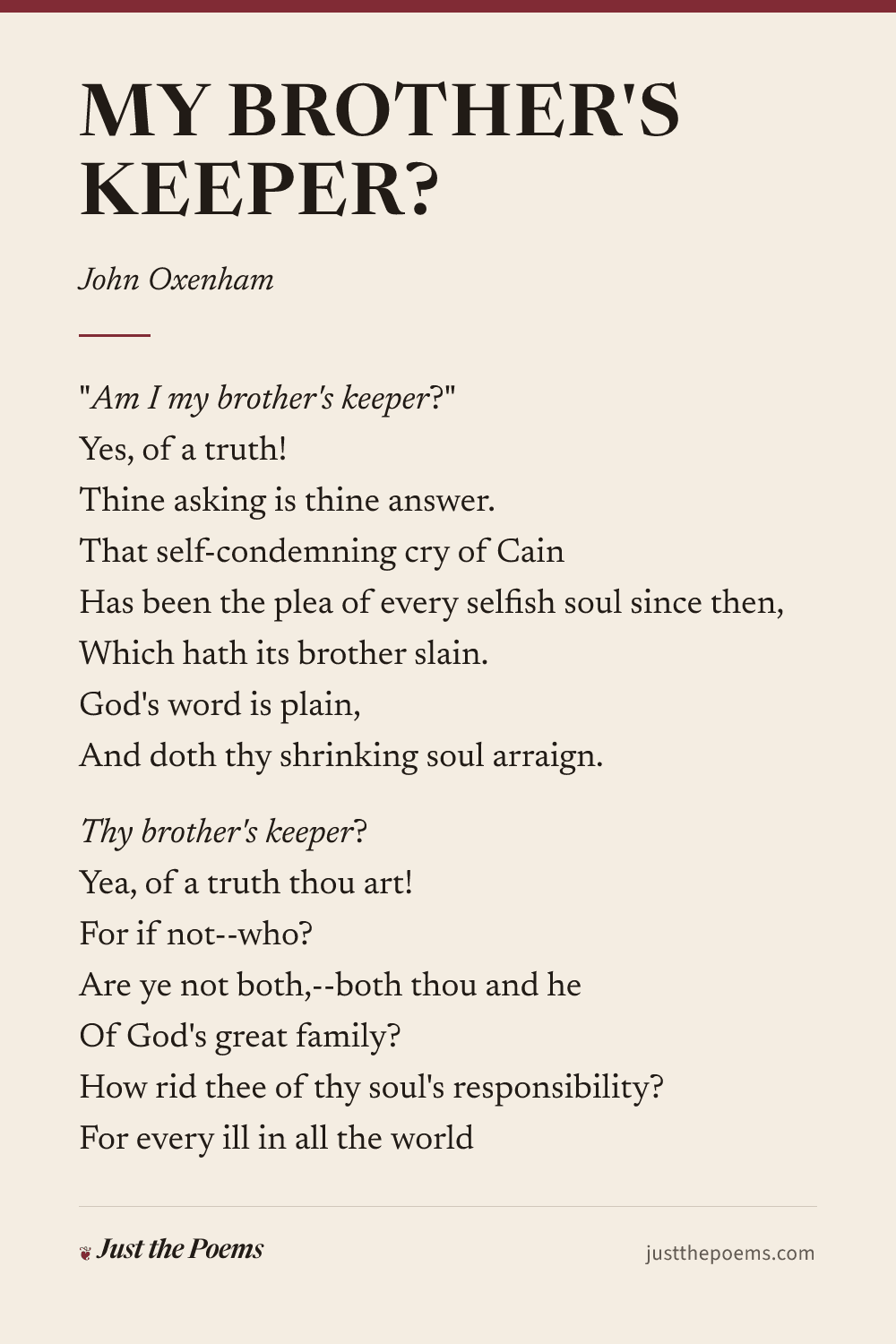
MY BROTHER'S KEEPER?

John Oxenham

In 0 Wikipedias 0 anthologies Poet in 4 Wikipedias

"Am I my brother's keeper?"Yes, of a truth!Thine asking is thine answer.That self-condemning cry of CainHas been the plea of every selfish soul since then,Which hath its brother slain.God's word is plain,And doth thy shrinking soul arraign.

Thy brother's keeper?Yea, of a truth thou art!For if not--who?Are ye not both,--both thou and he

Show all 45 lines 33 more

Of God's great family?How rid thee of thy soul's responsibility?For every ill in all the worldEach soul is sponsor and account must bear.And He, and he thy brother of despair,Claim, of thy overmuch, their share.

Thou hast had good, and he the strangled days;But now,--the old things pass.No longer of thy graceIs he content to live in evil caseFor the anointing of thy shining face.The old things pass.--Beware lest ye pass with them,And your placeBecome an emptiness!

Beware! Lest, when the "Have-nots" claim,From those who have, their rightful share,Thy borders be swept bareAs by the final flame.Better to share before than after."After?" ... For thee may be no after!Only the howl of mocking laughterAt thy belated care. Make no mistake!--"After" will be too late.When once the "Have-nots" claim ... they take."After!" ... When that full claim is made,You and your golden gods may all lie dead.

Set now your house in order,Ere it be too late!For, once the storm of hateBe loosed, no man shall stay it tillIts thirst has slaked its fill,And you, poor victims of this last "too late,"Shall in the shadows mourn your lost estate.

Source

'All's Well!', 1916

Filed under
  • Named in the title

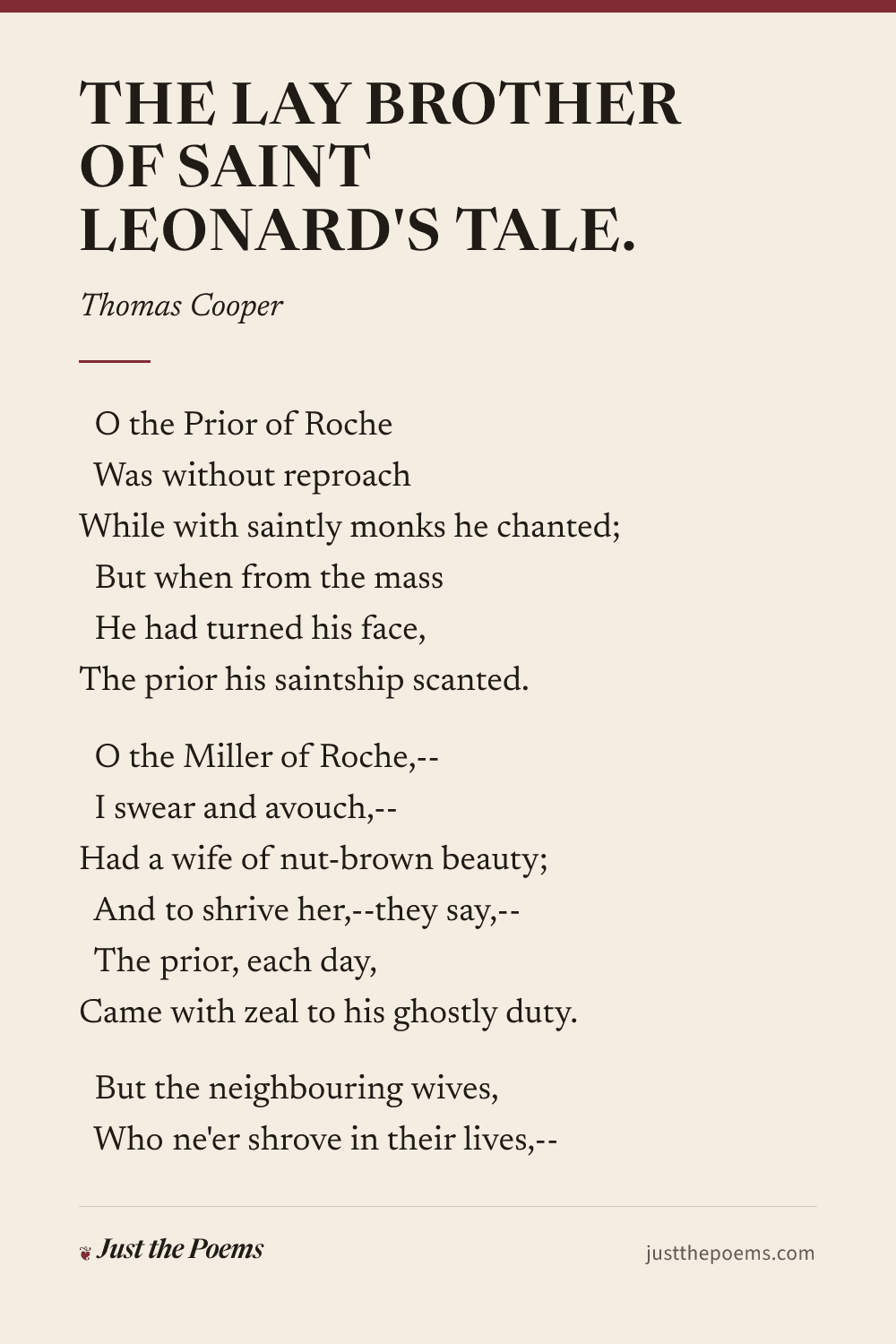
THE LAY BROTHER OF SAINT LEONARD'S TALE.

Thomas Cooper

In 0 Wikipedias 0 anthologies Poet in 4 Wikipedias

O the Prior of Roche Was without reproachWhile with saintly monks he chanted; But when from the mass He had turned his face,The prior his saintship scanted.

O the Miller of Roche,-- I swear and avouch,--Had a wife of nut-brown beauty; And to shrive her,--they say,-- The prior, each day,Came with zeal to his ghostly duty.

Show all 387 lines 375 more

But the neighbouring wives, Who ne'er shrove in their lives,--Such wickedness Sathanas whispers!-- Said the black-cloaked prior By the miller's log fire,Oft tarried too late for vespers!

O the thunder was loud, And the sky wore a shroud,And the lightning blue was gleaming; And the foaming flood, Where the good mill stood,Pell-mell o'er the dam was teeming.

O the Miller, that night, Toiled on in a fright,--Though, through terror, few bushels he grinded! Yet, although he'd stayed long, The storm was so strongThat full loath to depart was he minded.

Lo! at midnight a jolt, As loud as the boltOf the thunder on high that still rumbled, Assailed the mill-doors, And burst them, perforce,--And in a drenched beggar-lad stumbled!

"Saint Luke and saint John Save the ground we stand on"--Cried the Miller,--"but ye come in a hurry;" While the lad, turning pale, 'Gan to weep and to wail,And to patter this pitiful story:

"Goodman Miller, I pray, Believe what I say,--For, as surely as thou art a sinner,-- Since the break of the morn I have wandered forlorn,And have neither had breakfast nor dinner!"

O the Miller looked sad, And cried, "Good lack, my lad!But ye tell me a dolorous ditty!-- And ye seem in sad plight To travel to-night:--The sight o' ye stirs up one's pity!

"Go straight to my cot, And beg something that's hot,--For ye look very haggard and hollow:-- The storm's nearly o'er; I will not grind much more,--And when I have done, I will follow.

"Keep by the brook-side! The path is not wide--But ye cannot soon stray, if ye mind it;-- At the foot of the hill, Half a mile from the mill,Stands my cottage:--ye can't fail to find it."

Then out the lad set, All dripping with wet,--But the skies around him seemed brighter; And he went gaily on,-- For his burthen was gone,--And his heart in his bosom danced lighter.

Adown by the brook His travel he took,And soon raught the Miller's snug dwelling;-- But, what he saw ere He was admitted there--By Saint Bridget!--I must not be telling!

Thus much I may say-- That the cot was of clay,And the light was through wind-cracks ejected; And he placed close his eye, And peeped in, so sly,--And saw--what he never expected!

O the lad 'gan to fear That the Miller would appear,--And, to him, this strange sight would be vexing; So he, first, sharply coughed, And, then, knocked very soft,--Lest his summons should be too perplexing.

But, I scorn to think harm!-- So pass by all alarm,And trembling, and bustle, and terror, Occasioned within: The first stone at sinLet him cast who, himself, hath no error!

In inquisitive mood, The eaves-dropper stood,By the wind-cracks still keeping his station; Till, half-choked with fear, A voice cried, "Who's there?"--Cried the beggar, "Mary grant ye salvation!--

"I'm a poor beggar-lad, Very hungry and sad,Who have travelled in rain and in thunder; I am soaked, through and through"-- Cried the voice, "Perhaps 'tis true-- But who's likely to help thee, I wonder?

"Here's a strange time of night To put folk in a fright,By waking them up from their bolsters!-- Honest folk, by Saint Paul! Abroad never crawl,At the gloom-hour of night--when the owl stirs!"

But the Miller now came, And, hearing his dameSo sharply the beggar-lad scolding, Said, "Open, sweet Joan! And I'll tell thee, anon,--When thy brown cheek, once more, I'm beholding,

"Why this poor lad is found So late on our ground--Haste, my pigeon!--for here there's hard bedding!"-- So the door was unbarred;-- But the wife she frowned hard,As the lad, by the door, thrust his head in.

And she looked very cold While her lord the tale told;And then she made oath, by our Lady,-- Such wandering elves Might provide for themselves--For she would get no supper ready!

O the Miller waxed wroth, And vowed, by his troth,--While the beggar slunk into a corner,-- If his termagant wife Did not end her ill strife,He would change words for blows, he'd forewarn her!

O the lad he looked sly, And with mischievous eye,Cried, "Bridle your wrath, Goodman Grinder!-- Don't be in a pet,-- For I don't care a fret!--Your wife, in a trice, will be kinder!

"In the stars I have skill, And their powers, at my will,I can summon, with food to provide us: Say,--what d'ye choose? I pray, don't refuse:--Neither hunger nor thirst shall betide us!"

O the Miller he frowned, And rolled his eyes round,And seemed not the joke to be liking; But the lad did not heed: He was at his strange deed,And the table was chalking and striking!

With scrawls straight and crookt, And with signs square and hookt,With the lord of each house, or the lady, The table he filled, Like a clerk 'ith' stars skilled,--And, striking, cried "Presto! be ready!--

"A jug of spiced wine 'S in the box,--I divine!Ask thy wife for the key, and unlock it!-- Nay, stop!" the lad said; "We shall want meat and bread;"And the chalk took again from his pocket.

O the lad he looked wise, And, in scholarly guise,Completed his horary question:-- "A brace of roast ducks Thou wilt find in the box,With the wine--sure as I am a Christian!--

"And a white wheaten loaf;-- Quick! proceed to the proof!"--Cried the beggar,--while Grist stood stark staring;-- Though the lad's weasel eyes Shone so wondrously wise,That to doubt him seemed sin over-daring!

O the Miller's wife, Joan, Turning pale, 'gan to groan;But the Miller, arousing his spirits, Said, "Hand me the key, And our luck we will see--A faint heart no fortune inherits."

But,--Gramercy!--his looks-- When he opened the box,And at what he saw in it stood wondering! How his sturdy arm shook, While the wine-jug he took,And feared he would break it with blundering!

Faith and troth! at the last, On the table Grist placedThe wine and the ducks--hot and smoking! Yet he felt grievous shy His stomach to tryWith cates of a wizard's own cooking!

But, with hunger grown fell, The lad sped so well,That Grist was soon tempted to join in; While Joan sat apart, And looked sad at heart,And some fearful mishap seemed divining!

O the lad chopped away, And smiling so gay,Told stories to make his host merry:-- How the Moon kittened stars,-- And how Venus loved Mars,And often went to see him in a wherry!

O the Miller he laughed, And the liquor he quaffed;But the beggar new marvels was hatching:-- Quoth he "I'm a clerk, And I swear, by saint Mark,That the Devil from hell I'll be fetching!"--

O the wife she looked scared, And wildly Grist stared,And cried, "Nay, my lad, nay,--thou'rt not able!"-- But the lad plied his chalk, And muttered strange talk--Till Grist drew his stool from the table!

Then the lad quenched the rush, And cried, "Bring a gorse-bush,And under the caldron now kindle!"-- But the Miller cried, "Nay! Give over, I pray!"--For his courage began fast to dwindle.

Quoth the lad, "I must on Till my conjuring's done;To break off just now would be ruin: So fetch me the thorns,-- And a devil without horns,In the copper I soon will be brewing!"--

O the Miller he shook For fear his strange cookShould, indeed and in truth, prove successful; But feeling ashamed That his pluck should be blamed,Strove to smother his heart-quake distressful.

So the fuel he brought, And said he feared noughtOf the Devil being brewed in his copper: He'd as quickly believe Nick would sit in his sieve,Or dance 'mong the wheat in his hopper:--

And yet, lest strange ill, From such conjuring skill,Should arise, and their souls be in danger,-- He would have his crab-stick, And would show my lord NickSome tricks to which he was a stranger!

O the lad 'gan to raise 'Neath the caldron a blaze,--While the Miller, his crab-cudgel grasping, Stood on watch, for his life!-- But his terrified wifeHer hands--in devotion--was clasping!

When the copper grew warm, Quoth the lad, "Lest some harmFrom the visit of Nick be betiding,-- Set open the door, And not long on the floorWill the Goblin of Hell be abiding!"

Quickly so did the host, And returned to his post,--Uplifting his cudgel with trembling:-- His strength was soon proved,-- For the copper-lid moved!--When Grist's fears grew too big for dissembling.

Turning white as the wall, His staff he let fall,--While the Devil from the caldron ascended,-- And, all on a heap,-- With a flying leap,On the fear-stricken Miller descended!

In dread lest his soul, In the Devil's foul goal,Should be burnt to a spiritual cinder,-- Grist grabbed the Fiend's throat, And his grisly eyes smote,--Till Nick's face seemed a platter of tinder!

Yea, with many a thwack, Grist battered Nick's back,--Nor spared Satan's portly abdomen!-- Hot Nick had lain cold By this time--but his holdGrist lost, through the screams of his woman!

While up from the floor, And out, at the door,Went the Fiend, with the skip of a dancer! He seemed panic-struck,-- Or, doubted his luck,--For he neither staid question nor answer!

"Grist!" the beggar-lad cried, "Lay your trembling aside,And tell me, my man, how ye like him. 'Twas well ye were cool: He'd have proved ye a fool,--Had ye dar'd with the cudgel to strike him!"

"By saint Martin!" Grist said, And, scratching his head,Seemed pondering between good and evil,-- "I could swear and avouch 'Twas the Prior of Roche,--If thou hadst not said 'twas the Devil!"

And, in deed and in sooth,-- Though a marvellous truth,--Yet such was the Fiend's revelation!-- But think it not strange He should choose such a change:--'Tis much after his old occupation:--

An angel of light, 'Tis his darling delightTo be reckoned--'tis very well tested:-- I argue, therefore, 'Twas not sinning much more,In the garb of a Prior to be vested.

Though, with wink, nod, and smile-- O the world's very vile!--Grist's neighbours told tales unbelieving,-- How the beggar, so shrewd, Monk and supper had viewed,And produced 'em!--the Miller deceiving!

But I do not belong To that heretic throngWho measure their faith with their eyesight:-- Thus much I may say-- Grist's cottage of clayNever, now, doth the Prior of Roche visit:--

But, the sly beggar-lad, Be he hungry or sad,A remedy finds for each evil In the Miller's good cheer, Any day of the year;--And though Joan looketh shy--she is civil!

The tale was rude, but pleased rude men;And clamorous many a clown grew, when The rebeck ceased to thrill:Ploughboy and neatherd, shepherd swain,Gosherd and swineherd,--all were fain To prove their tuneful skill.

But, now, Sir Wilfrid waved his hand,And gently stilled the jarring band:"What ho!" he cried, "what ails your throats?Be these your most melodious notes?Forget ye that to-morrow mornOld Yule-day and its sports return,--And that your freres, from scrogg and carr,From heath and wold, and fen, afar,Will come to join ye in your glee?Husband your mirth and minstrelsy,And let some goodly portion beKept for their entertainment meet.Meanwhile, let frolic guide your feet, And warm your winter blood!Good night to all!--For His dear sakeWho bore our sin, if well we wake,We'll join to banish care and sorrowWith mirth and sport again to-morrow!" And forth the Baron goodPassed from his chair, midst looks of loveThat showed how truly was enwoveFull, free, and heartfelt gratitudeFor kindly deeds, in bosoms rude.

The broad hall-doors were open cast,And, smiling, forth De Thorold passed.Yet, was the crowning hour unflown-- Enjoyment's crowning hour!--A signal note the pipe hath blown, And a maiden at the doorCraves curtsied leave, with roseate blush,To bring the sacred missel-bush.

Gaily a younker leads the fair,Proud of his dimpled, blushing care:All clap their hands, both old and young,And soon the misseltoe is hungIn the mid-rafters, overhead;And, while the agile dance they thread,Such honey do the plough-lads seizeFrom lips of lasses as the beesNe'er sip from sweetest flowers of May.

All in the rapture of their play,--While shrilly swells the mirthsome pipe,And merrily their light feet trip,--Leave we the simple happy throngTheir mirth and rapture to prolong.
Source

The Baron's Yule Feast: A Christmas Rhyme, 1846

Filed under
  • Named in the title

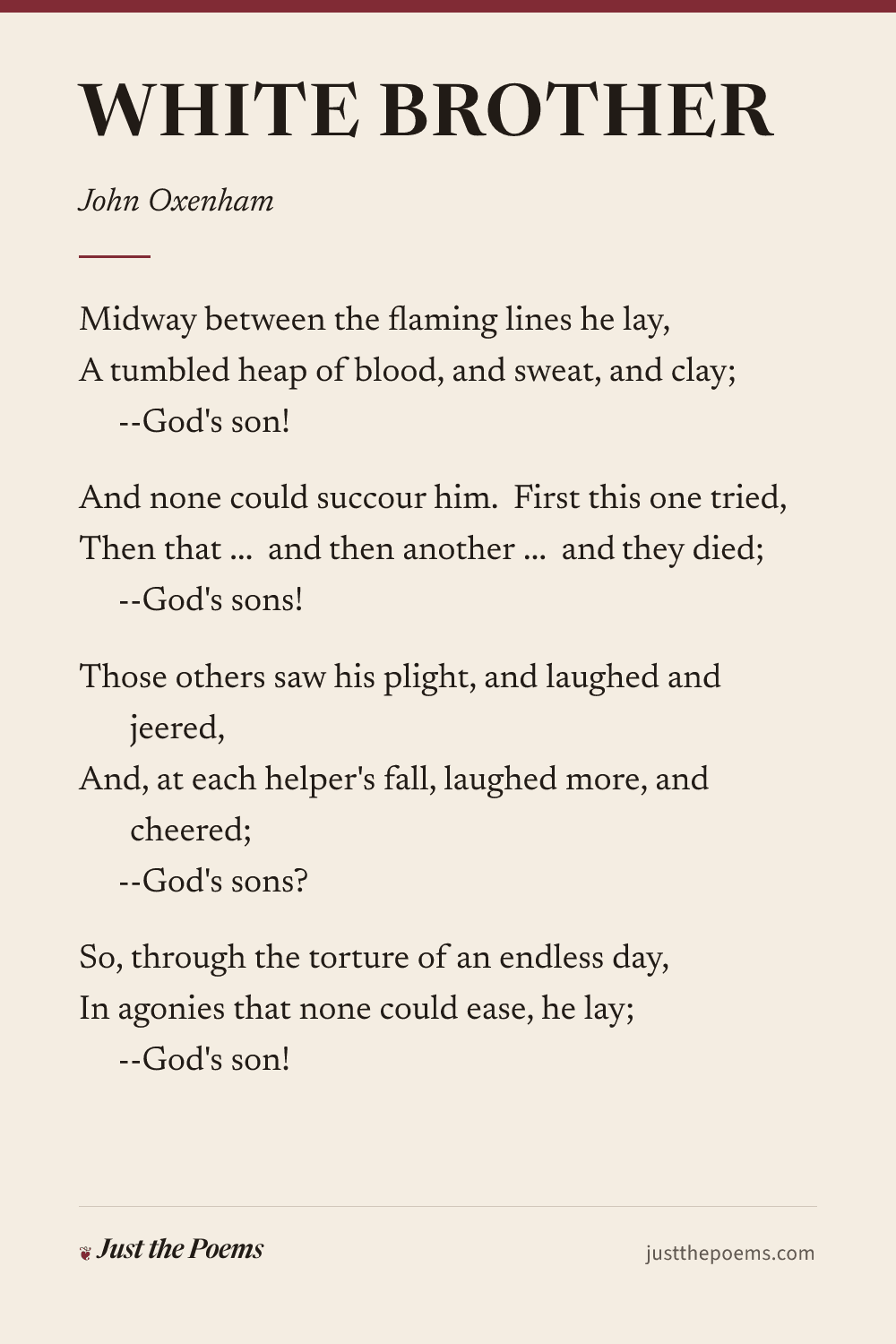
WHITE BROTHER

John Oxenham

In 0 Wikipedias 0 anthologies Poet in 4 Wikipedias

Midway between the flaming lines he lay,A tumbled heap of blood, and sweat, and clay; --God's son!

And none could succour him. First this one tried,Then that ... and then another ... and they died; --God's sons!

Those others saw his plight, and laughed and jeered,And, at each helper's fall, laughed more, and cheered; --God's sons?

So, through the torture of an endless day,In agonies that none could ease, he lay; --God's son!

Show all 45 lines 33 more

Then, as he wrestled for each hard-won breath,Bleeding his life out, craving only death;-- --God's son!

--Came One in white, athwart the fiery hail,And in His hand, a shining cup--The Grail; --God's Son!

He knelt beside him on the reeking ground,And with a touch soothed each hot-throbbing wound; --God's Son!

Gave him to drink, and in his failing earWhispered sweet words of comfort and good cheer; --God's Son!

The suffering one looked up into the faceOf Him whose death to sinners brought God's grace; --God's Son!

The tender brow with unhealed wounds was scarred,The hand that held The Cup, the nails had marred; --God's Son!

"Brother, for thee I suffered greater woes;As I forgave,--do thou forgive thy foes, --God's son!"

"Yea, Lord, as Thou forgavest, I forgive;And now, my soul unto Thyself receive, --God's Son!"

Thick-clustered in the battered trench, amazed,They gazed at that strange sight ... and gazed ... and gazed; --God's sons!

--The Christ of God, come down to succour oneOf their own number,--their own mate-- --God's son!

And none who saw that sight will e'er forgetHow once, upon the field of death, they met --God's Son.

Source

'All's Well!', 1916

Filed under
  • Named in the title

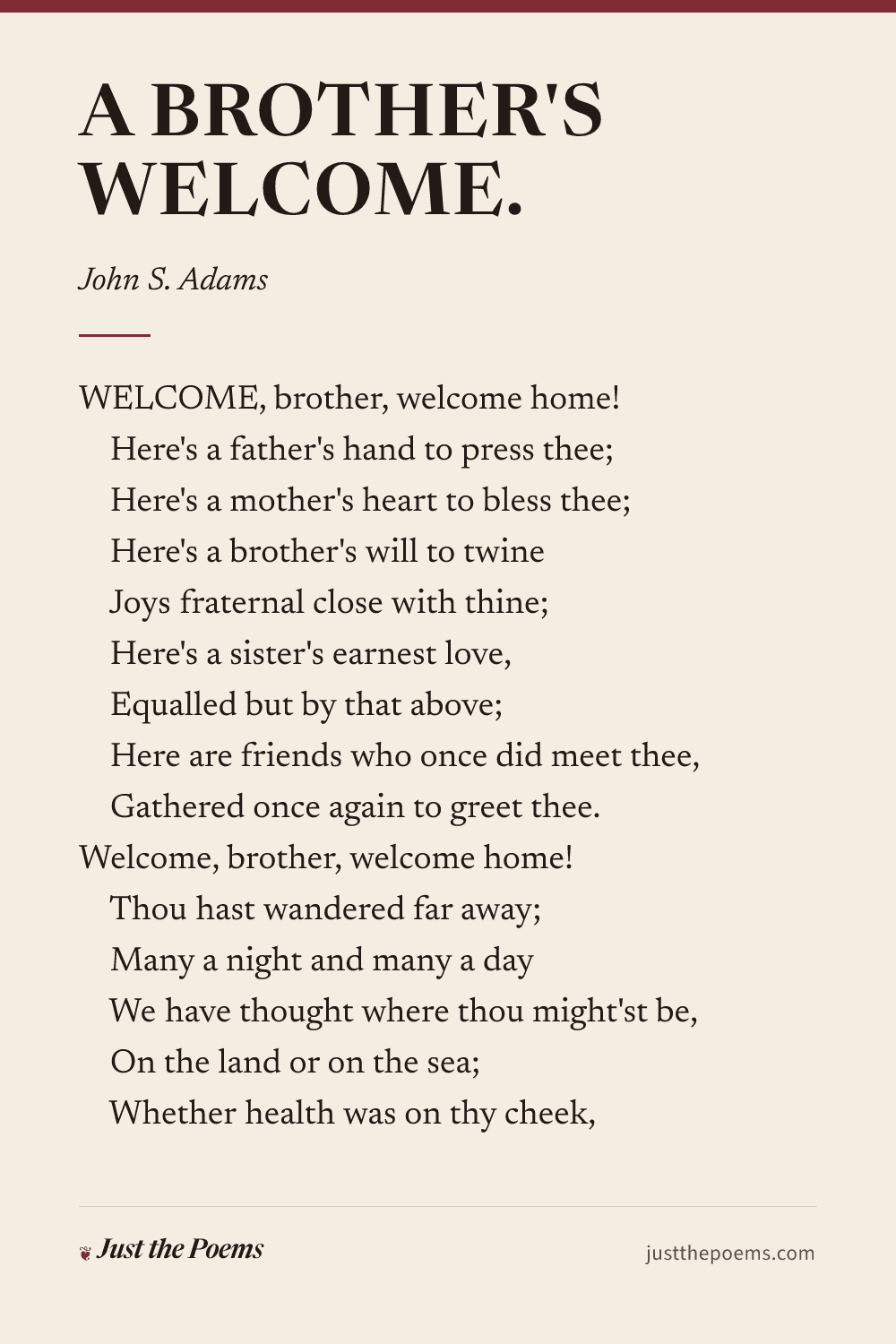
A BROTHER'S WELCOME.

John S. Adams

In 0 Wikipedias 0 anthologies Poet in 0 Wikipedias

WELCOME, brother, welcome home! Here's a father's hand to press thee; Here's a mother's heart to bless thee; Here's a brother's will to twine Joys fraternal close with thine; Here's a sister's earnest love, Equalled but by that above; Here are friends who once did meet thee, Gathered once again to greet thee.Welcome, brother, welcome home! Thou hast wandered far away; Many a night and many a day

Show all 27 lines 15 more

We have thought where thou might'st be, On the land or on the sea; Whether health was on thy cheek, Or that word we dare not speak Hung its shadowy wing above thee, Far away from those who love thee.Welcome, brother, welcome home! Here, where youthful days were spent Ere life had its labor lent, Where the hours went dancing by, 'Neath a clear, unclouded sky. And our thanks for blessings rendered Unto God were daily tendered, Here as ever pleasures reign, Welcome to these scenes again!

Source

Town and Country; Or, Life at Home and Abroad, Without and Within Us, 1855

Filed under
  • Named in the title

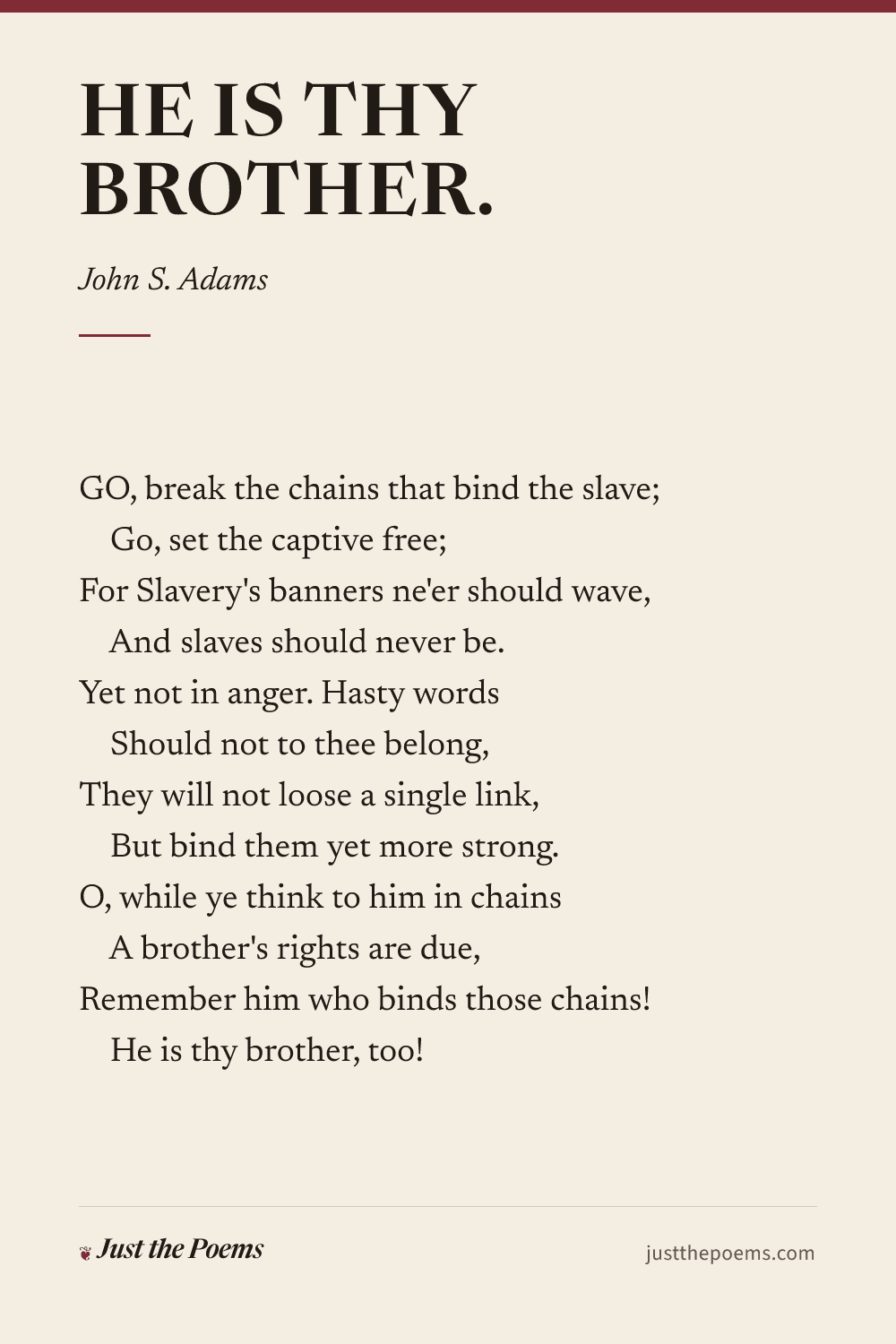
HE IS THY BROTHER.

John S. Adams

In 0 Wikipedias 0 anthologies Poet in 0 Wikipedias

GO, break the chains that bind the slave; Go, set the captive free;For Slavery's banners ne'er should wave, And slaves should never be.Yet not in anger. Hasty words Should not to thee belong,They will not loose a single link, But bind them yet more strong.O, while ye think to him in chains A brother's rights are due,Remember him who binds those chains! He is thy brother, too!

Source

Town and Country; Or, Life at Home and Abroad, Without and Within Us, 1855

Filed under
  • Named in the title

15 poems for brothers

9 poets

By poet's century of death

CenturyPoems
19th7
20th8

Poets with more than one poem

PoetPoems
John Keats3
John Oxenham3
John S. Adams2
Katherine Mansfield2