Poems About Dogs

Updated · How this page is checked

The 8 poems about dogs, by 7 poets, ranked by third-party data. How poems are ranked

Overview

Seven poets wrote these eight poems, and Ambrose Bierce has two. Two run to 24 lines or fewer: Jonathan Swift's has just 2 lines, while Bierce's The Oakland Dog runs to 76.

Read moreShow less

Three mourn a dog, or pretend to. In Oliver Goldsmith's elegy a dog bites a man, the neighbors expect the man to die, and it goes the other way; John Gay tells a woman called Celia to stop crying over her lap-dog and to look for comfort elsewhere; and Rudyard Kipling counts up the grief of owning an animal that will die first.

Three live with their people. Jonathan Swift lets a lap-dog speak from its collar and ask not to be stolen, the household in R. C. Lehmann's poem comes home after a month to a Dane and a Pekinese, and Everard Jack Appleton's dog admits that the three rescues it is praised for were all accidents.

Two are Bierce on the attack. In The Oakland Dog he dreams that every dog has been shot and the world has improved; in To a Stray Dog he argues over what the name Towser could mean, picks another name and ends on a threat.

Poems to read aloud, send and write in a card

Dogs mourned, or not quite

ELEGY ON THE DEATH OF A MAD DOG

Oliver Goldsmith

In 0 Wikipedias 1 anthology Poet in 51 Wikipedias

A mock elegy in which a dog bites a pious man, the town expects the man to die, and the dog dies instead. For reciting at a family party.

Good people all, of every sort, Give ear unto my song;And if you find it wondrous short, It cannot hold you long.

In Islington there was a man Of whom the world might say,That still a godly race he ran-- Whene'er he went to pray.

A kind and gentle heart he had, To comfort friends and foes:The naked every day he clad-- When he put on his clothes.

Show all 32 lines 20 more

And in that town a dog was found, As many dogs there be,Both mongrel, puppy, whelp, and hound, And curs of low degree.

This dog and man at first were friends; But when a pique began,The dog to gain his private ends, Went mad, and bit the man.

Around from all the neighboring streets The wondering neighbors ran,And swore the dog had lost his wits, To bite so good a man!

The wound it seemed both sore and sad To every Christian eye:And while they swore the dog was mad, They swore the man would die.

But soon a wonder came to light, That showed the rogues they lied:--The man recovered of the bite. The dog it was that died!

Source

The World's Best Poetry, Vol. IX, ed. Bliss Carman, 1904

Filed under
  • Named in the title

AN ELEGY ON A LAP-DOG

John Gay

In 0 Wikipedias 1 anthology Poet in 34 Wikipedias

A comic elegy urges a woman to stop crying over her dead lap-dog and to look for comfort in a man. For a pet owner with a sense of humor.

Shock's fate I mourn; poor Shock is now no more:Ye Muses! mourn; ye Chambermaids! deplore.Unhappy Shock! Yet more unhappy fair,Doomed to survive thy joy and only care.Thy wretched fingers now no more shall deck,And tie the favorite ribbon round his neck;No more thy hand shall smooth his glossy hair,And comb the wavings of his pendent ear.Let cease thy flowing grief, forsaken maid!All mortal pleasures in a moment fade:Our surest hope is in an hour destroyed,And love, best gift of Heaven, not long enjoyed.

Show all 32 lines 20 more

Methinks I see her frantic with despair,Her streaming eyes, wrung hands, and flowing hair;Her Mechlin pinners, rent, the floor bestrow,And her torn fan gives real signs of woe.Hence, Superstition! that tormenting guest,That haunts with fancied fears the coward breast;No dread events upon this fate attend,Stream eyes no more, no more thy tresses rend.Though certain omens oft forewarn a state,And dying lions show the monarch's fate,Why should such fears bid Celia's sorrow rise?For, when a lap-dog falls, no lover dies.Cease, Celia, cease; restrain thy flowing tears.Some warmer passion will dispel thy cares.In man you'll find a more substantial bliss,More grateful toying and a sweeter kiss.He's dead. Oh! lay him gently in the ground!And may his tomb be by this verse renowned:Here Shock, the pride of all his kind, is laid,Who fawned like man, but ne'er like man betrayed.

Source

The Home Book of Verse, ed. Burton Egbert Stevenson

Filed under
  • Named in the title

THE POWER OF THE DOG

Rudyard Kipling

In 0 Wikipedias 0 anthologies Poet in 126 Wikipedias

A speaker warns that a dog will break your heart when it dies, and asks why people keep taking the risk. It appeared in Actions and Reactions. For someone who has buried a dog.

There is sorrow enough in the natural wayFrom men and women to fill our day;But when we are certain of sorrow in store,Why do we always arrange for more?Brothers and sisters, I bid you bewareOf giving your heart to a dog to tear.

Buy a pup and your money will buyLove unflinching that cannot lie--Perfect passion and worship fedBy a kick in the ribs or a pat on the head.Nevertheless it is hardly fairTo risk your heart for a dog to tear.

Show all 34 lines 22 more

When the fourteen years which Nature permitsAre closing in asthma, or tumour, or fits,And the vet's unspoken prescription runsTo lethal chambers or loaded guns,Then you will find--it's your own affairBut... you've given your heart to a dog to tear.

When the body that lived at your single willWhen the whimper of welcome is stilled (how still!)When the spirit that answered your every moodIs gone--wherever it goes--for good,You will discover how much you care,And will give your heart to a dog to tear!

We've sorrow enough in the natural way,When it comes to burying Christian clay.Our loves are not given, but only lent,At compound interest of cent per cent.Though it is not always the case, I believe,That the longer we've kept 'em, the more do we grieve:For, when debts are payable, right or wrong,A short-time loan is as bad as a longSo why in Heaven (before we are there!)Should we give our hearts to a dog to tear?

Source

Actions and reactions

Filed under
  • Named in the title

Dogs at home

MRS. DINGLEY'S LAP-DOG

Jonathan Swift

In 0 Wikipedias 0 anthologies Poet in 101 Wikipedias

In two lines a lap-dog speaks for itself, asks any thief to leave it alone, and names its owner. The Poems of Jonathan Swift head it as written on the collar of a dog named Tiger. For a dog's collar tag.

Pray steal me not; I'm Mrs. Dingley's,Whose heart in this four-footed thing lies.

Source

The Poems of Jonathan Swift, D.D., Volume 2, 1910

Filed under
  • Named in the title

THE DOGS' WELCOME

R. C. Lehmann

In 0 Wikipedias 0 anthologies Poet in 4 Wikipedias

A household creeps home after a month away to surprise its two dogs, a Dane and a Pekinese, and is knocked flat by the welcome. It appeared in The Vagabond and Other Poems from Punch. For a family coming home to its dogs.

Hush! We're not a pack of boysAlways bound to make a noise. True, there's one amongst us, but He is young;And, wherever we may take him, We can generally shutSuch a youngster up and make him Hold his tongue.

Hush! Most cautiously we goOn the tippest tip of toe. Are the dogs expecting us At the gate?

Show all 52 lines 40 more

Two, who usually prize us, Will they jump and make a fuss?Will they really recognise us Where they wait?

Hush! I hear the funny pair Softly whimpering--yes, they're there.Dane and Pekinese, they scratch At the wood, At the solid wood between us;Duke attempts to lift the latch; It's a month since they have seen us-- Open! Good!

Down, Duke, down! Enough, enough!Soo-Ti's screaming; seize his scruff. Soo-Ti's having fearful fits; Duke is tearing us to bits.One will trip us, one will throw us--But, the darlings, don't they know us!

Then off with a clatter the long dog leapt, and, oh, what a race he ran,At the hurricane pace of a minute a mile, as only a long dog can.Into and out of the bushes he pierced like a shooting star;And now he thundered around us, and now he was whirling far.And the little dog gazed till he seemed amazed, and then he took to it too;With shrill notes flung from his pert pink tongue right after his friend he flew;And the long legs lashed and the short legs flashed and scurried like anything,While Duke ran round in a circle and Soo-Ti ran in a ring.

And last they hurtled amongst us, and then there were tales to tell,For all of us seemed to be scattered and torn, and all of us shrieked and fell;And John, who is plump, got an awful bump, and Helen, who's tall and thin,Was shot through a shrub and gained in bruise as much as she lost in skin;And Rosamond's frock was rent in rags, and tattered in strips was Peg's,And both of them suffered the ninepin fate to the ruin of arms and legs;And every face was licked by a dog, and battered was every limb,When Duke ran round in a circle and Soo-Ti ran after him.

Source

The Vagabond and Other Poems from Punch, 1918

Filed under
  • Named in the title

THE DOG CONFESSES

Everard Jack Appleton

In 0 Wikipedias 0 anthologies Poet in 0 Wikipedias

A dog praised for saving a boy three times admits that each rescue was an accident. It appeared in With the Colors in 1917. For reading aloud to a child who loves dogs.

I am a lucky dog, I know, and all my friends agreeThe people that I live with now are good as gold to meBecause three times I saved a life--and that is why they giveMe everything a dog could want--and will, while I shall live. But I've a conscience, and I must Confess the truth--or else I'll bust!

One day the cart that Bobbie drives ran up on pony's heels,And off he bolted! I went, too, and mixed up with the wheels,Until the cart came to a stop, and Bobbie-boy was saved--Then folks wept o'er the noble way that I, a dog, behaved. (The truth is, I got in that mix Avoiding pony's vicious kicks!)

Show all 28 lines 16 more

Another time, when Bobbie went to play out on the dockHe fell into the water there, (he'd stumbled on a block);I sprang in after him, of course, and dragged him back to land--Then everybody said the way I acted was "just grand." (The rat that I was chasing when I plunged, I never saw again!)

You see this stubby tail of mine? I got that when a carCame near to crushing Bobbie-boy--it gave us all a jar;I knocked him off the track in time, but one wheel caught my tailAnd cut it short; it hurt, of course, and I let out a wail-- (The cur that I had hoped to fight Across the street, was out of sight!)

So, though I haven't meant to be a noble brute at all, I have to take the praise they give, and hear them patiently;But there is comfort in this thought--although it may seem small-- There are some human heroes who are "posing"--just like me!

Source

With the Colors Songs of the American Service, 1917

Filed under
  • Named in the title

Dogs as a target

THE OAKLAND DOG

Ambrose Bierce

In 0 Wikipedias 0 anthologies Poet in 59 Wikipedias

A speaker dreams that every dog in the towns around Oakland has been shot, and lists how much better life becomes. It appeared in Black Beetles in Amber in 1892. For a neighbor kept awake by barking dogs.

I lay one happy night in bedAnd dreamed that all the dogs were dead.They'd all been taken out and shot--Their bodies strewed each vacant lot.

O'er all the earth, from Berkeley downTo San Leandro's ancient town,And out in space as far as Niles--I saw their mortal parts in piles.

One stack upreared its ridge so highAgainst the azure of the skyThat some good soul, with pious views,Put up a steeple and sold pews.

Show all 76 lines 64 more

No wagging tail the scene relieved:I never in my life conceived(I swear it on the Decalogue!)Such penury of living dog.

The barking and the howling stilled,The snarling with the snarler killed,All nature seemed to hold its breath:The silence was as deep as death.

True, candidates were all in roarOn every platform, as before;And villains, as before, felt freeTo finger the calliope.

True, the Salvationist by night,And milkman in the early light,The lonely flutist and the millPerformed their functions with a will.

True, church bells on a Sunday rangThe sick man's curtain down--the bangOf trains, contesting for the track,Out of the shadow called him back.

True, cocks, at all unheavenly hours,Crew with excruciating powers,Cats on the woodshed rang and roared,Fat citizens and fog-horns snored.

But this was all too fine for earsAccustomed, through the awful years,To the nocturnal monologuesAnd day debates of Oakland dogs.

And so the world was silent. NowWhat else befell--to whom and how?Imprimis, then, there were no fleas,And days of worth brought nights of ease.

Men walked about without the dreadOf being torn to many a shred,Each fragment holding half a cruseOf hydrophobia's quickening juice.

They had not to propitiateSome curst kioodle at each gate,But entered one another's grounds,Unscared, and were not fed to hounds.

Women could drive and not a pupWould lift the horse's tendons upAnd let them go--to interjectA certain musical effect.

Even children's ponies went about,All grave and sober-paced, withoutA bulldog hanging to each nose--Proud of his fragrance, I suppose.

Dog being dead, Man's lawless flameBurned out: he granted Woman's claim,Children's and those of country, art--all took lodgings in his heart.

When memories of his former shameCrimsoned his cheeks with sudden flameHe said; "I know my fault too well--They fawned upon me and I fell."

Ah! 'twas a lovely world!--no moreI met that indisposing bore,The unseraphic cynogogue--The man who's proud to love a dog.

Thus in my dream the golden reignOf Reason filled the world again,And all mankind confessed her sway,From Walnut Creek to San Jose.

Source

Black Beetles in Amber, 1892

Filed under
  • Named in the title

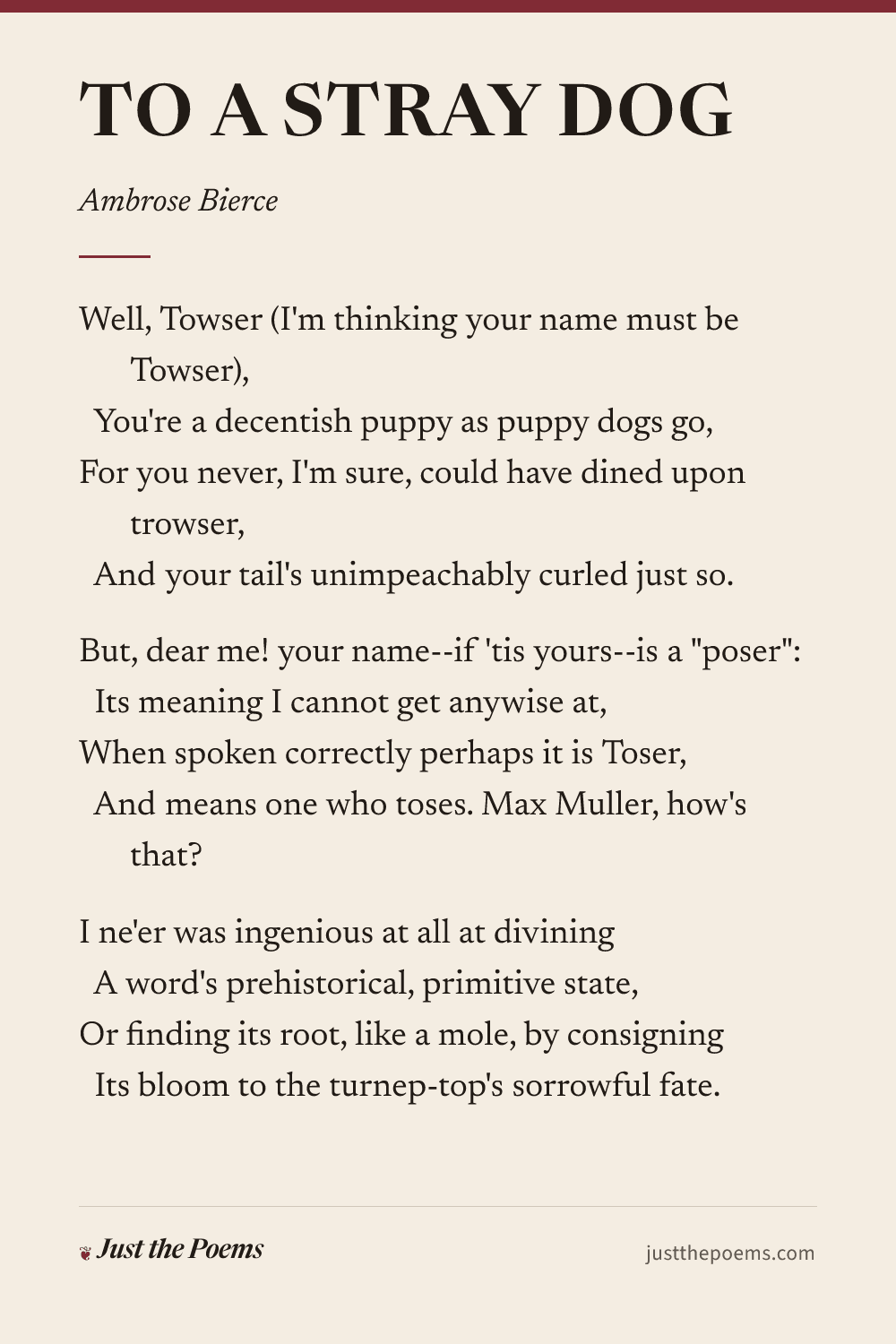
TO A STRAY DOG

Ambrose Bierce

In 0 Wikipedias 0 anthologies Poet in 59 Wikipedias

A speaker puzzles over what the name Towser means, gives up, renames the stray after a public man and ends with a joking threat. It appeared in Black Beetles in Amber in 1892. For someone trying to choose a name for a dog.

Well, Towser (I'm thinking your name must be Towser), You're a decentish puppy as puppy dogs go,For you never, I'm sure, could have dined upon trowser, And your tail's unimpeachably curled just so.

But, dear me! your name--if 'tis yours--is a "poser": Its meaning I cannot get anywise at,When spoken correctly perhaps it is Toser, And means one who toses. Max Muller, how's that?

I ne'er was ingenious at all at divining A word's prehistorical, primitive state,Or finding its root, like a mole, by consigning Its bloom to the turnep-top's sorrowful fate.

And, now that I think of it well, I'm no nearer The riddle's solution than ever--for how'sMy pretty invented word, "tose," any clearer In point of its signification than "towse"?

So, Towser (or Toser), I mean to rename you In honor of some good and eminent man,In the light and the heat of whose quickening fame you May grow to an eminent dog if you can.

In sunshine like his you'll not long be a croucher: The Senate shall hear you--for that I will vouch.Come here, sir. Stand up. I rechristen you Goucher. But damn you! I'll shoot you if ever you gouch!

Source

Black Beetles in Amber, 1892

Filed under
  • Named in the title

On Just the Saints: Hubertus, Patron Saint of Dogs

8 poems about dogs

7 poets

By poet's century of death

CenturyPoems
18th3
20th5

Poets with more than one poem

PoetPoems
Ambrose Bierce2