Poems About Gardens

The 26 poems about gardens, by 22 poets, ranked by third-party data. How poems are ranked

IN THE GARDEN.

Emily Dickinson

In 2 Wikipedias 0 anthologies Poet in 101 Wikipedias

A bird came down the walk:He did not know I saw;He bit an angle-worm in halvesAnd ate the fellow, raw.

And then he drank a dewFrom a convenient grass,And then hopped sidewise to the wallTo let a beetle pass.

He glanced with rapid eyesThat hurried all abroad, --They looked like frightened beads, I thought;He stirred his velvet head

Like one in danger; cautious,I offered him a crumb,And he unrolled his feathersAnd rowed him softer home

Than oars divide the ocean,Too silver for a seam,Or butterflies, off banks of noon,Leap, splashless, as they swim.

Source

Poems by Emily Dickinson, Series Two

Filed under
  • Named in the title

A FORSAKEN GARDEN

Algernon Charles Swinburne

In 1 Wikipedia 1 anthology Poet in 42 Wikipedias

In a coign of the cliff between lowland and highland,At the sea-down's edge between windward and lee,Walled round with rocks as an inland island,The ghost of a garden fronts the sea.A girdle of brushwood and thorn enclosesThe steep square slope of the blossomless bedWhere the weeds that grew green from the graves of its rosesNow lie dead.

The fields fall southward, abrupt and broken,To the low last edge of the long lone land.If a step should sound or a word be spoken,Would a ghost not rise at the strange guest's hand?

Show all 80 lines 68 more

So long have the gray, bare walks lain guestless,Through branches and briers if a man make way,He shall find no life but the sea-wind's, restlessNight and day.

The dense, hard passage is blind and stifledThat crawls by a track none turn to climbTo the strait waste place that the years have rifledOf all but the thorns that are touched not of Time.The thorns he spares when the rose is taken;The rocks are left when he wastes the plain.The wind that wanders, the weeds wind-shaken,These remain.

Not a flower to be pressed of the foot that falls not;As the heart of a dead man the seed-plots are dry;From the thicket of thorns whence the nightingale calls not,Could she call, there were never a rose to reply.Over the meadows that blossom and witherRings but the note of a sea-bird's song;Only the sun and the rain come hitherAll year long.

The sun burns sere and the rain dishevelsOne gaunt bleak blossom of scentless breath.Only the wind here hovers and revelsIn a round where life seems barren as death.Here there was laughing of old, there was weeping,Haply, of lovers none ever will know,Whose eyes went seaward a hundred sleepingYears ago.

Heart handfast in heart as they stood, "Look thither,"Did he, whisper? "Look forth from the flowers to the sea;For the foam-flowers endure when the rose-blossoms wither,And men that love lightly may die--but we?"And the same wind sang and the same waves whitened,And or ever the garden's last petals were shed,In the lips that had whispered, the eyes that had lightened,Love was dead.

Or they loved their life through, and then went whither?And were one to the end--but what end who knows?Love deep as the sea as a rose must wither,As the rose-red seaweed that mocks the rose.Shall the dead take thought for the dead to love them?What love was ever as deep as a grave?They are loveless now as the grass above themOr the wave.

All are at one now, roses and lovers,Not known of the cliffs and the fields and the sea.Not a breath of the time that has been hoversIn the air now soft with a summer to be.Not a breath shall there sweeten the seasons hereafterOf the flowers or the lovers that laugh now or weep,When, as they that are free now of weeping and laughter,We shall sleep.

Here death may deal not again forever;Here change may come not till all change end.From the graves they have made they shall rise up never,Who have left naught living to ravage and rend.Earth, stones, and thorns of the wild ground growing,While the sun and the rain live, these shall be;Till a last wind's breath, upon all these blowing,Roll the sea.

Till the slow sea rise and the sheer cliff crumble,Till terrace and meadow the deep gulfs drink,Till the strength of the waves of the high tides humbleThe fields that lessen, the rocks that shrink;Here now in his triumph where all things falter,Stretched out on the spoils that his own hand spread,As a god self-slain on his own strange altar,Death lies dead.

Source

The Home Book of Verse, ed. Burton Egbert Stevenson

Filed under
  • Named in the title

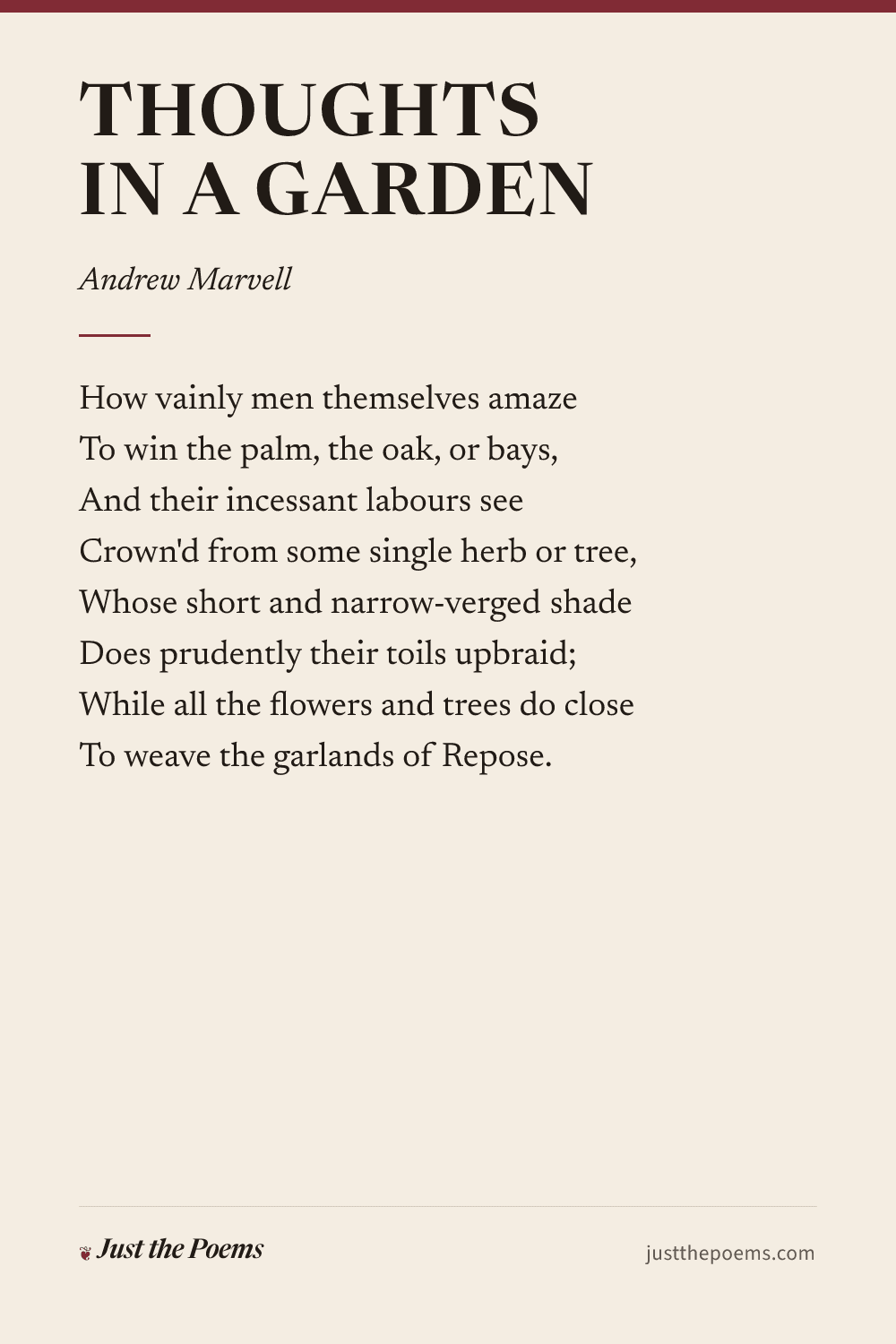
THOUGHTS IN A GARDEN

Andrew Marvell

In 0 Wikipedias 3 anthologies Poet in 38 Wikipedias

How vainly men themselves amazeTo win the palm, the oak, or bays,And their incessant labours seeCrown'd from some single herb or tree,Whose short and narrow-verged shadeDoes prudently their toils upbraid;While all the flowers and trees do closeTo weave the garlands of Repose.

Fair Quiet, have I found thee here,And Innocence thy sister dear?Mistaken long, I sought you thenIn busy companies of men:

Show all 72 lines 60 more

Your sacred plants, if here below,Only among the plants will grow:Society is all but rudeTo this delicious solitude.

No white nor red was ever seenSo amorous as this lovely green.Fond lovers, cruel as their flame,Cut in these trees their mistress' name:Little, alas! they know or heedHow far these beauties hers exceed!Fair trees! where'er your barks I wound,No name shall but your own be found.

When we have run our passions' heat,Love hither makes his best retreat:The gods, who mortal beauty chase,Still in a tree did end their race:Apollo hunted Daphne soOnly that she might laurel grow;And Pan did after Syrinx speedNot as a nymph, but for a reed.

What wondrous life in this I lead!Ripe apples drop about my head;The luscious clusters of the vineUpon my mouth do crush their wine;The nectarine and curious peachInto my hands themselves do reach;Stumbling on melons, as I pass,Ensnared with flowers, I fall on grass.

Meanwhile the mind from pleasure lessWithdraws into its happiness;The mind, that ocean where each kindDoes straight its own resemblance find;Yet it creates, transcending these,Far other worlds, and other seas;Annihilating all that's madeTo a green thought in a green shade.

Here at the fountain's sliding footOr at some fruit-tree's mossy root,Casting the body's vest asideMy soul into the boughs does glide;There, like a bird, it sits and sings,Then whets and claps its silver wings,And, till prepared for longer flight,Waves in its plumes the various light.

Such was that happy Garden-stateWhile man there walk'd without a mate:After a place so pure and sweet,What other help could yet be meet!But 'twas beyond a mortal's shareTo wander solitary there:Two paradises are in one,To live in Paradise alone.

How well the skilful gardener drewOf flowers and herbs this dial new!Where, from above, the milder sunDoes through a fragrant zodiac run:And, as it works, th' industrious beeComputes its time as well as we.How could such sweet and wholesome hoursBe reckon'd, but with herbs and flowers!

Source

The Golden Treasury, ed. Francis Turner Palgrave

Filed under
  • Named in the title

Advertisements

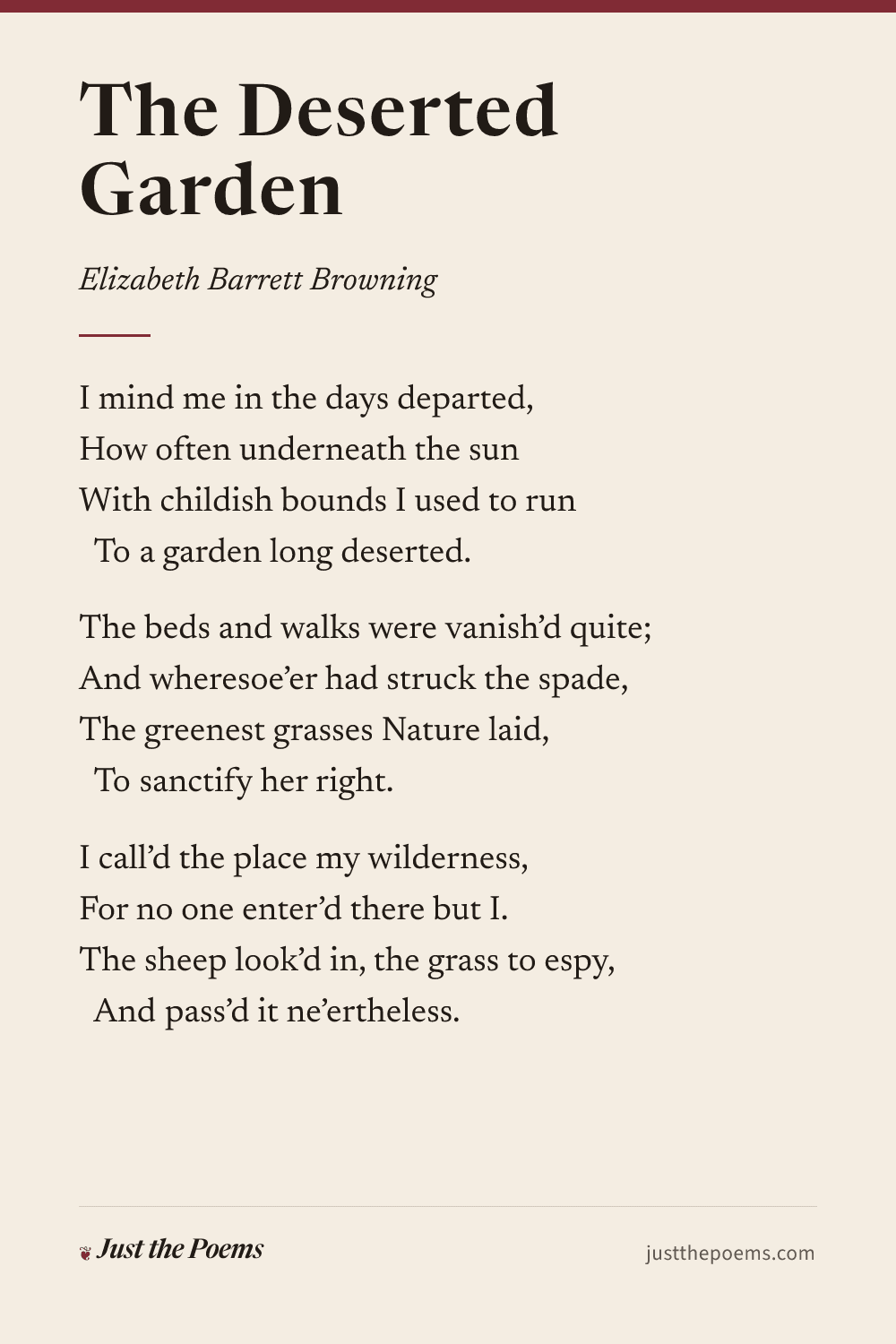
The Deserted Garden

Elizabeth Barrett Browning

In 0 Wikipedias 2 anthologies Poet in 60 Wikipedias

I mind me in the days departed,How often underneath the sunWith childish bounds I used to run To a garden long deserted.

The beds and walks were vanish’d quite;And wheresoe’er had struck the spade,The greenest grasses Nature laid, To sanctify her right.

I call’d the place my wilderness,For no one enter’d there but I.The sheep look’d in, the grass to espy, And pass’d it ne’ertheless.

Show all 112 lines 100 more

The trees were interwoven wild,And spread their boughs enough aboutTo keep both sheep and shepherd out, But not a happy child.

Adventurous joy it was for me;I crept beneath the boughs, and foundA circle smooth of mossy ground Beneath a poplar-tree.

Old garden rose-trees hedged it in;Bedropt with roses waxen-white,Well satisfied with dew and light, And careless to be seen.

Long years ago, it might befall,When all the garden flowers were trim,The grave old gardener prided him On these the most of all.

Some Lady, stately overmuch,Here moving with a silken noise,Has blush’d beside them at the voice That liken’d her to such.

Or these, to make a diadem,She often may have pluck’d and twined;Half-smiling as it came to mind, That few would look at them.

O, little thought that Lady proud,A child would watch her fair white rose,When buried lay her whiter brows, And silk was changed for shroud!--

Nor thought that gardener (full of scornsFor men unlearn’d and simple phrase)A child would bring it all its praise, By creeping through the thorns!

To me upon my low moss seat,Though never a dream the roses sentOf science or love’s compliment, I ween they smelt as sweet.

It did not move my grief to seeThe trace of human step departed:Because the garden was deserted, The blither place for me!

Friends, blame me not! a narrow kenHath childhood ’twixt the sun and sward;We draw the moral afterward-- We feel the gladness then.

And gladdest hours for me did glideIn silence at the rose-tree wall:A thrush made gladness musical Upon the other side.

Nor he nor I did e’er inclineTo peck or pluck the blossoms white:--How should I know but that they might Lead lives as glad as mine?

To make my hermit-home complete,I brought clear water from the springPraised in its own low murmuring, And cresses glossy wet.

And so, I thought, my likeness grew(Without the melancholy tale)To ‘gentle hermit of the dale,’ And Angelina too.

For oft I read within my nookSuch minstrel stories; till the breezeMade sounds poetic in the trees, And then I shut the book.

If I shut this wherein I write,I hear no more the wind athwartThose trees, nor feel that childish heart Delighting in delight.

My childhood from my life is parted,My footstep from the moss which drewIts fairy circle round: anew The garden is deserted.

Another thrush may there rehearseThe madrigals which sweetest are;No more for me!--myself afar Do sing a sadder verse.

Ah me! ah me! when erst I layIn that child’s-nest so greenly wrought,I laugh’d unto myself and thought, ‘The time will pass away.’

And still I laugh’d, and did not fearBut that, whene’er was pass’d awayThe childish time, some happier play My womanhood would cheer.

I knew the time would pass away;And yet, beside the rose-tree wall,Dear God, how seldom, if at all, Did I look up to pray!

The time is past: and now that growsThe cypress high among the trees,And I behold white sepulchres As well as the white rose,--

When wiser, meeker thoughts are given,And I have learnt to lift my face,Reminded how earth’s greenest place The colour draws from heaven,--

It something saith for earthly pain,But more for heavenly promise free,That I who was, would shrink to be That happy child again.
Source

The Oxford Book of English Verse 1250–1900, 1900

Filed under
  • Named in the title

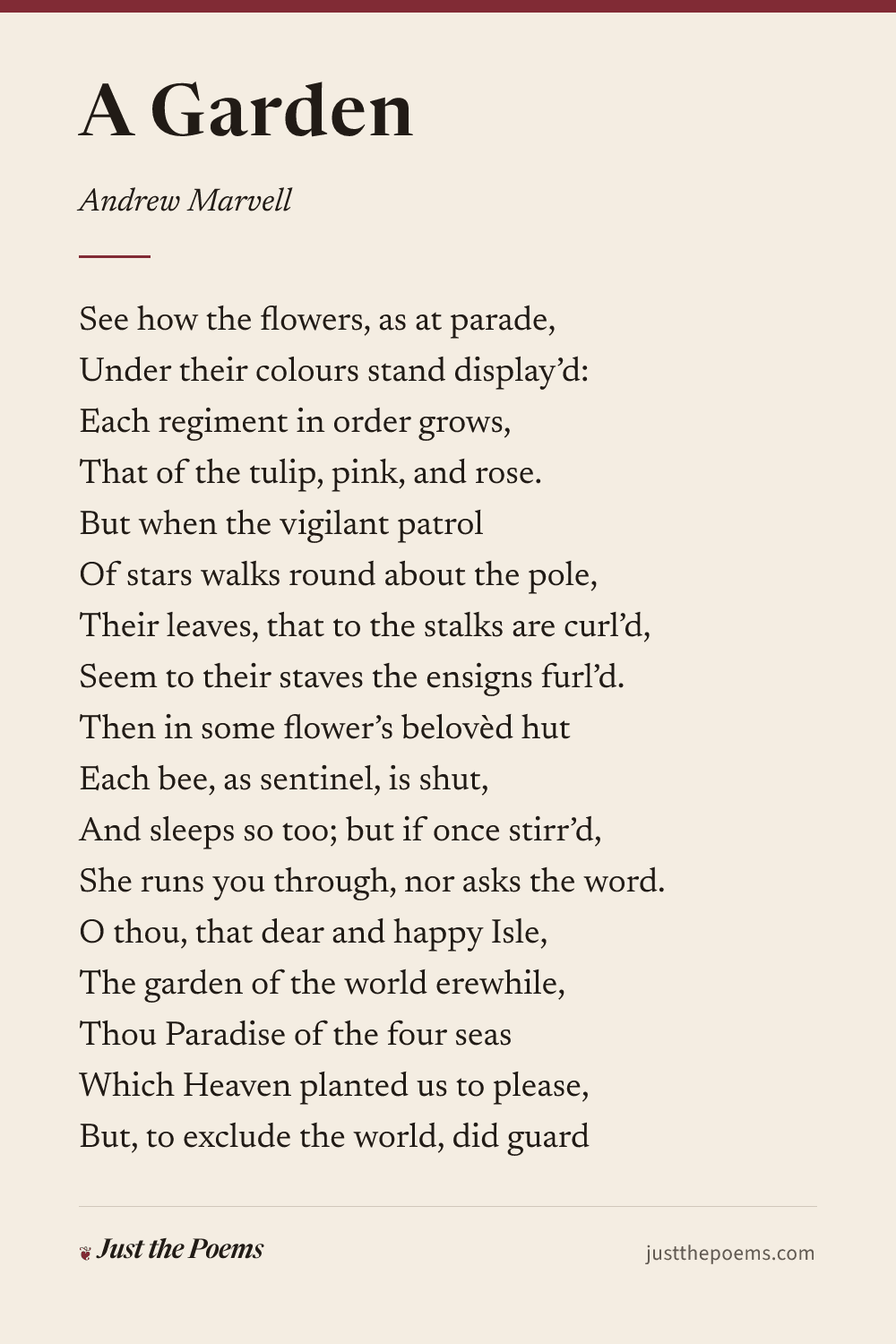
A Garden

Andrew Marvell

In 0 Wikipedias 2 anthologies Poet in 38 Wikipedias

See how the flowers, as at parade,Under their colours stand display’d:Each regiment in order grows,That of the tulip, pink, and rose.But when the vigilant patrolOf stars walks round about the pole,Their leaves, that to the stalks are curl’d,Seem to their staves the ensigns furl’d.Then in some flower’s belovèd hutEach bee, as sentinel, is shut,And sleeps so too; but if once stirr’d,She runs you through, nor asks the word.

Show all 26 lines 14 more

O thou, that dear and happy Isle,The garden of the world erewhile,Thou Paradise of the four seasWhich Heaven planted us to please,But, to exclude the world, did guardWith wat’ry if not flaming sword;What luckless apple did we tasteTo make us mortal and thee waste!Unhappy! shall we never moreThat sweet militia restore,When gardens only had their towers,And all the garrisons were flowers;When roses only arms might bear,And men did rosy garlands wear?

Source

The Oxford Book of English Verse 1250–1900, 1900

Filed under
  • Named in the title

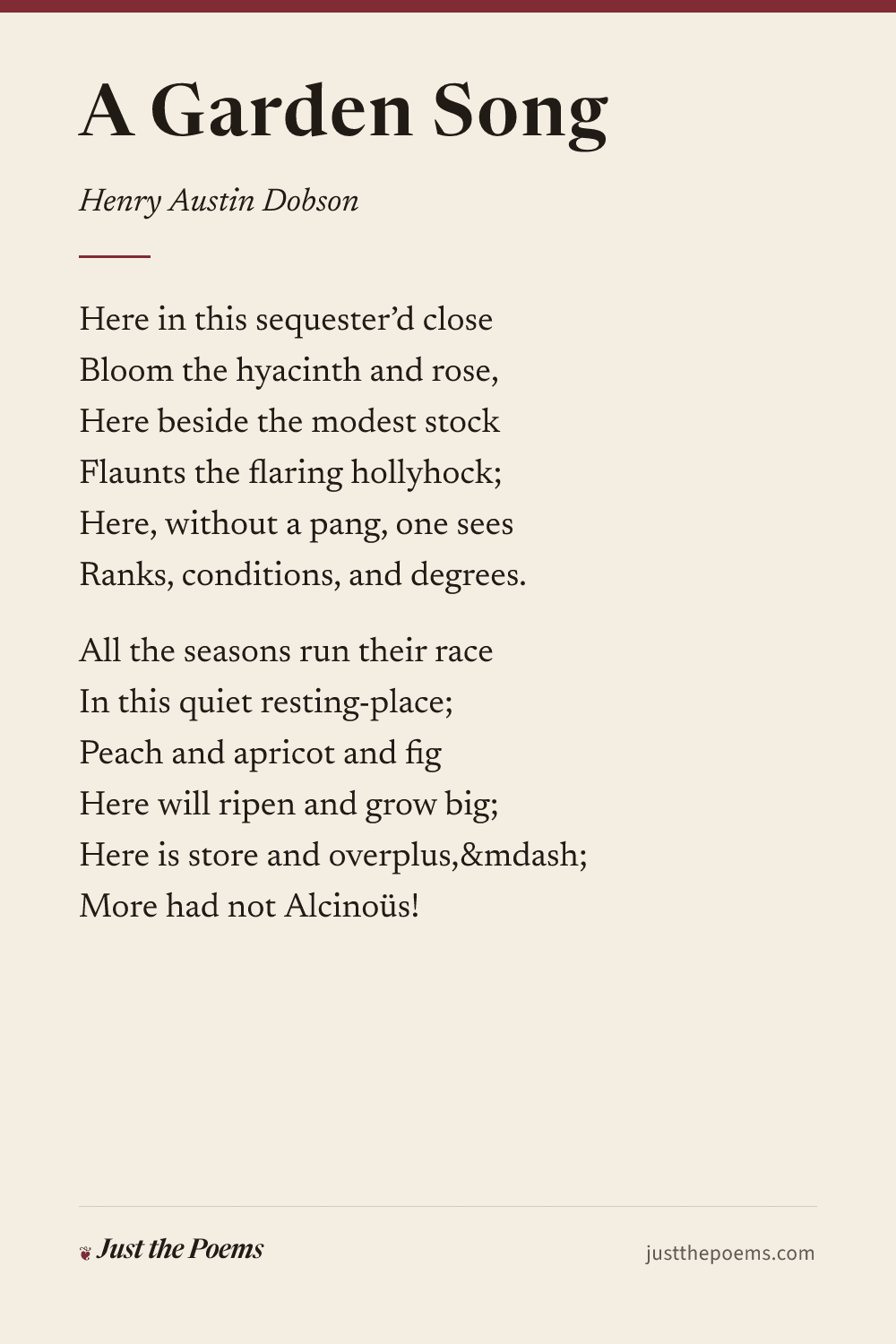
A Garden Song

Henry Austin Dobson

In 0 Wikipedias 2 anthologies Poet in 7 Wikipedias

Here in this sequester’d closeBloom the hyacinth and rose,Here beside the modest stockFlaunts the flaring hollyhock;Here, without a pang, one seesRanks, conditions, and degrees.

All the seasons run their raceIn this quiet resting-place;Peach and apricot and figHere will ripen and grow big;Here is store and overplus,—More had not Alcinoüs!

Here, in alleys cool and green,Far ahead the thrush is seen;Here along the southern wallKeeps the bee his festival;All is quiet else—afarSounds of toil and turmoil are.

Here be shadows large and long;Here be spaces meet for song;Grant, O garden-god, that I,Now that none profane is nigh,—Now that mood and moment please,—Find the fair Pierides!

Source

The Oxford Book of English Verse 1250–1900, 1900

Filed under
  • Named in the title

"DOWN BY THE SALLEY GARDENS"

William Butler Yeats

In 0 Wikipedias 1 anthology Poet in 113 Wikipedias

Down by the salley gardens my love and I did meet;She passed the salley gardens with little snow-white feet.She bid me take love easy, as the leaves grow on the tree;But I, being young and foolish, with her would not agree.In a field by the river my love and I did stand,And on my leaning shoulder she laid her snow-white hand.She bid me take life easy, as the grass grows on the weirs;But I was young and foolish, and now am full of tears.

Source

The Home Book of Verse, ed. Burton Egbert Stevenson

Filed under
  • Named in the title

THE CITY MOUSE AND THE GARDEN MOUSE

Christina Georgina Rossetti

In 0 Wikipedias 1 anthology Poet in 48 Wikipedias

The city mouse lives in a house;--The garden mouse lives in a bower,He's friendly with the frogs and toads,And sees the pretty plants in flower.

The city mouse eats bread and cheese;--The garden mouse eats what he can;We will not grudge him seeds and stocks,Poor little timid furry man.

Source

The Home Book of Verse, ed. Burton Egbert Stevenson

Filed under
  • Named in the title

Advertisements

THE GARDEN OF SHADOW

Ernest Dowson

In 0 Wikipedias 1 anthology Poet in 19 Wikipedias

Love heeds no more the sighing of the windAgainst the perfect flowers: thy garden's closeIs grown a wilderness, where none shall findOne strayed, last petal of one last year's rose.

O bright, bright hair! O mouth like a ripe fruit!Can famine be so nigh to harvesting?Love, that was songful, with a broken luteIn grass of graveyards goeth murmuring.

Let the wind blow against the perfect flowers,And all thy garden change and glow with spring:Love is grown blind with no more count of hoursNor part in seed-time nor in harvesting.

Source

The Home Book of Verse, ed. Burton Egbert Stevenson

Filed under
  • Named in the title

THE CHILD IN THE GARDEN

Henry Van Dyke

In 0 Wikipedias 1 anthology Poet in 18 Wikipedias

When to the garden of untroubled thoughtI came of late, and saw the open door,And wished again to enter, and exploreThe sweet, wild ways with stainless bloom inwrought,And bowers of innocence with beauty fraught,It seemed some purer voice must speak beforeI dared to tread that garden loved of yore,That Eden lost unknown and found unsought.Then just within the gate I saw a child,--A stranger-child, yet to my heart most dear,--Who held his hands to me and softly smiledWith eyes that knew no shade of sin or fear;"Come in," he said, "and play awhile with me;I am the little child you used to be."

Source

The Home Book of Verse, ed. Burton Egbert Stevenson

Filed under
  • Named in the title

THE GARDEN YEAR

Sara Coleridge

In 0 Wikipedias 1 anthology Poet in 18 Wikipedias

January brings the snow,Makes our feet and fingers glow.

February brings the rain,Thaws the frozen lake again.

March brings breezes, loud and shrill,To stir the dancing daffodil.

April brings the primrose sweet,Scatters daisies at our feet.

May brings flocks of pretty lambsSkipping by their fleecy dams.

June brings tulips, lilies, roses,Fills the children's hands with posies.

Hot July brings cooling showers,Apricots, and gillyflowers.

August brings the sheaves of corn,Then the harvest home is borne.

Warm September brings the fruit;Sportsmen then begin to shoot.

Fresh October brings the pheasant;Then to gather nuts is pleasant.

Dull November brings the blast;Then the leaves are whirling fast.

Chill December brings the sleet,Blazing fire, and Christmas treat.

Source

The Home Book of Verse, ed. Burton Egbert Stevenson

Filed under
  • Named in the title

"MY HEART SHALL BE THY GARDEN"

Alice Meynell

In 0 Wikipedias 1 anthology Poet in 12 Wikipedias

My heart shall be thy garden. Come, my own,Into thy garden; thine be happy hoursAmong my fairest thoughts, my tallest flowers,From root to crowning petal, thine alone.Thine is the place from where the seeds are sownUp to the sky inclosed, with all its showers.But ah, the birds, the birds! Who shall build bowersTo keep these thine? O friend, the birds have flown.

For as these come and go, and quit our pineTo follow the sweet season, or, new-corners,Sing one song only from our alder-trees,My heart has thoughts, which, though thine eyes hold mine.Flit to the silent world and other summers,With wings that dip beyond the silver seas.

Source

The Home Book of Verse, ed. Burton Egbert Stevenson

Filed under
  • Named in the title

AN AUTUMN GARDEN

Bliss Carman

In 0 Wikipedias 1 anthology Poet in 8 Wikipedias

My tent stands in a gardenOf aster and golden-rod,Tilled by the rain and the sunshine,And sown by the hand of God,--An old New England pastureAbandoned to peace and time,And by the magic of beautyReclaimed to the sublime.

About it are golden woodlandsOf tulip and hickory;On the open ridge behind itYou may mount to a glimpse of sea,--

Show all 96 lines 84 more

The far-off, blue, HomericRim of the world's great shield,A border of boundless glamorFor the soul's familiar field.

In purple and gray-wrought lichenThe boulders lie in the sun;Along its grassy footpath,The white-tailed rabbits run.The crickets work and chirrupThrough the still afternoon;And the owl calls at twilightUnder the frosty moon.

The odorous wild grape clambersOver the tumbling wall,And through the autumnal quietThe chestnuts open and fall.Sharing time's freshness and fragrance,Part of the earth's great soul,Here man's spirit may ripenTo wisdom serene and whole.

Shall we not grow with the asters?--Never reluctant nor sad,Not counting the cost of being,Living to dare and be glad.Shall we not lift with the cricketsA chorus of ready cheer,Braving the frost of oblivion,Quick to be happy here?

The deep red cones of the sumachAnd the woodbine's crimson spraysHave bannered the common roadsideFor the pageant of passing days.These are the oracles NatureFills with her holy breath,Giving them glory of color,Transcending the shadow of death.

Here in the sifted sunlightA spirit seems to broodOn the beauty and worth of being,In tranquil, instinctive mood;And the heart, athrob with gladnessSuch as the wise earth knows,Wells with a full thanksgivingFor the gifts that life bestows:

For the ancient and virile nurtureOf the teeming primordial ground,For the splendid gospel of color,The rapt revelations of sound;For the morning-blue above usAnd the rusted gold of the fern,For the chickadee's call to valorBidding the faint-heart turn;

For fire and running water,Snowfall and summer rain;For sunsets and quiet meadows,The fruit and the standing grain;For the solemn hour of moonriseOver the crest of trees,When the mellow lights are kindledIn the lamps of the centuries.

For those who wrought aforetime,Led by the mystic strainTo strive for the larger freedom,And live for the greater gain;For plenty and peace and playtime,The homely goods of earth,And for rare immaterial treasuresAccounted of little worth;

For art and learning and friendship,Where beneficent truth is supreme,Those everlasting citiesBuilt on the hills of dream;For all things growing and goodlyThat foster this life, and breedThe immortal flower of wisdomOut of the mortal seed.

But most of all for the spiritThat can not rest nor bideIn stale and sterile convenience,Nor safety proven and tried,But still inspired and driven,Must seek what better may be,And up from the loveliest gardenMust climb for a glimpse of sea.

Source

The Home Book of Verse, ed. Burton Egbert Stevenson

Filed under
  • Named in the title

Advertisements

IN THE GARDEN

Ernest Crosby

In 0 Wikipedias 1 anthology Poet in 5 Wikipedias

I spied beside the garden bedA tiny lass of ours,Who stopped and bent her sunny headAbove the red June flowers.

Pushing the leaves and thorns apart,She singled out a rose,And in its inmost crimson heart,Enraptured, plunged her nose.

"O dear, dear rose, come, tell me true--Come, tell me true," said she,"If I smell just as sweet to youAs you smell sweet to me!"

Source

The Home Book of Verse, ed. Burton Egbert Stevenson

Filed under
  • Named in the title

A GARDEN LYRIC

Frederick Locker Lampson

In 0 Wikipedias 1 anthology Poet in 2 Wikipedias

Dite, Damasippe, deaequeVerum ob consilium donent tonsore.

We have loitered and laughed in the flowery croft,We have met under wintry skies;Her voice is the dearest voice, and softIs the light in her wistful eyes;It is bliss in the silent woods, amongGay crowds, or in any place,To mould her mind, to gaze in her youngConfiding face.

For ever may roses divinely blow,And wine-dark pansies charm

Show all 42 lines 30 more

By that prim box path where I felt the glowOf her dimpled, trusting arm,And the sweep of her silk as she turned and smiledA smile as pure as her pearls;The breeze was in love with the darling Child,And coaxed her curls.

She showed me her ferns and woodbine sprays,Foxglove and jasmine stars,A mist of blue in the beds, a blazeOf red in the celadon jars:And velvety bees in convolvulus bells,And roses of bountiful Spring.But I said--"Though roses and bees have spells,They have thorn, and sting."

She showed me ripe peaches behind a netAs fine as her veil, and fatGoldfish a-gape, who lazily metFor her crumbs--I grudged them that!A squirrel, some rabbits with long lop ears,And guinea-pigs, tortoise-shell--wee;And I told her that eloquent truth inheresIn all we see.

I lifted her doe by its lops, quoth I,"Even here deep meaning lies,--Why have squirrels these ample tails, and whyHave rabbits these prominent eyes?"She smiled and said, as she twirled her veil,"For some nice little cause, no doubt--If you lift a guinea-pig up by the tailHis eyes drop out!"

Source

The Home Book of Verse, ed. Burton Egbert Stevenson

Filed under
  • Named in the title

"IN GREEN OLD GARDENS"

Violet Fane

In 0 Wikipedias 1 anthology Poet in 2 Wikipedias

In green old gardens, hidden awayFrom sight of revel and sound of strife,Where the bird may sing out his soul ere he die,Nor fears for the night, so he lives his day;Where the high red walls, which are growing grayWith their lichen and moss embroideries,Seem sadly and sternly to shut out life,Because it is often as red as they;

Where even the bee has time to glide(Gathering gayly his honey's store)Right to the heart of the old-world flowers--China-asters and purple stocks,

Show all 40 lines 28 more

Dahlias and tall red hollyhocks,Laburnums raining their golden showers,Columbines prim of the folded core,And lupins, and larkspurs, and "London pride";

Where the heron is waiting amongst the reeds,Grown tame in the silence that reigns around,Broken only, now and then,By shy woodpecker or noisy jay,By the far-off watch-dog's muffled bay;But where never the purposeless laughter of men,Or the seething city's murmurous soundWill float up over the river-weeds.

Here may I live what life I please,Married and buried out of sight,--Married to pleasure, and buried to pain,--Hidden away amongst scenes like these,Under the fans of the chestnut trees;Living my child-life over again,With the further hope of a fallen delight,Blithe as the birds and wise as the bees.

In green old gardens, hidden awayFrom sight of revel and sound of strife,--Here have I leisure to breathe and move,And to do my work in a nobler way;To sing my songs, and to say my say;To dream my dreams, and to love my love;To hold my faith, and to live my life,Making the most of its shadowy day.

Source

The Home Book of Verse, ed. Burton Egbert Stevenson

Filed under
  • Named in the title

OLD GARDENS

Arthur Upson

In 0 Wikipedias 1 anthology Poet in 2 Wikipedias

The white rose tree that spent its muskFor lovers' sweeter praise,The stately walks we sought at dusk,Have missed thee many days.

Again, with once-familiar feet,I tread the old parterre -But, ah, its bloom is now less sweetThan when thy face was there.

I hear the birds of evening call;I take the wild perfume;I pluck a rose - to let it fallAnd perish in the gloom.

Source

The Home Book of Verse, ed. Burton Egbert Stevenson

Filed under
  • Named in the title

MY GARDEN

Thomas Edward Brown

In 0 Wikipedias 1 anthology Poet in 1 Wikipedia

A garden is a lovesome thing, God wot!Rose plot,Fringed pool,Ferned grot--The veriest schoolOf peace; and yet the foolContends that God is not--Not God! in gardens! when the eve is cool?Nay, but I have a sign:'Tis very sure God walks in mine.

Source

The Home Book of Verse, ed. Burton Egbert Stevenson

Filed under
  • Named in the title

ABOUT THE SHELTERED GARDEN GROUND

Robert Louis Stevenson

In 0 Wikipedias 0 anthologies Poet in 101 Wikipedias

ABOUT the sheltered garden ground The trees stand strangely still.The vale ne’er seemed so deep before, Nor yet so high the hill.

An awful sense of quietness, A fulness of repose,Breathes from the dewy garden-lawns, The silent garden rows.

As the hoof-beats of a troop of horse Heard far across a plain,A nearer knowledge of great thoughts Thrills vaguely through my brain.

I lean my head upon my arm, My heart’s too full to think;Like the roar of seas, upon my heart Doth the morning stillness sink.

Source

New Poems, and Variant Readings, 1918

Filed under
  • Named in the title

ENVOY FOR “A CHILD’S GARDEN OF VERSES”

Robert Louis Stevenson

In 0 Wikipedias 0 anthologies Poet in 101 Wikipedias

WHETHER upon the garden seatYou lounge with your uplifted feetUnder the May’s whole Heaven of blue;Or whether on the sofa you,No grown up person being by,Do some soft corner occupy;Take you this volume in your handsAnd enter into other lands,For lo! (as children feign) supposeYou, hunting in the garden rows,Or in the lumbered attic, orThe cellar—a nail-studded door

Show all 44 lines 32 more

And dark, descending stairway foundThat led to kingdoms underground:There standing, you should hear with easeStrange birds a-singing, or the treesSwing in big robber woods, or bellsOn many fairy citadels:

There passing through (a step or so—Neither mamma nor nurse need know!)From your nice nurseries you would pass,Like Alice through the Looking-GlassOr Gerda following Little Ray,To wondrous countries far away.Well, and just so this volume canTransport each little maid or manPresto from where they live awayWhere other children used to play.As from the house your mother seesYou playing round the garden trees,So you may see if you but lookThrough the windows of this bookAnother child far, far awayAnd in another garden play.But do not think you can at all,By knocking on the window, callThat child to hear you. He intentIs still on his play-business bent.He does not hear, he will not look,Nor yet be lured out of this book.For long ago, the truth to say,He has grown up and gone away;And it is but a child of airThat lingers in the garden there.

Source

New Poems, and Variant Readings, 1918

Filed under
  • Named in the title

FOR RICHMOND’S GARDEN WALL

Robert Louis Stevenson

In 0 Wikipedias 0 anthologies Poet in 101 Wikipedias

WHEN Thomas set this tablet here,Time laughed at the vain chanticleer;And ere the moss had dimmed the stone,Time had defaced that garrison.Now I in turn keep watch and wardIn my red house, in my walled yardOf sunflowers, sitting here at easeWith friends and my bright canvases.But hark, and you may hear quite plainTime’s chuckled laughter in the lane.

Source

New Poems, and Variant Readings, 1918

Filed under
  • Named in the title

THE GARDEN PLOT

Jonathan Swift

In 0 Wikipedias 0 anthologies Poet in 101 Wikipedias

When Naboth's vineyard look'd so fine,The king cried out, "Would this were mine!"And yet no reason could prevailTo bring the owner to a sale.Jezebel saw, with haughty pride,How Ahab grieved to be denied;And thus accosted him with scorn:"Shall Naboth make a monarch mourn?A king, and weep! The ground's your own;I'll vest the garden in the crown."With that she hatch'd a plot, and madePoor Naboth answer with his head;And when his harmless blood was spilt,The ground became his forfeit guilt.

Source

The Poems of Jonathan Swift, D.D., Volume 2, 1910

Filed under
  • Named in the title

MY GARDEN

Ralph Waldo Emerson

In 0 Wikipedias 0 anthologies Poet in 92 Wikipedias

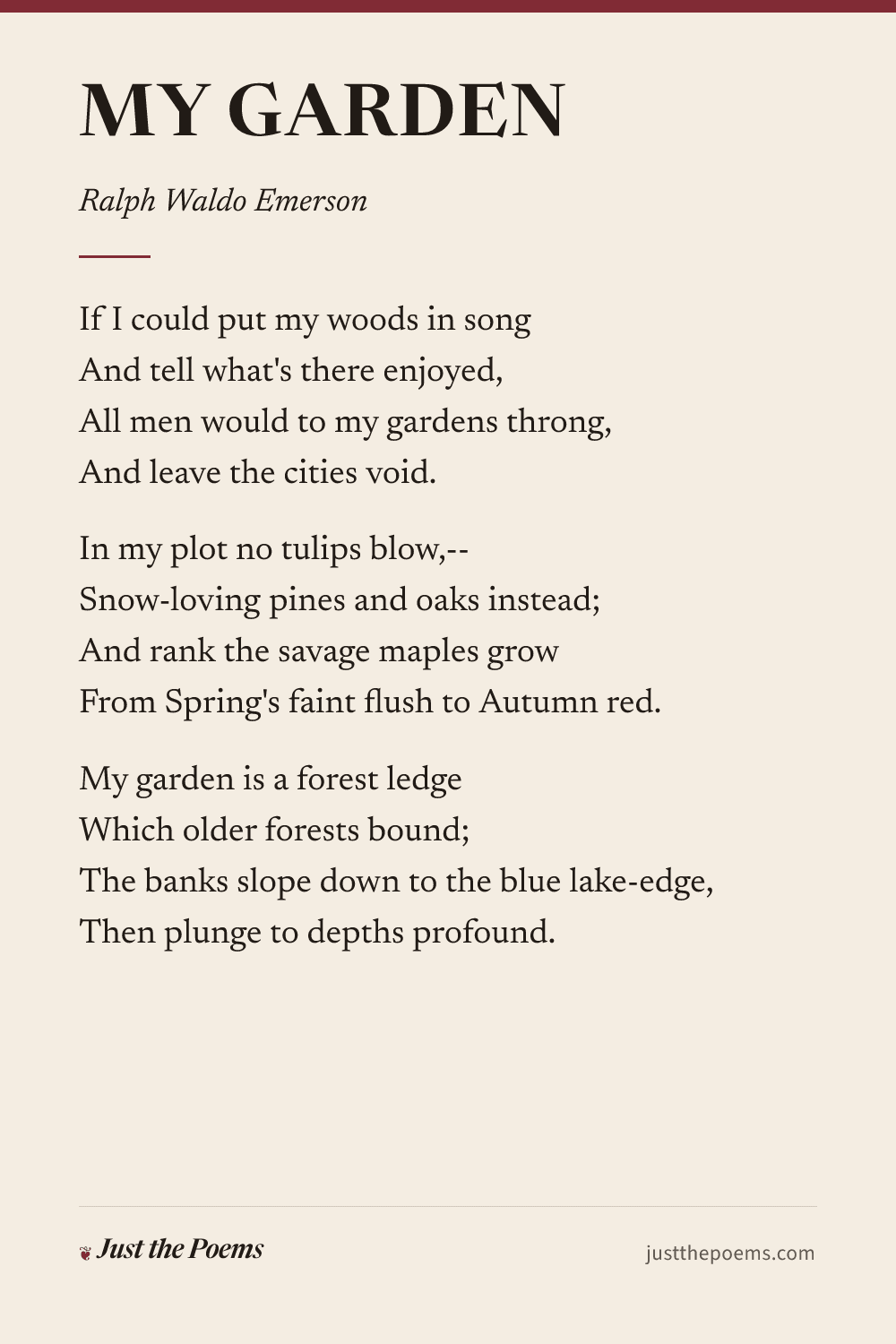
If I could put my woods in songAnd tell what's there enjoyed,All men would to my gardens throng,And leave the cities void.

In my plot no tulips blow,--Snow-loving pines and oaks instead;And rank the savage maples growFrom Spring's faint flush to Autumn red.

My garden is a forest ledgeWhich older forests bound;The banks slope down to the blue lake-edge,Then plunge to depths profound.

Show all 64 lines 52 more

Here once the Deluge ploughed,Laid the terraces, one by one;Ebbing later whence it flowed,They bleach and dry in the sun.

The sowers made haste to depart,--The wind and the birds which sowed it;Not for fame, nor by rules of art,Planted these, and tempests flowed it.

Waters that wash my garden-sidePlay not in Nature's lawful web,They heed not moon or solar tide,--Five years elapse from flood to ebb.

Hither hasted, in old time, Jove,And every god,--none did refuse;And be sure at last came Love,And after Love, the Muse.

Keen ears can catch a syllable,As if one spake to another,In the hemlocks tall, untamable,And what the whispering grasses smother.

Aeolian harps in the pineRing with the song of the Fates;Infant Bacchus in the vine,--Far distant yet his chorus waits.

Canst thou copy in verse one chimeOf the wood-bell's peal and cry,Write in a book the morning's prime,Or match with words that tender sky?

Wonderful verse of the gods,Of one import, of varied tone;They chant the bliss of their abodesTo man imprisoned in his own.

Ever the words of the gods resound;But the porches of man's earSeldom in this low life's roundAre unsealed that he may hear.

Wandering voices in the airAnd murmurs in the woldSpeak what I cannot declare,Yet cannot all withhold.

When the shadow fell on the lake,The whirlwind in ripples wroteAir-bells of fortune that shine and break,And omens above thought.

But the meanings cleave to the lake,Cannot be carried in book or urn;Go thy ways now, come later back,On waves and hedges still they burn.

These the fates of men forecast,Of better men than live to-day;If who can read them comes at lastHe will spell in the sculpture, 'Stay.'

Source

Poems Household Edition

Filed under
  • Named in the title

IN THE GARDEN (M. H.)

Thomas Hardy

In 0 Wikipedias 0 anthologies Poet in 91 Wikipedias

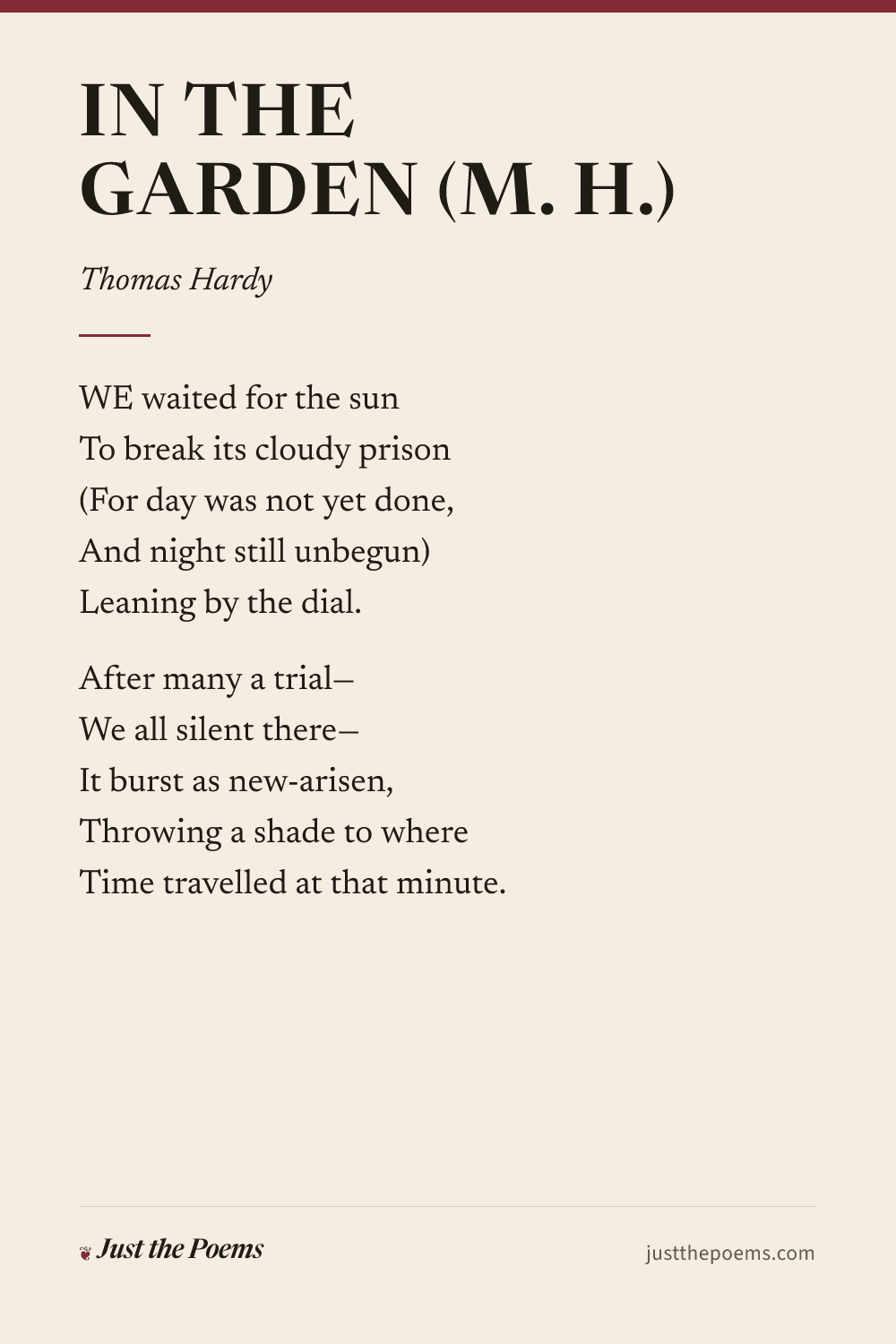
WE waited for the sunTo break its cloudy prison(For day was not yet done,And night still unbegun)Leaning by the dial.

After many a trial—We all silent there—It burst as new-arisen,Throwing a shade to whereTime travelled at that minute.

Little saw we in it,But this much I know,Of lookers on that shade,Her towards whom it madeSoonest had to go.

Source

Moments of Vision and Miscellaneous Verses, 1929

Filed under
  • Named in the title

THE GARDEN SEAT

Thomas Hardy

In 0 Wikipedias 0 anthologies Poet in 91 Wikipedias

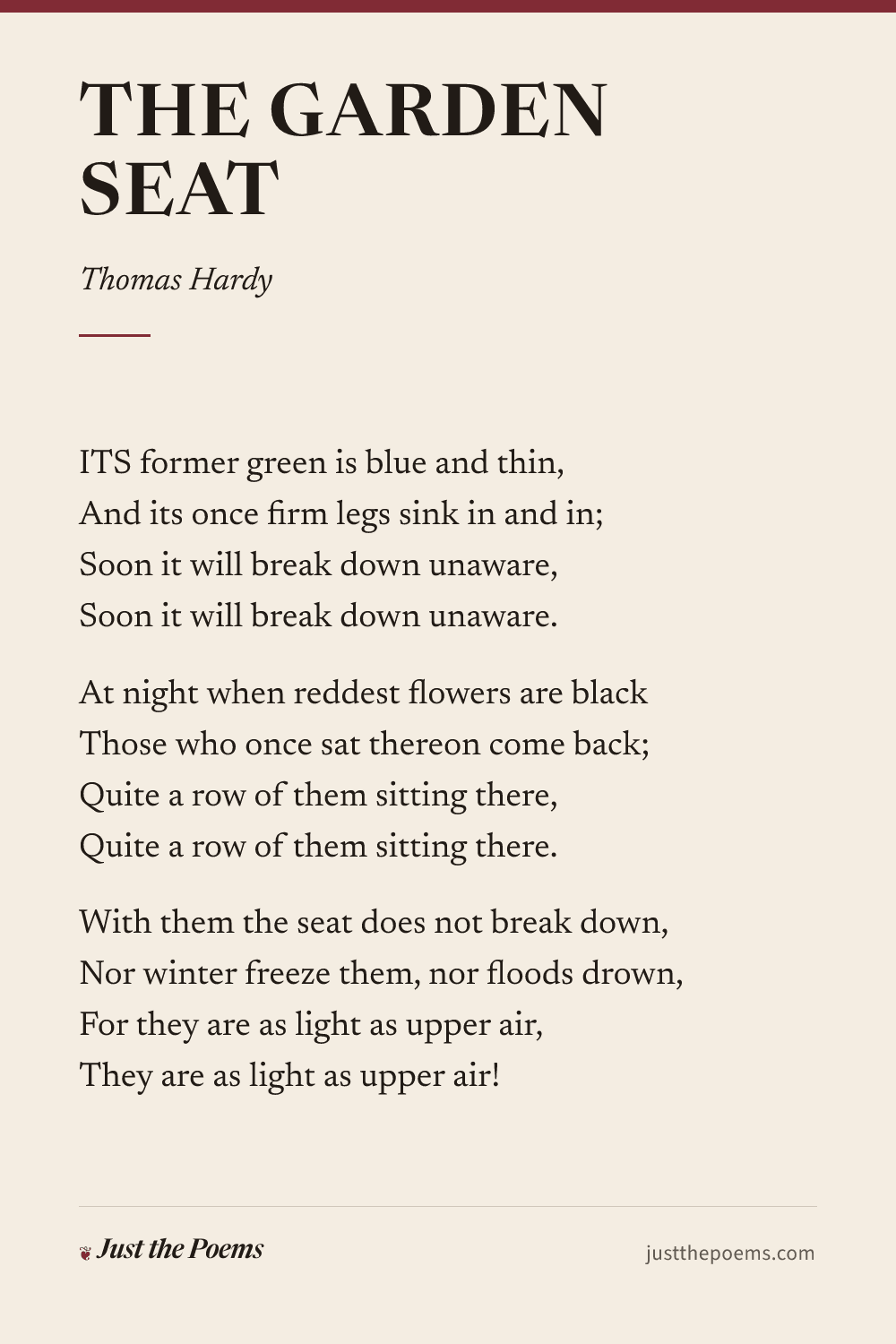
ITS former green is blue and thin,And its once firm legs sink in and in;Soon it will break down unaware,Soon it will break down unaware.

At night when reddest flowers are blackThose who once sat thereon come back;Quite a row of them sitting there,Quite a row of them sitting there.

With them the seat does not break down,Nor winter freeze them, nor floods drown,For they are as light as upper air,They are as light as upper air!

Source

Late Lyrics and Earlier, With Many Other Verses, 1922

Filed under
  • Named in the title

OUT IN THE GARDEN

Katherine Mansfield

In 0 Wikipedias 0 anthologies Poet in 53 Wikipedias

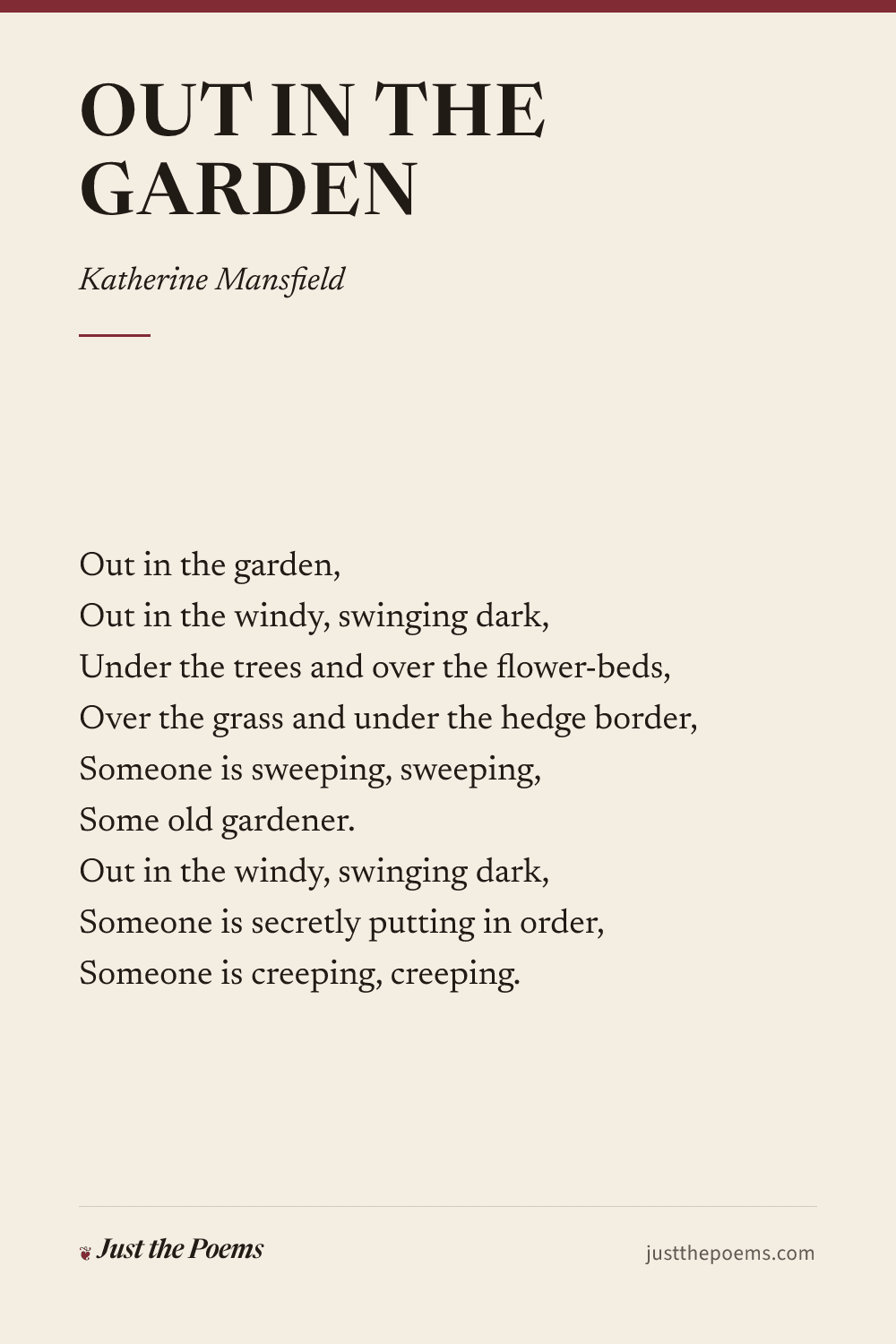
Out in the garden,Out in the windy, swinging dark,Under the trees and over the flower-beds,Over the grass and under the hedge border,Someone is sweeping, sweeping,Some old gardener.Out in the windy, swinging dark,Someone is secretly putting in order,Someone is creeping, creeping.

Source

Poems, 1923

Filed under
  • Named in the title

26 poems about gardens

22 poets

By poet's century of death

CenturyPoems
17th2
18th1
19th11
20th12

Poets with more than one poem

PoetPoems
Robert Louis Stevenson3
Andrew Marvell2
Thomas Hardy2