Poems About Music

The 12 poems about music, by 8 poets, ranked by third-party data. How poems are ranked

Music, when soft voices die,

Percy Bysshe Shelley

In 0 Wikipedias 2 anthologies Poet in 91 Wikipedias

Music, when soft voices die,Vibrates in the memory--Odours, when sweet violets sicken,Live within the sense they quicken.

Rose leaves, when the rose is dead,Are heap'd for the beloved's bed;And so thy thoughts, when Thou art gone,Love itself shall slumber on.

Source

The Golden Treasury, ed. Francis Turner Palgrave

Filed under
  • Named in the first line

AT A SOLEMN MUSIC

John Milton

In 0 Wikipedias 1 anthology Poet in 106 Wikipedias

Blest pair of Sirens, pledges of Heaven's joy,Sphere-born harmonious Sisters, Voice, and Verse,Wed your divine sounds, and mixt power employDead things with inbreathed sense able to pierce,And to our high-raised phantasy presentThat undisturbed Song of pure concent,Ay sung before the sapphire-colour'd throne To Him that sits thereon,With saintly shout and solemn jubilee;Where the bright Seraphim in burning rowTheir loud uplifted angel-trumpets blow;And the Cherubic host in thousand quires

Show all 28 lines 16 more

Touch their immortal harps of golden wires,With those just Spirits that wear victorious palms Hymns devout and holy psalms Singing everlastingly:That we on earth, with undiscording voiceMay rightly answer that melodious noise;As once we did, till disproportion'd sinJarr'd against nature's chime, and with harsh dinBroke the fair music that all creatures madeTo their great Lord, whose love their motion sway'dIn perfect diapason, whilst they stoodIn first obedience, and their state of good.O may we soon again renew that Song,And keep in tune with Heaven, till God ere longTo His celestial consort us unite,To live with Him, and sing in endless morn of light!

Source

The Golden Treasury, ed. Francis Turner Palgrave

Filed under
  • Named in the title

ALEXANDER'S FEAST, OR, THE POWER OF MUSIC

John Dryden

In 0 Wikipedias 1 anthology Poet in 69 Wikipedias

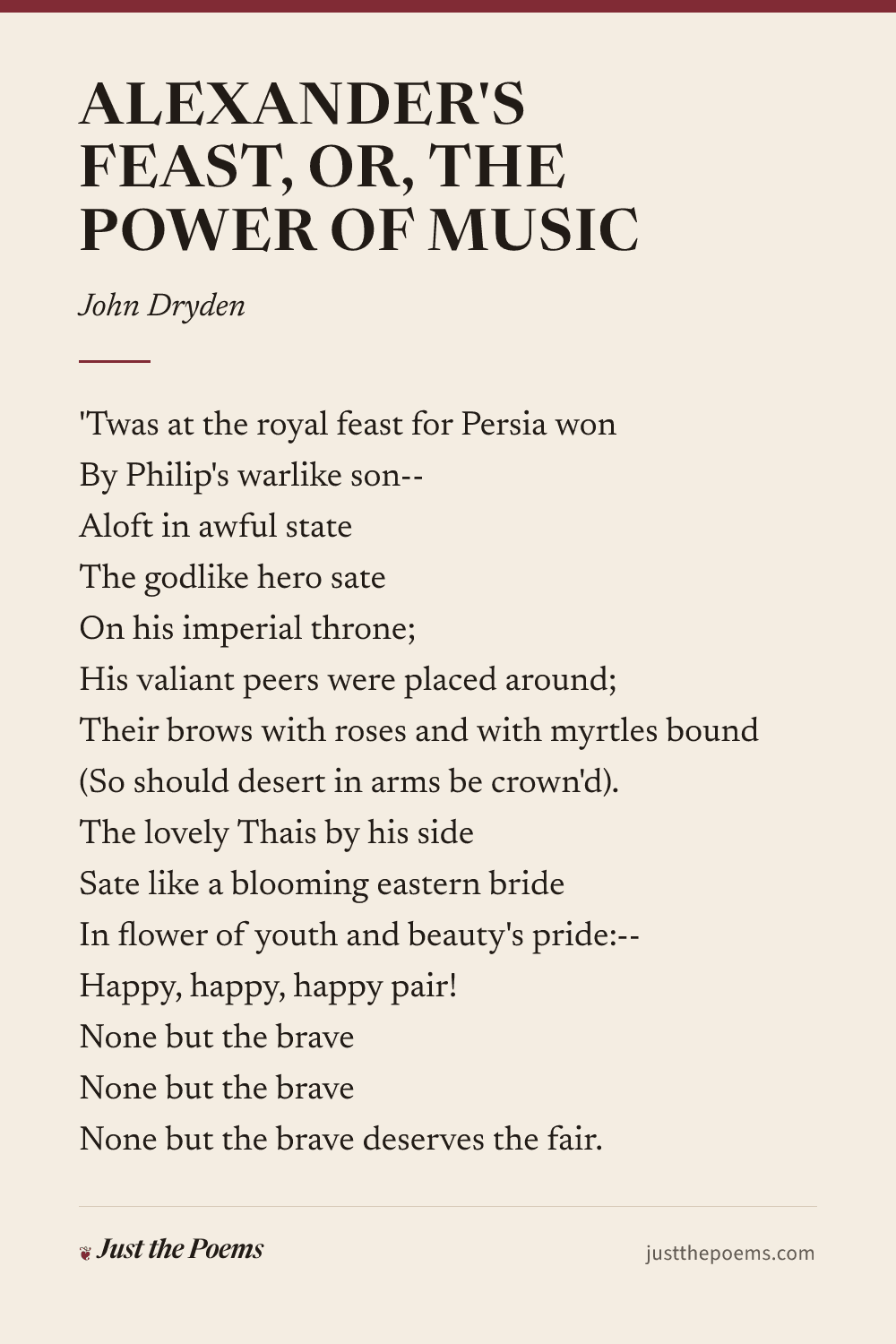
'Twas at the royal feast for Persia wonBy Philip's warlike son--Aloft in awful stateThe godlike hero sateOn his imperial throne;His valiant peers were placed around;Their brows with roses and with myrtles bound(So should desert in arms be crown'd).The lovely Thais by his sideSate like a blooming eastern brideIn flower of youth and beauty's pride:--Happy, happy, happy pair!

Show all 141 lines 129 more

None but the braveNone but the braveNone but the brave deserves the fair.

Timotheus placed on highAmid the tuneful quireWith flying fingers touch'd the lyre:The trembling notes ascend the skyAnd heavenly joys inspire.The song began from JoveWho left his blissful seats above--Such is the power of mighty love!A dragon's fiery form belied the god;Sublime on radiant spires he rodeWhen he to fair Olympia prest,And while he sought her snowy breast;Then round her slender waist he curl'd,And stamp'd an image of himself, a sovereign of the world.--The listening crowd admire the lofty sound!A present deity! they shout around:A present deity! the vaulted roofs rebound!With ravish'd earsThe monarch hears,Assumes the god;Affects to nodAnd seems to shake the spheres.

The praise of Bacchus then the sweet musician sung:Of Bacchus ever fair and ever young:The jolly god in triumph comes!Sound the trumpets, beat the drums!Flush'd with a purple graceHe shows his honest face:Now give the hautboys breath; he comes, he comes!Bacchus, ever fair and young,Drinking joys did first ordain;Bacchus' blessings are a treasure,Drinking is the soldier's pleasure:Rich the treasure,Sweet the pleasure,Sweet is pleasure after pain.

Soothed with the sound, the king grew vain;Fought all his battles o'er again,And thrice he routed all his foes; and thrice he slew the slain!The master saw the madness rise,His glowing cheeks, his ardent eyes;And while he Heaven and Earth defiedChanged his hand and check'd his pride.He chose a mournful MuseSoft pity to infuse:He sung Darius great and good,By too severe a fateFallen, fallen, fallen, fallen,Fallen from his high estate,And weltering in his blood;Deserted, at his utmost need,By those his former bounty fed;On the bare earth exposed he liesWith not a friend to close his eyes.--With downcast looks the joyless victor sate,Revolving in his alter'd soulThe various turns of Chance below;And now and then a sigh he stole;And tears began to flow.

The mighty master smiled to seeThat love was in the next degree;'Twas but a kindred-sound to move,For pity melts the mind to love.Softly sweet, in Lydian measures,Soon he soothed his soul to pleasures.War, he sung, is toil and trouble,Honour but an empty bubble,Never ending, still beginning;Fighting still, and still destroying;If the world be worth thy winning,Think, O think, it worth enjoying:Lovely Thais sits beside thee,Take the good the gods provide thee!--The many rend the skies with loud applause;So Love was crown'd, but Music won the cause.The prince, unable to conceal his pain,Gazed on the fairWho caused his care,And sigh'd and look'd, sigh'd and look'd,Sigh'd and look'd, and sigh'd again:At length, with love and wine at once opprestThe vanquish'd victor sunk upon her breast.

Now strike the golden lyre again:A louder yet, and yet a louder strain!Break his bands of sleep asunder,And rouse him, like a rattling peal of thunder.Hark, hark! the horrid soundHas raised up his head:As awaked from the dead,And amazed he stares around.Revenge, revenge, Timotheus cries,See the Furies arise!See the snakes that they rearHow they hiss in their hair,And the sparkles that flash from their eyes!Behold a ghastly bandEach a torch in his hand!Those are Grecian ghosts, that in battle were slainAnd unburied remainInglorious on the plain:Give the vengeance dueTo the valiant crew!Behold how they toss their torches on high,How they point to the Persian abodesAnd glittering temples of their hostile gods.--The princes applaud with a furious joy:And the king seized a flambeau with zeal to destroy;Thais led the way,To light him to his prey,And like another Helen, fired another Troy!

--Thus, long ago,Ere heaving bellows learn'd to blow,While organs yet were mute,Timotheus, to his breathing fluteAnd sounding lyreCould swell the soul to rage, or kindle soft desire.At last divine Cecilia came,Inventress of the vocal frame;The sweet enthusiast from her sacred storeEnlarged the former narrow bounds,And added length to solemn sounds,With Nature's mother-wit, and arts unknown before.--Let old Timotheus yield the prizeOr both divide the crown;He raised a mortal to the skies;She drew an angel down!
Source

The Golden Treasury, ed. Francis Turner Palgrave

Filed under
  • Named in the title

Advertisements

To Music, to becalm his Fever

Robert Herrick

In 0 Wikipedias 1 anthology Poet in 26 Wikipedias

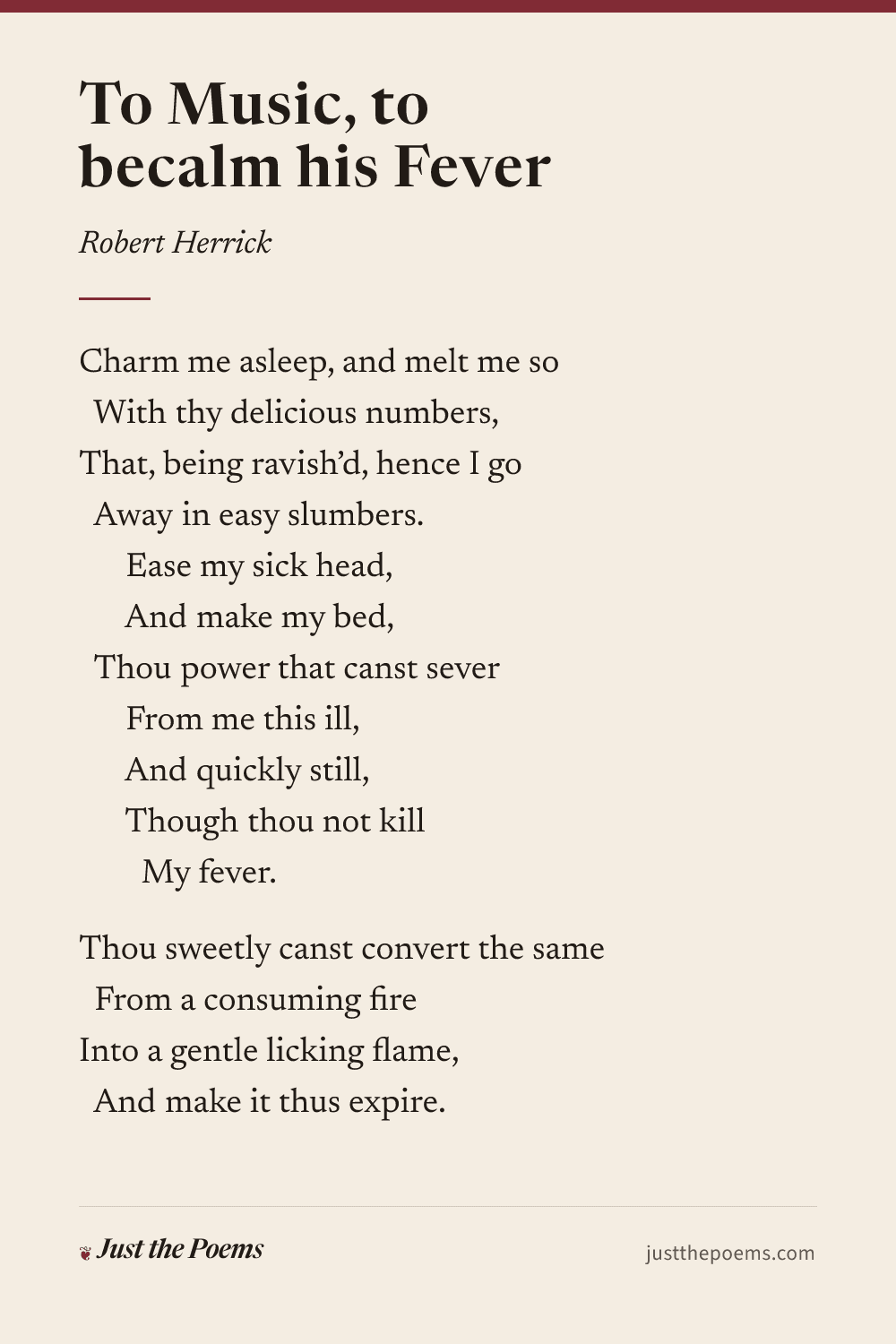
Charm me asleep, and melt me so With thy delicious numbers,That, being ravish’d, hence I go Away in easy slumbers. Ease my sick head, And make my bed, Thou power that canst sever From me this ill, And quickly still, Though thou not kill My fever.

Thou sweetly canst convert the same

Show all 33 lines 21 more

From a consuming fireInto a gentle licking flame, And make it thus expire. Then make me weep My pains asleep; And give me such reposes That I, poor I, May think thereby I live and die ’Mongst roses.

Fall on me like the silent dew, Or like those maiden showersWhich, by the peep of day, do strew A baptism o’er the flowers. Melt, melt my pains With thy soft strains; That, having ease me given, With full delight I leave this light, And take my flight For Heaven.

Source

The Oxford Book of English Verse 1250–1900, 1900

Filed under
  • Named in the title

MUSIC IN CAMP

John Randolph Thompson

In 0 Wikipedias 1 anthology Poet in 4 Wikipedias

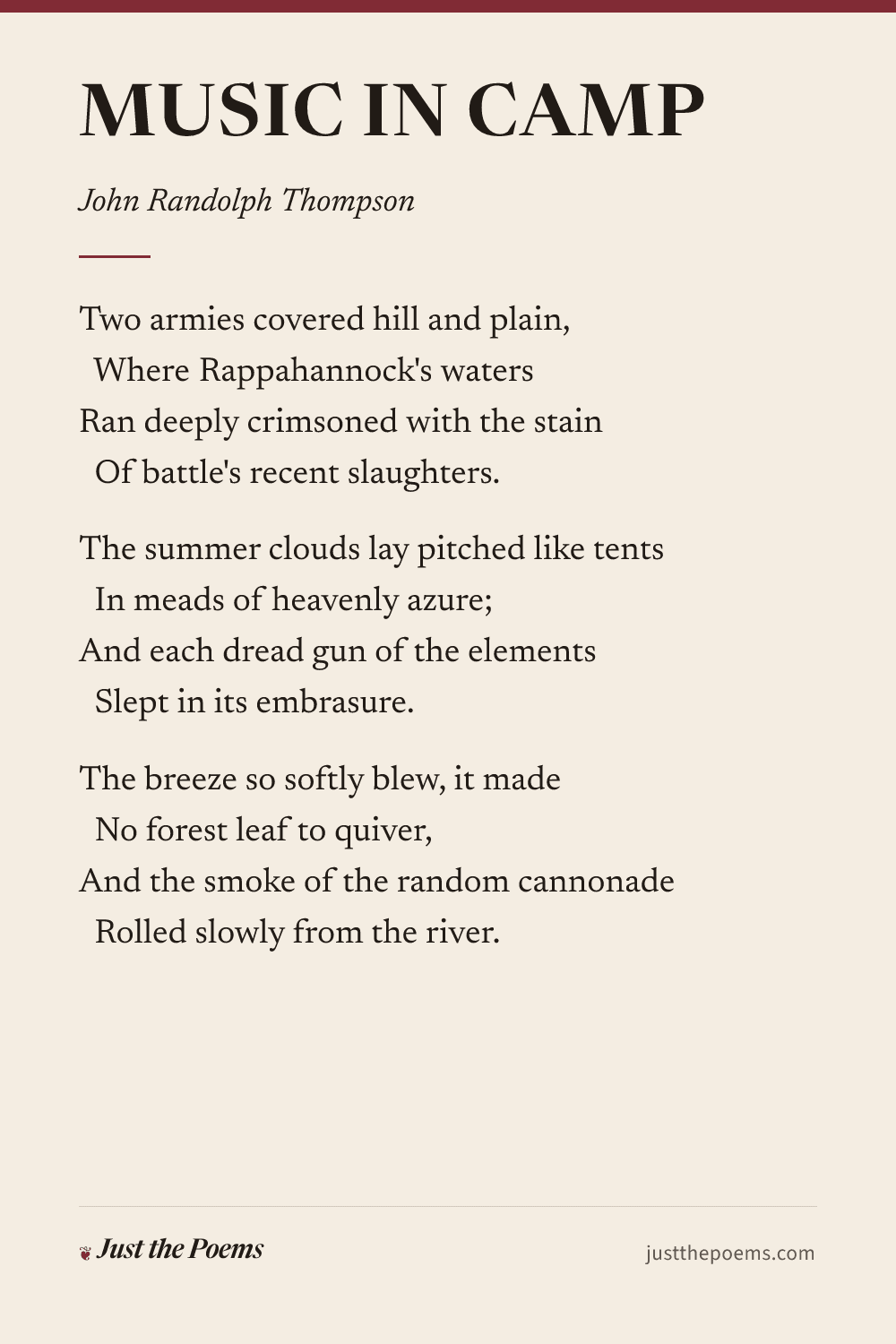
Two armies covered hill and plain, Where Rappahannock's watersRan deeply crimsoned with the stain Of battle's recent slaughters.

The summer clouds lay pitched like tents In meads of heavenly azure;And each dread gun of the elements Slept in its embrasure.

The breeze so softly blew, it made No forest leaf to quiver,And the smoke of the random cannonade Rolled slowly from the river.

Show all 76 lines 64 more

And now, where circling hills looked down With cannon grimly planted,O'er listless camp and silent town The golden sunset slanted.

When on the fervid air there came A strain--now rich, now tender;The music seemed itself aflame With day's departing splendor.

A Federal band, which, eve and morn, Played measures brave and nimble,Had just struck up, with flute and horn And lively clash of cymbal.

Down flocked the soldiers to the banks, Till, margined by its pebbles,One wooded shore was blue with "Yanks," And one was gray with "Rebels."

Then all was still, and then the band, With movements light and tricksy,Made stream and forest, hill and strand, Reverberate with "Dixie."

The conscious stream with burnished glow Went proudly o'er its pebbles,But thrilled throughout its deepest flow With yelling of the Rebels.

Again a pause, and then again The trumpets pealed sonorous,And "Yankee Doodle" was the strain To which the shore gave chorus.

The laughing ripple shoreward flew, To kiss the shining pebbles;Loud shrieked the swarming Boys in Blue Defiance to the Rebels.

And yet once more the bugle sang Above the stormy riot;No shout upon the evening rang-- There reigned a holy quiet.

The sad, slow stream its noiseless flood Poured o'er the glistening pebbles;All silent now the Yankees stood, And silent stood the Rebels.

No unresponsive soul had heard That plaintive note's appealing,So deeply "Home, Sweet Home" had stirred The hidden fount of feeling.

Or Blue, or Gray, the soldier sees, As by the wand of fairy,The cottage 'neath the live-oak trees, The cabin by the prairie.

Or cold, or warm, his native skies, Bend in their beauty o'er him;Seen through the tear-mist in his eyes, His loved ones stand before him.

As fades the iris after rain In April's tearful weather,The vision vanished, as the strain And daylight died together.

But memory, waked by music's art, Expressed in simplest numbers,Subdued the sternest Yankee's heart, Made light the Rebel's slumbers.

And fair the form of Music shines, That bright celestial creature.Who still, 'mid war's embattled lines, Gave this one touch of Nature.

Source

The World's Best Poetry, Vol. VIII, ed. Bliss Carman, 1904

Filed under
  • Named in the title

THE WORLD'S MUSIC

Gabriel Setoun

In 0 Wikipedias 1 anthology Poet in 1 Wikipedia

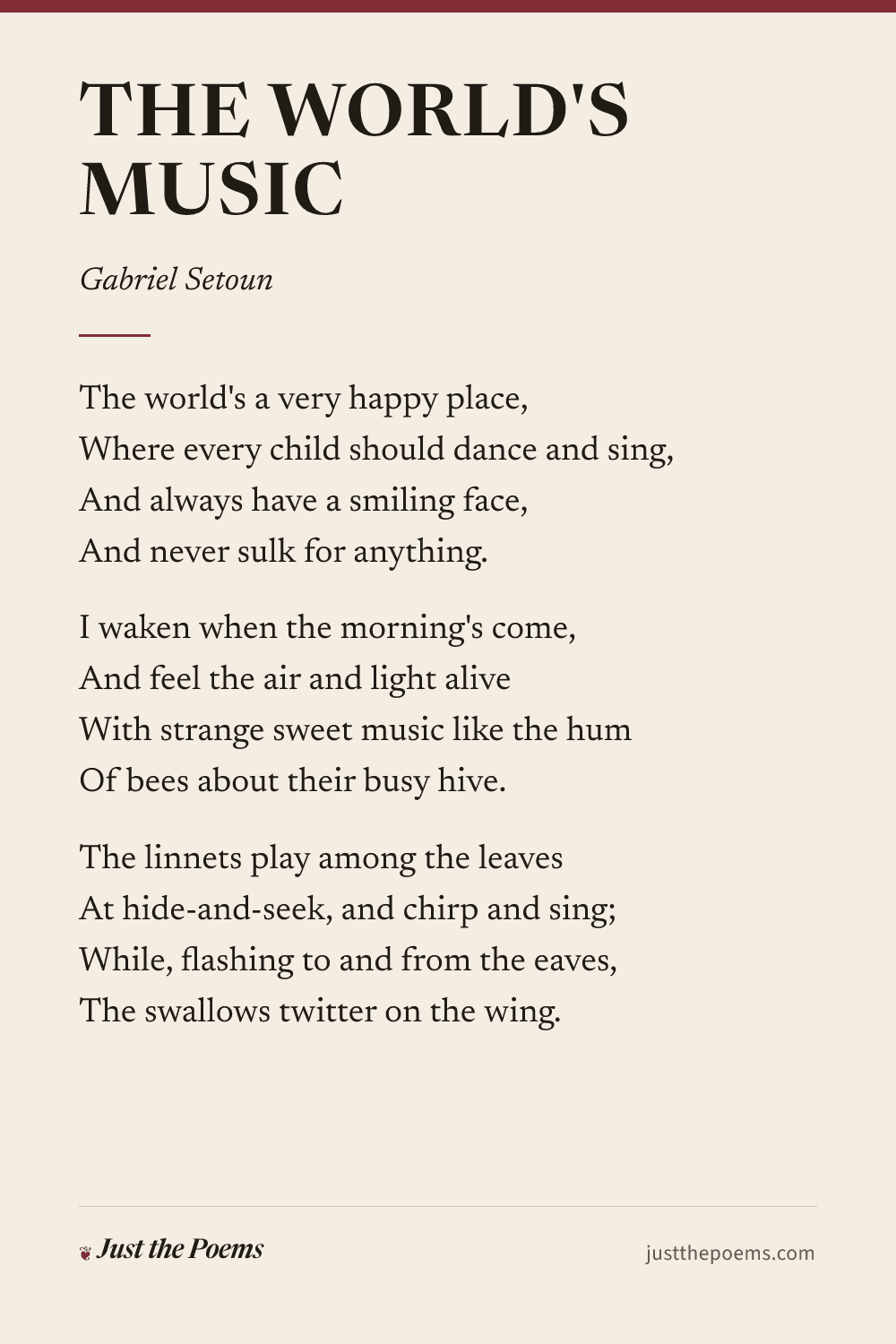
The world's a very happy place,Where every child should dance and sing,And always have a smiling face,And never sulk for anything.

I waken when the morning's come,And feel the air and light aliveWith strange sweet music like the humOf bees about their busy hive.

The linnets play among the leavesAt hide-and-seek, and chirp and sing;While, flashing to and from the eaves,The swallows twitter on the wing.

Show all 32 lines 20 more

The twigs that shake, and boughs that sway;And tall old trees you could not climb;And winds that come, but cannot stay,Are gaily singing all the time.

From dawn to dark the old mill-wheelMakes music, going round and round;And dusty-white with flour and meal,The miller whistles to its sound.

And if you listen to the rainWhen leaves and birds and bees are dumb,You hear it pattering on the paneLike Andrew beating on his drum.

The coals beneath the kettle croon,And clap their hands and dance in glee;And even the kettle hums a tuneTo tell you when it's time for tea.

The world is such a happy place,That children, whether big or small,Should always have a smiling face,And never, never sulk at all.

Source

The Home Book of Verse, ed. Burton Egbert Stevenson

Filed under
  • Named in the title

AWAY WITH FUNERAL MUSIC

Robert Louis Stevenson

In 0 Wikipedias 0 anthologies Poet in 101 Wikipedias

AWAY with funeral music—set The pipe to powerful lips—The cup of life’s for him that drinks And not for him that sips.

Source

New Poems, and Variant Readings, 1918

Filed under
  • Named in the title

MUSIC AT THE VILLA MARINA

Robert Louis Stevenson

In 0 Wikipedias 0 anthologies Poet in 101 Wikipedias

FOR some abiding central source of power, Strong-smitten steady chords, ye seem to flow And, flowing, carry virtue. Far below,The vain tumultuous passions of the hourFleet fast and disappear; and as the sun Shines on the wake of tempests, there is cast O’er all the shattered ruins of my pastA strong contentment as of battles won.

And yet I cry in anguish, as I hear The long drawn pageant of your passage roll Magnificently forth into the night.To yon fair land ye come from, to yon sphere

Show all 28 lines 16 more

Of strength and love where now ye shape your flight, O even wings of music, bear my soul!

Ye have the power, if but ye had the will, Strong-smitten steady chords in sequence grand, To bear me forth into that tranquil landWhere good is no more ravelled up with ill;Where she and I, remote upon some hill Or by some quiet river’s windless strand, May live, and love, and wander hand in hand,And follow nature simply, and be still.

From this grim world, where, sadly, prisoned, we Sit bound with others’ heart-strings as with chains, And, if one moves, all suffer,—to that Goal,If such a land, if such a sphere, there be, Thither, from life and all life’s joys and pains, O even wings of music, bear my soul!

Source

New Poems, and Variant Readings, 1918

Filed under
  • Named in the title

Advertisements

ANOTHER FRAGMENT: TO MUSIC.

Percy Bysshe Shelley

In 0 Wikipedias 0 anthologies Poet in 91 Wikipedias

No, Music, thou art not the 'food of Love.'Unless Love feeds upon its own sweet self,Till it becomes all Music murmurs of.

***

Source

The Complete Poetical Works of Percy Bysshe Shelley — Volume 2, ed. Thomas Hutchinson, 1914

Filed under
  • Named in the title

FRAGMENT: MUSIC AND SWEET POETRY.

Percy Bysshe Shelley

In 0 Wikipedias 0 anthologies Poet in 91 Wikipedias

How sweet it is to sit and read the talesOf mighty poets and to hear the whileSweet music, which when the attention failsFills the dim pause--

***

Source

The Complete Poetical Works of Percy Bysshe Shelley — Volume 2, ed. Thomas Hutchinson, 1914

Filed under
  • Named in the title

MUSIC

G. K. Chesterton

In 0 Wikipedias 0 anthologies Poet in 70 Wikipedias

Sounding brass and tinkling cymbal, He that made me sealed my ears,And the pomp of gorgeous noises, Waves of triumph, waves of tears,

Thundered empty round and past me, Shattered, lost for ever more,Ancient gold of pride and passion, Wrecked like treasure on a shore.

But I saw her cheek and forehead Change, as at a spoken word,And I saw her head uplifted Like a lily to the Lord.

Nought is lost, but all transmuted, Ears are sealed, yet eyes have seen;Saw her smiles (O soul be worthy!), Saw her tears (O heart be clean!).

Source

Poems, 1916

Filed under
  • Named in the title

THE STRANGE MUSIC

G. K. Chesterton

In 0 Wikipedias 0 anthologies Poet in 70 Wikipedias

Other loves may sink and settle, other loves may loose and slack,But I wander like a minstrel with a harp upon his back,Though the harp be on my bosom, though I finger and I fret,Still, my hope is all before me: for I cannot play it yet.

In your strings is hid a music that no hand hath ere let fall,In your soul is sealed a pleasure that you have not known at all;Pleasure subtle as your spirit, strange and slender as your frame,Fiercer than the pain that folds you, softer than your sorrow's name.

Not as mine, my soul's anointed, not as mine the rude and lightEasy mirth of many faces, swaggering pride of song and fight;Something stranger, something sweeter, something waiting you afar,Secret as your stricken senses, magic as your sorrows are.

But on this, God's harp supernal, stretched but to be stricken once.Hoary Time is a beginner, Life a bungler, Death a dunce.But I will not fear to match them--no, by God, I will not fear,I will learn you, I will play you and the stars stand still to hear.

Source

Poems, 1916

Filed under
  • Named in the title

12 poems about music

8 poets

By poet's century of death

CenturyPoems
17th3
19th6
20th3

Poets with more than one poem

PoetPoems
Percy Bysshe Shelley3
G. K. Chesterton2
Robert Louis Stevenson2