Lucy Gray
In 6 Wikipedias 1 anthology
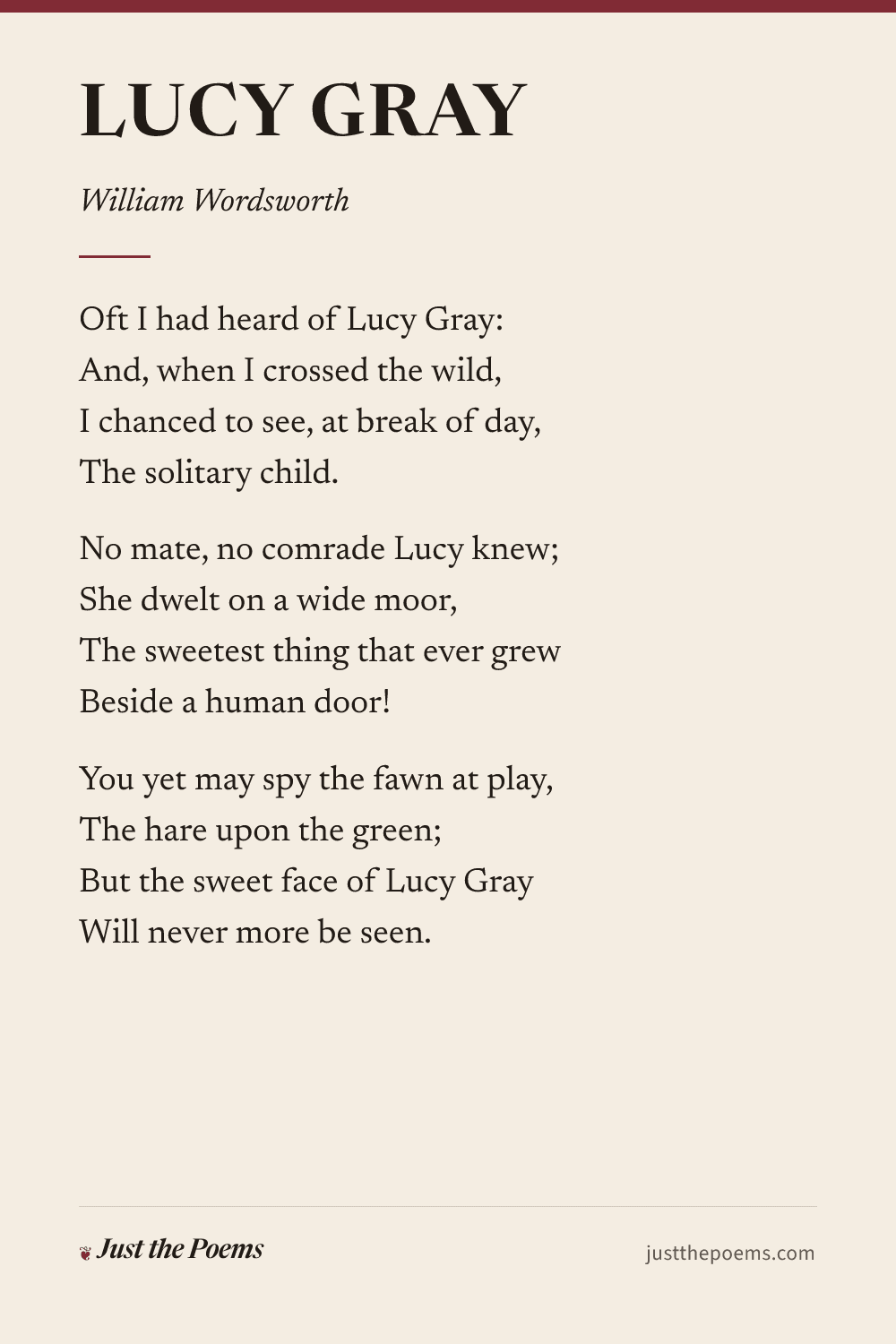
Oft I had heard of Lucy Gray:And, when I crossed the wild,I chanced to see, at break of day,The solitary child.
No mate, no comrade Lucy knew;She dwelt on a wide moor,The sweetest thing that ever grewBeside a human door!
You yet may spy the fawn at play,The hare upon the green;But the sweet face of Lucy GrayWill never more be seen.
"To-night will be a stormy night,--You to the town must go;And take a lantern, Child, to lightYour mother through the snow."
"That, Father, will I gladly do:'Tis scarcely afternoon,--The minster-clock has just struck two,And yonder is the moon!"
At this the Father raised his hook,And snapped a fagot-brand.He plied his work;--and Lucy tookThe lantern in her hand.
Not blither is the mountain roe:With many a wanton strokeHer feet disperse the powdery snow,That rises up like smoke.
The storm came on before its time:She wandered up and down:And many a hill did Lucy climb:But never reached the town.
The wretched parents all that nightWent shouting far and wide;But there was neither sound nor sightTo serve them for a guide.
At daybreak on the hill they stoodThat overlooked the moor;And thence they saw the bridge of wood,A furlong from their door.
They wept,--and, turning homeward, cried,"In heaven we all shall meet;"When in the snow the mother spiedThe print of Lucy's feet.
Then downwards from the steep hill's edgeThey tracked the footmarks small:And through the broken hawthorn-hedge,And by the low stone-wall;
And then an open field they crossed--The marks were still the same--They tracked them on, nor ever lost;And to the bridge they came.
They followed from the snowy bankThose footmarks, one by one,Into the middle of the plank;And further there were none!
--Yet some maintain that to this dayShe is a living child;That you may see sweet Lucy GrayUpon the lonesome wild.
O'er rough and smooth she trips along,And never looks behind;And sings a solitary songThat whistles in the wind.
- Source
The Home Book of Verse, ed. Burton Egbert Stevenson
- Topics
Share this poem