Poems About School

The 10 poems about school, by 9 poets, ranked by third-party data. How poems are ranked

MARY'S LAMB

Sarah Josepha Hale

In 17 Wikipedias 1 anthology Poet in 20 Wikipedias

Mary had a little lamb,Its fleece was white as snow,And every where that Mary wentThe lamb was sure to go;He followed her to school one day--That was against the rule,It made the children laugh and play,To see a lamb at school.

And so the Teacher turned him out,But still he lingered near,And waited patiently about,Till Mary did appear;And then he ran to her, and laidHis head upon her arm,As if he said--"I'm not afraid--You'll keep me from all harm."

"What makes the lamb love Mary so?"The eager children cry--"O, Mary loves the lamb, you know,"The Teacher did reply;--"And you each gentle animalIn confidence may bind,And make them follow at your call,If you are always kind."

Source

The Home Book of Verse, ed. Burton Egbert Stevenson

Filed under
  • Wikidata main subject: classroom

THE SCHOOL OF WAR

Christopher Marlowe

In 0 Wikipedias 1 anthology Poet in 82 Wikipedias

TAMBURLAINE.--But now, my boys, leave off and list to me,That mean to teach you rudiments of war:I'll have you learn to sleep upon the ground,March in your armor through watery fens,Sustain the scorching heat and freezing cold,Hunger and thirst, right adjuncts of the war,And after this to scale a castle wall,Besiege a fort, to undermine a town,And make whole cities caper in the air.Then next the way to fortify your men:In champion grounds, what figure serves you best,For which the quinque-angle form is meet,

Show all 93 lines 81 more

Because the corners there may fall more flatWhereas the fort may fittest be assailed,And sharpest where the assault is desperate.The ditches must be deep; the counterscarpsNarrow and steep; the walls made high and broad;The bulwarks and the rampires large and strong,With cavalieros and thick counterforts,And room within to lodge six thousand men.It must have privy ditches, countermines,And secret issuings to defend the ditch;It must have high argins and covered ways,To keep the bulwark fronts from battery,And parapets to hide the musketers;Casemates to place the great artillery;And store of ordnance, that from every flankMay scour the outward curtains of the fort,Dismount the cannon of the adverse part,Murder the foe, and save the walls from breach.When this is learned for service on the land,By plain and easy demonstrationI'll teach you how to make the water mount,That you may dry-foot march through lakes and pools,Deep rivers, havens, creeks, and little seas,And make a fortress in the raging waves,Fenced with the concave of monstrous rock,Invincible by nature of the place.When this is done then are ye soldiers,And worthy sons of Tamburlaine the Great.

CALYPHAS.--My lord, but this is dangerous to be done:We may be slain or wounded ere we learn.

TAMBURLAINE.--Villain! Art thou the son of Tamburlaine,And fear'st to die, or with a curtle-axeTo hew thy flesh, and make a gaping wound?Hast thou beheld a peal of ordnance strikeA ring of pikes, mingled with shot and horse,Whose shattered limbs, being tossed as high as Heaven,Hang in the air as thick as sunny motes,And canst thou, coward, stand in fear of death?Hast thou not seen my horsemen charge the foe,Shot through the arms, cut overthwart the hands,Dyeing their lances with their streaming blood,And yet at night carouse within my tent,Filling their empty veins with airy wine,That, being concocted, turns to crimson blood.--And wilt thou shun the field for fear of wounds?View me, thy father, that hath conquered kings,And with his horse marched round about the earthQuite void of scars and clear from any wound,That by the wars lost not a drop of blood,--And see him lance his flesh to teach you all. (He cuts his arm.)A wound is nothing, be it ne'er so deep;Blood is the god of war's rich livery,Now look I like a soldier, and this woundAs great a grace and majesty to me,As if a chain of gold, enamellèd,Enchased with diamonds, sapphires, rubies,And fairest pearl of wealthy India,Were mounted here under a canopy,And I sate down clothed with a massy robe,That late adorned the Afric potentate,Whom I brought bound unto Damascus' walls.Come, boys, and with your fingers search my wound,And in my blood wash all your hands at once,While I sit smiling to behold the sight.Now, my boys, what think ye of a wound?

CALYPHAS.--I know not what I should think of it; methinks it is a pitiful sight.

CELEBINUS.--'Tis nothing: give me a wound, father.

AMYRAS.--And me another, my lord.

TAMBURLAINE.--Come, sirrah, give me your arm.

CELEBINUS.--Here, father, cut it bravely, as you did your own.

TAMBURLAINE.--It shall suffice thou darest abide a wound:My boy, thou shalt not lose a drop of bloodBefore we meet the army of the Turk;But then run desperate through the thickest throngs,Dreadless of blows, of bloody wounds, and death;And let the burning of Larissa-walls,My speech of war, and this my wound you see,Teach you, my boys, to bear courageous minds,Fit for the followers of great Tamburlaine!

Source

The World's Best Poetry, Vol. VIII, ed. Bliss Carman, 1904

Filed under
  • Named in the title

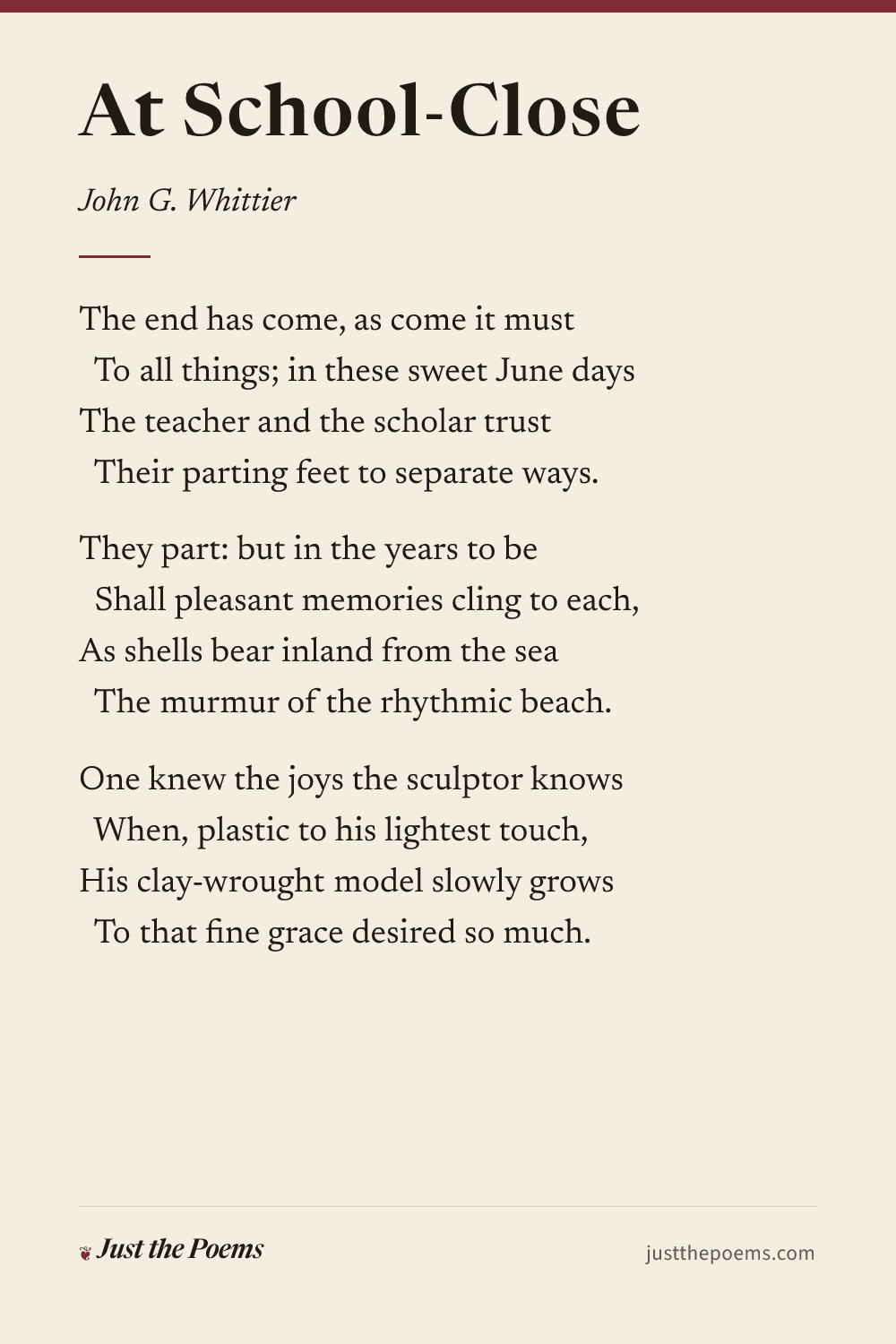
At School-Close

John G. Whittier

In 0 Wikipedias 1 anthology Poet in 33 Wikipedias

The end has come, as come it must To all things; in these sweet June daysThe teacher and the scholar trust Their parting feet to separate ways.

They part: but in the years to be Shall pleasant memories cling to each,As shells bear inland from the sea The murmur of the rhythmic beach.

One knew the joys the sculptor knows When, plastic to his lightest touch,His clay-wrought model slowly grows To that fine grace desired so much.

Show all 60 lines 48 more

So daily grew before her eyes The living shapes whereon she wrought,Strong, tender, innocently wise, The child's heart with the woman's thought.

And one shall never quite forget The voice that called from dream and play,The firm but kindly hand that set Her feet in learning's pleasant way,--

The joy of Undine soul-possessed, The wakening sense, the strange delightThat swelled the fabled statue's breast And filled its clouded eyes with sight!

O Youth and Beauty, loved of all! Ye pass from girlhood's gate of dreams;In broader ways your footsteps fall, Ye test the truth of all that seems.

Her little realm the teacher leaves, She breaks her wand of power apart,While, for your love and trust, she gives The warm thanks of a grateful heart.

Hers is the sober summer noon Contrasted with your morn of spring;The waning with the waxing moon, The folded with the outspread wing.

Across the distance of the years She sends her God-speed back to you;She has no thought of doubts or fears; Be but yourselves, be pure, be true,

And prompt in duty; heed the deep, Low voice of conscience; through the illAnd discord round about you, keep Your faith in human nature still.

Be gentle: unto griefs and needs Be pitiful as woman should,And, spite of all the lies of creeds, Hold fast the truth that God is good.

Give and receive; go forth and bless The world that needs the hand and heartOf Martha's helpful carefulness No less than Mary's better part.

So shall the stream of time flow by And leave each year a richer good,And matron loveliness outvie The nameless charm of maidenhood.

And, when the world shall link your names With gracious lives and manners fine,The teacher shall assert her claims, And proudly whisper, "These were mine!"

Source

Poems Teachers Ask For

Filed under
  • Named in the title

Advertisements

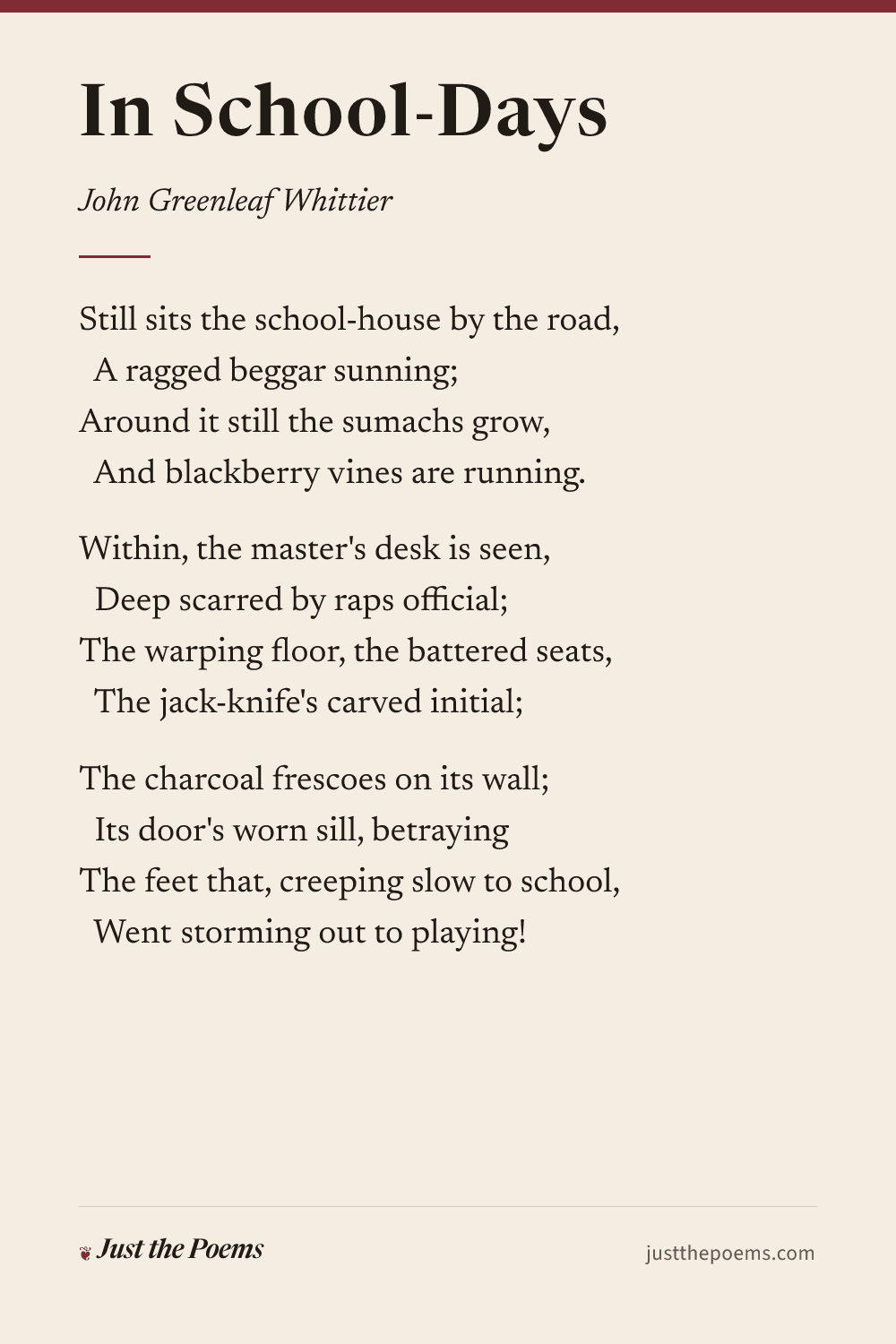
In School-Days

John Greenleaf Whittier

In 0 Wikipedias 1 anthology Poet in 33 Wikipedias

Still sits the school-house by the road, A ragged beggar sunning;Around it still the sumachs grow, And blackberry vines are running.

Within, the master's desk is seen, Deep scarred by raps official;The warping floor, the battered seats, The jack-knife's carved initial;

The charcoal frescoes on its wall; Its door's worn sill, betrayingThe feet that, creeping slow to school, Went storming out to playing!

Show all 44 lines 32 more

Long years ago a winter sun Shone over it at setting;Lit up its western window-panes, And low eaves' icy fretting.

It touched the tangled golden curls, And brown eyes full of grieving,Of one who still her steps delayed When all the school were leaving.

For near her stood the little boy Her childish favor singled:His cap pulled low upon a face Where pride and shame were mingled.

Pushing with restless feet the snow To right and left, he lingered;--As restlessly her tiny hands The blue-checked apron fingered.

He saw her lift her eyes; he felt The soft hand's light caressing,And heard the tremble of her voice, As if a fault confessing.

"I'm sorry that I spelt the word: I hate to go above you,Because,"--the brown eyes lower fell,-- "Because, you see, I love you!"

Still memory to a gray-haired man That sweet child-face is showing.Dear girl: the grasses on her grave Have forty years been growing!

He lives to learn, in life's hard school, How few who pass above himLament their triumph and his loss, Like her,--because they love him.

Source

Poems Teachers Ask For

Filed under
  • Named in the title

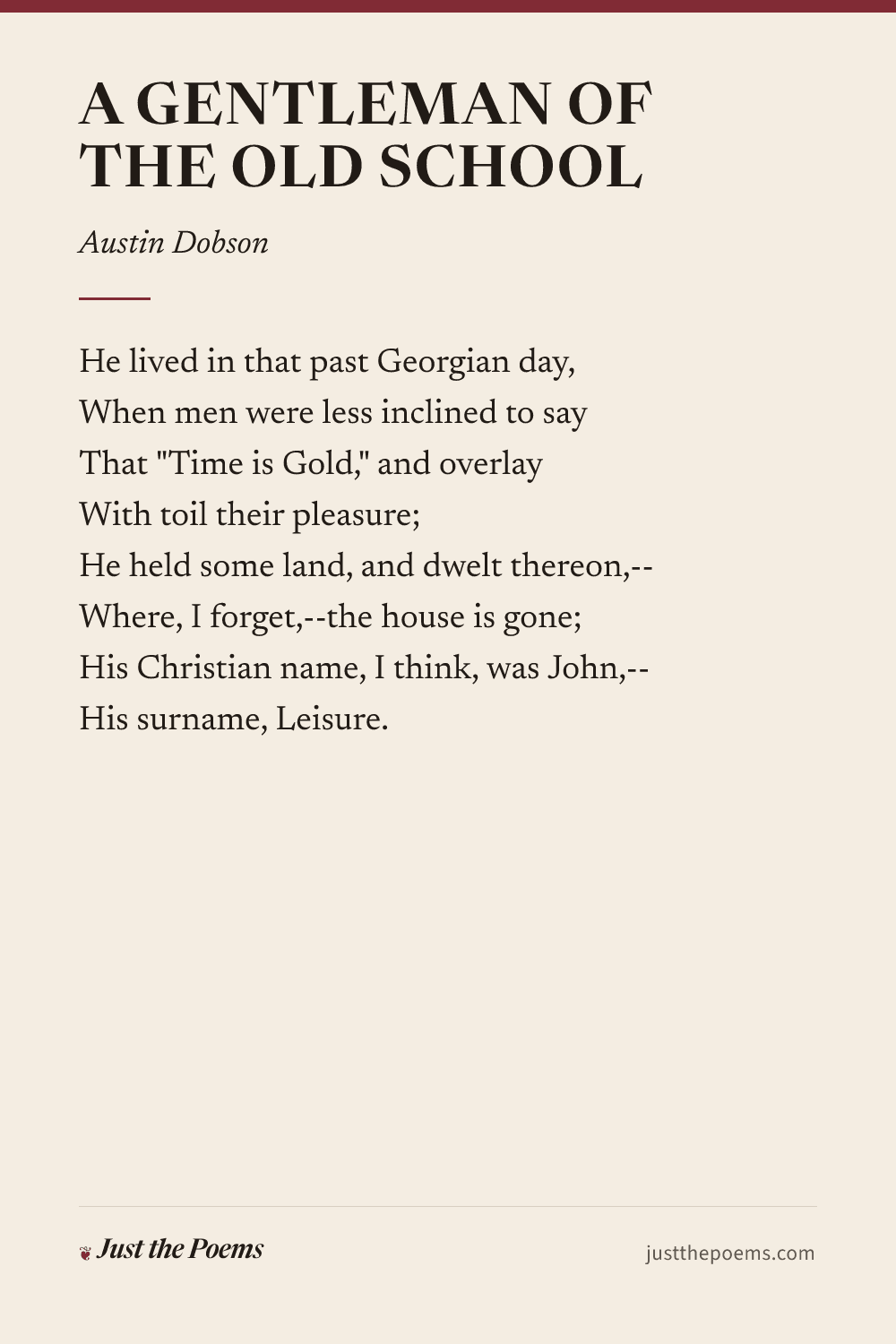
A GENTLEMAN OF THE OLD SCHOOL

Austin Dobson

In 0 Wikipedias 1 anthology Poet in 7 Wikipedias

He lived in that past Georgian day,When men were less inclined to sayThat "Time is Gold," and overlayWith toil their pleasure;He held some land, and dwelt thereon,--Where, I forget,--the house is gone;His Christian name, I think, was John,--His surname, Leisure.

Reynolds has painted him,--a faceFilled with a fine, old-fashioned grace,Fresh-colored, frank, with ne'er a traceOf trouble shaded;

Show all 112 lines 100 more

The eyes are blue, the hair is dressedIn plainest way,--one hand is pressedDeep in a flapped canary vest,With buds brocaded.

He wears a brown old Brunswick coat,With silver buttons,--round his throat,A soft cravat;--in all you noteAn elder fashion,--A strangeness, which, to us who shineIn shapely hats,--whose coats combineAll harmonies of hue and line,Inspires compassion.

He lived so long ago, you see!Men were untravelled then, but we,Like Ariel, post o'er land and seaWith careless parting;He found it quite enough for himTo smoke his pipe in "garden trim,"And watch, about the fish tank's brim,The swallows darting.

He liked the well-wheel's creaking tongue,--He liked the thrush that fed her young,--He liked the drone of flies amongHis netted peaches;He liked to watch the sunlight fallAthwart his ivied orchard wall;Or pause to catch the cuckoo's callBeyond the beeches.

His were the times of Paint and Patch,And yet no Ranelagh could matchThe sober doves that round his thatchSpread tails and sidled;He liked their ruffling, puffed content;For him their drowsy wheelings meantMore than a Mall of Beaux that bent,Or Belles that bridled.

Not that, in truth, when life beganHe shunned the flutter of the fan;He too had maybe "pinked his man"In Beauty's quarrel;But now his "fervent youth" had flownWhere lost things go; and he was grownAs staid and slow-paced as his ownOld hunter, Sorrel.

Yet still he loved the chase, and heldThat no composer's score excelledThe merry horn, when Sweetlip swelledIts jovial riot;But most his measured words of praiseCaressed the angler's easy ways,--His idly meditative days,--His rustic diet.

Not that his "meditating" roseBeyond a sunny summer doze;He never troubled his reposeWith fruitless prying;But held, as law for high and low,What God withholds no man can know,And smiled away enquiry so,Without replying.

We read--alas, how much we read!--The jumbled strifes of creed and creedWith endless controversies feedOur groaning tables;His books--and they sufficed him--wereCotton's Montaigne, The Grave of Blair,A "Walton"--much the worse for wear,And Aesop's Fables.

One more--The Bible. Not that heHad searched its page as deep as we;No sophistries could make him seeIts slender credit;It may be that he could not countThe sires and sons to Jesse's fount,--He liked the "Sermon on the Mount,"--And more, he read it.

Once he had loved, but failed to wed,A red-cheeked lass who long was dead;His ways were far too slow, he said,To quite forget her;And still when time had turned him gray,The earliest hawthorn buds in MayWould find his lingering feet astray,Where first he met her.

"In Coelo Quies" heads the stoneOn Leisure's grave,--now little known,A tangle of wild-rose has grownSo thick across it;The "Benefactions" still declareHe left the clerk an elbow-chair,And "12 Pence Yearly to PrepareA Christmas Posset."

Lie softly, Leisure! Doubtless you,With too serene a conscience drewYour easy breath, and slumbered throughThe gravest issue;But we, to whom our age allowsScarce space to wipe our weary brows,Look down upon your narrow house,Old friend, and miss you!

Source

The Home Book of Verse, ed. Burton Egbert Stevenson

Filed under
  • Named in the title

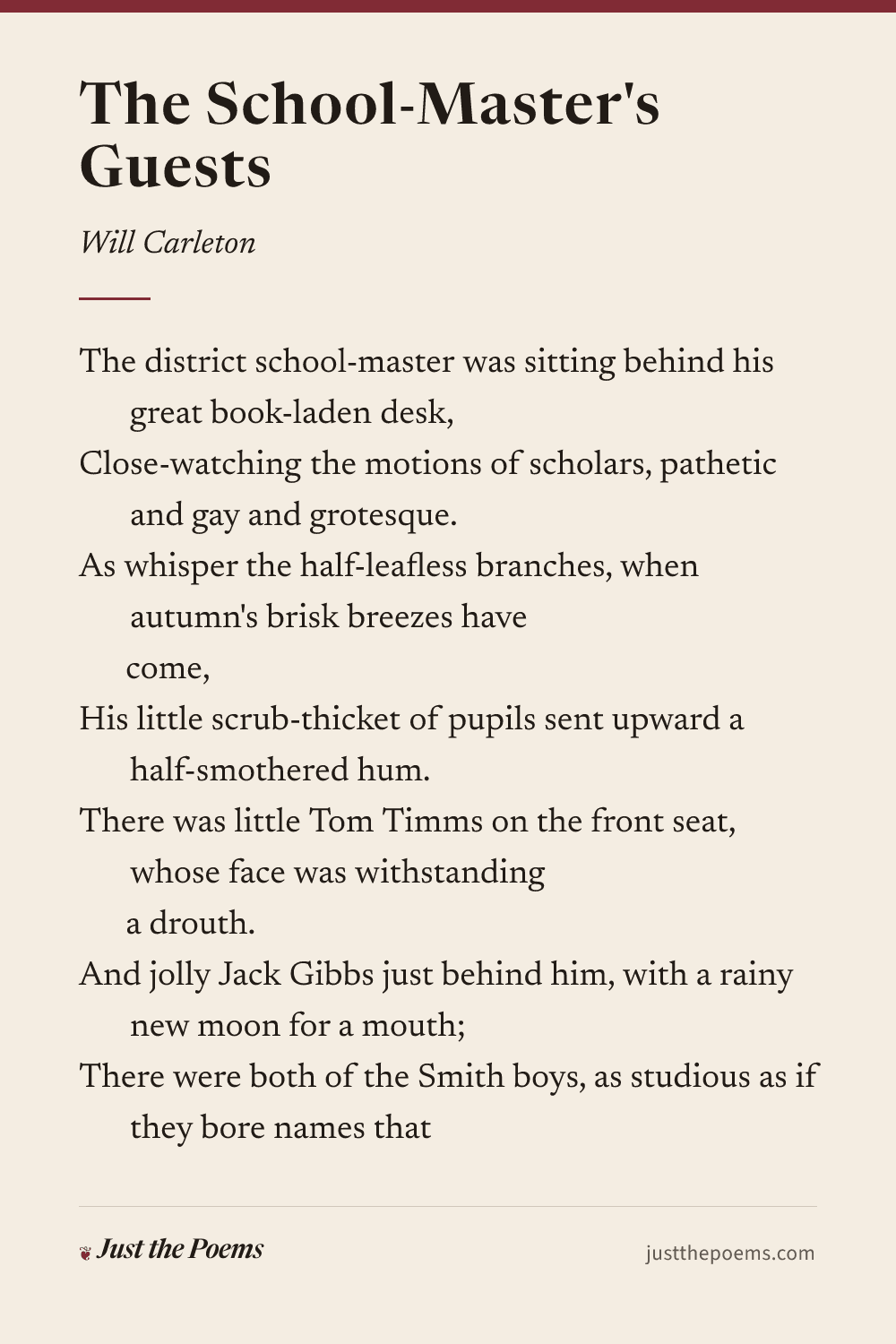
The School-Master's Guests

Will Carleton

In 0 Wikipedias 1 anthology Poet in 1 Wikipedia

The district school-master was sitting behind his great book-laden desk,Close-watching the motions of scholars, pathetic and gay and grotesque.As whisper the half-leafless branches, when autumn's brisk breezes have come,His little scrub-thicket of pupils sent upward a half-smothered hum.There was little Tom Timms on the front seat, whose face was withstanding a drouth.And jolly Jack Gibbs just behind him, with a rainy new moon for a mouth;There were both of the Smith boys, as studious as if they bore names that could bloom,And Jim Jones, a heaven-built mechanic, the slyest young knave in the room,With a countenance grave as a horse's, and his honest eyes fixed on a pin,

Show all 131 lines 119 more

Queer-bent on a deeply-laid project to tunnel Joe Hawkins's skin.There were anxious young novices, drilling their spelling-books into their brain,Loud-puffing each half-whispered letter, like an engine just starting its train;There was one fiercely muscular fellow, who scowled at the sums on his slate,And leered at the innocent figures a look of unspeakable hate;And set his white teeth close together, and gave his thin lips a short twist,As to say, "I could whip you, confound you! could such things be done with the fist!"There were two knowing girls in the corner, each one with some beauty possessed,In a whisper discussing the problem which one the young master likes best;A class in the front, with their readers, were telling, with difficult pains,How perished brave Marco Bozzaris while bleeding at all of his veins;And a boy on the floor to be punished, a statue of idleness stood,Making faces at all of the others, and enjoying the scene all he could.

Around were the walls, gray and dingy, which every old school-sanctum hath,With many a break on their surface, where grinned a wood-grating of lath.A patch of thick plaster, just over the school-master's rickety chair,Seemed threat'ningly o'er him suspended, like Damocles' sword, by a hair.There were tracks on the desks where the knife-blades had wandered in search of their prey;Their tops were as duskily spattered as if they drank ink every day.The square stove it puffed and it crackled, and broke out in red flaming sores,Till the great iron quadruped trembled like a dog fierce to rush out-o'-doors.White snowflakes looked in at the windows; the gale pressed its lips to the cracks;And the children's hot faces were streaming, the while they were freezing their backs.

Now Marco Bozzaris had fallen, and all of his suff'rings were o'er,And the class to their seats were retreating, when footsteps were heard at the door;And five of the good district fathers marched into the room in a row,And stood themselves up by the fire, and shook off their white cloaks of snow.And the spokesman, a grave squire of sixty, with countenance solemnly sad,Spoke thus, while the children all listened, with all of the ears that they had:"We've come here, school-master, in-tendin' to cast an inquirin' eye 'round,Concernin' complaints that's been entered, an' fault that has lately been found;To pace off the width of your doin's, an' witness what you've been about,An' see if it's paying to keep you, or whether we'd best turn ye out.

"The first thing I'm bid for to mention is, when the class gets up to readYou give 'em too tight of a reinin', an' touch 'em up more than they need;You're nicer than wise in the matter of holdin' the book in one han',An' you turn a stray g in their doin's, an' tack an odd d on their an';There ain't no great good comes of speakin' the words so polite, as I see,Providin' you know what the facts is, an' tell 'em off jest as they be.An' then there's that readin' in corncert, is censured from first unto last;It kicks up a heap of a racket, when folks is a-travelin' past.Whatever is done as to readin', providin' things go to my say,Shan't hang on no new-fangled hinges, but swing in the old-fashioned way."And the other four good district fathers gave quick the consent that was due,And nodded obliquely, and muttered: "Them 'ere is my sentiments tew.""Then as to your spellin': I've heern tell, by the mas has looked into this,That you turn the u out o' your labour, an' make the word shorter than 'tis;An' clip the k off yer musick, which makes my son Ephraim perplexed,An' when he spells out as he ought'r, you pass the word on to the next.They say there's some new-grafted books here that don't take them letters along;But if it is so, just depend on 't, them new-grafted books is made wrong.You might just as well say that Jackson didn't know all there was about war,As to say that old Spellin'-book Webster didn't know what them letters was for."And the other four good district fathers gave quick the consent that was due,And scratched their heads slyly and softly, and said: "Them's my sentiments tew.""Then, also, your 'rithmetic doin's, as they are reported to me,Is that you have left Tare an' Tret out, an' also the old Rule o' Three;An' likewise brought in a new study, some high-steppin' scholars to please,With saw-bucks an' crosses and pothooks, an' w's, x's, y's an' z's.We ain't got no time for such foolin'; there ain't no great good to be reachedBy tiptoein' childr'n up higher than ever their fathers was teached."And the other four good district fathers gave quick the consent that was due,And cocked one eye up to the ceiling, and said: "Them's my sentiments tew.""Another thing, I must here mention, comes into the question to-day,Concernin' some things in the grammar you're teachin' our gals for to say.My gals is as steady as clockwork, and never give cause for much fear,But they come home from school t'other evenin' a-talking such stuff as this here:'I love,' an' 'Thou lovest,' an' 'He loves,' an' 'We love,' an' 'You love,' an' 'They--'An' they answered my questions: 'It's grammar'--'twas all I could get 'em to say.Now if, 'stead of doin' your duty, you're carryin' matters on soAs to make the gals say that they love you, it's just all that I want to know."

Now Jim, the young heaven-built mechanic, in the dusk of the evening before,Had well-nigh unjointed the stovepipe, to make it come down on the floor;And the squire bringing smartly his foot down, as a clincher to what he had said,A joint of the pipe fell upon him, and larruped him square on the head.The soot flew in clouds all about him, and blotted with black all the placeAnd the squire and the other four fathers were peppered with black in the face.The school, ever sharp for amusement, laid down all their cumbersome booksAnd, spite of the teacher's endeavors, laughed loud at their visitors' looks.And the squire, as he stalked to the doorway, swore oaths of a violet hue;And the four district fathers, who followed, seemed to say: "Them's my sentiments tew."
Source

Poems Teachers Ask For, Book Two

Filed under
  • Named in the title

The Smack in School

William Pitt Palmer

In 0 Wikipedias 1 anthology Poet in 0 Wikipedias

A district school, not far away,'Mid Berkshire hills, one winter's day,Was humming with its wonted noiseOf three-score mingled girls and boys;Some few upon their tasks intent,But more on furtive mischief bent.The while the master's downward lookWas fastened on a copy-book;When suddenly, behind his back,Rose sharp and clear a rousing smack!As 'twere a battery of blissLet off in one tremendous kiss!

Show all 40 lines 28 more

"What's that?" the startled master cries;"That, thir," a little imp replies,"Wath William Willith, if you pleathe,I thaw him kith Thuthanna Peathe!"With frown to make a statue thrill,The master thundered, "Hither, Will!"Like wretch o'ertaken in his trackWith stolen chattels on his back,Will hung his head in fear and shame,And to the awful presence came,--A great, green, bashful simpleton,The butt of all good-natured fun,With smile suppressed, and birch upraisedThe threatener faltered, "I'm amazedThat you, my biggest pupil, shouldBe guilty of an act so rude--Before the whole set school to boot--What evil genius put you to 't?""'Twas she, herself, sir," sobbed the lad;"I did not mean to be so bad;But when Susanna shook her curls,And whispered I was 'fraid of girls,And dursn't kiss a baby's doll,I couldn't stand it, sir, at all,But up and kissed her on the spot!I know--boo-hoo--I ought to not,But, somehow, from her looks--boo-hoo--I thought she kind o' wished me to!"

Source

Poems Teachers Ask For

Filed under
  • Named in the title

A SCHOOL SONG

Rudyard Kipling

In 0 Wikipedias 0 anthologies Poet in 126 Wikipedias

'Let us now praise famous men'-- Men of little showing--For their work continueth,And their work continueth,Broad and deep continueth, Greater than their knowing!

Western wind and open surge Took us from our mothers.Flung us on a naked shore(Twelve bleak houses by the shore!Seven summers by the shore!) 'Mid two hundred brothers.

Show all 78 lines 66 more

There we met with famous men Set in office o'er us;And they beat on us with rods--Faithfully with many rods--Daily beat on us with rods, For the love they bore us!

Out of Egypt unto Troy-- Over Himalaya--Far and sure our bands have gone--Hy-Brasil or Babylon,Islands of the Southern Run, And Cities of Cathaia!

And we all praise famous men-- Ancients of the College;For they taught us common sense--Tried to teach us common sense--Truth and God's Own Common Sense, Which is more than knowledge!

Each degree of Latitude Strung about CreationSeeth one or more of us(Of one muster each of us),Diligent in that he does, Keen in his vocation.

This we learned from famous men, Knowing not its uses,When they showed, in daily work,Man must finish off his work--Right or wrong, his daily work-- And without excuses.

Servants of the Staff and chain, Mine and fuse and grapnel--Some before the face of Kings,Stand before the face of Kings;Bearing gifts to divers Kings-- Gifts of case and shrapnel.

This we learned from famous men Teaching in our borders,Who declared it was best,Safest, easiest, and best--Expeditious, wise, and best-- To obey your orders.

Some beneath the further stars Bear the greater burden:Set to serve the lands they rule,(Save he serve no man may rule),Serve and love the lands they rule; Seeking praise nor guerdon.

This we learned from famous men, Knowing not we learned it.Only, as the years went by--Lonely, as the years went by--Far from help as years went by, Plainer we discerned it.

Wherefore praise we famous men From whose bays we borrow--They that put aside To-day--All the joys of their To-day--And with toil of their To-day Bought for us To-morrow!

Bless and praise we famous men-- Men of little showing--For their work continueth,And their work continueth,Broad and deep continueth, Great beyond their knowing!

Source

Songs from Books, 1914

Filed under
  • Named in the title

A PROLOGUE TO A PLAY PERFORMED AT MR. SHERIDAN'S SCHOOL. SPOKEN BY ONE OF THE SCHOLARS

Jonathan Swift

In 0 Wikipedias 0 anthologies Poet in 101 Wikipedias

AS in a silent night a lonely swain,'Tending his flocks on the Pharsalian plain,To Heaven around directs his wandering eyes,And every look finds out a new surprise;So great's our wonder, ladies, when we viewOur lower sphere made more serene by you.O! could such light in my dark bosom shine,What life, what vigour, should adorn each line!Beauty and virtue should be all my theme,And Venus brighten my poetic flame.The advent'rous painter's fate and mine are oneWho fain would draw the bright meridian sun;Majestic light his feeble art defies,And for presuming, robs him of his eyes.Then blame your power, that my inferior laysSink far below your too exalted praise:Don't think we flatter, your applause to gain;No, we're sincere,--to flatter you were vain.You spurn at fine encomiums misapplied,And all perfections but your beauties hide.Then as you're fair, we hope you will be kind,Nor frown on those you see so well inclinedTo please you most. Grant us your smiles, and thenThose sweet rewards will make us act like men.

Source

The Poems of Jonathan Swift, D.D., Volume 2, 1910

Filed under
  • Named in the title

HE REVISITS HIS FIRST SCHOOL

Thomas Hardy

In 0 Wikipedias 0 anthologies Poet in 91 Wikipedias

I SHOULD not have shown in the flesh,I ought to have gone as a ghost;It was awkward, unseemly almost,Standing solidly there as when fresh, Pink, tiny, crisp-curled, My pinions yet furled From the winds of the world.

After waiting so many a yearTo wait longer, and go as a spriteFrom the tomb at the mid of some nightWas the right, radiant way to appear; Not as one wanzing weak

Show all 28 lines 16 more

From life’s roar and reek, His rest still to seek:

Yea, beglimpsed through the quaint quarried glassOf green moonlight, by me greener made,When they’d cry, perhaps, “There sits his shadeIn his olden haunt—just as he was When in Walkingame he Conned the grand Rule-of-Three With the bent of a bee.”

But to show in the afternoon sun,With an aspect of hollow-eyed care,When none wished to see me come there,Was a garish thing, better undone. Yes; wrong was the way; But yet, let me say, I may right it—some day.

Source

Moments of Vision and Miscellaneous Verses, 1929

Filed under
  • Named in the title

10 poems about school

9 poets

By poet's century of death

CenturyPoems
16th1
18th1
19th4
20th4

Poets with more than one poem

PoetPoems
John G. Whittier2