Poems for Dads

The 10 poems for dads, by 9 poets, ranked by third-party data. How poems are ranked

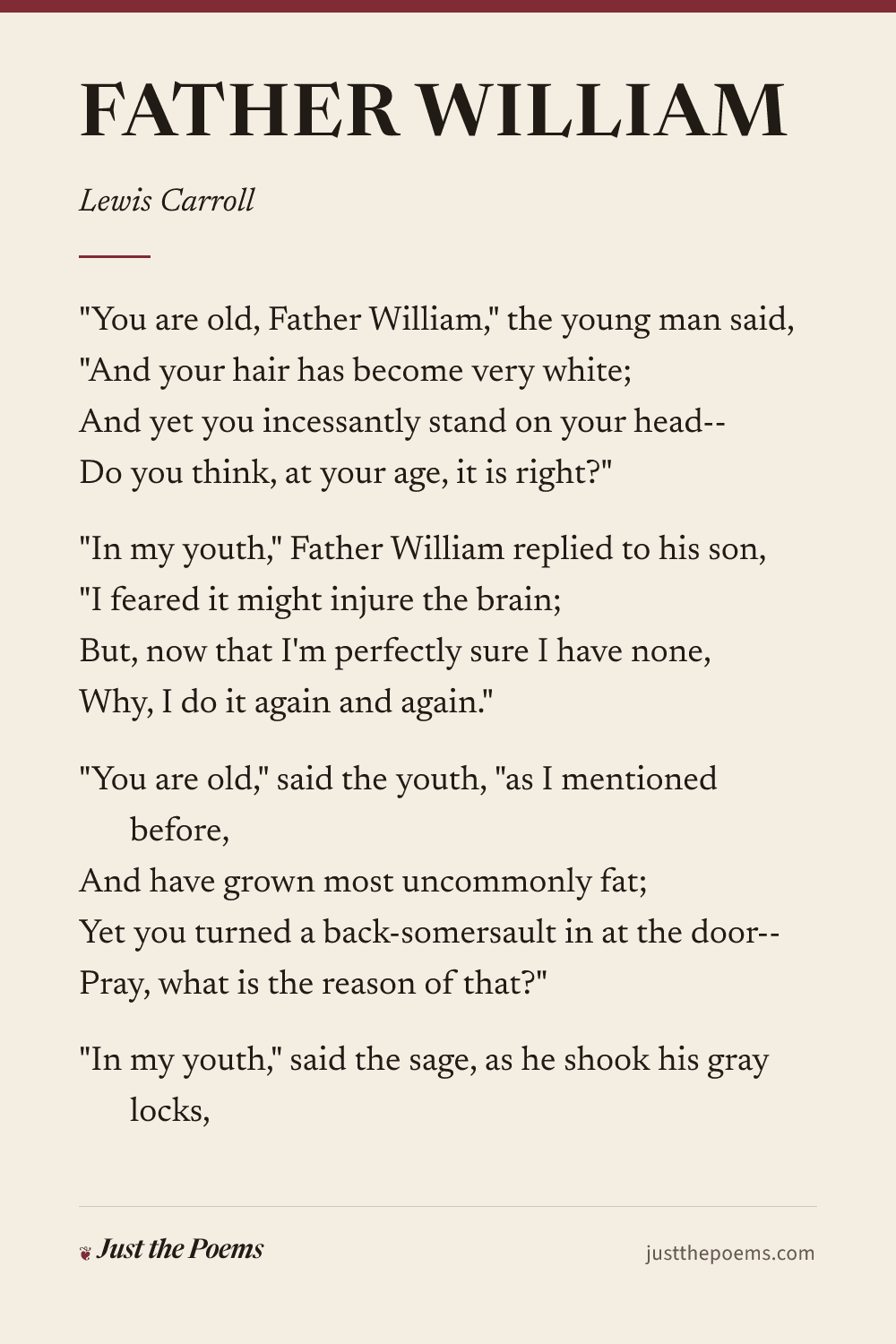
FATHER WILLIAM

Lewis Carroll

In 0 Wikipedias 1 anthology Poet in 111 Wikipedias

"You are old, Father William," the young man said,"And your hair has become very white;And yet you incessantly stand on your head--Do you think, at your age, it is right?"

"In my youth," Father William replied to his son,"I feared it might injure the brain;But, now that I'm perfectly sure I have none,Why, I do it again and again."

"You are old," said the youth, "as I mentioned before,And have grown most uncommonly fat;Yet you turned a back-somersault in at the door--Pray, what is the reason of that?"

Show all 32 lines 20 more

"In my youth," said the sage, as he shook his gray locks,"I kept all my limbs very suppleBy the use of this ointment--one shilling the box--Allow me to sell you a couple?"

"You are old," said the youth, "and your jaws are too weakFor anything tougher than suet;Yet you finished the goose, with the bones and the beak--Pray, how did you manage to do it?"

"In my youth," said his father, "I took to the law,And argued each case with my wife;And the muscular strength which it gave to my jaw,Has lasted the rest of my life."

"You are old," said the youth, "one would hardly supposeThat your eye was as steady as ever;Yet you balanced an eel on the end of your nose--What made you so awfully clever?"

"I have answered three questions and that is enough,"Said his father; "don't give yourself airs!Do you think I can listen all day to such stuff?Be off, or I'll kick you downstairs!"

Source

The Home Book of Verse, ed. Burton Egbert Stevenson

Filed under
  • Named in the title

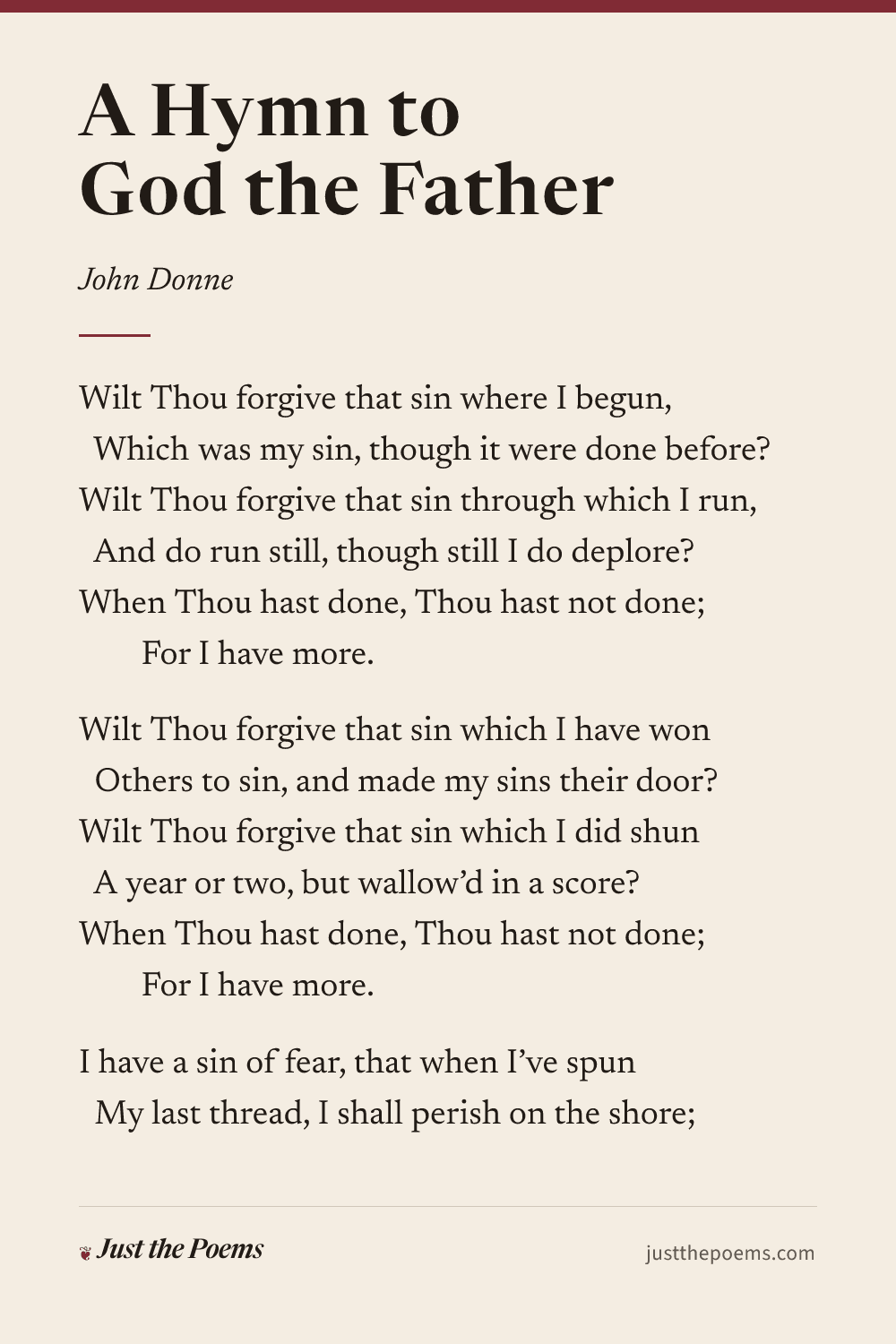
A Hymn to God the Father

John Donne

In 0 Wikipedias 1 anthology Poet in 74 Wikipedias

Wilt Thou forgive that sin where I begun, Which was my sin, though it were done before?Wilt Thou forgive that sin through which I run, And do run still, though still I do deplore?When Thou hast done, Thou hast not done; For I have more.

Wilt Thou forgive that sin which I have won Others to sin, and made my sins their door?Wilt Thou forgive that sin which I did shun A year or two, but wallow’d in a score?When Thou hast done, Thou hast not done; For I have more.

I have a sin of fear, that when I’ve spun My last thread, I shall perish on the shore;But swear by Thyself that at my death Thy Son Shall shine as He shines now and heretofore:And having done that, Thou hast done; I fear no more.

Source

The Oxford Book of English Verse 1250–1900, 1900

Filed under
  • Named in the title

THE ROMAN FATHER

Thomas Babington, Lord Macaulay

In 0 Wikipedias 1 anthology Poet in 48 Wikipedias

Straightway Virginius led the maid A little space aside,To where the reeking shambles stood, Piled up with horn and hide;Close to yon low dark archway, Where, in a crimson flood,Leaps down to the great sewer The gurgling stream of blood.

Hard by, a flesher on a block Had laid his whittle down:Virginius caught the whittle up, And hid it in his gown.

Show all 128 lines 116 more

And then his eyes grew very dim, And his throat began to swell,And in a hoarse, changed voice he spake, "Farewell, sweet child! Farewell!

"O, how I loved my darling! Though stern I sometimes be,To thee, thou know'st, I was not so,-- Who could be so to thee?And how my darling loved me! How glad she was to hearMy footstep on the threshold When I came back last year!

"And how she danced with pleasure To see my civic crown,And took my sword, and hung it up, And brought me forth my gown!Now, all those things are over,-- Yes, all thy pretty ways,Thy needlework, thy prattle, Thy snatches of old lays;

"And none will grieve when I go forth, Or smile when I return,Or watch beside the old man's bed, Or weep upon his urn.The house that was the happiest Within the Roman walls,The house that envied not the wealth Of Capua's marble halls,

"Now, for the brightness of thy smile, Must have eternal gloom,And for the music of thy voice, The silence of the tomb.The time is come! See how he points His eager hand this way!See how his eyes gloat on thy grief, Like a kite's upon the prey!

"With all his wit, he little deems That, spurned, betrayed, bereft,Thy father hath, in his despair, One fearful refuge left.He little deems that in this hand I clutch what still can saveThy gentle youth from taunts and blows, The portion of the slave;

"Yea, and from nameless evil, That passes taunt and blow,--Foul outrage which thou knowest not, Which thou shalt never know.Then clasp me round the neck once more, And give me one more kiss;And now, mine own dear little girl, There is no way but this."

With that he lifted high the steel, And smote her in the side,And in her blood she sank to earth, And with one sob she died.Then, for a little moment, All people held their breath;And through the crowded forum Was stillness as of death;

And in another moment Brake forth, from one and all,A cry as if the Volscians Were coming o'er the wall.Some with averted faces Shrieking fled home amain;Some ran to call a leech; and some Ran to lift up the slain.

Some felt her lips and little wrist, If life might there be found;And some tore up their garments fast, And strove to stanch the wound.In vain they ran, and felt, and stanched; For never truer blowThat good right arm had dealt in fight Against a Volscian foe.

When Appius Claudius saw that deed, He shuddered and sank down,And hid his face some little space With the corner of his gown;Till, with white lips and bloodshot eyes, Virginius tottered nigh,And stood before the judgment-seat, And held the knife on high.

"O dwellers in the nether gloom, Avengers of the slain,By this dear blood I cry to you Do right between us twain;And even as Appius Claudius Hath dealt by me and mine,Deal you by Appius Claudius, And all the Claudian line!"

So spake the slayer of his child, And turned and went his way;But first he cast one haggard glance To where the body lay,And writhed, and groaned a fearful groan, And then, with-steadfast feet,Strode right across the market-place Unto the Sacred Street.

Then up sprang Appius Claudius: "Stop him; alive or dead!Ten thousand pounds of copper To the man who brings his head."He looked upon his clients; But none would work his will.He looked upon his lictors; But they trembled, and stood still.

And as Virginius through the press His way in silence cleft,Ever the mighty multitude Fell back to right and left.And he hath passed in safety Onto his woful home,And there ta'en horse to tell the camp What deeds are done in Rome.
Source

The World's Best Poetry, Vol. IX, ed. Bliss Carman, 1904

Filed under
  • Named in the title

Advertisements

FATHER, THY WILL BE DONE!

Sarah Flower Adams

In 0 Wikipedias 1 anthology Poet in 23 Wikipedias

He sendeth sun, he sendeth shower,Alike they're needful for the flower;And joys and tears alike are sentTo give the soul fit nourishment: As comes to me or cloud or sun, Father, thy will, not mine, be done!

Can loving children e'er reproveWith murmurs whom they trust and love?Creator, I would ever beA trusting, loving child to thee: As comes to me or cloud or sun, Father, thy will, not mine, be done!

Oh, ne'er will I at life repine;Enough that thou hast made it mine;When falls the shadow cold of death,I yet will sing with parting breath: As comes to me or shade or sun, Father, thy will, not mine, be done!

Source

The World's Best Poetry, Vol. IV, ed. Bliss Carman, 1904

Filed under
  • Named in the title

FATHER AND MOTHER TONGUE

Samuel Lover

In 0 Wikipedias 1 anthology Poet in 6 Wikipedias

Our Father Land! and wouldst thou know Why we should call it Father Land?It is that Adam here below Was made of earth by Nature's hand;And he our father, made of earth, Hath peopled earth on every hand;And we, in memory of his birth, Do call our country Father Land.

At first, in Eden's bowers, they say, No sound of speech had Adam caught,But whistled like a bird all day,-- And maybe 'twas for want of thought:But Nature, with resistless laws, Made Adam soon surpass the birds;She gave him lovely Eve because If he'd a wife they must have words.

And so the native land, I hold, By male descent is proudly mine;The language, as the tale hath told, Was given in the female line.And thus we see on either hand We name our blessings whence they've sprung;We call our country Father Land, We call our language Mother Tongue.

Source

The World's Best Poetry, Vol. VIII, ed. Bliss Carman, 1904

Filed under
  • Named in the title

'OUR FATHERS OF OLD'

Rudyard Kipling

In 0 Wikipedias 0 anthologies Poet in 126 Wikipedias

Excellent herbs had our fathers of old-- Excellent herbs to ease their pain--Alexanders and Marigold, Eyebright, Orris, and Elecampane.Basil, Rocket, Valerian, Rue, (Almost singing themselves they run)Vervain, Dittany, Call-me-to-you-- Cowslip, Melilot, Rose of the Sun. Anything green that grew out of the mould Was an excellent herb to our fathers of old.

Wonderful tales had our fathers of old-- Wonderful tales of the herbs and the stars--

Show all 51 lines 39 more

The Sun was Lord of the Marigold, Basil and Rocket belonged to Mars.Pat as a sum in division it goes-- (Every plant had a star bespoke)--Who but Venus should govern the Rose? Who but Jupiter own the Oak? Simply and gravely the facts are told In the wonderful books of our fathers of old.

Wonderful little, when all is said, Wonderful little our fathers knew.Half their remedies cured you dead-- Most of their teaching was quite untrue--'Look at the stars when a patient is ill, (Dirt has nothing to do with disease,)Bleed and blister as much as you will, Blister and bleed him as oft as you please.' Whence enormous and manifold Errors were made by our fathers of old.

Yet when the sickness was sore in the land, And neither planets nor herbs assuaged,They took their lives in their lancet-hand And, oh, what a wonderful war they waged!Yes, when the crosses were chalked on the door-- (Yes, when the terrible dead-cart rolled,)Excellent courage our fathers bore-- Excellent heart had our fathers of old. None too learned, but nobly bold Into the fight went our fathers of old.

If it be certain, as Galen says, And sage Hippocrates holds as much--'That those afflicted by doubts and dismays Are mightily helped by a dead man's touch',Then, be good to us, stars above! Then, be good to us, herbs below!We are afflicted by what we can prove, We are distracted by what we know-- So--ah, so! Down from your heaven or up from your mould, Send us the hearts of our fathers of old!

Source

Songs from Books, 1914

Filed under
  • Named in the title

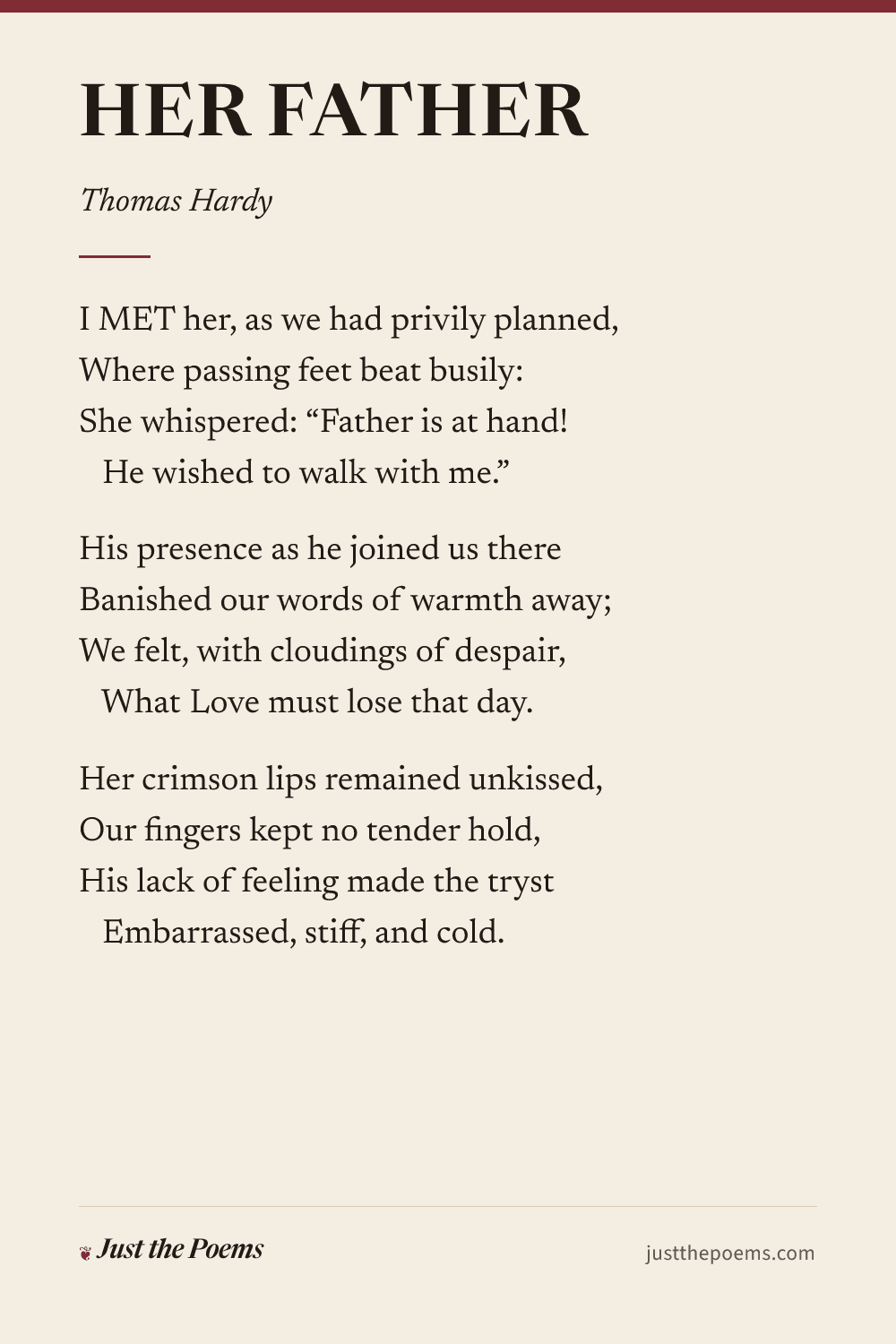
HER FATHER

Thomas Hardy

In 0 Wikipedias 0 anthologies Poet in 91 Wikipedias

I MET her, as we had privily planned,Where passing feet beat busily:She whispered: “Father is at hand! He wished to walk with me.”

His presence as he joined us thereBanished our words of warmth away;We felt, with cloudings of despair, What Love must lose that day.

Her crimson lips remained unkissed,Our fingers kept no tender hold,His lack of feeling made the tryst Embarrassed, stiff, and cold.

A cynic ghost then rose and said,“But is his love for her so smallThat, nigh to yours, it may be read As of no worth at all?

“You love her for her pink and white;But what when their fresh splendours close?His love will last her in despite Of Time, and wrack, and foes.”

Source

Time's Laughingstocks, and Other Verses, 1928

Filed under
  • Named in the title

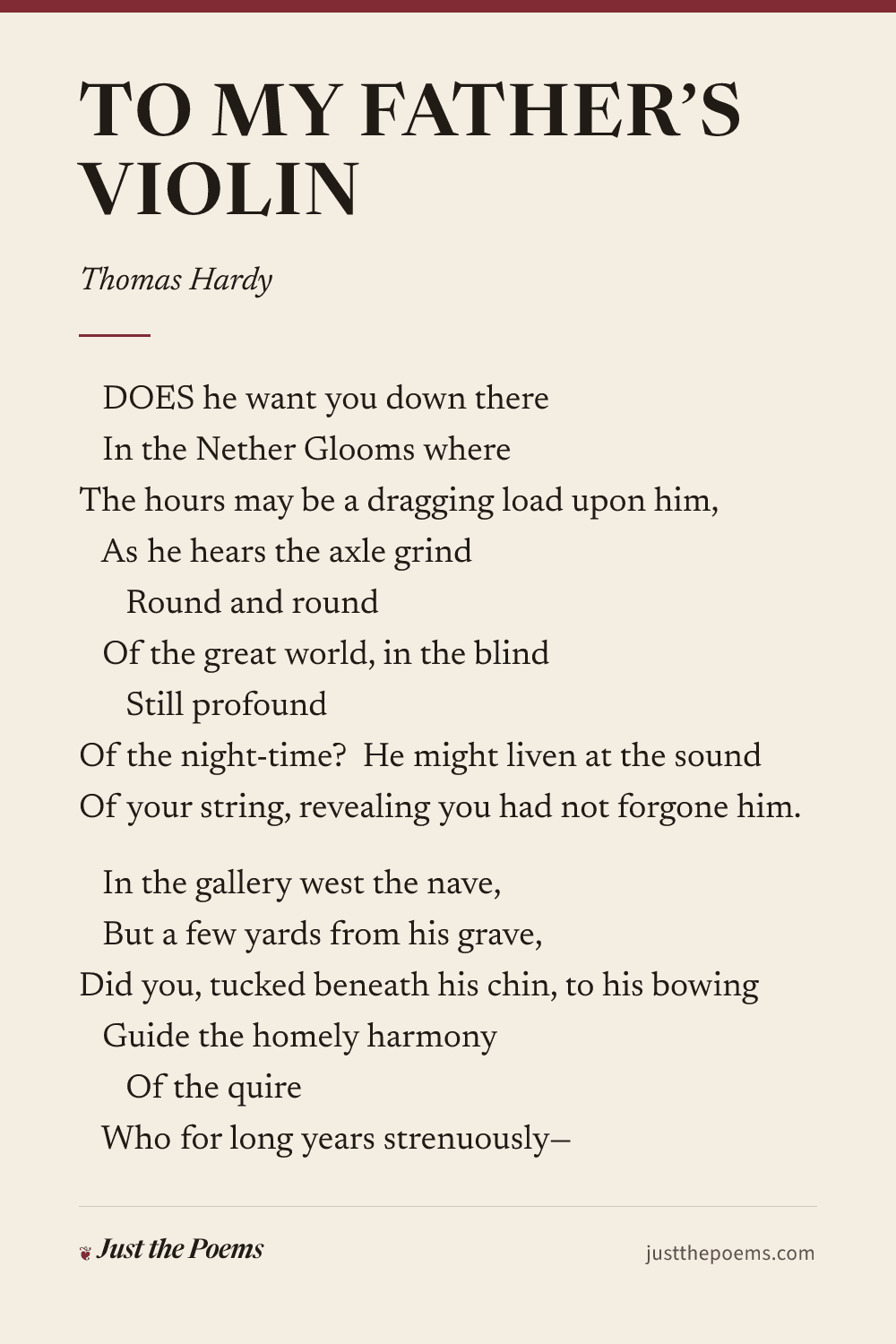
TO MY FATHER’S VIOLIN

Thomas Hardy

In 0 Wikipedias 0 anthologies Poet in 91 Wikipedias

DOES he want you down there In the Nether Glooms whereThe hours may be a dragging load upon him, As he hears the axle grind Round and round Of the great world, in the blind Still profoundOf the night-time? He might liven at the soundOf your string, revealing you had not forgone him.

In the gallery west the nave, But a few yards from his grave,Did you, tucked beneath his chin, to his bowing

Show all 45 lines 33 more

Guide the homely harmony Of the quire Who for long years strenuously— Son and sire—Caught the strains that at his fingering low or higherFrom your four thin threads and eff-holes came outflowing.

And, too, what merry tunes He would bow at nights or noonsThat chanced to find him bent to lute a measure, When he made you speak his heart As in dream, Without book or music-chart, On some themeElusive as a jack-o’-lanthorn’s gleam,And the psalm of duty shelved for trill of pleasure.

Well, you can not, alas, The barrier overpassThat screens him in those Mournful Meads hereunder, Where no fiddling can be heard In the glades Of silentness, no bird Thrills the shades;Where no viol is touched for songs or serenades,No bowing wakes a congregation’s wonder.

He must do without you now, Stir you no more anyhowTo yearning concords taught you in your glory; While, your strings a tangled wreck, Once smart drawn, Ten worm-wounds in your neck, Purflings wanWith dust-hoar, here alone I sadly conYour present dumbness, shape your olden story.

Source

Moments of Vision and Miscellaneous Verses, 1929

Filed under
  • Named in the title

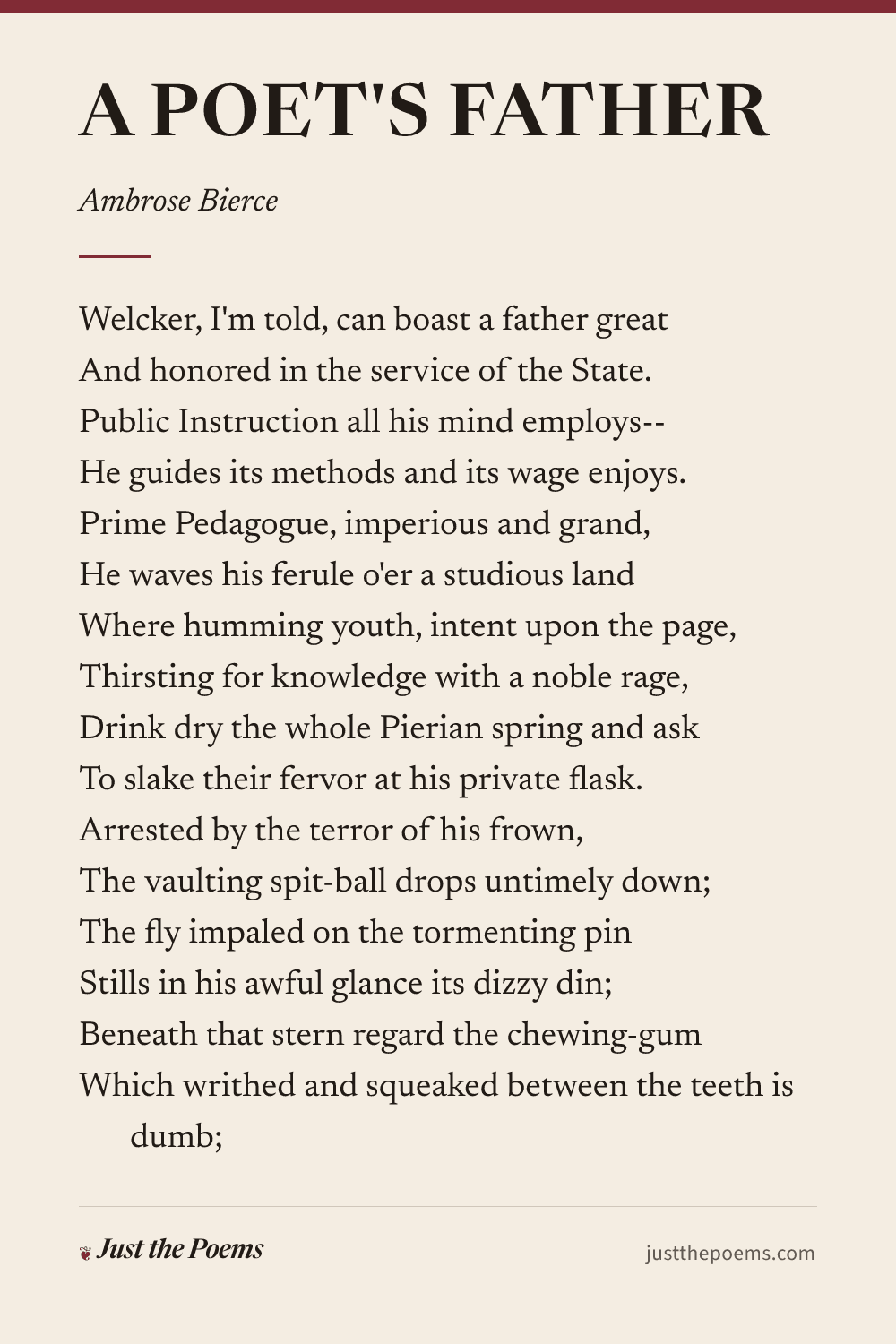
A POET'S FATHER

Ambrose Bierce

In 0 Wikipedias 0 anthologies Poet in 59 Wikipedias

Welcker, I'm told, can boast a father greatAnd honored in the service of the State.Public Instruction all his mind employs--He guides its methods and its wage enjoys.Prime Pedagogue, imperious and grand,He waves his ferule o'er a studious landWhere humming youth, intent upon the page,Thirsting for knowledge with a noble rage,Drink dry the whole Pierian spring and askTo slake their fervor at his private flask.Arrested by the terror of his frown,The vaulting spit-ball drops untimely down;

Show all 34 lines 22 more

The fly impaled on the tormenting pinStills in his awful glance its dizzy din;Beneath that stern regard the chewing-gumWhich writhed and squeaked between the teeth is dumb;Obedient to his will the dunce-cap fliesTo perch upon the brows of the unwise;The supple switch forsakes the parent woodTo settle where 'twill do the greatest good,Puissant still, as when of old it stroveWith Solomon for spitting on the stoveLearned Professor, variously great,Guide, guardian, instructor of the State--Quick to discern and zealous to correctThe faults which mar the public intellectFrom where of Siskiyou the northern boundIs frozen eternal to the sunless groundTo where in San Diego's torrid climeThe swarthy Greaser swelters in his grime--Beneath your stupid nose can you not seeThe dunce whom once you dandled on your knee?O mighty master of a thousand schools,Stop teaching wisdom, or stop breeding fools.

Source

Black Beetles in Amber, 1892

Filed under
  • Named in the title

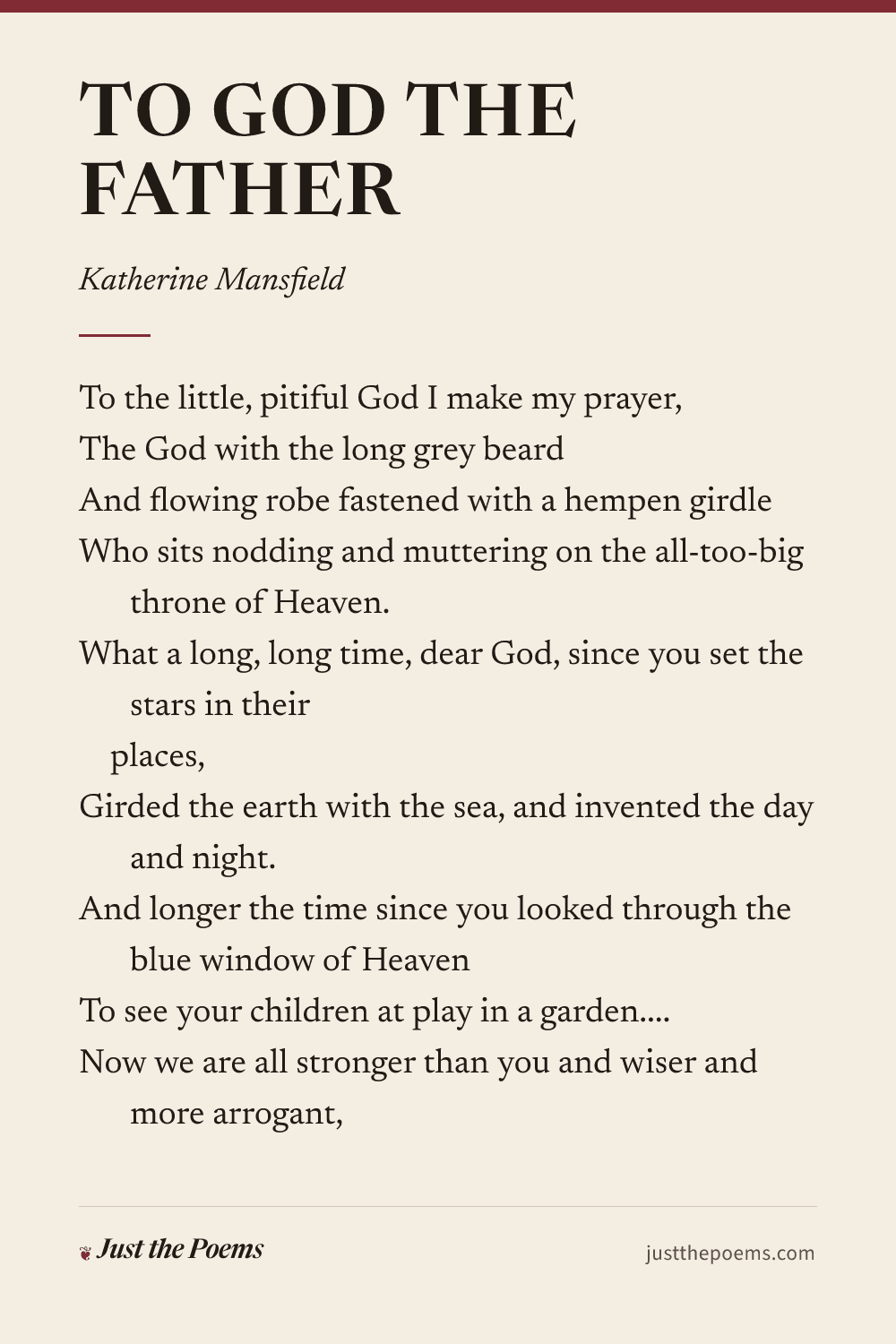
TO GOD THE FATHER

Katherine Mansfield

In 0 Wikipedias 0 anthologies Poet in 53 Wikipedias

To the little, pitiful God I make my prayer,The God with the long grey beardAnd flowing robe fastened with a hempen girdleWho sits nodding and muttering on the all-too-big throne of Heaven.What a long, long time, dear God, since you set the stars in their places,Girded the earth with the sea, and invented the day and night.And longer the time since you looked through the blue window of HeavenTo see your children at play in a garden....Now we are all stronger than you and wiser and more arrogant,In swift procession we pass you by.“Who is that marionette nodding and mutteringOn the all-too-big throne of Heaven?Come down from your place, Grey Beard,We have had enough of your play-acting!” It is centuries since I believed in you,But to-day my need of you has come back.I want no rose-coloured future,No books of learning, no protestations and denials--I am sick of this ugly scramble,I am tired of being pulled about--O God, I want to sit on your kneesOn the all-too-big throne of Heaven,And fall asleep with my hands tangled in your grey beard.

Source

Poems, 1923

Filed under
  • Named in the title

10 poems for dads

9 poets

By poet's century of death

CenturyPoems
17th1
19th4
20th5

Poets with more than one poem

PoetPoems
Thomas Hardy2