Poems About God

The first 30 of 37 poems about god, by 24 poets, ranked by third-party data. How poems are ranked

THE GIFTS OF GOD

George Herbert

In 0 Wikipedias 4 anthologies Poet in 37 Wikipedias

When God at first made Man,Having a glass of blessings standing by;Let us (said he) pour on him all we can:Let the world's riches, which dispersed lie, Contract into a span.

So strength first made a way;Then beauty flow'd, then wisdom, honour, pleasure:When almost all was out, God made a stay,Perceiving that alone, of all his treasure, Rest in the bottom lay.

For if I should (said he)Bestow this jewel also on my creature,He would adore My gifts instead of Me,And rest in Nature, not the God of Nature: So both should losers be.

Yet let him keep the rest,But keep them with repining restlessness:Let him be rich and weary, that at least,If goodness lead him not, yet weariness May toss him to my breast.

Source

The Golden Treasury, ed. Francis Turner Palgrave

Filed under
  • Named in the title

GOD'S JUDGMENT ON A WICKED BISHOP

Robert Southey

In 0 Wikipedias 3 anthologies Poet in 44 Wikipedias

The summer and autumn had been so wet,That in winter the corn was growing yet:'Twas a piteous sight to see all aroundThe grain lie rotting on the ground.

Every day the starving poorCrowded around Bishop Hatto's door;For he had a plentiful last-year's store,And all the neighborhood could tellHis granaries were furnished well.

At last Bishop Hatto appointed a dayTo quiet the poor without delay;He bade them to his great barn repair,

Show all 76 lines 64 more

And they should have food for the winter there.

Rejoiced the tidings good to hear,The poor folks flocked from far and near;The great barn was full as it could holdOf women and children, and young and old.

Then, when he saw it could hold no more,Bishop Hatto he made fast the door;And whilst for mercy on Christ they call,He set fire to the barn, and burnt them all.

"I' faith, 'tis an excellent bonfire!" quoth he;"And the country is greatly obliged to meFor ridding it, in these times forlorn,Of rats that only consume the corn."

So then to his palace returned he,And he sate down to supper merrily,And he slept that night like an innocent man;But Bishop Hatto never slept again.

In the morning, as he entered the hall,Where his picture hung against the wall,A sweat like death all over him came,For the rats had eaten it out of the frame.

As he looked, there came a man from his farm--He had a countenance white with alarm:"My lord, I opened your granaries this morn,And the rats had eaten all your corn."

Another came running presently,And he was pale as pale could be."Fly! my lord bishop, fly!" quoth he,"Ten thousand rats are coming this way,--The Lord forgive you for yesterday!"

"I'll go to my tower in the Rhine," replied he;"'T is the safest place in Germany,--The walls are high, and the shores are steep,And the tide is strong, and the water deep."

Bishop Hatto fearfully hastened away;And he crossed the Rhine without delay,And reached his tower, and barred with careAll the windows, doors, and loop-holes there.

He laid him down and closed his eyes,But soon a scream made him arise;He started, and saw two eyes of flameOn his pillow, from whence the screaming came.

He listened and looked,--it was only the cat;But the bishop he grew more fearful for that,For she sate screaming, mad with fear,At the army of rats that were drawing near.

For they have swum over the river so deep,And they have climbed the shores so steep,And now by thousands up they crawlTo the holes and the windows in the wall.

Down on his knees the bishop fell,And faster and faster his beads did he tell,As louder and louder, drawing near,The saw of their teeth without he could hear.

And in at the windows, and in at the door,And through the walls, by thousands they pour;And down from the ceiling and up through the floor,From the right and the left, from behind and before,From within and without, from above and below,--And all at once to the bishop they go.

They have whetted their teeth against the stones,And now they pick the bishop's bones;They gnawed the flesh from every limb,For they were sent to do judgment on him!
Source

The World's Best Poetry, Vol. IX, ed. Bliss Carman, 1904

Filed under
  • Named in the title

God's Message to Men

Ralph Waldo Emerson

In 0 Wikipedias 1 anthology Poet in 92 Wikipedias

God said: I am tired of kings; I suffer them no more;Up to my ear the morning brings The outrage of the poor.

Think ye I have made this ball A field of havoc and war,Where tyrants great and tyrants small Might harry the weak and poor?

My angel--his name is Freedom-- Choose him to be your king.He shall cut pathways east and west And fend you with his wing.

I will never have a noble; No lineage counted great,Fishers and choppers and plowmen Shall constitute a state,

And ye shall succor man, 'Tis nobleness to serve;Help them who cannot help again; Beware from right to swerve.

Source

Poems Teachers Ask For, Book Two

Filed under
  • Named in the title

Advertisements

GOD AND MAN

Alexander Pope

In 0 Wikipedias 1 anthology Poet in 78 Wikipedias

Lo, the poor Indian! whose untutored mindSees God in clouds, or hears him in the wind:His soul, proud science never taught to strayFar as the solar walk or Milky Way:Yet simple Nature to his hope has given,Behind the cloud-topt hill, an humbler heaven;Some safer world in depth of woods embraced,Some happier island in the watery waste,Where slaves once more their native land behold,No fiends torment, no Christians thirst for gold.To Be, contents his natural desire;He asks no angel's wing, no seraph's fire;

Show all 74 lines 62 more

But thinks, admitted to that equal sky,His faithful dog shall bear him company. Go, wiser thou! and in thy scale of sense,Weigh thy opinion against Providence:Call imperfection what thou fancy'st such,--Say, here he gives too little, there too much;Destroy all creatures for thy sport or gust,Yet cry, If man's unhappy, God's unjust,--If man alone engross not Heaven's high care,Alone made perfect here, immortal there;Snatch from his hand the balance and the rod,Re-judge his justice, be the god of God.In pride, in reasoning pride, our error lies;All quit their sphere, and rush into the skies.Pride still is aiming at the blest abodes:Men would be angels, angels would be gods.Aspiring to be gods, if angels fell,Aspiring to be angels, men rebel;And who but wishes to invert the lawsOf Order, sins against the Eternal Cause.

All are but parts of one stupendous whole,Whose body Nature is, and God the soul:That, changed through all, and yet in all the same;Great in the earth as in the ethereal frame;Warms in the sun, refreshes in the breeze,Glows in the stars, and blossoms in the trees,Lives through all life, extends through all extent,Spreads undivided, operates unspent:Breathes in our soul, informs our mortal part,As full, as perfect, in a hair as heart;As full, as perfect, in vile man that mourns,As the rapt seraph that adores and burns:To him no high, no low, no great, no small;He fills, he bounds, connects, and equals all. Cease then, nor order imperfection name:Our proper bliss depends on what we blame.Know thy own point: This kind, this due degreeOf blindness, weakness, Heaven bestows on thee.Submit.--In this or any other sphere,Secure to be as blest as thou canst bear;Safe in the hand of one disposing Power,Or in the natal or the mortal hour.All nature is but art unknown to thee;All chance, direction which thou canst not see;All discord, harmony not understood;All partial evil, universal good:And, spite of pride, in erring reason's spite,One truth is clear--Whatever is, is right.

Order is Heaven's first law: and, this confest,Some are and must be greater than the rest,More rich, more wise; but who infers from henceThat such are happier, shocks all common-sense.Heaven to mankind impartial we confess,If all are equal in their happiness:But mutual wants this happiness increase;All nature's difference keeps all nature's peace.Condition, circumstance, is not the thing:Bliss is the same in subject or in king,In who obtain defence or who defend,In him who is or him who finds a friend;Heaven breathes through every member of the wholeOne common blessing, as one common soul.

Source

The World's Best Poetry, Vol. IV, ed. Bliss Carman, 1904

Filed under
  • Named in the title

MY GOD, I LOVE THEE

St. Francis Xavier

In 0 Wikipedias 1 anthology Poet in 78 Wikipedias

My God, I love thee! not because I hope for heaven thereby;Nor because those who love thee not Must burn eternally.

Thou, O my Jesus, thou didst me Upon the cross embrace!For me didst bear the nails and spear, And manifold disgrace,

And griefs and torments numberless, And sweat of agony,Yea, death itself,--and all for one That was thine enemy.

Then why, O blessed Jesus Christ, Should I not love thee well?Not for the hope of winning heaven, Nor of escaping hell;

Not with the hope of gaining aught, Not seeking a reward;But as thyself hast loved me, O everlasting Lord!

E'en so I love thee, and will love, And in thy praise will sing,--Solely because thou art my God, And my eternal King.

Source

The World's Best Poetry, Vol. IV, ed. Bliss Carman, 1904

Filed under
  • Named in the title

A Hymn to God the Father

John Donne

In 0 Wikipedias 1 anthology Poet in 74 Wikipedias

Wilt Thou forgive that sin where I begun, Which was my sin, though it were done before?Wilt Thou forgive that sin through which I run, And do run still, though still I do deplore?When Thou hast done, Thou hast not done; For I have more.

Wilt Thou forgive that sin which I have won Others to sin, and made my sins their door?Wilt Thou forgive that sin which I did shun A year or two, but wallow’d in a score?When Thou hast done, Thou hast not done; For I have more.

I have a sin of fear, that when I’ve spun My last thread, I shall perish on the shore;But swear by Thyself that at my death Thy Son Shall shine as He shines now and heretofore:And having done that, Thou hast done; I fear no more.

Source

The Oxford Book of English Verse 1250–1900, 1900

Filed under
  • Named in the title

STRONG SON OF GOD, IMMORTAL LOVE

Alfred, Lord Tennyson

In 0 Wikipedias 1 anthology Poet in 72 Wikipedias

Strong Son of God, immortal Love, Whom we, that have not seen thy face, By faith, and faith alone, embrace,Believing where we cannot prove;

Thine are these orbs of light and shade; Thou madest Life in man and brute; Thou madest Death; and lo, thy footIs on the skull which thou hast made.

Thou wilt not leave us in the dust: Thou madest man, he knows not why; He thinks he was not made to die;And thou hast made him: thou art just.

Show all 44 lines 32 more

Thou seemest human and divine, The highest, holiest manhood, thou: Our wills are ours, we know not how;Our wills are ours, to make them thine.

Our little systems have their day; They have their day and cease to be: They are but broken lights of thee,And thou, O Lord, art more than they.

We have but faith: we cannot know; For knowledge is of things we see; And yet we trust it comes from thee,A beam in darkness: let it grow.

Let knowledge grow from more to more, But more of reverence in us dwell; That mind and soul, according well,May make one music as before,

But vaster. We are fools and slight; We mock thee when we do not fear: But help thy foolish ones to bear;Help thy vain worlds to bear thy light.

Forgive what seemed my sin in me; What seemed my worth since I began; For merit lives from man to man,And not from man, O Lord, to thee.

Forgive my grief for one removed, Thy creature, whom I found so fair.I trust he lives in thee, and there I find him worthier to be loved.

Forgive these wild and wandering cries, Confusions of a wasted youth;Forgive them where they fail in truth, And in thy wisdom make me wise.

Source

The World's Best Poetry, Vol. IV, ed. Bliss Carman, 1904

Filed under
  • Named in the title

GOD'S-ACRE

Henry Wadsworth Longfellow

In 0 Wikipedias 1 anthology Poet in 71 Wikipedias

I like that ancient Saxon phrase which calls The burial-ground God's-Acre! It is just;It consecrates each grave within its walls, And breathes a benison o'er the sleeping dust.

God's Acre! Yes, that blessed name imparts Comfort to those who in the grave have sownThe seed that they had garnered in their hearts, Their bread of life, alas! no more their own.

Into its furrows shall we all be cast, In the sure faith that we shall rise againAt the great harvest, when the archangel's blast Shall winnow, like a fan, the chaff and grain.

Then shall the good stand in immortal bloom, In the fair gardens of that second birth;And each bright blossom mingle its perfume With that of flowers which never bloomed on earth.

With thy rude ploughshare, Death, turn up the sod, And spread the furrow for the seed we sow;This is the field and Acre of our God, This is the place where human harvests grow!

Source

The World's Best Poetry, Vol. III, ed. Bliss Carman, 1904

Filed under
  • Named in the title

Advertisements

A Child's Thought of God

Elizabeth Barrett Browning

In 0 Wikipedias 1 anthology Poet in 60 Wikipedias

They say that God lives very high; But if you look above the pinesYou cannot see our God; and why?

And if you dig down in the mines, You never see him in the gold,Though from Him all that's glory shines.

God is so good, He wears a fold Of heaven and earth across His face,Like secrets kept for love untold.

But still I feel that His embrace Slides down by thrills through all things made,Through sight and sound of every place;

As if my tender mother laid On my shut lips her kisses' pressure,Half waking me at night, and said, "Who kissed you through the dark, dear guesser?"

Source

Poems Teachers Ask For

Filed under
  • Named in the title

God Lyaeus

John Fletcher

In 0 Wikipedias 1 anthology Poet in 33 Wikipedias

God Lyaeus, ever young,Ever honour’d, ever sung,Stain’d with blood of lusty grapes,In a thousand lusty shapesDance upon the mazer’s brim,In the crimson liquor swim;

From thy plenteous hand divineLet a river run with wine: God of youth, let this day here Enter neither care nor fear.

Source

The Oxford Book of English Verse 1250–1900, 1900

Filed under
  • Named in the title

PRAISE TO GOD

Anna Laetitia Barbauld

In 0 Wikipedias 1 anthology Poet in 27 Wikipedias

Praise to God, immortal praise,For the love that crowns our days--Bounteous source of every joy,Let Thy praise our tongues employ!

For the blessings of the field,For the stores the gardens yield,For the vine's exalted juice,For the generous olive's use;

Flocks that, whiten all the plain,Yellow sheaves of ripened grain,Clouds that drop their fattening dews,Suns that temperate warmth diffuse--

Show all 36 lines 24 more

All that Spring, with bounteous hand,Scatters o'er the smiling land;All that liberal Autumn poursFrom her rich o'erflowing stores:

These to Thee, my God, we owe--Source whence all our blessings flow!And for these my soul shall raiseGrateful vows and solemn praise.

Yet should rising whirlwinds tearFrom its stem the ripening ear--Should the fig-tree's blasted shootDrop her green untimely fruit--

Should the vine put forth no more,Nor the olive yield her store--Though the sickening flocks should fall,And the herds desert the stall--

Should Thine altered hand restrainThe early and the latter rain,Blast each opening bud of joy,And the rising year destroy;

Yet to Thee my soul should raiseGrateful vows and solemn praise,And when every blessing's flown,Love Thee--for Thyself alone.

Source

The World's Best Poetry, Vol. IV, ed. Bliss Carman, 1904

Filed under
  • Named in the title

OUR GOD, OUR HELP IN AGES PAST

Isaac Watts

In 0 Wikipedias 1 anthology Poet in 24 Wikipedias

Our God, our help in ages past, Our hope for years to come,Our shelter from the stormy blast, And our eternal home,--

Under the shadow of thy throne Thy saints have dwelt secure;Sufficient is thine arm alone, And our defence is sure.

Before the hills in order stood, Or earth received her frame,From everlasting thou art God, To endless years the same.

A thousand ages in thy sight Are like an evening gone;Short as the watch that ends the night Before the rising sun.

Time like an ever-rolling stream Bears all its sons away;They fly, forgotten, as a dream Dies at the opening day.

Our God, our help in ages past, Our hope for years to come,Be thou our guard while troubles last, And our eternal home.

Source

The World's Best Poetry, Vol. IV, ed. Bliss Carman, 1904

Filed under
  • Named in the title

GOD SAVE THE KING

Henry Carey

In 0 Wikipedias 1 anthology Poet in 13 Wikipedias

God save our gracious king!Long live our noble king! God save the king!Send him victorious,Happy and glorious,Long to reign over us-- God save the king!

O Lord our God, arise!Scatter his enemies, And make them fall;Confound their politics,Frustrate their knavish tricks;On him our hopes we fix, God save us all!

Thy choicest gifts in storeOn him be pleased to pour; Long may he reign.May he defend our laws,And ever give us cause,To sing with heart and voice-- God save the king!

Source

The World's Best Poetry, Vol. VIII, ed. Bliss Carman, 1904

Filed under
  • Named in the title

Advertisements

THE WILL OF GOD

Frederick William Faber

In 0 Wikipedias 1 anthology Poet in 13 Wikipedias

I worship thee, sweet will of God! And all thy ways adore;And every day I live, I seem To love thee more and more.

Thou wert the end, the blessèd rule Of our Saviour's toils and tears;Thou wert the passion of his heart Those three and thirty years.

And he hath breathed into my soul A special love of thee,A love to lose my will in his, And by that loss be free.

Show all 56 lines 44 more

I love to see thee bring to naught The plans of wily men;When simple hearts outwit the wise, Oh, thou art loveliest then.

The headstrong world it presses hard Upon the church full oft,And then how easily thou turn'st The hard ways into soft.

I love to kiss each print where thou Hast set thine unseen feet;I cannot fear thee, blessèd will! Thine empire is so sweet.

When obstacles and trials seem Like prison walls to be,I do the little I can do, And leave the rest to thee.

I know not what it is to doubt, My heart is ever gay;I run no risk, for, come what will, Thou always hast thy way.

I have no cares, O blessèd will! For all my cares are thine:I live in triumph, Lord! for thou Hast made thy triumphs mine.

And when it seems no chance or change From grief can set me free,Hope finds its strength in helplessness, And gayly waits on thee.

Man's weakness, waiting upon God, Its end can never miss,For men on earth no work can do More angel-like than this.

Ride on, ride on, triumphantly, Thou glorious will, ride on!Faith's pilgrim sons behind thee take The road that thou hast gone.

He always wins who sides with God, To him no chance is lost;God's will is sweetest to him, when It triumphs at his cost.

Ill that he blesses is our good, And unblessed good is ill;And all is right that seems most wrong. If it be his sweet will.

Source

The World's Best Poetry, Vol. IV, ed. Bliss Carman, 1904

Filed under
  • Named in the title

DELIGHT IN GOD

Francis Quarles

In 0 Wikipedias 1 anthology Poet in 12 Wikipedias

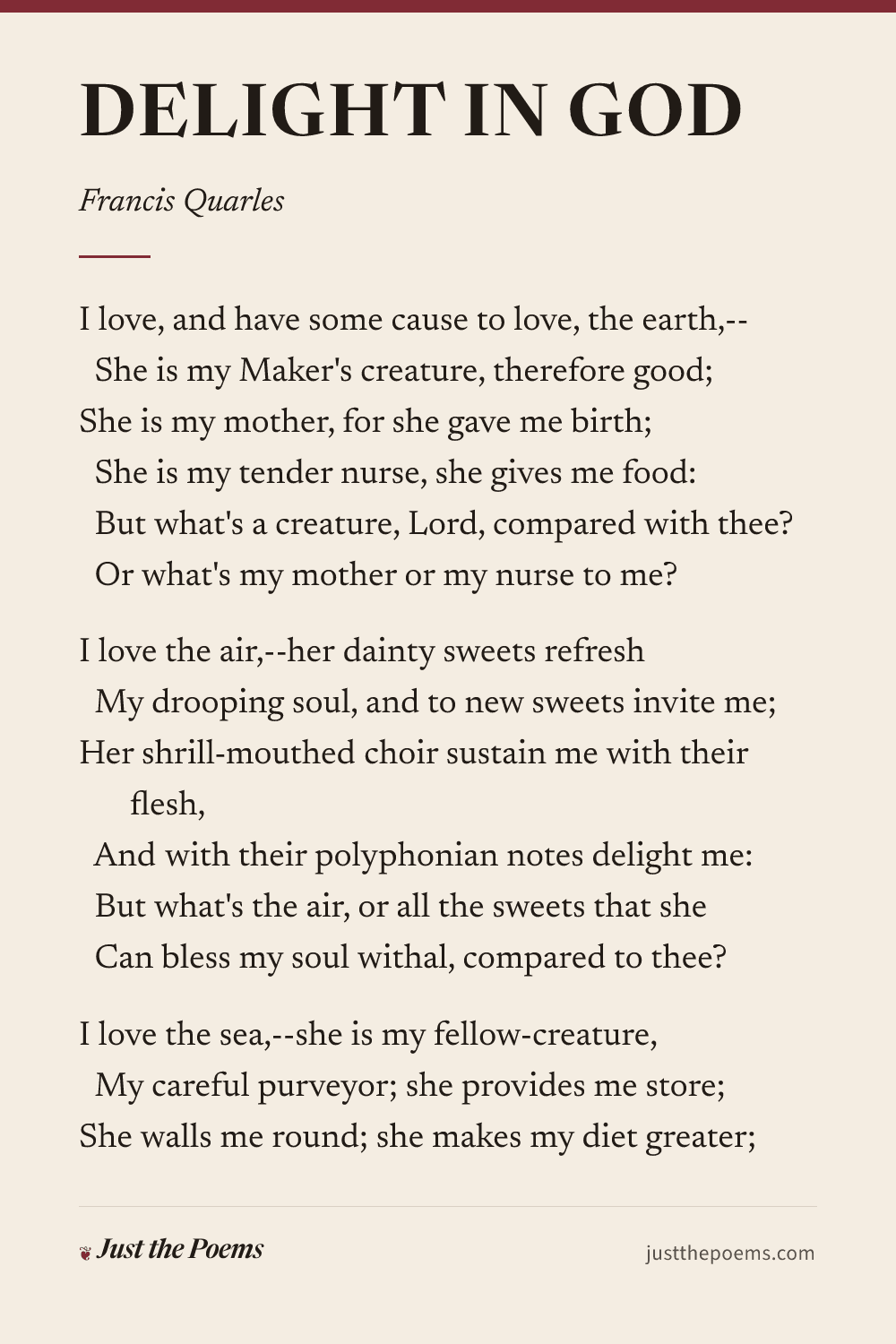
I love, and have some cause to love, the earth,-- She is my Maker's creature, therefore good;She is my mother, for she gave me birth; She is my tender nurse, she gives me food: But what's a creature, Lord, compared with thee? Or what's my mother or my nurse to me?

I love the air,--her dainty sweets refresh My drooping soul, and to new sweets invite me;Her shrill-mouthed choir sustain me with their flesh, And with their polyphonian notes delight me: But what's the air, or all the sweets that she Can bless my soul withal, compared to thee?

Show all 48 lines 36 more

I love the sea,--she is my fellow-creature, My careful purveyor; she provides me store;She walls me round; she makes my diet greater; She wafts my treasure from a foreign shore: But, Lord of oceans, when compared with thee, What is the ocean or her wealth to me?

To heaven's high city I direct my journey, Whose spangled suburbs entertain mine eye;Mine eye, by contemplation's great attorney, Transcends the crystal pavement of the sky: But what is heaven, great God, compared to thee? Without thy presence, heaven's no heaven to me.

Without thy presence, earth gives no refection; Without thy presence, sea affords no treasure;Without thy presence, air's a rank infection; Without thy presence, heaven's itself no pleasure: If not possessed, if not enjoyed in thee, What's earth, or sea, or air, or heaven to me?

The highest honors that the world can boast Are subjects far too low for my desire;The brightest beams of glory are, at most, But dying sparkles of thy living fire; The loudest flames that earth can kindle be But nightly glow-worms, if compared to thee.

Without thy presence, wealth is bags of cares; Wisdom but folly; joy, disquiet--sadness;Friendship is treason, and delights are snares; Pleasures but pain, and mirth but pleasing madness; Without thee, Lord, things be not what they be, Nor have their being, when compared with thee.

In having all things, and not thee, what have I? Not having thee, what have my labors got?Let me enjoy but thee, what further crave I? And having thee alone, what have I not? I wish nor sea nor land; nor would I be Possessed of heaven, heaven unpossessed of thee!

Source

The World's Best Poetry, Vol. IV, ed. Bliss Carman, 1904

Filed under
  • Named in the title

THE BOOK OF GOD

Horatius Bonar

In 0 Wikipedias 1 anthology Poet in 7 Wikipedias

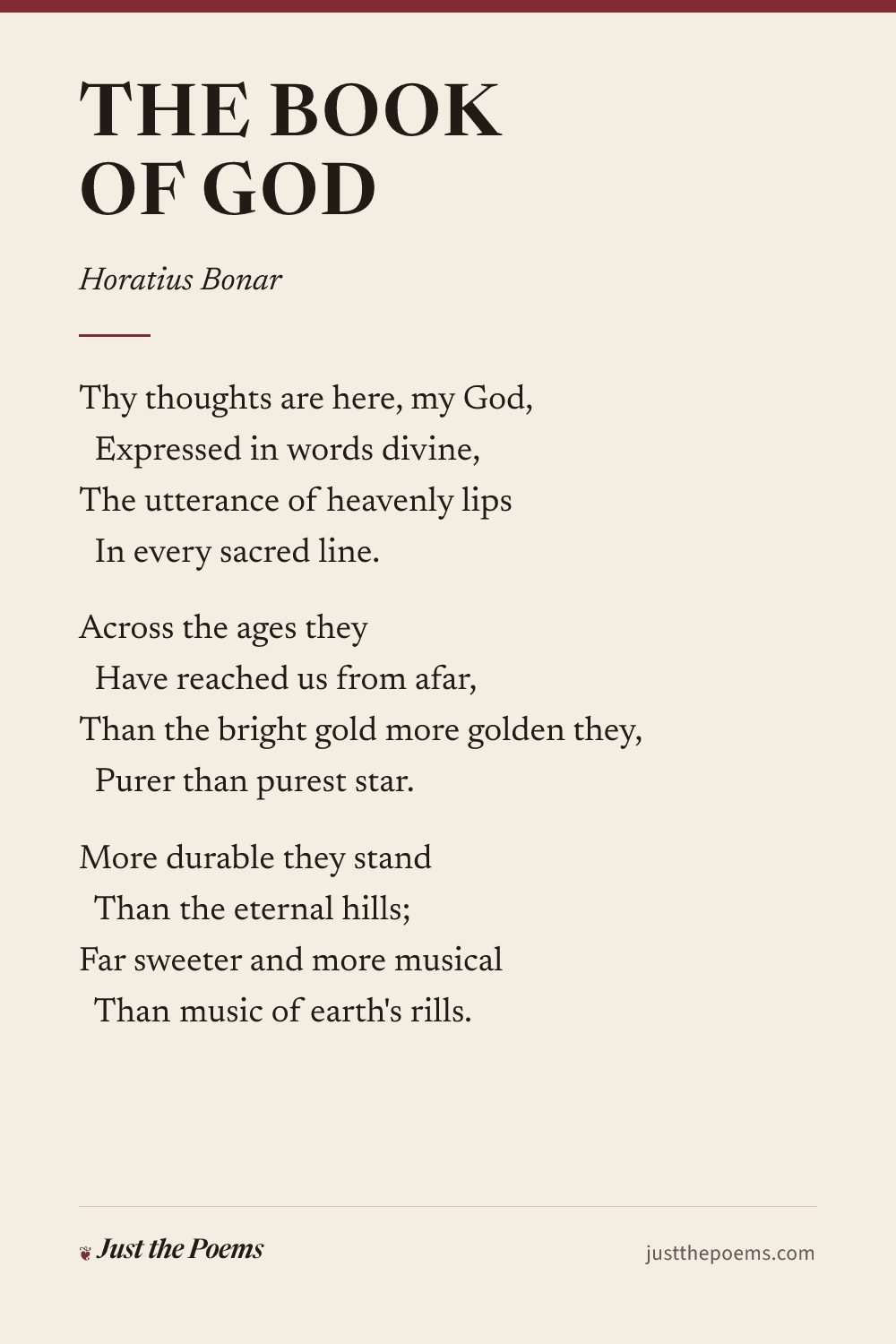
Thy thoughts are here, my God, Expressed in words divine,The utterance of heavenly lips In every sacred line.

Across the ages they Have reached us from afar,Than the bright gold more golden they, Purer than purest star.

More durable they stand Than the eternal hills;Far sweeter and more musical Than music of earth's rills.

Show all 44 lines 32 more

Fairer in their fair hues Than the fresh flowers of earth,More fragrant than the fragrant climes Where odors have their birth.

Each word of thine a gem From the celestial mines,A sunbeam from that holy heaven Where holy sunlight shines.

Thine, thine, this book, though given In man's poor human speech,Telling of things unseen, unheard, Beyond all human reach.

No strength it craves or needs From this world's wisdom vain;No filling up from human wells, Or sublunary rain.

No light from sons of time, Nor brilliance from its gold;It sparkles with its own glad light, As in the ages old.

A thousand hammers keen, With fiery force and strain,Brought down on it in rage and hate, Have struck this gem in vain.

Against this sea-swept rock Ten thousand storms their willOf foam and rage have wildly spent; It lifts its calm face still.

It standeth and will stand, Without or change or age,The word of majesty and light, The church's heritage.

Source

The World's Best Poetry, Vol. IV, ed. Bliss Carman, 1904

Filed under
  • Named in the title

THE LOVE OF GOD

Eliza Scudder

In 0 Wikipedias 1 anthology Poet in 2 Wikipedias

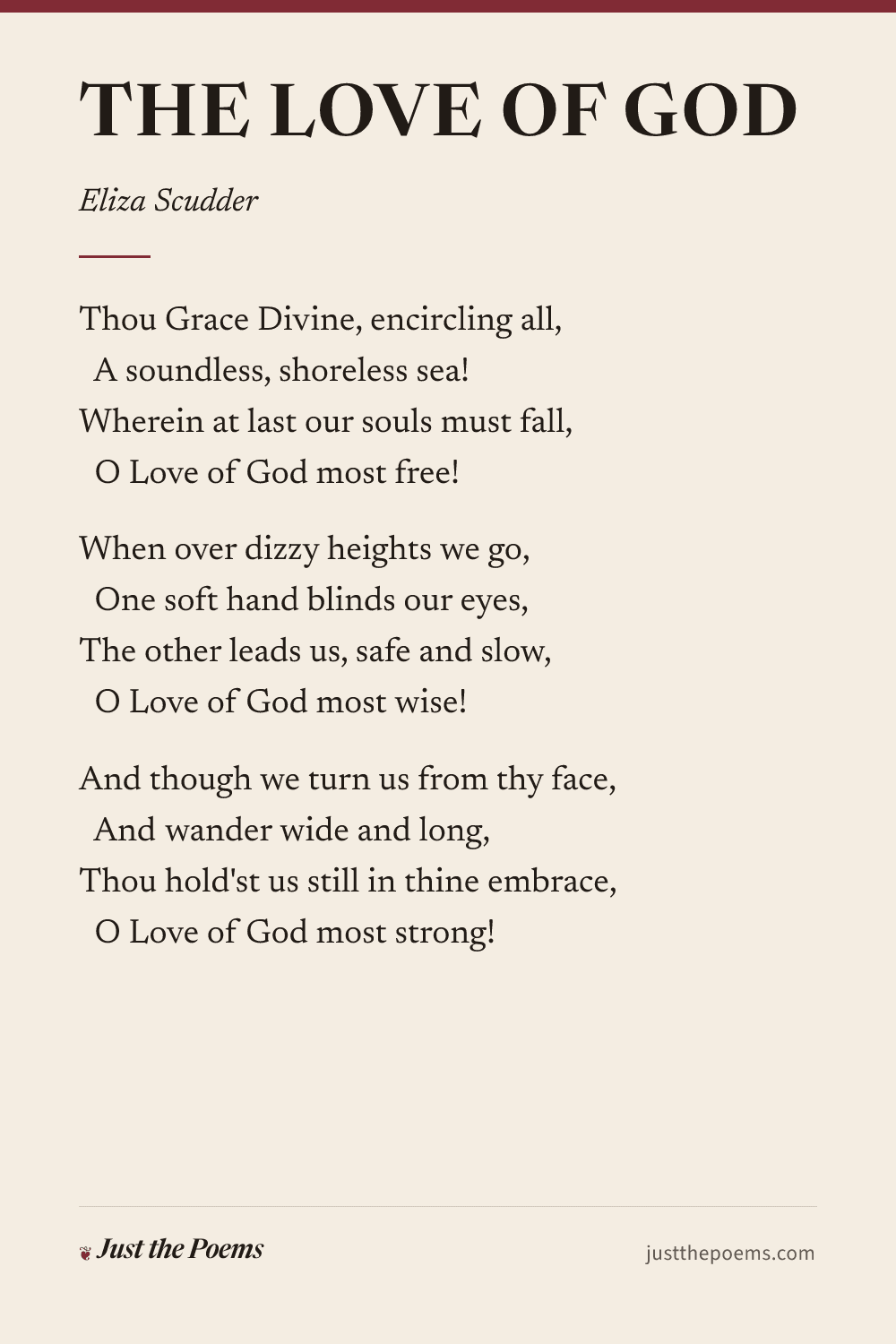
Thou Grace Divine, encircling all, A soundless, shoreless sea!Wherein at last our souls must fall, O Love of God most free!

When over dizzy heights we go, One soft hand blinds our eyes,The other leads us, safe and slow, O Love of God most wise!

And though we turn us from thy face, And wander wide and long,Thou hold'st us still in thine embrace, O Love of God most strong!

The saddened heart, the restless soul, The toil-worn frame and mind,Alike confess thy sweet control, O Love of God most kind!

But not alone thy care we claim, Our wayward steps to win;We know thee by a dearer name, O Love of God within!

And, filled and quickened by thy breath, Our souls are strong and freeTo rise o'er sin and fear and death, O Love of God, to thee!

Source

The World's Best Poetry, Vol. IV, ed. Bliss Carman, 1904

Filed under
  • Named in the title

GOD IS EVERYWHERE

Robert Nicoll

In 0 Wikipedias 1 anthology Poet in 1 Wikipedia

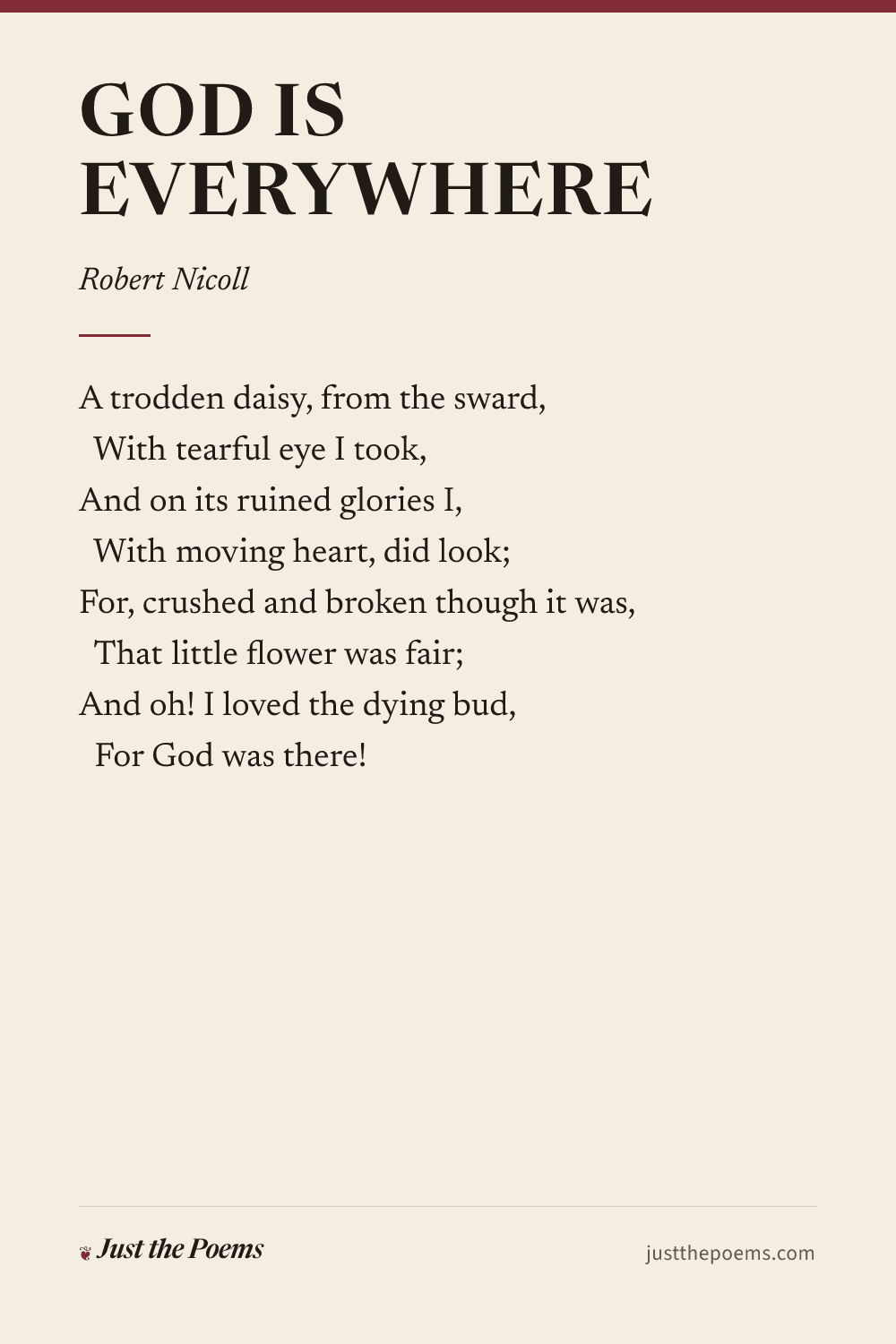
A trodden daisy, from the sward, With tearful eye I took,And on its ruined glories I, With moving heart, did look;For, crushed and broken though it was, That little flower was fair;And oh! I loved the dying bud, For God was there!

I stood upon the sea-beat shore, The waves came rushing on;The tempest raged in giant wrath, The light of day was gone.

Show all 56 lines 44 more

The sailor from his drowning bark Sent up his dying prayer;I looked amid the ruthless storm, And God was there!

I sought a lonely, woody dell, Where all things soft and sweet,Birds, flowers, and trees, and running streams, Mid bright sunshine did meet:I stood beneath an old oak's shade, And summer round was fair;I gazed upon the peaceful scene, And God was there!

I saw a home--a happy home-- Upon a bridal day,And youthful hearts were blithesome there, And aged hearts were gay:I sat amid the smiling band Where all so blissful were--Among the bridal maidens sweet-- And God was there!

I stood beside an infant's couch, When light had left its eye--I saw the mother's bitter tears, I heard her woful cry--I saw her kiss its fair pale face, And smooth its yellow hair;And oh, I loved the mourner's home, For God was there!

I sought a cheerless wilderness-- A desert, pathless wild--Where verdure grew not by the streams, Where beauty never smiled;Where desolation brooded o'er A muirland lone and bare,And awe upon my spirit crept, For God was there!

I looked upon the lowly flower, And on each blade of grass;Upon the forests, wide and deep, I saw the tempests pass:I gazed on all created things In earth, in sea, and air;Then bent the knee--for God, in love, Was everywhere!

Source

The World's Best Poetry, Vol. IV, ed. Bliss Carman, 1904

Filed under
  • Named in the title

"GOD REST YOU MERRY, GENTLEMEN"

Anonymous

In 0 Wikipedias 1 anthology Poet in 0 Wikipedias

God rest you merry, gentlemen,Let nothing you dismay,For Jesus Christ, our Saviour,Was born upon this day,To save us all from Satan's powerWhen we were gone astray.O tidings of comfort and joy!For Jesus Christ, our Saviour,Was born on Christmas Day.

In Bethlehem, in Jewry,This blessed babe was born,And laid within a manger,

Show all 48 lines 36 more

Upon this blessed morn;The which His mother, Mary,Nothing did take in scorn.

From God our Heavenly Father,A blessed angel came;And unto certain shepherdsBrought tidings of the same:How that in Bethlehem was bornThe Son of God by name.

"Fear not," then said the angel,"Let nothing you affright,This day is born a SaviourOf virtue, power, and might,So frequently to vanquish allThe friends of Satan quite."

The shepherds at these tidingsRejoiced much in mind,And left their flocks a-feedingIn tempest, storm, and wind,And went to Bethlehem straightway,This blessed babe to find.

But when to Bethlehem they came,Whereat this infant lay,They found Him in a manger,Where oxen feed on hay,His mother Mary kneeling,Unto the Lord did pray.

Now to the Lord sing praises,All you within this place,And with true love and brotherhoodEach other now embrace;This holy tide of ChristmasAll others doth deface.

O tidings of comfort and joy!For Jesus Christ, our Saviour,Was born in Christmas Day.

Source

The Home Book of Verse, ed. Burton Egbert Stevenson

Filed under
  • Named in the title

THE SACK OF THE GODS

Rudyard Kipling

In 0 Wikipedias 0 anthologies Poet in 126 Wikipedias

Strangers drawn from the ends of the earth, jewelled and plumed were we.I was Lord of the Inca race, and she was Queen of the Sea.Under the stars beyond our stars where the new-forged meteors glowHotly we stormed Valhalla, a million years ago.

Ever 'neath high Valhalla Hall the well-tuned horns beginWhen the swords are out in the underworld, and the weary Gods come in.Ever through high Valhalla Gate the Patient Angel goes;He opens the eyes that are blind with hate--he joins the hands of foes.

Dust of the stars was under our feet, glitter of stars above--Wrecks of our wrath dropped reeling down as we fought and we spurned and we strove.Worlds upon worlds we tossed aside, and scattered them to and fro,The night that we stormed Valhalla, a million years ago!

They are forgiven as they forgive all those dark wounds and deep,Their beds are made on the lap of Time and they lie down and sleep.They are forgiven as they forgive all those old wounds that bleed,They shut their eyes from their worshippers. They sleep till the world has need.

She with the star I had marked for my own--I with my set desire--Lost in the loom of the Night of Nights--lighted by worlds afire--Met in a war against the Gods where the headlong meteors glow,Hewing our way to Valhalla, a million years ago!

They will come back--come back again, as long as the red Earth rolls.He never wasted a leaf or a tree. Do you think He would squander souls?

Source

Songs from Books, 1914

Filed under
  • Named in the title

FLOWER GOD, GOD OF THE SPRING

Robert Louis Stevenson

In 0 Wikipedias 0 anthologies Poet in 101 Wikipedias

FLOWER god, god of the spring, beautiful, bountiful,Cold-dyed shield in the sky, lover of versicles, Here I wander in April Cold, grey-headed; and still to myHeart, Spring comes with a bound, Spring the deliverer,Spring, song-leader in woods, chorally resonant; Spring, flower-planter in meadows, Child-conductor in willowyFields deep dotted with bloom, daisies and crocuses:Here that child from his heart drinks of eternity: O child, happy are children! She still smiles on their innocence,She, dear mother in God, fostering violets,Fills earth full of her scents, voices and violins: Thus one cunning in music Wakes old chords in the memory:Thus fair earth in the Spring leads her performances.One more touch of the bow, smell of the virginal Green—one more, and my bosom Feels new life with an ecstasy.

Source

New Poems, and Variant Readings, 1918

Filed under
  • Named in the title

GOD GAVE TO ME A CHILD IN PART

Robert Louis Stevenson

In 0 Wikipedias 0 anthologies Poet in 101 Wikipedias

GOD gave to me a child in part,Yet wholly gave the father’s heart:Child of my soul, O whither now,Unborn, unmothered, goest thou?

You came, you went, and no man wist;Hapless, my child, no breast you kist;On no dear knees, a privileged babbler, clomb,Nor knew the kindly feel of home.

My voice may reach you, O my dear—A father’s voice perhaps the child may hear;And, pitying, you may turn your viewOn that poor father whom you never knew.

Alas! alone he sits, who then,Immortal among mortal men,Sat hand in hand with love, and all day throughWith your dear mother wondered over you.

Source

New Poems, and Variant Readings, 1918

Filed under
  • Named in the title

SINCE THOU HAST GIVEN ME THIS GOOD HOPE, O GOD

Robert Louis Stevenson

In 0 Wikipedias 0 anthologies Poet in 101 Wikipedias

SINCE thou hast given me this good hope, O God,That while my footsteps tread the flowery sodAnd the great woods embower me, and white dawnAnd purple even sweetly lead me onFrom day to day, and night to night, O God,My life shall no wise miss the light of love;But ever climbing, climb aboveMan’s one poor star, man’s supine lands,Into the azure steadfastness of death,My life shall no wise lack the light of love,My hands not lack the loving touch of hands;But day by day, while yet I draw my breath,And day by day, unto my last of years,I shall be one that has a perfect friend.Her heart shall taste my laughter and my tears,And her kind eyes shall lead me to the end.

Source

New Poems, and Variant Readings, 1918

Filed under
  • Named in the title

GOD-FORGOTTEN

Thomas Hardy

In 0 Wikipedias 0 anthologies Poet in 91 Wikipedias

I TOWERED far, and lo! I stood within The presence of the Lord Most High,Sent thither by the sons of earth, to win Some answer to their cry.

—“The Earth, say’st thou? The Human race? By Me created? Sad its lot?Nay: I have no remembrance of such place: Such world I fashioned not.”—

—“O Lord, forgive me when I say Thou spak’st the word, and mad’st it all.”—“The Earth of men—let me bethink me . . . Yea! I dimly do recall

Show all 48 lines 36 more

“Some tiny sphere I built long back (Mid millions of such shapes of mine)So named . . . It perished, surely—not a wrack Remaining, or a sign?

“It lost my interest from the first, My aims therefor succeeding ill;Haply it died of doing as it durst?”— “Lord, it existeth still.”—

“Dark, then, its life! For not a cry Of aught it bears do I now hear;Of its own act the threads were snapt whereby Its plaints had reached mine ear.

“It used to ask for gifts of good, Till came its severance self-entailed,When sudden silence on that side ensued, And has till now prevailed.

“All other orbs have kept in touch; Their voicings reach me speedily:Thy people took upon them overmuch In sundering them from me!

“And it is strange—though sad enough— Earth’s race should think that one whose callFrames, daily, shining spheres of flawless stuff Must heed their tainted ball! . . .

“But say’st thou ’tis by pangs distraught, And strife, and silent suffering?—Deep grieved am I that injury should be wrought Even on so poor a thing!

“Thou should’st have learnt that Not to Mend For Me could mean but Not to Know:Hence, Messengers! and straightway put an end To what men undergo.” . . .

Homing at dawn, I thought to see One of the Messengers standing by.—Oh, childish thought! . . . Yet oft it comes to me When trouble hovers nigh.

Source

Poems of the Past and the Present, 1919

Filed under
  • Named in the title

GOD’S EDUCATION

Thomas Hardy

In 0 Wikipedias 0 anthologies Poet in 91 Wikipedias

I SAW him steal the light away That haunted in her eye:It went so gently none could sayMore than that it was there one day And missing by-and-by.

I watched her longer, and he stole Her lily tincts and rose;All her young sprightliness of soulNext fell beneath his cold control, And disappeared like those.

I asked: “Why do you serve her so? Do you, for some glad day,Hoard these her sweets—?” He said, “O no,They charm not me; I bid Time throw Them carelessly away.”

Said I: “We call that cruelty— We, your poor mortal kind.”He mused. “The thought is new to me.Forsooth, though I men’s master be, Theirs is the teaching mind!”

Source

Time's Laughingstocks, and Other Verses, 1928

Filed under
  • Named in the title

THE BEDRIDDEN PEASANT TO AN UNKNOWING GOD

Thomas Hardy

In 0 Wikipedias 0 anthologies Poet in 91 Wikipedias

MUCH wonder I—here long low-laid— That this dead wall should beBetwixt the Maker and the made, Between Thyself and me!

For, say one puts a child to nurse, He eyes it now and thenTo know if better ’tis, or worse, And if it mourn, and when.

But Thou, Lord, giv’st us men our clay In helpless bondage thusTo Time and Chance, and seem’st straightway To think no more of us!

Show all 32 lines 20 more

That some disaster cleft Thy scheme And tore us wide apart,So that no cry can cross, I deem; For Thou art mild of heart,

And would’st not shape and shut us in Where voice can not he heard:’Tis plain Thou meant’st that we should win Thy succour by a word.

Might but Thy sense flash down the skies Like man’s from clime to clime,Thou would’st not let me agonize Through my remaining time;

But, seeing how much Thy creatures bear— Lame, starved, or maimed, or blind—Thou’dst heal the ills with quickest care Of me and all my kind.

Then, since Thou mak’st not these things be, But these things dost not know,I’ll praise Thee as were shown to me The mercies Thou would’st show!

Source

Poems of the Past and the Present, 1919

Filed under
  • Named in the title

A SONG OF GIFTS TO GOD

G. K. Chesterton

In 0 Wikipedias 0 anthologies Poet in 70 Wikipedias

When the first Christmas presents came, the straw where Christ was rolledSmelt sweeter than their frankincense, burnt brighter than their gold,And a wise man said, "We will not give; the thanks would be but cold."

"Nay," said the next, "To all new gifts, to this gift or another,Bends the high gratitude of God; even as He now, my brother,Who had a Father for all time, yet thanks Him for a Mother.

"Yet scarce for Him this yellow stone or prickly-smells and sparse.Who holds the gold heart of the sun that fed these timber bars,Nor any scentless lily lives for One that smells the stars."

Then spake the third of the Wise Men; the wisest of the three:"We may not with the widest lives enlarge His liberty,Whose wings are wider than the world. It is not He, but we.

Show all 27 lines 15 more

"We say not He has more to gain, but we have more to lose.Less gold shall go astray, we say, less gold, if thus we choose,Go to make harlots of the Greeks and hucksters of the Jews.

"Less clouds before colossal feet redden in the under-light,To the blind gods from Babylon less incense burn to-night,To the high beasts of Babylon, whose mouths make mock of right."

Babe of the thousand birthdays, we that are young yet grey,White with the centuries, still can find no better thing to say,We that with sects and whims and wars have wasted Christmas Day.

Light Thou Thy censer to Thyself, for all our fires are dim,Stamp Thou Thine image on our coin, for Caesar's face grows dim,And a dumb devil of pride and greed has taken hold of him.

We bring Thee back great Christendom, churches and towns and towers.And if our hands are glad, O God, to cast them down like flowers,'Tis not that they enrich Thine hands, but they are saved from ours.

Source

Poems, 1916

Filed under
  • Named in the title

THE BALLAD OF GOD-MAKERS

G. K. Chesterton

In 0 Wikipedias 0 anthologies Poet in 70 Wikipedias

A bird flew out at the break of day From the nest where it had curled,And ere the eve the bird had set Fear on the kings of the world.

The first tree it lit upon Was green with leaves unshed;The second tree it lit upon Was red with apples red;

The third tree it lit upon Was barren and was brown,Save for a dead man nailed thereon On a hill above a town.

Show all 56 lines 44 more

That night the kings of the earth were gay And filled the cup and can;Last night the kings of the earth were chill For dread of a naked man.

'If he speak two more words,' they said, 'The slave is more than the free;If he speak three more words,' they said, 'The stars are under the sea.'

Said the King of the East to the King of the West, I wot his frown was set,'Lo; let us slay him and make him as dung, It is well that the world forget.'

Said the King of the West to the King of the East, I wot his smile was dread,'Nay, let us slay him and make him a god, It is well that our god be dead.'

They set the young man on a hill, They nailed him to a rod;And there in darkness and in blood They made themselves a god.

And the mightiest word was left unsaid, And the world had never a mark,And the strongest man of the sons of men Went dumb into the dark.

Then hymns and harps of praise they brought, Incense and gold and myrrh,And they thronged above the seraphim, The poor dead carpenter.

'Thou art the prince of all,' they sang, 'Ocean and earth and air.'Then the bird flew on to the cruel cross, And hid in the dead man's hair.

'Thou art the sun of the world,' they cried, 'Speak if our prayers be heard.'And the brown bird stirred in the dead man's hair, And it seemed that the dead man stirred.

Then a shriek went up like the world's last cry From all nations under heaven,And a master fell before a slave And begged to be forgiven.

They cowered, for dread in his wakened eyes The ancient wrath to see;And the bird flew out of the dead Christ's hair, And lit on a lemon-tree.

Source

The Wild Knight and Other Poems, 1900

Filed under
  • Named in the title

THE GOD'S VIEW-POINT.

Ambrose Bierce

In 0 Wikipedias 0 anthologies Poet in 59 Wikipedias

Cheeta Raibama Chunder Sen,The wisest and the best of men,Betook him to the place where satWith folded feet upon a matOf precious stones beneath a palm,In sweet and everlasting calm,That ancient and immortal gent,The God of Rational Content.As tranquil and unmoved as Fate,The deity reposed in state,With palm to palm and sole to sole,And beaded breast and beetling jowl,

Show all 84 lines 72 more

And belly spread upon his thighs,And costly diamonds for eyes.As Chunder Sen approached and kneltTo show the reverence he felt;Then beat his head upon the sodTo prove his fealty to the god;And then by gestures signifiedThe other sentiments inside;The god's right eye (as Chunder Sen,The wisest and the best of men,Half-fancied) grew by just a thoughtMore narrow than it truly ought.Yet still that prince of devotees,Persistent upon bended kneesAnd elbows bored into the earth,Declared the god's exceeding worth,And begged his favor. Then at last,Within that cavernous and vastThoracic space was heard a soundLike that of water underground--A gurgling note that found a ventAt mouth of that Immortal GentIn such a chuckle as no earHad e'er been privileged to hear!

Cheeta Raibama Chunder Sen,The wisest, greatest, best of men,Heard with a natural surpriseThat mighty midriff improvise.And greater yet the marvel wasWhen from between those massive jawsFell words to make the views more plainThe god was pleased to entertain:"Cheeta Raibama Chunder Sen,"So ran the rede in speech of men--"Foremost of mortals in assentTo creed of Rational Content,Why come you here to impetrateA blessing on your scurvy pate?Can you not rationally beContent without disturbing me?Can you not take a hint--a wink--Of what of all this rot I think?Is laughter lost upon you quite,To check you in your pious rite?What! know you not we gods protestThat all religion is a jest?You take me seriously?--youAbout me make a great ado(When I but wish to be alone)With attitudes supine and prone,With genuflexions and with prayers,And putting on of solemn airs,To draw my mind from the surveyOf Rational Content away!Learn once for all, if learn you can,This truth, significant to man:A pious person is by oddsThe one most hateful to the gods."Then stretching forth his great right hand,Which shadowed all that sunny land,That deity bestowed a touchWhich Chunder Sen not overmuchEnjoyed--a touch divine that madeThe sufferer hear stars! They playedAnd sang as on Creation's mornWhen spheric harmony was born.

Cheeta Raibama Chunder Sen,The most astonished man of men,Fell straight asleep, and when he wokeThe deity nor moved nor spoke,But sat beneath that ancient palmIn sweet and everlasting calm.

Source

Shapes of Clay, 1903

Filed under
  • Named in the title

TO GOD THE FATHER

Katherine Mansfield

In 0 Wikipedias 0 anthologies Poet in 53 Wikipedias

To the little, pitiful God I make my prayer,The God with the long grey beardAnd flowing robe fastened with a hempen girdleWho sits nodding and muttering on the all-too-big throne of Heaven.What a long, long time, dear God, since you set the stars in their places,Girded the earth with the sea, and invented the day and night.And longer the time since you looked through the blue window of HeavenTo see your children at play in a garden....Now we are all stronger than you and wiser and more arrogant,In swift procession we pass you by.“Who is that marionette nodding and mutteringOn the all-too-big throne of Heaven?Come down from your place, Grey Beard,We have had enough of your play-acting!” It is centuries since I believed in you,But to-day my need of you has come back.I want no rose-coloured future,No books of learning, no protestations and denials--I am sick of this ugly scramble,I am tired of being pulled about--O God, I want to sit on your kneesOn the all-too-big throne of Heaven,And fall asleep with my hands tangled in your grey beard.

Source

Poems, 1923

Filed under
  • Named in the title

30 of 37 poems about god

24 poets

By poet's century of death (29 of 30)

CenturyPoems
16th1
17th4
18th3
19th13
20th8

Poets with more than one poem

PoetPoems
Robert Louis Stevenson3
Thomas Hardy3
G. K. Chesterton2