Poems About Books

The 25 poems about books, by 17 poets, ranked by third-party data. How poems are ranked

Where My Books go

William Butler Yeats

In 0 Wikipedias 1 anthology Poet in 113 Wikipedias

All the words that I utter, And all the words that I write,Must spread out their wings untiring, And never rest in their flight,Till they come where your sad, sad heart is, And sing to you in the night,Beyond where the waters are moving, Storm-darken’d or starry bright.

Source

The Oxford Book of English Verse 1250–1900, 1900

Filed under
  • Named in the title

BOOK XII

John Milton

In 0 Wikipedias 1 anthology Poet in 106 Wikipedias

In either hand the hastening angel caughtOur lingering parents, and to the eastern gateLed them direct, and down the cliff as fastTo the subjected plain; then disappeared.They, looking back, all the eastern side beheldOf Paradise, so late their happy seat,Waved over by that naming brand; the gateWith dreadful faces thronged and fiery arms.Some natural tears they dropt, but wiped them soon;The world was all before them, where to chooseTheir place of rest, and Providence their guide.They, hand in hand, with wandering steps and slow,Through Eden took their solitary way.

Source

The World's Best Poetry, Vol. IV, ed. Bliss Carman, 1904

Filed under
  • Named in the title

THE LAND OF STORY-BOOKS

Robert Louis Stevenson

In 0 Wikipedias 1 anthology Poet in 101 Wikipedias

At evening when the lamp is lit,Around the fire my parents sit;They sit at home and talk and sing,And do not play at anything.

Now, with my little gun, I crawlAll in the dark along the wall,And follow round the forest trackAway behind the sofa back.

There, in the night, where none can spy,All in my hunter's camp I lie,And play at books that I have readTill it is time to go to bed.

These are the hills, these are the woods,These are my starry solitudes;And there the river by whose brinkThe roaring lions come to drink.

I see the others far awayAs if in firelit camp they lay,And I, like to an Indian scout,Around their party prowled about.

So, when my nurse comes in for me,Home I return across the sea,And go to bed with backward looksAt my dear land of Story-books.

Source

The Home Book of Verse, ed. Burton Egbert Stevenson

Filed under
  • Named in the title

Advertisements

Upon the Book and Picture of the Seraphical Saint Teresa

Richard Crashaw

In 0 Wikipedias 1 anthology Poet in 24 Wikipedias

O thou undaunted daughter of desires!By all thy dower of lights and fires;By all the eagle in thee, all the dove;By all thy lives and deaths of love;By thy large draughts of intellectual day,And by thy thirsts of love more large than they;By all thy brim-fill’d bowls of fierce desire,By thy last morning’s draught of liquid fire;By the full kingdom of that final kissThat seized thy parting soul, and seal’d thee His;By all the Heav’n thou hast in Him(Fair sister of the seraphim!);By all of Him we have in thee;Leave nothing of myself in me.Let me so read thy life, that IUnto all life of mine may die!

Source

The Oxford Book of English Verse 1250–1900, 1900

Filed under
  • Named in the title

THE ART OF BOOK-KEEPING

Thomas Hood

In 0 Wikipedias 1 anthology Poet in 20 Wikipedias

How hard, when those who do not wish To lend, thus lose, their books,Are snared by anglers--folks that fish With literary hooks--Who call and take some favorite tome, But never read it through;They thus complete their set at home By making one at you.

I, of my "Spenser" quite bereft, Last winter sore was shaken;Of "Lamb" I 've but a quarter left, Nor could I save my "Bacon";

Show all 80 lines 68 more

And then I saw my "Crabbe" at last, Like Hamlet, backward go,And, as the tide was ebbing fast, Of course I lost my "Rowe."

My "Mallet" served to knock me down, Which makes me thus a talker,And once, when I was out of town, My "Johnson" proved a "Walker."While studying o'er the fire one day My "Hobbes" amidst the smoke,They bore my "Colman" clean away, And carried off my "Coke."

They picked my "Locke," to me far more Than Bramah's patent worth,And now my losses I deplore, Without a "Home" on earth.If once a book you let them lift, Another they conceal,For though I caught them stealing "Swift,"As swiftly went my "Steele."

"Hope" is not now upon my shelf, Where late he stood elated,But, what is strange, my "Pope" himself Is excommunicated.My little "Suckling" in the grave Is sunk to swell the ravage,And what was Crusoe's fate to save, 'T was mine to lose--a "Savage."

Even "Glover's" works I cannot put My frozen hands upon,Though ever since I lost my "Foote" My "Bunyan" has been gone.My "Hoyle" with "Cotton" went oppressed, My "Taylor," too, must fail,To save my "Goldsmith" from arrest, In vain I offered "Bayle."

I "Prior" sought, but could not see The "Hood" so late in front,And when I turned to hunt for "Lee," O, where was my "Leigh Hunt"?I tried to laugh, old Care to tickle, Yet could not "Tickell" touch,And then, alack! I missed my "Mickle," And surely mickle's much.

'T is quite enough my griefs to feed, My sorrows to excuse,To think I cannot read my "Reid," Nor even use my "Hughes."My classics would not quiet lie,-- A thing so fondly hoped;Like Dr. Primrose, I may cry, My "Livy" has eloped.

My life is ebbing fast away; I suffer from these shocks;And though I fixed a lock on "Gray," There's gray upon my locks.I 'm far from "Young," am growing pale, I see my "Butler" fly,And when they ask about my ail, 'T is "Burton" I reply.

They still have made me slight returns, And thus my griefs divide;For O, they cured me of my "Burns," And eased my "Akenside."But all I think I shall not say, Nor let my anger burn,For, as they never found me "Gay," They have not left me "Sterne."

Source

The World's Best Poetry, Vol. IX, ed. Bliss Carman, 1904

Filed under
  • Named in the title

THE BOOK OF GOD

Horatius Bonar

In 0 Wikipedias 1 anthology Poet in 7 Wikipedias

Thy thoughts are here, my God, Expressed in words divine,The utterance of heavenly lips In every sacred line.

Across the ages they Have reached us from afar,Than the bright gold more golden they, Purer than purest star.

More durable they stand Than the eternal hills;Far sweeter and more musical Than music of earth's rills.

Show all 44 lines 32 more

Fairer in their fair hues Than the fresh flowers of earth,More fragrant than the fragrant climes Where odors have their birth.

Each word of thine a gem From the celestial mines,A sunbeam from that holy heaven Where holy sunlight shines.

Thine, thine, this book, though given In man's poor human speech,Telling of things unseen, unheard, Beyond all human reach.

No strength it craves or needs From this world's wisdom vain;No filling up from human wells, Or sublunary rain.

No light from sons of time, Nor brilliance from its gold;It sparkles with its own glad light, As in the ages old.

A thousand hammers keen, With fiery force and strain,Brought down on it in rage and hate, Have struck this gem in vain.

Against this sea-swept rock Ten thousand storms their willOf foam and rage have wildly spent; It lifts its calm face still.

It standeth and will stand, Without or change or age,The word of majesty and light, The church's heritage.

Source

The World's Best Poetry, Vol. IV, ed. Bliss Carman, 1904

Filed under
  • Named in the title

THE FAIRY BOOK

Norman Gale

In 0 Wikipedias 1 anthology Poet in 2 Wikipedias

In summer, when the grass is thick, if mother has the time,She shows me with her pencil how a poet makes a rhyme,And often she is sweet enough to choose a leafy nook,Where I cuddle up so closely when she reads the Fairybook.

In winter, when the corn's asleep, and birds are not in song,And crocuses and violets have been away too long,Dear mother puts her thimble by in answer to my look,And I cuddle up so closely when she reads the Fairybook.

And mother tells the servants that of course they must contriveTo manage all the household things from four till half-past five,For we really cannot suffer interruption from the cook,When we cuddle close together with the happy Fairybook.

Source

The Home Book of Verse, ed. Burton Egbert Stevenson

Filed under
  • Named in the title

THE FAIRY BOOK

Abbie Farwell Brown

In 0 Wikipedias 1 anthology Poet in 2 Wikipedias

When Mother takes the Fairy BookAnd we curl up to hear,'Tis "All aboard for Fairyland!"Which seems to be so near.

For soon we reach the pleasant placeOf Once Upon a Time,Where birdies sing the hour of day,And flowers talk in rhyme;

Where Bobby is a velvet Prince,And where I am a Queen;Where one can talk with animals,And walk about unseen;

Where Little People live in nuts,And ride on butterflies,And wonders kindly come to passBefore your very eyes;

Where candy grows on every bush,And playthings on the trees,And visitors pick basketfulsAs often as they please.

It is the nicest time of day--Though Bedtime is so near,--When Mother takes the Fairy BookAnd we curl up to hear.

Source

The Home Book of Verse, ed. Burton Egbert Stevenson

Filed under
  • Named in the title

Advertisements

ON THE FLY-LEAF OF A BOOK OF OLD PLAYS

Walter Learned

In 0 Wikipedias 1 anthology Poet in 0 Wikipedias

At Cato's Head in Russell StreetThese leaves she sat a-stitching;I fancy she was trim and neat,Blue-eyed and quite bewitching.

Before her on the street below,All powder, ruffs, and laces,There strutted idle London beauxTo ogle pretty faces;

While, filling many a Sedan chairWith monstrous hoop and feather,In paint and powder London's fairWent trooping past together.

Show all 32 lines 20 more

Swift, Addison, and Pope, mayhapThey sauntered slowly past her,Or printer's boy, with gown and cap,For Steele, went trotting faster.

For beau nor wit had she a look;Nor lord nor lady minding,She bent her head above this book,Attentive to her binding.

And one stray thread of golden hair,Caught on her nimble fingers,Was stitched within this volume, whereUntil to-day it lingers.

Past and forgotten, beaux and fair,Wigs, powder, all outdated;A queer antique, the Sedan chair,Pope, stiff and antiquated.

Yet as I turn these odd, old plays,This single stray lock finding,I'm back in those forgotten days,And watch her at her binding.

Source

The Home Book of Verse, ed. Burton Egbert Stevenson

Filed under
  • Named in the title

AFTER READING “ANTONY AND CLEOPATRA”

Robert Louis Stevenson

In 0 Wikipedias 0 anthologies Poet in 101 Wikipedias

AS when the hunt by holt and field Drives on with horn and strife,Hunger of hopeless things pursues Our spirits throughout life.

The sea’s roar fills us aching full Of objectless desire—The sea’s roar, and the white moon-shine, And the reddening of the fire.

Who talks to me of reason now? It would be more delightTo have died in Cleopatra’s arms Than be alive to-night.

Source

New Poems, and Variant Readings, 1918

Filed under
  • Named in the title

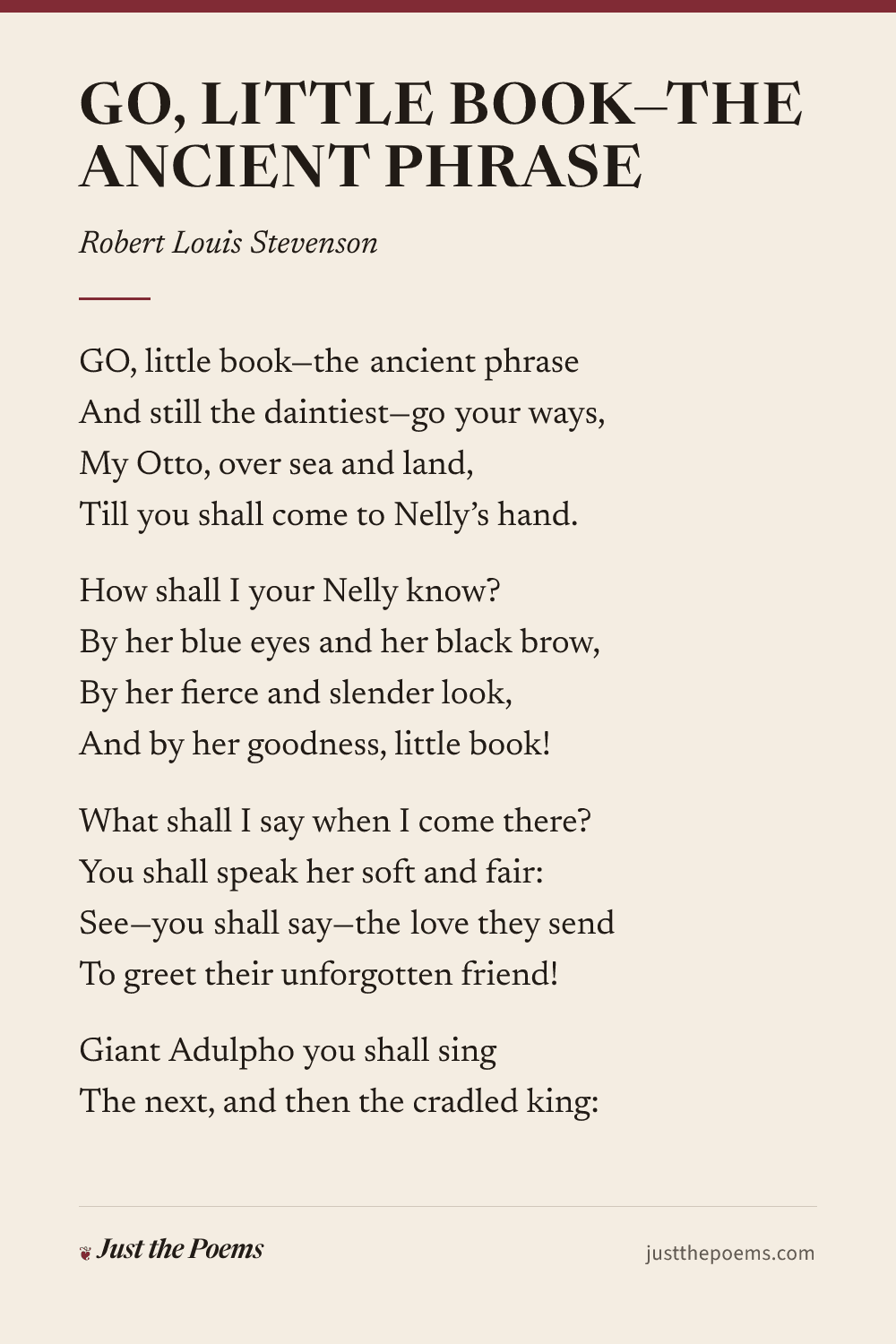
GO, LITTLE BOOK—THE ANCIENT PHRASE

Robert Louis Stevenson

In 0 Wikipedias 0 anthologies Poet in 101 Wikipedias

GO, little book—the ancient phraseAnd still the daintiest—go your ways,My Otto, over sea and land,Till you shall come to Nelly’s hand.

How shall I your Nelly know?By her blue eyes and her black brow,By her fierce and slender look,And by her goodness, little book!

What shall I say when I come there?You shall speak her soft and fair:See—you shall say—the love they sendTo greet their unforgotten friend!

Show all 36 lines 24 more

Giant Adulpho you shall singThe next, and then the cradled king:And the four corners of the roofThen kindly bless; and to your perch aloof,Where Balzac all in yellow dressedAnd the dear Webster of the westEncircle the prepotent throneOf Shakespeare and of Calderon,Shall climb an upstart.

There with theseYou shall give ear to breaking seasAnd windmills turning in the breeze,A distant undetermined dinWithout; and you shall hear withinThe blazing and the bickering logs,The crowing child, the yawning dogs,And ever agile, high and low,Our Nelly going to and fro.

There shall you all silent sit,Till, when perchance the lamp is litAnd the day’s labour done, she takesPoor Otto down, and, warming for our sakes,Perchance beholds, alive and near,Our distant faces reappear.

Source

New Poems, and Variant Readings, 1918

Filed under
  • Named in the title

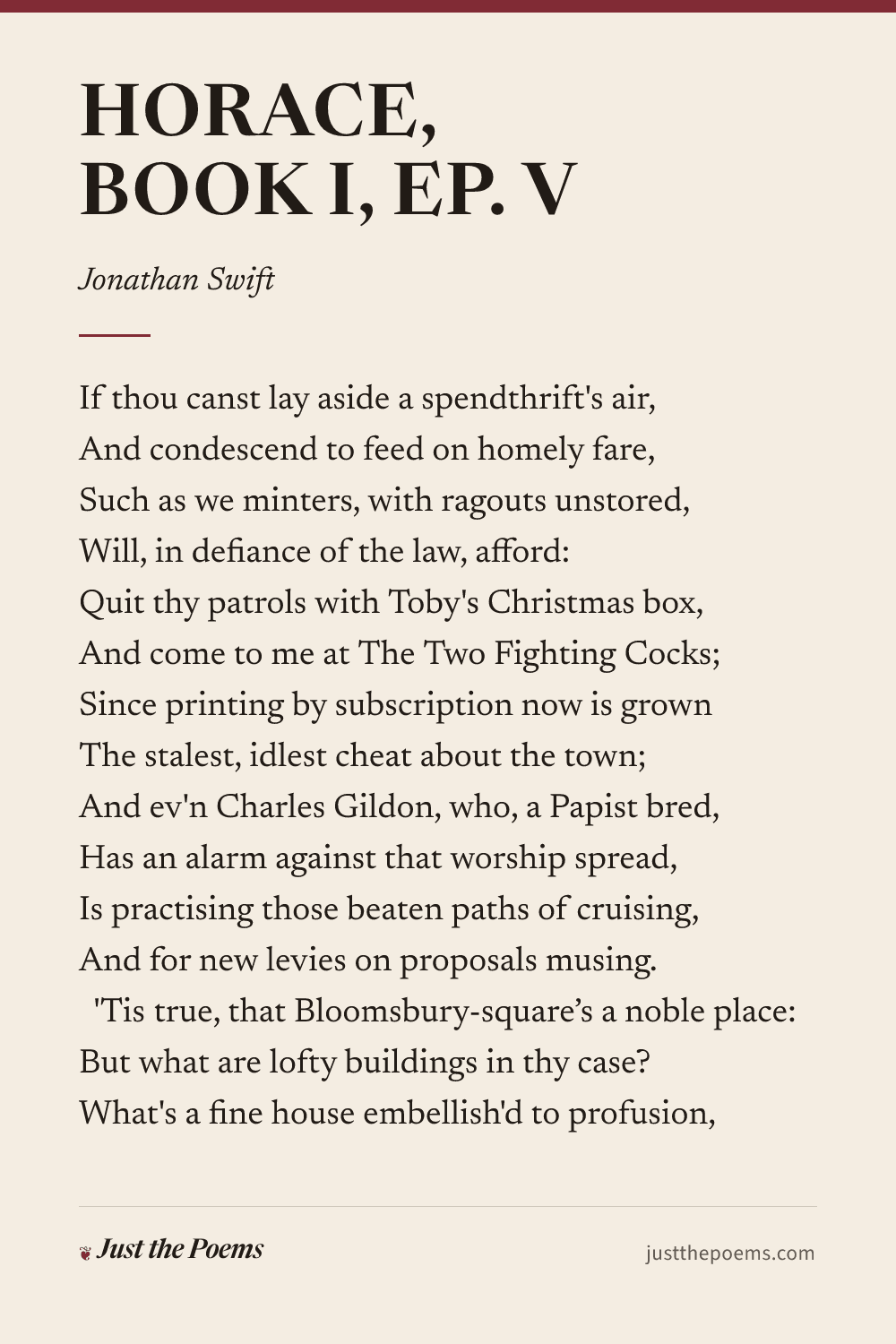
HORACE, BOOK I, EP. V

Jonathan Swift

In 0 Wikipedias 0 anthologies Poet in 101 Wikipedias

If thou canst lay aside a spendthrift's air,And condescend to feed on homely fare,Such as we minters, with ragouts unstored,Will, in defiance of the law, afford:Quit thy patrols with Toby's Christmas box,And come to me at The Two Fighting Cocks;Since printing by subscription now is grownThe stalest, idlest cheat about the town;And ev'n Charles Gildon, who, a Papist bred,Has an alarm against that worship spread,Is practising those beaten paths of cruising,And for new levies on proposals musing.

Show all 174 lines 162 more

'Tis true, that Bloomsbury-square’s a noble place:But what are lofty buildings in thy case?What's a fine house embellish'd to profusion,Where shoulder dabbers are in execution?Or whence its timorous tenant seldom sallies,But apprehensive of insulting bailiffs?This once be mindful of a friend's advice,And cease to be improvidently nice;Exchange the prospects that delude thy sight,From Highgate's steep ascent and Hampstead's height,With verdant scenes, that, from St. George's Field,More durable and safe enjoyments yield. Here I, even I, that ne'er till now could findEase to my troubled and suspicious mind,But ever was with jealousies possess'd,Am in a state of indolence and rest;Fearful no more of Frenchmen in disguise,Nor looking upon strangers as on spies,But quite divested of my former spleen,Am unprovoked without, and calm within:And here I'll wait thy coming, till the sunShall its diurnal course completely run.Think not that thou of sturdy bub shalt fail,My landlord's cellar stock'd with beer and ale,With every sort of malt that is in use,And every country's generous produce.The ready (for here Christian faith is sick,Which makes us seldom trespass upon tick)Instantly brings the choicest liquors out,Whether we ask for home-brew'd or for stout,For mead or cider, or, with dainties fed,Ring for a flask or two of white or red,Such as the drawer will not fail to swearWas drunk by Pilkingtonwhen third time mayor.That name, methinks, so popularly knownFor opposition to the church and crown,Might make the Lusitanian grape to pass,And almost give a sanction to the glass;Especially with thee, whose hasty zealAgainst the late rejected commerce billMade thee rise up, like an audacious elf,To do the speaker honour, not thyself. But if thou soar'st above the common prices,By virtue of subscription to thy Crisis,And nothing can go down with thee but winesPress'd from Burgundian and Campanian vines,Bid them be brought; for, though I hate the French,I love their liquors, as thou lovest a wench;Else thou must humble thy expensive taste,And, with us, hold contentment for a feast. The fire's already lighted; and the maidHas a clean cloth upon the table laid,Who never on a Saturday had struck,But for thy entertainment, up a buck.Think of this act of grace, which by your leaveSusan would not have done on Easter Eve,Had she not been inform'd over and over,'Twas for th'ingenious author of The Lover. Cease, therefore, to beguile thyself with hopes,Which is no more than making sandy ropes,And quit the vain pursuit of loud applause,That must bewilder thee in faction's cause.Pr'ythee what is't to thee who guides the state?Why Dunkirk's demolition is so late?Or why her majesty thinks fit to ceaseThe din of war, and hush the world to peace?The clergy too, without thy aid, can tellWhat texts to choose, and on what topics dwell;And, uninstructed by thy babbling, teachTheir flocks celestial happiness to reach.Rather let such poor souls as you and I,Say that the holidays are drawing nigh,And that to-morrow's sun begins the week,Which will abound with store of ale and cake,With hams of bacon, and with powder'd beef,Stuff d to give field-itinerants relief. Then I, who have within these precincts kept,And ne'er beyond the chimney-sweeper's stept,Will take a loose, and venture to be seen,Since 'twill be Sunday, upon Shanks's green;There, with erected looks and phrase sublime,To talk of unity of place and time,And with much malice, mix'd with little satire,Explode the wits on t'other side o' th' water. Why has my Lord Godolphin's special graceInvested me with a queen's waiter's place,If I, debarr'd of festival delights,Am not allow'd to spend the perquisites?He's but a short remove from being mad,Who at a time of jubilee is sad,And, like a griping usurer, does spareHis money to be squander'd by his heir;Flutter'd away in liveries and in coaches,And washy sorts of feminine debauches.As for my part, whate'er the world may think,I'll bid adieu to gravity, and drink;And, though I can't put off a woful mien,Will be all mirth and cheerfulness within:As, in despight of a censorious race,I most incontinently suck my face.What mighty projects does not he design,Whose stomach flows, and brain turns round with wine?Wine, powerful wine, can thaw the frozen cit,And fashion him to humour and to wit;Makes even Somers to disclose his artBy racking every secret from his heart,As he flings off the statesman's sly disguise,To name the cuckold's wife with whom he lies.Ev'n Sarum, when he quaffs it’stead of tea,Fancies himself in Canterbury's see,And S****, when he carousing reels,Imagines that he has regain'd the seals:W****, by virtue of his juice, can fight,And Stanhope of commissioners make light.Wine gives Lord Wingham aptitude of parts,And swells him with his family's deserts:Whom can it not make eloquent of speech;Whom in extremest poverty not rich?Since, by the means of the prevailing grape,Th***n can Lechmere's warmth not only ape,But, half seas o'er, by its inspiring bounties,Can qualify himself in several counties.What I have promised, thou may'st rest assuredShall faithfully and gladly be procured.Nay, I'm already better than my word,New plates and knives adorn the jovial board:And, lest you at their sight shouldst make wry facesThe girl has scour'd the pots, and wash'd the glassesTa'en care so excellently well to clean 'em,That thou may'st see thine own dear picture in 'em. Moreover, due provision has been made,That conversation may not be betray'd;I have no company but what is properTo sit with the most flagrant Whig at supper.There's not a man among them but must please,Since they're as like each other as are pease.Toland and Hare have jointly sent me wordThey'll come; and Kennet thinks to make a third,Provided he's no other invitationFrom men of greater quality and station.Room will for Oldmixon and J--s be left:But their discourses smell so much of theft,There would be no abiding in the room,Should two such ignorant pretenders come.However, by this trusty bearer write,If I should any other scabs invite;Though, if I may my serious judgment give,I'm wholly for King Charles's number five:That was the stint in which that monarch fix'd,Who would not be with noisiness perplex'd:And that, if thou'lt agree to think it best,Shall be our tale of heads, without one other guest. I've nothing more, now this is said, to say,But to request thou'lt instantly away,And leave the duties of thy present post,To some well-skill'd retainer in a host:Doubtless he'll carefully thy place supply,And o'er his grace's horses have an eye.While thou, who slunk thro' postern more than once,Dost by that means avoid a crowd of duns,And, crossing o'er the Thames at Temple Stairs,Leav'st Phillips with good words to cheat their ears.
Source

The Poems of Jonathan Swift, D.D., Volume 2, 1910

Filed under
  • Named in the title

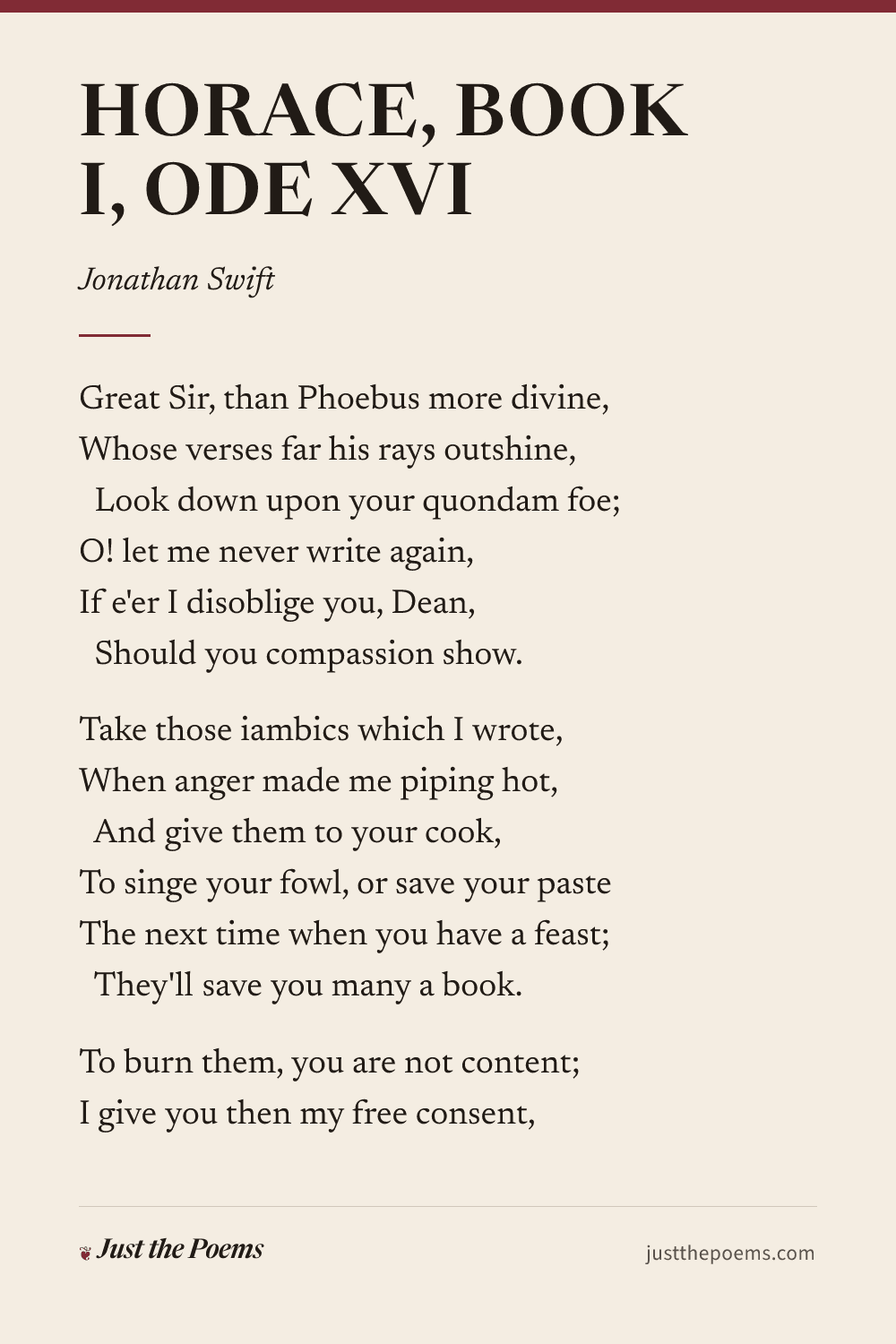
HORACE, BOOK I, ODE XVI

Jonathan Swift

In 0 Wikipedias 0 anthologies Poet in 101 Wikipedias

Great Sir, than Phoebus more divine,Whose verses far his rays outshine, Look down upon your quondam foe;O! let me never write again,If e'er I disoblige you, Dean, Should you compassion show.

Take those iambics which I wrote,When anger made me piping hot, And give them to your cook,To singe your fowl, or save your pasteThe next time when you have a feast; They'll save you many a book.

Show all 48 lines 36 more

To burn them, you are not content;I give you then my free consent, To sink them in the harbour;If not, they'll serve to set off blocks,To roll on pipes, and twist in locks; So give them to your barber.

Or, when you next your physic take,I must entreat you then to make A proper application;'Tis what I've done myself before,With Dan's fine thoughts and many more, Who gave me provocation.

What cannot mighty anger do?It makes the weak the strong pursue, A goose attack a swan;It makes a woman, tooth and nail,Her husband's hands and face assail, While he's no longer man.

Though some, we find, are more discreet,Before the world are wondrous sweet, And let their husbands hector:But when the world's asleep, they wake,That is the time they choose to speak: Witness the curtain lecture.

Such was the case with you, I find:All day you could conceal your mind; But when St. Patrick's chimesAwaked your muse, (my midnight curse,When I engaged for better for worse,) You scolded with your rhymes.

Have done! have done! I quit the field,To you as to my wife, I yield: As she must wear the breeches:So shall you wear the laurel crown,Win it and wear it, 'tis your own; The poet's only riches.

Source

The Poems of Jonathan Swift, D.D., Volume 2, 1910

Filed under
  • Named in the title

Advertisements

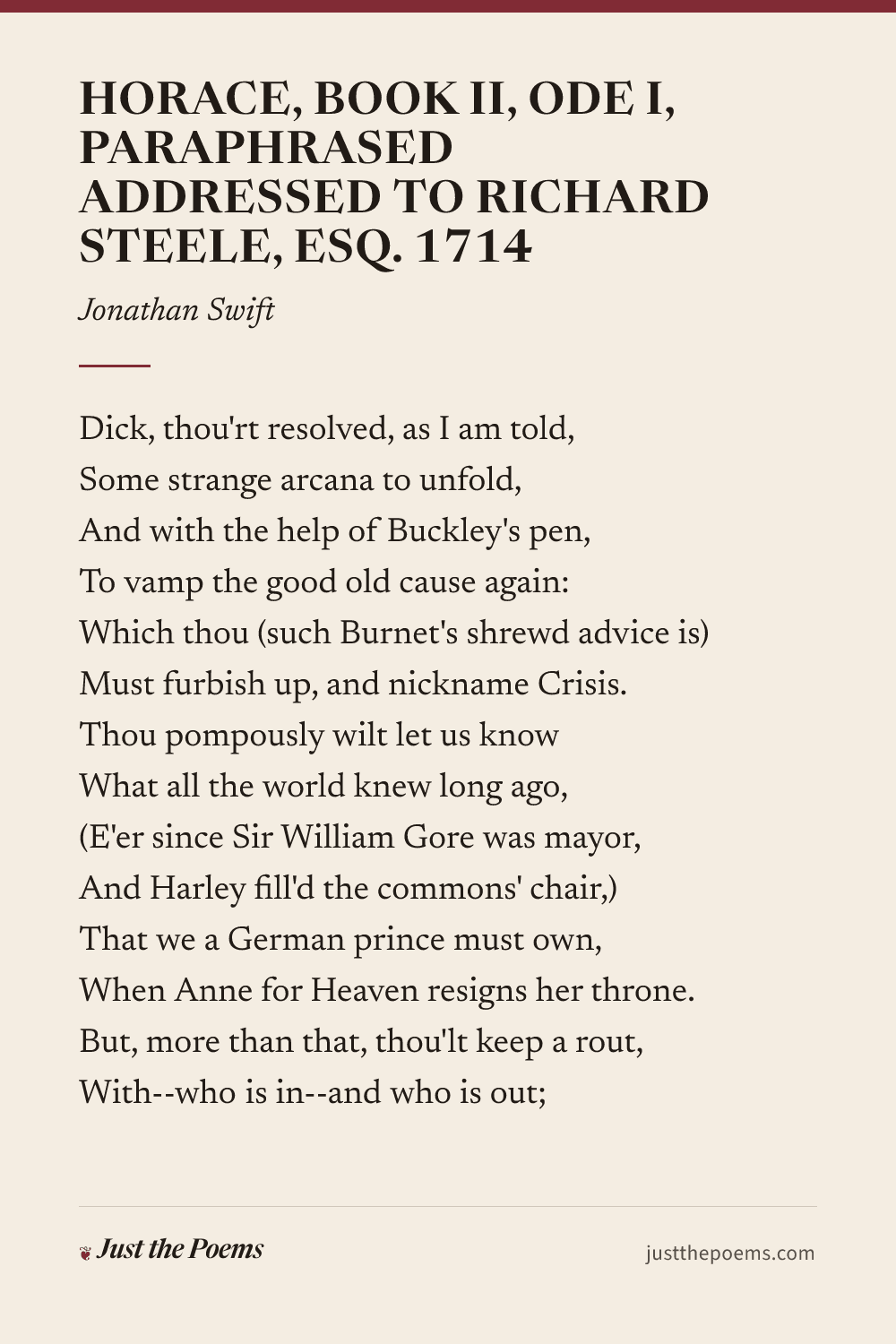
HORACE, BOOK II, ODE I, PARAPHRASED ADDRESSED TO RICHARD STEELE, ESQ. 1714

Jonathan Swift

In 0 Wikipedias 0 anthologies Poet in 101 Wikipedias

Dick, thou'rt resolved, as I am told,Some strange arcana to unfold,And with the help of Buckley's pen,To vamp the good old cause again:Which thou (such Burnet's shrewd advice is)Must furbish up, and nickname Crisis.Thou pompously wilt let us knowWhat all the world knew long ago,(E'er since Sir William Gore was mayor,And Harley fill'd the commons' chair,)That we a German prince must own,When Anne for Heaven resigns her throne.

Show all 116 lines 104 more

But, more than that, thou'lt keep a rout,With--who is in--and who is out;Thou'lt rail devoutly at the peace,And all its secret causes trace,The bucket-play 'twixt Whigs and Tories,Their ups and downs, with fifty storiesOf tricks the Lord of Oxford knows,And errors of our plenipoes.Thou'lt tell of leagues among the great,Portending ruin to our state:And of that dreadful coup d'éclat,Which has afforded thee much chat.The queen, forsooth! (despotic,) gaveTwelve coronets without thy leave!A breach of liberty, 'tis own'd,For which no heads have yet atoned!Believe me, what thou'st undertakenMay bring in jeopardy thy bacon;For madmen, children, wits, and fools,Should never meddle with edged tools.But, since thou'st got into the fire,And canst not easily retire,Thou must no longer deal in farce,Nor pump to cobble wicked verse;Until thou shall have eased thy conscience,Of spleen, of politics, and nonsense;And, when thou'st bid adieu to cares,And settled Europe's grand affairs,'Twill then, perhaps, be worth thy whileFor Drury Lane to shape thy style:"To make a pair of jolly fellows,The son and father, join to tell us,How sons may safely disobey,And fathers never should say nay;By which wise conduct they grow friendsAt last--and so the story ends."When first I knew thee, Dick, thou wertRenown'd for skill in Faustus' art;Which made thy closet much frequentedBy buxom lasses--some repentedTheir luckless choice of husbands--othersImpatient to be like their mothers,Received from thee profound directionsHow best to settle their affections.Thus thou, a friend to the distress'd,Didst in thy calling do thy best. But now the senate (if things hit,And thou at Stockbridge wert not bit)Must feel thy eloquence and fire,Approve thy schemes, thy wit admire,Thee with immortal honours crown,While, patriot-like, thou'lt strut and frown. What though by enemies 'tis said,The laurel, which adorns thy head,Must one day come in competition,By virtue of some sly petition:Yet mum for that; hope still the best,Nor let such cares disturb thy rest. Methinks I hear thee loud as trumpet,As bagpipe shrill or oyster-strumpet;Methinks I see thee, spruce and fine,With coat embroider'd richly shine,And dazzle all the idol faces,As through the hall thy worship paces;(Though this I speak but at a venture,Supposing thou hast tick with Hunter,)Methinks I see a blackguard routAttend thy coach, and hear them shoutIn approbation of thy tongue,Which (in their style) is purely hung.Now! now you carry all before you!Nor dares one Jacobite or ToryPretend to answer one syl-lable,Except the matchless hero Abel.What though her highness and her spouse,In Antwerp keep a frugal house,Yet, not forgetful of a friend,They'll soon enable thee to spend,If to Macartney thou wilt toast,And to his pious patron's ghost.Now, manfully thou'lt run a tilt"On popes, for all the blood they've spilt,For massacres, and racks, and flames,For lands enrich'd by crimson streams,For inquisitions taught by Spain,Of which the Christian world complain."Dick, we agree--all's true thou'st said,As that my Muse is yet a maid.But, if I may with freedom talk,All this is foreign to thy walk:Thy genius has perhaps a knackAt trudging in a beaten track,But is for state affairs as fitAs mine for politics and wit.Then let us both in time grow wise,Nor higher than our talents rise;To some snug cellar let's repair,From duns and debts, and drown our care;Now quaff of honest ale a quart,Now venture at a pint of port;With which inspired, we'll club each nightSome tender sonnet to indite,And with Tom D'Urfey, Phillips, Dennis,Immortalize our Dolls and Jennys.

Source

The Poems of Jonathan Swift, D.D., Volume 2, 1910

Filed under
  • Named in the title

IMITATION OF PART OF THE SIXTH SATIRE OF THE SECOND BOOK OF HORACE. 1714

Jonathan Swift

In 0 Wikipedias 0 anthologies Poet in 101 Wikipedias

I often wish'd that I had clear,For life, six hundred pounds a-year,A handsome house to lodge a friend,A river at my garden's end,A terrace walk, and half a roodOf land, set out to plant a wood. Well, now I have all this and more,I ask not to increase my store;But should be perfectly content,Could I but live on this side Trent;Nor cross the channel twice a-year,To spend six months with statesmen here.

Show all 114 lines 102 more

I must by all means come to town,'Tis for the service of the crown."Lewis, the Dean will be of use;Send for him up, take no excuse."The toil, the danger of the seas,Great ministers ne'er think of these;Or let it cost a hundred pound,No matter where the money's found,It is but so much more in debt,And that they ne'er consider'd yet. "Good Mr. Dean, go change your gown,Let my lord know you're come to town."I hurry me in haste away,Not thinking it is levee-day;And find his honour in a pound,Hemm'd by a triple circle round,Chequer'd with ribbons blue and green:How should I thrust myself between?Some wag observes me thus perplex'd,And, smiling, whispers to the next,"I thought the Dean had been too proud,To justle here among a crowd!"Another, in a surly fit,Tells me I have more zeal than wit."So eager to express your love,You ne'er consider whom you shove,But rudely press before a duke."I own I'm pleased with this rebuke,And take it kindly meant, to showWhat I desire the world should know. I get a whisper, and withdraw;When twenty fools I never sawCome with petitions fairly penn'd,Desiring I would stand their friend. This humbly offers me his case;That begs my interest for a place;A hundred other men's affairs,Like bees, are humming in my ears."To-morrow my appeal comes on;Without your help, the cause is gone--""The duke expects my lord and you,About some great affair, at two--""Put my Lord Bolingbroke in mind,To get my warrant quickly sign'd:Consider, 'tis my first request."--Be satisfied I'll do my best:Then presently he falls to tease,"You may for certain, if you please;I doubt not if his lordship knew---And Mr. Dean, one word from you----" 'Tis (let me see) three years and more,(October next it will be four,)Since Harley bid me first attend,And chose me for an humble friend;Would take me in his coach to chat,And question me of this and that;As "What's o'clock?" And, "How's the wind?""Whose chariot's that we left behind?"Or gravely try to read the linesWrit underneath the country signs;And mark at Brentford how they spellHear is good Eal and Bear to cell.Or, "Have you nothing new to-dayTo shew from Parnell, Pope and Gay?"Such tattle often entertainsMy lord and me as far as Staines,As once a-week we travel downTo Windsor, and again to town;Where all that passes inter nosMight be proclaim'd at Charing-cross. Yet some I know with envy swell,Because they see me used so well:"How think you of our friend the Dean?I wonder what some people mean!My lord and he are grown so great,Always together, tête-à-tête;What! they admire him for his jokes?--See but the fortune of some folks!" There flies about a strange reportOf mighty news arrived at court:I'm stopp'd by all the fools I meet,And catechised in every street."You, Mr. Dean, frequent the great:Inform us, will the emperor treat?Or do the prints and papers lie?"Faith, sir, you know as much as I."Ah, Doctor, how you love to jest!'Tis now no secret"--I protestIt's one to me--"Then tell us, pray,When are the troops to have their pay?"And, though I solemnly declareI know no more than my lord mayor,They stand amazed, and think me grownThe closest mortal ever known.Thus in a sea of folly toss'd,My choicest hours of life are lost:Yet always wishing to retreat,O, could I see my country-seat!There leaning near a gentle brook,Sleep, or peruse some ancient book;And there in sweet oblivion drownThose cares that haunt the court and town.

Source

The Poems of Jonathan Swift, D.D., Volume 2, 1910

Filed under
  • Named in the title

ON HIS BOOK ENTITLED "OBSERVATIONS ON LORD ORRERY'S REMARKS"

Jonathan Swift

In 0 Wikipedias 0 anthologies Poet in 101 Wikipedias

Delany, to escape your friend the Dean, And prove all false that Orrery had writ,You kindly own his Gulliver profane, Yet make his puns and riddles sterling wit.

But if for wrongs to Swift you would atone, And please the world, one way you may succeed,Collect Boyle's writings and your own, And serve them as you served THE DEED.

Source

The Poems of Jonathan Swift, D.D., Volume 2, 1910

Filed under
  • Named in the title

Picture-Books in Winter

Robert Louis Stevenson

In 0 Wikipedias 0 anthologies Poet in 101 Wikipedias

Summer fading, winter comes--Frosty mornings, tingling thumbs,Window robins, winter rooks,And the picture story-books.

Water now is turned to stoneNurse and I can walk upon;Still we find the flowing brooksIn the picture story-books.

All the pretty things put by,Wait upon the children's eye,Sheep and shepherds, trees and crooks,In the picture story-books.

We may see how all things areSeas and cities, near and far,And the flying fairies' looks,In the picture story-books.

How am I to sing your praise,Happy chimney-corner days,Sitting safe in nursery nooks,Reading picture story-books?

Source

A Child's Garden of Verses

Filed under
  • Named in the title

THE BOOK OF MARTYRS.

Emily Dickinson

In 0 Wikipedias 0 anthologies Poet in 101 Wikipedias

Read, sweet, how others strove,Till we are stouter;What they renounced,Till we are less afraid;How many times they boreThe faithful witness,Till we are helped,As if a kingdom cared!

Read then of faithThat shone above the fagot;Clear strains of hymnThe river could not drown;Brave names of menAnd celestial women,Passed out of recordInto renown!

Source

Poems by Emily Dickinson, Series One

Filed under
  • Named in the title

AFTER READING PSALMS XXXIX., XL., ETC.

Thomas Hardy

In 0 Wikipedias 0 anthologies Poet in 91 Wikipedias

SIMPLE was I and was young; Kept no gallant tryst, I; Even from good words held my tongue, Quoniam Tu fecisti!

Through my youth I stirred me not, High adventure missed I, Left the shining shrines unsought; Yet—me deduxisti!

At my start by Helicon Love-lore little wist I, Worldly less; but footed on; Why? Me suscepisti!

Show all 25 lines 13 more

When I failed at fervid rhymes, “Shall,” I said, “persist I?” “Dies” (I would add at times) “Meos posuisti!”

So I have fared through many suns; Sadly little grist I Bring my mill, or any one’s, Domine, Tu scisti!

And at dead of night I call: “Though to prophets list I, Which hath understood at all? Yea: Quem elegisti?”

187–

Source

Late Lyrics and Earlier, With Many Other Verses, 1922

Filed under
  • Named in the title

TO A LADY OFFENDED BY A BOOK OF THE WRITER’S

Thomas Hardy

In 0 Wikipedias 0 anthologies Poet in 91 Wikipedias

NOW that my page upcloses, doomed, maybe,Never to press thy cosy cushions more,Or wake thy ready Yeas as heretofore,Or stir thy gentle vows of faith in me:

Knowing thy natural receptivity,I figure that, as flambeaux banish eve,My sombre image, warped by insidious heaveOf those less forthright, must lose place in thee.

So be it. I have borne such. Let thy dreamsOf me and mine diminish day by day,And yield their space to shine of smugger things;Till I shape to thee but in fitful gleams,And then in far and feeble visitings,And then surcease. Truth will be truth alway.

Source

Wessex Poems and Other Verses, 1919

Filed under
  • Named in the title

A BALLADE OF A BOOK-REVIEWER

G. K. Chesterton

In 0 Wikipedias 0 anthologies Poet in 70 Wikipedias

I have not read a rotten pageOf "Sex-Hate" or "The Social Test,"And here comes "Husks" and "Heritage"....O Moses, give us all a rest!"Ethics of Empire"!... I protestI will not even cut the strings,I'll read "Jack Redskin on the Quest"And feed my brain with better things.

Somebody wants a Wiser Age(He also wants me to invest);Somebody likes the Finnish StageBecause the Jesters do not jest;And grey with dust is Dante's crest,The bell of Rabelais soundless swings;And the winds come out of the westAnd feed my brain with better things.

Lord of our laughter and our rage.Look on us with our sins oppressed!I, too, have trodden mine heritage,Wickedly wearying of the best.Burn from my brain and from my breastSloth, and the cowardice that clings,And stiffness and the soul's arrest:And feed my brain with better things.

Source

Poems, 1916

Filed under
  • Named in the title

TO HIS BOOK.

Edmund Spenser

In 0 Wikipedias 0 anthologies Poet in 68 Wikipedias

Go, little Book! thyself present,As child whose parent is unkent,To him that is the PresidentOf Nobleness and Chivalry:And if that Envy bark at thee,As sure it will, for succour fleeUnder the shadow of his wing.And, asked who thee forth did bring,A shepheard's swain, say, did thee sing,All as his straying flock he fed:And, when his Honour has thee read,Crave pardon for thy hardyhed.But, if that any ask thy name,Say, thou wert base-begot with blame;Forthy thereof thou takest shame.And, when thou art past jeopardy,Come tell me what was said of me,And I will send more after thee.

Source

The Shepheard's Calender: Twelve Aeglogues Proportionable to the Twelve Monethes, 1898

Filed under
  • Named in the title

ON FINDING SOME DEISTICAL BOOKS IN THE HOUSE OF ONE WHO ONCE FEARED GOD!

John Castillo

In 0 Wikipedias 0 anthologies Poet in 1 Wikipedia

"How is the gold become dim!" (Lamen. iv. 1.)

False publications throw their gloomy rays, Where once the Sun of Righteousness did shine;With pain we recollect the former days, While scoffing infidels their voices join!

Insulting Heav'n, they oft with brazen brow, Deny our Saviour is the Son of God!But soon to Him their every knee shall bow, And they shall groan beneath His iron rod!

What madness to defy His power above, To slight that blood which has their souls redeem'd;To him who does his God sincerely love, How painful 'tis to hear His name blasphem'd!

Show all 36 lines 24 more

O let us flee these men of wicked minds, Whose glory reaches not beyond the grave;Who to accomplish their absurd designs, Dethrone our King, and style the conquest brave!

Yet still He reigns, and shall for ever hold, In massy chains the gloomy powers of Hell;They soon His second coming shall behold, And howling, see the place from whence they fell!

Ah! surely Satan's thousand years are up, And he once more is suffer'd loose to go!His object is to stagger Israel's hope, And drag them captive to his den below!

Come down, O Lord! and bid thy thunders roll! Send forth thy lightnings, and thy foes consume!O let them know that thou wilt them controul, In each, and all the shapes which they assume!

Gird on thy sword, thou mighty matchless King! Reclaim these poor deluded sons of men!O save them from the cruel serpent's sting; And drive him back to his infernal den!

If Israel's hope is not quite lost in death, May these dry bones the Word of God receive!Come from the four winds, O reviving breath, And breathe upon these slain, that they may live!

Source

Awd Isaac, The Steeple Chase, and Other Poems With a glossary of the Yorkshire Dialect, 1843

Filed under
  • Named in the title

NOW CLOSE THE BOOK.

John S. Adams

In 0 Wikipedias 0 anthologies Poet in 0 Wikipedias

NOW close the book. Each page hath done its part,Each thought hath left its impress on the heart.O, may it be that naught hath here been tracedThat after years may wish to have effaced!O, may it be Humanity hath wonSome slight bestowment by the task now done!If struggling Right hath found one cheering word,If Hope hath in desponding heart been stirred,If Sorrow hath from one lone soul been drivenBy one kind word of Sympathy here given,Then in my soul a living joy shall dwell,Brighter than art can paint or language tell.Yes, close the book: the story and the songHave each been said, and sung. I see the throngOf gentle ministrants who've led my penWithdraw their aid. I hear the word, Amen.And now to you, who have been with me throughThe "Town and Country," I must bid adieu.

Source

Town and Country; Or, Life at Home and Abroad, Without and Within Us, 1855

Filed under
  • Named in the title

ON RE-READING “BARCHESTER TOWERS”

Charles L. Graves

In 0 Wikipedias 0 anthologies Poet in 0 Wikipedias

In days when Bellona less madly The wheels of her chariot drave,To you, Father Anthony, gladly My doggerel homage I gave;And again uncontrollably yearning For solace in desolate hoursI find a brief respite in turning To Barchester Towers.

How good are the women, how various, As slowly their natures unfold!—The feudal Miss Thorne; the gregarious And amiable Eleanor Bold;

Show all 56 lines 44 more

Mrs. Quiverful, dauntless though dowdy, With fourteen young ravens to feed,Who managed to melt Mrs. Proudie, So great was her need.

Mrs. Proudie, of course, is prodigious, A terror to friends and to foes,Ambitious, correctly religious, Yet leading her lord by the nose;Very far from an angel or jewel, Very near to a feminine Pope,And priceless in waging the duel That smashed Mr. Slope.

And who would not willingly linger With you, O Signora, who twirledRound the tip of your white little finger Staid clerics and men of the world!Commanding the spells of a Circe; Bewitching, though crippled and lame;Redeeming your malice with mercy And playing the game.

The clergy—Tractarian, Erastian, Low Churchmen—you faithfully paintReveal to our view no SEBASTIAN, No martyr, and hardly a saint;Though perhaps, by so freely discarding Preferment and riches and fame,The guileless and good Mr. Harding Is worthy the name.

You looked upon country and city With kindly and tolerant eyes;You never set out to be witty, Though seldom you failed to be wise;You were neither ornate nor elliptic, But most unaffectedly shrewd,For the art that is consciously cryptic You strictly tabooed.

Your outlook is certainly narrowed To lives that are never sublime;Our hearts are not haunted or harrowed With desperate anguish or crime;But a mutual trust is for ever ’Twixt author and reader maintained,And we know all along we shall never Be wantonly pained.

Source

Lauds and libels, 1918

Filed under
  • Named in the title

25 poems about books

17 poets

By poet's century of death

CenturyPoems
16th1
17th2
18th5
19th9
20th8

Poets with more than one poem

PoetPoems
Jonathan Swift5
Robert Louis Stevenson4
Thomas Hardy2