Poems About Childhood

The first 30 of 64 poems about childhood, by 20 poets, ranked by third-party data. How poems are ranked

The Little Black Boy

William Blake

In 3 Wikipedias 2 anthologies Poet in 101 Wikipedias

My mother bore me in the southern wild, And I am black, but O, my soul is white!White as an angel is the English child, But I am black, as if bereaved of light.

My mother taught me underneath a tree, And, sitting down before the heat of day,She took me on her lap and kissèd me, And, pointing to the East, began to say:

‘Look at the rising sun: there God does live, And gives His light, and gives His heat away,And flowers and trees and beasts and men receive Comfort in morning, joy in the noonday.

Show all 28 lines 16 more

‘And we are put on earth a little space, That we may learn to bear the beams of love;And these black bodies and this sunburnt face Are but a cloud, and like a shady grove.

‘For when our souls have learn’d the heat to bear, The cloud will vanish, we shall hear His voice,Saying, “Come out from the grove, my love and care, And round my golden tent like lambs rejoice.”’

Thus did my mother say, and kissèd me, And thus I say to little English boy.When I from black and he from white cloud free, And round the tent of God like lambs we joy,

I’ll shade him from the heat till he can bear To lean in joy upon our Father’s knee;And then I’ll stand and stroke his silver hair, And be like him, and he will then love me.

Source

The Oxford Book of English Verse 1250–1900, 1900

Filed under
  • Section “RHYMES OF CHILDHOOD”, The Home Book of Verse

HOLY THURSDAY

William Blake

In 2 Wikipedias 1 anthology Poet in 101 Wikipedias

'Twas on a Holy Thursday, their innocent faces clean,Came children walking two and two, in red, and blue, and green;Gray-headed beadles walked before, with wands as white as snow,Till into the high dome of Paul's they like Thames waters flow.

Oh what a multitude they seemed, these flowers of London town!Seated in companies they sit, with radiance all their own.The hum of multitudes was there, but multitudes of lambs,Thousands of little boys and girls raising their innocent hands.

Now like a mighty wind they raise to heaven the voice of song,Or like harmonious thunderings the seats of heaven among:Beneath them sit the aged men, wise guardians of the poor.Then cherish pity, lest you drive an angel from your door.

Source

The Home Book of Verse, ed. Burton Egbert Stevenson

Filed under
  • Section “RHYMES OF CHILDHOOD”, The Home Book of Verse

THE SHEPHERD

William Blake

In 2 Wikipedias 1 anthology Poet in 101 Wikipedias

How sweet is the Shepherd's sweet lot!From the morn to the evening he strays;He shall follow his sheep all the day,And his tongue shall be filled with praise.For he hears the lamb's innocent call,And he hears the ewe's tender reply;He is watchful, while they are in peace,For they know when their Shepherd is nigh.

Source

The Home Book of Verse, ed. Burton Egbert Stevenson

Filed under
  • Section “RHYMES OF CHILDHOOD”, The Home Book of Verse

Advertisements

THE RAGGEDY MAN

James Whitcomb Riley

In 1 Wikipedia 2 anthologies Poet in 16 Wikipedias

O the Raggedy Man! He works fer Pa;An' he's the goodest man ever you saw!He comes to our house every day,An' waters the horses, an' feeds 'em hay;An' he opens the shed--an' we all ist laughWhen he drives out our little old wobble-ly calf;An' nen--ef our hired girl says he can--He milks the cow fer 'Lizabuth Ann.--Ain't he a' awful good Raggedy Man?Raggedy! Raggedy! Raggedy Man!

W'y, the Raggedy Man--he's ist so goodHe splits the kindlin' an' chops the wood;

Show all 41 lines 29 more

An' nen he spades in our garden, too,An' does most things 'at boys can't do.--He clumbed clean up in our big treeAn' shooked a' apple down fer me--An' nother'n', too, fer 'Lizabuth Ann--An' nother'n', too, fer the Raggedy Man.--Ain't he a' awful kind Raggedy Man?Raggedy! Raggedy! Raggedy Man!

An' the Raggedy Man, he knows most rhymesAn' tells 'em, ef I be good, sometimes:Knows 'bout Giunts, an' Griffuns, an' Elves,An' the Squidgicum-Squees 'at swallers therselves!An', wite by the pump in our pasture-lot,He showed me the hole 'at the Wunks is got,'At lives 'way deep in the ground, an' canTurn into me, er 'Lizabuth Ann!Er Ma, er Pa, er the Raggedy Man!Ain't he a funny old Raggedy Man?Raggedy! Raggedy! Raggedy Man!

The Raggedy Man--one time when heWas makin' a little bow-n'-orry fer me,Says, "When you're big like your Pa is,Air you go' to keep a fine store like his--An' be a rich merchunt--an' wear fine clothes?--Er what air you go' to be, goodness knows?"An' nen he laughed at 'Lizabuth Ann,An' I says "'M go' to be a Raggedy Man!--I'm ist go' to be a nice Raggedy Man!"Raggedy! Raggedy! Raggedy Man!

Source

The Home Book of Verse, ed. Burton Egbert Stevenson

Filed under
  • Section “RHYMES OF CHILDHOOD”, The Home Book of Verse

ODE ON INTIMATIONS OF IMMORTALITY FROM RECOLLECTIONS OF EARLY CHILDHOOD

William Wordsworth

In 0 Wikipedias 4 anthologies Poet in 97 Wikipedias

There was a time when meadow, grove, and stream,The earth, and every common sight To me did seem Apparell'd in celestial light,The glory and the freshness of a dream.It is not now as it hath been of yore;-- Turn wheresoe'er I may, By night or day,The things which I have seen I now can see no more!

The rainbow comes and goes, And lovely is the rose; The moon doth with delight

Show all 204 lines 192 more

Look round her when the heavens are bare; Waters on a starry night Are beautiful and fair; The sunshine is a glorious birth; But yet I know, where'er I go,That there hath pass'd away a glory from the earth.

Now, while the birds thus sing a joyous song, And while the young lambs bound As to the tabor's sound,To me alone there came a thought of grief:A timely utterance gave that thought relief, And I again am strong.The cataracts blow their trumpets from the steep,--No more shall grief of mine the season wrong:I hear the echoes through the mountains throng,The winds come to me from the fields of sleep, And all the earth is gay; Land and sea Give themselves up to jollity, And with the heart of May Doth every beast keep holiday;-- Thou child of joy,Shout round me, let me hear thy shouts, thou happy Shepherd boy!

Ye blessed creatures, I have heard the call Ye to each other make; I seeThe heavens laugh with you in your jubilee; My heart is at your festival, My head hath its coronal,The fulness of your bliss, I feel--I feel it all. O evil day! if I were sullen While Earth herself is adorning This sweet May morning, And the children are pulling On every side In a thousand valleys far and wide Fresh flowers; while the sun shines warm,And the babe leaps up on his mother's arm:-- I hear, I hear, with joy I hear! --But there's a tree, of many, one,A single field which I have look'd upon,Both of them speak of something that is gone: The pansy at my feet Doth the same tale repeat:Whither is fled the visionary gleam?Where is it now, the glory and the dream?

Our birth is but a sleep and a forgetting;The Soul that rises with us, our life's Star, Hath had elsewhere its setting And cometh from afar; Not in entire forgetfulness And not in utter nakednessBut trailing clouds of glory do we come From God, who is our home:Heaven lies about us in our infancy!Shades of the prison-house begin to close Upon the growing boy,But he beholds the light, and whence it flows, He sees it in his joy,The youth, who daily farther from the east Must travel, still is Nature's priest, And by the vision splendid Is on his way attended;At length the man perceives it die away,And fade into the light of common day.

Earth fills her lap with pleasures of her own;Yearnings she hath in her own natural kind,And, even with something of a mother's mind, And no unworthy aim, The homely nurse doth all she canTo make her foster-child, her inmate, Man, Forget the glories he hath knownAnd that imperial palace whence he came.

Behold the Child among his new-born blisses,A six years' darling of a pigmy size!See, where 'mid work of his own hand he lies,Fretted by sallies of his mother's kisses,With light upon him from his father's eyes!See, at his feet, some little plan or chart,Some fragment from his dream of human life,Shaped by himself with newly-learned art; A wedding or a festival, A mourning or a funeral; And this hath now his heart, And unto this he frames his song: Then will he fit his tongueTo dialogues of business, love, or strife; But it will not be long Ere this be thrown aside, And with new joy and prideThe little actor cons another part;Filling from time to time his "humorous stage"With all the Persons, down to palsied Age,That life brings with her in her equipage; As if his whole vocation Were endless imitation.

Thou, whose exterior semblance doth belie Thy soul's immensity;Thou best philosopher, who yet dost keepThy heritage, thou eye among the blind,That, deaf and silent, read'st the eternal deep,Haunted for ever by the eternal mind,-- Mighty prophet! Seer blest! On whom those truths do restWhich we are toiling all our lives to find;In darkness lost, the darkness of the grave;Thou, over whom thy immortalityBroods like the day, a master o'er a slave,A presence which is not to be put by;Thou little child, yet glorious in the mightOf heaven-born freedom on thy being's height,Why with such earnest pains dost thou provokeThe years to bring the inevitable yoke,Thus blindly with thy blessedness at strife?Full soon thy soul shall have her earthly freight,And custom lie upon thee with a weightHeavy as frost, and deep almost as life!

O joy! that in our embers Is something that doth live, That nature yet remembers What was so fugitive!The thought of our past years in me doth breedPerpetual benediction: not indeedFor that which is most worthy to be blest,Delight and liberty, the simple creedOf childhood, whether busy or at rest,With new-fledged hope still fluttering in his breast: --Not for these I raise The song of thanks and praise; But for those obstinate questionings Of sense and outward things, Fallings from us, vanishings, Blank misgivings of a creatureMoving about in worlds not realised,High instincts, before which our mortal natureDid tremble like a guilty thing surprised: But for those first affections, Those shadowy recollections, Which, be they what they may,Are yet the fountain-light of all our day,Are yet a master-light of all our seeing; Uphold us--cherish--and have power to makeOur noisy years seem moments in the beingOf the eternal silence: truths that wake, To perish never;Which neither listlessness, nor mad endeavour Nor man nor boyNor all that is at enmity with joy,Can utterly abolish or destroy! Hence, in a season of calm weather Though inland far we be,Our souls have sight of that immortal sea Which brought us hither; Can in a moment travel thither--And see the children sport upon the shore,And hear the mighty waters rolling evermore.

Then sing, ye birds, sing, sing a joyous song! And let the young lambs bound As to the tabor's sound! We, in thought, will join your throng Ye that pipe and ye that play, Ye that through your hearts to-day Feel the gladness of the May!What though the radiance which was once so brightBe now for ever taken from my sight, Though nothing can bring back the hourOf splendour in the grass, of glory in the flower; We will grieve not, rather find Strength in what remains behind, In the primal sympathy Which having been must ever be, In the soothing thoughts that spring Out of human suffering, In the faith that looks through death,In years that bring the philosophic mind.

And O, ye Fountains, Meadows, Hills, and Groves,Forebode not any severing of our loves!Yet in my heart of hearts I feel your might;I only have relinquish'd one delightTo live beneath your more habitual sway;I love the brooks which down their channels fretEven more than when I tripp'd lightly as they;The innocent brightness of a new-born day Is lovely yet;The clouds that gather round the setting sunDo take a sober colouring from an eyeThat hath kept watch o'er man's mortality;Another race hath been, and other palms are won.Thanks to the human heart by which we live,Thanks to its tenderness, its joys, and fears,To me the meanest flower that blows can giveThoughts that do often lie too deep for tears.

Source

The Golden Treasury, ed. Francis Turner Palgrave

Filed under
  • Named in the title

GOD'S JUDGMENT ON A WICKED BISHOP

Robert Southey

In 0 Wikipedias 3 anthologies Poet in 44 Wikipedias

The summer and autumn had been so wet,That in winter the corn was growing yet:'Twas a piteous sight to see all aroundThe grain lie rotting on the ground.

Every day the starving poorCrowded around Bishop Hatto's door;For he had a plentiful last-year's store,And all the neighborhood could tellHis granaries were furnished well.

At last Bishop Hatto appointed a dayTo quiet the poor without delay;He bade them to his great barn repair,

Show all 76 lines 64 more

And they should have food for the winter there.

Rejoiced the tidings good to hear,The poor folks flocked from far and near;The great barn was full as it could holdOf women and children, and young and old.

Then, when he saw it could hold no more,Bishop Hatto he made fast the door;And whilst for mercy on Christ they call,He set fire to the barn, and burnt them all.

"I' faith, 'tis an excellent bonfire!" quoth he;"And the country is greatly obliged to meFor ridding it, in these times forlorn,Of rats that only consume the corn."

So then to his palace returned he,And he sate down to supper merrily,And he slept that night like an innocent man;But Bishop Hatto never slept again.

In the morning, as he entered the hall,Where his picture hung against the wall,A sweat like death all over him came,For the rats had eaten it out of the frame.

As he looked, there came a man from his farm--He had a countenance white with alarm:"My lord, I opened your granaries this morn,And the rats had eaten all your corn."

Another came running presently,And he was pale as pale could be."Fly! my lord bishop, fly!" quoth he,"Ten thousand rats are coming this way,--The Lord forgive you for yesterday!"

"I'll go to my tower in the Rhine," replied he;"'T is the safest place in Germany,--The walls are high, and the shores are steep,And the tide is strong, and the water deep."

Bishop Hatto fearfully hastened away;And he crossed the Rhine without delay,And reached his tower, and barred with careAll the windows, doors, and loop-holes there.

He laid him down and closed his eyes,But soon a scream made him arise;He started, and saw two eyes of flameOn his pillow, from whence the screaming came.

He listened and looked,--it was only the cat;But the bishop he grew more fearful for that,For she sate screaming, mad with fear,At the army of rats that were drawing near.

For they have swum over the river so deep,And they have climbed the shores so steep,And now by thousands up they crawlTo the holes and the windows in the wall.

Down on his knees the bishop fell,And faster and faster his beads did he tell,As louder and louder, drawing near,The saw of their teeth without he could hear.

And in at the windows, and in at the door,And through the walls, by thousands they pour;And down from the ceiling and up through the floor,From the right and the left, from behind and before,From within and without, from above and below,--And all at once to the bishop they go.

They have whetted their teeth against the stones,And now they pick the bishop's bones;They gnawed the flesh from every limb,For they were sent to do judgment on him!

Source

The World's Best Poetry, Vol. IX, ed. Bliss Carman, 1904

Filed under
  • Section “RHYMES OF CHILDHOOD”, The Home Book of Verse

A Boy’s Song

James Hogg

In 0 Wikipedias 3 anthologies Poet in 24 Wikipedias

Where the pools are bright and deep,Where the grey trout lies asleep,Up the river and over the lea,That’s the way for Billy and me.

Where the blackbird sings the latest,Where the hawthorn blooms the sweetest,Where the nestlings chirp and flee,That’s the way for Billy and me.

Where the mowers mow the cleanest,Where the hay lies thick and greenest,There to track the homeward bee,That’s the way for Billy and me.

Where the hazel bank is steepest,Where the shadow falls the deepest,Where the clustering nuts fall free,That’s the way for Billy and me.

Why the boys should drive awayLittle sweet maidens from the play,Or love to banter and fight so well,That’s the thing I never could tell.

But this I know, I love to playThrough the meadow, among the hay;Up the water and over the lea,That’s the way for Billy and me.

Source

The Oxford Book of English Verse 1250–1900, 1900

Filed under
  • Section “RHYMES OF CHILDHOOD”, The Home Book of Verse

Reeds of Innocence

William Blake

In 0 Wikipedias 2 anthologies Poet in 101 Wikipedias

Piping down the valleys wild, Piping songs of pleasant glee,On a cloud I saw a child, And he laughing said to me:

‘Pipe a song about a Lamb!’ So I piped with merry cheer.‘Piper, pipe that song again;’ So I piped: he wept to hear.

‘Drop thy pipe, thy happy pipe; Sing thy songs of happy cheer!’So I sung the same again, While he wept with joy to hear.

‘Piper, sit thee down and write In a book that all may read.’So he vanish’d from my sight; And I pluck’d a hollow reed,

And I made a rural pen, And I stain’d the water clear,And I wrote my happy songs Every child may joy to hear.

Source

The Oxford Book of English Verse 1250–1900, 1900

Filed under
  • Section “RHYMES OF CHILDHOOD”, The Home Book of Verse

Advertisements

The Tiger

William Blake

In 0 Wikipedias 2 anthologies Poet in 101 Wikipedias

Tiger, tiger, burning brightIn the forests of the night,What immortal hand or eyeCould frame thy fearful symmetry?

In what distant deeps or skiesBurnt the fire of thine eyes?On what wings dare he aspire?What the hand dare seize the fire?

And what shoulder and what artCould twist the sinews of thy heart?And, when thy heart began to beat,What dread hand and what dread feet?

What the hammer? What the chain?In what furnace was thy brain?What the anvil? What dread graspDare its deadly terrors clasp?

When the stars threw down their spears,And watered heaven with their tears,Did He smile His work to see?Did He who made the lamb make thee?

Tiger, tiger, burning brightIn the forests of the night,What immortal hand or eyeDare frame thy fearful symmetry?

Source

The Oxford Book of English Verse 1250–1900, 1900

Filed under
  • Section “RHYMES OF CHILDHOOD”, The Home Book of Verse

"WHAT DOES LITTLE BIRDIE SAY?"

Alfred Tennyson

In 0 Wikipedias 2 anthologies Poet in 72 Wikipedias

What does little birdie sayIn her nest at peep of day?Let me fly, says little birdie,Mother, let me fly away.Birdie, rest a little longer,Till the little wings are stronger.So she rests a little longer,Then she flies away.

What does little baby say,In her bed at peep of day?Baby says, like little birdie,Let me rise and fly away.Baby, sleep a little longer,Till the little limbs are stronger,If she sleeps a little longer,Baby too shall fly away.

Source

The Home Book of Verse, ed. Burton Egbert Stevenson

Filed under
  • Section “RHYMES OF CHILDHOOD”, The Home Book of Verse

THE WIND AND THE MOON

George Macdonald

In 0 Wikipedias 2 anthologies Poet in 40 Wikipedias

Said the Wind to the Moon, "I will blow you out;You stareIn the airLike a ghost in a chair,Always looking what I am about--I hate to be watched; I'll blow you out."

The Wind blew hard, and out went the Moon.So, deepOn a heapOf clouds to sleep,Down lay the Wind, and slumbered soon,Muttering low, "I've done for that Moon."

Show all 66 lines 54 more

He turned in his bed; she was there again!On highIn the sky,With her one ghost eye,The Moon shone white and alive and plain.Said the Wind, "I will blow you out again."

The Wind blew hard, and the Moon grew dim."With my sledge,And my wedge,I have knocked off her edge!If only I blow right fierce and grim,The creature will soon be dimmer than dim."

He blew and he blew, and she thinned to a thread."One puffMore's enoughTo blow her to snuff!One good puff more where the last was bred,And glimmer, glimmer, glum will go the thread."

He blew a great blast, and the thread was gone.In the airNowhereWas a moonbeam bare;Far off and harmless the shy stars shone--Sure and certain the Moon was gone!

The Wind he took to his revels once more;On down,In town,Like a merry-mad clown,He leaped and halloed with whistle and roar--"What's that?" The glimmering thread once more!

He flew in a rage--he danced and blew;But in vainWas the painOf his bursting brain;For still the broader the Moon-scrap grew,The broader he swelled his big cheeks and blew.

Slowly she grew--till she filled the night,And shoneOn her throneIn the sky alone,A matchless, wonderful silvery light,Radiant and lovely, the queen of the night.

Said the Wind: "What a marvel of power am I!With my breath,Good faith!I blew her to death--First blew her away right out of the sky--Then blew her in; what strength have I!

But the Moon she knew nothing about the affair;For highIn the sky,With her one white eye,Motionless, miles above the air,She had never heard the great Wind blare.

Source

The Home Book of Verse, ed. Burton Egbert Stevenson

Filed under
  • Section “RHYMES OF CHILDHOOD”, The Home Book of Verse

THE BLIND BOY

Colley Cibber

In 0 Wikipedias 2 anthologies Poet in 23 Wikipedias

O say what is that thing call'd Light, Which I must ne'er enjoy;What are the blessings of the sight, O tell your poor blind boy!

You talk of wondrous things you see, You say the sun shines bright;I feel him warm, but how can he Or make it day or night?

My day or night myself I make Whene'er I sleep or play;And could I ever keep awake With me 'twere always day.

With heavy sighs I often hear You mourn my hapless woe;But sure with patience I can bear A loss I ne'er can know.

Then let not what I cannot have My cheer of mind destroy:Whilst thus I sing, I am a king, Although a poor blind boy.

Source

The Golden Treasury, ed. Francis Turner Palgrave

Filed under
  • Section “RHYMES OF CHILDHOOD”, The Home Book of Verse

A STORY FOR A CHILD

Bayard Taylor

In 0 Wikipedias 2 anthologies Poet in 17 Wikipedias

Little one, come to my knee!Hark, how the rain is pouringOver the roof, in the pitch-black night,And the wind in the woods a-roaring!

Hush, my darling, and listen,Then pay for the story with kisses;Father was lost in the pitch-black night,In just such a storm as this is!

High up on the lonely mountains,Where the wild men watched and waited;Wolves in the forest, and bears in the bush,And I on my path belated.

Show all 40 lines 28 more

The rain and the night togetherCame down and the wind came after,Bending the props of the pine-tree roof,And snapping many a rafter.

I crept along in the darkness,Stunned, and bruised, and blinded,--Crept to a fir with thick-set boughs,And a sheltering rock behind it.

There, from the blowing and raining,Crouching, I sought to hide me:Something rustled, two green eyes shone,And a wolf lay down beside me.

Little one, be not frightened;I and the wolf together,Side by side, through the long, long night,Hid from the awful weather.

His wet fur pressed against me;Each of us warmed the other;Each of us felt, in the stormy dark,That beast and man was brother.

And when the falling forestNo longer crashed in warning,Each of us went from our hiding-placeForth in the wild, wet morning.

Darling, kiss me payment!Hark, how the wind is roaring;Father's house is a better placeWhen the stormy rain is pouring!

Source

The Home Book of Verse, ed. Burton Egbert Stevenson

Filed under
  • Section “RHYMES OF CHILDHOOD”, The Home Book of Verse

Advertisements

WISHING

William Allingham

In 0 Wikipedias 2 anthologies Poet in 16 Wikipedias

Ring-ting! I wish I were a Primrose,A bright yellow Primrose, blowing in the Spring!The stooping bough above me,The wandering bee to love me,The fern and moss to creep across,And the Elm-tree for our King!

Nay,--stay! I wish I were an Elm-tree,A great lofty Elm-tree, with green leaves gay!The winds would set them dancing,The sun and moonshine glance in,The Birds would house among the boughs,And sweetly sing!

O--no! I wish I were a Robin,A Robin or a little Wren, everywhere to go;Through forest, field, or garden,And ask no leave or pardon,Till Winter comes with icy thumbsTo ruffle up our wing.

Well--tell! Where should I fly to,Where go to sleep in the dark wood or dell?Before a day was over,Home comes the rover,For Mother's kiss,--sweeter thisThan any other thing!

Source

The Home Book of Verse, ed. Burton Egbert Stevenson

Filed under
  • Section “RHYMES OF CHILDHOOD”, The Home Book of Verse

A LEGEND OF THE NORTHLAND

Phoebe Cary

In 0 Wikipedias 2 anthologies Poet in 13 Wikipedias

Away, away in the Northland,Where the hours of the day are few,And the nights are so long in winterThat they cannot sleep them through;

Where they harness the swift reindeerTo the sledges, when it snows;And the children look like bear's cubsIn their funny, furry clothes:

They tell them a curious story--I don't believe 'tis true;And yet you may learn a lessonIf I tell the tale to you.

Show all 80 lines 68 more

Once, when the good Saint PeterLived in the world below,And walked about it, preaching,Just as he did, you know,

He came to the door of a cottage,In traveling round the earth,Where a little woman was making cakes,And baking them on the hearth;

And being faint with fasting,For the day was almost done,He asked her, from her store of cakes,To give him a single one.

So she made a very little cake,But as it baking lay,She looked at it, and thought it seemedToo large to give away.

Therefore she kneaded another,And still a smaller one;But it looked, when she turned it over,As large as the first had done.

Then she took a tiny scrap of dough,And rolled and rolled it flat;And baked it thin as a wafer--But she couldn't part with that.

For she said, "My cakes that seem too smallWhen I eat of them myself,Are yet too large to give away."So she put them on the shelf.

Then good Saint Peter grew angry,For he was hungry and faint;And surely such a womanWas enough to provoke a saint.

And he said, "You are far too selfishTo dwell in a human form,To have both food and shelter,And fire to keep you warm.

"Now, you shall build as the birds do,And shall get your scanty foodBy boring, and boring, and boring,All day in the hard, dry wood."

Then up she went through the chimney,Never speaking a word,And out of the top flew a woodpecker,For she was changed to a bird.

She had a scarlet cap on her head,And that was left the same,But all the rest of her clothes were burnedBlack as a coal in the flame.

And every country school-boyHas seen her in the wood,Where she lives in the trees till this very day,Boring and boring for food.

And this is the lesson she teaches:Live not for yourself alone,Lest the needs you will not pityShall one day be your own.

Give plenty of what is given to you,Listen to pity's call;Don't think the little you give is great,And the much you get is small.

Now, my little boy, remember that,And try to be kind and good,When you see the woodpecker's sooty dress,And see her scarlet hood.

You mayn't be changed to a bird though you liveAs selfishly as you can;But you will be changed to a smaller thing--A mean and selfish man.

Source

The Home Book of Verse, ed. Burton Egbert Stevenson

Filed under
  • Section “RHYMES OF CHILDHOOD”, The Home Book of Verse

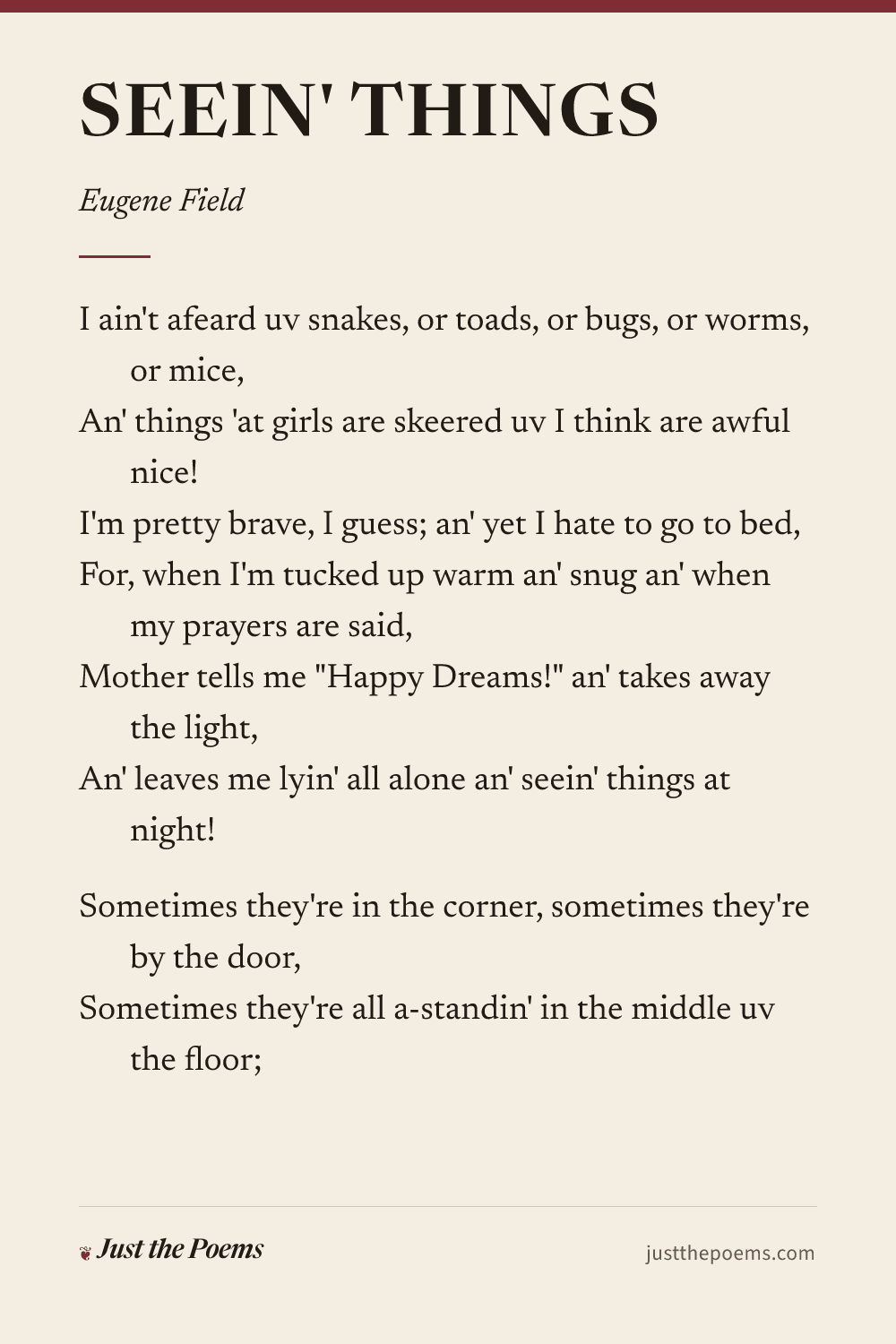
SEEIN' THINGS

Eugene Field

In 0 Wikipedias 2 anthologies Poet in 10 Wikipedias

I ain't afeard uv snakes, or toads, or bugs, or worms, or mice,An' things 'at girls are skeered uv I think are awful nice!I'm pretty brave, I guess; an' yet I hate to go to bed,For, when I'm tucked up warm an' snug an' when my prayers are said,Mother tells me "Happy Dreams!" an' takes away the light,An' leaves me lyin' all alone an' seein' things at night!

Sometimes they're in the corner, sometimes they're by the door,Sometimes they're all a-standin' in the middle uv the floor;Sometimes they are a-sittin' down, sometimes they're walkin' roundSo softly and so creepylike they never make a sound!Sometimes they are as black as ink, an' other times they're white--But the color ain't no difference when you see things at night!

Show all 30 lines 18 more

Once, when I licked a feller 'at had just moved on our street,An' father sent me up to bed without a bite to eat,I woke up in the dark an' saw things standin' in a row,A-lookin' at me cross-eyed an' p'intin' at me--so!Oh, my! I wuz so skeered that time I never slep' a mite--It's almost alluz when I'm bad I see things at night!

Lucky thing I ain't a girl, or I'd be skeered to death!Bein' I'm a boy, I duck my head an' hold my breath;An' I am, oh, so sorry I'm a naughty boy, an' thenI promise to be better an' I say my prayers again!Gran'ma tells me that's the only way to make it rightWhen a feller has been wicked an' sees things at night!

An' so, when other naughty boys would coax me into sin,I try to skwush the Tempter's voice 'at urges me within;An' when they's pie for supper, or cakes 'at's big an' nice,I want to--but I do not pass my plate f'r them things twice!No, ruther let Starvation wipe me slowly out o' sightThan I should keep a-livin' on an' seein' things at night!

Source

The Home Book of Verse, ed. Burton Egbert Stevenson

Filed under
  • Section “RHYMES OF CHILDHOOD”, The Home Book of Verse

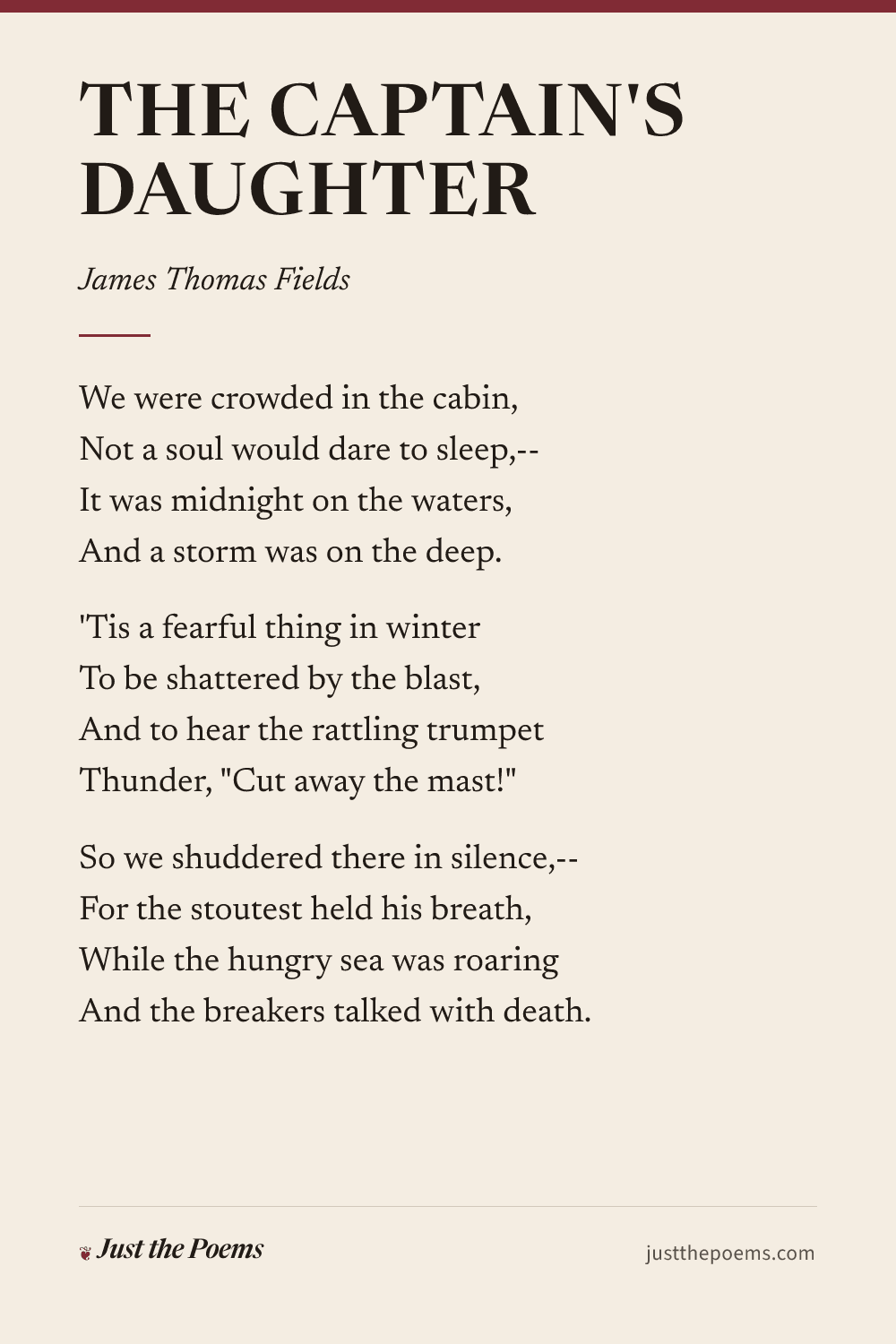
THE CAPTAIN'S DAUGHTER

James Thomas Fields

In 0 Wikipedias 2 anthologies Poet in 6 Wikipedias

We were crowded in the cabin,Not a soul would dare to sleep,--It was midnight on the waters,And a storm was on the deep.

'Tis a fearful thing in winterTo be shattered by the blast,And to hear the rattling trumpetThunder, "Cut away the mast!"

So we shuddered there in silence,--For the stoutest held his breath,While the hungry sea was roaringAnd the breakers talked with death.

As thus we sat in darkness,Each one busy with his prayers,"We are lost!" the captain shouted,As he staggered down the stairs.

But his little daughter whispered,As she took his icy hand,"Isn't God upon the ocean,Just the same as on the land?"

Then we kissed the little maiden,And we spake in better cheer,And we anchored safe in harborWhen the morn was shining clear.

Source

The Home Book of Verse, ed. Burton Egbert Stevenson

Filed under
  • Section “RHYMES OF CHILDHOOD”, The Home Book of Verse

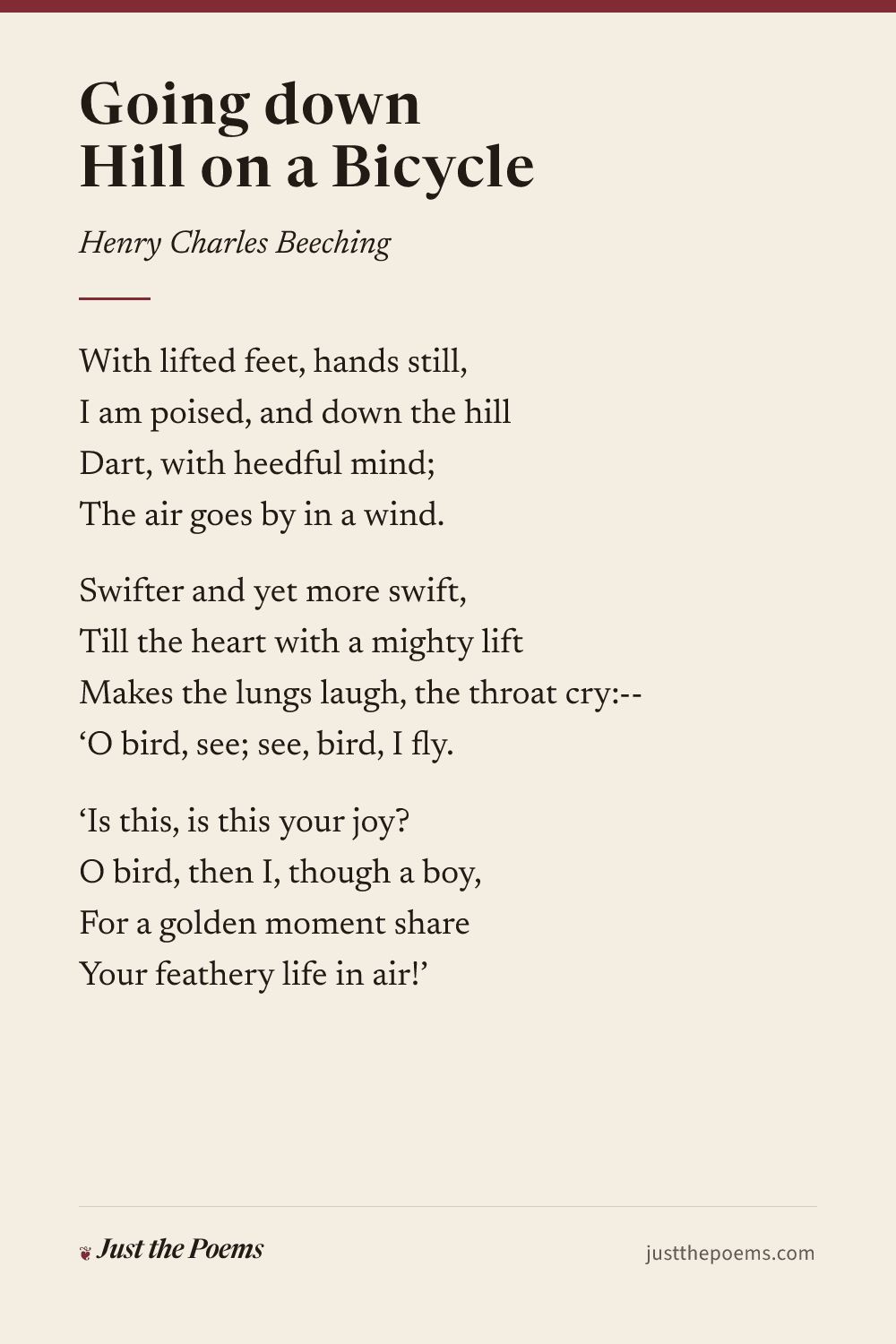
Going down Hill on a Bicycle

Henry Charles Beeching

In 0 Wikipedias 2 anthologies Poet in 3 Wikipedias

With lifted feet, hands still,I am poised, and down the hillDart, with heedful mind;The air goes by in a wind.

Swifter and yet more swift,Till the heart with a mighty liftMakes the lungs laugh, the throat cry:--‘O bird, see; see, bird, I fly.

‘Is this, is this your joy?O bird, then I, though a boy,For a golden moment shareYour feathery life in air!’

Say, heart, is there aught like thisIn a world that is full of bliss?’Tis more than skating, boundSteel-shod to the level ground.

Speed slackens now, I floatAwhile in my airy boat;Till, when the wheels scarce crawl,My feet to the treadles fall.

Alas, that the longest hillMust end in a vale; but still,Who climbs with toil, wheresoe’er,Shall find wings waiting there.

Source

The Oxford Book of English Verse 1250–1900, 1900

Filed under
  • Section “RHYMES OF CHILDHOOD”, The Home Book of Verse

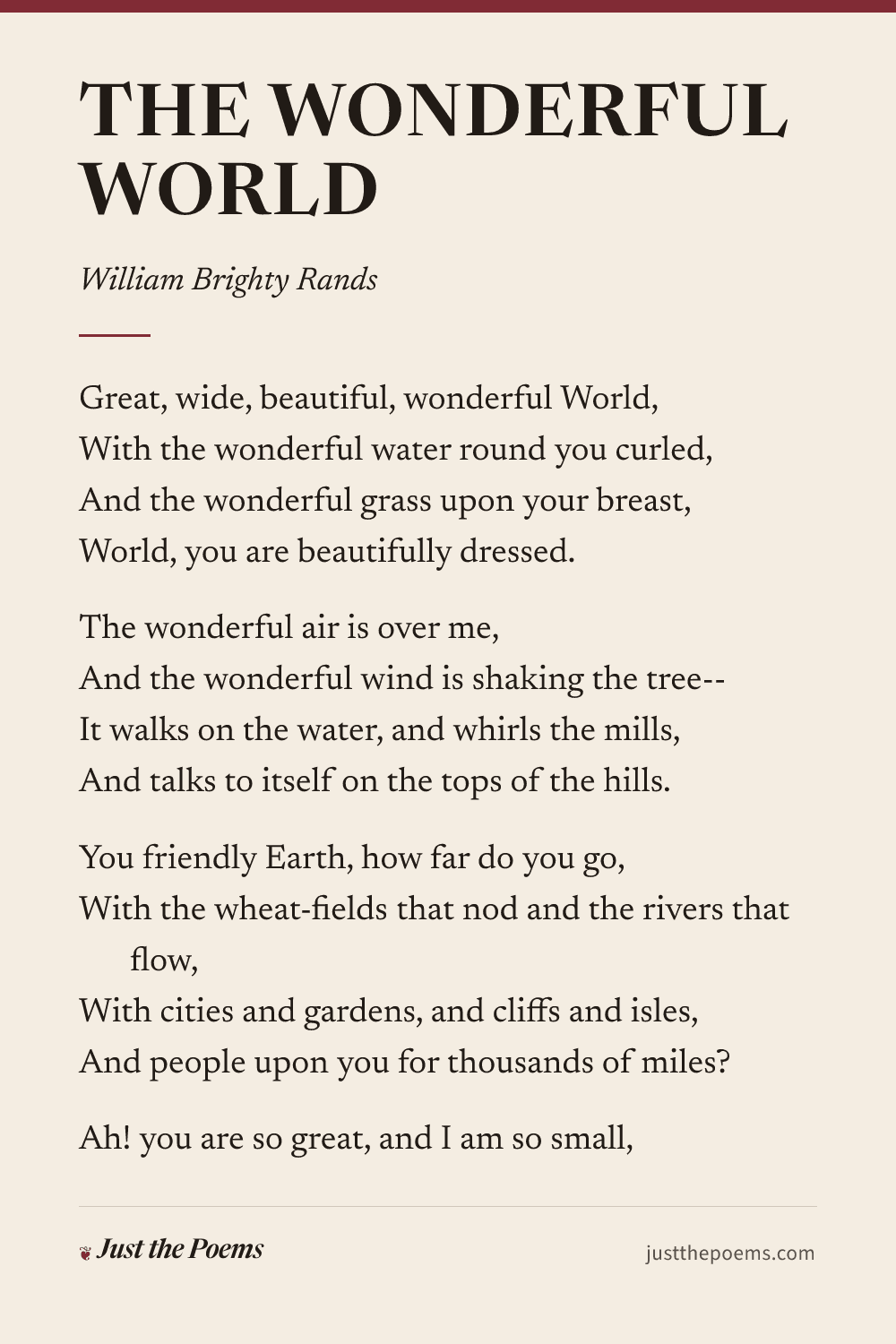
THE WONDERFUL WORLD

William Brighty Rands

In 0 Wikipedias 2 anthologies Poet in 3 Wikipedias

Great, wide, beautiful, wonderful World,With the wonderful water round you curled,And the wonderful grass upon your breast,World, you are beautifully dressed.

The wonderful air is over me,And the wonderful wind is shaking the tree--It walks on the water, and whirls the mills,And talks to itself on the tops of the hills.

You friendly Earth, how far do you go,With the wheat-fields that nod and the rivers that flow,With cities and gardens, and cliffs and isles,And people upon you for thousands of miles?

Ah! you are so great, and I am so small,I tremble to think of you, World, at all;And yet, when I said my prayers to-day,A whisper inside me seemed to say,"You are more than the Earth, though you are such a dot:You can love and think, and the Earth cannot!"

Source

The Home Book of Verse, ed. Burton Egbert Stevenson

Filed under
  • Section “RHYMES OF CHILDHOOD”, The Home Book of Verse

FOREIGN LANDS

Robert Louis Stevenson

In 0 Wikipedias 1 anthology Poet in 101 Wikipedias

Up into the cherry treeWho should climb but little me?I held the trunk with both my handsAnd looked abroad on foreign lands.

I saw the next door garden lie,Adorned with flowers, before my eye,And many pleasant places moreThat I had never seen before.

I saw the dimpling river passAnd be the sky's blue looking-glass;The dusty roads go up and downWith people tramping in to town.

If I could find a higher tree,Farther and farther I should see,To where the grown-up river slipsInto the sea among the ships;

To where the roads on either handLead onward into fairy land,Where all the children dine at five,And all the playthings come alive.

Source

The Home Book of Verse, ed. Burton Egbert Stevenson

Filed under
  • Section “RHYMES OF CHILDHOOD”, The Home Book of Verse

MY SHADOW

Robert Louis Stevenson

In 0 Wikipedias 1 anthology Poet in 101 Wikipedias

I have a little shadow that goes in and out with me,And what can be the use of him is more than I can see.He is very, very like me from the heels up to the head;And I see him jump before me, when I jump into my bed.

The funniest thing about him is the way he likes to grow--Not at all like proper children, which is always very slow;For he sometimes shoots up taller like an India-rubber ball,And he sometimes gets so little that there's none of him at all.

He hasn't got a notion of how children ought to play,And can only make a fool of me in every sort of way.He stays so close beside me, he's a coward you can see;I'd think shame to stick to nursie as that shadow sticks to me!

One morning, very early, before the sun was up,I rose and found the shining dew on every buttercup;But my lazy little shadow, like an arrant sleepy-head,Had stayed at home behind me and was fast asleep in bed.

Source

The Home Book of Verse, ed. Burton Egbert Stevenson

Filed under
  • Section “RHYMES OF CHILDHOOD”, The Home Book of Verse

NURSE'S SONG

William Blake

In 0 Wikipedias 1 anthology Poet in 101 Wikipedias

When the voices of children are heard on the greenAnd laughing is heard on the hill,My heart is at rest within my breast,And everything else is still.

"Then come home, my children, the sun is gone down,And the dews of the night arise;Come, come, leave off play, and let us awayTill the morning appears in the skies."

"No, no, let us play, for it is yet day,And we cannot go to sleep;Besides in the sky the little birds fly,And the hills are all covered with sheep."

"Well, well, go and play till the light fades away,And then go home to bed."The little ones leaped and shouted and laughed;And all the hills echoed.

Source

The Home Book of Verse, ed. Burton Egbert Stevenson

Filed under
  • Section “RHYMES OF CHILDHOOD”, The Home Book of Verse

THE GARDENER

Robert Louis Stevenson

In 0 Wikipedias 1 anthology Poet in 101 Wikipedias

The gardener does not love to talk,He makes me keep the gravel walk;And when he puts his tools away,He locks the door and takes the key.

Away behind the currant rowWhere no one else but cook may go,Far in the plots, I see him dig,Old and serious, brown and big.

He digs the flowers, green, red, and blue,Nor wishes to be spoken to.He digs the flowers and cuts the hay,And never seems to want to play.

Silly gardener! summer goes,And winter comes with pinching toes,When in the garden bare and brownYou must lay your barrow down.

Well now, and while the summer stays,To profit by these garden daysO how much wiser you would beTo play at Indian wars with me!

Source

The Home Book of Verse, ed. Burton Egbert Stevenson

Filed under
  • Section “RHYMES OF CHILDHOOD”, The Home Book of Verse

THE LAND OF COUNTERPANE

Robert Louis Stevenson

In 0 Wikipedias 1 anthology Poet in 101 Wikipedias

When I was sick and lay a-bed,I had two pillows at my head,And all my toys beside me layTo keep me happy all the day.

And sometimes for an hour or soI watched my leaden soldiers go,With different uniforms and drills,Among the bed-clothes, through the hills;

And sometimes sent my ships in fleetsAll up and down among the sheets;Or brought my trees and houses out,And planted cities all about.

I was the giant great and stillThat sits upon the pillow-hill,And sees before him, dale and plain,The pleasant land of counterpane.

Source

The Home Book of Verse, ed. Burton Egbert Stevenson

Filed under
  • Section “RHYMES OF CHILDHOOD”, The Home Book of Verse

THE LAND OF STORY-BOOKS

Robert Louis Stevenson

In 0 Wikipedias 1 anthology Poet in 101 Wikipedias

At evening when the lamp is lit,Around the fire my parents sit;They sit at home and talk and sing,And do not play at anything.

Now, with my little gun, I crawlAll in the dark along the wall,And follow round the forest trackAway behind the sofa back.

There, in the night, where none can spy,All in my hunter's camp I lie,And play at books that I have readTill it is time to go to bed.

These are the hills, these are the woods,These are my starry solitudes;And there the river by whose brinkThe roaring lions come to drink.

I see the others far awayAs if in firelit camp they lay,And I, like to an Indian scout,Around their party prowled about.

So, when my nurse comes in for me,Home I return across the sea,And go to bed with backward looksAt my dear land of Story-books.

Source

The Home Book of Verse, ed. Burton Egbert Stevenson

Filed under
  • Section “RHYMES OF CHILDHOOD”, The Home Book of Verse

ANSWER TO A CHILD'S QUESTION

Samuel Taylor Coleridge

In 0 Wikipedias 1 anthology Poet in 86 Wikipedias

Do you ask what the birds say? The Sparrow, the Dove,The Linnet and Thrush say, "I love and I love!"In the winter they're silent--the wind is so strong;What it says, I don't know, but it sings a loud song.But green leaves, and blossoms, and sunny warm weather,And singing, and loving--all come back together.But the Lark is so brimful of gladness and love,The green fields below him, the blue sky above,That he sings, and he sings, and for ever sings he--"I love my Love, and my Love loves me!"

Source

The Home Book of Verse, ed. Burton Egbert Stevenson

Filed under
  • Section “RHYMES OF CHILDHOOD”, The Home Book of Verse

THE PIED PIPER OF HAMELIN

Robert Browning

In 0 Wikipedias 1 anthology Poet in 57 Wikipedias

Hamelin Town's in Brunswick,By famous Hanover city;The river Weser, deep and wide,Washes its wall on the southern side;A pleasanter spot you never spied;But, when begins my ditty,Almost five hundred years ago,To see the townsfolk suffer soFrom vermin was a pity.

Rats!They fought the dogs and killed the cats,And bit the babies in the cradles,

Show all 303 lines 291 more

And ate the cheeses out of the vats,And licked the soup from the cooks' own ladles,Split open the kegs of salted sprats,Made nests inside men's Sunday hats,And even spoiled the women's chatsBy drowning their speakingWith shrieking and squeakingIn fifty different sharps and flats.

At last the people in a bodyTo the Town Hall came flocking:"'Tis clear," cried they, "our Mayor's a noddy;And as for our Corporation,--shockingTo think we buy gowns lined with ermineFor dolts that can't or won't determineWhat's best to rid us of our vermin!You hope, because you're old and obese,To find in the furry civic robe ease?Rouse up, sirs! Give your brains a racking,To find the remedy we're lacking,Or, sure as fate, we'll send you packing!"At this the Mayor and CorporationQuaked with a mighty consternation.

An hour they sat in council,--At length the Mayor broke silence:"For a guilder I'd my ermine gown sell;I wish I were a mile hence!It's easy to bid one rack one's brain,--I'm sure my poor head aches again,I've scratched it so, and all in vain.Oh for a trap, a trap, a trap!"Just as he said this, what should hapAt the chamber-door but a gentle tap?"Bless us," cried the Mayor, "what's that?"(With the Corporation as he sat,Looking little though wondrous fat;Nor brighter was his eye, nor moisterThan a too-long-opened oyster,Save when at noon his paunch grew mutinousFor a plate of turtle green and glutinous)"Only a scraping of shoes on the mat?Anything like the sound of a ratMakes my heart go pit-a-pat!"

"Come in!" the Mayor cried, looking bigger:And in did come the strangest figure!His queer long coat from heel to headWas half of yellow and half of red,And he himself was tall and thin,With sharp blue eyes, each like a pin,And light loose hair, yet swarthy skin,No tuft on cheek nor beard on chin,But lips where smiles went out and in;There was no guessing his kith and kin:And nobody could enough admireThe tall man and his quaint attire.Quoth one: "It's as my great-grandsire,Starting up at the Trump of Doom's tone,Had walked this way from his painted tombstone!"

He advanced to the council-table:And, "Please your honors," said he, I'm able,By means of a secret charm, to drawAll creatures living beneath the sun,That creep or swim or fly or run,After me so as you never saw!And I chiefly use my charmOn creatures that do people harm,The mole and toad and newt and viper;And people call me the Pied Piper."(And here they noticed round his neckA scarf of red and yellow stripe,To match with his coat of the self-same check,And at the scarf's end hung a pipe;And his fingers, they noticed, were ever strayingAs if impatient to be playingUpon this pipe, as low it dangledOver his vesture so old-fangled.)"Yet," said he, "poor piper as I am,In Tartary I freed the Cham,Last June, from his huge swarms of gnats;I eased in Asia the NizamOf a monstrous brood of vampire-bats;And as for what your brain bewilders,--If I can rid your town of rats,Will you give me a thousand guilders?""One? fifty thousand!" was the exclamationOf the astonished Mayor and Corporation.

Into the street the Piper stepped,Smiling first a little smile,As if he knew what magic sleptIn his quiet pipe the while;Then, like a musical adept,To blow the pipe his lips he wrinkled,And green and blue his sharp eyes twinkled,Like a candle-flame where salt is sprinkled;And ere three shrill notes the pipe uttered,You heard as if an army muttered;And the muttering grew to a grumbling;And the grumbling grew to a mighty rumbling;And out of the houses the rats came tumbling.Great rats, small rats, lean rats, brawny rats,Brown rats, black rats, gray rats, tawny rats,Grave old plodders, gay young friskers,Fathers, mothers, uncles, cousins,Cocking tails and pricking whiskers;Families by tens and dozens,Brothers, sisters, husbands, wives,--Followed the Piper for their lives.From street to street he piped advancing,And step for step they followed dancing,Until they came to the river Weser,Wherein all plunged and perished!--Save one who, stout as Julius Caesar,Swam across and lived to carry(As he, the manuscript he cherished)To Rat-land home his commentary,Which was: "At the first shrill notes of the pipe,I heard a sound as of scraping tripe,And putting apples, wondrous ripe,Into a cider-press's gripe,--And a moving away of pickle-tub-boards,And a leaving ajar of conserve-cupboards,And a drawing the corks of train-oil-flasks,And a breaking the hoops of butter-casks;And it seemed as if a voice(Sweeter far than by harp or by psalteryIs breathed) called out, 'Oh rats, rejoice!The world is grown to one vast drysaltery!So munch on, crunch on, take your nuncheon,Breakfast, supper, dinner, luncheon!'And just as a bulky sugar-puncheon,Already staved, like a great sun shoneGlorious scarce an inch before me,Just as methought it said, 'Come, bore me!'--I found the Weser rolling o'er me."

You should have heard the Hamelin peopleRinging the bells till they rocked the steeple;"Go," cried the Mayor, "and get long poles!Poke out the nests and block up the holes!Consult with carpenters and builders,And leave in our town not even a traceOf the rats!"--when suddenly, up the faceOf the Piper perked in the market-place,With a "First, if you please, my thousand guilders!"

A thousand guilders! the Mayor looked blue;So did the Corporation too.For council-dinners made rare havocWith Claret, Moselle, Via-de-Grave, Hock;And half the money would replenishTheir cellar's biggest butt with Rhenish.To pay this sum to a wandering fellowWith a gypsy coat of red and yellow!"Beside," quoth the Mayor, with a knowing wink,"Our business was done at the river's brink;We saw with our eyes the vermin sink,And what's dead can't come to life, I think.So, friend, we're not the folks to shrinkFrom the duty of giving you something to drink,And a matter of money to put in your poke;But as for the guilders, what we spokeOf them, as you very well know, was in joke.Beside, our losses have made us thrifty;A thousand guilders! Come, take fifty!"

The Piper's face fell, and he cried,"No trifling! I can't wait! beside,I've promised to visit by dinner timeBagdat, and accept the primeOf the Head Cook's pottage, all he's rich in,For having left, in the Caliph's kitchen,Of a nest of scorpions no survivor:With him I proved no bargain-driver;With you, don't think I'll bate a stiver!And folks who put me in a passionMay find me pipe after another fashion."

"How?" cried the Mayor, "d'ye think I brookBeing worse treated than a Cook?Insulted by a lazy ribaldWith idle pipe and vesture piebald?You threaten us, fellow? Do your worst,Blow your pipe there till you burst!"

Once more he stepped into the street;And to his lips againLaid his long pipe of smooth straight cane;And ere he blew three notes (such sweetSoft notes as yet musician's cunningNever gave the enraptured air)There was a rustling that seemed like a bustlingOf merry crowds justling at pitching and hustling;Small feet were pattering, wooden shoes clattering,Little hands clapping, and little tongues chattering;And, like fowls in a farm-yard when barley is scattering,Out came the children running:All the little boys and girls,With rosy cheeks and flaxen curls,And sparkling eyes and teeth like pearls,Tripping and skipping, ran merrily afterThe wonderful music with shouting and laughter.

The Mayor was dumb, and the Council stoodAs if they were changed into blocks of wood,Unable to move a step, or cryTo the children merrily skipping by,--And could only follow with the eyeThat joyous crowd at the Piper's back.But how the Mayor was on the rack,And the wretched Council's bosoms beat,As the Piper turned from the High StreetTo where the Weser rolled its watersRight in the way of their sons and daughters!However, he turned from south to west,And to Koppelberg Hill his steps addressed,And after him the children pressed;Great was the joy in every breast."He never can cross that mighty top!He's forced to let the piping drop,And we shall see our children stop!"When, lo, as they reached the mountain-side,A wondrous portal opened wide,As if a cavern was suddenly hollowed;And the Piper advanced and the children followed;And when all were in, to the very last,The door in the mountain-side shut fast.Did I say, all? No! One was lame,And could not dance the whole of the way;And in after years, if you would blameHis sadness, he was used to say,--"It's dull in our town since my playmates left!I can't forget that I'm bereftOf all the pleasant sights they see,Which the Piper also promised me;For he led us, he said, to a joyous land,Joining the town and just at hand,Where waters gushed, and fruit-trees grew,And flowers put forth a fairer hue,And everything was strange and new;The sparrows were brighter than peacocks here,And their dogs outran our fallow deer,And honey-bees had lost their stings,And horses were born with eagles' wings;And just as I became assuredMy lame foot would be speedily cured,The music stopped and I stood still,And found myself outside the hill,Left alone against my will,To go now limping as before,And never hear of that country more!

Alas, alas for Hamelin!There came into many a burgher's pateA text which says that heaven's gateOpes to the rich at as easy rateAs the needle's eye takes a camel in!The Mayor sent East, West, North and South,To offer the Piper, by word of mouth,Wherever it was men's lot to find him,Silver and gold to his heart's content,If he'd only return the way he went,And bring the children behind him.But when they saw 'twas a lost endeavor,And piper and dancers were gone forever,They made a decree that lawyers neverShould think their records dated dulyIf, after the day of the month and year,These words did not as well appear,"And so long after what happened hereOn the Twenty-second of July,Thirteen hundred and seventy-six:"And the better in memory to fixThe place of the children's last retreat,They called it, the Pied Piper's Street--Where any one playing on pipe or taborWas sure for the future to lose his labor.Nor suffered they hostlery or tavernTo shock with mirth a street so solemn;But opposite the place of the cavernThey wrote the story on a column,And on the great church-window paintedThe same, to make the world acquaintedHow their children were stolen away,And there it stands to this very day.And I must not omit to sayThat in Transylvania there's a tribeOf alien people who ascribeThe outlandish ways and dressOn which their neighbors lay such stress,To their fathers and mothers having risenOut of some subterraneous prisonInto which they were trepannedLong time ago in a mighty bandOut of Hamelin town in Brunswick land,But how or why, they don't understand.

So, Willy, let me and you be wipersOf scores out with all men--especially pipers!And, whether they pipe us free from rats or from mice,If we've promised them aught, let us keep our promise!
Source

The Home Book of Verse, ed. Burton Egbert Stevenson

Filed under
  • Section “RHYMES OF CHILDHOOD”, The Home Book of Verse

"WHO HAS SEEN THE WIND?"

Christina Georgina Rossetti

In 0 Wikipedias 1 anthology Poet in 48 Wikipedias

Who has seen the wind?Neither I nor you:But when the leaves hang trembling,The wind is passing through.

Who has seen the wind?Neither you nor I:But when the trees bow down their heads,The wind is passing by.

Source

The Home Book of Verse, ed. Burton Egbert Stevenson

Filed under
  • Section “RHYMES OF CHILDHOOD”, The Home Book of Verse

THE NIGHTINGALE AND GLOW-WORM

William Cowper

In 0 Wikipedias 1 anthology Poet in 41 Wikipedias

A nightingale, that all day longHad cheered the village with his song,Nor yet at eve his note suspended,Nor yet when eventide was ended,Began to feel, as well he might,The keen demands of appetite;When, looking eagerly around,He spied far off, upon the ground,A something shining in the dark,And knew the glow-worm by his spark;So, stooping down from hawthorn top,He thought to put him in his crop.

Show all 38 lines 26 more

The worm, aware of his intent,Harangued him thus, right eloquent:"Did you admire my lamp," quoth he,"As much as I your minstrelsy,You would abhor to do me wrong,As much as I to spoil your song;For 'twas the self-same Power DivineTaught you to sing, and me to shine;That you with music, I with light,Might beautify and cheer the night."The songster heard his short oration,And warbling out his approbation,Released him, as my story tells,And found a supper somewhere else.Hence jarring sectaries may learnTheir real interest to discern;That brother should not war with brother,And worry and devour each other;But sing and shine by sweet consent,Till life's poor transient night is spent,Respecting in each other's caseThe gifts of nature and of grace.Those Christians best deserve the nameWho studiously make peace their aim;Peace both the duty and the prizeOf him that creeps and him that flies.

Source

The Home Book of Verse, ed. Burton Egbert Stevenson

Filed under
  • Section “RHYMES OF CHILDHOOD”, The Home Book of Verse

LITTLE WHITE LILY

George Macdonald

In 0 Wikipedias 1 anthology Poet in 40 Wikipedias

Little White Lily sat by a stone,Drooping and waiting till the sun shone.Little White Lily sunshine has fed;Little White Lily is lifting her head.

Little White Lily said: "It is good,Little White Lily's clothing and food."Little White Lily dressed like a bride!Shining with whiteness, and crowned beside!

Little White Lily drooping with pain,Waiting and waiting for the wet rain,Little White Lily holdeth her cup;Rain is fast falling and filling it up.

Little White Lily said: "Good again,When I am thirsty to have the nice rain.Now I am stronger, now I am cool;Heat cannot burn me, my veins are so full."

Little White Lily smells very sweet;On her head sunshine, rain at her feet.Thanks to the sunshine, thanks to the rain,Little White Lily is happy again.

Source

The Home Book of Verse, ed. Burton Egbert Stevenson

Filed under
  • Section “RHYMES OF CHILDHOOD”, The Home Book of Verse

30 of 64 poems about childhood

20 poets

By poet's century of death

CenturyPoems
18th2
19th24
20th4

Poets with more than one poem

PoetPoems
William Blake6
Robert Louis Stevenson5
George Macdonald2