Poems for Men

The first 30 of 125 poems for men, by 21 poets, ranked by third-party data. How poems are ranked

THE WHITE MAN'S BURDEN

Rudyard Kipling

In 26 Wikipedias 0 anthologies Poet in 126 Wikipedias

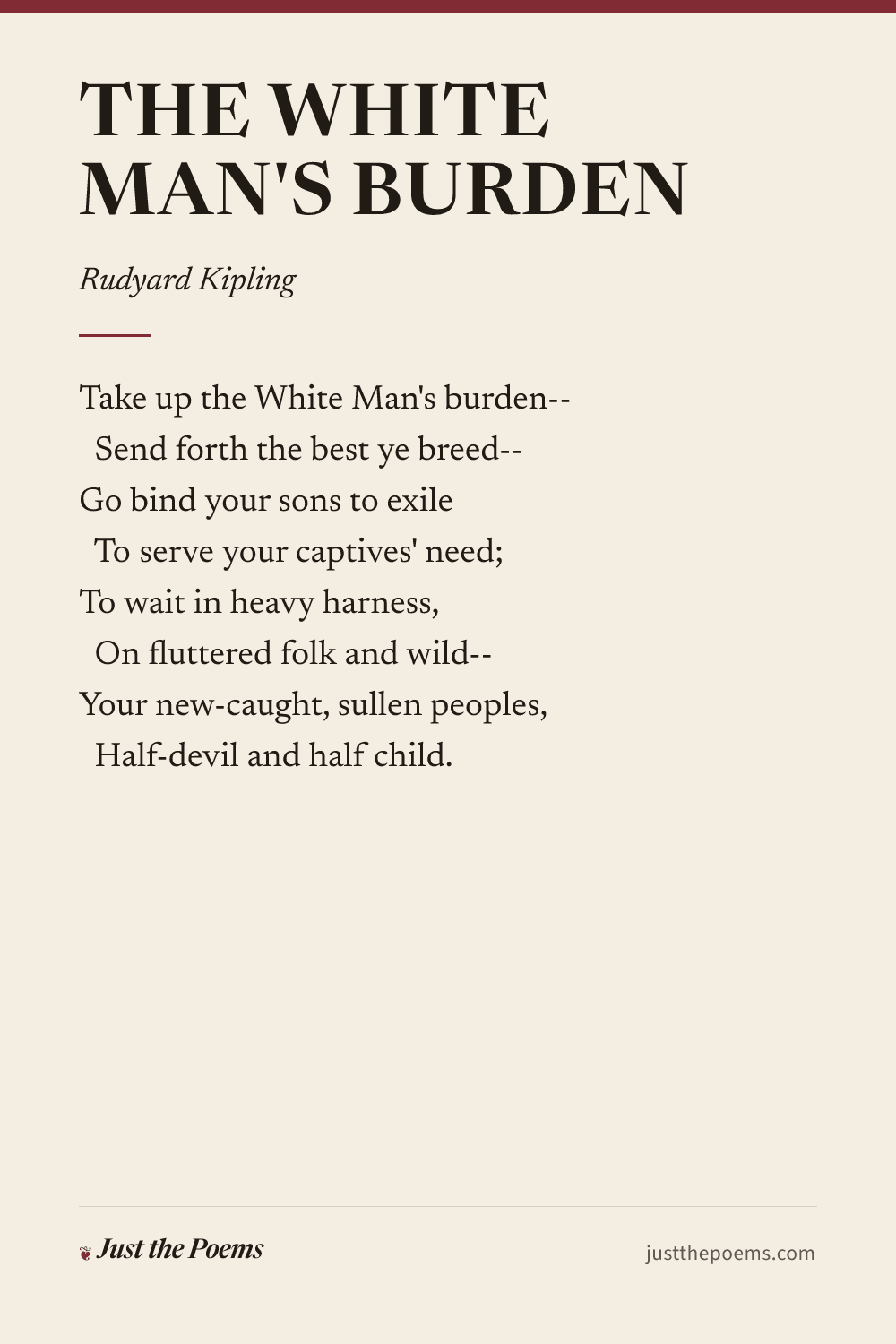
Take up the White Man's burden-- Send forth the best ye breed--Go bind your sons to exile To serve your captives' need;To wait in heavy harness, On fluttered folk and wild--Your new-caught, sullen peoples, Half-devil and half child.

Take up the White Man's burden-- In patience to abide,To veil the threat of terror And check the show of pride;

Show all 56 lines 44 more

By open speech and simple, An hundred times made plain,To seek another's profit, And work another's gain.

Take up the White Man's burden-- The savage wars of peace--Fill full the mouth of Famine And bid the sickness cease;And when your goal is nearest The end for others sought,Watch Sloth and heathen Folly Bring all your hope to naught.

Take up the White Man's burden-- No tawdry rule of kings,But toil of serf and sweeper-- The tale of common things.The ports ye shall not enter, The roads ye shall not tread,Go make them with your living, And mark them with your dead.

Take up the White Man's burden-- And reap his old reward;The blame of those ye better, The hate of those ye guard--The cry of hosts ye humour (Ah, slowly!) toward the light:--"Why brought ye us from bondage, Our loved Egyptian night?"

Take up the White Man's burden-- Ye dare not stoop to less--Nor call too loud on Freedom To cloak your weariness;By all ye cry or whisper, By all ye leave or do,The silent, sullen peoples Shall weigh your Gods and you.

Take up the White Man's burden-- Have done with childish days--The lightly proffered laurel The easy, ungrudged praise.Comes now, to search your manhood Through all the thankless years,Cold, edged with dear-bought wisdom, The judgment of your peers!

Source

Kipling Stories and Poems Every Child Should Know, Book II

Filed under
  • Named in the title

THE RAGGEDY MAN

James Whitcomb Riley

In 1 Wikipedia 2 anthologies Poet in 16 Wikipedias

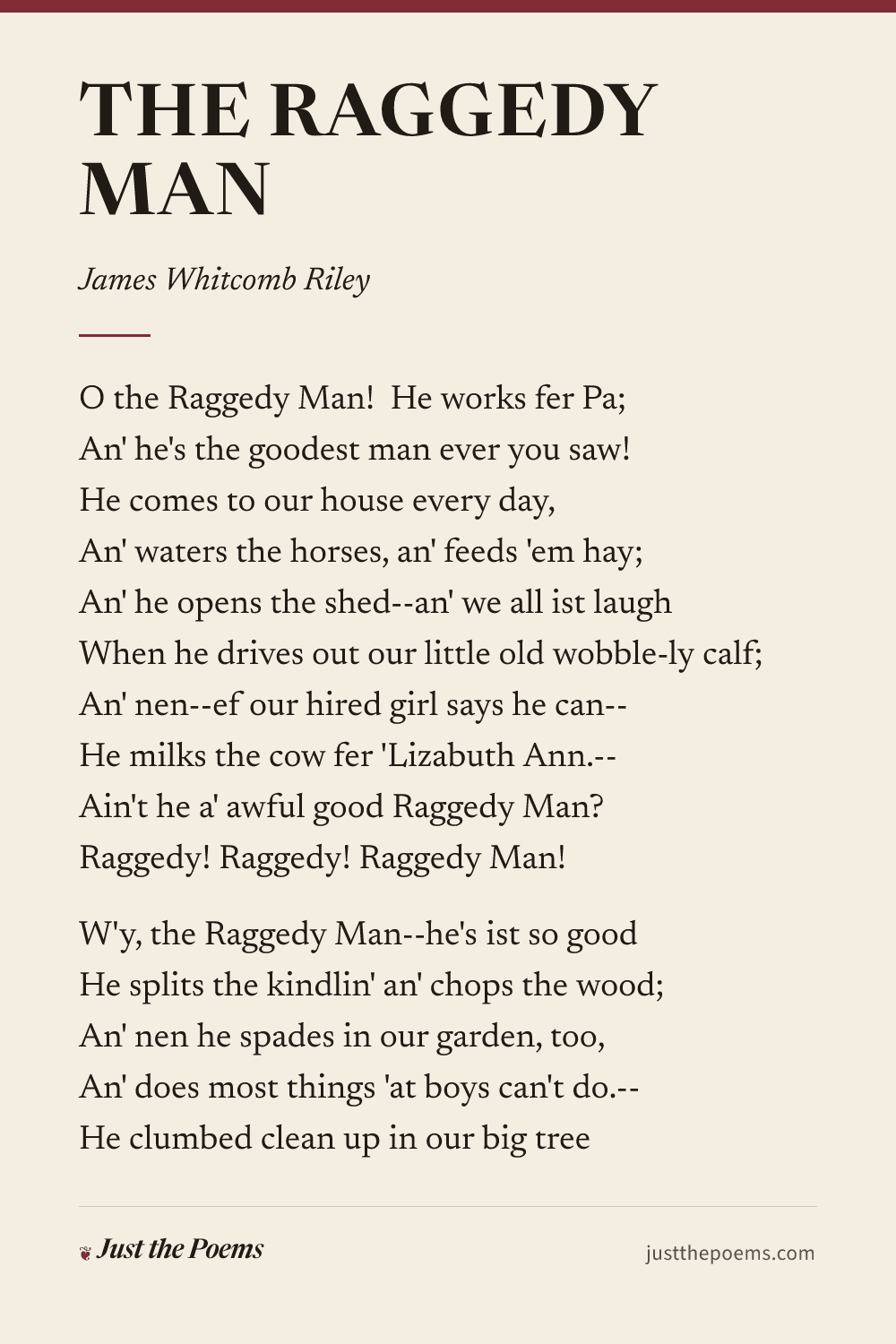
O the Raggedy Man! He works fer Pa;An' he's the goodest man ever you saw!He comes to our house every day,An' waters the horses, an' feeds 'em hay;An' he opens the shed--an' we all ist laughWhen he drives out our little old wobble-ly calf;An' nen--ef our hired girl says he can--He milks the cow fer 'Lizabuth Ann.--Ain't he a' awful good Raggedy Man?Raggedy! Raggedy! Raggedy Man!

W'y, the Raggedy Man--he's ist so goodHe splits the kindlin' an' chops the wood;

Show all 41 lines 29 more

An' nen he spades in our garden, too,An' does most things 'at boys can't do.--He clumbed clean up in our big treeAn' shooked a' apple down fer me--An' nother'n', too, fer 'Lizabuth Ann--An' nother'n', too, fer the Raggedy Man.--Ain't he a' awful kind Raggedy Man?Raggedy! Raggedy! Raggedy Man!

An' the Raggedy Man, he knows most rhymesAn' tells 'em, ef I be good, sometimes:Knows 'bout Giunts, an' Griffuns, an' Elves,An' the Squidgicum-Squees 'at swallers therselves!An', wite by the pump in our pasture-lot,He showed me the hole 'at the Wunks is got,'At lives 'way deep in the ground, an' canTurn into me, er 'Lizabuth Ann!Er Ma, er Pa, er the Raggedy Man!Ain't he a funny old Raggedy Man?Raggedy! Raggedy! Raggedy Man!

The Raggedy Man--one time when heWas makin' a little bow-n'-orry fer me,Says, "When you're big like your Pa is,Air you go' to keep a fine store like his--An' be a rich merchunt--an' wear fine clothes?--Er what air you go' to be, goodness knows?"An' nen he laughed at 'Lizabuth Ann,An' I says "'M go' to be a Raggedy Man!--I'm ist go' to be a nice Raggedy Man!"Raggedy! Raggedy! Raggedy Man!

Source

The Home Book of Verse, ed. Burton Egbert Stevenson

Filed under
  • Named in the title

MAN WAS MADE TO MOURN

Robert Burns

In 1 Wikipedia 0 anthologies Poet in 89 Wikipedias

When chill November’s surly blast Made fields and forests bare,One ev’ning as I wander’d forth Along the banks of Ayr,I spied a man, whose agèd step Seem’d weary, worn with care;His face was furrow’d o’er with years, And hoary was his hair.

‘Young stranger, whither wand’rest thou?’ Began the rev’rend sage;‘Does thirst of wealth thy step constrain, Or youthful pleasure’s rage?

Show all 88 lines 76 more

Or, haply, prest with cares and woes, Too soon thou hast beganTo wander forth with me to mourn The miseries of man.

‘The sun that overhangs yon moors, Out-spreading far and wide,Where hundreds labour to support A haughty lordling’s pride—I’ve seen yon weary winter-sun Twice forty times return,And ev’ry time has added proofs That man was made to mourn.

‘O man! while in thy early years, How prodigal of time!Mis-spending all thy precious hours, Thy glorious youthful prime!Alternate follies take the sway; Licentious passions burn;Which tenfold force give nature’s law, That man was made to mourn.

‘Look not alone on youthful prime, Or manhood’s active might;Man then is useful to his kind, Supported is his right;But see him on the edge of life, With cares and sorrows worn,Then age and want, oh! ill-match’d pair! Show man was made to mourn.

‘A few seem favourites of fate, In pleasure’s lap carest;Yet think not all the rich and great Are likewise truly blest.But oh! what crowds in ev’ry land All wretched and forlorn,Thro’ weary life this lesson learn— That man was made to mourn.

‘Many and sharp the num’rous ills Inwoven with our frame!More pointed still we make ourselves Regret, remorse, and shame!And man, whose heaven-erected face The smiles of love adorn—Man’s inhumanity to man Makes countless thousands mourn!

‘See yonder poor o’erlabour’d wight, So abject, mean, and vile,Who begs a brother of the earth To give him leave to toil;And see his lordly fellow-worm The poor petition spurn,Unmindful tho’ a weeping wife And helpless offspring mourn.

‘If I’m design’d yon lordling’s slave,— By nature’s law design’d,—Why was an independent wish E’er planted in my mind?If not, why am I subject to His cruelty, or scorn?Or why has man the will and pow’r To make his fellow mourn?

‘Yet let not this too much, my son, Disturb thy youthful breast;This partial view of human-kind Is surely not the last!The poor oppressèd honest man Had never sure been bornHad there not been some recompense To comfort those that mourn!

‘O Death, the poor man’s dearest friend, The kindest and the best!Welcome the hour my agèd limbs Are laid with thee at rest!The great, the wealthy, fear thy blow, From pomp and pleasure torn;But oh; a blest relief to those That weary-laden mourn.’

Source

Songs and lyrics of Robert Burns

Filed under
  • Named in the title

Advertisements

ODE ON INTIMATIONS OF IMMORTALITY FROM RECOLLECTIONS OF EARLY CHILDHOOD

William Wordsworth

In 0 Wikipedias 4 anthologies Poet in 97 Wikipedias

There was a time when meadow, grove, and stream,The earth, and every common sight To me did seem Apparell'd in celestial light,The glory and the freshness of a dream.It is not now as it hath been of yore;-- Turn wheresoe'er I may, By night or day,The things which I have seen I now can see no more!

The rainbow comes and goes, And lovely is the rose; The moon doth with delight

Show all 204 lines 192 more

Look round her when the heavens are bare; Waters on a starry night Are beautiful and fair; The sunshine is a glorious birth; But yet I know, where'er I go,That there hath pass'd away a glory from the earth.

Now, while the birds thus sing a joyous song, And while the young lambs bound As to the tabor's sound,To me alone there came a thought of grief:A timely utterance gave that thought relief, And I again am strong.The cataracts blow their trumpets from the steep,--No more shall grief of mine the season wrong:I hear the echoes through the mountains throng,The winds come to me from the fields of sleep, And all the earth is gay; Land and sea Give themselves up to jollity, And with the heart of May Doth every beast keep holiday;-- Thou child of joy,Shout round me, let me hear thy shouts, thou happy Shepherd boy!

Ye blessed creatures, I have heard the call Ye to each other make; I seeThe heavens laugh with you in your jubilee; My heart is at your festival, My head hath its coronal,The fulness of your bliss, I feel--I feel it all. O evil day! if I were sullen While Earth herself is adorning This sweet May morning, And the children are pulling On every side In a thousand valleys far and wide Fresh flowers; while the sun shines warm,And the babe leaps up on his mother's arm:-- I hear, I hear, with joy I hear! --But there's a tree, of many, one,A single field which I have look'd upon,Both of them speak of something that is gone: The pansy at my feet Doth the same tale repeat:Whither is fled the visionary gleam?Where is it now, the glory and the dream?

Our birth is but a sleep and a forgetting;The Soul that rises with us, our life's Star, Hath had elsewhere its setting And cometh from afar; Not in entire forgetfulness And not in utter nakednessBut trailing clouds of glory do we come From God, who is our home:Heaven lies about us in our infancy!Shades of the prison-house begin to close Upon the growing boy,But he beholds the light, and whence it flows, He sees it in his joy,The youth, who daily farther from the east Must travel, still is Nature's priest, And by the vision splendid Is on his way attended;At length the man perceives it die away,And fade into the light of common day.

Earth fills her lap with pleasures of her own;Yearnings she hath in her own natural kind,And, even with something of a mother's mind, And no unworthy aim, The homely nurse doth all she canTo make her foster-child, her inmate, Man, Forget the glories he hath knownAnd that imperial palace whence he came.

Behold the Child among his new-born blisses,A six years' darling of a pigmy size!See, where 'mid work of his own hand he lies,Fretted by sallies of his mother's kisses,With light upon him from his father's eyes!See, at his feet, some little plan or chart,Some fragment from his dream of human life,Shaped by himself with newly-learned art; A wedding or a festival, A mourning or a funeral; And this hath now his heart, And unto this he frames his song: Then will he fit his tongueTo dialogues of business, love, or strife; But it will not be long Ere this be thrown aside, And with new joy and prideThe little actor cons another part;Filling from time to time his "humorous stage"With all the Persons, down to palsied Age,That life brings with her in her equipage; As if his whole vocation Were endless imitation.

Thou, whose exterior semblance doth belie Thy soul's immensity;Thou best philosopher, who yet dost keepThy heritage, thou eye among the blind,That, deaf and silent, read'st the eternal deep,Haunted for ever by the eternal mind,-- Mighty prophet! Seer blest! On whom those truths do restWhich we are toiling all our lives to find;In darkness lost, the darkness of the grave;Thou, over whom thy immortalityBroods like the day, a master o'er a slave,A presence which is not to be put by;Thou little child, yet glorious in the mightOf heaven-born freedom on thy being's height,Why with such earnest pains dost thou provokeThe years to bring the inevitable yoke,Thus blindly with thy blessedness at strife?Full soon thy soul shall have her earthly freight,And custom lie upon thee with a weightHeavy as frost, and deep almost as life!

O joy! that in our embers Is something that doth live, That nature yet remembers What was so fugitive!The thought of our past years in me doth breedPerpetual benediction: not indeedFor that which is most worthy to be blest,Delight and liberty, the simple creedOf childhood, whether busy or at rest,With new-fledged hope still fluttering in his breast: --Not for these I raise The song of thanks and praise; But for those obstinate questionings Of sense and outward things, Fallings from us, vanishings, Blank misgivings of a creatureMoving about in worlds not realised,High instincts, before which our mortal natureDid tremble like a guilty thing surprised: But for those first affections, Those shadowy recollections, Which, be they what they may,Are yet the fountain-light of all our day,Are yet a master-light of all our seeing; Uphold us--cherish--and have power to makeOur noisy years seem moments in the beingOf the eternal silence: truths that wake, To perish never;Which neither listlessness, nor mad endeavour Nor man nor boyNor all that is at enmity with joy,Can utterly abolish or destroy! Hence, in a season of calm weather Though inland far we be,Our souls have sight of that immortal sea Which brought us hither; Can in a moment travel thither--And see the children sport upon the shore,And hear the mighty waters rolling evermore.

Then sing, ye birds, sing, sing a joyous song! And let the young lambs bound As to the tabor's sound! We, in thought, will join your throng Ye that pipe and ye that play, Ye that through your hearts to-day Feel the gladness of the May!What though the radiance which was once so brightBe now for ever taken from my sight, Though nothing can bring back the hourOf splendour in the grass, of glory in the flower; We will grieve not, rather find Strength in what remains behind, In the primal sympathy Which having been must ever be, In the soothing thoughts that spring Out of human suffering, In the faith that looks through death,In years that bring the philosophic mind.

And O, ye Fountains, Meadows, Hills, and Groves,Forebode not any severing of our loves!Yet in my heart of hearts I feel your might;I only have relinquish'd one delightTo live beneath your more habitual sway;I love the brooks which down their channels fretEven more than when I tripp'd lightly as they;The innocent brightness of a new-born day Is lovely yet;The clouds that gather round the setting sunDo take a sober colouring from an eyeThat hath kept watch o'er man's mortality;Another race hath been, and other palms are won.Thanks to the human heart by which we live,Thanks to its tenderness, its joys, and fears,To me the meanest flower that blows can giveThoughts that do often lie too deep for tears.
Source

The Golden Treasury, ed. Francis Turner Palgrave

Filed under
  • Section “THE MAN”, The Home Book of Verse

THE GIFTS OF GOD

George Herbert

In 0 Wikipedias 4 anthologies Poet in 37 Wikipedias

When God at first made Man,Having a glass of blessings standing by;Let us (said he) pour on him all we can:Let the world's riches, which dispersed lie, Contract into a span.

So strength first made a way;Then beauty flow'd, then wisdom, honour, pleasure:When almost all was out, God made a stay,Perceiving that alone, of all his treasure, Rest in the bottom lay.

For if I should (said he)Bestow this jewel also on my creature,He would adore My gifts instead of Me,And rest in Nature, not the God of Nature: So both should losers be.

Yet let him keep the rest,But keep them with repining restlessness:Let him be rich and weary, that at least,If goodness lead him not, yet weariness May toss him to my breast.

Source

The Golden Treasury, ed. Francis Turner Palgrave

Filed under
  • Section “THE MAN”, The Home Book of Verse

My heart leaps up when I behold

William Wordsworth

In 0 Wikipedias 3 anthologies Poet in 97 Wikipedias

My heart leaps up when I behold A rainbow in the sky:So was it when my life began,So is it now I am a man;So be it when I shall grow old Or let me die!The Child is father of the Man:I could wish my days to beBound each to each by natural piety.

Source

The Golden Treasury, ed. Francis Turner Palgrave

Filed under
  • Section “THE MAN”, The Home Book of Verse

YOUTH AND AGE

Lord Byron

In 0 Wikipedias 2 anthologies Poet in 155 Wikipedias

There's not a joy the world can give like that it takes awayWhen the glow of early thought declines in feeling's dull decay;'Tis not on youth's smooth cheek the blush alone which fades so fast,But the tender bloom of heart is gone, ere youth itself be past.

Then the few whose spirits float above the wreck of happinessAre driven o'er the shoals of guilt or ocean of excess:The magnet of their course is gone, or only points in vainThe shore to which their shiver'd sail shall never stretch again.

Then the mortal coldness of the soul like death itself comes down;It cannot feel for others' woes, it dare not dream its own;That heavy chill has frozen o'er the fountain of our tears,And though the eye may sparkle still, 'tis where the ice appears.

Though wit may flash from fluent lips, and mirth distract the breast,Through midnight hours that yield no more their former hope of rest;'Tis but as ivy-leaves around the ruin'd turret wreathe,All green and wildly fresh without, but worn and gray beneath.

O could I feel as I have felt, or be what I have been,Or weep as I could once have wept o'er many a vanish'd scene,--As springs in deserts found seem sweet, all brackish though they be,So midst the wither'd waste of life, those tears would flow to me!

Source

The Golden Treasury, ed. Francis Turner Palgrave

Filed under
  • Section “THE MAN”, The Home Book of Verse

THE OLD MAN DREAMS

Oliver Wendell Holmes

In 0 Wikipedias 2 anthologies Poet in 37 Wikipedias

Oh for one hour of youthful joy!Give back my twentieth spring!I'd rather laugh, a bright-haired boy,Than reign, a gray-beard king.

Off with the spoils of wrinkled age!Away with Learning's crown!Tear out life's Wisdom-written page,And dash its trophies down!

One moment let my life-blood streamFrom boyhood's fount of flame!Give me one giddy, reeling dreamOf life all love and fame!

Show all 44 lines 32 more

My listening angel heard the prayer,And, calmly smiling, said,"If I but touch thy silvered hair,Thy hasty wish hath sped.

"But is there nothing in thy trackTo bid thee fondly stay,While the swift seasons hurry backTo find the wished-for day?"

"Ah, truest soul of womankind!Without thee what were life?One bliss I cannot leave behind:I'll take--my--precious--wife!"

The angel took a sapphire penAnd wrote in rainbow dew,The man would be a boy again,And be a husband, too!

"And is there nothing yet unsaid,Before the change appears?Remember, all their gifts have fledWith those dissolving years."

"Why, yes;" for memory would recallMy fond paternal joys;"I could not bear to leave them all--I'll take--my--girl--and--boys."

The smiling angel dropped his pen,--"Why, this will never do;The man would be a boy again,And be a father, too!"

And so I laughed,--my laughter wokeThe household with its noise,--And wrote my dream, when morning broke,To please the gray-haired boys.

Source

The Home Book of Verse, ed. Burton Egbert Stevenson

Filed under
  • Named in the title

Advertisements

SONG OF MARION'S MEN.

William Cullen Bryant

In 0 Wikipedias 2 anthologies Poet in 28 Wikipedias

Our band is few, but true and tried, Our leader frank and bold;The British soldier trembles When Marion's name is told.Our fortress is the good greenwood, Our tent the cypress-tree;We know the forest round us, As seamen know the sea;We know its walls of thorny vines, Its glades of reedy grass,Its safe and silent islands Within the dark morass.

Show all 60 lines 48 more

Woe to the English soldiery That little dread us near!On them shall light at midnight A strange and sudden fear;When, waking to their tents on fire, They grasp their arms in vain,And they who stand to face us Are beat to earth again;And they who fly in terror deem A mighty host behind,And hear the tramp of thousands Upon the hollow wind.

Then sweet the hour that brings release From danger and from toil;We talk the battle over, And share the battle's spoil.The woodland rings with laugh and shout, As if a hunt were up,And woodland flowers are gathered To crown the soldier's cup.With merry songs we mock the wind That in the pine-top grieves,And slumber long and sweetly On beds of oaken leaves.

Well knows the fair and friendly moon The band that Marion leads,--The glitter of their rifles, The scampering of their steeds.'Tis life to guide the fiery barb Across the moonlight plain;'Tis life to feel the night-wind That lifts his tossing mane.A moment in the British camp-- A moment--and awayBack to the pathless forest, Before the peep of day.

Grave men there are by broad Santee, Grave men with hoary hairs;Their hearts are all with Marion, For Marion are their prayers.And lovely ladies greet our band With kindliest welcoming,With smiles like those of summer, And tears like those of spring.For them we wear these trusty arms, And lay them down no moreTill we have driven the Briton Forever from our shore.

Source

The World's Best Poetry, Vol. VIII, ed. Bliss Carman, 1904

Filed under
  • Named in the title

A Farewell

Coventry Patmore

In 0 Wikipedias 2 anthologies Poet in 16 Wikipedias

With all my will, but much against my heart,We two now part.My Very Dear,Our solace is, the sad road lies so clear.It needs no art,With faint, averted feetAnd many a tear,In our opposèd paths to persevere.Go thou to East, I West.We will not sayThere’s any hope, it is so far away.But, O, my Best,

Show all 25 lines 13 more

When the one darling of our widowhead,The nursling Grief,Is dead,And no dews blur our eyesTo see the peach-bloom come in evening skies,Perchance we may,Where now this night is day,And even through faith of still averted feet,Making full circle of our banishment,Amazèd meet;The bitter journey to the bourne so sweetSeasoning the termless feast of our contentWith tears of recognition never dry.

Source

The Oxford Book of English Verse 1250–1900, 1900

Filed under
  • Library subject “Man-woman relationships -- Poetry”, The Victories of Love, and Other Poems

Departure

Coventry Patmore

In 0 Wikipedias 2 anthologies Poet in 16 Wikipedias

It was not like your great and gracious ways!Do you, that have naught other to lament,Never, my Love, repentOf how, that July afternoon,You went,With sudden, unintelligible phrase,And frighten’d eye,Upon your journey of so many daysWithout a single kiss, or a good-bye?I knew, indeed, that you were parting soon;And so we sate, within the low sun’s rays,You whispering to me, for your voice was weak,

Show all 32 lines 20 more

Your harrowing praise.Well, it was wellTo hear you such things speak,And I could tellWhat made your eyes a growing gloom of love,As a warm South-wind sombres a March grove.And it was like your great and gracious waysTo turn your talk on daily things, my Dear,Lifting the luminous, pathetic lashTo let the laughter flash,Whilst I drew near,Because you spoke so low that I could scarcely hear.But all at once to leave me at the last,More at the wonder than the loss aghast,With huddled, unintelligible phrase,And frighten’d eye,And go your journey of all daysWith not one kiss, or a good-bye,And the only loveless look the look with which you pass’d:’Twas all unlike your great and gracious ways.

Source

The Oxford Book of English Verse 1250–1900, 1900

Filed under
  • Library subject “Man-woman relationships -- Poetry”, The Victories of Love, and Other Poems

‘If I were dead’

Coventry Patmore

In 0 Wikipedias 2 anthologies Poet in 16 Wikipedias

‘If I were dead, you’d sometimes say, Poor Child!’The dear lips quiver’d as they spake,And the tears brakeFrom eyes which, not to grieve me, brightly smiled.Poor Child, poor Child!I seem to hear your laugh, your talk, your song.It is not true that Love will do no wrong.Poor Child!And did you think, when you so cried and smiled,How I, in lonely nights, should lie awake,And of those words your full avengers make?Poor Child, poor Child!And now, unless it beThat sweet amends thrice told are come to thee,O God, have Thou no mercy upon me!Poor Child!

Source

The Oxford Book of English Verse 1250–1900, 1900

Filed under
  • Library subject “Man-woman relationships -- Poetry”, The Victories of Love, and Other Poems

The Toys

Coventry Patmore

In 0 Wikipedias 2 anthologies Poet in 16 Wikipedias

My little Son, who look’d from thoughtful eyesAnd moved and spoke in quiet grown-up wise,Having my law the seventh time disobey’d,I struck him, and dismissedWith hard words and unkiss’d,--His Mother, who was patient, being dead.Then, fearing lest his grief should hinder sleep,I visited his bed,But found him slumbering deep,With darkened eyelids, and their lashes yetFrom his late sobbing wet.And I, with moan,

Show all 33 lines 21 more

Kissing away his tears, left others of my own;For, on a table drawn beside his head,He had put, within his reach,A box of counters and a red-vein’d stone,A piece of glass abraded by the beach,And six or seven shells,A bottle with bluebells,And two French copper coins, ranged there with careful art,To comfort his sad heart.So when that night I pray’dTo God, I wept, and said:Ah, when at last we lie with trancèd breath,Not vexing Thee in death,And Thou rememberest of what toysWe made our joys,How weakly understoodThy great commanded good,Then, fatherly not lessThan I whom Thou hast moulded from the clay,Thou’lt leave Thy wrath, and say,‘I will be sorry for their childishness.’

Source

The Oxford Book of English Verse 1250–1900, 1900

Filed under
  • Library subject “Man-woman relationships -- Poetry”, The Victories of Love, and Other Poems

Advertisements

ON THIS DAY I COMPLETE MY THIRTY-SIXTH YEAR

George Gordon Byron

In 0 Wikipedias 1 anthology Poet in 155 Wikipedias

'Tis time this heart should be unmoved,Since others it hath ceased to move:Yet, though I cannot be beloved,Still let me love!

My days are in the yellow leaf;The flowers and fruits of love are gone;The worm, the canker, and the griefAre mine alone!

The fire that on my bosom preysIs lone as some volcanic isle;No torch is kindled at its blaze--A funeral pile.

Show all 40 lines 28 more

The hope, the fear, the jealous care,The exalted portion of the painAnd power of love, I cannot share,But wear the chain.

But 'tis not thus--and 'tis not here--Such thoughts should shake my soul, nor now,Where glory decks the hero's bier,Or binds his brow.

The sword, the banner, and the field,Glory and Greece, around me see!The Spartan, borne upon his shield,Was not more free.

Awake! (not Greece--she is awake!)Awake, my spirit! Think through whomThy life-blood tracks its parent lake,And then strike home!

Tread those reviving passions down,Unworthy manhood I--unto theeIndifferent should the smile or frownOf beauty be.

If thou regret'st thy youth, why live?The land of honorable deathIs here:--up to the field, and giveAway thy breath!

Seek out--less often sought than found--A soldier's grave, for thee the best;Then look around, and choose thy ground,And take thy rest.

Source

The Home Book of Verse, ed. Burton Egbert Stevenson

Filed under
  • Section “THE MAN”, The Home Book of Verse

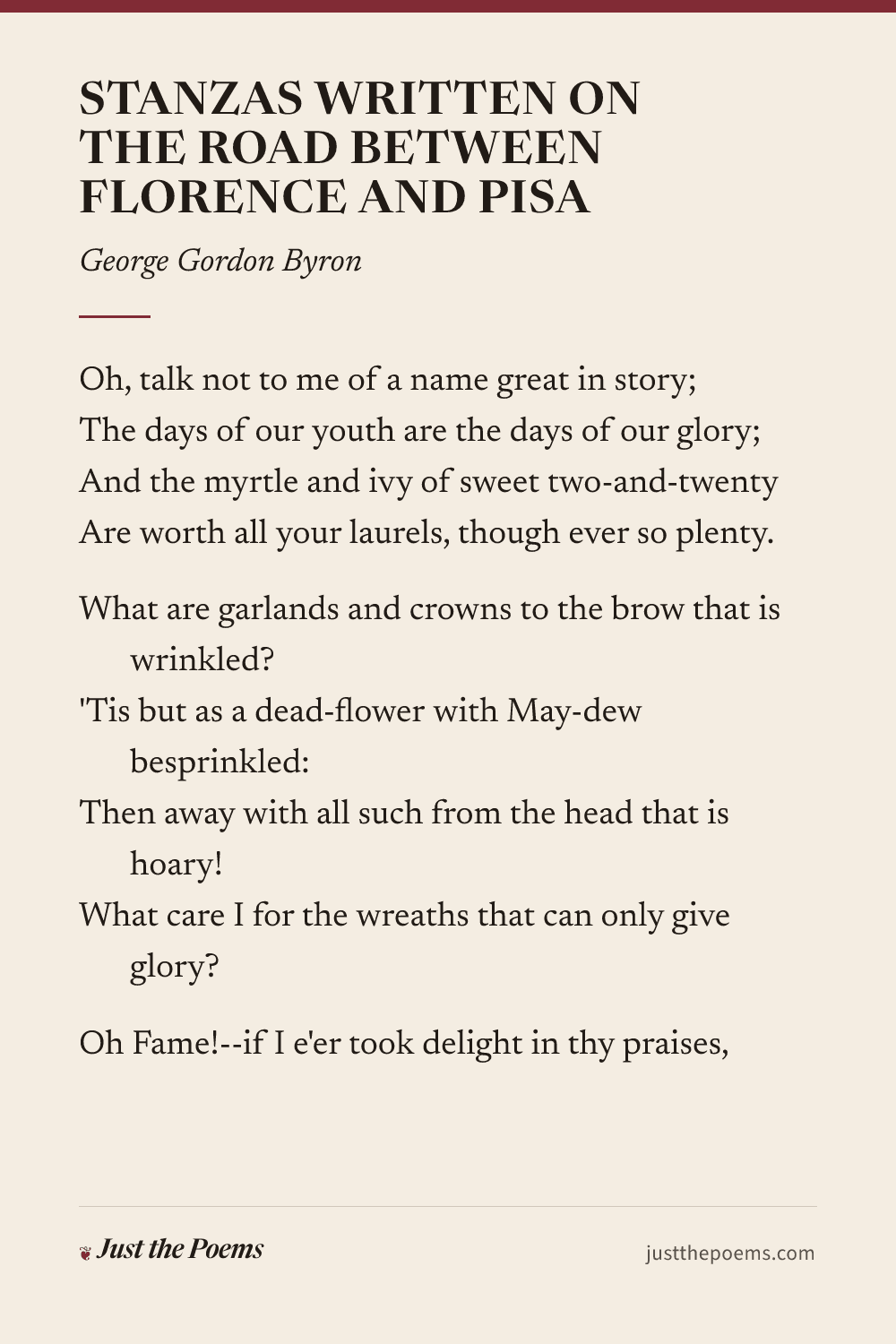
STANZAS WRITTEN ON THE ROAD BETWEEN FLORENCE AND PISA

George Gordon Byron

In 0 Wikipedias 1 anthology Poet in 155 Wikipedias

Oh, talk not to me of a name great in story;The days of our youth are the days of our glory;And the myrtle and ivy of sweet two-and-twentyAre worth all your laurels, though ever so plenty.

What are garlands and crowns to the brow that is wrinkled?'Tis but as a dead-flower with May-dew besprinkled:Then away with all such from the head that is hoary!What care I for the wreaths that can only give glory?

Oh Fame!--if I e'er took delight in thy praises,'Twas less for the sake of thy high-sounding phrases,Than to see the bright eyes of the dear one discover,She thought that I was not unworthy to love her.

There chiefly I sought thee, there only I found thee;Her glance was the best of the rays that surround thee;When it sparkled o'er aught that was bright in my story,I knew it was love, and I felt it was glory.

Source

The Home Book of Verse, ed. Burton Egbert Stevenson

Filed under
  • Section “THE MAN”, The Home Book of Verse

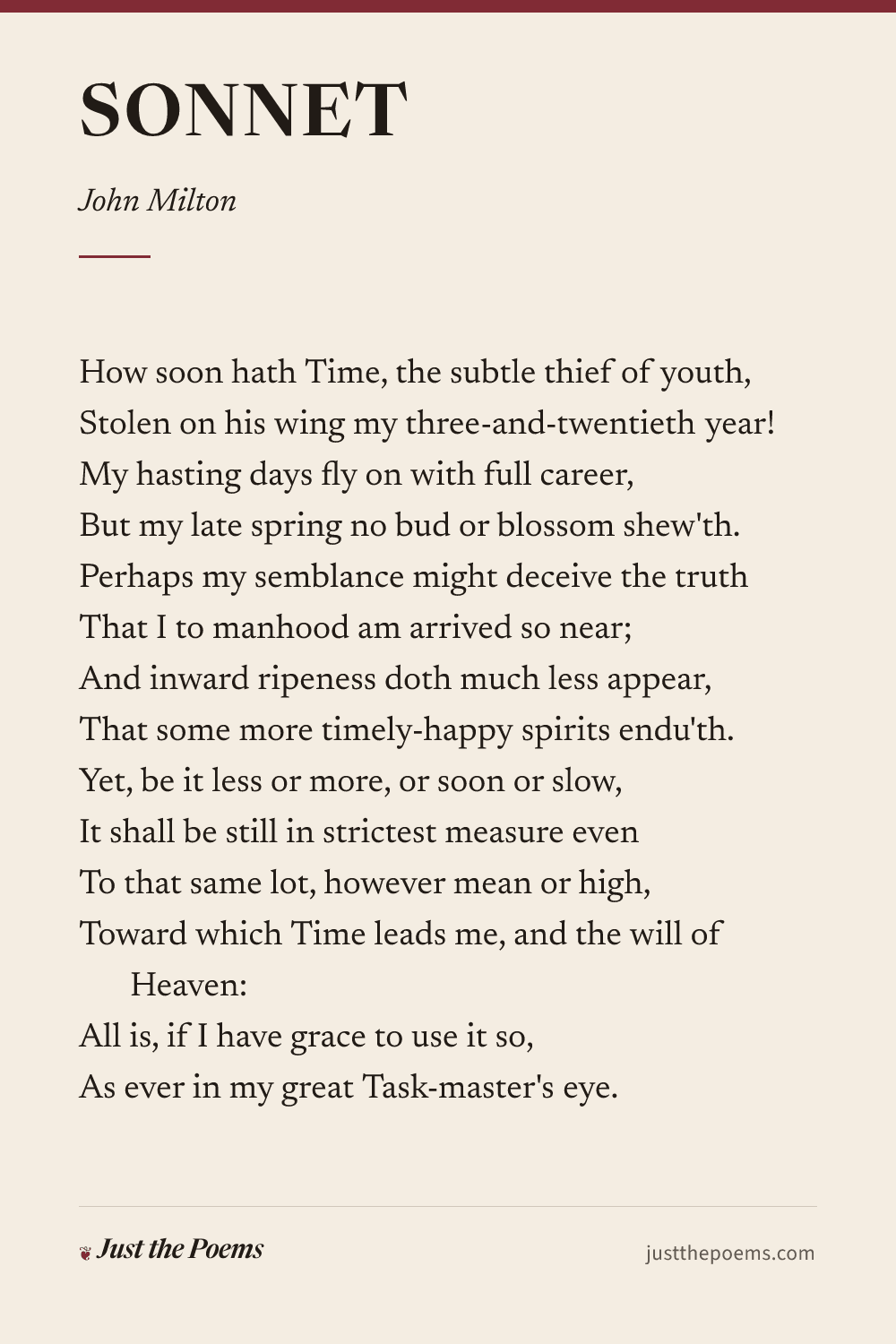
SONNET

John Milton

In 0 Wikipedias 1 anthology Poet in 106 Wikipedias

How soon hath Time, the subtle thief of youth,Stolen on his wing my three-and-twentieth year!My hasting days fly on with full career,But my late spring no bud or blossom shew'th.Perhaps my semblance might deceive the truthThat I to manhood am arrived so near;And inward ripeness doth much less appear,That some more timely-happy spirits endu'th.Yet, be it less or more, or soon or slow,It shall be still in strictest measure evenTo that same lot, however mean or high,Toward which Time leads me, and the will of Heaven:All is, if I have grace to use it so,As ever in my great Task-master's eye.

Source

The Home Book of Verse, ed. Burton Egbert Stevenson

Filed under
  • Section “THE MAN”, The Home Book of Verse

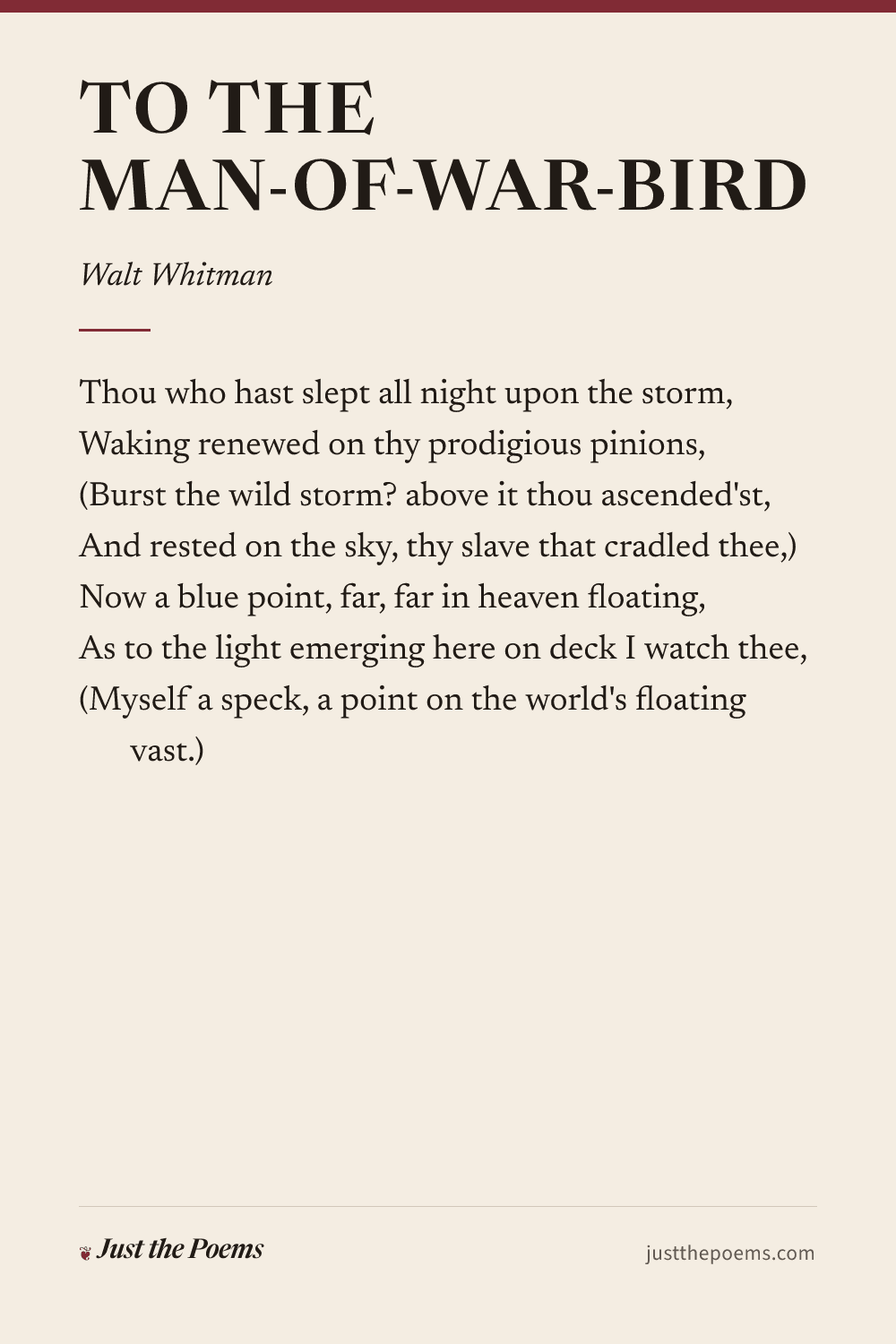
TO THE MAN-OF-WAR-BIRD

Walt Whitman

In 0 Wikipedias 1 anthology Poet in 105 Wikipedias

Thou who hast slept all night upon the storm,Waking renewed on thy prodigious pinions,(Burst the wild storm? above it thou ascended'st,And rested on the sky, thy slave that cradled thee,)Now a blue point, far, far in heaven floating,As to the light emerging here on deck I watch thee,(Myself a speck, a point on the world's floating vast.)

Far, far at sea,After the night's fierce drifts have strewn the shore with wrecks,With re-appearing day as now so happy and serene,The rosy and elastic dawn, the flashing sun,The limpid spread of air cerulean,Thou also re-appearest.

Thou born to match the gale, (thou art all wings,)To cope with heaven and earth and sea and hurricane,Thou ship of air that never furl'st thy sails,Days, even weeks untired and onward, through spaces, realms gyrating,At dusk that look'st on Senegal, at morn America,That sport'st amid the lightning-flash and thunder-cloud,In them, in thy experiences, hadst thou my soul,What joys! what joys were thine!

Source

The Home Book of Verse, ed. Burton Egbert Stevenson

Filed under
  • Named in the title

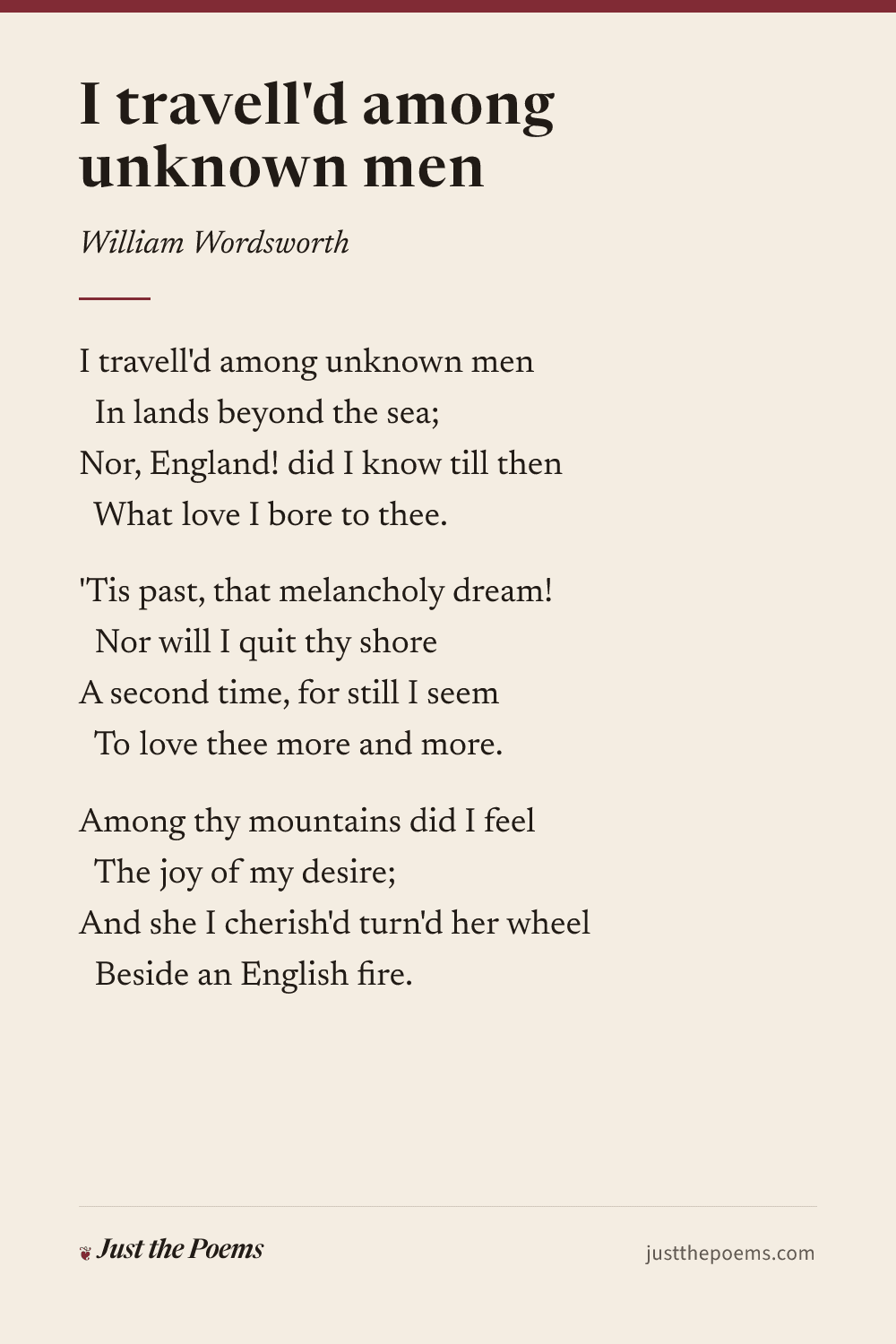
I travell'd among unknown men

William Wordsworth

In 0 Wikipedias 1 anthology Poet in 97 Wikipedias

I travell'd among unknown men In lands beyond the sea;Nor, England! did I know till then What love I bore to thee.

'Tis past, that melancholy dream! Nor will I quit thy shoreA second time, for still I seem To love thee more and more.

Among thy mountains did I feel The joy of my desire;And she I cherish'd turn'd her wheel Beside an English fire.

Thy mornings showed, thy nights conceal'd, The bowers where Lucy play'd;And thine too is the last green field That Lucy's eyes survey'd.

Source

The Golden Treasury, ed. Francis Turner Palgrave

Filed under
  • Named in the first line

God's Message to Men

Ralph Waldo Emerson

In 0 Wikipedias 1 anthology Poet in 92 Wikipedias

God said: I am tired of kings; I suffer them no more;Up to my ear the morning brings The outrage of the poor.

Think ye I have made this ball A field of havoc and war,Where tyrants great and tyrants small Might harry the weak and poor?

My angel--his name is Freedom-- Choose him to be your king.He shall cut pathways east and west And fend you with his wing.

I will never have a noble; No lineage counted great,Fishers and choppers and plowmen Shall constitute a state,

And ye shall succor man, 'Tis nobleness to serve;Help them who cannot help again; Beware from right to swerve.

Source

Poems Teachers Ask For, Book Two

Filed under
  • Named in the title

THE GOOD GREAT MAN

Samuel Taylor Coleridge

In 0 Wikipedias 1 anthology Poet in 86 Wikipedias

How seldom, Friend! a good great man inherits Honor or wealth with all his worth and pains!It sounds like stories from the land of spirits.If any man obtain that which he merits, Or any merit that which he obtains.

For shame, dear Friend; renounce this canting strain!What wouldst thou have a good great man obtain?Place--titles--salary--a gilded chain--Or throne of corses which his sword has slain?Greatness and goodness are not means, but ends!

Hath he not always treasures, always friends,The good great man? three treasures,--love, and light,And calm thoughts, regular as infant's breath;And three firm friends, more sure than day and night--Himself, his Maker, and the angel Death.

Source

The World's Best Poetry, Vol. III, ed. Bliss Carman, 1904

Filed under
  • Named in the title

GOD AND MAN

Alexander Pope

In 0 Wikipedias 1 anthology Poet in 78 Wikipedias

Lo, the poor Indian! whose untutored mindSees God in clouds, or hears him in the wind:His soul, proud science never taught to strayFar as the solar walk or Milky Way:Yet simple Nature to his hope has given,Behind the cloud-topt hill, an humbler heaven;Some safer world in depth of woods embraced,Some happier island in the watery waste,Where slaves once more their native land behold,No fiends torment, no Christians thirst for gold.To Be, contents his natural desire;He asks no angel's wing, no seraph's fire;

Show all 74 lines 62 more

But thinks, admitted to that equal sky,His faithful dog shall bear him company. Go, wiser thou! and in thy scale of sense,Weigh thy opinion against Providence:Call imperfection what thou fancy'st such,--Say, here he gives too little, there too much;Destroy all creatures for thy sport or gust,Yet cry, If man's unhappy, God's unjust,--If man alone engross not Heaven's high care,Alone made perfect here, immortal there;Snatch from his hand the balance and the rod,Re-judge his justice, be the god of God.In pride, in reasoning pride, our error lies;All quit their sphere, and rush into the skies.Pride still is aiming at the blest abodes:Men would be angels, angels would be gods.Aspiring to be gods, if angels fell,Aspiring to be angels, men rebel;And who but wishes to invert the lawsOf Order, sins against the Eternal Cause.

All are but parts of one stupendous whole,Whose body Nature is, and God the soul:That, changed through all, and yet in all the same;Great in the earth as in the ethereal frame;Warms in the sun, refreshes in the breeze,Glows in the stars, and blossoms in the trees,Lives through all life, extends through all extent,Spreads undivided, operates unspent:Breathes in our soul, informs our mortal part,As full, as perfect, in a hair as heart;As full, as perfect, in vile man that mourns,As the rapt seraph that adores and burns:To him no high, no low, no great, no small;He fills, he bounds, connects, and equals all. Cease then, nor order imperfection name:Our proper bliss depends on what we blame.Know thy own point: This kind, this due degreeOf blindness, weakness, Heaven bestows on thee.Submit.--In this or any other sphere,Secure to be as blest as thou canst bear;Safe in the hand of one disposing Power,Or in the natal or the mortal hour.All nature is but art unknown to thee;All chance, direction which thou canst not see;All discord, harmony not understood;All partial evil, universal good:And, spite of pride, in erring reason's spite,One truth is clear--Whatever is, is right.

Order is Heaven's first law: and, this confest,Some are and must be greater than the rest,More rich, more wise; but who infers from henceThat such are happier, shocks all common-sense.Heaven to mankind impartial we confess,If all are equal in their happiness:But mutual wants this happiness increase;All nature's difference keeps all nature's peace.Condition, circumstance, is not the thing:Bliss is the same in subject or in king,In who obtain defence or who defend,In him who is or him who finds a friend;Heaven breathes through every member of the wholeOne common blessing, as one common soul.

Source

The World's Best Poetry, Vol. IV, ed. Bliss Carman, 1904

Filed under
  • Named in the title

THE OLD MAN'S COMFORTS

Robert Southey

In 0 Wikipedias 1 anthology Poet in 44 Wikipedias

"You are old, Father William," the young man cried;"The few locks which are left you are gray;You are hale, Father William,--a hearty old man:Now tell me the reason, I pray."

"In the days of my youth," Father William replied,"I remembered that youth would fly fast,And abused not my health and my vigor at first,That I never might need them at last."

"You are old, Father William," the young man cried,"And pleasures with youth pass away;And yet you lament not the days that are gone:Now tell me the reason, I pray."

"In the days of my youth," Father William replied,"I remembered that youth could not last;I thought of the future, whatever I did,That I never might grieve for the past."

"You are old, Father William," the young man cried,"And life must be hastening away;You are cheerful, and love to converse upon death:Now tell me the reason, I pray."

"I am cheerful, young man," Father William replied;"Let the cause thy attention engage;In the days of my youth, I remembered my God,And He hath not forgotten my age."

Source

The Home Book of Verse, ed. Burton Egbert Stevenson

Filed under
  • Named in the title

MY BIRTH-DAY

Thomas Moore

In 0 Wikipedias 1 anthology Poet in 43 Wikipedias

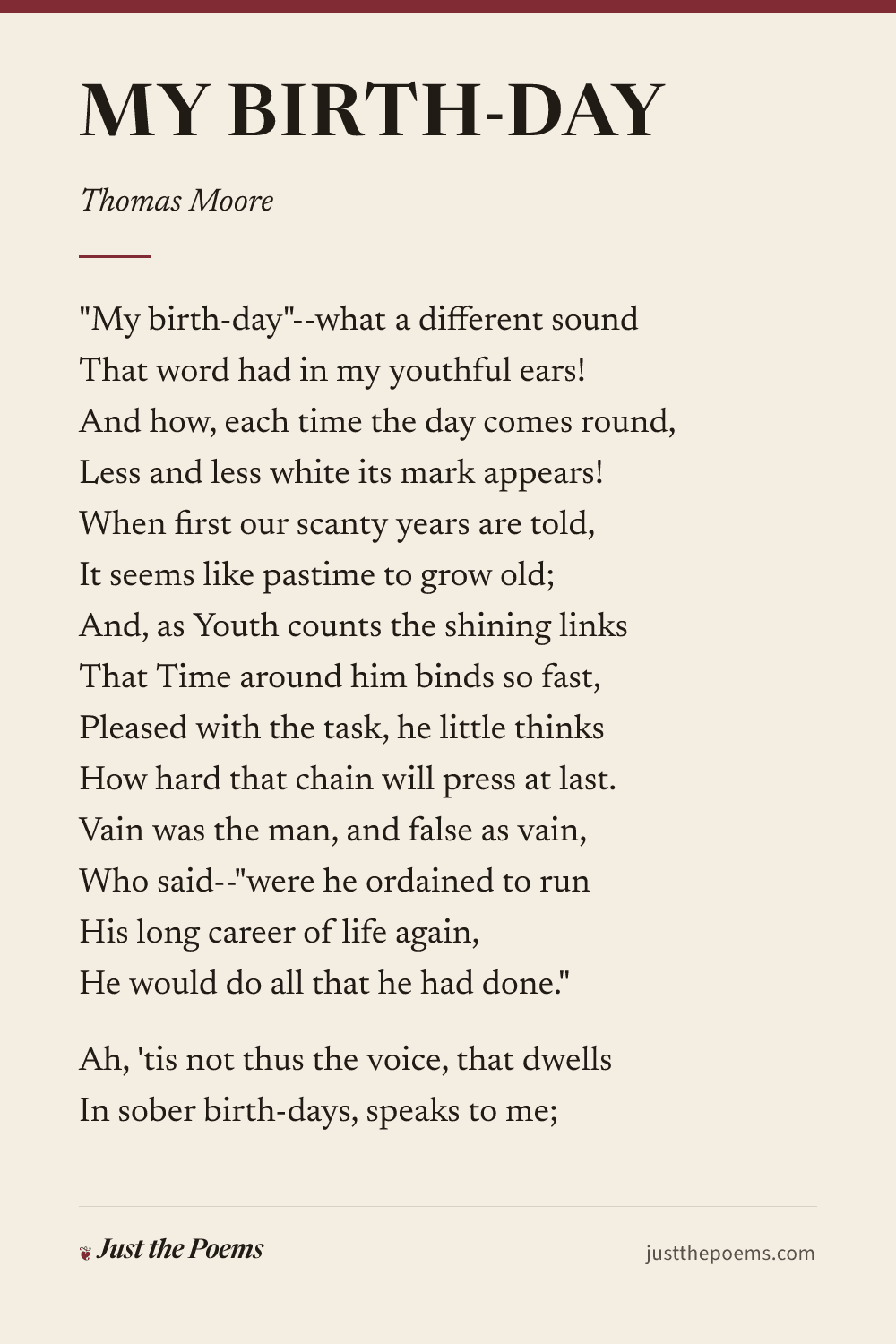
"My birth-day"--what a different soundThat word had in my youthful ears!And how, each time the day comes round,Less and less white its mark appears!When first our scanty years are told,It seems like pastime to grow old;And, as Youth counts the shining linksThat Time around him binds so fast,Pleased with the task, he little thinksHow hard that chain will press at last.Vain was the man, and false as vain,Who said--"were he ordained to run

Show all 40 lines 28 more

His long career of life again,He would do all that he had done."

Ah, 'tis not thus the voice, that dwellsIn sober birth-days, speaks to me;Far otherwise--of time it tellsLavished unwisely, carelessly;Of counsel mocked: of talents, madeHaply for high and pure designs,But oft, like Israel's incense, laidUpon unholy, earthly shrines;Of nursing many a wrong desire;Of wandering after Love too far,And taking every meteor-fireThat crossed my pathway, for a star.All this it tells, and, could I traceThe imperfect picture o'er again,With power to add, retouch, effaceThe lights and shades, the joy and pain,How little of the past would stay!How quickly all should melt away--All--but that Freedom of the Mind,Which hath been more than wealth to me;Those friendships, in my boyhood twined,And kept till now unchangingly;And that dear home, that saving-ark,Where Love's true light at last I've found,Cheering within, when all grows dark,And comfortless, and stormy round!

Source

The Home Book of Verse, ed. Burton Egbert Stevenson

Filed under
  • Section “THE MAN”, The Home Book of Verse

"BEFORE THE BEGINNING OF YEARS"

Algernon Charles Swinburne

In 0 Wikipedias 1 anthology Poet in 42 Wikipedias

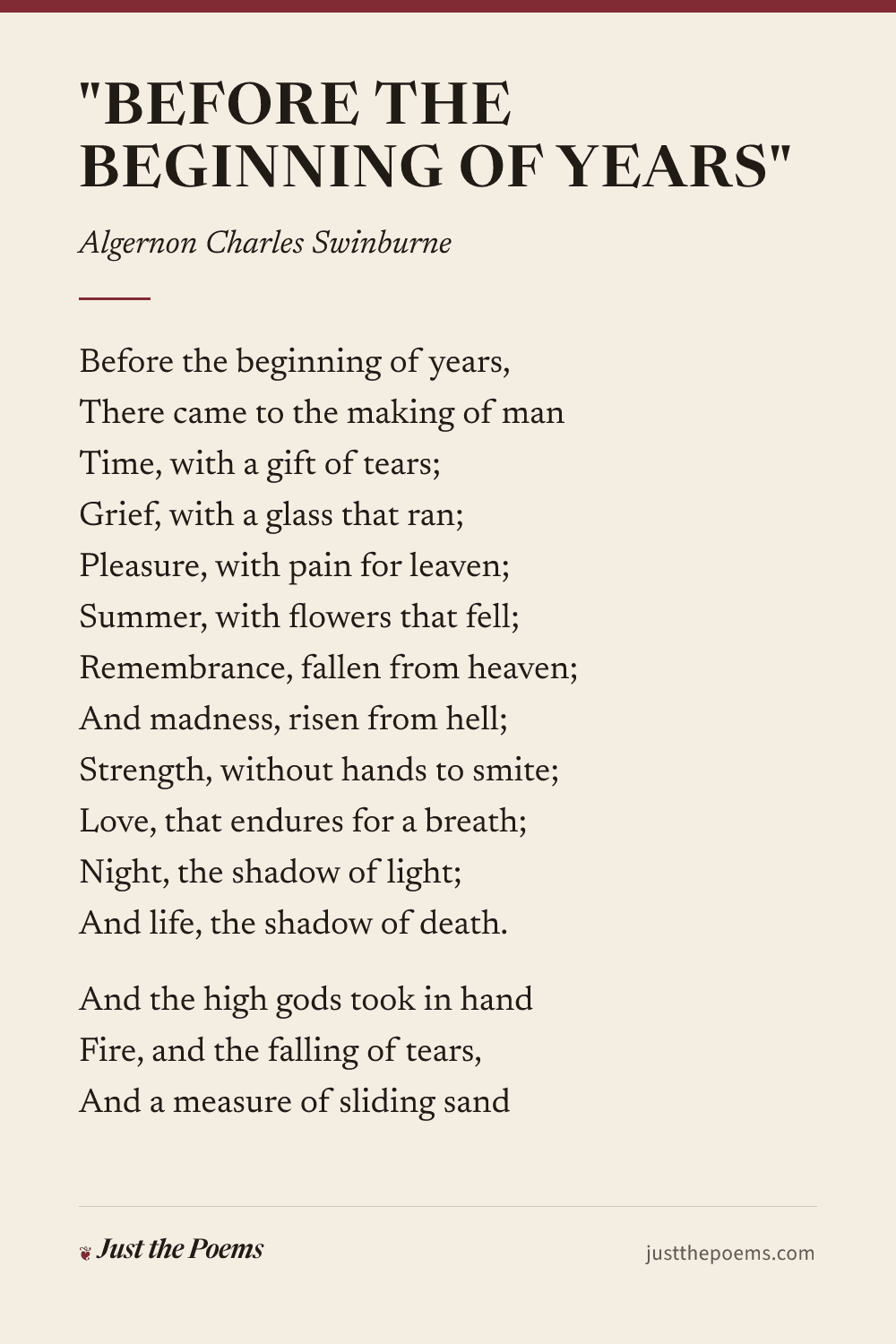
Before the beginning of years,There came to the making of manTime, with a gift of tears;Grief, with a glass that ran;Pleasure, with pain for leaven;Summer, with flowers that fell;Remembrance, fallen from heaven;And madness, risen from hell;Strength, without hands to smite;Love, that endures for a breath;Night, the shadow of light;And life, the shadow of death.

Show all 48 lines 36 more

And the high gods took in handFire, and the falling of tears,And a measure of sliding sandFrom under the feet of the years;And froth and drift of the sea,And dust of the laboring earth;And bodies of things to beIn the houses of death and of birth;And wrought with weeping and laughter,And fashioned with loathing and love,With life before and after,And death beneath and above,For a day and a night and a morrow,That his strength might endure for a span,With travail and heavy sorrow,The holy Spirit of man.

From the winds of the north and the southThey gathered as unto strife;They breathed upon his mouth,They filled his body with life;Eyesight and speech they wroughtFor the veils of the soul therein,A time for labor and thought,A time to serve and to sin;They gave him light in his ways,And love, and a space for delight,And beauty and length of days,And night, and sleep in the night.His speech is a burning fire;With his lips he travaileth;In his heart is a blind desire,In his eyes foreknowledge of death;He weaves, and is clothed with derisionSows, and he shall not reap;His life is a watch or a visionBetween a sleep and a sleep.

Source

The Home Book of Verse, ed. Burton Egbert Stevenson

Filed under
  • Section “THE MAN”, The Home Book of Verse

BALLADE OF MIDDLE AGE

Andrew Lang

In 0 Wikipedias 1 anthology Poet in 34 Wikipedias

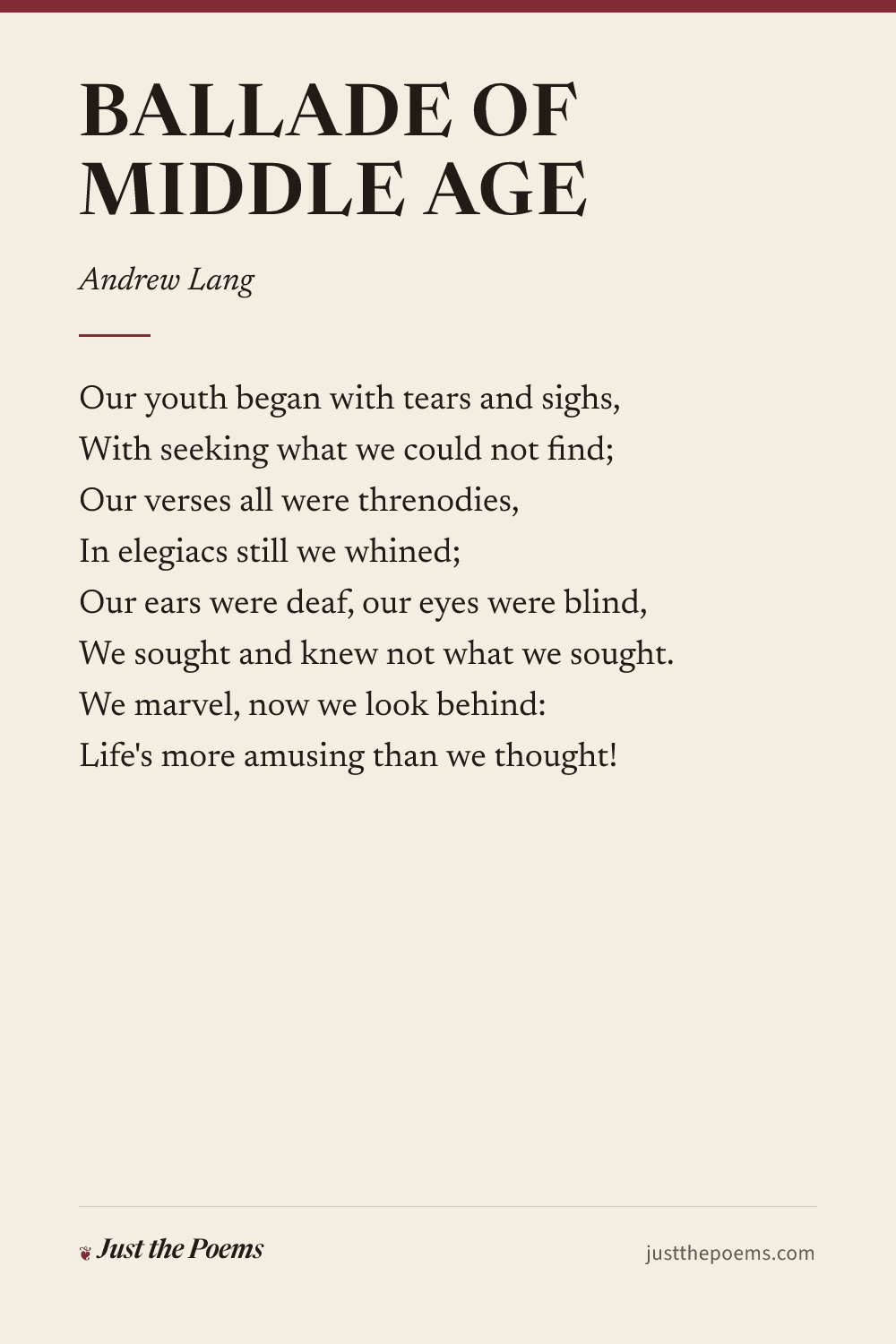
Our youth began with tears and sighs,With seeking what we could not find;Our verses all were threnodies,In elegiacs still we whined;Our ears were deaf, our eyes were blind,We sought and knew not what we sought.We marvel, now we look behind:Life's more amusing than we thought!

Oh, foolish youth, untimely wise!Oh, phantoms of the sickly mind!What? not content with seas and skies,With rainy clouds and southern wind,

Show all 29 lines 17 more

With common cares and faces kind,With pains and joys each morning brought?Ah, old, and worn, and tired we findLife's more amusing than we thought!

Though youth "turns spectre-thin and dies,"To mourn for youth we're not inclined;We set our souls on salmon flies,We whistle where we once repined.Confound the woes of human-kind!By Heaven we're "well deceived," I wot;Who hum, contented or resigned,"Life's more amusing than we thought"!

ENVOYO nate mecum, worn and linedOur faces show, but that is naught;Our hearts are young 'neath wrinkled rind:Life's more amusing than we thought!

Source

The Home Book of Verse, ed. Burton Egbert Stevenson

Filed under
  • Section “THE MAN”, The Home Book of Verse

MAN AND THE ASCIDIAN

Andrew Lang

In 0 Wikipedias 1 anthology Poet in 34 Wikipedias

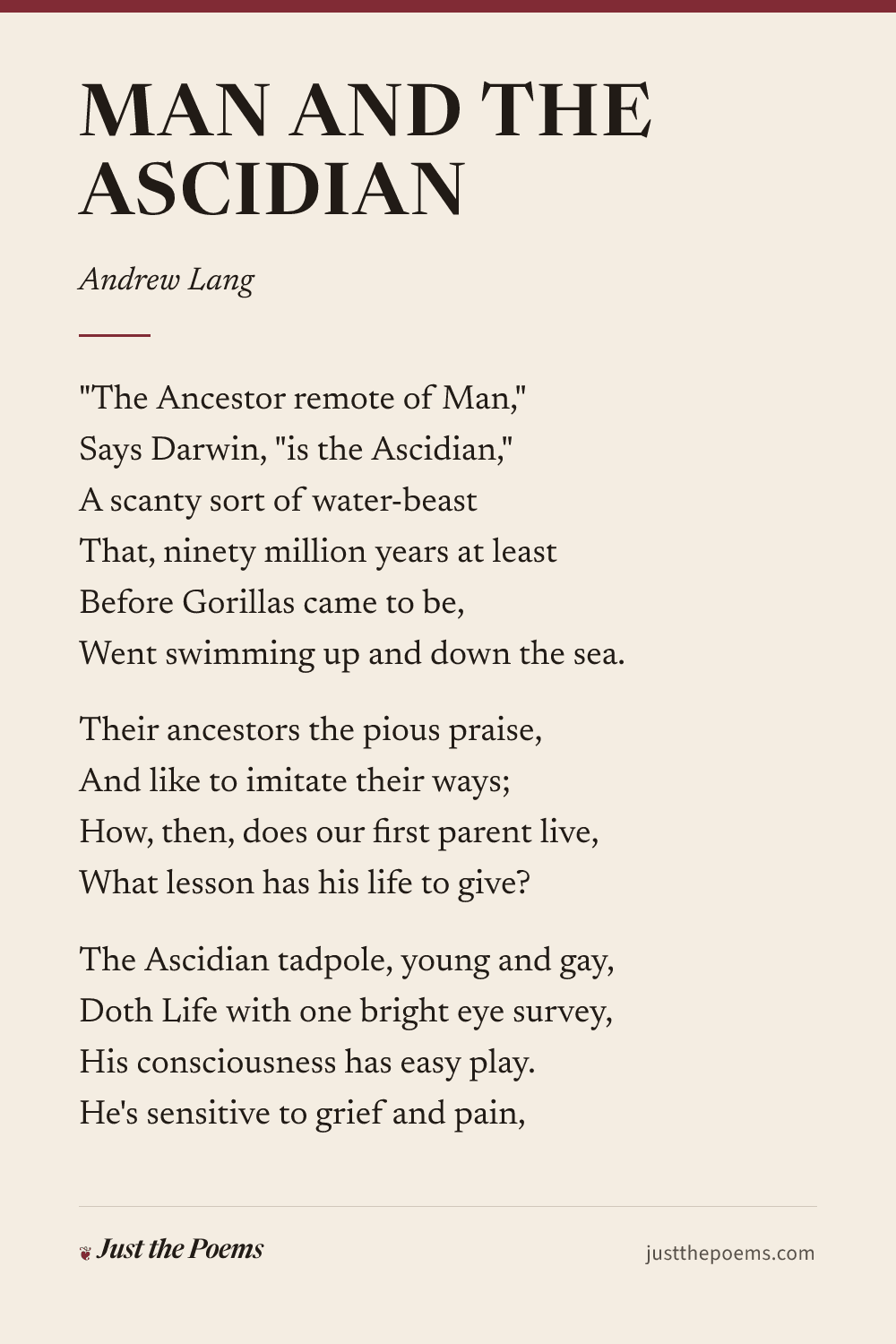
"The Ancestor remote of Man,"Says Darwin, "is the Ascidian,"A scanty sort of water-beastThat, ninety million years at leastBefore Gorillas came to be,Went swimming up and down the sea.

Their ancestors the pious praise,And like to imitate their ways;How, then, does our first parent live,What lesson has his life to give?

The Ascidian tadpole, young and gay,Doth Life with one bright eye survey,

Show all 44 lines 32 more

His consciousness has easy play.He's sensitive to grief and pain,Has tail, a spine, and bears a brain,And everything that fits the stateOf creatures we call vertebrate.But age comes on; with sudden shockHe sticks his head against a rock!His tail drops off, his eye drops in,His brain's absorbed into his skin;He does not move, nor feel, nor knowThe tidal water's ebb and flow,But still abides, unstirred, alone,A sucker sticking to a stone.

And we, his children, truly weIn youth are, like the Tadpole, free.And where we would we blithely go,Have brains and hearts, and feel and know.Then Age comes on! To Habit weAffix ourselves and are not free;The Ascidian's rooted to a rock,And we are bond-slaves of the clock;Our rocks are Medicine--Letters--Law,From these our heads we cannot draw:Our loves drop off, our hearts drop in,And daily thicker grows our skin.

Ah, scarce we live, we scarcely knowThe wide world's moving ebb and flow,The clanging currents ring and shock,But we are rooted to the rock.And thus at ending of his span,Blind, deaf, and indolent, does ManRevert to the Ascidian.

Source

The Home Book of Verse, ed. Burton Egbert Stevenson

Filed under
  • Named in the title

ALADDIN

James Russell Lowell

In 0 Wikipedias 1 anthology Poet in 31 Wikipedias

When I was a beggarly boy,And lived in a cellar damp,I had not a friend nor a toy,But I had Aladdin's lamp;When I could not sleep for the cold,I had fire enough in my brain,And builded, with roofs of gold,My beautiful castles in Spain!

Since then I have toiled day and night,I have money and power good store,But I'd give all my lamps of silver brightFor the one that is mine no more.Take, Fortune, whatever you choose;You gave, and may snatch again;I have nothing 'twould pain me to lose,For I own no more castles in Spain!

Source

The Home Book of Verse, ed. Burton Egbert Stevenson

Filed under
  • Section “THE MAN”, The Home Book of Verse

Three Men of Gotham

Thomas Love Peacock

In 0 Wikipedias 1 anthology Poet in 25 Wikipedias

Seamen three! What men be ye?Gotham’s three wise men we be.Whither in your bowl so free?To rake the moon from out the sea.The bowl goes trim. The moon doth shine.And our ballast is old wine.--And your ballast is old wine.

Who art thou, so fast adrift?I am he they call Old Care.Here on board we will thee lift.No: I may not enter there.Wherefore so? ’Tis Jove’s decree,In a bowl Care may not be.--In a bowl Care may not be.

Fear ye not the waves that roll?No: in charmèd bowl we swim.What the charm that floats the bowl?Water may not pass the brim.The bowl goes trim. The moon doth shine.And our ballast is old wine.--And your ballast is old wine.

Source

The Oxford Book of English Verse 1250–1900, 1900

Filed under
  • Named in the title

"AROUND THE CHILD"

Walter Savage Landor

In 0 Wikipedias 1 anthology Poet in 24 Wikipedias

Around the child bend all the threeSweet Graces--Faith, Hope, Charity.Around the man bend other facesPride, Envy, Malice, are his Graces.

Source

The Home Book of Verse, ed. Burton Egbert Stevenson

Filed under
  • Section “THE MAN”, The Home Book of Verse

MAN

Walter Savage Landor

In 0 Wikipedias 1 anthology Poet in 24 Wikipedias

In his own image the Creator made, His own pure sunbeam quickened thee, O man! Thou breathing dial! since the day beganThe present hour was ever marked with shade!

Source

The World's Best Poetry, Vol. III, ed. Bliss Carman, 1904

Filed under
  • Named in the title

30 of 125 poems for men

21 poets

By poet's century of death

CenturyPoems
17th2
18th2
19th21
20th5

Poets with more than one poem

PoetPoems
Coventry Patmore4
Lord Byron3
William Wordsworth3
Andrew Lang2
Walter Savage Landor2