Poems About War

The first 30 of 746 poems about war, by 24 poets, ranked by third-party data. How poems are ranked

THE WHITE MAN'S BURDEN

Rudyard Kipling

In 26 Wikipedias 0 anthologies Poet in 126 Wikipedias

Take up the White Man's burden-- Send forth the best ye breed--Go bind your sons to exile To serve your captives' need;To wait in heavy harness, On fluttered folk and wild--Your new-caught, sullen peoples, Half-devil and half child.

Take up the White Man's burden-- In patience to abide,To veil the threat of terror And check the show of pride;

Show all 56 lines 44 more

By open speech and simple, An hundred times made plain,To seek another's profit, And work another's gain.

Take up the White Man's burden-- The savage wars of peace--Fill full the mouth of Famine And bid the sickness cease;And when your goal is nearest The end for others sought,Watch Sloth and heathen Folly Bring all your hope to naught.

Take up the White Man's burden-- No tawdry rule of kings,But toil of serf and sweeper-- The tale of common things.The ports ye shall not enter, The roads ye shall not tread,Go make them with your living, And mark them with your dead.

Take up the White Man's burden-- And reap his old reward;The blame of those ye better, The hate of those ye guard--The cry of hosts ye humour (Ah, slowly!) toward the light:--"Why brought ye us from bondage, Our loved Egyptian night?"

Take up the White Man's burden-- Ye dare not stoop to less--Nor call too loud on Freedom To cloak your weariness;By all ye cry or whisper, By all ye leave or do,The silent, sullen peoples Shall weigh your Gods and you.

Take up the White Man's burden-- Have done with childish days--The lightly proffered laurel The easy, ungrudged praise.Comes now, to search your manhood Through all the thankless years,Cold, edged with dear-bought wisdom, The judgment of your peers!

Source

Kipling Stories and Poems Every Child Should Know, Book II

Filed under
  • Wikidata main subject: Philippine–American War

In Flanders Fields

John McCrae

In 25 Wikipedias 1 anthology Poet in 27 Wikipedias

In Flanders fields the poppies growBetween the crosses, row on row,That mark our place; and in the skyThe larks, still bravely singing, fly,Scarce heard amid the guns below.

We are the dead. Short days agoWe lived, felt dawn, saw sunset glow,Loved and were loved; and now we lie In Flanders fields.

Take up our quarrel with the foe!To you, from failing hands, we throwThe torch. Be yours to hold it high!If ye break faith with us who die,We shall not sleep, though poppies blow In Flanders fields.

Source

Poems Teachers Ask For

Filed under
  • Library subject “World War, 1914-1918 -- Poetry”, In Flanders Fields, and Other Poems

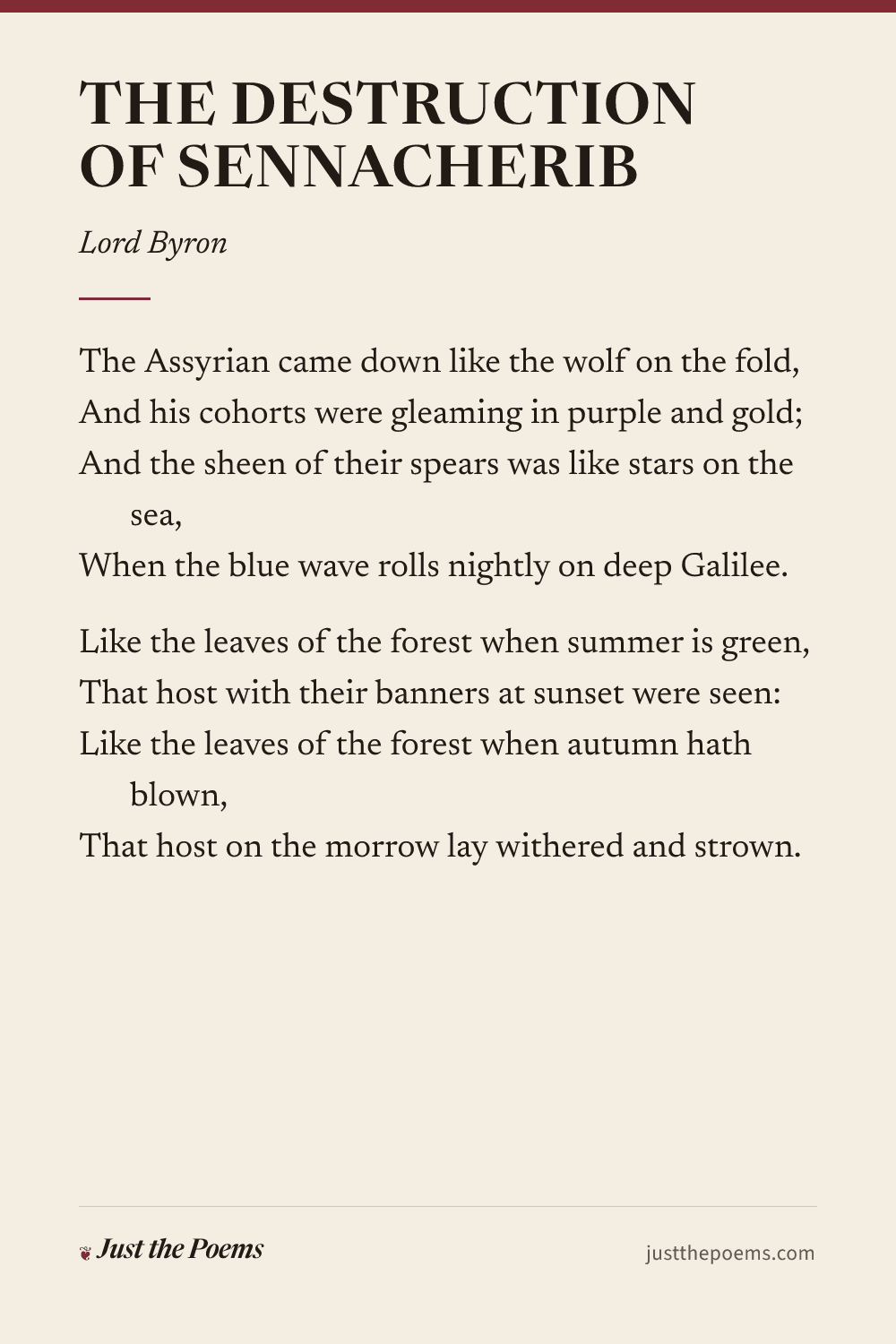
THE DESTRUCTION OF SENNACHERIB

Lord Byron

In 4 Wikipedias 1 anthology Poet in 155 Wikipedias

The Assyrian came down like the wolf on the fold,And his cohorts were gleaming in purple and gold;And the sheen of their spears was like stars on the sea,When the blue wave rolls nightly on deep Galilee.

Like the leaves of the forest when summer is green,That host with their banners at sunset were seen:Like the leaves of the forest when autumn hath blown,That host on the morrow lay withered and strown.

For the Angel of Death spread his wings on the blast,And breathed in the face of the foe as he passed;And the eyes of the sleepers waxed deadly and chill,And their hearts but once heaved, and forever grew still!

And there lay the steed with his nostril all wide,But through it there rolled not the breath of his pride:And the foam of his gasping lay white on the turf,And cold as the spray of the rock-beating surf.

And there lay the rider distorted and pale.With the dew on his brow, and the rust on his mail;And the tents were all silent, the banners alone,The lances unlifted, the trumpet unblown.

And the widows of Ashur are loud in their wail,And the idols are broke in the temple of Baal;And the might of the Gentile, unsmote by the sword,Hath melted like snow in the glance of the Lord!

Source

The World's Best Poetry, Vol. VIII, ed. Bliss Carman, 1904

Filed under
  • Section “WAR”, The World's Best Poetry

Advertisements

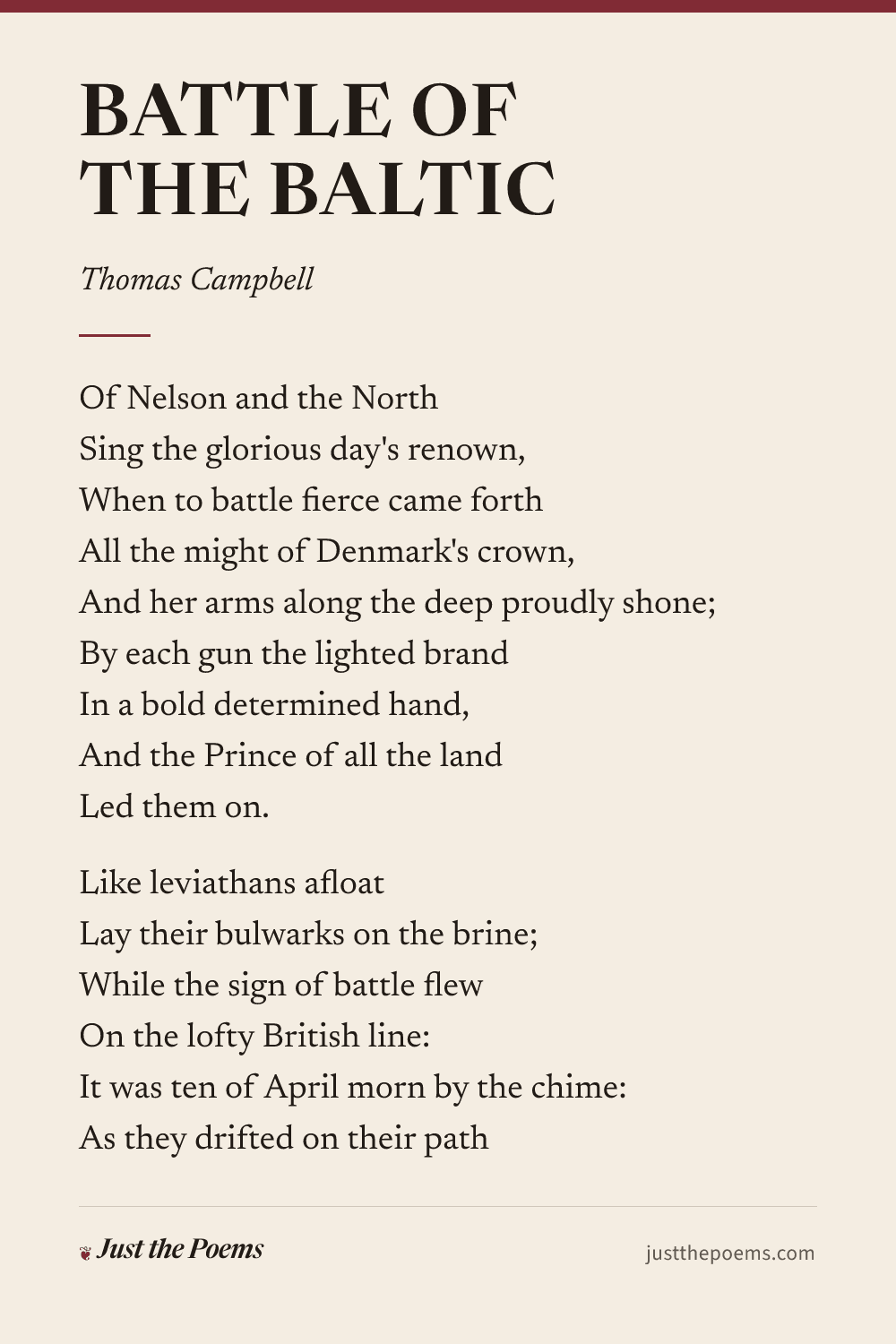
BATTLE OF THE BALTIC

Thomas Campbell

In 1 Wikipedia 3 anthologies Poet in 16 Wikipedias

Of Nelson and the NorthSing the glorious day's renown,When to battle fierce came forthAll the might of Denmark's crown,And her arms along the deep proudly shone;By each gun the lighted brandIn a bold determined hand,And the Prince of all the landLed them on.

Like leviathans afloatLay their bulwarks on the brine;While the sign of battle flew

Show all 72 lines 60 more

On the lofty British line:It was ten of April morn by the chime:As they drifted on their pathThere was silence deep as death;And the boldest held his breathFor a time.

But the might of England flush'dTo anticipate the scene;And her van the fleeter rush'dO'er the deadly space between."Hearts of oak!" our captains cried, when each gunFrom its adamantine lipsSpread a death-shade round the ships,Like the hurricane eclipseOf the sun.

Again! again! again!And the havoc did not slack,Till a feeble cheer the DaneTo our cheering sent us back;--Their shots along the deep slowly boom:--Then ceased--and all is wail,As they strike the shatter'd sail,Or in conflagration paleLight the gloom.

Out spoke the victor thenAs he hail'd them o'er the wave,"Ye are brothers! ye are men!And we conquer but to save:--So peace instead of death let us bring:But yield, proud foe, thy fleetWith the crews, at England's feet,And make submission meetTo our King."

Then Denmark blest our chiefThat he gave her wounds repose;And the sounds of joy and griefFrom her people wildly rose,As death withdrew his shades from the day:While the sun look'd smiling brightO'er a wide and woeful sight,Where the fires of funeral lightDied away.

Now joy, old England, raise!For the tidings of thy might,By the festal cities' blaze,Whilst the wine-cup shines in light;And yet amidst that joy and uproar,Let us think of them that sleepFull many a fathom deepBy thy wild and stormy steep,Elsinore!

Brave hearts! to Britain's prideOnce so faithful and so true,On the deck of fame that diedWith the gallant good Riou:Soft sigh the winds of heaven o'er their grave!While the billow mournful rollsAnd the mermaid's song condolesSinging glory to the soulsOf the brave!

Source

The Golden Treasury, ed. Francis Turner Palgrave

Filed under
  • Section “WAR”, The World's Best Poetry

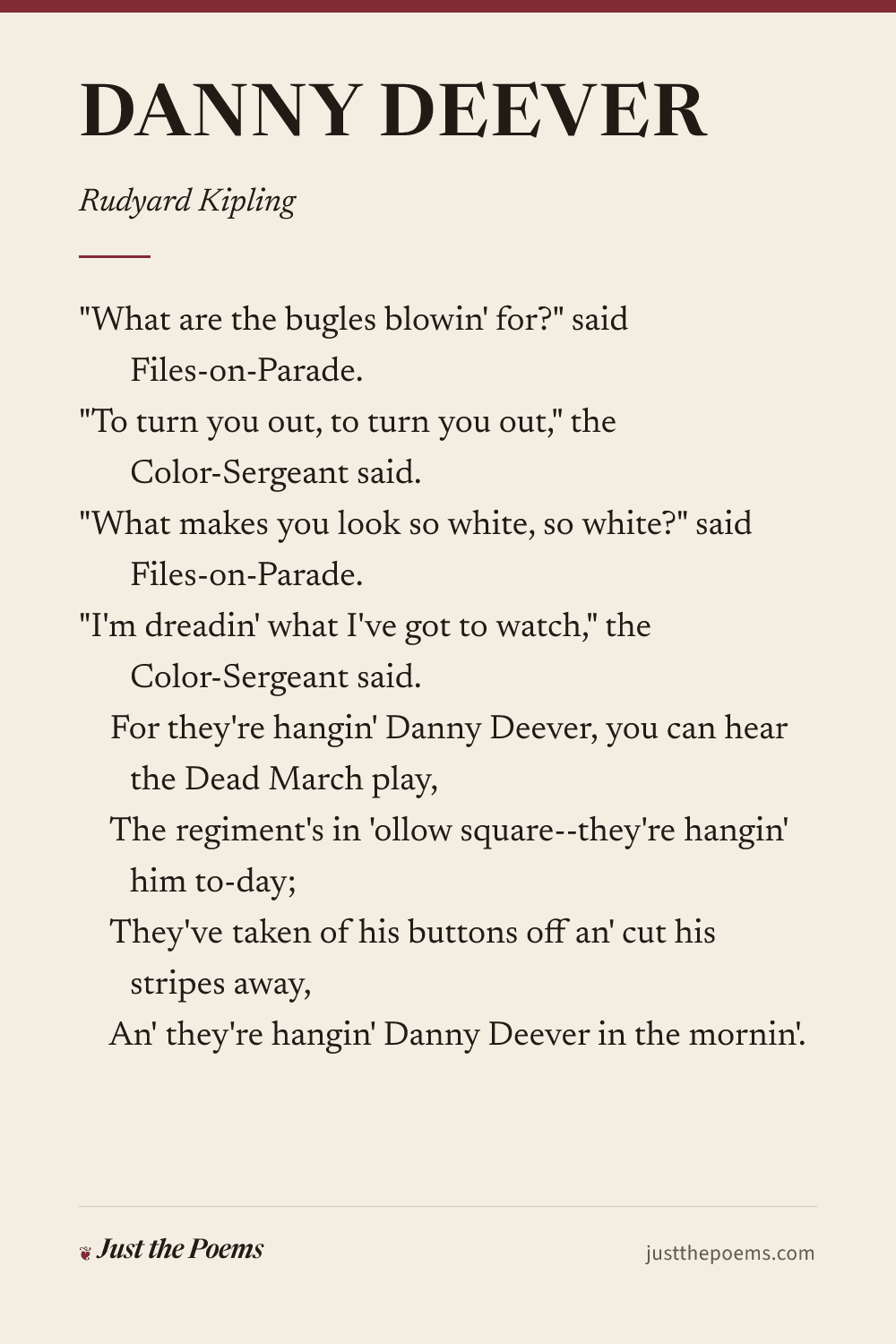
DANNY DEEVER

Rudyard Kipling

In 1 Wikipedia 1 anthology Poet in 126 Wikipedias

"What are the bugles blowin' for?" said Files-on-Parade."To turn you out, to turn you out," the Color-Sergeant said."What makes you look so white, so white?" said Files-on-Parade."I'm dreadin' what I've got to watch," the Color-Sergeant said. For they're hangin' Danny Deever, you can hear the Dead March play, The regiment's in 'ollow square--they're hangin' him to-day; They've taken of his buttons off an' cut his stripes away, An' they're hangin' Danny Deever in the mornin'.

"What makes the rear-rank breathe so 'ard?" said Files-on-Parade."It's bitter cold, it's bitter cold," the Color-Sergeant said."What makes that front-rank man fall down?" says Files-on-Parade."A touch o' sun, a touch o' sun," the Color-Sergeant said.

Show all 33 lines 21 more

They are hangin' Danny Deever, they are marchin' of 'im round, They 'ave 'alted Danny Deever by 'is coffin on the ground; An' 'e'll swing in 'arf a minute for a sneakin' shootin' hound-- O they're hangin' Danny Deever in the mornin'!

"'Is cot was right-'and cot to mine," said Files-on-Parade."'E's sleepin' out an' far to-night," the Color-Sergeant said."I've drunk 'is beer a score o' times," said Files-on-Parade."'E's drinkin' bitter beer alone," the Color-Sergeant said. They are hangin' Danny Deever, you must mark 'im to 'is place, For 'e shot a comrade sleepin'--you must look 'im in the face; Nine 'undred of 'is county an' the regiment's disgrace, While they're hangin' Danny Deever in the mornin'.

"What's that so black agin the sun?" said Files-on-Parade."It's Danny fightin' 'ard for life," the Color-Sergeant said."What's that that whimpers over'ead?" said Files-on-Parade."It's Danny's soul that's passin' now," the Color-Sergeant said. For they're done with Danny Deever, you can 'ear the quickstep play, The regiment's in column, an' they're marchin' us away; Ho! the young recruits are shakin', an' they'll want their beer to-day, After hangin' Danny Deever in the mornin'.

Source

The World's Best Poetry, Vol. VIII, ed. Bliss Carman, 1904

Filed under
  • Section “WAR”, The World's Best Poetry

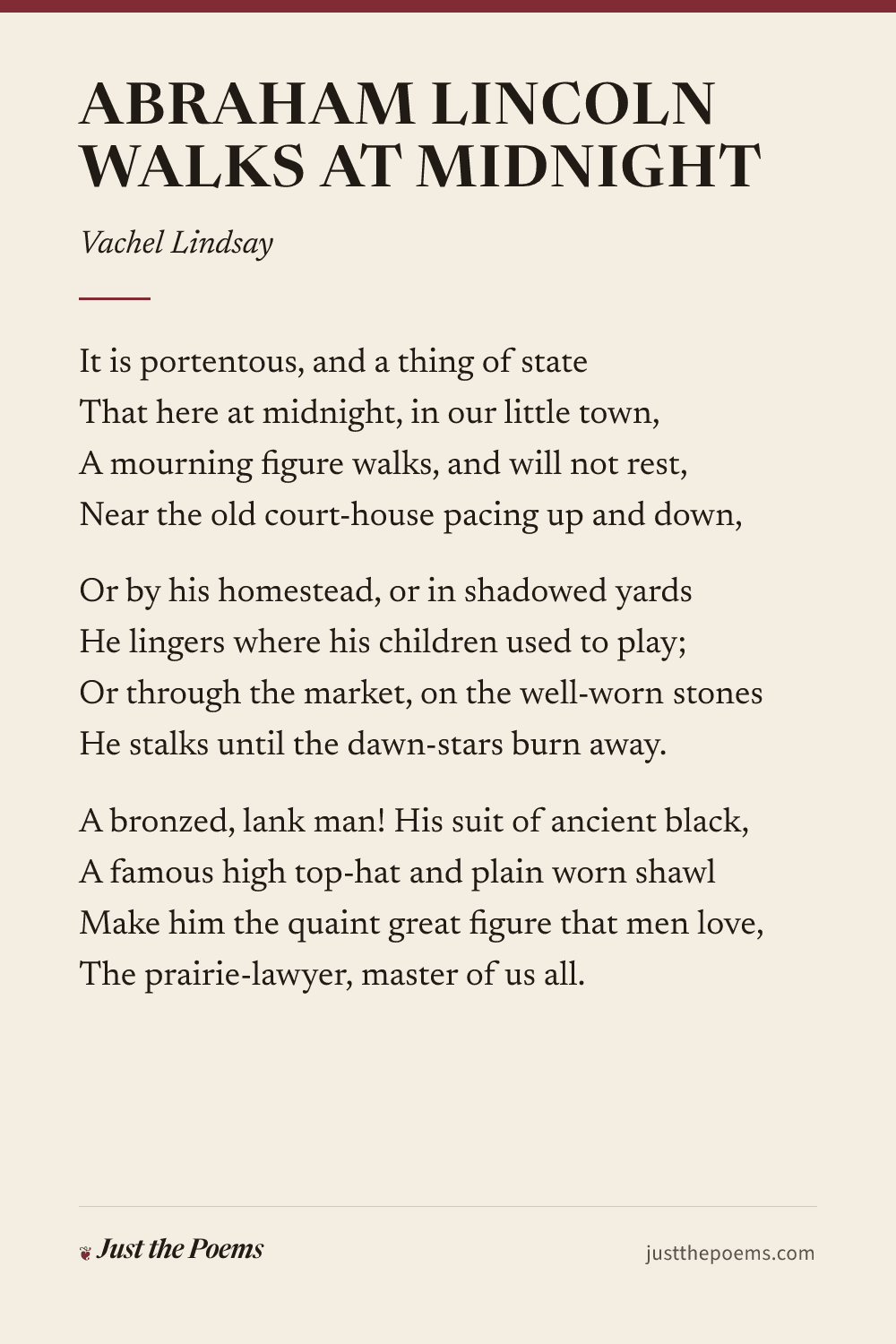
ABRAHAM LINCOLN WALKS AT MIDNIGHT

Vachel Lindsay

In 1 Wikipedia 0 anthologies Poet in 20 Wikipedias

It is portentous, and a thing of stateThat here at midnight, in our little town,A mourning figure walks, and will not rest,Near the old court-house pacing up and down,

Or by his homestead, or in shadowed yardsHe lingers where his children used to play;Or through the market, on the well-worn stonesHe stalks until the dawn-stars burn away.

A bronzed, lank man! His suit of ancient black,A famous high top-hat and plain worn shawlMake him the quaint great figure that men love,The prairie-lawyer, master of us all.

Show all 32 lines 20 more

He cannot sleep upon his hillside now.He is among us:--as in times before!And we who toss and lie awake for longBreathe deep, and start, to see him pass the door.

His head is bowed. He thinks on men and kings.Yea, when the sick world cries, how can he sleep?Too many peasants fight, they know not why,Too many homesteads in black terror weep.

The sins of all the war-lords burn his heart.He sees the dreadnaughts scouring every main.He carries on his shawl-wrapped shoulders nowThe bitterness, the folly, and the pain.

He cannot rest until a spirit-dawnShall come;--the shining hope of Europe free:The league of sober folk, the Workers' EarthBringing long peace to Cornland, Alp, and Sea.

It breaks his heart that kings must murder still,That all his hours of travail here for menSeem yet in vain. And who will bring white peaceThat he may sleep upon his hill again?

Source

A Treasury of War Poetry: British and American Poems of the World War 1914-1917, ed. George Herbert Clarke

Filed under
  • Library subject “World War, 1914-1918 -- Poetry”, A Treasury of War Poetry: British and American Poems of the World War 1914-1917

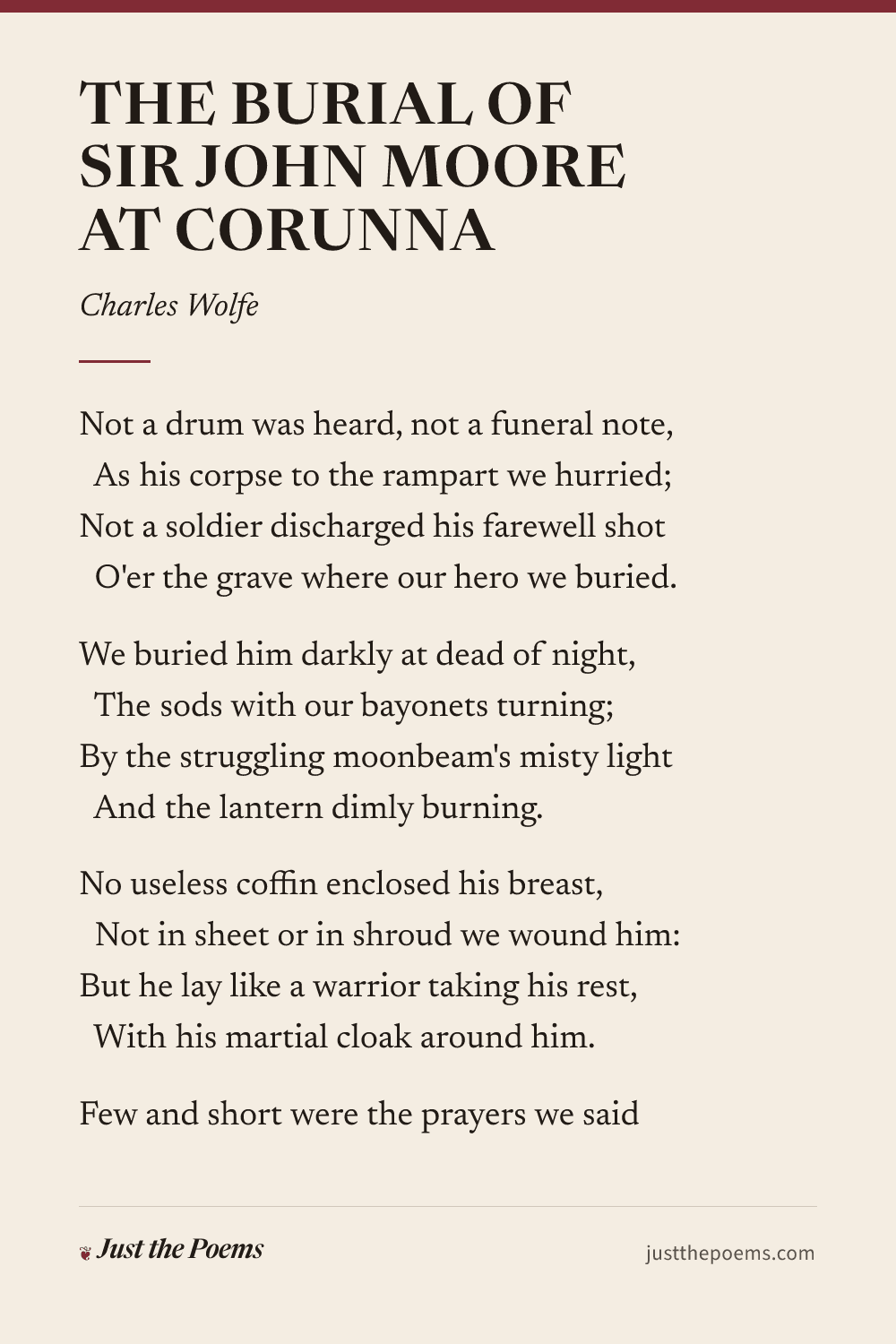
THE BURIAL OF SIR JOHN MOORE AT CORUNNA

Charles Wolfe

In 0 Wikipedias 4 anthologies Poet in 7 Wikipedias

Not a drum was heard, not a funeral note, As his corpse to the rampart we hurried;Not a soldier discharged his farewell shot O'er the grave where our hero we buried.

We buried him darkly at dead of night, The sods with our bayonets turning;By the struggling moonbeam's misty light And the lantern dimly burning.

No useless coffin enclosed his breast, Not in sheet or in shroud we wound him:But he lay like a warrior taking his rest, With his martial cloak around him.

Show all 32 lines 20 more

Few and short were the prayers we said And we spoke not a word of sorrow,But we steadfastly gazed on the face that was dead, And we bitterly thought of the morrow.

We thought, as we hollow'd his narrow bed And smooth'd down his lonely pillow,That the foe and the stranger would tread o'er his head, And we far away on the billow!

Lightly they'll talk of the spirit that's gone, And o'er his cold ashes upbraid him--But little he'll reck, if they let him sleep on In the grave where a Briton has laid him.

But half of our heavy task was done When the clock struck the hour for retiring;And we heard the distant and random gun That the foe was sullenly firing.

Slowly and sadly we laid him down, From the field of his fame fresh and gory;We carved not a line, and we raised not a stone, But we left him alone with his glory.

Source

The Golden Treasury, ed. Francis Turner Palgrave

Filed under
  • Section “WAR”, The World's Best Poetry

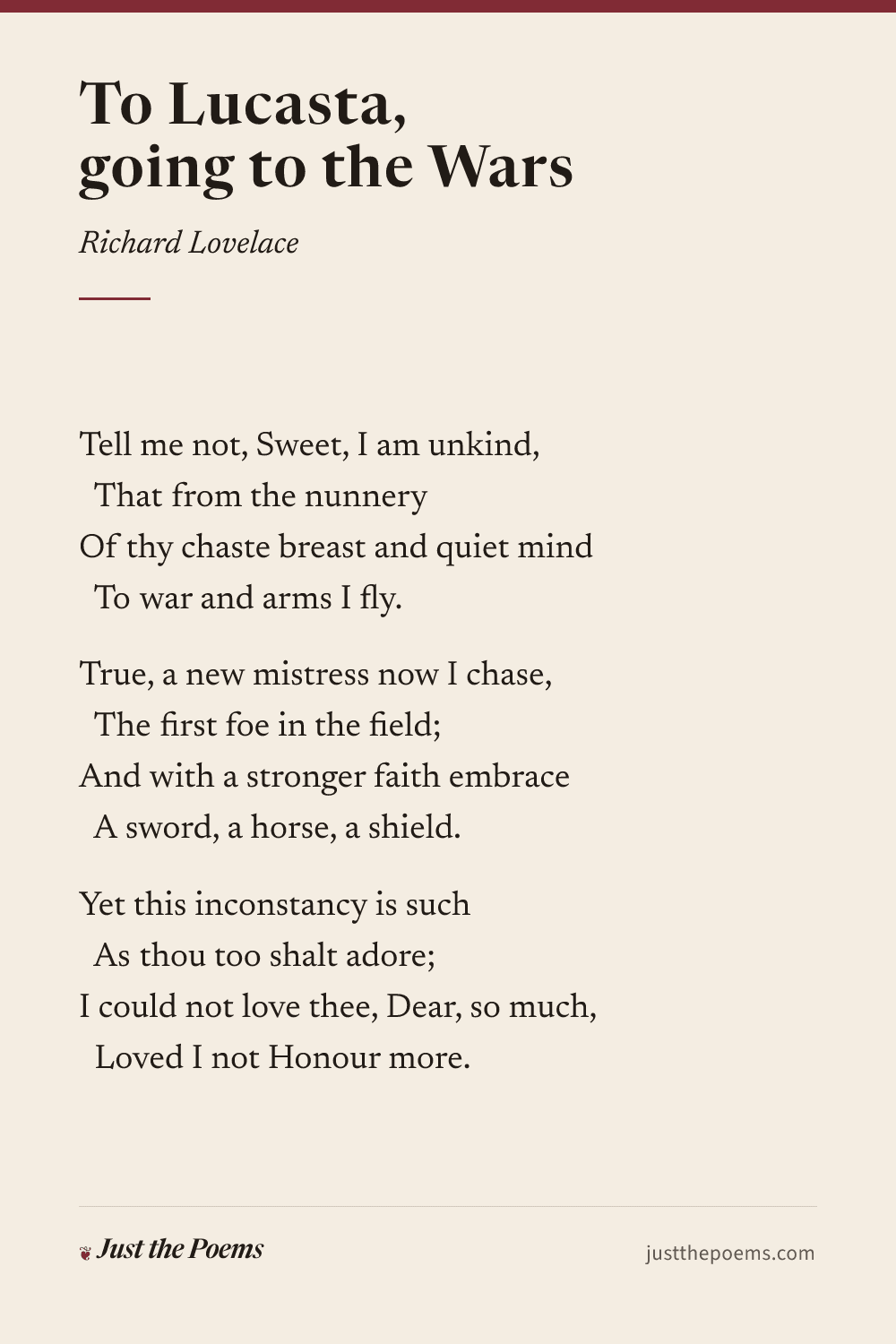
To Lucasta, going to the Wars

Richard Lovelace

In 0 Wikipedias 3 anthologies Poet in 21 Wikipedias

Tell me not, Sweet, I am unkind, That from the nunneryOf thy chaste breast and quiet mind To war and arms I fly.

True, a new mistress now I chase, The first foe in the field;And with a stronger faith embrace A sword, a horse, a shield.

Yet this inconstancy is such As thou too shalt adore;I could not love thee, Dear, so much, Loved I not Honour more.

Source

The Oxford Book of English Verse 1250–1900, 1900

Filed under
  • Named in the title

Advertisements

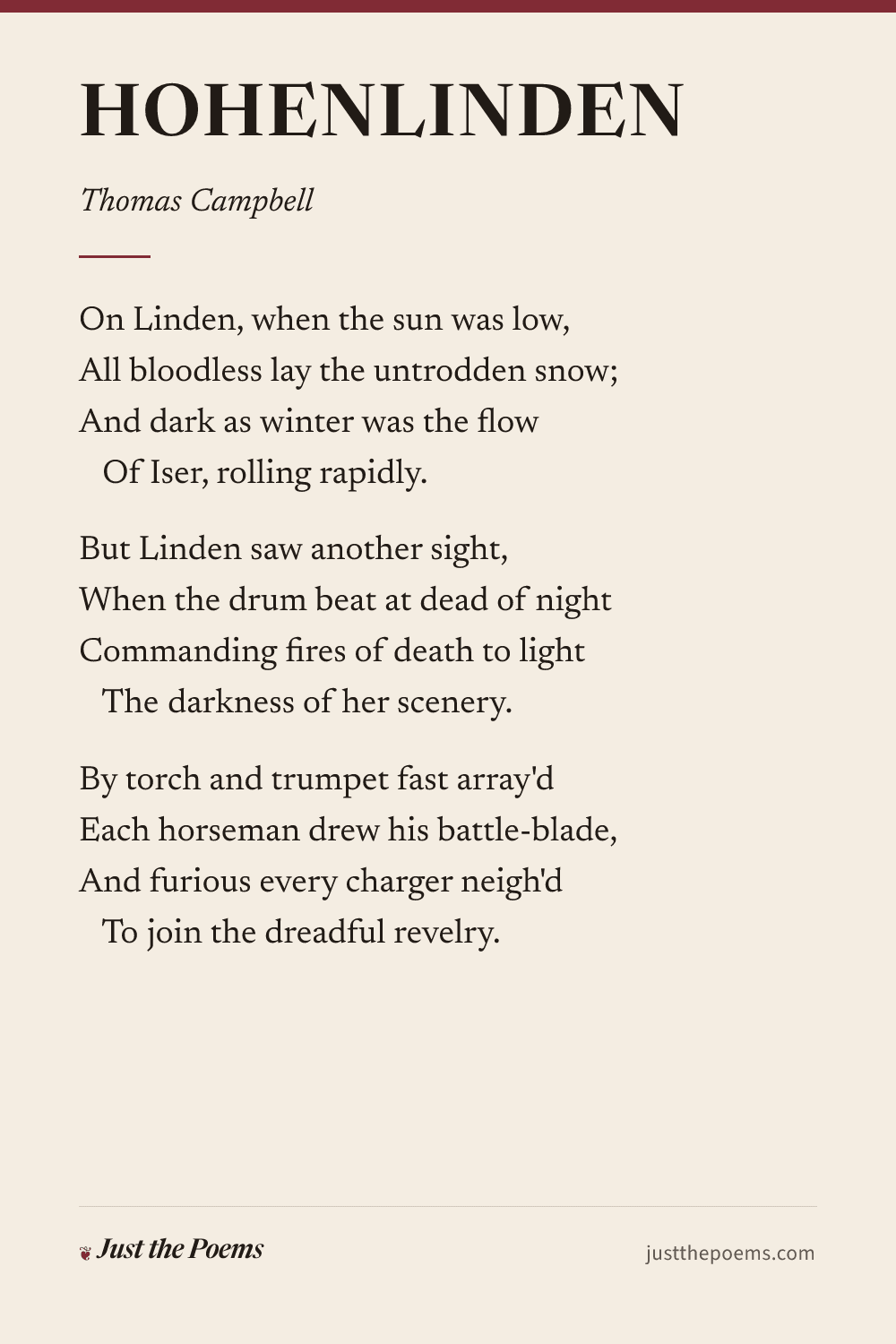
HOHENLINDEN

Thomas Campbell

In 0 Wikipedias 3 anthologies Poet in 16 Wikipedias

On Linden, when the sun was low,All bloodless lay the untrodden snow;And dark as winter was the flow Of Iser, rolling rapidly.

But Linden saw another sight,When the drum beat at dead of nightCommanding fires of death to light The darkness of her scenery.

By torch and trumpet fast array'dEach horseman drew his battle-blade,And furious every charger neigh'd To join the dreadful revelry.

Show all 32 lines 20 more

Then shook the hills with thunder riven;Then rush'd the steed, to battle driven;And louder than the bolts of Heaven Far flash'd the red artillery.

But redder yet that light shall glowOn Linden's hills of stained snow;And bloodier yet the torrent flow Of Iser, rolling rapidly.

'Tis morn; but scarce yon level sunCan pierce the war-clouds, rolling dun,Where furious Frank and fiery Hun Shout in their sulphurous canopy.

The combat deepens. On, ye BraveWho rush to glory, or the grave!Wave, Munich all thy banners wave, And charge with all thy chivalry!

Few, few shall part, where many meet!The snow shall be their winding-sheet,And every turf beneath their feet Shall be a soldier's sepulchre.

Source

The Golden Treasury, ed. Francis Turner Palgrave

Filed under
  • Section “WAR”, The World's Best Poetry

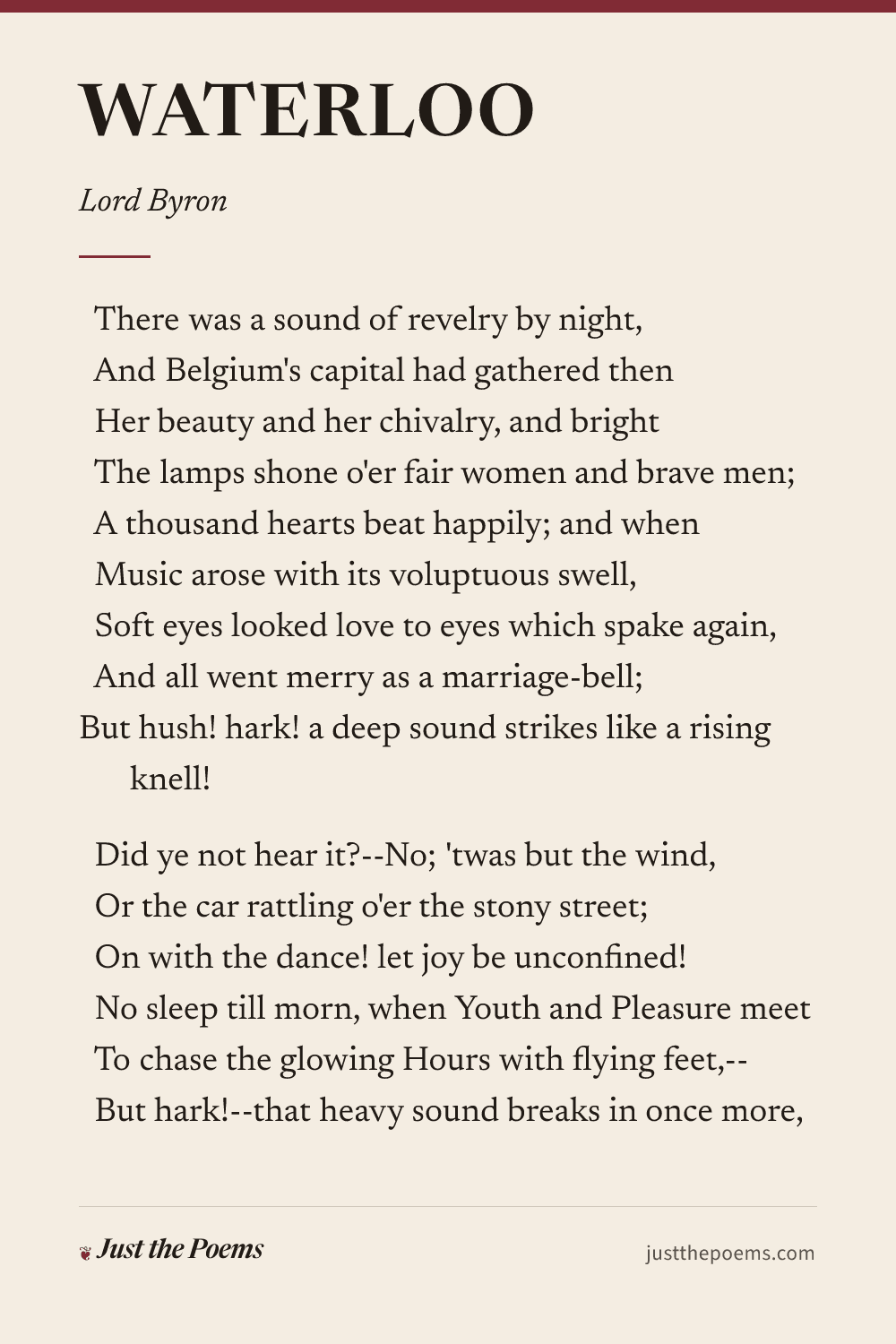
WATERLOO

Lord Byron

In 0 Wikipedias 2 anthologies Poet in 155 Wikipedias

There was a sound of revelry by night, And Belgium's capital had gathered then Her beauty and her chivalry, and bright The lamps shone o'er fair women and brave men; A thousand hearts beat happily; and when Music arose with its voluptuous swell, Soft eyes looked love to eyes which spake again, And all went merry as a marriage-bell;But hush! hark! a deep sound strikes like a rising knell!

Did ye not hear it?--No; 'twas but the wind, Or the car rattling o'er the stony street; On with the dance! let joy be unconfined!

Show all 117 lines 105 more

No sleep till morn, when Youth and Pleasure meet To chase the glowing Hours with flying feet,-- But hark!--that heavy sound breaks in once more, As if the clouds its echo would repeat; And nearer, clearer, deadlier than before!Arm! arm! it is--it is--the cannon's opening roar!

Within a windowed niche of that high hall Sate Brunswick's fated chieftain; he did hear That sound the first amidst the festival, And caught its tone with Death's prophetic ear; And when they smiled because he deemed it near, His heart more truly knew that peal too well Which stretched his father on a bloody bier, And roused the vengeance blood alone could quell:He rushed into the field, and, foremost fighting, fell.

Ah! then and there was hurrying to and fro, And gathering tears, and tremblings of distress, And cheeks all pale which but an hour ago Blushed at the praise of their own loveliness; And there were sudden partings, such as press The life from out young hearts, and choking sighs Which ne'er might be repeated: who would guess If evermore should meet those mutual eyesSince upon night so sweet such awful morn could rise!

And there was mounting in hot haste: the steed, The mustering squadron, and the clattering car, Went pouring forward with impetuous speed, And swiftly forming in the ranks of war; And the deep thunder peal on peal afar; And near, the beat of the alarming drum Roused up the soldier ere the morning star; While thronged the citizens with terror dumb,Or whispering with white lips,--"The foe! they come! they come!"

And wild and high the "Cameron's gathering" rose, The war-note of Lochiel, which Albyn's hills Have heard,--and heard, too, have her Saxon foes: How in the noon of night that pibroch thrills Savage and shrill! But with the breath which fills Their mountain pipe, so fill the mountaineers With the fierce native daring which instills The stirring memory of a thousand years,And Evan's, Donald's fame, rings in each clansman's ears!

And Ardennes waves above them her green leaves, Dewy with nature's tear-drops, as they pass, Grieving, if aught inanimate e'er grieves, Over the unreturning brave,--alas! Ere evening to be trodden like the grass Which now beneath them, but above shall grow In its next verdure, when this fiery mass Of living valor, rolling on the foe,And burning with high hope, shall moulder cold and low.

Last noon beheld them full of lusty life, Last eve in Beauty's circle proudly gay, The midnight brought the signal sound of strife, The morn the marshalling in arms,--the day Battle's magnificently stern array! The thunder-clouds close o'er it, which when rent The earth is covered thick with other clay, Which her own clay shall cover, heaped and pent,Rider and horse,--friend, foe,--in one red burial blent!

Their praise is hymned by loftier harps than mine; Yet one I would select from that proud throng, Partly because they blend me with his line, And partly that I did his sire some wrong, And partly that bright names will hallow song! And his was of the bravest, and when showered The death-bolts deadliest the thinned files along, Even where the thickest of war's tempest lowered,They reached no nobler breast than thine, young, gallant Howard!

There have been tears and breaking hearts for thee, And mine were nothing, had I such to give; But when I stood beneath the fresh green tree, Which living waves where thou didst cease to live, And saw around me the wide field revive With fruits and fertile promise, and the Spring Come forth her work of gladness to contrive, With all her reckless birds upon the wing,I turned from all she brought to those she could not bring.

I turned to thee, to thousands, of whom each And one as all a ghastly gap did make In his own kind and kindred, whom to teach Forgetfulness were mercy for their sake; The Archangel's trump, not glory's, must awake Those whom they thirst for; though the sound of Fame May for a moment soothe, it cannot slake The fever of vain longing, and the nameSo honored but assumes a stronger, bitterer claim.

They mourn, but smile at length; and, smiling, mourn: The tree will wither long before it fall; The hull drives on, though mast and sail be torn; The roof-tree sinks, but moulders on the hall In massy hoariness; the ruined wall Stands when its wind-worn battlements are gone; The bars survive the captive they enthrall; The day drags through though storms keep out the sun;And thus the heart will break, yet brokenly live on;

Even as a broken mirror, which the glass In every fragment multiplies, and makes A thousand images of one that was The same, and still the more, the more it breaks; And thus the heart will do which not forsakes, Living in shattered guise, and still, and cold, And bloodless, with its sleepless sorrow aches, Yet withers on till all without is old,Showing no visible sign, for such things are untold.

Source

The World's Best Poetry, Vol. VIII, ed. Bliss Carman, 1904

Filed under
  • Section “WAR”, The World's Best Poetry

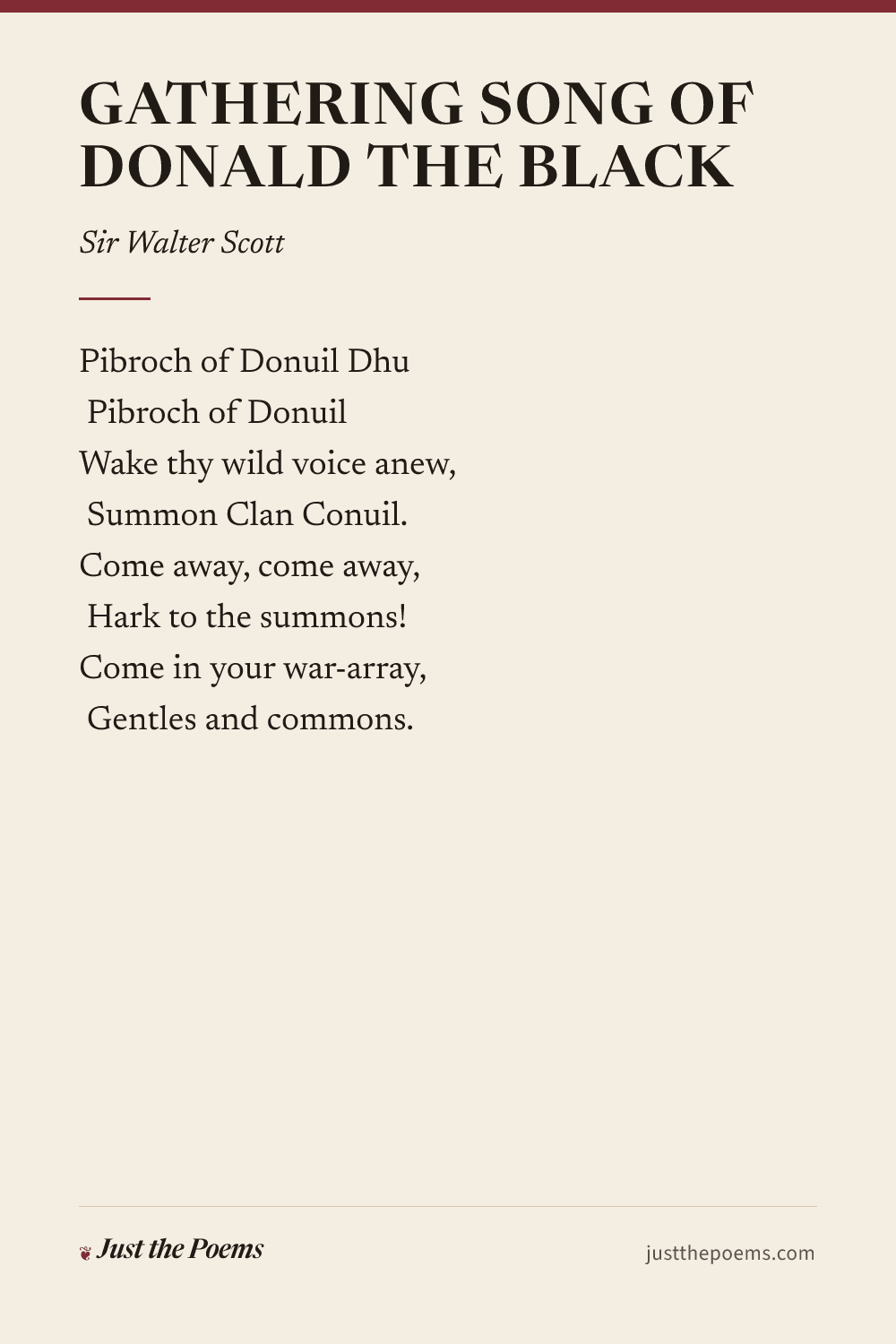
GATHERING SONG OF DONALD THE BLACK

Sir Walter Scott

In 0 Wikipedias 2 anthologies Poet in 98 Wikipedias

Pibroch of Donuil Dhu Pibroch of DonuilWake thy wild voice anew, Summon Clan Conuil.Come away, come away, Hark to the summons!Come in your war-array, Gentles and commons.

Come from deep glen, and From mountain so rocky;The war-pipe and pennon Are at Inverlochy.

Show all 40 lines 28 more

Come every hill-plaid, and True heart that wears one,Come every steel blade, and Strong hand that bears one.

Leave untended the herd, The flock without shelter;Leave the corpse uninterr'd, The bride at the altar;Leave the deer, leave the steer, Leave nets and barges:Come with your fighting gear, Broadswords and targes.

Come as the winds come, when Forests are rended,Come as the waves come, when Navies are stranded:Faster come, faster come, Faster and faster,Chief, vassal, page and groom, Tenant and master.

Fast they come, fast they come; See how they gather!Wide waves the eagle plume Blended with heather.Cast your plaids, draw your blades, Forward each man set!Pibroch of Donuil Dhu Knell for the onset!

Source

The Golden Treasury, ed. Francis Turner Palgrave

Filed under
  • Section “WAR”, The World's Best Poetry

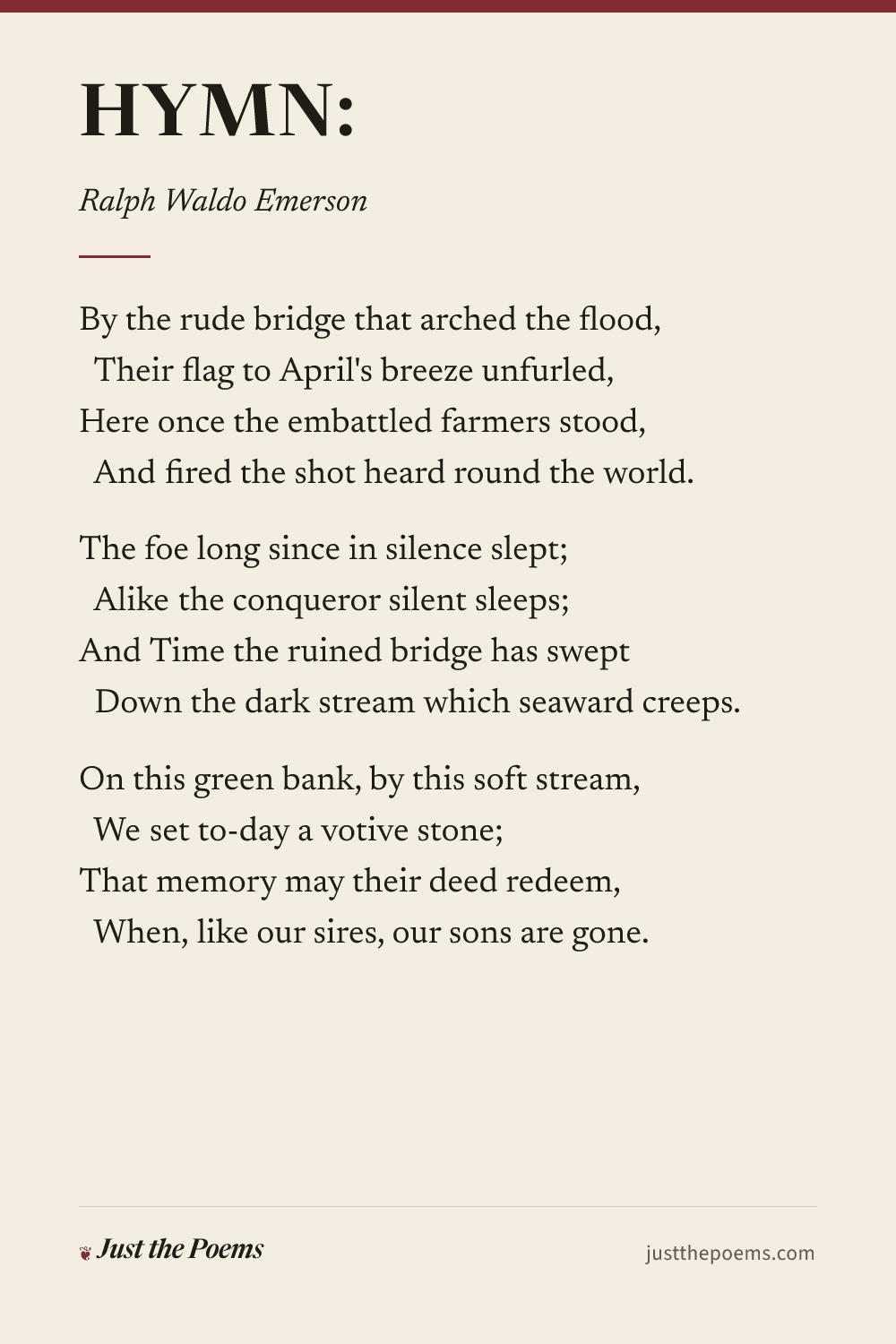
HYMN:

Ralph Waldo Emerson

In 0 Wikipedias 2 anthologies Poet in 92 Wikipedias

By the rude bridge that arched the flood, Their flag to April's breeze unfurled,Here once the embattled farmers stood, And fired the shot heard round the world.

The foe long since in silence slept; Alike the conqueror silent sleeps;And Time the ruined bridge has swept Down the dark stream which seaward creeps.

On this green bank, by this soft stream, We set to-day a votive stone;That memory may their deed redeem, When, like our sires, our sons are gone.

Spirit, that made those heroes dare To die, or leave their children free,Bid Time and Nature gently spare The shaft we raise to them and thee.

Source

The World's Best Poetry, Vol. VIII, ed. Bliss Carman, 1904

Filed under
  • Section “WAR”, The World's Best Poetry

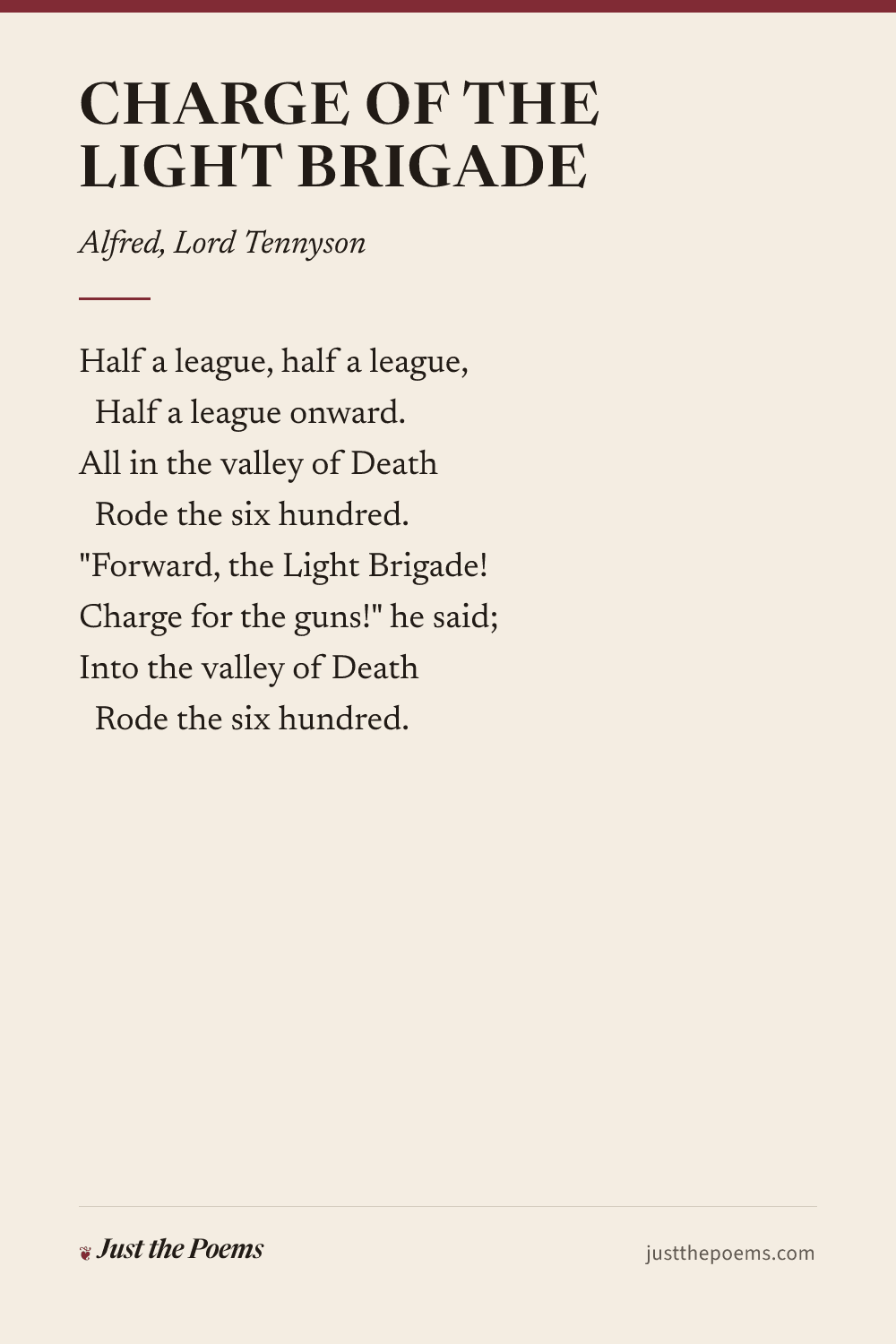
CHARGE OF THE LIGHT BRIGADE

Alfred, Lord Tennyson

In 0 Wikipedias 2 anthologies Poet in 72 Wikipedias

Half a league, half a league, Half a league onward.All in the valley of Death Rode the six hundred."Forward, the Light Brigade!Charge for the guns!" he said;Into the valley of Death Rode the six hundred.

"Forward, the Light Brigade!"Was there a man dismayed?Not though the soldier knew Some one had blundered:

Show all 55 lines 43 more

Theirs not to make reply,Theirs not to reason why.Theirs but to do and die:Into the valley of Death Rode the six hundred.

Cannon to right of them,Cannon to left of them,Cannon in front of them Volleyed and thundered;Stormed at with shot and shell,Boldly they rode and well;Into the jaws of Death,Into the mouth of Hell, Rode the six hundred.

Flashed all their sabres bare,Flashed as they turned in air,Sabring the gunners there,Charging an army, while All the world wondered:Plunged in the battery-smoke,Right through the line they broke:Cossack and RussianReeled from the sabre-stroke, Shattered and sundered.Then they rode back, but not-- Not the six hundred.

Cannon to right of them,Cannon to left of them,Cannon behind them Volleyed and thundered:Stormed at with shot and shell,While horse and hero fell,They that had fought so wellCame through the jaws of DeathBack from the mouth of Hell,--All that was left of them, Left of six hundred.

When can their glory fade?O the wild charge they made! All the world wondered.Honor the charge they made!Honor the Light Brigade, Noble six hundred!

Source

The World's Best Poetry, Vol. VIII, ed. Bliss Carman, 1904

Filed under
  • Section “WAR”, The World's Best Poetry

Advertisements

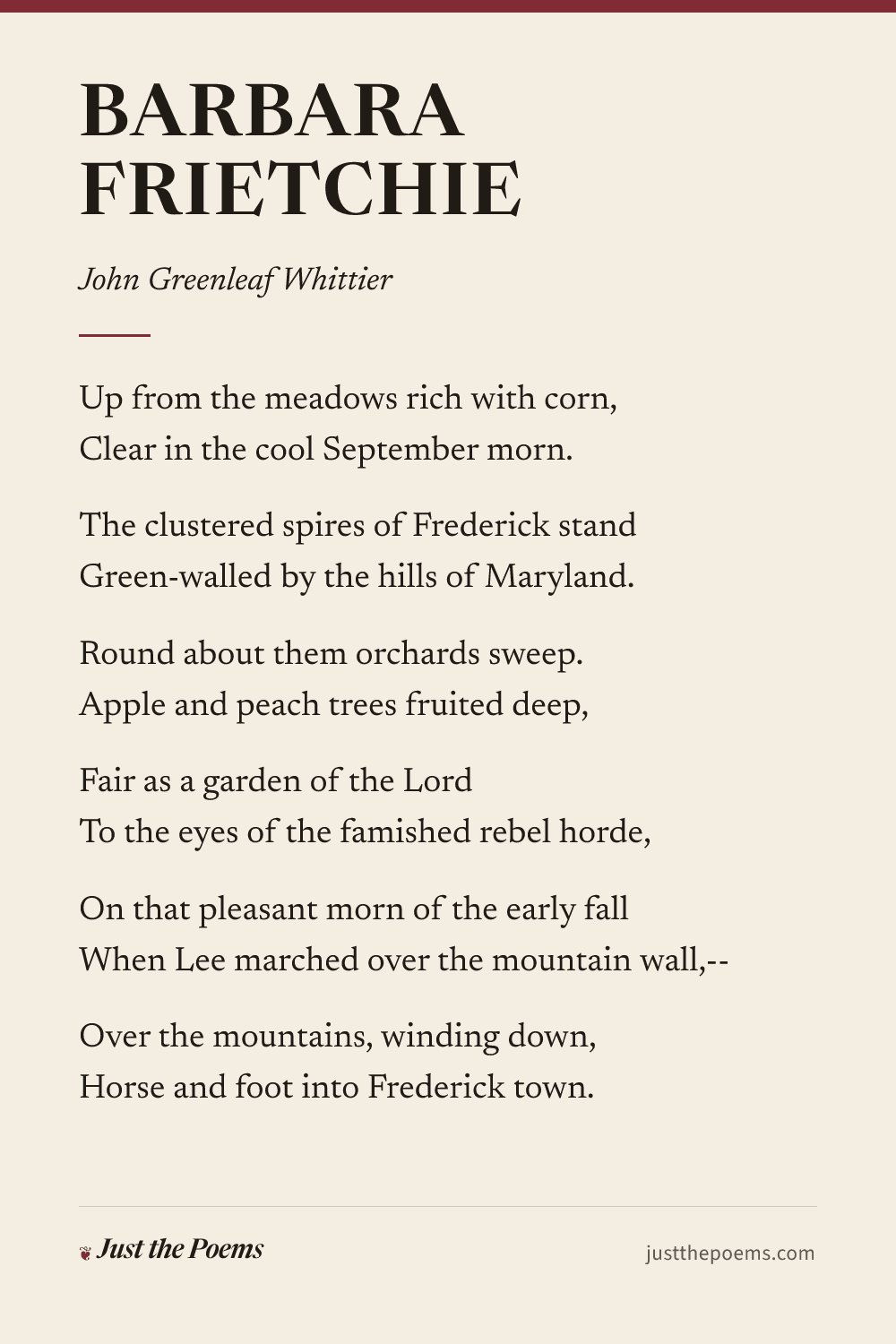
BARBARA FRIETCHIE

John Greenleaf Whittier

In 0 Wikipedias 2 anthologies Poet in 33 Wikipedias

Up from the meadows rich with corn,Clear in the cool September morn.

The clustered spires of Frederick standGreen-walled by the hills of Maryland.

Round about them orchards sweep.Apple and peach trees fruited deep,

Fair as a garden of the LordTo the eyes of the famished rebel horde,

On that pleasant morn of the early fallWhen Lee marched over the mountain wall,--

Over the mountains, winding down,Horse and foot into Frederick town.

Show all 60 lines 48 more

Forty flags with their silver stars,Forty flags with their crimson bars,

Flapped in the morning wind: the sunOf noon looked down, and saw not one.

Tip rose old Barbara Frietchie then,Bowed with her fourscore years and ten;

Bravest of all in Frederick town,She took up the flag the men hauled down;

In her attic-window the staff she set,To show that one heart was loyal yet.

Up the street came the rebel tread,Stonewall Jackson riding ahead.

Under his slouched hat left and rightHe glanced: the old flag met his sight.

"Halt!"--the dust-brown ranks stood fast;"Fire!"--out blazed the rifle-blast.

It shivered the window, pane and sash;It rent the banner with seam and gash.

Quick, as it fell, from the broken staffDame Barbara snatched the silken scarf;

She leaned far out on the window-sill,And shook it forth with a royal will.

"Shoot, if you must, this old gray head,But spare your country's flag," she said.

A shade of sadness, a blush of shame,Over the face of the leader came;

The nobler nature within him stirredTo life at that woman's deed and word:

"Who touches a hair of yon gray headDies like a dog! March on!" he said.

All day long through Frederick streetSounded the tread of marching feet;

All day long that free flag tostOver the heads of the rebel host.

Ever its torn folds rose and fellOn the loyal winds that loved it well;

And through the hill-gaps sunset lightShone over it with a warm good-night.

Barbara Frietchie's work is o'er.And the rebel rides on his raids no more.

Honor to her! and let a tearFall, for her sake, on Stonewall's bier.

Over Barbara Frietchie's grave,Flag of freedom and union, wave!

Peace and order and beauty drawRound thy symbol of light and law;

And ever the stars above look downOn thy stars below in Frederick town!

Source

The World's Best Poetry, Vol. VIII, ed. Bliss Carman, 1904

Filed under
  • Section “WAR”, The World's Best Poetry

SONG OF MARION'S MEN.

William Cullen Bryant

In 0 Wikipedias 2 anthologies Poet in 28 Wikipedias

Our band is few, but true and tried, Our leader frank and bold;The British soldier trembles When Marion's name is told.Our fortress is the good greenwood, Our tent the cypress-tree;We know the forest round us, As seamen know the sea;We know its walls of thorny vines, Its glades of reedy grass,Its safe and silent islands Within the dark morass.

Show all 60 lines 48 more

Woe to the English soldiery That little dread us near!On them shall light at midnight A strange and sudden fear;When, waking to their tents on fire, They grasp their arms in vain,And they who stand to face us Are beat to earth again;And they who fly in terror deem A mighty host behind,And hear the tramp of thousands Upon the hollow wind.

Then sweet the hour that brings release From danger and from toil;We talk the battle over, And share the battle's spoil.The woodland rings with laugh and shout, As if a hunt were up,And woodland flowers are gathered To crown the soldier's cup.With merry songs we mock the wind That in the pine-top grieves,And slumber long and sweetly On beds of oaken leaves.

Well knows the fair and friendly moon The band that Marion leads,--The glitter of their rifles, The scampering of their steeds.'Tis life to guide the fiery barb Across the moonlight plain;'Tis life to feel the night-wind That lifts his tossing mane.A moment in the British camp-- A moment--and awayBack to the pathless forest, Before the peep of day.

Grave men there are by broad Santee, Grave men with hoary hairs;Their hearts are all with Marion, For Marion are their prayers.And lovely ladies greet our band With kindliest welcoming,With smiles like those of summer, And tears like those of spring.For them we wear these trusty arms, And lay them down no moreTill we have driven the Briton Forever from our shore.

Source

The World's Best Poetry, Vol. VIII, ed. Bliss Carman, 1904

Filed under
  • Section “WAR”, The World's Best Poetry

Agincourt

Michael Drayton

In 0 Wikipedias 2 anthologies Poet in 21 Wikipedias

Fair stood the wind for FranceWhen we our sails advance,Nor now to prove our chance Longer will tarry;But putting to the main,At Caux, the mouth of Seine,With all his martial train Landed King Harry.

And taking many a fort,Furnish’d in warlike sort,Marcheth tow’rds Agincourt In happy hour;

Show all 120 lines 108 more

Skirmishing day by dayWith those that stopp’d his way,Where the French gen’ral lay With all his power.

Which, in his height of pride,King Henry to deride,His ransom to provide Unto him sending;Which he neglects the whileAs from a nation vile,Yet with an angry smile Their fall portending.

And turning to his men,Quoth our brave Henry then,‘Though they to one be ten Be not amazèd:Yet have we well begun;Battles so bravely wonHave ever to the sun By fame been raisèd.

‘And for myself (quoth he)This my full rest shall be:England ne’er mourn for me Nor more esteem me:Victor I will remainOr on this earth lie slain,Never shall she sustain Loss to redeem me.

‘Poitiers and Cressy tell,When most their pride did swell,Under our swords they fell: No less our skill isThan when our grandsire great,Claiming the regal seat,By many a warlike feat Lopp’d the French lilies.’

The Duke of York so dreadThe eager vaward led;With the main Henry sped Among his henchmen.Excester had the rear,A braver man not there;O Lord, how hot they were On the false Frenchmen!

They now to fight are gone,Armour on armour shone,Drum now to drum did groan, To hear was wonder;That with the cries they makeThe very earth did shake:Trumpet to trumpet spake, Thunder to thunder.

Well it thine age became,O noble Erpingham,Which didst the signal aim To our hid forces!When from a meadow by,Like a storm suddenlyThe English archery Stuck the French horses.

With Spanish yew so strong,Arrows a cloth-yard longThat like to serpents stung, Piercing the weather;None from his fellow starts,But playing manly parts,And like true English hearts Stuck close together.

When down their bows they threw,And forth their bilbos drew,And on the French they flew, Not one was tardy;Arms were from shoulders sent,Scalps to the teeth were rent,Down the French peasants went-- Our men were hardy.

This while our noble king,His broadsword brandishing,

Down the French host did ding As to o’erwhelm it;And many a deep wound lent,His arms with blood besprent,And many a cruel dent Bruisèd his helmet.

Gloster, that duke so good,Next of the royal blood,For famous England stood With his brave brother;Clarence, in steel so bright,Though but a maiden knight,Yet in that furious fight Scarce such another.

Warwick in blood did wade,Oxford the foe invade,And cruel slaughter made Still as they ran up;Suffolk his axe did ply,Beaumont and WilloughbyBare them right doughtily, Ferrers and Fanhope.

Upon Saint Crispin’s DayFought was this noble fray,Which fame did not delay To England to carry.O when shall English menWith such acts fill a pen?Or England breed again Such a King Harry?

Source

The Oxford Book of English Verse 1250–1900, 1900

Filed under
  • Section “WAR”, The World's Best Poetry

BINGEN ON THE RHINE

Caroline Elizabeth Sarah Norton

In 0 Wikipedias 2 anthologies Poet in 19 Wikipedias

A soldier of the Legion lay dying in Algiers,There was lack of woman's nursing, there was dearth of woman's tears;But a comrade stood beside him, while his life-blood ebbed away,And bent, with pitying glances, to hear what he might say.The dying soldier faltered, and he took that comrade's hand,And he said, "I nevermore shall see my own, my native land;Take a message, and a token, to some distant friends of mine,For I was born at Bingen,--at Bingen on the Rhine.

"Tell my brothers and companions, when they meet and crowd around,To hear my mournful story, in that pleasant vineyard ground,That we fought the battle bravely, and when the day was done,

Show all 60 lines 48 more

Full many a corse lay ghastly pale beneath the setting sun;And, mid the dead and dying, were some grown old in wars,--The death-wound on their gallant breasts, the last of many scars;And some were young, and suddenly beheld life's morn decline,--And one had come from Bingen,--fair Bingen on the Rhine.

"Tell my mother that her other son shall comfort her old age;For I was still a truant bird, that thought his home a cage.For my father was a soldier, and even as a childMy heart leaped forth to hear him tell of struggles fierce and wild;And when he died, and left us to divide his scanty hoard,I let them take whate'er they would,--but kept my father's sword;And with boyish love I hung it where the bright light used to shine,On the cottage wall at Bingen,--calm Bingen on the Rhine.

"Tell my sister not to weep for me, and sob with drooping head,When the troops come marching home again with glad and gallant tread,But to look upon them proudly, with a calm and steadfast eye,For her brother was a soldier too, and not afraid to die;And if a comrade seek her love, I ask her in my nameTo listen to him kindly, without regret or shame,And to hang the old sword in its place (my father's sword and mine)For the honor of old Bingen,--dear Bingen on the Rhine.

"There's another,--not a sister; in the happy days gone byYou'd have known her by the merriment that sparkled in her eye;Too innocent for coquetry,--too fond for idle scorning,--O friend! I fear the lightest heart makes sometimes heaviest mourning!Tell her the last night of my life (for, ere the moon be risen,My body will be out of pain, my soul be out of prison),--I dreamed I stood with her, and saw the yellow sunlight shineOn the vine-clad hills of Bingen,--fair Bingen on the Rhine.

"I saw the blue Rhine sweep along,--I heard, or seemed to hear,The German songs we used to sing, in chorus sweet and clear;And down the pleasant river, and up the slanting hill,The echoing chorus sounding, through the evening calm and still;And her glad blue eyes were on me, as we passed, with friendly talk,Down many a path beloved of yore, and well-remembered walk!And her little hand lay lightly, confidingly in mine,--But we'll meet no more at Bingen,--loved Bingen on the Rhine."

His trembling voice grew faint and hoarse,--his grasp was childish weak,--His eyes put on a dying look,--he sighed and ceased to speak;His comrade bent to lift him, but the spark of life had fled,--The soldier of the Legion in a foreign land is dead!And the soft moon rose up slowly, and calmly she looked downOn the red sand of the battle-field, with bloody corses strewn;Yes, calmly on that dreadful scene her pale light seemed to shine,As it shone on distant Bingen,--fair Bingen on the Rhine.

Source

The World's Best Poetry, Vol. VIII, ed. Bliss Carman, 1904

Filed under
  • Section “WAR”, The World's Best Poetry

SHERIDAN'S RIDE

Thomas Buchanan Read

In 0 Wikipedias 2 anthologies Poet in 7 Wikipedias

Up from the South at break of day,Bringing to Winchester fresh dismay,The affrighted air with a shudder bore,Like a herald in haste, to the chieftain's door,The terrible grumble and rumble and roar,Telling the battle was on once more,And Sheridan twenty miles away.

And wider still those billows of warThundered along the horizon's bar;And louder yet into Winchester rolledThe roar of that red sea uncontrolled,Making the blood of the listener cold

Show all 63 lines 51 more

As he thought of the stake in that fiery fray,With Sheridan twenty miles away.

But there is a road from Winchester town,A good, broad highway, leading down;And there, through the flash of the morning light,A steed as black as the steeds of nightWas seen to pass as with eagle flight.As if he knew the terrible need,He stretched away with the utmost speed;Hills rose and fell,--but his heart was gay,With Sheridan fifteen miles away.

Still sprung from those swift hoofs, thundering South,The dust, like smoke from the cannon's mouth;Or the trail of a comet, sweeping faster and faster,Foreboding to traitors the doom of disaster.The heart of the steed and the heart of the masterWere beating, like prisoners assaulting their walls.Impatient to be where the battle-field calls;Every nerve of the charger was strained to full play,With Sheridan only ten miles away.

Under his spurning feet, the roadLike an arrowy Alpine river flowed,And the landscape sped away behind,Like an ocean flying before the wind;And the steed, like a bark fed with furnace ire,Swept on, with his wild eyes full of fire;But, lo! he is nearing his heart's desire,He is snuffing the smoke of the roaring fray,With Sheridan only five miles away.

The first that the General saw were the groupsOf stragglers, and then the retreating troops;What was done,--what to do,--a glance told him both,And, striking his spurs with a terrible oath,He dashed down the line mid a storm of huzzas,And the wave of retreat checked its course there, becauseThe sight of the master compelled it to pause.With foam and with dust the black charger was gray;By the flash of his eye, and his nostril's play,He seemed to the whole great army to say,"I have brought you Sheridan all the wayFrom Winchester down, to save the day!"

Hurrah, hurrah for Sheridan!Hurrah, hurrah, for horse and man!And when their statues are placed on high,Under the dome of the Union sky,--The American soldier's Temple of Fame,--There with the glorious General's nameBe it said in letters both bold and bright:"Here is the steed that saved the dayBy carrying Sheridan into the fight,From Winchester,--twenty miles away!"

Source

The World's Best Poetry, Vol. VIII, ed. Bliss Carman, 1904

Filed under
  • Section “WAR”, The World's Best Poetry

MONTEREY

Charles Fenno Hoffman

In 0 Wikipedias 2 anthologies Poet in 5 Wikipedias

We were not many,--we who stood Before the iron sleet that day;Yet many a gallant spirit would Give half his years if but he couldHave been with us at Monterey.

Now here, now there, the shot it hailed In deadly drifts of fiery spray,Yet not a single soldier quailedWhen wounded comrades round them wailed Their dying shouts at Monterey.

And on, still on our column kept, Through walls of flame its withering way;

Show all 30 lines 18 more

Where fell the dead, the living stept,Still charging on the guns which swept The slippery streets of Monterey.

The foe himself recoiled aghast, When striking where he strongest lay,We swooped his flanking batteries past,And, braving full their murderous blast, Stormed home the towers of Monterey.

Our banners on those turrets wave, And there our evening bugles play;Where orange boughs above their grave,Keep green the memory of the brave Who fought and fell at Monterey.

We are not many,--we who pressed Beside the brave who fell that day;But who of us has not confessedHe'd rather share their warrior rest Than not have been at Monterey?

Source

The World's Best Poetry, Vol. VIII, ed. Bliss Carman, 1904

Filed under
  • Section “WAR”, The World's Best Poetry

WARREN'S ADDRESS.

John Pierpont

In 0 Wikipedias 2 anthologies Poet in 5 Wikipedias

Stand! the ground's your own, my braves!Will ye give it up to slaves?Will ye look for greener graves? Hope ye mercy still?What's the mercy despots feel?Hear it in that battle-peal!Read it on yon bristling steel! Ask it,--ye who will.

Fear ye foes who kill for hire?Will ye to your homes retire?Look behind you!--they're afire! And, before you, seeWho have done it! From the valeOn they come!--and will ye quail?Leaden rain and iron hail Let their welcome be!

In the God of battles trust!Die we may,--and die we must:But, O, where can dust to dust Be consigned so well,As where heaven its dews shall shedOn the martyred patriot's bed,And the rocks shall raise their head, Of his deeds to tell?

Source

The World's Best Poetry, Vol. VIII, ed. Bliss Carman, 1904

Filed under
  • Section “WAR”, The World's Best Poetry

NATHAN HALE.

Francis Miles Finch

In 0 Wikipedias 2 anthologies Poet in 2 Wikipedias

To drum-beat and heart-beat A soldier marches by:There is color in his cheek, There is courage in his eye,Yet to drum-beat and heart-beat In a moment he must die.

By starlight and moonlight, He seeks the Briton's camp;He hears the rustling flag, And the armèd sentry's tramp;And the starlight and moonlight His silent wanderings lamp.

Show all 60 lines 48 more

With slow tread and still tread, He scans the tented line;And he counts the battery guns By the gaunt and shadowy pine;And his slow tread and still tread Gives no warning sign.

The dark wave, the plumed wave, It meets his eager glance;And it sparkles 'neath the stars, Like the glimmer of a lance--A dark wave, a plumed wave, On an emerald expanse.

A sharp clang, a steel clang, And terror in the sound!For the sentry, falcon-eyed, In the camp a spy hath found;With a sharp clang, a steel clang, The patriot is bound.

With calm brow, steady brow, He listens to his doom;In his look there is no fear, Nor a shadow-trace of gloom;But with calm brow and steady brow He robes him for the tomb.

In the long night, the still night, He kneels upon the sod;And the brutal guards withhold E'en the solemn Word of God!In the long night, the still night, He walks where Christ hath trod.

'Neath the blue morn, the sunny morn, He dies upon the tree;And he mourns that he can lose But one life for Liberty;And in the blue morn, the sunny morn, His spirit-wings are free.

But his last words, his message-words, They burn, lest friendly eyeShould read how proud and calm A patriot could die,With his last words, his dying words, A soldier's battle-cry.

From Fame-leaf and Angel-leaf, From monument and urn,The sad of earth, the glad of heaven, His tragic fate shall learn;And on Fame-leaf and Angel-leaf The name of HALE shall burn!

Source

The World's Best Poetry, Vol. VIII, ed. Bliss Carman, 1904

Filed under
  • Section “WAR”, The World's Best Poetry

"PICCIOLA."

Robert Henry Newell

In 0 Wikipedias 2 anthologies Poet in 2 Wikipedias

It was a Sergeant old and gray, Well singed and bronzed from siege and pillage,Went tramping in an army's wake Along the turnpike of the village.

For days and nights the winding host Had through the little place been marching,And ever loud the rustics cheered, Till every throat was hoarse and parching.

The Squire and Farmer, maid and dame, All took the sight's electric stirring,And hats were waved and staves were sung, And kerchiefs white were countless whirring.

Show all 56 lines 44 more

They only saw a gallant show Of heroes stalwart under banners,And, in the fierce heroic glow, 'Twas theirs to yield but wild hosannas.

The Sergeant heard the shrill hurrahs, Where he behind in step was keeping;But glancing down beside the road He saw a little maid sit weeping.

"And how is this?" he gruffly said, A moment pausing to regard her;--"Why weepest thou, my little chit?" And then she only cried the harder.

"And how is this, my little chit?" The sturdy trooper straight repeated,"When all the village cheers us on, That you, in tears, apart are seated?

"We march two hundred thousand strong, And that's a sight, my baby beauty,To quicken silence into song And glorify the soldier's duty."

"It's very, very grand, I know," The little maid gave soft replying;"And Father, Mother, Brother too, All say 'Hurrah' while I am crying;

"But think--O Mr. Soldier, think,-- How many little sisters' brothersAre going all away to fight And may be killed, as well as others!"

"Why, bless thee, child," the Sergeant said, His brawny hand her curls caressing,"'Tis left for little ones like thee To find that War's not all a blessing."

And "Bless thee!" once again he cried; Then cleared his throat and looked indignant,And marched away with wrinkled brow To stop the struggling tear benignaut.

And still the ringing shouts went up From doorway, thatch, and fields of tillage;The pall behind the standard seen By one alone of all the village.

The oak and cedar bend and writhe When roars the wind through gap and braken;But 'tis the tenderest reed of all That trembles first when Earth is shaken.

Source

The World's Best Poetry, Vol. VIII, ed. Bliss Carman, 1904

Filed under
  • Section “WAR”, The World's Best Poetry

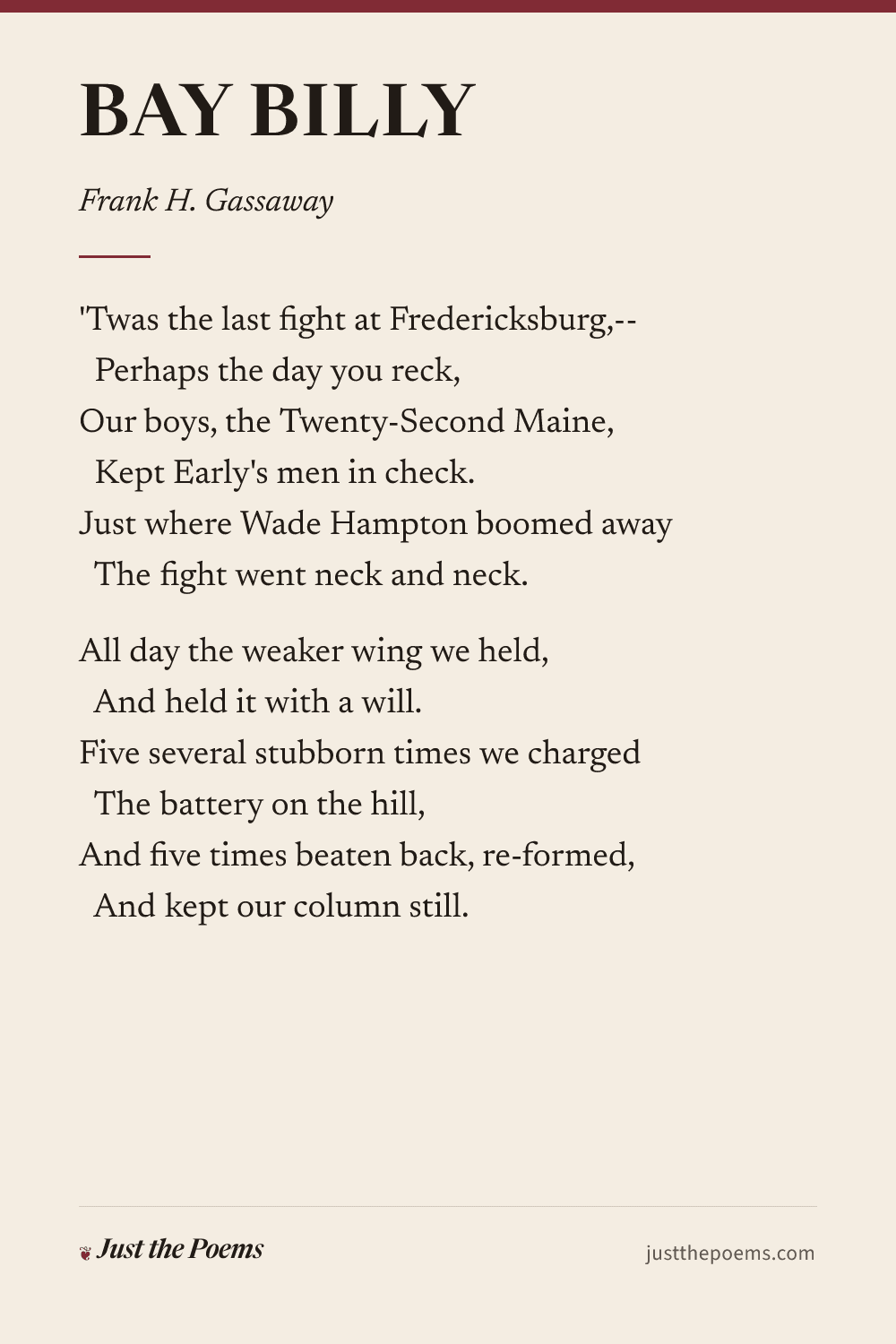
BAY BILLY

Frank H. Gassaway

In 0 Wikipedias 2 anthologies Poet in 1 Wikipedia

'Twas the last fight at Fredericksburg,-- Perhaps the day you reck,Our boys, the Twenty-Second Maine, Kept Early's men in check.Just where Wade Hampton boomed away The fight went neck and neck.

All day the weaker wing we held, And held it with a will.Five several stubborn times we charged The battery on the hill,And five times beaten back, re-formed, And kept our column still.

Show all 126 lines 114 more

At last from out the centre fight Spurred up a general's aide:"That battery must silenced be!" He cried, as past he sped.Our colonel simply touched his cap, And then, with measured tread,

To lead the crouching line once more The grand old fellow came.No wounded man but raised his head And strove to gasp his name,And those who could not speak nor stir, "God blessed him" just the same.

For he was all the world to us, That hero gray and grim.Right well we knew that fearful slope We'd climb with none but him,Though while his white head led the way We'd charge hell's portals in.

This time we were not half-way up. When, midst the storm of shell,Our leader, with his sword upraised, Beneath our bayonets fell.And, as we bore him back, the foe Set up a joyous yell.

Our hearts went with him. Back we swept, And when the bugle said"Up, charge again!" no man was there But hung his dogged head."We've no one left to lead us now," The sullen soldiers said.

Just then before the laggard line The colonel's horse we spied,Bay Billy with his trappings on, His nostrils swelling wide,As though still on his gallant back The master sat astride.

Right royally he took the place That was of old his wont,And with a neigh that seemed to say, Above the battle's brunt,"How can the Twenty-Second charge If I am not in front?"

Like statues rooted there we stood, And gazed a little space,Above that floating mane we missed The dear familiar face,But we saw Bay Billy's eye of fire, And it gave us heart of grace.

No bugle-call could rouse us all As that brave sight had done,Down all the battered line we felt A lightning impulse run.Up! up the hill we followed Bill,-- And we captured every gun!

And when upon the conquered height Died out the battle's hum,Vainly mid living and the dead We sought our leader dumb.It seemed as if a spectre steed To win that day had come.

And then the dusk and dew of night Fell softly o'er the plain,As though o'er man's dread work of death The angels wept again,And drew night's curtain gently round A thousand beds of pain.

All night the surgeons' torches went, The ghastly rows between,--All night with solemn step I paced The torn and bloody green.But who that fought in the big war Such dread sights have not seen?

At last the morning broke. The lark Sang in the merry skies,As if to e'en the sleepers there It bade awake, and rise!Though naught but that last trump of all Could ope their heavy eyes.

And then once more with banners gay, Stretched out the long brigade.Trimly upon the furrowed field The troops stood on parade,And bravely mid the ranks were closed The gaps the fight had made.

Not half the Twenty-Second's men Were in their place that morn;And Corporal Dick, who yester-noon Stood six brave fellows on,Now touched my elbow in the ranks, For all between were gone.

Ah I who forgets that dreary hour When, as with misty eyes,To call the old familiar roll The solemn sergeant tries,--One feels that thumping of the heart As no prompt voice replies.

And as in faltering tone and slow The last few names were said,Across the field some missing horse Toiled up the weary tread.It caught the sergeant's eye, and quick Bay Billy's name he read.

Yes! there the old bay hero stood, All safe from battle's harms,And ere an order could be heard, Or the bugle's quick alarms,Down all the front, from end to end, The troops presented arms!

Not all the shoulder-straps on earth Could still our mighty cheer;And ever from that famous day, When rang the roll call clear,Bay Billy's name was read, and then The whole line answered, "Here!"

Source

The World's Best Poetry, Vol. VIII, ed. Bliss Carman, 1904

Filed under
  • Section “WAR”, The World's Best Poetry

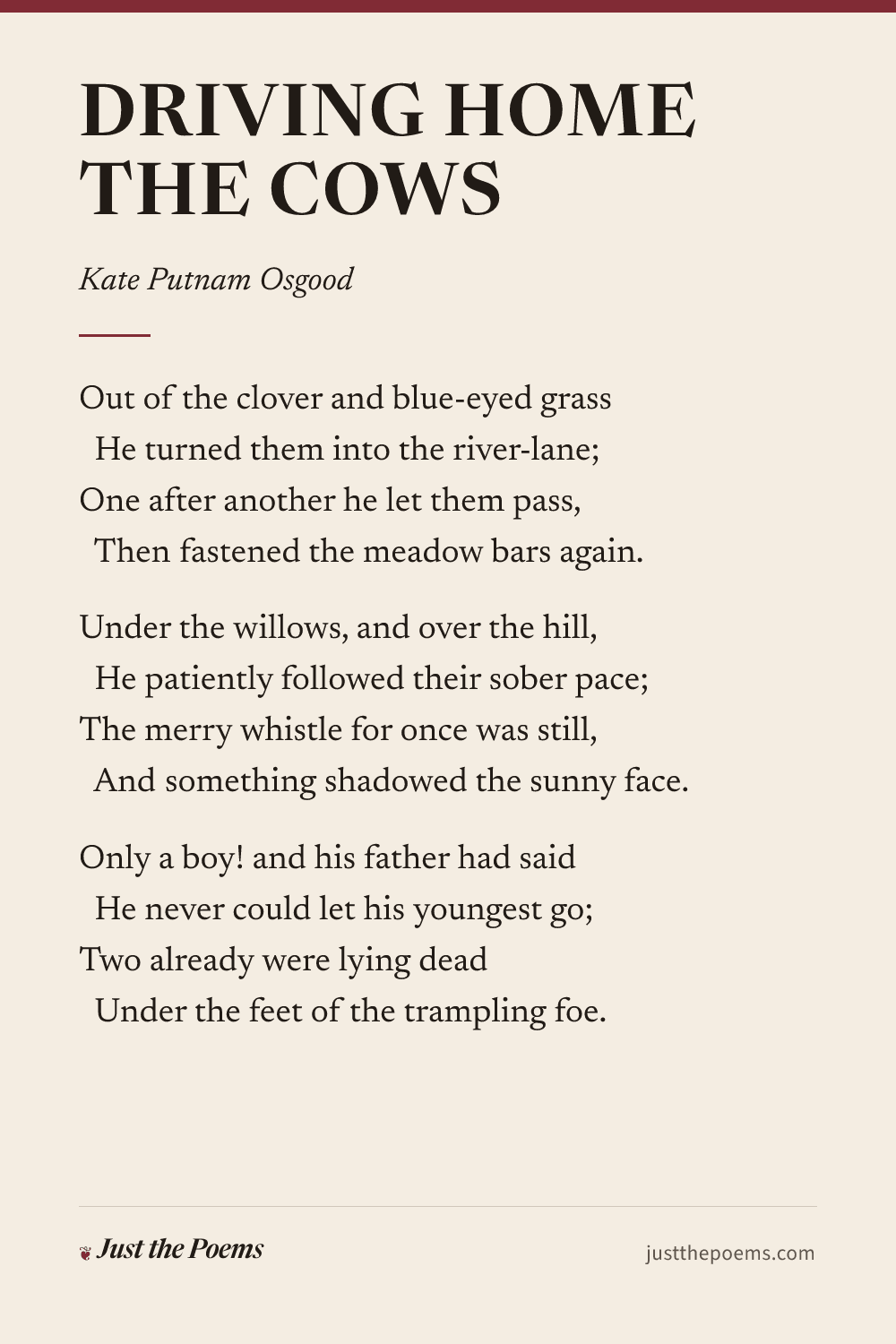
DRIVING HOME THE COWS

Kate Putnam Osgood

In 0 Wikipedias 2 anthologies Poet in 0 Wikipedias

Out of the clover and blue-eyed grass He turned them into the river-lane;One after another he let them pass, Then fastened the meadow bars again.

Under the willows, and over the hill, He patiently followed their sober pace;The merry whistle for once was still, And something shadowed the sunny face.

Only a boy! and his father had said He never could let his youngest go;Two already were lying dead Under the feet of the trampling foe.

Show all 48 lines 36 more

But after the evening work was done, And the frogs were loud in the meadow-swamp,Over his shoulder he slung his gun And stealthily followed the foot-path damp,

Across the clover and through the wheat With resolute heart and purpose grim,Though cold was the dew on his hurrying feet, And the blind bat's flitting startled him.

Thrice since then had the lanes been white, And the orchards sweet with apple-bloom;And now, when the cows came back at night, The feeble father drove them home.

For news had come to the lonely farm That three were lying where two had lain;And the old man's tremulous, palsied arm Could never lean on a son's again.

The summer day grew cool and late, He went for the cows when the work was done;But down the lane, as he opened the gate, He saw them coming one by one,--

Brindle, Ebony, Speckle, and Bess, Shaking their horns in the evening wind;Cropping the buttercups out of the grass,--But who was it following close behind?

Loosely swung in the idle air The empty sleeve of army blue;And worn and pale, from the crisping hair, Looked out a face that the father knew.

For gloomy prisons will sometimes yawn, And yield their dead unto life again;And the day that comes with a cloudy dawn In golden glory at last may wane.

The great tears sprang to their meeting eyes; For the heart must speak when the lips are dumb;And under the silent evening skies Together they followed the cattle home.

Source

The World's Best Poetry, Vol. VIII, ed. Bliss Carman, 1904

Filed under
  • Section “WAR”, The World's Best Poetry

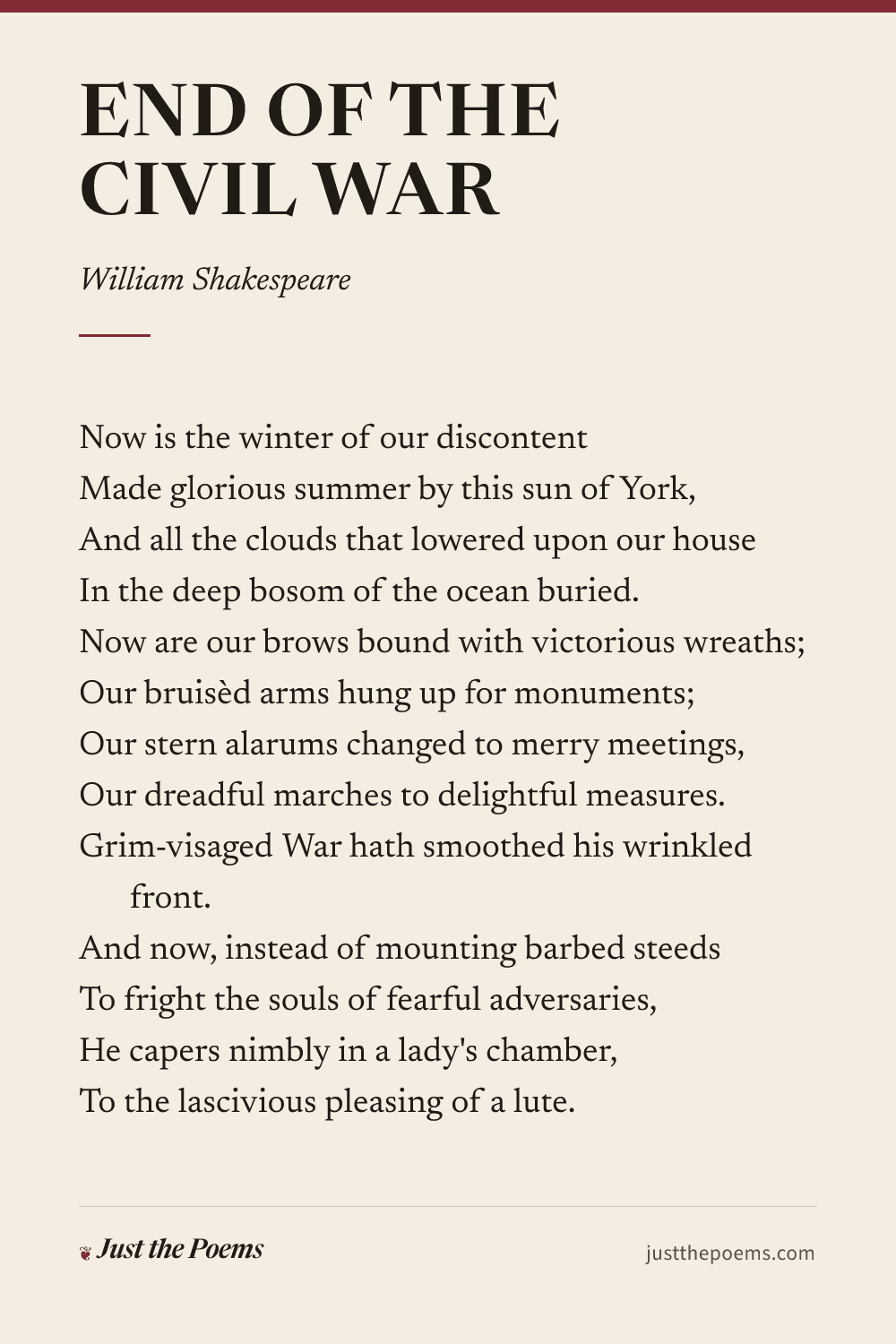
END OF THE CIVIL WAR

William Shakespeare

In 0 Wikipedias 1 anthology Poet in 237 Wikipedias

Now is the winter of our discontentMade glorious summer by this sun of York,And all the clouds that lowered upon our houseIn the deep bosom of the ocean buried.Now are our brows bound with victorious wreaths;Our bruisèd arms hung up for monuments;Our stern alarums changed to merry meetings,Our dreadful marches to delightful measures.Grim-visaged War hath smoothed his wrinkled front.And now, instead of mounting barbed steedsTo fright the souls of fearful adversaries,He capers nimbly in a lady's chamber,To the lascivious pleasing of a lute.

Source

The World's Best Poetry, Vol. VIII, ed. Bliss Carman, 1904

Filed under
  • Named in the title

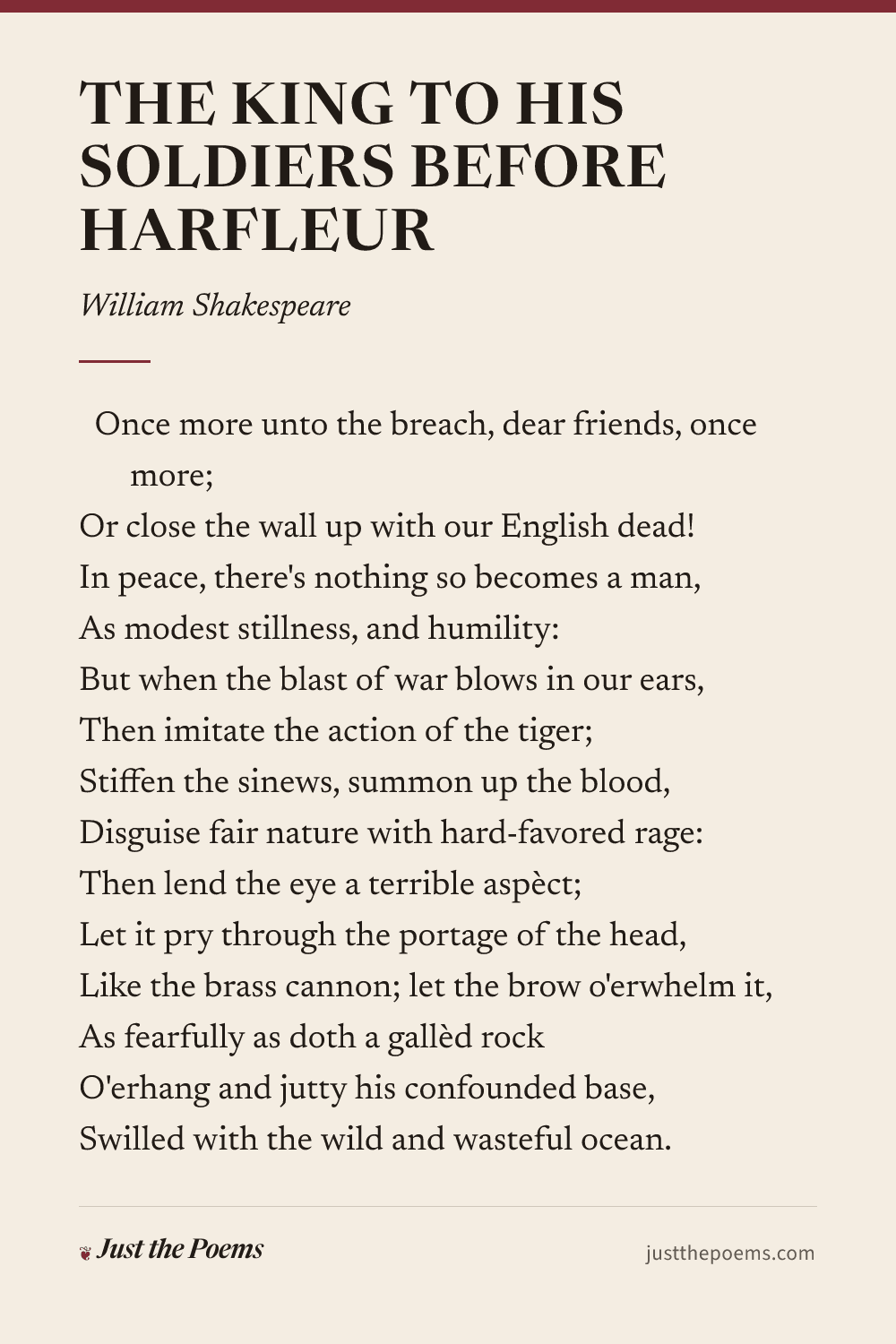
THE KING TO HIS SOLDIERS BEFORE HARFLEUR

William Shakespeare

In 0 Wikipedias 1 anthology Poet in 237 Wikipedias

Once more unto the breach, dear friends, once more;Or close the wall up with our English dead!In peace, there's nothing so becomes a man,As modest stillness, and humility:But when the blast of war blows in our ears,Then imitate the action of the tiger;Stiffen the sinews, summon up the blood,Disguise fair nature with hard-favored rage:Then lend the eye a terrible aspèct;Let it pry through the portage of the head,Like the brass cannon; let the brow o'erwhelm it,As fearfully as doth a gallèd rock

Show all 34 lines 22 more

O'erhang and jutty his confounded base,Swilled with the wild and wasteful ocean.Now set the teeth, and stretch the nostril wide;Hold hard the breath, and bend up every spiritTo his full height!--On, on, you noblest English,Whose blood is fet from fathers of war-proof!Fathers, that, like so many Alexanders,Have, in these parts, from morn till even fought,And sheathed their swords for lack of argument.Dishonor not your mothers; now attest,That those whom you called fathers, did beget you!Be copy now to men of grosser blood,And teach them how to war!--And you, good yeomen,Whose limbs were made in England, show us hereThe mettle of your pasture; let us swearThat you are worth your breeding: which I doubt not;For there is none of you so mean and base,That hath not noble lustre in your eyes.I see you stand like greyhounds in the slips,Straining upon the start. The game's afoot;Follow your spirit: and, upon this charge,Cry--God for Harry! England! and Saint George!

Source

The World's Best Poetry, Vol. VIII, ed. Bliss Carman, 1904

Filed under
  • Section “WAR”, The World's Best Poetry

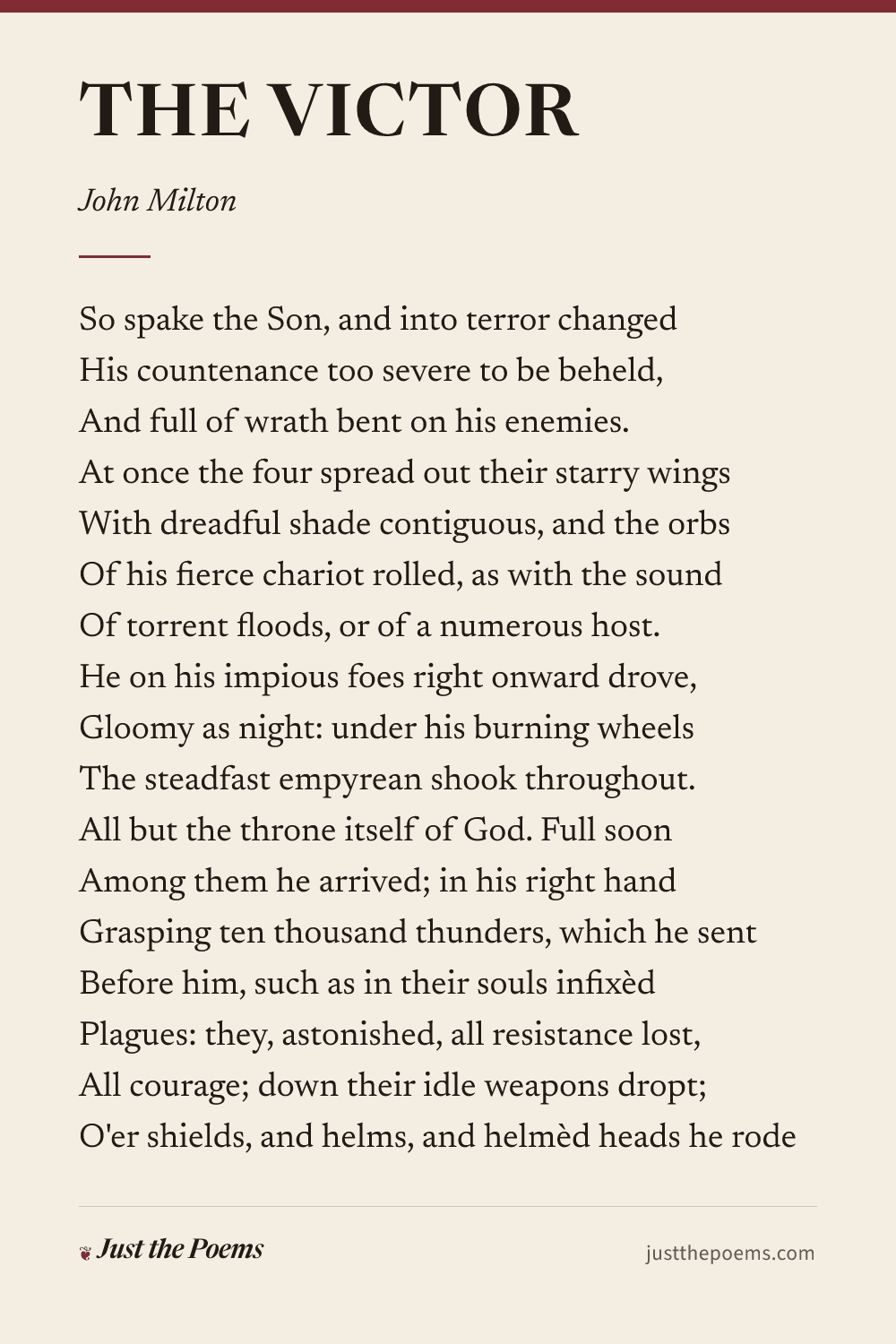
THE VICTOR

John Milton

In 0 Wikipedias 1 anthology Poet in 106 Wikipedias

So spake the Son, and into terror changedHis countenance too severe to be beheld,And full of wrath bent on his enemies.At once the four spread out their starry wingsWith dreadful shade contiguous, and the orbsOf his fierce chariot rolled, as with the soundOf torrent floods, or of a numerous host.He on his impious foes right onward drove,Gloomy as night: under his burning wheelsThe steadfast empyrean shook throughout.All but the throne itself of God. Full soonAmong them he arrived; in his right hand

Show all 43 lines 31 more

Grasping ten thousand thunders, which he sentBefore him, such as in their souls infixèdPlagues: they, astonished, all resistance lost,All courage; down their idle weapons dropt;O'er shields, and helms, and helmèd heads he rodeOf thrones and mighty seraphim prostráte,That wished the mountains now might be againThrown on them, as a shelter from his ire.Nor less on either side tempestuous fellHis arrows, from the fourfold-visaged FourDistinct with eyes, and from the living wheelsDistinct alike with multitude of eyes;One spirit in them ruled; and every eyeGlared lightning, and shot forth pernicious fireAmong the accursed, that withered all their strength,And of their wonted vigor left them drained,Exhausted, spiritless, afflicted, fallen.Yet half his strength he put not forth, but checkedHis thunder in mid volley; for he meantNot to destroy, but root them out of heaven:The overthrown he raised, and as a herdOf goats or timorous flock together thronged,Drove them before him thunderstruck, pursuedWith terrors and with furies, to the boundsAnd crystal wall of heaven; which, opening wide,Rolled inward, and a spacious gap disclosedInto the wasteful deep: the monstrous sightStruck them with horror backward, but far worseUrged them behind: headlong themselves they threwDown from the verge of heaven; eternal wrathBurnt after them to the bottomless pit.

Source

The World's Best Poetry, Vol. VIII, ed. Bliss Carman, 1904

Filed under
  • Section “WAR”, The World's Best Poetry

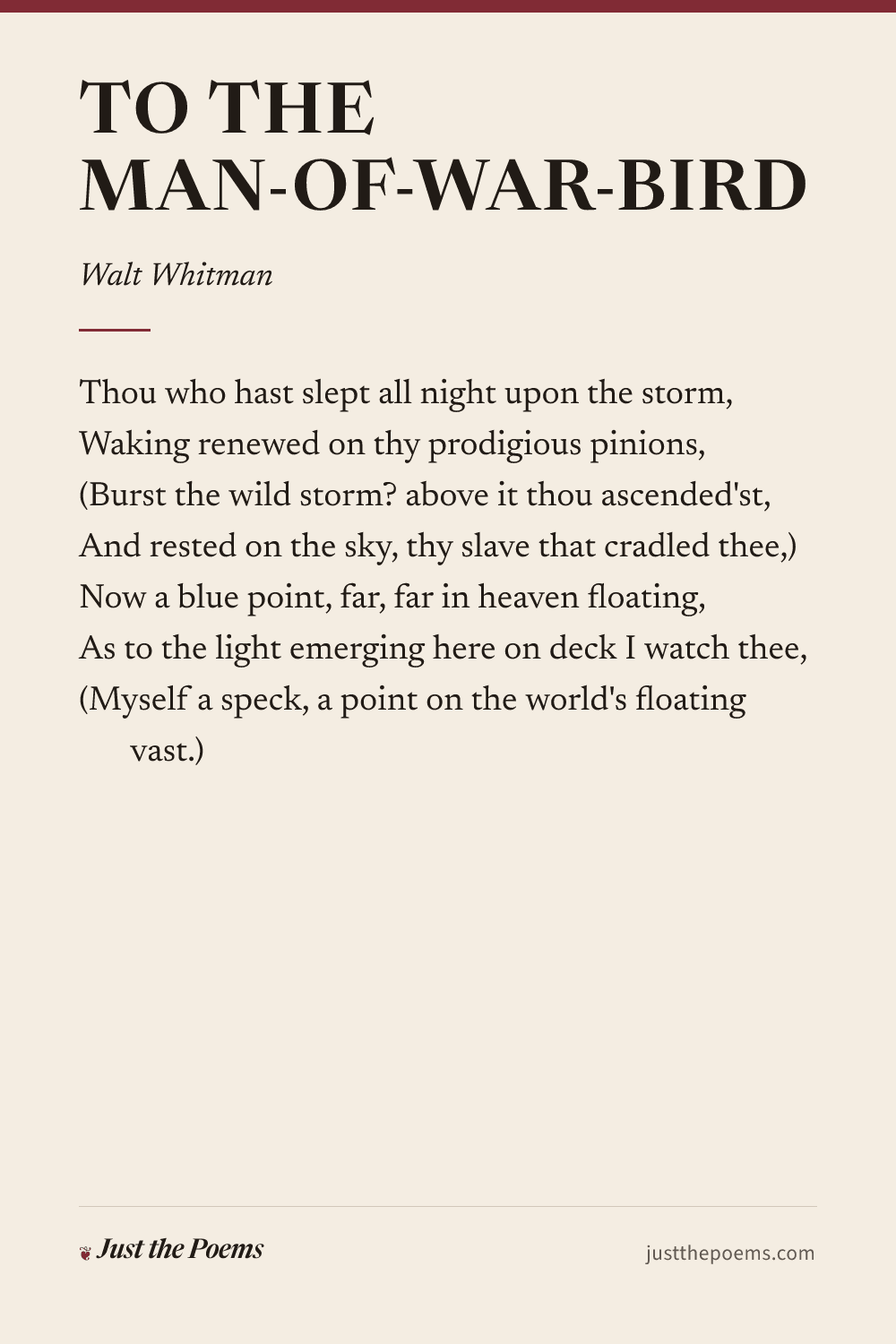
TO THE MAN-OF-WAR-BIRD

Walt Whitman

In 0 Wikipedias 1 anthology Poet in 105 Wikipedias

Thou who hast slept all night upon the storm,Waking renewed on thy prodigious pinions,(Burst the wild storm? above it thou ascended'st,And rested on the sky, thy slave that cradled thee,)Now a blue point, far, far in heaven floating,As to the light emerging here on deck I watch thee,(Myself a speck, a point on the world's floating vast.)

Far, far at sea,After the night's fierce drifts have strewn the shore with wrecks,With re-appearing day as now so happy and serene,The rosy and elastic dawn, the flashing sun,The limpid spread of air cerulean,Thou also re-appearest.

Thou born to match the gale, (thou art all wings,)To cope with heaven and earth and sea and hurricane,Thou ship of air that never furl'st thy sails,Days, even weeks untired and onward, through spaces, realms gyrating,At dusk that look'st on Senegal, at morn America,That sport'st amid the lightning-flash and thunder-cloud,In them, in thy experiences, hadst thou my soul,What joys! what joys were thine!

Source

The Home Book of Verse, ed. Burton Egbert Stevenson

Filed under
  • Named in the title

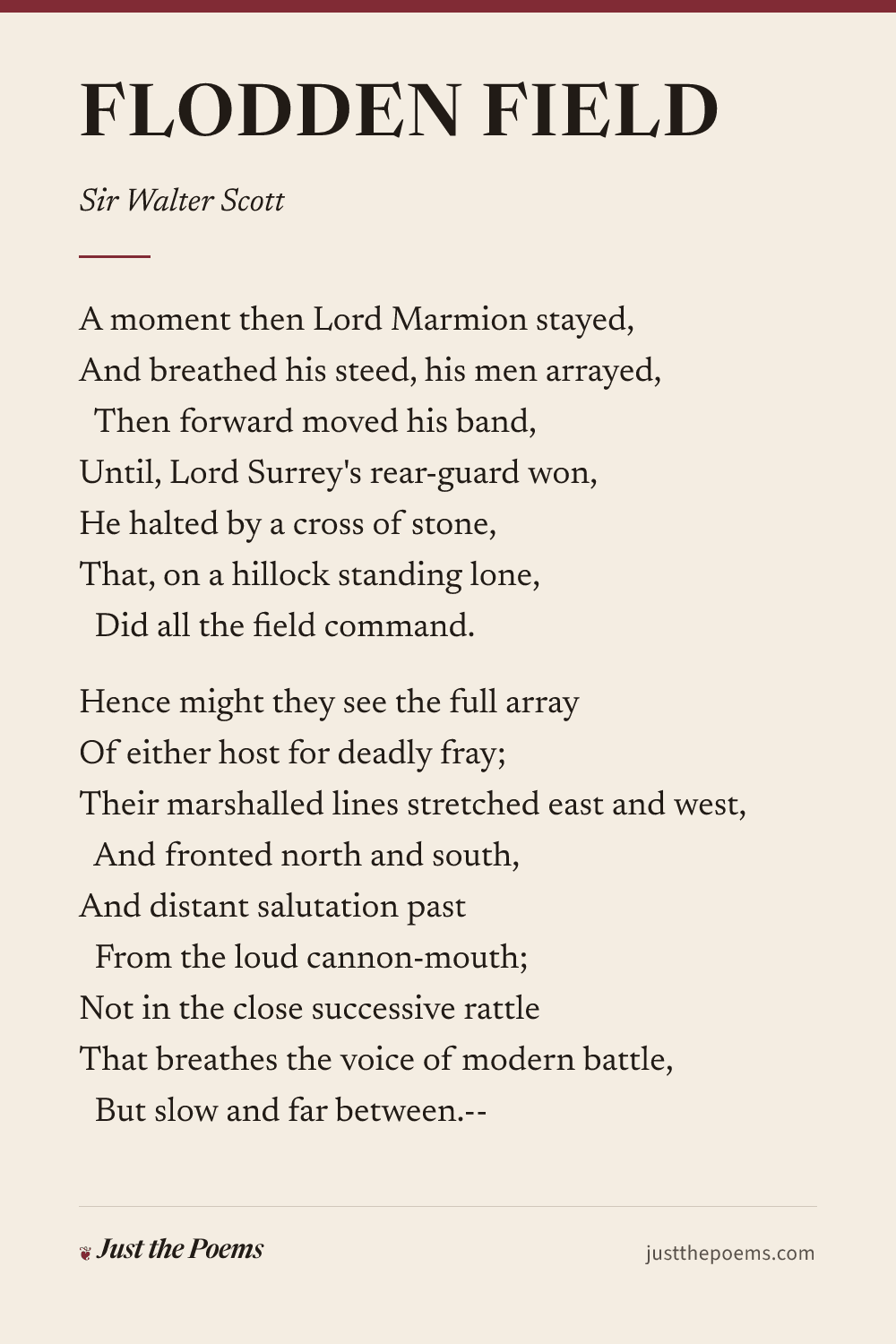
FLODDEN FIELD

Sir Walter Scott

In 0 Wikipedias 1 anthology Poet in 98 Wikipedias

A moment then Lord Marmion stayed,And breathed his steed, his men arrayed, Then forward moved his band,Until, Lord Surrey's rear-guard won,He halted by a cross of stone,That, on a hillock standing lone, Did all the field command.

Hence might they see the full arrayOf either host for deadly fray;Their marshalled lines stretched east and west, And fronted north and south,And distant salutation past

Show all 295 lines 283 more

From the loud cannon-mouth;Not in the close successive rattleThat breathes the voice of modern battle, But slow and far between.--The hillock gained, Lord Marmion stayed:"Here, by this cross," he gently said, "You well may view the scene;Here shalt thou tarry, lovely Clare:O, think of Marmion in thy prayer!--Thou wilt not?--well,--no less my careShall, watchful, for thy weal prepare.--You, Blount and Eustace, are her guard, With ten picked archers of my train;With England if the day go hard, To Berwick speed amain,--But, if we conquer, cruel maid,My spoils shall at your feet be laid, When here we meet again."He waited not for answer there,And would not mark the maid's despair, Nor heed the discontented lookFrom either squire: but spurred amain,And, dashing through the battle-plain, His way to Surrey took.

Blount and Fitz-Eustace rested stillWith Lady Clare upon the hill;On which (for far the day was spent)The western sunbeams now were bent.The cry they heard, its meaning knew,Could plain their distant comrades view:Sadly to Blount did Eustace say,"Unworthy office here to stay!No hope of gilded spurs to-day.--But, see! look up,--on Flodden bentThe Scottish foe has fired his tent."-- And sudden, as he spoke,From the sharp ridges of the hill,All downward to the banks of Till Was wreathed in sable smoke.Volumed and vast, and rolling far,The cloud enveloped Scotland's war, As down the hill they broke;Nor martial shout, nor minstrel tone,Announced their march; their tread alone,At times their warning trumpet blown, At times a stifled hum,Told England, from his mountain-throne King James did rushing come.--Scarce could they hear or see their foes,Until at weapon-point they close.--They close in clouds of smoke and dust,With sword-sway and with lance's thrust; And such a yell was there,Of sudden and portentous birth,As if men fought upon the earth And fiends in upper air:O, life and death were in the shout,Recoil and rally, charge and rout, And triumph and despair.Long looked the anxious squires; their eyeCould in the darkness naught descry.

At length the freshening western blastAside the shroud of battle cast;And, first, the ridge of mingled spearsAbove the brightened cloud appears;And in the smoke the pennons flew,As in the storm the white sea-mew.Then marked they, dashing broad and far,The broken billows of the war,And plumèd crests of chieftains braveFloating like foam upon the wave; But naught distinct they see:Wide raged the battle on the plain;Spears shook, and falchions flashed amain;Fell England's arrow-flight like rain;Crests rose, and stooped, and rose again, Wild and disorderly.Amid the scene of tumult, highThey saw Lord Marmion's falcon fly:And stainless Tunstall's banner white,And Edmund Howard's lion bright,Still bear them bravely in the fight; Although against them comeOf gallant Gordons many a one,And many a stubborn Highlandman,And many a rugged Border clan, With Huntley and with Home.

Far on the left, unseen the while,Stanley broke Lennox and Argyle;Though there the western mountaineerRushed with bare bosom on the spear,And flung the feeble targe aside,And with both hands the broadsword plied,'Twas vain:--But Fortune, on the right,With fickle smile, cheered Scotland's fight.Then fell that spotless banner white, The Howard's lion fell;Yet still Lord Marmion's falcon flewWith wavering flight, while fiercer grew Around the battle-yell.The Border slogan rent the sky!A Home! a Gordon! was the cry:Loud were the clanging blows;Advanced,--forced back,--now low, now high, The pennon sunk and rose;As bends the bark's mast in the gale,When rent are rigging, shrouds, and sail, It wavered mid the foes.No longer Blount the view could bear:--"By heaven and all its saints, I swear, I will not see it lost!Fitz-Eustace, you with Lady ClareMay bid your beads, and patter prayer,-- I gallop to the host."And to the fray he rode amain,Followed by all the archer train.The fiery youth, with desperate charge,Made, for a space, an opening large, The rescued banner rose.But darkly closed the war around.Like pine-tree rooted from the ground. It sunk among the foes.Then Eustace mounted too;--yet stayed,As loath to leave the helpless maid, When, fast as shaft can fly,Bloodshot his eyes, his nostrils spread,The loose rein dangling from his head,Housing and saddle bloody red, Lord Marmion's steed rushed by;And Eustace, maddening at the sight, A look and sign to Clara cast, To mark he would return in haste,Then plunged into the fight.

Ask me not what the maiden feels, Left in that dreadful hour alone:Perchance her reason stoops or reels; Perchance a courage, not her own, Braces her mind to desperate tone.--The scattered van of England wheels;-- She only said, as loud in air; The tumult roared, "Is Wilton there?" They fly, or, maddened by despair, Fight but to die,--"Is Wilton there?"With that, straight up the hill there rode; Two horsemen drenched with gore,And in their arms, a helpless load, A wounded knight they bore.His hand still strained the broken brand;His arms were smeared with blood and sand.Dragged from among the horses' feet,With dinted shield, and helmet beat,The falcon-crest and plumage gone,Can that be haughty Marmion!...Young Blount his armor did unlace,And, gazing on his ghastly face, Said,--"By Saint George, he's gone!That spear-wound has our master sped,--And see the deep cut on his head! Good night to Marmion."--"Unnurtured Blount! thy brawling cease:He opes his eyes," said Eustace; "peace!"

When, doffed his casque, he felt free air,Around 'gan Marmion wildly stare:--"Where's Harry Blount? Fitz-Eustace where?Linger ye here, ye hearts of hare!Redeem my pennon,--charge again!Cry--'Marmion to the rescue!'--vain!Last of my race, on battle-plainThat shout shall ne'er be heard again!--Yet my last thought is England's:--fly, To Dacre bear my signet-ring: Tell him his squadrons up to bring:--Fitz-Eustace, to Lord Surrey hie; Tunstall lies dead upon the field, His life-blood stains the spotless shield: Edmund is down;--my life is reft;-- The Admiral alone is left. Let Stanley charge with spur of fire,-- With Chester charge, and Lancashire, Full upon Scotland's central host, Or victory and England's lost.-- Must I bid twice?--hence, varlets! fly! Leave Marmion here alone--to die." They parted, and alone he lay: Clare drew her from the sight away,Till pain rung forth a lowly moan,And half he murmured,--"Is there none, Of all my halls have nurst.Page, squire, or groom, one cup to bring,Of blessèd water from the spring,To slake my dying thirst?"

O woman! in our hours of ease,Uncertain, coy, and hard to please,And variable as the shadeBy the light quivering aspen made;When pain and anguish wring the brow,A ministering angel thou!--Scarce were the piteous accents said,When, with the Baron's casque, the maid To the nigh streamlet ran;Forgot were hatred, wrongs, and fears;The plaintive voice alone she hears, Sees but the dying man.She stooped her by the runnel's side, But in abhorrence backward drew;For, oozing from the mountain's side,Where raged the war, a dark-red tide Was curdling in the streamlet blue,Where shall she turn!--behold her mark A little fountain cell,Where water, clear as diamond-spark, In a stone basin fell.Above, some half-worn letters say,Drink : weary : pilgrim : drink : and : pray :for : the : kind : soul : of : Sybil : Gray : Who : built : this : cross : and : well :She filled the helm, and back she hied,And with surprise and joy espied A monk supporting Marmion's head;A pious man whom duty broughtTo dubious verge of battle fought, To shrive the dying, bless the dead.

Deep drank Lord Marmion of the wave,And, as she stooped his brow to lave,--"Is it the hand of Clare," he said,"Or injured Constance, bathes my head?" Then, as remembrance rose,--"Speak not to me of shrift or prayer! I must redress her woes.Short space, few words, are mine to spare;Forgive and listen, gentle Clare!"-- "Alas!" she said, "the while.--O, think of your immortal weal!In vain for Constance is your zeal; She--died at Holy Isle."--Lord Marmion started from the ground,As light as if he felt no wound;Though in the action burst the tideIn torrents from his wounded side."Then it was truth!" he said,--"I knewThat the dark presage must be true.--I would the Fiend, to whom belongsThe vengeance due to all her wrongs, Would spare me but a day!For wasting fire, and dying groan,And priests slain on the altar stone, Might bribe him for delay.It may not be!--this dizzy trance,--Curse on yon base marauder's lance,And doubly cursed my failing brand!A sinful heart makes feeble hand."Then, fainting, down on earth he sunk,Supported by the trembling monk.

With fruitless labor, Clara bound,And strove to stanch the gushing wound:The monk, with unavailing cares,Exhausted all the Church's prayers.Ever, he said, that, close and near,A lady's voice was in his ear,And that the priest he could not hear, For that she ever sung,"In the lost battle, borne down by the flying,Where mingles war's rattle with groans of the dying!" So the notes rung:--"Avoid thee, Fiend!--with cruel hand,Shake not the dying sinner's sand!--O, look, my son, upon yon signOf the Redeemer's grace divine: O, think on faith and bliss!--By many a death-bed I have been,And many a sinner's parting seen, But never aught like this."

The war, that for a space did fail,Now trebly thundering swelled the gale, And STANLEY! was the cry:--A light on Marmion's visage spread, And fired his glazing eye:With dying hand above his headHe shook the fragment of his blade, And shouted "Victory!--Charge, Chester, charge! On, Stanley, on!"Were the last words of Marmion.
Source

The World's Best Poetry, Vol. VIII, ed. Bliss Carman, 1904

Filed under
  • Section “WAR”, The World's Best Poetry

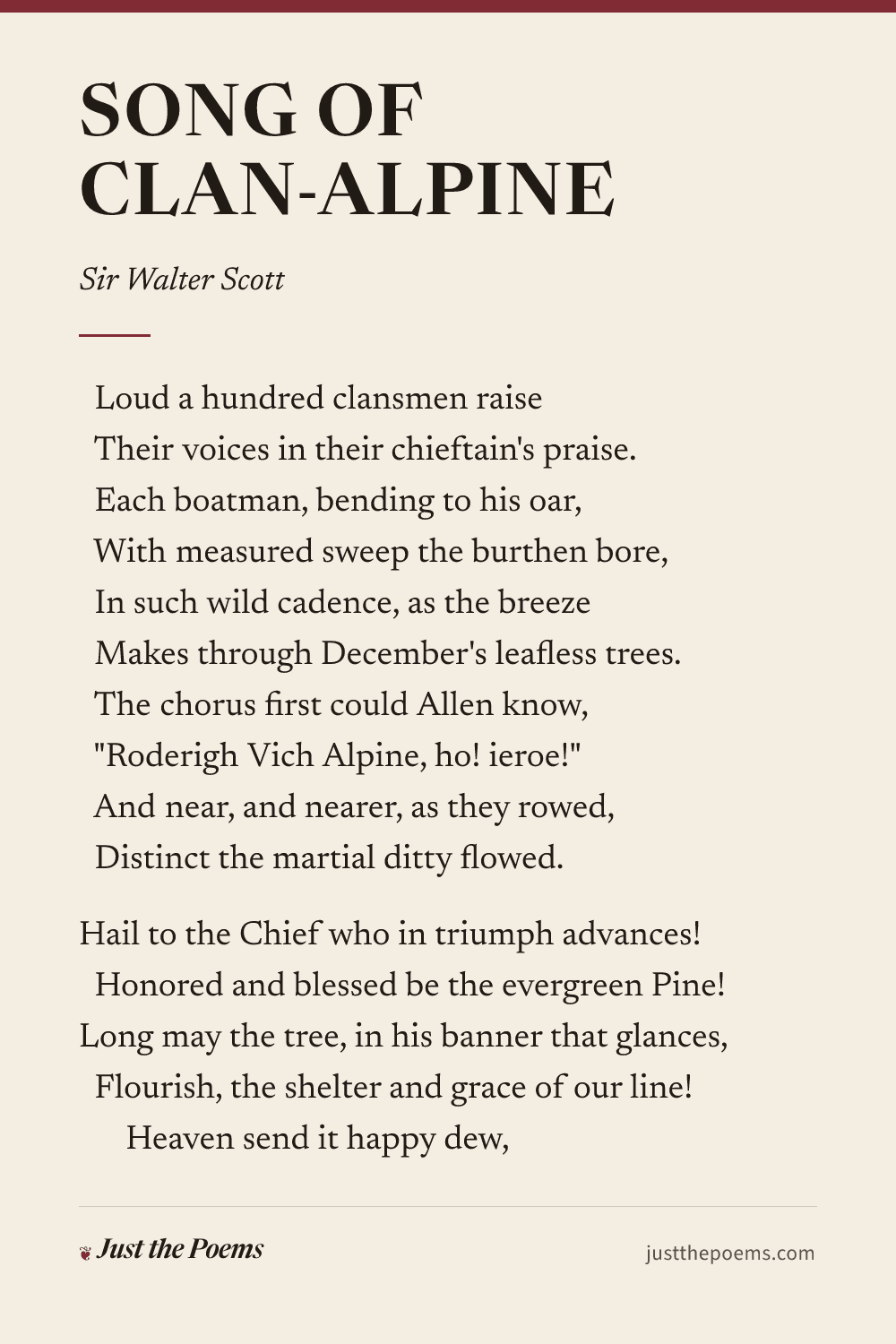
SONG OF CLAN-ALPINE

Sir Walter Scott

In 0 Wikipedias 1 anthology Poet in 98 Wikipedias

Loud a hundred clansmen raise Their voices in their chieftain's praise. Each boatman, bending to his oar, With measured sweep the burthen bore, In such wild cadence, as the breeze Makes through December's leafless trees. The chorus first could Allen know, "Roderigh Vich Alpine, ho! ieroe!" And near, and nearer, as they rowed, Distinct the martial ditty flowed.

Hail to the Chief who in triumph advances! Honored and blessed be the evergreen Pine!

Show all 50 lines 38 more

Long may the tree, in his banner that glances, Flourish, the shelter and grace of our line! Heaven send it happy dew, Earth lend it sap anew, Gayly to bourgeon, and broadly to grow, While every Highland glen Sends our shouts back again, "Roderigh Vich Alpine dhu, ho! ieroe!"

Ours is no sapling chance-sown by the fountain. Blooming at Beltane, in winter to fade;When the whirlwind has stripped every leaf on the mountain, The more shall Clan-Alpine exult in her shade. Moored in the rifted rock, Proof to the tempest's shock, Firmer he roots him the ruder it blow; Menteith and Breadalbane, then, Echo his praise again, "Roderigh Vich Alpine dhu, ho! ieroe!"

Proudly our pibroch has thrilled in Glen Fruin, And Bannachar's groans to our slogan replied;Glen Luss and Ross-dhu, they are smoking in ruin, And the best of Loch-Lomond lie dead on her side. Widow and Saxon maid Long shall lament our raid, Think of Clan-Alpine with fear and with woe; Lennox and Leven-glen Shake when they hear again, "Roderigh Vich Alpine dhu, ho! ieroe!"

Row, vassals, row, for the pride of the Highlands! Stretch to your oars for the evergreen Pine!O that the rosebud that graces yon islands Were wreathed in a garland around him to twine! O that some seedling gem, Worthy such noble stem,Honored and blessed in their shadow might grow! Loud should Clan-Alpine then Ring from the deepmost glen, "Roderigh Vich Alpine dhu, ho! ieroe!"

Source

The World's Best Poetry, Vol. VIII, ed. Bliss Carman, 1904

Filed under
  • Section “WAR”, The World's Best Poetry

30 of 746 poems about war

24 poets

By poet's century of death

CenturyPoems
17th5
19th17
20th8

Poets with more than one poem

PoetPoems
Sir Walter Scott3
Lord Byron2
Rudyard Kipling2
Thomas Campbell2
William Shakespeare2