Poems About Peace

The first 30 of 32 poems about peace, by 25 poets, ranked by third-party data. How poems are ranked

THE KNIGHT'S TOMB

Samuel Taylor Coleridge

In 1 Wikipedia 1 anthology Poet in 86 Wikipedias

Where is the grave of Sir Arthur O'Kellyn?Where may the grave of that good man be?--By the side of a spring, on the breast of Helvellyn,Under the twigs of a young birch-tree!The oak that in summer was sweet to hear,And rustled its leaves in the fall of the year,And whistled and roared in the winter alone,Is gone,--and the birch in its stead is grown.--The knight's bones are dust,And his good sword rust;--His soul is with the saints, I trust.

Source

The World's Best Poetry, Vol. VIII, ed. Bliss Carman, 1904

Filed under
  • Section “PEACE”, The World's Best Poetry

ODE WRITTEN IN MDCCXLVI

William Collins

In 0 Wikipedias 4 anthologies Poet in 16 Wikipedias

How sleep the brave, who sink to restBy all their Country's wishes blest!When Spring, with dewy fingers cold,Returns to deck their hallow'd mould,She there shall dress a sweeter sodThan Fancy's feet have ever trod.

By fairy hands their knell is rung,By forms unseen their dirge is sung:There Honour comes, a pilgrim gray,To bless the turf that wraps their clay,And Freedom shall awhile repairTo dwell a weeping hermit, there!

Source

The Golden Treasury, ed. Francis Turner Palgrave

Filed under
  • Section “PEACE”, The World's Best Poetry

AFTER BLENHEIM

Robert Southey

In 0 Wikipedias 2 anthologies Poet in 44 Wikipedias

It was a summer evening, Old Kaspar's work was done,And he before his cottage door Was sitting in the sun;And by him sported on the greenHis little grandchild Wilhelmine.

She saw her brother Peterkin Roll something large and roundWhich he beside the rivulet In playing there had foundHe came to ask what he had foundThat was so large and smooth and round.

Show all 66 lines 54 more

Old Kaspar took it from the boy Who stood expectant by;And then the old man shook his head, And with a natural sigh"'Tis some poor fellow's skull," said he,"Who fell in the great victory.

"I find then in the garden, For there's many here about;And often when I go to plough The ploughshare turns them out.For many thousand men," said he,"Were slain in that great victory."

"Now tell us what 'twas all about," Young Peterkin he cries;And little Wilhelmine looks up With wonder-waiting eyes;"Now tell us all about the war,And what they fought each other for."

"It was the English," Kaspar cried, "Who put the French to rout;But what they fought each other for I could not well make out.But every body said," quoth he,"That 'twas a famous victory.

"My father lived at Blenheim then, Yon little stream hard by;They burnt his dwelling to the ground, And he was forced to fly:So with his wife and child he fled,Nor had he where to rest his head.

"With fire and sword the country round Was wasted far and wide,And many a childing mother then And newborn baby died:But things like that, you know, must beAt every famous victory.

"They say it was a shocking sight After the field was won;For many thousand bodies here Lay rotting in the sun:But things like that, you know, must beAfter a famous victory.

"Great praise the Duke of Marlbro' won And our good Prince Eugene";"Why 'twas a very wicked thing!" Said little Wilhelmine;"Nay--nay--my little girl," quoth he,"It was a famous victory.

And every body praised the Duke Who this great fight did win.""But what good came of it at last?" Quoth little Peterkin:--"Why that I cannot tell," said he,"But 'twas a famous victory."

Source

The Golden Treasury, ed. Francis Turner Palgrave

Filed under
  • Section “PEACE”, The World's Best Poetry

Advertisements

Peace

Henry Vaughan

In 0 Wikipedias 2 anthologies Poet in 19 Wikipedias

My soul, there is a country Far beyond the stars,Where stands a wingèd sentry All skilful in the wars:There, above noise and danger, Sweet Peace sits crown’d with smiles,And One born in a manger Commands the beauteous files.He is thy gracious Friend, And--O my soul, awake!--Did in pure love descend To die here for thy sake.If thou canst get but thither, There grows the flower of Peace,The Rose that cannot wither, Thy fortress, and thy ease.Leave then thy foolish ranges; For none can thee secureBut One who never changes-- Thy God, thy life, thy cure.

Source

The Oxford Book of English Verse 1250–1900, 1900

Filed under
  • Named in the title

THE BIVOUAC OF THE DEAD

Theodore O'Hara

In 0 Wikipedias 2 anthologies Poet in 2 Wikipedias

The muffled drum's sad roll has beat The soldier's last tattoo;No more on Life's parade shall meet That brave and fallen few.On Fame's eternal camping-ground Their silent tents are spread,And Glory guards, with solemn round, The bivouac of the dead.

No rumor of the foe's advance Now swells upon the wind;No troubled thought at midnight haunts Of loved ones left behind;

Show all 96 lines 84 more

No vision of the morrow's strife The warrior's dream alarms;No braying horn nor screaming fife At dawn shall call to arms.

Their shivered swords are red with rust, Their plumèd heads are bowed;Their haughty banner, trailed in dust, Is now their martial shroud.And plenteous funeral tears have washed The red stains from each brow,And the proud forms, by battle gashed, Are free from anguish now.

The neighing troop, the flashing blade, The bugle's stirring blast,The charge, the dreadful cannonade, The din and shout, are past;Nor war's wild note nor glory's peal Shall thrill with fierce delightThose breasts that nevermore may feel The rapture of the fight.

Like the fierce northern hurricane That sweeps his great plateau,Flushed with the triumph yet to gain, Came down the serried foe.Who heard the thunder of the fray Break o'er the field beneath,Knew well the watchword of that day Was "Victory or Death."

Long had the doubtful conflict raged O'er all that stricken plain,For never fiercer fight had waged The vengeful blood of Spain;And still the storm of battle blew, Still swelled the gory tide;Not long, our stout old chieftain knew, Such odds his strength could bide.

'Twas in that hour his stern command Called to a martyr's graveThe flower of his beloved land, The nation's flag to save.By rivers of their fathers' gore His first-born laurels grew,And well he deemed the sons would pour Their lives for glory too.

Full many a norther's breath has swept O'er Angostura's plain,And long the pitying sky has wept Above its mouldered slain.The raven's scream, or eagle's flight, Or shepherd's pensive lay,Alone awakes each sullen height That frowned o'er that dread fray.

Sons of the Dark and Bloody Ground, Ye must not slumber there,Where stranger steps and tongues resound Along the heedless air.Your own proud land's heroic soil Shall be your fitter grave:She claims from war his richest spoil-- The ashes of her brave.

Thus 'neath their parent turf they rest, Far from the gory field,Borne to a Spartan mother's breast On many a bloody shield;The sunshine of their native sky Smiles sadly on them here,And kindred eyes and hearts watch by The heroes' sepulchre.

Rest on, embalmed and sainted dead! Dear as the blood ye gave;No impious footstep here shall tread The herbage of your grave;Nor shall your glory be forgot While Fame her record keeps,Or Honor points the hallowed spot Where Valor proudly sleeps.

Yon marble minstrel's voiceless stone In deathless song shall tell,When many a vanished age hath flown, The story how ye fell;Nor wreck, nor change, nor winter's blight, Nor Time's remorseless doom.Shall dim one ray of glory's light That gilds your deathless tomb.

Source

The World's Best Poetry, Vol. VIII, ed. Bliss Carman, 1904

Filed under
  • Section “PEACE”, The World's Best Poetry

THE BLUE AND THE GRAY

Francis Miles Finch

In 0 Wikipedias 2 anthologies Poet in 2 Wikipedias

By the flow of the inland river, Whence the fleets of iron have fled,Where the blades of the grave-grass quiver Asleep are the ranks of the dead;-- Under the sod and the dew, Waiting the judgment-day;-- Under the one, the Blue; Under the other, the Gray.

These in the robing of glory, Those in the gloom of defeat,All with the battle-blood gory, In the dusk of eternity meet;--

Show all 56 lines 44 more

Under the sod and the dew, Waiting the judgment-day;-- Under the laurel, the Blue; Under the willow, the Gray.

From the silence of sorrowful hours The desolate mourners go,Lovingly laden with flowers Alike for the friend and the foe,-- Under the sod and the dew, Waiting the judgment-day;-- Under the roses, the Blue; Under the lilies, the Gray.

So with an equal splendor The morning sun-rays fall,With a touch, impartially tender, On the blossoms blooming for all;-- Under the sod and the dew, Waiting the judgment-day;-- 'Broidered with gold, the Blue; Mellowed with gold, the Gray.

So when the summer calleth, On forest and field of grainWith an equal murmur falleth The cooling drip of the rain;-- Under the sod and the dew. Waiting the judgment-day;-- Wet with the rain, the Blue; Wet with the rain, the Gray.

Sadly, but not with upbraiding, The generous deed was done;In the storm of the years that are fading, No braver battle was won;-- Under the sod and the dew, Waiting the judgment-day;-- Under the blossoms, the Blue; Under the garlands, the Gray.

No more shall the war-cry sever, Or the winding rivers be red;They banish our anger forever When they laurel the graves of our dead! Under the sod and the dew, Waiting the judgment-day;-- Love and tears for the Blue, Tears and love for the Gray.

Source

The World's Best Poetry, Vol. VIII, ed. Bliss Carman, 1904

Filed under
  • Section “PEACE”, The World's Best Poetry

END OF THE CIVIL WAR

William Shakespeare

In 0 Wikipedias 1 anthology Poet in 237 Wikipedias

Now is the winter of our discontentMade glorious summer by this sun of York,And all the clouds that lowered upon our houseIn the deep bosom of the ocean buried.Now are our brows bound with victorious wreaths;Our bruisèd arms hung up for monuments;Our stern alarums changed to merry meetings,Our dreadful marches to delightful measures.Grim-visaged War hath smoothed his wrinkled front.And now, instead of mounting barbed steedsTo fright the souls of fearful adversaries,He capers nimbly in a lady's chamber,To the lascivious pleasing of a lute.

Source

The World's Best Poetry, Vol. VIII, ed. Bliss Carman, 1904

Filed under
  • Section “PEACE”, The World's Best Poetry

THE ARSENAL AT SPRINGFIELD

Henry Wadsworth Longfellow

In 0 Wikipedias 1 anthology Poet in 71 Wikipedias

This is the arsenal. From floor to ceiling, Like a huge organ, rise the burnished arms;But from their silent pipes no anthem pealing Startles the villages with strange alarms.

Ah! what a sound will rise--how wild and dreary-- When the death-angel touches those swift keys!What loud lament and dismal miserere Will mingle with their awful symphonies!

I hear even now the infinite fierce chorus-- The cries of agony, the endless groan,Which, through the ages that have gone before us, In long reverberations reach our own.

Show all 48 lines 36 more

On helm and harness rings the Saxon hammer; Through Cimbric forest roars the Norseman's song;And loud amid the universal clamor, O'er distant deserts sounds the Tartar gong.

I hear the Florentine, who from his palace Wheels out his battle-bell with dreadful din;And Aztec priests upon their teocallis Beat the wild war-drums made of serpents' skin;

The tumult of each sacked and burning village; The shout that every prayer for mercy drowns;The soldiers' revels in the midst of pillage; The wail of famine in beleaguered towns;

The bursting shell, the gateway wrenched asunder, The rattling musketry, the clashing blade--And ever and anon, in tones of thunder, The diapason of the cannonade.

Is it, O man, with such discordant noises, With such accursed instruments as these,Thou drownest nature's sweet and kindly voices, And jarrest the celestial harmonies?

Were half the power that fills the world with terror,Were half the wealth bestowed on camps and courts,Given to redeem the human mind from error, There were no need of arsenals nor forts;

The warrior's name would be a name abhorred; And every nation that should lift againIts hand against a brother, on its forehead Would wear forevermore the curse of Cain!

Down the dark future, through long generations, The echoing sounds grow fainter and then cease;And like a bell, with solemn, sweet vibrations, I hear once more the voice of Christ say, "Peace!"

Peace!--and no longer from its brazen portals The blast of war's great organ shakes the skies;But, beautiful as songs of the immortals, The holy melodies of love arise.

Source

The World's Best Poetry, Vol. VIII, ed. Bliss Carman, 1904

Filed under
  • Section “PEACE”, The World's Best Poetry

Advertisements

THE DAY IS COMING

William Morris

In 0 Wikipedias 1 anthology Poet in 59 Wikipedias

Come hither lads and hearken, for a tale there is to tell,Of the wonderful days a-coming, when all shall be better than well.

And the tale shall be told of a country, a land in the midst of the sea,And folk shall call it England in the days that are going to be.

There more than one in a thousand, in the days that are yet to come,Shall have some hope of the morrow, some joy of the ancient home.

Show all 108 lines 96 more

For then--laugh not, but listen to this strange tale of mine--All folk that are in England shall be better lodged than swine.

Then a man shall work and bethink him, and rejoice in the deeds of his hand;Nor yet come home in the even too faint and weary to stand.

Men in that time a-coming shall work and have no fearFor to-morrow's lack of earning, and the hunger-Wolf anear.

I tell you this for a wonder, that no man then shall be gladOf his fellow's fall and mishap, to snatch at the work he had.

For that which the worker winneth shall then be his indeed,Nor shall half be reaped for nothing by him that sowed no seed.

Oh, strange new wonderful justice! But for whom shall we gather the gain?For ourselves and for each of our fellows, and no hand shall labor in vain.

Then all Mine and all Thine shall be Ours, and no more shall any man craveFor riches that serve for nothing but to fetter a friend for a slave.

And what wealth then shall be left us, when none shall gather goldTo buy his friend in the market, and pinch and pine the sold?

Nay, what save the lovely city, and the little house on the hill,And the wastes and the woodland beauty, and the happy fields we till;

And the homes of ancient stories, the tombs of the mighty dead;And the wise men seeking out marvels, and the poet's teeming head;

And the painter's hand of wonder, and the marvellous fiddle-bow,And the banded choirs of music: all those that do and know.

For all these shall be ours and all men's; nor shall any lack a shareOf the toil and the gain of living, in the days when the world grows fair.

Ah! such are the days that shall be! But what are the deeds of to-day,In the days of the years we dwell in, that wear our lives away?

Why, then, and for what are we waiting? There are three words to speak:We will it, and what is the foeman but the dream-strong wakened and weak?

Oh, why and for what are we waiting, while our brothers droop and die,And on every wind of the heavens a wasted life goes by?

How long shall they reproach us, where crowd on crowd they dwell,--Poor ghosts of the wicked city, the gold-crushed hungry hell?

Through squalid life they labored, in sordid grief they died,--Those sons of a mighty mother, those props of England's pride.

They are gone; there is none can undo it, nor save our souls from the curse:But many a million cometh, and shall they be better or worse?

It is we must answer and hasten, and open wide the doorFor the rich man's hurrying terror, and the slow-foot hope of the poor.

Yea, the voiceless wrath of the wretched, and their unlearned discontent,--We must give it voice and wisdom till the waiting-tide be spent.

Come then, since all things call us, the living and the dead,And o'er the weltering tangle a glimmering light is shed.

Come then, let us cast off fooling, and put by ease and rest,For the Cause alone is worthy till the good days bring the best.

Come, join in the only battle wherein no man can fail,Where whoso fadeth and dieth, yet his deed shall still prevail.

Ah! come, cast off all fooling, for this, at least, we know:That the dawn and the day is coming, and forth the banners go.
Source

The World's Best Poetry, Vol. VIII, ed. Bliss Carman, 1904

Filed under
  • Section “PEACE”, The World's Best Poetry

PEACE

George Herbert

In 0 Wikipedias 1 anthology Poet in 37 Wikipedias

Sweet Peace, where dost thou dwell? I humbly crave. Let me once know. I sought thee in a secret cave; And asked if Peace were there.A hollow wind did seem to answer, "No! Go, seek elsewhere."

I did; and, going, did a rainbow note: "Surely," thought I, "This is the lace of Peace's coat. I will search out the matter."But, while I looked, the clouds immediately Did break and scatter.

Show all 42 lines 30 more

Then went I to a garden, and did spy A gallant flower,--The crown-imperial. "Sure," said I, "Peace at the root must dwell."But, when I digged, I saw a worm devour What showed so well.

At length I met a reverend, good old man; Whom when for Peace I did demand, he thus began: "There was a prince of oldAt Salem dwelt, who lived with good increase Of flock and fold.

"He sweetly lived; yet sweetness did not save His life from foes. But, after death, out of his grave There sprang twelve stalks of wheat;Which many wondering at, got some of those To plant and set.

"It prospered strangely, and did soon disperse Through all the earth. For they that taste it do rehearse, That virtue lies therein,--A secret virtue, bringing peace and mirth, By flight of sin.

"Take of this grain, which in my garden grows, And grows for you: Make bread of it; and that repose And peace which everywhereWith so much earnestness you do pursue, Is only there."

Source

The World's Best Poetry, Vol. IV, ed. Bliss Carman, 1904

Filed under
  • Named in the title

CENTENNIAL HYMN

John Greenleaf Whittier

In 0 Wikipedias 1 anthology Poet in 33 Wikipedias

Our fathers' God! from out whose handThe centuries fall like grains of sand,We meet to-day, united, free,And loyal to our land and Thee,To thank Thee for the era done,And trust Thee for the opening one.

Here, where of old, by Thy design,The fathers spake that word of ThineWhose echo is the glad refrainOf rended bolt and falling chain,To grace our festal time, from allThe zones of earth our guests we call.

Show all 36 lines 24 more

Be with us while the New World greetsThe Old World thronging all its streets,Unveiling all the triumphs wonBy art or toil beneath the sun;And unto common good ordainThis rivalship of hand and brain.

Thou, who hast here in concord furledThe war flags of a gathered world,Beneath our Western skies fulfilThe Orient's mission of good-will,And, freighted with love's Golden Fleece,Send back its Argonauts of peace.

For art and labor met in truce,For beauty made the bride of use,We thank Thee; but, withal, we craveThe austere virtues strong to save,The honor proof to place or gold,The manhood never bought nor sold!

Oh make Thou us, through centuries long,In peace secure, in justice strong;Around our gift of freedom drawThe safeguards of thy righteous law:And, cast in some diviner mould,Let the new cycle shame the old!

Source

The World's Best Poetry, Vol. VIII, ed. Bliss Carman, 1904

Filed under
  • Section “PEACE”, The World's Best Poetry

DISARMAMENT

John Greenleaf Whittier

In 0 Wikipedias 1 anthology Poet in 33 Wikipedias

"Put up the sword!" the voice of Christ once moreSpeaks, in the pauses of the cannon's roar,O'er fields of corn by fiery sickles reapedAnd left dry ashes; over trenches heapedWith nameless dead; o'er cities starving slowUnder a rain of fire; through wards of woeDown which a groaning diapason runsFrom tortured brothers, husbands, lovers, sonsOf desolate women in their far-off homes,Waiting to hear the step that never comes!O men and brothers! let that voice be heard.War fails, try peace; put up the useless sword!

Show all 32 lines 20 more

Fear not the end. There is a story toldIn Eastern tents, when autumn nights grow cold,And round the fire the Mongol shepherds sitWith grave responses listening unto it:Once on the errands of his mercy bent,Buddha, the holy and benevolent,Met a fell monster, huge and fierce of look,Whose awful voice the hills and forests shook.

"O son of peace!" the giant cried, "thy fateIs sealed at last, and love shall yield to hate."The unarmed Buddha looking, with no traceOf fear or anger, in the monster's face,In pity said, "Poor fiend, even thee I love."Lo! as he spake the sky-tall terror sankTo hand-breadth size; the huge abhorrence shrankInto the form and fashion of a dove;And where the thunder of its rage was heard,Circling above him sweetly sang the bird:"Hate hath no harm for love," so ran the song,"And peace unweaponed conquers every wrong!"

Source

The World's Best Poetry, Vol. VIII, ed. Bliss Carman, 1904

Filed under
  • Section “PEACE”, The World's Best Poetry

THE BATTLE-FIELD

William Cullen Bryant

In 0 Wikipedias 1 anthology Poet in 28 Wikipedias

Once this soft turf, this rivulet's sands, Were trampled by a hurrying crowd,And fiery hearts and armèd hands Encountered in the battle-cloud.

Ah! never shall the land forget How gushed the life-blood of her brave,--Gushed, warm with hope and courage yet, Upon the soil they fought to save.

Now all is calm and fresh and still; Alone the chirp of flitting bird,And talk of children on the hill, And bell of wandering kine, are heard.

Show all 44 lines 32 more

No solemn host goes trailing by The black-mouthed gun and staggering wain;Men start not at the battle-cry,-- O, be it never heard again!

Soon rested those who fought; but thou Who minglest in the harder strifeFor truths which men receive not now, Thy warfare only ends with life.

A friendless warfare! lingering long Through weary day and weary year;A wild and many-weaponed throng Hang on thy front and flank and rear.

Yet nerve thy spirit to the proof, And blench not at thy chosen lot;The timid good may stand aloof, The sage may frown,--yet faint thou not.

Nor heed the shaft too surely cast, The foul and hissing bolt of scorn;For with thy side shall dwell, at last, The victory of endurance born.

Truth, crushed to earth, shall rise again,-- The eternal years of God are hers;But Error, wounded, writhes in pain, And dies among his worshippers.

Yea, though thou lie upon the dust, When they who helped thee flee in fear,Die full of hope and manly trust, Like those who fell in battle here!

Another hand thy sword shall wield, Another hand the standard wave,Till from the trumpet's mouth is pealed The blast of triumph o'er thy grave.

Source

The World's Best Poetry, Vol. VIII, ed. Bliss Carman, 1904

Filed under
  • Section “PEACE”, The World's Best Poetry

Advertisements

TUBAL CAIN

Charles Mackay

In 0 Wikipedias 1 anthology Poet in 20 Wikipedias

Old Tubal Cain was a man of might, In the days when earth was young;By the fierce red light of his furnace bright, The strokes of his hammer rung:And he lifted high his brawny hand On the iron glowing clear,Till the sparks rushed out in scarlet showers, As he fashioned the sword and the spear.And he sang: "Hurrah for my handiwork! Hurrah for the spear and the sword!Hurrah for the hand that shall wield them well, For he shall be king and lord."

Show all 60 lines 48 more

To Tubal Cain came many a one, As he wrought by his roaring fire,And each one prayed for a strong steel blade As the crown of his desire:And he made them weapons sharp and strong, Till they shouted loud for glee,And gave him gifts of pearl and gold, And spoils of the forest free.And they sang: "Hurrah for Tubal Cain, Who hath given us strength anew!Hurrah for the smith, hurrah for the fire, And hurrah for the metal true!"

But a sudden change came o'er his heart, Ere the setting of the sun,And Tubal Cain was filled with pain For the evil he had done;He saw that men, with rage and hate, Made war upon their kind,That the land was red with the blood they shed, In their lust for carnage blind.And he said: "Alas! that ever I made, Or that skill of mine should plan,The spear and the sword for men whose joy Is to slay their fellow-man!"

And for many a day old Tubal Cain Sat brooding o'er his woe;And his hand forbore to smite the ore, And his furnace smouldered low.But he rose at last with a cheerful face, And a bright courageous eye,And bared his strong right arm for work, While the quick flames mounted high.And he sang: "Hurrah for my handiwork!" And the red sparks lit the air;"Not alone for the blade was the bright steel made,"-- And he fashioned the first ploughshare.

And men, taught wisdom from the past, In friendship joined their hands,Hung the sword in the hall, the spear on the wall, And ploughed the willing lands;And sang: "Hurrah for Tubal Cain! Our stanch good friend is he;And for the ploughshare and the plough To him our praise shall be.But while oppression lifts its head, Or a tyrant would be lord,Though we may thank him for the plough, We'll not forget the sword!"

Source

The World's Best Poetry, Vol. VIII, ed. Bliss Carman, 1904

Filed under
  • Section “PEACE”, The World's Best Poetry

ODE

Henry Timrod

In 0 Wikipedias 1 anthology Poet in 8 Wikipedias

Sleep sweetly in your humble graves,-- Sleep, martyrs of a fallen cause!Though yet no marble column craves The pilgrim here to pause,

In seeds of laurel in the earth The blossom of your fame is blown,And somewhere, waiting for its birth, The shaft is in the stone!

Meanwhile, behalf the tardy years Which keep in trust your storied tombs,Behold! your sisters bring their tears, And these memorial blooms.

Small tributes! but your shades will smile More proudly on these wreaths to-day,Then when some cannon-moulded pile Shall overlook this bay.

Stoop, angels, hither from the skies! There is no holier spot of groundThan where defeated valor lies, By mourning beauty crowned!

Source

The World's Best Poetry, Vol. VIII, ed. Bliss Carman, 1904

Filed under
  • Section “PEACE”, The World's Best Poetry

PEACE

Frances Ridley Havergal

In 0 Wikipedias 1 anthology Poet in 8 Wikipedias

Is this the peace of God, this strange sweet calm?The weary day is at its zenith still, Yet 't is as if beside some cool, clear rill,Through shadowy stillness rose an evening psalm.And all the noise of life were hushed away,And tranquil gladness reigned with gently soothing sway.

It was not so just now. I turned asideWith aching head, and heart most sorely bowed;Around me cares and griefs in crushing crowd. While inly rose the sense, in swelling tide,Of weakness, insufficiency, and sin,And fear, and gloom, and doubt in mighty flood rolled in.

Show all 37 lines 25 more

That rushing flood I had no power to meet,Nor power to flee: my present, future, past,Myself, my sorrow, and my sin I cast In utter helplessness at Jesu's feet:Then bent me to the storm, if such his will.He saw the winds and waves, and whispered. "Peace, be still!"

And there was calm! O Saviour, I have provedThat thou to help and save art really near:How else this quiet rest from grief and fear And all distress? The cross is not removed,I must go forth to bear it as before,But, leaning on thine arm, I dread its weight no more.

Is it indeed thy peace? I have not triedTo analyze my faith, dissect my trust,Or measure if belief be full and just, And therefore claim thy peace. But thou hast died,I know that this is true for me,And, knowing it, I come, and cast my all on thee.

It is not that I feel less weak, but thouWilt be my strength; it is not that I seeLess sin, but more of pardoning love with thee, And all-sufficient grace. Enough! and nowAll fluttering thought is stilled, I only rest,And feel that thou art near, and know that I am blest.

Source

The World's Best Poetry, Vol. IV, ed. Bliss Carman, 1904

Filed under
  • Named in the title

AN OLD BATTLE-FIELD

Frank Lebby Stanton

In 0 Wikipedias 1 anthology Poet in 6 Wikipedias

The softest whisperings of the scented South,And rust and roses in the cannon's mouth;

And, where the thunders of the fight were born,The wind's sweet tenor in the standing corn;

With song of larks, low-lingering in the loam,And blue skies bending over love and home.

But still the thought: Somewhere,--upon the hills,Or where the vales ring with the whip-poor-wills,

Sad wistful eyes and broken hearts that beatFor the loved sound of unreturning feet,

And, when the oaks their leafy banners wave,Dream of the battle and an unmarked grave!

Source

The World's Best Poetry, Vol. VIII, ed. Bliss Carman, 1904

Filed under
  • Section “PEACE”, The World's Best Poetry

NOT ON THE BATTLE-FIELD

John Pierpont

In 0 Wikipedias 1 anthology Poet in 5 Wikipedias

"To fall on the battle-field fighting for my dear country,--that wouldnot be hard."--The Neighbors.

O no, no,--let me lie Not on a field of battle when I die! Let not the iron tread Of the mad war-horse crush my helmèd head; Nor let the reeking knife, That I have drawn against a brother's life, Be in my hand when Death Thunders along, and tramples me beneath His heavy squadron's heels, Or gory felloes of his cannon's wheels.

From such a dying bed, Though o'er it float the stripes of white and red,

Show all 68 lines 56 more

And the bald eagle brings The clustered stars upon his wide-spread wings To sparkle in my sight, O, never let my spirit take her flight!

I know that beauty's eye Is all the brighter where gay pennants fly, And brazen helmets dance, And sunshine flashes on the lifted lance; I know that bards have sung, And people shouted till the welkin rung, In honor of the brave Who on the battle-field have found a grave; I know that o'er their bones How grateful hands piled monumental stones. Some of those piles I've seen: The one at Lexington upon the green Where the first blood was shed, And to my country's independence led; And others, on our shore, The "Battle Monument" at Baltimore, And that on Bunker's Hill. Ay, and abroad, a few more famous still; Thy "tomb," Themistocles, That looks out yet upon the Grecian seas, And which the waters kiss That issue from the gulf of Salamis. And thine, too, have I seen, Thy mound of earth, Patroclus, robed in green, That, like a natural knoll, Sheep climb and nibble over as they stroll, Watched by some turbaned boy, Upon the margin of the plain of Troy. Such honors grace the bed, I know, whereon the warrior lays his head, And hears, as life ebbs out, The conquered flying, and the conqueror's shout; But as his eye grows dim, What is a column or a mound to him? What, to the parting soul. The mellow note of bugles? What the roll Of drums? No, let me die Where the blue heaven bends o'er me lovingly, And the soft summer air, As it goes by me, stirs my thin white hair, And from my forehead dries The death-damp as it gathers, and the skies Seem waiting to receive My soul to their clear depths! Or let me leave The world when round my bed Wife, children, weeping friends are gatherèd, And the calm voice of prayer And holy hymning shall my soul prepare To go and be at rest With kindred spirits,--spirits who have blessed The human brotherhood By labors, cares, and counsels for their good.

Source

The World's Best Poetry, Vol. VIII, ed. Bliss Carman, 1904

Filed under
  • Section “PEACE”, The World's Best Poetry

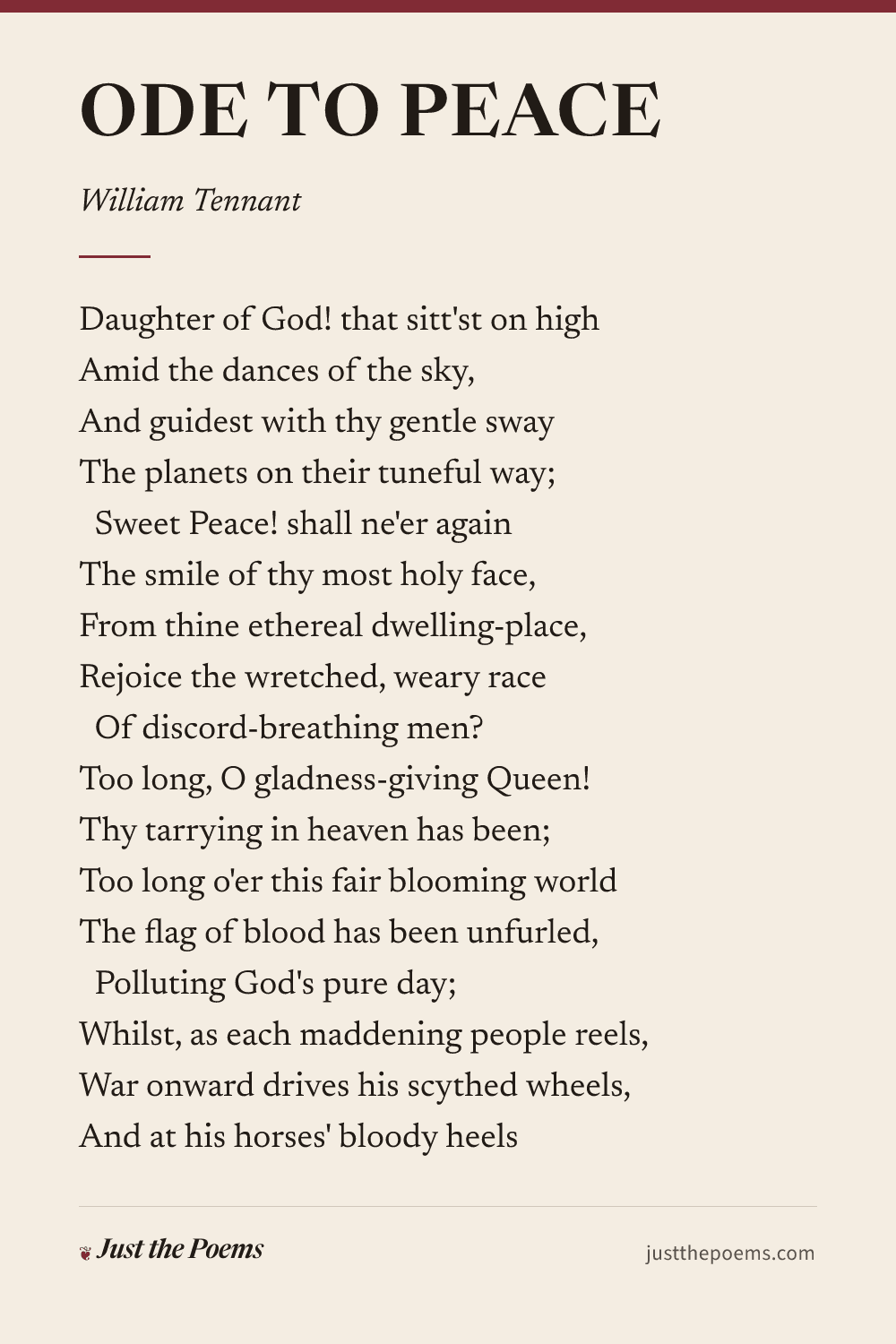
ODE TO PEACE

William Tennant

In 0 Wikipedias 1 anthology Poet in 5 Wikipedias

Daughter of God! that sitt'st on highAmid the dances of the sky,And guidest with thy gentle swayThe planets on their tuneful way; Sweet Peace! shall ne'er againThe smile of thy most holy face,From thine ethereal dwelling-place,Rejoice the wretched, weary race Of discord-breathing men?Too long, O gladness-giving Queen!Thy tarrying in heaven has been;Too long o'er this fair blooming world

Show all 36 lines 24 more

The flag of blood has been unfurled, Polluting God's pure day;Whilst, as each maddening people reels,War onward drives his scythed wheels,And at his horses' bloody heels Shriek Murder and Dismay.

Oft have I wept to hear the cryOf widow wailing bitterly;To see the parent's silent tearFor children fallen beneath the spear; And I have felt so soreThe sense of human guilt and woe,That I, in Virtue's passioned glow,Have cursed (my soul was wounded so) The shape of man I bore!Then come from thy serene abode,Thou gladness-giving child of God!And cease the world's ensanguined strife,And reconcile my soul to life; For much I long to see,Ere I shall to the grave descend,Thy hand its blessed branch extend,And to the world's remotest end Wave Love and Harmony!

Source

The World's Best Poetry, Vol. VIII, ed. Bliss Carman, 1904

Filed under
  • Section “PEACE”, The World's Best Poetry
  • Named in the title

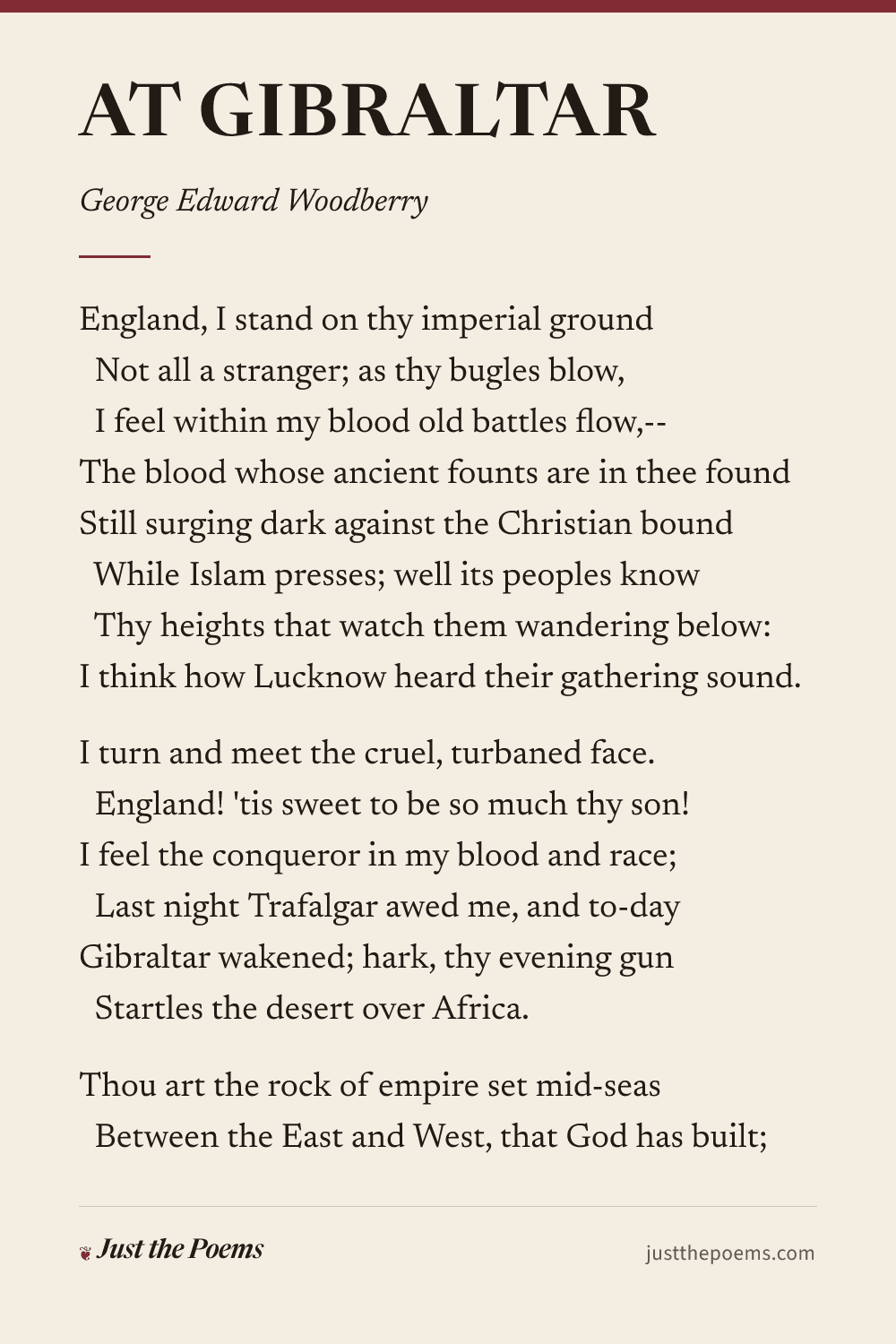
AT GIBRALTAR

George Edward Woodberry

In 0 Wikipedias 1 anthology Poet in 3 Wikipedias

England, I stand on thy imperial ground Not all a stranger; as thy bugles blow, I feel within my blood old battles flow,--The blood whose ancient founts are in thee foundStill surging dark against the Christian bound While Islam presses; well its peoples know Thy heights that watch them wandering below:I think how Lucknow heard their gathering sound.

I turn and meet the cruel, turbaned face. England! 'tis sweet to be so much thy son!I feel the conqueror in my blood and race; Last night Trafalgar awed me, and to-day

Show all 28 lines 16 more

Gibraltar wakened; hark, thy evening gun Startles the desert over Africa.

Thou art the rock of empire set mid-seas Between the East and West, that God has built; Advance thy Roman borders where thou wilt,While run thy armies true with his decrees;Law, justice, liberty,--great gifts are these. Watch that they spread where English blood is spilt, Lest, mixed and sullied with his country's guiltThe soldier's life-stream flow, and Heaven displease!

Two swords there are: one naked, apt to smite, Thy blade of war; and, battle-storied, oneRejoices in the sheath, and hides from light. American I am; would wars were done!Now westward, look, my country bids good night,-- Peace to the world, from ports without a gun!

Source

The World's Best Poetry, Vol. VIII, ed. Bliss Carman, 1904

Filed under
  • Section “PEACE”, The World's Best Poetry

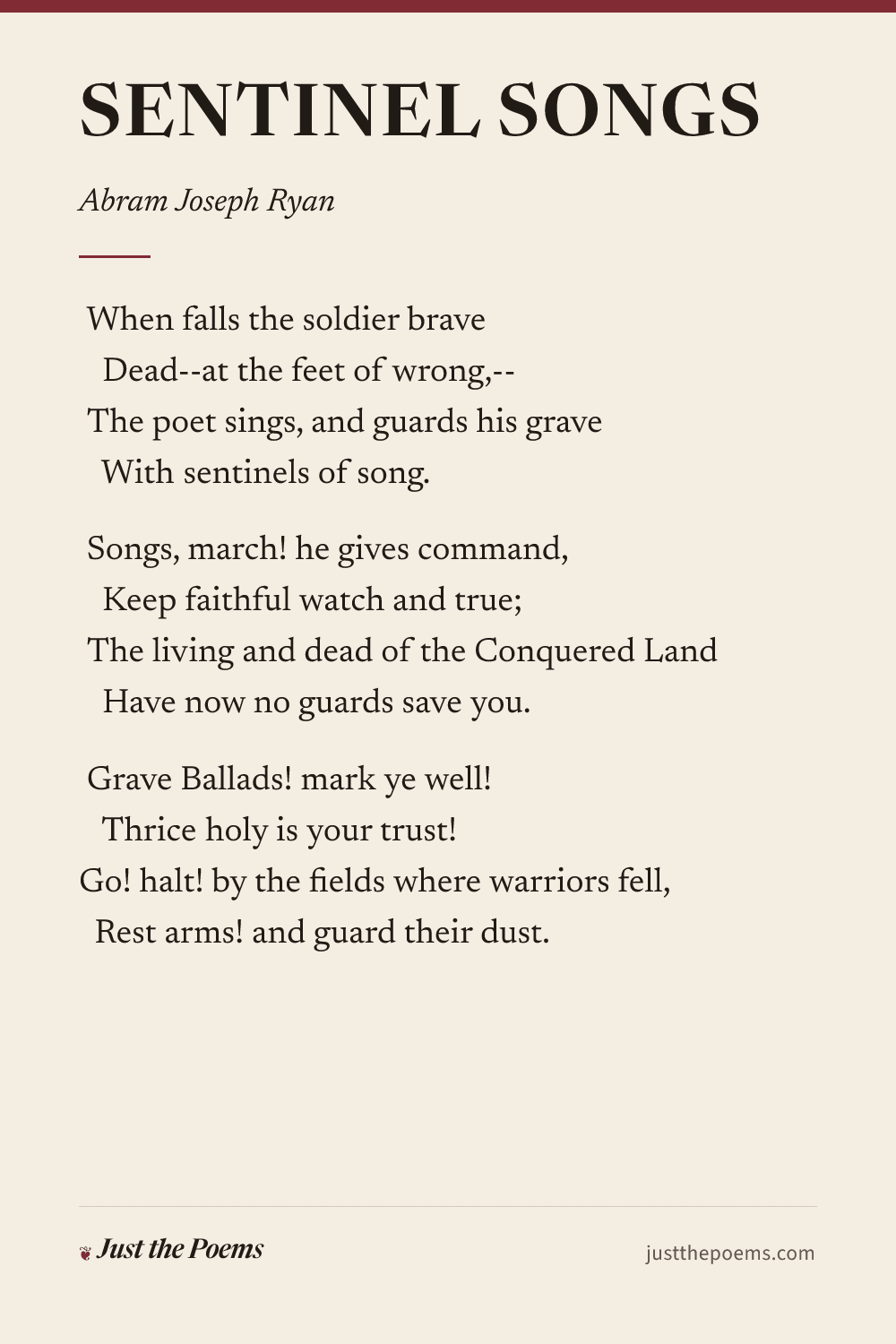
SENTINEL SONGS

Abram Joseph Ryan

In 0 Wikipedias 1 anthology Poet in 3 Wikipedias

When falls the soldier brave Dead--at the feet of wrong,-- The poet sings, and guards his grave With sentinels of song.

Songs, march! he gives command, Keep faithful watch and true; The living and dead of the Conquered Land Have now no guards save you.

Grave Ballads! mark ye well! Thrice holy is your trust!Go! halt! by the fields where warriors fell, Rest arms! and guard their dust.

Show all 40 lines 28 more

List, Songs! your watch is long! The soldiers' guard was brief,Whilst right is right, and wrong is wrong, Ye may not seek relief.

Go! wearing the gray of grief! Go! watch o'er the Dead in Gray!Go guard the private and guard the chief, And sentinel their clay!

And the songs, in stately rhyme, And with softly sounding tread,Go forth, to watch for a time--a time, Where sleep the Deathless Dead.

And the songs, like funeral dirge, In music soft and low,Sing round the graves,--whilst not tears surge From hearts that are homes of woe.

What though no sculptured shaft Immortalize each brave?What though no monument epitaphed Be built above each grave?

When marble wears away, And monuments are dust,--The songs that guard our soldiers' clay Will still fulfil their trust.

With lifted head, and steady tread, Like stars that guard the skies, Go watch each bed, where rest the dead, Brave Songs! with sleepless eyes.

Source

The World's Best Poetry, Vol. VIII, ed. Bliss Carman, 1904

Filed under
  • Section “PEACE”, The World's Best Poetry

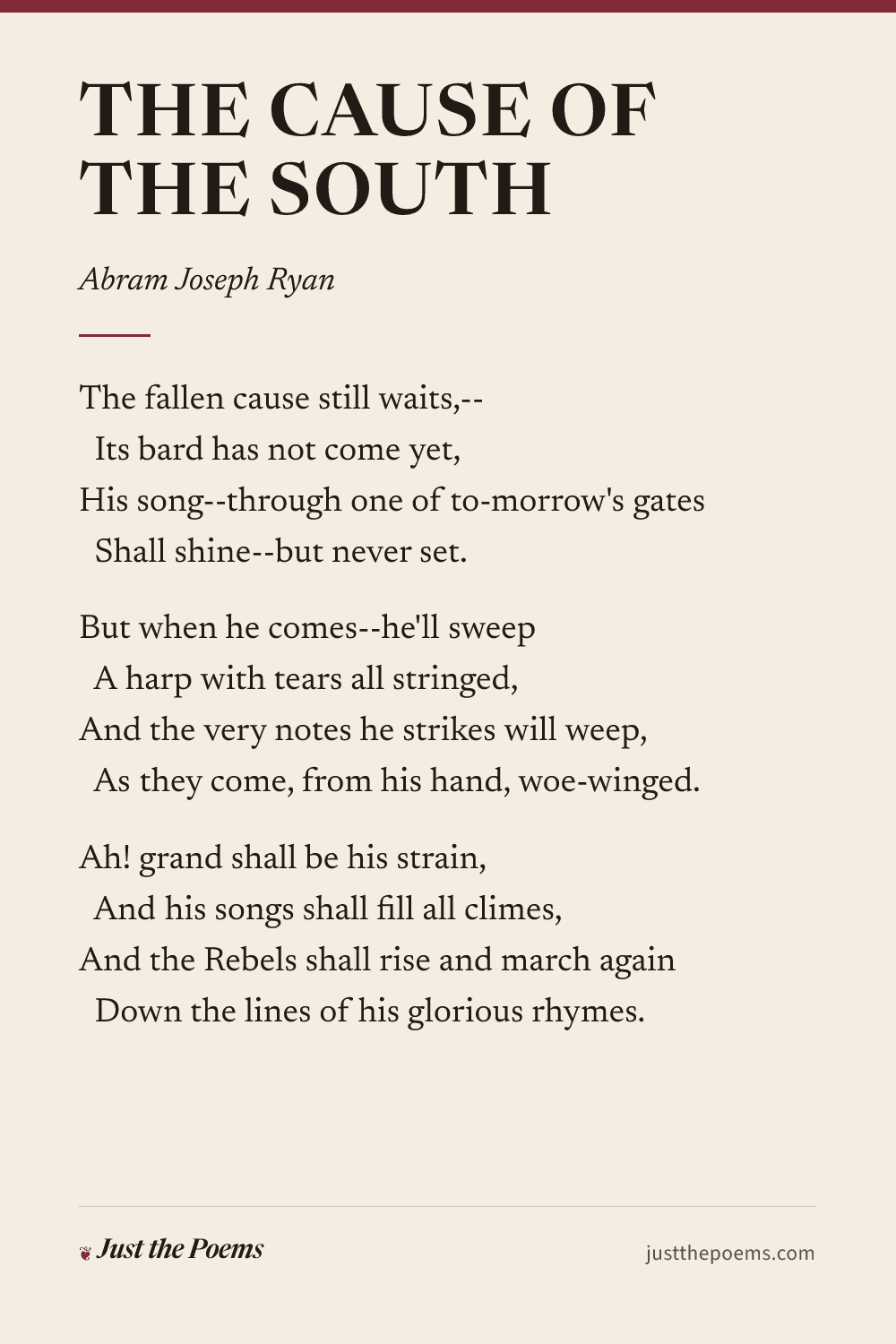
THE CAUSE OF THE SOUTH

Abram Joseph Ryan

In 0 Wikipedias 1 anthology Poet in 3 Wikipedias

The fallen cause still waits,-- Its bard has not come yet,His song--through one of to-morrow's gates Shall shine--but never set.

But when he comes--he'll sweep A harp with tears all stringed,And the very notes he strikes will weep, As they come, from his hand, woe-winged.

Ah! grand shall be his strain, And his songs shall fill all climes,And the Rebels shall rise and march again Down the lines of his glorious rhymes.

Show all 36 lines 24 more

And through his verse shall gleam The swords that flashed in vain,And the men who wore the gray shall seem To be marshalling again.

But hush! between his words Peer faces sad and pale,And you hear the sound of broken chords Beat through the poet's wail.

Through his verse the orphans cry-- The terrible undertone!And the father's curse and the mother's sigh, And the desolate young wife's moan.

I sing, with a voice too low To be heard beyond to-day,In minor keys of my people's woe; And my songs pass away.

To-morrow hears them not-- To-morrow belongs to fame:My songs--like the birds'--will be forgot, And forgotten shall be my name.

And yet who knows! betimes The grandest songs depart,While the gentle, humble, and low-toned rhymes Will echo from heart to heart.

Source

The World's Best Poetry, Vol. VIII, ed. Bliss Carman, 1904

Filed under
  • Section “PEACE”, The World's Best Poetry

OUR FALLEN HEROES

George Bancroft Griffith

In 0 Wikipedias 1 anthology Poet in 0 Wikipedias

The angel of the nation's peace Has wreathed with flowers the battle-drum;We see the fruiting fields increase Where sound of war no more shall come.

The swallow skims the Tennessee, Soft winds play o'er the Rapidan;There only echo notes of glee, Where gleamed a mighty army's van!

Fair Chattanooga's wooded slope With summer airs is lightly stirred,And many a heart is warm with hope Where once the deep-mouthed gun was heard.

Show all 32 lines 20 more

The blue Potomac stainless rolls, And Mission Ridge is gemmed with fern;On many a height sleep gallant souls, And still the blooming years return.

Thank God! unseen to outward eye, But felt in every freeman's breast,From graves where fallen comrades lie Ascends at Nature's wise behest,

With springing grass and blossoms new, A prayer to bless the nation's life,To freedom's flower give brighter hue, And hide the awful stains of strife.

O, Boys in Blue, we turn to you, The scarred and mangled who survive;No more we meet in grand review, But all the arts of freedom thrive.

Still glows the jewel in its shrine, Won where the James now tranquil rolls;Its wealth for all, the glory thine, O memory of heroic souls!

Source

The World's Best Poetry, Vol. VIII, ed. Bliss Carman, 1904

Filed under
  • Section “PEACE”, The World's Best Poetry

PEACE

Anonymous

In 0 Wikipedias 1 anthology Poet in 0 Wikipedias

There is the peace that cometh after sorrow, Of hope surrendered, not of hope fulfilled;A peace that looketh not upon to-morrow, But calmly on a tempest that is stilled.

A peace which lives not now in joy's excesses, Nor in the happy life of love secure,But in the unerring strength the heart possesses, Of conflicts won, while learning to endure.

A peace-there is, in sacrifice secluded, A life subdued, from will and passion free;'Tis not the peace that over Eden brooded, But that which triumphed in Gethsemane.

Source

The World's Best Poetry, Vol. III, ed. Bliss Carman, 1904

Filed under
  • Named in the title

A FRIENDLY APOLOGY FOR A CERTAIN JUSTICE OF PEACE BY WAY OF DEFENCE OF HARTLEY HUTCHESON, ESQ. BY JAMES BLACK-WELL, OPERATOR FOR THE FEET

Jonathan Swift

In 0 Wikipedias 0 anthologies Poet in 101 Wikipedias

But he by bawling news about, And aptly using brush and clout, A justice of the peace became, To punish rogues who do the same.

I sing the man of courage tried,O'errun with ignorance and pride,Who boldly hunted out disgraceWith canker'd mind, and hideous face;The first who made (let none deny it)The libel-vending rogues be quiet. The fact was glorious, we must own,For Hartley was before unknown,

Show all 52 lines 40 more

Contemn'd I mean;--for who would chuseSo vile a subject for the Muse? 'Twas once the noblest of his wishesTo fill his paunch with scraps from dishes,For which he'd parch before the grate,Or wind the jack's slow-rising weight,(Such toils as best his talents fit,)Or polish shoes, or turn the spit;But, unexpectedly grown rich inSquire Domvile's family and kitchen,He pants to eternize his name,And takes the dirty road to fame;Believes that persecuting witWill prove the surest way to it;So with a colonel at his back,The Libel feels his first attack;He calls it a seditious paper,Writ by another patriot Drapier;Then raves and blunders nonsense thickerThan alderman o'ercharged with liquor:And all this with design, no doubt,To hear his praises hawk'd about;To send his name through every street,Which erst he roam'd with dirty feet;Well pleased to live in future times,Though but in keen satiric rhymes. So, Ajax, who, for aught we know,Was justice many years ago,And minding then no earthly things,But killing libellers of kings;Or if he wanted work to do,To run a bawling news-boy through;Yet he, when wrapp'd up in a cloud,Entreated father Jove aloud,Only in light to show his face,Though it might tend to his disgrace. And so the Ephesian villain firedThe temple which the world admired,Contemning death, despising shame,To gain an ever-odious name.

Source

The Poems of Jonathan Swift, D.D., Volume 2, 1910

Filed under
  • Named in the title

PEACE AND DUNKIRK

Jonathan Swift

In 0 Wikipedias 0 anthologies Poet in 101 Wikipedias

Spite of Dutch friends and English foes,Poor Britain shall have peace at last:Holland got towns, and we got blows; But Dunkirk's ours, we'll hold it fast. We have got it in a string, And the Whigs may all go swing,For among good friends I love to be plain; All their false deluded hopes Will, or ought to end in ropes;"But the Queen shall enjoy her own again."

Sunderland’s run out of his wits, And Dismal double Dismal looks;

Show all 40 lines 28 more

Wharton can only swear by fits, And strutting Hal is off the hooks; Old Godolphin, full of spleen, Made false moves, and lost his Queen:Harry look'd fierce, and shook his ragged mane: But a Prince of high renown Swore he'd rather lose a crown,"Than the Queen should enjoy her own again."

Our merchant-ships may cut the line, And not be snapt by privateers.And commoners who love good wine Will drink it now as well as peers: Landed men shall have their rent, Yet our stocks rise cent, per cent.The Dutch from hence shall no more millions drain: We'll bring on us no more debts, Nor with bankrupts fill gazettes;"And the Queen shall enjoy her own again."

The towns we took ne'er did us good: What signified the French to beat?We spent our money and our blood, To make the Dutchmen proud and great: But the Lord of Oxford swears, Dunkirk never shall be theirs.The Dutch-hearted Whigs may rail and complain; But true Englishmen may fill A good health to General Hill:"For the Queen now enjoys her own again."

Source

The Poems of Jonathan Swift, D.D., Volume 2, 1910

Filed under
  • Named in the title

THE PEACE-OFFERING

Thomas Hardy

In 0 Wikipedias 0 anthologies Poet in 91 Wikipedias

IT was but a little thing,Yet I knew it meant to meEase from what had given a stingTo the very birdsinging Latterly.

But I would not welcome it;And for all I then declinedO the regrettings infiniteWhen the night-processions flit Through the mind!

Source

Moments of Vision and Miscellaneous Verses, 1929

Filed under
  • Named in the title

THE PEACE-PIPE

Henry Wadsworth Longfellow

In 0 Wikipedias 0 anthologies Poet in 71 Wikipedias

On the Mountains of the Prairie,On the great Red Pipe-stone Quarry,Gitche Manito, the mighty,He the Master of Life, descending,On the red crags of the quarryStood erect, and called the nations,Called the tribes of men together. From his footprints flowed a river,Leaped into the light of morning,O'er the precipice plunging downwardGleamed like Ishkoodah, the comet.And the Spirit, stooping earthward,

Show all 163 lines 151 more

With his finger on the meadowTraced a winding pathway for it,Saying to it, "Run in this way!" From the red stone of the quarryWith his hand he broke a fragment,Moulded it into a pipe-head,Shaped and fashioned it with figures;From the margin of the riverTook a long reed for a pipe-stem,With its dark green leaves upon it;Filled the pipe with bark of willow,With the bark of the red willow;Breathed upon the neighboring forest,Made its great boughs chafe together,Till in flame they burst and kindled;And erect upon the mountains,Gitche Manito, the mighty,Smoked the calumet, the Peace-Pipe,As a signal to the nations. And the smoke rose slowly, slowly,Through the tranquil air of morning,First a single line of darkness,Then a denser, bluer vapor,Then a snow-white cloud unfolding,Like the tree-tops of the forest,Ever rising, rising, rising,Till it touched the top of heaven,Till it broke against the heaven,And rolled outward all around it. From the Vale of Tawasentha,From the Valley of Wyoming,From the groves of Tuscaloosa,From the far-off Rocky Mountains,From the Northern lakes and riversAll the tribes beheld the signal,Saw the distant smoke ascending,The Pukwana of the Peace-Pipe. And the Prophets of the nationsSaid: "Behold it, the Pukwana!By the signal of the Peace-Pipe,Bending like a wand of willow,Waving like a hand that beckons,Gitche Manito, the mighty,Calls the tribes of men together,Calls the warriors to his council!" Down the rivers, o'er the prairies,Came the warriors of the nations,Came the Delawares and Mohawks,Came the Choctaws and Camanches,Came the Shoshonies and Blackfeet,Came the Pawnees and Omahas,Came the Mandans and Dacotahs,Came the Hurons and Ojibways,All the warriors drawn togetherBy the signal of the Peace-Pipe,To the Mountains of the Prairie,To the great Red Pipe-stone Quarry. And they stood there on the meadow,With their weapons and their war-gear,Painted like the leaves of Autumn,Painted like the sky of morning,Wildly glaring at each other;In their faces stern defiance,In their hearts the feuds of ages,The hereditary hatred,The ancestral thirst of vengeance. Gitche Manito, the mighty,The creator of the nations,Looked upon them with compassion,With paternal love and pity;Looked upon their wrath and wranglingBut as quarrels among children,But as feuds and fights of children! Over them he stretched his right hand,To subdue their stubborn natures,To allay their thirst and fever,By the shadow of his right hand;Spake to them with voice majesticAs the sound of far-off waters,Falling into deep abysses,Warning, chiding, spake in this wise:-- "O my children! my poor children!Listen to the words of wisdom,Listen to the words of warning,From the lips of the Great Spirit,From the Master of Life, who made you! "I have given you lands to hunt in,I have given you streams to fish in,I have given you bear and bison,I have given you roe and reindeer,I have given you brant and beaver,Filled the marshes full of wild-fowl,Filled the rivers full of fishes:Why then are you not contented?Why then will you hunt each other? "I am weary of your quarrels,Weary of your wars and bloodshed,Weary of your prayers for vengeance,Of your wranglings and dissensions;All your strength is in your union,All your danger is in discord;Therefore be at peace henceforward,And as brothers live together. "I will send a Prophet to you,A Deliverer of the nations,Who shall guide you and shall teach you,Who shall toil and suffer with you.If you listen to his counsels,You will multiply and prosper;If his warnings pass unheeded,You will fade away and perish! "Bathe now in the stream before you,Wash the war-paint from your faces,Wash the blood-stains from your fingers,Bury your war-clubs and your weapons,Break the red stone from this quarry,Mould and make it into Peace-Pipes,Take the reeds that grow beside you,Deck them with your brightest feathers,Smoke the calumet together,And as brothers live henceforward!" Then upon the ground the warriorsThrew their cloaks and shirts of deer-skin,Threw their weapons and their war-gear,Leaped into the rushing river,Washed the war-paint from their faces.Clear above them flowed the water,Clear and limpid from the footprintsOf the Master of Life descending;Dark below them flowed the water,Soiled and stained with streaks of crimson,As if blood were mingled with it! From the river came the warriors,Clean and washed from all their war-paint;On the banks their clubs they buried,Buried all their warlike weapons.Gitche Manito, the mighty,The Great Spirit, the creator,Smiled upon his helpless children! And in silence all the warriorsBroke the red stone of the quarry,Smoothed and formed it into Peace-Pipes,Broke the long reeds by the river,Decked them with their brightest feathers,And departed each one homeward,While the Master of Life, ascending,Through the opening of cloud-curtains,Through the doorways of the heaven,Vanished from before their faces,In the smoke that rolled around him,The Pukwana of the Peace-Pipe!

Source

The Complete Poetical Works of Henry Wadsworth Longfellow

Filed under
  • Named in the title

PEACE.

Ambrose Bierce

In 0 Wikipedias 0 anthologies Poet in 59 Wikipedias

When lion and lamb have together lain down Spectators cry out, all in chorus;"The lamb doesn't shrink nor the lion frown-- A miracle's working before us!"

But 't is patent why Hot-head his wrath holds in, And Faint-heart her terror and loathing;For the one's but an ass in a lion's skin, The other a wolf in sheep's clothing.

Source

Shapes of Clay, 1903

Filed under
  • Named in the title

THE CRIMES OF PEACE

Ella Wheeler Wilcox

In 0 Wikipedias 0 anthologies Poet in 18 Wikipedias

Musing upon the tragedies of earth,Of each new horror which each hour gives birth,Of sins that scar and cruelties that blightLife’s little season, meant for man’s delight,Methought those monstrous and repellent crimesWhich hate engenders in war-heated times,To God’s great heart bring not so much despairAs other sins which flourish everywhereAnd in all times—bold sins, bare-faced and proud,Unchecked by college, and by Church allowed,Lifting their lusty heads like ugly weedsAbove wise precepts and religious creeds,

Show all 59 lines 47 more

And growing rank in prosperous days of peace.Think you the evils of this world would ceaseWith war’s cessation? If God’s eyes know tears,Methinks He weeps more for the wasted yearsAnd the lost meaning of this earthly life—This big, brief life—than over bloody strife.Yea; there are mean, lean sins God must abhorMore than the fatted, blood-drunk monster, War.Looking from His place, looking from His high place among the stars,God saw a peaceful land—A land of fertile fields and golden harvests—and great cities whoseinnumerable spires pierced the vault of heaven, like bayonets of aninvading army.And God said, speaking unto Himself aloud, God said:‘Peace and power and plenty have I given unto this land; and thosetall steeples are monuments to Me.Now let My people reveal themselves, that I may see their works, donein My name in a fertile land of peace.I will withdraw Mine eyes from other worlds that I may behold them,that I may behold these people to whom I sent Christ—they whoseinnumerable spires pierce My blue vault like bayonets.’God saw the restless, idle rich in club and cabaret,Meat-gorged, wine-filled, they played and preened and danced till dawno’ day;They played at sports; they played at love; they played at being gay.They were but empty, silk-clad shells; their souls had leaked away.He saw the sweat-shop and the mill where little children toiled,The sunless rooms where mothers slaved and unborn souls were spoiled;While those whose greedy, selfish lives had thrust the toilers there,He saw whirled down broad avenues, clothed all with raiment fair.

He saw in homes made beautiful with all that gold can giveUnhappy souls at odds with life, not knowing how to live.He saw fair, pampered women turn from motherhood’s sweet joy,Obsessed with methods to prevent or mania to destroy.He saw men sell their souls to vice and avarice and greed;He heard race quarrelling with race and creed decrying creed;And shameful wealth and waste He saw, and shameful want and need.

He saw bold little children come from church and schoolroom, blindTo suffering of lesser things, unfeeling and unkind;He heard them taunt the poor, and tease their furred and featheredkin;And no voice spake from home or church to tell them this was sin.He heard the cry of wounded things, the wasteful gun’s report;He saw the morbid craze to kill, which Christian men called sport.

And then God hid His grieving face behind a wall of cloud,On earth they said, ‘A thunder-storm’—but God had wept aloud.

Source

Hello, Boys!, 1919

Filed under
  • Named in the title

30 of 32 poems about peace

25 poets

By poet's century of death (29 of 30)

CenturyPoems
17th3
18th3
19th16
20th7

Poets with more than one poem

PoetPoems
Abram Joseph Ryan2
Henry Wadsworth Longfellow2
John Greenleaf Whittier2
Jonathan Swift2