Poems About Life

The first 30 of 187 poems about life, by 22 poets, ranked by third-party data. How poems are ranked

GUNGA DIN

Rudyard Kipling

In 8 Wikipedias 0 anthologies Poet in 126 Wikipedias

You may talk o' gin and beerWhen you're quartered safe out 'ere,An' you're sent to penny-fights an' Aldershot it;But when it comes to slaughterYou will do your work on water,An' you'll lick the bloomin' boots of 'im that's got it.

Now in Injia's sunny clime,Where I used to spend my timeA-servin' of 'Er Majesty the Queen,Of all them blackfaced crewThe finest man I knewWas our regimental bhisti, Gunga Din.

Show all 90 lines 78 more

He was “Din! Din! Din! You limpin' lump o' brick-dust, Gunga Din! Hi! slippy hitherao! Water, get it! Panee lao!1 You squidgy-nosed old idol, Gunga Din.”

The uniform 'e woreWas nothin' much before,An' rather less than 'arf o' that be'ind,For a piece o' twisty ragAn' a goatskin water-bagWas all the field-equipment 'e could find.

When the sweatin' troop-train layIn a sidin' through the day,Where the 'eat would make your bloomin' eyebrows crawl,We shouted “Harry By!” 2Till our throats were bricky-dry,Then we wopped 'im 'cause 'e couldn't serve us all.

It was “Din! Din! Din! You 'eathen, where the mischief 'ave you been? You put some juldee 3 in it Or I'll marrow 4 you this minute If you don't fill up my helmet, Gunga Din!”

'E would dot an' carry oneTill the longest day was done;An' 'e didn't seem to know the use o' fear.

If we charged or broke or cut,You could bet your bloomin' nut,'E'd be waitin' fifty paces right flank rear.With 'is mussick 5 on 'is back,'E would skip with our attack,An' watch us till the bugles made “Retire”,An' for all 'is dirty 'ide'E was white, clear white, insideWhen 'e went to tend the wounded under fire! It was “Din! Din! Din!” With the bullets kickin' dust-spots on the green.

When the cartridges ran out, You could hear the front-files shout, “Hi! ammunition-mules an' Gunga Din!”

I shan't forgit the nightWhen I dropped be'ind the fightWith a bullet where my belt-plate should 'a' been.I was chokin' mad with thirst,An' the man that spied me firstWas our good old grinnin', gruntin' Gunga Din.'E lifted up my 'ead,An' he plugged me where I bled,An' 'e guv me 'arf-a-pint o' water-green:It was crawlin' and it stunk,But of all the drinks I've drunk,I'm gratefullest to one from Gunga Din.

It was “Din! Din! Din! 'Ere's a beggar with a bullet through 'is spleen; 'E's chawin' up the ground, An' 'e's kickin' all around: For Gawd's sake git the water, Gunga Din!”

'E carried me awayTo where a dooli lay,An' a bullet come an' drilled the beggar clean.'E put me safe inside,An' just before 'e died,“I 'ope you liked your drink”, sez Gunga Din.So I'll meet 'im later onAt the place where 'e is gone--Where it's always double drill and no canteen;'E'll be squattin' on the coalsGivin' drink to poor damned souls,An' I'll get a swig in hell from Gunga Din! Yes, Din! Din! Din! You Lazarushian-leather Gunga Din! Though I've belted you and flayed you, By the livin' Gawd that made you, You're a better man than I am, Gunga Din!

1 Bring water swiftly.2 Mr Atkins' equivalent for “O Brother.” 3 Hit you.4 Be quick.5 Water skin.

Source

Departmental ditties and Ballads and Barrack-room ballads

Filed under
  • Library subject “Great Britain. Army -- Military life -- Poetry”, Departmental ditties and Ballads and Barrack-room ballads

A PSALM OF LIFE

Henry Wadsworth Longfellow

In 3 Wikipedias 2 anthologies Poet in 71 Wikipedias

Tell me not, in mournful numbers, Life is but an empty dream!For the soul is dead that slumbers, And things are not what they seem.

Life is real! Life is earnest! And the grave is not its goal;Dust thou art, to dust returnest, Was not spoken of the soul.

Not enjoyment, and not sorrow, Is our destined end or way;But to act, that each to-morrow Find us farther than to-day.

Show all 36 lines 24 more

Art is long, and Time is fleeting, And our hearts, though stout and brave,Still, like muffled drums, are beating Funeral marches to the grave.

In the world's broad field of battle, In the bivouac of Life,Be not like dumb, driven cattle! Be a hero in the strife!

Trust no Future, howe'er pleasant! Let the dead Past bury its dead!Act,--act in the living Present! Heart within, and God o'erhead!

Lives of great men all remind us We can make our lives sublime.And, departing, leave behind us Footprints on the sands of time;--

Footprints, that perhaps another, Sailing o'er life's solemn main,A forlorn and shipwrecked brother, Seeing, shall take heart again.

Let us, then, be up and doing, With a heart for any fate;Still achieving, still pursuing, Learn to labor and to wait.

Source

The World's Best Poetry, Vol. IV, ed. Bliss Carman, 1904

Filed under
  • Named in the title

THE CHARIOT.

Emily Dickinson

In 3 Wikipedias 0 anthologies Poet in 101 Wikipedias

Because I could not stop for Death,He kindly stopped for me;The carriage held but just ourselvesAnd Immortality.

We slowly drove, he knew no haste,And I had put awayMy labor, and my leisure too,For his civility.

We passed the school where children played,Their lessons scarcely done;We passed the fields of gazing grain,We passed the setting sun.

We paused before a house that seemedA swelling of the ground;The roof was scarcely visible,The cornice but a mound.

Since then 't is centuries; but eachFeels shorter than the dayI first surmised the horses' headsWere toward eternity.

Source

Poems by Emily Dickinson, Series One

Filed under
  • Wikidata main subject: death

Advertisements

DANNY DEEVER

Rudyard Kipling

In 1 Wikipedia 1 anthology Poet in 126 Wikipedias

"What are the bugles blowin' for?" said Files-on-Parade."To turn you out, to turn you out," the Color-Sergeant said."What makes you look so white, so white?" said Files-on-Parade."I'm dreadin' what I've got to watch," the Color-Sergeant said. For they're hangin' Danny Deever, you can hear the Dead March play, The regiment's in 'ollow square--they're hangin' him to-day; They've taken of his buttons off an' cut his stripes away, An' they're hangin' Danny Deever in the mornin'.

"What makes the rear-rank breathe so 'ard?" said Files-on-Parade."It's bitter cold, it's bitter cold," the Color-Sergeant said."What makes that front-rank man fall down?" says Files-on-Parade."A touch o' sun, a touch o' sun," the Color-Sergeant said.

Show all 33 lines 21 more

They are hangin' Danny Deever, they are marchin' of 'im round, They 'ave 'alted Danny Deever by 'is coffin on the ground; An' 'e'll swing in 'arf a minute for a sneakin' shootin' hound-- O they're hangin' Danny Deever in the mornin'!

"'Is cot was right-'and cot to mine," said Files-on-Parade."'E's sleepin' out an' far to-night," the Color-Sergeant said."I've drunk 'is beer a score o' times," said Files-on-Parade."'E's drinkin' bitter beer alone," the Color-Sergeant said. They are hangin' Danny Deever, you must mark 'im to 'is place, For 'e shot a comrade sleepin'--you must look 'im in the face; Nine 'undred of 'is county an' the regiment's disgrace, While they're hangin' Danny Deever in the mornin'.

"What's that so black agin the sun?" said Files-on-Parade."It's Danny fightin' 'ard for life," the Color-Sergeant said."What's that that whimpers over'ead?" said Files-on-Parade."It's Danny's soul that's passin' now," the Color-Sergeant said. For they're done with Danny Deever, you can 'ear the quickstep play, The regiment's in column, an' they're marchin' us away; Ho! the young recruits are shakin', an' they'll want their beer to-day, After hangin' Danny Deever in the mornin'.

Source

The World's Best Poetry, Vol. VIII, ed. Bliss Carman, 1904

Filed under
  • Library subject “Great Britain. Army -- Military life -- Poetry”, Departmental ditties and Ballads and Barrack-room ballads

THE TABLES TURNED

William Wordsworth

In 1 Wikipedia 1 anthology Poet in 97 Wikipedias

Up! up! my friend, and quit your books;Or surely you'll grow double:Up! up! my friend, and clear your looks;Why all this toil and trouble?

The sun, above the mountain's head,A freshening luster mellowThrough all the long green fields has spread,His first sweet evening yellow.

Books! 'tis a dull and endless strife:Come, hear the woodland linnet,How sweet his music! on my lifeThere's more of wisdom in it.

Show all 32 lines 20 more

And hark! how blithe the throstle sings!He, too, is no mean preacher:Come forth into the light of things,Let Nature be your teacher.

She has a world of ready wealth,Our minds and hearts to bless--Spontaneous wisdom breathed by health,Truth breathed by cheerfulness.

One impulse from a vernal woodMay teach you more of man,Of moral evil and of good,Than all the sages can.

Sweet is the lore which Nature brings;Our meddling intellectMisshapes the beauteous forms of things:--We murder to dissect.

Enough of Science and of Art;Close up those barren leaves;Come forth, and bring with you a heartThat watches and receives.

Source

The Home Book of Verse, ed. Burton Egbert Stevenson

Filed under
  • Section “THE SIMPLE LIFE”, The Home Book of Verse

"A LIFE ON THE OCEAN WAVE"

Epes Sargent

In 1 Wikipedia 1 anthology Poet in 4 Wikipedias

A life on the ocean wave,A home on the rolling deep,Where the scattered waters rave,And the winds their revels keep!Like an eagle caged, I pineOn this dull, unchanging shore:Oh! give me the flashing brine,The spray and the tempest's roar!

Once more on the deck I standOf my own swift-gliding craft:Set sail! farewell to the land!The gale follows fair abaft.We shoot through the sparkling foamLike an ocean-bird set free;--Like the ocean-bird, our homeWe'll find far out on the sea.

The land is no longer in view,The clouds have begun to frown;But with a stout vessel and crew,We'll say, Let the storm come down!And the song of our hearts shall be,While the winds and the waters rave,A home on the rolling sea!A life on the ocean wave!

Source

The Home Book of Verse, ed. Burton Egbert Stevenson

Filed under
  • Named in the title

TO A SKYLARK

Percy Bysshe Shelley

In 0 Wikipedias 5 anthologies Poet in 91 Wikipedias

Hail to thee, blithe Spirit! Bird thou never wert, That from heaven, or near it Pourest thy full heartIn profuse strains of unpremeditated art.

Higher still and higher From the earth thou springest, Like a cloud of fire; The blue deep thou wingest,And singing still dost soar, and soaring ever singest.

In the golden lightning Of the sunken sun

Show all 105 lines 93 more

O'er which clouds are brightening, Thou dost float and run,Like an unbodied joy whose race is just begun.

The pale purple even Melts around thy flight; Like a star of heaven In the broad daylightThou art unseen, but yet I hear thy shrill delight:

Keen as are the arrows Of that silver sphere, Whose intense lamp narrows In the white dawn clearUntil we hardly see, we feel that it is there.

All the earth and air With thy voice is loud, As, when night is bare, From one lonely cloudThe moon rains out her beams, and heaven is overflow'd.

What thou art we know not; What is most like thee? From rainbow clouds there flow not Drops so bright to seeAs from thy presence showers a rain of melody.

Like a poet hidden In the light of thought, Singing hymns unbidden Till the world is wroughtTo sympathy with hopes and fears it heeded not:

Like a high-born maiden In a palace tower, Soothing her love-laden Soul in secret hourWith music sweet as love, which overflows her bower:

Like a glow-worm golden In a dell of dew, Scattering unbeholden Its aerial hueAmong the flowers and grass, which screen it from the view:

Like a rose embower'd In its own green leaves, By warm winds deflower'd, Till the scent it givesMakes faint with too much sweet those heavy-winged thieves.

Sound of vernal showers On the twinkling grass, Rain-awaken'd flowers, All that ever wasJoyous, and clear, and fresh, thy music doth surpass.

Teach us, sprite or bird, What sweet thoughts are thine: I have never heard Praise of love or wineThat panted forth a flood of rapture so divine.

Chorus hymeneal Or triumphal chaunt Match'd with thine, would be all But an empty vaunt--A thing wherein we feel there is some hidden want.

What objects are the fountains Of thy happy strain? What fields, or waves, or mountains? What shapes of sky or plain?What love of thine own kind? what ignorance of pain?

With thy clear keen joyance Languor cannot be: Shadow of annoyance Never came near thee:Thou lovest; but ne'er knew love's sad satiety.

Waking or asleep Thou of death must deem Things more true and deep Than we mortals dream,Or how could thy notes flow in such a crystal stream?

We look before and after, And pine for what is not: Our sincerest laughter With some pain is fraught;Our sweetest songs are those that tell of saddest thought.

Yet if we could scorn Hate, and pride, and fear; If we were things born Not to shed a tear,I know not how thy joy we ever should come near.

Better than all measures Of delightful sound, Better than all treasures That in books are found,Thy skill to poet were, thou scorner of the ground!

Teach me half the gladness That thy brain must know, Such harmonious madness From my lips would flowThe world should listen then, as I am listening now!

Source

The Golden Treasury, ed. Francis Turner Palgrave

Filed under
  • Library subject “Country life -- Poetry”, The rhyme and reason of country life

THE REAPER

William Wordsworth

In 0 Wikipedias 4 anthologies Poet in 97 Wikipedias

Behold her, single in the field,Yon solitary Highland Lass!Reaping and singing by herself;Stop here, or gently pass!Alone she cuts and binds the grain,And sings a melancholy strain;O listen! for the vale profoundIs overflowing with the sound.

No nightingale did ever chauntMore welcome notes to weary bandsOf travellers in some shady haunt,Among Arabian sands:

Show all 32 lines 20 more

No sweeter voice was ever heardIn spring-time from the cuckoo-bird,Breaking the silence of the seasAmong the farthest Hebrides.

Will no one tell me what she sings?Perhaps the plaintive numbers flowFor old, unhappy, far-off things,And battles long ago:Or is it some more humble lay,Familiar matter of to-day?Some natural sorrow, loss, or pain,That has been, and may be again?

Whate'er the theme, the maiden sangAs if her song could have no ending;I saw her singing at her work,And o'er the sickle bending;I listen'd till I had my fill;And, as I mounted up the hill,The music in my heart I boreLong after it was heard no more.

Source

The Golden Treasury, ed. Francis Turner Palgrave

Filed under
  • Library subject “Country life -- Poetry”, The rhyme and reason of country life

Advertisements

Life! I know not what thou art,

Anna Laetitia Barbauld

In 0 Wikipedias 4 anthologies Poet in 27 Wikipedias

Life! I know not what thou art,But know that thou and I must part;And when, or how, or where we metI own to me's a secret yet.

Life! we've been long togetherThrough pleasant and through cloudy weather;'Tis hard to part when friends are dear--Perhaps 'twill cost a sigh, a tear;--Then steal away, give little warning, Choose thine own time;Say not Good Night,--but in some brighter clime Bid me Good Morning.

Source

The Golden Treasury, ed. Francis Turner Palgrave

Filed under
  • Named in the first line

Under the greenwood tree

William Shakespeare

In 0 Wikipedias 3 anthologies Poet in 237 Wikipedias

Under the greenwood tree Who loves to lie with me, And tune his merry note Unto the sweet bird's throat--Come hither, come hither, come hither! Here shall we see No enemyBut winter and rough weather.

Who doth ambition shun And loves to live i' the sun, Seeking the food he eats And pleased with what he gets--Come hither, come hither, come hither! Here shall he see No enemyBut winter and rough weather.

Source

The Golden Treasury, ed. Francis Turner Palgrave

Filed under
  • Section “THE SIMPLE LIFE”, The Home Book of Verse

The Sands of Dee

Charles Kingsley

In 0 Wikipedias 3 anthologies Poet in 35 Wikipedias

‘O Mary, go and call the cattle home, And call the cattle home, And call the cattle home, Across the sands of Dee.’The western wind was wild and dark with foam, And all alone went she.

The western tide crept up along the sand, And o’er and o’er the sand, And round and round the sand, As far as eye could see.The rolling mist came down and hid the land: And never home came she.

‘O is it weed, or fish, or floating hair-- A tress of golden hair, A drownèd maiden’s hair, Above the nets at sea?’Was never salmon yet that shone so fair Among the stakes of Dee.

They row’d her in across the rolling foam, The cruel crawling foam, The cruel hungry foam, To her grave beside the sea.But still the boatmen hear her call the cattle home, Across the sands of Dee.

Source

The Oxford Book of English Verse 1250–1900, 1900

Filed under
  • Library subject “Country life -- Poetry”, The rhyme and reason of country life

A WISH

Samuel Rogers

In 0 Wikipedias 3 anthologies Poet in 12 Wikipedias

Mine be a cot beside the hill;A bee-hive's hum shall sooth my ear;A willowy brook that turns a mill,With many a fall shall linger near.

The swallow, oft, beneath my thatchShall twitter from her clay-built nest;Oft shall the pilgrim lift the latch,And share my meal, a welcome guest.

Around my ivied porch shall springEach fragrant flower that drinks the dew;And Lucy, at her wheel, shall singIn russet-gown and apron blue.

The village-church among the trees,Where first our marriage-vows were given,With merry peals shall swell the breezeAnd point with taper spire to Heaven.

Source

The Golden Treasury, ed. Francis Turner Palgrave

Filed under
  • Section “THE SIMPLE LIFE”, The Home Book of Verse
  • Library subject “Country life -- Poetry”, The rhyme and reason of country life

THE LIFE WITHOUT PASSION

William Shakespeare

In 0 Wikipedias 2 anthologies Poet in 237 Wikipedias

They that have power to hurt, and will do none,That do not do the thing they most do show,Who, moving others, are themselves as stone,Unmoved, cold, and to temptation slow,--

They rightly do inherit Heaven's graces,And husband nature's riches from expense;They are the lords and owners of their faces,Others, but stewards of their excellence.

The summer's flower is to the summer sweet,Though to itself it only live and die;But if that flower with base infection meet,The basest weed outbraves his dignity:

For sweetest things turn sourest by their deeds;Lilies that fester smell far worse than weeds.

Source

The Golden Treasury, ed. Francis Turner Palgrave

Filed under
  • Named in the title

Advertisements

The Lake Isle of Innisfree

William Butler Yeats

In 0 Wikipedias 2 anthologies Poet in 113 Wikipedias

I will arise and go now, and go to Innisfree,And a small cabin build there, of clay and wattles made;Nine bean rows will I have there, a hive for the honey bee, And live alone in the bee-loud glade.

And I shall have some peace there, for peace comes dropping slow,Dropping from the veils of the morning to where the cricket sings;There midnight’s all a-glimmer, and noon a purple glow, And evening full of the linnet’s wings.

I will arise and go now, for always night and dayI hear lake water lapping with low sounds by the shore;While I stand on the roadway, or on the pavements gray, I hear it in the deep heart’s core.

Source

The Oxford Book of English Verse 1250–1900, 1900

Filed under
  • Section “THE SIMPLE LIFE”, The Home Book of Verse

HYMN

Samuel Taylor Coleridge

In 0 Wikipedias 2 anthologies Poet in 86 Wikipedias

Hast thou a charm to stay the morning starIn his steep course? So long he seems to pauseOn thy bald, awful head, O sovran Blanc!The Arve and Arveiron at thy baseRave ceaselessly; but thou, most awful Form,Risest from forth thy silent sea of pinesHow silently! Around thee and above,Deep is the air and dark, substantial, black--An ebon mass. Methinks thou piercest it,As with a wedge! But when I look again,It is thine own calm home, thy crystal shrine,Thy habitation from eternity!

Show all 85 lines 73 more

O dread and silent Mount! I gazed upon thee,Till thou, still present to the bodily sense,Didst vanish from my thought. Entranced in prayerI worshipped the Invisible alone.

Yet, like some sweet beguiling melody,So sweet we know not we are listening to it,Thou, the mean while, wast blending with my thought,--Yea, with my life and life's own secret joy,--Till the dilating soul, enrapt, transfused,Into the mighty vision passing, there,As in her natural form, swelled vast to Heaven!

Awake, my soul! not only passive praiseThou owest! not alone these swelling tears,Mute thanks, and secret ecstasy! Awake,Voice of sweet song! Awake, my heart, awake!Green vales and icy cliffs, all join my hymn.

Thou first and chief, sole sovereign of the vale!O, struggling with the darkness all the night,And visited all night by troops of stars,Or when they climb the sky, or when they sink,Companion of the morning-star at dawn,Thyself Earth's rosy star, and of the dawnCo-herald,--wake, O, wake, and utter praise!Who sank thy sunless pillars deep in earth?Who filled thy countenance with rosy light?Who made thee parent of perpetual streams?

And you, ye five wild torrents fiercely glad!Who called you forth from night and utter death,From dark and icy caverns called you forth,Down those precipitous, black, jagged rocks,Forever shattered and the same forever?Who gave you your invulnerable life,Your strength, your speed, your fury, and your joy,Unceasing thunder and eternal foam?And who commanded (and the silence came),Here let the billows stiffen, and have rest?

Ye ice-falls! ye that from the mountain's browAdown enormous ravines slope amain,--Torrents, methinks, that heard a mighty voice,And stopped at once amid their maddest plunge!Motionless torrents! silent cataracts!Who made you glorious as the gates of HeavenBeneath the keen full moon? Who bade the sunClothe you with rainbows? Who, with living flowersOf loveliest blue, spread garlands at your feet?God!--let the torrents, like a shout of nations,Answer! and let the ice-plains echo, God!God! sing, ye meadow-streams, with gladsome voice!Ye pine-groves, with your soft and soul-like sounds!And they too have a voice, yon piles of snow,And in their perilous fall shall thunder, God!

Ye living flowers that skirt the eternal frost!Ye wild goats sporting round the eagle's nest!Ye eagles, playmates of the mountain-storm!Ye lightnings, the dread arrows of the clouds!Ye signs and wonders of the elements!Utter forth God, and fill the hills with praise!

Thou, too, hoar Mount! with thy sky-pointing peaks,Oft from whose feet the avalanche, unheard,Shoots downward, glittering through the pure serene,Into the depth of clouds that veil thy breast,--Thou too again, stupendous Mountain! thouThat, as I raise my head, awhile bowed lowIn adoration, upward from thy baseSlow travelling with dim eyes suffused with tears,Solemnly seemest, like a vapory cloud,To rise before me,--Rise, O, ever rise!Rise, like a cloud of incense from the Earth!Thou kingly Spirit throned among the hills,Thou dread ambassador from Earth to Heaven,Great Hierarch! tell thou the silent sky,And tell the stars, and tell yon rising sun,Earth with her thousand voices, praises God.

Source

The World's Best Poetry, Vol. IV, ed. Bliss Carman, 1904

Filed under
  • Library subject “Country life -- Poetry”, The rhyme and reason of country life

BUGLE SONG

Alfred Tennyson

In 0 Wikipedias 2 anthologies Poet in 72 Wikipedias

The splendor falls on castle wallsAnd snowy summits old in story:The long light shakes across the lakes,And the wild cataract leaps in glory.Blow, bugle, blow, set the wild echoes flying,Blow, bugle; answer, echoes, dying, dying, dying.

O hark, O hear! how thin and clear,And thinner, clearer, farther going!O sweet and far from cliff and scarThe horns of Elfland faintly blowing!Blow, let us hear the purple glens replying:Blow, bugle; answer, echoes, dying, dying, dying.

O love, they die in yon rich sky,They faint on hill or field or river:Our echoes roll from soul to soul,And grow for ever and for ever.Blow, bugle, blow, set the wild echoes flying,And answer, echoes, answer, dying, dying, dying.

Source

The Home Book of Verse, ed. Burton Egbert Stevenson

Filed under
  • Library subject “Country life -- Poetry”, The rhyme and reason of country life

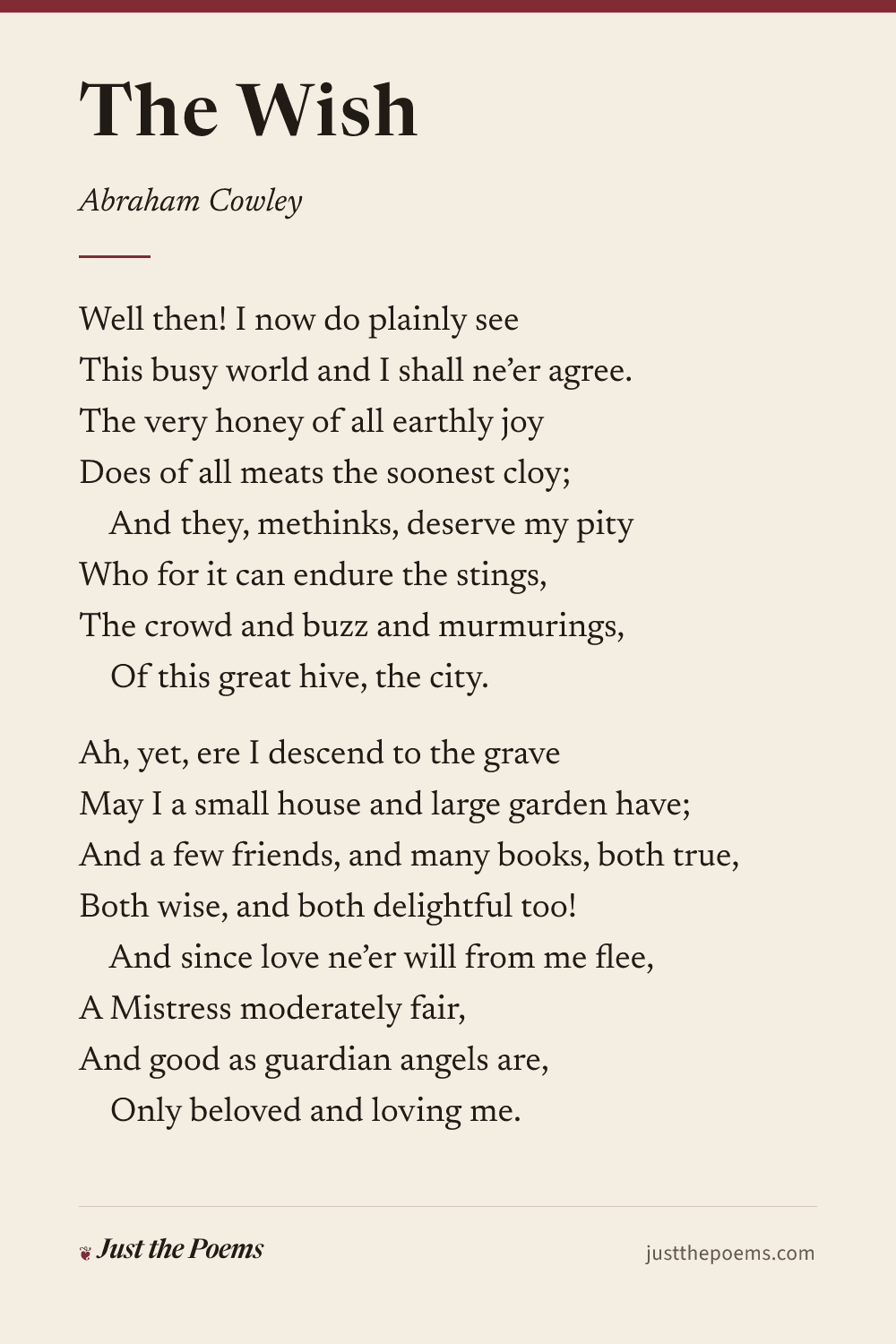
The Wish

Abraham Cowley

In 0 Wikipedias 2 anthologies Poet in 26 Wikipedias

Well then! I now do plainly seeThis busy world and I shall ne’er agree.The very honey of all earthly joyDoes of all meats the soonest cloy; And they, methinks, deserve my pityWho for it can endure the stings,The crowd and buzz and murmurings, Of this great hive, the city.

Ah, yet, ere I descend to the graveMay I a small house and large garden have;And a few friends, and many books, both true,Both wise, and both delightful too!

Show all 40 lines 28 more

And since love ne’er will from me flee,A Mistress moderately fair,And good as guardian angels are, Only beloved and loving me.

O fountains! when in you shall IMyself eased of unpeaceful thoughts espy?O fields! O woods! when, when shall I be madeThe happy tenant of your shade? Here’s the spring-head of Pleasure’s flood:Here’s wealthy Nature’s treasury,Where all the riches lie that she Has coin’d and stamp’d for good.

Pride and ambition hereOnly in far-fetch’d metaphors appear;Here nought but winds can hurtful murmurs scatter,And nought but Echo flatter. The gods, when they descended, hitherFrom heaven did always choose their way:And therefore we may boldly say That ’tis the way too thither.

How happy here should IAnd one dear She live, and embracing die!She who is all the world, and can excludeIn deserts solitude. I should have then this only fear:Lest men, when they my pleasures see,Should hither throng to live like me, And so make a city here.

Source

The Oxford Book of English Verse 1250–1900, 1900

Filed under
  • Section “THE SIMPLE LIFE”, The Home Book of Verse

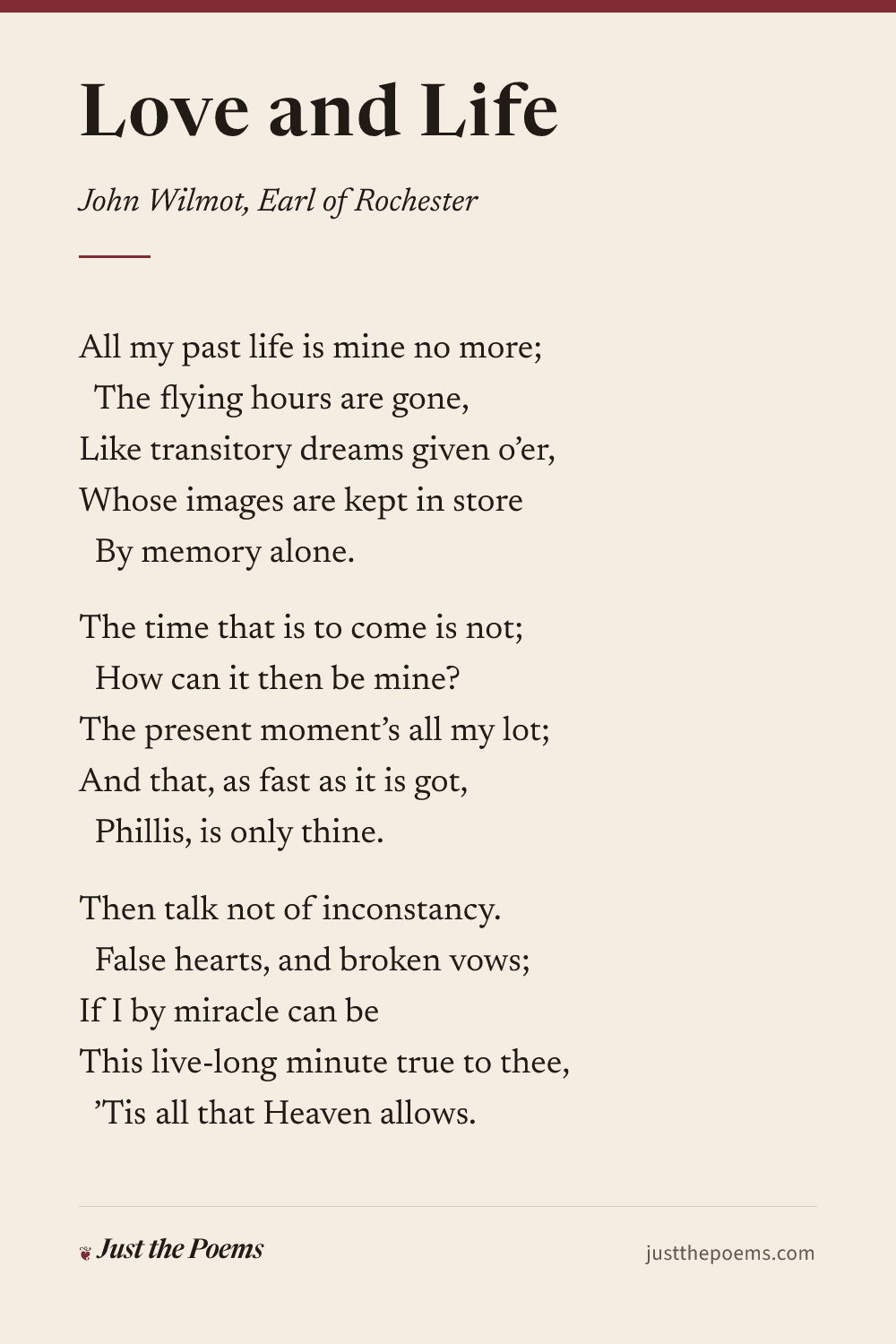
Love and Life

John Wilmot, Earl of Rochester

In 0 Wikipedias 2 anthologies Poet in 23 Wikipedias

All my past life is mine no more; The flying hours are gone,Like transitory dreams given o’er,Whose images are kept in store By memory alone.

The time that is to come is not; How can it then be mine?The present moment’s all my lot;And that, as fast as it is got, Phillis, is only thine.

Then talk not of inconstancy. False hearts, and broken vows;If I by miracle can beThis live-long minute true to thee, ’Tis all that Heaven allows.

Source

The Oxford Book of English Verse 1250–1900, 1900

Filed under
  • Named in the title

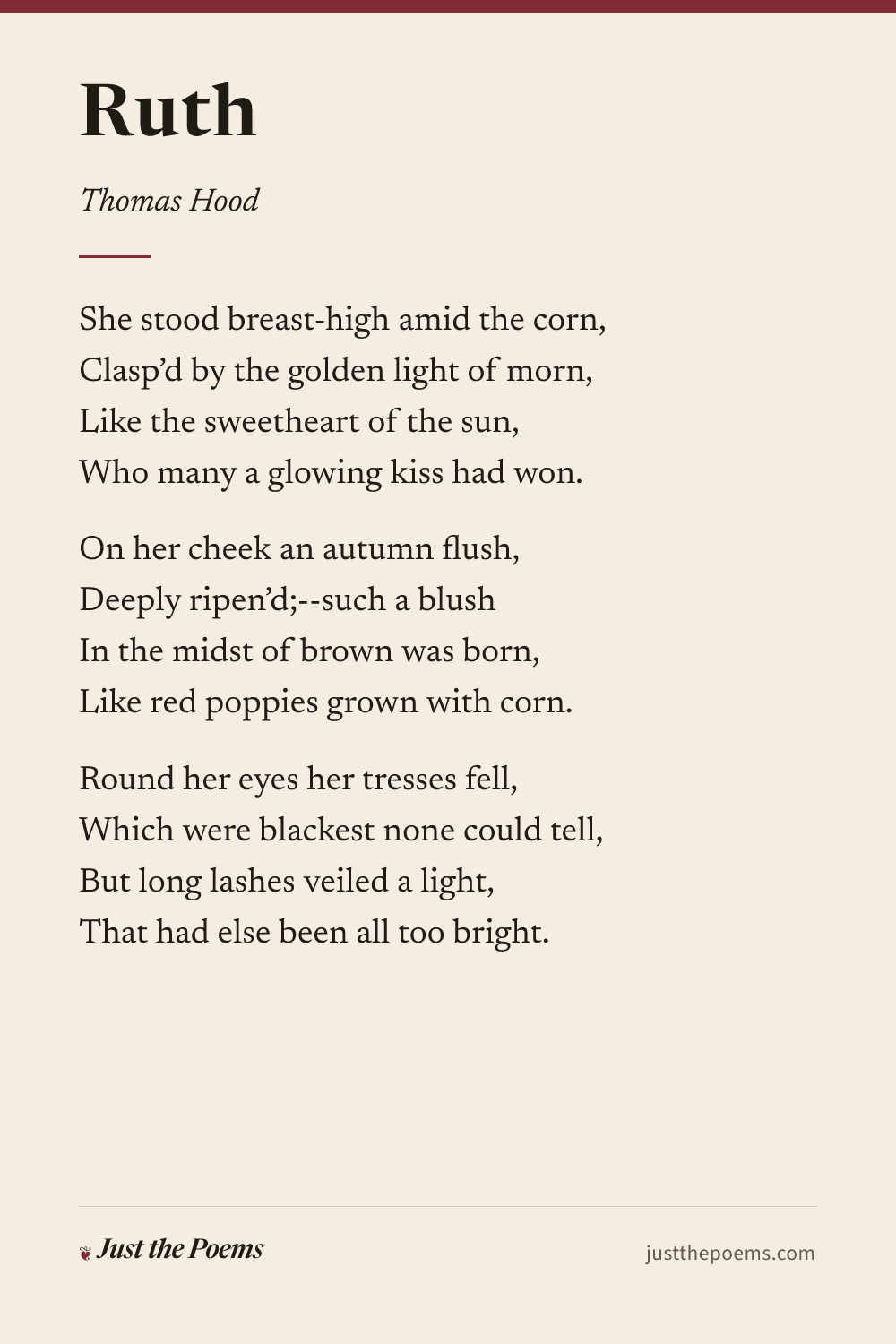
Ruth

Thomas Hood

In 0 Wikipedias 2 anthologies Poet in 20 Wikipedias

She stood breast-high amid the corn,Clasp’d by the golden light of morn,Like the sweetheart of the sun,Who many a glowing kiss had won.

On her cheek an autumn flush,Deeply ripen’d;--such a blushIn the midst of brown was born,Like red poppies grown with corn.

Round her eyes her tresses fell,Which were blackest none could tell,But long lashes veiled a light,That had else been all too bright.

And her hat, with shady brim,Made her tressy forehead dim;Thus she stood amid the stooks,Praising God with sweetest looks:--

Sure, I said, Heav’n did not mean,Where I reap thou shouldst but glean,Lay thy sheaf adown and come,Share my harvest and my home.

Source

The Oxford Book of English Verse 1250–1900, 1900

Filed under
  • Library subject “Country life -- Poetry”, The rhyme and reason of country life

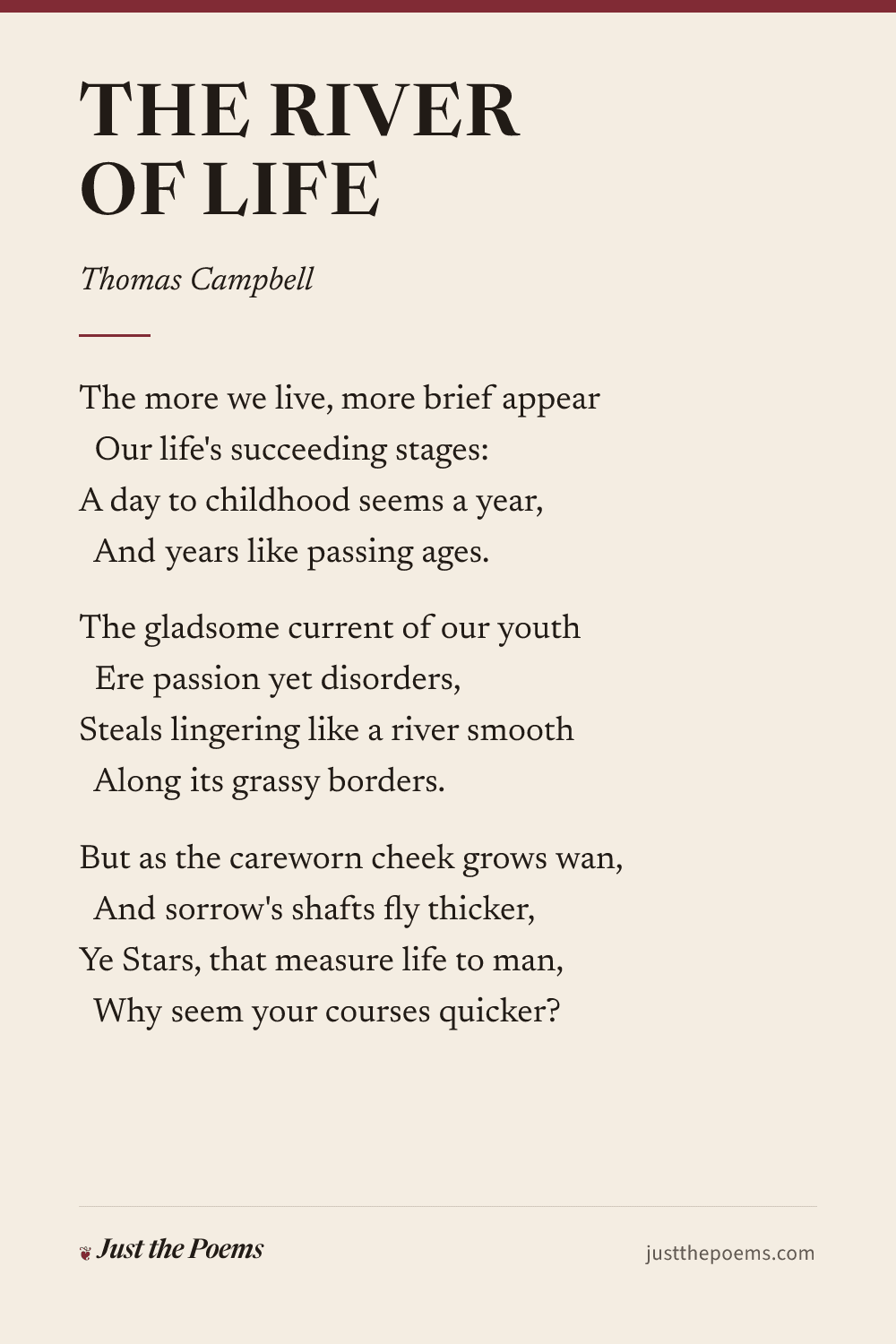
THE RIVER OF LIFE

Thomas Campbell

In 0 Wikipedias 2 anthologies Poet in 16 Wikipedias

The more we live, more brief appear Our life's succeeding stages:A day to childhood seems a year, And years like passing ages.

The gladsome current of our youth Ere passion yet disorders,Steals lingering like a river smooth Along its grassy borders.

But as the careworn cheek grows wan, And sorrow's shafts fly thicker,Ye Stars, that measure life to man, Why seem your courses quicker?

When joys have lost their bloom and breath And life itself is vapid,Why, as we reach the Falls of Death, Feel we its tide more rapid?

It may be strange--yet who would change Time's course to lower speeding,When one by one our friends have gone And left our bosoms bleeding?

Heaven gives our years of fading strength Indemnifying fleetness;And those of youth, a seeming length, Proportion'd to their sweetness.

Source

The Golden Treasury, ed. Francis Turner Palgrave

Filed under
  • Named in the title

CHARACTER OF A HAPPY LIFE

Sir Henry Wotton

In 0 Wikipedias 2 anthologies Poet in 11 Wikipedias

How happy is he born and taughtThat serveth not another's will;Whose armour is his honest thoughtAnd simple truth his utmost skill!

Whose passions not his masters are,Whose soul is still prepared for death,Not tied unto the world by careOf public fame, or private breath;

Who envies none that chance doth raiseOr vice; Who never understoodHow deepest wounds are given by praise;Nor rules of state, but rules of good:

Who hath his life from rumours freed,Whose conscience is his strong retreat;Whose state can neither flatterers feed,Nor ruin make accusers great;

Who God doth late and early prayMore of His grace than gifts to lend;And entertains the harmless dayWith a well-chosen book or friend;

--This man is freed from servile bandsOf hope to rise, or fear to fall;Lord of himself, though not of lands,And having nothing, yet hath all.

Source

The Golden Treasury, ed. Francis Turner Palgrave

Filed under
  • Named in the title

An Ode to Master Anthony Stafford

Thomas Randolph

In 0 Wikipedias 2 anthologies Poet in 7 Wikipedias

Come, spur away, I have no patience for a longer stay, But must go down And leave the chargeable noise of this great town: I will the country see, Where old simplicity, Though hid in gray, Doth look more gay Than foppery in plush and scarlet clad. Farewell, you city wits, that are Almost at civil war--’Tis time that I grow wise, when all the world grows mad.

Show all 84 lines 72 more

More of my days I will not spend to gain an idiot’s praise; Or to make sport For some slight Puisne of the Inns of Court. Then, worthy Stafford, say, How shall we spend the day? With what delights Shorten the nights? When from this tumult we are got secure, Where mirth with all her freedom goes, Yet shall no finger lose;Where every word is thought, and every thought is pure?

There from the tree We’ll cherries pluck, and pick the strawberry; And every day Go see the wholesome country girls make hay, Whose brown hath lovelier grace Than any painted face That I do know Hyde Park can show: Where I had rather gain a kiss than meet (Though some of them in greater state Might court my love with plate)The beauties of the Cheap, and wives of Lombard Street.

But think upon Some other pleasures: these to me are none. Why do I prate Of women, that are things against my fate! I never mean to wed That torture to my bed: My Muse is she My love shall be. Let clowns get wealth and heirs: when I am gone And that great bugbear, grisly Death, Shall take this idle breath,If I a poem leave, that poem is my son.

Of this no more! We’ll rather taste the bright Pomona’s store. No fruit shall ’scape Our palates, from the damson to the grape. Then, full, we’ll seek a shade, And hear what music’s made; How Philomel Her tale doth tell, And how the other birds do fill the quire; The thrush and blackbird lend their throats, Warbling melodious notes;We will all sports enjoy which others but desire.

Ours is the sky, Where at what fowl we please our hawk shall fly: Nor will we spare To hunt the crafty fox or timorous hare; But let our hounds run loose In any ground they’ll choose; The buck shall fall, The stag, and all. Our pleasures must from their own warrants be, For to my Muse, if not to me, I’m sure all game is free:Heaven, earth, are all but parts of her great royalty.

And when we mean To taste of Bacchus’ blessings now and then, And drink by stealth A cup or two to noble Barkley’s health, I’ll take my pipe and try The Phrygian melody; Which he that hears, Lets through his ears A madness to distemper all the brain: Then I another pipe will take And Doric music make,To civilize with graver notes our wits again.

Source

The Oxford Book of English Verse 1250–1900, 1900

Filed under
  • Section “THE SIMPLE LIFE”, The Home Book of Verse

OVER THE HILL TO THE POOR-HOUSE

Will Carleton

In 0 Wikipedias 2 anthologies Poet in 1 Wikipedia

Over the hill to the poor-house I'm trudgin' my weary way--I, a woman of seventy, and only a trifle gray--I, who am smart an' chipper, for all the years I've told,As many another woman that's only half as old.

Over the hill to the poor-house--I can't quite make it clear!Over the hill to the poor-house--it seems so horrid queer!Many a step I've taken a-toilin' to and fro,But this is a sort of journey I never thought to go.

What is the use of heapin' on me a pauper's shame?Am I lazy or crazy? am I blind or lame?True, I am not so supple, nor yet so awful stout;But charity ain't no favor, if one can live without.

Show all 84 lines 72 more

I am willin' and anxious an' ready any dayTo work for a decent livin', an' pay my honest way;For I can earn my victuals, an' more too, I'll be bound,If anybody only is willin' to have me round.

Once I was young an' han'some--I was, upon my soul--Once my cheeks was roses, my eyes as black as coal;And I can't remember, in them days, of hearin' people say,For any kind of a reason, that I was in their way.

'Tain't no use of boastin', or talkin' over free,But many a house an' home was open then to me;Many a ban'some offer I had from likely men,And nobody ever hinted that I was a burden then.

And when to John I was married, sure he was good and smart,But he and all the neighbors would own I done my part;For life was all before me, an' I was young an' strong,And I worked the best that I could in tryin' to get along.

And so we worked together: and life was hard, but gay,With now and then a baby for to cheer us on our way;Till we had half a dozen, an' all growed clean an' neat,An' went to school like others, an' had enough to eat.

So we worked for the child'rn, and raised 'em every one;Worked for 'em summer and winter, just as we ought to 've done;Only perhaps we humored 'em, which some good folks condemn,But every couple's child'rn 's heap the best to them.

Strange how much we think of our blessed little ones!--I'd have died for my daughters, I'd have died for my sons;And God he made that rule of love; but when we're old and gray,I've noticed it sometimes somehow fails to work the other way.

Strange, another thing: when our boys an' girls was grown,And when, exceptin' Charley, they'd left us there alone;When John he nearer an' nearer come, an' dearer seemed to be,The Lord of Hosts he come one day an' took him away from me.

Still I was bound to struggle, an' never to cringe or fall--Still I worked for Charley, for Charley was now my all;And Charley was pretty good to me, with scarce a word or frown,Till at last he went a-courtin', and brought a wife from town.

She was somewhat dressy, an' hadn't a pleasant smile--She was quite conceity, and carried a heap o' style;But if I ever tried to be friends, I did with her, I know;But she was hard and proud, an' I couldn't make it go.

She had an edication, an' that was good for her;But when she twitted me on mine, 'twas carryin' things too fur;An' I told her once, 'fore company (an' it almost made her sick),That I never swallowed a grammar, or 'et a rithmetic.

So 'twas only a few days before the thing was done--They was a family of themselves, and I another one;And a very little cottage one family will do,But I never have seen a house that was big enough for two.

An' I could never speak to suit her, never could please her eye,An' it made me independent, an' then I didn't try;But I was terribly staggered, an' felt it like a blow,When Charley turned ag'in me, an' told me I could go.

I went to live with Susan, but Susan's house was small,And she was always a-hintin' how snug it was for us all;And what with her husband's sisters, and what with child'rn three,'Twas easy to discover that there wasn't room for me.

An' then I went to Thomas, the oldest son I've got,For Thomas's buildings'd cover the half of an acre lot;But all the child'rn was on me--I couldn't stand their sauce--And Thomas said I needn't think I was comin' there to boss.

An' then I wrote to Rebecca, my girl who lives out West,And to Isaac, not far from her--some twenty miles at best;And one of 'em said 'twas too warm there for any one so old,And t' other had an opinion the climate was too cold.

So they have shirked and slighted me, an' shifted me about--So they have well-nigh soured me, an' wore my old heart out;But still I've borne up pretty well, an' wasn't much put down,Till Charley went to the poor-master, an' put me on the town.

Over the hill to the poor-house--my child'rn dear, good by!Many a night I've watched you when only God was nigh;And God'll judge between us; but I will al'ays prayThat you shall never suffer the half I do to-day.

Source

The World's Best Poetry, Vol. III, ed. Bliss Carman, 1904

Filed under
  • Library subject “Farm life -- Poetry”, Farm Ballads

THE IVY GREEN

Charles Dickens

In 0 Wikipedias 1 anthology Poet in 177 Wikipedias

Oh, a dainty plant is the Ivy green,That creepeth o'er ruins old!Of right choice food are his meals I ween,In his cell so lone and cold.The wall must be crumbled, the stone decayed,To pleasure his dainty whim;And the mouldering dust that years have madeIs a merry meal for him.Creeping where no life is seen,A rare old plant is the Ivy green.

Fast he stealeth on, though he wears no wings,And a staunch old heart has he.

Show all 30 lines 18 more

How closely he twineth, how tight he clingsTo his friend the huge Oak Tree!And slily he traileth along the ground,And his leaves he gently waves,As he joyously hugs and crawleth roundThe rich mould of dead men's graves.Creeping where grim death has been,A rare old plant is the Ivy green.

Whole ages have fled and their works decayed,And nations have scattered been;But the stout old Ivy shall never fade,From its hale and hearty green.The brave old plant, in its lonely days,Shall fatten upon the past:For the stateliest building man can raiseIs the Ivy's food at last.Creeping on, where time has been,A rare old plant is the Ivy green.

Source

The Home Book of Verse, ed. Burton Egbert Stevenson

Filed under
  • Library subject “England -- Social life and customs -- 19th century -- Poetry”, The Poems and Verses of Charles Dickens

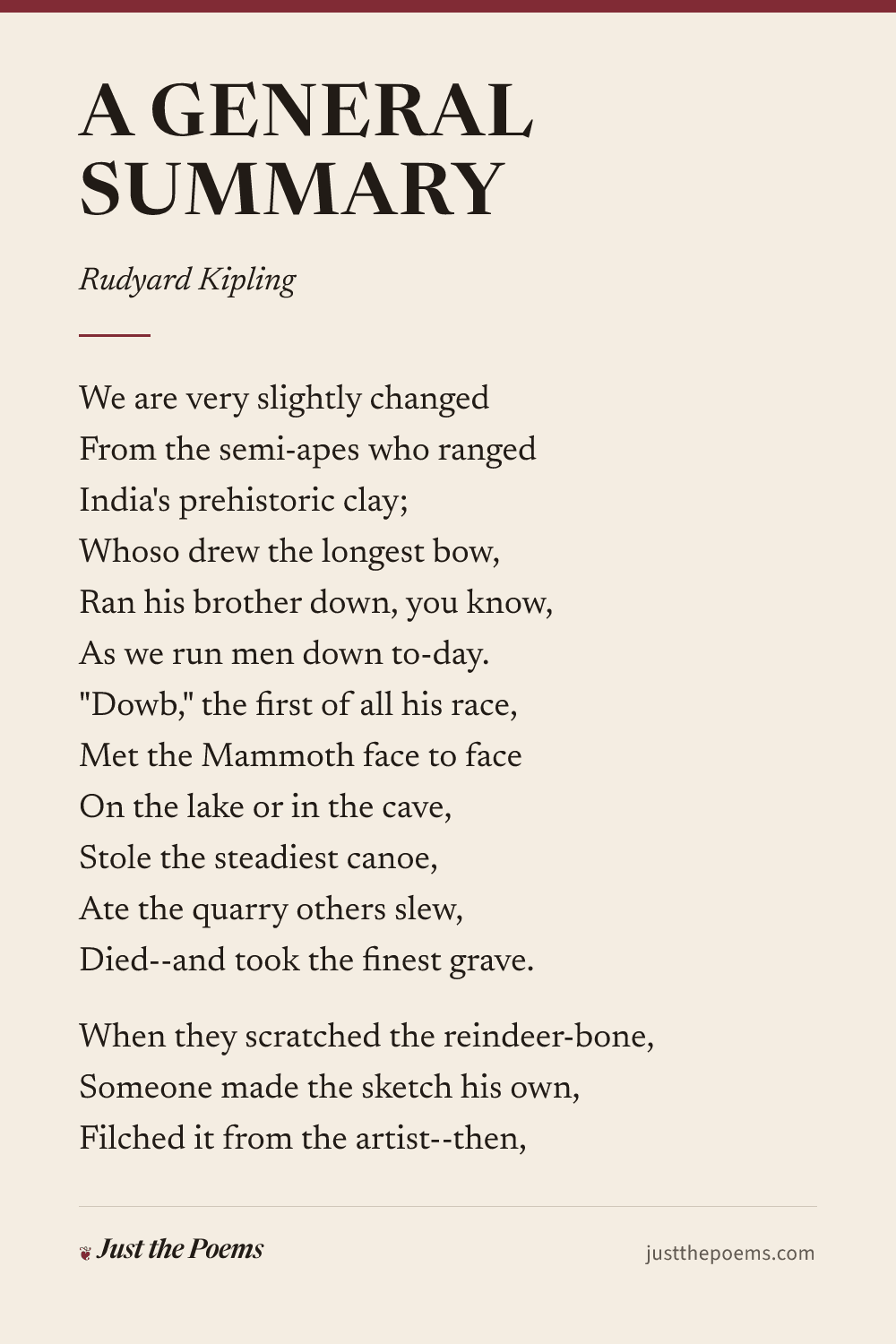
A GENERAL SUMMARY

Rudyard Kipling

In 0 Wikipedias 1 anthology Poet in 126 Wikipedias

We are very slightly changedFrom the semi-apes who rangedIndia's prehistoric clay;Whoso drew the longest bow,Ran his brother down, you know,As we run men down to-day."Dowb," the first of all his race,Met the Mammoth face to faceOn the lake or in the cave,Stole the steadiest canoe,Ate the quarry others slew,Died--and took the finest grave.

Show all 35 lines 23 more

When they scratched the reindeer-bone,Someone made the sketch his own,Filched it from the artist--then,Even in those early days,Won a simple Viceroy's praiseThrough the toil of other men.Ere they hewed the Sphinx's visage,Favoritism governed kissage,Even as it does in this age.

Who shall doubt "the secret hidUnder Cheops' pyramid"Was that the contractor didCheops out of several millions?Or that Joseph's sudden riseTo Comptroller of SuppliesWas a fraud of monstrous sizeOn King Pharaoh's swart Civilians?

Thus, the artless songs I singDo not deal with anythingNew or never said before.As it was in the beginning,Is to-day official sinning,And shall be for evermore!

Source

The Home Book of Verse, ed. Burton Egbert Stevenson

Filed under
  • Library subject “Great Britain. Army -- Military life -- Poetry”, Departmental ditties and Ballads and Barrack-room ballads

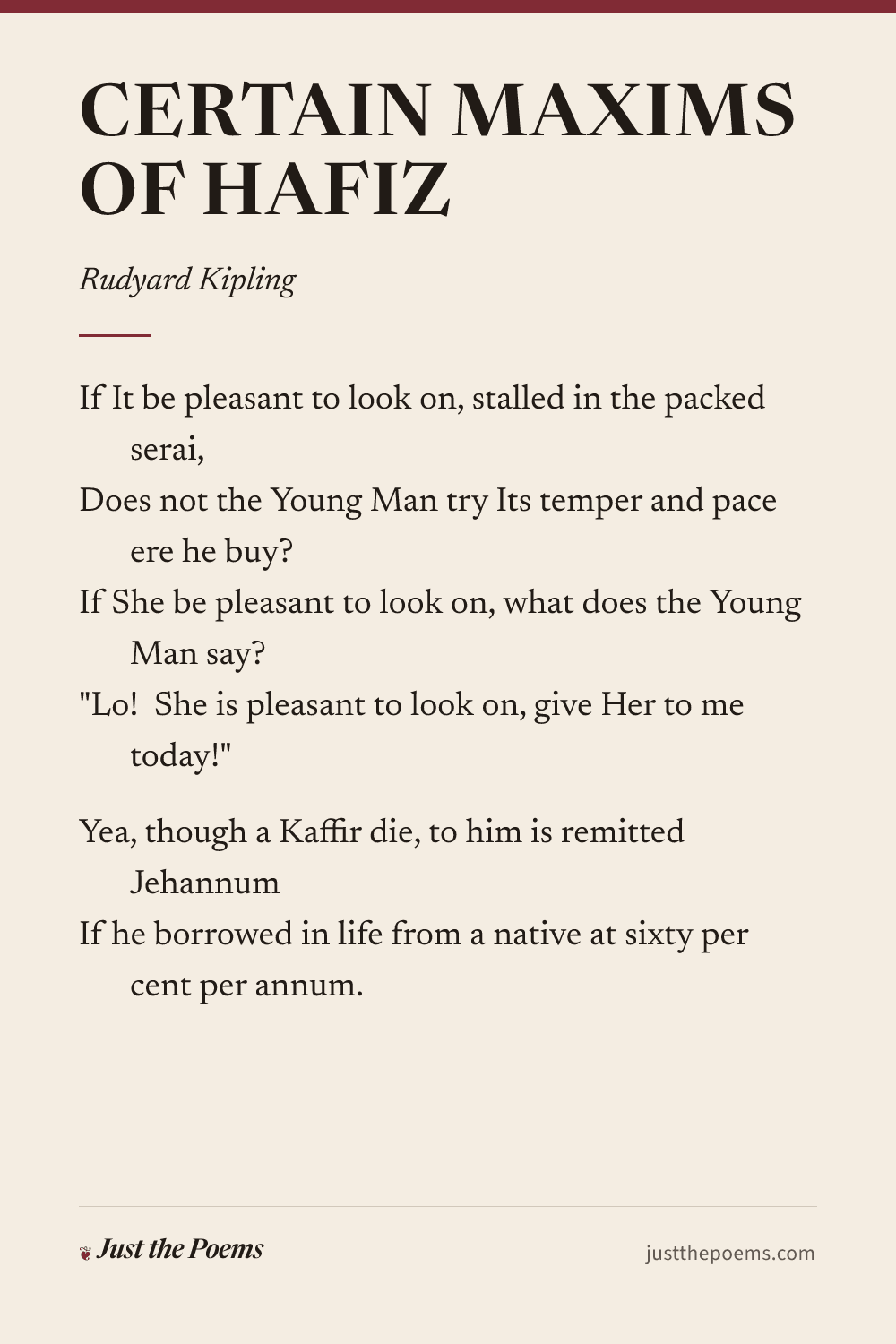
CERTAIN MAXIMS OF HAFIZ

Rudyard Kipling

In 0 Wikipedias 1 anthology Poet in 126 Wikipedias

If It be pleasant to look on, stalled in the packed serai,Does not the Young Man try Its temper and pace ere he buy?If She be pleasant to look on, what does the Young Man say?"Lo! She is pleasant to look on, give Her to me today!"

Yea, though a Kaffir die, to him is remitted JehannumIf he borrowed in life from a native at sixty per cent per annum.

Blister we not for bursati? So when the heart is vexed,The pain of one maiden's refusal is drowned in the pain of the next.

The temper of chums, the love of your wife, and a new piano's tune--Which of the three will you trust at the end of an Indian June?

Who are the rulers of Ind--to whom shall we bow the knee?Make your peace with the women, and men will make you L. G.

Show all 57 lines 45 more

Does the woodpecker flit round the young ferash?Does the grass clothe a new-built wall?Is she under thirty, the woman who holds a boy in her thrall?

If She grow suddenly gracious--reflect. Is it all for thee?The black-buck is stalked through the bullock, and Man through jealousy.

Seek not for favor of women. So shall you find it indeed.Does not the boar break cover just when you're lighting a weed?

If He play, being young and unskilful, for shekels of silver and gold,Take His money, my son, praising Allah. The kid was ordained to be sold.

With a "weed" among men or horses verily this is the best,That you work him in office or dog-cart lightly--but give him no rest.

Pleasant the snaffle of Courtship, improving the manners and carriage;But the colt who is wise will abstain from the terrible thornbit of Marriage.

As the thriftless gold of the babul, so is the gold that we spendOn a Derby Sweep, or our neighbor's wife, or the horse that we buy from a friend.

The ways of a man with a maid be strange, yet simple and tameTo the ways of a man with a horse, when selling or racing that same.

In public Her face turneth to thee, and pleasant Her smile when ye meet.It is ill. The cold rocks of El-Gidar smile thus on the waves at their feet.In public Her face is averted, with anger She nameth thy name.It is well. Was there ever a loser content with the loss of the game?

If She have spoken a word, remember thy lips are sealed,And the Brand of the Dog is upon him by whom is the secret revealed.If She have written a letter, delay not an instant, but burn it.Tear it in pieces, O Fool, and the wind to her mate shall return it!If there be trouble to Herward, and a lie of the blackest can clear,Lie, while thy lips can move or a man is alive to hear.

My Son, if a maiden deny thee and scufflingly bid thee give o'er,Yet lip meets with lip at the lastward--get out!She has been there before.They are pecked on the ear and the chin and the nose who are lacking in lore.

If we fall in the race, though we win, the hoof-slide is scarred on the course.Though Allah and Earth pardon Sin, remaineth forever Remorse.

"By all I am misunderstood!" if the Matron shall say, or the Maid:--"Alas! I do not understand," my son, be thou nowise afraid.In vain in the sight of the Bird is the net of the Fowler displayed.

My Son, if I, Hafiz, thy father, take hold of thy knees in my pain,Demanding thy name on stamped paper, one day or one hour--refrain.Are the links of thy fetters so light that thou cravest another man's chain?

Source

The Home Book of Verse, ed. Burton Egbert Stevenson

Filed under
  • Library subject “Great Britain. Army -- Military life -- Poetry”, Departmental ditties and Ballads and Barrack-room ballads

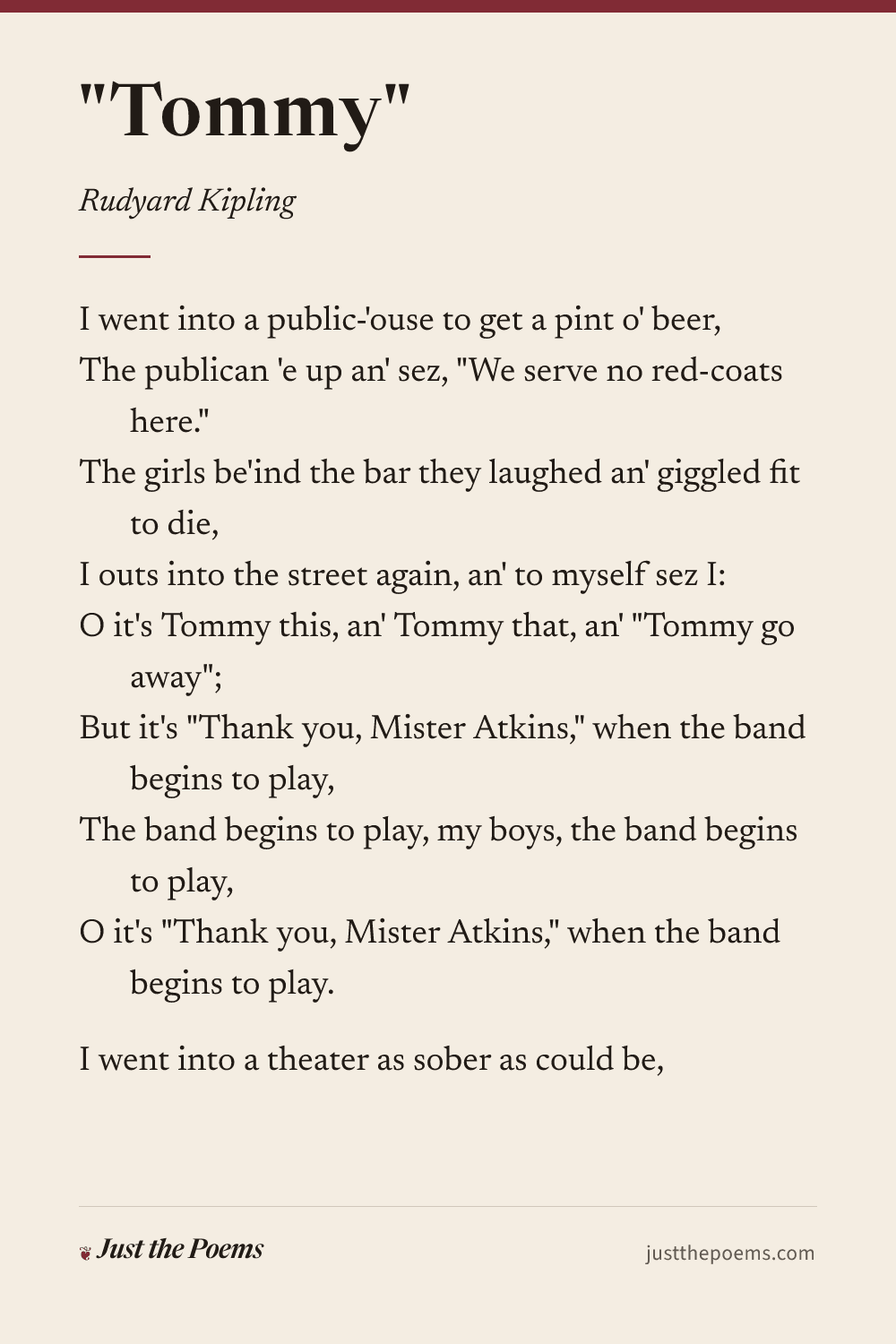
"Tommy"

Rudyard Kipling

In 0 Wikipedias 1 anthology Poet in 126 Wikipedias

I went into a public-'ouse to get a pint o' beer,The publican 'e up an' sez, "We serve no red-coats here."The girls be'ind the bar they laughed an' giggled fit to die,I outs into the street again, an' to myself sez I:O it's Tommy this, an' Tommy that, an' "Tommy go away";But it's "Thank you, Mister Atkins," when the band begins to play,The band begins to play, my boys, the band begins to play,O it's "Thank you, Mister Atkins," when the band begins to play.

I went into a theater as sober as could be,They give a drunk civilian room, but 'adn't none for me;They sent me to the gallery or round the music-'alls,But when it comes to fightin', Lord! they'll shove me in the stalls.

Show all 37 lines 25 more

For it's Tommy this, an' Tommy that, an' "Tommy wait outside";But it's "Special train for Atkins," when the trooper's on the tide,The troopship's on the tide, my boys, etc.

O makin' mock o' uniforms that guard you while you sleepIs cheaper than them uniforms, an' they're starvation cheap;An' hustlin' drunken sodgers when they're goin' large a bitIs five times better business than paradin' in full kit.Then it's Tommy this, an' Tommy that, an' "Tommy, 'ow's yer soul?"But it's "Thin red line of 'eroes" when the drums begin to roll,The drums begin to roll, my boys, etc.

We aren't no thin red 'eroes, nor we aren't no blackguards too,But single men in barricks, most remarkable like you;An' if sometimes our conduck isn't all your fancy paints,Why, single men in barricks don't grow into plaster saints.While it's Tommy this, an' Tommy that, an' "Tommy fall be'ind";But it's "Please to walk in front, sir," when there's trouble in the wind.There's trouble in the wind, my boys, etc.

You talk o' better food for us, an' schools, an' fires, an' all:We'll wait for extry rations if you treat us rational.Don't mess about the cook-room slops, but prove it to our face,The Widow's uniform is not the soldierman's disgrace.For it's Tommy this, an' Tommy that, an' "Chuck him out, the brute!"But it's "Saviour of 'is country" when the guns begin to shoot;An' it's Tommy this, an' Tommy that, an' anything you please;An' Tommy ain't a bloomin' fool--you bet that Tommy sees!

Source

Poems Teachers Ask For, Book Two

Filed under
  • Library subject “Great Britain. Army -- Military life -- Poetry”, Departmental ditties and Ballads and Barrack-room ballads

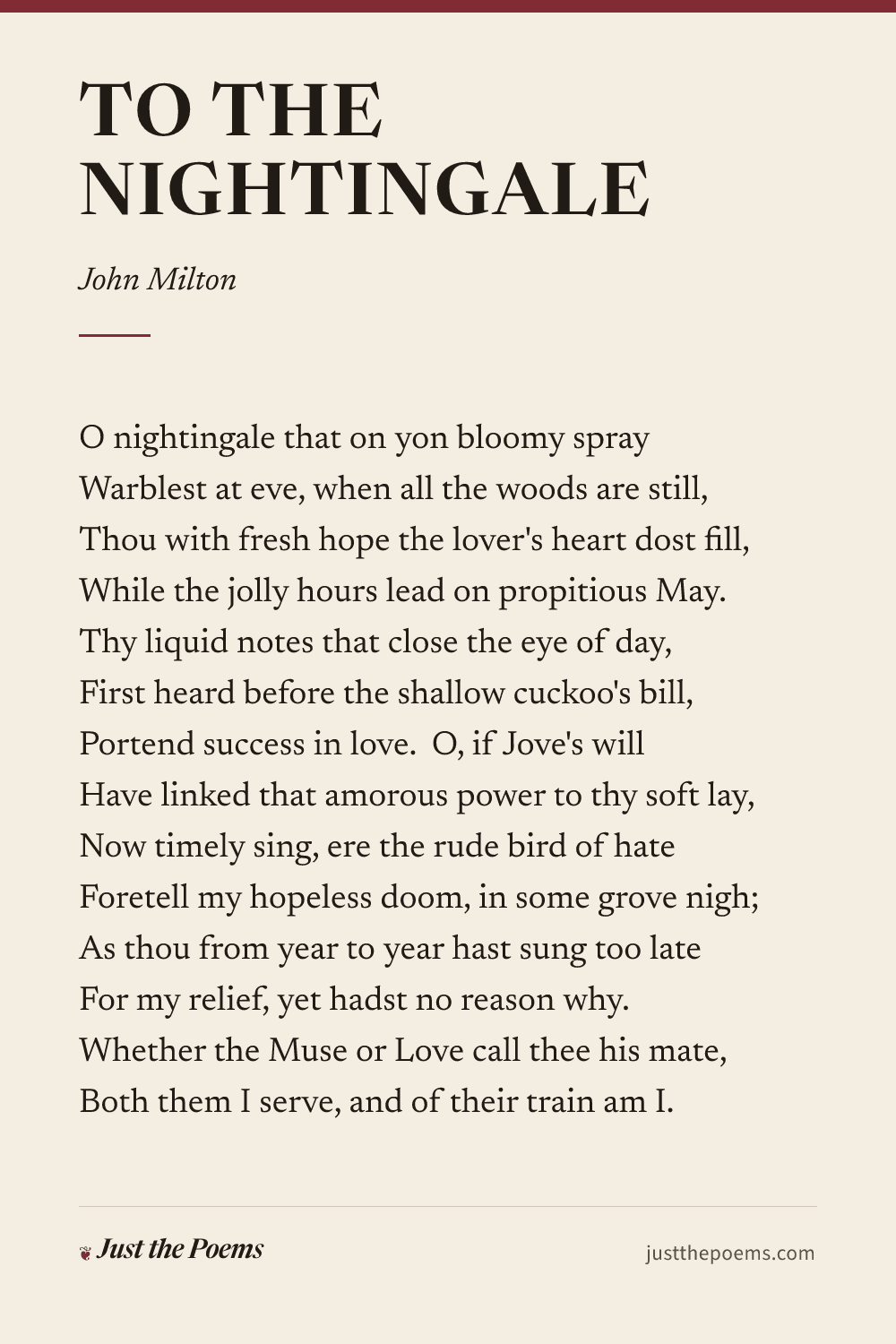
TO THE NIGHTINGALE

John Milton

In 0 Wikipedias 1 anthology Poet in 106 Wikipedias

O nightingale that on yon bloomy sprayWarblest at eve, when all the woods are still,Thou with fresh hope the lover's heart dost fill,While the jolly hours lead on propitious May.Thy liquid notes that close the eye of day,First heard before the shallow cuckoo's bill,Portend success in love. O, if Jove's willHave linked that amorous power to thy soft lay,Now timely sing, ere the rude bird of hateForetell my hopeless doom, in some grove nigh;As thou from year to year hast sung too lateFor my relief, yet hadst no reason why.Whether the Muse or Love call thee his mate,Both them I serve, and of their train am I.

Source

The Home Book of Verse, ed. Burton Egbert Stevenson

Filed under
  • Library subject “Country life -- Poetry”, The rhyme and reason of country life

EXPOSTULATION AND REPLY

William Wordsworth

In 0 Wikipedias 1 anthology Poet in 97 Wikipedias

"Why, William, on that old gray stone,Thus for the length of half a day,Why, William, sit you thus alone,And dream your time away?

"Where are your books?--that light bequeathedTo beings else forlorn and blind!Up! up! and drink the spirit breathedFrom dead men to their kind.

"You look round on your Mother Earth,As if she for no purpose bore you;As if you were her first-born birth,And none had lived before you!"

Show all 32 lines 20 more

One morning thus, by Esthwaite lake,When life was sweet, I knew not why,To me my good friend Matthew spakeAnd thus I made reply:

"The eye--it cannot choose but see;We cannot bid the ear be still;Our bodies feel, where'er they be,Against or with our will.

"Nor less I dream that there are PowersWhich of themselves our minds impress;That we can feed this mind of oursIn a wise passiveness.

"Think you, 'mid all this mighty sumOf things forever speaking,That nothing of itself will come,But we must still be seeking?

"--Then ask not wherefore, here, alone,Conversing as I may,I sit upon this old gray stone,And dream my time away."

Source

The Home Book of Verse, ed. Burton Egbert Stevenson

Filed under
  • Section “THE SIMPLE LIFE”, The Home Book of Verse

Mutability

William Wordsworth

In 0 Wikipedias 1 anthology Poet in 97 Wikipedias

From low to high doth dissolution climb, And sink from high to low, along a scale Of awful notes, whose concord shall not fail;A musical but melancholy chime,Which they can hear who meddle not with crime. Nor avarice, nor over-anxious care. Truth fails not; but her outward forms that bearThe longest date do melt like frosty rime,That in the morning whiten’d hill and plainAnd is no more; drop like the tower sublime Of yesterday, which royally did wearHis crown of weeds, but could not even sustain Some casual shout that broke the silent air,Or the unimaginable touch of Time.

Source

The Oxford Book of English Verse 1250–1900, 1900

Filed under
  • Library subject “Country life -- Poetry”, The rhyme and reason of country life

30 of 187 poems about life

22 poets

By poet's century of death

CenturyPoems
17th7
19th16
20th7

Poets with more than one poem

PoetPoems
Rudyard Kipling5
William Wordsworth4
William Shakespeare2