Poems About Death

The first 30 of 244 poems about death, by 23 poets, ranked by third-party data. How poems are ranked

AN IRISH AIRMAN FORESEES HIS DEATH

W. B. Yeats

In 4 Wikipedias 0 anthologies Poet in 113 Wikipedias

I know that I shall meet my fateSomewhere among the clouds above;Those that I fight I do not hateThose that I guard I do not love;My country is Kiltartan Cross,My countrymen Kiltartan's poor,No likely end could bring them lossOr leave them happier than before.Nor law, nor duty bade me fight,Nor public man, nor angry crowds,A lonely impulse of delightDrove to this tumult in the clouds;I balanced all, brought all to mind,The years to come seemed waste of breath,A waste of breath the years behindIn balance with this life, this death.

Source

The Wild Swans at Coole

Filed under
  • Named in the title

THE CHARIOT.

Emily Dickinson

In 3 Wikipedias 0 anthologies Poet in 101 Wikipedias

Because I could not stop for Death,He kindly stopped for me;The carriage held but just ourselvesAnd Immortality.

We slowly drove, he knew no haste,And I had put awayMy labor, and my leisure too,For his civility.

We passed the school where children played,Their lessons scarcely done;We passed the fields of gazing grain,We passed the setting sun.

We paused before a house that seemedA swelling of the ground;The roof was scarcely visible,The cornice but a mound.

Since then 't is centuries; but eachFeels shorter than the dayI first surmised the horses' headsWere toward eternity.

Source

Poems by Emily Dickinson, Series One

Filed under
  • Wikidata main subject: death

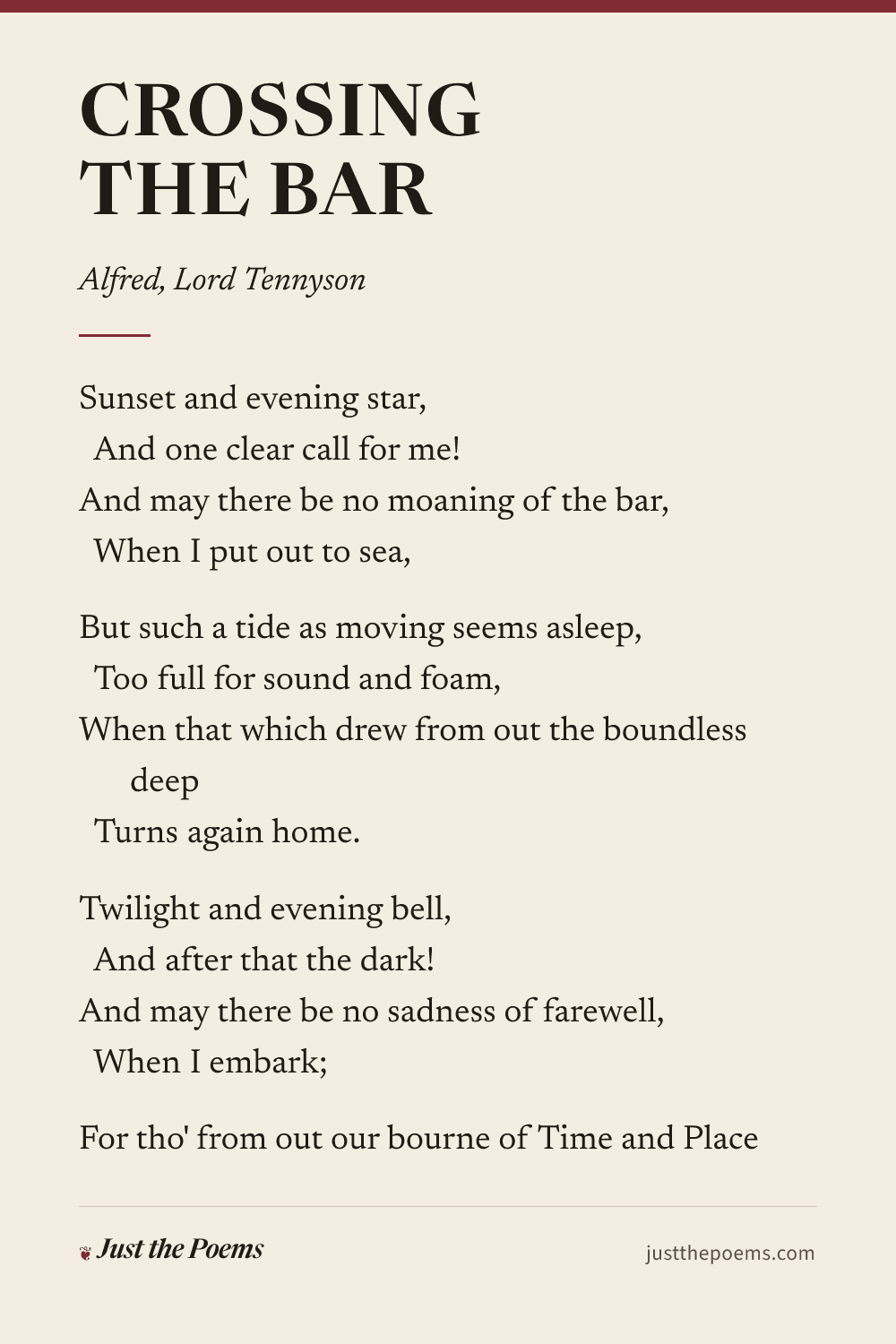
CROSSING THE BAR

Alfred, Lord Tennyson

In 2 Wikipedias 3 anthologies Poet in 72 Wikipedias

Sunset and evening star, And one clear call for me!And may there be no moaning of the bar, When I put out to sea,

But such a tide as moving seems asleep, Too full for sound and foam,When that which drew from out the boundless deep Turns again home.

Twilight and evening bell, And after that the dark!And may there be no sadness of farewell, When I embark;

For tho' from out our bourne of Time and Place The flood may bear me far,I hope to see my Pilot face to face When I have crossed the bar.

Source

The World's Best Poetry, Vol. IV, ed. Bliss Carman, 1904

Filed under
  • Section “DEATH: IMMORTALITY: HEAVEN”, The World's Best Poetry

DYING.

Emily Dickinson

In 2 Wikipedias 0 anthologies Poet in 101 Wikipedias

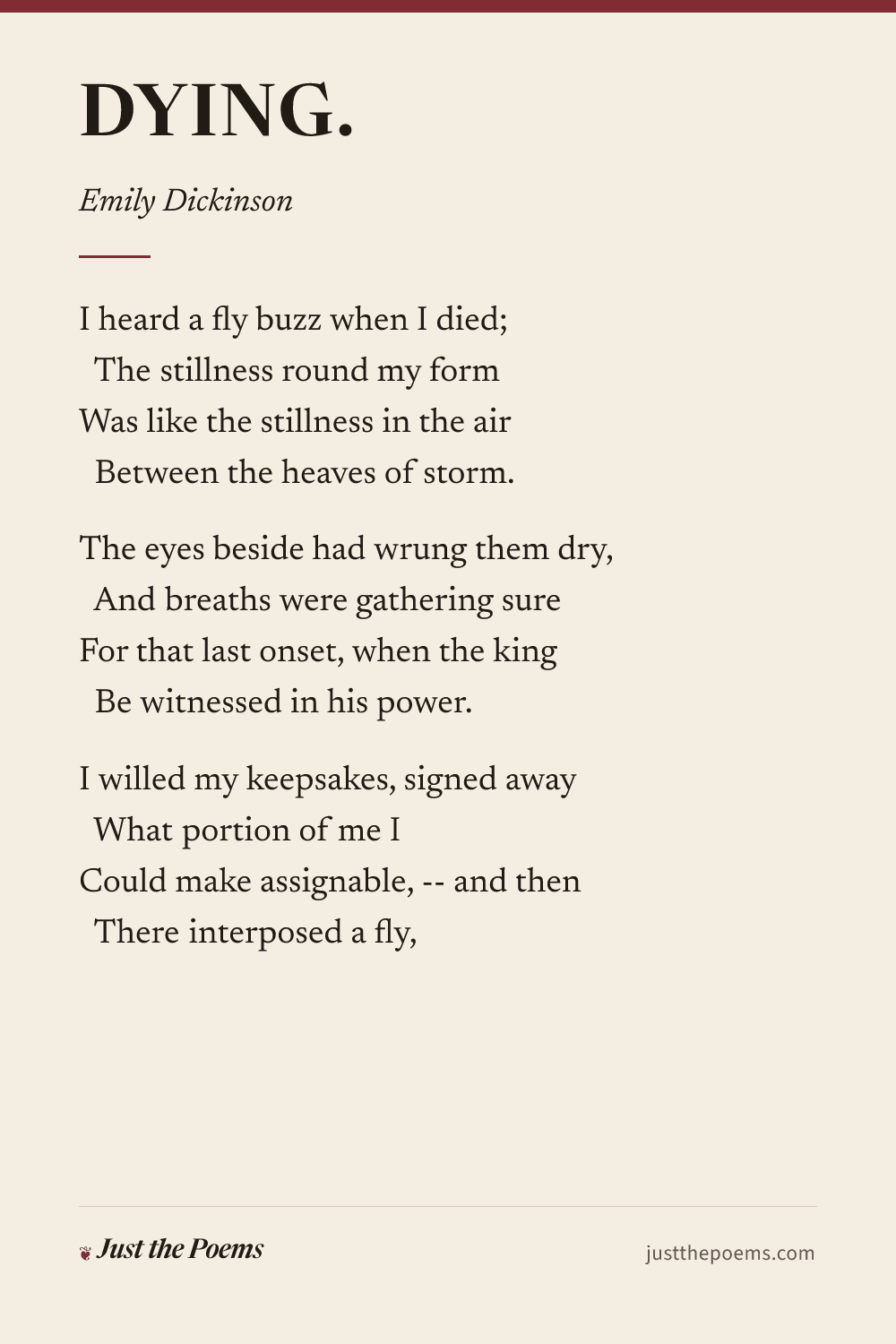
I heard a fly buzz when I died; The stillness round my formWas like the stillness in the air Between the heaves of storm.

The eyes beside had wrung them dry, And breaths were gathering sureFor that last onset, when the king Be witnessed in his power.

I willed my keepsakes, signed away What portion of me ICould make assignable, -- and then There interposed a fly,

With blue, uncertain, stumbling buzz, Between the light and me;And then the windows failed, and then I could not see to see.

Source

Poems by Emily Dickinson, Third Series, ed. Mabel Loomis Todd

Filed under
  • Named in the title

BREAK, BREAK, BREAK

Alfred, Lord Tennyson

In 1 Wikipedia 3 anthologies Poet in 72 Wikipedias

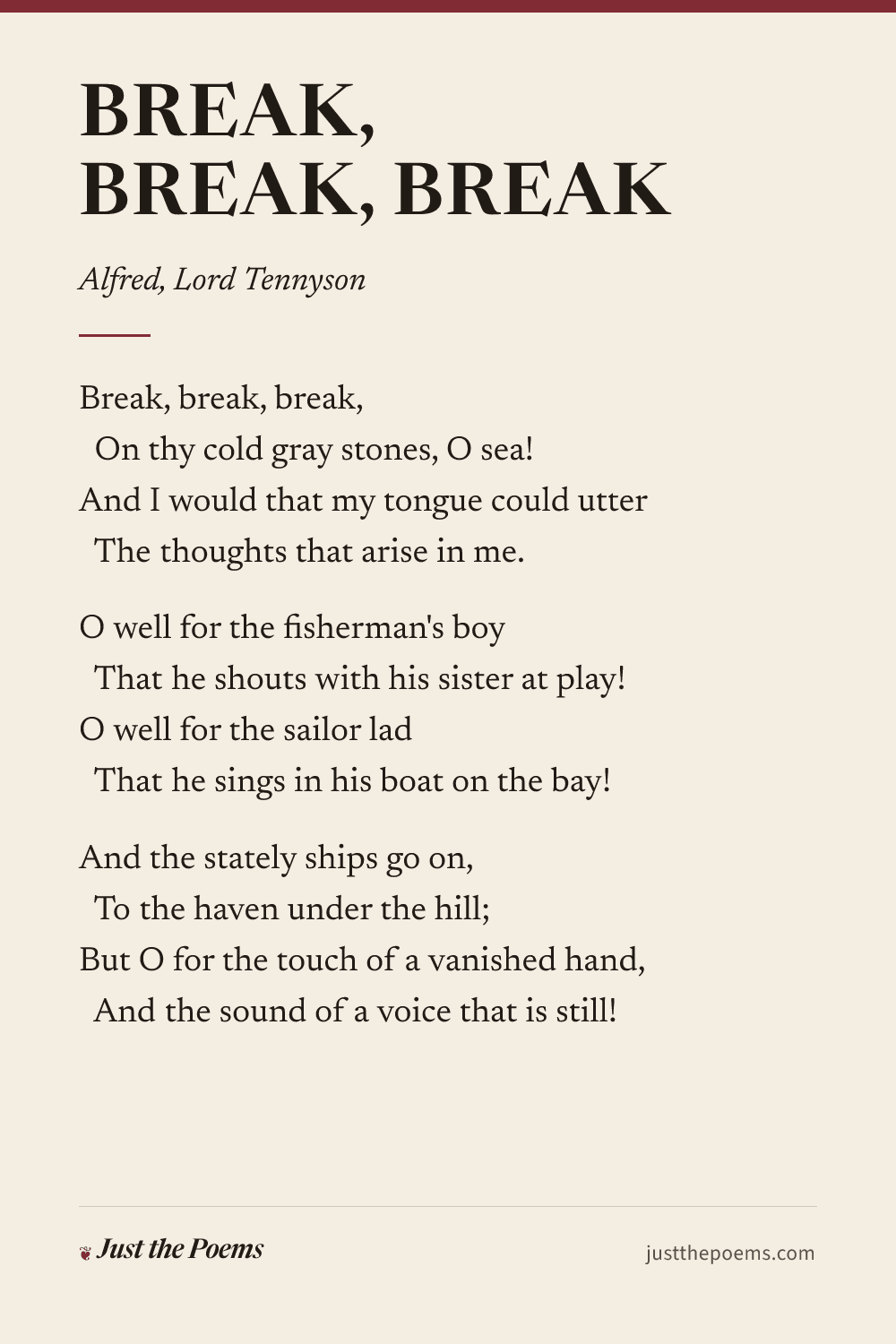
Break, break, break, On thy cold gray stones, O sea!And I would that my tongue could utter The thoughts that arise in me.

O well for the fisherman's boy That he shouts with his sister at play!O well for the sailor lad That he sings in his boat on the bay!

And the stately ships go on, To the haven under the hill;But O for the touch of a vanished hand, And the sound of a voice that is still!

Break, break, break, At the foot of thy crags, O sea!But the tender grace of a day that is dead Will never come back to me.

Source

The World's Best Poetry, Vol. III, ed. Bliss Carman, 1904

Filed under
  • Section “DEATH AND BEREAVEMENT”, The World's Best Poetry

St. Agnes’ Eve

Alfred Tennyson, Lord Tennyson

In 1 Wikipedia 3 anthologies Poet in 72 Wikipedias

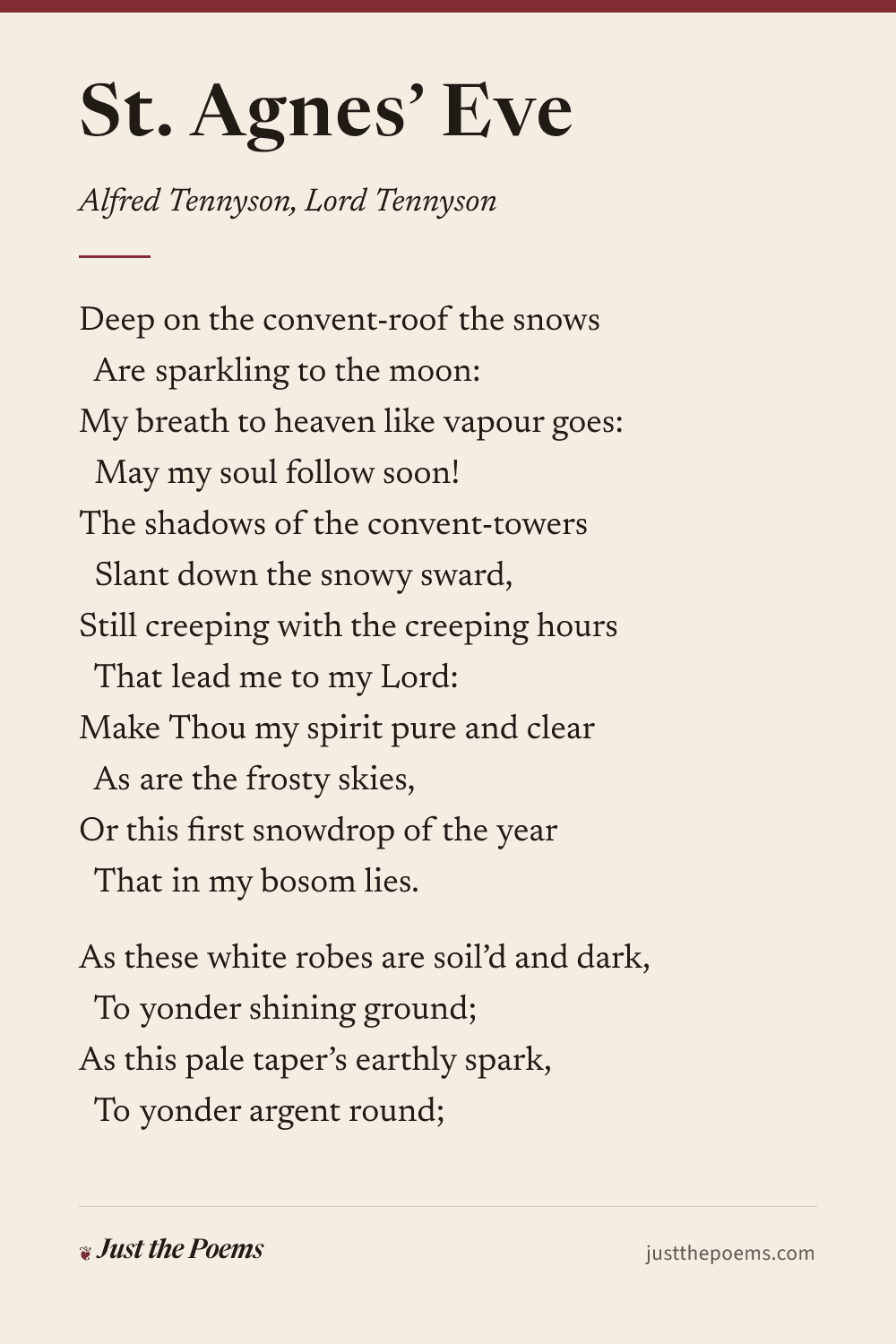
Deep on the convent-roof the snows Are sparkling to the moon:My breath to heaven like vapour goes: May my soul follow soon!The shadows of the convent-towers Slant down the snowy sward,Still creeping with the creeping hours That lead me to my Lord:Make Thou my spirit pure and clear As are the frosty skies,Or this first snowdrop of the year That in my bosom lies.

Show all 36 lines 24 more

As these white robes are soil’d and dark, To yonder shining ground;As this pale taper’s earthly spark, To yonder argent round;So shows my soul before the Lamb, My spirit before Thee;So in mine earthly house I am, To that I hope to be.Break up the heavens, O Lord! and far, Thro’ all yon starlight keen,Draw me, thy bride, a glittering star, In raiment white and clean.

He lifts me to the golden doors; The flashes come and go;All heaven bursts her starry floors, And strows her lights below,And deepens on and up! the gates Roll back, and far withinFor me the Heavenly Bridegroom waits, To make me pure of sin.The sabbaths of Eternity, One sabbath deep and wide--A light upon the shining sea-- The Bridegroom with his bride!

Source

The Oxford Book of English Verse 1250–1900, 1900

Filed under
  • Section “DEATH: IMMORTALITY: HEAVEN”, The World's Best Poetry

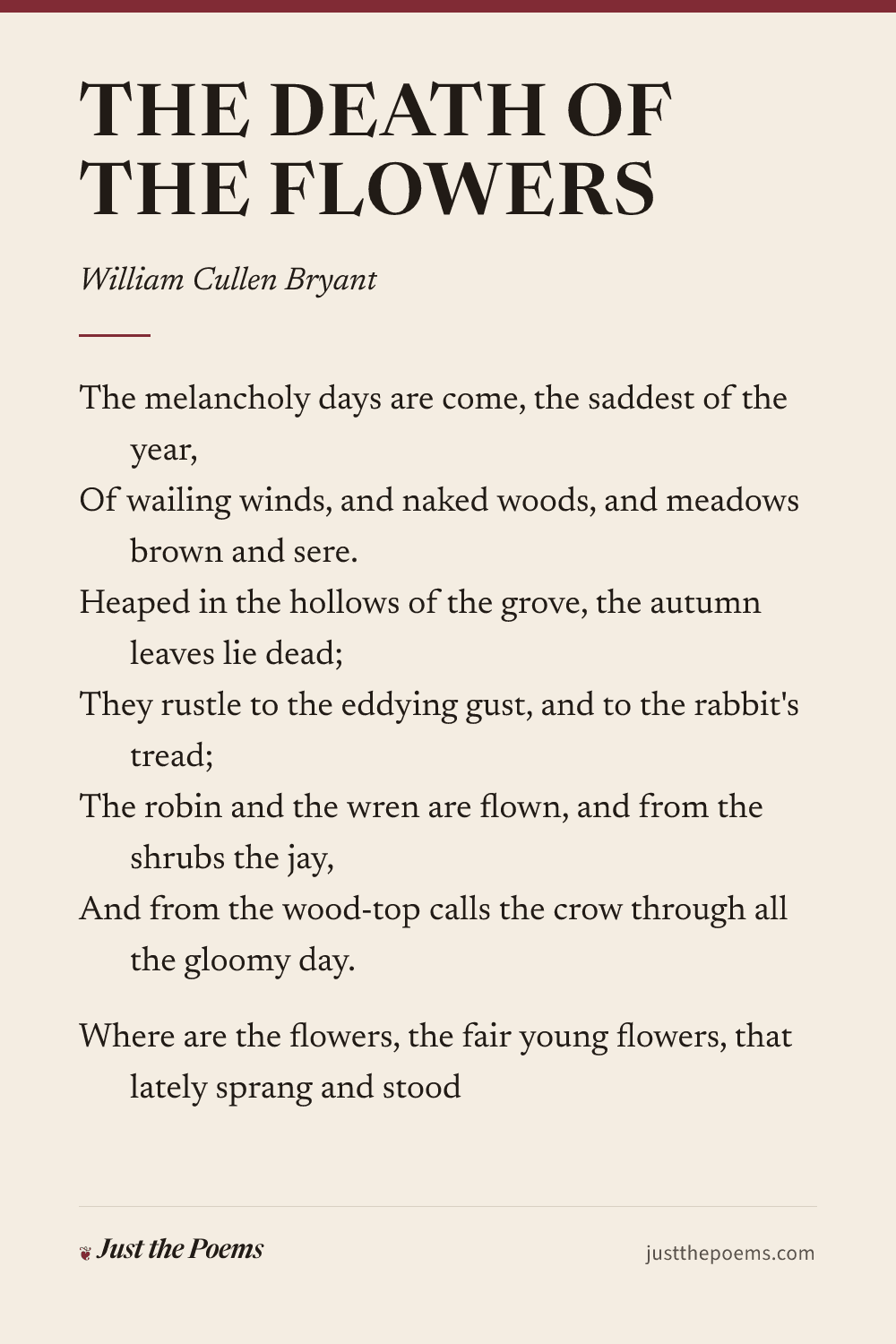
THE DEATH OF THE FLOWERS

William Cullen Bryant

In 1 Wikipedia 2 anthologies Poet in 28 Wikipedias

The melancholy days are come, the saddest of the year,Of wailing winds, and naked woods, and meadows brown and sere.Heaped in the hollows of the grove, the autumn leaves lie dead;They rustle to the eddying gust, and to the rabbit's tread;The robin and the wren are flown, and from the shrubs the jay,And from the wood-top calls the crow through all the gloomy day.

Where are the flowers, the fair young flowers, that lately sprang and stoodIn brighter light and softer airs, a beauteous sisterhood?Alas! they all are in their graves, the gentle race of flowersAre lying in their lowly beds, with the fair and good of ours.The rain is falling where they lie, but the cold November rainCalls not from out the gloomy earth the lovely ones again.

Show all 30 lines 18 more

The wind-flower and the violet, they perished long ago,And the brier-rose and the orchis died amid the summer glow;But on the hill the golden-rod, and the aster in the wood,And the yellow sun-flower by the brook, in autumn beauty stood,Till fell the frost from the clear cold heaven, as falls the plague on men,And the brightness of their smile was gone, from upland, glade, and glen.

And now, when comes the calm mild day, as still such days will come,To call the squirrel and the bee from out their winter home;When the sound of dropping nuts is heard, though all the trees are still,And twinkle in the smoky light the waters of the rill,The south wind searches for the flowers whose fragrance late he bore,And sighs to find them in the wood and by the stream no more.

And then I think of one who in her youthful beauty died,The fair meek blossom that grew up and faded by my side.In the cold moist earth we laid her, when the forest cast the leaf,And we wept that one so lovely should have a life so brief:Yet not unmeet it was that one like that young friend of ours,So gentle and so beautiful, should perish with the flowers.

Source

The Home Book of Verse, ed. Burton Egbert Stevenson

Filed under
  • Named in the title

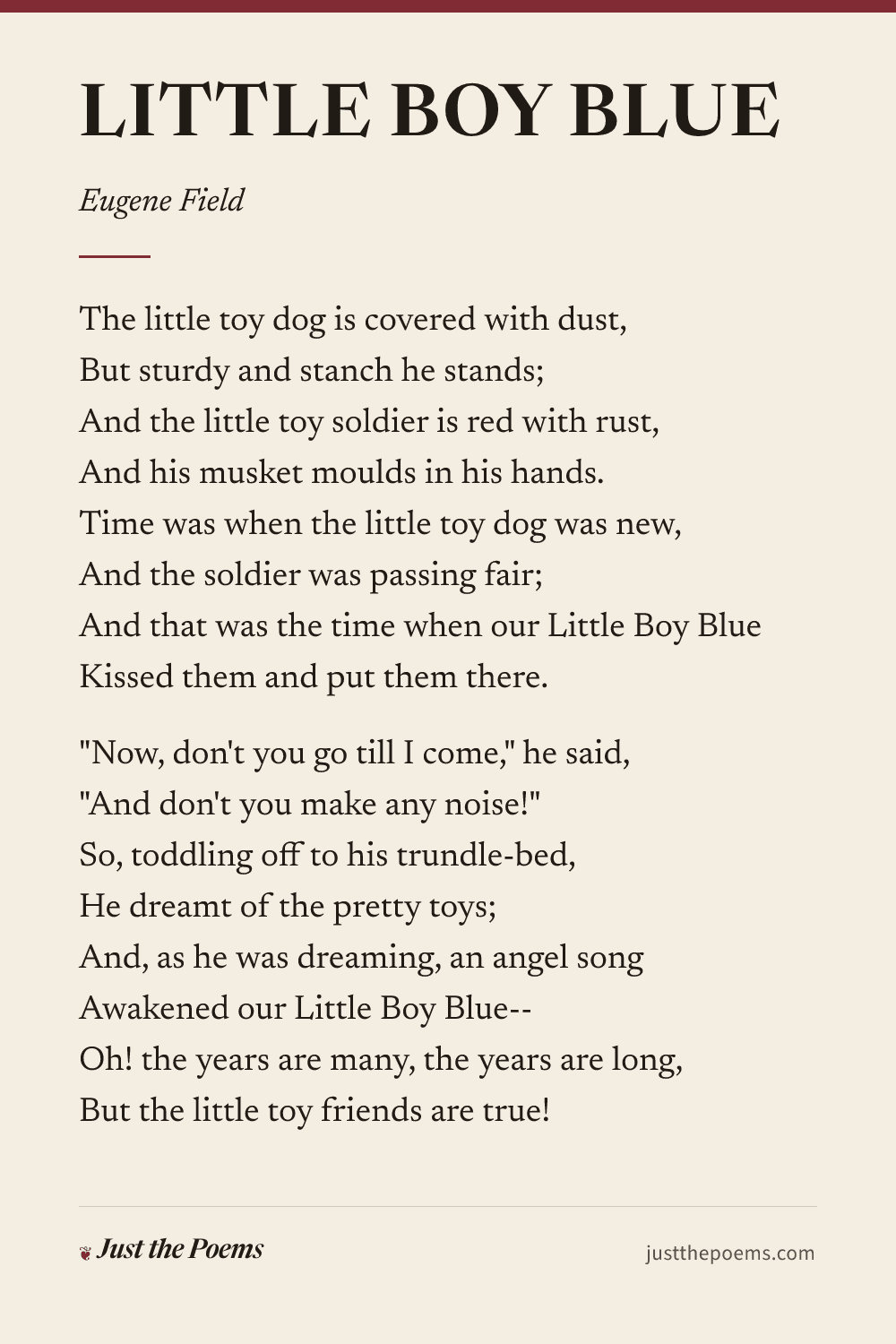
LITTLE BOY BLUE

Eugene Field

In 1 Wikipedia 2 anthologies Poet in 10 Wikipedias

The little toy dog is covered with dust,But sturdy and stanch he stands;And the little toy soldier is red with rust,And his musket moulds in his hands.Time was when the little toy dog was new,And the soldier was passing fair;And that was the time when our Little Boy BlueKissed them and put them there.

"Now, don't you go till I come," he said,"And don't you make any noise!"So, toddling off to his trundle-bed,He dreamt of the pretty toys;And, as he was dreaming, an angel songAwakened our Little Boy Blue--Oh! the years are many, the years are long,But the little toy friends are true!

Ay, faithful to Little Boy Blue they stand,Each in the same old place,Awaiting the touch of a little hand,The smile of a little face;And they wonder, as waiting the long years throughIn the dust of that little chair,What has become of our Little Boy Blue,Since he kissed them and put them there.

Source

The Home Book of Verse, ed. Burton Egbert Stevenson

Filed under
  • Wikidata main subject: child mortality

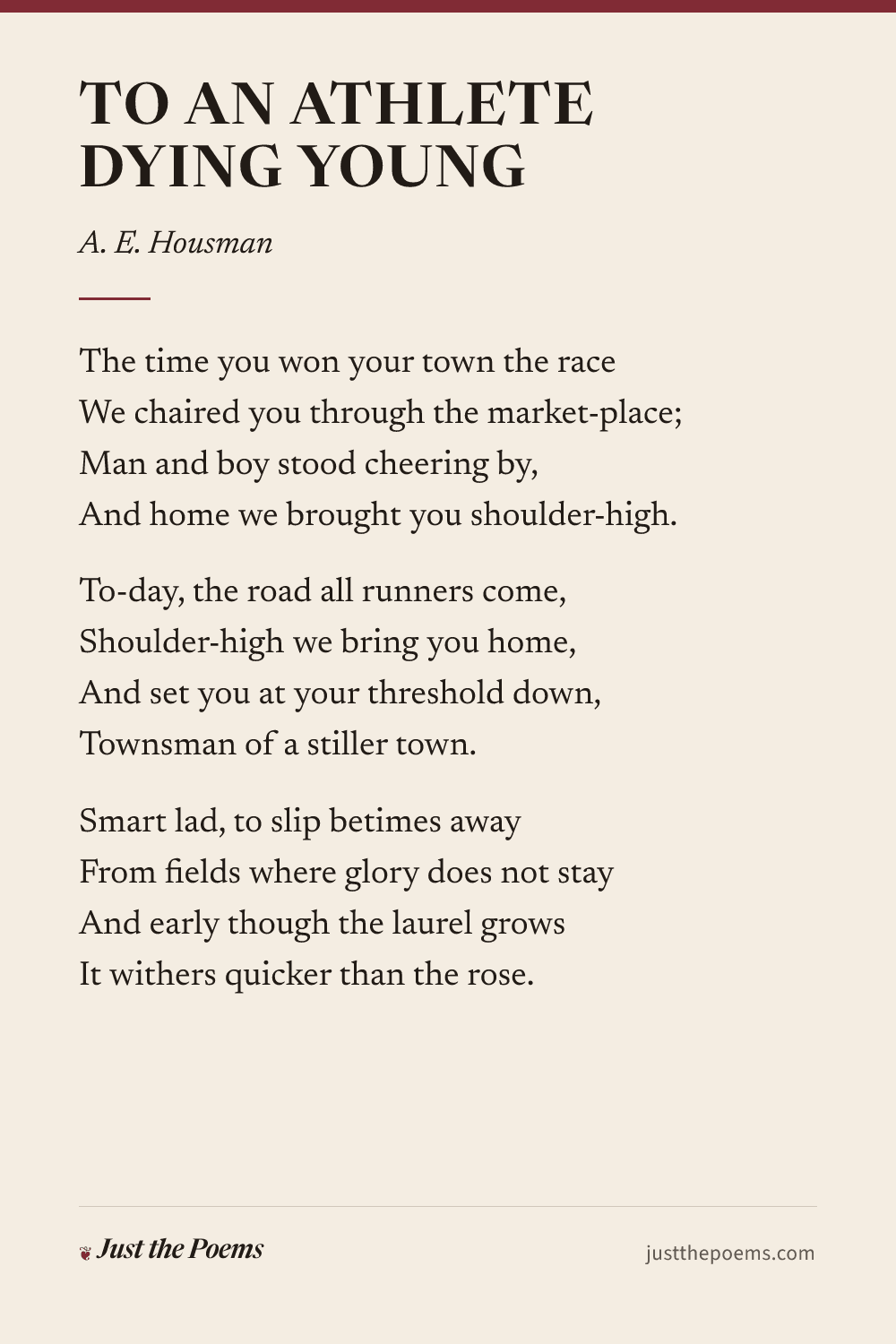
TO AN ATHLETE DYING YOUNG

A. E. Housman

In 1 Wikipedia 0 anthologies Poet in 32 Wikipedias

The time you won your town the raceWe chaired you through the market-place;Man and boy stood cheering by,And home we brought you shoulder-high.

To-day, the road all runners come,Shoulder-high we bring you home,And set you at your threshold down,Townsman of a stiller town.

Smart lad, to slip betimes awayFrom fields where glory does not stayAnd early though the laurel growsIt withers quicker than the rose.

Show all 28 lines 16 more

Eyes the shady night has shutCannot see the record cut,And silence sounds no worse than cheersAfter earth has stopped the ears:

Now you will not swell the routOf lads that wore their honours out,Runners whom renown outranAnd the name died before the man.

So set, before its echoes fade,The fleet foot on the sill of shade,And hold to the low lintel upThe still-defended challenge-cup.

And round that early-laurelled headWill flock to gaze the strengthless dead,And find unwithered on its curlsThe garland briefer than a girl's.

Source

A Shropshire Lad, 1919

Filed under
  • Named in the title

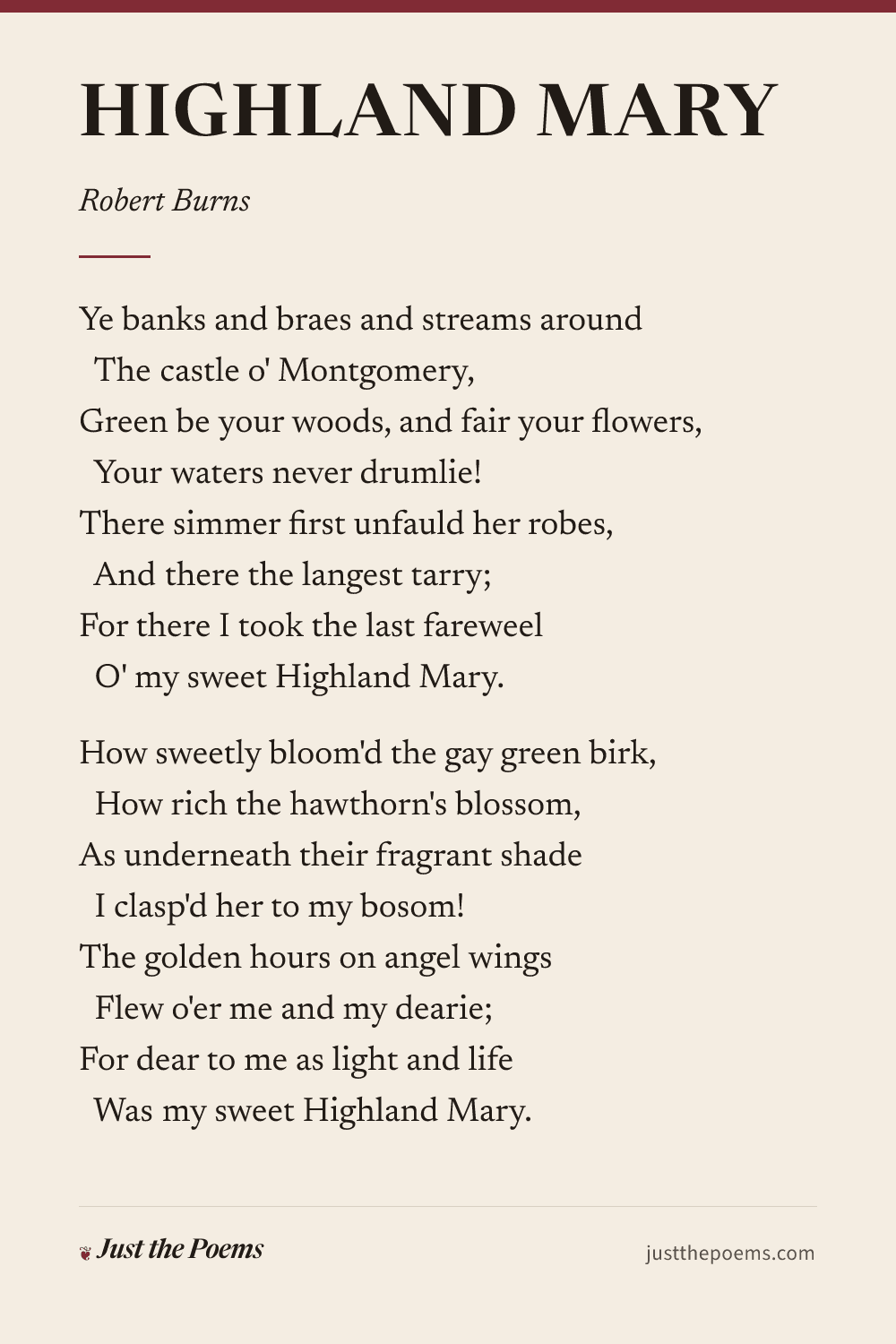
HIGHLAND MARY

Robert Burns

In 0 Wikipedias 5 anthologies Poet in 89 Wikipedias

Ye banks and braes and streams around The castle o' Montgomery,Green be your woods, and fair your flowers, Your waters never drumlie!There simmer first unfauld her robes, And there the langest tarry;For there I took the last fareweel O' my sweet Highland Mary.

How sweetly bloom'd the gay green birk, How rich the hawthorn's blossom,As underneath their fragrant shade I clasp'd her to my bosom!

Show all 32 lines 20 more

The golden hours on angel wings Flew o'er me and my dearie;For dear to me as light and life Was my sweet Highland Mary.

Wi' mony a vow and lock'd embrace Our parting was fu' tender;And pledging aft to meet again, We tore oursels asunder;But O! fell Death's untimely frost, That nipt my flower sae early!Now green's the sod, and cauld's the clay, That wraps my Highland Mary!

O pale, pale now, those rosy lips, I aft hae kiss'd sae fondly!And closed for aye the sparkling glance That dwelt on me sae kindly;And mouldering now in silent dust That heart that lo'ed me dearly!But still within my bosom's core Shall live my Highland Mary.

Source

The Golden Treasury, ed. Francis Turner Palgrave

Filed under
  • Section “DEATH AND BEREAVEMENT”, The World's Best Poetry
  • Section “LOVE AND DEATH”, The Home Book of Verse

FIDELE

William Shakespeare

In 0 Wikipedias 4 anthologies Poet in 237 Wikipedias

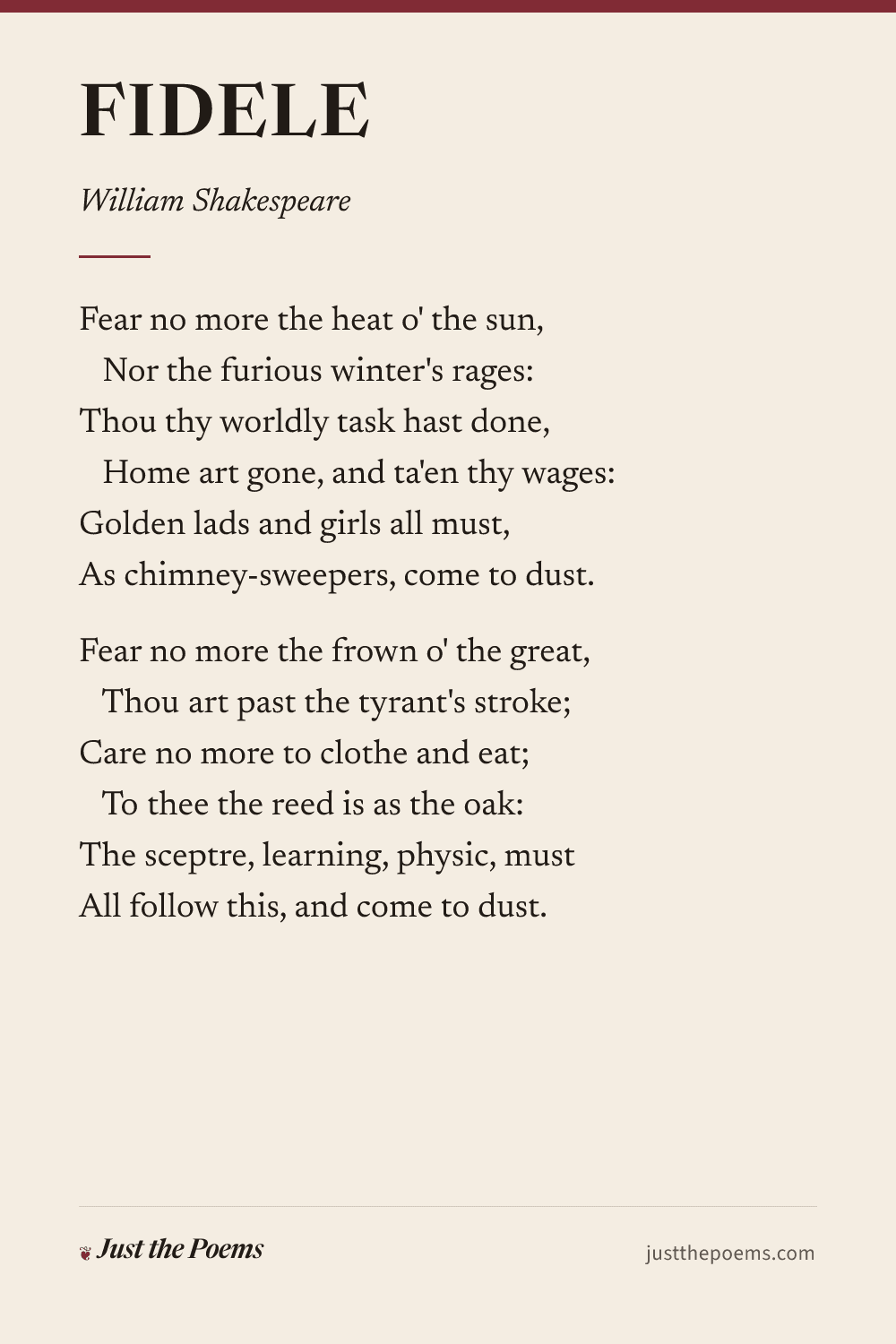
Fear no more the heat o' the sun, Nor the furious winter's rages:Thou thy worldly task hast done, Home art gone, and ta'en thy wages:Golden lads and girls all must,As chimney-sweepers, come to dust.

Fear no more the frown o' the great, Thou art past the tyrant's stroke;Care no more to clothe and eat; To thee the reed is as the oak:The sceptre, learning, physic, mustAll follow this, and come to dust.

Fear no more the lightning flash Nor the all-dreaded thunder-stone;Fear not slander, censure rash; Thou hast finish'd joy and moan:All lovers young, all lovers mustConsign to thee, and come to dust.

Source

The Golden Treasury, ed. Francis Turner Palgrave

Filed under
  • Section “DEATH AND BEREAVEMENT”, The World's Best Poetry

ELEGY WRITTEN IN A COUNTRY CHURCH-YARD

Thomas Gray

In 0 Wikipedias 4 anthologies Poet in 40 Wikipedias

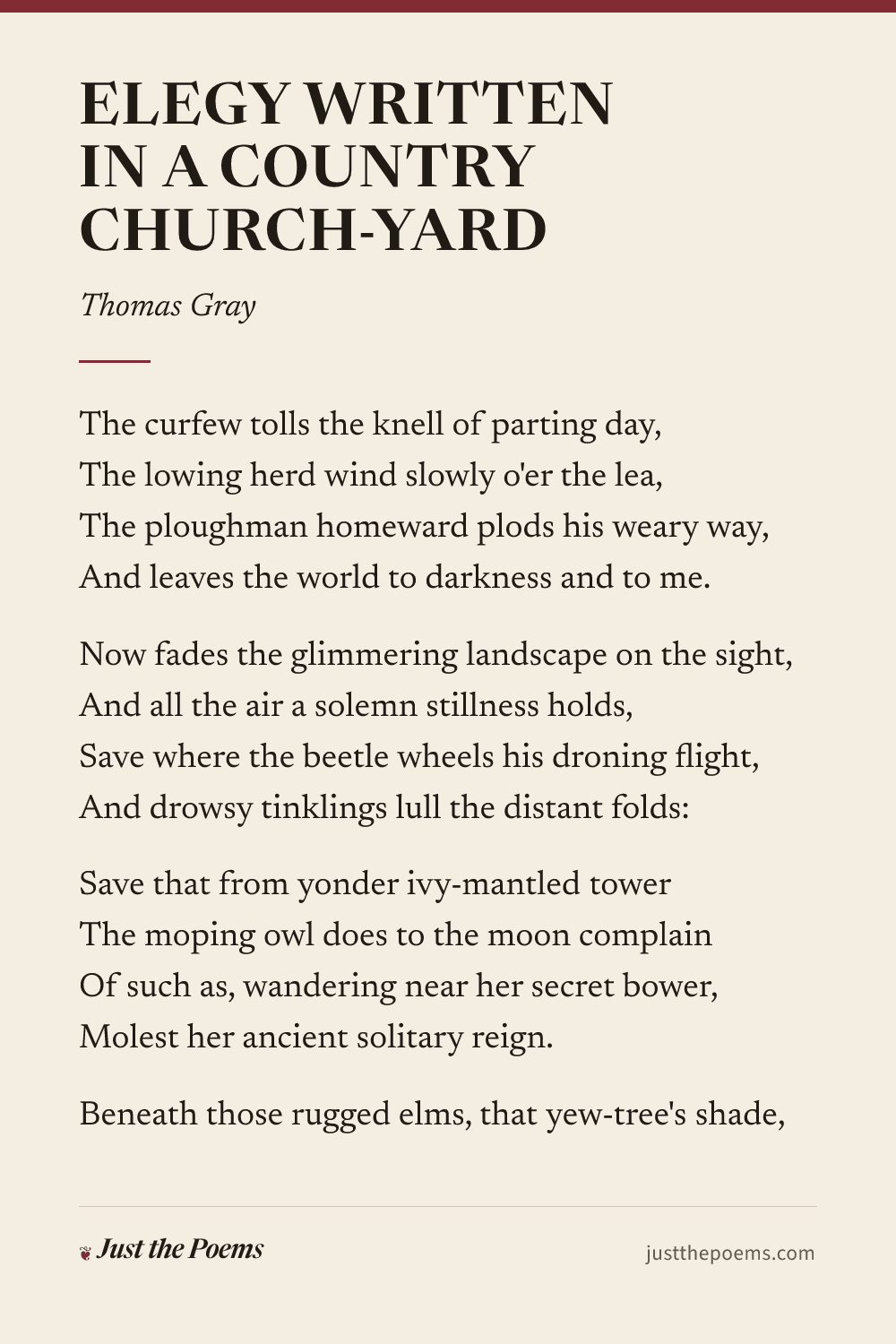
The curfew tolls the knell of parting day,The lowing herd wind slowly o'er the lea,The ploughman homeward plods his weary way,And leaves the world to darkness and to me.

Now fades the glimmering landscape on the sight,And all the air a solemn stillness holds,Save where the beetle wheels his droning flight,And drowsy tinklings lull the distant folds:

Save that from yonder ivy-mantled towerThe moping owl does to the moon complainOf such as, wandering near her secret bower,Molest her ancient solitary reign.

Show all 129 lines 117 more

Beneath those rugged elms, that yew-tree's shade,Where heaves the turf in many a mouldering heap,Each in his narrow cell for ever laid,The rude Forefathers of the hamlet sleep.

The breezy call of incense-breathing morn,The swallow twittering from the straw-built shed,The cock's shrill clarion, or the echoing horn,No more shall rouse them from their lowly bed.

For them no more the blazing hearth shall burnOr busy housewife ply her evening care:No children run to lisp their sire's return,Or climb his knees the envied kiss to share.

Oft did the harvest to their sickle yield,Their furrow oft the stubborn glebe has broke;How jocund did they drive their team afield!How bow'd the woods beneath their sturdy stroke!

Let not Ambition mock their useful toil,Their homely joys, and destiny obscure;Nor Grandeur hear with a disdainful smileThe short and simple annals of the Poor.

The boast of heraldry, the pomp of power,And all that beauty, all that wealth e'er gave,Await alike th' inevitable hour:--The paths of glory lead but to the grave.

Nor you, ye Proud, impute to these the faultIf Memory o'er their tomb no trophies raise,Where through the long-drawn aisle and fretted vault,The pealing anthem swells the note of praise.

Can storied urn or animated bustBack to its mansion call the fleeting breath?Can Honour's voice provoke the silent dust,Or Flattery soothe the dull cold ear of Death?

Perhaps in this neglected spot is laidSome heart once pregnant with celestial fire;Hands, that the rod of empire might have sway'd,Or waked to ecstasy the living lyre:

But Knowledge to their eyes her ample pageRich with the spoils of time, did ne'er unroll;Chill Penury repress'd their noble rage,And froze the genial current of the soul.

Full many a gem of purest ray sereneThe dark unfathom'd caves of ocean bear:Full many a flower is born to blush unseen,And waste its sweetness on the desert air.

Some village-Hampden, that with dauntless breastThe little tyrant of his fields withstood,Some mute inglorious Milton here may rest,Some Cromwell, guiltless of his country's blood.

Th' applause of listening senates to command,The threats of pain and ruin to despise,To scatter plenty o'er a smiling land,And read their history in a nation's eyes

Their lot forbad; nor circumscribed aloneTheir growing virtues, but their crimes confined;Forbad to wade through slaughter to a throne,And shut the gates of mercy on mankind;

The struggling pangs of conscious truth to hide,To quench the blushes of ingenuous shame,Or heap the shrine of Luxury and PrideWith incense kindled at the Muse's flame.

Far from the madding crowd's ignoble strifeTheir sober wishes never learn'd to stray;Along the cool sequester'd vale of lifeThey kept the noiseless tenour of their way.

Yet e'en these bones from insult to protectSome frail memorial still erected nigh,With uncouth rhymes and shapeless sculpture deck'd,Implores the passing tribute of a sigh.

Their name, their years, spelt by the unletter'd Muse,The place of fame and elegy supply:And many a holy text around she strews,That teach the rustic moralist to die.

For who, to dumb forgetfulness a prey,This pleasing anxious being e'er resign'd,Left the warm precincts of the cheerful day,Nor cast one longing, lingering look behind?

On some fond breast the parting soul relies,Some pious drops the closing eye requires;E'en from the tomb the voice of Nature cries,E'en in our ashes live their wonted fires.

For thee, who, mindful of th' unhonour'd dead,Dost in those lines their artless tale relate;If chance, by lonely Contemplation led,Some kindred spirit shall inquire thy fate,--

Haply some hoary-headed swain may say,Oft have we seen him at the peep of dawn,Brushing with hasty steps the dews away,To meet the sun upon the upland lawn;

There, at the foot of yonder nodding beechThat wreathes its old fantastic roots so high,His listless length at noon-tide would he stretch,And pore upon the brook that babbles by.

Hard by yon wood, now smiling as in scorn,Muttering his wayward fancies he would rove;Now drooping, woeful-wan, like one forlorn,Or crazed with care, or cross'd in hopeless love.

One morn I miss'd him on the custom'd hill,Along the heath, and near his favourite tree;Another came; nor yet beside the rill,Nor up the lawn, nor at the wood was he;

The next with dirges due in sad array,Slow through the church-way path we saw him borne,--Approach, and read (for thou canst read) the layGraved on the stone beneath yon aged thorn.

THE EPITAPH.

Here rests his head upon the lap of EarthA Youth, to Fortune and to Fame unknown;Fair Science frown'd not on his humble birth,And Melancholy mark'd him for her own.

Large was his bounty, and his soul sincere;Heaven did a recompense as largely send:He gave to Misery all he had, a tear,He gain'd from Heaven, 'twas all he wish'd, a friend.

No farther seek his merits to disclose,Or draw his frailties from their dread abode,(There they alike in trembling hope repose),The bosom of his Father and his God.
Source

The Golden Treasury, ed. Francis Turner Palgrave

Filed under
  • Section “DEATH AND BEREAVEMENT”, The World's Best Poetry

Life! I know not what thou art,

Anna Laetitia Barbauld

In 0 Wikipedias 4 anthologies Poet in 27 Wikipedias

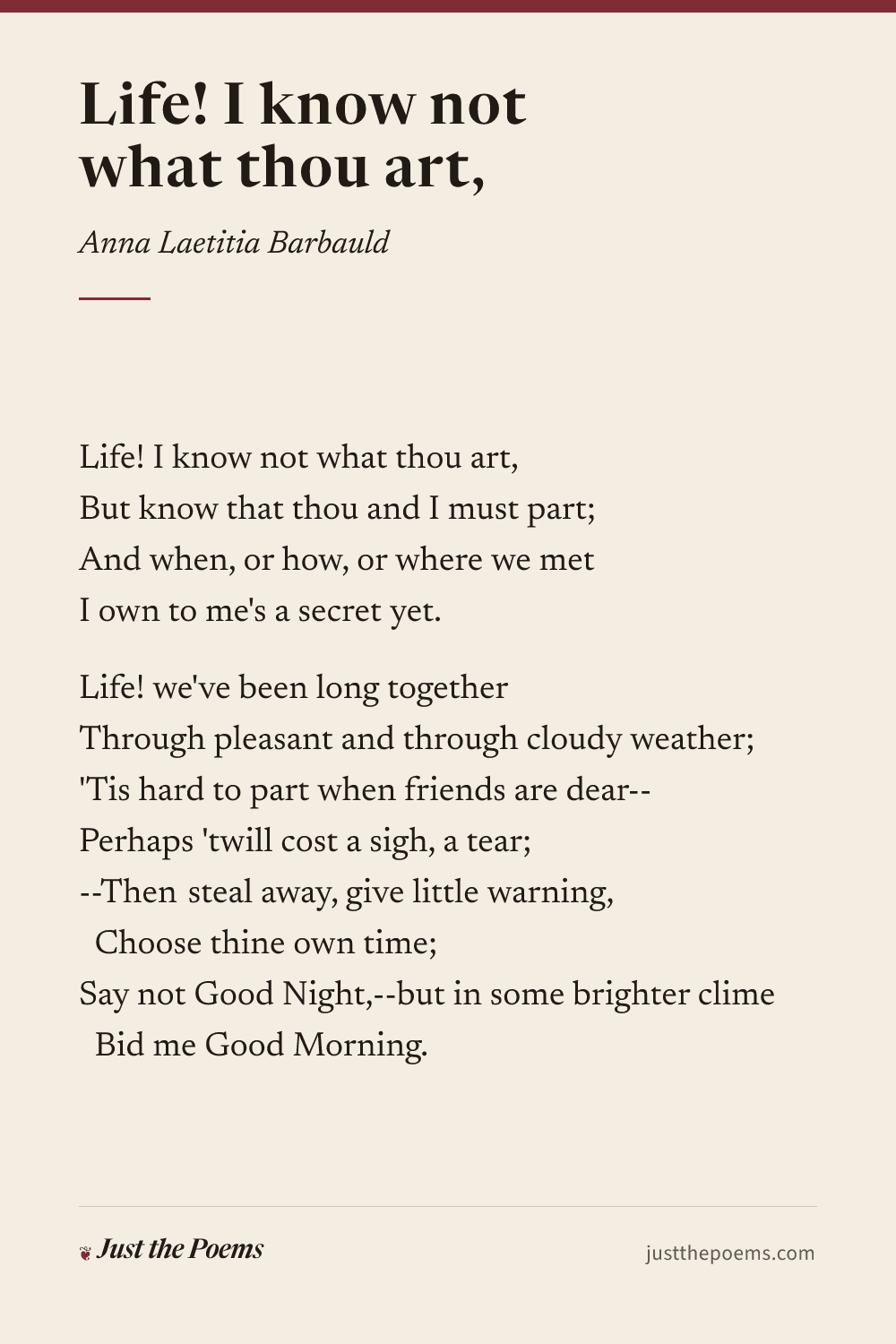
Life! I know not what thou art,But know that thou and I must part;And when, or how, or where we metI own to me's a secret yet.

Life! we've been long togetherThrough pleasant and through cloudy weather;'Tis hard to part when friends are dear--Perhaps 'twill cost a sigh, a tear;--Then steal away, give little warning, Choose thine own time;Say not Good Night,--but in some brighter clime Bid me Good Morning.

Source

The Golden Treasury, ed. Francis Turner Palgrave

Filed under
  • Section “DEATH AND BEREAVEMENT”, The World's Best Poetry

THE DEATH BED

Thomas Hood

In 0 Wikipedias 4 anthologies Poet in 20 Wikipedias

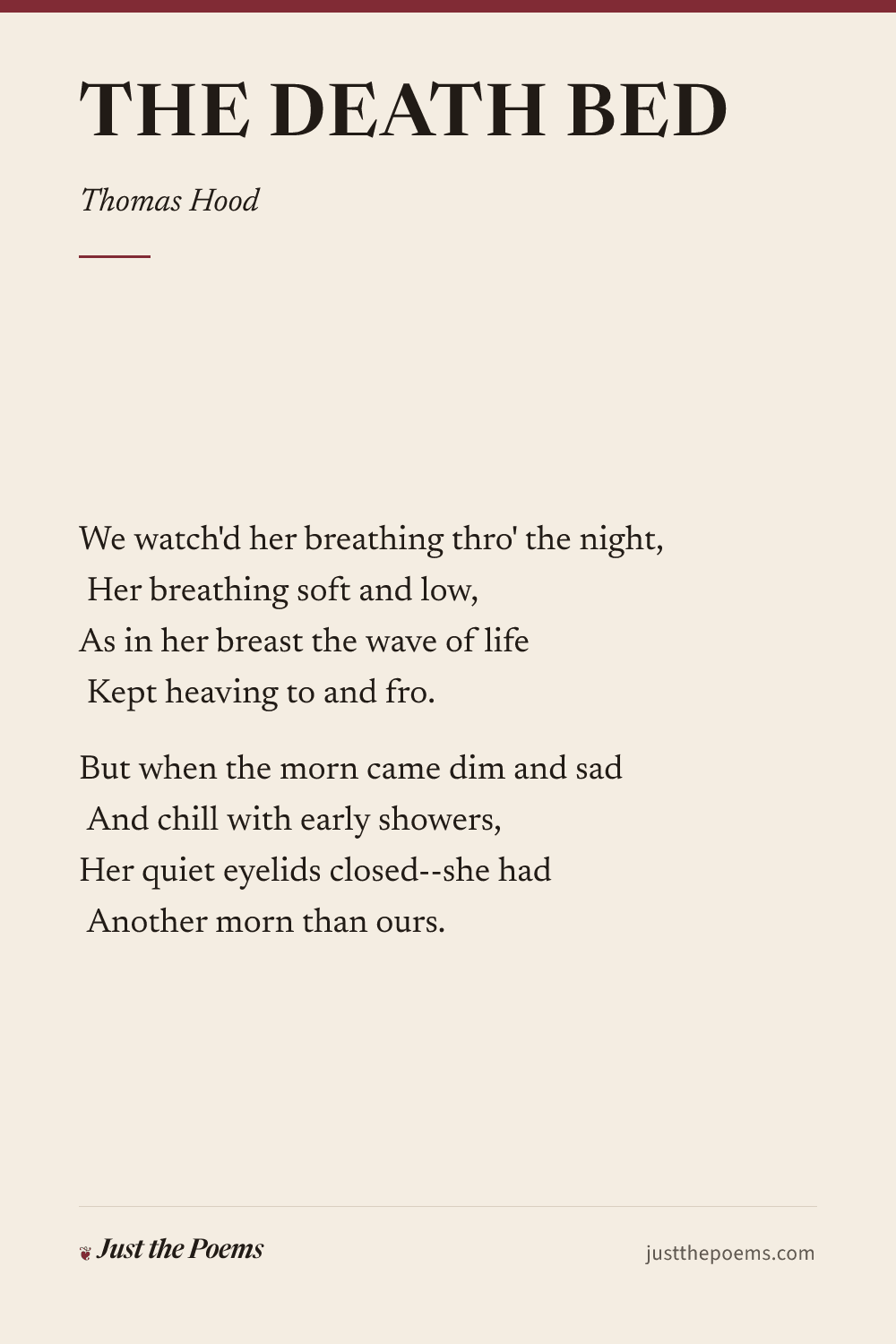
We watch'd her breathing thro' the night, Her breathing soft and low,As in her breast the wave of life Kept heaving to and fro.

But when the morn came dim and sad And chill with early showers,Her quiet eyelids closed--she had Another morn than ours.

Source

The Golden Treasury, ed. Francis Turner Palgrave

Filed under
  • Section “DEATH AND BEREAVEMENT”, The World's Best Poetry
  • Named in the title

DEATH THE LEVELLER

James Shirley

In 0 Wikipedias 4 anthologies Poet in 14 Wikipedias

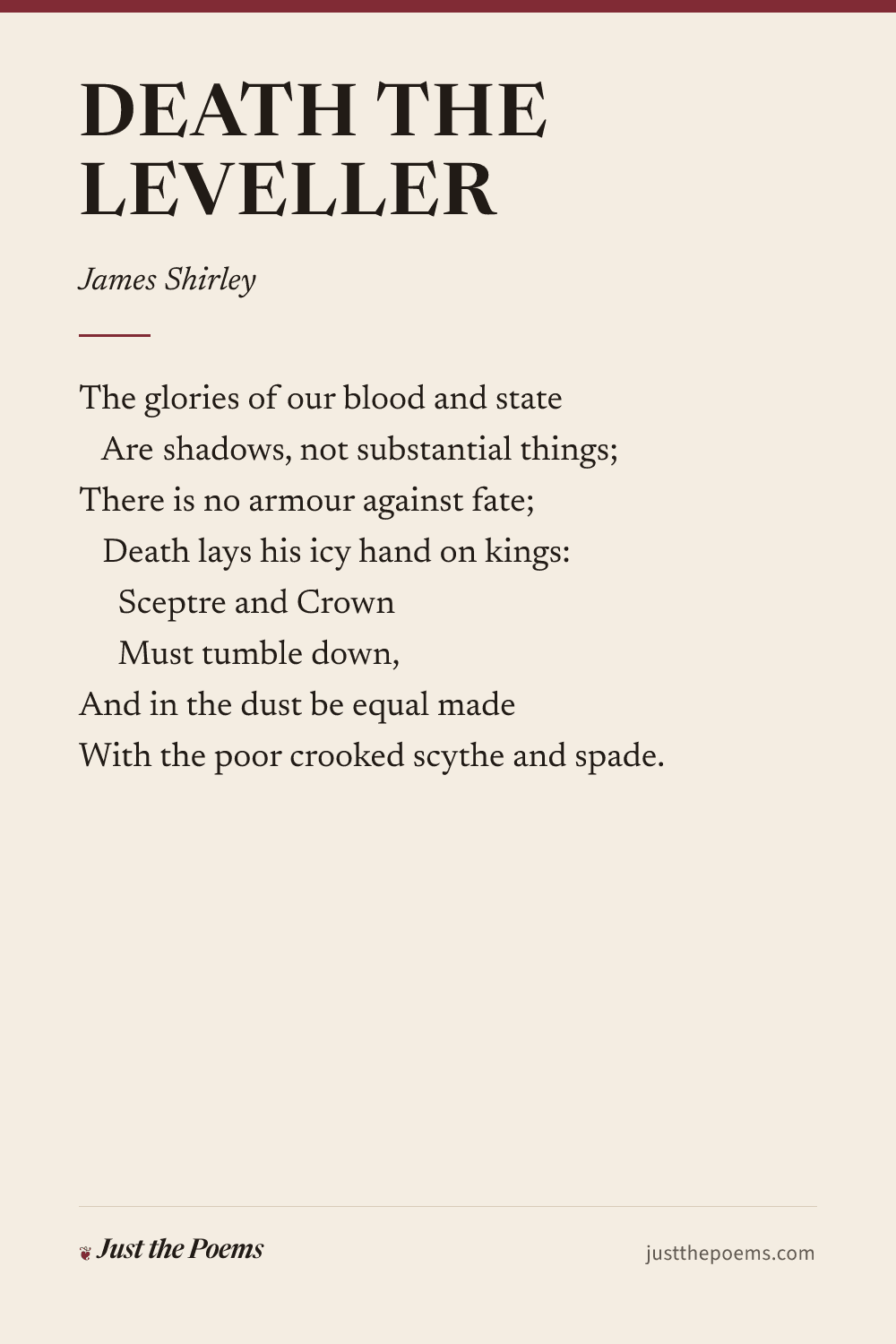
The glories of our blood and state Are shadows, not substantial things;There is no armour against fate; Death lays his icy hand on kings: Sceptre and Crown Must tumble down,And in the dust be equal madeWith the poor crooked scythe and spade.

Some men with swords may reap the field, And plant fresh laurels where they kill:But their strong nerves at last must yield; They tame but one another still: Early or late They stoop to fate,And must give up their murmuring breathWhen they, pale captives, creep to death.

The garlands wither on your brow; Then boast no more your mighty deeds;Upon Death's purple altar now See where the victor-victim bleeds: Your heads must come To the cold tomb;Only the actions of the justSmell sweet, and blossom in their dust.

Source

The Golden Treasury, ed. Francis Turner Palgrave

Filed under
  • Section “DEATH AND BEREAVEMENT”, The World's Best Poetry
  • Named in the title

FAIR HELEN

Anonymous

In 0 Wikipedias 4 anthologies Poet in 0 Wikipedias

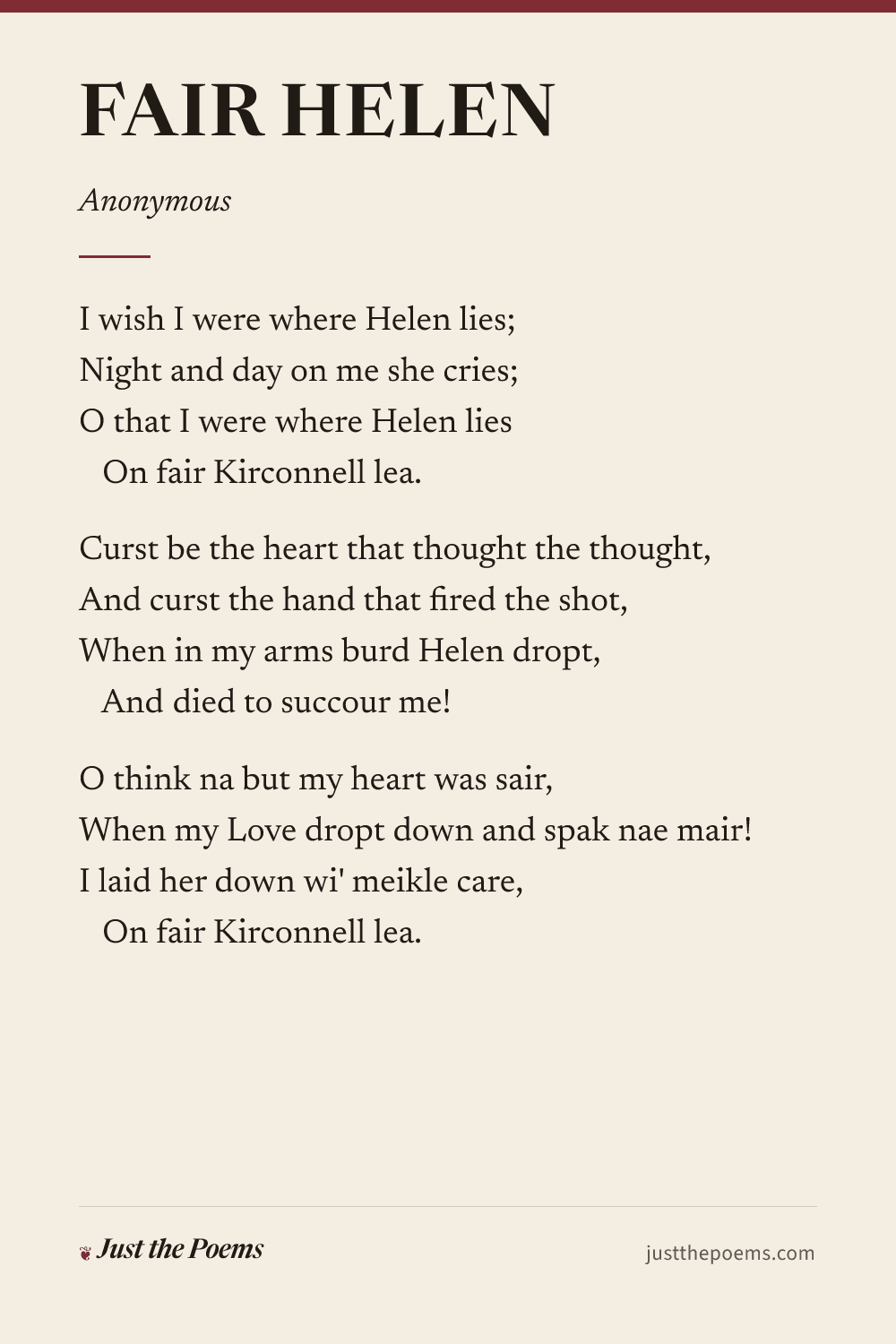
I wish I were where Helen lies;Night and day on me she cries;O that I were where Helen lies On fair Kirconnell lea.

Curst be the heart that thought the thought,And curst the hand that fired the shot,When in my arms burd Helen dropt, And died to succour me!

O think na but my heart was sair,When my Love dropt down and spak nae mair!I laid her down wi' meikle care, On fair Kirconnell lea.

Show all 40 lines 28 more

As I went down the water side,None but my foe to be my guide,None but my foe to be my guide, On fair Kirconnell lea;

I lighted down my sword to draw,I hacked him in pieces sma',I hacked him in pieces sma', For her sake that died for me.

O Helen fair, beyond compare!I'll make a garland of thy hairShall bind my heart for evermair Until the day I die.

O that I were where Helen lies!Night and day on me she cries;Out of my bed she bids me rise, Says, "Haste, and come to me!"

O Helen fair! O Helen chaste!If I were with thee, I were blest,Where thou lies low and takes thy rest On fair Kirconnell lea.

I wish my grave were growing green,A winding-sheet drawn ower my een,And I in Helen's arms lying, On fair Kirconnell lea.

I wish I were where Helen lies;Night and day on me she cries;And I am weary of the skies, Since my Love died for me.

Source

The Golden Treasury, ed. Francis Turner Palgrave

Filed under
  • Section “DEATH AND BEREAVEMENT”, The World's Best Poetry
  • Section “LOVE AND DEATH”, The Home Book of Verse

Annabel Lee

Edgar Allan Poe

In 0 Wikipedias 3 anthologies Poet in 153 Wikipedias

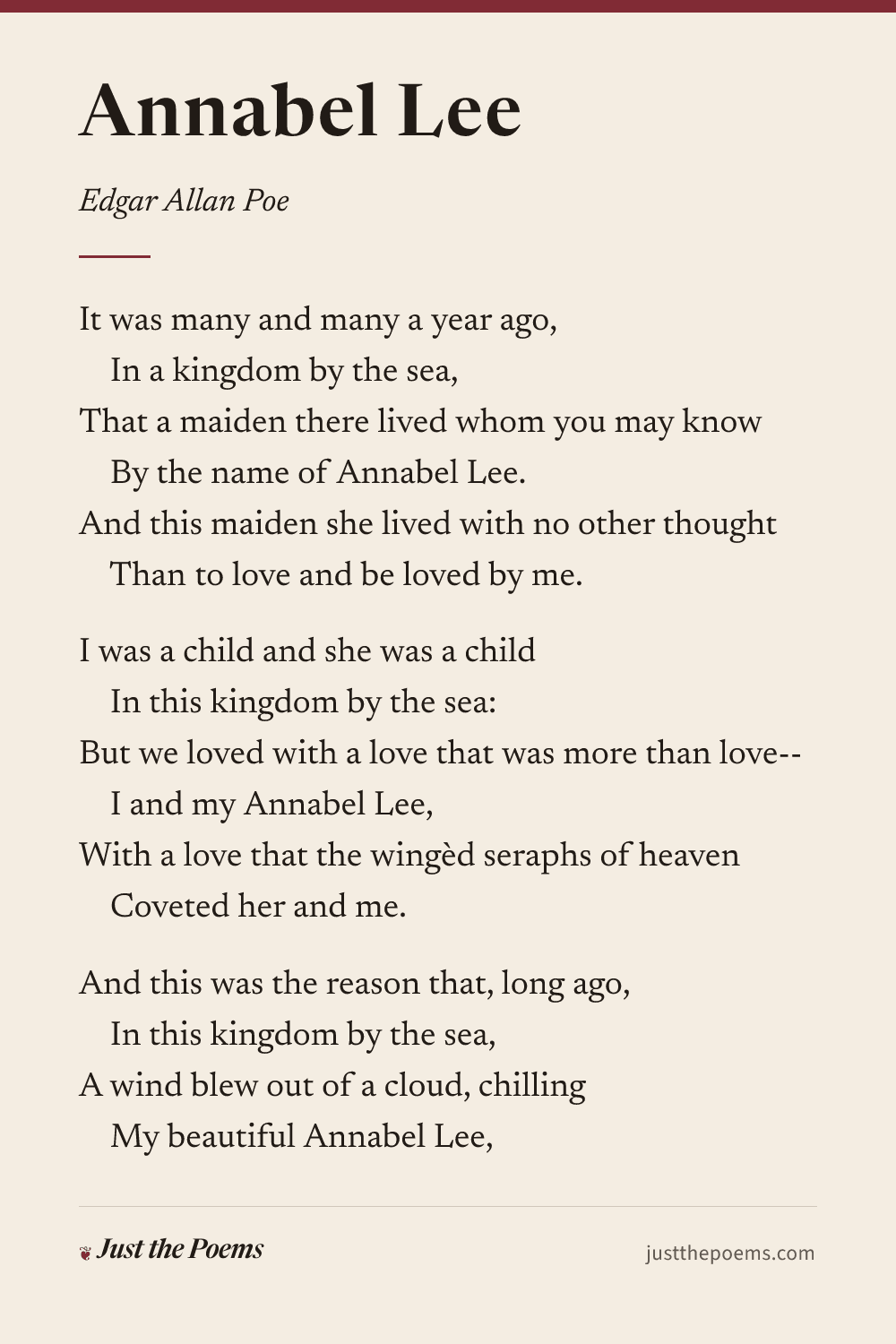
It was many and many a year ago, In a kingdom by the sea,That a maiden there lived whom you may know By the name of Annabel Lee.And this maiden she lived with no other thought Than to love and be loved by me.

I was a child and she was a child In this kingdom by the sea:But we loved with a love that was more than love-- I and my Annabel Lee,With a love that the wingèd seraphs of heaven Coveted her and me.

Show all 41 lines 29 more

And this was the reason that, long ago, In this kingdom by the sea,A wind blew out of a cloud, chilling My beautiful Annabel Lee,So that her high-born kinsmen came And bore her away from me,To shut her up in a sepulchre In this kingdom by the sea.

The angels, not half so happy in heaven, Went envying her and me--Yes! that was the reason (as all men know, In this kingdom by the sea)That the wind came out of the cloud one night, Chilling and killing my Annabel Lee.

But our love it was stronger by far than the love Of those who were older than we-- Of many far wiser than we--And neither the angels in heaven above, Nor the demons down under the sea,Can ever dissever my soul from the soul Of the beautiful Annabel Lee:

For the moon never beams without bringing me dreams Of the beautiful Annabel Lee;And the stars never rise, but I feel the bright eyes Of the beautiful Annabel Lee;And so, all the night-tide, I lie down by the sideOf my darling--my darling--my life and my bride, In the sepulchre there by the sea, In her tomb by the sounding sea.

Source

The Oxford Book of English Verse 1250–1900, 1900

Filed under
  • Section “LOVE AND DEATH”, The Home Book of Verse

For Annie

Edgar Allan Poe

In 0 Wikipedias 3 anthologies Poet in 153 Wikipedias

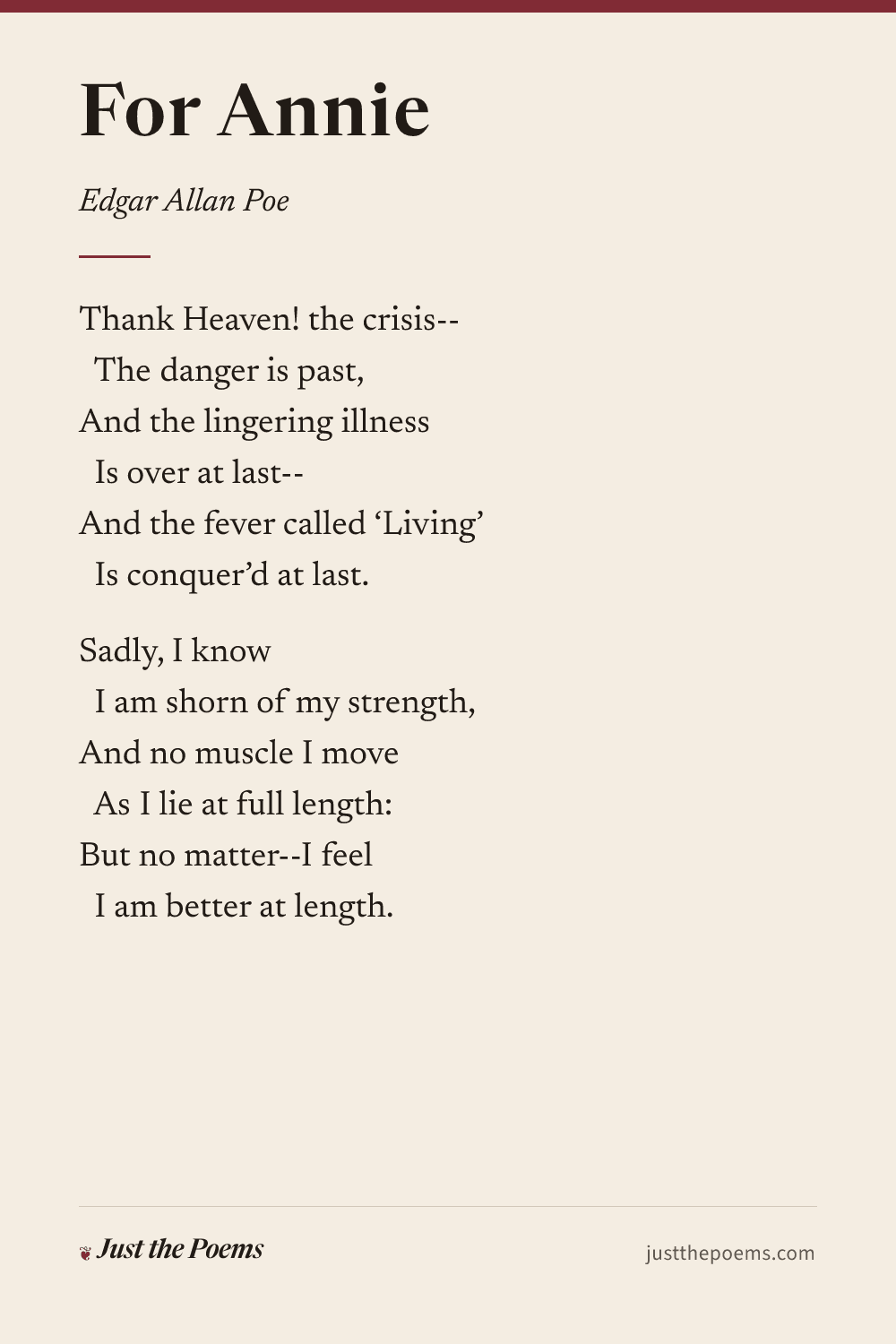
Thank Heaven! the crisis-- The danger is past,And the lingering illness Is over at last--And the fever called ‘Living’ Is conquer’d at last.

Sadly, I know I am shorn of my strength,And no muscle I move As I lie at full length:But no matter--I feel I am better at length.

Show all 102 lines 90 more

And I rest so composedly Now, in my bed,That any beholder Might fancy me dead--Might start at beholding me, Thinking me dead.

The moaning and groaning, The sighing and sobbing,Are quieted now, With that horrible throbbingAt heart--ah, that horrible, Horrible throbbing!

The sickness--the nausea-- The pitiless pain--Have ceased, with the fever That madden’d my brain--With the fever called ‘Living’ That burn’d in my brain.

And O! of all tortures That torture the worstHas abated--the terrible Torture of thirstFor the naphthaline river Of Passion accurst--I have drunk of a water That quenches all thirst.

--Of a water that flows, With a lullaby sound,From a spring but a very few Feet under ground--From a cavern not very far Down under ground.

And ah! let it never Be foolishly saidThat my room it is gloomy, And narrow my bed;For man never slept In a different bed--And, to sleep, you must slumber In just such a bed.

My tantalized spirit Here blandly reposes,Forgetting, or never Regretting its roses--Its old agitations Of myrtles and roses:

For now, while so quietly Lying, it fanciesA holier odour About it, of pansies--A rosemary odour, Commingled with pansies--With rue and the beautiful Puritan pansies.

And so it lies happily, Bathing in manyA dream of the truth And the beauty of Annie--Drown’d in a bath Of the tresses of Annie.

She tenderly kiss’d me, She fondly caress’d,And then I fell gently To sleep on her breast--Deeply to sleep From the heaven of her breast.

When the light was extinguish’d, She cover’d me warm,And she pray’d to the angels To keep me from harm--To the queen of the angels To shield me from harm.

And I lie so composedly, Now, in my bed(Knowing her love), That you fancy me dead--And I rest so contentedly, Now, in my bed(With her love at my breast), That you fancy me dead--That you shudder to look at me, Thinking me dead.

But my heart it is brighter Than all of the manyStars in the sky, For it sparkles with Annie--It glows with the light Of the love of my Annie--With the thought of the light Of the eyes of my Annie.

Source

The Oxford Book of English Verse 1250–1900, 1900

Filed under
  • Section “DEATH AND BEREAVEMENT”, The World's Best Poetry
  • Section “LOVE AND DEATH”, The Home Book of Verse

THE PRIDE OF YOUTH

Sir Walter Scott

In 0 Wikipedias 3 anthologies Poet in 98 Wikipedias

Proud Maisie is in the wood, Walking so early;Sweet Robin sits on the bush, Singing so rarely.

"Tell me, thou bonny bird, When shall I marry me?"--"When six braw gentlemen Kirkward shall carry ye."

"Who makes the bridal bed, Birdie, say truly?"--"The gray-headed sexton That delves the grave duly.

"The glowworm o'er grave and stone Shall light thee steady;The owl from the steeple sing Welcome, proud lady!"

Source

The Golden Treasury, ed. Francis Turner Palgrave

Filed under
  • Section “LOVE AND DEATH”, The Home Book of Verse

THE TERROR OF DEATH

John Keats

In 0 Wikipedias 3 anthologies Poet in 97 Wikipedias

When I have fears that I may cease to beBefore my pen has glean'd my teeming brain,Before high-piled books, in charact'ry,Hold like rich garners the full-ripen'd grain;

When I behold, upon the night's starr'd face,Huge cloudy symbols of a high romance,And think that I may never live to traceTheir shadows, with the magic hand of chance;

And when I feel, fair Creature of an hour!That I shall never look upon thee more,Never have relish in the fairy powerOf unreflecting love--then on the shore

Of the wide world I stand alone, and think,Till Love and Fame to nothingness do sink.

Source

The Golden Treasury, ed. Francis Turner Palgrave

Filed under
  • Named in the title

HOME THEY BROUGHT HER WARRIOR DEAD

Alfred, Lord Tennyson

In 0 Wikipedias 3 anthologies Poet in 72 Wikipedias

Home they brought her warrior dead: She nor swooned, nor uttered cry;All her maidens, watching, said, "She must weep or she will die."

Then they praised him, soft and low, Called him worthy to be loved,Truest friend and noblest foe; Yet she neither spoke nor moved.

Stole a maiden from her place, Lightly to the warrior stept,Took the face-cloth from the face; Yet she neither moved nor wept.

Rose a nurse of ninety years, Set his child upon her knee,--Like summer tempest came her tears, "Sweet my child, I live for thee."

Source

The World's Best Poetry, Vol. III, ed. Bliss Carman, 1904

Filed under
  • Section “DEATH AND BEREAVEMENT”, The World's Best Poetry
  • Section “LOVE AND DEATH”, The Home Book of Verse
  • Named in the title

Requiescat

Matthew Arnold

In 0 Wikipedias 3 anthologies Poet in 50 Wikipedias

Strew on her roses, roses, And never a spray of yew.In quiet she reposes: Ah! would that I did too.

Her mirth the world required: She bathed it in smiles of glee.But her heart was tired, tired, And now they let her be.

Her life was turning, turning, In mazes of heat and sound.But for peace her soul was yearning, And now peace laps her round.

Her cabin’d, ample Spirit, It flutter’d and fail’d for breath.To-night it doth inherit The vasty hall of Death.

Source

The Oxford Book of English Verse 1250–1900, 1900

Filed under
  • Section “DEATH AND BEREAVEMENT”, The World's Best Poetry
  • Section “LOVE AND DEATH”, The Home Book of Verse

Virtue

George Herbert

In 0 Wikipedias 3 anthologies Poet in 37 Wikipedias

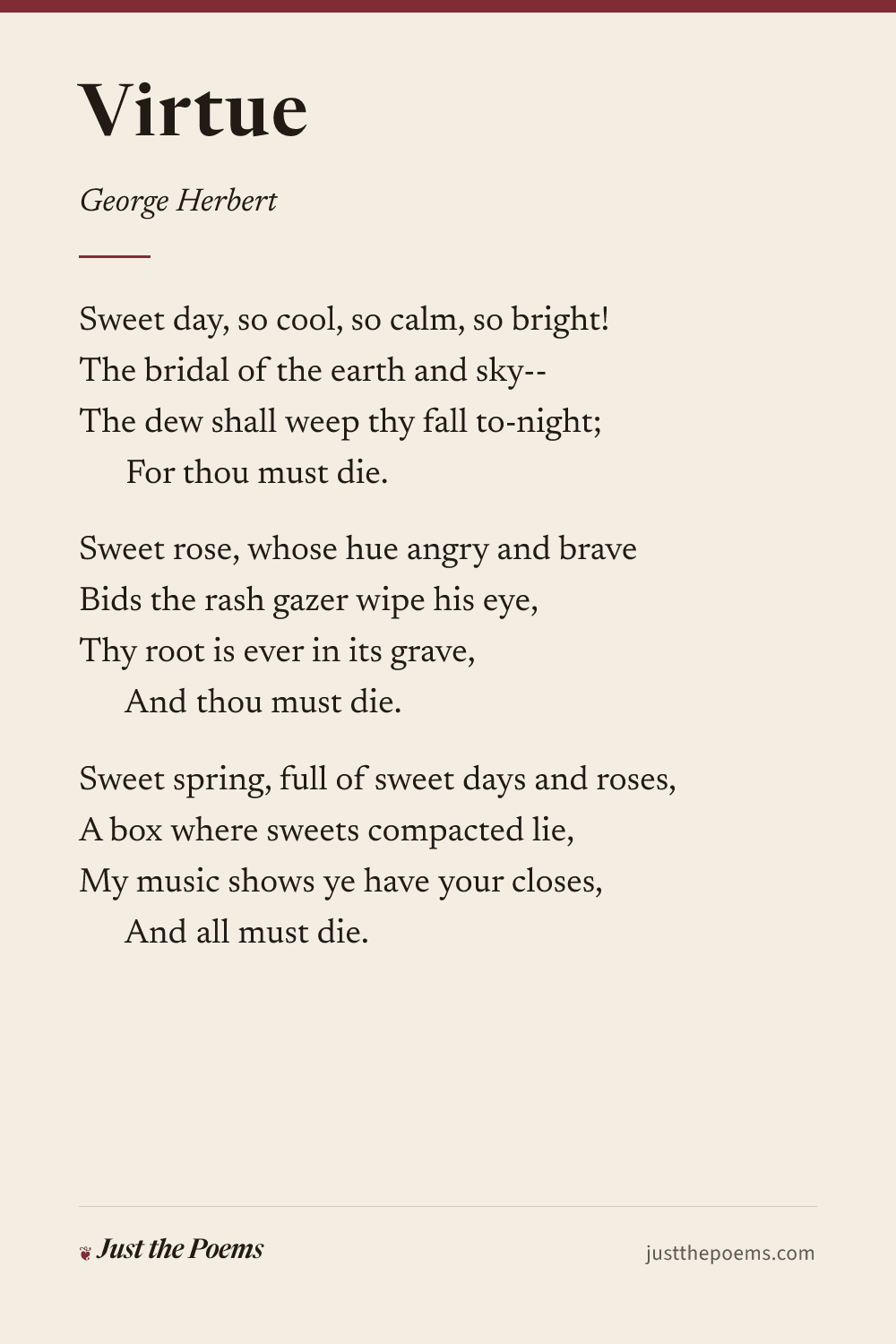
Sweet day, so cool, so calm, so bright!The bridal of the earth and sky--The dew shall weep thy fall to-night; For thou must die.

Sweet rose, whose hue angry and braveBids the rash gazer wipe his eye,Thy root is ever in its grave, And thou must die.

Sweet spring, full of sweet days and roses,A box where sweets compacted lie,My music shows ye have your closes, And all must die.

Only a sweet and virtuous soul,Like season’d timber, never gives;But though the whole world turn to coal, Then chiefly lives.

Source

The Oxford Book of English Verse 1250–1900, 1900

Filed under
  • Section “DEATH AND BEREAVEMENT”, The World's Best Poetry

THE TOMBS IN WESTMINSTER ABBEY

Francis Beaumont

In 0 Wikipedias 3 anthologies Poet in 33 Wikipedias

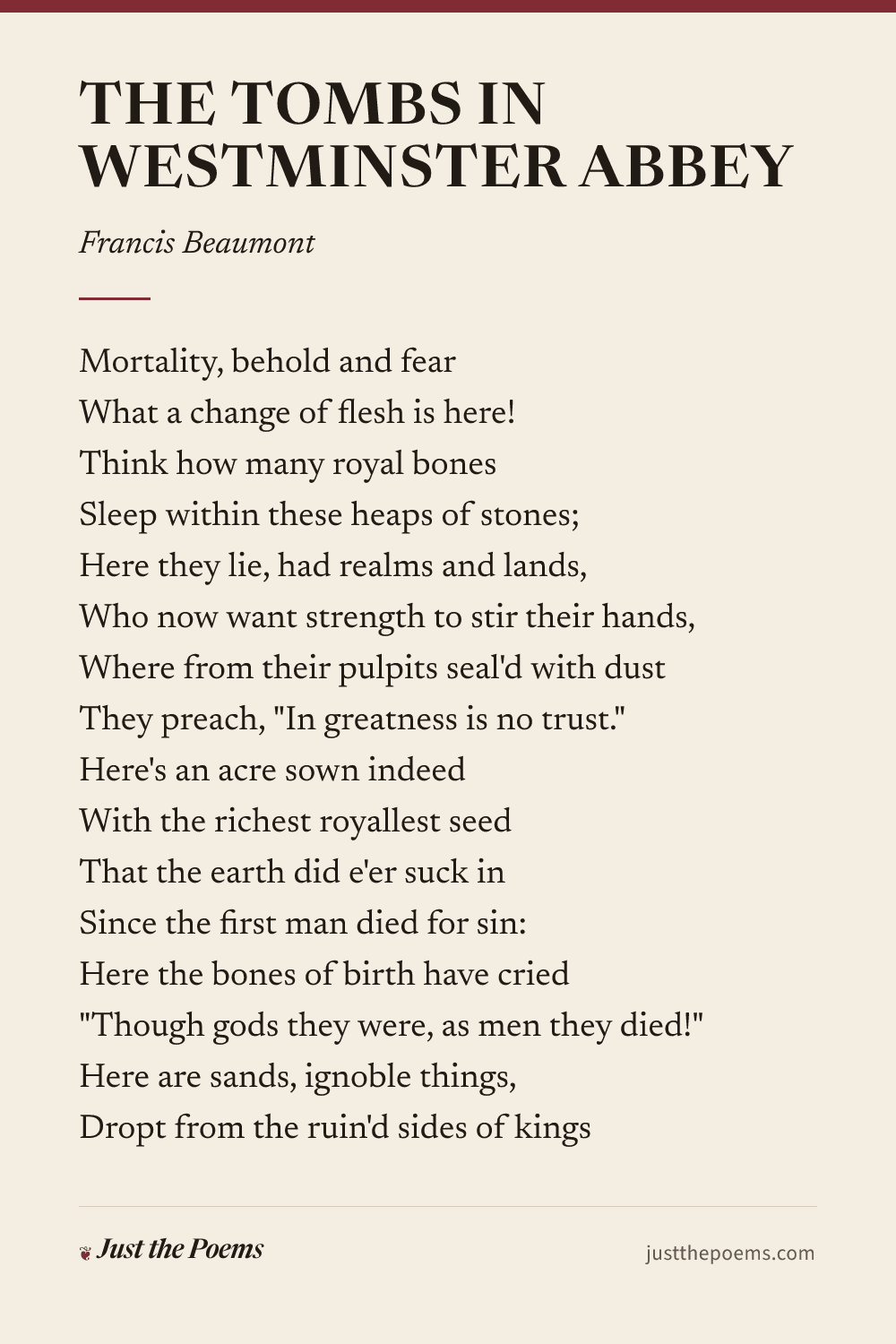
Mortality, behold and fearWhat a change of flesh is here!Think how many royal bonesSleep within these heaps of stones;Here they lie, had realms and lands,Who now want strength to stir their hands,Where from their pulpits seal'd with dustThey preach, "In greatness is no trust."Here's an acre sown indeedWith the richest royallest seedThat the earth did e'er suck inSince the first man died for sin:Here the bones of birth have cried"Though gods they were, as men they died!"Here are sands, ignoble things,Dropt from the ruin'd sides of kingsHere's a world of pomp and stateBuried in dust, once dead by fate.

Source

The Golden Treasury, ed. Francis Turner Palgrave

Filed under
  • Section “DEATH AND BEREAVEMENT”, The World's Best Poetry

THE FIRST SNOW-FALL

James Russell Lowell

In 0 Wikipedias 3 anthologies Poet in 31 Wikipedias

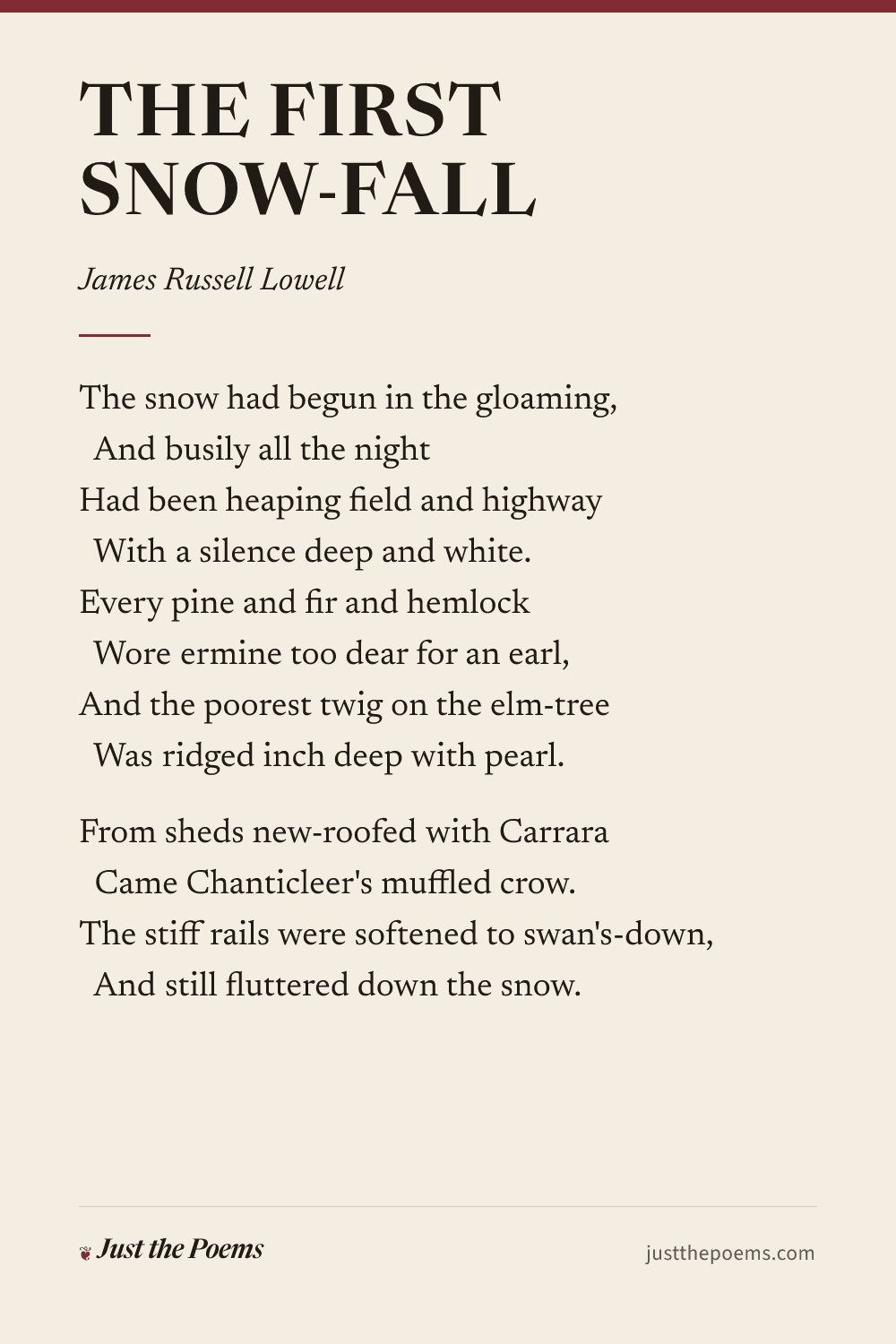
The snow had begun in the gloaming, And busily all the nightHad been heaping field and highway With a silence deep and white.Every pine and fir and hemlock Wore ermine too dear for an earl,And the poorest twig on the elm-tree Was ridged inch deep with pearl.

From sheds new-roofed with Carrara Came Chanticleer's muffled crow.The stiff rails were softened to swan's-down, And still fluttered down the snow.

Show all 40 lines 28 more

I stood and watched by the window The noiseless work of the sky,And the sudden flurries of snow-birds, Like brown leaves whirling by.

I thought of a mound in sweet Auburn Where a little headstone stood;How the flakes were folding it gently, As did robins the babes in the wood.

Up spoke our own little Mabel, Saying, "Father, who makes it snow?"And I told of the good All-father Who cares for us here below.

Again I looked at the snow-fall, And thought of the leaden skyThat arched o'er our first great sorrow, When that mound was heaped so high.

I remember the gradual patience That fell from that cloud like snow,Flake by flake, healing and hiding The scar of our deep-plunged woe.

And again to the child I whispered, "The snow that husheth all,Darling, the merciful Father Alone can make it fall!"

Then, with eyes that saw not, I kissed her; And she, kissing back, could not knowThat my kiss was given to her sister, Folded close under deepening snow.

Source

The World's Best Poetry, Vol. III, ed. Bliss Carman, 1904

Filed under
  • Section “DEATH AND BEREAVEMENT”, The World's Best Poetry

The Maid’s Lament

Walter Savage Landor

In 0 Wikipedias 3 anthologies Poet in 24 Wikipedias

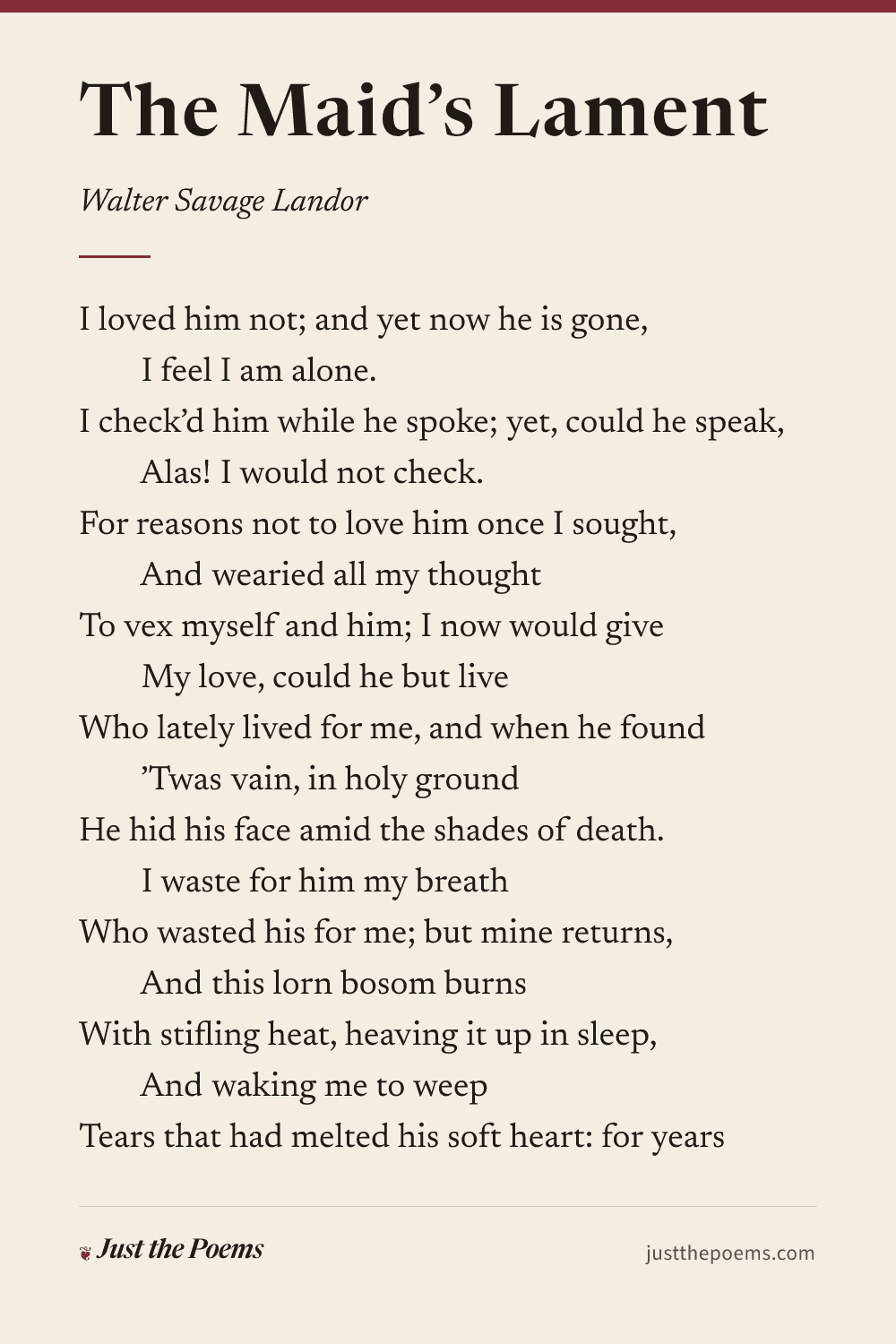
I loved him not; and yet now he is gone, I feel I am alone.I check’d him while he spoke; yet, could he speak, Alas! I would not check.For reasons not to love him once I sought, And wearied all my thoughtTo vex myself and him; I now would give My love, could he but liveWho lately lived for me, and when he found ’Twas vain, in holy groundHe hid his face amid the shades of death. I waste for him my breath

Show all 26 lines 14 more

Who wasted his for me; but mine returns, And this lorn bosom burnsWith stifling heat, heaving it up in sleep, And waking me to weepTears that had melted his soft heart: for years Wept he as bitter tears.‘Merciful God!’ such was his latest prayer, ‘These may she never share!’Quieter is his breath, his breast more cold Than daisies in the mould,Where children spell, athwart the churchyard gate, His name and life’s brief date.Pray for him, gentle souls, whoe’er you be, And, O, pray too for me!

Source

The Oxford Book of English Verse 1250–1900, 1900

Filed under
  • Section “LOVE AND DEATH”, The Home Book of Verse

Lament of the Irish Emigrant

Helen Selina, Lady Dufferin

In 0 Wikipedias 3 anthologies Poet in 3 Wikipedias

I’m sittin’ on the stile, Mary, Where we sat side by sideOn a bright May mornin’ long ago, When first you were my bride;The corn was springin’ fresh and green, And the lark sang loud and high--And the red was on your lip, Mary, And the love-light in your eye.

The place is little changed, Mary, The day is bright as then,The lark’s loud song is in my ear, And the corn is green again;

Show all 64 lines 52 more

But I miss the soft clasp of your hand, And your breath warm on my cheek,And I still keep list’ning for the words You never more will speak.

’Tis but a step down yonder lane, And the little church stands near,The church where we were wed, Mary, I see the spire from here.But the graveyard lies between, Mary, And my step might break your rest--For I’ve laid you, darling! down to sleep, With your baby on your breast.

I’m very lonely now, Mary, For the poor make no new friends,But, O, they love the better still, The few our Father sends!And you were all I had, Mary, My blessin’ and my pride:There’s nothin’ left to care for now, Since my poor Mary died.

Yours was the good, brave heart, Mary, That still kept hoping on,When the trust in God had left my soul, And my arm’s young strength was gone:There was comfort ever on your lip, And the kind look on your brow--I bless you, Mary, for that same, Though you cannot hear me now.

I thank you for the patient smile When your heart was fit to break,When the hunger pain was gnawin’ there, And you hid it, for my sake!I bless you for the pleasant word, When your heart was sad and sore--O, I’m thankful you are gone, Mary, Where grief can’t reach you more!

I’m biddin’ you a long farewell, My Mary--kind and true!But I’ll not forget you, darling! In the land I’m goin’ to;They say there’s bread and work for all, And the sun shines always there--But I’ll not forget old Ireland, Were it fifty times as fair!

And often in those grand old woods I’ll sit, and shut my eyes,And my heart will travel back again To the place where Mary lies;And I’ll think I see the little stile Where we sat side by side:And the springin’ corn, and the bright May morn, When first you were my bride.

Source

The Oxford Book of English Verse 1250–1900, 1900

Filed under
  • Section “DEATH AND BEREAVEMENT”, The World's Best Poetry
  • Section “LOVE AND DEATH”, The Home Book of Verse

THE BRAES OF YARROW

John Logan

In 0 Wikipedias 3 anthologies Poet in 2 Wikipedias

Thy braes were bonny, Yarrow stream,When first on them I met my lover;Thy braes how dreary, Yarrow stream,When now thy waves his body cover!For ever now, O Yarrow stream!Thou art to me a stream of sorrow;For never on thy banks shall IBehold my Love, the flower of Yarrow!

He promised me a milk-white steedTo bear me to his father's bowers;He promised me a little pageTo squire me to his father's towers;

Show all 48 lines 36 more

He promised me a wedding-ring,--The wedding-day was fix'd to-morrow;--Now he is wedded to his grave,Alas, his watery grave, in Yarrow!

Sweet were his words when last we met;My passion I as freely told him;Clasp'd in his arms, I little thoughtThat I should never more behold him!Scarce was he gone, I saw his ghost;It vanish'd with a shriek of sorrow;Thrice did the water-wraith ascend,And gave a doleful groan thro' Yarrow.

His mother from the window look'dWith all the longing of a mother;His little sister weeping walk'dThe green-wood path to meet her brother;They sought him east, they sought him west,They sought him all the forest thorough;They only saw the cloud of night,They only heard the roar of Yarrow.

No longer from thy window look--Thou hast no son, thou tender mother!No longer walk, thou lovely maid;Alas, thou hast no more a brother!No longer seek him east or westAnd search no more the forest thorough;For, wandering in the night so dark,He fell a lifeless corpse in Yarrow.

The tear shall never leave my cheek,No other youth shall be my marrow--I'll seek thy body in the stream,And then with thee I'll sleep in Yarrow.--The tear did never leave her cheek,No other youth became her marrow;She found his body in the stream,And now with him she sleeps in Yarrow.

Source

The Golden Treasury, ed. Francis Turner Palgrave

Filed under
  • Section “DEATH AND BEREAVEMENT”, The World's Best Poetry
  • Section “LOVE AND DEATH”, The Home Book of Verse

THE TRIUMPH OF DEATH

William Shakespeare

In 0 Wikipedias 2 anthologies Poet in 237 Wikipedias

No longer mourn for me when I am deadThan you shall hear the surly sullen bellGive warning to the world, that I am fledFrom this vile world, with vilest worms to dwell;

Nay, if you read this line, remember notThe hand that writ it; for I love you so,That I in your sweet thoughts would be forgotIf thinking on me then should make you woe.

O if, I say, you look upon this verseWhen I perhaps compounded am with clayDo not so much as my poor name rehearse,But let your love even with my life decay;

Lest the wise world should look into your moan,And mock you with me after I am gone.

Source

The Golden Treasury, ed. Francis Turner Palgrave

Filed under
  • Named in the title

"OH! SNATCHED AWAY IN BEAUTY'S BLOOM"

George Gordon Byron

In 0 Wikipedias 2 anthologies Poet in 155 Wikipedias

Oh! snatched away in beauty's bloom,On thee shall press no ponderous tomb;But on thy turf shall roses rearTheir leaves, the earliest of the year;And the wild cypress wave in tender gloom:

And oft by yon blue gushing streamShall Sorrow lean her drooping head,And feed deep thought with many a dream,And lingering pause and lightly tread;Fond wretch! as if her step disturbed the dead!

Away! we know that tears are vain,That Death nor heeds nor hears distress:Will this unteach us to complain?Or make one mourner weep the less?And thou, - who tell'st me to forget,Thy looks are wan, thine eyes are wet.

Source

The Home Book of Verse, ed. Burton Egbert Stevenson

Filed under
  • Section “LOVE AND DEATH”, The Home Book of Verse

30 of 244 poems about death

23 poets

By poet's century of death (29 of 30)

CenturyPoems
17th5
18th3
19th19
20th2

Poets with more than one poem

PoetPoems
Alfred, Lord Tennyson4
Edgar Allan Poe2
Emily Dickinson2
William Shakespeare2