Poems About Love

The first 30 of 700 poems about love, by 13 poets, ranked by third-party data. How poems are ranked

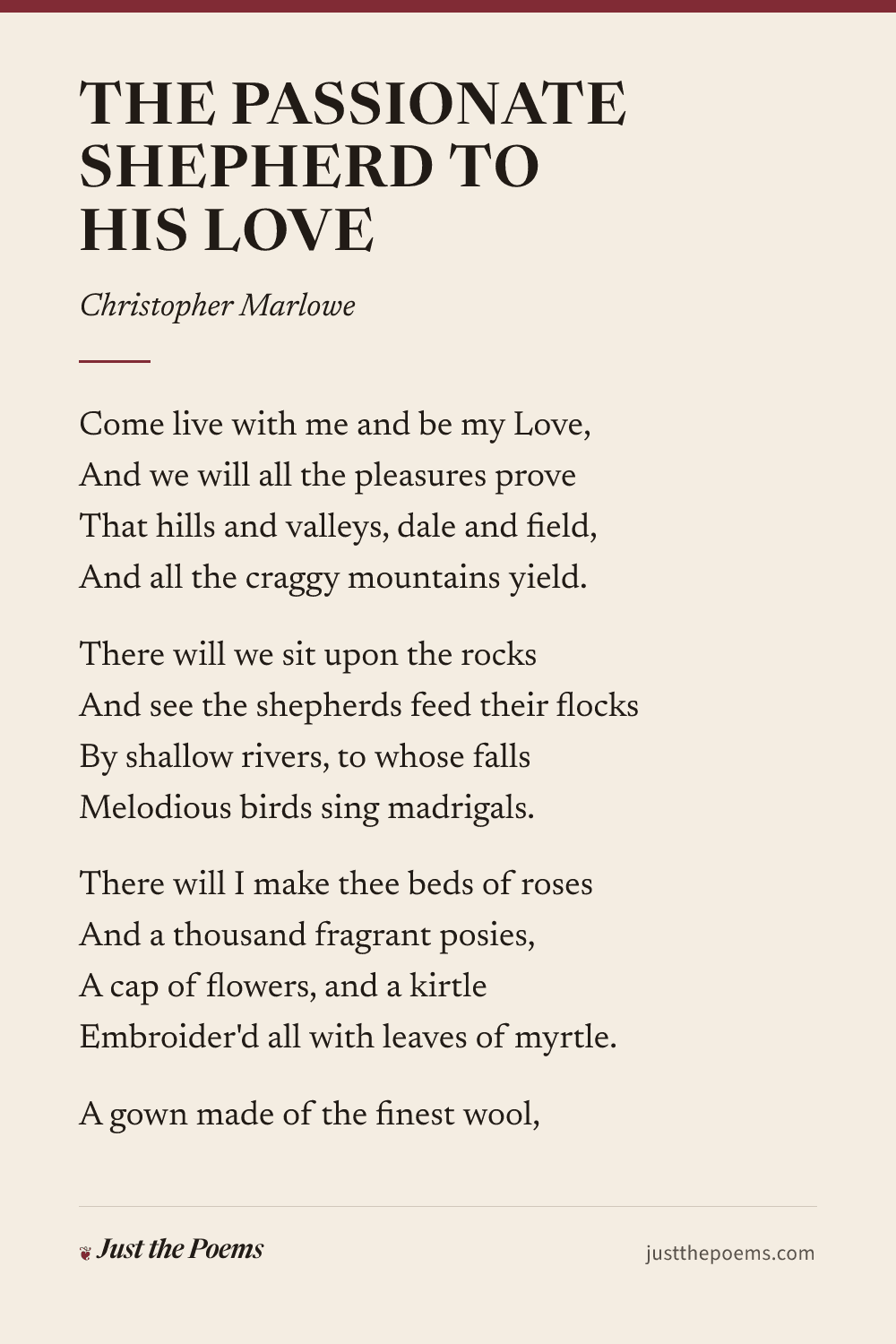
THE PASSIONATE SHEPHERD TO HIS LOVE

Christopher Marlowe

In 5 Wikipedias 3 anthologies Poet in 82 Wikipedias

Come live with me and be my Love,And we will all the pleasures proveThat hills and valleys, dale and field,And all the craggy mountains yield.

There will we sit upon the rocksAnd see the shepherds feed their flocksBy shallow rivers, to whose fallsMelodious birds sing madrigals.

There will I make thee beds of rosesAnd a thousand fragrant posies,A cap of flowers, and a kirtleEmbroider'd all with leaves of myrtle.

Show all 28 lines 16 more

A gown made of the finest wool,Which from our pretty lambs we pull,Fair-lined slippers for the cold,With buckles of the purest gold.

A belt of straw and ivy-budsWith coral clasps and amber studs:And if these pleasures may thee move,Come live with me and be my Love.

Thy silver dishes for thy meatAs precious as the gods do eat,Shall on an ivory table bePrepared each day for thee and me.

The shepherd swains shall dance and singFor thy delight each May-morning:If these delights thy mind may move,Then live with me and be my Love.

Source

The Golden Treasury, ed. Francis Turner Palgrave

Filed under
  • Named in the title

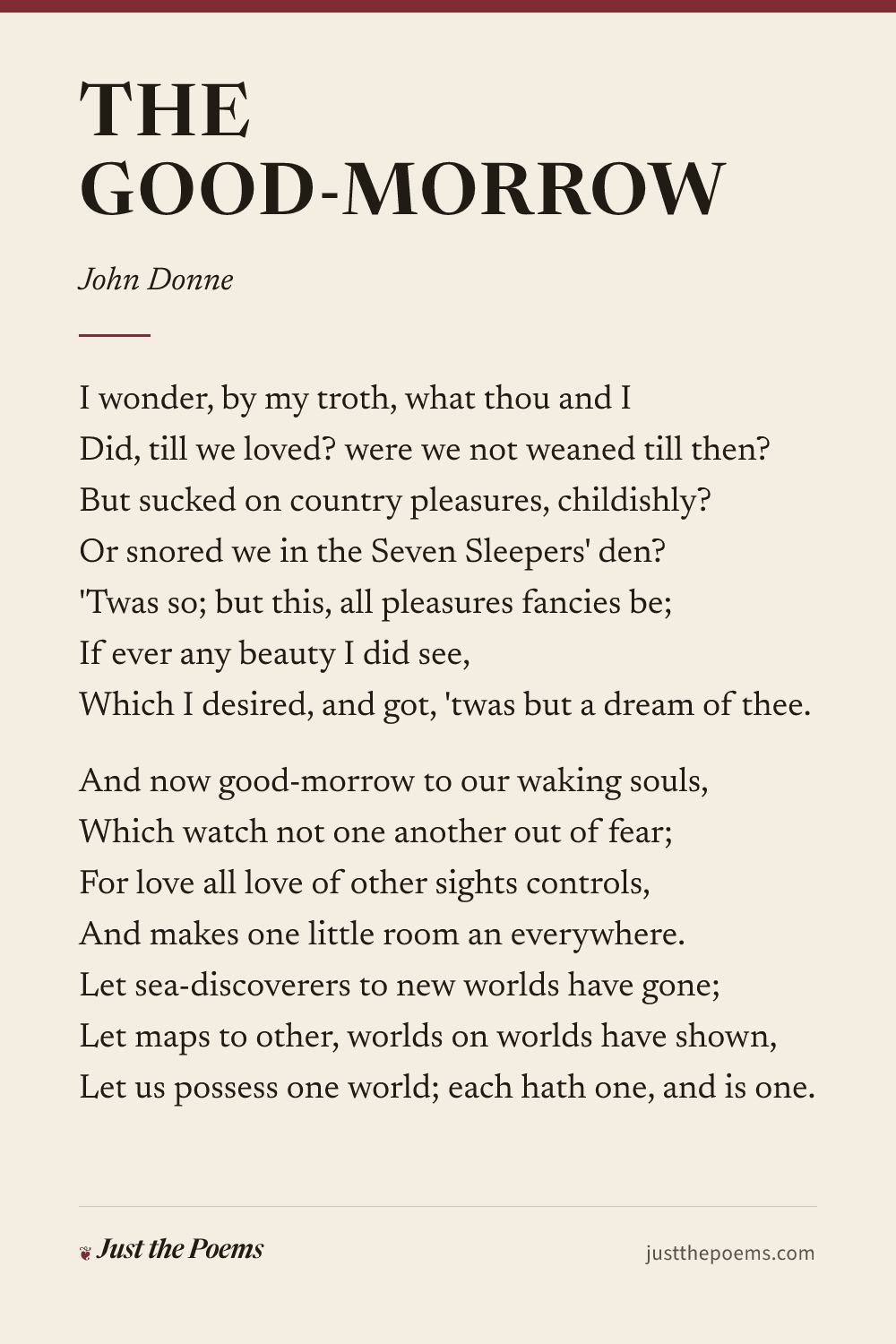
THE GOOD-MORROW

John Donne

In 5 Wikipedias 1 anthology Poet in 74 Wikipedias

I wonder, by my troth, what thou and IDid, till we loved? were we not weaned till then?But sucked on country pleasures, childishly?Or snored we in the Seven Sleepers' den?'Twas so; but this, all pleasures fancies be;If ever any beauty I did see,Which I desired, and got, 'twas but a dream of thee.

And now good-morrow to our waking souls,Which watch not one another out of fear;For love all love of other sights controls,And makes one little room an everywhere.Let sea-discoverers to new worlds have gone;Let maps to other, worlds on worlds have shown,Let us possess one world; each hath one, and is one.

My face in thine eye, thine in mine appears,And true plain hearts do in the faces rest;Where can we find two fitter hemispheresWithout sharp north, without declining west?Whatever dies, was not mixed equally;If our two loves be one, or thou and ILove just alike in all, none of these loves can die.

Source

The Home Book of Verse, ed. Burton Egbert Stevenson

Filed under
  • Section “LOVE'S FULFILMENT”, The Home Book of Verse

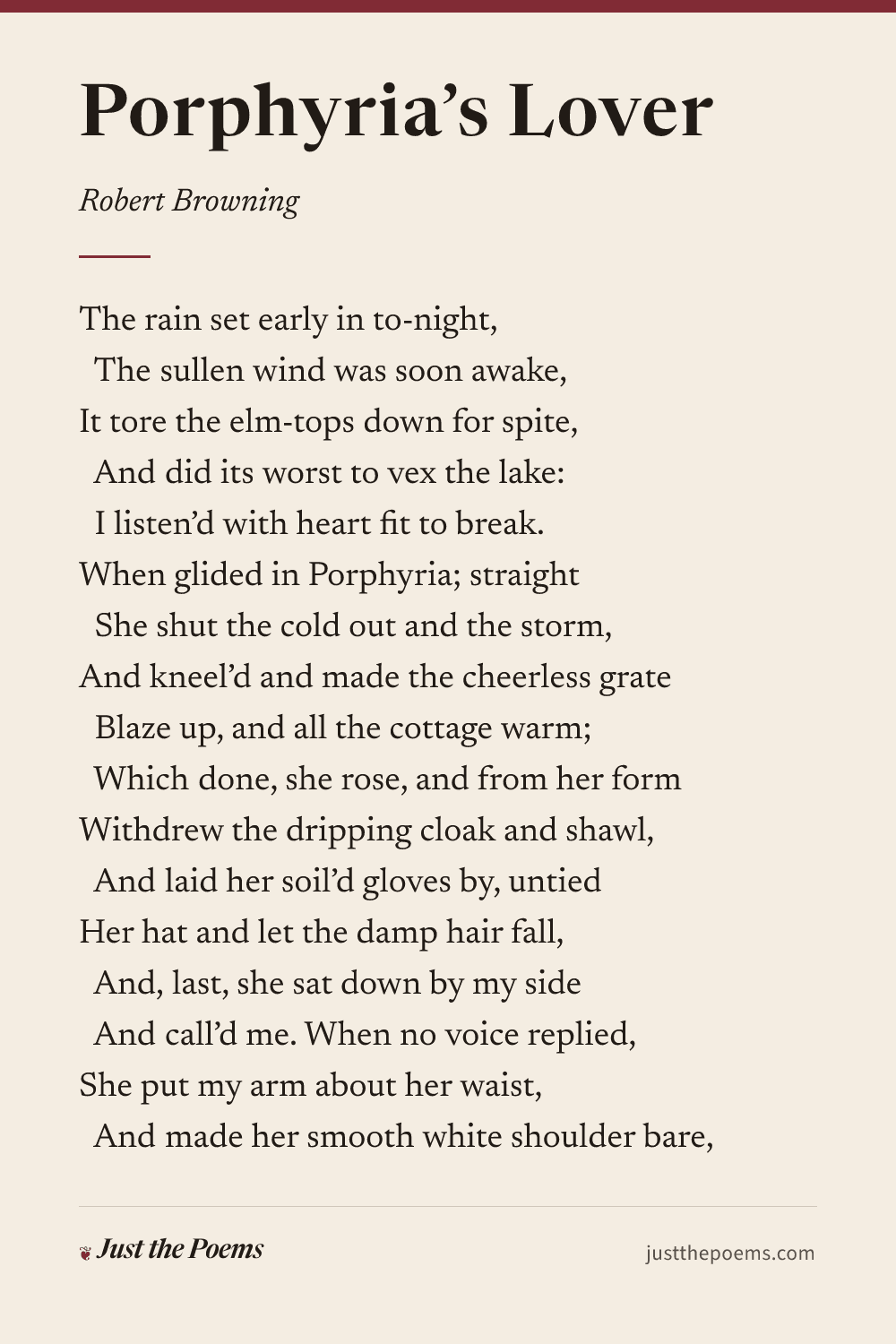
Porphyria’s Lover

Robert Browning

In 3 Wikipedias 2 anthologies Poet in 57 Wikipedias

The rain set early in to-night, The sullen wind was soon awake,It tore the elm-tops down for spite, And did its worst to vex the lake: I listen’d with heart fit to break.When glided in Porphyria; straight She shut the cold out and the storm,And kneel’d and made the cheerless grate Blaze up, and all the cottage warm; Which done, she rose, and from her formWithdrew the dripping cloak and shawl, And laid her soil’d gloves by, untied

Show all 60 lines 48 more

Her hat and let the damp hair fall, And, last, she sat down by my side And call’d me. When no voice replied,She put my arm about her waist, And made her smooth white shoulder bare,And all her yellow hair displaced, And, stooping, made my cheek lie there, And spread, o’er all, her yellow hair,Murmuring how she loved me--she Too weak, for all her heart’s endeavour,To set its struggling passion free From pride, and vainer ties dissever, And give herself to me for ever.But passion sometimes would prevail, Nor could to-night’s gay feast restrainA sudden thought of one so pale For love of her, and all in vain: So, she was come through wind and rain.Be sure I look’d up at her eyes Happy and proud; at last I knewPorphyria worshipp’d me; surprise Made my heart swell, and still it grew While I debated what to do.That moment she was mine, mine, fair, Perfectly pure and good: I foundA thing to do, and all her hair In one long yellow string I wound Three times her little throat around,And strangled her. No pain felt she; I am quite sure she felt no pain.As a shut bud that holds a bee, I warily oped her lids: again Laugh’d the blue eyes without a stain.And I untighten’d next the tress About her neck; her cheek once moreBlush’d bright beneath my burning kiss: I propp’d her head up as before, Only, this time my shoulder boreHer head, which droops upon it still: The smiling rosy little head,So glad it has its utmost will, That all it scorn’d at once is fled, And I, its love, am gain’d instead!Porphyria’s love: she guess’d not how Her darling one wish would be heard.And thus we sit together now, And all night long we have not stirr’d, And yet God has not said a word!

Source

The Oxford Book of English Verse 1250–1900, 1900

Filed under
  • Section “THE TRAGEDY OF LOVE”, The Home Book of Verse
  • Named in the title

Advertisements

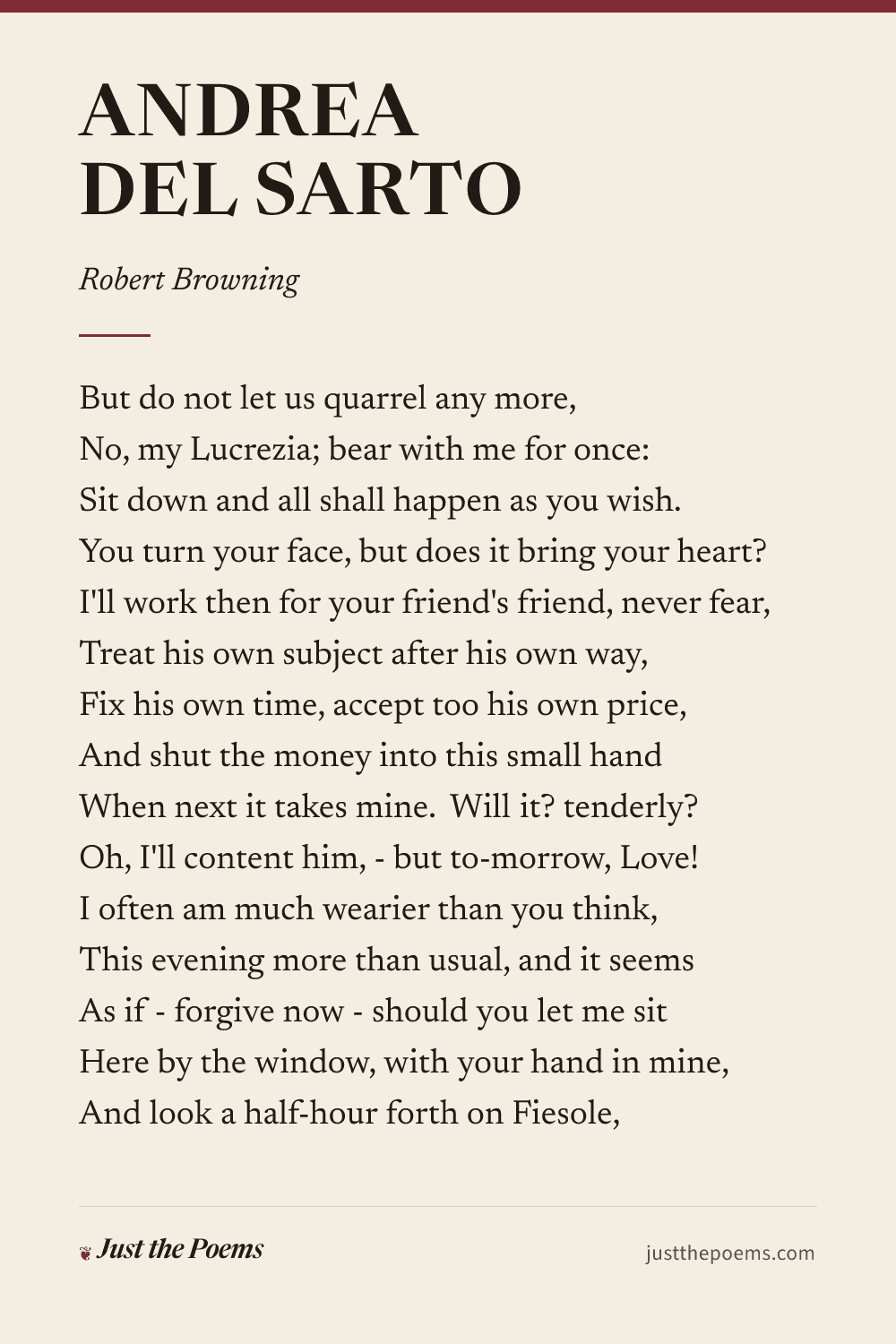
ANDREA DEL SARTO

Robert Browning

In 3 Wikipedias 1 anthology Poet in 57 Wikipedias

But do not let us quarrel any more,No, my Lucrezia; bear with me for once:Sit down and all shall happen as you wish.You turn your face, but does it bring your heart?I'll work then for your friend's friend, never fear,Treat his own subject after his own way,Fix his own time, accept too his own price,And shut the money into this small handWhen next it takes mine. Will it? tenderly?Oh, I'll content him, - but to-morrow, Love!I often am much wearier than you think,This evening more than usual, and it seems

Show all 267 lines 255 more

As if - forgive now - should you let me sitHere by the window, with your hand in mine,And look a half-hour forth on Fiesole,Both of one mind, as married people use,Quietly, quietly the evening through,I might get up to-morrow to my workCheerful and fresh as ever. Let us try.To-morrow how you shall be glad for this!Your soft hand is a woman of itself,And mine the man's bared breast she curls inside.Don't count the time lost neither; you must serveFor each of the five pictures we require;It saves a model. So! keep looking soMy serpentining beauty, rounds on rounds!- How could you ever prick those perfect ears,Even to put the pearl there! oh, so sweet -My face, my moon, my everybody's moon,Which everybody looks on and calls his,And, I suppose, is looked on by in turn,While she looks - no one's: very dear, no less.You smile? why, there's my picture ready made,There's what we painters call our harmony!A common grayness silvers everything, -All in a twilight, you and I alike- You, at the point of your first pride in me(That's gone you know), - but I, at every point;My youth, my hope, my art, being all toned downTo yonder sober pleasant Fiesole.There's the bell clinking from the chapel-top;That length of convent wall across the wayHolds the trees safer, huddled more inside;The last monk leaves the garden; days decrease,And autumn grows, autumn in everything.Eh? the whole seems to fall into a shapeAs if I saw alike my work and selfAnd all that I was born to be and do,A twilight-piece. Love, we are in God's hand.How strange now looks the life he makes us lead;So free we seem, so fettered fast we are!I feel he laid the fetter; let it lie!This chamber for example - turn your head -All that's behind us! You don't understandNor care to understand about my art,But you can hear at least when people speak:And that cartoon, the second from the door- It is the thing, Love! so such thing should be -Behold Madonna! - I am bold to say.I can do with my pencil what I know,What I see, what at bottom of my heartI wish for, if I ever wish so deep -Do easily, too - when I say, perfectly,I do not boast, perhaps: yourself are judge,Who listened to the Legate's talk last week,And just as much they used to say in France.At any rate 'tis easy, all of it!No sketches first, no studies, that's long past;I do what many dream of all their lives,- Dream? strive to do, and agonize to do,And fail in doing. I could count twenty suchOn twice your fingers, and not leave this town,Who strive - you don't know how the others striveTo paint a little thing like that you smearedCarelessly passing with your robes afloat, -Yet do much less, so much less, Someone says,(I know his name, no matter) - so much less!Well, less is more, Lucrezia: I am judged.There burns a truer light of God in them,In their vexed beating stuffed and stopped-up brain,Heart, or whate'er else, than goes on to promptThis low-pulsed forthright craftsman's hand of mine.Their works drop groundward, but themselves, I know,Reach many a time a heaven that's shut to me,Enter and take their place there sure enough,Though they come back and cannot tell the world.My works are nearer heaven, but I sit here.The sudden blood of these men! at a word -Praise them, it boils, or blame them, it boils too.I, painting from myself and to myself,Know what I do, am unmoved by men's blameOr their praise either. Somebody remarksMorello's outline there is wrongly traced,His hue mistaken; what of that? or else,Rightly traced and well ordered; what of that?Speak as they please, what does the mountain care?Ah, but a man's reach should exceed his grasp,Or what's a heaven for? All is silver-gray;Placid and perfect with my art; the worse!I know both what I want and what might gain;And yet how profitless to know, to sigh"Had I been two, another and myself,Our head would have o'erlooked the world!" No doubt.Yonder's a work now, of that famous youthThe Urbinate who died five years ago.('Tis copied, George Vasari sent it me.)Well, I can fancy how he did it all,Pouring his soul, with kings and popes to see,Reaching, that heaven might so replenish him,Above and through his art - for it gives way;That arm is wrongly put - and there again -A fault to pardon in the drawing's lines,Its body, so to speak: its soul is right,He means right, - that, a child may understand.Still, what an arm! and I could alter it:But all the play, the insight and the stretch -Out of me, out of me! And wherefore out?Had you enjoined them on me, given me soul,We might have risen to Rafael, I and you!Nay, Love, you did give all I asked, I think -More than I merit, yes, by many times.But had you - oh, with the same perfect brow,And perfect eyes, and more than perfect mouth,And the low voice my soul hears, as a birdThe fowler's pipe, and follows to the snare -Had you, with these the same, but brought a mind!Some women do so. Had the mouth there urged,"God and the glory! never care for gain.The present by the future, what is that?Live for fame, side by side with Agnolo!Rafael is waiting: up to God, all three!"I might have done it for you. So it seems:Perhaps not. All is as God overrules.Beside, incentives come from the soul's self;The rest avail not. Why do I need you?What wife had Rafael, or has Agnolo?In this world, who can do a thing, will not;And who would do it, cannot, I perceive:Yet the will's somewhat - somewhat, too, the power -And thus we half-men struggle. At the end,God I conclude, compensates, punishes.'Tis safer for me, if the award be strict,That I am something underrated here,Poor this long while, despised, to speak the truth.I dared not, do you know, leave home all day,For fear of chancing on the Paris lords.The best is when they pass and look aside;But they speak sometimes; I must bear it all.Well may they speak! That Francis, that first time,And that long festal year at Fontainebleau!I surely then could sometimes leave the ground,Put on the glory, Rafael's daily wear,In that humane great monarch's golden look, -One finger in his beard or twisted curlOver his mouth's good mark that made the smile,One arm about my shoulder, round my neck,The jingle of his gold chain in my ear,I painting proudly with his breath on me,All his court round him, seeing with his eyes,Such frank French eyes, and such a fire of soulsProfuse, my hand kept plying by those hearts, -And, best of all, this, this, this face beyond,This in the background, waiting on my work;To crown the issue with a last reward!A good time, was it not, my kingly days?And had you not grown restless . . . but I know -'Tis done and past; 'twas right, my instinct said;Too live the life grew, golden and not gray,And I'm the weak-eyed bat no sun should temptOut of the grange whose four walls make his world.How could it end in any other way?You called me, and I came home to your heart.The triumph was, - to reach and stay there; sinceI reached it ere the triumph, what is lost?Let my hands frame your face in your hair's gold,You beautiful Lucrezia that are mine!"Rafael did this, Andrea painted that;The Roman's is the better when you pray,But still the other's Virgin was his wife -Men will excuse me. I am glad to judgeBoth pictures in your presence; clearer growsMy better fortune, I resolve to think.For do you know, Lucrezia, as God lives,Said one day Agnolo, his very selfTo Rafael . . . I have known it all these years . . .(When the young man was flaming out his thoughtsUpon a palace-wall for Rome to see,Too lifted up in heart because of it)Friend, there's a certain sorry little scrubGoes up and down our Florence, none cares how,Who, were he set to plan and executeAs you are, pricked on by your popes and kings,Would bring the sweat into that brow of yours!"To Rafael's! And indeed the arm is wrong.I hardly dare . . . yet, only you to see,Give the chalk here - quick, thus the line should go!Ay, but the soul! he's Rafael! rub it out!Still, all I care for, if he spoke the truth,(What he? why, who but Michel Agnolo?Do you forget already words like those?)If really there was such a chance, so lost, -Is, whether you're - not grateful - but more pleased.Well, let me think so. And you smile indeed!This hour has been an hour! Another smile?If you would sit thus by me every nightI should work better, do you comprehend?I mean that I should earn more, give you more.See, it is settled dusk now; there's a star;Morello's gone, the watch-lights show the wall,The cue-owls speak the name we call them by.Come from the window, love, - come in, at last,Inside the melancholy little houseWe built to be so gay with. God is just.King Francis may forgive me: oft at nightsWhen I look up from painting, eyes tired out,The walls become illumined, brick from brickDistinct, instead of mortar, fierce bright gold,That gold of his I did cement them with!Let us but love each other. Must you go?That Cousin here again? he waits outside?Must see you - you, and not with me? Those loans?More gaming debts to pay? you smiled for that?Well, let smiles buy me! have you more to spend?While hand and eye and something of a heartAre left me, work's my ware, and what's it worth?I'll pay my fancy. Only let me sitThe gray remainder of the evening out,Idle, you call it, and muse perfectlyHow I could paint, were I but back in France,One picture, just one more, - the Virgin's face,Not yours this time! I want you at my sideTo hear them - that is Michel Agnolo -Judge all I do and tell you of its worth.Will you? To-morrow, satisfy your friend.I take the subjects for his corridor,Finish the portrait out of hand - there, there,And throw him in another thing or twoIf he demurs; the whole should prove enoughTo pay for this same Cousin's freak. Beside,What's better and what's all I care about,Get you the thirteen scudi for the ruff!Love, does that please you? Ah, but what does he,The Cousin! what does he to please you more?

I am grown peaceful as old age to-night.I regret little, I would change still less.Since there my past life lies, why alter it?The very wrong to Francis! - it is trueI took his coin, was tempted and complied,And built this house and sinned, and all is said.My father and my mother died of want.Well, had I riches of my own? you seeHow one gets rich! Let each one bear his lot.They were born poor, lived poor, and poor they died:And I have labored somewhat in my timeAnd not been paid profusely. Some good sonPaint my two hundred pictures - let him try!No doubt, there's something strikes a balance. Yes,You loved me quite enough, it seems to-night.This must suffice me here. What would one have?In heaven, perhaps, new chances, one more chance -Four great walls in the New Jerusalem,Meted on each side by the angel's reed,For Leonard, Rafael, Agnolo, and meTo cover, - the three first without a wife,While I have mine! So - still they overcomeBecause there's still Lucrezia, - as I choose.

Again the Cousin's whistle! Go, my love.
Source

The Home Book of Verse, ed. Burton Egbert Stevenson

Filed under
  • Section “THE IRONY OF LOVE”, The Home Book of Verse

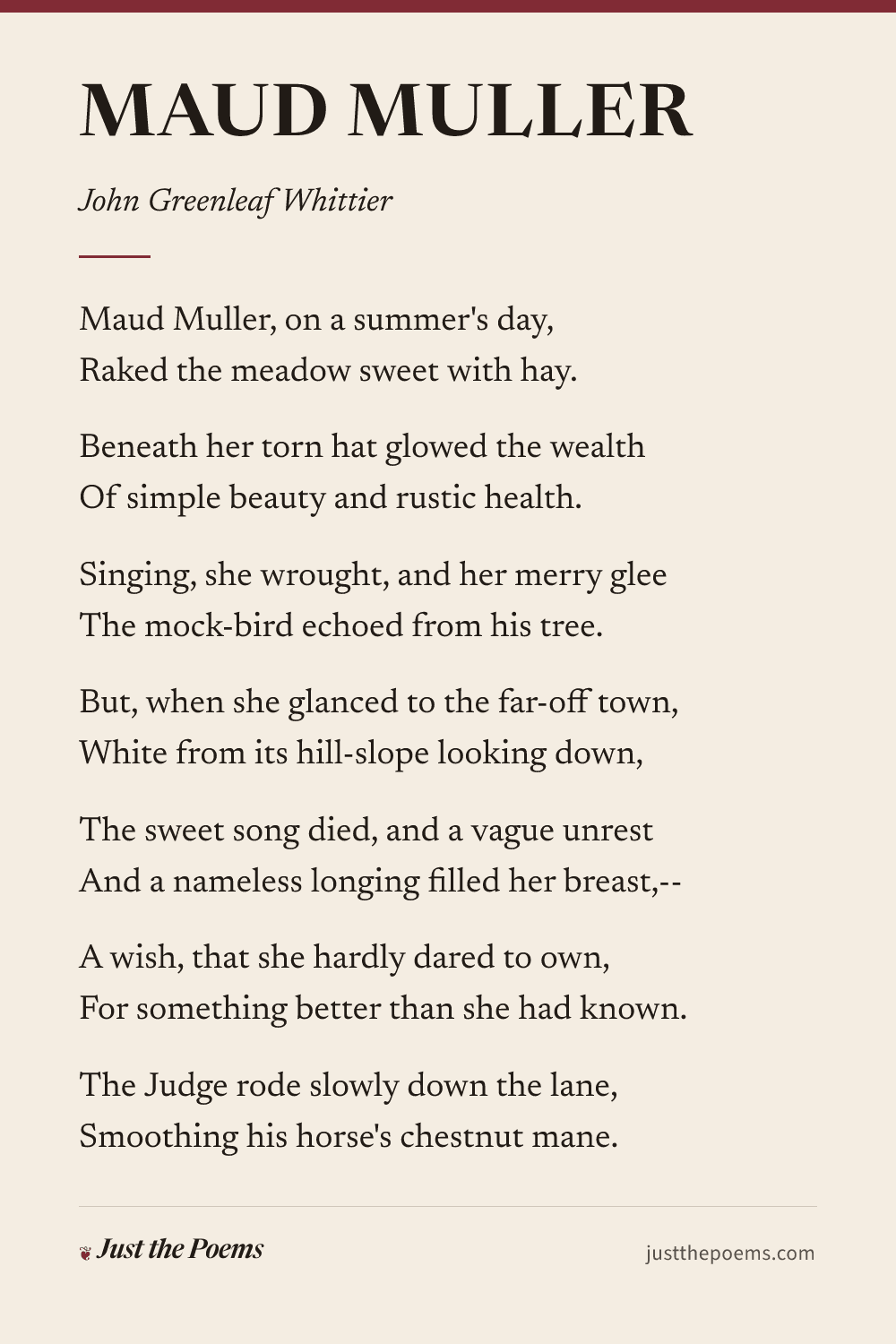
MAUD MULLER

John Greenleaf Whittier

In 2 Wikipedias 3 anthologies Poet in 33 Wikipedias

Maud Muller, on a summer's day,Raked the meadow sweet with hay.

Beneath her torn hat glowed the wealthOf simple beauty and rustic health.

Singing, she wrought, and her merry gleeThe mock-bird echoed from his tree.

But, when she glanced to the far-off town,White from its hill-slope looking down,

The sweet song died, and a vague unrestAnd a nameless longing filled her breast,--

A wish, that she hardly dared to own,For something better than she had known.

Show all 110 lines 98 more

The Judge rode slowly down the lane,Smoothing his horse's chestnut mane.

He drew his bridle in the shadeOf the apple-trees, to greet the maid,

And ask a draught from the spring that flowedThrough the meadow, across the road.

She stooped where the cool spring bubbled up,And filled for him her small tin cup,

And blushed as she gave it, looking downOn her feet so bare, and her tattered gown.

"Thanks!" said the Judge, "a sweeter draughtFrom a fairer hand was never quaffed."

He spoke of the grass and flowers and trees,Of the singing birds and the humming bees;

Then talked of the haying, and wondered whetherThe cloud in the west would bring foul weather.

And Maud forgot her brier-torn gown,And her graceful ankles, bare and brown,

And listened, while a pleased surpriseLooked from her long-lashed hazel eyes.

At last, like one who for delaySeeks a vain excuse, he rode away.

Maud Muller looked and sighed: "Ah me!That I the Judge's bride might be!

"He would dress me up in silks so fine,And praise and toast me at his wine.

"My father should wear a broadcloth coat,My brother should sail a painted boat.

"I 'd dress my mother so grand and gay,And the baby should have a new toy each day.

"And I'd feed the hungry and clothe the poor,And all should bless me who left our door."

The Judge looked back as he climbed the hill,And saw Maud Muller standing still:

"A form more fair, a face more sweet,Ne'er hath it been my lot to meet.

"And her modest answer and graceful airShow her wise and good as she is fair.

"Would she were mine, and I to-day,Like her, a harvester of hay.

"No doubtful balance of rights and wrongs,Nor weary lawyers with endless tongues,

"But low of cattle, and song of birds,And health, and quiet, and loving words."

But he thought of his sister, proud and cold,And his mother, vain of her rank and gold.

So, closing his heart, the Judge rode on,And Maud was left in the field alone.

But the lawyers smiled that afternoon,When he hummed in court an old love tune;

And the young girl mused beside the well,Till the rain on the unraked clover fell.

He wedded a wife of richest dower,Who lived for fashion, as he for power.

Yet oft, in his marble hearth's bright glow,He watched a picture come and go;

And sweet Maud Muller's hazel eyesLooked out in their innocent surprise.

Oft, when the wine in his glass was red,He longed for the wayside well instead,

And closed his eyes on his garnished rooms,To dream of meadows and clover blooms;

And the proud man sighed with a secret pain,"Ah, that I were free again!

"Free as when I rode that dayWhere the barefoot maiden raked the hay."

She wedded a man unlearned and poor,And many children played round her door.

But care and sorrow, and child-birth pain,Left their traces on heart and brain.

And oft, when the summer sun shone hotOn the new-mown hay in the meadow lot,

And she heard the little spring brook fallOver the roadside, through the wall,

In the shade of the apple-tree againShe saw a rider draw his rein,

And, gazing down with a timid grace,She felt his pleased eyes read her face.

Sometimes her narrow kitchen wallsStretched away into stately halls;

The weary wheel to a spinnet turned,The tallow candle an astral burned;

And for him who sat by the chimney lug,Dozing and grumbling o'er pipe and mug,

A manly form at her side she saw,And joy was duty and love was law.

Then she took up her burden of life again,Saying only, "It might have been."

Alas for maiden, alas for judge,For rich repiner and household drudge!

God pity them both! and pity us all,Who vainly the dreams of youth recall;

For of all sad words of tongue or pen,The saddest are these: "It might have been!"

Ah, well! for us all some sweet hope liesDeeply buried from human eyes;

And, in the hereafter, angels mayRoll the stone from its grave away!

Source

The World's Best Poetry, Vol. III, ed. Bliss Carman, 1904

Filed under
  • Section “DISAPPOINTMENT IN LOVE”, The World's Best Poetry
  • Section “LOVE'S SADNESS”, The Home Book of Verse

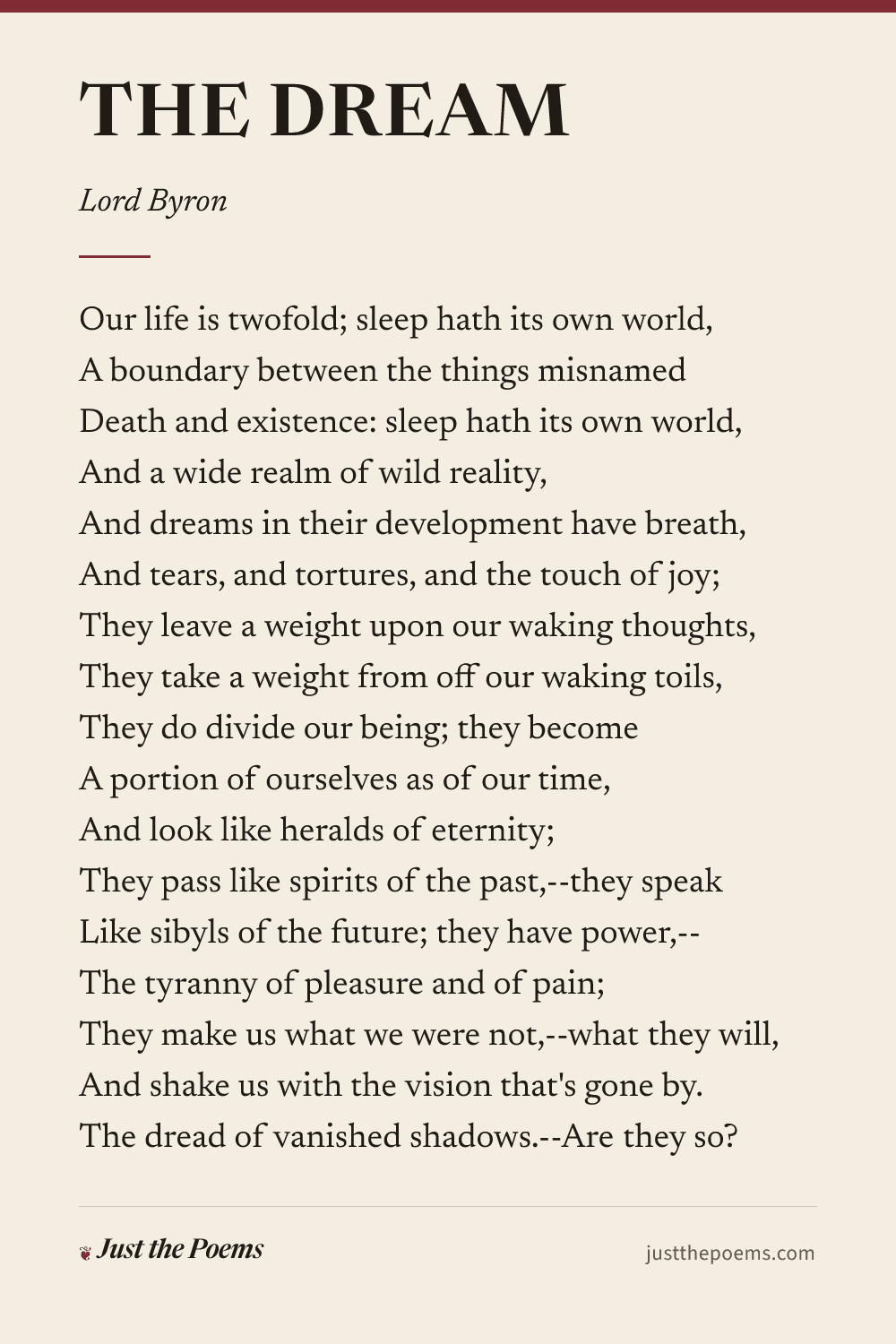
THE DREAM

Lord Byron

In 1 Wikipedia 1 anthology Poet in 155 Wikipedias

Our life is twofold; sleep hath its own world,A boundary between the things misnamedDeath and existence: sleep hath its own world,And a wide realm of wild reality,And dreams in their development have breath,And tears, and tortures, and the touch of joy;They leave a weight upon our waking thoughts,They take a weight from off our waking toils,They do divide our being; they becomeA portion of ourselves as of our time,And look like heralds of eternity;They pass like spirits of the past,--they speak

Show all 206 lines 194 more

Like sibyls of the future; they have power,--The tyranny of pleasure and of pain;They make us what we were not,--what they will,And shake us with the vision that's gone by.The dread of vanished shadows.--Are they so?Is not the past all shadow? What are they?Creations of the mind?--The mind can makeSubstances, and people planets of its ownWith beings brighter than have been, and giveA breath to forms which can outlive all flesh.I would recall a vision which I dreamedPerchance in sleep,--for in itself a thought,A slumbering thought, is capable of years,And curdles a long life into one hour.

I saw two beings in the hues of youthStanding upon a hill, a gentle hill,Green and of a mild declivity, the lastAs 't were the cape of a long ridge of such,Save that there was no sea to lave its base,But a most living landscape, and the waveOf woods and cornfields, and the abodes of menScattered at intervals, and wreathing smokeArising from such rustic roofs; the hillWas crowned with a peculiar diademOf trees, in circular array, so fixed,Not by the sport of nature, but of man:These two, a maiden and a youth, were thereGazing,--the one on all that was beneathFair as herself,--but the boy gazed on her;And both were young, and one was beautiful;And both were young,--yet not alike in youth.As the sweet moon on the horizon's verge,The maid was on the eve of womanhood;The boy had fewer summers, but his heartHad far outgrown his years, and to his eyeThere was but one beloved face on earth,And that was shining on him; he had lookedUpon it till it could not pass away;He had no breath, no being, but in hers;She was his voice; he did not speak to her,But trembled on her words; she was his sight,For his eye followed hers, and saw with hers,Which colored all his objects;--he had ceasedTo live with himself: she was his life,The ocean to the river of his thoughts,Which terminated all; upon a tone,A touch of hers, his blood would ebb and flow,And his cheek change tempestuously;--his heartUnknowing of its cause of agony.But she in these fond feelings had no share:Her sighs were not for him; to her he wasEven as a brother,--but no more; 'twas much,For brotherless she was, save in the nameHer infant friendship had bestowed on him;Herself the solitary scion leftOf a time-honored race. It was a nameWhich pleased him, and yet pleased him not,--and why?Time taught him a deep answer--when she lovedAnother; even now she loved another,And on the summit of the hill she stood,Looking afar if yet her lover's steedKept pace with her expectancy, and flew.

A change came o'er the spirit of my dream.There was an ancient mansion, and beforeIts walls there was a steed caparisoned;Within an antique oratory stoodThe boy of whom I spake;--he was alone,And pale, and pacing to and fro: anonHe sate him down, and seized a pen and tracedWords which I could not guess of; then he leanedHis bowed head on his hands and shook, as 'twereWith a convulsion,--then arose again,And with his teeth and quivering hands did tearWhat he had written, but he shed no tears,And he did calm himself, and fix his browInto a kind of quiet; as he paused,The lady of his love re-entered there;She was serene and smiling then, and yetShe knew she was by him beloved; she knew--For quickly comes such knowledge--that his heartWas darkened with her shadow, and she sawThat he was wretched, but she saw not all.He rose, and with a cold and gentle graspHe took her hand; a moment o'er his faceA tablet of unutterable thoughtsWas traced, and then it faded, as it came;He dropped the hand he held, and with slow stepsRetired, but not as bidding her adieu,For they did part with mutual smiles; he passedFrom out the massy gate of that old Hall,And mounting on his steed he went his way;And ne'er repassed that hoary threshold more.

A change came o'er the spirit of my dream.The boy was sprung to manhood; in the wildsOf fiery climes he made himself a home,And his soul drank their sunbeams; he was girtWith strange and dusky aspects; he was notHimself like what he had been; on the seaAnd on the shore he was a wanderer;There was a mass of many imagesCrowded like waves upon me, but he wasA part of all; and in the last he layReposing from the noontide sultriness,Couched among fallen columns, in the shadeOf ruined walls that had survived the namesOf those who reared them; by his sleeping sideStood camels grazing, and some goodly steedsWere fastened near a fountain; and a man,Clad in a flowing garb, did watch the while,While many of his tribe slumbered around:And they were canopied by the blue sky,So cloudless, clear, and purely beautiful,That God alone was to be seen in heaven.

A change came o'er the spirit of my dream.The lady of his love was wed with oneWho did not love her better: in her home,A thousand leagues from his,--her native home,She dwelt, begirt with growing infancy,Daughters and sons of beauty,--but behold!Upon her face there was the tint of grief,The settled shadow of an inward strife,And an unquiet drooping of the eye,As if its lids were charged with unshed tears.What could her grief be?--she had all she loved,And he who had so loved her was not thereTo trouble with bad hopes, or evil wish,Or ill-repressed affliction, her pure thoughts.What could her grief be?--she had loved him not,Nor given him cause to deem himself beloved,Nor could he be a part of that which preyedUpon her mind--a spectre of the past.

A change came o'er the spirit of my dream.The wanderer was returned.--I saw him standBefore an altar--with a gentle bride;Her face was fair, but was not that which madeThe starlight of his boyhood;--as he stoodEven at the altar, o'er his brow there cameThe selfsame aspect and the quivering shockThat in the antique oratory shookHis bosom in its solitude; and then--As in that hour--a moment o'er his faceThe tablet of unutterable thoughtsWas traced,--and then it faded as it came,And he stood calm and quiet, and he spokeThe fitting vows, but heard not his own words,And all things reeled around him; he could seeNot that which was, nor that which should have been,--But the old mansion, and the accustomed hall,And the remembered chambers, and the place,The day, the hour, the sunshine, and the shade,All things pertaining to that place and hour,And her who was his destiny, came backAnd thrust themselves between him and the light;What business had they there at such a time?

A change came o'er the spirit of my dream.The lady of his love;--O, she was changed,As by the sickness of the soul! her mindHad wandered from its dwelling, and her eyes,They had not their own lustre, but the lookWhich is not of the earth; she was becomeThe queen of a fantastic realm; her thoughtsWere combinations of disjointed things,And forms impalpable and unperceivedOf others' sight familiar were to hers.And this the world calls frenzy; but the wiseHave a far deeper madness, and the glanceOf melancholy is a fearful gift;What is it but the telescope of truth,Which strips the distance of its fantasies,And brings life near in utter nakedness,Making the cold reality too real!

A change came o'er the spirit of my dream.The wanderer was alone as heretofore,The beings which surrounded him were gone,Or were at war with him; he was a markFor blight and desolation, compassed roundWith hatred and contention; pain was mixedIn all which was served up to him, until,Like to the Pontic monarch of old days,He fed on poisons, and they had no power,But were a kind of nutriment; he livedThrough that which had been death to many men,And made him friends of mountains: with the starsAnd the quick Spirit of the universeHe held his dialogues; and they did teachTo him the magic of their mysteries;To him the book of Night was opened wide,And voices from the deep abyss revealedA marvel and a secret.--Be it so.

My dream was past; it had no further change.It was of a strange order, that the doomOf these two creatures should be thus traced outAlmost like a reality,--the oneTo end in madness--both in misery.

Source

The World's Best Poetry, Vol. III, ed. Bliss Carman, 1904

Filed under
  • Section “DISAPPOINTMENT IN LOVE”, The World's Best Poetry

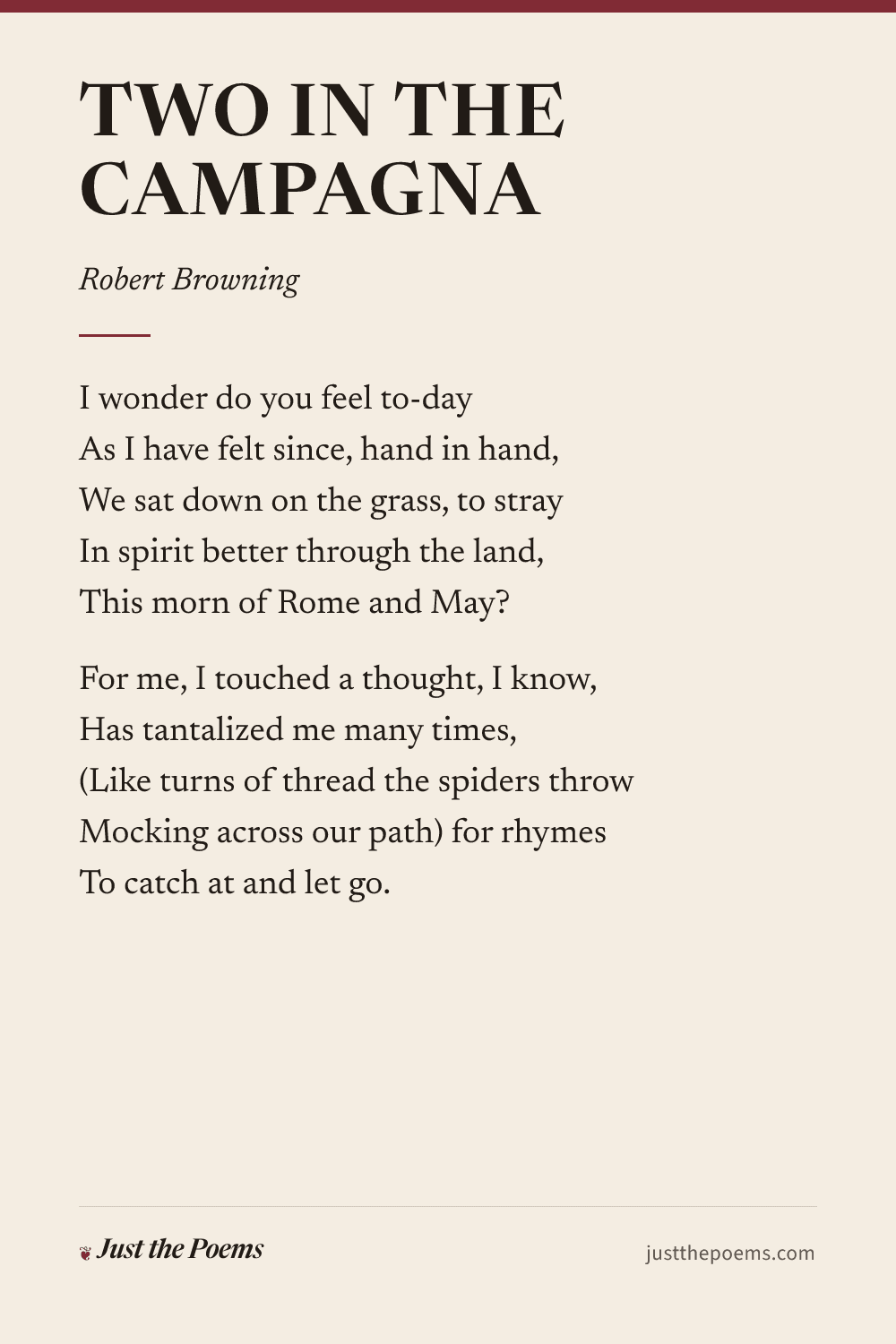
TWO IN THE CAMPAGNA

Robert Browning

In 1 Wikipedia 1 anthology Poet in 57 Wikipedias

I wonder do you feel to-dayAs I have felt since, hand in hand,We sat down on the grass, to strayIn spirit better through the land,This morn of Rome and May?

For me, I touched a thought, I know,Has tantalized me many times,(Like turns of thread the spiders throwMocking across our path) for rhymesTo catch at and let go.

Help me to hold it! First it leftThe yellowing fennel, run to seed

Show all 60 lines 48 more

There, branching from the brickwork's cleft,Some old tomb's ruin: yonder weedTook up the floating weft,

Where one small orange cup amassedFive beetles, - blind and green they gropeAmong the honey-meal: and last,Everywhere on the grassy slopeI traced it. Hold it fast!

The champaign with its endless fleeceOf feathery grasses everywhere!Silence and passion, joy and peace,And everlasting wash of air -Rome's ghost since her decease.

Such life here, through such lengths of hours,Such miracles performed in play,Such primal naked forms of flowers,Such letting Nature have her wayWhile Heaven looks from its towers!

How say you? Let us, O my dove,Let us be unashamed of soul,As earth lies bare to heaven above!How is it under our controlTo love or not to love?

I would that you were all to me,You that are just so much, no more.Nor yours, nor mine - nor slave nor free!Where does the fault lie? What the coreOf the wound, since wound must be?

I would I could adopt your will,See with your eyes, and set my heartBeating by yours, and drink my fillAt your soul's springs, - your part, my partIn life, for good and ill.

No. I yearn upward, touch you close,Then stand away. I kiss your cheek,Catch your soul's warmth, - I pluck the roseAnd love it more than tongue can speak -Then the good minute goes.

Already how am I so farOut of that minute? Must I goStill like the thistle-ball, no bar,Onward, whenever light winds blow,Fixed by no friendly star?

Just when I seemed about to learn!Where is the thread now? Off again!The old trick! Only I discern -Infinite passion, and the painOf finite hearts that yearn.

Source

The Home Book of Verse, ed. Burton Egbert Stevenson

Filed under
  • Section “LOVE'S SADNESS”, The Home Book of Verse

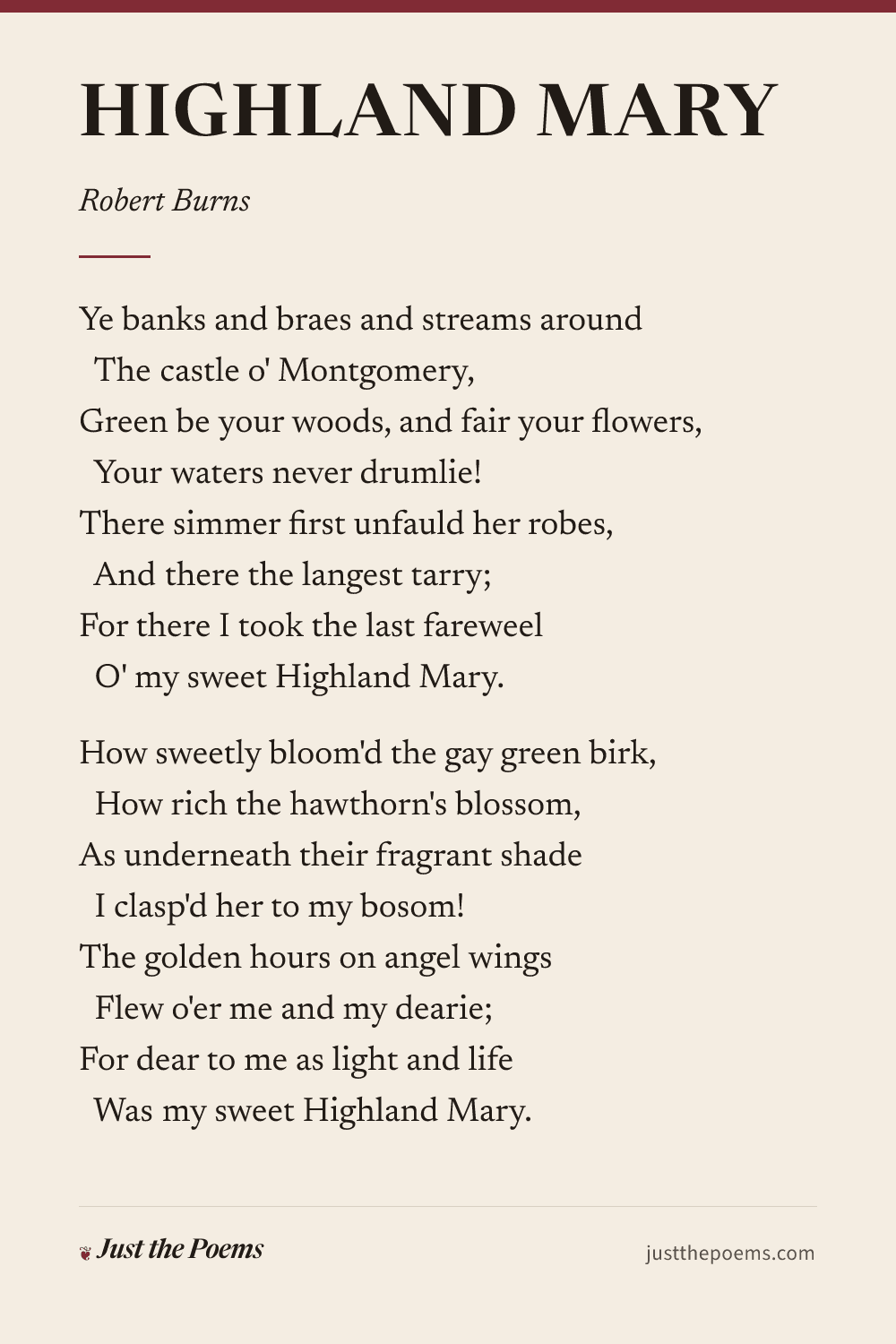
HIGHLAND MARY

Robert Burns

In 0 Wikipedias 5 anthologies Poet in 89 Wikipedias

Ye banks and braes and streams around The castle o' Montgomery,Green be your woods, and fair your flowers, Your waters never drumlie!There simmer first unfauld her robes, And there the langest tarry;For there I took the last fareweel O' my sweet Highland Mary.

How sweetly bloom'd the gay green birk, How rich the hawthorn's blossom,As underneath their fragrant shade I clasp'd her to my bosom!

Show all 32 lines 20 more

The golden hours on angel wings Flew o'er me and my dearie;For dear to me as light and life Was my sweet Highland Mary.

Wi' mony a vow and lock'd embrace Our parting was fu' tender;And pledging aft to meet again, We tore oursels asunder;But O! fell Death's untimely frost, That nipt my flower sae early!Now green's the sod, and cauld's the clay, That wraps my Highland Mary!

O pale, pale now, those rosy lips, I aft hae kiss'd sae fondly!And closed for aye the sparkling glance That dwelt on me sae kindly;And mouldering now in silent dust That heart that lo'ed me dearly!But still within my bosom's core Shall live my Highland Mary.

Source

The Golden Treasury, ed. Francis Turner Palgrave

Filed under
  • Section “LOVE AND DEATH”, The Home Book of Verse

Advertisements

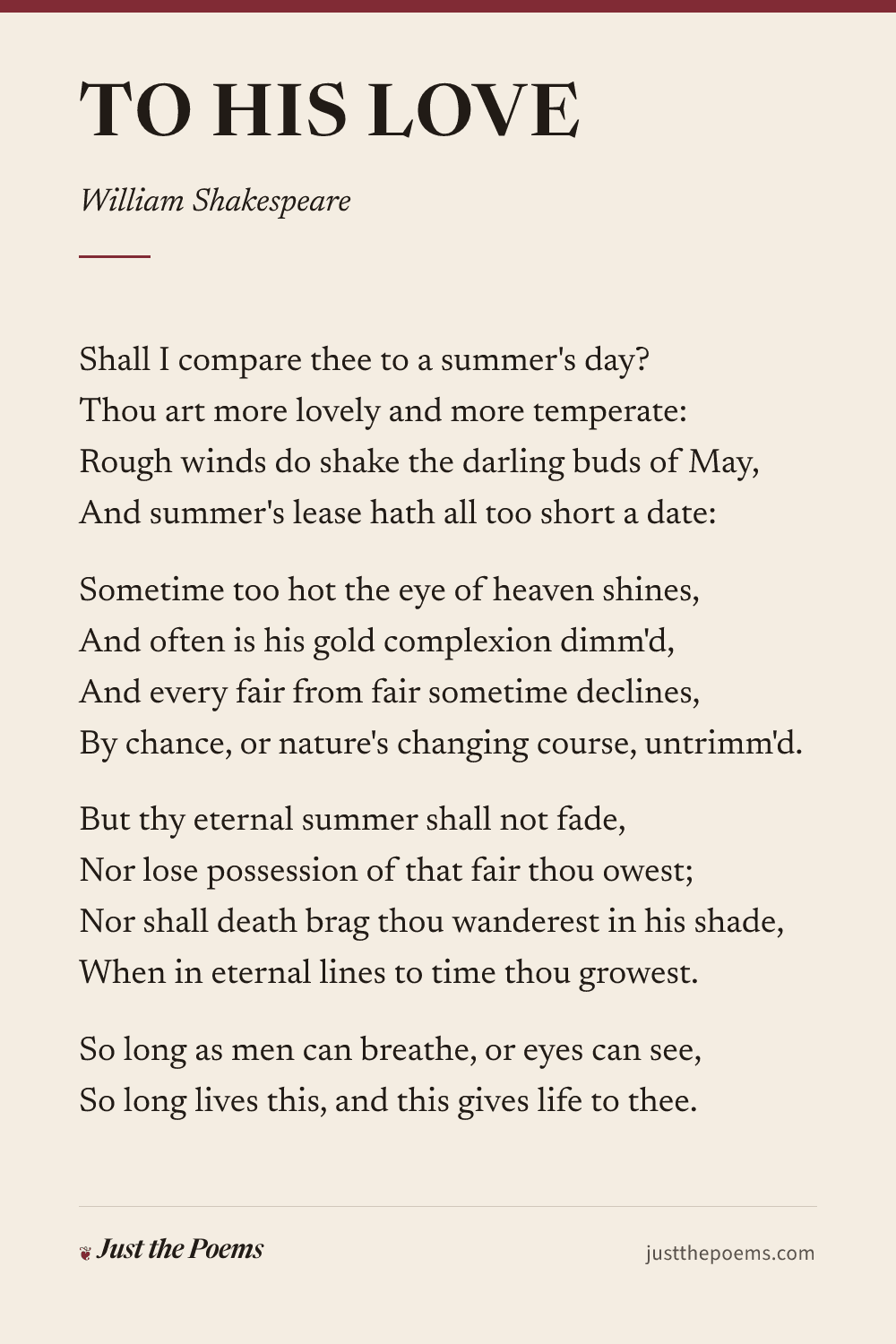
TO HIS LOVE

William Shakespeare

In 0 Wikipedias 4 anthologies Poet in 237 Wikipedias

Shall I compare thee to a summer's day?Thou art more lovely and more temperate:Rough winds do shake the darling buds of May,And summer's lease hath all too short a date:

Sometime too hot the eye of heaven shines,And often is his gold complexion dimm'd,And every fair from fair sometime declines,By chance, or nature's changing course, untrimm'd.

But thy eternal summer shall not fade,Nor lose possession of that fair thou owest;Nor shall death brag thou wanderest in his shade,When in eternal lines to time thou growest.

So long as men can breathe, or eyes can see,So long lives this, and this gives life to thee.

Source

The Golden Treasury, ed. Francis Turner Palgrave

Filed under
  • Section “LOVE SONNETS”, The Home Book of Verse
  • Named in the title

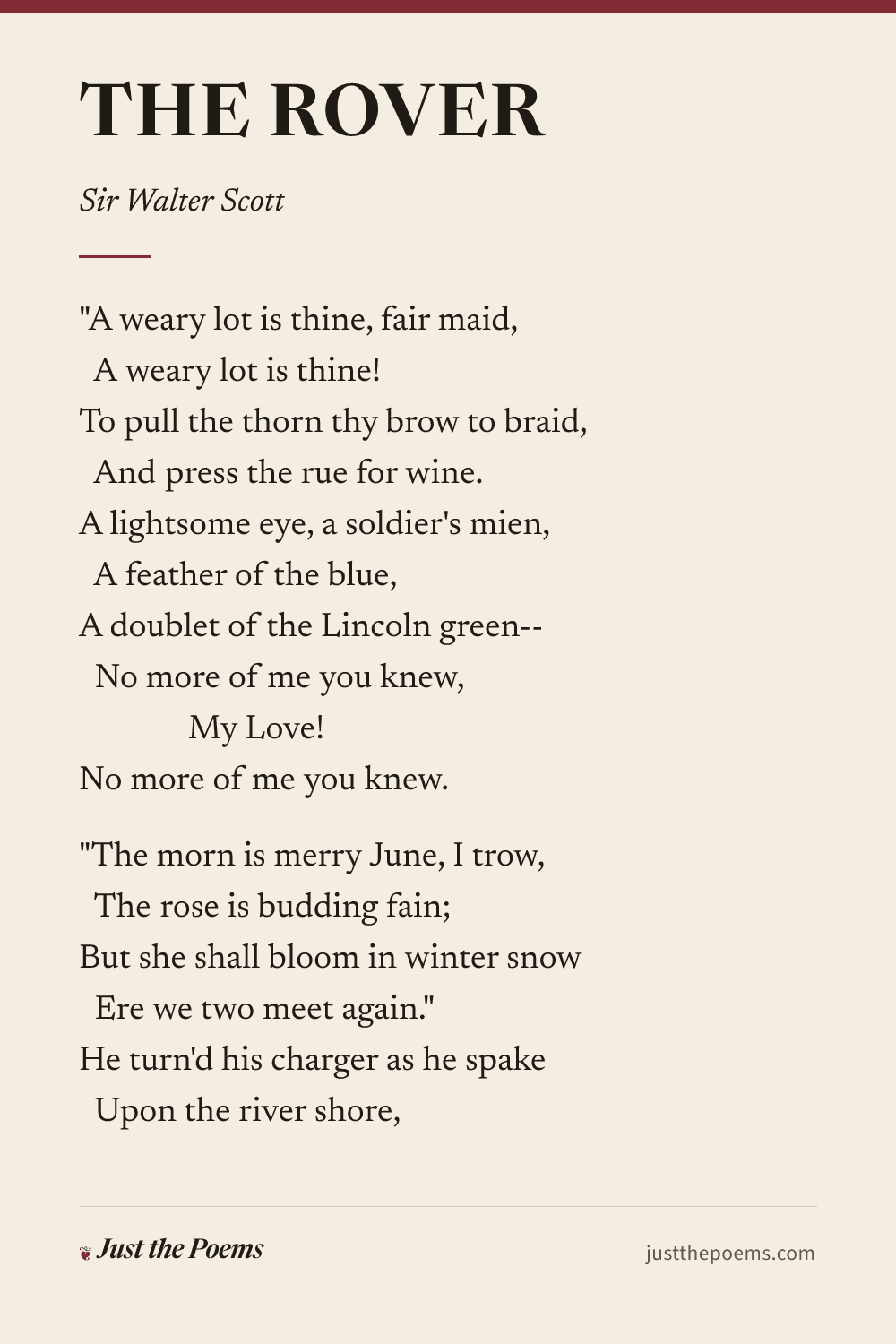
THE ROVER

Sir Walter Scott

In 0 Wikipedias 4 anthologies Poet in 98 Wikipedias

"A weary lot is thine, fair maid, A weary lot is thine!To pull the thorn thy brow to braid, And press the rue for wine.A lightsome eye, a soldier's mien, A feather of the blue,A doublet of the Lincoln green-- No more of me you knew, My Love!No more of me you knew.

"The morn is merry June, I trow, The rose is budding fain;But she shall bloom in winter snow Ere we two meet again."He turn'd his charger as he spake Upon the river shore,He gave the bridle-reins a shake, Said "Adieu for evermore, My Love!And adieu for evermore."

Source

The Golden Treasury, ed. Francis Turner Palgrave

Filed under
  • Section “DISAPPOINTMENT IN LOVE”, The World's Best Poetry
  • Section “THE PARTED LOVERS”, The Home Book of Verse

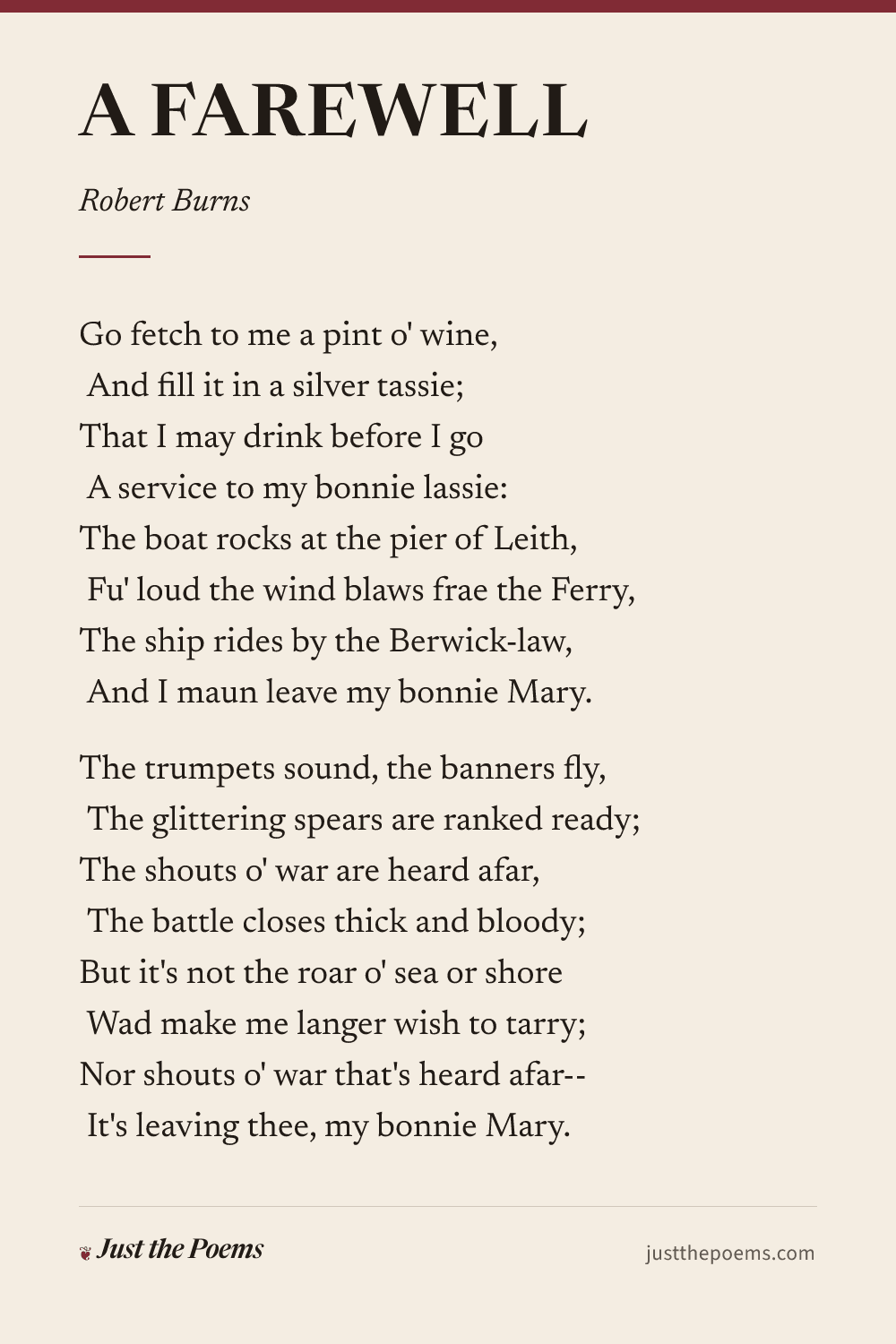
A FAREWELL

Robert Burns

In 0 Wikipedias 4 anthologies Poet in 89 Wikipedias

Go fetch to me a pint o' wine, And fill it in a silver tassie;That I may drink before I go A service to my bonnie lassie:The boat rocks at the pier of Leith, Fu' loud the wind blaws frae the Ferry,The ship rides by the Berwick-law, And I maun leave my bonnie Mary.

The trumpets sound, the banners fly, The glittering spears are ranked ready;The shouts o' war are heard afar, The battle closes thick and bloody;But it's not the roar o' sea or shore Wad make me langer wish to tarry;Nor shouts o' war that's heard afar-- It's leaving thee, my bonnie Mary.

Source

The Golden Treasury, ed. Francis Turner Palgrave

Filed under
  • Section “THE PARTED LOVERS”, The Home Book of Verse

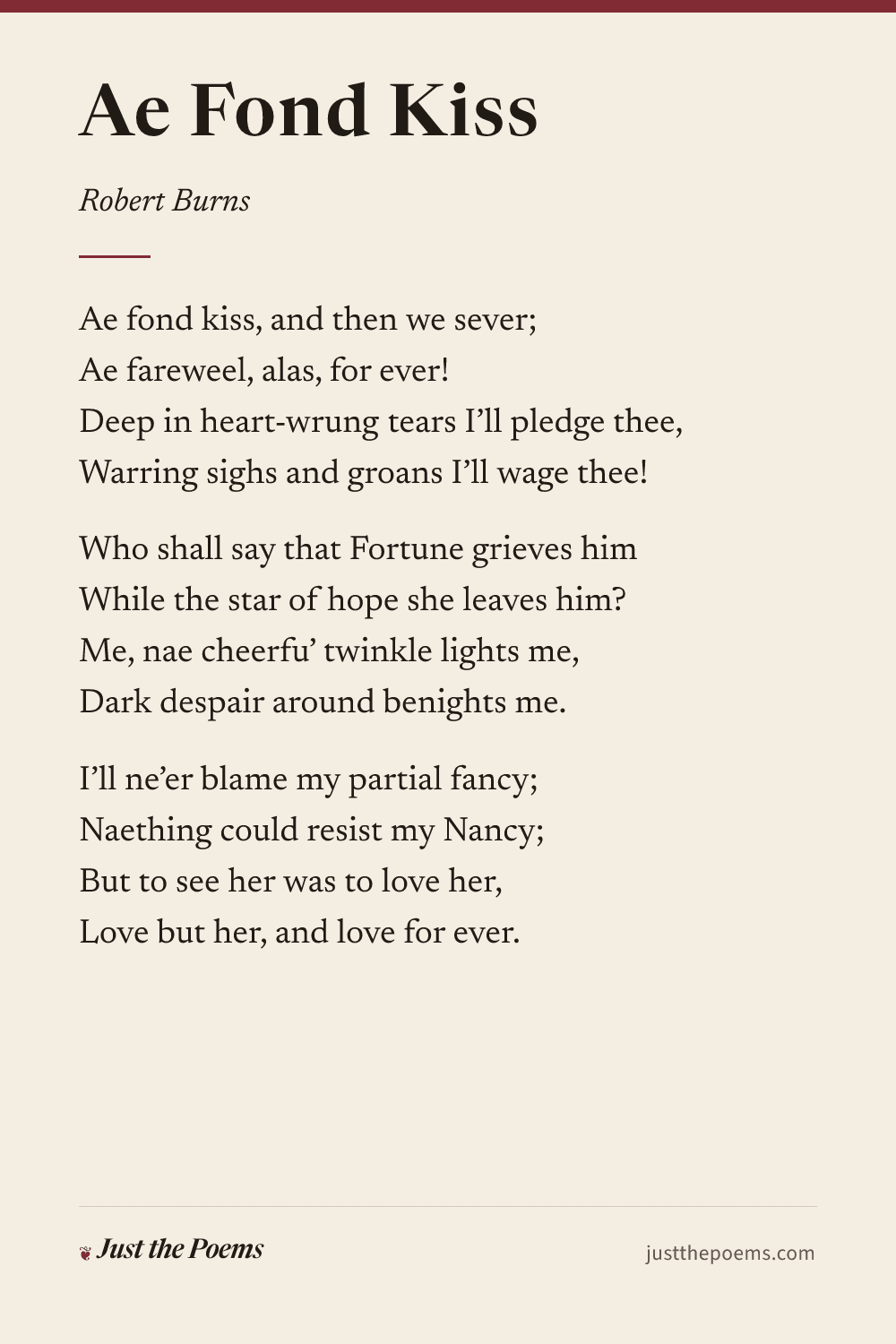
Ae Fond Kiss

Robert Burns

In 0 Wikipedias 4 anthologies Poet in 89 Wikipedias

Ae fond kiss, and then we sever;Ae fareweel, alas, for ever!Deep in heart-wrung tears I’ll pledge thee,Warring sighs and groans I’ll wage thee!

Who shall say that Fortune grieves himWhile the star of hope she leaves him?Me, nae cheerfu’ twinkle lights me,Dark despair around benights me.

I’ll ne’er blame my partial fancy;Naething could resist my Nancy;But to see her was to love her,Love but her, and love for ever.

Had we never loved sae kindly,Had we never loved sae blindly,Never met--or never parted,We had ne’er been broken-hearted.

Fare thee weel, thou first and fairest!Fare thee weel, thou best and dearest!Thine be ilka joy and treasure,Peace, enjoyment, love, and pleasure!

Ae fond kiss, and then we sever!Ae fareweel, alas, for ever!Deep in heart-wrung tears I’ll pledge thee,Warring sighs and groans I’ll wage thee!

Source

The Oxford Book of English Verse 1250–1900, 1900

Filed under
  • Section “THE PARTED LOVERS”, The Home Book of Verse

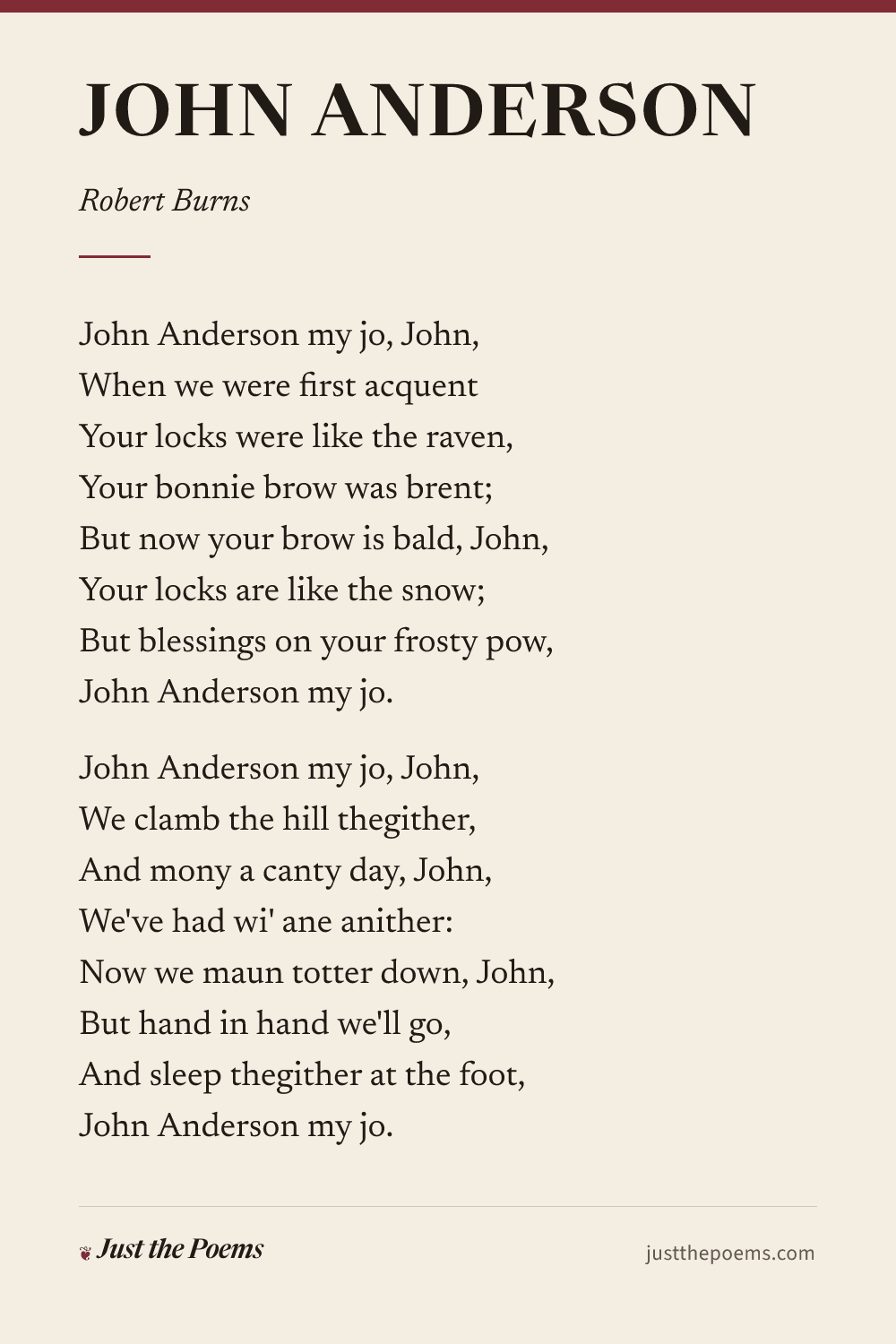
JOHN ANDERSON

Robert Burns

In 0 Wikipedias 4 anthologies Poet in 89 Wikipedias

John Anderson my jo, John,When we were first acquentYour locks were like the raven,Your bonnie brow was brent;But now your brow is bald, John,Your locks are like the snow;But blessings on your frosty pow,John Anderson my jo.

John Anderson my jo, John,We clamb the hill thegither,And mony a canty day, John,We've had wi' ane anither:Now we maun totter down, John,But hand in hand we'll go,And sleep thegither at the foot,John Anderson my jo.

Source

The Golden Treasury, ed. Francis Turner Palgrave

Filed under
  • Section “LOVE'S FULFILMENT”, The Home Book of Verse

Advertisements

AULD ROBIN GRAY

Lady Anne Lindsay

In 0 Wikipedias 4 anthologies Poet in 13 Wikipedias

When the sheep are in the fauld, and the kye at hame,And a' the warld to rest are gane,The waes o' my heart fa' in showers frae my e'e,While my gudeman lies sound by me.

Young Jamie lo'ed me weel, and sought me for his bride;But saving a croun he had naething else beside:To make the croun a pund, young Jamie gaed to sea;And the croun and the pund were baith for me.

He hadna been awa' a week but only twa,When my father brak his arm, and the cow was stown awa;My mother she fell sick, and my Jamie at the sea--And auld Robin Gray came a-courtin' me.

Show all 36 lines 24 more

My father couldna work, and my mother couldna spin;I toil'd day and night, but their bread I couldna win;Auld Rob maintain'd them baith, and wi' tears in his e'eSaid, Jennie, for their sakes, O, marry me!

My heart it said nay; I look'd for Jamie back;But the wind it blew high, and the ship it was a wrack;His ship it was a wrack--Why didna Jamie dee?Or why do I live to cry, Wae's me?

My father urgit sair: my mother didna speak;But she look'd in my face till my heart was like to break:They gi'ed him my hand, but my heart was at the sea;Sae auld Robin Gray he was gudeman to me.

I hadna been a wife a week but only four,When mournfu' as I sat on the stane at the door,I saw my Jamie's wraith, for I couldna think it he--Till he said, I'm come hame to marry thee.

O sair, sair did we greet, and muckle did we say;We took but ae kiss, and I bad him gang away;I wish that I were dead, but I'm no like to dee;And why was I born to say, Wae's me!

I gang like a ghaist, and I carena to spin;I daurna think on Jamie, for that wad be a sin;But I'll do my best a gude wife aye to be,For auld Robin Gray he is kind unto me.

Source

The Golden Treasury, ed. Francis Turner Palgrave

Filed under
  • Section “DISAPPOINTMENT IN LOVE”, The World's Best Poetry
  • Section “THE TRAGEDY OF LOVE”, The Home Book of Verse

Go, lovely Rose!

Edmund Waller

In 0 Wikipedias 4 anthologies Poet in 13 Wikipedias

Go, lovely Rose!Tell her, that wastes her time and me, That now she knows,When I resemble her to thee,How sweet and fair she seems to be.

Tell her that's young,And shuns to have her graces spied, That hadst thou sprungIn deserts, where no men abide,Thou must have uncommended died.

Small is the worthOf beauty from the light retired: Bid her come forth,Suffer herself to be desired,And not blush so to be admired.

Then die! that sheThe common fate of all things rare May read in thee:How small a part of time they shareThat are so wondrous sweet and fair!

Source

The Golden Treasury, ed. Francis Turner Palgrave

Filed under
  • Section “THE PARTED LOVERS”, The Home Book of Verse

FAIR HELEN

Anonymous

In 0 Wikipedias 4 anthologies Poet in 0 Wikipedias

I wish I were where Helen lies;Night and day on me she cries;O that I were where Helen lies On fair Kirconnell lea.

Curst be the heart that thought the thought,And curst the hand that fired the shot,When in my arms burd Helen dropt, And died to succour me!

O think na but my heart was sair,When my Love dropt down and spak nae mair!I laid her down wi' meikle care, On fair Kirconnell lea.

Show all 40 lines 28 more

As I went down the water side,None but my foe to be my guide,None but my foe to be my guide, On fair Kirconnell lea;

I lighted down my sword to draw,I hacked him in pieces sma',I hacked him in pieces sma', For her sake that died for me.

O Helen fair, beyond compare!I'll make a garland of thy hairShall bind my heart for evermair Until the day I die.

O that I were where Helen lies!Night and day on me she cries;Out of my bed she bids me rise, Says, "Haste, and come to me!"

O Helen fair! O Helen chaste!If I were with thee, I were blest,Where thou lies low and takes thy rest On fair Kirconnell lea.

I wish my grave were growing green,A winding-sheet drawn ower my een,And I in Helen's arms lying, On fair Kirconnell lea.

I wish I were where Helen lies;Night and day on me she cries;And I am weary of the skies, Since my Love died for me.

Source

The Golden Treasury, ed. Francis Turner Palgrave

Filed under
  • Section “LOVE AND DEATH”, The Home Book of Verse

Love not me for comely grace,

Anonymous

In 0 Wikipedias 4 anthologies Poet in 0 Wikipedias

Love not me for comely grace,For my pleasing eye or face,Nor for any outward part,No, nor for a constant heart,-- For these may fail, or turn to ill, So thou and I shall sever:Keep, therefore, a true woman's eye,And love me still, but know not why-- So hast thou the same reason still To doat upon me ever!

Source

The Golden Treasury, ed. Francis Turner Palgrave

Filed under
  • Named in the first line

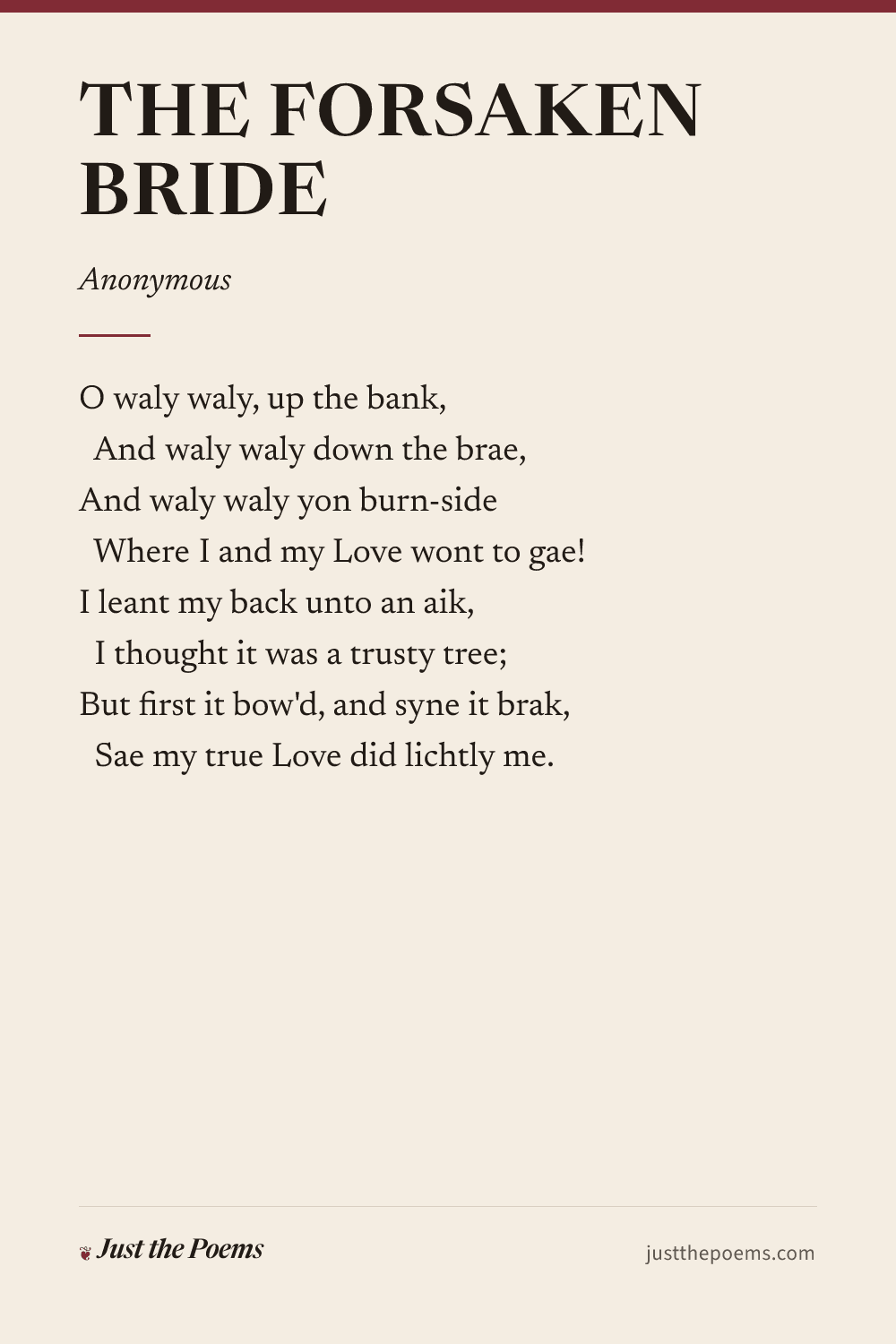
THE FORSAKEN BRIDE

Anonymous

In 0 Wikipedias 4 anthologies Poet in 0 Wikipedias

O waly waly, up the bank, And waly waly down the brae,And waly waly yon burn-side Where I and my Love wont to gae!I leant my back unto an aik, I thought it was a trusty tree;But first it bow'd, and syne it brak, Sae my true Love did lichtly me.

O waly waly, but love be bonny A little time while it is new;But when 'tis auld, it waxeth cauld, And fades awa' like morning dew.

Show all 40 lines 28 more

O wherefore should I busk my head? Or wherefore should I kame my hair?For my true Love has me forsook, And says he'll never loe me mair.

Now Arthur-seat sall be my bed; The sheets sall ne'er be prest by me:Saint Anton's well sall be my drink, Since my true Love has forsaken me.Marti'mas wind, when wilt thou blaw And shake the green leaves aff the tree?O gentle Death, when wilt thou come? For of my life I am wearie.

'Tis not the frost, that freezes fell, Nor blawing snaw's inclemencie,'Tis not sic cauld that makes me cry, But my Love's heart grown cauld to me.When we came in by Glasgow town We were a comely sight to see;My Love was clad in the black velvet, And I mysell in cramasie.

But had I wist, before I kist, That love had been sae ill to win,I had lockt my heart in a case of gowd And pinn'd it wi' a siller pin.And O! if my young babe were born, And set upon the nurse's knee,And I mysell were dead and gane, And the green grass growing over me!

Source

The Golden Treasury, ed. Francis Turner Palgrave

Filed under
  • Section “DISAPPOINTMENT IN LOVE”, The World's Best Poetry
  • Section “THE TRAGEDY OF LOVE”, The Home Book of Verse

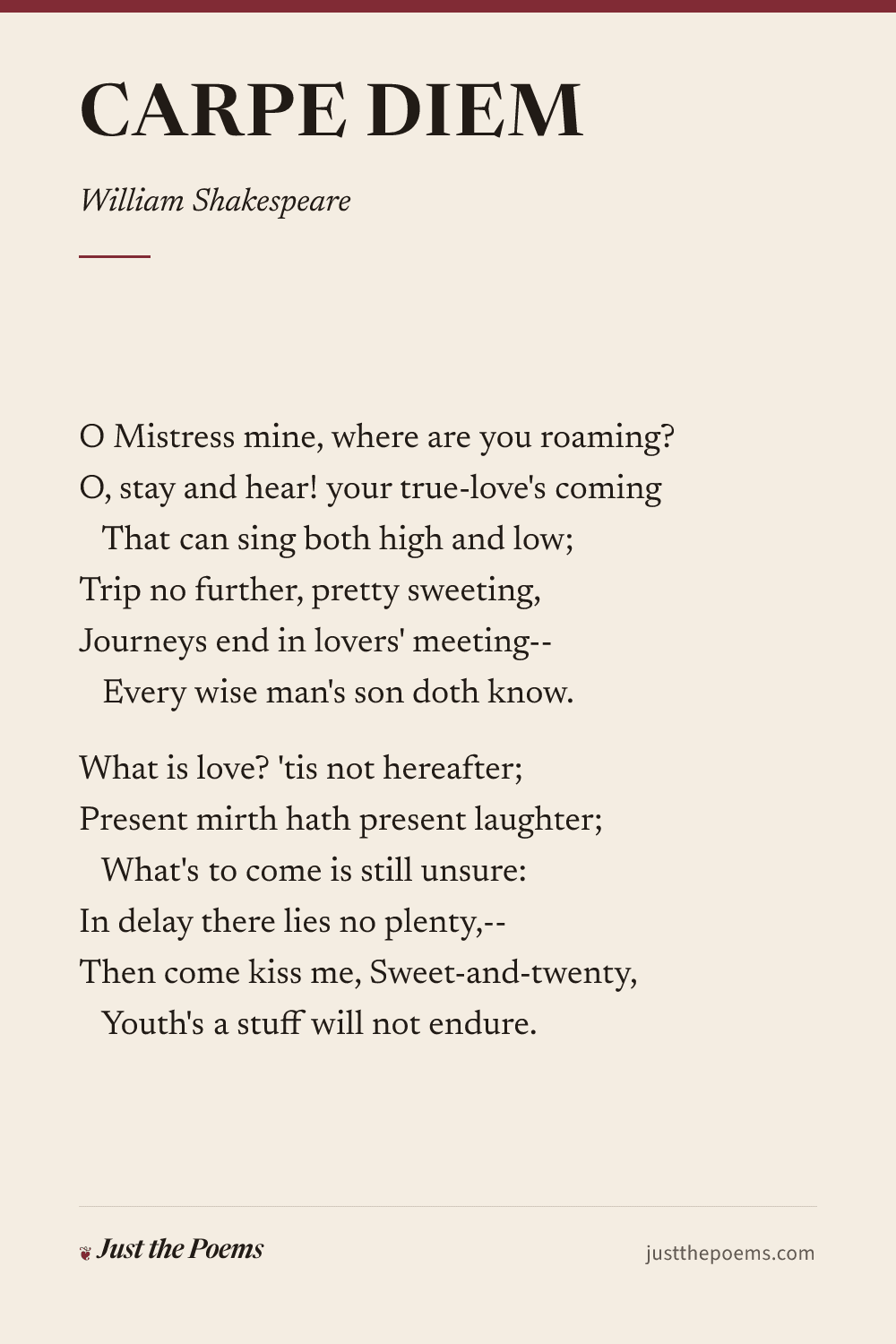
CARPE DIEM

William Shakespeare

In 0 Wikipedias 3 anthologies Poet in 237 Wikipedias

O Mistress mine, where are you roaming?O, stay and hear! your true-love's coming That can sing both high and low;Trip no further, pretty sweeting,Journeys end in lovers' meeting-- Every wise man's son doth know.

What is love? 'tis not hereafter;Present mirth hath present laughter; What's to come is still unsure:In delay there lies no plenty,--Then come kiss me, Sweet-and-twenty, Youth's a stuff will not endure.

Source

The Golden Treasury, ed. Francis Turner Palgrave

Filed under
  • Section “THE PARTED LOVERS”, The Home Book of Verse

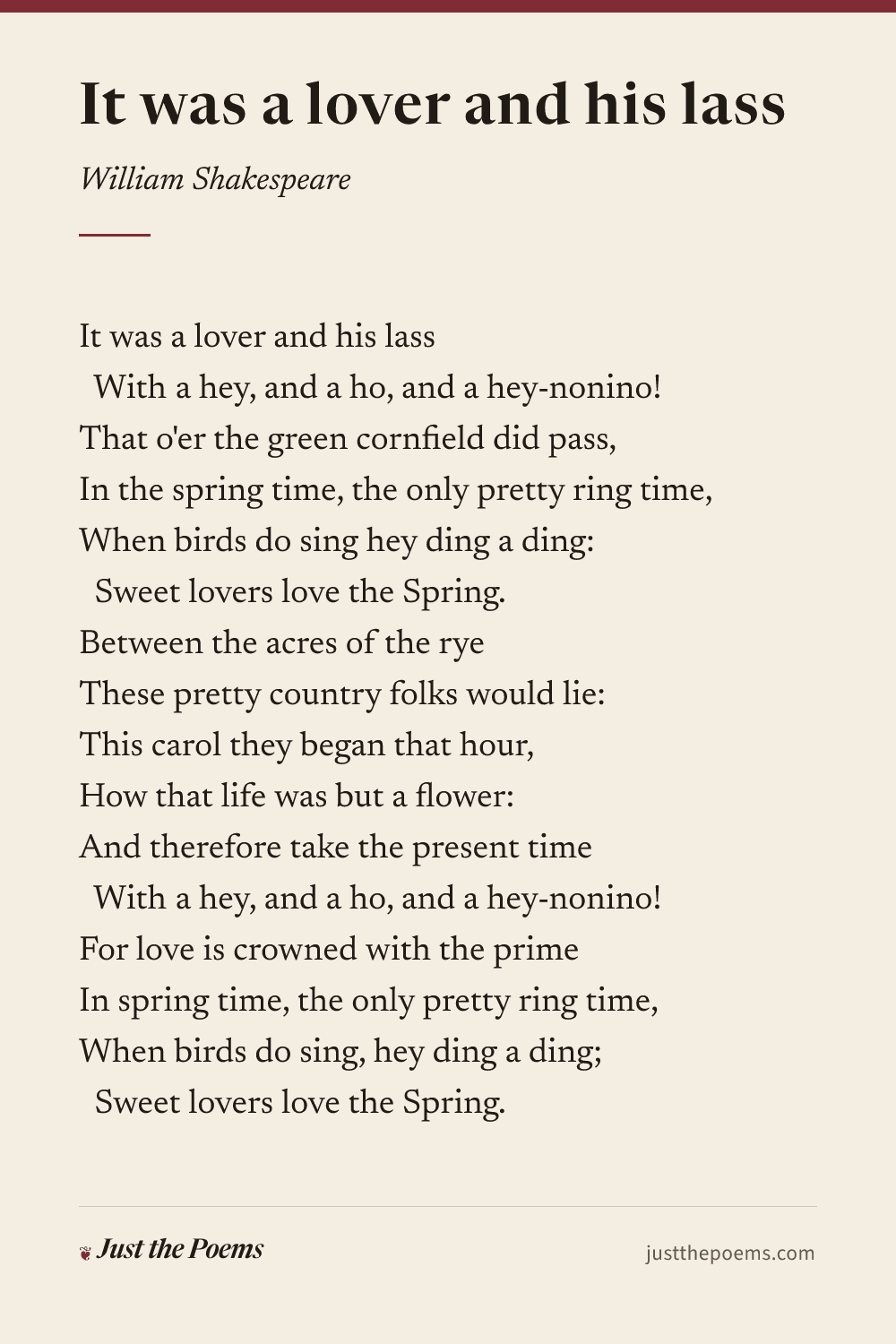
It was a lover and his lass

William Shakespeare

In 0 Wikipedias 3 anthologies Poet in 237 Wikipedias

It was a lover and his lass With a hey, and a ho, and a hey-nonino!That o'er the green cornfield did pass,In the spring time, the only pretty ring time,When birds do sing hey ding a ding: Sweet lovers love the Spring.Between the acres of the ryeThese pretty country folks would lie:This carol they began that hour,How that life was but a flower:And therefore take the present time With a hey, and a ho, and a hey-nonino!For love is crowned with the primeIn spring time, the only pretty ring time,When birds do sing, hey ding a ding; Sweet lovers love the Spring.

Source

The Golden Treasury, ed. Francis Turner Palgrave

Filed under
  • Section “THE COMEDY OF LOVE”, The Home Book of Verse
  • Named in the first line

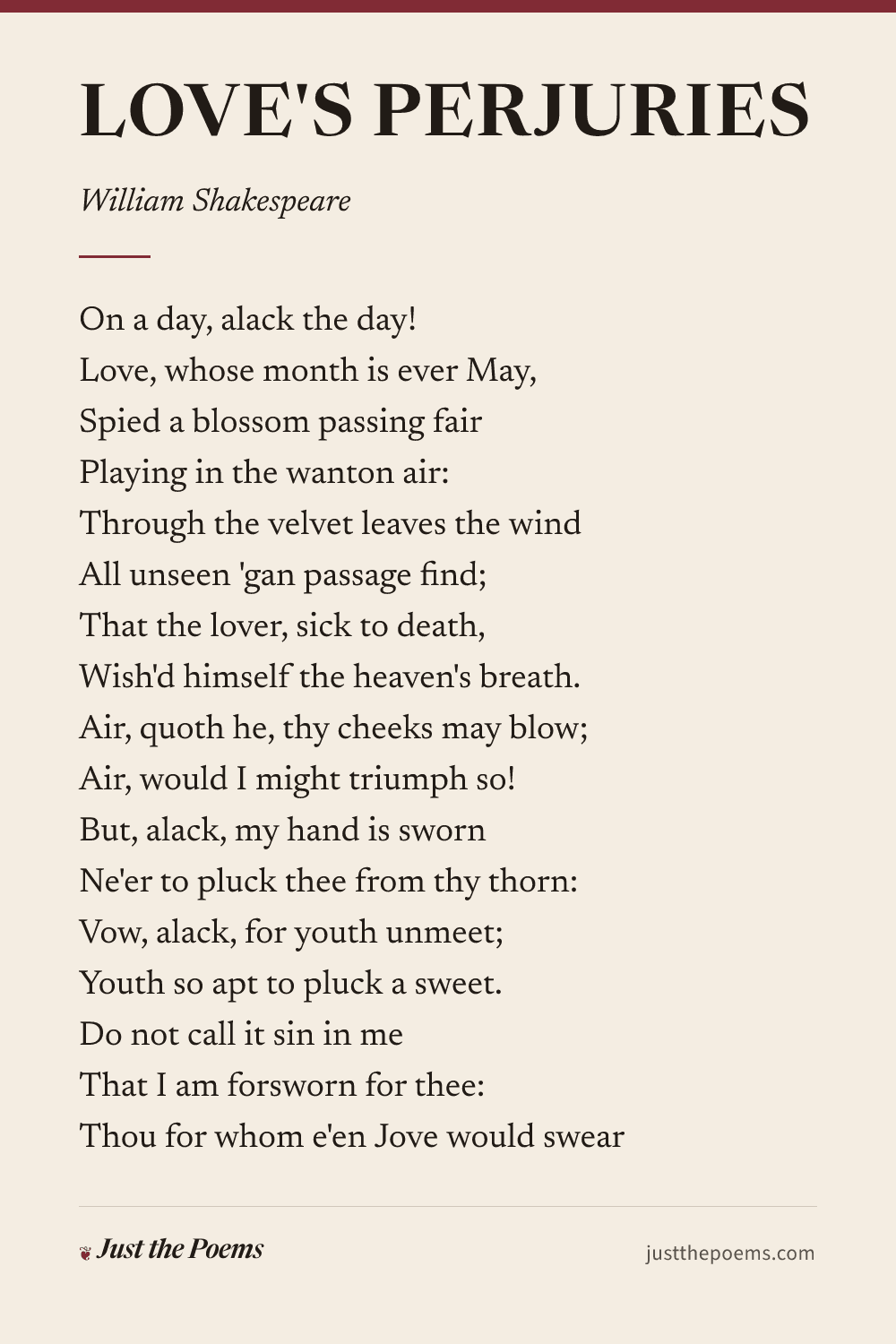
LOVE'S PERJURIES

William Shakespeare

In 0 Wikipedias 3 anthologies Poet in 237 Wikipedias

On a day, alack the day!Love, whose month is ever May,Spied a blossom passing fairPlaying in the wanton air:Through the velvet leaves the windAll unseen 'gan passage find;That the lover, sick to death,Wish'd himself the heaven's breath.Air, quoth he, thy cheeks may blow;Air, would I might triumph so!But, alack, my hand is swornNe'er to pluck thee from thy thorn:Vow, alack, for youth unmeet;Youth so apt to pluck a sweet.Do not call it sin in meThat I am forsworn for thee:Thou for whom e'en Jove would swearJuno but an Ethiope were,And deny himself for Jove,Turning mortal for thy love.

Source

The Golden Treasury, ed. Francis Turner Palgrave

Filed under
  • Section “"NOW WHAT IS LOVE"”, The Home Book of Verse
  • Named in the title

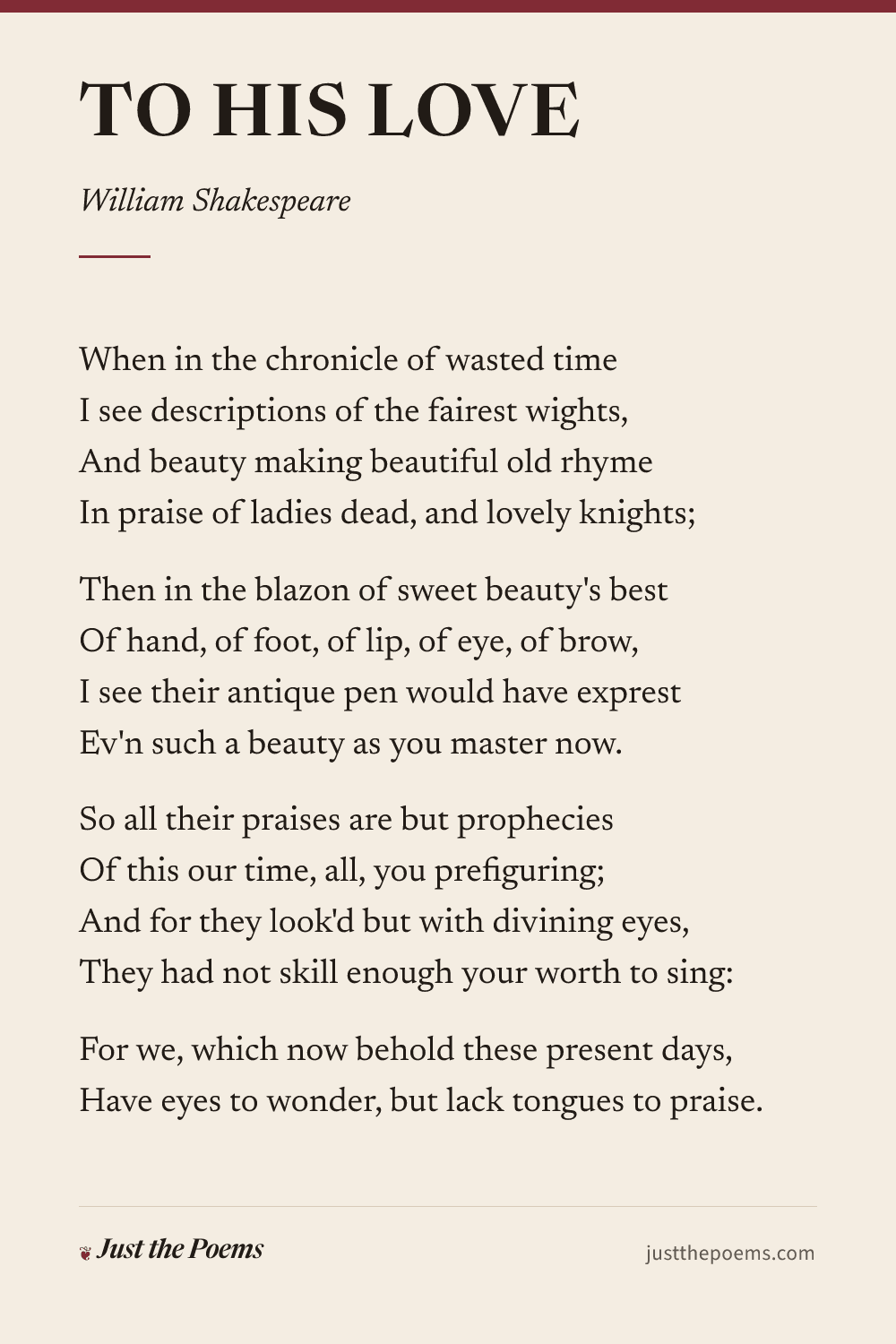
TO HIS LOVE

William Shakespeare

In 0 Wikipedias 3 anthologies Poet in 237 Wikipedias

When in the chronicle of wasted timeI see descriptions of the fairest wights,And beauty making beautiful old rhymeIn praise of ladies dead, and lovely knights;

Then in the blazon of sweet beauty's bestOf hand, of foot, of lip, of eye, of brow,I see their antique pen would have exprestEv'n such a beauty as you master now.

So all their praises are but propheciesOf this our time, all, you prefiguring;And for they look'd but with divining eyes,They had not skill enough your worth to sing:

For we, which now behold these present days,Have eyes to wonder, but lack tongues to praise.

Source

The Golden Treasury, ed. Francis Turner Palgrave

Filed under
  • Named in the title

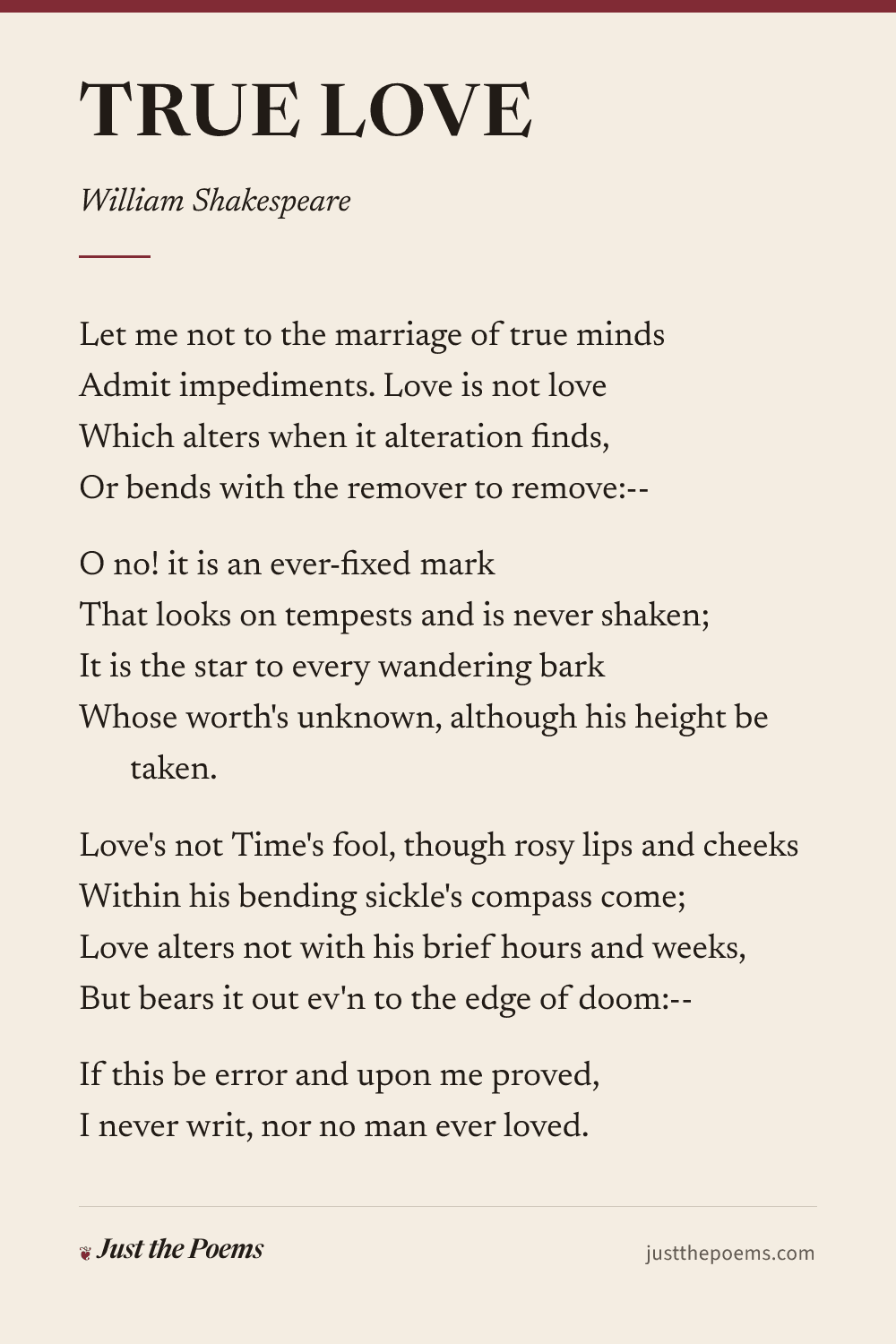
TRUE LOVE

William Shakespeare

In 0 Wikipedias 3 anthologies Poet in 237 Wikipedias

Let me not to the marriage of true mindsAdmit impediments. Love is not loveWhich alters when it alteration finds,Or bends with the remover to remove:--

O no! it is an ever-fixed markThat looks on tempests and is never shaken;It is the star to every wandering barkWhose worth's unknown, although his height be taken.

Love's not Time's fool, though rosy lips and cheeksWithin his bending sickle's compass come;Love alters not with his brief hours and weeks,But bears it out ev'n to the edge of doom:--

If this be error and upon me proved,I never writ, nor no man ever loved.

Source

The Golden Treasury, ed. Francis Turner Palgrave

Filed under
  • Named in the title

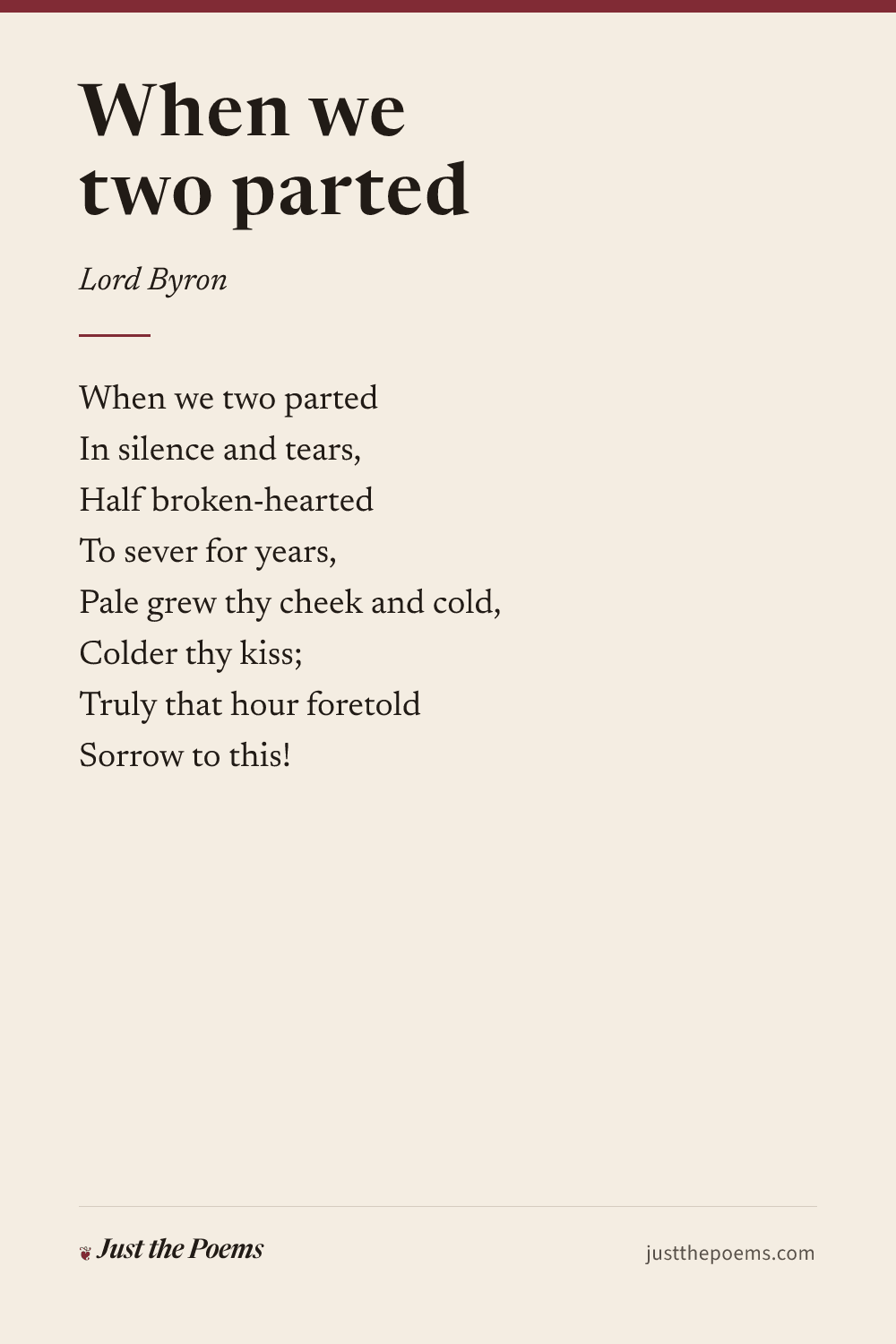
When we two parted

Lord Byron

In 0 Wikipedias 3 anthologies Poet in 155 Wikipedias

When we two partedIn silence and tears,Half broken-heartedTo sever for years,Pale grew thy cheek and cold,Colder thy kiss;Truly that hour foretoldSorrow to this!

The dew of the morningSunk chill on my brow;It felt like the warningOf what I feel now.

Show all 32 lines 20 more

Thy vows are all broken,And light is thy fame:I hear thy name spoken,And share in its shame.

They name thee before me,A knell to mine ear;A shudder comes o'er me--Why wert thou so dear?They know not I knew thee,Who knew thee too well:Long, long shall I rue theeToo deeply to tell.

In secret we met:In silence I grieveThat thy heart could forget,Thy spirit deceive.If I should meet theeAfter long years,How should I greet thee?--With silence and tears.

Source

The Golden Treasury, ed. Francis Turner Palgrave

Filed under
  • Section “THE PARTED LOVERS”, The Home Book of Verse

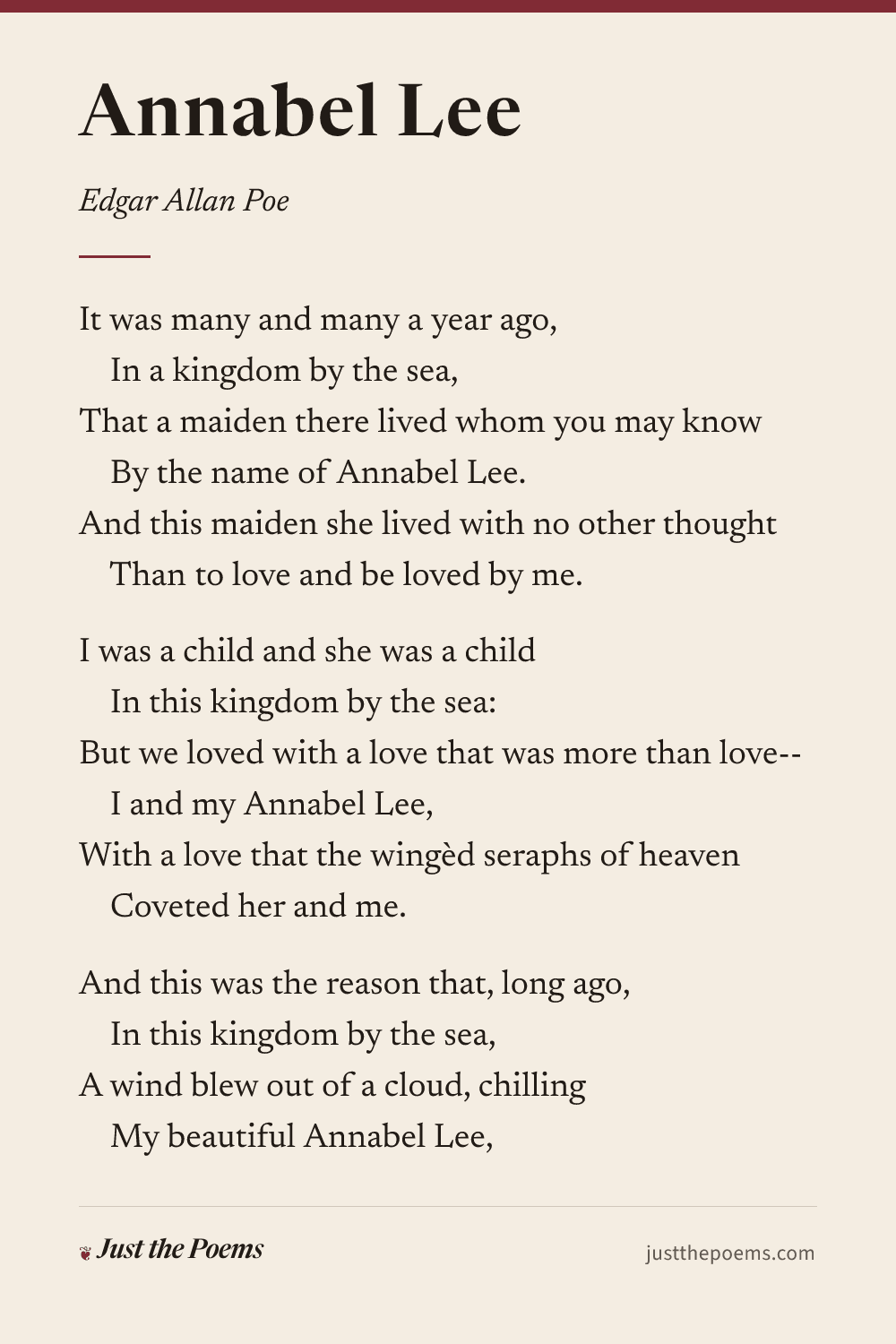
Annabel Lee

Edgar Allan Poe

In 0 Wikipedias 3 anthologies Poet in 153 Wikipedias

It was many and many a year ago, In a kingdom by the sea,That a maiden there lived whom you may know By the name of Annabel Lee.And this maiden she lived with no other thought Than to love and be loved by me.

I was a child and she was a child In this kingdom by the sea:But we loved with a love that was more than love-- I and my Annabel Lee,With a love that the wingèd seraphs of heaven Coveted her and me.

Show all 41 lines 29 more

And this was the reason that, long ago, In this kingdom by the sea,A wind blew out of a cloud, chilling My beautiful Annabel Lee,So that her high-born kinsmen came And bore her away from me,To shut her up in a sepulchre In this kingdom by the sea.

The angels, not half so happy in heaven, Went envying her and me--Yes! that was the reason (as all men know, In this kingdom by the sea)That the wind came out of the cloud one night, Chilling and killing my Annabel Lee.

But our love it was stronger by far than the love Of those who were older than we-- Of many far wiser than we--And neither the angels in heaven above, Nor the demons down under the sea,Can ever dissever my soul from the soul Of the beautiful Annabel Lee:

For the moon never beams without bringing me dreams Of the beautiful Annabel Lee;And the stars never rise, but I feel the bright eyes Of the beautiful Annabel Lee;And so, all the night-tide, I lie down by the sideOf my darling--my darling--my life and my bride, In the sepulchre there by the sea, In her tomb by the sounding sea.

Source

The Oxford Book of English Verse 1250–1900, 1900

Filed under
  • Section “LOVE AND DEATH”, The Home Book of Verse

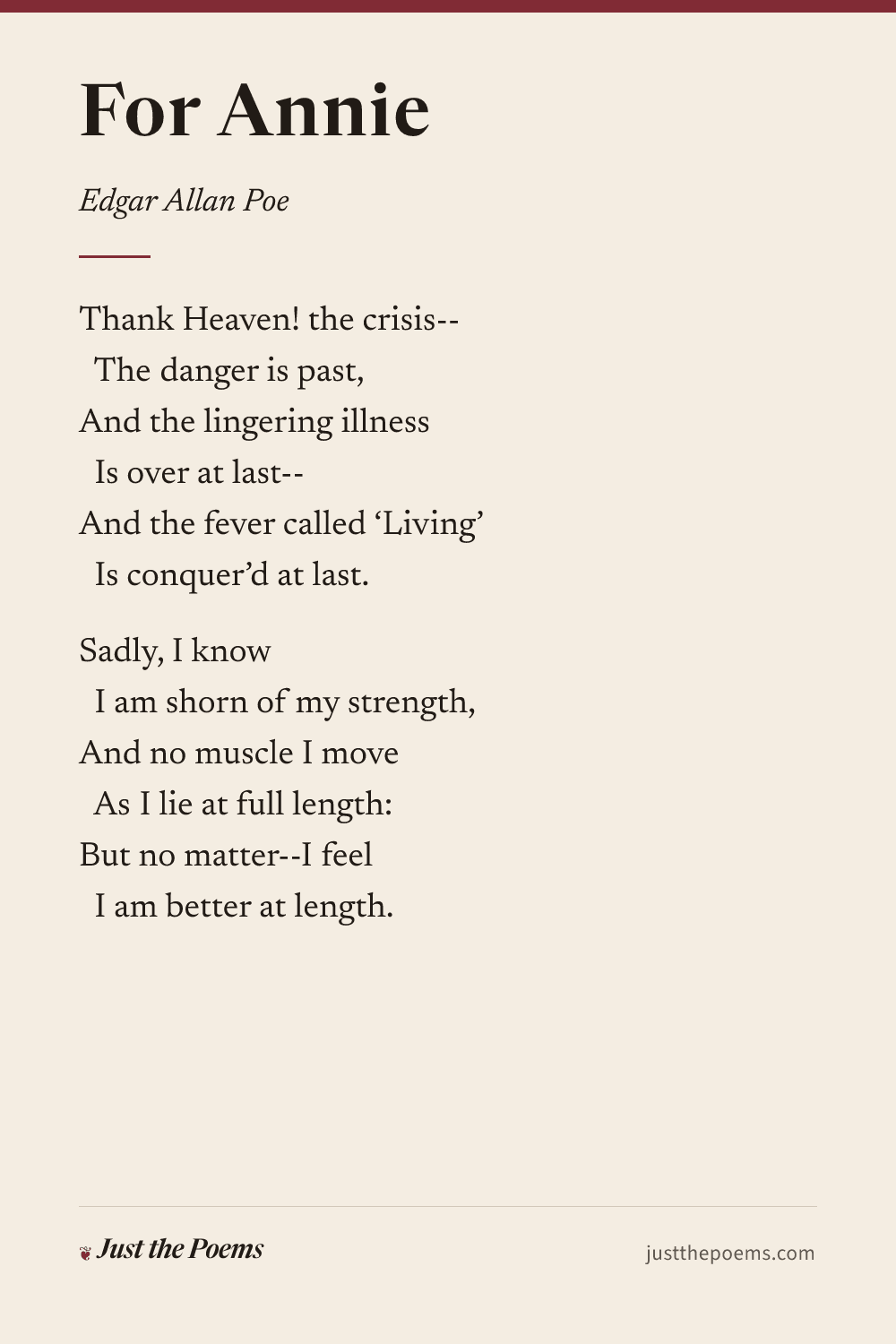
For Annie

Edgar Allan Poe

In 0 Wikipedias 3 anthologies Poet in 153 Wikipedias

Thank Heaven! the crisis-- The danger is past,And the lingering illness Is over at last--And the fever called ‘Living’ Is conquer’d at last.

Sadly, I know I am shorn of my strength,And no muscle I move As I lie at full length:But no matter--I feel I am better at length.

Show all 102 lines 90 more

And I rest so composedly Now, in my bed,That any beholder Might fancy me dead--Might start at beholding me, Thinking me dead.

The moaning and groaning, The sighing and sobbing,Are quieted now, With that horrible throbbingAt heart--ah, that horrible, Horrible throbbing!

The sickness--the nausea-- The pitiless pain--Have ceased, with the fever That madden’d my brain--With the fever called ‘Living’ That burn’d in my brain.

And O! of all tortures That torture the worstHas abated--the terrible Torture of thirstFor the naphthaline river Of Passion accurst--I have drunk of a water That quenches all thirst.

--Of a water that flows, With a lullaby sound,From a spring but a very few Feet under ground--From a cavern not very far Down under ground.

And ah! let it never Be foolishly saidThat my room it is gloomy, And narrow my bed;For man never slept In a different bed--And, to sleep, you must slumber In just such a bed.

My tantalized spirit Here blandly reposes,Forgetting, or never Regretting its roses--Its old agitations Of myrtles and roses:

For now, while so quietly Lying, it fanciesA holier odour About it, of pansies--A rosemary odour, Commingled with pansies--With rue and the beautiful Puritan pansies.

And so it lies happily, Bathing in manyA dream of the truth And the beauty of Annie--Drown’d in a bath Of the tresses of Annie.

She tenderly kiss’d me, She fondly caress’d,And then I fell gently To sleep on her breast--Deeply to sleep From the heaven of her breast.

When the light was extinguish’d, She cover’d me warm,And she pray’d to the angels To keep me from harm--To the queen of the angels To shield me from harm.

And I lie so composedly, Now, in my bed(Knowing her love), That you fancy me dead--And I rest so contentedly, Now, in my bed(With her love at my breast), That you fancy me dead--That you shudder to look at me, Thinking me dead.

But my heart it is brighter Than all of the manyStars in the sky, For it sparkles with Annie--It glows with the light Of the love of my Annie--With the thought of the light Of the eyes of my Annie.

Source

The Oxford Book of English Verse 1250–1900, 1900

Filed under
  • Section “LOVE AND DEATH”, The Home Book of Verse

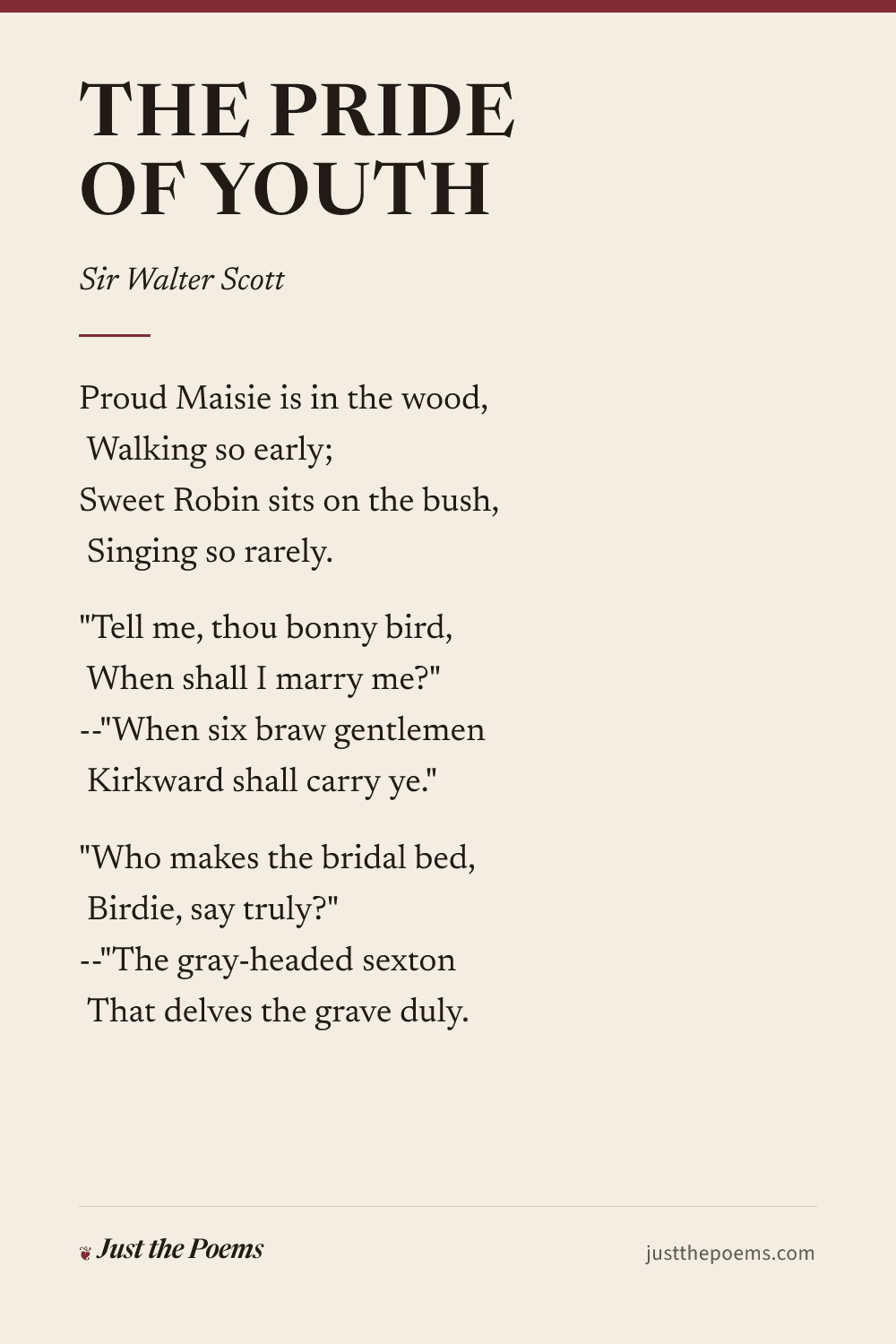
THE PRIDE OF YOUTH

Sir Walter Scott

In 0 Wikipedias 3 anthologies Poet in 98 Wikipedias

Proud Maisie is in the wood, Walking so early;Sweet Robin sits on the bush, Singing so rarely.

"Tell me, thou bonny bird, When shall I marry me?"--"When six braw gentlemen Kirkward shall carry ye."

"Who makes the bridal bed, Birdie, say truly?"--"The gray-headed sexton That delves the grave duly.

"The glowworm o'er grave and stone Shall light thee steady;The owl from the steeple sing Welcome, proud lady!"

Source

The Golden Treasury, ed. Francis Turner Palgrave

Filed under
  • Section “LOVE AND DEATH”, The Home Book of Verse

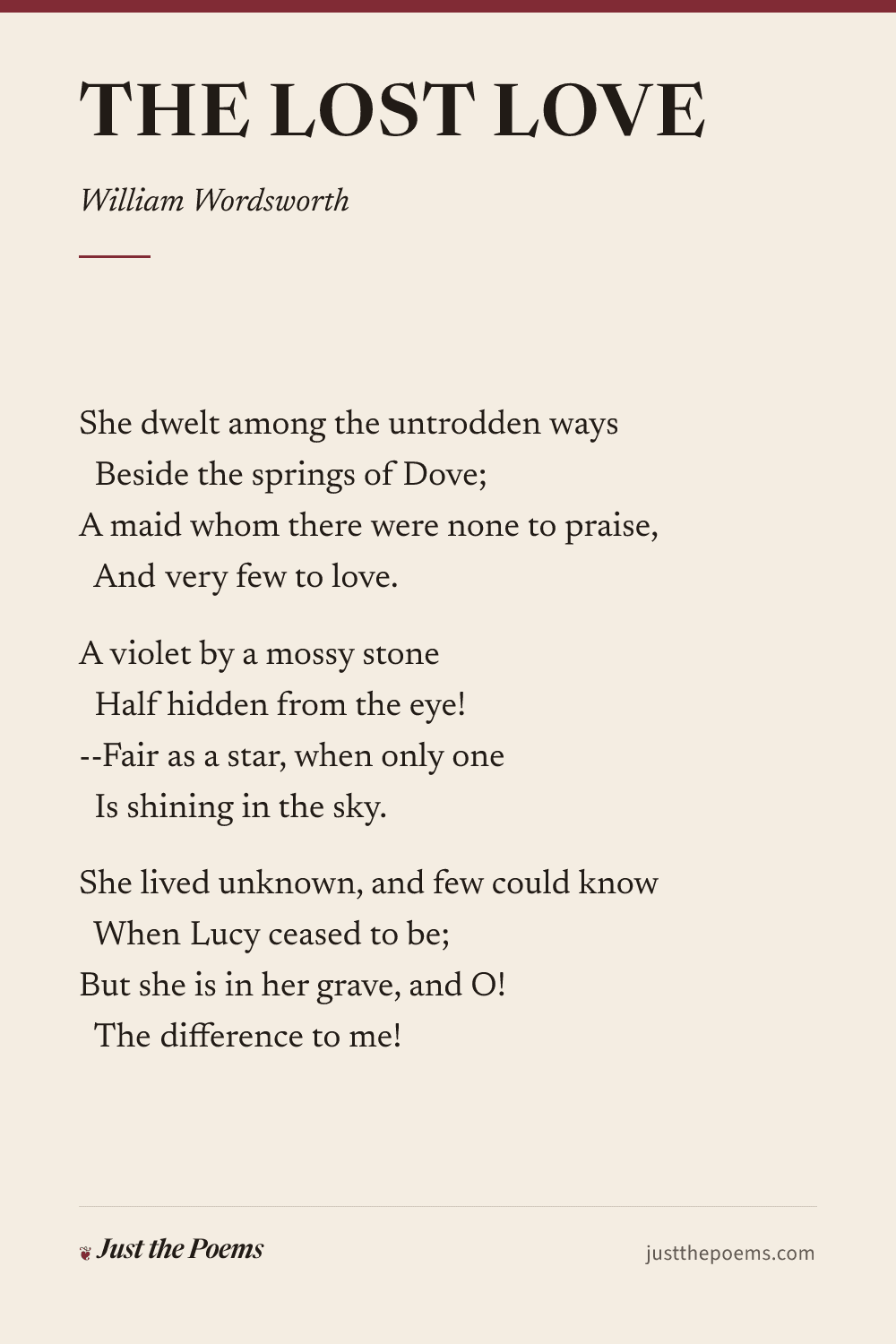
THE LOST LOVE

William Wordsworth

In 0 Wikipedias 3 anthologies Poet in 97 Wikipedias

She dwelt among the untrodden ways Beside the springs of Dove;A maid whom there were none to praise, And very few to love.

A violet by a mossy stone Half hidden from the eye!--Fair as a star, when only one Is shining in the sky.

She lived unknown, and few could know When Lucy ceased to be;But she is in her grave, and O! The difference to me!

Source

The Golden Treasury, ed. Francis Turner Palgrave

Filed under
  • Named in the title

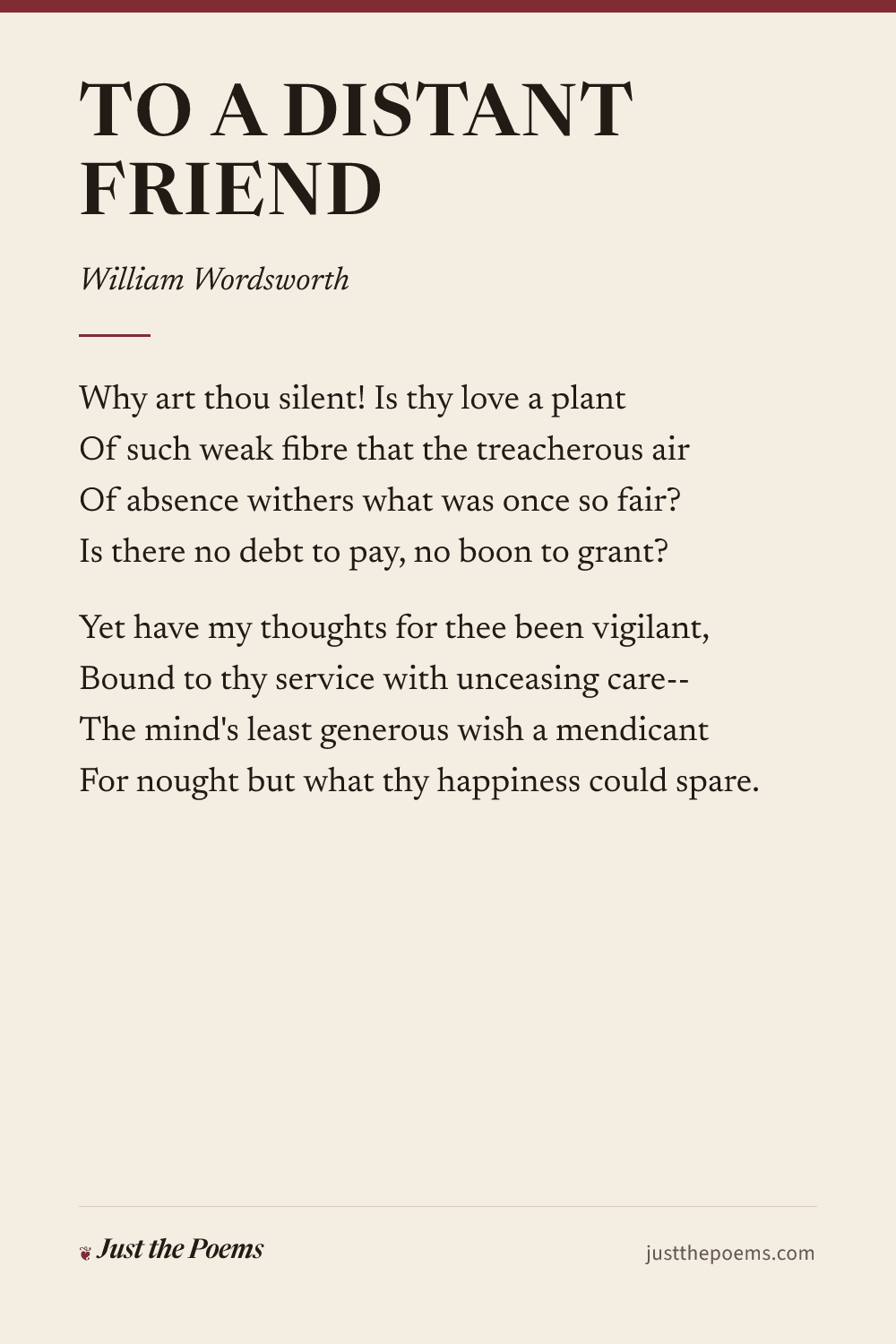
TO A DISTANT FRIEND

William Wordsworth

In 0 Wikipedias 3 anthologies Poet in 97 Wikipedias

Why art thou silent! Is thy love a plantOf such weak fibre that the treacherous airOf absence withers what was once so fair?Is there no debt to pay, no boon to grant?

Yet have my thoughts for thee been vigilant,Bound to thy service with unceasing care--The mind's least generous wish a mendicantFor nought but what thy happiness could spare.

Speak!--though this soft warm heart, once free to holdA thousand tender pleasures, thine and mine,Be left more desolate, more dreary coldThan a forsaken bird's-nest fill'd with snow'Mid its own bush of leafless eglantine--Speak, that my torturing doubts their end may know!

Source

The Golden Treasury, ed. Francis Turner Palgrave

Filed under
  • Section “LOVE SONNETS”, The Home Book of Verse

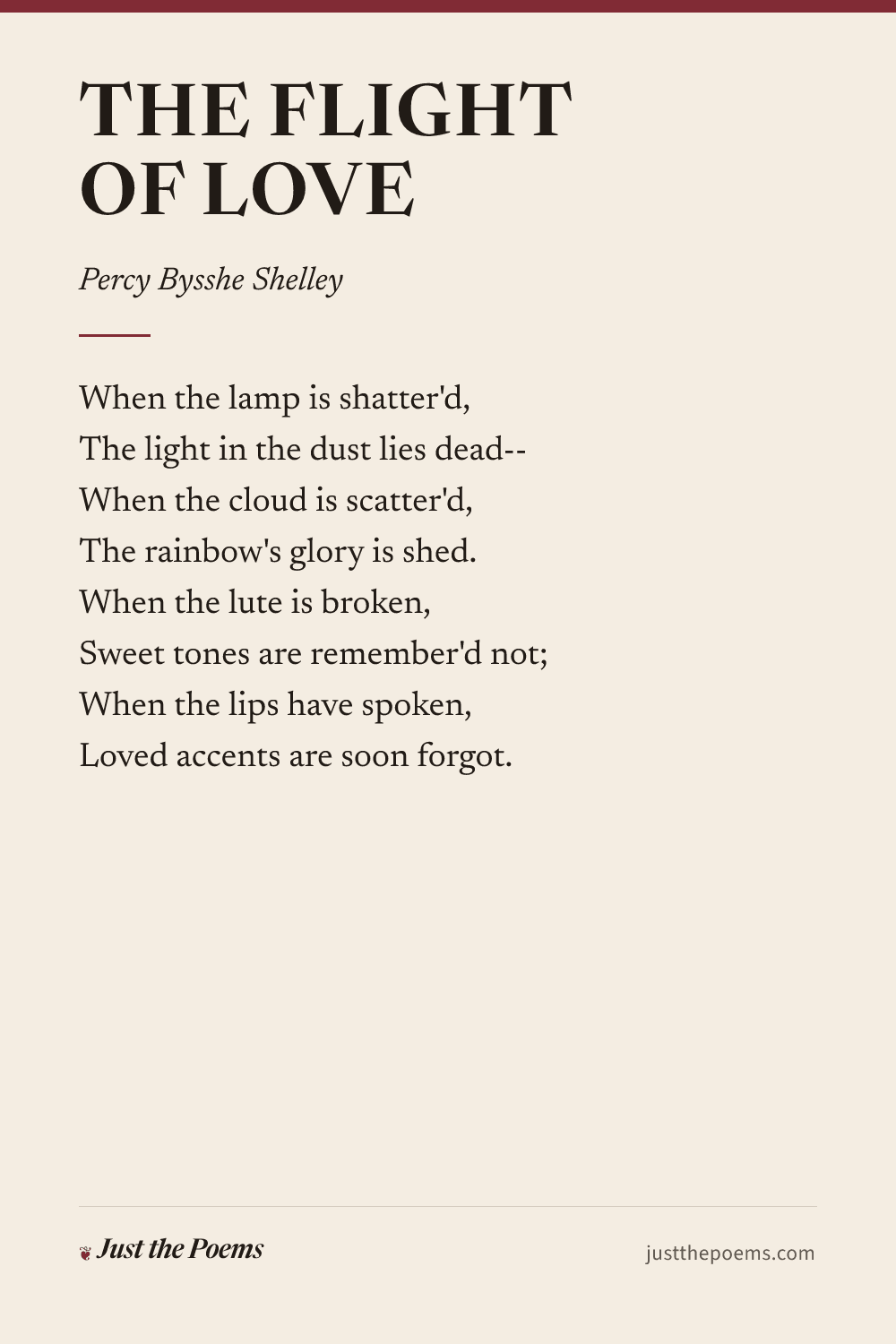
THE FLIGHT OF LOVE

Percy Bysshe Shelley

In 0 Wikipedias 3 anthologies Poet in 91 Wikipedias

When the lamp is shatter'd,The light in the dust lies dead--When the cloud is scatter'd,The rainbow's glory is shed.When the lute is broken,Sweet tones are remember'd not;When the lips have spoken,Loved accents are soon forgot.

As music and splendourSurvive not the lamp and the lute,The heart's echoes renderNo song when the spirit is mute--

Show all 32 lines 20 more

No song but sad dirges,Like the wind through a ruin'd cell,Or the mournful surgesThat ring the dead seaman's knell.

When hearts have once mingled,Love first leaves the well-built nest;The weak one is singledTo endure what it once possest.O Love! who bewailestThe frailty of all things here,Why choose you the frailestFor your cradle, your home, and your bier?

Its passions will rock theeAs the storms rock the ravens on high;Bright reason will mock theeLike the sun from a wintry sky.From thy nest every rafterWill rot, and thine eagle homeLeave thee naked to laughter,When leaves fall and cold winds come.

Source

The Golden Treasury, ed. Francis Turner Palgrave

Filed under
  • Section “THE TRAGEDY OF LOVE”, The Home Book of Verse
  • Named in the title

30 of 700 poems about love

13 poets

By poet's century of death (27 of 30)

CenturyPoems
16th1
17th8
18th4
19th14

Poets with more than one poem

PoetPoems
William Shakespeare6
Robert Burns4
Robert Browning3
Edgar Allan Poe2
Lord Byron2
Sir Walter Scott2
William Wordsworth2