Poems About Aging

The first 30 of 32 poems about aging, by 28 poets, ranked by third-party data. How poems are ranked

A Farewell to Arms

George Peele

In 1 Wikipedia 2 anthologies Poet in 16 Wikipedias

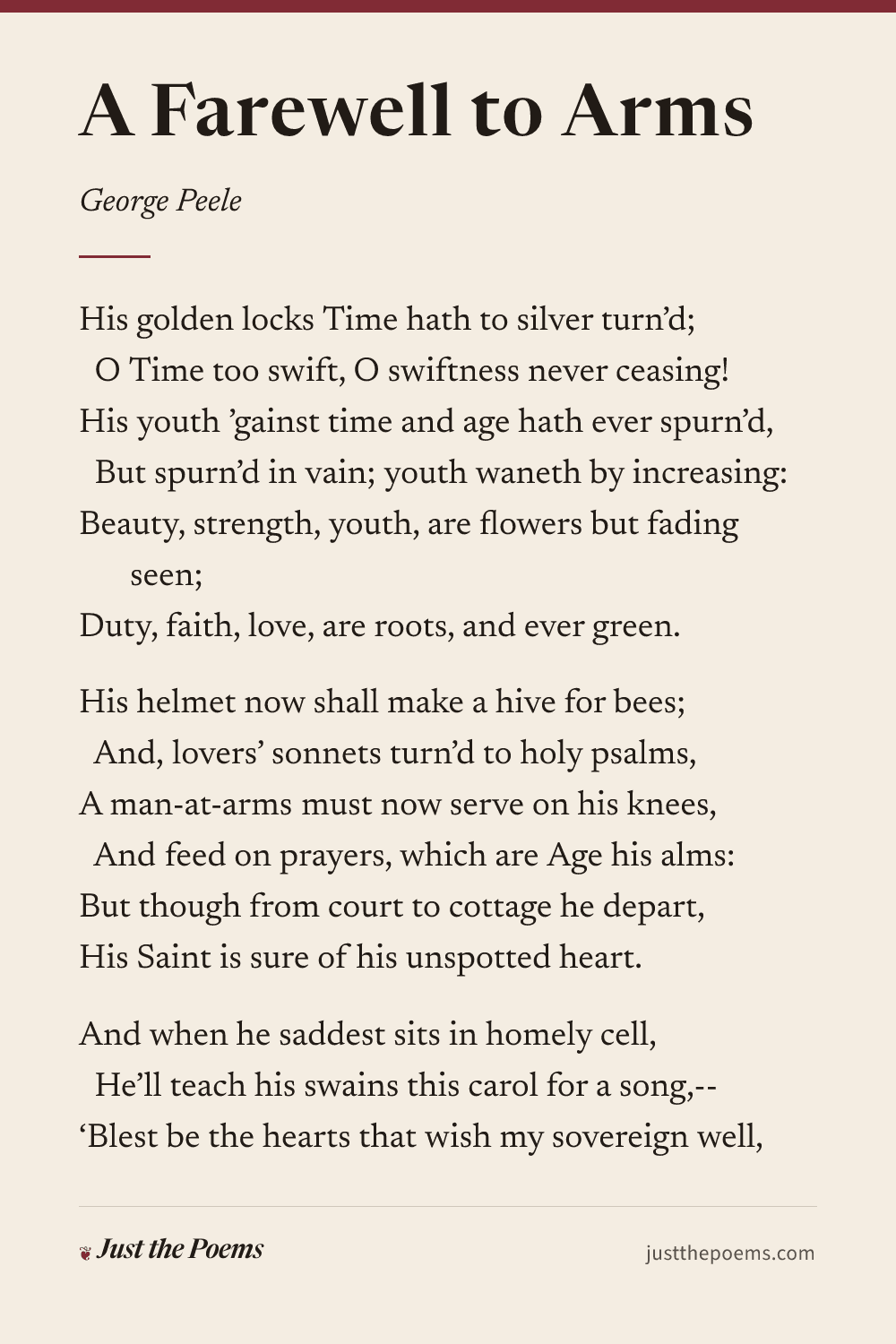
His golden locks Time hath to silver turn’d; O Time too swift, O swiftness never ceasing!His youth ’gainst time and age hath ever spurn’d, But spurn’d in vain; youth waneth by increasing:Beauty, strength, youth, are flowers but fading seen;Duty, faith, love, are roots, and ever green.

His helmet now shall make a hive for bees; And, lovers’ sonnets turn’d to holy psalms,A man-at-arms must now serve on his knees, And feed on prayers, which are Age his alms:But though from court to cottage he depart,His Saint is sure of his unspotted heart.

And when he saddest sits in homely cell, He’ll teach his swains this carol for a song,--‘Blest be the hearts that wish my sovereign well, Curst be the souls that think her any wrong.’Goddess, allow this agèd man his rightTo be your beadsman now that was your knight.

Source

The Oxford Book of English Verse 1250–1900, 1900

Filed under
  • Section “STEPPING WESTWARD”, The Home Book of Verse

YOUTH AND AGE

Samuel Taylor Coleridge

In 0 Wikipedias 4 anthologies Poet in 86 Wikipedias

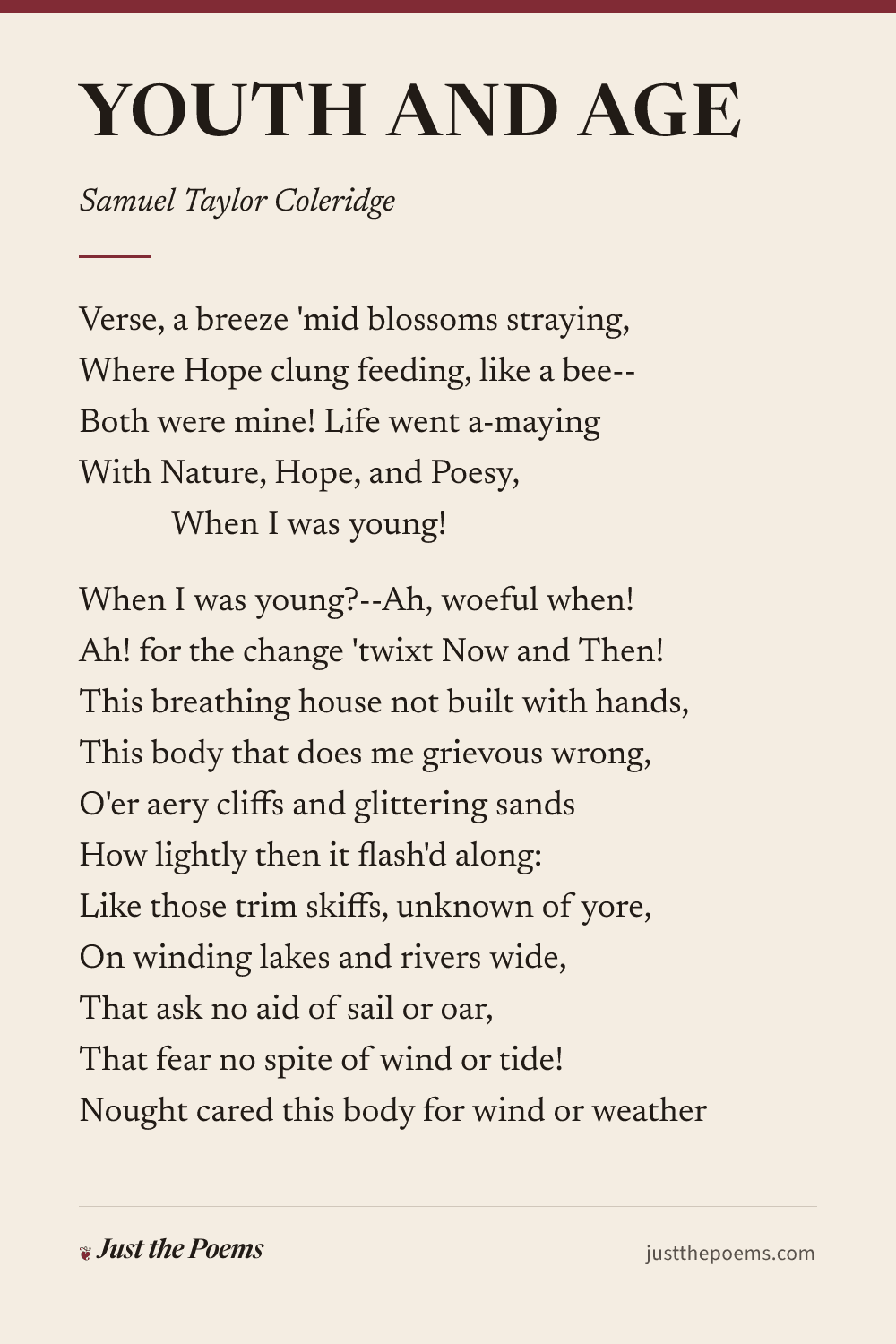
Verse, a breeze 'mid blossoms straying,Where Hope clung feeding, like a bee--Both were mine! Life went a-mayingWith Nature, Hope, and Poesy, When I was young!

When I was young?--Ah, woeful when!Ah! for the change 'twixt Now and Then!This breathing house not built with hands,This body that does me grievous wrong,O'er aery cliffs and glittering sandsHow lightly then it flash'd along:Like those trim skiffs, unknown of yore,

Show all 49 lines 37 more

On winding lakes and rivers wide,That ask no aid of sail or oar,That fear no spite of wind or tide!Nought cared this body for wind or weatherWhen Youth and I lived in't together.Flowers are lovely; Love is flower-like;Friendship is a sheltering tree;O! the joys, that came down shower-like,Of Friendship, Love, and Liberty, Ere I was old!

Ere I was old? Ah woeful Ere,Which tells me, Youth's no longer here!O Youth! for years so many and sweet'Tis known that Thou and I were one,I'll think it but a fond conceit--It cannot be, that Thou art gone!Thy vesper-bell hath not yet toll'd:--And thou wert aye a masker bold!What strange disguise hast now put onTo make believe that thou art gone?I see these locks in silvery slips,This drooping gait, this alter'd size:But Springtide blossoms on thy lips,And tears take sunshine from thine eyes!Life is but Thought: so think I willThat Youth and I are housemates still.

Dew-drops are the gems of morning,But the tears of mournful eve!Where no hope is, life's a warningThat only serves to make us grieve

When we are old:--That only serves to make us grieveWith oft and tedious taking-leave,Like some poor nigh-related guestThat may not rudely be dismist,Yet hath out-stay'd his welcome while,And tells the jest without a smile.

Source

The Golden Treasury, ed. Francis Turner Palgrave

Filed under
  • Section “STEPPING WESTWARD”, The Home Book of Verse

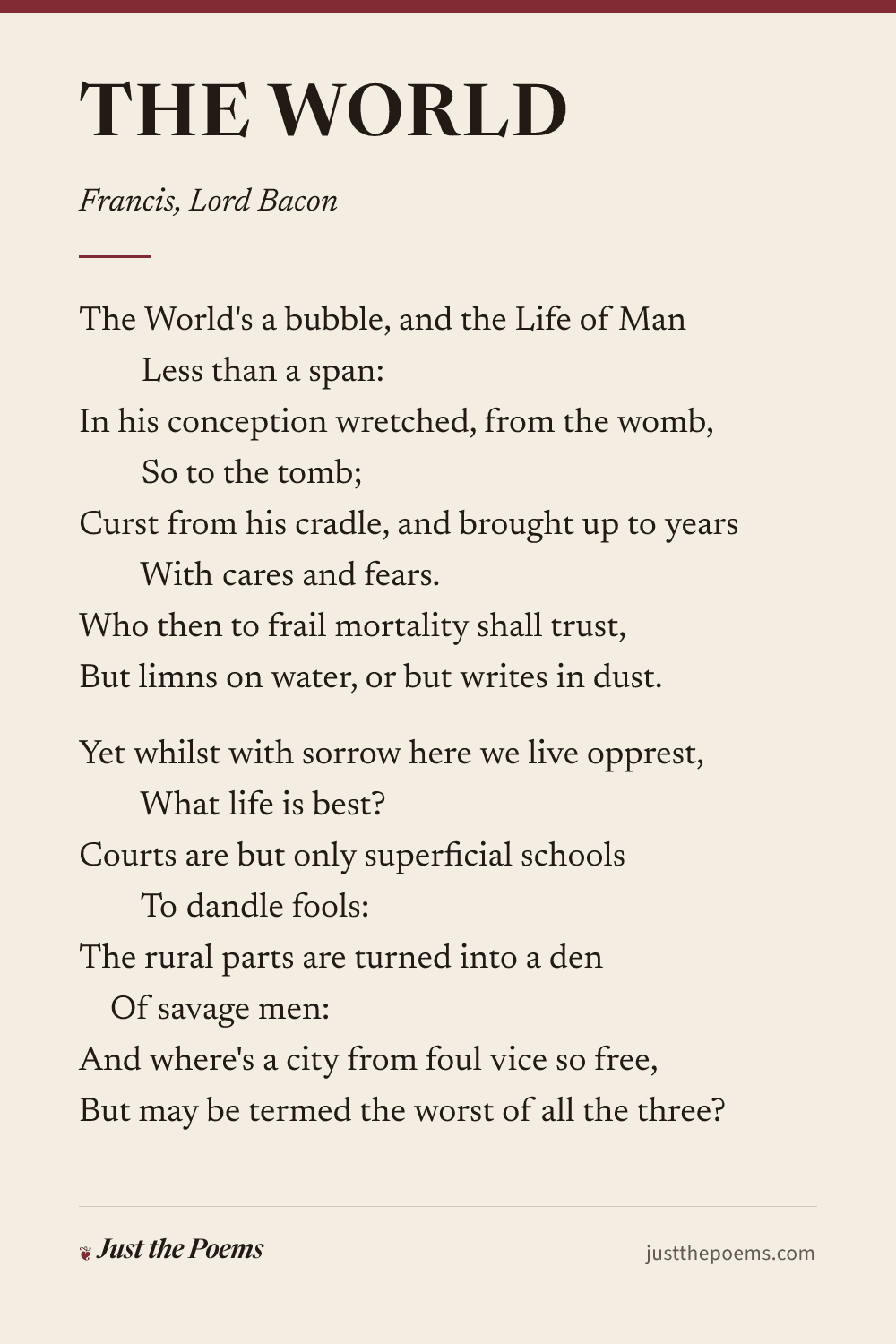
THE WORLD

Francis, Lord Bacon

In 0 Wikipedias 2 anthologies Poet in 119 Wikipedias

The World's a bubble, and the Life of Man Less than a span:In his conception wretched, from the womb, So to the tomb;Curst from his cradle, and brought up to years With cares and fears.Who then to frail mortality shall trust,But limns on water, or but writes in dust.

Yet whilst with sorrow here we live opprest, What life is best?Courts are but only superficial schools To dandle fools:

Show all 32 lines 20 more

The rural parts are turned into a den Of savage men:And where's a city from foul vice so free,But may be termed the worst of all the three?

Domestic cares afflict the husband's bed, Or pains his head:Those that live single, take it for a curse, Or do things worse:Some would have children: those that have them, moan Or wish them gone:What is it, then, to have or have no wife,But single thraldom, or a double strife?

Our own affection still at home to please Is a disease:To cross the seas to any foreign soil, Peril and toil:Wars with their noise affright us; when they cease, We are worse in peace;--What then remains, but that we still should cryFor being born, or, being born, to die?

Source

The World's Best Poetry, Vol. III, ed. Bliss Carman, 1904

Filed under
  • Section “STEPPING WESTWARD”, The Home Book of Verse

Advertisements

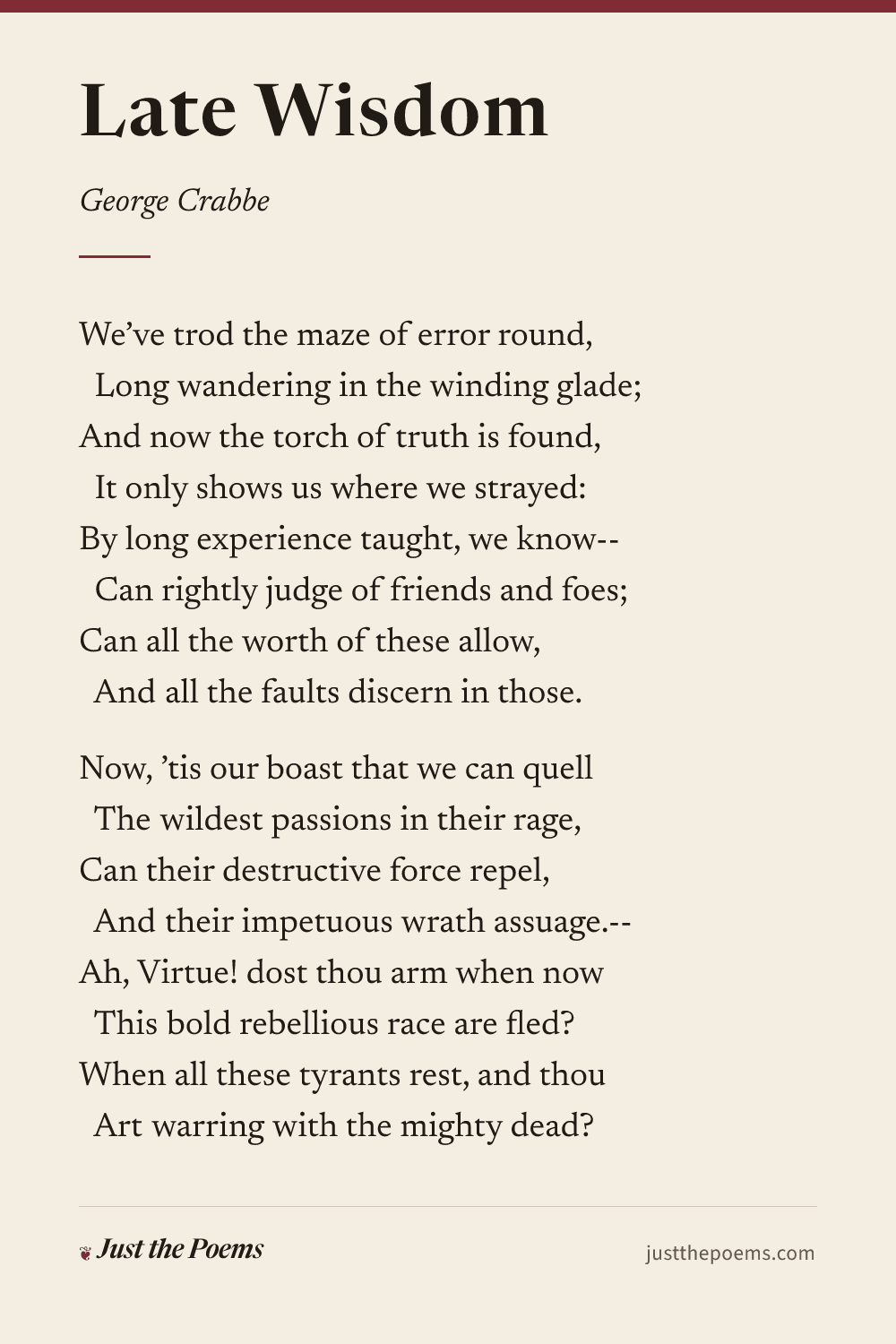
Late Wisdom

George Crabbe

In 0 Wikipedias 2 anthologies Poet in 28 Wikipedias

We’ve trod the maze of error round, Long wandering in the winding glade;And now the torch of truth is found, It only shows us where we strayed:By long experience taught, we know-- Can rightly judge of friends and foes;Can all the worth of these allow, And all the faults discern in those.

Now, ’tis our boast that we can quell The wildest passions in their rage,Can their destructive force repel, And their impetuous wrath assuage.--Ah, Virtue! dost thou arm when now This bold rebellious race are fled?When all these tyrants rest, and thou Art warring with the mighty dead?

Source

The Oxford Book of English Verse 1250–1900, 1900

Filed under
  • Section “STEPPING WESTWARD”, The Home Book of Verse

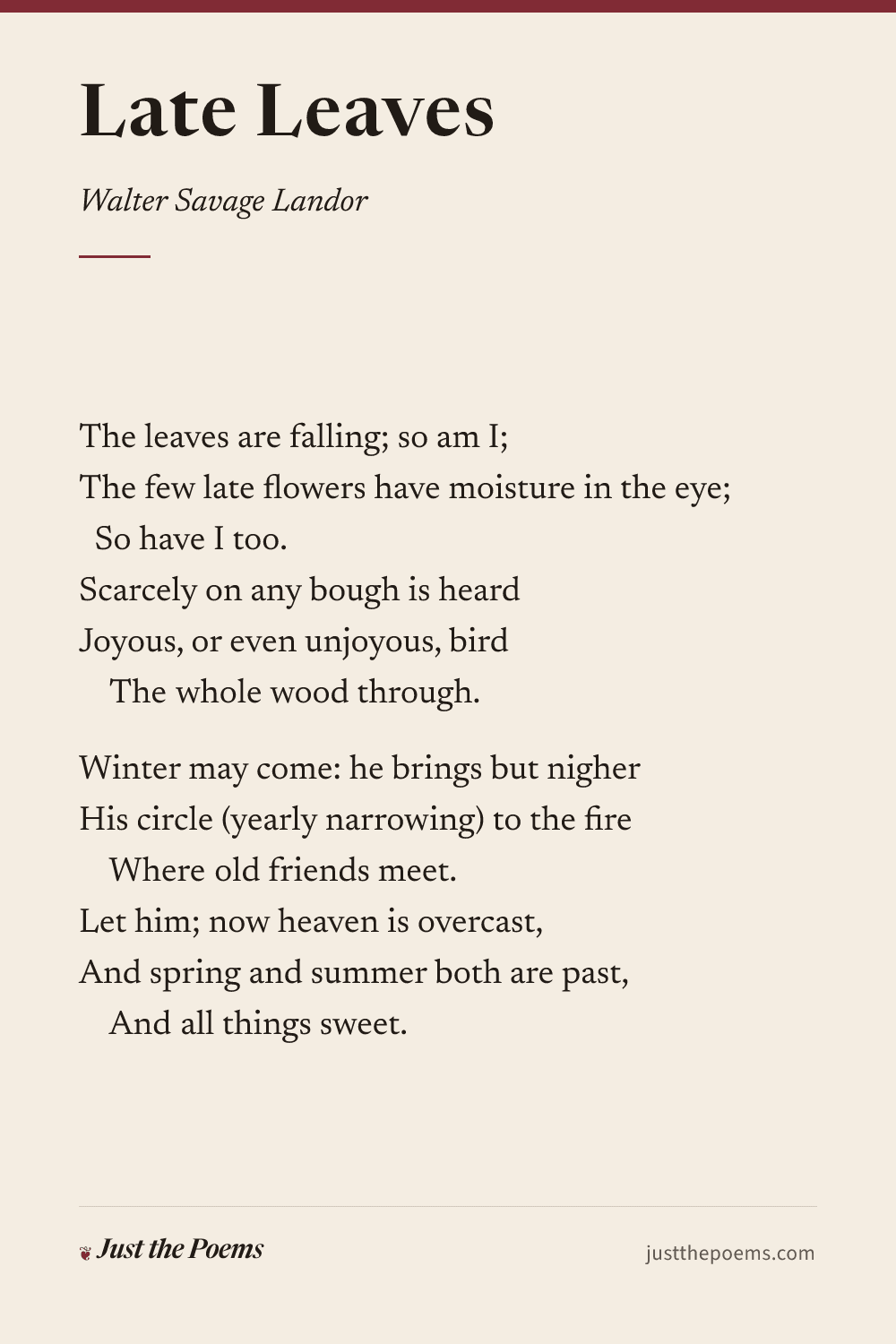
Late Leaves

Walter Savage Landor

In 0 Wikipedias 2 anthologies Poet in 24 Wikipedias

The leaves are falling; so am I;The few late flowers have moisture in the eye; So have I too.Scarcely on any bough is heardJoyous, or even unjoyous, bird The whole wood through.

Winter may come: he brings but nigherHis circle (yearly narrowing) to the fire Where old friends meet.Let him; now heaven is overcast,And spring and summer both are past, And all things sweet.

Source

The Oxford Book of English Verse 1250–1900, 1900

Filed under
  • Section “STEPPING WESTWARD”, The Home Book of Verse

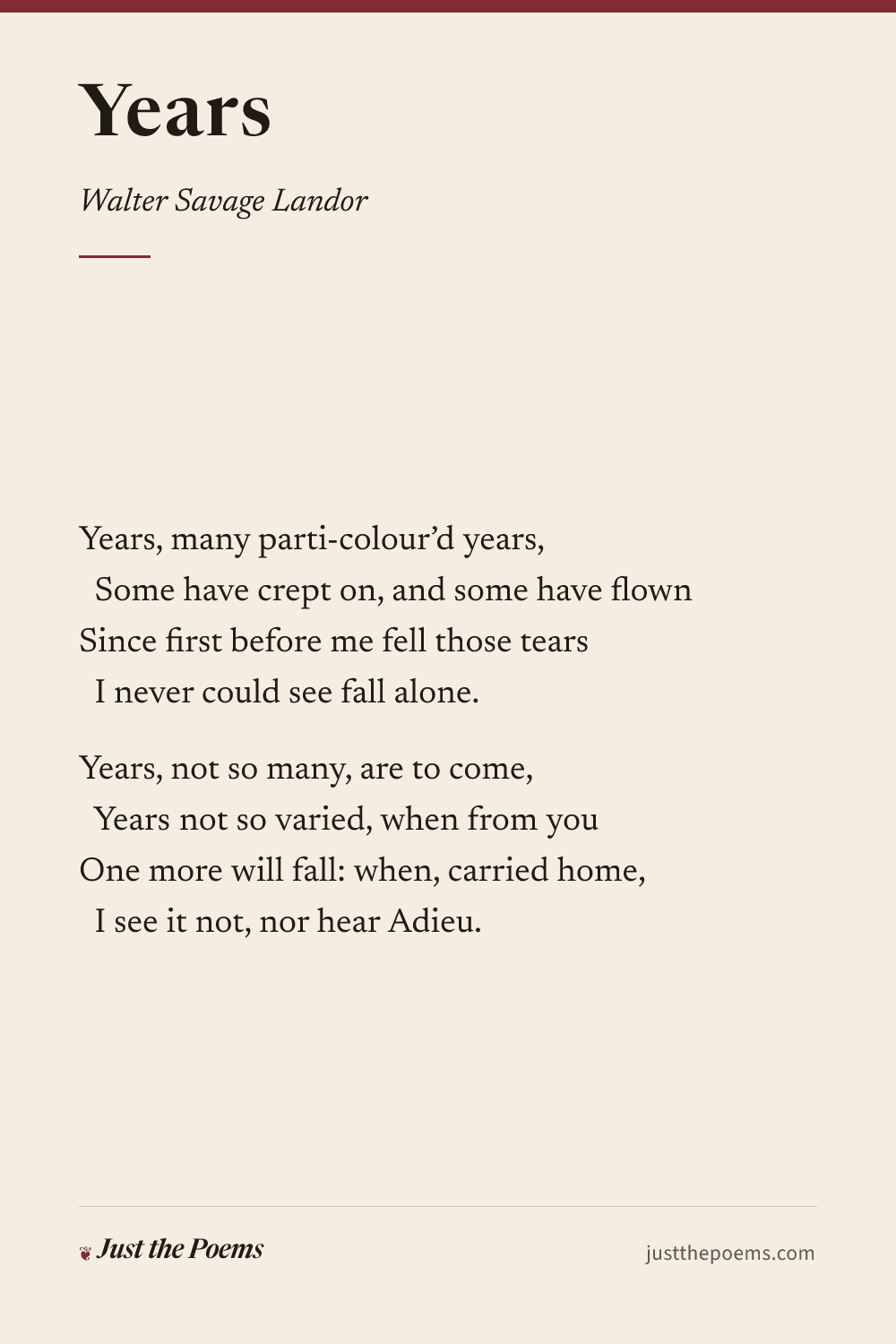
Years

Walter Savage Landor

In 0 Wikipedias 2 anthologies Poet in 24 Wikipedias

Years, many parti-colour’d years, Some have crept on, and some have flownSince first before me fell those tears I never could see fall alone.

Years, not so many, are to come, Years not so varied, when from youOne more will fall: when, carried home, I see it not, nor hear Adieu.

Source

The Oxford Book of English Verse 1250–1900, 1900

Filed under
  • Section “STEPPING WESTWARD”, The Home Book of Verse

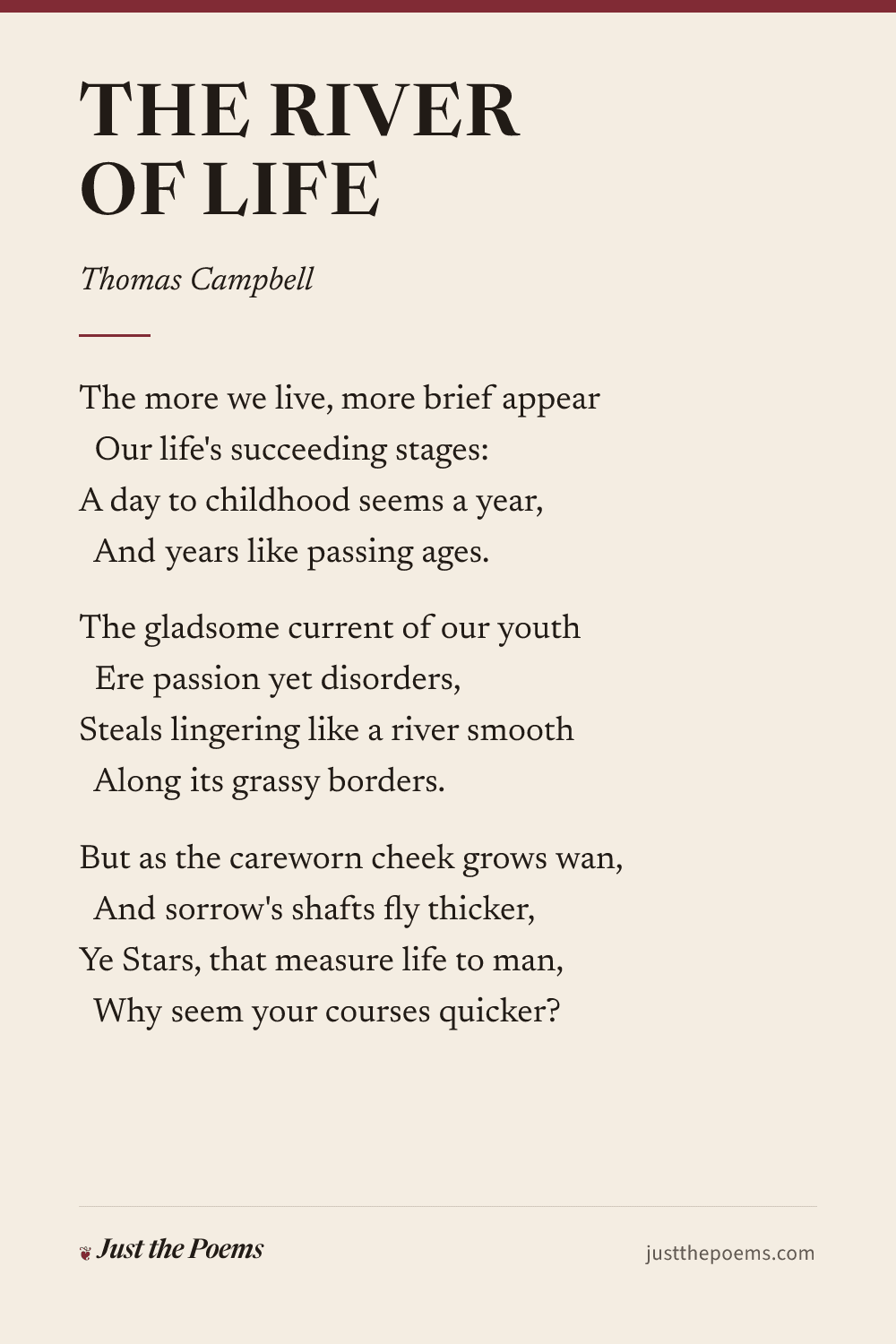
THE RIVER OF LIFE

Thomas Campbell

In 0 Wikipedias 2 anthologies Poet in 16 Wikipedias

The more we live, more brief appear Our life's succeeding stages:A day to childhood seems a year, And years like passing ages.

The gladsome current of our youth Ere passion yet disorders,Steals lingering like a river smooth Along its grassy borders.

But as the careworn cheek grows wan, And sorrow's shafts fly thicker,Ye Stars, that measure life to man, Why seem your courses quicker?

When joys have lost their bloom and breath And life itself is vapid,Why, as we reach the Falls of Death, Feel we its tide more rapid?

It may be strange--yet who would change Time's course to lower speeding,When one by one our friends have gone And left our bosoms bleeding?

Heaven gives our years of fading strength Indemnifying fleetness;And those of youth, a seeming length, Proportion'd to their sweetness.

Source

The Golden Treasury, ed. Francis Turner Palgrave

Filed under
  • Section “STEPPING WESTWARD”, The Home Book of Verse

Old Age

Edmund Waller

In 0 Wikipedias 2 anthologies Poet in 13 Wikipedias

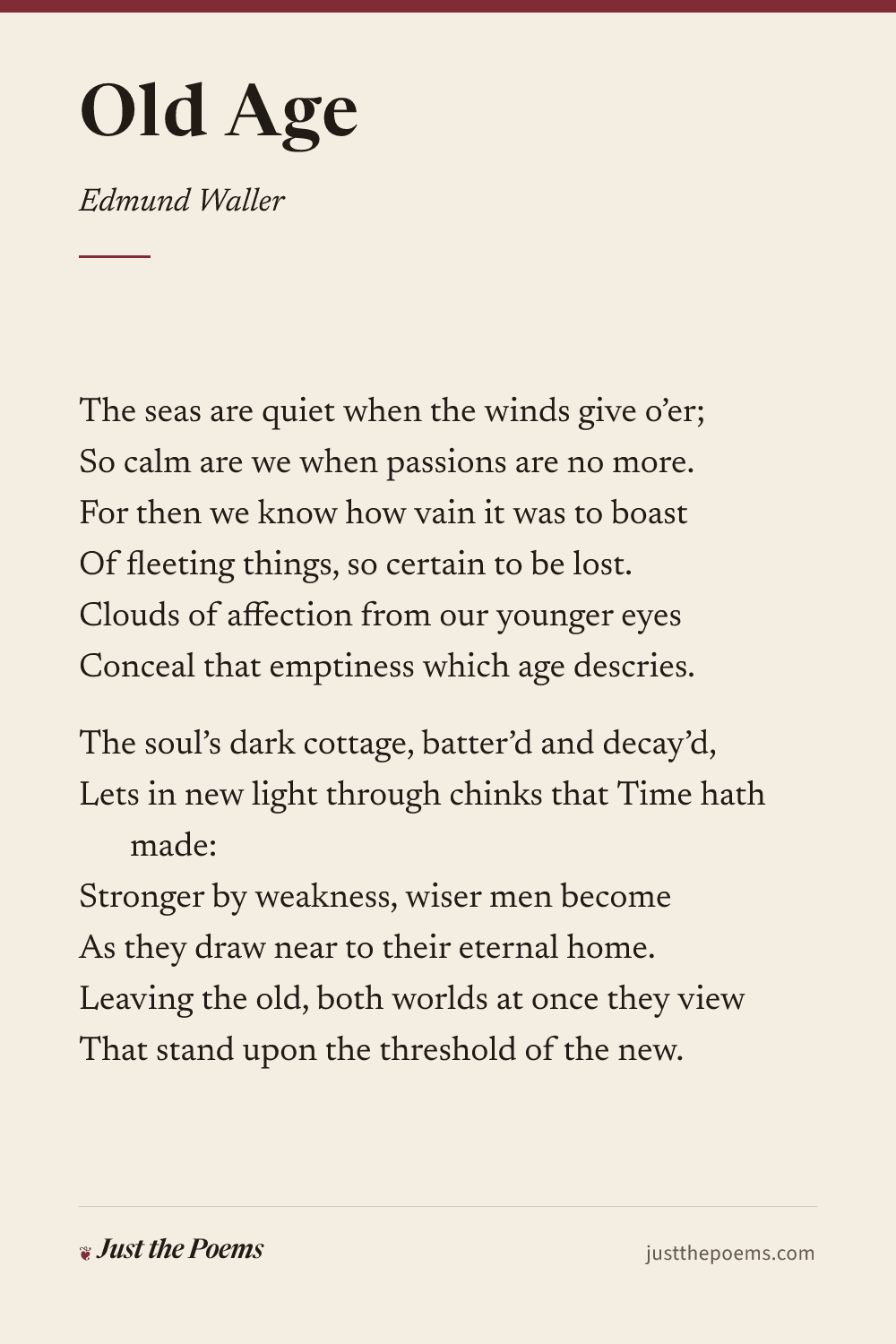
The seas are quiet when the winds give o’er;So calm are we when passions are no more.For then we know how vain it was to boastOf fleeting things, so certain to be lost.Clouds of affection from our younger eyesConceal that emptiness which age descries.

The soul’s dark cottage, batter’d and decay’d,Lets in new light through chinks that Time hath made:Stronger by weakness, wiser men becomeAs they draw near to their eternal home.Leaving the old, both worlds at once they viewThat stand upon the threshold of the new.

Source

The Oxford Book of English Verse 1250–1900, 1900

Filed under
  • Section “STEPPING WESTWARD”, The Home Book of Verse
  • Named in the title

Advertisements

SAD IS OUR YOUTH, FOR IT IS EVER GOING

Aubrey Thomas de Vere

In 0 Wikipedias 2 anthologies Poet in 6 Wikipedias

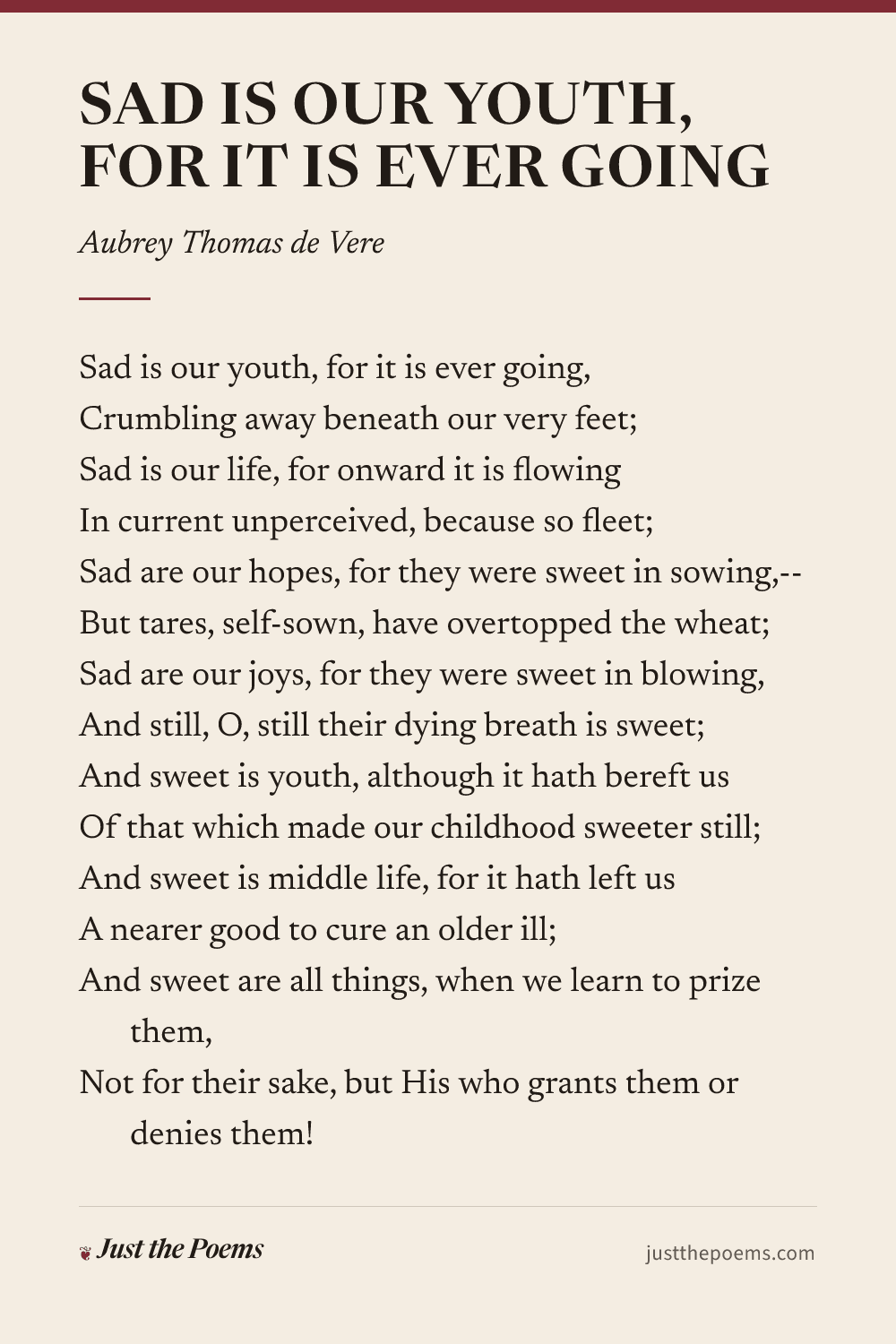
Sad is our youth, for it is ever going,Crumbling away beneath our very feet;Sad is our life, for onward it is flowingIn current unperceived, because so fleet;Sad are our hopes, for they were sweet in sowing,--But tares, self-sown, have overtopped the wheat;Sad are our joys, for they were sweet in blowing,And still, O, still their dying breath is sweet;And sweet is youth, although it hath bereft usOf that which made our childhood sweeter still;And sweet is middle life, for it hath left usA nearer good to cure an older ill;And sweet are all things, when we learn to prize them,Not for their sake, but His who grants them or denies them!

Source

The World's Best Poetry, Vol. III, ed. Bliss Carman, 1904

Filed under
  • Section “STEPPING WESTWARD”, The Home Book of Verse

"WHEN THAT I WAS AND A LITTLE TINY BOY"

William Shakespeare

In 0 Wikipedias 1 anthology Poet in 237 Wikipedias

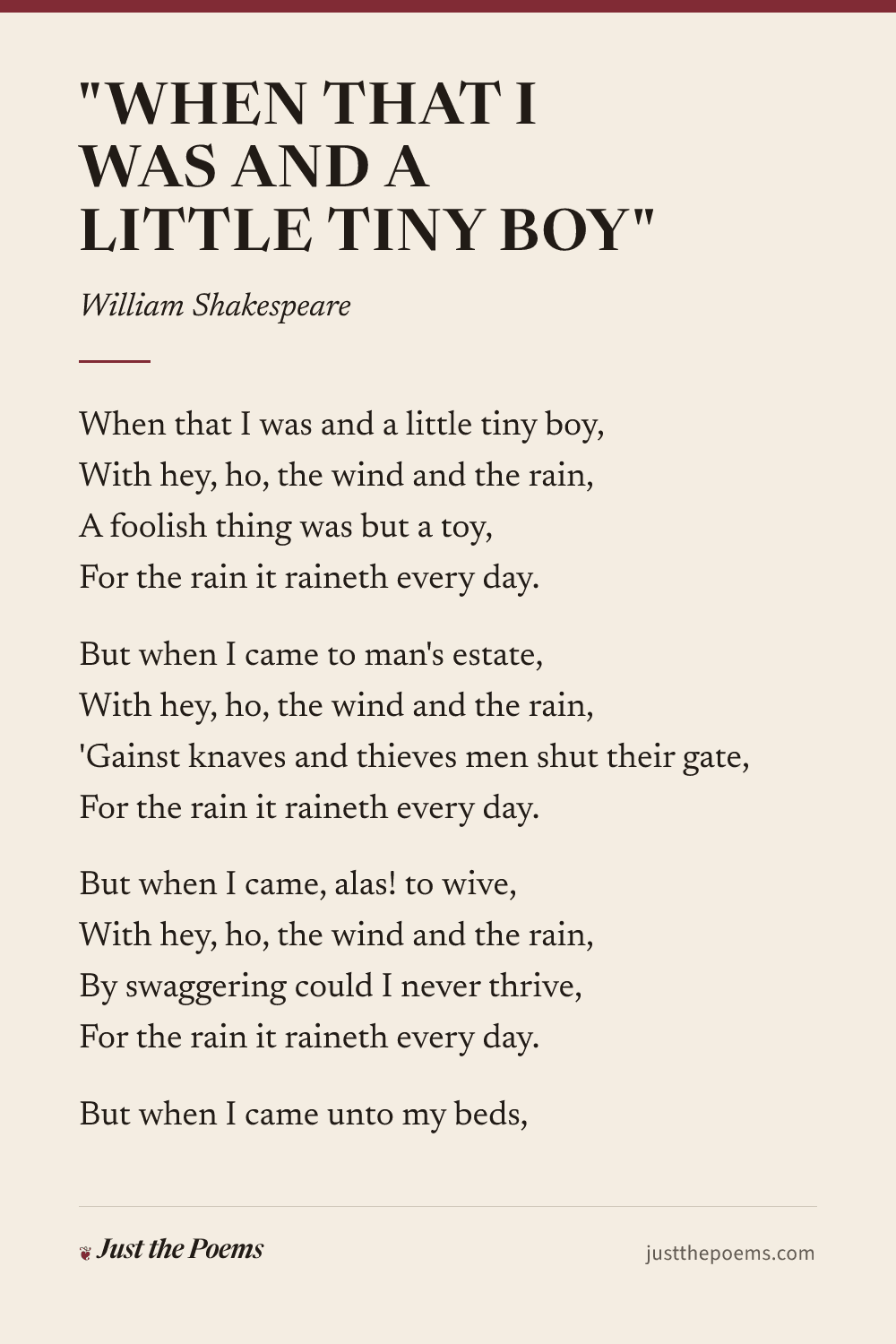
When that I was and a little tiny boy,With hey, ho, the wind and the rain,A foolish thing was but a toy,For the rain it raineth every day.

But when I came to man's estate,With hey, ho, the wind and the rain,'Gainst knaves and thieves men shut their gate,For the rain it raineth every day.

But when I came, alas! to wive,With hey, ho, the wind and the rain,By swaggering could I never thrive,For the rain it raineth every day.

But when I came unto my beds,With hey, ho, the wind and the rain,With toss-pots still had drunken heads;For the rain it raineth every day.

A great while ago the world begun,With hey, ho, the wind and the rain,But that's all one, our play is done,And we'll strive to please you every day.

Source

The Home Book of Verse, ed. Burton Egbert Stevenson

Filed under
  • Section “STEPPING WESTWARD”, The Home Book of Verse

STEPPING WESTWARD

William Wordsworth

In 0 Wikipedias 1 anthology Poet in 97 Wikipedias

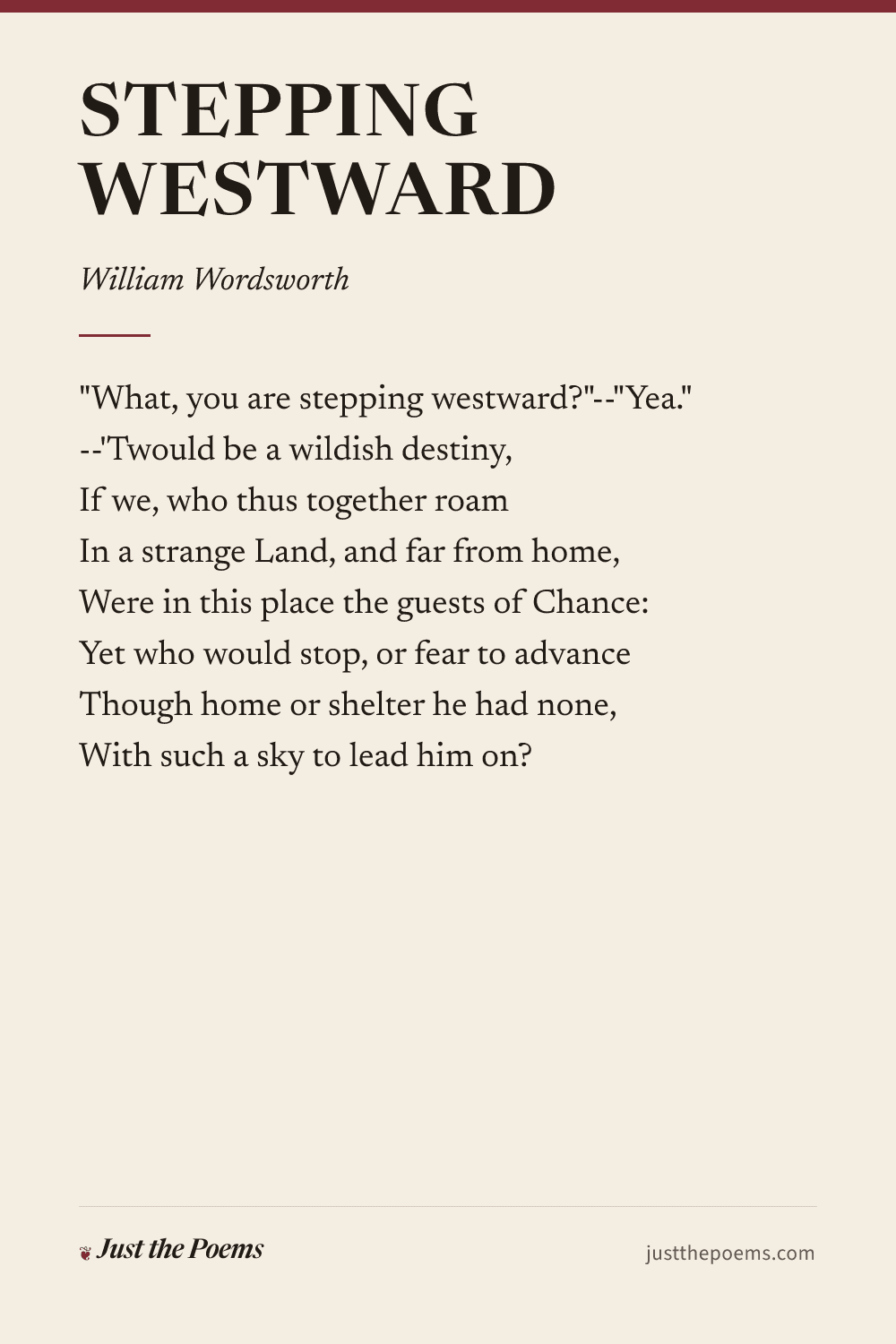
"What, you are stepping westward?"--"Yea."--'Twould be a wildish destiny,If we, who thus together roamIn a strange Land, and far from home,Were in this place the guests of Chance:Yet who would stop, or fear to advanceThough home or shelter he had none,With such a sky to lead him on?

The dewy ground was dark and cold;Behind, all gloomy to behold;And stepping westward seemed to beA kind of heavenly destiny:

Show all 26 lines 14 more

I liked the greeting; 'twas a soundOf something without place or bound;And seemed to give me spiritual rightTo travel through that region bright.

The voice was soft, and she who spakeWas walking by her native lake:The salutation had to meThe very sound of courtesy:Its power was felt; and while my eyeWas fixed upon the glowing Sky,The echo of the voice enwroughtA human sweetness with the thoughtOf travelling through the world that layBefore me in my endless way.

Source

The Home Book of Verse, ed. Burton Egbert Stevenson

Filed under
  • Section “STEPPING WESTWARD”, The Home Book of Verse

TERMINUS

Ralph Waldo Emerson

In 0 Wikipedias 1 anthology Poet in 92 Wikipedias

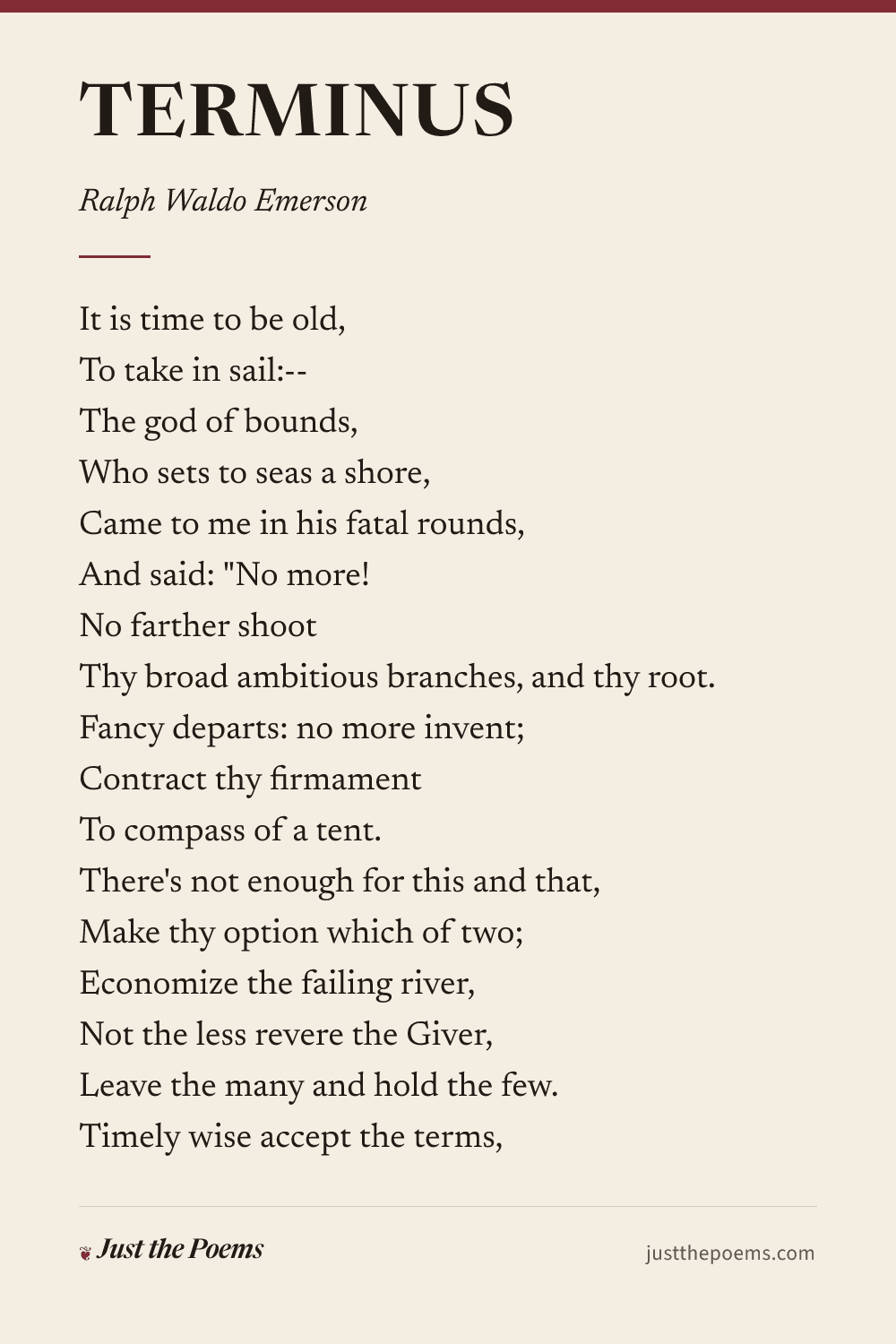
It is time to be old,To take in sail:--The god of bounds,Who sets to seas a shore,Came to me in his fatal rounds,And said: "No more!No farther shootThy broad ambitious branches, and thy root.Fancy departs: no more invent;Contract thy firmamentTo compass of a tent.There's not enough for this and that,

Show all 40 lines 28 more

Make thy option which of two;Economize the failing river,Not the less revere the Giver,Leave the many and hold the few.Timely wise accept the terms,Soften the fall with wary foot;A little whileStill plan and smile,And,--fault of novel germs,--Mature the unfallen fruit.Curse, if thou wilt, thy sires,Bad husbands of their fires,Who, when they gave thee breath,Failed to bequeathThe needful sinew stark as once,The Baresark marrow to thy bones,But left a legacy of ebbing veins,Inconstant heat and nerveless reins,--Amid the Muses, left thee deaf and dumb,Amid the Gladiators, halt and numb."

As the bird trims her to the gale,I trim myself to the storm of time,I man the rudder, reef the sail,Obey the voice at eve obeyed at prime:"Lowly faithful, banish fear,Right onward drive unharmed;The port, well worth the cruise, is near,And every wave is charmed."

Source

The Home Book of Verse, ed. Burton Egbert Stevenson

Filed under
  • Section “STEPPING WESTWARD”, The Home Book of Verse

PAST

John Galsworthy

In 0 Wikipedias 1 anthology Poet in 89 Wikipedias

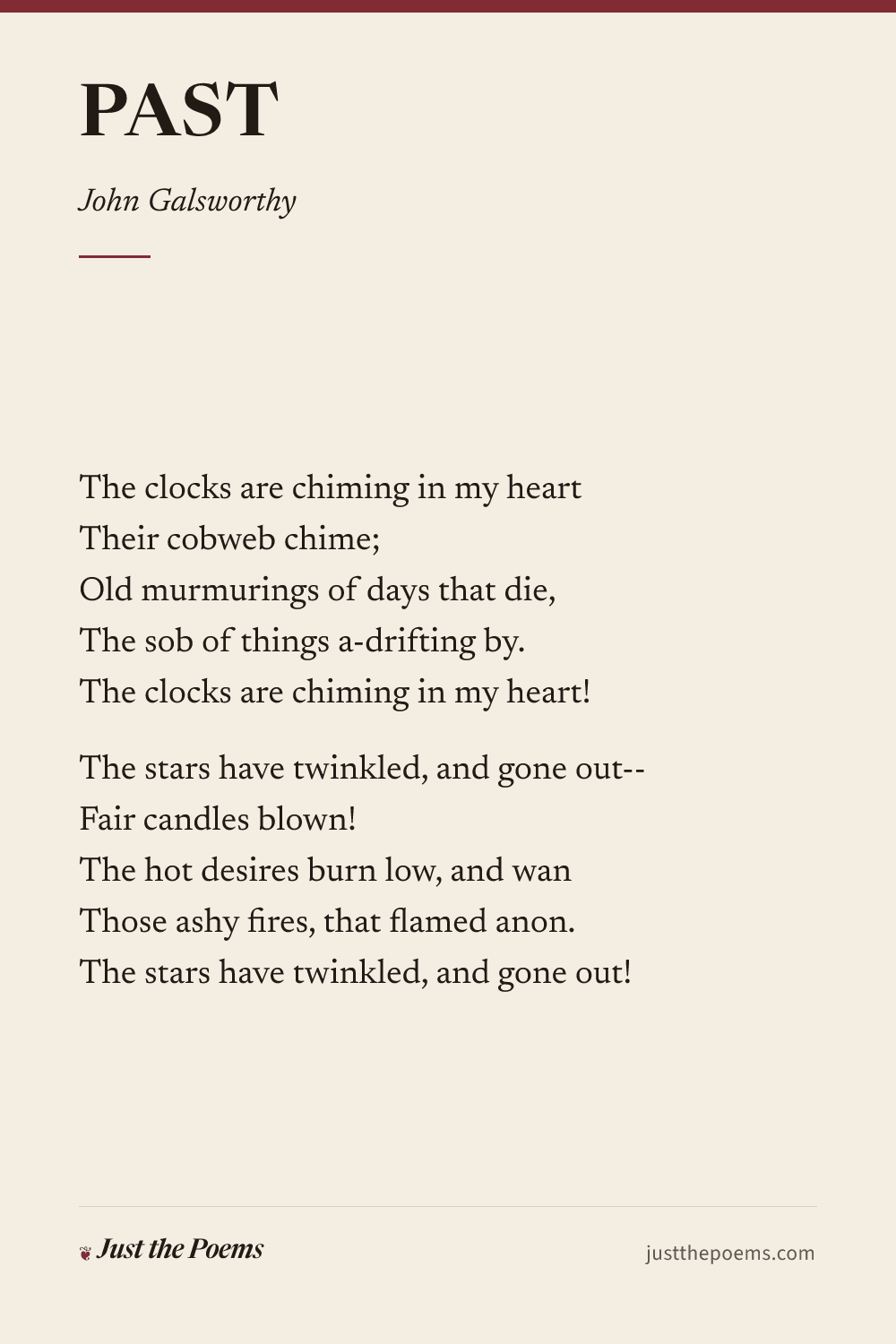
The clocks are chiming in my heartTheir cobweb chime;Old murmurings of days that die,The sob of things a-drifting by.The clocks are chiming in my heart!

The stars have twinkled, and gone out--Fair candles blown!The hot desires burn low, and wanThose ashy fires, that flamed anon.The stars have twinkled, and gone out!

Source

The Home Book of Verse, ed. Burton Egbert Stevenson

Filed under
  • Section “STEPPING WESTWARD”, The Home Book of Verse

Advertisements

GROWING OLD

Matthew Arnold

In 0 Wikipedias 1 anthology Poet in 50 Wikipedias

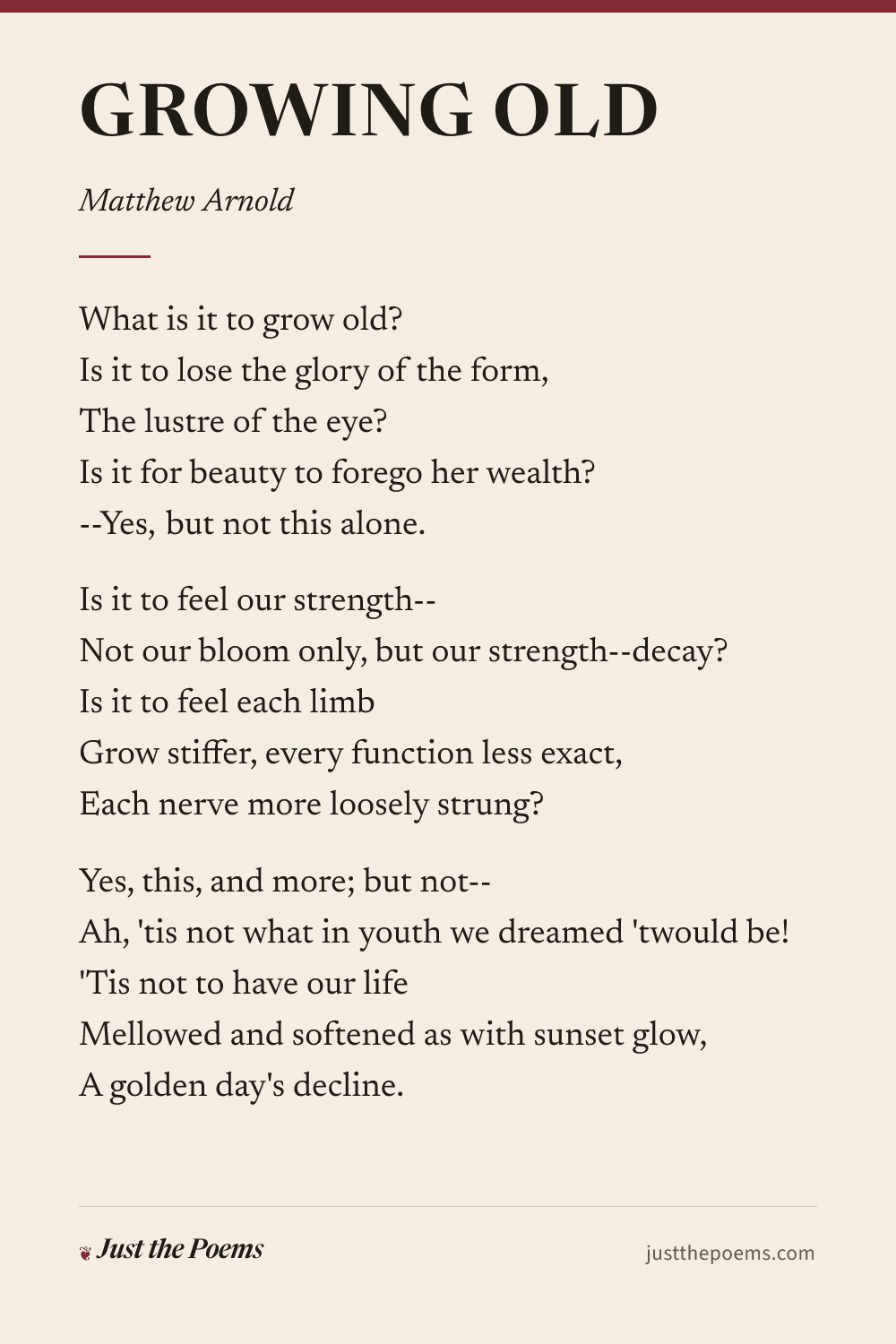
What is it to grow old?Is it to lose the glory of the form,The lustre of the eye?Is it for beauty to forego her wealth?--Yes, but not this alone.

Is it to feel our strength--Not our bloom only, but our strength--decay?Is it to feel each limbGrow stiffer, every function less exact,Each nerve more loosely strung?

Yes, this, and more; but not--Ah, 'tis not what in youth we dreamed 'twould be!

Show all 35 lines 23 more

'Tis not to have our lifeMellowed and softened as with sunset glow,A golden day's decline.

'Tis not to see the worldAs from a height, with rapt prophetic eyes,And heart profoundly stirred;And weep, and feel the fulness of the past,The years that are no more.

It is to spend long daysAnd not once feel that we were ever young;It is to add, immuredIn the hot prison of the present, monthTo month with weary pain.

It is to suffer this,And feel but half, and feebly, what we feel.Deep in our hidden heartFesters the dull remembrance of a change,But no emotion--none.

It is!--last stage of all--When we are frozen up within, and quiteThe phantom of ourselves,To hear the world applaud the hollow ghostWhich blessed the living man.

Source

The Home Book of Verse, ed. Burton Egbert Stevenson

Filed under
  • Section “STEPPING WESTWARD”, The Home Book of Verse

THE OLD MAN'S COMFORTS

Robert Southey

In 0 Wikipedias 1 anthology Poet in 44 Wikipedias

"You are old, Father William," the young man cried;"The few locks which are left you are gray;You are hale, Father William,--a hearty old man:Now tell me the reason, I pray."

"In the days of my youth," Father William replied,"I remembered that youth would fly fast,And abused not my health and my vigor at first,That I never might need them at last."

"You are old, Father William," the young man cried,"And pleasures with youth pass away;And yet you lament not the days that are gone:Now tell me the reason, I pray."

"In the days of my youth," Father William replied,"I remembered that youth could not last;I thought of the future, whatever I did,That I never might grieve for the past."

"You are old, Father William," the young man cried,"And life must be hastening away;You are cheerful, and love to converse upon death:Now tell me the reason, I pray."

"I am cheerful, young man," Father William replied;"Let the cause thy attention engage;In the days of my youth, I remembered my God,And He hath not forgotten my age."

Source

The Home Book of Verse, ed. Burton Egbert Stevenson

Filed under
  • Section “STEPPING WESTWARD”, The Home Book of Verse

YOUNG AND OLD

Charles Kingsley

In 0 Wikipedias 1 anthology Poet in 35 Wikipedias

When all the world is young, lad,And all the trees are green;And every goose a swan, lad,And every lass a queen;Then hey for boot and horse, lad,And round the world away;Young blood must have its course, lad,And every dog his day.

When all the world is old, lad,And all the trees are brown;And all the sport is stale, lad,And all the wheels run down:Creep home, and take your place there,The spent and maimed among:God grant you find one face thereYou loved when all was young.

Source

The Home Book of Verse, ed. Burton Egbert Stevenson

Filed under
  • Section “STEPPING WESTWARD”, The Home Book of Verse

AUSPEX

James Russell Lowell

In 0 Wikipedias 1 anthology Poet in 31 Wikipedias

My heart, I cannot still it,Nest that had song-birds in it;And when the last shall go,The dreary days, to fill it,Instead of lark or linnet,Shall whirl dead leaves and snow.

Had they been swallows only,Without the passion strongerThat skyward longs and sings,--Woe's me, I shall be lonelyWhen I can feel no longerThe impatience of their wings!

A moment, sweet delusion,Like birds the brown leaves hover;But it will not be longBefore their wild confusionFall wavering down to coverThe poet and his song.

Source

The Home Book of Verse, ed. Burton Egbert Stevenson

Filed under
  • Section “STEPPING WESTWARD”, The Home Book of Verse

THE WORLD I AM PASSING THROUGH

Lydia Maria Child

In 0 Wikipedias 1 anthology Poet in 27 Wikipedias

Few, in the days of early youth,Trusted like me in love and truth.I've learned sad lessons from the years;But slowly, and with many tears;For God made me to kindly viewThe world that I was passing through.

How little did I once believeThat friendly tones could e'er deceive!That kindness, and forbearance long,Might meet ingratitude and wrong!I could not help but kindly viewThe world that I was passing through.

Show all 42 lines 30 more

And though I've learned some souls are base,I would not, therefore, hate the race;I still would bless my fellow men,And trust them, though deceived again.God help me still to kindly viewThe world that I am passing through!

Through weary conflicts I have passed,And struggled into rest at last;Such rest as when the rack has brokeA joint, or nerve, at every stroke.The wish survives to kindly viewThe world that I am passing through.

From all that fate has brought to meI strive to learn humility,And trust in Him who rules above,Whose universal law is love.Thus only can I kindly viewThe world that I am passing through.

When I approach the setting sun,And feel my journey nearly done,May earth be veiled in genial light,And her last smile to me seem bright!Help me till then to kindly viewThe world that I am passing through!

And all who tempt a trusting heartFrom faith and hope to drift apart,--May they themselves be spared the painOf losing power to trust again!God help us all to kindly viewThe world that we are passing through!

Source

The Home Book of Verse, ed. Burton Egbert Stevenson

Filed under
  • Section “STEPPING WESTWARD”, The Home Book of Verse

TO AGE

Walter Savage Landor

In 0 Wikipedias 1 anthology Poet in 24 Wikipedias

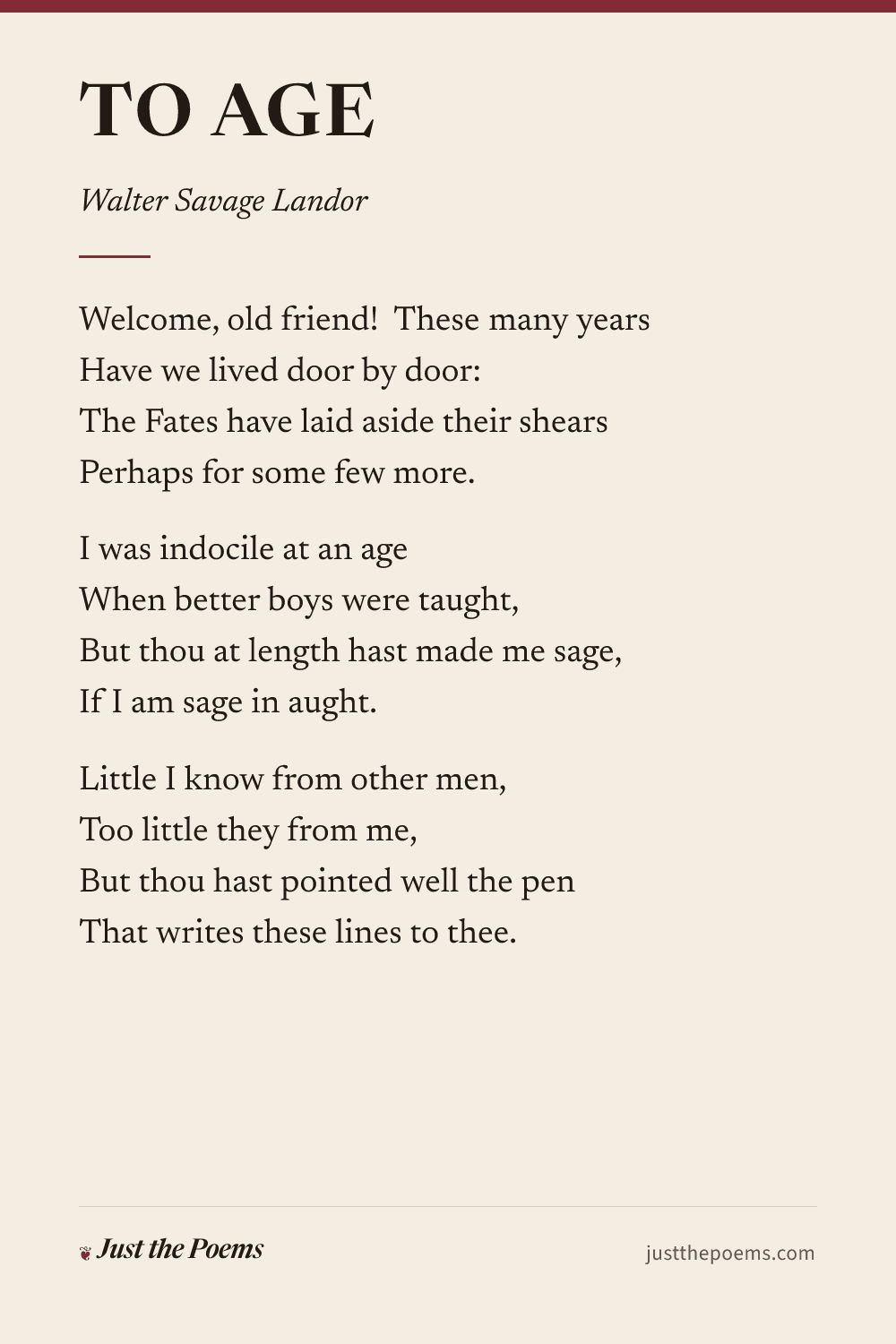
Welcome, old friend! These many yearsHave we lived door by door:The Fates have laid aside their shearsPerhaps for some few more.

I was indocile at an ageWhen better boys were taught,But thou at length hast made me sage,If I am sage in aught.

Little I know from other men,Too little they from me,But thou hast pointed well the penThat writes these lines to thee.

Thanks for expelling Fear and Hope,One vile, the other vain;One's scourge, the other's telescope,I shall not see again:

Rather what lies before my feetMy notice shall engage.--He who hath braved Youth's dizzy heatDreads not the frost of Age.

Source

The Home Book of Verse, ed. Burton Egbert Stevenson

Filed under
  • Section “STEPPING WESTWARD”, The Home Book of Verse

DREGS

Ernest Dowson

In 0 Wikipedias 1 anthology Poet in 19 Wikipedias

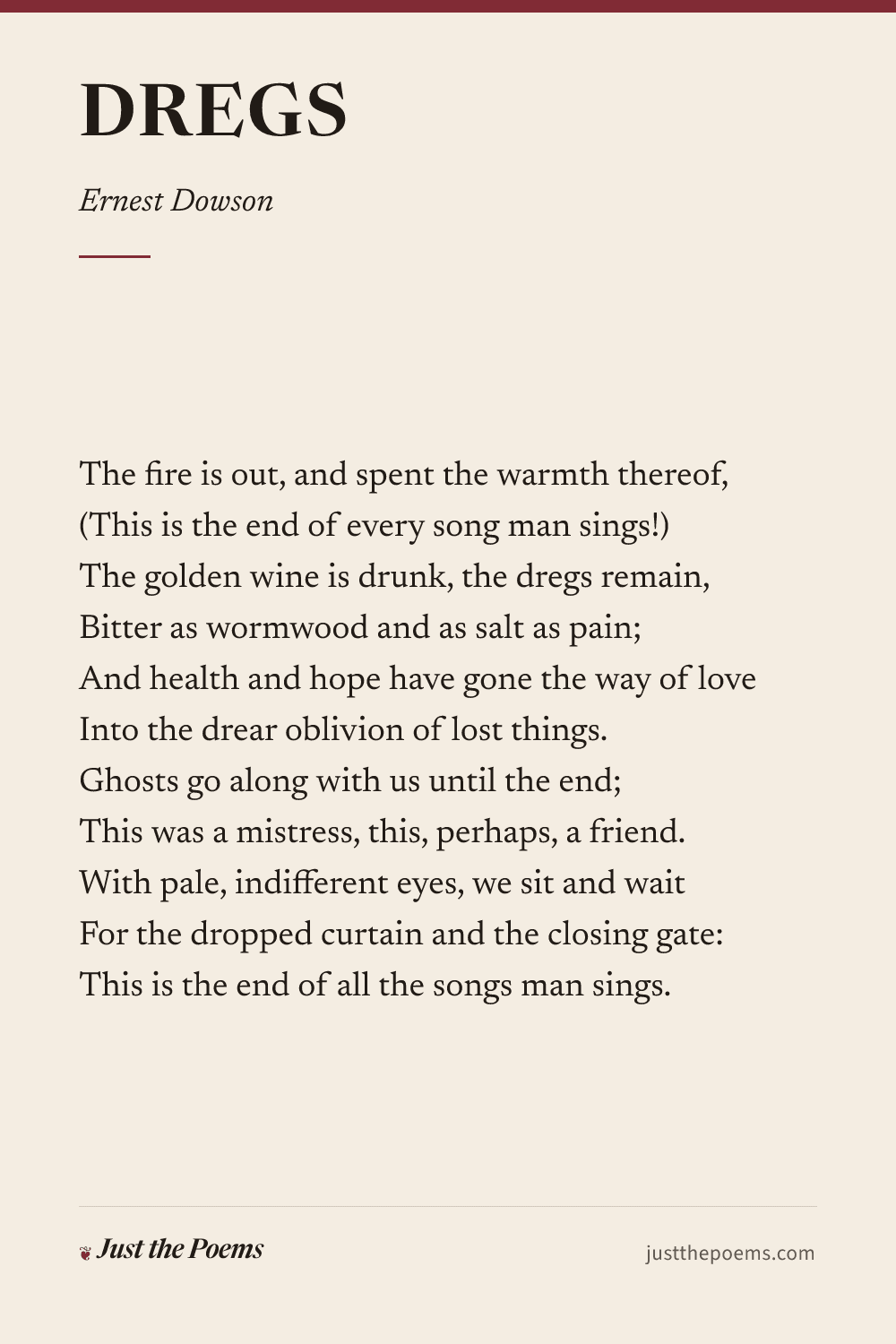
The fire is out, and spent the warmth thereof,(This is the end of every song man sings!)The golden wine is drunk, the dregs remain,Bitter as wormwood and as salt as pain;And health and hope have gone the way of loveInto the drear oblivion of lost things.Ghosts go along with us until the end;This was a mistress, this, perhaps, a friend.With pale, indifferent eyes, we sit and waitFor the dropped curtain and the closing gate:This is the end of all the songs man sings.

Source

The Home Book of Verse, ed. Burton Egbert Stevenson

Filed under
  • Section “STEPPING WESTWARD”, The Home Book of Verse

TWILIGHT

A. Mary F. Robinson

In 0 Wikipedias 1 anthology Poet in 11 Wikipedias

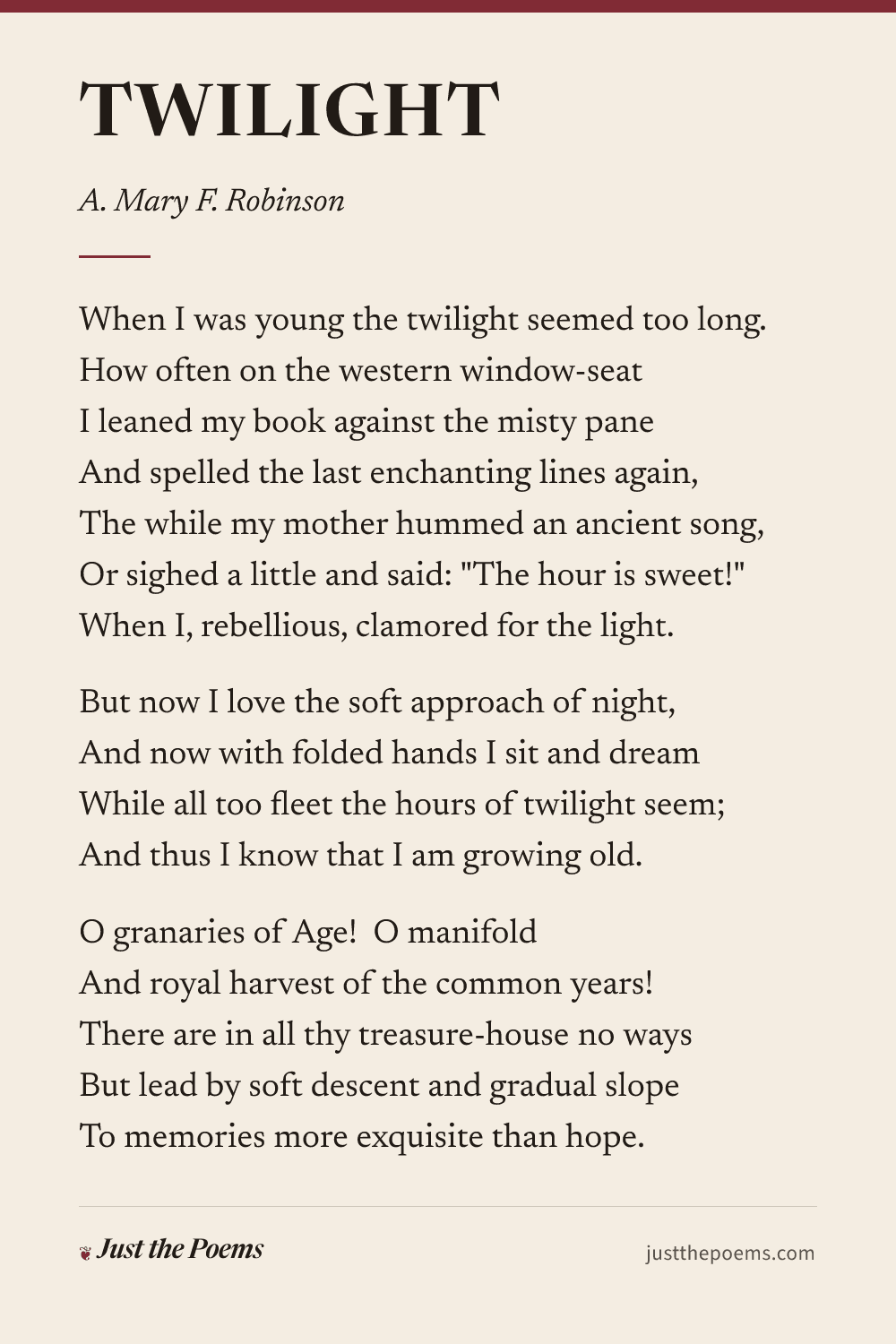
When I was young the twilight seemed too long.How often on the western window-seatI leaned my book against the misty paneAnd spelled the last enchanting lines again,The while my mother hummed an ancient song,Or sighed a little and said: "The hour is sweet!"When I, rebellious, clamored for the light.

But now I love the soft approach of night,And now with folded hands I sit and dreamWhile all too fleet the hours of twilight seem;And thus I know that I am growing old.

O granaries of Age! O manifoldAnd royal harvest of the common years!There are in all thy treasure-house no waysBut lead by soft descent and gradual slopeTo memories more exquisite than hope.Thine is the Iris born of olden tears,And thrice more happy are the happy daysThat live divinely in the lingering rays.

Source

The Home Book of Verse, ed. Burton Egbert Stevenson

Filed under
  • Section “STEPPING WESTWARD”, The Home Book of Verse

FORTY YEARS ON

Edward Ernest Bowen

In 0 Wikipedias 1 anthology Poet in 9 Wikipedias

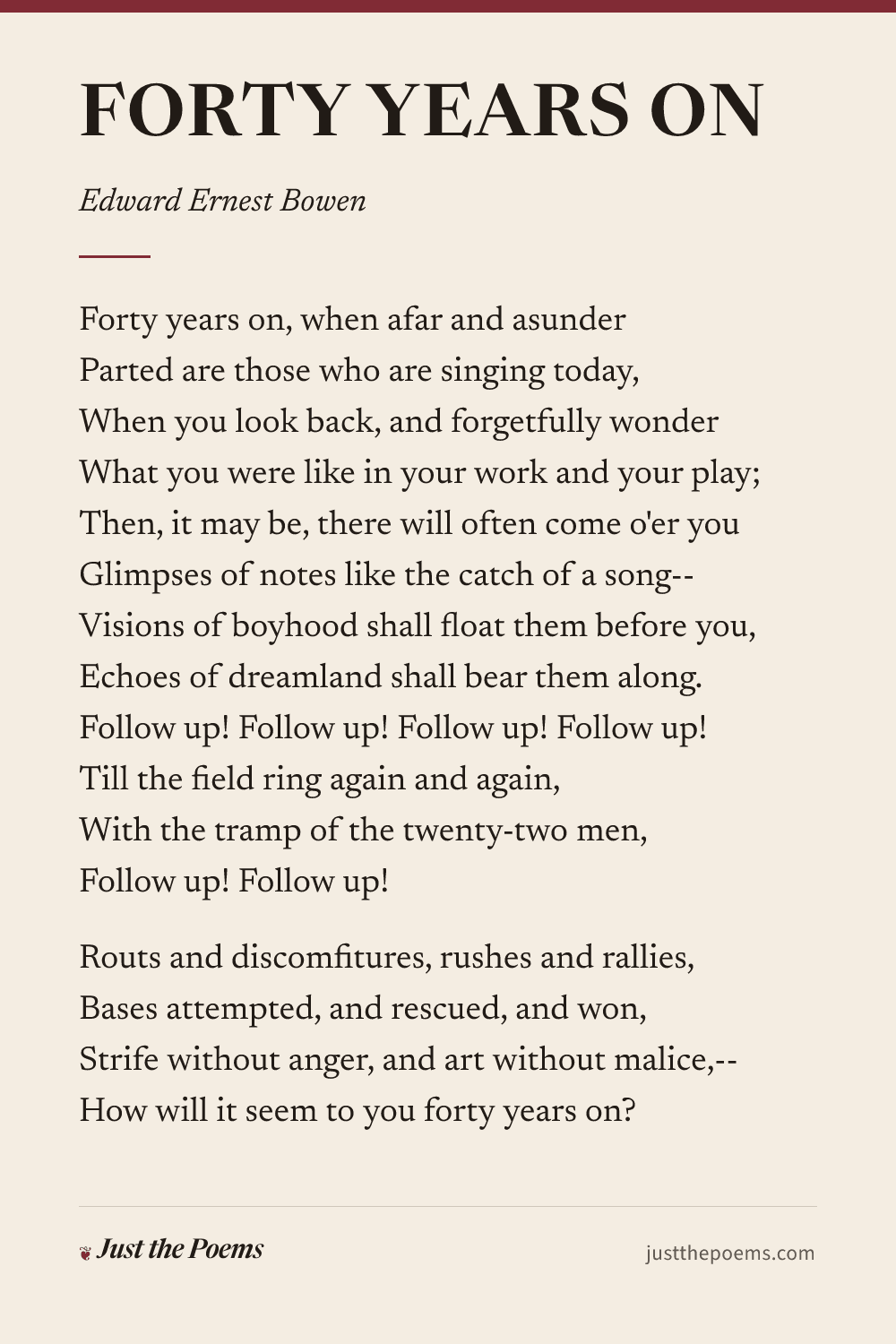
Forty years on, when afar and asunderParted are those who are singing today,When you look back, and forgetfully wonderWhat you were like in your work and your play;Then, it may be, there will often come o'er youGlimpses of notes like the catch of a song--Visions of boyhood shall float them before you,Echoes of dreamland shall bear them along.Follow up! Follow up! Follow up! Follow up!Till the field ring again and again,With the tramp of the twenty-two men,Follow up! Follow up!

Show all 39 lines 27 more

Routs and discomfitures, rushes and rallies,Bases attempted, and rescued, and won,Strife without anger, and art without malice,--How will it seem to you forty years on?Then, you will say, not a feverish minuteStrained the weak heart, and the wavering knee,Never the battle raged hottest, but in itNeither the last nor the faintest were we!Follow up! Follow up!

O the great days, in the distance enchanted,Days of fresh air, in the rain and the sun,How we rejoiced as we struggled and panted--Hardly believable forty years on!How we discoursed of them, one with another,Auguring triumph, or balancing fate,Loved the ally with the heart of a brother,Hated the foe with a playing at hate!Follow up! Follow up!

Forty years on, growing older and older,Shorter in wind, and in memory long,Feeble of foot and rheumatic of shoulder,What will it help you that once you were strong?God gives us bases to guard or beleaguer,Games to play out, whether earnest or fun,Fights for the fearless, and goals for the eager,Twenty, and thirty, and forty years on!Follow up! Follow up!

Source

The Home Book of Verse, ed. Burton Egbert Stevenson

Filed under
  • Section “STEPPING WESTWARD”, The Home Book of Verse

SONGS OF SEVEN

Jean Ingelow

In 0 Wikipedias 1 anthology Poet in 9 Wikipedias

Seven Times One.--EXULTATION

There's no dew left on the daisies and clover,There's no rain left in heaven;I've said my "seven times" over and over,Seven times one are seven.

I am old, so old, I can write a letter;My birthday lessons are done;The lambs play always, they know no better;They are only one times one.

O moon! in the night I have seen you sailingAnd shining so round and low;You were bright! ah, bright! but your light is failing,--

Show all 240 lines 228 more

You are nothing now but a bow.

You moon, have you done something wrong in heavenThat God has hidden your face?I hope if you have, you will soon be forgiven,And shine again in your place.

O velvet bee, you're a dusty fellow,You've powdered your legs with gold!O brave marsh marybuds, rich and yellow,Give me your money to hold!

O columbine, open your folded wrapper,Where two twin turtle-doves dwell?O cuckoopint, toll me the purple clapperThat hangs in your clear green bell!

And show me your nest with the young ones in it;I will not steal them away;I am old! you may trust me, linnet, linnet,--I am seven times one to-day.

Seven Times Two.--ROMANCE

You bells in the steeple, ring, ring out your changes,How many soever they be,And let the brown meadow-lark's note as he rangesCome over, come over to me.

Yet birds' clearest carol by fall or by swellingNo magical sense conveys,And bells have forgotten their old art of tellingThe fortune of future days

"Turn again, turn again," once they rang cheerily,While a boy listened alone;Made his heart yearn again, musing so wearilyAll by himself on a stone.

Poor bells! I forgive you; your good days are over,And mine, they are yet to be;No listening, no longing shall aught, aught discover:You leave the story to me.

The foxglove shoots out of the green matted heatherPreparing her hoods of snow;She was idle, and slept till the sunshiny weather:Oh! children take long to grow.

I wish and I wish that the spring would go faster,Nor long summer bide so late;And I could grow on like the foxglove and aster,For some things are ill to wait.

I wait for the day when dear hearts shall discover,While dear hands are laid on my head;"The child is a woman, the book may close over,For all the lessons are said."

I wait for my story,--the birds cannot sing it,Not one, as he sits on the tree;The bells cannot ring it, but long years, oh, bring it!Such as I wish it to be.

Seven Times Three.--LOVE

I leaned out of window, I smelt the white clover,Dark, dark was the garden, I saw not the gate,"Now, if there be footsteps, he comes, my one lover,--Hush, nightingale, hush! O sweet nightingale, waitTill I listen and hearIf a step draweth near,For my love he is late!

"The skies in the darkness stoop nearer and nearer,A cluster of stars hangs like fruit in the tree,The fall of the water comes sweeter, comes clearer:To what art thou listening, and what dost thou see?Let the star-clusters grow,Let the sweet waters flow,And cross quickly to me.

"You night-moths that hover, where honey brims overFrom sycamore blossoms, or settle or sleep;You glowworms, shine out, and the pathway discoverTo him that comes darkling along the rough steep.Ah, my sailor, make haste,For the time runs to waste,And my love lieth deep,--

"Too deep for swift telling; and yet, my one lover,I've conned thee an answer, it waits thee to-night."By the sycamore passed he, and through the white clover,Then all the sweet speech I had fashioned took flight;But I'll love him more, moreThan e'er wife loved before,Be the days dark or bright.

Seven Times Four.--MATERNITY

Heigh-ho! daisies and buttercups!Fair yellow daffodils, stately and tall!When the wind wakes how they rock in the grasses,And dance with the cuckoo-buds slender and small!Here's two bonny boys, and here's mother's own lasses,Eager to gather them all.

Heigh-ho! daisies and buttercups;Mother shall thread them a daisy chain;Sing them a song of the pretty hedge-sparrow,That loved her brown little ones, loved them full fain;Sing, "Heart, thou art wide though the house be but narrow,"--Sing once, and sing it again.

Heigh-ho! daisies and buttercups!Sweet wagging cowslips, they bend and they bow;A ship sails afar over warm ocean waters,And haply one musing doth stand at her prow.O bonny brown sons, and O sweet little daughters,Maybe he thinks of you now.

Heigh-ho! daisies and buttercups!Fair yellow daffodils, stately and tall!A sunshiny world full of laughter and leisure,And fresh hearts unconscious of sorrow and thrall!Send down on their pleasure smiles passing its measure,God that is over us all!

Seven Times Five.--WIDOWHOOD

I sleep and rest, my heart makes moanBefore I am well awake;"Let me bleed! O let me alone,Since I must not break!"

For children wake, though fathers sleepWith a stone at foot and at head:O sleepless God, forever keep,Keep both living and dead!

I lift mine eyes, and what to seeBut a world happy and fair!I have not wished it to mourn with me,--Comfort is not there.

Oh, what anear but golden brooms,But a waste of reedy rills!Oh, what afar but the fine gloomsOn the rare blue hills!

I shall not die, but live forlore,--How bitter it is to part!Oh, to meet thee, my love, once more!O my heart, my heart!

No more to hear, no more to see!Oh, that an echo might wakeAnd waft one note of thy psalm to meEre my heart-strings break!

I should know it how faint soe'er,And with angel voices blent;Oh, once to feel thy spirit anear;I could be content!

Or once between the gates of gold,While an entering angel trod,But once,--thee sitting to beholdOn the hills of God!

Seven Times Six.--GIVING IN MARRIAGE

To bear, to nurse, to rear,To watch, and then to lose:To see my bright ones disappear,Drawn up like morning dews,--To bear, to nurse, to rear,To watch and then to lose:This have I done when God drew nearAmong his own to choose.

To hear, to heed, to wed,And with thy lord departIn tears, that he, as soon as shed,Will let no longer smart,--To hear, to heed, to wed,This while thou didst I smiled,For now it was not God who said,"Mother, give ME thy child."

O fond, O fool, and blind!To God I gave with tears;But when a man like grace would find,My soul put by her fears,--O fond, O fool, and blind!God guards in happier spheres;That man will guard where he did bindIs hope for unknown years.

To hear, to heed, to wed,Fair lot that maidens choose,Thy mother's tenderest words are said,Thy face no more she views;Thy mother's lot, my dear,She doth in naught accuse;Her lot to bear, to nurse, to rear,To love,--and then to lose.

Seven Times Seven.--LONGING FOR HOME

A song of a boat:--There was once a boat on a billow:Lightly she rocked to her port remote,And the foam was white in her wake like snow,And her frail mast bowed when the breeze would blow,And bent like a wand of willow.

I shaded mine eyes one day when a boatWent curtsying over the billow,I marked her course till a dancing mote,She faded out on the moonlit foam,And I stayed behind in the dear-loved home;And my thoughts all day were about the boat,And my dreams upon the pillow.

I pray you hear my song of a boatFor it is but short:--My boat you shall find none fairer afloat,In river or port.Long I looked out for the lad she bore,On the open desolate sea,And I think he sailed to the heavenly shore,For he came not back to me--Ah me!

A song of a nest:--There was once a nest in a hollow:Down in the mosses and knot-grass pressed,Soft and warm and full to the brim--Vetches leaned over it purple, and dim,With buttercup buds to follow.

I pray you hear my song of a nest,For it is not long:--You shall never light in a summer questThe bushes among--Shall never light on a prouder sitter,A fairer nestful, nor ever knowA softer sound than their tender twitter,That wind-like did come and go.

I had a nestful once of my own,Ah, happy, happy I!Right dearly I loved them; but when they were grownThey spread out their wings to fly--Oh, one after one they flew awayFar up to the heavenly blue,To the better country, the upper day,And--I wish I was going too.

I pray you what is the nest to me,My empty nest?And what is the shore where I stood to seeMy boat sail down to the west?Can I call that home where I anchor yet,Though my good man has sailed?Can I call that home where my nest was set,Now all its hope hath failed?

Nay, but the port where my sailor went,And the land where my nestlings be:There is the home where my thoughts are sentThe only home for me--Ah me!
Source

The Home Book of Verse, ed. Burton Egbert Stevenson

Filed under
  • Section “STEPPING WESTWARD”, The Home Book of Verse

"LONG TIME A CHILD"

Hartley Coleridge

In 0 Wikipedias 1 anthology Poet in 7 Wikipedias

Long time a child, and still a child, when yearsHad painted manhood on my check, was I,--For yet I lived like one not born to die;A thriftless prodigal of smiles and tears,No hope I needed, and I knew no fears.But sleep, though sweet, is only sleep; and waking,I waked to sleep no more; at once o'ertakingThe vanguard of my age, with all arrearsOf duty on my back. Nor child, nor man,Nor youth, nor sage, I find my head is gray,For I have lost the race I never ran:A rathe December blights my lagging May;And still I am a child, though I be old:Time is my debtor for my years untold.

Source

The Home Book of Verse, ed. Burton Egbert Stevenson

Filed under
  • Section “STEPPING WESTWARD”, The Home Book of Verse

THE PARADOX OF TIME

Austin Dobson

In 0 Wikipedias 1 anthology Poet in 7 Wikipedias

"Le temps s'en va, le temps s'en va, ma dame!Las! le temps non: mais nous nous en allons!"

Time goes, you say? Ah no!Alas, Time stays, we go;Or else, were this not so,What need to chain the hours,For Youth were always ours?Time goes, you say?--ah no!

Ours is the eyes' deceitOf men whose flying feetLead through some landscape low;We pass, and think we see

Show all 38 lines 26 more

The earth's fixed surface flee:--Alas, Time stays--we go!

Once in the days of old,Your locks were curling gold,And mine had shamed the crow.Now, in the self-same stage,We've reached the silver age;Time goes, you say?--ah no!

Once, when my voice was strong,I filled the woods with songTo praise your "rose" and "snow";My bird, that sang, is dead;Where are your roses fled?Alas, Time stays--we go!

See, in what traversed ways,What backward Fate delaysThe hopes we used to know;Where are our old desires?--Ah, where those vanished fires?Time goes, you say?--ah no!

How far, how far, O sweet,The past behind our feetLies in the even-glow!Now, on the forward way,Let us fold hands, and pray;Alas, Time stays,--we go!

Source

The Home Book of Verse, ed. Burton Egbert Stevenson

Filed under
  • Section “STEPPING WESTWARD”, The Home Book of Verse

THE YEAR'S END

Timothy Cole

In 0 Wikipedias 1 anthology Poet in 7 Wikipedias

Full happy is the man who comes at lastInto the safe completion of his year;Weathered the perils of his spring, that blastHow many blossoms promising and dear!And of his summer, with dread passions fraughtThat oft, like fire through the ripening corn,Blight all with mocking death and leave distraughtLoved ones to mourn the ruined waste forlorn.But now, though autumn gave but harvest slight,Oh, grateful is he to the powers aboveFor winter's sunshine, and the lengthened nightBy hearth-side genial with the warmth of love.Through silvered days of vistas gold and greenContentedly he glides away, serene.

Source

The Home Book of Verse, ed. Burton Egbert Stevenson

Filed under
  • Section “STEPPING WESTWARD”, The Home Book of Verse

A LAMENT

Chidiock Tichborne

In 0 Wikipedias 1 anthology Poet in 6 Wikipedias

My prime of youth is but a frost of cares;My feast of joy is but a dish of pain;My crop of corn is but a field of tares;And all my good is but vain hope of gain;The day is fled, and yet I saw no sun;And now I live, and now my life is done!

The spring is past, and yet it is not sprung;The fruit is dead, and yet the leaves be green;My youth is gone, and yet I am but young;I saw the world, and yet I was not seen;My thread is cut, and yet it is not spun;And now I live, and now my life is done!

I sought my death, and found it in my womb;I looked for life, and saw it was a shade;I trod the earth, and knew it was my tomb;And now I die, and now I am but made;The glass is full, and now my glass is run;And now I live, and now my life is done!

Source

The Home Book of Verse, ed. Burton Egbert Stevenson

Filed under
  • Section “STEPPING WESTWARD”, The Home Book of Verse

OMNIA SOMNIA

Rosamund Marriott Watson

In 0 Wikipedias 1 anthology Poet in 5 Wikipedias

Dawn drives the dreams away, yet some abide.Once, in a tide of pale and sunless weather,I dreamed I wandered on a bare hillside,When suddenly the birds sang all together.

Still it was Winter, even in the dream;There was no leaf nor bud nor young grass springing;The skies shone cold above the frost-bound stream:It was not Spring, and yet the birds were singing.

Blackbird and thrush and plaintive willow-wren,Chaffinch and lark and linnet, all were calling;A golden web of music held me then,Innumerable voices, rising, falling.

O, never do the birds of April singMore sweet than in that dream I still remember:Perchance the heart may keep its songs of SpringEven through the wintry dream of life's December.

Source

The Home Book of Verse, ed. Burton Egbert Stevenson

Filed under
  • Section “STEPPING WESTWARD”, The Home Book of Verse

AGE

William Winter

In 0 Wikipedias 1 anthology Poet in 4 Wikipedias

Snow and stars, the same as everIn the days when I was young,--But their silver song, ah never,Never now is sung!

Cold the stars are, cold the earth is,Everything is grim and cold!Strange and drear the sound of mirth is--Life and I are old!

Source

The Home Book of Verse, ed. Burton Egbert Stevenson

Filed under
  • Section “STEPPING WESTWARD”, The Home Book of Verse

YOUTH AND AGE

George Arnold

In 0 Wikipedias 1 anthology Poet in 4 Wikipedias

Youth hath many charms,--Hath many joys, and much delight;Even its doubts, and vague alarms,By contrast make it bright:And yet--and yet--forsooth,I love Age as well as Youth!

Well, since I love them both,The good of both I will combine,--In women, I will look for Youth,And look for Age, in wine:And then--and then--I'll blessThis twain that gives me happiness!

Source

The Home Book of Verse, ed. Burton Egbert Stevenson

Filed under
  • Section “STEPPING WESTWARD”, The Home Book of Verse

30 of 32 poems about aging

28 poets

By poet's century of death

CenturyPoems
16th2
17th3
19th17
20th8

Poets with more than one poem

PoetPoems
Walter Savage Landor3