Poems About Time

The first 30 of 50 poems about time, by 24 poets, ranked by third-party data. How poems are ranked

That time of year thou may'st in me behold

William Shakespeare

In 8 Wikipedias 3 anthologies Poet in 237 Wikipedias

That time of year thou may'st in me beholdWhen yellow leaves, or none, or few do hangUpon those boughs which shake against the cold,Bare ruin'd choirs, where late the sweet birds sang.

In me thou seest the twilight of such dayAs after sunset fadeth in the west,Which by and by black night doth take away,Death's second self, that seals up all in rest.

In me thou seest the glowing of such fire,That on the ashes of his youth doth lieAs the deathbed whereon it must expire,Consumed with that which it was nourish'd by.

--This thou perceiv'st, which makes thy love more strong,To love that well which thou must leave ere long.

Source

The Golden Treasury, ed. Francis Turner Palgrave

Filed under
  • Named in the first line

To the Virgins, to make much of Time

Robert Herrick

In 5 Wikipedias 3 anthologies Poet in 26 Wikipedias

Gather ye rosebuds while ye may, Old Time is still a-flying:And this same flower that smiles to-day To-morrow will be dying.

The glorious lamp of heaven, the sun, The higher he’s a-getting,The sooner will his race be run, And nearer he’s to setting.

That age is best which is the first, When youth and blood are warmer;But being spent, the worse, and worst Times still succeed the former.

Then be not coy, but use your time, And while ye may, go marry:For having lost but once your prime, You may for ever tarry.

Source

The Oxford Book of English Verse 1250–1900, 1900

Filed under
  • Named in the title

Time, Real and Imaginary

Samuel Taylor Coleridge

In 1 Wikipedia 1 anthology Poet in 86 Wikipedias

On the wide level of a mountain’s head(I knew not where, but ’twas some faery place),Their pinions, ostrich-like, for sails outspread,Two lovely children run an endless race, A sister and a brother! This far outstripp’d the other; Yet ever runs she with reverted face, And looks and listens for the boy behind: For he, alas! is blind!O’er rough and smooth with even step he pass’d,And knows not whether he be first or last.

Source

The Oxford Book of English Verse 1250–1900, 1900

Filed under
  • Named in the title

Advertisements

Beauty, Time, and Love

Samuel Daniel

In 0 Wikipedias 2 anthologies Poet in 17 Wikipedias

Fair is my Love and cruel as she’s fair;Her brow-shades frown, although her eyes are sunny,Her smiles are lightning, though her pride despair,And her disdains are gall, her favours honey:A modest maid, deck’d with a blush of honour,Whose feet do tread green paths of youth and love;The wonder of all eyes that look upon her,Sacred on earth, design’d a Saint above.Chastity and Beauty, which were deadly foes,Live reconcilèd friends within her brow;And had she Pity to conjoin with those,Then who had heard the plaints I utter now?

Show all 98 lines 86 more

For had she not been fair, and thus unkind, My Muse had slept, and none had known my mind.

My spotless love hovers with purest wings,About the temple of the proudest frame,Where blaze those lights, fairest of earthly things,Which clear our clouded world with brightest flame.My ambitious thoughts, confinèd in her face,Affect no honour but what she can give;My hopes do rest in limits of her grace;I weigh no comfort unless she relieve.For she, that can my heart imparadise,Holds in her fairest hand what dearest is;My Fortune’s wheel’s the circle of her eyes,Whose rolling grace deign once a turn of bliss. All my life’s sweet consists in her alone; So much I love the most Unloving one.

And yet I cannot reprehend the flightOr blame th’ attempt presuming so to soar;The mounting venture for a high delightDid make the honour of the fall the more.For who gets wealth, that puts not from the shore?Danger hath honour, great designs their fame;Glory doth follow, courage goes before;And though th’ event oft answers not the same--Suffice that high attempts have never shame.The mean observer, whom base safety keeps,Lives without honour, dies without a name,And in eternal darkness ever sleeps.-- And therefore, Delia, ’tis to me no blot To have attempted, tho’ attain’d thee not.

When men shall find thy flow’r, thy glory, pass,And thou with careful brow, sitting alone,Receivèd hast this message from thy glass,That tells the truth and says that All is gone;Fresh shalt thou see in me the wounds thou mad’st,Though spent thy flame, in me the heat remaining:I that have loved thee thus before thou fad’st--My faith shall wax, when thou art in thy waning.The world shall find this miracle in me,That fire can burn when all the matter’s spent:Then what my faith hath been thyself shalt see,And that thou wast unkind thou may’st repent.-- Thou may’st repent that thou hast scorn’d my tears, When Winter snows upon thy sable hairs.

Beauty, sweet Love, is like the morning dew,Whose short refresh upon the tender greenCheers for a time, but till the sun doth show,And straight ’tis gone as it had never been.Soon doth it fade that makes the fairest flourish,Short is the glory of the blushing rose;The hue which thou so carefully dost nourish,Yet which at length thou must be forced to lose.When thou, surcharged with burthen of thy years,Shalt bend thy wrinkles homeward to the earth;And that, in Beauty’s Lease expired, appearsThe Date of Age, the Calends of our Death-- But ah, no more!--this must not be foretold, For women grieve to think they must be old.

I must not grieve my Love, whose eyes would readLines of delight, whereon her youth might smile;Flowers have time before they come to seed,And she is young, and now must sport the while.And sport, Sweet Maid, in season of these years,And learn to gather flowers before they wither;And where the sweetest blossom first appears,Let Love and Youth conduct thy pleasures thither.Lighten forth smiles to clear the clouded air,And calm the tempest which my sighs do raise;Pity and smiles do best become the fair;Pity and smiles must only yield thee praise. Make me to say when all my griefs are gone, Happy the heart that sighed for such a one!

Let others sing of Knights and PaladinesIn agèd accents and untimely words,Paint shadows in imaginary lines,Which well the reach of their high wit records:But I must sing of thee, and those fair eyesAuthentic shall my verse in time to come;When yet th’ unborn shall say, Lo, where she lies!Whose beauty made him speak, that else was dumb!These are the arcs, the trophies I erect,That fortify thy name against old age;And these thy sacred virtues must protectAgainst the Dark, and Time’s consuming rage. Though th’ error of my youth in them appear, Suffice, they show I lived, and loved thee dear.

Source

The Oxford Book of English Verse 1250–1900, 1900

Filed under
  • Named in the title

Times go by Turns

Robert Southwell

In 0 Wikipedias 2 anthologies Poet in 17 Wikipedias

The loppèd tree in time may grow again,Most naked plants renew both fruit and flower;The sorest wight may find release of pain,The driest soil suck in some moist’ning shower;Times go by turns and chances change by course,From foul to fair, from better hap to worse.

The sea of Fortune doth not ever flow,She draws her favours to the lowest ebb;Her tides hath equal times to come and go,Her loom doth weave the fine and coarsest web;No joy so great but runneth to an end,No hap so hard but may in fine amend.

Not always fall of leaf nor ever spring,No endless night yet not eternal day;The saddest birds a season find to sing,The roughest storm a calm may soon allay:Thus with succeeding turns God tempereth all,That man may hope to rise, yet fear to fall.

A chance may win that by mischance was lost;The net that holds no great, takes little fish;In some things all, in all things none are crost,Few all they need, but none have all they wish;Unmeddled joys here to no man befall:Who least, hath some; who most, hath never all.

Source

The Oxford Book of English Verse 1250–1900, 1900

Filed under
  • Named in the title

HIGH-TIDE ON THE COAST OF LINCOLNSHIRE. [TIME, 1571.]

Jean Ingelow

In 0 Wikipedias 2 anthologies Poet in 9 Wikipedias

THE old mayor climbed the belfry tower, The ringers rang by two, by three;"Pull! if ye never pulled before; Good ringers, pull your best," quoth he."Play uppe, play uppe, O Boston bells!Ply all your changes, all your swells! Play uppe The Brides of Enderby!"

Men say it was a "stolen tyde,"-- The Lord that sent it, he knows all,But in myne ears doth still abide The message that the bells let fall;And there was naught of strange, beside

Show all 176 lines 164 more

The flights of mews and peewits pied, By millions crouched on the old sea-wall.

I sat and spun within the doore; My thread brake off, I raised myne eyes:The level sun, like ruddy ore, Lay sinking in the barren skies;And dark against day's golden deathShe moved where Lindis wandereth,--My sonne's faire wife, Elizabeth.

"Cusha! Cusha! Cusha!" calling,Ere the early dews were falling,Farre away I heard her song."Cusha! Cusha!" all along;Where the reedy Lindis floweth, Floweth, floweth,From the meads where melick groweth,Faintly came her milking-song.

"Cusha! Cusha! Cusha!" calling,"For the dews will soone be falling;Leave your meadow grasses mellow, Mellow, mellow!Quit your cowslips, cowslips yellow!Come uppe, Whitefoot! come uppe, Lightfoot!Quit the stalks of parsley hollow, Hollow, hollow!Come uppe, Jetty! rise and follow;From the clovers lift your head!Come uppe, Whitefoot! come uppe, Lightfoot!Come uppe, Jetty! rise and follow,Jetty, to the milking-shed."

If it be long--ay, long ago-- When I beginne to think howe long,Againe I hear the Lindis flow, Swift as an arrowe, sharpe and strong;And all the aire, it seemeth mee,Bin full of floating bells (sayth shee),That ring the tune of Enderby.Alle fresh the level pasture lay, And not a shadowe mote be seene,Save where, full fyve good miles away, The steeple towered from out the greene.And lo! the great bell farre and wideWas heard in all the country sideThat Saturday at eventide.

The swannerds, where their sedges are, Moved on in sunset's golden breath;The shepherde lads I heard afarre, And my sonne's wife, Elizabeth;Till, floating o'er the grassy sea,Came downe that kyndly message free,The Brides of Mavis Enderby.

Then some looked uppe into the sky, And all along where Lindis flowsTo where the goodly vessels lie, And where the lordly steeple shows.They sayde, "And why should this thing be,What danger lowers by land or sea?They ring the tune of Enderby.

"For evil news from Mablethorpe, Of pyrate galleys, warping down,--For shippes ashore beyond the scorpe, They have not spared to wake the towne;But while the west bin red to see,And storms be none, and pyrates flee,Why ring The Brides of Enderby?"

I looked without, and lo! my sonne Came riding downe with might and main;He raised a shout as he drew on, Till all the welkin rang again:"Elizabeth! Elizabeth!"(A sweeter woman ne'er drew breathThan my sonne's wife, Elizabeth.)

"The olde sea-wall (he cryed) is downe! The rising tide comes on apace;And boats adrift in yonder towne Go sailing uppe the market-place!"He shook as one that looks on death:"God save you, mother!" straight he sayth;"Where is my wife, Elizabeth?"

"Good sonne, where Lindis winds away With her two bairns I marked her long;And ere yon tells beganne to play, Afar I heard her milking-song."He looked across the grassy sea,To right, to left, Ho, Enderby!They rang The Brides of Enderby.

With that he cried and beat his breast; For lo! along the river's bedA mighty eygre reared his crest, And uppe the Lindis raging sped.It swept with thunderous noises loud,--Shaped like a curling snow-white cloud,Or like a demon in a shroud.

And rearing Lindis, backward pressed, Shook all her trembling bankes amaine;Then madly at the eygre's breast Flung uppe her weltering walls again.Then bankes came downe with ruin and rout,--Then beaten foam flew round about,--Then all the mighty floods were out.

So farre, so fast, the eygre drave, The heart had hardly time to beatBefore a shallow seething wave Sobbed in the grasses at oure feet:The feet had hardly time to fleeBefore it brake against the knee,--And all the world was in the sea.

Upon the roofe we sate that night; The noise of bells went sweeping by;I marked the lofty beacon light Stream from the church-tower, red and high,--A lurid mark, and dread to see;And awsome bells they were to mee,That in the dark rang Enderby.

They rang the sailor lads to guide, From roofe to roofe who fearless rowed;And I,--my sonne was at my side, And yet the ruddy beacon glowed;And yet he moaned beneath his breath,"O, come in life, or come in death!O lost! my love, Elizabeth!"

And didst thou visit him no more? Thou didst, thou didst, my daughter deare?The waters laid thee at his doore Ere yet the early dawn was clear:Thy pretty bairns in fast embrace,The lifted sun shone on thy face,Downe drifted to thy dwelling-place.

That flow strewed wrecks about the grass, That ebbe swept out the flocks to sea,--fatal ebbe and flow, alas! To manye more than myne and mee;But each will mourne his own (she sayth)And sweeter woman ne'er drew breathThan my sonne's wife, Elizabeth.

I shall never hear her moreBy the reedy Lindis shore,"Cusha! Cusha! Cusha!" calling,Ere the early dews be falling;I shall never hear her song,"Cusha! Cusha!" all along,Where the sunny Lindis floweth, Goeth, floweth,From the meads where melick groweth,Where the water, winding down,Onward floweth to the town.

I shall never see her more,Where the reeds and rushes quiver, Shiver, quiver,Stand beside the sobbing river,--Sobbing, throbbing, in its falling,To the sandy, lonesome shore;I shall never hear her calling,"Leave your meadow grasses mellow, Mellow, mellow!Quit your cowslips, cowslips yellow!Come uppe, Whitefoot! come uppe, Lightfoot!Quit your pipes of parsley hollow, Hollow, hollow!Come uppe, Lightfoot! rise and follow; Lightfoot! Whitefoot!From your clovers lift the head;Come uppe, Jetty! follow, follow,Jetty, to the milking-shed!"
Source

The World's Best Poetry, Vol. IX, ed. Bliss Carman, 1904

Filed under
  • Named in the title

TIME AND LOVE

William Shakespeare

In 0 Wikipedias 1 anthology Poet in 237 Wikipedias

When I have seen by Time's fell hand defacedThe rich proud cost of out-worn buried age;When sometime lofty towers I see down-razed,And brass eternal slave to mortal rage.

When I have seen the hungry ocean gainAdvantage on the kingdom of the shore,And the firm soil win of the watery main,Increasing store with loss, and loss with store.

When I have seen such interchange of state,Or state itself confounded to decay,Ruin hath taught me thus to ruminate--That Time will come and take my Love away.

--This thought is as a death, which cannot chooseBut weep to have that which it fears to lose.

Source

The Golden Treasury, ed. Francis Turner Palgrave

Filed under
  • Named in the title

On Time

John Milton

In 0 Wikipedias 1 anthology Poet in 106 Wikipedias

Fly envious Time, till thou run out thy race,Call on the lazy leaden-stepping hours,Whose speed is but the heavy Plummets pace;And glut thy self with what thy womb devours,Which is no more then what is false and vain,And meerly mortal dross;So little is our loss,So little is thy gain.For when as each thing bad thou hast entomb’d,And last of all, thy greedy self consum’d,Then long Eternity shall greet our blissWith an individual kiss;And Joy shall overtake us as a flood,When every thing that is sincerely goodAnd perfectly divine,With Truth, and Peace, and Love shall ever shineAbout the supreme ThroneOf him, t’whose happy-making sight alone,When once our heav’nly-guided soul shall clime,Then all this Earthy grosnes quit,Attir’d with Stars, we shall for ever sit, Triumphing over Death, and Chance, and thee O Time.

Source

The Oxford Book of English Verse 1250–1900, 1900

Filed under
  • Named in the title

Advertisements

TIME LONG PAST

Percy Bysshe Shelley

In 0 Wikipedias 1 anthology Poet in 91 Wikipedias

Like the ghost of a dear friend deadIs Time long past.A tone which is now forever fled,A hope which is now forever past,A love so sweet it could not last,Was Time long past.

There were sweet dreams in the nightOf Time long past:And, was it sadness or delight,Each day a shadow onward castWhich made us wish it yet might last,--That Time long past.

There is regret, almost remorse,For Time long past.'Tis like a child's beloved corseA father watches, till at lastBeauty is like remembrance, castFrom Time long past.

Source

The Home Book of Verse, ed. Burton Egbert Stevenson

Filed under
  • Named in the title

That Time and Absence proves

John Donne

In 0 Wikipedias 1 anthology Poet in 74 Wikipedias

That Time and Absence provesRather helps than hurts to loves

Absence, hear thou my protestation Against thy strength, Distance and length:Do what thou canst for alteration, For hearts of truest mettle Absence doth join and Time doth settle.

Who loves a mistress of such quality, His mind hath found Affection’s groundBeyond time, place, and all mortality.

Show all 26 lines 14 more

To hearts that cannot vary Absence is present, Time doth tarry.

My senses want their outward motion Which now within Reason doth win,Redoubled by her secret notion: Like rich men that take pleasure In hiding more than handling treasure.

By Absence this good means I gain, That I can catch her Where none can watch her,In some close corner of my brain: There I embrace and kiss her, And so enjoy her and none miss her.

Source

The Oxford Book of English Verse 1250–1900, 1900

Filed under
  • Named in the first line

"NEVER THE TIME AND THE PLACE"

Robert Browning

In 0 Wikipedias 1 anthology Poet in 57 Wikipedias

Never the time and the placeAnd the loved one all together!This path - how soft to pace!This May - what magic weather!Where is the loved one's face?In a dream that loved one's face meets mine,But the house is narrow, the place is bleakWhere, outside, rain and wind combineWith a furtive ear, if I strive to speak,With a hostile eye at my flushing cheek,With a malice that marks each word, each sign!O enemy sly and serpentine,Uncoil thee from the waking man!Do I hold the PastThus firm and fastYet doubt if the Future hold I can?This path so soft to pace shall leadThrough the magic of May to herself indeed!Or narrow if needs the house must be,Outside are the storms and strangers: we -Oh, close, safe, warm sleep I and she,- I and she!

Source

The Home Book of Verse, ed. Burton Egbert Stevenson

Filed under
  • Named in the title

"THE TIME I'VE LOST IN WOOING"

Thomas Moore

In 0 Wikipedias 1 anthology Poet in 43 Wikipedias

The time I've lost in wooing,In watching and pursuingThe light that liesIn woman's eyes,Has been my heart's undoing.Though Wisdom oft has sought me,I scorned the lore she brought me, -My only booksWere women's looks,And folly's all they taught me.

Her smile when Beauty granted,I hung with gaze enchanted,

Show all 30 lines 18 more

Like him the spriteWhom maids by nightOft meet in glen that's haunted.Like him, too, Beauty won me;But when the spell was on me,If once their rayWas turned away,O! winds could not outrun me.

And are those follies going?And is my proud heart growingToo cold or wiseFor brilliant eyesAgain to set it glowing?No - vain, alas! th' endeavorFrom bonds so sweet to sever; -Poor Wisdom's chanceAgainst a glanceIs now as weak as ever.

Source

The Home Book of Verse, ed. Burton Egbert Stevenson

Filed under
  • Named in the title

TIME'S REVENGE

Agathias

In 0 Wikipedias 1 anthology Poet in 36 Wikipedias

She, who but late in beauty's flower was seen,Proud of her auburn curls and noble mien--Who froze my hopes and triumphed in my fears,Now sheds her graces in the waste of years.Changed to unlovely is that breast of snow,And dimmed her eye, and wrinkled is her brow;And querulous the voice by time repressed,Whose artless music stole me from my rest.Age gives redress to love; and silvery hairAnd earlier wrinkles brand the haughty fair.

Source

The World's Best Poetry, Vol. III, ed. Bliss Carman, 1904

Filed under
  • Named in the title

Advertisements

In Time of Pestilence

Thomas Nashe

In 0 Wikipedias 1 anthology Poet in 28 Wikipedias

ADIEU, farewell earth’s bliss!This world uncertain is:Fond are life’s lustful joys,Death proves them all but toys.None from his darts can fly;I am sick, I must die-- Lord, have mercy on us!

Rich men, trust not in wealth,Gold cannot buy you health;Physic himself must fade;All things to end are made;The plague full swift goes by;

Show all 42 lines 30 more

I am sick, I must die-- Lord, have mercy on us!

Beauty is but a flowerWhich wrinkles will devour;Brightness falls from the air;Queens have died young and fair;Dust hath closed Helen’s eye;I am sick, I must die-- Lord, have mercy on us!

Strength stoops unto the grave,Worms feed on Hector brave;Swords may not fight with fate;Earth still holds ope her gate;Come, come! the bells do cry;I am sick, I must die-- Lord, have mercy on us!

Wit with his wantonnessTasteth death’s bitterness;Hell’s executionerHath no ears for to hearWhat vain art can reply;I am sick, I must die-- Lord, have mercy on us!

Haste therefore each degreeTo welcome destiny;Heaven is our heritage,Earth but a player’s stage.Mount we unto the sky;I am sick, I must die-- Lord, have mercy on us!

Source

The Oxford Book of English Verse 1250–1900, 1900

Filed under
  • Named in the title

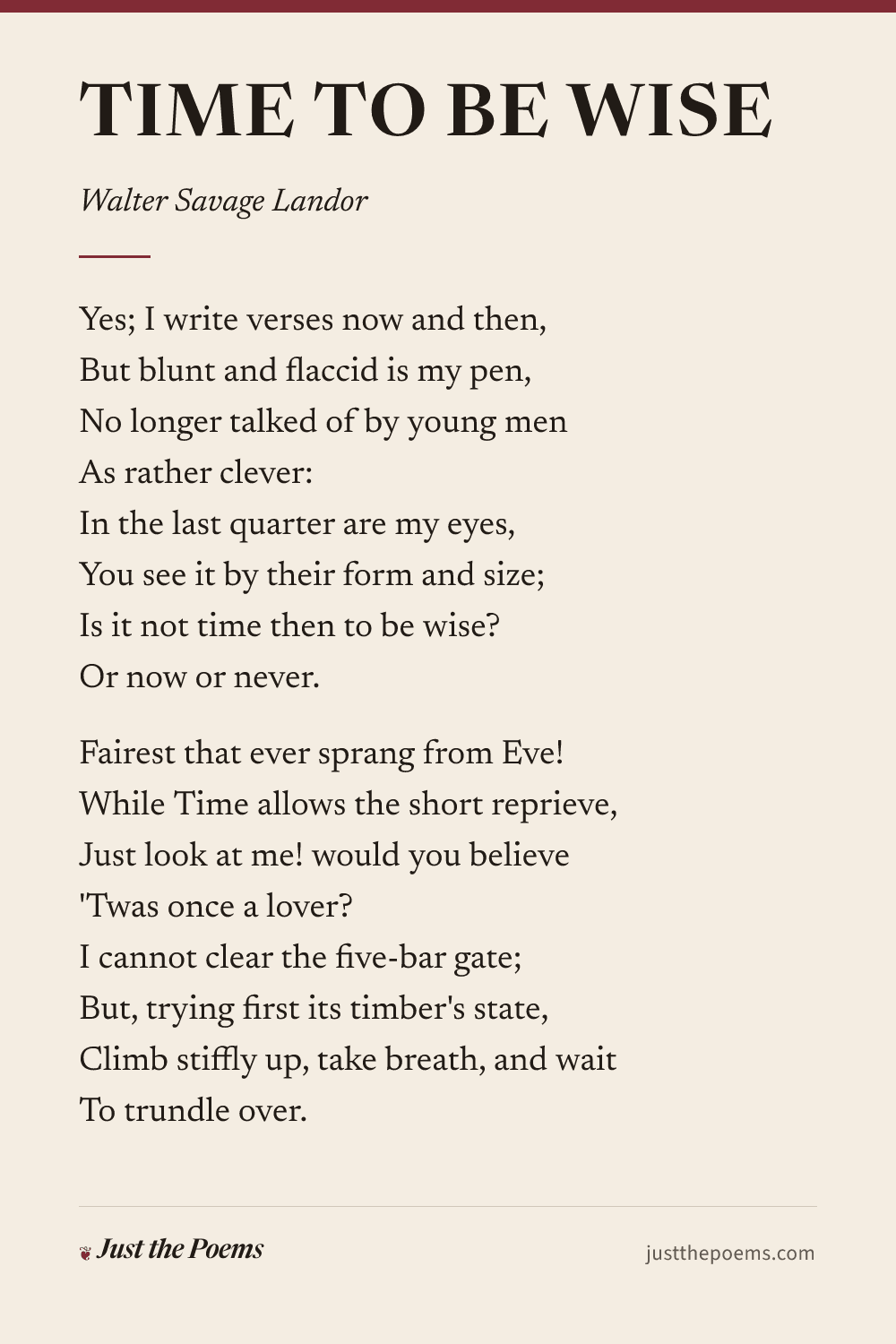
TIME TO BE WISE

Walter Savage Landor

In 0 Wikipedias 1 anthology Poet in 24 Wikipedias

Yes; I write verses now and then,But blunt and flaccid is my pen,No longer talked of by young menAs rather clever:In the last quarter are my eyes,You see it by their form and size;Is it not time then to be wise?Or now or never.

Fairest that ever sprang from Eve!While Time allows the short reprieve,Just look at me! would you believe'Twas once a lover?

Show all 32 lines 20 more

I cannot clear the five-bar gate;But, trying first its timber's state,Climb stiffly up, take breath, and waitTo trundle over.

Through gallopade I cannot swingThe entangling blooms of Beauty's spring:I cannot say the tender thing,Be't true or false,And am beginning to opineThose girls are only half-divineWhose waists yon wicked boys entwineIn giddy waltz.

I fear that arm above that shoulder;I wish them wiser, graver, older,Sedater, and no harm if colder,And panting less.Ah! people were not half so wildIn former days, when, starchly mild,Upon her high-heeled Essex smiledThe brave Queen Bess.

Source

The Home Book of Verse, ed. Burton Egbert Stevenson

Filed under
  • Named in the title

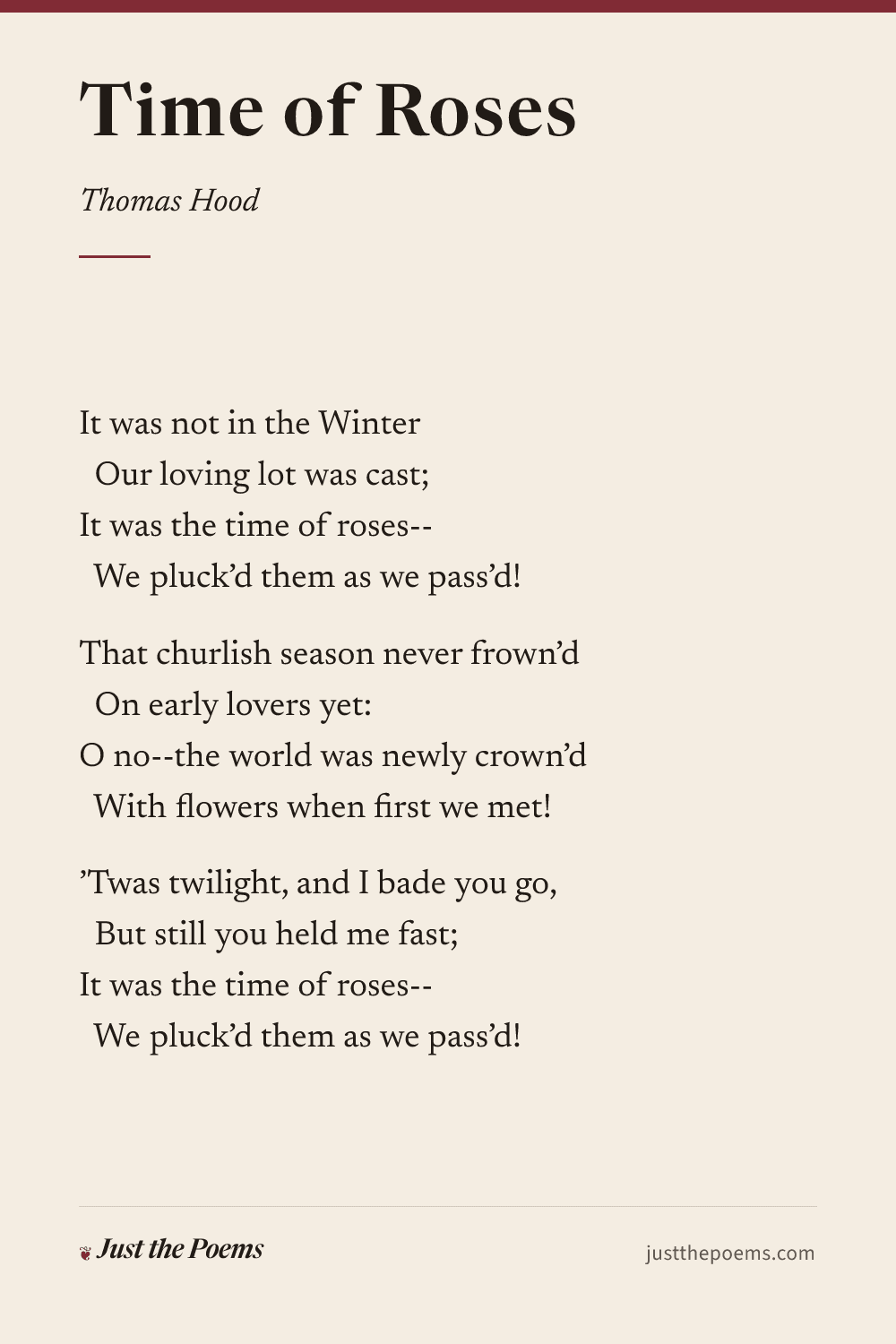
Time of Roses

Thomas Hood

In 0 Wikipedias 1 anthology Poet in 20 Wikipedias

It was not in the Winter Our loving lot was cast;It was the time of roses-- We pluck’d them as we pass’d!

That churlish season never frown’d On early lovers yet:O no--the world was newly crown’d With flowers when first we met!

’Twas twilight, and I bade you go, But still you held me fast;It was the time of roses-- We pluck’d them as we pass’d!

Source

The Oxford Book of English Verse 1250–1900, 1900

Filed under
  • Named in the title

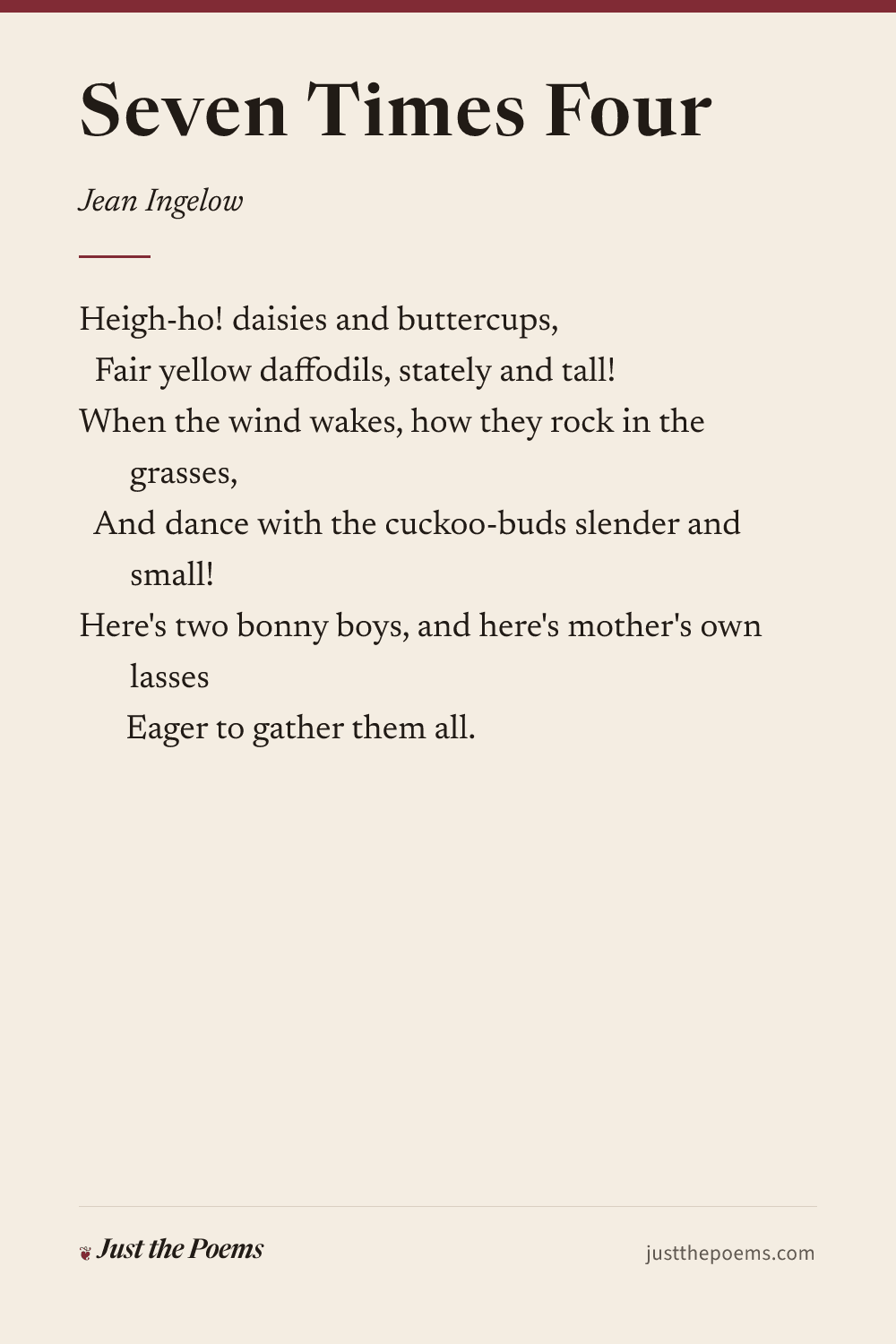
Seven Times Four

Jean Ingelow

In 0 Wikipedias 1 anthology Poet in 9 Wikipedias

Heigh-ho! daisies and buttercups, Fair yellow daffodils, stately and tall!When the wind wakes, how they rock in the grasses, And dance with the cuckoo-buds slender and small!Here's two bonny boys, and here's mother's own lasses Eager to gather them all.

Heigh-ho! daisies and buttercups! Mother shall thread them a daisy chain;Sing them a song of the pretty hedge-sparrow, That loved her brown little ones, loved them full fain;Sing, "Heart, thou art wide though the house be but narrow,"-- Sing once, and sing it again.

Heigh-ho! daisies and buttercups, Sweet wagging cowslips, they bend and they bow;A ship sails afar over warm ocean waters, And haply one musing doth stand at her prow,O bonny brown son, and O sweet little daughters, Maybe he thinks on you now!

Heigh-ho! daisies and buttercups, Fair yellow daffodils, stately and tall!A sunshiny world full of laughter and leisure, And fresh hearts unconscious of sorrow and thrall!Send down on their pleasure smiles passing its measure, God that is over us all!

Source

Poems Teachers Ask For

Filed under
  • Named in the title

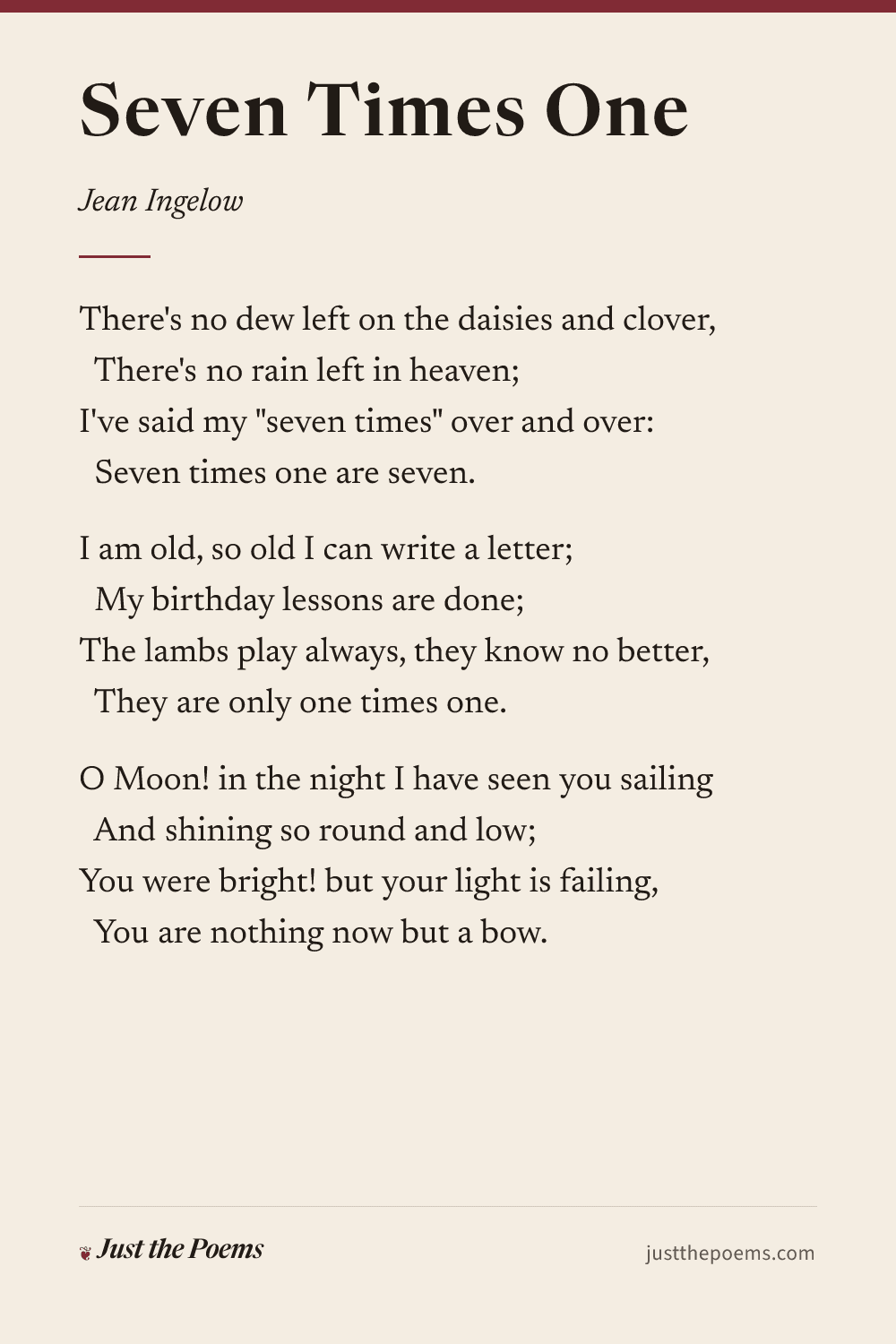
Seven Times One

Jean Ingelow

In 0 Wikipedias 1 anthology Poet in 9 Wikipedias

There's no dew left on the daisies and clover, There's no rain left in heaven;I've said my "seven times" over and over: Seven times one are seven.

I am old, so old I can write a letter; My birthday lessons are done;The lambs play always, they know no better, They are only one times one.

O Moon! in the night I have seen you sailing And shining so round and low;You were bright! but your light is failing, You are nothing now but a bow.

Show all 28 lines 16 more

You Moon, have you done something wrong in heaven, That God has hidden your face?I hope if you have, you'll soon be forgiven, And shine again in your place.

O velvet Bee, you're a dusty fellow; You've powdered your legs with gold!O brave Marshmary buds, rich and yellow, Give me your money to hold!

O Columbine, open your folded wrapper Where two twin turtle-doves dwell!O Cuckoo-pint, toll me the purple clapper That hangs in your clear green bell!

And show me your nest, with the young ones in it, I will not steal them away;I am old! you may trust me, linnet, linnet, I am seven times one to-day.

Source

Poems Teachers Ask For

Filed under
  • Named in the title

Seven Times Three

Jean Ingelow

In 0 Wikipedias 1 anthology Poet in 9 Wikipedias

I leaned out of window, I smelt the white clover, Dark, dark was the garden, I saw not the gate;"Now, if there be footsteps, he comes, my one lover-- Hush, nightingale, hush! O sweet nightingale, wait Till I listen and hear If a step draweth near, For my love he is late!

"The skies in the darkness stoop nearer and nearer, A cluster of stars hangs like fruit in the tree,The fall of the water comes sweeter, comes clearer: To what art thou listening, and what dost thou see? Let the star-clusters grow,

Show all 28 lines 16 more

Let the sweet waters flow. And cross quickly to me.

"You night-moths that hover where honey brims over From sycamore blossoms, or settle or sleep;You glowworms, shine out, and the pathway discover To him that comes darkling along the rough steep. Ah, my sailor, make haste, For the time runs to waste, And my love lieth deep,

"Too deep for swift telling; and yet, my one lover, I've conned thee an answer, it waits thee to-night."By the sycamore passed he, and through the white clover; Then all the sweet speech I had fashioned took flight; But I'll love him more, more Than e'er wife loved before, Be the days dark or bright.

Source

Poems Teachers Ask For

Filed under
  • Named in the title

Seven Times Two

Jean Ingelow

In 0 Wikipedias 1 anthology Poet in 9 Wikipedias

You bells in the steeple, ring, ring out your changes, How many soever they be,And let the brown meadow-lark's note as he ranges, Come over, come over to me.

Yet birds' clearest carol by fall or by swelling No magical sense conveys,And bells have forgotten their old art of telling The fortune of future days.

"Turn again, turn again," once they rang cheerily. While a boy listened alone;Made his heart yearn again, musing so wearily All by himself on a stone.

Show all 32 lines 20 more

Poor bells! I forgive you; your good days are over, And mine, they are yet to be;No listening, no longing shall aught, aught discover: You leave the story to me.

The foxglove shoots out of the green matted heather, Preparing her hoods of snow:She was idle, and slept till the sunshiny weather: Oh, children take long to grow.

I wish and I wish that the spring would go faster, Nor long summer bide so late;And I could grow on like the foxglove and aster, For some things are ill to wait.

I wait for the day when dear hearts shall discover, While dear hands are laid on my head:"The child is a woman, the book may close over, For all the lessons are said."

I wait for my story--the birds cannot sing it, Not one, as he sits on the tree;The bells cannot ring it, but long years, oh bring it! Such as I wish it to be.

Source

Poems Teachers Ask For

Filed under
  • Named in the title

"LONG TIME A CHILD"

Hartley Coleridge

In 0 Wikipedias 1 anthology Poet in 7 Wikipedias

Long time a child, and still a child, when yearsHad painted manhood on my check, was I,--For yet I lived like one not born to die;A thriftless prodigal of smiles and tears,No hope I needed, and I knew no fears.But sleep, though sweet, is only sleep; and waking,I waked to sleep no more; at once o'ertakingThe vanguard of my age, with all arrearsOf duty on my back. Nor child, nor man,Nor youth, nor sage, I find my head is gray,For I have lost the race I never ran:A rathe December blights my lagging May;And still I am a child, though I be old:Time is my debtor for my years untold.

Source

The Home Book of Verse, ed. Burton Egbert Stevenson

Filed under
  • Named in the title

ON THE HURRY OF THIS TIME

Austin Dobson

In 0 Wikipedias 1 anthology Poet in 7 Wikipedias

With slower pen men used to write,Of old, when "letters" were "polite";In Anna's or in George's days,They could afford to turn a phrase,Or trim a struggling theme aright.

They knew not steam; electric lightNot yet had dazed their calmer sight;--They meted out both blame and praiseWith slower pen.

Too swiftly now the Hours take flight!What's read at morn is dead at night:Scant space have we for Art's delays,Whose breathless thought so briefly stays,We may not work--ah! would we might!--With slower pen.

Source

The Home Book of Verse, ed. Burton Egbert Stevenson

Filed under
  • Named in the title

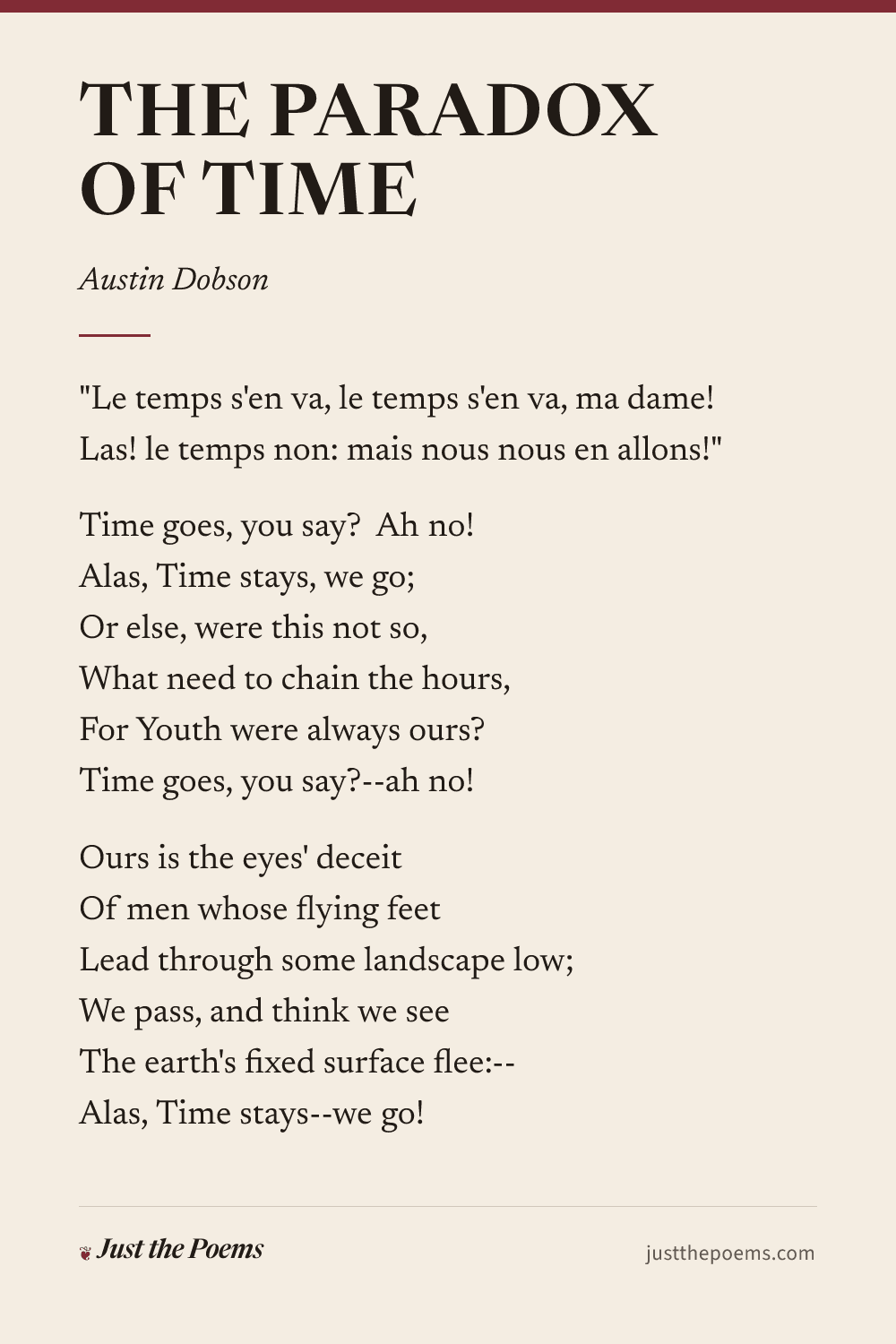
THE PARADOX OF TIME

Austin Dobson

In 0 Wikipedias 1 anthology Poet in 7 Wikipedias

"Le temps s'en va, le temps s'en va, ma dame!Las! le temps non: mais nous nous en allons!"

Time goes, you say? Ah no!Alas, Time stays, we go;Or else, were this not so,What need to chain the hours,For Youth were always ours?Time goes, you say?--ah no!

Ours is the eyes' deceitOf men whose flying feetLead through some landscape low;We pass, and think we see

Show all 38 lines 26 more

The earth's fixed surface flee:--Alas, Time stays--we go!

Once in the days of old,Your locks were curling gold,And mine had shamed the crow.Now, in the self-same stage,We've reached the silver age;Time goes, you say?--ah no!

Once, when my voice was strong,I filled the woods with songTo praise your "rose" and "snow";My bird, that sang, is dead;Where are your roses fled?Alas, Time stays--we go!

See, in what traversed ways,What backward Fate delaysThe hopes we used to know;Where are our old desires?--Ah, where those vanished fires?Time goes, you say?--ah no!

How far, how far, O sweet,The past behind our feetLies in the even-glow!Now, on the forward way,Let us fold hands, and pray;Alas, Time stays,--we go!

Source

The Home Book of Verse, ed. Burton Egbert Stevenson

Filed under
  • Named in the title

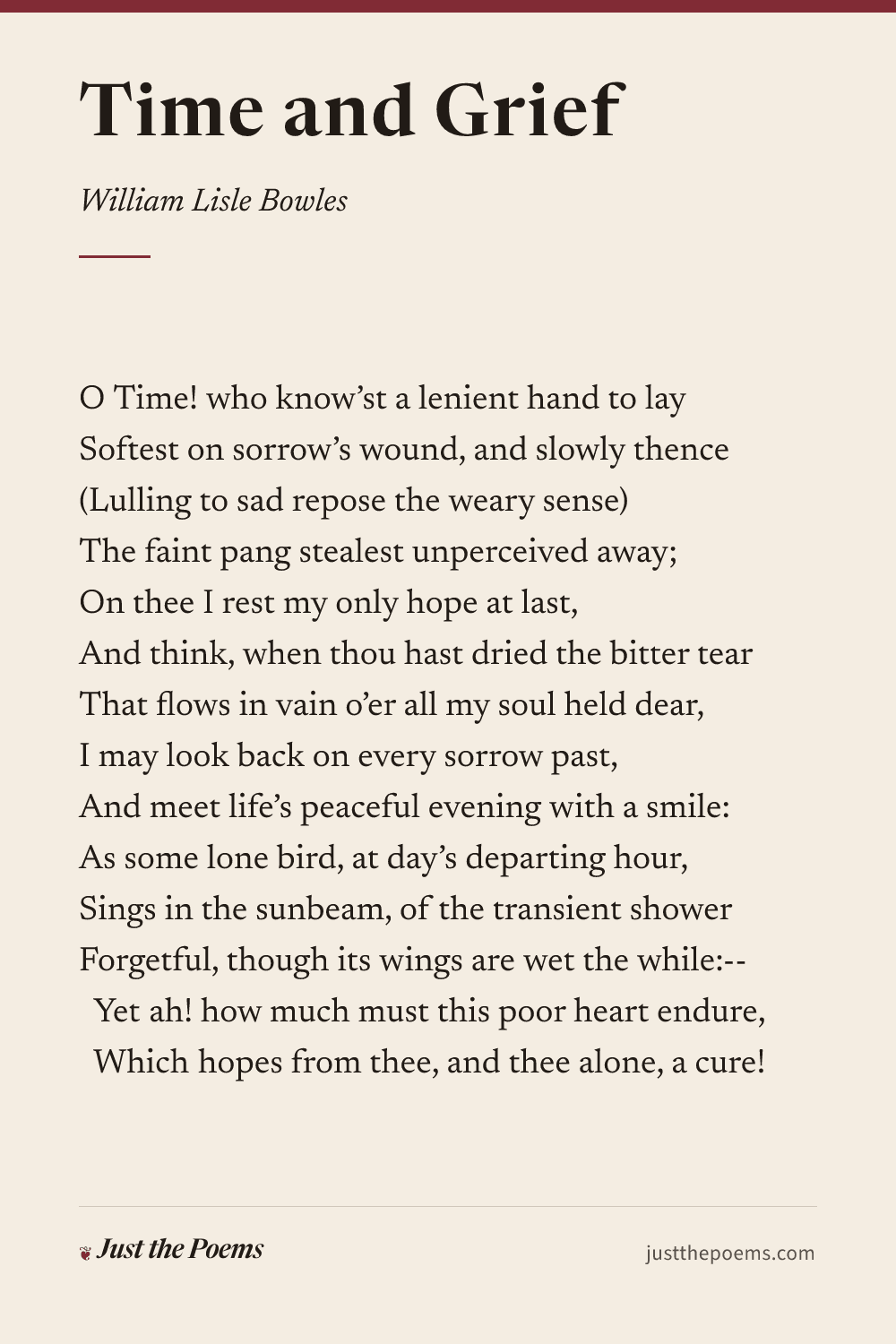
Time and Grief

William Lisle Bowles

In 0 Wikipedias 1 anthology Poet in 7 Wikipedias

O Time! who know’st a lenient hand to laySoftest on sorrow’s wound, and slowly thence(Lulling to sad repose the weary sense)The faint pang stealest unperceived away;On thee I rest my only hope at last,And think, when thou hast dried the bitter tearThat flows in vain o’er all my soul held dear,I may look back on every sorrow past,And meet life’s peaceful evening with a smile:As some lone bird, at day’s departing hour,Sings in the sunbeam, of the transient showerForgetful, though its wings are wet the while:-- Yet ah! how much must this poor heart endure, Which hopes from thee, and thee alone, a cure!

Source

The Oxford Book of English Verse 1250–1900, 1900

Filed under
  • Named in the title

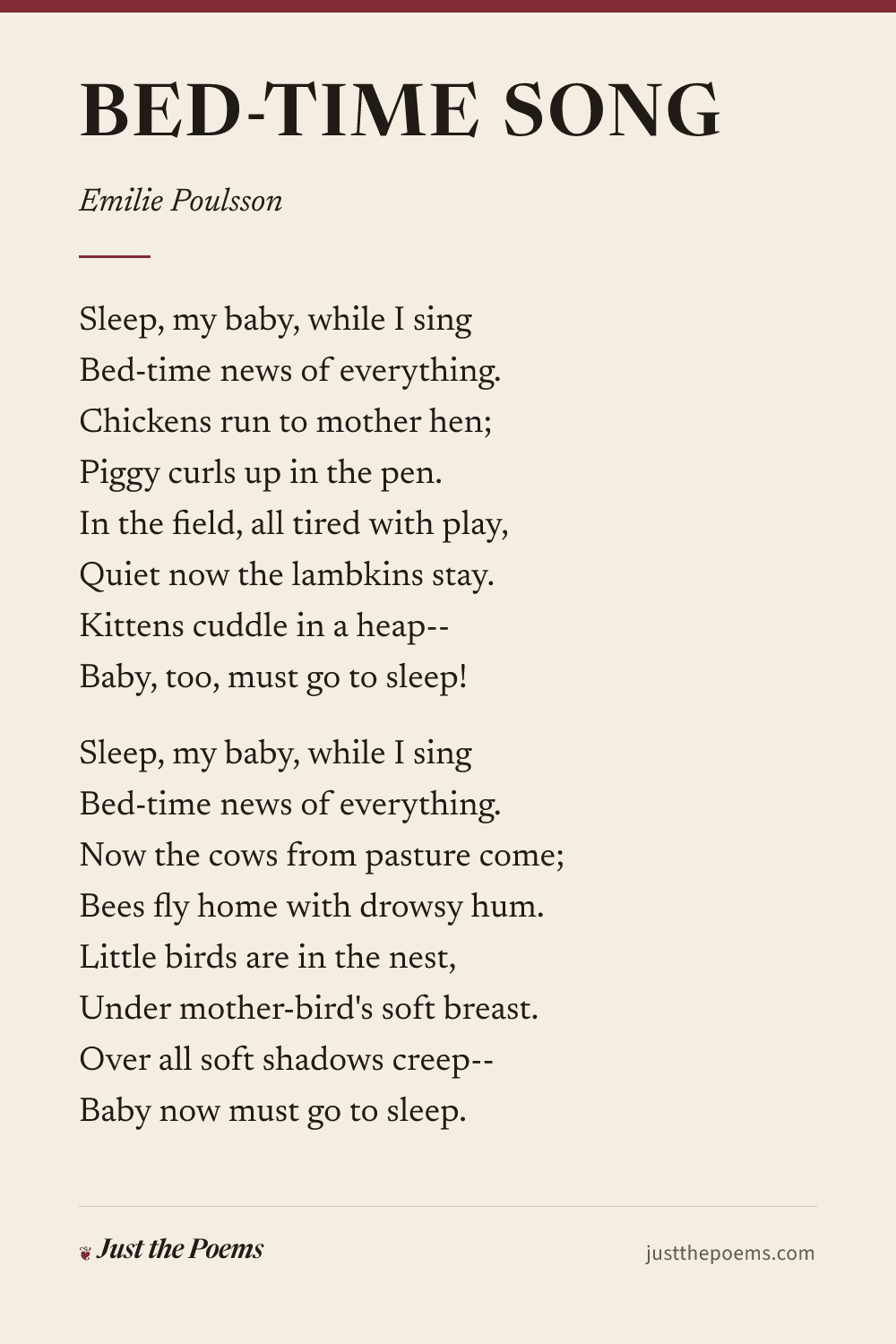
BED-TIME SONG

Emilie Poulsson

In 0 Wikipedias 1 anthology Poet in 2 Wikipedias

Sleep, my baby, while I singBed-time news of everything.Chickens run to mother hen;Piggy curls up in the pen.In the field, all tired with play,Quiet now the lambkins stay.Kittens cuddle in a heap--Baby, too, must go to sleep!

Sleep, my baby, while I singBed-time news of everything.Now the cows from pasture come;Bees fly home with drowsy hum.Little birds are in the nest,Under mother-bird's soft breast.Over all soft shadows creep--Baby now must go to sleep.

Sleep, my baby, while I singBed-time news of everything.Sleepy flowers seem to nod,Drooping toward the dewy sod;While the big sun's fading lightBids my baby dear good-night.Mother loving watch will keep;Baby now must go to sleep.

Source

The Home Book of Verse, ed. Burton Egbert Stevenson

Filed under
  • Named in the title

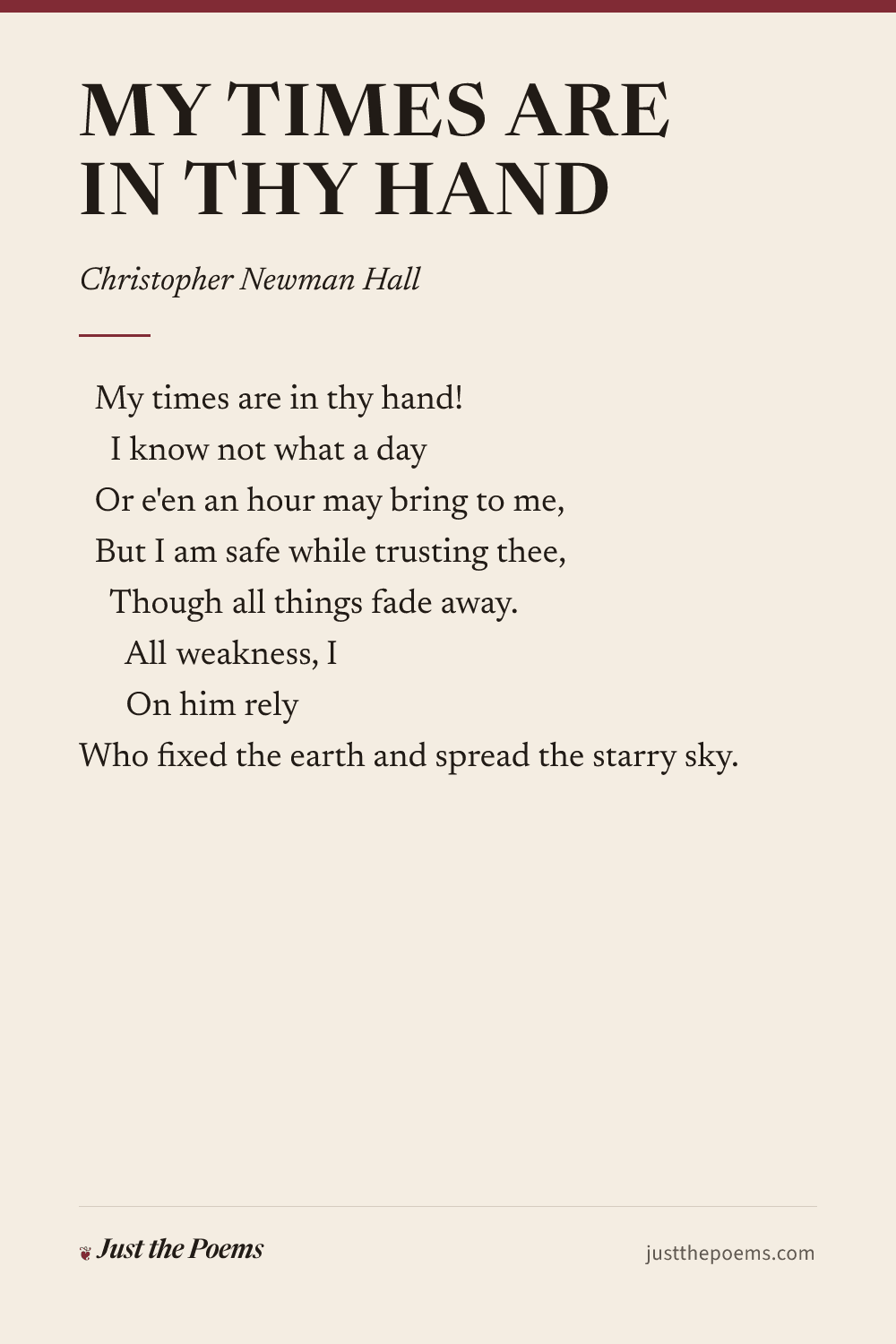
MY TIMES ARE IN THY HAND

Christopher Newman Hall

In 0 Wikipedias 1 anthology Poet in 1 Wikipedia

My times are in thy hand! I know not what a day Or e'en an hour may bring to me, But I am safe while trusting thee, Though all things fade away. All weakness, I On him relyWho fixed the earth and spread the starry sky.

My times are in thy hand! Pale poverty or wealth. Corroding care or calm repose. Spring's balmy breath or winter's snows.

Show all 56 lines 44 more

Sickness or buoyant health,-- Whate'er betide, If God provide,'T is for the best; I wish no lot beside.

My times are in thy hand! Should friendship pure illume And strew my path with fairest flowers, Or should I spend life's dreary hours In solitude's dark gloom, Thou art a friend. Till time shall endUnchangeably the same; in thee all beauties blend.

My times are in thy hand! Many or few, my days I leave with thee,--this only pray, That by thy grace, I, every day Devoting to thy praise, May ready be To welcome theeWhene'er thou com'st to set my spirit free.

My times are in thy hand! Howe'er those times may end, Sudden or slow my soul's release, Midst anguish, frenzy, or in peace, I'm safe with Christ my friend. If he is nigh, Howe'er I die,'T will be the dawn of heavenly ecstasy.

My times are in thy hand! To thee I can intrust My slumbering clay, till thy command Bids all the dead before thee stand, Awaking from the dust. Beholding thee, What bliss 't will beWith all thy saints to spend eternity!

To spend eternity In heaven's unclouded light! From sorrow, sin, and frailty free, Beholding and resembling thee,-- O too transporting sight! Prospect too fair For flesh to bear!Haste! haste! my Lord, and soon transport me there!

Source

The World's Best Poetry, Vol. IV, ed. Bliss Carman, 1904

Filed under
  • Named in the title

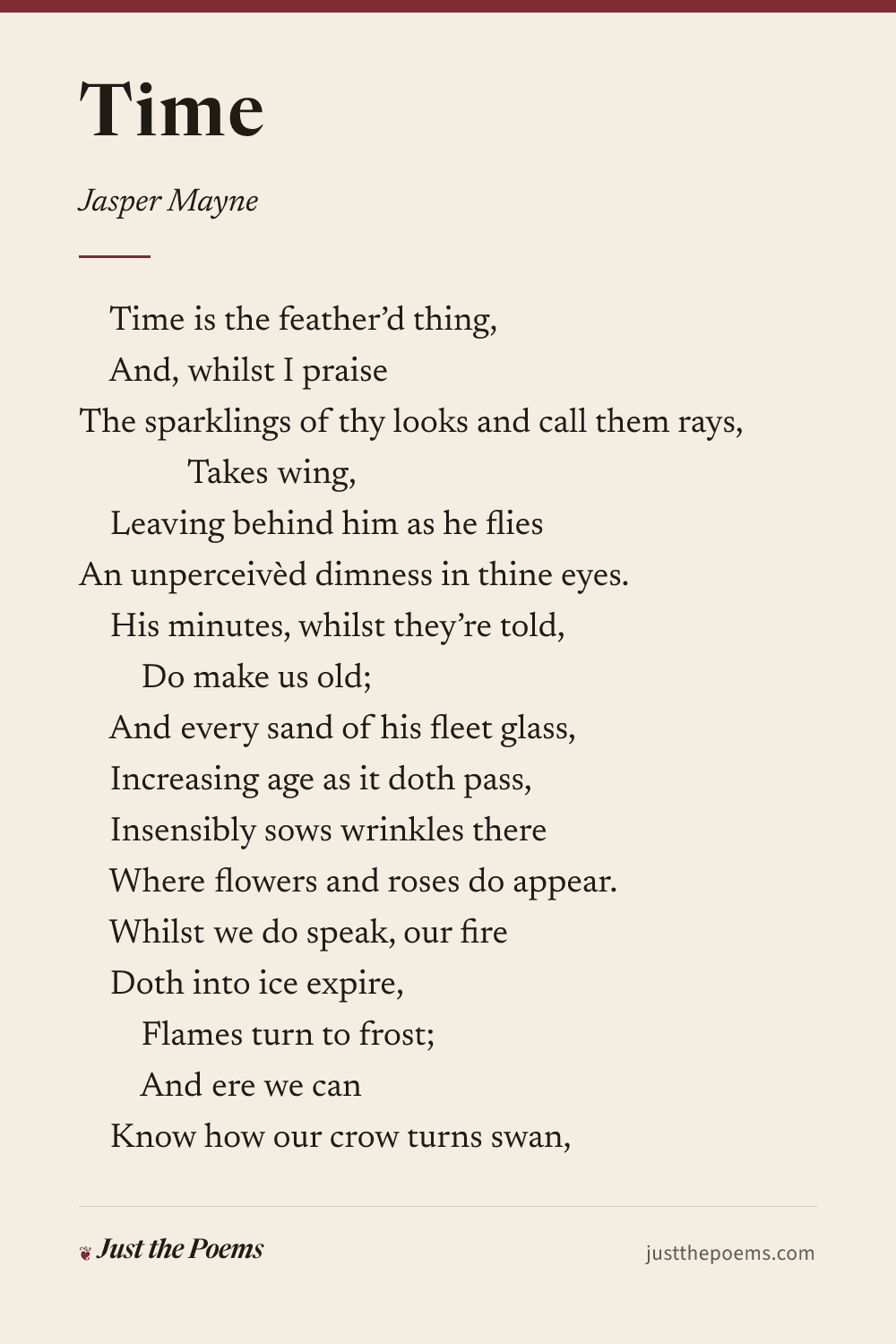
Time

Jasper Mayne

In 0 Wikipedias 1 anthology Poet in 1 Wikipedia

Time is the feather’d thing, And, whilst I praiseThe sparklings of thy looks and call them rays, Takes wing, Leaving behind him as he fliesAn unperceivèd dimness in thine eyes. His minutes, whilst they’re told, Do make us old; And every sand of his fleet glass, Increasing age as it doth pass, Insensibly sows wrinkles there Where flowers and roses do appear.

Show all 40 lines 28 more

Whilst we do speak, our fire Doth into ice expire, Flames turn to frost; And ere we can Know how our crow turns swan, Or how a silver snow Springs there where jet did grow,Our fading spring is in dull winter lost. Since then the Night hath hurl’d Darkness, Love’s shade, Over its enemy the Day, and made The world Just such a blind and shapeless thingAs ’twas before light did from darkness spring, Let us employ its treasure And make shade pleasure:Let’s number out the hours by blisses,And count the minutes by our kisses; Let the heavens new motions feel And by our embraces wheel; And whilst we try the way By which Love doth convey Soul unto soul, And mingling so Makes them such raptures know As makes them entrancèd lie In mutual ecstasy,Let the harmonious spheres in music roll!

Source

The Oxford Book of English Verse 1250–1900, 1900

Filed under
  • Named in the title

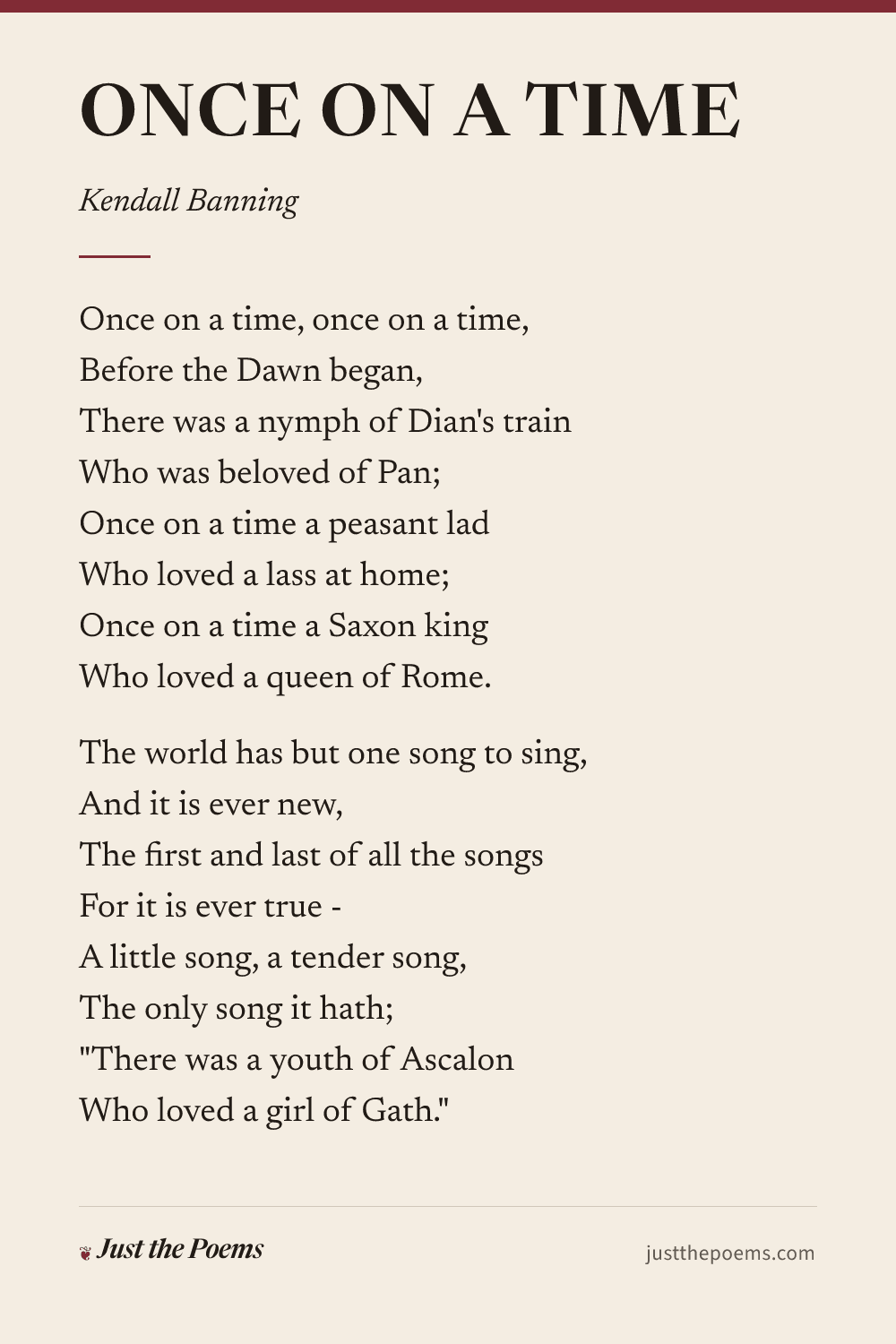
ONCE ON A TIME

Kendall Banning

In 0 Wikipedias 1 anthology Poet in 0 Wikipedias

Once on a time, once on a time,Before the Dawn began,There was a nymph of Dian's trainWho was beloved of Pan;Once on a time a peasant ladWho loved a lass at home;Once on a time a Saxon kingWho loved a queen of Rome.

The world has but one song to sing,And it is ever new,The first and last of all the songsFor it is ever true -A little song, a tender song,The only song it hath;"There was a youth of AscalonWho loved a girl of Gath."

A thousand thousand years have gone,And aeons still shall pass,Yet shall the world forever singOf him who loved a lass -An olden song, a golden song,And sing it unafraid:"There was a youth, once on a time,Who dearly loved a maid."

Source

The Home Book of Verse, ed. Burton Egbert Stevenson

Filed under
  • Named in the title

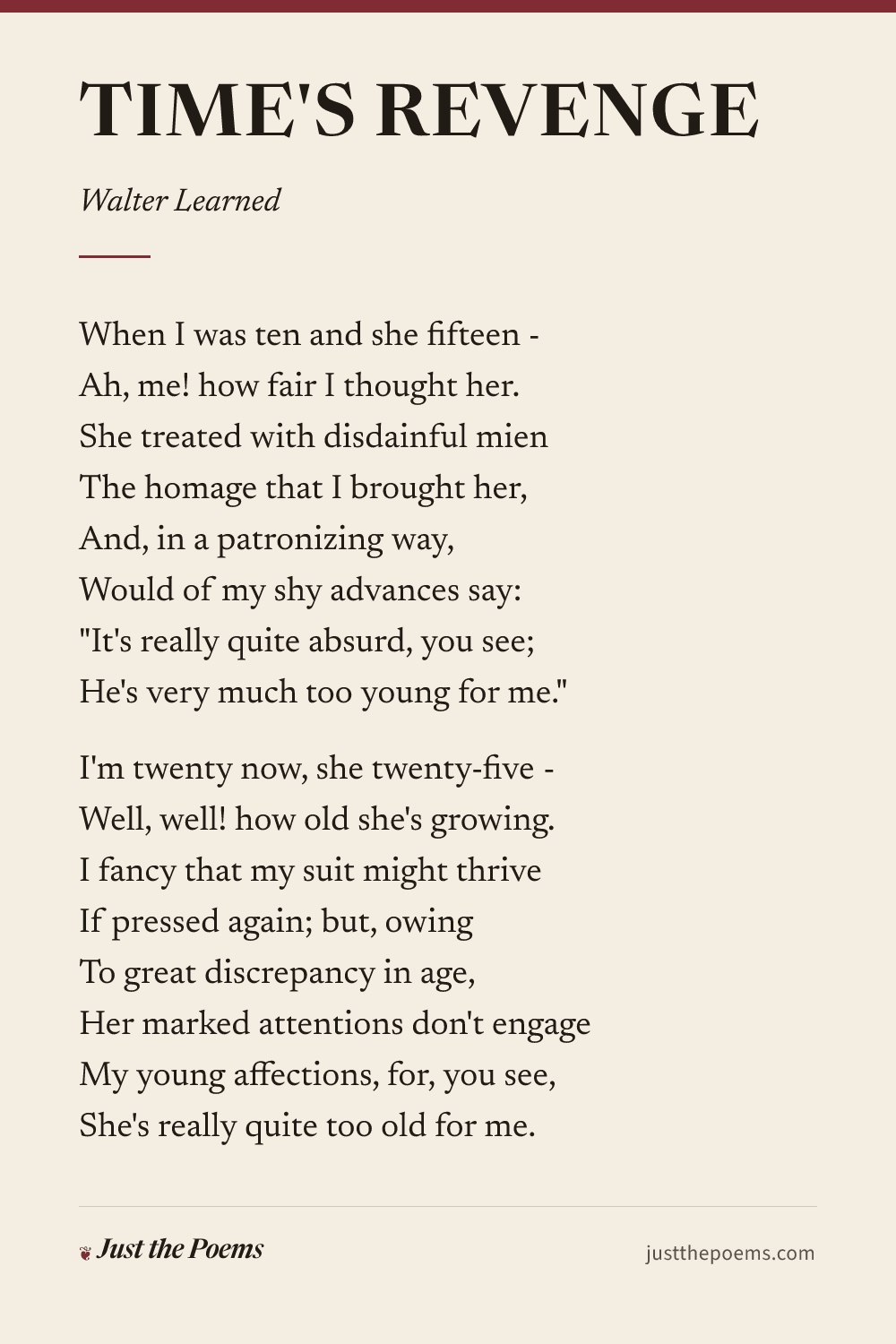
TIME'S REVENGE

Walter Learned

In 0 Wikipedias 1 anthology Poet in 0 Wikipedias

When I was ten and she fifteen -Ah, me! how fair I thought her.She treated with disdainful mienThe homage that I brought her,And, in a patronizing way,Would of my shy advances say:"It's really quite absurd, you see;He's very much too young for me."

I'm twenty now, she twenty-five -Well, well! how old she's growing.I fancy that my suit might thriveIf pressed again; but, owingTo great discrepancy in age,Her marked attentions don't engageMy young affections, for, you see,She's really quite too old for me.

Source

The Home Book of Verse, ed. Burton Egbert Stevenson

Filed under
  • Named in the title

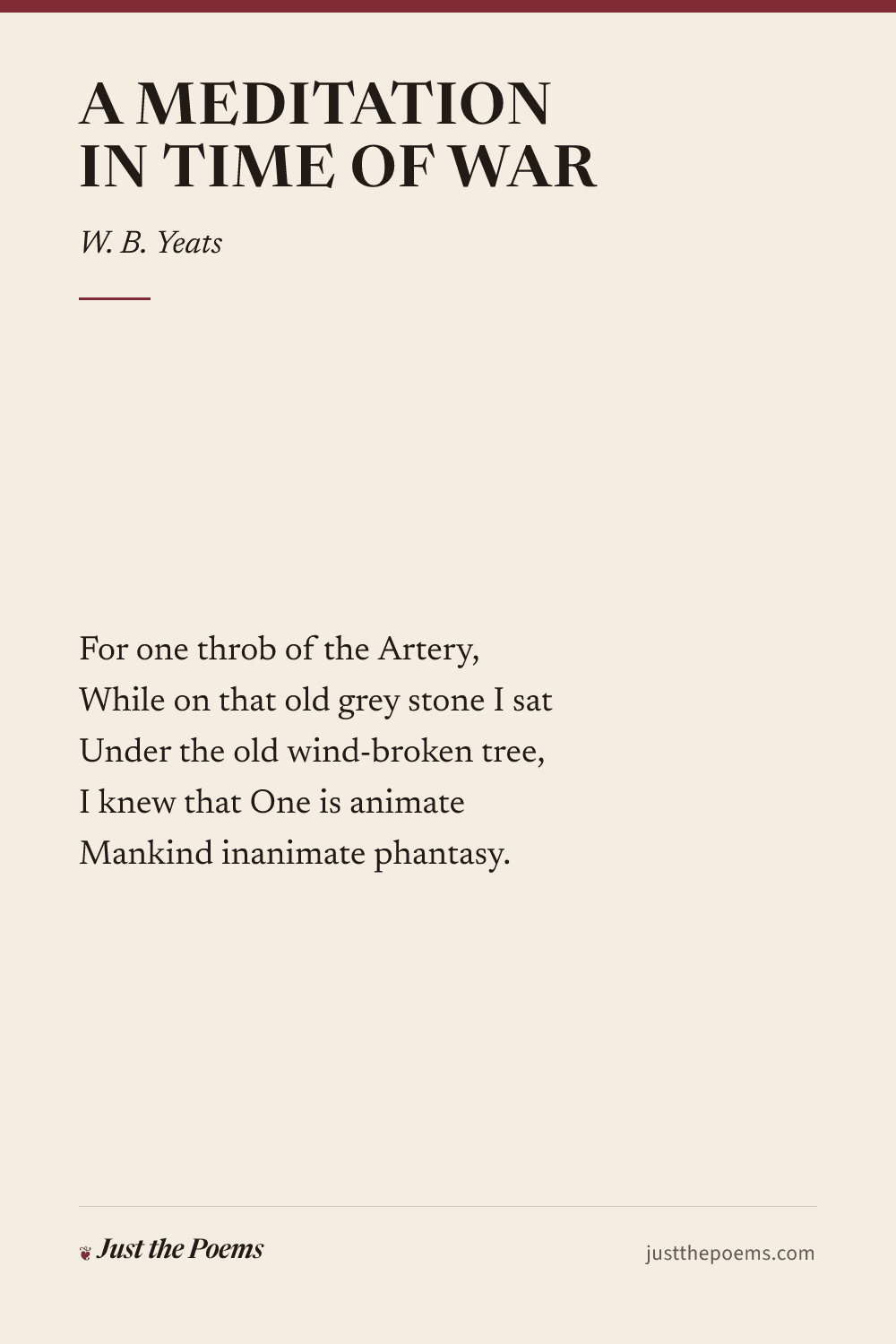
A MEDITATION IN TIME OF WAR

W. B. Yeats

In 0 Wikipedias 0 anthologies Poet in 113 Wikipedias

For one throb of the Artery,While on that old grey stone I satUnder the old wind-broken tree,I knew that One is animateMankind inanimate phantasy.

Source

Michael Robartes and the dancer, 1920

Filed under
  • Named in the title

30 of 50 poems about time

24 poets

By poet's century of death

CenturyPoems
6th1
16th1
17th8
19th13
20th7

Poets with more than one poem

PoetPoems
Jean Ingelow5
Austin Dobson2
William Shakespeare2