Poems About Roses

The first 30 of 36 poems about roses, by 28 poets, ranked by third-party data. How poems are ranked

Go, lovely Rose!

Edmund Waller

In 0 Wikipedias 4 anthologies Poet in 13 Wikipedias

Go, lovely Rose!Tell her, that wastes her time and me, That now she knows,When I resemble her to thee,How sweet and fair she seems to be.

Tell her that's young,And shuns to have her graces spied, That hadst thou sprungIn deserts, where no men abide,Thou must have uncommended died.

Small is the worthOf beauty from the light retired: Bid her come forth,Suffer herself to be desired,And not blush so to be admired.

Then die! that sheThe common fate of all things rare May read in thee:How small a part of time they shareThat are so wondrous sweet and fair!

Source

The Golden Treasury, ed. Francis Turner Palgrave

Filed under
  • Named in the first line

Rose Aylmer

Walter Savage Landor

In 0 Wikipedias 2 anthologies Poet in 24 Wikipedias

Ah, what avails the sceptred race! Ah, what the form divine!What every virtue, every grace! Rose Aylmer, all were thine.

Rose Aylmer, whom these wakeful eyes May weep, but never see,A night of memories and sighs I consecrate to thee.

Source

The Oxford Book of English Verse 1250–1900, 1900

Filed under
  • Named in the title
  • Wikidata main subject: Rose Whitworth Aylmer

A Rose

Sir Richard Fanshawe

In 0 Wikipedias 2 anthologies Poet in 8 Wikipedias

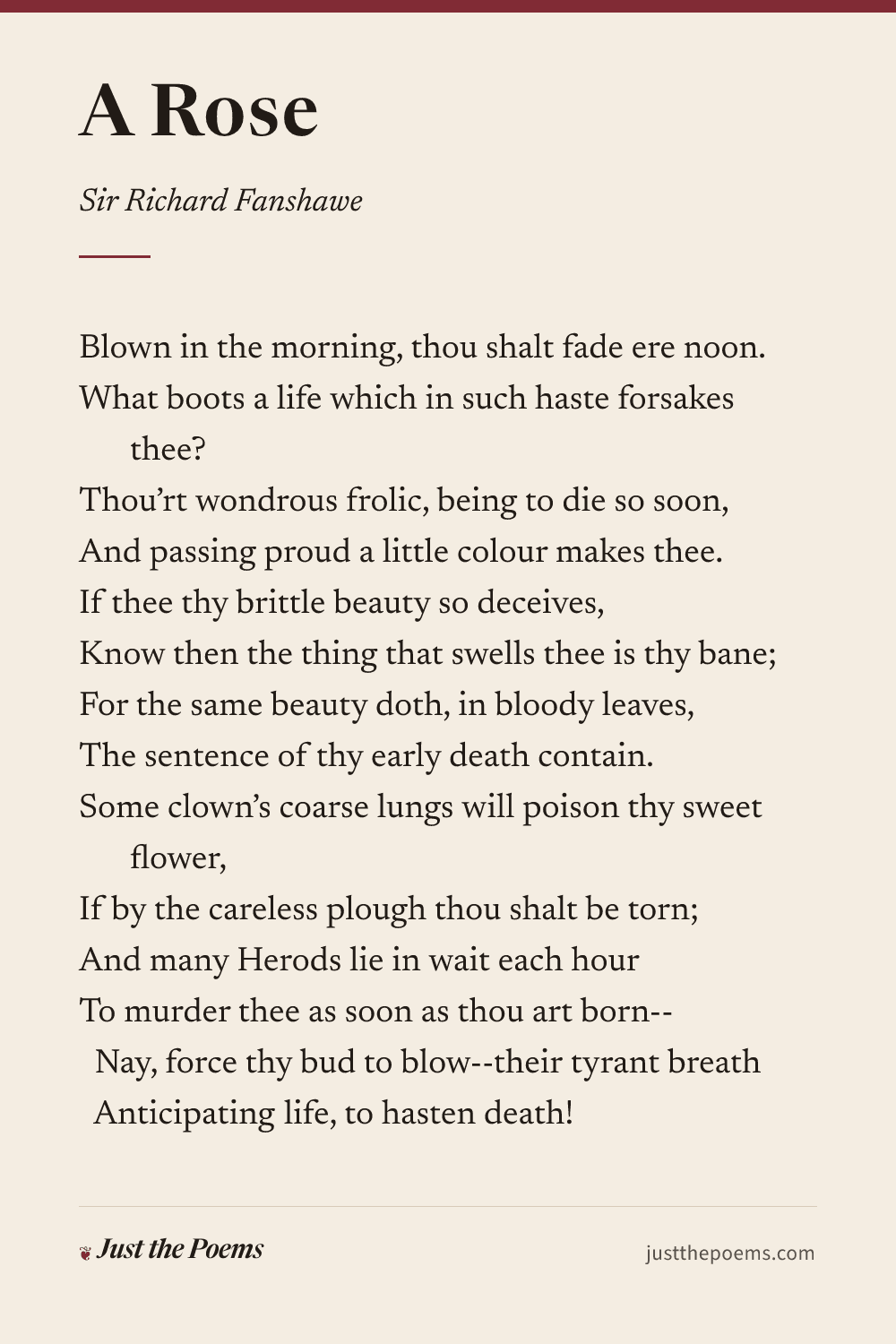
Blown in the morning, thou shalt fade ere noon.What boots a life which in such haste forsakes thee?Thou’rt wondrous frolic, being to die so soon,And passing proud a little colour makes thee.If thee thy brittle beauty so deceives,Know then the thing that swells thee is thy bane;For the same beauty doth, in bloody leaves,The sentence of thy early death contain.Some clown’s coarse lungs will poison thy sweet flower,If by the careless plough thou shalt be torn;And many Herods lie in wait each hourTo murder thee as soon as thou art born-- Nay, force thy bud to blow--their tyrant breath Anticipating life, to hasten death!

Source

The Oxford Book of English Verse 1250–1900, 1900

Filed under
  • Named in the title

Advertisements

A White Rose

John Boyle O’Reilly

In 0 Wikipedias 2 anthologies Poet in 8 Wikipedias

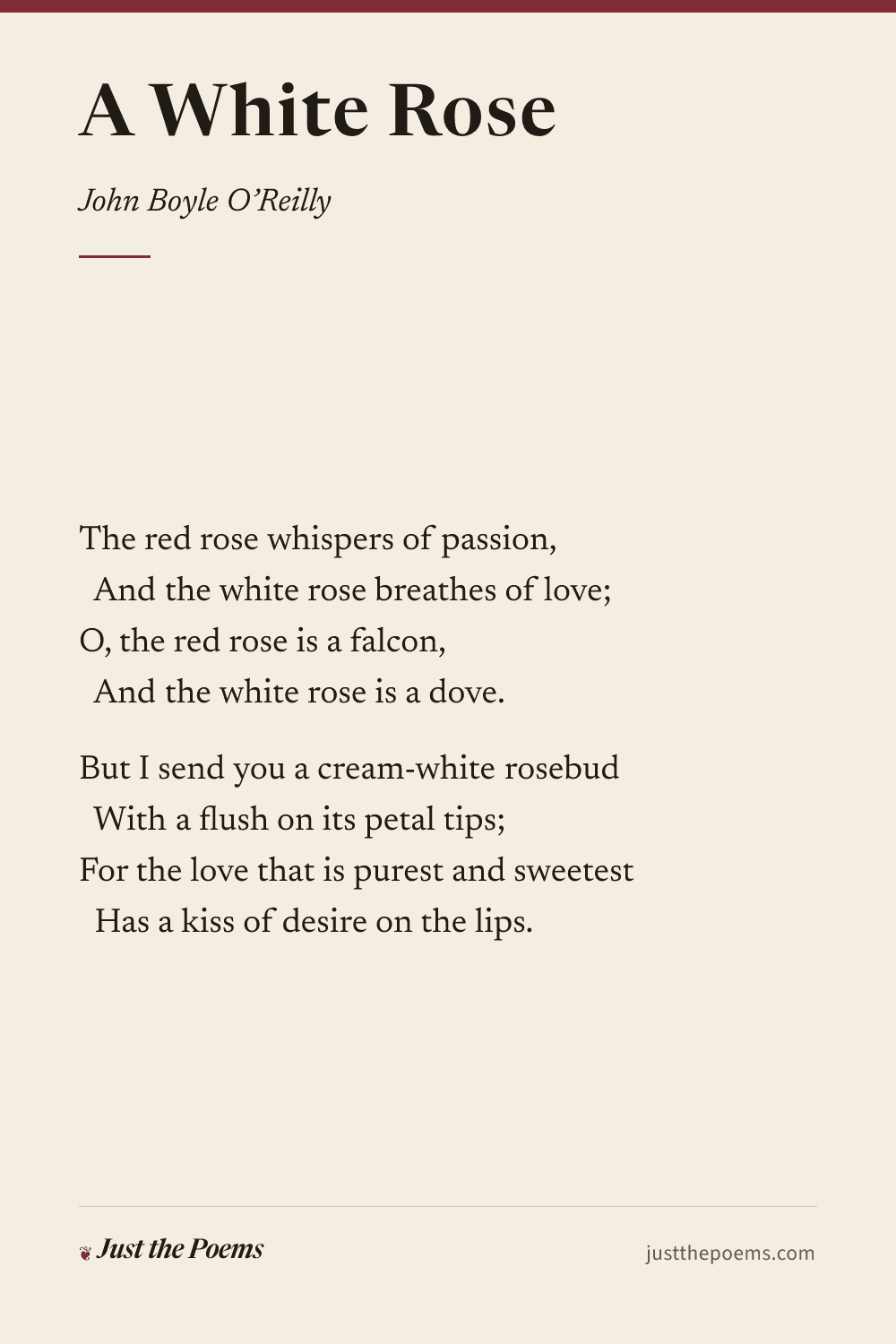
The red rose whispers of passion, And the white rose breathes of love;O, the red rose is a falcon, And the white rose is a dove.

But I send you a cream-white rosebud With a flush on its petal tips;For the love that is purest and sweetest Has a kiss of desire on the lips.

Source

The Oxford Book of English Verse 1250–1900, 1900

Filed under
  • Named in the title

To Roses in the Bosom of Castara

William Habington

In 0 Wikipedias 2 anthologies Poet in 7 Wikipedias

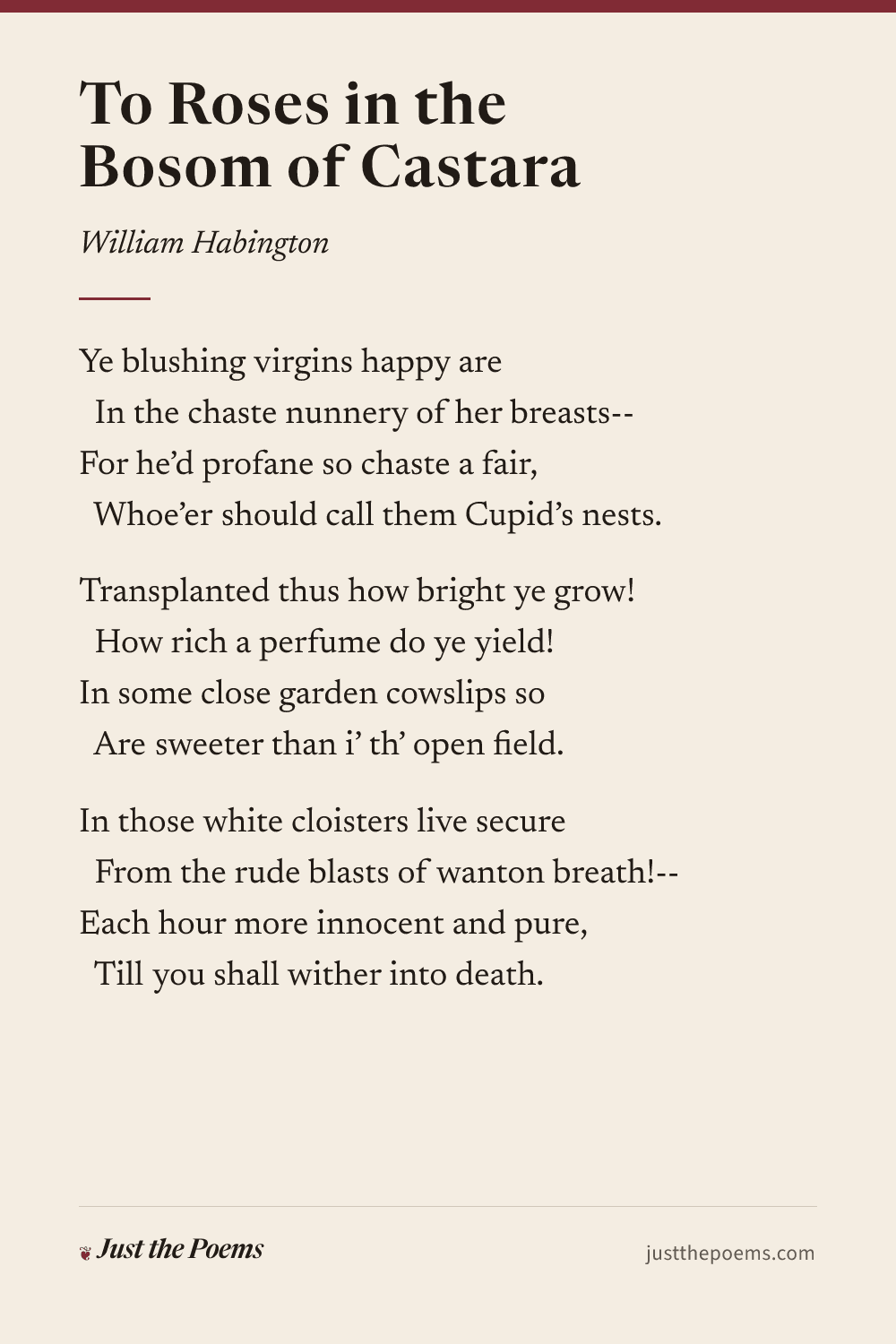
Ye blushing virgins happy are In the chaste nunnery of her breasts--For he’d profane so chaste a fair, Whoe’er should call them Cupid’s nests.

Transplanted thus how bright ye grow! How rich a perfume do ye yield!In some close garden cowslips so Are sweeter than i’ th’ open field.

In those white cloisters live secure From the rude blasts of wanton breath!--Each hour more innocent and pure, Till you shall wither into death.

Then that which living gave you room, Your glorious sepulchre shall be.There wants no marble for a tomb Whose breast hath marble been to me.

Source

The Oxford Book of English Verse 1250–1900, 1900

Filed under
  • Named in the title

HAS SUMMER COME WITHOUT THE ROSE?

Arthur O'Shaughnessy

In 0 Wikipedias 2 anthologies Poet in 6 Wikipedias

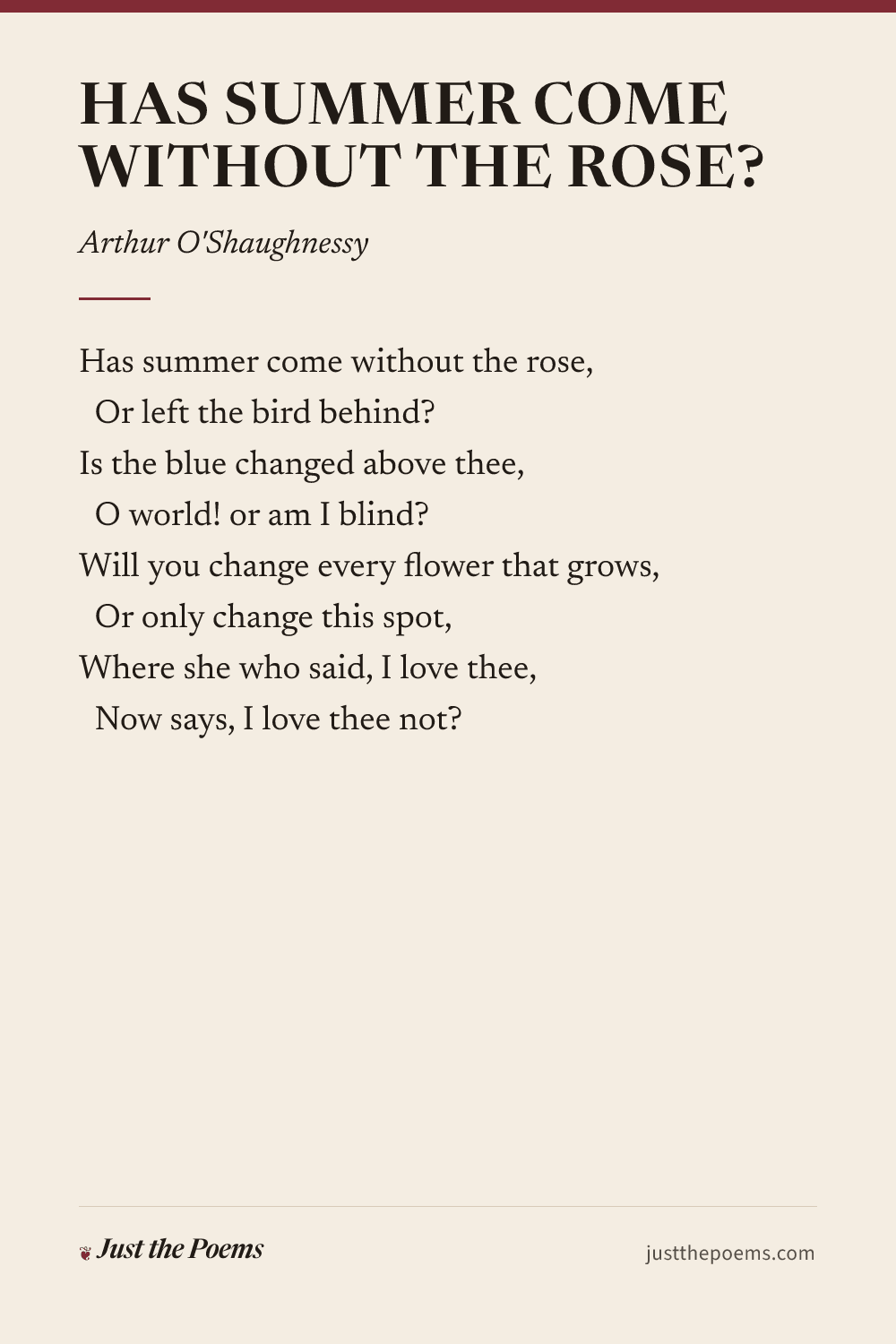
Has summer come without the rose, Or left the bird behind?Is the blue changed above thee, O world! or am I blind?Will you change every flower that grows, Or only change this spot,Where she who said, I love thee, Now says, I love thee not?

The skies seemed true above thee, The rose true on the tree;The bird seemed true the summer through, But all proved false to me.

Show all 32 lines 20 more

World, is there one good thing in you, Life, love, or death--or what?Since lips that sang, I love thee, Have said, I love thee not?

I think the sun's kiss will scarce fall Into one flower's gold cup;I think the bird will miss me, And give the summer up.O sweet place, desolate in tall Wild grass, have you forgotHow her lips loved to kiss me, Now that they kiss me not?

Be false or fair above me; Come back with any face,Summer!--do I care what you do? You cannot change one place,--The grass, the leaves, the earth, the dew, The grave I make the spot,--Here, where she used to love me, Here, where she loves me not.

Source

The World's Best Poetry, Vol. III, ed. Bliss Carman, 1904

Filed under
  • Named in the title

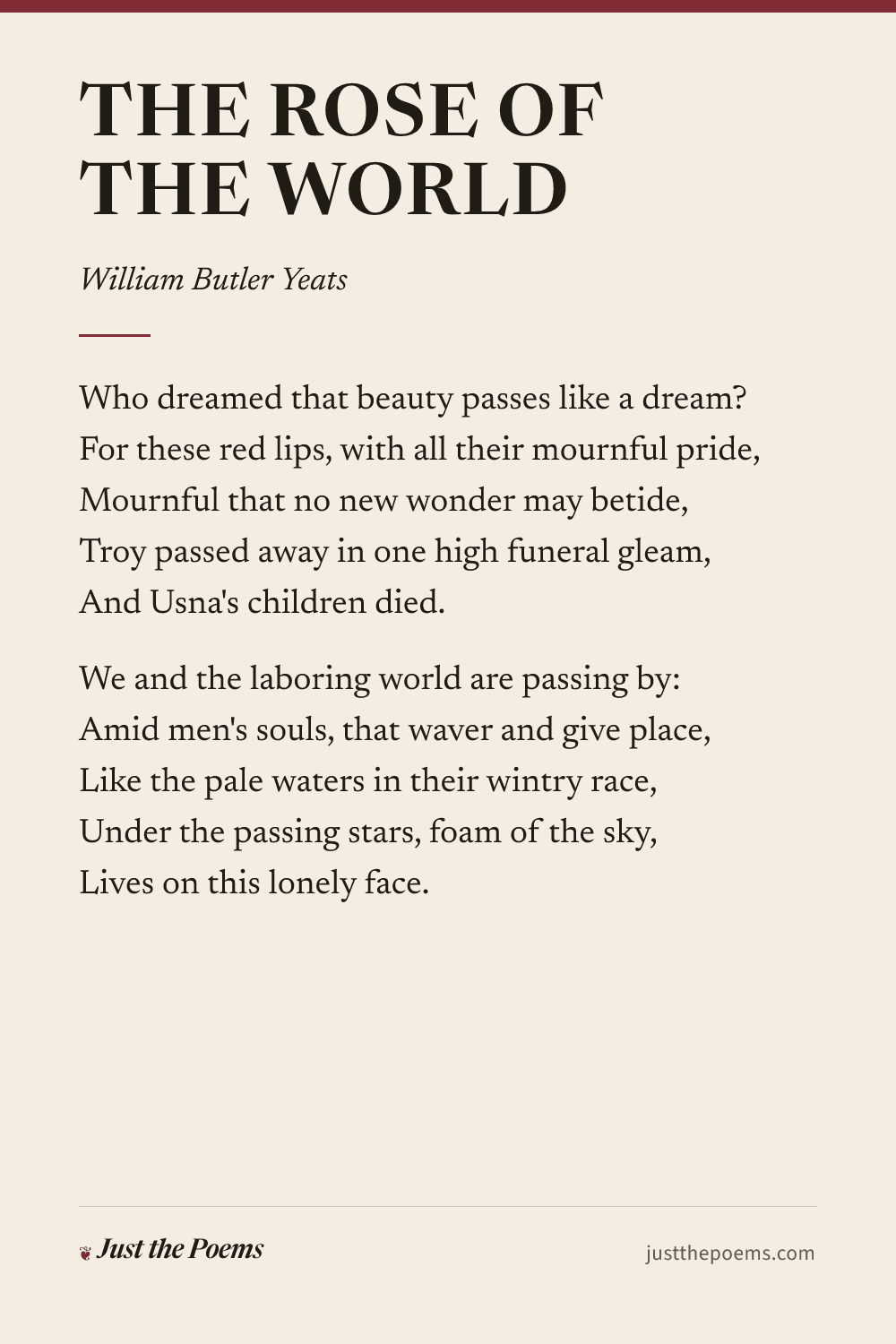
THE ROSE OF THE WORLD

William Butler Yeats

In 0 Wikipedias 1 anthology Poet in 113 Wikipedias

Who dreamed that beauty passes like a dream?For these red lips, with all their mournful pride,Mournful that no new wonder may betide,Troy passed away in one high funeral gleam,And Usna's children died.

We and the laboring world are passing by:Amid men's souls, that waver and give place,Like the pale waters in their wintry race,Under the passing stars, foam of the sky,Lives on this lonely face.

Bow down, archangels, in your dim abode:Before you were, or any hearts to beat,Weary and kind one lingered by His seat;He made the world to be a grassy roadBefore her wandering feet.

Source

The Home Book of Verse, ed. Burton Egbert Stevenson

Filed under
  • Named in the title

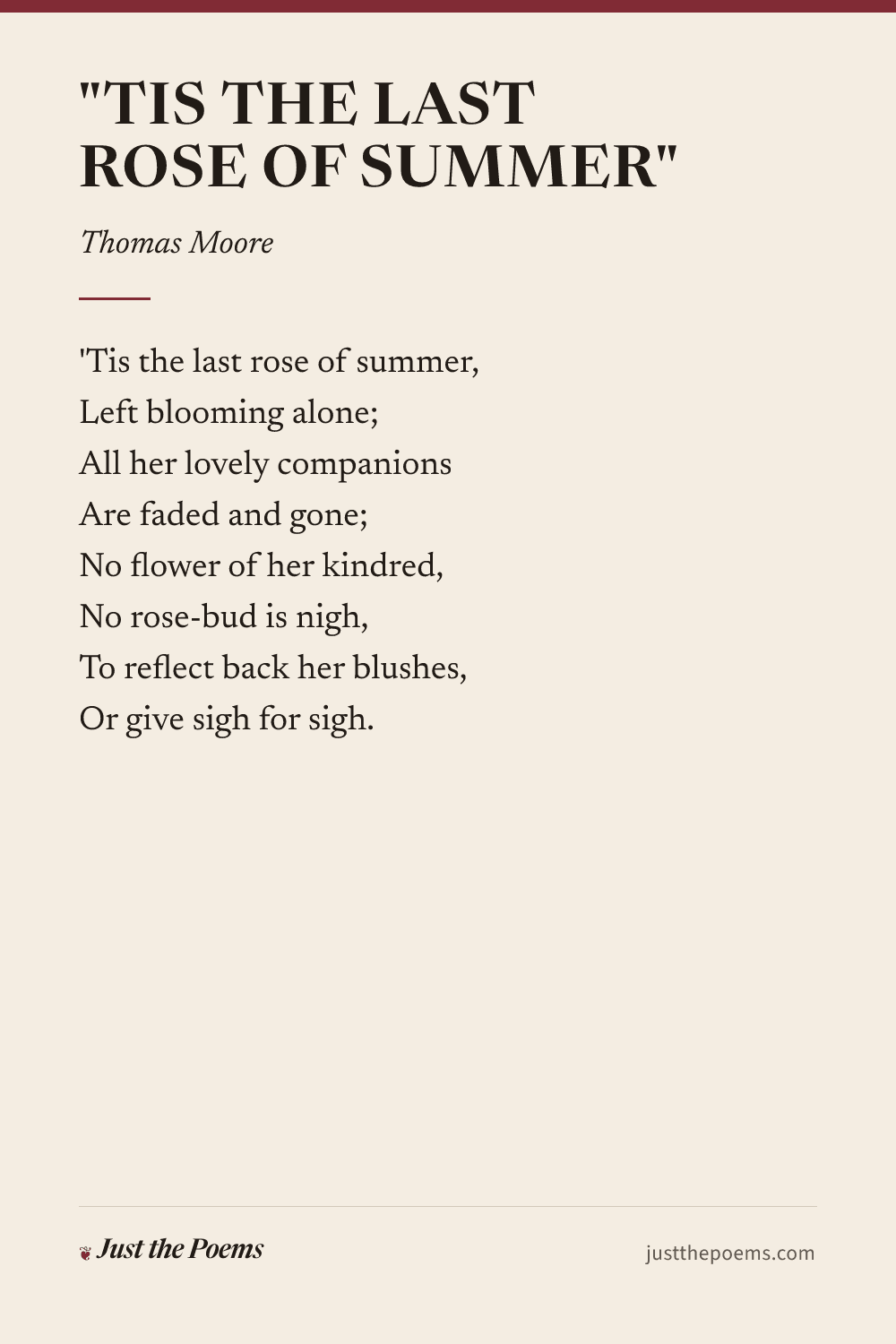
"TIS THE LAST ROSE OF SUMMER"

Thomas Moore

In 0 Wikipedias 1 anthology Poet in 43 Wikipedias

'Tis the last rose of summer,Left blooming alone;All her lovely companionsAre faded and gone;No flower of her kindred,No rose-bud is nigh,To reflect back her blushes,Or give sigh for sigh.

I'll not leave thee, thou lone one!To pine on the stem;Since the lovely are sleeping,Go, sleep thou with them.Thus kindly I scatterThy leaves o'er the bedWhere thy mates of the gardenLie scentless and dead.

So soon may I follow,When friendships decay,And from Love's shining circleThe gems drop away.When true hearts lie withered,And fond ones are flown,O who would inhabitThis bleak world alone?

Source

The Home Book of Verse, ed. Burton Egbert Stevenson

Filed under
  • Named in the title

Advertisements

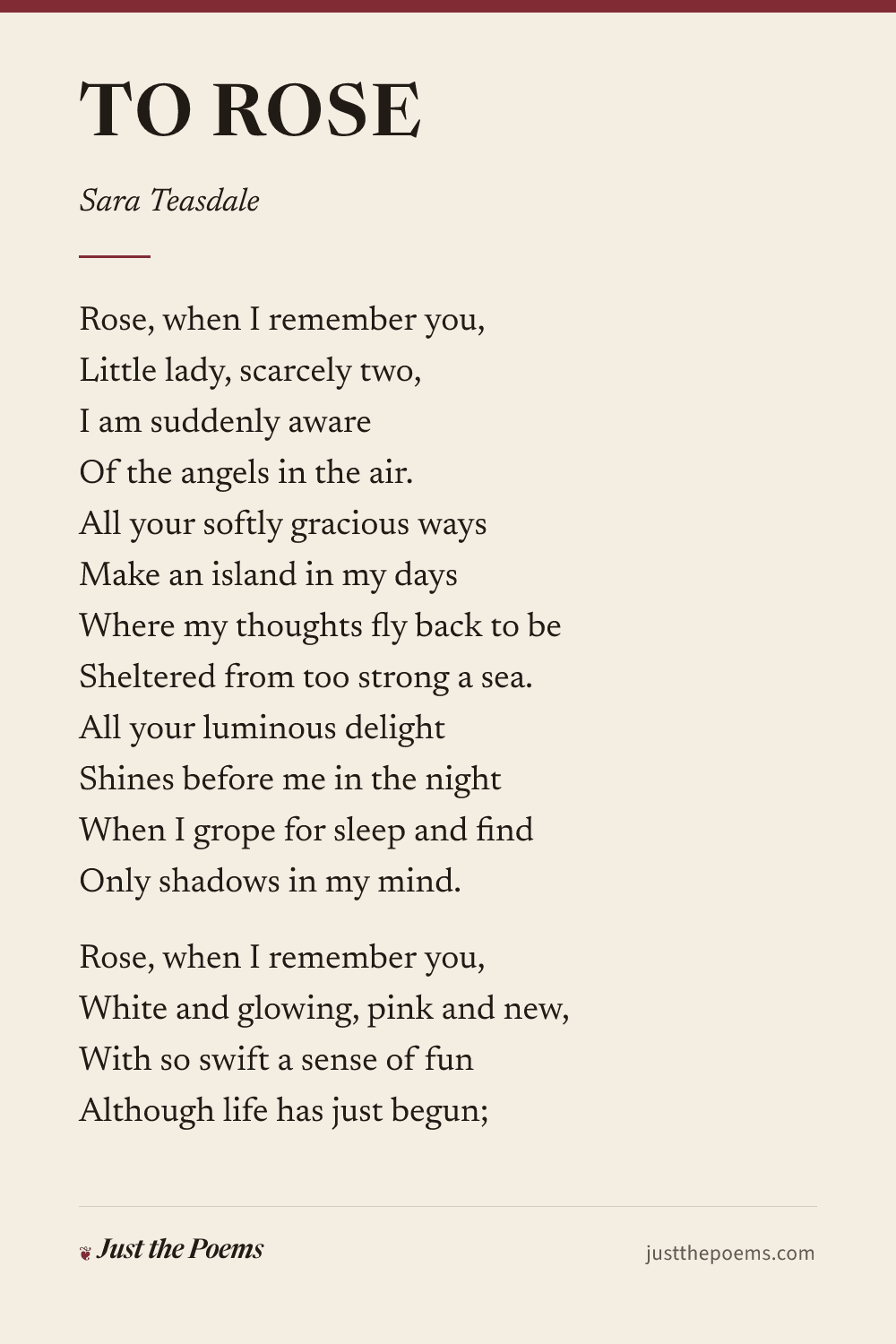
TO ROSE

Sara Teasdale

In 0 Wikipedias 1 anthology Poet in 37 Wikipedias

Rose, when I remember you,Little lady, scarcely two,I am suddenly awareOf the angels in the air.All your softly gracious waysMake an island in my daysWhere my thoughts fly back to beSheltered from too strong a sea.All your luminous delightShines before me in the nightWhen I grope for sleep and findOnly shadows in my mind.

Rose, when I remember you,White and glowing, pink and new,With so swift a sense of funAlthough life has just begun;With so sure a pride of placeIn your very infant face,I should like to make a prayerTo the angels in the air:"If an angel ever bringsMe a baby in her wings,Please be certain that it growsVery, very much like Rose."

Source

The Home Book of Verse, ed. Burton Egbert Stevenson

Filed under
  • Named in the title

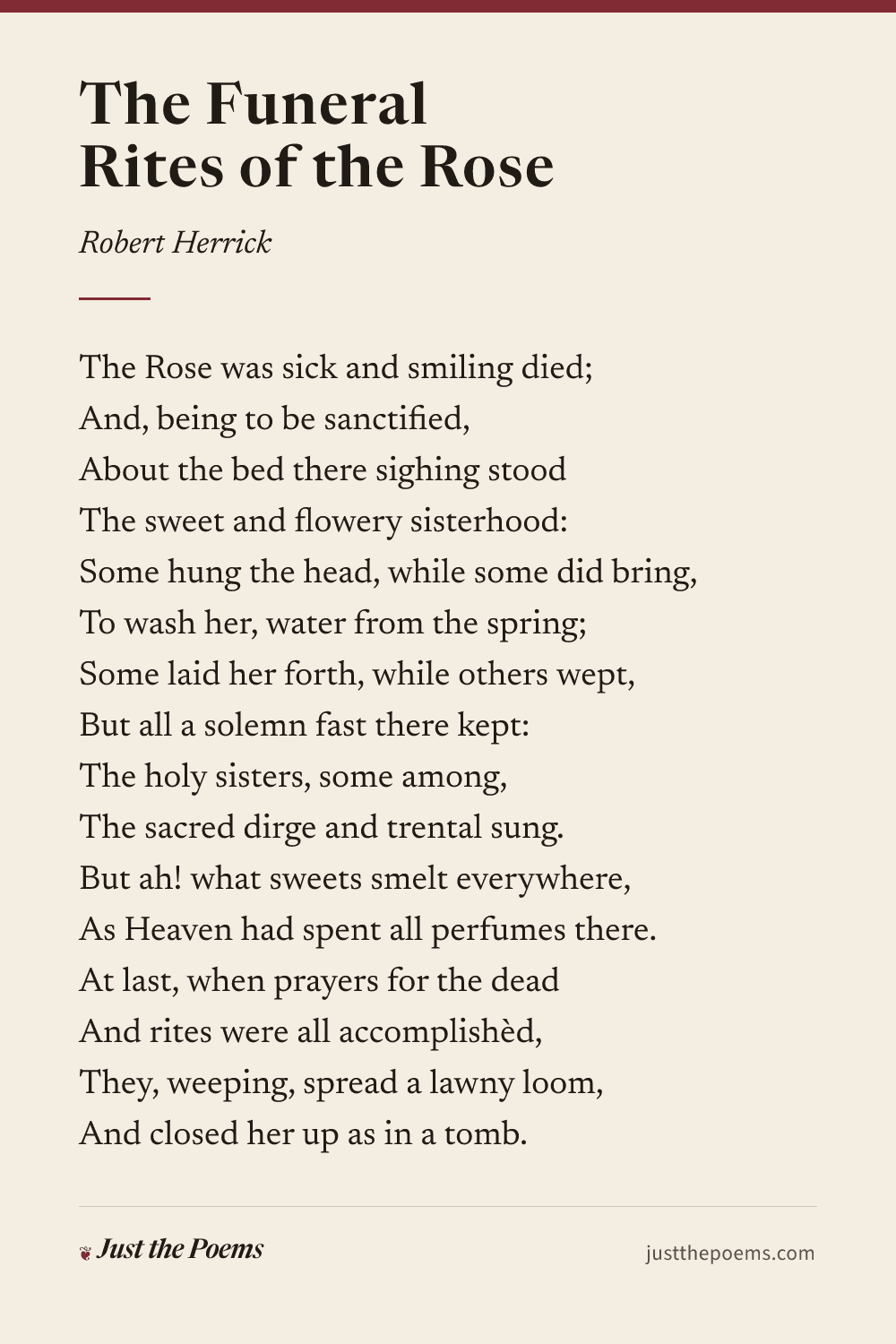
The Funeral Rites of the Rose

Robert Herrick

In 0 Wikipedias 1 anthology Poet in 26 Wikipedias

The Rose was sick and smiling died;And, being to be sanctified,About the bed there sighing stoodThe sweet and flowery sisterhood:Some hung the head, while some did bring,To wash her, water from the spring;Some laid her forth, while others wept,But all a solemn fast there kept:The holy sisters, some among,The sacred dirge and trental sung.But ah! what sweets smelt everywhere,As Heaven had spent all perfumes there.At last, when prayers for the deadAnd rites were all accomplishèd,They, weeping, spread a lawny loom,And closed her up as in a tomb.

Source

The Oxford Book of English Verse 1250–1900, 1900

Filed under
  • Named in the title

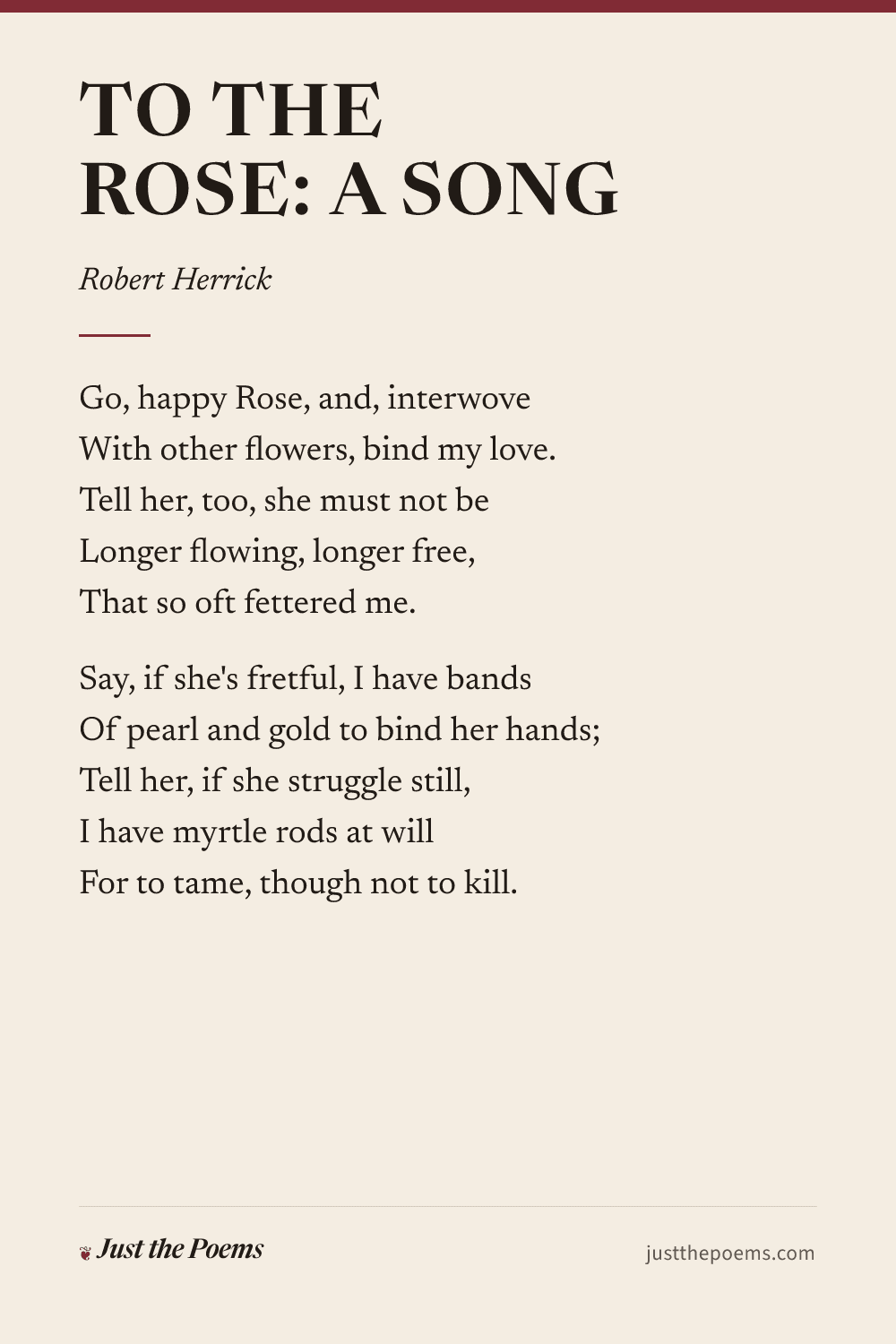
TO THE ROSE: A SONG

Robert Herrick

In 0 Wikipedias 1 anthology Poet in 26 Wikipedias

Go, happy Rose, and, interwoveWith other flowers, bind my love.Tell her, too, she must not beLonger flowing, longer free,That so oft fettered me.

Say, if she's fretful, I have bandsOf pearl and gold to bind her hands;Tell her, if she struggle still,I have myrtle rods at willFor to tame, though not to kill.

Take thou my blessing thus, and goAnd tell her this, - but do not so! -Lest a handsome anger flyLike a lightning from her eye,And burn thee up, as well as I!

Source

The Home Book of Verse, ed. Burton Egbert Stevenson

Filed under
  • Named in the title

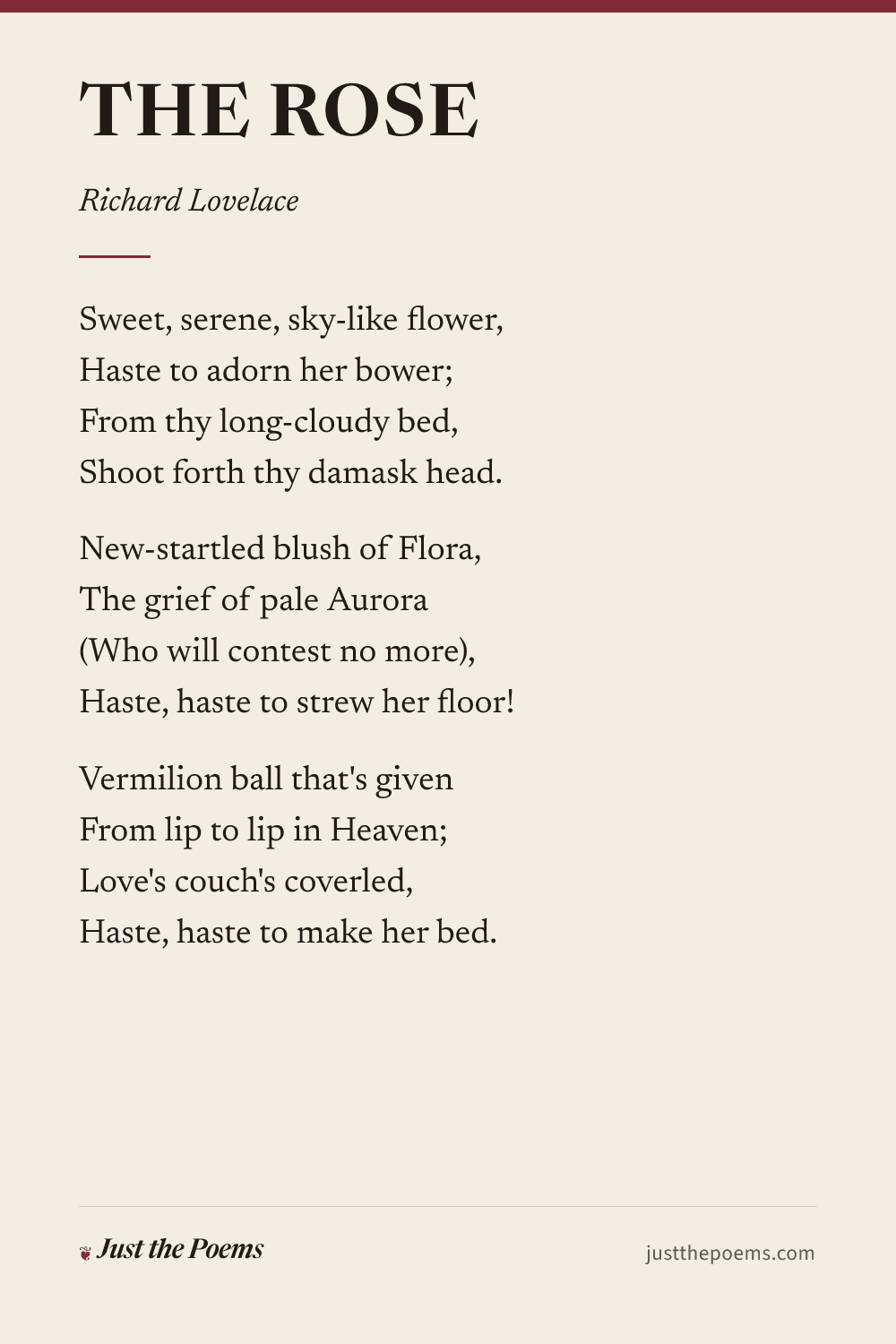
THE ROSE

Richard Lovelace

In 0 Wikipedias 1 anthology Poet in 21 Wikipedias

Sweet, serene, sky-like flower,Haste to adorn her bower;From thy long-cloudy bed,Shoot forth thy damask head.

New-startled blush of Flora,The grief of pale Aurora(Who will contest no more),Haste, haste to strew her floor!

Vermilion ball that's givenFrom lip to lip in Heaven;Love's couch's coverled,Haste, haste to make her bed.

Dear offspring of pleased VenusAnd jolly, plump Silenus,Haste, haste to deck the hairOf the only sweetly fair!

See! rosy is her bower,Her floor is all this flowerHer bed a rosy nestBy a bed of roses pressed.

But early as she dresses,Why fly you her bright tresses?Ah! I have found, I fear, -Because her cheeks are near.

Source

The Home Book of Verse, ed. Burton Egbert Stevenson

Filed under
  • Named in the title

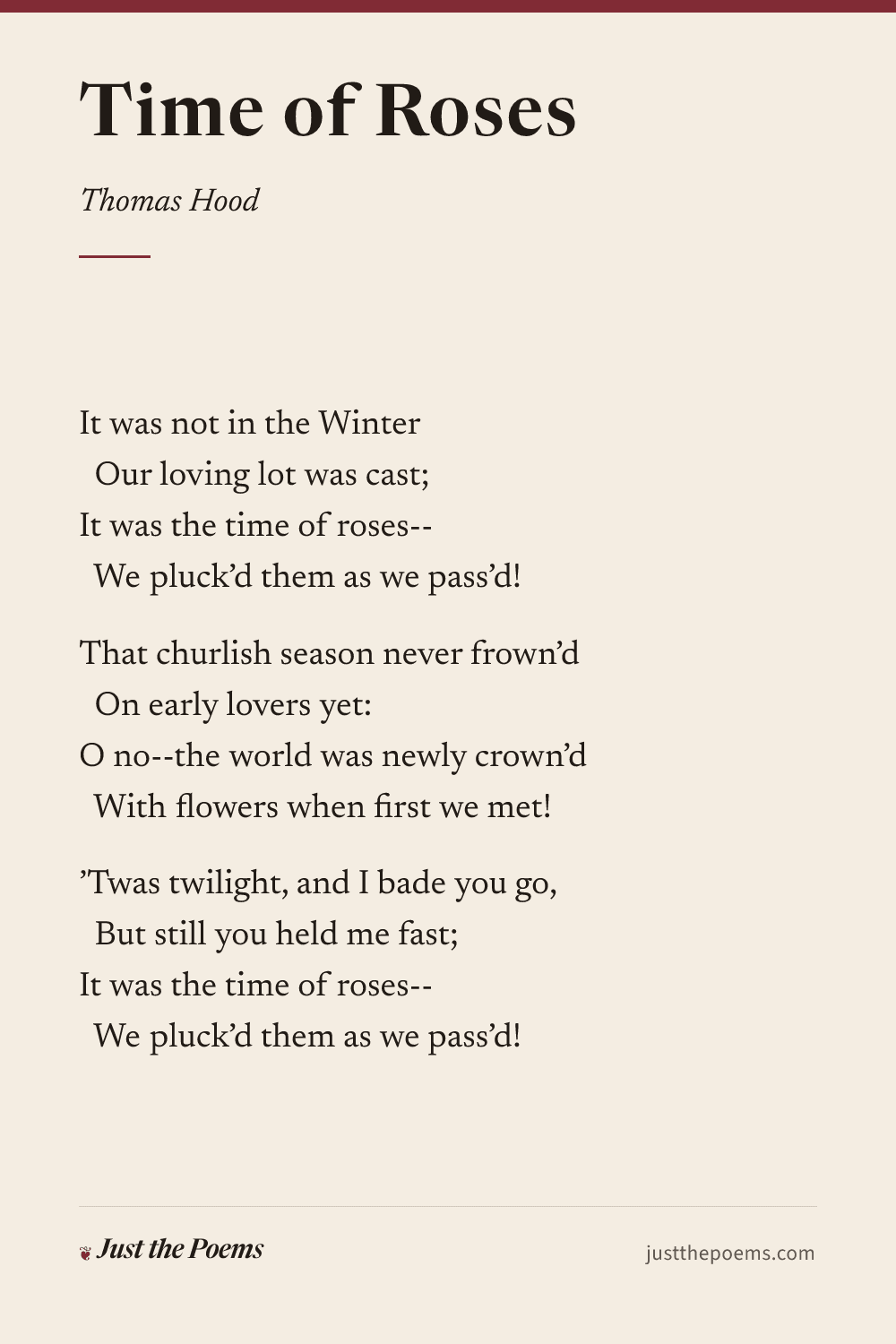
Time of Roses

Thomas Hood

In 0 Wikipedias 1 anthology Poet in 20 Wikipedias

It was not in the Winter Our loving lot was cast;It was the time of roses-- We pluck’d them as we pass’d!

That churlish season never frown’d On early lovers yet:O no--the world was newly crown’d With flowers when first we met!

’Twas twilight, and I bade you go, But still you held me fast;It was the time of roses-- We pluck’d them as we pass’d!

Source

The Oxford Book of English Verse 1250–1900, 1900

Filed under
  • Named in the title

Advertisements

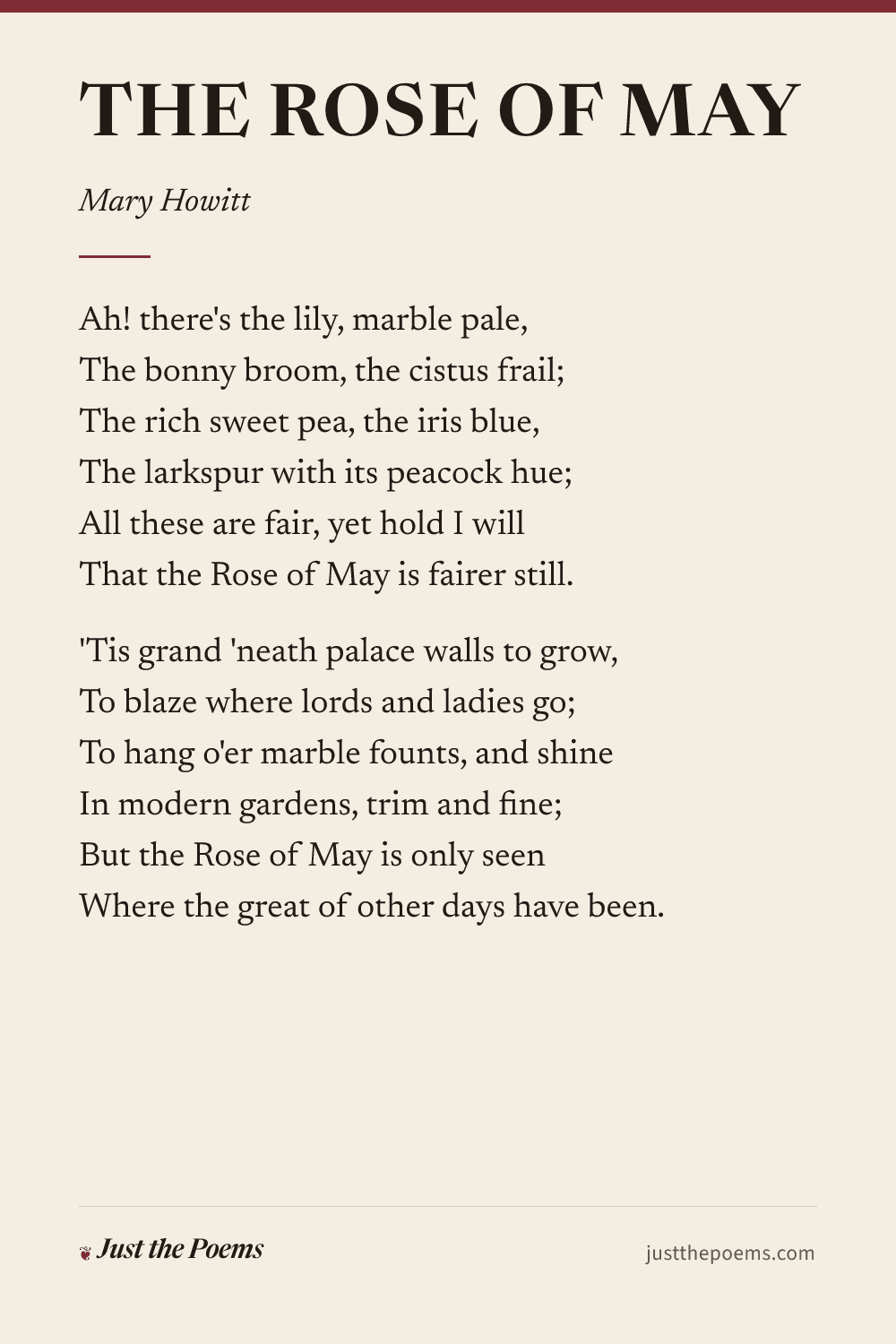
THE ROSE OF MAY

Mary Howitt

In 0 Wikipedias 1 anthology Poet in 13 Wikipedias

Ah! there's the lily, marble pale,The bonny broom, the cistus frail;The rich sweet pea, the iris blue,The larkspur with its peacock hue;All these are fair, yet hold I willThat the Rose of May is fairer still.

'Tis grand 'neath palace walls to grow,To blaze where lords and ladies go;To hang o'er marble founts, and shineIn modern gardens, trim and fine;But the Rose of May is only seenWhere the great of other days have been.

Show all 36 lines 24 more

The house is mouldering stone by stone,The garden-walks are overgrown;The flowers are low, the weeds are high,The fountain-stream is choked and dry,The dial-stone with moss is green,Where'er the Rose of May is seen.

The Rose of May its pride displayedAlong the old stone balustrade;And ancient ladies, quaintly dight,In its pink blossoms took delight;And on the steps would make a standTo scent its fragrance--fan in hand.

Long have been dead those ladies gay;Their very heirs have passed away;And their old portraits, prim and tall,Are mouldering in the mouldering hall;The terrace and the balustradeLie broken, weedy and decayed.

But blithe and tall the Rose of MayShoots upward through the ruin gray;With scented flower, and leaf pale green,Such rose as it hath never been,Left, like a noble deed, to graceThe memory of an ancient race.

Source

The Home Book of Verse, ed. Burton Egbert Stevenson

Filed under
  • Named in the title

ROSE-MARIE OF THE ANGELS

Adelaide Crapsey

In 0 Wikipedias 1 anthology Poet in 11 Wikipedias

Little Sister Rose-Marie,Will thy feet as willing-lightRun through Paradise, I wonder,As they run the blue skies under,Willing feet, so airy-light?

Little Sister Rose-Marie,Will thy voice as bird-note clearLift and ripple over HeavenAs its mortal sound is given,Swift bird-voice, so young and clear?

How God will be glad of thee,Little Sister Rose-Marie!

Source

The Home Book of Verse, ed. Burton Egbert Stevenson

Filed under
  • Named in the title

THE VIOLET AND THE ROSE

Augusta Webster

In 0 Wikipedias 1 anthology Poet in 9 Wikipedias

The violet in the wood, that's sweet to-day,Is longer sweet than roses of red June;Set me sweet violets along my way,And bid the red rose flower, but not too soon.Ah violet, ah rose, why not the two?Why bloom not all fair flowers the whole year through?Why not the two, young violet, ripe rose?Why dies one sweetness when another blows?

Source

The Home Book of Verse, ed. Burton Egbert Stevenson

Filed under
  • Named in the title

Brier-Rose

Hjalmar Hjorth Boyesen

In 0 Wikipedias 1 anthology Poet in 8 Wikipedias

Said Brier-Rose's mother to the naughty Brier-Rose:"What will become of you, my child, the Lord Almighty knows.You will not scrub the kettles, and you will not touch the broom;You never sit a minute still at spinning-wheel or loom."

Thus grumbled in the morning, and grumbled late at eve,The good-wife as she bustled with pot and tray and sieve;But Brier-Rose, she laughed and she cocked her dainty head:"Why, I shall marry, mother dear," full merrily she said.

"You marry; saucy Brier-Rose! The man, he is not foundTo marry such a worthless wench, these seven leagues around."But Brier-Rose, she laughed and she trilled a merry lay:"Perhaps he'll come, my mother dear, from eight leagues away."

Show all 120 lines 108 more

The good-wife with a "humph" and a sigh forsook the battle,And flung her pots and pails about with much vindictive rattle;"O Lord, what sin did I commit in youthful days, and wild,That thou hast punished me in age with such a wayward child?"

Up stole the girl on tiptoe, so that none her step could hear,And laughing pressed an airy kiss behind the good-wife's ear.And she, as e'er relenting, sighed: "Oh, Heaven only knowsWhatever will become of you, my naughty Brier-Rose!"

The sun was high and summer sounds were teeming in the air;The clank of scythes, the cricket's whir, and swelling woodnotes rare,From fields and copse and meadow; and through the open doorSweet, fragrant whiffs of new-mown hay the idle breezes bore.

Then Brier-Rose grew pensive, like a bird of thoughtful mien,Whose little life has problems among the branches green.She heard the river brawling where the tide was swift and strong,She heard the summer singing its strange, alluring song.

And out she skipped the meadows o'er and gazed into the sky;Her heart o'erbrimmed with gladness, she scarce herself knew why,And to a merry tune she hummed, "Oh, Heaven only knowsWhatever will become of the naughty Brier-Rose!"

Whene'er a thrifty matron this idle maid espied,She shook her head in warning, and scarce her wrath could hide;For girls were made for housewives, for spinning-wheel and loom,And not to drink the sunshine and wild flower's sweet perfume.

And oft the maidens cried, when the Brier-Rose went by,"You cannot knit a stocking, and you cannot make a pie."But Brier-Rose, as was her wont, she cocked her curly head:"But I can sing a pretty song," full merrily she said.

And oft the young lads shouted, when they saw the maid at play:"Ho, good-for-nothing Brier-Rose, how do you do to-day?"Then she shook her tiny fist; to her cheeks the color flew:"However much you coax me, I'll never dance with you."

Thus flew the years light winged over Brier-Rose's head,Till she was twenty summers old and yet remained unwed.And all the parish wondered: "The Lord Almighty knowsWhatever will become of that naughty Brier-Rose!"

And while they wondered came the spring a-dancing o'er the hills;Her breath was warmer than of yore, and all the mountain rills,With their tinkling and their rippling and their rushing, filled the air,And the misty sounds of water forth-welling everywhere.

And in the valley's depth, like a lusty beast of prey,The river leaped and roared aloud and tossed its mane of spray;Then hushed again its voice to a softly plashing croon,As dark it rolled beneath the sun and white beneath the moon.

It was a merry sight to see the lumber as it whirledAdown the tawny eddies that hissed and seethed and swirled,Now shooting through the rapids and, with a reeling swing,Into the foam-crests diving like an animated thing.

But in the narrows of the rocks, where o'er a steep inclineThe waters plunged, and wreathed in foam the dark boughs of the pine,The lads kept watch with shout and song, and sent each straggling beamA-spinning down the rapids, lest it should lock the stream.

And yet--methinks I hear it now--wild voices in the night,A rush of feet, a dog's harsh bark, a torch's flaring light,And wandering gusts of dampness, and round us far and nigh,A throbbing boom of water like a pulse-beat in the sky.

The dawn just pierced the pallid east with spears of gold and red.As we, with boat-hooks in our hands, toward the narrows sped.And terror smote us; for we heard the mighty tree-tops sway,And thunder, as of chariots, and hissing showers of spray.

"Now, lads," the sheriff shouted, "you are strong, like Norway's rock:A hundred crowns I give to him who breaks the lumber lock!For if another hour go by, the angry waters' spoilOur homes will be, and fields, and our weary years of toil."

We looked each at the other; each hoped his neighbor wouldBrave death and danger for his home, as valiant Norsemen should.But at our feet the brawling tide expanded like a lake,And whirling beams came shooting on, and made the firm rock quake.

"Two hundred crowns!" the sheriff cried, and breathless stood the crowd."Two hundred crowns, my bonny lads!" in anxious tones and loud.But not a man came forward, and no one spoke or stirred,And nothing save the thunder of the cataract was heard.

But as with trembling hands and with fainting hearts we stood,We spied a little curly head emerging from the wood.We heard a little snatch of a merry little song,And saw the dainty Brier-Rose come dancing through the throng.

An angry murmur rose from the people round about."Fling her into the river," we heard the matrons shout;"Chase her away, the silly thing; for God himself scarce knowsWhy ever he created that worthless Brier-Rose."

Sweet Brier-Rose, she heard their cries; a little pensive smileAcross her fair face flitted that might a stone beguile;And then she gave her pretty head a roguish little cock:"Hand me a boat-hook, lads," she said; "I think I'll break the lock."

Derisive shouts of laughter broke from throats of young and old:"Ho! good-for-nothing Brier-Rose, your tongue was ever bold."And, mockingly, a boat-hook into her hands was flung,When, lo! into the river's midst with daring leaps she sprung!

We saw her dimly through a mist of dense and blinding spray;From beam to beam she skipped, like a water-sprite at play.And now and then faint gleams we caught of color through the mist:A crimson waist, a golden head, a little dainty wrist.

In terror pressed the people to the margin of the hill,A hundred breaths were bated, a hundred hearts stood still.For, hark! from out the rapids came a strange and creaking sound,And then a crash of thunder which shook the very ground.

The waters hurled the lumber mass down o'er the rocky steep.We heard a muffled rumbling and a rolling in the deep;We saw a tiny form which the torrent swiftly boreAnd flung into the wild abyss, where it was seen no more.

Ah, little naughty Brier-Rose, thou couldst not weave nor spin;Yet thou couldst do a nobler deed than all thy mocking kin;For thou hadst courage e'en to die, and by thy death to saveA thousand farms and lives from the fury of the wave.

And yet the adage lives, in the valley of thy birth,When wayward children spend their days in heedless play and mirth,Oft mothers say, half smiling, half sighing, "Heaven knowsWhatever will become of the naughty Brier-Rose!"
Source

Poems Teachers Ask For

Filed under
  • Named in the title

OUR WEE WHITE ROSE

Gerald Massey

In 0 Wikipedias 1 anthology Poet in 8 Wikipedias

All in our marriage gardenGrew, smiling up to God,A bonnier flower than everSucked the green warmth of the sod;O, beautiful unfathomablyIts little life unfurled;And crown of all things was our weeWhite Rose of all the world.

From out a balmy bosomOur bud of beauty grew;It fed on smiles for sunshine,On tears for daintier dew:

Show all 48 lines 36 more

Aye nestling warm and tenderly,Our leaves of love were curledSo close and close about our weeWhite Rose of all the world.

With mystical faint fragranceOur house of life she filled;Revealed each hour some fairy towerWhere winged hopes might build!We saw--though none like us might see--Such precious promise pearledUpon the petals of our weeWhite Rose of all the world.

But evermore the haloOf angel-light increased,Like the mystery of moonlightThat folds some fairy feast.Snow-white, snow-soft, snow-silentlyOur darling bud uncurled,And dropped in the grave--God's lap--our weeWhite Rose of all the world.

Our Rose was but in blossom,Our life was but in spring,When down the solemn midnightWe heard the spirits sing,"Another bud of infancyWith holy dews impearled!"And in their hands they bore our weeWhite Rose of all the world.

You scarce could think so small a thingCould leave a loss so large;Her little light such shadow flingFrom dawn to sunset's marge.In other springs our life may beIn bannered bloom unfurled,But never, never match our weeWhite Rose of all the world.

Source

The Home Book of Verse, ed. Burton Egbert Stevenson

Filed under
  • Named in the title

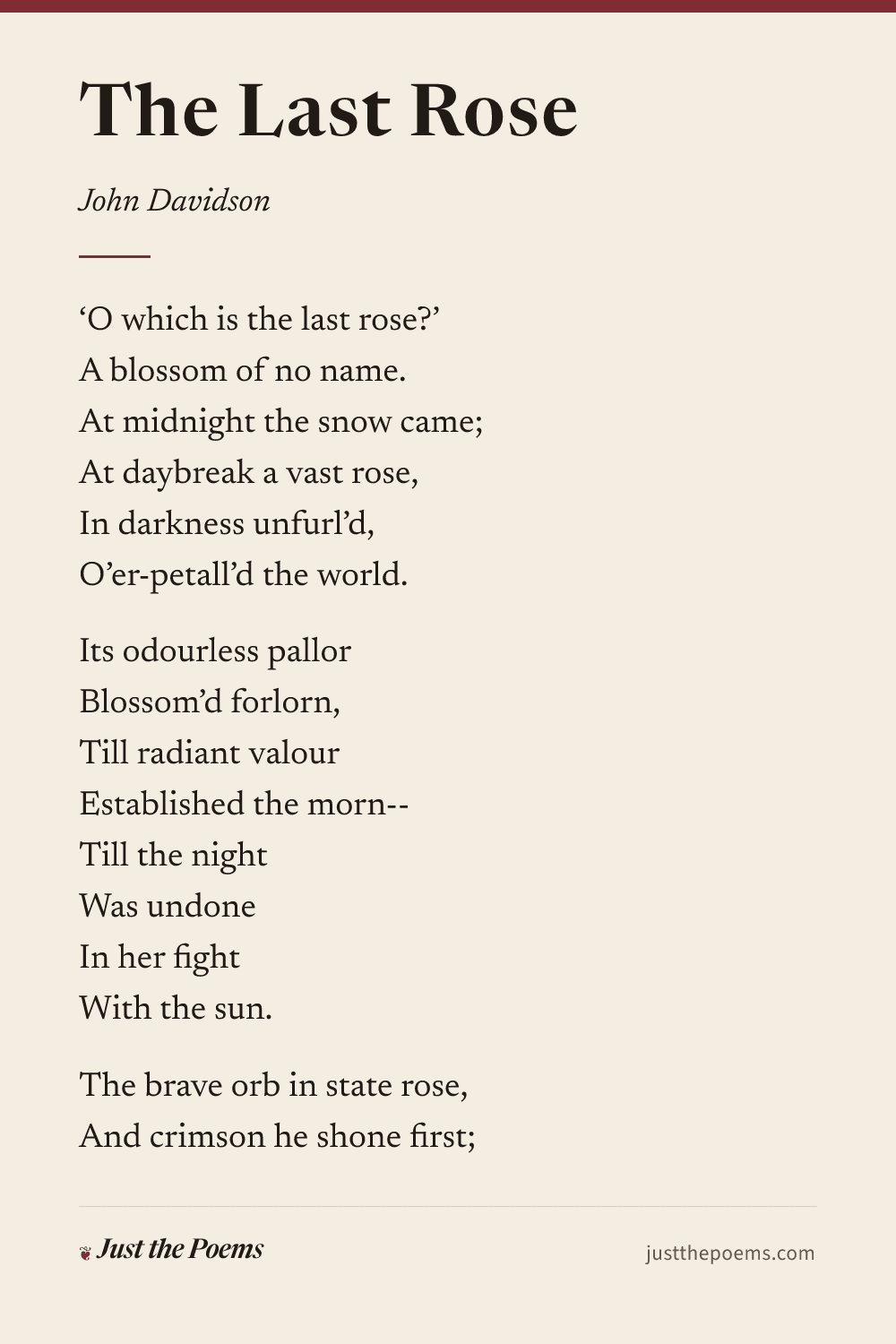
The Last Rose

John Davidson

In 0 Wikipedias 1 anthology Poet in 8 Wikipedias

‘O which is the last rose?’A blossom of no name.At midnight the snow came;At daybreak a vast rose,In darkness unfurl’d,O’er-petall’d the world.

Its odourless pallorBlossom’d forlorn,Till radiant valourEstablished the morn--Till the nightWas undone

Show all 55 lines 43 more

In her fightWith the sun.

The brave orb in state rose,And crimson he shone first;While from the high vineOf heaven the dawn burst,Staining the great roseFrom sky-line to sky-line.

The red rose of mornA white rose at noon turn’d;But at sunset rebornAll red again soon burn’d.Then the pale rose of noondayRebloom’d in the night,And spectrally white In the lightOf the moon lay.

But the vast rose Was scentless,And this is the reason:When the blast rose Relentless,And brought in due seasonThe snow rose, the last roseCongeal’d in its breath,Then came with it treason;The traitor was Death.

In lee-valleys crowded,The sheep and the birdsWere frozen and shroudedIn flights and in herds.In highwaysAnd bywaysThe young and the oldWere tortured and madden’dAnd kill’d by the cold.But many were gladden’dBy the beautiful last rose,The blossom of no nameThat came when the snow came,In darkness unfurl’d--The wonderful vast roseThat fill’d all the world.

Source

The Oxford Book of English Verse 1250–1900, 1900

Filed under
  • Named in the title

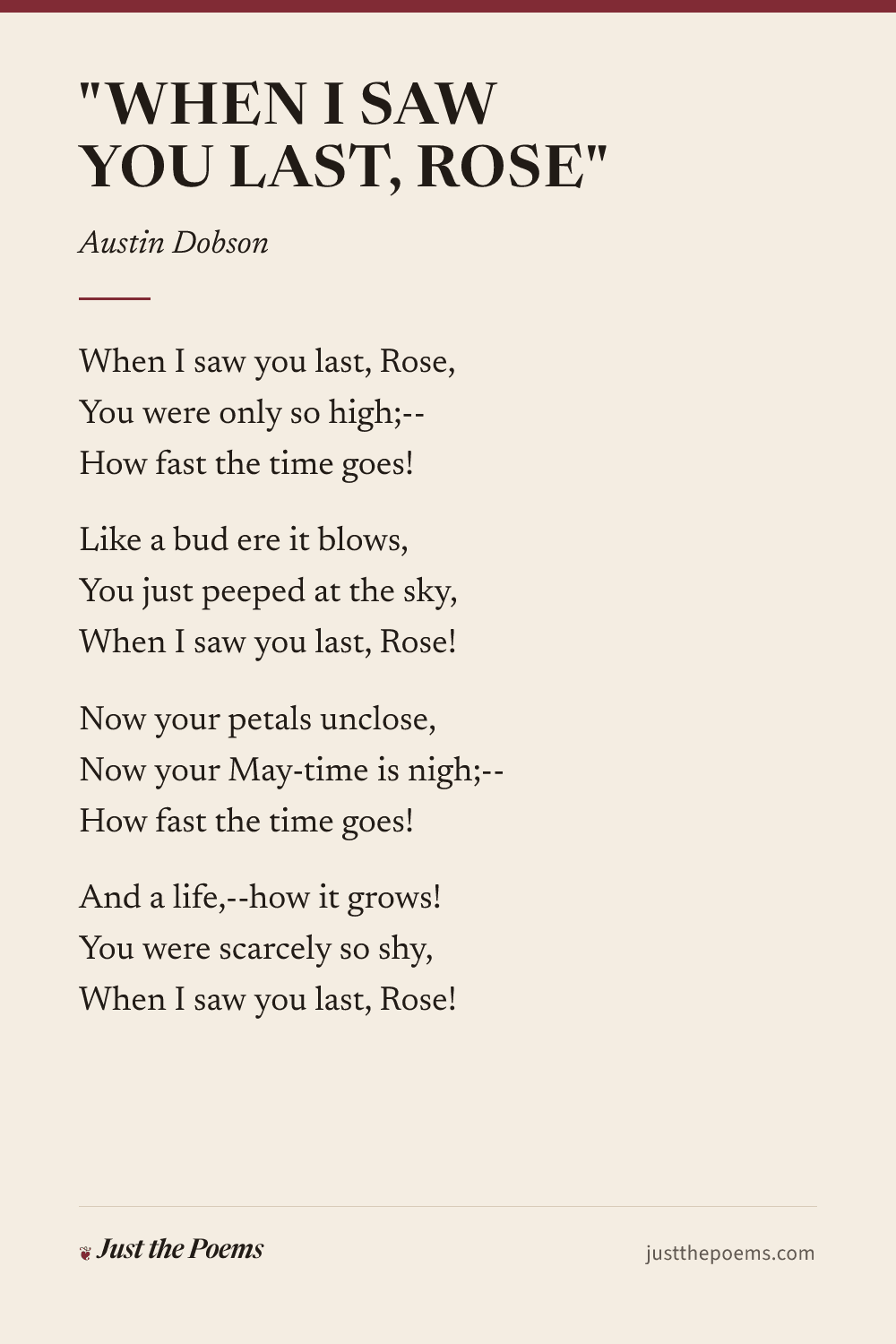
"WHEN I SAW YOU LAST, ROSE"

Austin Dobson

In 0 Wikipedias 1 anthology Poet in 7 Wikipedias

When I saw you last, Rose,You were only so high;--How fast the time goes!

Like a bud ere it blows,You just peeped at the sky,When I saw you last, Rose!

Now your petals unclose,Now your May-time is nigh;--How fast the time goes!

And a life,--how it grows!You were scarcely so shy,When I saw you last, Rose!

In your bosom it showsThere's a guest on the sly;(How fast the time goes!)

Is it Cupid? Who knows!Yet you used not to sigh,When I saw you last, Rose;--How fast the time goes!

Source

The Home Book of Verse, ed. Burton Egbert Stevenson

Filed under
  • Named in the title

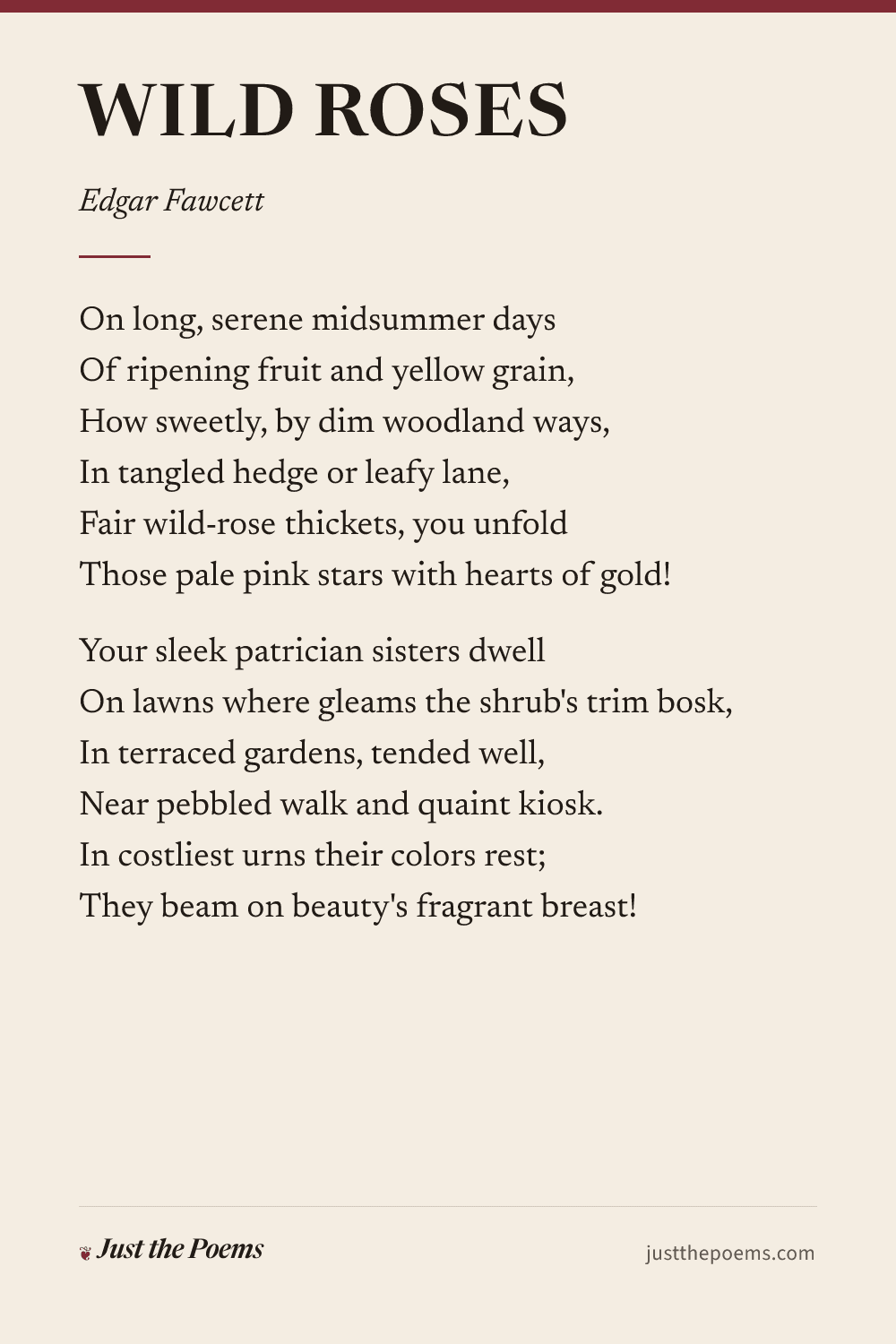
WILD ROSES

Edgar Fawcett

In 0 Wikipedias 1 anthology Poet in 7 Wikipedias

On long, serene midsummer daysOf ripening fruit and yellow grain,How sweetly, by dim woodland ways,In tangled hedge or leafy lane,Fair wild-rose thickets, you unfoldThose pale pink stars with hearts of gold!

Your sleek patrician sisters dwellOn lawns where gleams the shrub's trim bosk,In terraced gardens, tended well,Near pebbled walk and quaint kiosk.In costliest urns their colors rest;They beam on beauty's fragrant breast!

Show all 30 lines 18 more

But you in lowly calm abide,Scarce heeded save by breeze or bee;You know what splendor, pomp and prideFull oft your brilliant sisters see;What sorrow too, and bitter fears;What mad farewells and hopeless tears.

How some are kept in old, dear books,That once in bridal wreaths were worn;How some are kissed, with tender looks,And later tossed aside with scorn;How some their taintless petals layOn icy foreheads, pale as they!

So, while these truths you vaguely guess,A-bloom in many a lonesome spot,Shy roadside roses, may you blessThe fate that rules your modest lot,Like rustic maids that meekly standBelow the ladies of their land!

Source

The Home Book of Verse, ed. Burton Egbert Stevenson

Filed under
  • Named in the title

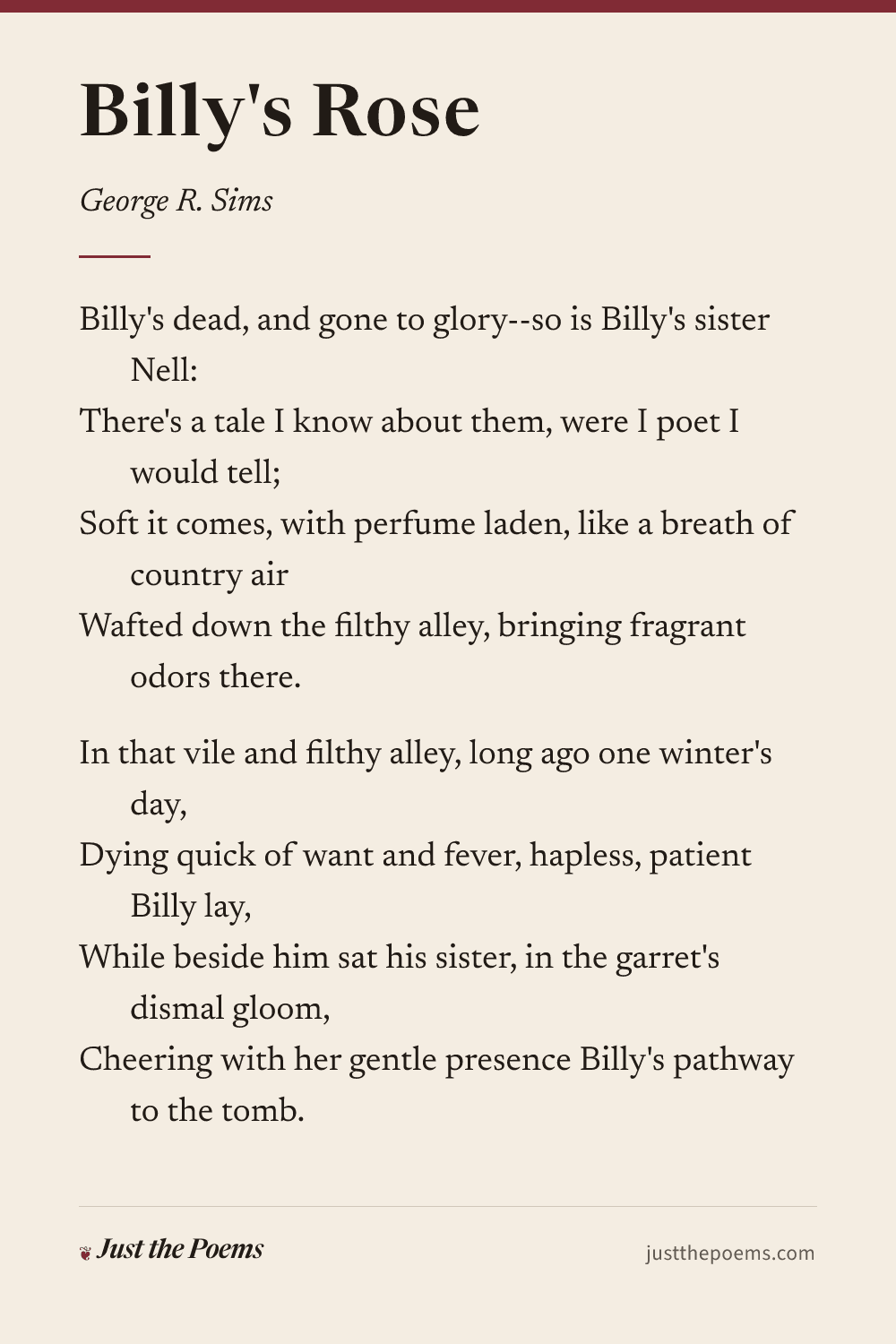
Billy's Rose

George R. Sims

In 0 Wikipedias 1 anthology Poet in 6 Wikipedias

Billy's dead, and gone to glory--so is Billy's sister Nell:There's a tale I know about them, were I poet I would tell;Soft it comes, with perfume laden, like a breath of country airWafted down the filthy alley, bringing fragrant odors there.

In that vile and filthy alley, long ago one winter's day,Dying quick of want and fever, hapless, patient Billy lay,While beside him sat his sister, in the garret's dismal gloom,Cheering with her gentle presence Billy's pathway to the tomb.

Many a tale of elf and fairy did she tell the dying child,Till his eyes lost half their anguish, and his worn, wan features smiled;Tales herself had heard haphazard, caught amid the Babel roar,Lisped about by tiny gossips playing round their mothers' door.

Show all 85 lines 73 more

Then she felt his wasted fingers tighten feebly as she toldHow beyond this dismal alley lay a land of shining gold,Where, when all the pain was over,--where, when all the tears were shed,--He would be a white-frocked angel, with a gold thing on his head.

Then she told some garbled story of a kind-eyed Saviour's love,How He'd built for little children great big playgrounds up above,Where they sang and played at hopscotch and at horses all the day,And where beadles and policemen never frightened them away.

This was Nell's idea of heaven,--just a bit of what she'd heard,With a little bit invented, and a little bit inferred.But her brother lay and listened, and he seemed to understand,For he closed his eyes and murmured he could see the promised land.

"Yes," he whispered, "I can see it, I can see it, sister Nell,Oh, the children look so happy and they're all so strong and well;I can see them there with Jesus--He is playing with them, too!Let as run away and join them, if there's room for me and you."

She was eight, this little maiden, and her life had all been spentIn the garret and the alley, where they starved to pay the rent;Where a drunken father's curses and a drunken mother's blowsDrove her forth into the gutter from the day's dawn to its close.

But she knew enough, this outcast, just to tell this sinking boy,"You must die before you're able all the blessings to enjoy.You must die," she whispered, "Billy, and I am not even ill;But I'll come to you, dear brother,--yes, I promise that I will.

"You are dying, little brother, you are dying, oh, so fast;I heard father say to mother that he knew you couldn't last.They will put you in a coffin, then you'll wake and be up there,While I'm left alone to suffer in this garret bleak and bare."

"Yes, I know it," answered Billy. "Ah, but, sister, I don't mind,Gentle Jesus will not beat me; He's not cruel or unkind.But I can't help thinking, Nelly, I should like to take awaySomething, sister, that you gave me, I might look at every day.

"In the summer you remember how the mission took us outTo a great green lovely meadow, where we played and ran about,And the van that took us halted by a sweet bright patch of land,Where the fine red blossoms grew, dear, half as big as mother's hand.

"Nell, I asked the good kind teacher what they called such flowers as those,And he told me, I remember, that the pretty name was rose.I have never seen them since, dear--how I wish that I had one!Just to keep and think of you, Nell, when I'm up beyond the sun."

Not a word said little Nelly; but at night, when Billy slept,On she flung her scanty garments and then down the stairs she crept.Through the silent streets of London she ran nimbly as a fawn,Running on and running ever till the night had changed to dawn.

When the foggy sun had risen, and the mist had cleared away,All around her, wrapped in snowdrift, there the open country lay.She was tired, her limbs were frozen, and the roads had cut her feet,But there came no flowery gardens her poor tearful eyes to greet.

She had traced the road by asking, she had learnt the way to go;She had found the famous meadow--it was wrapped in cruel snow;Not a buttercup or daisy, not a single verdant bladeShowed its head above its prison. Then she knelt her down and prayed;

With her eyes upcast to heaven, down she sank upon the ground,And she prayed to God to tell her where the roses might be found.Then the cold blast numbed her senses, and her sight grew strangely dim;And a sudden, awful tremor seemed to seize her every limb.

"Oh, a rose!" she moaned, "good Jesus,--just a rose to take to Bill!"And as she prayed a chariot came thundering down the hill;And a lady sat there, toying with a red rose, rare and sweet;As she passed she flung it from her, and it fell at Nelly's feet.

Just a word her lord had spoken caused her ladyship to fret,And the rose had been his present, so she flung it in a pet;But the poor, half-blinded Nelly thought it fallen from the skies,And she murmured, "Thank you, Jesus!" as she clasped the dainty prize.

Lo! that night from but the alley did a child's soul pass away,From dirt and sin and misery up to where God's children play.Lo! that night a wild, fierce snowstorm burst in fury o'er the land,And at morn they found Nell frozen, with the red rose in her hand.

Billy's dead, and gone to glory--so is Billy's sister Nell;Am I bold to say this happened in the land where angels dwell,--That the children met in heaven, after all their earthly woes,And that Nelly kissed her brother, and said, "Billy, here's your rose"?

Source

Poems Teachers Ask For, Book Two

Filed under
  • Named in the title

THE ROSE AND THE GAUNTLET

John Sterling

In 0 Wikipedias 1 anthology Poet in 6 Wikipedias

Low spake the knight to the peasant-girl:"I tell thee sooth, I am belted earl;Fly with me from this garden smallAnd thou shalt sit in my castle's hall;

"Thou shalt have pomp, and wealth, and pleasure,Joys beyond thy fancy's measure;Here with my sword and horse I stand,To bear thee away to my distant land.

"Take, thou fairest! this full-blown rose,A token of love that as ripely blows."With his glove of steel he plucked the token,But it fell from his gauntlet crushed and broken.

Show all 32 lines 20 more

The maiden exclaimed, "Thou seest, sir knight,Thy fingers of iron can only smite;And, like the rose thou hast torn and scattered,I in thy grasp should be wrecked and shattered."

She trembled and blushed, and her glances fell;But she turned from the knight, and said, "Farewell!""Not so," he cried, "will I lose my prize;I heed not thy words, but I read thine eyes."

He lifted her up in his grasp of steel,And he mounted and spurred with furious heel;But her cry drew forth her hoary sire,Who snatched his bow from above the fire.

Swift from the valley the warrior fled,Swifter the bolt of the crossbow sped;And the weight that pressed on the fleet-foot horseWas the living man, and the woman's corse.

That morning the rose was bright of hue;That morning the maiden was fair to view;But the evening sun its beauty shedOn the withered leaves, and the maiden dead.

Source

The World's Best Poetry, Vol. IX, ed. Bliss Carman, 1904

Filed under
  • Named in the title

THE ROSE AND THORN

Paul Hamilton Hayne

In 0 Wikipedias 1 anthology Poet in 6 Wikipedias

She's loveliest of the festal throngIn delicate form and Grecian face, -A beautiful, incarnate song,A marvel of harmonious grace;And yet I know the truth I speak:From those gay groups she stands apart,A rose upon her tender cheek,A thorn within her heart.

Though bright her eyes' bewildering gleams,Fair tremulous lips and shining hair,A something born of mournful dreamsBreathes round her sad enchanted air;No blithesome thoughts at hide and seekFrom out her dimples smiling start;If still the rose be on her cheek,A thorn is in her heart.

Young lover, tossed 'twixt hope and fear,Your whispered vow and yearning eyesYon marble Clytie pillared nearCould move as soon to soft replies:Or, if she thrill at words you speak,Love's memory prompts the sudden start;The rose has paled upon her cheek,The thorn has pierced her heart.

Source

The Home Book of Verse, ed. Burton Egbert Stevenson

Filed under
  • Named in the title

A ROSE

Arlo Bates

In 0 Wikipedias 1 anthology Poet in 5 Wikipedias

'Twas a Jacqueminot roseThat she gave me at parting;Sweetest flower that blows,'Twas a Jacqueminot rose.In the love garden close,With the swift blushes starting,'Twas a Jacqueminot roseThat she gave me at parting.

If she kissed it, who knows -Since I will not discover,And love is that close,If she kissed it, who knows?Or if not the red rosePerhaps then the lover!If she kissed it, who knows,Since I will not discover.

Yet at least with the roseWent a kiss that I'm wearing!More I will not disclose,Yet at least with the roseWent whose kiss no one knows, -Since I'm only declaring,"Yet at least with the roseWent a kiss that I'm wearing."

Source

The Home Book of Verse, ed. Burton Egbert Stevenson

Filed under
  • Named in the title

"A ROSE WILL FADE"

Dora Sigerson Shorter

In 0 Wikipedias 1 anthology Poet in 4 Wikipedias

You were always a dreamer, Rose - red Rose,As you swung on your perfumed spray,Swinging, and all the world was true,Swaying, what did it trouble you?A rose will fade in a day.

Why did you smile to his face, red Rose,As he whistled across your way?And all the world went mad for you,All the world it knelt to woo.A rose will bloom in a day.

I gather your petals, Rose - red Rose,The petals he threw away.And all the world derided you;Ah! the world, how well it knewA rose will fade in a day!

Source

The Home Book of Verse, ed. Burton Egbert Stevenson

Filed under
  • Named in the title

THE ROSE OF STARS

George Edward Woodberry

In 0 Wikipedias 1 anthology Poet in 3 Wikipedias

When Love, our great Immortal,Put on mortality,And down from Eden's portalBrought this sweet life to be,At the sublime archangelHe laughed with veiled eyes,For he bore within his bosomThe seed of Paradise.

He hid it in his bosom,And there such warmth it found,It brake in bud and blossomAnd the rose fell on the ground;As the green light on the prairie,As the red light on the sea,Through fragrant belts of summerCame this sweet life to be.

And the grave archangel seeing,Spread his mighty wings for flight,But the glow hung round him fleeingLike the rose of an Arctic night;And sadly moving heavenwardBy Venus and by Mars,He heard the joyful planetsHail Earth, the Rose of Stars.

Source

The Home Book of Verse, ed. Burton Egbert Stevenson

Filed under
  • Named in the title

A ROSE TO THE LIVING

Nixon Waterman

In 0 Wikipedias 1 anthology Poet in 2 Wikipedias

A rose to the living is moreThan sumptuous wreaths to the dead:In filling love's infinite store,A rose to the living is more,--If graciously given beforeThe hungering spirit is fled,--A rose to the living is moreThan sumptuous wreaths to the dead.

Source

The Home Book of Verse, ed. Burton Egbert Stevenson

Filed under
  • Named in the title

Of a rose, a lovely rose,

Anonymous

In 0 Wikipedias 1 anthology Poet in 0 Wikipedias

Of a rose is al myn song.

Lestenyt, lordynges, both elde and yinge,How this rose began to sprynge;Swych a rose to myn lykynge In al this word ne knowe I non.

The Aungil came fro hevene tour,To grete Marye with gret honour,And seyde sche xuld bere the flour That xulde breke the fyndes bond.

The flour sprong in heye Bedlem,That is bothe bryht and schen:The rose is Mary hevene qwyn,

Show all 29 lines 17 more

Out of here bosum the blosme sprong.

The ferste braunche is ful of myht,That sprang on Cyrstemesse nyht,The sterre schon over Bedlem bryht That is bothe brod and long.

The secunde braunche sprong to helle,The fendys power doun to felle:Therein myht non sowle dwelle; Blyssid be the time the rose sprong!

The thredde braunche is good and swote,It sprang to hevene crop and rote,Therein to dwellyn and ben our bote; Every day it schewit in prystes hond.

Prey we to here with gret honour,Che that bar the blyssid flowr,Che be our helpe and our socour And schyd us fro the fyndes bond.

Source

The Oxford Book of English Verse 1250–1900, 1900

Filed under
  • Named in the title

THE SHADOW ROSE

Robert Cameron Rogers

In 0 Wikipedias 1 anthology Poet in 0 Wikipedias

A noisette on my garden path An ever-swaying shadow throws;But if I pluck it strolling by, I pluck the shadow with the rose.

Just near enough my heart you stood To shadow it,--but was it fairIn him, who plucked and bore you off, To leave your shadow lingering there?

Source

The World's Best Poetry, Vol. III, ed. Bliss Carman, 1904

Filed under
  • Named in the title

30 of 36 poems about roses

28 poets

By poet's century of death (29 of 30)

CenturyPoems
17th6
19th9
20th14

Poets with more than one poem

PoetPoems
Robert Herrick2