Poems About Summer

Updated · How this page is checked

The 21 poems about summer, by 17 poets, ranked by third-party data. How poems are ranked

Overview

Every title on this page has the word summer in it, and the twenty-one poems come from seventeen poets. Robert Louis Stevenson has three of them, Thomas Hardy and John S. Adams two each, and every other poet one. Fifteen run to 24 lines or fewer; Alexander Hume's A Summer Day runs to 120.

Read moreShow less

Seven set love against the season. Arthur O'Shaughnessy's speaker asks whether summer has changed now that a woman's love has ended, Louise Chandler Moulton's wind leaves a rose to her grave, and Tennyson's Summer Night and William Morris's Summer Dawn are spoken to one other person, at night and towards morning.

Five watch the season end or look back on it: Emily Dickinson's last warm days, Thomas Moore's last rose, Stevenson's grass that whispers of winter, and two by Hardy, one set on Beeny and one on plans for next summer that may not come to pass.

Seven ask for summer or go out into it. Denis Florence MacCarthy's speaker waits for May, William Cox Bennett's asks for rain on parched fields, Harriet Beecher Stowe's asks why anyone should study books in June, and Oliver Herford has small creatures singing a mass in the grass. Alexander Hume follows a whole day from before sunrise to evening, and John S. Adams has a shower over a lake and the days ahead.

Two are complaints: in Bed in Summer a child's bedtime comes while it is still light, and Ambrose Bierce's speaker asks a summer poet to stop.

Poems to read aloud, send and write in a card

Love set against the summer

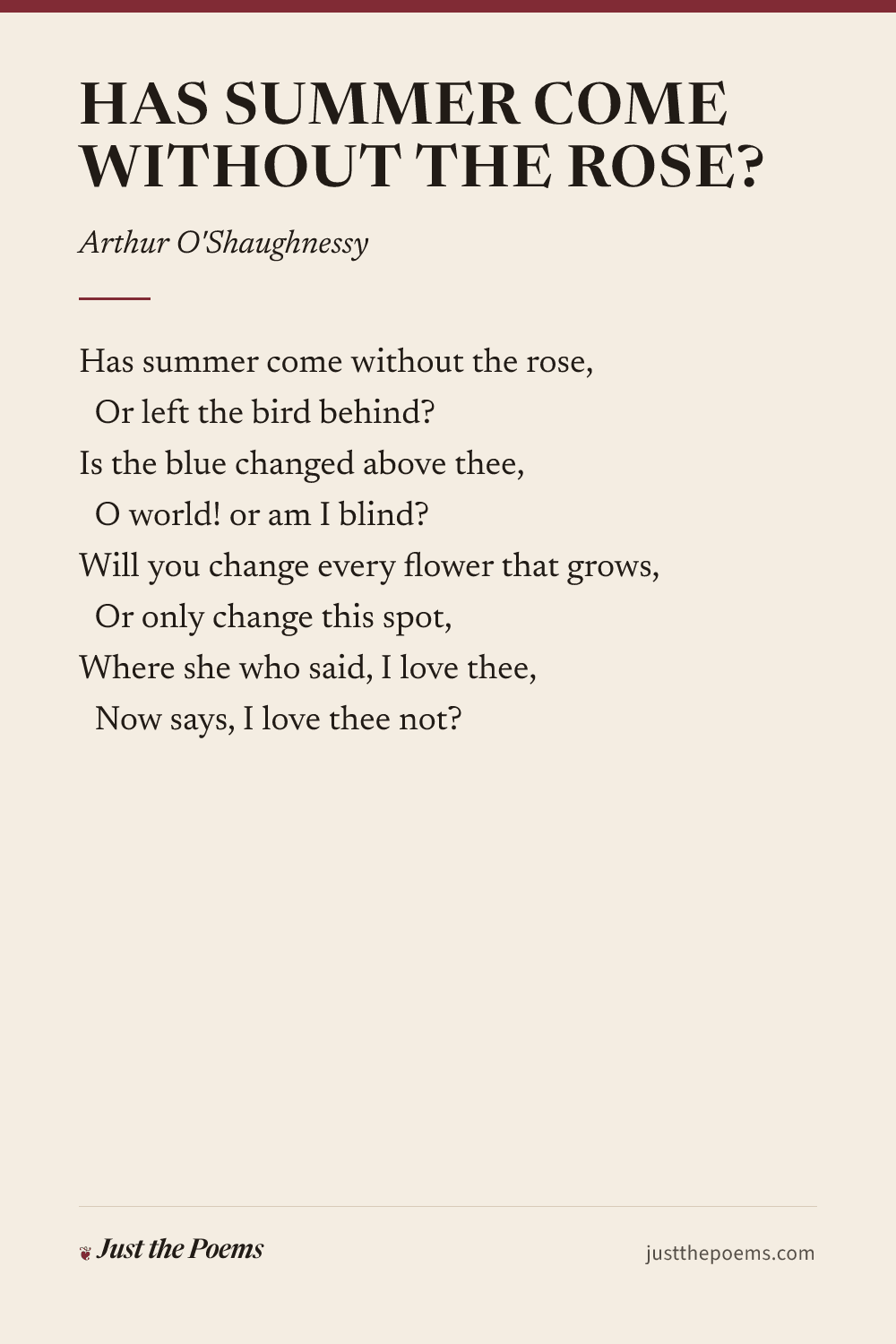
HAS SUMMER COME WITHOUT THE ROSE?

Arthur O'Shaughnessy

In 0 Wikipedias 2 anthologies Poet in 6 Wikipedias

A speaker asks whether summer has changed, now that the woman who said “I love thee” says she does not. For someone after a break-up.

Has summer come without the rose, Or left the bird behind?Is the blue changed above thee, O world! or am I blind?Will you change every flower that grows, Or only change this spot,Where she who said, I love thee, Now says, I love thee not?

The skies seemed true above thee, The rose true on the tree;The bird seemed true the summer through, But all proved false to me.

Show all 32 lines 20 more

World, is there one good thing in you, Life, love, or death--or what?Since lips that sang, I love thee, Have said, I love thee not?

I think the sun's kiss will scarce fall Into one flower's gold cup;I think the bird will miss me, And give the summer up.O sweet place, desolate in tall Wild grass, have you forgotHow her lips loved to kiss me, Now that they kiss me not?

Be false or fair above me; Come back with any face,Summer!--do I care what you do? You cannot change one place,--The grass, the leaves, the earth, the dew, The grave I make the spot,--Here, where she used to love me, Here, where she loves me not.

Source

The World's Best Poetry, Vol. III, ed. Bliss Carman, 1904

Filed under
  • Named in the title

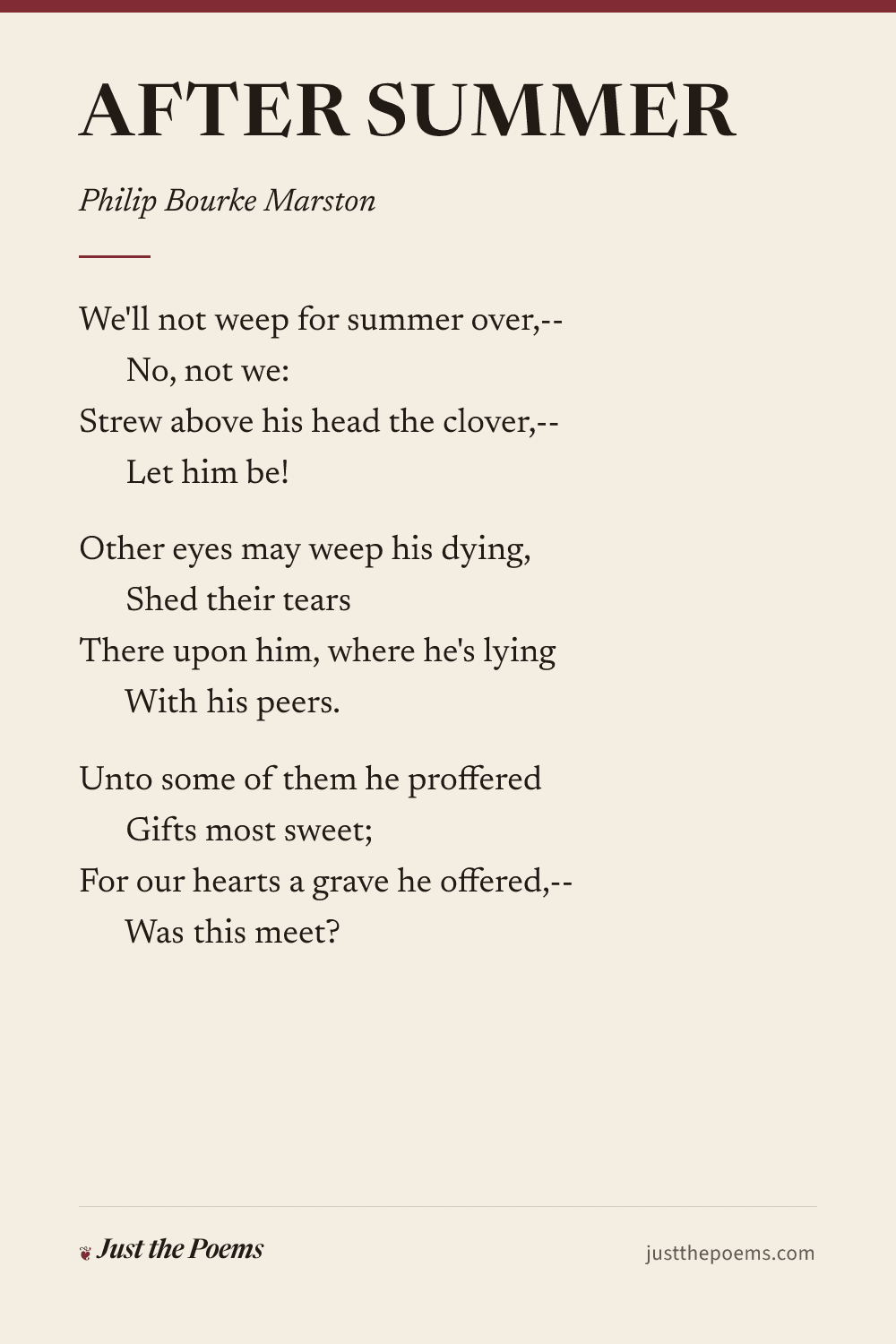
AFTER SUMMER

Philip Bourke Marston

In 0 Wikipedias 2 anthologies Poet in 4 Wikipedias

A speaker refuses to mourn a summer that destroyed the couple's hopes, and asks whether, parted in their tombs, they will dream of it. For a couple who have parted.

We'll not weep for summer over,-- No, not we:Strew above his head the clover,-- Let him be!

Other eyes may weep his dying, Shed their tearsThere upon him, where he's lying With his peers.

Unto some of them he proffered Gifts most sweet;For our hearts a grave he offered,-- Was this meet?

Show all 32 lines 20 more

All our fond hopes, praying, perished In his wrath,--All the lovely dreams we cherished Strewed his path.

Shall we in our tombs, I wonder, Far apart,Sundered wide as seas can sunder Heart from heart,

Dream at all of all the sorrows That were ours,--Bitter nights, more bitter morrows; Poison-flowers

Summer gathered, as in madness, Saying, "See,These are yours, in place of gladness,-- Gifts from me"?

Nay, the rest that will be ours Is supreme,And below the poppy flowers Steals no dream.

Source

The World's Best Poetry, Vol. III, ed. Bliss Carman, 1904

Filed under
  • Named in the title

Summer Night

Alfred Tennyson, Lord Tennyson

In 0 Wikipedias 1 anthology Poet in 72 Wikipedias

In a palace garden at night, a speaker asks a loved one to wake and come close. It is a song from Tennyson's The Princess. For an anniversary.

Now sleeps the crimson petal, now the white;Nor waves the cypress in the palace walk;Nor winks the gold fin in the porphyry font:The firefly wakens: waken thou with me.

Now droops the milk-white peacock like a ghost,And like a ghost she glimmers on to me.

Now lies the Earth all Danaë to the stars,And all thy heart lies open unto me.

Now slides the silent meteor on, and leavesA shining furrow, as thy thoughts in me.

Now folds the lily all her sweetness up,And slips into the bosom of the lake:So fold thyself, my dearest, thou, and slipInto my bosom and be lost in me.

Source

The Oxford Book of English Verse 1250–1900, 1900

Filed under
  • Named in the title

Summer Dawn

William Morris

In 0 Wikipedias 1 anthology Poet in 59 Wikipedias

A speaker asks someone for one prayer, one thought and one word as night gives way to dawn over the corn. It appeared in The Defence of Guenevere and Other Poems in 1858. For a love letter.

Pray but one prayer for me ’twixt thy closed lips, Think but one thought of me up in the stars.The summer night waneth, the morning light slips Faint and gray ’twixt the leaves of the aspen, betwixt the cloud-bars,That are patiently waiting there for the dawn: Patient and colourless, though Heaven’s goldWaits to float through them along with the sun.Far out in the meadows, above the young corn, The heavy elms wait, and restless and coldThe uneasy wind rises; the roses are dun;Through the long twilight they pray for the dawnRound the lone house in the midst of the corn. Speak but one word to me over the corn, Over the tender, bow’d locks of the corn.

Source

The Oxford Book of English Verse 1250–1900, 1900

Filed under
  • Named in the title

A SUMMER WOOING

Louise Chandler Moulton

In 0 Wikipedias 1 anthology Poet in 8 Wikipedias

The wind courts a rose and abandons her, and the speaker asks whether it cares now that she is buried. For someone left by a lover.

The wind went wooing the rose,For the rose was fair.How the rough wind won her, who knows?But he left her there.Far away from her grave he blows:Does the free wind care?

Source

The Home Book of Verse, ed. Burton Egbert Stevenson

Filed under
  • Named in the title

O, LOVE IS NOT A SUMMER MOOD

Richard Watson Gilder

In 0 Wikipedias 1 anthology Poet in 5 Wikipedias

A list of what love is not, followed by what it is. For a wedding.

O, love is not a summer mood,Nor flying phantom of the brain,Nor youthful fever of the blood,Nor dream, nor fate, nor circumstance.Love is not born of blinded chance,Nor bred in simple ignorance.

Love is the flower of maidenhood;Love is the fruit of mortal pain;And she hath winter in her blood.True love is steadfast as the skies,And once alight, she never flies;And love is strong, and love is wise.

Source

The Home Book of Verse, ed. Burton Egbert Stevenson

Filed under
  • Named in the title

ST. MARTIN’S SUMMER

Robert Louis Stevenson

In 0 Wikipedias 0 anthologies Poet in 101 Wikipedias

A speaker, told by a lady's eyes to stay and by her words to go, says that forgotten hopes have come back. It appeared in New Poems, and Variant Readings in 1918. For someone torn over a parting.

AS swallows turning backward When half-way o’er the sea,At one word’s trumpet summons They came again to me—The hopes I had forgotten Came back again to me.

I know not which to credit, O lady of my heart!Your eyes that bade me linger, Your words that bade us part—I know not which to credit, My reason or my heart.

But be my hopes rewarded, Or be they but in vain,I have dreamed a golden vision, I have gathered in the grain—I have dreamed a golden vision, I have not lived in vain.

Source

New Poems, and Variant Readings, 1918

Filed under
  • Named in the title

Summer's end and summers remembered

INDIAN SUMMER

Emily Dickinson

In 0 Wikipedias 1 anthology Poet in 101 Wikipedias

The last warm days of the year, which the speaker calls a mistake and then a sacrament, as a leaf hurries down. For a walk on a warm autumn day.

These are the days when birds come back,A very few, a bird or two,To take a backward look.

These are the days when skies put onThe old, old sophistries of June,--A blue and gold mistake.

Oh, fraud that cannot cheat the bee,Almost thy plausibilityInduces my belief,

Till ranks of seeds their witness bear,And softly through the altered airHurries a timid leaf!

Oh, sacrament of summer days,Oh, last communion in the haze,Permit a child to join,

Thy sacred emblems to partake,Thy consecrated bread to break,Taste thine immortal wine!

Source

The Home Book of Verse, ed. Burton Egbert Stevenson

Filed under
  • Named in the title

TIS THE LAST ROSE OF SUMMER

Thomas Moore

In 0 Wikipedias 1 anthology Poet in 43 Wikipedias

A speaker scatters the petals of the last rose and asks who would live alone in such a world. It appeared in A Selection of Irish Melodies in 1813. For an Irish evening.

'Tis the last rose of summer,Left blooming alone;All her lovely companionsAre faded and gone;No flower of her kindred,No rose-bud is nigh,To reflect back her blushes,Or give sigh for sigh.

I'll not leave thee, thou lone one!To pine on the stem;Since the lovely are sleeping,Go, sleep thou with them.Thus kindly I scatterThy leaves o'er the bedWhere thy mates of the gardenLie scentless and dead.

So soon may I follow,When friendships decay,And from Love's shining circleThe gems drop away.When true hearts lie withered,And fond ones are flown,O who would inhabitThis bleak world alone?

Source

The Home Book of Verse, ed. Burton Egbert Stevenson

Filed under
  • Named in the title

THE SUMMER SUN SHONE ROUND ME

Robert Louis Stevenson

In 0 Wikipedias 0 anthologies Poet in 101 Wikipedias

On a still, hot day in a valley, the grass stirs against the speaker's face with word that winter is near. It appeared in New Poems, and Variant Readings in 1918. For the last days of summer.

THE summer sun shone round me, The folded valley layIn a stream of sun and odour, That sultry summer day.

The tall trees stood in the sunlight As still as still could be,But the deep grass sighed and rustled And bowed and beckoned me.

The deep grass moved and whispered And bowed and brushed my face.It whispered in the sunshine: “The winter comes apace.”

Source

New Poems, and Variant Readings, 1918

Filed under
  • Named in the title

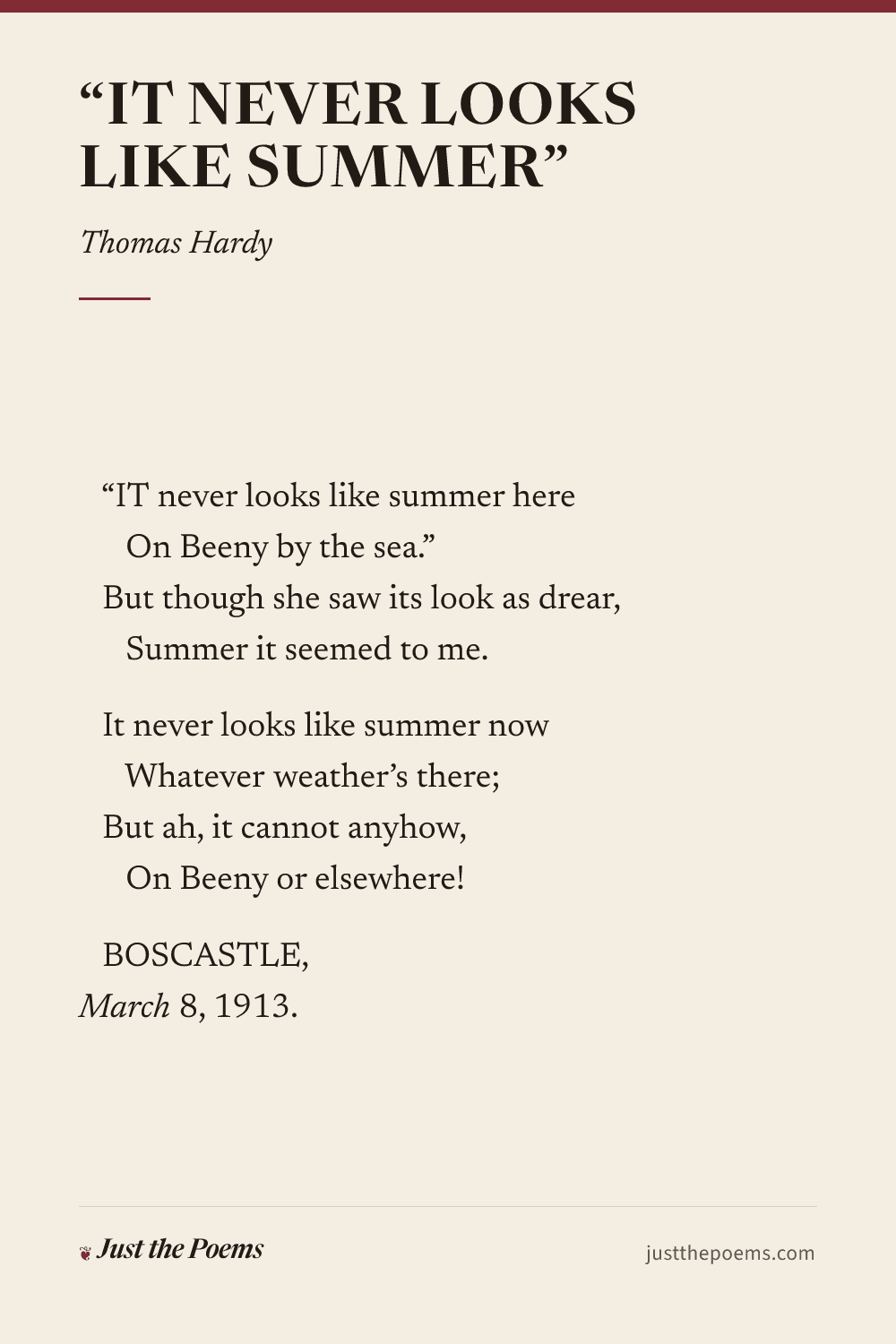
IT NEVER LOOKS LIKE SUMMER

Thomas Hardy

In 0 Wikipedias 0 anthologies Poet in 91 Wikipedias

A speaker recalls a woman saying that it never looks like summer on Beeny, and says that now it never can. Dated March 8, 1913, at Boscastle. It appeared in Moments of Vision in 1917. For someone returning to a place once shared.

“IT never looks like summer here On Beeny by the sea.” But though she saw its look as drear, Summer it seemed to me.

It never looks like summer now Whatever weather’s there; But ah, it cannot anyhow, On Beeny or elsewhere!

BOSCASTLE,March 8, 1913.

Source

Moments of Vision and Miscellaneous Verses, 1929

Filed under
  • Named in the title

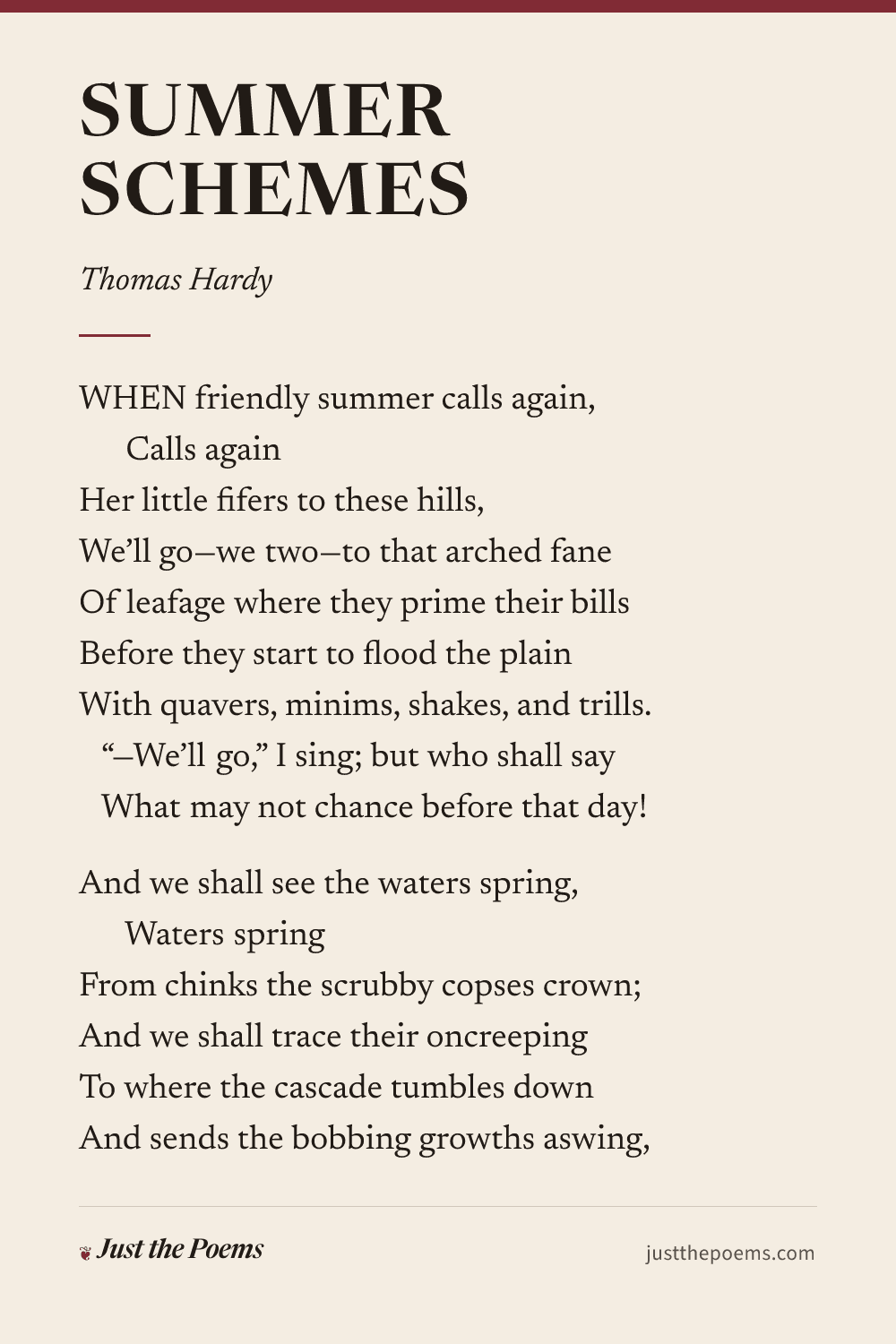
SUMMER SCHEMES

Thomas Hardy

In 0 Wikipedias 0 anthologies Poet in 91 Wikipedias

A speaker plans outings with someone to hear the birds and trace the springs, and stops each time to say that no one can tell what may happen. It appeared in Late Lyrics and Earlier in 1922. For sending to someone you hope to see next summer.

WHEN friendly summer calls again, Calls againHer little fifers to these hills,We’ll go—we two—to that arched faneOf leafage where they prime their billsBefore they start to flood the plainWith quavers, minims, shakes, and trills. “—We’ll go,” I sing; but who shall say What may not chance before that day!

And we shall see the waters spring, Waters springFrom chinks the scrubby copses crown;And we shall trace their oncreepingTo where the cascade tumbles downAnd sends the bobbing growths aswing,And ferns not quite but almost drown. “—We shall,” I say; but who may sing Of what another moon will bring!

Source

Late Lyrics and Earlier, With Many Other Verses, 1922

Filed under
  • Named in the title

Longing for summer and days out of doors

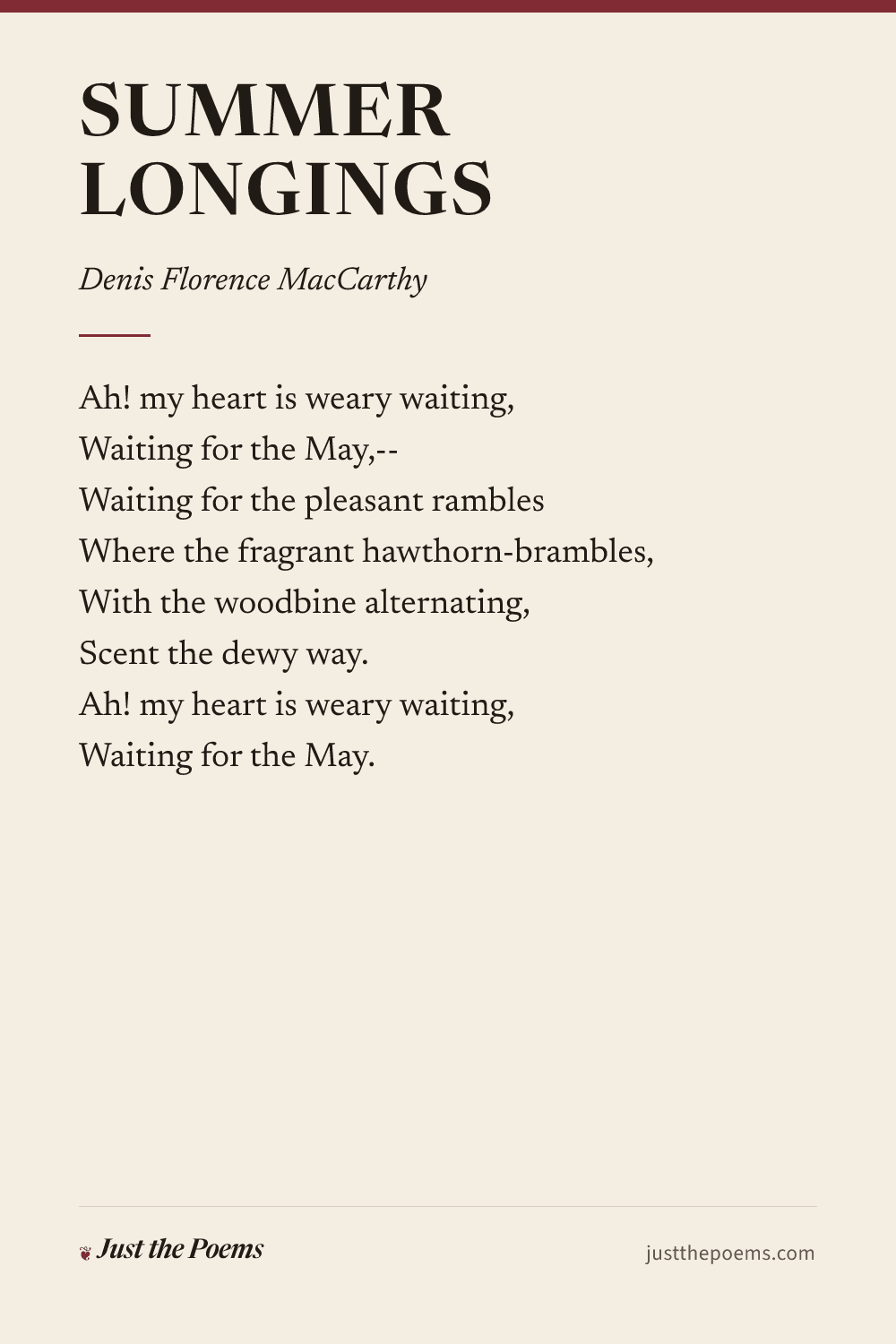
SUMMER LONGINGS

Denis Florence MacCarthy

In 0 Wikipedias 1 anthology Poet in 6 Wikipedias

A speaker weary of waiting longs for May, for hawthorn lanes and the seaside, and ends with summer arriving and the waiting not over. For the last day before the holidays.

Ah! my heart is weary waiting,Waiting for the May,--Waiting for the pleasant ramblesWhere the fragrant hawthorn-brambles,With the woodbine alternating,Scent the dewy way.Ah! my heart is weary waiting,Waiting for the May.

Ah! my heart is sick with longing,Longing for the May,--Longing to escape from studyTo the young face fair and ruddy,

Show all 40 lines 28 more

And the thousand charms belongingTo the summer's day.Ah! my heart is sick with longing,Longing for the May.

Ah! my heart is sore with sighing,Sighing for the May,--Sighing for their sure returning,When the summer beams are burning,Hopes and flowers that, dead or dying,All the winter lay.Ah! my heart is sore with sighing,Sighing for the May.

Ah! my heart is pained with throbbing,Throbbing for the May,--Throbbing for the seaside billows,Or the water-wooing willows;Where, in laughing and in sobbing,Glide the streams away.Ah! my heart, my heart is throbbing,Throbbing for the May.

Waiting sad, dejected, weary,Waiting for the May:Spring goes by with wasted warnings,--Moonlit evenings, sunbright mornings,--Summer comes, yet dark and drearyLife still ebbs away;Man is ever weary, weary,Waiting for the May!

Source

The Home Book of Verse, ed. Burton Egbert Stevenson

Filed under
  • Named in the title

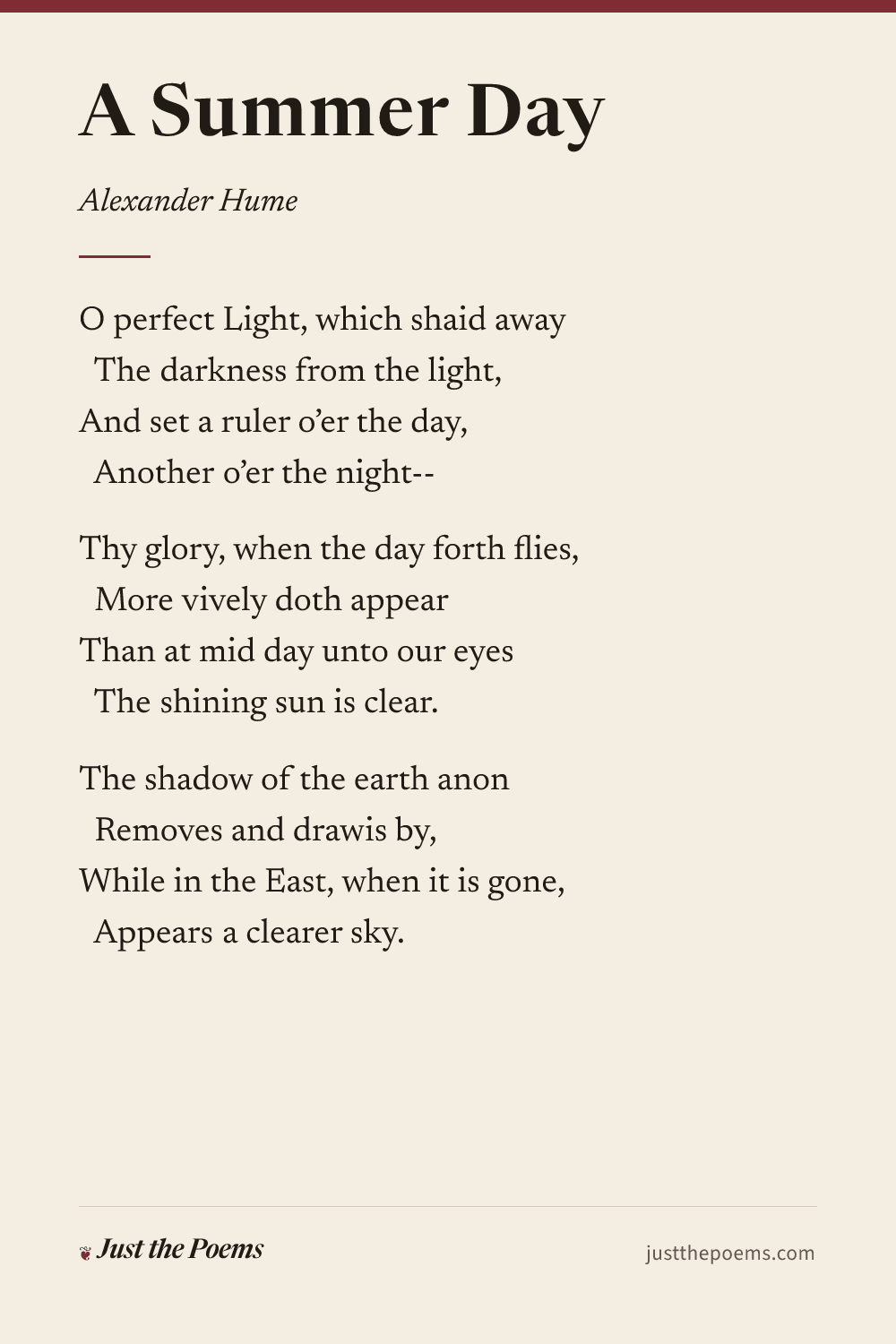
A Summer Day

Alexander Hume

In 0 Wikipedias 1 anthology Poet in 4 Wikipedias

A single day from before sunrise to evening: birds, dew, bees, the heat of noon, and labourers going home. For a harvest festival.

O perfect Light, which shaid away The darkness from the light,And set a ruler o’er the day, Another o’er the night--

Thy glory, when the day forth flies, More vively doth appearThan at mid day unto our eyes The shining sun is clear.

The shadow of the earth anon Removes and drawis by,While in the East, when it is gone, Appears a clearer sky.

Show all 120 lines 108 more

Which soon perceive the little larks, The lapwing and the snipe,And tune their songs, like Nature’s clerks, O’er meadow, muir, and stripe.

Our hemisphere is polisht clean, And lighten’d more and more,While everything is clearly seen Which seemit dim before:

Except the glistering astres bright, Which all the night were clear,Offuskit with a greater light No longer do appear.

The golden globe incontinent Sets up his shining head,And o’er the earth and firmament Displays his beams abread.

For joy the birds with boulden throats Against his visage sheenTake up their kindly musick notes In woods and gardens green.

The dew upon the tender crops, Like pearlis white and round,Or like to melted silver drops, Refreshis all the ground.

The misty reek, the clouds of rain, From tops of mountains skails,Clear are the highest hills and plain, The vapours take the vales.

The ample heaven of fabrick sure In cleanness does surpassThe crystal and the silver pure, Or clearest polisht glass.

The time so tranquil is and still That nowhere shall ye find,Save on a high and barren hill, An air of peeping wind.

All trees and simples, great and small, That balmy leaf do bear,Than they were painted on a wall No more they move or steir.

Calm is the deep and purple sea, Yea, smoother than the sand;The waves that weltering wont to be Are stable like the land.

So silent is the cessile air That every cry and callThe hills and dales and forest fair Again repeats them all.

The flourishes and fragrant flowers, Through Phoebus’ fostering heat,Refresht with dew and silver showers Cast up an odour sweet.

The cloggit busy humming bees, That never think to drone,On flowers and flourishes of trees Collect their liquor brown.

The Sun, most like a speedy post With ardent course ascends;The beauty of the heavenly host Up to our zenith tends.

The burning beams down from his face So fervently can beat,That man and beast now seek a place To save them from the heat.

The herds beneath some leafy tree Amidst the flowers they lie;The stable ships upon the sea Tend up their sails to dry.

With gilded eyes and open wings The cock his courage shows;With claps of joy his breast he dings, And twenty times he crows.

The dove with whistling wings so blue The winds can fast collect;Her purple pens turn many a hue Against the sun direct.

Now noon is went; gone is midday, The heat doth slake at last;The sun descends down West away, For three of clock is past.

The rayons of the sun we see Diminish in their strength;The shade of every tower and tree Extendit is in length.

Great is the calm, for everywhere The wind is setting down;The reek throws right up in the air From every tower and town.

The gloming comes; the day is spent; The sun goes out of sight;And painted is the occident With purple sanguine bright.

Our west horizon circular From time the sun be setIs all with rubies, as it were, Or roses red o’erfret.

What pleasure were to walk and see, Endlong a river clear,The perfect form of every tree Within the deep appear.

O then it were a seemly thing, While all is still and calm,The praise of God to play and sing With cornet and with shalm!

All labourers draw home at even, And can to other say,Thanks to the gracious God of heaven, Which sent this summer day.
Source

The Oxford Book of English Verse 1250–1900, 1900

Filed under
  • Named in the title

SUMMER INVOCATION

William Cox Bennett

In 0 Wikipedias 1 anthology Poet in 2 Wikipedias

A speaker asks the summer rain to come to a parched landscape and a drooping lily. For a garden club meeting.

O gentle, gentle summer rain,Let not the silver lily pine,The drooping lily pine in vainTo feel that dewy touch of thine,--To drink thy freshness once again,O gentle, gentle summer rain!

In heat the landscape quivering lies;The cattle pant beneath the tree;Through parching air and purple skiesThe earth looks up, in vain, for thee;For thee--for thee, it looks in vainO gentle, gentle summer rain.

Come thou, and brim the meadow streams,And soften all the hills with mist,O falling dew! from burning dreamsBy thee shall herb and flower be kissed,And Earth shall bless thee yet again,O gentle, gentle summer rain.

Source

The Home Book of Verse, ed. Burton Egbert Stevenson

Filed under
  • Named in the title

SUMMER STUDIES

Harriet Beecher Stowe

In 0 Wikipedias 0 anthologies Poet in 85 Wikipedias

A speaker asks why anyone should study books in June, when the woods and fields are open. It appeared in Religious Poems in 1867. For the start of a summer holiday.

WHY shouldst thou study in the month of JuneIn dusky books of Greek and Hebrew lore,When the Great Teacher of all glorious thingsPasses in hourly light before thy door?

There is a brighter book unrolling now;Fair are its leaves as is the tree of heaven,All veined and dewed and gemmed with wondrous signs,To which a healing mystic power is given.

A thousand voices to its study call,From the fair hill-top, from the waterfall,Where the bird singeth, and the yellow bee,And the breeze talketh from the airy tree.

Show all 60 lines 48 more

Now is that glorious resurrection timeWhen all earth's buried beauties have new birth:Behold the yearly miracle complete,--God hath created a new heaven and earth!

No tree that wants its joyful garments now,No flower but hastes his bravery to don;God bids thee to this marriage feast of joy,Let thy soul put the wedding garment on.

All fringed with festal gold the barberry stands;The ferns, exultant, clap their new-made wings;The hemlock rustles broideries of fresh green,And thousand bells of pearl the blueberry rings.

The long, weird fingers of the old white-pinesDo beckon thee into the flickering wood,Where moving spots of light show mystic flowers,And wavering music fills the dreamy hours.

Hast thou no time for all this wondrous show,--No thought to spare? Wilt thou forever beWith thy last year's dry flower-stalk and dead leaves,And no new shoot or blossom on thy tree?

See how the pines push off their last year's leaves.And stretch beyond them with exultant bound:The grass and flowers, with living power, o'ergrowTheir last year's remnants on the greening ground.

Wilt thou, then, all thy wintry feelings keep,The old dead routine of thy book-writ lore,Nor deem that God can teach, by one bright hour,What life hath never taught to thee before?

See what vast leisure, what unbounded rest,Lie in the bending dome of the blue sky:Ah! breathe that life-born languor from thy breast,And know once more a child's unreasoning joy.

Cease, cease to think, and be content to be;Swing safe at anchor in fair Nature's bay;Reason no more, but o'er thy quiet soulLet God's sweet teachings ripple their soft way.

Soar with the birds, and flutter with the leaf;Dance with the seeded grass in fringy play;Sail with the cloud, wave with the dreaming pine,And float with Nature all the livelong day.

Call not such hours an idle waste of time,--Land that lies fallow gains a quiet power;It treasures, from the brooding of God's wings,Strength to unfold the future tree and flower.

And when the summer's glorious show is past,Its miracles no longer charm thy sight,The treasured riches of those thoughtful hoursShall make thy wintry musings warm and bright.

Source

Religious Poems

Filed under
  • Named in the title

SUMMER MASS

Oliver Herford

In 0 Wikipedias 0 anthologies Poet in 1 Wikipedia

Small creatures sing in the grass as at a mass, and God, bending to listen, forgets the churches built for him. It appeared in The Laughing Willow in 1918. For an outdoor summer service.

In the cloisters of the grass,Lit by buttercups and daisies,Celebrants of summer mass,Little creatures sing their praises.From a myriad throbbing throatsRises up their song of Love,Like a mist of golden motes,To the Golden Throne above.And the good Lord, bending nigh,Quite forgets his house of stoneWhere the frightened sinners cry,And the frowning priests intone,And the saints (if saints they be)Smile and smile in effigy.

Source

The Laughing Willow Verses and Pictures, 1918

Filed under
  • Named in the title

THE SUMMER DAYS ARE COMING

John S. Adams

In 0 Wikipedias 0 anthologies Poet in 0 Wikipedias

A speaker looks ahead to summer, grants that winter has its pleasures and asks for summer all the same. It appeared in Town and Country in 1855. For a spring gathering.

THE summer days are coming, The glorious summer hours,When Nature decks her gorgeous robe With sunbeams and with flowers;And gathers all her choristers In plumage bright and gay,Till every vale is echoing with Their joyous roundelay.No more shall frosty winter Hold in its cold embraceThe water; but the river Shall join again the race;And down the mountain's valley, And o'er its rocky side,The glistening streams shall rush and leap In all their bounding pride.There's pleasure in the winter, When o'er the frozen snowWith faithful friend and noble steed Right merrily we go!But give to me the summer, The pleasant summer days,When blooming flowers and sparkling streams Enliven all our ways.

Source

Town and Country; Or, Life at Home and Abroad, Without and Within Us, 1855

Filed under
  • Named in the title

THE SUMMER SHOWER

John S. Adams

In 0 Wikipedias 0 anthologies Poet in 0 Wikipedias

A mist rises from a lake, falls as rain and clears, and a rainbow appears. It appeared in Town and Country in 1855. For a walk after rain.

UP from the lake a mist ascends, And forms a sea of cloud above, That hangs o'er earth as if in loveWith its green vales; then quick it send Its blessings down in cooling rain, On hill and valley, rock and plain.Nature, delighted with the shower,Sends up the fragrance of each flower; Birds carol forth their cheeriest lays, The green leaves rustle forth their praise.Soon, one by one, the clouds depart, And a bright rainbow spans the sky,That seems but the reflective part Of all below, fixed there on high.

Source

Town and Country; Or, Life at Home and Abroad, Without and Within Us, 1855

Filed under
  • Named in the title

Complaints about summer

Bed in Summer

Robert Louis Stevenson

In 0 Wikipedias 0 anthologies Poet in 101 Wikipedias

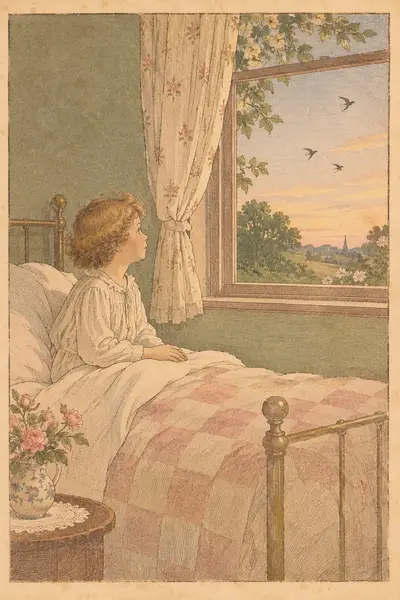
A child complains that in summer bedtime comes while it is still light outside. It appeared in A Child's Garden of Verses in 1885. For reading to a child at bedtime.

In winter I get up at nightAnd dress by yellow candle-light.In summer quite the other way,I have to go to bed by day.

I have to go to bed and seeThe birds still hopping on the tree,Or hear the grown-up people's feetStill going past me in the street.

And does it not seem hard to you,When all the sky is clear and blue,And I should like so much to play,To have to go to bed by day?

Source

A Child's Garden of Verses

Filed under
  • Named in the title

TO A SUMMER POET

Ambrose Bierce

In 0 Wikipedias 0 anthologies Poet in 59 Wikipedias

A speaker tells a summer poet that everyone already knows what such poets write about, and asks for it to stop. It appeared in Shapes of Clay in 1903. For a friend who writes verse.

Yes, the Summer girl is flirting on the beach, With a him.And the damboy is a-climbing for the peach, On the limb;Yes, the bullfrog is a-croakingAnd the dudelet is a-smoking Cigarettes;And the hackman is a-hackingAnd the showman is a-cracking Up his pets;Yes, the Jersey 'skeeter flits along the shoreAnd the snapdog--we have heard it o'er and o'er;

Show all 34 lines 22 more

Yes, my poet, Well we know it--Know the spooners how they spoon In the bright Dollar lightOf the country tavern moon; Yes, the caterpillars fall From the trees (we know it all),And with beetles all the shelves Are alive.

Please unbuttonhole us--O, Have the grace to let us go, For we know How you Summer poets thrive, By the recapitulation And insistent iterationOf the wondrous doings incident to Life Among Ourselves! So, I pray you stop the fervor and the fuss. For you, poor human linnet, There's a half a living in it, But there's not a copper cent in it for us!

Source

Shapes of Clay, 1903

Filed under
  • Named in the title

21 poems about summer

17 poets

By poet's century of death

CenturyPoems
17th1
19th14
20th6

Poets with more than one poem

PoetPoems
Robert Louis Stevenson3
John S. Adams2
Thomas Hardy2