Poems About Nature

The first 30 of 35 poems about nature, by 20 poets, ranked by third-party data. How poems are ranked

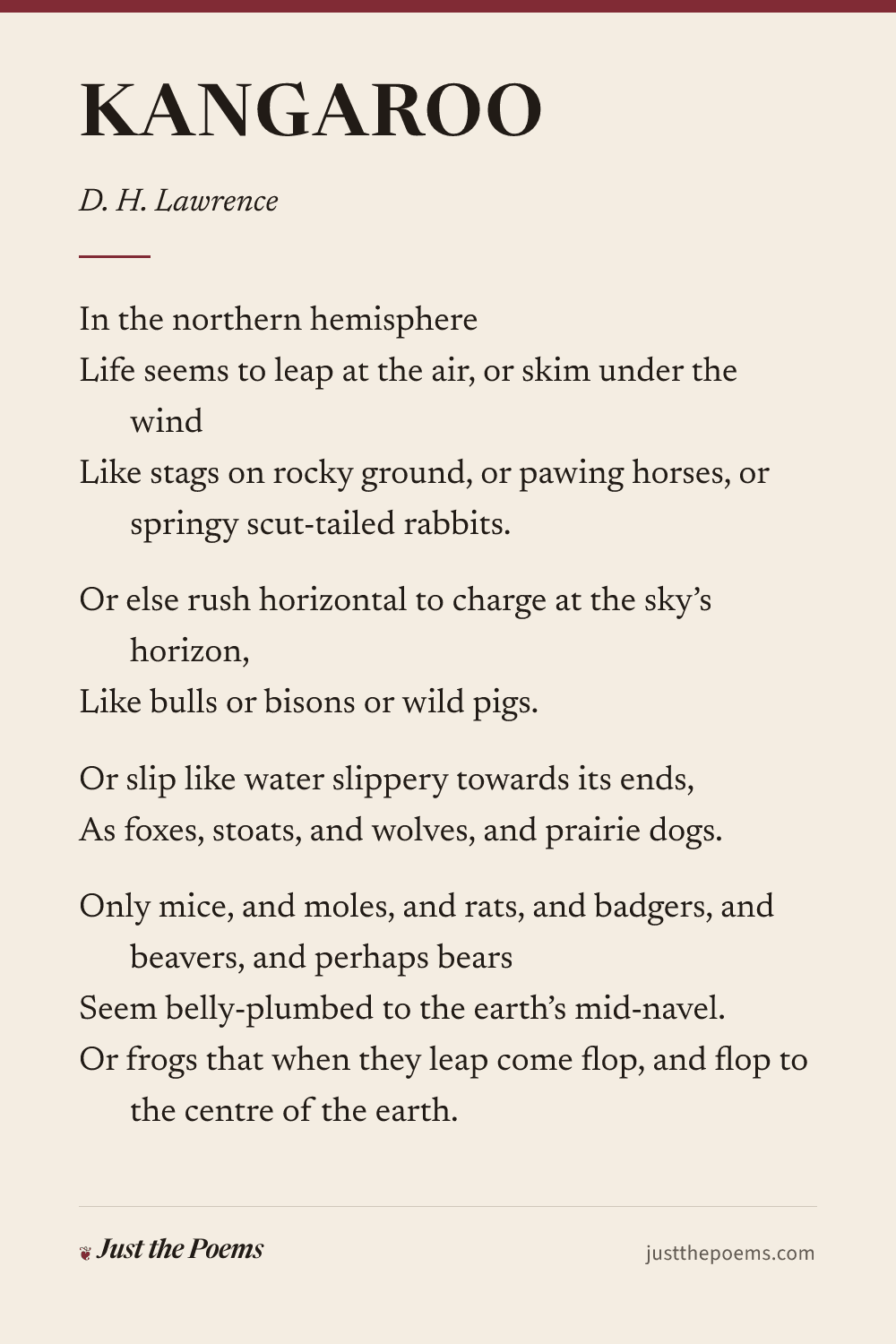
KANGAROO

D. H. Lawrence

In 3 Wikipedias 0 anthologies Poet in 79 Wikipedias

In the northern hemisphereLife seems to leap at the air, or skim under the windLike stags on rocky ground, or pawing horses, or springy scut-tailed rabbits.

Or else rush horizontal to charge at the sky’s horizon,Like bulls or bisons or wild pigs.

Or slip like water slippery towards its ends,As foxes, stoats, and wolves, and prairie dogs.

Only mice, and moles, and rats, and badgers, and beavers, and perhaps bearsSeem belly-plumbed to the earth’s mid-navel.Or frogs that when they leap come flop, and flop to the centre of the earth.

But the yellow antipodal Kangaroo, when she sits up,Who can unseat her, like a liquid drop that is heavy, and just touches earth.

Show all 63 lines 51 more

The downward drip.The down-urge.So much denser than cold-blooded frogs.

Delicate mother KangarooSitting up there rabbit-wise, but huge, plumb-weighted,And lifting her beautiful slender face, oh! so much more gently and finely lined than a rabbit’s, or than a hare’s,Lifting her face to nibble at a round white peppermint drop, which she loves, sensitive mother Kangaroo.

Her sensitive, long, pure-bred face.Her full antipodal eyes, so dark,So big and quiet and remote, having watched so many empty dawns in silent Australia.

Her little loose hands, and drooping Victorian shoulders.And then her great weight below the waist, her vast pale bellyWith a thin young yellow little paw hanging out, and straggle of a long thin ear, like ribbon,Like a funny trimming to the middle of her belly, thin little dangle of an immature paw, and one thin ear.

Her belly, her big haunchesAnd in addition, the great muscular python-stretch of her tail.

There, she shan’t have any more peppermint drops.So she wistfully, sensitively sniffs the air, and then turns, goes off in slow sad leaps

On the long flat skis of her legs,Steered and propelled by that steel-strong snake of a tail.

Stops again, half turns, inquisitive to look back.While something stirs quickly in her belly, and a lean little face comes out, as from a window,Peaked and a bit dismayed,Only to disappear again quickly away from the sight of the world, to snuggle down in the warmth,Leaving the trail of a different paw hanging out.

Still she watches with eternal, cocked wistfulness!How full her eyes are, like the full, fathomless, shining eyes of an Australian black-boyWho has been lost so many centuries on the margins of existence!

She watches with insatiable wistfulness.Untold centuries of watching for something to come,For a new signal from life, in that silent lost land of the South.

Where nothing bites but insects and snakes and the sun, small life.Where no bull roared, no cow ever lowed, no stag cried, no leopard screeched, no lion coughed, no dog barked,But all was silent save for parrots occasionally, in the haunted blue bush.

Wistfully watching, with wonderful liquid eyes.And all her weight, all her blood, dripping sack-wise down towards the earth’s centre,And the live little one taking in its paw at the door of her belly.

Leap then, and come down on the line that draws to the earth’s deep, heavy centre. Sydney

Source

Birds, Beasts and Flowers Poems by D. H. Lawrence

Filed under
  • Library subject “Nature -- Poetry”, Birds, Beasts and Flowers Poems by D. H. Lawrence

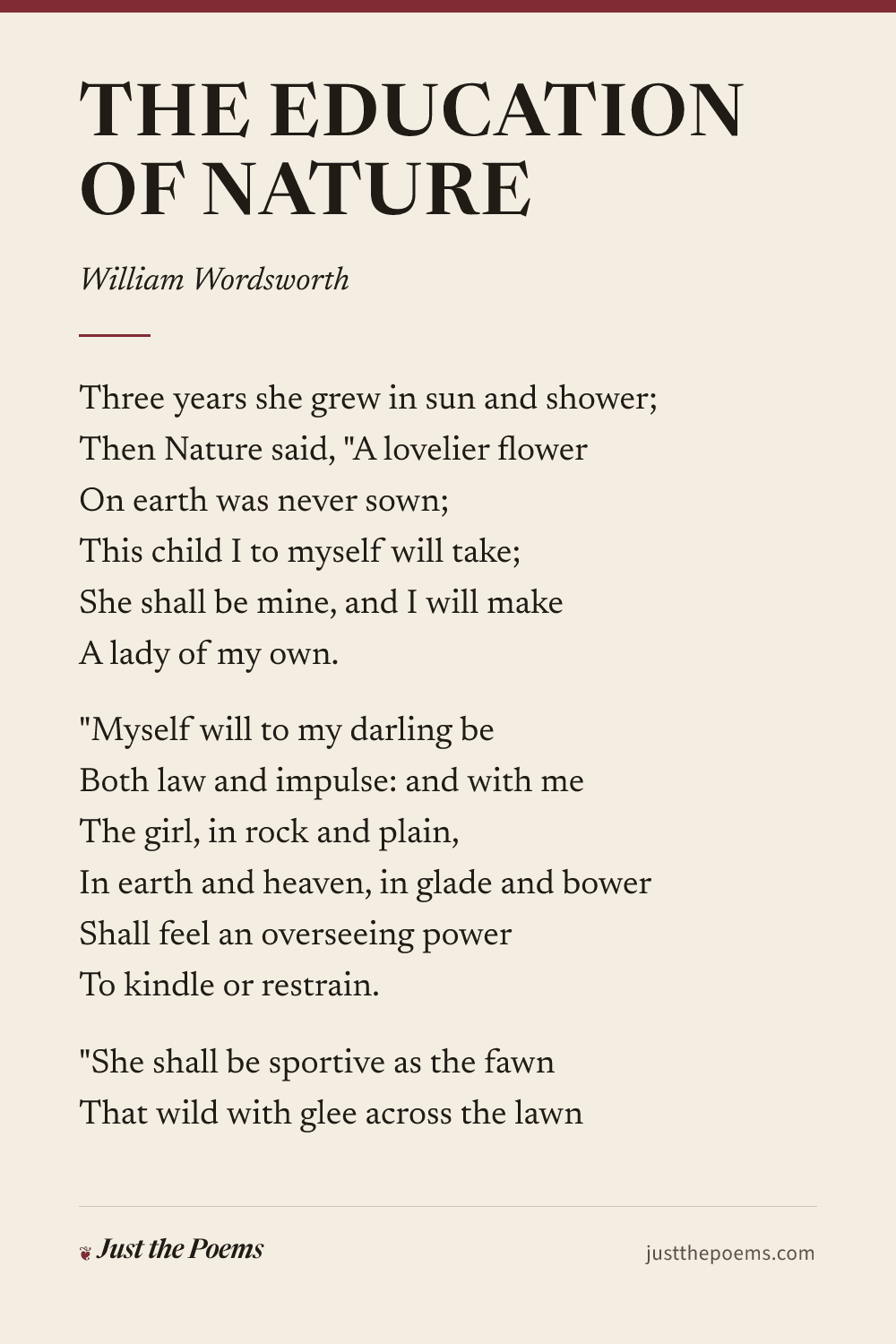
THE EDUCATION OF NATURE

William Wordsworth

In 0 Wikipedias 2 anthologies Poet in 97 Wikipedias

Three years she grew in sun and shower;Then Nature said, "A lovelier flowerOn earth was never sown;This child I to myself will take;She shall be mine, and I will makeA lady of my own.

"Myself will to my darling beBoth law and impulse: and with meThe girl, in rock and plain,In earth and heaven, in glade and bowerShall feel an overseeing powerTo kindle or restrain.

Show all 42 lines 30 more

"She shall be sportive as the fawnThat wild with glee across the lawnOr up the mountain springs;And her's shall be the breathing balm,And her's the silence and the calmOf mute insensate things.

"The floating clouds their state shall lendTo her; for her the willow bend;Nor shall she fail to seeE'en in the motions of the stormGrace that shall mould the maiden's formBy silent sympathy.

"The stars of midnight shall be dearTo her; and she shall lean her earIn many a secret placeWhere rivulets dance their wayward round,And beauty born of murmuring soundShall pass into her face.

"And vital feelings of delightShall rear her form to stately height,Her virgin bosom swell;Such thoughts to Lucy I will giveWhile she and I together liveHere in this happy dell."

Thus Nature spake--The work was done--How soon my Lucy's race was run!She died, and left to meThis heath, this calm and quiet scene;The memory of what has been,And never more will be.

Source

The Golden Treasury, ed. Francis Turner Palgrave

Filed under
  • Named in the title

THE NOBLE NATURE

Ben Jonson

In 0 Wikipedias 2 anthologies Poet in 63 Wikipedias

It is not growing like a tree In bulk, doth make Man better be;Or standing long an oak, three hundred year,To fall a log at last, dry, bald, and sere: A lily of a day Is fairer far in May, Although it fall and die that night-- It was the plant and flower of Light.In small proportions we just beauties see;And in short measures life may perfect be.

Source

The Golden Treasury, ed. Francis Turner Palgrave

Filed under
  • Named in the title

Advertisements

THE LESSONS OF NATURE

William Drummond

In 0 Wikipedias 2 anthologies Poet in 11 Wikipedias

Of this fair volume which we World do nameIf we the sheets and leaves could turn with care,Of Him who it corrects, and did it frame,We clear might read the art and wisdom rare:

Find out His power which wildest powers doth tame,His providence extending everywhere,His justice which proud rebels doth not spare,In every page, no period of the same.

But silly we, like foolish children, restWell pleased with colour'd vellum, leaves of gold,Fair dangling ribbands, leaving what is best,On the great Writer's sense ne'er taking hold;

Or if by chance we stay our minds on aught,It is some picture on the margin wrought.

Source

The Golden Treasury, ed. Francis Turner Palgrave

Filed under
  • Section “MOTHER NATURE”, The Home Book of Verse
  • Named in the title

NATURE AND THE POET

William Wordsworth

In 0 Wikipedias 1 anthology Poet in 97 Wikipedias

I was thy neighbour once, thou rugged Pile!Four summer weeks I dwelt in sight of thee:I saw thee every day; and all the whileThy form was sleeping on a glassy sea.

So pure the sky, so quiet was the air!So like, so very like, was day to day!Whene'er I look'd, thy image still was there;It trembled, but it never pass'd away.

How perfect was the calm! It seem'd no sleep,No mood, which season takes away, or brings:I could have fancied that the mighty DeepWas even the gentlest of all gentle things.

Show all 56 lines 44 more

Ah! then if mine had been the painter's handTo express what then I saw; and add the gleam,The light that never was on sea or land,The consecration, and the Poet's dream,--

I would have planted thee, thou hoary pile,Amid a world how different from this!Beside a sea that could not cease to smile;On tranquil land, beneath a sky of bliss.

A picture had it been of lasting ease,Elysian quiet, without toil or strife;No motion but the moving tide, a breeze,Or merely silent Nature's breathing life.

Such, in the fond illusion of my heart,Such picture would I at that time have made;And seen the soul of truth in every part,A steadfast peace that might not be betray'd.

So once it would have been,--'tis so no moreI have submitted to a new control:A power is gone, which nothing can restore;A deep distress hath humanised my soul.

Not for a moment could I now beholdA smiling sea, and be what I have been:The feeling of my loss will ne'er be old;This, which I know, I speak with mind serene.

Then, Beaumont, Friend! who would have been the friendIf he had lived, of him whom I deplore,This work of thine I blame not, but commend;This sea in anger, and that dismal shore.

O 'tis a passionate work!--yet wise and well,Well chosen is the spirit that is here;That hulk which labours in the deadly swell,This rueful sky, this pageantry of fear!

And this huge Castle, standing here sublime,I love to see the look with which it braves,--Cased in the unfeeling armour of old time--The lightning, the fierce wind, and trampling waves.

Farewell, farewell the heart that lives alone,Housed in a dream, at distance from the Kind!Such happiness, wherever it be known,Is to be pitied; for 'tis surely blind.

But welcome fortitude, and patient cheer,And frequent sights of what is to be borne!Such sights, or worse, as are before me here:Not without hope we suffer and we mourn.

Source

The Golden Treasury, ed. Francis Turner Palgrave

Filed under
  • Named in the title

RUTH: OR THE INFLUENCES OF NATURE

William Wordsworth

In 0 Wikipedias 1 anthology Poet in 97 Wikipedias

When Ruth was left half desolate,Her father took another mate;And Ruth, not seven years old,A slighted child, at her own willWent wandering over dale and hill,In thoughtless freedom bold.

And she had made a pipe of straw,And music from that pipe could drawLike sounds of winds and floods;Had built a bower upon the green,As if she from her birth had beenAn infant of the woods.

Show all 258 lines 246 more

Beneath her father's roof, aloneShe seem'd to live; her thoughts her own;Herself her own delight:Pleased with herself, nor sad nor gay,She pass'd her time; and in this wayGrew up to woman's height.

There came a youth from Georgia's shore--A military casque he woreWith splendid feathers drest;He brought them from the Cherokees;The feathers nodded in the breezeAnd made a gallant crest.

From Indian blood you deem him sprung:But no! he spake the English tongueAnd bore a soldier's name;And, when America was freeFrom battle and from jeopardy,He 'cross the ocean came.

With hues of genius on his cheek,In finest tones the youth could speak:--While he was yet a boyThe moon, the glory of the sun,And streams that murmur as they runHad been his dearest joy.

He was a lovely youth! I guessThe panther in the wildernessWas not so fair as he;And when he chose to sport and play,No dolphin ever was so gayUpon the tropic sea.

Among the Indians he had fought,And with him many tales he broughtOf pleasure and of fear;Such tales as, told to any maidBy such a youth, in the green shade,Were perilous to hear.

He told of girls, a happy rout!Who quit their fold with dance and shout,Their pleasant Indian town,To gather strawberries all day long;Returning with a choral songWhen daylight is gone down.

He spake of plants that hourly changeTheir blossoms, through a boundless rangeOf intermingling hues;With budding, fading, faded flowers,They stand the wonder of the bowersFrom morn to evening dews,

He told of the Magnolia, spreadHigh as a cloud, high over head!The cypress and her spire;--Of flowers that with one scarlet gleamCover a hundred leagues, and seemTo set the hills on fire.

The youth of green savannahs spake,And many an endless, endless lake,With all its fairy crowdsOf islands, that together lieAs quietly as spots of skyAmong the evening clouds.

And then he said, "How sweet it wereA fisher or a hunter there,In sunshine or in shadeTo wander with an easy mind,And build a household fire, and findA home in every glade!

"What days and what bright years! Ah me!Our life were life indeed, with TheeSo pass'd in quiet bliss;And all the while," said he, "to knowThat we were in a world of woe,On such an earth as this!"

And then he sometimes interwoveFond thoughts about a father's love,"For there," said he, "are spunAround the heart such tender ties,That our own children to our eyesAre dearer than the sun.

"Sweet Ruth! and could you go with meMy helpmate in the woods to be,Our shed at night to rear;Or run, my own adopted bride,A sylvan huntress at my side,And drive the flying deer!

"Beloved Ruth!"--No more he said.The wakeful Ruth at midnight shedA solitary tear:She thought again--and did agreeWith him to sail across the sea,And drive the flying deer.

"And now, as fitting is and right,We in the church our faith will plight,A husband and a wife."Even so they did; and I may sayThat to sweet Ruth that happy dayWas more than human life.

Through dream and vision did she sink,Delighted all the while to thinkThat, on those lonesome floods,And green savannahs, she should shareHis board with lawful joy, and bearHis name in the wild woods.

But, as you have before been told,This Stripling, sportive, gay, and bold,And with his dancing crestSo beautiful, through savage landsHad roam'd about, with vagrant bandsOf Indians in the West.

The wind, the tempest roaring high,The tumult of a tropic skyMight well be dangerous foodFor him, a youth to whom was givenSo much of earth--so much of heaven,And such impetuous blood.

Whatever in those climes he foundIrregular in sight or soundDid to his mind impartA kindred impulse, seem'd alliedTo his own powers, and justifiedThe workings of his heart.

Nor less, to feed voluptuous thought,The beauteous forms of Nature wrought,--Fair trees and gorgeous flowers;The breezes their own languor lent;The stars had feelings, which they sentInto those favour'd bowers.

Yet, in his worst pursuits, I weenThat sometimes there did intervenePure hopes of high intent:For passions link'd to forms so fairAnd stately, needs must have their shareOf noble sentiment.

But ill he lived, much evil saw,With men to whom no better lawNor better life was known;Deliberately and undeceived,Those wild men's vices he received,And gave them back his own.

His genius and his moral frameWere thus impair'd, and he becameThe slave of low desires:A man who without self-controlWould seek what the degraded soulUnworthily admires.

And yet he with no feign'd delightHad woo'd the maiden, day and nightHad loved her, night and morn:What could he less than love a maidWhose heart with so much nature play'd--So kind and so forlorn?

Sometimes most earnestly he said,"O Ruth! I have been worse than dead;False thoughts, thoughts bold and vainEncompass'd me on every sideWhen I, in confidence and pride,Had cross'd the Atlantic main.

"Before me shone a glorious worldFresh as a banner bright, unfurl'dTo music suddenly:I look'd upon those hills and plains,And seem'd as if let loose from chainsTo live at liberty!

"No more of this--for now, by thee,Dear Ruth! more happily set freeWith nobler zeal I burn;My soul from darkness is releasedLike the whole sky when to the eastThe morning doth return."

Full soon that better mind was gone;No hope, no wish remain'd, not one,--They stirr'd him now no more;New objects did new pleasure give,And once again he wish'd to liveAs lawless as before.

Meanwhile, as thus with him it fared,They for the voyage were prepared,And went to the sea-shore,But, when they thither came, the youthDeserted his poor bride, and RuthCould never find him more.

God help thee, Ruth!--Such pains she hadThat she in half a year was madAnd in a prison housed;And there, exulting in her wrongs,Among the music of her songsShe fearfully caroused.

Yet sometimes milder hours she knew,Nor wanted sun, nor rain, nor dew,Nor pastimes of the May;--They all were with her in her cell;And a clear brook with cheerful knellDid o'er the pebbles play.

When Ruth three seasons thus had lain,There came a respite to her pain;She from her prison fled;But of the vagrant none took thought;And where it liked her best she soughtHer shelter and her bread.

Among the fields she breathed again:The master-current of her brainRan permanent and free;And, coming to the banks of Tone,There did she rest; and dwell aloneUnder the greenwood tree.

The engines of her pain, the toolsThat shaped her sorrow, rocks and pools,And airs that gently stirThe vernal leaves--she loved them still,Nor ever tax'd them with the illWhich had been done to her.

A barn her Winter bed supplies;But, till the warmth of Summer skiesAnd Summer days is gone,(And all do in this tale agree)She sleeps beneath the greenwood tree,And other home hath none.

An innocent life, yet far astray!And Ruth will, long before her day,Be broken down and old:Sore aches she needs must have! but lessOf mind, than body's wretchedness,From damp, and rain, and cold.

If she is prest by want of foodShe from her dwelling in the woodRepairs to a road-side;And there she begs at one steep placeWhere up and down with easy paceThe horsemen-travellers ride.

That oaten pipe of hers is muteOr thrown away; but with a fluteHer loneliness she cheers;This flute, made of a hemlock stalk,At evening in his homeward walkThe Quantock woodman hears.

I, too, have pass'd her on the hillsSetting her little water-millsBy spouts and fountains wild--Such small machinery as she turn'dEre she had wept, ere she had mourn'd,A young and happy child!

Farewell! and when thy days are told,Ill-fated Ruth! in hallow'd mouldThy corpse shall buried be;For thee a funeral bell shall ring,And all the congregation singA Christian psalm for thee.
Source

The Golden Treasury, ed. Francis Turner Palgrave

Filed under
  • Named in the title

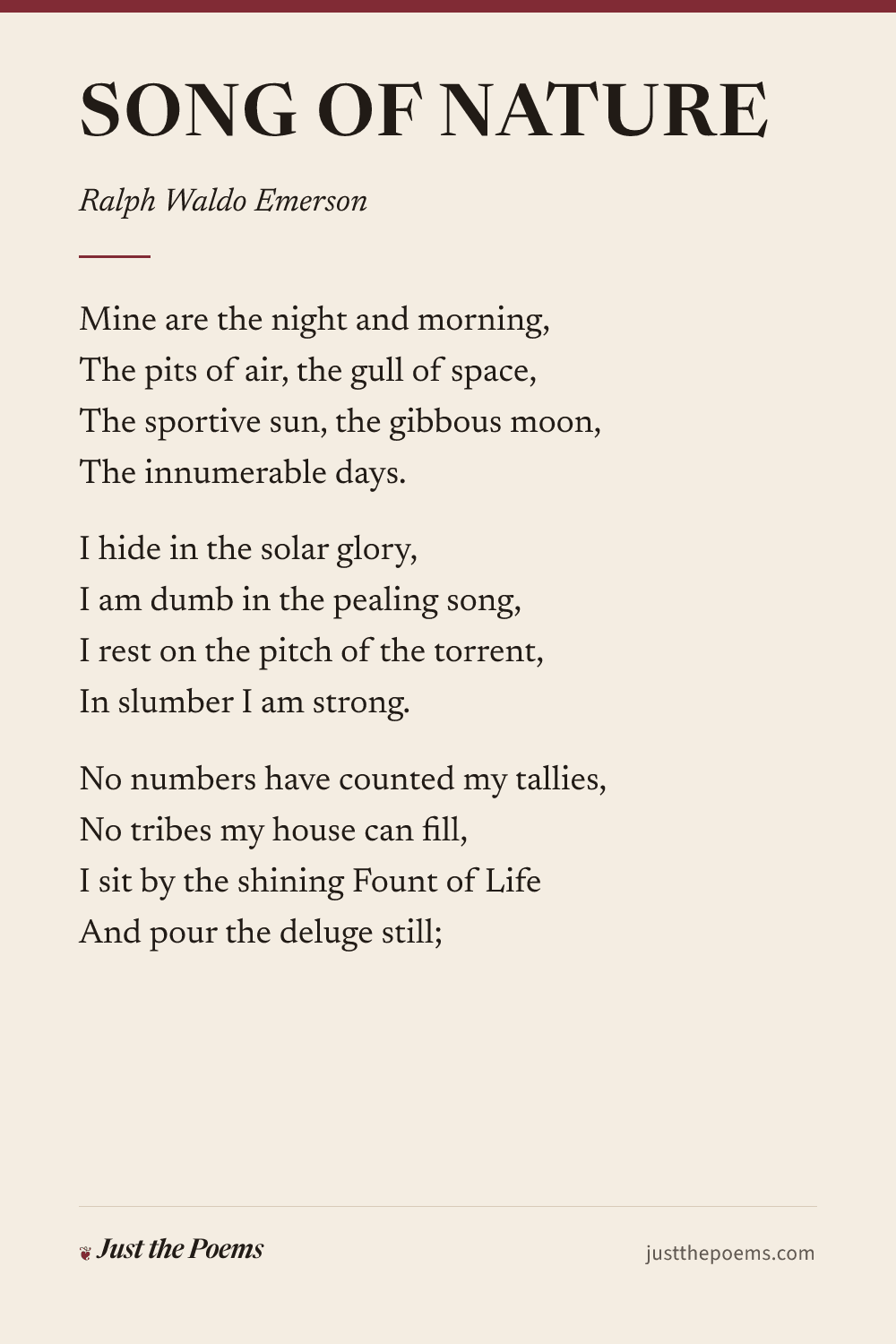
SONG OF NATURE

Ralph Waldo Emerson

In 0 Wikipedias 1 anthology Poet in 92 Wikipedias

Mine are the night and morning,The pits of air, the gull of space,The sportive sun, the gibbous moon,The innumerable days.

I hide in the solar glory,I am dumb in the pealing song,I rest on the pitch of the torrent,In slumber I am strong.

No numbers have counted my tallies,No tribes my house can fill,I sit by the shining Fount of LifeAnd pour the deluge still;

Show all 84 lines 72 more

And ever by delicate powersGathering along the centuriesFrom race on race the rarest flowers,My wreath shall nothing miss.

And many a thousand summersMy gardens ripened well,And light from meliorating starsWith firmer glory fell.

I wrote the past in charactersOf rock and fire the scroll,The building in the coral sea,The planting of the coal.

And thefts from satellites and ringsAnd broken stars I drew,And out of spent and aged thingsI formed the world anew;

What time the gods kept carnival,Tricked out in star and flower,And in cramp elf and saurian formsThey swathed their too much power.

Time and Thought were my surveyors,They laid their courses well,They boiled the sea, and piled the layersOf granite, marl and shell.

But he, the man-child glorious,--Where tarries he the while?The rainbow shines his harbinger,The sunset gleams his smile.

My boreal lights leap upward,Forthright my planets roll,And still the man-child is not born,The summit of the whole.

Must time and tide forever run?Will never my winds go sleep in the west?Will never my wheels which whirl the sunAnd satellites have rest?

Too much of donning and doffing,Too slow the rainbow fades,I weary of my robe of snow,My leaves and my cascades;

I tire of globes and races,Too long the game is played;What without him is summer's pomp,Or winter's frozen shade?

I travail in pain for him,My creatures travail and wait;His couriers come by squadrons,He comes not to the gate.

Twice I have moulded an image,And thrice outstretched my hand,Made one of day and one of nightAnd one of the salt sea-sand.

One in a Judaean manger,And one by Avon stream,One over against the mouths of Nile,And one in the Academe.

I moulded kings and saviors,And bards o'er kings to rule;--But fell the starry influence short,The cup was never full.

Yet whirl the glowing wheels once more,And mix the bowl again;Seethe, Fate! the ancient elements,Heat, cold, wet, dry, and peace, and pain.

Let war and trade and creeds and songBlend, ripen race on race,The sunburnt world a man shall breedOf all the zones and countless days.

No ray is dimmed, no atom worn,My oldest force is good as new,And the fresh rose on yonder thornGives back the bending heavens in dew.

Source

The Home Book of Verse, ed. Burton Egbert Stevenson

Filed under
  • Section “MOTHER NATURE”, The Home Book of Verse
  • Named in the title

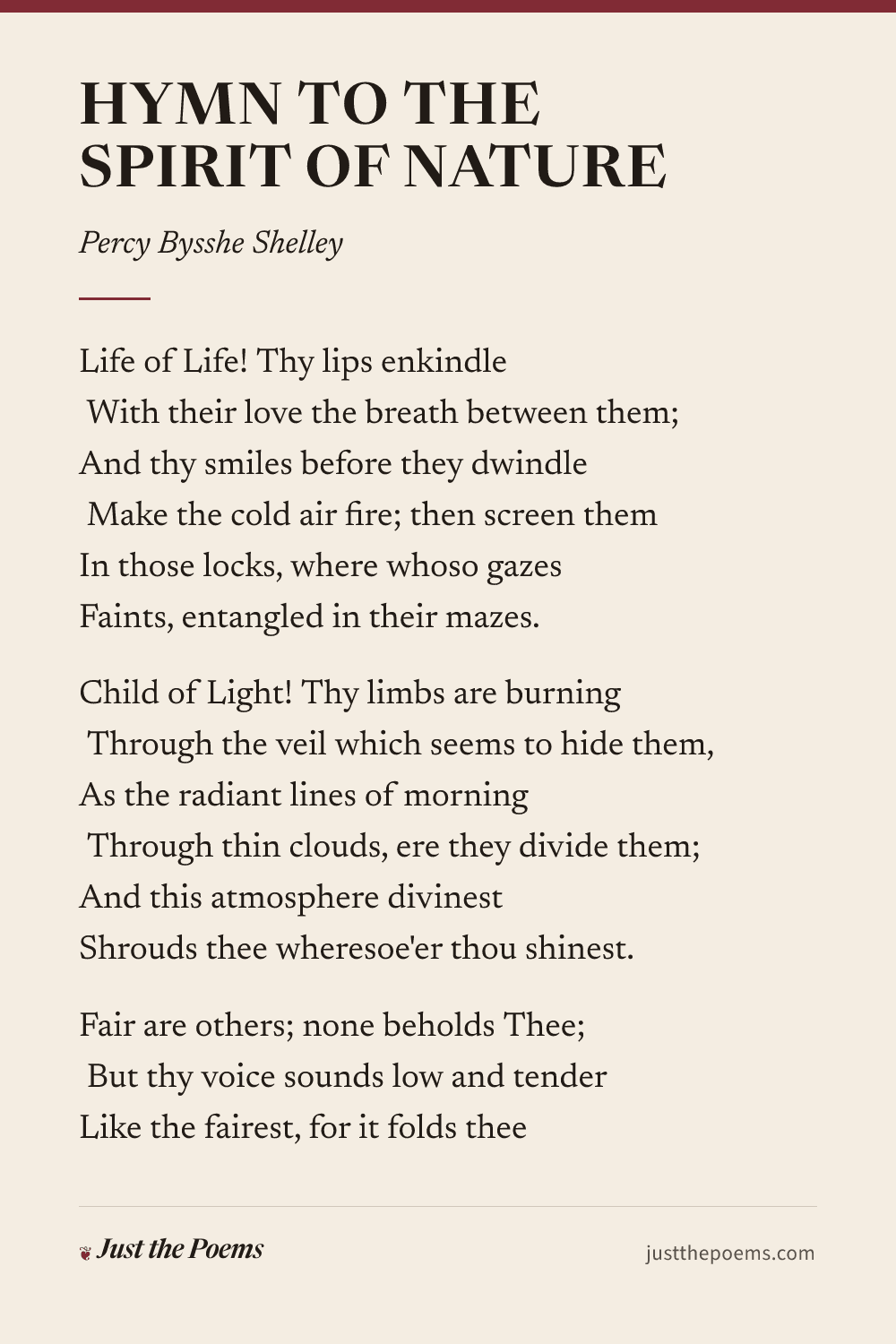
HYMN TO THE SPIRIT OF NATURE

Percy Bysshe Shelley

In 0 Wikipedias 1 anthology Poet in 91 Wikipedias

Life of Life! Thy lips enkindle With their love the breath between them;And thy smiles before they dwindle Make the cold air fire; then screen themIn those locks, where whoso gazesFaints, entangled in their mazes.

Child of Light! Thy limbs are burning Through the veil which seems to hide them,As the radiant lines of morning Through thin clouds, ere they divide them;And this atmosphere divinestShrouds thee wheresoe'er thou shinest.

Fair are others; none beholds Thee; But thy voice sounds low and tenderLike the fairest, for it folds thee From the sight, that liquid splendour;And all feel, yet see thee never,--As I feel now, lost for ever!

Lamp of Earth! Where'er thou movest Its dim shapes are clad with brightness,And the souls of whom thou lovest Walk upon the winds with lightnessTill they fail, as I am failing,Dizzy, lost, yet unbewailing!

Source

The Golden Treasury, ed. Francis Turner Palgrave

Filed under
  • Named in the title

Advertisements

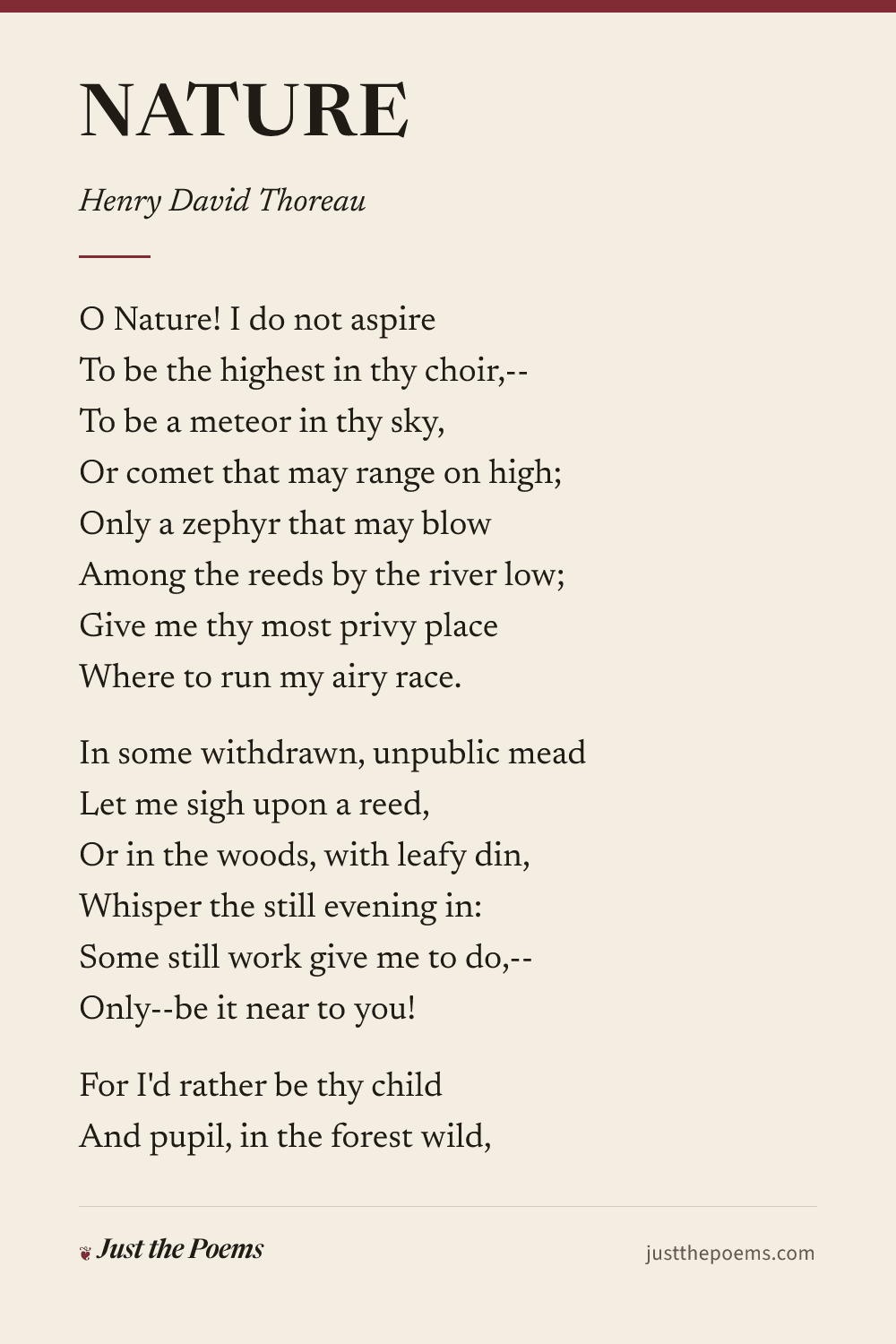
NATURE

Henry David Thoreau

In 0 Wikipedias 1 anthology Poet in 88 Wikipedias

O Nature! I do not aspireTo be the highest in thy choir,--To be a meteor in thy sky,Or comet that may range on high;Only a zephyr that may blowAmong the reeds by the river low;Give me thy most privy placeWhere to run my airy race.

In some withdrawn, unpublic meadLet me sigh upon a reed,Or in the woods, with leafy din,Whisper the still evening in:Some still work give me to do,--Only--be it near to you!

For I'd rather be thy childAnd pupil, in the forest wild,Than be the king of men elsewhere,And most sovereign slave of care;To have one moment of thy dawn,Than share the city's year forlorn.

Source

The Home Book of Verse, ed. Burton Egbert Stevenson

Filed under
  • Section “MOTHER NATURE”, The Home Book of Verse
  • Library subject “Nature -- Poetry”, Poems of Nature
  • Named in the title

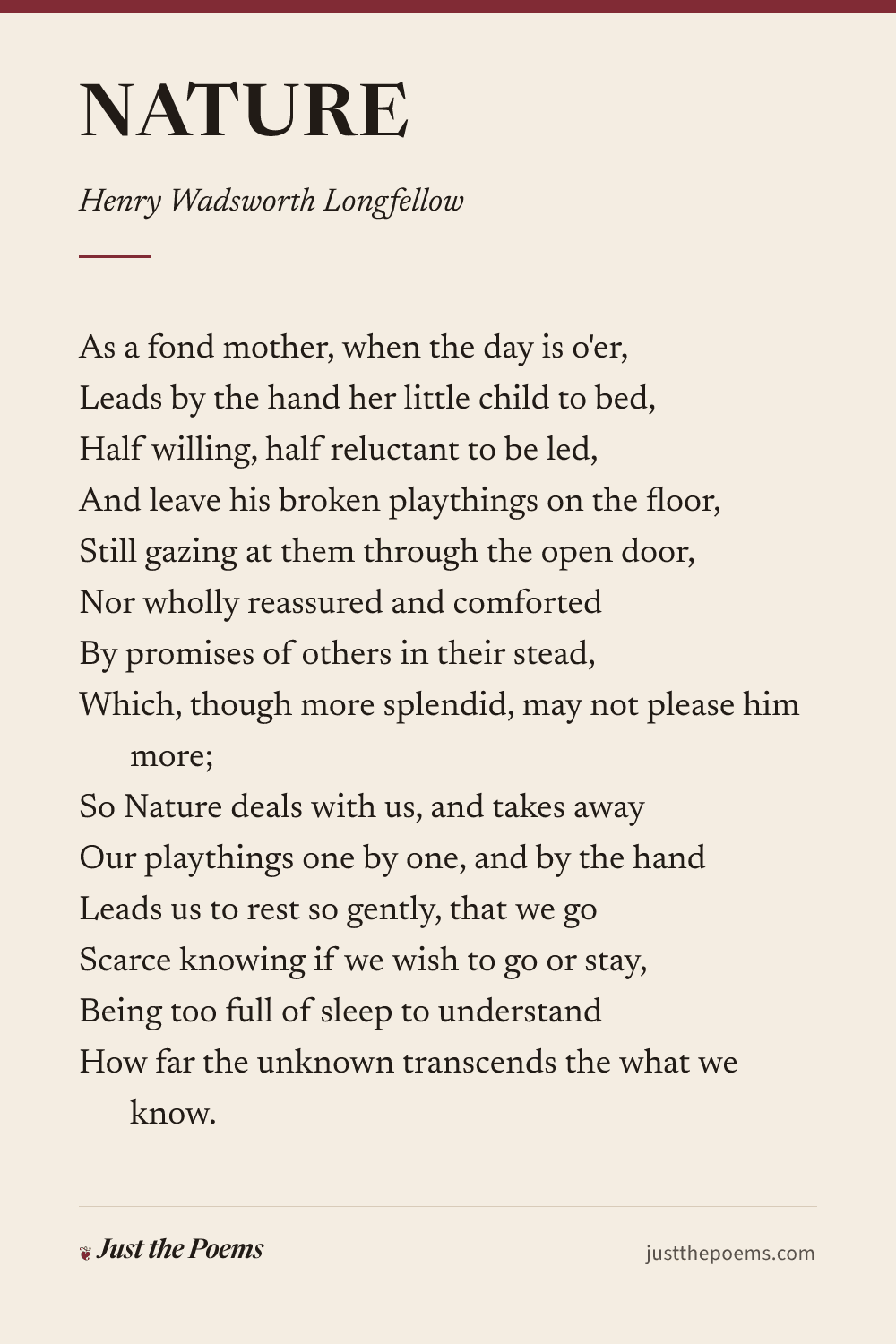
NATURE

Henry Wadsworth Longfellow

In 0 Wikipedias 1 anthology Poet in 71 Wikipedias

As a fond mother, when the day is o'er,Leads by the hand her little child to bed,Half willing, half reluctant to be led,And leave his broken playthings on the floor,Still gazing at them through the open door,Nor wholly reassured and comfortedBy promises of others in their stead,Which, though more splendid, may not please him more;So Nature deals with us, and takes awayOur playthings one by one, and by the handLeads us to rest so gently, that we goScarce knowing if we wish to go or stay,Being too full of sleep to understandHow far the unknown transcends the what we know.

Source

The Home Book of Verse, ed. Burton Egbert Stevenson

Filed under
  • Section “MOTHER NATURE”, The Home Book of Verse
  • Named in the title

QUIET WORK

Matthew Arnold

In 0 Wikipedias 1 anthology Poet in 50 Wikipedias

One lesson, Nature, let me learn of thee,One lesson which in every wind is blown,One lesson of two duties kept at oneThough the loud world proclaim their enmity--Of toil unsevered from tranquillity;Of labor, that in lasting fruit outgrowsFar noisier schemes, accomplished in repose,Too great for haste, too high for rivalry.

Yes, while on earth a thousand discords ring,Man's fitful uproar mingling with his toil,Still do thy sleepless ministers move on,Their glorious tasks in silence perfecting;Still working, blaming still our vain turmoil;Laborers that shall not fail, when man is gone.

Source

The Home Book of Verse, ed. Burton Egbert Stevenson

Filed under
  • Section “MOTHER NATURE”, The Home Book of Verse

I SHALL NOT CARE

Sara Teasdale

In 0 Wikipedias 1 anthology Poet in 37 Wikipedias

When I am dead and over me bright AprilShakes out her rain-drenched hair,Though you should lean above me broken-hearted,I shall not care.

I shall have peace, as leafy trees are peacefulWhen rain bends down the bough,And I shall be more silent and cold-heartedThan you are now.

Source

The Home Book of Verse, ed. Burton Egbert Stevenson

Filed under
  • Library subject “Nature -- Poetry”, Rivers to the Sea

THE KISS

Sara Teasdale

In 0 Wikipedias 1 anthology Poet in 37 Wikipedias

Before you kissed me only winds of heavenHad kissed me, and the tenderness of rain -Now you have come, how can I care for kissesLike theirs again?

I sought the sea, she sent her winds to meet me,They surged about me singing of the south -I turned my head away to keep still holyYour kiss upon my mouth.

And swift sweet rains of shining April weatherFound not my lips where living kisses are;I bowed my head lest they put out my gloryAs rain puts out a star.

I am my love's and he is mine forever,Sealed with a seal and safe forevermore -Think you that I could let a beggar enterWhere a king stood before?

Source

The Home Book of Verse, ed. Burton Egbert Stevenson

Filed under
  • Library subject “Nature -- Poetry”, Rivers to the Sea

Advertisements

THE LOOK

Sara Teasdale

In 0 Wikipedias 1 anthology Poet in 37 Wikipedias

Strephon kissed me in the spring,Robin in the fall,But Colin only looked at meAnd never kissed at all.

Strephon's kiss was lost in jest,Robin's lost in play,But the kiss in Colin's eyesHaunts me night and day.

Source

The Home Book of Verse, ed. Burton Egbert Stevenson

Filed under
  • Library subject “Nature -- Poetry”, Rivers to the Sea

TO ROSE

Sara Teasdale

In 0 Wikipedias 1 anthology Poet in 37 Wikipedias

Rose, when I remember you,Little lady, scarcely two,I am suddenly awareOf the angels in the air.All your softly gracious waysMake an island in my daysWhere my thoughts fly back to beSheltered from too strong a sea.All your luminous delightShines before me in the nightWhen I grope for sleep and findOnly shadows in my mind.

Rose, when I remember you,White and glowing, pink and new,With so swift a sense of funAlthough life has just begun;With so sure a pride of placeIn your very infant face,I should like to make a prayerTo the angels in the air:"If an angel ever bringsMe a baby in her wings,Please be certain that it growsVery, very much like Rose."

Source

The Home Book of Verse, ed. Burton Egbert Stevenson

Filed under
  • Library subject “Nature -- Poetry”, Rivers to the Sea

THE GLADNESS OF NATURE

William Cullen Bryant

In 0 Wikipedias 1 anthology Poet in 28 Wikipedias

Is this a time to be cloudy and sad,When our mother Nature laughs around;When even the deep blue heavens look glad,And gladness breathes from the blossoming ground?

There are notes of joy from the hang-bird and wren,And the gossip of swallows through all the sky;The ground-squirrel gaily chirps by his den,And the wilding bee hums merrily by.

The clouds are at play in the azure spaceAnd their shadows at play on the bright-green vale,And here they stretch to the frolic chase,And there they roll on the easy gale.

There's a dance of leaves in that aspen bower,There's a titter of winds in that beechen tree,There's a smile on the fruit, and a smile on the flower,And a laugh from the brook that runs to the sea.

And look at the broad-faced sun, how he smilesOn the dewy earth that smiles in his ray,On the leaping waters and gay young isles;Ay, look, and he'll smile thy gloom away.

Source

The Home Book of Verse, ed. Burton Egbert Stevenson

Filed under
  • Named in the title

SIMPLE NATURE

George John Romanes

In 0 Wikipedias 1 anthology Poet in 16 Wikipedias

Be it not mine to steal the cultured flowerFrom any garden of the rich and great,Nor seek with care, through many a weary hour,Some novel form of wonder to create.Enough for me the leafy woods to rove,And gather simple cups of morning dew,Or, in the fields and meadows that I love,Find beauty in their bells of every hue.Thus round my cottage floats a fragrant air,And though the rustic plot be humbly laid,Yet, like the lilies gladly growing there,I have not toiled, but take what God has made.My Lord Ambition passed, and smiled in scorn;I plucked a rose, and, lo! it had no thorn.

Source

The Home Book of Verse, ed. Burton Egbert Stevenson

Filed under
  • Named in the title

COMPENSATION

Celia Thaxter

In 0 Wikipedias 1 anthology Poet in 8 Wikipedias

In that new world toward which our feet are set,Shall we find aught to make our hearts forgetEarth's homely joys and her bright hours of bliss?Has heaven a spell divine enough for this?For who the pleasure of the spring shall tellWhen on the leafless stalk the brown buds swell,When the grass brightens and the days grow long,And little birds break out in rippling song?

O sweet the dropping eve, the blush of morn,The starlit sky, the rustling fields of corn,The soft airs blowing from the freshening seas,The sunflecked shadow of the stately trees,

Show all 32 lines 20 more

The mellow thunder and the lulling rain,The warm, delicious, happy summer rain,When the grass brightens and the days grow long,And little birds break out in rippling song!

O beauty manifold, from morn till night,Dawn's flush, noon's blaze and sunset's tender light!O fair, familiar features, changes sweetOf her revolving seasons, storm and sleetAnd golden calm, as slow she wheels through space,From snow to roses,--and how dear her face,When the grass brightens, when the days grow long,And little birds break out in rippling song!

O happy earth! O home so well beloved!What recompense have we, from thee removed?One hope we have that overtops the whole,--The hope of finding every vanished soul,We love and long for daily, and for thisGladly we turn from thee, and all thy bliss,Even at thy loveliest, when the days are long,And little birds break out in rippling song.

Source

The Home Book of Verse, ed. Burton Egbert Stevenson

Filed under
  • Section “MOTHER NATURE”, The Home Book of Verse

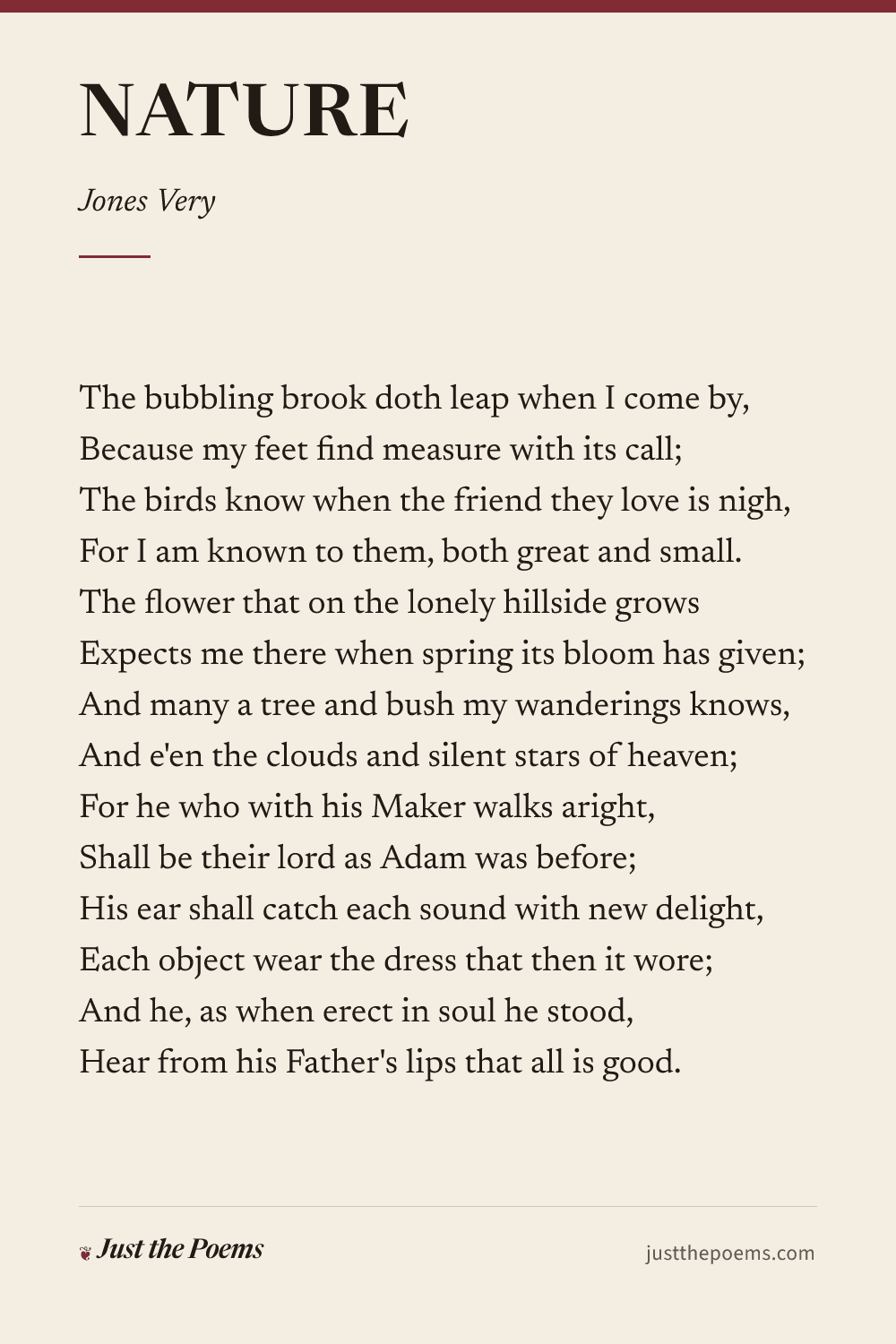
NATURE

Jones Very

In 0 Wikipedias 1 anthology Poet in 8 Wikipedias

The bubbling brook doth leap when I come by,Because my feet find measure with its call;The birds know when the friend they love is nigh,For I am known to them, both great and small.The flower that on the lonely hillside growsExpects me there when spring its bloom has given;And many a tree and bush my wanderings knows,And e'en the clouds and silent stars of heaven;For he who with his Maker walks aright,Shall be their lord as Adam was before;His ear shall catch each sound with new delight,Each object wear the dress that then it wore;And he, as when erect in soul he stood,Hear from his Father's lips that all is good.

Source

The Home Book of Verse, ed. Burton Egbert Stevenson

Filed under
  • Section “MOTHER NATURE”, The Home Book of Verse
  • Named in the title

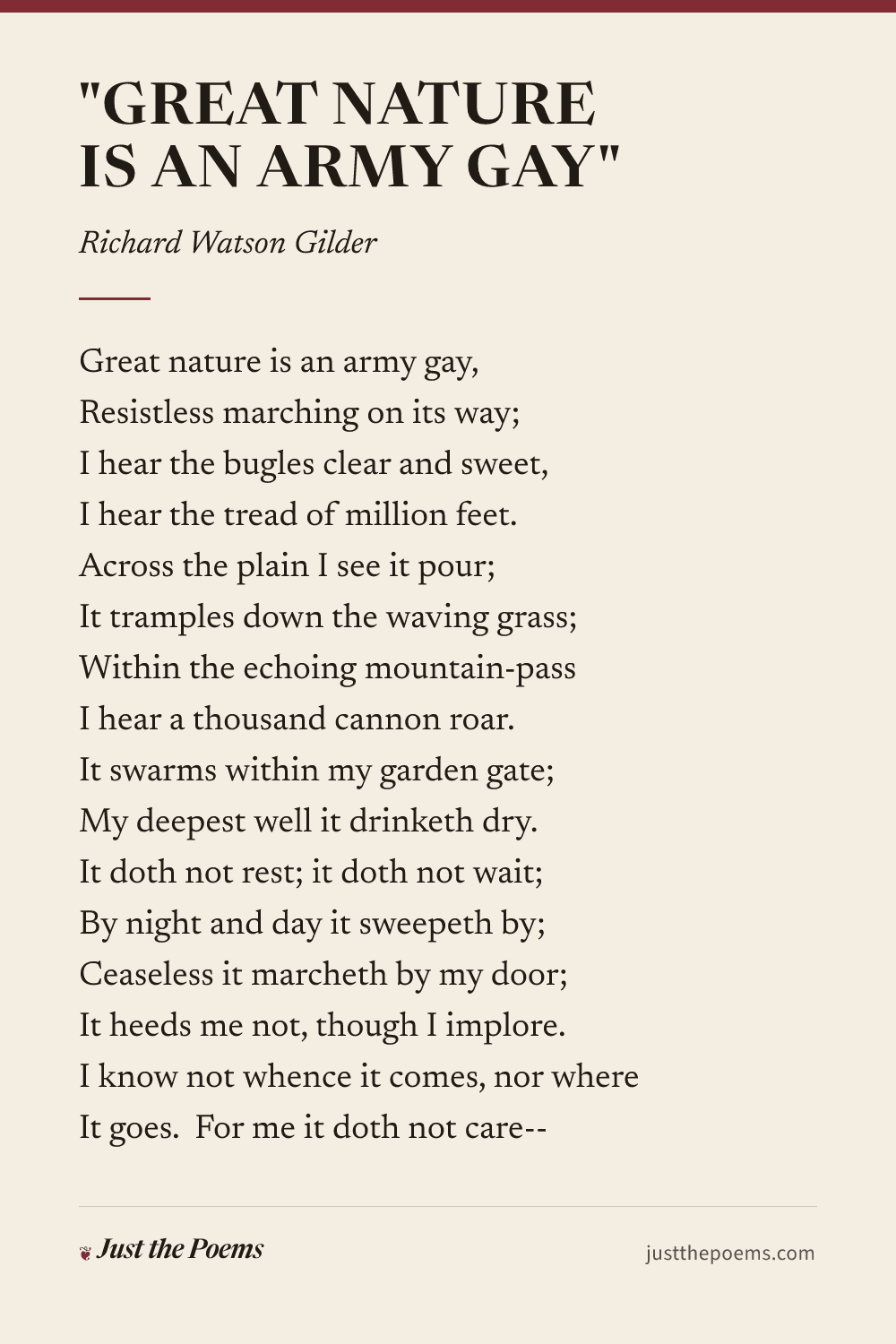
"GREAT NATURE IS AN ARMY GAY"

Richard Watson Gilder

In 0 Wikipedias 1 anthology Poet in 5 Wikipedias

Great nature is an army gay,Resistless marching on its way;I hear the bugles clear and sweet,I hear the tread of million feet.Across the plain I see it pour;It tramples down the waving grass;Within the echoing mountain-passI hear a thousand cannon roar.It swarms within my garden gate;My deepest well it drinketh dry.It doth not rest; it doth not wait;By night and day it sweepeth by;Ceaseless it marcheth by my door;It heeds me not, though I implore.I know not whence it comes, nor whereIt goes. For me it doth not care--Whether I starve, or eat, or sleep,Or live, or die, or sing, or weep.And now the banners all are bright,Now torn and blackened by the fight.Sometimes its laughter shakes the sky,Sometimes the groans of those who die.Still through the night and through the livelong dayThe infinite army marches on its remorseless way.

Source

The Home Book of Verse, ed. Burton Egbert Stevenson

Filed under
  • Section “MOTHER NATURE”, The Home Book of Verse
  • Named in the title

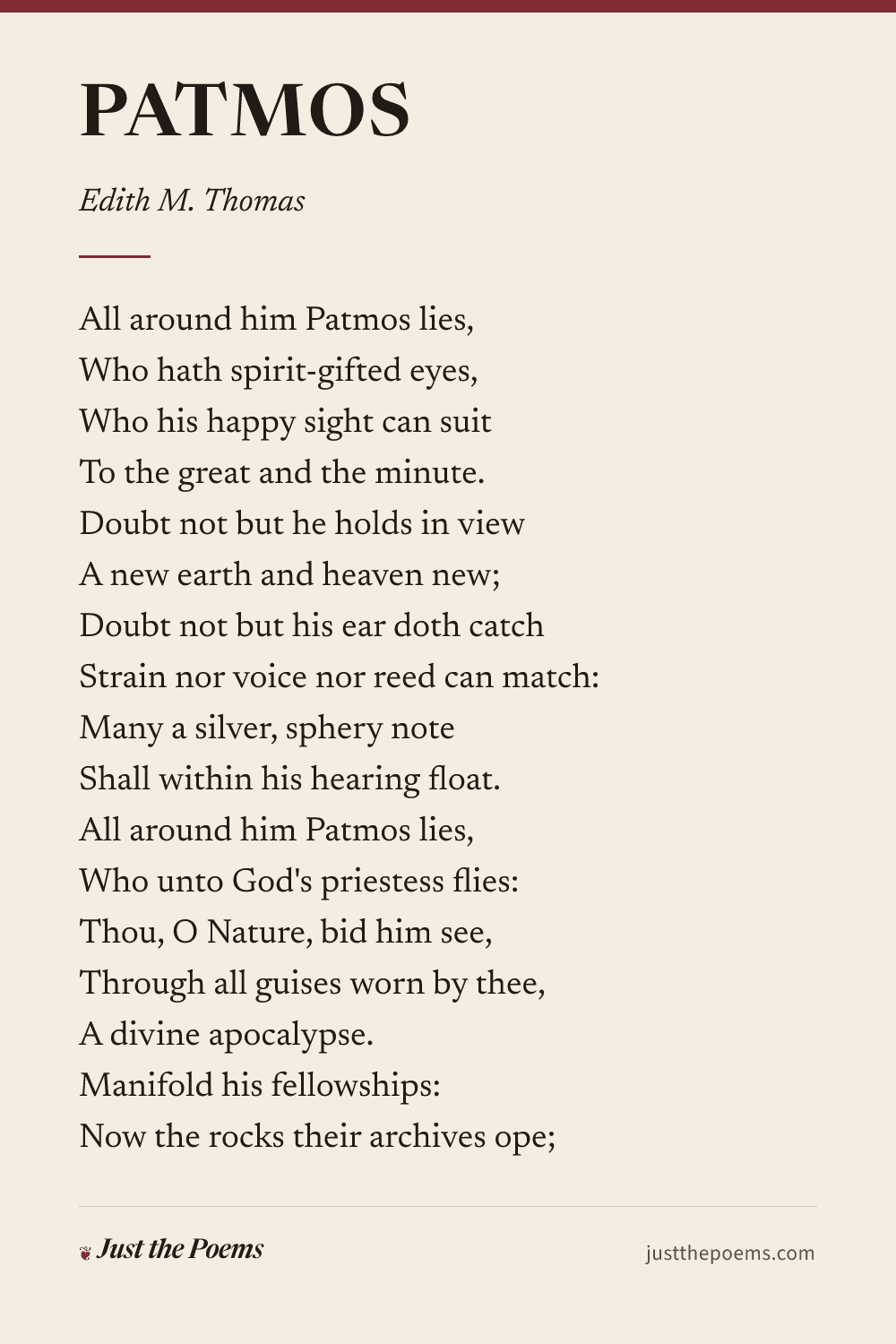
PATMOS

Edith M. Thomas

In 0 Wikipedias 1 anthology Poet in 3 Wikipedias

All around him Patmos lies,Who hath spirit-gifted eyes,Who his happy sight can suitTo the great and the minute.Doubt not but he holds in viewA new earth and heaven new;Doubt not but his ear doth catchStrain nor voice nor reed can match:Many a silver, sphery noteShall within his hearing float.All around him Patmos lies,Who unto God's priestess flies:

Show all 48 lines 36 more

Thou, O Nature, bid him see,Through all guises worn by thee,A divine apocalypse.Manifold his fellowships:Now the rocks their archives ope;Voiceless creatures tell their hopeIn a language symbol-wrought;Groves to him sigh out their thought;Musings of the flower and grassThrough his quiet spirit pass.'Twixt new earth and heaven newHe hath traced and holds the clue,Number his delights ye may not;Fleets the year but these decay not.Now the freshets of the rain,Bounding on from hill to plain,Show him earthly streams have riseIn the bosom of the skies.Now he feels the morning thrill,As upmounts, unseen and still,Dew the wing of evening drops.Now the frost, that meets and stopsSummer's feet in tender sward,Greets him, breathing heavenward.Hieroglyphics writes the snow,Through the silence falling slow;Types of star and petaled bloomA white missal-page illume.By these floating symbols fine,Heaven-truth shall be divine.

All around him Patmos lies,Who hath spirit-gifted eyes;He need not afar remove,He need not the times reprove,Who would hold perpetual leaseOf an isle in seas of peace.

Source

The Home Book of Verse, ed. Burton Egbert Stevenson

Filed under
  • Section “MOTHER NATURE”, The Home Book of Verse

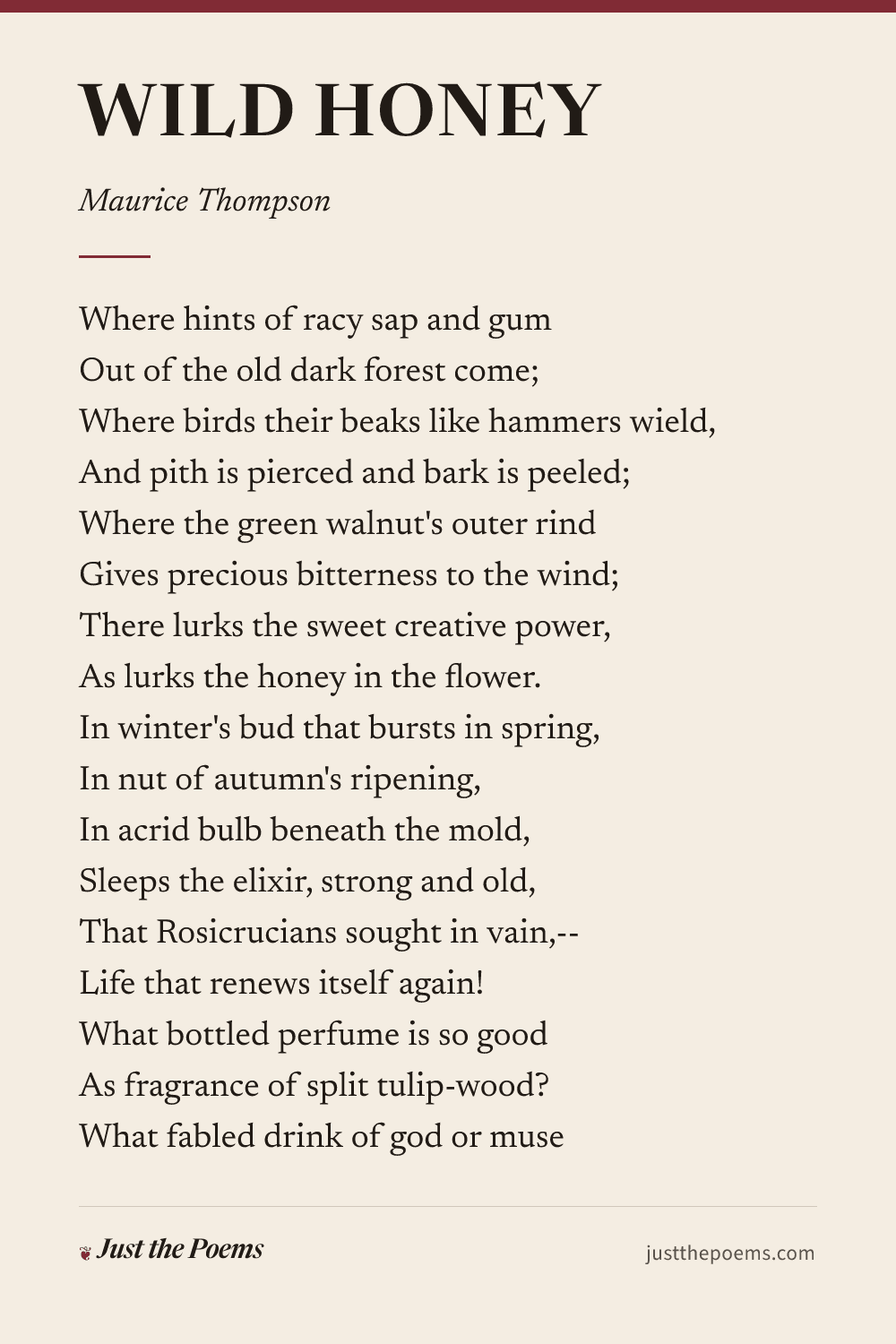
WILD HONEY

Maurice Thompson

In 0 Wikipedias 1 anthology Poet in 3 Wikipedias

Where hints of racy sap and gumOut of the old dark forest come;Where birds their beaks like hammers wield,And pith is pierced and bark is peeled;Where the green walnut's outer rindGives precious bitterness to the wind;There lurks the sweet creative power,As lurks the honey in the flower.In winter's bud that bursts in spring,In nut of autumn's ripening,In acrid bulb beneath the mold,Sleeps the elixir, strong and old,

Show all 26 lines 14 more

That Rosicrucians sought in vain,--Life that renews itself again!What bottled perfume is so goodAs fragrance of split tulip-wood?What fabled drink of god or museWas rich as purple mulberry juice?And what school-polished gem of thoughtIs like the rune from Nature caught?He is a poet strong and trueWho loves wild thyme and honey-dew;And like a brown bee works and singsWith morning freshness on his wings,And a golden burden on his thighs,--The pollen-dust of centuries!

Source

The Home Book of Verse, ed. Burton Egbert Stevenson

Filed under
  • Section “MOTHER NATURE”, The Home Book of Verse

"HERE IS THE PLACE WHERE LOVELINESS KEEPS HOUSE"

Madison Cawein

In 0 Wikipedias 1 anthology Poet in 2 Wikipedias

Here is the place where Loveliness keeps house,Between the river and the wooded hills,Within a valley where the Springtime spillsHer firstling wind-flowers under blossoming boughs:Where Summer sits braiding her warm, white browsWith bramble-roses; and where Autumn fillsHer lap with asters; and old Winter frillsWith crimson haw and hip his snowy blouse.Here you may meet with Beauty. Here she sitsGazing upon the moon, or all the dayTuning a wood-thrush flute, remote, unseen;Or when the storm is out, 'tis she who flitsFrom rock to rock, a form of flying spray,Shouting, beneath the leaves' tumultuous green.

Source

The Home Book of Verse, ed. Burton Egbert Stevenson

Filed under
  • Section “MOTHER NATURE”, The Home Book of Verse

TO MOTHER NATURE

Frederic Lawrence Knowles

In 0 Wikipedias 1 anthology Poet in 1 Wikipedia

Nature, in thy largess, grantI may be thy confidant!Taste who will life's roadside cheer(Though my heart doth hold it dear--Song and wine and trees and grass,All the joys that flash and pass),I must put within my prayerGifts more intimate and rare.Show me how dry branches throwSuch blue shadows on the snow,--Tell me how the wind can fareOn his unseen feet of air,--

Show all 36 lines 24 more

Show me how the spider's loomWeaves the fabric from her womb,--Lead me to those brooks of mornWhere a woman's laugh is born,--Let me taste the sap that flowsThrough the blushes of a rose,Yea, and drain the blood which runsFrom the heart of dying suns,--Teach me how the butterflyGuessed at immortality,--Let me follow up the trackOf Love's deathless ZodiacWhere Joy climbs among the spheresCircled by her moon of tears,--Tell me how, when I forgetAll the schools have taught me, yetI recall each trivial thingIn a golden far off Spring,--Give me whispered hints how IMay instruct my heart to flyWhere the baffling Vision gleamsTill I overtake my dreams,And the impossible be doneWhen the Wish and Deed grow one!

Source

The Home Book of Verse, ed. Burton Egbert Stevenson

Filed under
  • Section “MOTHER NATURE”, The Home Book of Verse
  • Named in the title

FRAGMENT: ROME AND NATURE.

Percy Bysshe Shelley

In 0 Wikipedias 0 anthologies Poet in 91 Wikipedias

Rome has fallen, ye see it lyingHeaped in undistinguished ruin:Nature is alone undying.

***

Source

The Complete Poetical Works of Percy Bysshe Shelley — Volume 2, ed. Thomas Hutchinson, 1914

Filed under
  • Named in the title

NATURE’S QUESTIONING

Thomas Hardy

In 0 Wikipedias 0 anthologies Poet in 91 Wikipedias

WHEN I look forth at dawning, pool, Field, flock, and lonely tree, All seem to gaze at meLike chastened children sitting silent in a school;

Their faces dulled, constrained, and worn, As though the master’s ways Through the long teaching daysTheir first terrestrial zest had chilled and overborne.

And on them stirs, in lippings mere (As if once clear in call, But now scarce breathed at all)—“We wonder, ever wonder, why we find us here!

Show all 28 lines 16 more

“Has some Vast Imbecility, Mighty to build and blend, But impotent to tend,Framed us in jest, and left us now to hazardry?

“Or come we of an Automaton Unconscious of our pains? . . . Or are we live remainsOf Godhead dying downwards, brain and eye now gone?

“Or is it that some high Plan betides, As yet not understood, Of Evil stormed by Good,We the Forlorn Hope over which Achievement strides?”

Thus things around. No answerer I . . . Meanwhile the winds, and rains, And Earth’s old glooms and painsAre still the same, and gladdest Life Death neighbours nigh.

Source

Wessex Poems and Other Verses, 1919

Filed under
  • Named in the title

THE SLOW NATURE (AN INCIDENT OF FROOM VALLEY)

Thomas Hardy

In 0 Wikipedias 0 anthologies Poet in 91 Wikipedias

“THY husband—poor, poor Heart!—is dead— Dead, out by Moreford Rise;A bull escaped the barton-shed, Gored him, and there he lies!”

—“Ha, ha—go away! ’Tis a tale, methink, Thou joker Kit!” laughed she.“I’ve known thee many a year, Kit Twink, And ever hast thou fooled me!”

—“But, Mistress Damon—I can swear Thy goodman John is dead!And soon th’lt hear their feet who bear His body to his bed.”

Show all 32 lines 20 more

So unwontedly sad was the merry man’s face— That face which had long deceived—That she gazed and gazed; and then could trace The truth there; and she believed.

She laid a hand on the dresser-ledge, And scanned far Egdon-side;And stood; and you heard the wind-swept sedge And the rippling Froom; till she cried:

“O my chamber’s untidied, unmade my bed Though the day has begun to wear!‘What a slovenly hussif!’ it will be said, When they all go up my stair!”

She disappeared; and the joker stood Depressed by his neighbour’s doom,And amazed that a wife struck to widowhood Thought first of her unkempt room.

But a fortnight thence she could take no food, And she pined in a slow decay;While Kit soon lost his mournful mood And laughed in his ancient way.

Source

Wessex Poems and Other Verses, 1919

Filed under
  • Named in the title

TO OUTER NATURE

Thomas Hardy

In 0 Wikipedias 0 anthologies Poet in 91 Wikipedias

SHOW thee as I thought theeWhen I early sought thee, Omen-scouting, All undoubtingLove alone had wrought thee—

Wrought thee for my pleasure,Planned thee as a measure For expounding And resoundingGlad things that men treasure.

O for but a momentOf that old endowment—

Show all 30 lines 18 more

Light to gaily See thy dailyIrisèd embowment!

But such re-adorningTime forbids with scorning— Makes me see things Cease to be thingsThey were in my morning.

Fad’st thou, glow-forsaken,Darkness-overtaken! Thy first sweetness, Radiance, meetness,None shall re-awaken.

Why not sempiternalThou and I? Our vernal Brightness keeping, Time outleaping;Passed the hodiernal!

Source

Wessex Poems and Other Verses, 1919

Filed under
  • Named in the title

BABY TORTOISE

D. H. Lawrence

In 0 Wikipedias 0 anthologies Poet in 79 Wikipedias

You know what it is to be born alone,Baby tortoise!

The first day to heave your feet little by little from the shell,Not yet awake,And remain lapsed on earth,Not quite alive.

A tiny, fragile, half-animate bean.

To open your tiny beak-mouth, that looks as if it would never open,Like some iron door;To lift the upper hawk-beak from the lower baseAnd reach your skinny little neckAnd take your first bite at some dim bit of herbage,

Show all 80 lines 68 more

Alone, small insect,Tiny bright-eye,Slow one.

To take your first solitary biteAnd move on your slow, solitary hunt.Your bright, dark little eye,Your eye of a dark disturbed night,Under its slow lid, tiny baby tortoise,So indomitable.

No one ever heard you complain.

You draw your head forward, slowly, from your little wimpleAnd set forward, slow-dragging, on your four-pinned toes,Rowing slowly forward.Whither away, small bird?

Rather like a baby working its limbs,Except that you make slow, ageless progressAnd a baby makes none.

The touch of sun excites you,And the long ages, and the lingering chillMake you pause to yawn,Opening your impervious mouth,Suddenly beak-shaped, and very wide, like some suddenly gaping pincers;Soft red tongue, and hard thin gums,Then close the wedge of your little mountain front,Your face, baby tortoise.

Do you wonder at the world, as slowly you turn your head in its wimpleAnd look with laconic, black eyes?Or is sleep coming over you again,The non-life?

You are so hard to wake.

Are you able to wonder?Or is it just your indomitable will and pride of the first lifeLooking roundAnd slowly pitching itself against the inertiaWhich had seemed invincible?

The vast inanimate,And the fine brilliance of your so tiny eye,Challenger.

Nay, tiny shell-bird,What a huge vast inanimate it is, that you must row against,What an incalculable inertia.

Challenger,Little Ulysses, fore-runner,No bigger than my thumb-nail,Buon viaggio.

All animate creation on your shoulder,Set forth, little Titan, under your battle-shield.

The ponderous, preponderate,Inanimate universe;And you are slowly moving, pioneer, you alone.

How vivid your travelling seems now, in the troubled sunshine,Stoic, Ulyssean atom;Suddenly hasty, reckless, on high toes.

Voiceless little bird,Resting your head half out of your wimpleIn the slow dignity of your eternal pause.Alone, with no sense of being alone,And hence six times more solitary;Fulfilled of the slow passion of pitching through immemorial agesYour little round house in the midst of chaos.

Over the garden earth,Small bird,Over the edge of all things.

Traveller,With your tail tucked a little on one sideLike a gentleman in a long-skirted coat.

All life carried on your shoulder,Invincible fore-runner.

Source

Birds, Beasts and Flowers Poems by D. H. Lawrence

Filed under
  • Library subject “Nature -- Poetry”, Birds, Beasts and Flowers Poems by D. H. Lawrence

LUI ET ELLE

D. H. Lawrence

In 0 Wikipedias 0 anthologies Poet in 79 Wikipedias

She is large and matronlyAnd rather dirty,A little sardonic-looking, as if domesticity had driven her to it.

Though what she does, except lay four eggs at random in the garden once a yearAnd put up with her husband,I don’t know.

She likes to eat.She hurries up, striding reared on long uncanny legs,When food is going.Oh yes, she can make haste when she likes.

She snaps the soft bread from my hand in great mouthfuls,

Show all 109 lines 97 more

Opening her rather pretty wedge of an iron, pristine faceInto an enormously wide-beaked mouthLike sudden curved scissors,And gulping at more than she can swallow, and working her thick, soft tongue,And having the bread hanging over her chin.

O Mistress, Mistress,Reptile mistress,Your eye is very dark, very bright,And it never softensAlthough you watch.

She knows,She knows well enough to come for food,Yet she sees me not;Her bright eye sees, but not me, not anything,Sightful, sightless, seeing and visionless,Reptile mistress.

Taking bread in her curved, gaping, toothless mouth,She has no qualm when she catches my finger in her steel overlapping gums,But she hangs on, and my shout and my shrinking are nothing to her.She does not even know she is nipping me with her curved beak.Snake-like she draws at my finger, while I drag it in horror away.

Mistress, reptile mistress,You are almost too large, I am almost frightened.

He is much smaller,Dapper beside her,And ridiculously small.

Her laconic eye has an earthy, materialistic look,His, poor darling, is almost fiery.

His wimple, his blunt-prowed face,His low forehead, his skinny neck, his long, scaled, striving legs,So striving, striving,Are all more delicate than she,And he has a cruel scar on his shell.

Poor darling, biting at her feet,Running beside her like a dog, biting her earthy, splay feet,Nipping her ankles,Which she drags apathetic away, though without retreating into her shell.

Agelessly silent,And with a grim, reptile determination,Cold, voiceless age-after-age behind him, serpents’ long obstinacyOf horizontal persistence.

Little old manScuffling beside her, bending down, catching his opportunity,Parting his steel-trap face, so suddenly, and seizing her scaly ankle,And hanging grimly on,Letting go at last as she drags away,And closing his steel-trap face.

His steel-trap, stoic, ageless, handsome face.Alas, what a fool he looks in this scuffle.

And how he feels it!The lonely rambler, the stoic, dignified stalker through chaos,The immune, the animate,Enveloped in isolation,Forerunner.Now look at him!

Alas, the spear is through the side of his isolation.His adolescence saw him crucified into sex,Doomed, in the long crucifixion of desire, to seek his consummation beyond himself.Divided into passionate duality,He, so finished and immune, now broken into desirous fragmentariness,Doomed to make an intolerable fool of himselfIn his effort toward completion again.

Poor little earthy house-inhabiting Osiris,The mysterious bull tore him at adolescence into pieces,And he must struggle after reconstruction, ignominiously.

And so behold him following the tailOf that mud-hovel of his slowly rambling spouse,Like some unhappy bull at the tail of a cow,But with more than bovine, grim, earth-dank persistence.

Suddenly seizing the ugly ankle as she stretches out to walk,Roaming over the sods,Or, if it happen to show, at her pointed, heavy tailBeneath the low-dropping back-board of her shell.

Their two shells like domed boats bumping,Hers huge, his small;Their splay feet rambling and rowing like paddles,And stumbling mixed up in one another,In the race of love--Two tortoises,She huge, he small.

She seems earthily apathetic,And he has a reptile’s awful persistence.

I heard a woman pitying her, pitying the Mère Tortue.While I, I pity Monsieur.“He pesters her and torments her,” said the woman.How much more is he pestered and tormented, say I.

What can he do?He is dumb, he is visionless,Conceptionless.His black, sad-lidded eye sees but beholds notAs her earthen mound moves on,But he catches the folds of vulnerable, leathery skin,Nail-studded, that shake beneath her shell,And drags at these with his beak,Drags and drags and bites,While she pulls herself free, and rows her dull mound along.

Source

Birds, Beasts and Flowers Poems by D. H. Lawrence

Filed under
  • Library subject “Nature -- Poetry”, Birds, Beasts and Flowers Poems by D. H. Lawrence

30 of 35 poems about nature

20 poets

By poet's century of death

CenturyPoems
17th2
19th13
20th15

Poets with more than one poem

PoetPoems
Sara Teasdale4
D. H. Lawrence3
Thomas Hardy3
William Wordsworth3
Percy Bysshe Shelley2