Poems About Marriage

The first 30 of 89 poems about marriage, by 19 poets, ranked by third-party data. How poems are ranked

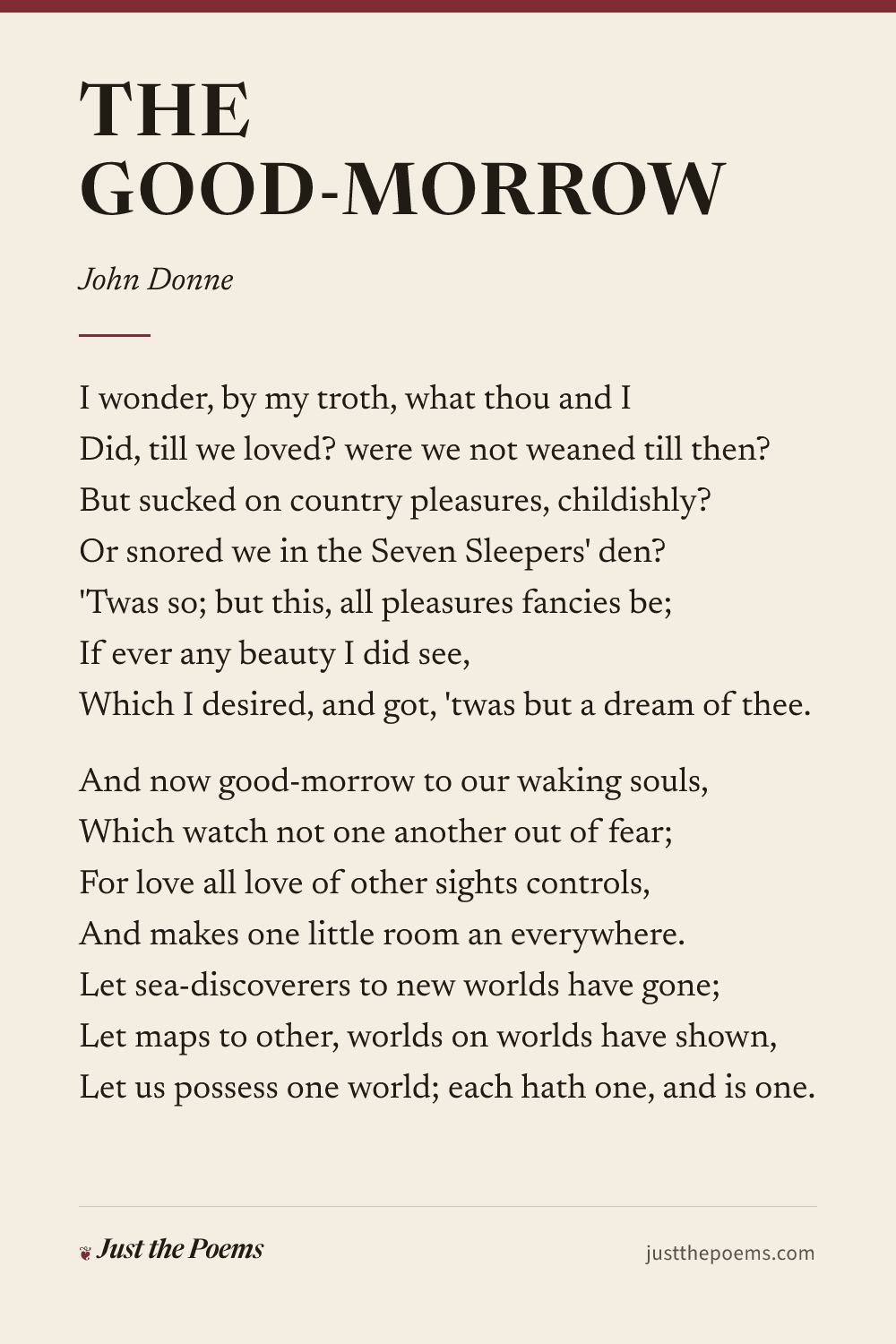
THE GOOD-MORROW

John Donne

In 5 Wikipedias 1 anthology Poet in 74 Wikipedias

I wonder, by my troth, what thou and IDid, till we loved? were we not weaned till then?But sucked on country pleasures, childishly?Or snored we in the Seven Sleepers' den?'Twas so; but this, all pleasures fancies be;If ever any beauty I did see,Which I desired, and got, 'twas but a dream of thee.

And now good-morrow to our waking souls,Which watch not one another out of fear;For love all love of other sights controls,And makes one little room an everywhere.Let sea-discoverers to new worlds have gone;Let maps to other, worlds on worlds have shown,Let us possess one world; each hath one, and is one.

My face in thine eye, thine in mine appears,And true plain hearts do in the faces rest;Where can we find two fitter hemispheresWithout sharp north, without declining west?Whatever dies, was not mixed equally;If our two loves be one, or thou and ILove just alike in all, none of these loves can die.

Source

The Home Book of Verse, ed. Burton Egbert Stevenson

Filed under
  • Section “LOVE'S FULFILMENT”, The Home Book of Verse

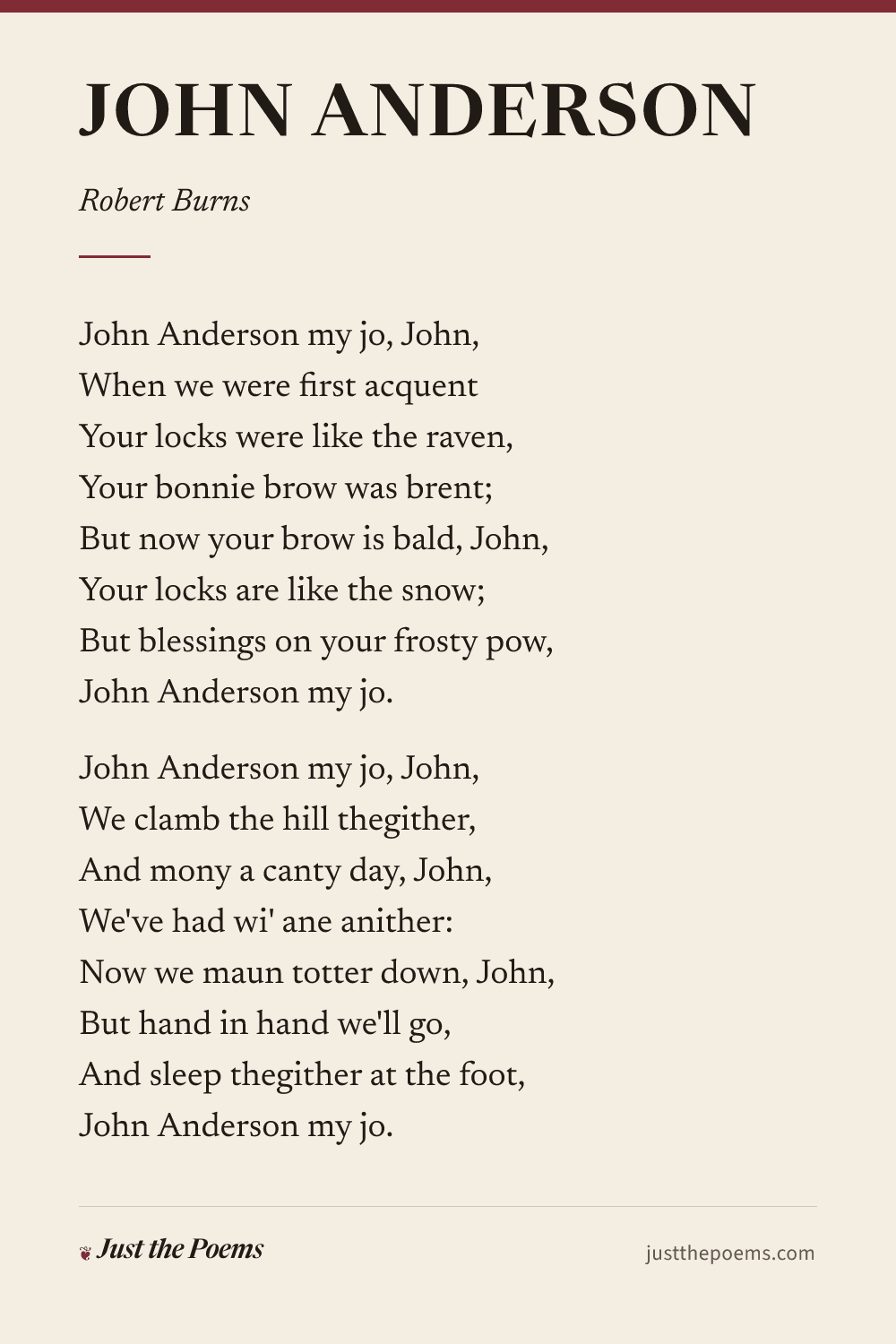
JOHN ANDERSON

Robert Burns

In 0 Wikipedias 4 anthologies Poet in 89 Wikipedias

John Anderson my jo, John,When we were first acquentYour locks were like the raven,Your bonnie brow was brent;But now your brow is bald, John,Your locks are like the snow;But blessings on your frosty pow,John Anderson my jo.

John Anderson my jo, John,We clamb the hill thegither,And mony a canty day, John,We've had wi' ane anither:Now we maun totter down, John,But hand in hand we'll go,And sleep thegither at the foot,John Anderson my jo.

Source

The Golden Treasury, ed. Francis Turner Palgrave

Filed under
  • Section “LOVE'S FULFILMENT”, The Home Book of Verse

LOVE

Samuel Taylor Coleridge

In 0 Wikipedias 3 anthologies Poet in 86 Wikipedias

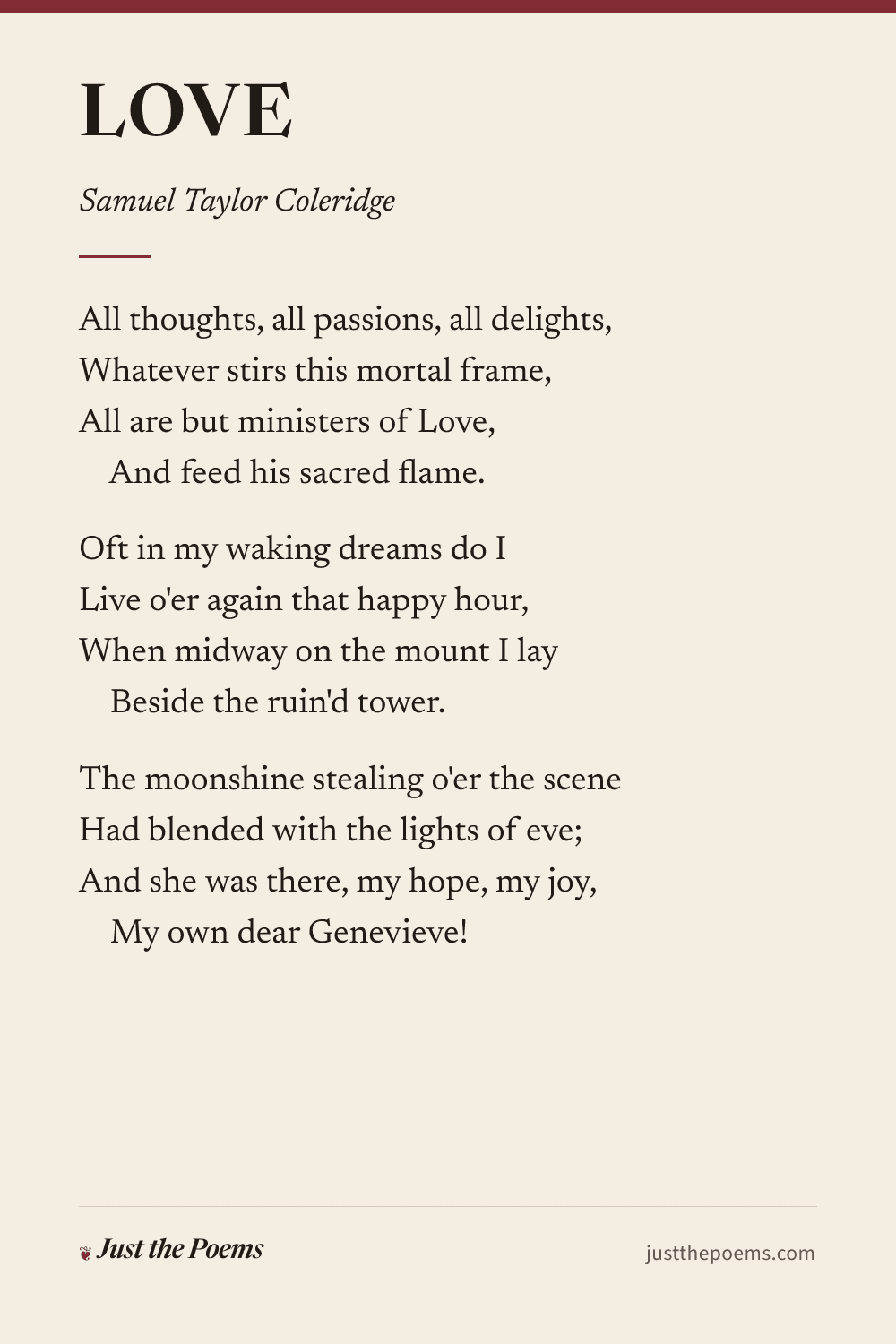
All thoughts, all passions, all delights,Whatever stirs this mortal frame,All are but ministers of Love, And feed his sacred flame.

Oft in my waking dreams do ILive o'er again that happy hour,When midway on the mount I lay Beside the ruin'd tower.

The moonshine stealing o'er the sceneHad blended with the lights of eve;And she was there, my hope, my joy, My own dear Genevieve!

Show all 96 lines 84 more

She lean'd against the armed man,The statue of the armed knight;She stood and listen'd to my lay, Amid the lingering light.

Few sorrows hath she of her ownMy hope! my joy! my Genevieve!She loves me best, whene'er I sing The songs that make her grieve.

I play'd a soft and doleful air,I sang an old and moving story--An old rude song, that suited well That ruin wild and hoary.

She listen'd with a flitting blush,With downcast eyes and modest grace;For well she knew, I could not choose But gaze upon her face.

I told her of the Knight that woreUpon his shield a burning brand;And that for ten long years he woo'd The Lady of the Land.

I told her how he pined: and ah!The deep, the low, the pleading toneWith which I sang another's love, Interpreted my own.

She listen'd with a flitting blush,With downcast eyes, and modest grace;And she forgave me, that I gazed Too fondly on her face.

But when I told the cruel scornThat crazed that bold and lovely Knight,And that he cross'd the mountain-woods, Nor rested day nor night;

That sometimes from the savage den,And sometimes from the darksome shade,And sometimes starting up at once In green and sunny glade.

There came and look'd him in the faceAn angel beautiful and bright;And that he knew it was a Fiend, This miserable Knight!

And that unknowing what he did,He leap'd amid a murderous band,And saved from outrage worse than death The Lady of the Land;

And how she wept, and clasp'd his knees;And how she tended him in vain;And ever strove to expiate The scorn that crazed his brain;

And that she nursed him in a cave,And how his madness went away,When on the yellow forest-leaves A dying man he lay;

--His dying words--but when I reach'dThat tenderest strain of all the ditty,My faltering voice and pausing harp Disturb'd her soul with pity!

All impulses of soul and senseHad thrill'd my guileless Genevieve;The music and the doleful tale, The rich and balmy eve;

And hopes, and fears that kindle hope,An undistinguishable throng,And gentle wishes long subdued, Subdued and cherish'd long!

She wept with pity and delight,She blush'd with love, and virgin shame;And like the murmur of a dream, I heard her breathe my name.

Her bosom heaved--she stepp'd aside,As conscious of my look she stept--Then suddenly, with timorous eye She fled to me and wept.

She half enclosed me with her arms,She press'd me with a meek embrace;And bending back her head, look'd up, And gazed upon my face.

'Twas partly love, and partly fear,And partly 'twas a bashful art,That I might rather feel, than see. The swelling of her heart.

I calm'd her fears, and she was calm,And told her love with virgin pride;And so I won my Genevieve, My bright and beauteous Bride.

Source

The Golden Treasury, ed. Francis Turner Palgrave

Filed under
  • Section “LOVE'S FULFILMENT”, The Home Book of Verse

Advertisements

PROTHALAMION

Edmund Spenser

In 0 Wikipedias 3 anthologies Poet in 68 Wikipedias

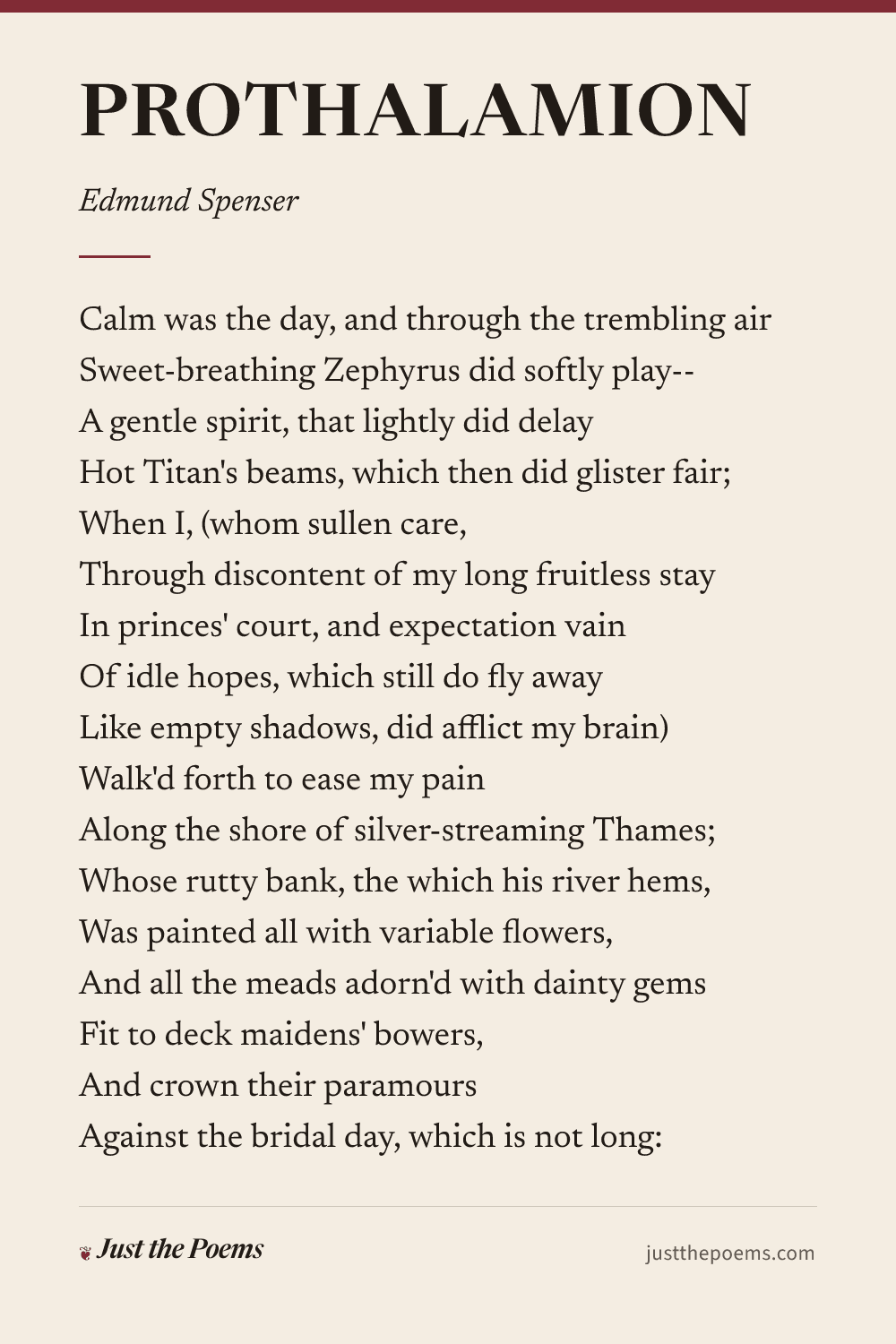
Calm was the day, and through the trembling airSweet-breathing Zephyrus did softly play--A gentle spirit, that lightly did delayHot Titan's beams, which then did glister fair;When I, (whom sullen care,Through discontent of my long fruitless stayIn princes' court, and expectation vainOf idle hopes, which still do fly awayLike empty shadows, did afflict my brain)Walk'd forth to ease my painAlong the shore of silver-streaming Thames;Whose rutty bank, the which his river hems,

Show all 180 lines 168 more

Was painted all with variable flowers,And all the meads adorn'd with dainty gemsFit to deck maidens' bowers,And crown their paramoursAgainst the bridal day, which is not long: Sweet Thames! run softly, till I end my song.

There in a meadow by the river's side,A flock of nymphs I chanced to espy,All lovely daughters of the flood thereby,With goodly greenish locks all loose untiedAs each had been a bride;And each one had a little wicker basketMade of fine twigs, entrailed curiously,In which they gather'd flowers to fill their flasket,And with fine fingers cropt full feateouslyThe tender stalks on high.Of every sort which in that meadow grewThey gather'd some; the violet, pallid blue,The little daisy that at evening closes,The virgin lily and the primrose true:With store of vermeil roses,To deck their bridegrooms' posiesAgainst the bridal day, which was not long: Sweet Thames! run softly, till I end my song.

With that I saw two swans of goodly hueCome softly swimming down along the lee;Two fairer birds I yet did never see;The snow which doth the top of Pindus strow,Did never whiter show,Nor Jove himself, when he a swan would beFor love of Leda, whiter did appear;Yet Leda was (they say) as white as he,Yet not so white as these, nor nothing near;So purely white they were,That even the gentle stream, the which them bare,Seem'd foul to them, and bade his billows spareTo wet their silken feathers, lest they mightSoil their fair plumes with water not so fair,And mar their beauties brightThat shone as Heaven's lightAgainst their bridal day, which was not long: Sweet Thames! run softly, till I end my song.

Eftsoons the nymphs, which now had flowers their fill,Ran all in haste to see that silver broodAs they came floating on the crystal flood;Whom when they saw, they stood amazed stillTheir wondering eyes to fill;Them seem'd they never saw a sight so fairOf fowls, so lovely, that they sure did deemThem heavenly born, or to be that same pairWhich through the sky draw Venus' silver team;For sure they did not seemTo be begot of any earthly seed,But rather angels, or of angels' breed;Yet were they bred of summer's heat, they say,In sweetest season, when each flower and weedThe earth did fresh array;So fresh they seem'd as day,Even as their bridal day, which was not long: Sweet Thames! run softly, till I end my song.

Then forth they all out of their baskets drewGreat store of flowers, the honour of the field,That to the sense did fragrant odours yield,All which upon those goodly birds they threwAnd all the waves did strew,That like old Peneus' waters they did seemWhen down along by pleasant Tempe's shoreScatter'd with flowers, through Thessaly they stream,That they appear, through lilies' plenteous store,Like a bride's chamber-floor.Two of those nymphs meanwhile two garlands boundOf freshest flowers which in that mead they found,The which presenting all in trim array,Their snowy foreheads therewithal they crown'dWhilst one did sing this layPrepar'd against that day,Against their bridal day, which was not long: Sweet Thames! run softly, till I end my song.

"Ye gentle birds! the world's fair ornament,And Heaven's glory, whom this happy hourDoth lead unto your lovers' blissful bower,Joy may you have, and gentle hearts contentOf your loves complement;And let fair Venus, that is queen of love,With her heart-quelling son upon you smile,Whose smile, they say, hath virtue to removeAll love's dislike, and friendship's faulty guileFor ever to assoil.Let endless peace your steadfast hearts accord,And blessed plenty wait upon your board;And let your bed with pleasures chaste abound,That fruitful issue may to you affordWhich may your foes confound,And make your joys redoundUpon your bridal day, which is not long: Sweet Thames! run softly, till I end my song."

So ended she; and all the rest aroundTo her redoubled that her undersong,Which said their bridal day should not be long:And gentle Echo from the neighbour groundTheir accents did resound.So forth those joyous birds did pass alongAdown the lee that to them murmur'd low,As he would speak but that he lack'd a tongue,Yet did by signs his glad affection show,Making his stream run slow.And all the fowl which in his flood did dwell'Gan flock about these twain, that did excelThe rest, so far as Cynthia doth shendThe lesser stars. So they, enranged well,Did on those two attend,And their best service lendAgainst their wedding day, which was not long: Sweet Thames! run softly, till I end my song.

At length they all to merry London came,To merry London, my most kindly nurse,That to me gave this life's first native source,Though from another place I take my name,An house of ancient fame:There when they came whereas those bricky towersThe which on Thames' broad aged back do ride,Where now the studious lawyers have their bowers,There whilome wont the Templar-knights to bide,Till they decay'd through pride:Next whereunto there stands a stately place,Where oft I gained gifts and goodly graceOf that great lord, which therein wont to dwell,Whose want too well now feels my friendless case;But ah! here fits not wellOld woes, but joys to tellAgainst the bridal day, which is not long: Sweet Thames! run softly, till I end my song.

Yet therein now doth lodge a noble peer,Great England's glory and the world's wide wonder,Whose dreadful name late thro' all Spain did thunder,And Hercules' two pillars standing nearDid make to quake and fear:Fair branch of honour, flower of chivalry!That fillest England with thy triumphs' fameJoy have thou of thy noble victory,And endless happiness of thine own nameThat promiseth the same;That through thy prowess and victorious arms,Thy country may be freed from foreign harms,And great Eliza's glorious name may ringThrough all the world, fill'd with thy wide alarmsWhich some brave Muse may singTo ages following,Upon the bridal day, which is not long: Sweet Thames! run softly till I end my song.

From those high towers this noble lord issuing,Like radiant Hesper, when his golden hairIn th' ocean billows he hath bathed fair,Descended to the river's open viewingWith a great train ensuing.Above the rest were goodly to be seenTwo gentle knights of lovely face and feature,Beseeming well the bower of any queen,With gifts of wit and ornaments of nature,Fit for so goodly stature,That like the twins of Jove they seem'd in sightWhich deck the baldric of the Heavens bright;They two, forth pacing to the river's side,Received those two fair brides, their love's delight;Which, at th' appointed tide,Each one did make his brideAgainst their bridal day, which is not long: Sweet Thames! run softly, till I end my song.

Source

The Golden Treasury, ed. Francis Turner Palgrave

Filed under
  • Section “LOVE'S FULFILMENT”, The Home Book of Verse

A DITTY

Sir Philip Sidney

In 0 Wikipedias 3 anthologies Poet in 47 Wikipedias

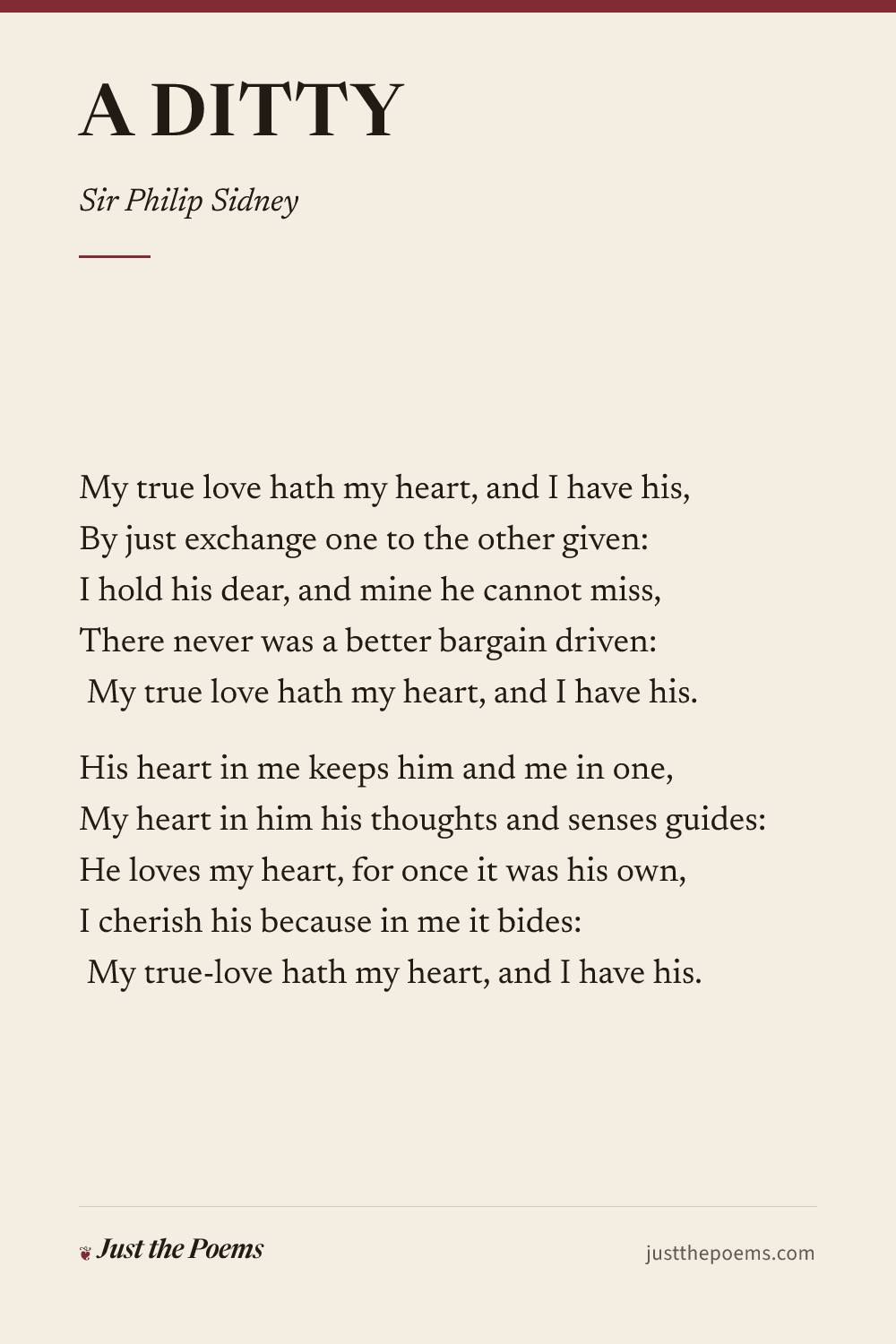
My true love hath my heart, and I have his,By just exchange one to the other given:I hold his dear, and mine he cannot miss,There never was a better bargain driven: My true love hath my heart, and I have his.

His heart in me keeps him and me in one,My heart in him his thoughts and senses guides:He loves my heart, for once it was his own,I cherish his because in me it bides: My true-love hath my heart, and I have his.

Source

The Golden Treasury, ed. Francis Turner Palgrave

Filed under
  • Section “LOVE'S FULFILMENT”, The Home Book of Verse

Epithalamion

Edmund Spenser

In 0 Wikipedias 2 anthologies Poet in 68 Wikipedias

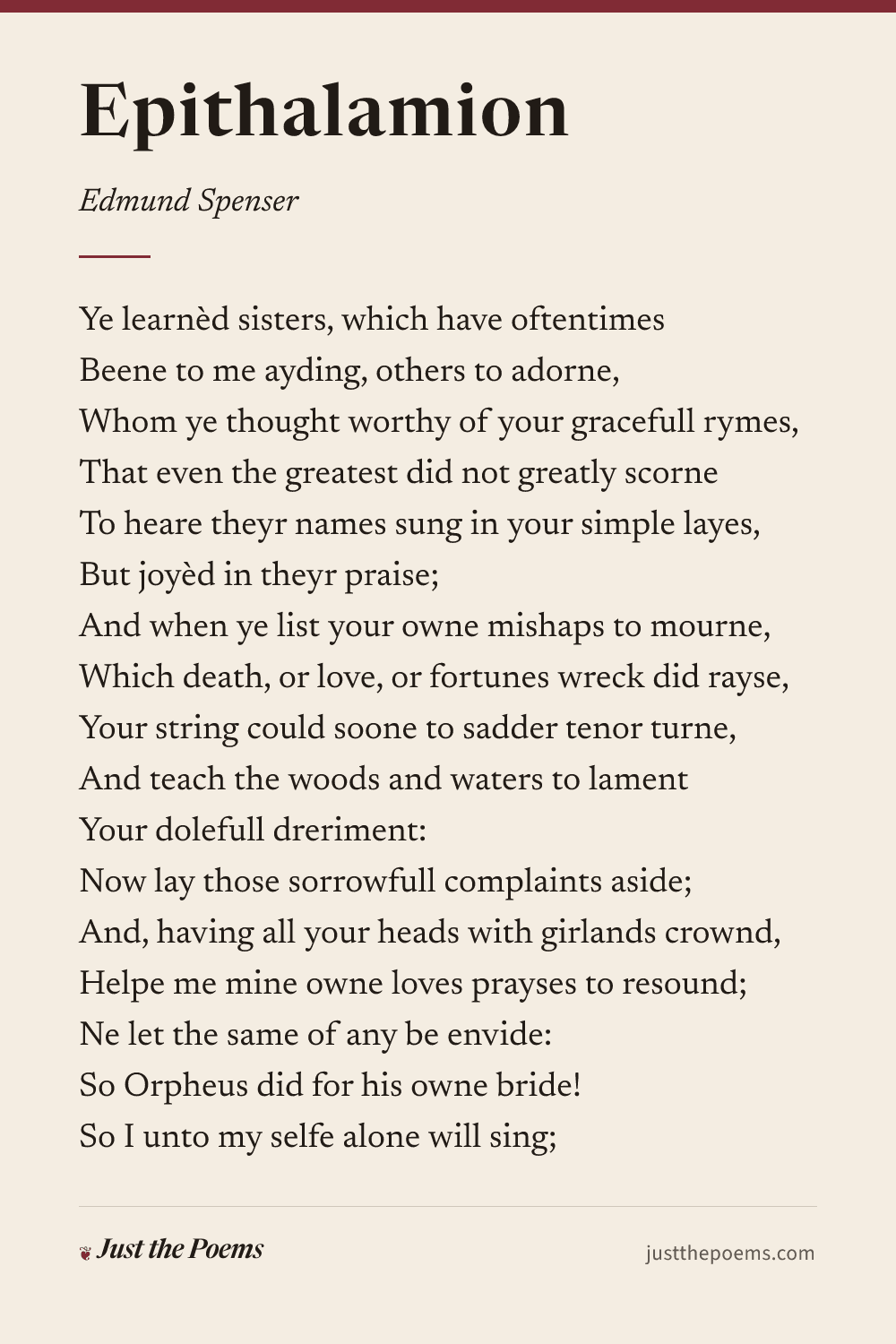
Ye learnèd sisters, which have oftentimesBeene to me ayding, others to adorne,Whom ye thought worthy of your gracefull rymes,That even the greatest did not greatly scorneTo heare theyr names sung in your simple layes,But joyèd in theyr praise;And when ye list your owne mishaps to mourne,Which death, or love, or fortunes wreck did rayse,Your string could soone to sadder tenor turne,And teach the woods and waters to lamentYour dolefull dreriment:Now lay those sorrowfull complaints aside;

Show all 433 lines 421 more

And, having all your heads with girlands crownd,Helpe me mine owne loves prayses to resound;Ne let the same of any be envide:So Orpheus did for his owne bride!So I unto my selfe alone will sing;The woods shall to me answer, and my Eccho ring.

Early, before the worlds light-giving lampeHis golden beame upon the hils doth spred,Having disperst the nights unchearefull dampe,Doe ye awake; and, with fresh lusty-hed,Go to the bowre of my belovèd love,My truest turtle dove;Bid her awake; for Hymen is awake,And long since ready forth his maske to move,With his bright Tead that flames with many a flake,And many a bachelor to waite on him,In theyr fresh garments trim.Bid her awake therefore, and soone her dight,For lo! the wishèd day is come at last,That shall, for all the paynes and sorrowes past,Pay to her usury of long delight:And, whylest she doth her dight,Doe ye to her of joy and solace sing,That all the woods may answer, and your eccho ring.

Bring with you all the Nymphes that you can heareBoth of the rivers and the forrests greene,

And of the sea that neighbours to her neare:Al with gay girlands goodly wel beseene.And let them also with them bring in handAnother gay girlandFor my fayre love, of lillyes and of roses,Bound truelove wize, with a blew silke riband.And let them make great store of bridale poses,And let them eeke bring store of other flowers,To deck the bridale bowers.And let the ground whereas her foot shall tread,For feare the stones her tender foot should wrong,Be strewed with fragrant flowers all along,And diapred lyke the discolored mead.Which done, doe at her chamber dore awayt,For she will waken strayt;The whiles doe ye this song unto her sing,The woods shall to you answer, and your Eccho ring.

Ye Nymphes of Mulla, which with carefull heedThe silver scaly trouts doe tend full well,And greedy pikes which use therein to feed;(Those trouts and pikes all others doo excell;)And ye likewise, which keepe the rushy lake,Where none doo fishes take;Bynd up the locks the which hang scatterd light,And in his waters, which your mirror make,Behold your faces as the christall bright,That when you come whereas my love doth lie,No blemish she may spie.And eke, ye lightfoot mayds, which keepe the deere,That on the hoary mountayne used to towre;And the wylde wolves, which seeke them to devoure,With your steele darts doo chace from comming neer;Be also present heere,

To helpe to decke her, and to help to sing,That all the woods may answer, and your eccho ring.

Wake now, my love, awake! for it is time;The Rosy Morne long since left Tithones bed,All ready to her silver coche to clyme;And Phœbus gins to shew his glorious hed.Hark! how the cheerefull birds do chaunt theyr laiesAnd carroll of Loves praise.The merry Larke hir mattins sings aloft;The Thrush replyes; the Mavis descant playes;The Ouzell shrills; the Ruddock warbles soft;So goodly all agree, with sweet consent,To this dayes merriment.Ah! my deere love, why doe ye sleepe thus long?When meeter were that ye should now awake,T’ awayt the comming of your joyous make,And hearken to the birds love-learnèd song,The deawy leaves among!Nor they of joy and pleasance to you sing,That all the woods them answer, and theyr eccho ring.My love is now awake out of her dreames,And her fayre eyes, like stars that dimmèd wereWith darksome cloud, now shew theyr goodly beamsMore bright then Hesperus his head doth rere.Come now, ye damzels, daughters of delight,Helpe quickly her to dight:But first come ye fayre houres, which were begotIn Joves sweet paradice of Day and Night;Which doe the seasons of the yeare allot,And al, that ever in this world is fayre,Doe make and still repayre:

And ye three handmayds of the Cyprian Queene,The which doe still adorne her beauties pride,Helpe to addorne my beautifullest bride:And, as ye her array, still throw betweeneSome graces to be seene;And, as ye use to Venus, to her sing,The whiles the woods shal answer, and your eccho ring.

Now is my love all ready forth to come:Let all the virgins therefore well awayt:And ye fresh boyes, that tend upon her groome,Prepare your selves; for he is comming strayt.Set all your things in seemely good aray,Fit for so joyfull day:The joyfulst day that ever sunne did see.Faire Sun! shew forth thy favourable ray,And let thy lifull heat not fervent be,For feare of burning her sunshyny face,Her beauty to disgrace.O fayrest Phœbus! father of the Muse!If ever I did honour thee aright,Or sing the thing that mote thy mind delight,Doe not thy servants simple boone refuse;But let this day, let this one day, be myne;Let all the rest be thine.Then I thy soverayne prayses loud wil sing,That all the woods shal answer, and theyr eccho ring.

Harke! how the Minstrils gin to shrill aloudTheir merry Musick that resounds from far,The pipe, the tabor, and the trembling Croud,That well agree withouten breach or jar.

But, most of all, the Damzels doe deliteWhen they their tymbrels smyte,And thereunto doe daunce and carrol sweet,That all the sences they doe ravish quite;The whyles the boyes run up and downe the street,Crying aloud with strong confusèd noyce,As if it were one voyce,Hymen, iö Hymen, Hymen, they do shout;That even to the heavens theyr shouting shrillDoth reach, and all the firmament doth fill;To which the people standing all about,As in approvance, doe thereto applaud,And loud advaunce her laud;And evermore they Hymen, Hymen sing,That al the woods them answer, and theyr eccho ring.

Loe! where she comes along with portly pace,Lyke Phœbe, from her chamber of the East,Arysing forth to run her mighty race,Clad all in white, that seemes a virgin best.So well it her beseemes, that ye would weeneSome angell she had beene.Her long loose yellow locks lyke golden wyre,Sprinckled with perle, and perling flowres atweene,Doe lyke a golden mantle her attyre;And, being crownèd with a girland greene,Seeme lyke some mayden Queene.Her modest eyes, abashèd to beholdSo many gazers as on her do stare,Upon the lowly ground affixèd are;Ne dare lift up her countenance too bold,But blush to heare her prayses sung so loud,So farre from being proud.Nathlesse doe ye still loud her prayses sing,That all the woods may answer, and your eccho ring.

Tell me, ye merchants daughters, did ye seeSo fayre a creature in your towne before;So sweet, so lovely, and so mild as she,Adornd with beautyes grace and vertues store?Her goodly eyes lyke Saphyres shining bright,Her forehead yvory white,Her cheekes lyke apples which the sun hath rudded,Her lips lyke cherryes charming men to byte,Her brest like to a bowle of creame uncrudded,Her paps lyke lyllies budded,Her snowie necke lyke to a marble towre;And all her body like a pallace fayre,Ascending up, with many a stately stayre,To honors seat and chastities sweet bowre.Why stand ye still ye virgins in amaze,Upon her so to gaze,Whiles ye forget your former lay to sing,To which the woods did answer, and your eccho ring?

But if ye saw that which no eyes can see,The inward beauty of her lively spright,Garnisht with heavenly guifts of high degree,Much more then would ye wonder at that sight,And stand astonisht lyke to those which redMedusaes mazeful hed.There dwels sweet love, and constant chastity,Unspotted fayth, and comely womanhood,Regard of honour, and mild modesty;There vertue raynes as Queene in royal throne,And giveth lawes alone,The which the base affections doe obay,And yeeld theyr services unto her will;Ne thought of thing uncomely ever mayThereto approch to tempt her mind to ill.Had ye once seene these her celestial threasures,And unrevealèd pleasures,Then would ye wonder, and her prayses sing,That al the woods should answer, and your echo ring.

Open the temple gates unto my love,Open them wide that she may enter in,And all the postes adorne as doth behove,And all the pillours deck with girlands trim,For to receyve this Saynt with honour dew,That commeth in to you.With trembling steps, and humble reverence,She commeth in, before th’ Almighties view;Of her ye virgins learne obedience,When so ye come into those holy places,To humble your proud faces:Bring her up to th’ high altar, that she mayThe sacred ceremonies there partake,The which do endlesse matrimony make;And let the roring Organs loudly playThe praises of the Lord in lively notes;The whiles, with hollow throates,The Choristers the joyous Antheme sing,That al the woods may answere, and their eccho ring.

Behold, whiles she before the altar stands,Hearing the holy priest that to her speakes,And blesseth her with his two happy hands,How the red roses flush up in her cheekes,And the pure snow, with goodly vermill stayneLike crimsin dyde in grayne:That even th’ Angels, which continuallyAbout the sacred Altare doe remaine,Forget their service and about her fly,Ofte peeping in her face, that seems more fayre,The more they on it stare.But her sad eyes, still fastened on the ground,Are governèd with goodly modesty,That suffers not one looke to glaunce awry,Which may let in a little thought unsownd.Why blush ye, love, to give to me your hand,The pledge of all our band!Sing, ye sweet Angels, Alleluya sing,That all the woods may answere, and your eccho ring.

Now al is done: bring home the bride againe;Bring home the triumph of our victory:Bring home with you the glory of her gaine;With joyance bring her and with jollity.Never had man more joyfull day then this,Whom heaven would heape with blis,Make feast therefore now all this live-long day;This day for ever to me holy is.Poure out the wine without restraint or stay,Poure not by cups, but by the belly full,Poure out to all that wull,And sprinkle all the postes and wals with wine,That they may sweat, and drunken be withall.Crowne ye God Bacchus with a coronall,And Hymen also crowne with wreathes of vine;And let the Graces daunce unto the rest,For they can doo it best:The whiles the maydens doe theyr carroll sing,To which the woods shall answer, and theyr eccho ring.

Ring ye the bels, ye yong men of the towne,And leave your wonted labors for this day:This day is holy; doe ye write it downe,That ye for ever it remember may.This day the sunne is in his chiefest hight,With Barnaby the bright,From whence declining daily by degrees,He somewhat loseth of his heat and light,When once the Crab behind his back he sees.But for this time it ill ordainèd was,To chose the longest day in all the yeare,And shortest night, when longest fitter weare:Yet never day so long, but late would passe.Ring ye the bels, to make it weare away,And bonefiers make all day;And daunce about them, and about them sing,That all the woods may answer, and your eccho ring.

Ah! when will this long weary day have end,And lende me leave to come unto my love?How slowly do the houres theyr numbers spend?How slowly does sad Time his feathers move?Hast thee, O fayrest Planet, to thy home,Within the Westerne fome:Thy tyrèd steedes long since have need of rest.Long though it be, at last I see it gloome,And the bright evening-star with golden creastAppeare out of the East.Fayre childe of beauty! glorious lampe of love!That all the host of heaven in rankes doost lead,And guydest lovers through the nights sad dread,How chearefully thou lookest from above,And seemst to laugh atweene thy twinkling light,As joying in the sightOf these glad many, which for joy doe sing,That all the woods them answer, and their echo ring!

Now ceasse, ye damsels, your delights fore-past;Enough it is that all the day was youres:Now day is doen, and night is nighing fast,Now bring the Bryde into the brydall boures.The night is come, now soon her disaray,And in her bed her lay;Lay her in lillies and in violets,And silken courteins over her display,And odourd sheetes, and Arras coverlets.Behold how goodly my faire love does ly,In proud humility!Like unto Maia, when as Jove her tookIn Tempe, lying on the flowry gras,Twixt sleepe and wake, after she weary was,With bathing in the Acidalian brooke.Now it is night, ye damsels may be gon,And leave my love alone,And leave likewise your former lay to sing:The woods no more shall answere, nor your echo ring.

Now welcome, night! thou night so long expected,That long daies labour doest at last defray,And all my cares, which cruell Love collected,Hast sumd in one, and cancellèd for aye:Spread thy broad wing over my love and me,That no man may us see;And in thy sable mantle us enwrap,From feare of perrill and foule horror free.Let no false treason seeke us to entrap,Nor any dread disquiet once annoyThe safety of our joy;But let the night be calme, and quietsome,Without tempestuous storms or sad afray:Lyke as when Jove with fayre Alcmena lay,When he begot the great Tirynthian groome:Or lyke as when he with thy selfe did lieAnd begot Majesty.And let the mayds and yong men cease to sing;Ne let the woods them answer nor theyr eccho ring.

Let no lamenting cryes, nor dolefull teares,Be heard all night within, nor yet without:Ne let false whispers, breeding hidden feares,Breake gentle sleepe with misconceivèd dout.Let no deluding dreames, nor dreadfull sights,Make sudden sad affrights;Ne let house-fyres, nor lightnings helpelesse harmes,Ne let the Pouke, nor other evill sprights,Ne let mischivous witches with theyr charmes,Ne let hob Goblins, names whose sence we see not,Fray us with things that be not:Let not the shriech Oule nor the Storke be heard,Nor the night Raven, that still deadly yels;Nor damnèd ghosts, cald up with mighty spels,Nor griesly vultures, make us once affeard:Ne let th’ unpleasant Quyre of Frogs still crokingMake us to wish theyr choking.Let none of these theyr drery accents sing;Ne let the woods them answer, nor theyr eccho ring.

But let stil Silence trew night-watches keepe,That sacred Peace may in assurance rayne,And tymely Sleep, when it is tyme to sleepe,May poure his limbs forth on your pleasant playne;The whiles an hundred little wingèd loves,Like divers-fethered doves,Shall fly and flutter round about your bed,And in the secret darke, that none reproves,Their prety stealthes shal worke, and snares shal spreadTo filch away sweet snatches of delight,Conceald through covert night.Ye sonnes of Venus, play your sports at will!For greedy pleasure, carelesse of your toyes,Thinks more upon her paradise of joyes,Then what ye do, albe it good or ill.All night therefore attend your merry play,For it will soone be day:Now none doth hinder you, that say or sing;Ne will the woods now answer, nor your Eccho ring.

Who is the same, which at my window peepes?Or whose is that faire face that shines so bright?Is it not Cinthia, she that never sleepes,But walkes about high heaven al the night?O! fayrest goddesse, do thou not envyMy love with me to spy:For thou likewise didst love, though now unthought,And for a fleece of wooll, which privilyThe Latmian shepherd once unto thee brought,His pleasures with thee wrought.Therefore to us be favorable now;And sith of wemens labours thou hast charge,And generation goodly dost enlarge,Encline thy will t’effect our wishfull vow,And the chast wombe informe with timely seedThat may our comfort breed:Till which we cease our hopefull hap to sing;Ne let the woods us answere, nor our Eccho ring.

And thou, great Juno! which with awful mightThe lawes of wedlock still dost patronize;And the religion of the faith first plightWith sacred rites hast taught to solemnize;And eeke for comfort often callèd artOf women in their smart;Eternally bind thou this lovely band,And all thy blessings unto us impart.And thou, glad Genius! in whose gentle handThe bridale bowre and geniall bed remaine,Without blemish or staine;And the sweet pleasures of theyr loves delightWith secret ayde doest succour and supply,Till they bring forth the fruitfull progeny;Send us the timely fruit of this same night.And thou, fayre Hebe! and thou, Hymen free!Grant that it may so be.Til which we cease your further prayse to sing;Ne any woods shall answer, nor your Eccho ring.

And ye high heavens, the temple of the gods,In which a thousand torches flaming brightDoe burne, that to us wretched earthly clodsIn dreadful darknesse lend desirèd lightAnd all ye powers which in the same remayne,More then we men can fayne!Poure out your blessing on us plentiously,And happy influence upon us raine,That we may raise a large posterity,Which from the earth, which they may long possesseWith lasting happinesse,Up to your haughty pallaces may mount;And, for the guerdon of theyr glorious merit,May heavenly tabernacles there inherit,Of blessèd Saints for to increase the count.So let us rest, sweet love, in hope of this,And cease till then our tymely joyes to sing:The woods no more us answer, nor our eccho ring!

Song! made in lieu of many ornaments.With which my love should duly have been dect,Which cutting off through hasty accidents,Ye would not stay your dew time to expectBut promist both to recompens;Be unto her a goodly ornament,And for short time an endlesse moniment.
Source

The Oxford Book of English Verse 1250–1900, 1900

Filed under
  • Section “LOVE'S FULFILMENT”, The Home Book of Verse

Earl Mertoun’s Song

Robert Browning

In 0 Wikipedias 2 anthologies Poet in 57 Wikipedias

There’s a woman like a dewdrop, she’s so purer than the purest;And her noble heart’s the noblest, yes, and her sure faith’s the surest:And her eyes are dark and humid, like the depth on depth of lustreHid i’ the harebell, while her tresses, sunnier than the wild-grape cluster,Gush in golden-tinted plenty down her neck’s rose-misted marble:Then her voice’s music ... call it the well’s bubbling, the bird’s warble!

And this woman says, ‘My days were sunless and my nights were moonless,Parch’d the pleasant April herbage, and the lark’s heart’s outbreak tuneless,If you loved me not!’ And I who (ah, for words of flame!) adore her,Who am mad to lay my spirit prostrate palpably before her--I may enter at her portal soon, as now her lattice takes me,And by noontide as by midnight make her mine, as hers she makes me!

Source

The Oxford Book of English Verse 1250–1900, 1900

Filed under
  • Section “LOVE'S FULFILMENT”, The Home Book of Verse

Meeting at Night

Robert Browning

In 0 Wikipedias 2 anthologies Poet in 57 Wikipedias

The gray sea and the long black land;And the yellow half-moon large and low;And the startled little waves that leapIn fiery ringlets from their sleep,As I gain the cove with pushing prow,And quench its speed i’ the slushy sand.

Then a mile of warm sea-scented beach;Three fields to cross till a farm appears;A tap at the pane, the quick sharp scratchAnd blue spurt of a lighted match,And a voice less loud, thro’ its joys and fears,Than the two hearts beating each to each!

Source

The Oxford Book of English Verse 1250–1900, 1900

Filed under
  • Section “LOVE'S FULFILMENT”, The Home Book of Verse

Advertisements

Parting at Morning

Robert Browning

In 0 Wikipedias 2 anthologies Poet in 57 Wikipedias

Round the cape of a sudden came the sea,And the sun look’d over the mountain’s rimAnd straight was a path of gold for him,And the need of a world of men for me.

Source

The Oxford Book of English Verse 1250–1900, 1900

Filed under
  • Section “LOVE'S FULFILMENT”, The Home Book of Verse

My Delight and Thy Delight

Robert Bridges

In 0 Wikipedias 2 anthologies Poet in 19 Wikipedias

My delight and thy delightWalking, like two angels white,In the gardens of the night:

My desire and thy desireTwining to a tongue of fire,Leaping live, and laughing higher:

Thro’ the everlasting strifeIn the mystery of life.

Love, from whom the world begun,Hath the secret of the sun.

Love can tell, and love alone,Whence the million stars were strewn,Why each atom knows its own,How, in spite of woe and death,Gay is life, and sweet is breath:

This he taught us, this we knew,Happy in his science true,Hand in hand as we stood’Neath the shadows of the wood,Heart to heart as we layIn the dawning of the day.

Source

The Oxford Book of English Verse 1250–1900, 1900

Filed under
  • Section “LOVE'S FULFILMENT”, The Home Book of Verse

When Death to Either shall come

Robert Bridges

In 0 Wikipedias 2 anthologies Poet in 19 Wikipedias

When Death to either shall come,-- I pray it be first to me,--Be happy as ever at home, If so, as I wish, it be.

Possess thy heart, my own; And sing to the child on thy knee,Or read to thyself alone The songs that I made for thee.

Source

The Oxford Book of English Verse 1250–1900, 1900

Filed under
  • Section “LOVE'S FULFILMENT”, The Home Book of Verse

The Married Lover

Coventry Patmore

In 0 Wikipedias 2 anthologies Poet in 16 Wikipedias

Why, having won her, do I woo? Because her spirit’s vestal graceProvokes me always to pursue, But, spirit-like, eludes embrace;Because her womanhood is such That, as on court-days subjects kissThe Queen’s hand, yet so near a touch Affirms no mean familiarness;Nay, rather marks more fair the height Which can with safety so neglectTo dread, as lower ladies might, That grace could meet with disrespect;

Show all 32 lines 20 more

Thus she with happy favour feeds Allegiance from a love so highThat thence no false conceit proceeds Of difference bridged, or state put by;Because although in act and word As lowly as a wife can be,Her manners, when they call me lord, Remind me ’tis by courtesy;Not with her least consent of will, Which would my proud affection hurt,But by the noble style that still Imputes an unattain’d desert;Because her gay and lofty brows, When all is won which hope can ask,Reflect a light of hopeless snows That bright in virgin ether bask;Because, though free of the outer court I am, this Temple keeps its shrineSacred to Heaven; because, in short, She’s not and never can be mine.

Source

The Oxford Book of English Verse 1250–1900, 1900

Filed under
  • Section “LOVE'S FULFILMENT”, The Home Book of Verse

Exequy on his Wife

Henry King, Bishop of Chichester

In 0 Wikipedias 2 anthologies Poet in 5 Wikipedias

Accept, thou shrine of my dead saint,Instead of dirges this complaint;And for sweet flowers to crown thy herseReceive a strew of weeping verseFrom thy grieved friend, whom thou might’st seeQuite melted into tears for thee. Dear loss! since thy untimely fate,My task hath been to meditateOn thee, on thee! Thou art the book,The library whereon I look,Tho’ almost blind. For thee, loved clay,I languish out, not live, the day....

Show all 94 lines 82 more

Thou hast benighted me; thy setThis eve of blackness did beget,Who wast my day (tho’ overcastBefore thou hadst thy noontide past):And I remember must in tearsThou scarce hadst seen so many yearsAs day tells hours. By thy clear sunMy love and fortune first did run;But thou wilt never more appearFolded within my hemisphere,Since both thy light and motion,Like a fled star, is fall’n and gone,And ’twixt me and my soul’s dear wishThe earth now interposèd is.... I could allow thee for a timeTo darken me and my sad clime;Were it a month, a year, or ten,I would thy exile live till then,And all that space my mirth adjourn--So thou wouldst promise to return,And putting off thy ashy shroudAt length disperse this sorrow’s cloud. But woe is me! the longest dateToo narrow is to calculateThese empty hopes: never shall IBe so much blest as to descryA glimpse of thee, till that day comeWhich shall the earth to cinders doom,And a fierce fever must calcineThe body of this world--like thine,My little world! That fit of fireOnce off, our bodies shall aspireTo our souls’ bliss: then we shall riseAnd view ourselves with clearer eyesIn that calm region where no nightCan hide us from each other’s sight. Meantime thou hast her, earth: much goodMay my harm do thee! Since it stoodWith Heaven’s will I might not callHer longer mine, I give thee allMy short-lived right and interestIn her whom living I loved best.Be kind to her, and prithee lookThou write into thy Doomsday bookEach parcel of this rarityWhich in thy casket shrined doth lie,As thou wilt answer Him that lent--Not gave--thee my dear monument.So close the ground, and ’bout her shadeBlack curtains draw: my bride is laid. Sleep on, my Love, in thy cold bedNever to be disquieted!My last good-night! Thou wilt not wakeTill I thy fate shall overtake:Till age, or grief, or sickness mustMarry my body to that dustIt so much loves; and fill the roomMy heart keeps empty in thy tomb.Stay for me there: I will not failTo meet thee in that hollow vale.And think not much of my delay:I am already on the way,And follow thee with all the speedDesire can make, or sorrows breed.Each minute is a short degreeAnd every hour a step towards thee.... ’Tis true--with shame and grief I yield--Thou, like the van, first took’st the field;And gotten hast the victoryIn thus adventuring to dieBefore me, whose more years might craveA just precedence in the grave.But hark! my pulse, like a soft drum,Beats my approach, tells thee I come;And slow howe’er my marches beI shall at last sit down by thee. The thought of this bids me go onAnd wait my dissolutionWith hope and comfort. Dear--forgiveThe crime--I am content to liveDivided, with but half a heart,Till we shall meet and never part.

Source

The Oxford Book of English Verse 1250–1900, 1900

Filed under
  • Section “LOVE'S FULFILMENT”, The Home Book of Verse

Advertisements

THE WIFE TO HER HUSBAND

Anonymous

In 0 Wikipedias 2 anthologies Poet in 0 Wikipedias

Linger not long. Home is not home without thee: Its dearest tokens do but make me mourn.O, let its memory, like a chain about thee, Gently compel and hasten thy return!

Linger not long. Though crowds should woo thy staying, Bethink thee, can the mirth of thy friends, though dear,Compensate for the grief thy long delaying Costs the fond heart that sighs to have thee here?

Linger not long. How shall I watch thy coming, As evening shadows stretch o'er moor and dell;When the wild bee hath ceased her busy humming, And silence hangs on all things like a spell!

How shall I watch for thee, when fears grow stronger,As night grows dark and darker on the hill!How shall I weep, when I can watch no longer! Ah! art thou absent, art thou absent still?

Yet I shall grieve not, though the eye that seeth me Gazeth through tears that makes its splendor dull;For oh! I sometimes fear when thou art with me, My cup of happiness is all too full.

Haste, haste thee home unto thy mountain dwelling, Haste, as a bird unto its peaceful nest!Haste, as a skiff, through tempests wide and swelling, Flies to its haven of securest rest!

Source

The World's Best Poetry, Vol. III, ed. Bliss Carman, 1904

Filed under
  • Section “LOVE'S FULFILMENT”, The Home Book of Verse

"BID ADIEU TO GIRLISH DAYS"

James Joyce

In 0 Wikipedias 1 anthology Poet in 165 Wikipedias

Bid adieu, adieu, adieu,Bid adieu to girlish days,Happy Love is come to wooThee and woo thy girlish ways -The zone that doth become thee fair,The snood upon thy yellow hair.

When thou hast heard his name uponThe bugles of the cherubim,Begin thou softly to unzoneThy girlish bosom unto him,And softly to undo the snoodThat is the sign of maidenhood.

Source

The Home Book of Verse, ed. Burton Egbert Stevenson

Filed under
  • Section “LOVE'S FULFILMENT”, The Home Book of Verse

TWO LOVERS

George Eliot

In 0 Wikipedias 1 anthology Poet in 92 Wikipedias

Two lovers by a moss-grown spring:They leaned soft cheeks together there,Mingled the dark and sunny hair,And heard the wooing thrashes sing.O budding time!O love's blest prime!

Two wedded from the portal stept:The bells made happy carolings,The air was soft as fanning wings,White petals on the pathway slept.O pure-eyed bride!O tender pride!

Show all 36 lines 24 more

Two faces o'er a cradle bent:Two hands above the head were locked:These pressed each other while they rocked,Those watched a life that love had sent.O solemn hour!O hidden power!

Two parents by the evening fire:The red light fell about their kneesOn heads that rose by slow degreesLike buds upon the lily spire.O patient life!O tender strife!

The two still sat together there,The red light shone about their knees;But all the heads by slow degreesHad gone and left that lonely pair.O voyage fast!O vanished past!

The red light shone upon the floorAnd made the space between them wide;They drew their chairs up side by side,Their pale cheeks joined, and said, "Once more!"O memories!O past that is!

Source

The Home Book of Verse, ed. Burton Egbert Stevenson

Filed under
  • Section “LOVE'S FULFILMENT”, The Home Book of Verse

THE BEGGAR MAID

Alfred Tennyson

In 0 Wikipedias 1 anthology Poet in 72 Wikipedias

Her arms across her breast she laid;She was more fair than words can say:Bare footed came the beggar maidBefore the king Cophetua.In robe and crown the king stepped down,To meet and greet her on her way;"It is no wonder," said the lords,"She is more beautiful than day."

As shines the moon in clouded skies,She in her poor attire was seen:One praised her ankles, one her eyes,One her dark hair and lovesome mien.So sweet a face, such angel grace,In all that land had never been:Cophetua sware a royal oath:"This beggar maid shall be my queen!"

Source

The Home Book of Verse, ed. Burton Egbert Stevenson

Filed under
  • Section “LOVE'S FULFILMENT”, The Home Book of Verse

THE LETTERS

Alfred Tennyson

In 0 Wikipedias 1 anthology Poet in 72 Wikipedias

Still on the tower stood the vane,A black yew gloomed the stagnant air;I peered athwart the chancel pane,And saw the altar cold and bare.A clog of lead was round my feet,A band of pain across my brow;"Cold altar, heaven and earth shall meetBefore you hear my marriage vow."

I turned and hummed a bitter songThat mocked the wholesome human heart,And then we met in wrath and wrong,We met, but only meant to part.

Show all 48 lines 36 more

Full cold my greeting was and dry;She faintly smiled, she hardly moved;I saw, with half-unconscious eye,She wore the colors I approved.

She took the little ivory chest,With half a sigh she turned the key,Then raised her head with lips compressed,And gave my letters back to me;And gave the trinkets and the rings,My gifts, when gifts of mine could please.As looks a father on the thingsOf his dead son, I looked on these.

She told me all her friends had said;I raged against the public liar.She talked as if her love were dead;But in my words were seeds of fire."No more of love, your sex is known;I never will be twice deceived.Henceforth I trust the man alone;The woman cannot be believed.

"Through slander, meanest spawn of hell, -And woman's slander is the worst, -And you, whom once I loved so well,Through you my life will be accursed."I spoke with heart and heat and force,I shook her breast with vague alarms -Like torrents from a mountain sourceWe rushed into each other's arms.

We parted; sweetly gleamed the stars,And sweet the vapor-braided blue;Low breezes fanned the belfry bars,As homeward by the church I drew.The very graves appeared to smile,So fresh they rose in shadowed swells;"Dark porch," I said, "and silent aisle,There comes a sound of marriage bells."

Source

The Home Book of Verse, ed. Burton Egbert Stevenson

Filed under
  • Section “LOVE'S FULFILMENT”, The Home Book of Verse

THE RECONCILIATION

Alfred Tennyson

In 0 Wikipedias 1 anthology Poet in 72 Wikipedias

As through the land at eve we went,And plucked the ripened ears,We fell out, my wife and I,O, we fell out, I know not why,And kissed again with tears.

And blessings on the falling outThat all the more endears,When we fall out with those we loveAnd kiss again with tears!

For when we came where lies the childWe lost in other years,There above the little grave,O, there above the little grave,We kissed again with tears.

Source

The Home Book of Verse, ed. Burton Egbert Stevenson

Filed under
  • Section “LOVE'S FULFILMENT”, The Home Book of Verse

"TRUTH DOTH TRUTH DESERVE"

Philip Sidney

In 0 Wikipedias 1 anthology Poet in 47 Wikipedias

Who doth desire that chaste his wife should be,First be he true, for truth doth truth deserve:Then such be he as she his worth may see,And one man still credit with her preserve.Not toying kind, nor causelessly unkind;Not stirring thoughts, nor yet denying right;Not spying faults, nor in plain errors blind;Never hard hand, nor ever reins too light.As far from want, as far from vain expense(The one doth force, the latter doth entice);Allow good company, but keep from thenceAll filthy mouths that glory in their vice.This done, thou hast no more, but leave the restTo virtue, fortune, time, and woman's breast.

Source

The Home Book of Verse, ed. Burton Egbert Stevenson

Filed under
  • Section “LOVE'S FULFILMENT”, The Home Book of Verse

LOVE AT SEA

Algernon Charles Swinburne

In 0 Wikipedias 1 anthology Poet in 42 Wikipedias

We are in love's land to-day;Where shall we go?Love, shall we start or stay,Or sail or row?There's many a wind and way,And never a May but May;We are in love's hand to-day;Where shall we go?

Our land-wind is the breathOf sorrows kissed to deathAnd joys that were;Our ballast is a rose;

Show all 35 lines 23 more

Our way lies where God knowsAnd love knows where.We are in love's hand to-day -

Our seamen are fledged Loves,Our masts are bills of doves,Our decks fine gold;Our ropes are dead maids' hair,Our stores are love-shafts fairAnd manifold.We are in love's land to-day -

Where shall we land you, sweet?On fields of strange men's feet,Or fields near home?Or where the fire-flowers blow,Or where the flowers of snowOr flowers of foam?We are in love's hand to-day -

Land me, she says, where loveShows but one shaft, one dove,One heart, one hand, -A shore like that, my dear,Lies where no man will steer,No maiden land.

Source

The Home Book of Verse, ed. Burton Egbert Stevenson

Filed under
  • Section “LOVE'S FULFILMENT”, The Home Book of Verse

MARY BEATON'S SONG

Algernon Charles Swinburne

In 0 Wikipedias 1 anthology Poet in 42 Wikipedias

Between the sunset and the seaMy love laid hands and lips on me;Of sweet came sour, of day came night,Of long desire came brief delight:Ah love, and what thing came of theeBetween the sea-downs and the sea?

Between the sea-mark and the seaJoy grew to grief, grief grew to me;Love turned to tears, and tears to fire,And dead delight to new desire;Love's talk, love's touch there seemed to beBetween the sea-sand and the sea.

Between the sundown and the seaLove watched one hour of love with me;Then down the all-golden water-waysHis feet flew after yesterday's;I saw them come and saw them fleeBetween the sea-foam and the sea.

Between the sea-strand and the seaLove fell on sleep, sleep fell on me;The first star saw twain turn to oneBetween the moonrise and the sun;The next, that saw not love, saw meBetween the sea-banks and the sea.

Source

The Home Book of Verse, ed. Burton Egbert Stevenson

Filed under
  • Section “LOVE'S FULFILMENT”, The Home Book of Verse

RONDEL

Algernon Charles Swinburne

In 0 Wikipedias 1 anthology Poet in 42 Wikipedias

Kissing her hair, I sat against her feet,Wove and unwove it, wound and found it sweet;Made fast therewith her hands, drew down her eyes,Deep as deep flowers and dreamy like dim skies;With her own tresses bound and found her fair,Kissing her hair.

Sleep were no sweeter than her face to me,Sleep of cold sea-bloom under the cold sea;What pain could get between my face and hers?What new sweet thing would love not relish worse?Unless, perhaps, white death had kissed me there,Kissing her hair.

Source

The Home Book of Verse, ed. Burton Egbert Stevenson

Filed under
  • Section “LOVE'S FULFILMENT”, The Home Book of Verse

LINES

George Meredith

In 0 Wikipedias 1 anthology Poet in 39 Wikipedias

Love within the lover's breastBurns like Hesper in the West,O'er the ashes of the sun,Till the day and night are done;Then, when dawn drives up his car -Lo! it is the morning star.

Love! thy love pours down on mine,As the sunlight on the vine,As the snow rill on the vale,As the salt breeze on the sail;As the song unto the birdOn my lips thy name is heard.

As a dewdrop on the roseIn thy heart my passion glows;As a skylark to the sky,Up into thy breast I fly;As a sea-shell of the seaEver shall I sing of thee.

Source

The Home Book of Verse, ed. Burton Egbert Stevenson

Filed under
  • Section “LOVE'S FULFILMENT”, The Home Book of Verse

THE KISS

Sara Teasdale

In 0 Wikipedias 1 anthology Poet in 37 Wikipedias

Before you kissed me only winds of heavenHad kissed me, and the tenderness of rain -Now you have come, how can I care for kissesLike theirs again?

I sought the sea, she sent her winds to meet me,They surged about me singing of the south -I turned my head away to keep still holyYour kiss upon my mouth.

And swift sweet rains of shining April weatherFound not my lips where living kisses are;I bowed my head lest they put out my gloryAs rain puts out a star.

I am my love's and he is mine forever,Sealed with a seal and safe forevermore -Think you that I could let a beggar enterWhere a king stood before?

Source

The Home Book of Verse, ed. Burton Egbert Stevenson

Filed under
  • Section “LOVE'S FULFILMENT”, The Home Book of Verse

DOLCINO TO MARGARET

Charles Kingsley

In 0 Wikipedias 1 anthology Poet in 35 Wikipedias

The world goes up and the world goes down,And the sunshine follows the rain;And yesterday's sneer, and yesterday's frown,Can never come over again,Sweet wife:No, never come over again.

For woman is warm, though man be cold,And the night will hallow the day;Till the heart which at even was weary and oldCan rise in the morning gay,Sweet wife;To its work in the morning gay.

Source

The Home Book of Verse, ed. Burton Egbert Stevenson

Filed under
  • Section “LOVE'S FULFILMENT”, The Home Book of Verse

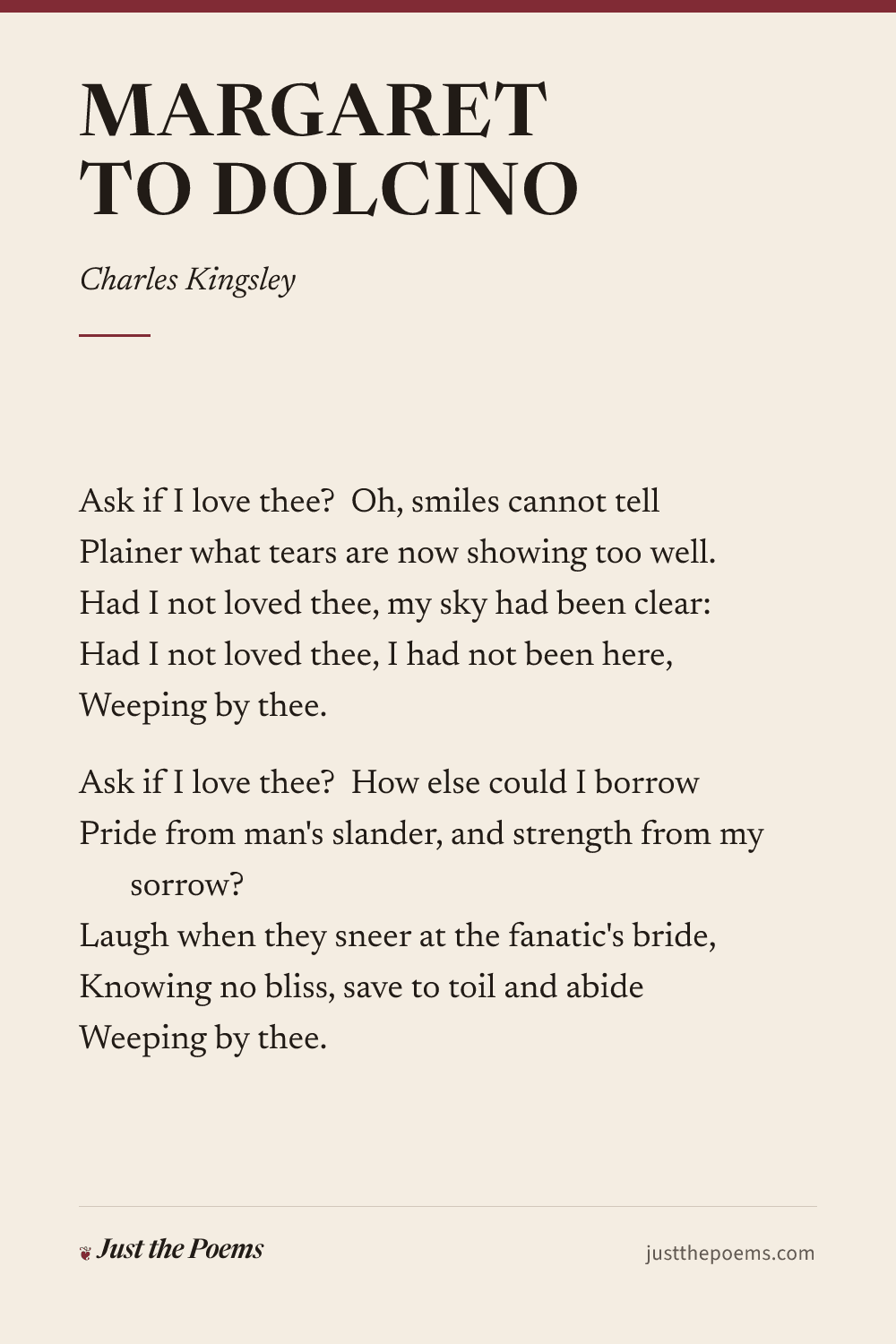
MARGARET TO DOLCINO

Charles Kingsley

In 0 Wikipedias 1 anthology Poet in 35 Wikipedias

Ask if I love thee? Oh, smiles cannot tellPlainer what tears are now showing too well.Had I not loved thee, my sky had been clear:Had I not loved thee, I had not been here,Weeping by thee.

Ask if I love thee? How else could I borrowPride from man's slander, and strength from my sorrow?Laugh when they sneer at the fanatic's bride,Knowing no bliss, save to toil and abideWeeping by thee.

Source

The Home Book of Verse, ed. Burton Egbert Stevenson

Filed under
  • Section “LOVE'S FULFILMENT”, The Home Book of Verse

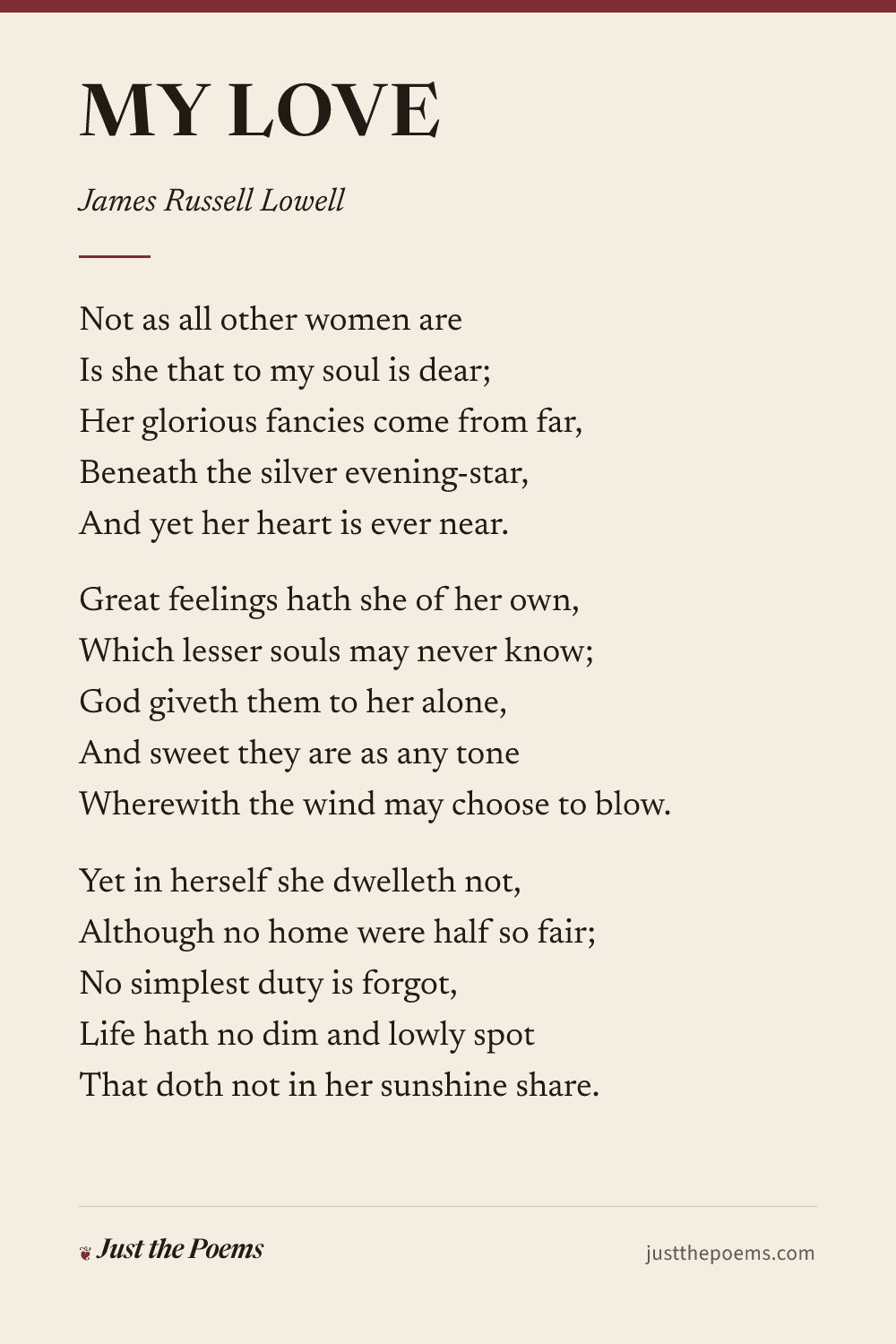
MY LOVE

James Russell Lowell

In 0 Wikipedias 1 anthology Poet in 31 Wikipedias

Not as all other women areIs she that to my soul is dear;Her glorious fancies come from far,Beneath the silver evening-star,And yet her heart is ever near.

Great feelings hath she of her own,Which lesser souls may never know;God giveth them to her alone,And sweet they are as any toneWherewith the wind may choose to blow.

Yet in herself she dwelleth not,Although no home were half so fair;

Show all 50 lines 38 more

No simplest duty is forgot,Life hath no dim and lowly spotThat doth not in her sunshine share.

She doeth little kindnesses,Which most leave undone, or despise:For naught that sets one heart at ease,And giveth happiness or peace,Is low-esteemed in her eyes.

She hath no scorn of common things,And, though she seem of other birth,Round us her heart intwines and clings,And patiently she folds her wingsTo tread the humble paths of earth.

Blessing she is: God made her so,And deeds of week-day holinessFall from her noiseless as the snow,Nor hath she ever chanced to knowThat aught were easier than to bless.

She is most fair, and thereuntoHer life doth rightly harmonize;Feeling or thought that was not trueNe'er made less beautiful the blueUnclouded heaven of her eyes.

She is a woman: one in whomThe spring-time of her childish yearsHath never lost its fresh perfume,Though knowing well that life hath roomFor many blights and many tears.

I love her with a love as stillAs a broad river's peaceful might,Which, by high tower and lowly mill,Seems following its own wayward will,And yet doth ever flow aright.

And, on its full, deep breast serene,Like quiet isles my duties lie;It flows around them and between,And makes them fresh and fair and green,Sweet homes wherein to live and die.

Source

The Home Book of Verse, ed. Burton Egbert Stevenson

Filed under
  • Section “LOVE'S FULFILMENT”, The Home Book of Verse

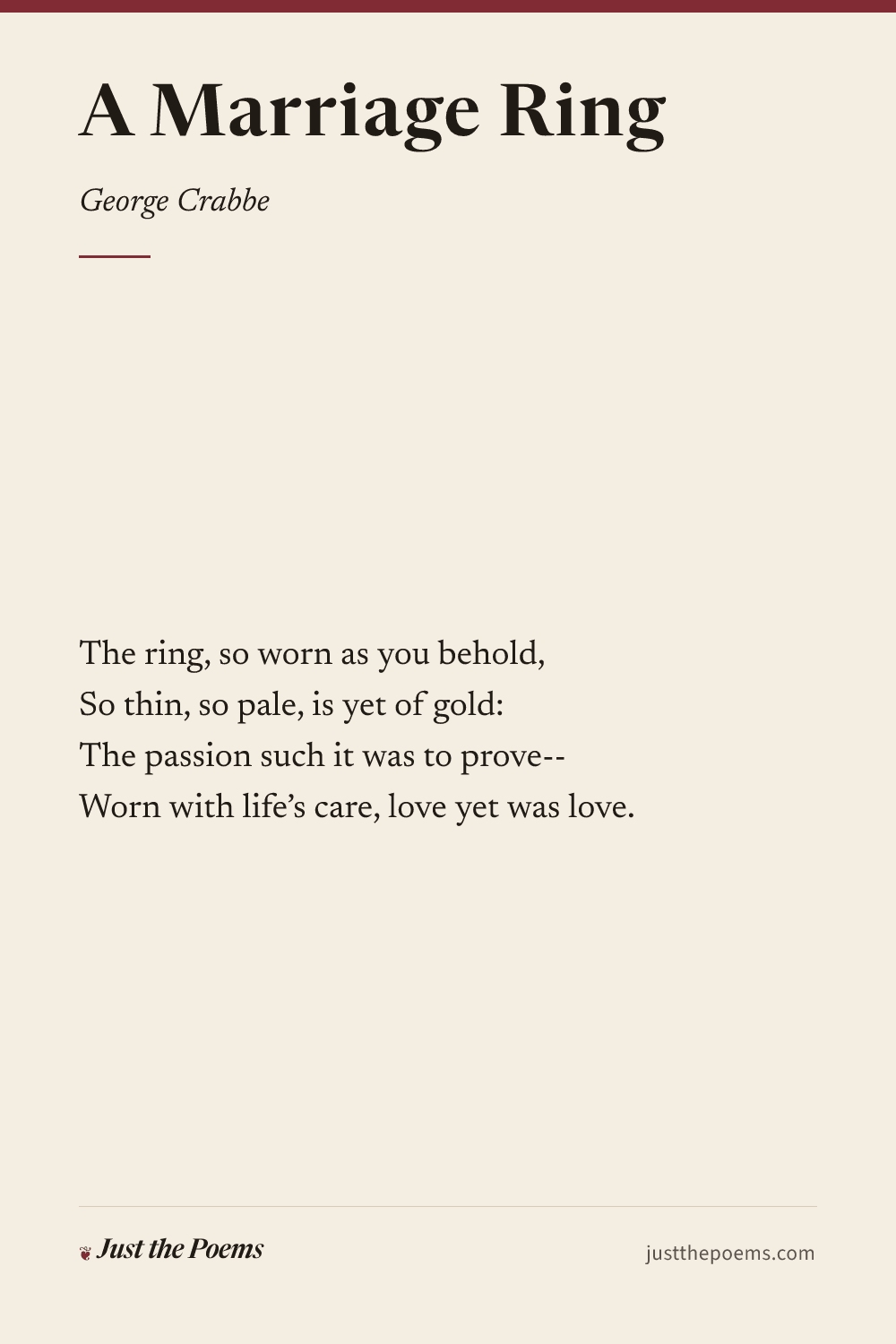
A Marriage Ring

George Crabbe

In 0 Wikipedias 1 anthology Poet in 28 Wikipedias

The ring, so worn as you behold,So thin, so pale, is yet of gold:The passion such it was to prove--Worn with life’s care, love yet was love.

Source

The Oxford Book of English Verse 1250–1900, 1900

Filed under
  • Named in the title

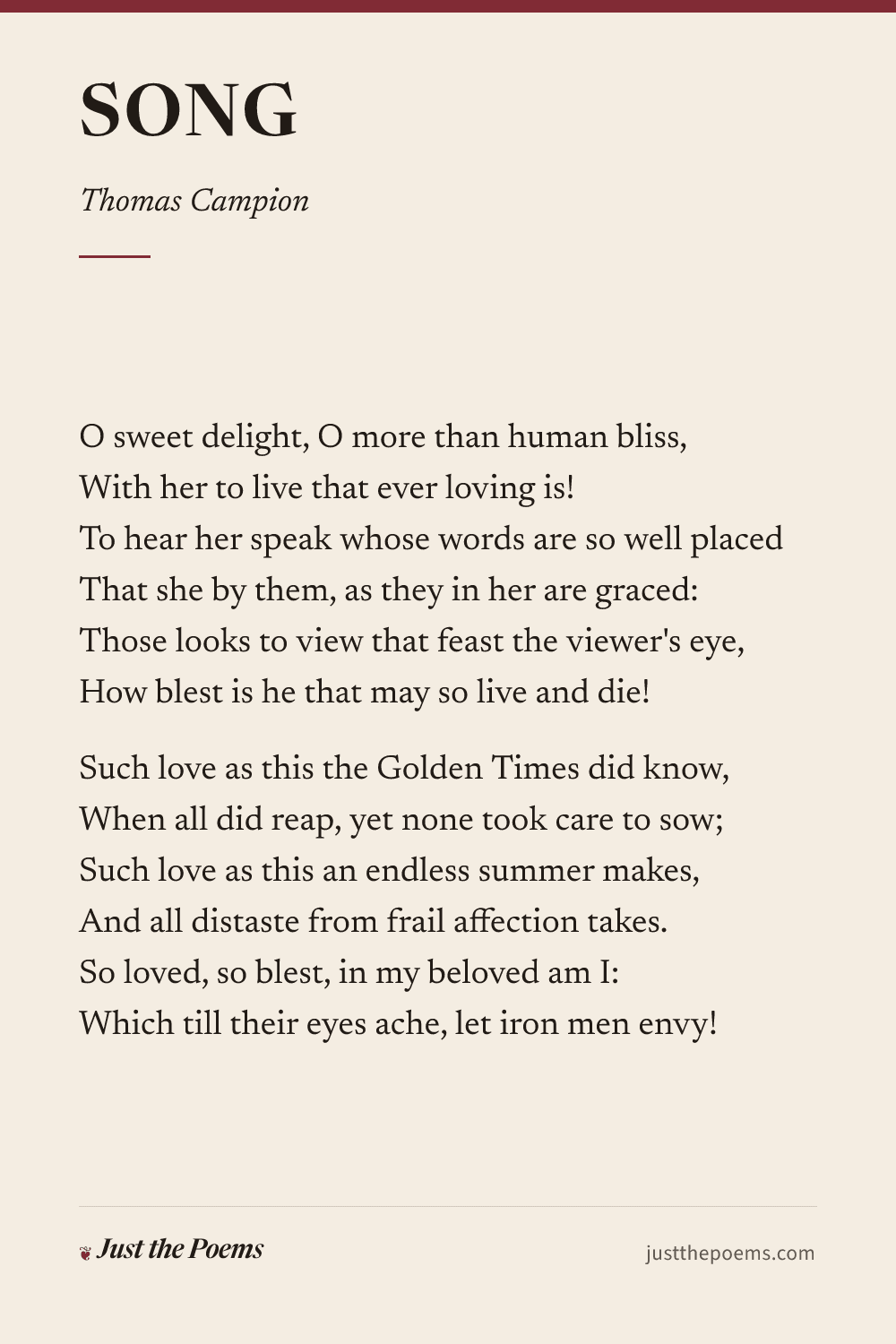
SONG

Thomas Campion

In 0 Wikipedias 1 anthology Poet in 25 Wikipedias

O sweet delight, O more than human bliss,With her to live that ever loving is!To hear her speak whose words are so well placedThat she by them, as they in her are graced:Those looks to view that feast the viewer's eye,How blest is he that may so live and die!

Such love as this the Golden Times did know,When all did reap, yet none took care to sow;Such love as this an endless summer makes,And all distaste from frail affection takes.So loved, so blest, in my beloved am I:Which till their eyes ache, let iron men envy!

Source

The Home Book of Verse, ed. Burton Egbert Stevenson

Filed under
  • Section “LOVE'S FULFILMENT”, The Home Book of Verse

30 of 89 poems about marriage

19 poets

By poet's century of death (29 of 30)

CenturyPoems
16th4
17th3
18th1
19th13
20th8

Poets with more than one poem

PoetPoems
Alfred Tennyson3
Algernon Charles Swinburne3
Robert Browning3
Charles Kingsley2
Edmund Spenser2
Robert Bridges2
Sir Philip Sidney2