Poems for Wife

The 24 poems for wife, by 16 poets, ranked by third-party data. How poems are ranked

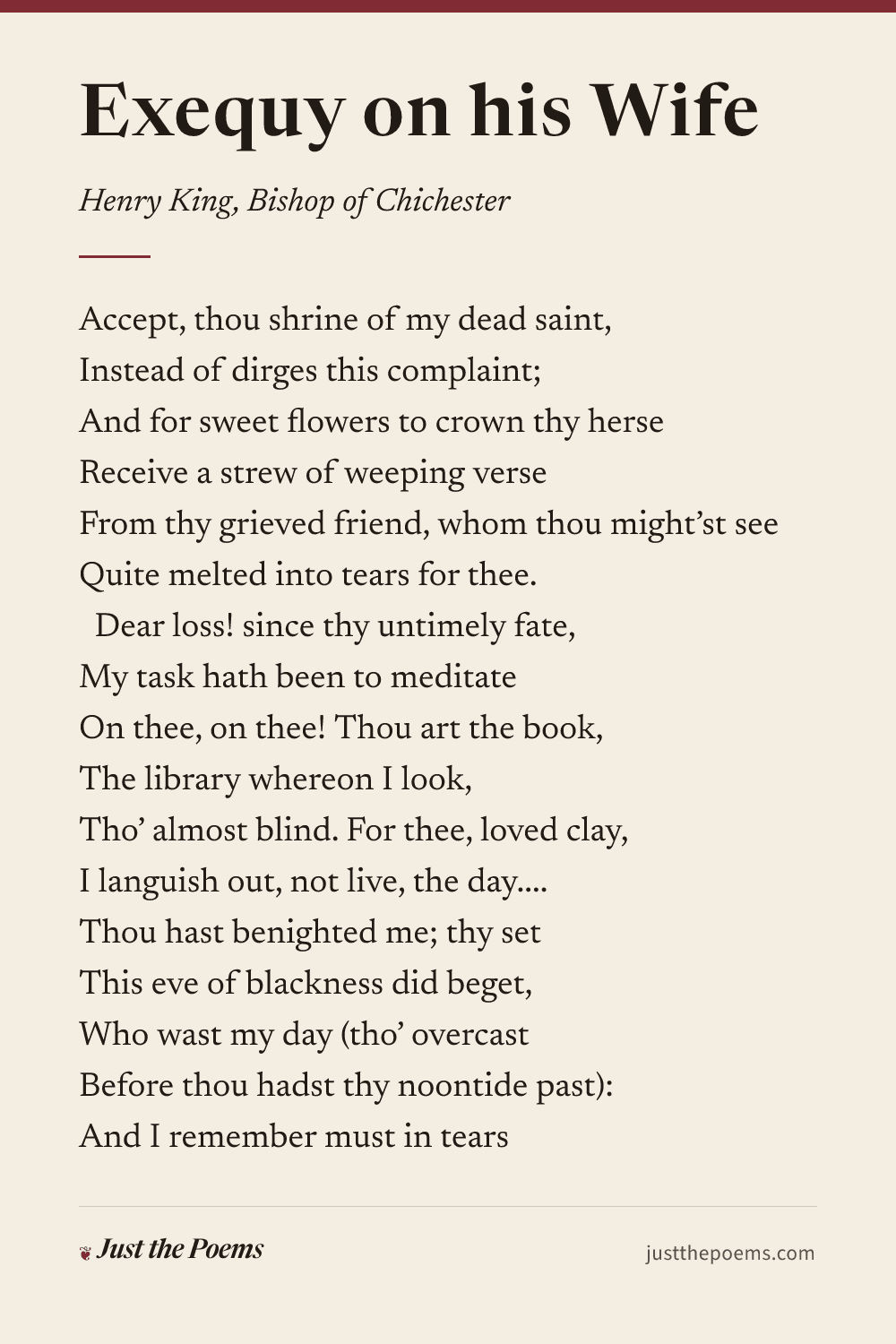
Exequy on his Wife

Henry King, Bishop of Chichester

In 0 Wikipedias 2 anthologies Poet in 5 Wikipedias

Accept, thou shrine of my dead saint,Instead of dirges this complaint;And for sweet flowers to crown thy herseReceive a strew of weeping verseFrom thy grieved friend, whom thou might’st seeQuite melted into tears for thee. Dear loss! since thy untimely fate,My task hath been to meditateOn thee, on thee! Thou art the book,The library whereon I look,Tho’ almost blind. For thee, loved clay,I languish out, not live, the day....

Show all 94 lines 82 more

Thou hast benighted me; thy setThis eve of blackness did beget,Who wast my day (tho’ overcastBefore thou hadst thy noontide past):And I remember must in tearsThou scarce hadst seen so many yearsAs day tells hours. By thy clear sunMy love and fortune first did run;But thou wilt never more appearFolded within my hemisphere,Since both thy light and motion,Like a fled star, is fall’n and gone,And ’twixt me and my soul’s dear wishThe earth now interposèd is.... I could allow thee for a timeTo darken me and my sad clime;Were it a month, a year, or ten,I would thy exile live till then,And all that space my mirth adjourn--So thou wouldst promise to return,And putting off thy ashy shroudAt length disperse this sorrow’s cloud. But woe is me! the longest dateToo narrow is to calculateThese empty hopes: never shall IBe so much blest as to descryA glimpse of thee, till that day comeWhich shall the earth to cinders doom,And a fierce fever must calcineThe body of this world--like thine,My little world! That fit of fireOnce off, our bodies shall aspireTo our souls’ bliss: then we shall riseAnd view ourselves with clearer eyesIn that calm region where no nightCan hide us from each other’s sight. Meantime thou hast her, earth: much goodMay my harm do thee! Since it stoodWith Heaven’s will I might not callHer longer mine, I give thee allMy short-lived right and interestIn her whom living I loved best.Be kind to her, and prithee lookThou write into thy Doomsday bookEach parcel of this rarityWhich in thy casket shrined doth lie,As thou wilt answer Him that lent--Not gave--thee my dear monument.So close the ground, and ’bout her shadeBlack curtains draw: my bride is laid. Sleep on, my Love, in thy cold bedNever to be disquieted!My last good-night! Thou wilt not wakeTill I thy fate shall overtake:Till age, or grief, or sickness mustMarry my body to that dustIt so much loves; and fill the roomMy heart keeps empty in thy tomb.Stay for me there: I will not failTo meet thee in that hollow vale.And think not much of my delay:I am already on the way,And follow thee with all the speedDesire can make, or sorrows breed.Each minute is a short degreeAnd every hour a step towards thee.... ’Tis true--with shame and grief I yield--Thou, like the van, first took’st the field;And gotten hast the victoryIn thus adventuring to dieBefore me, whose more years might craveA just precedence in the grave.But hark! my pulse, like a soft drum,Beats my approach, tells thee I come;And slow howe’er my marches beI shall at last sit down by thee. The thought of this bids me go onAnd wait my dissolutionWith hope and comfort. Dear--forgiveThe crime--I am content to liveDivided, with but half a heart,Till we shall meet and never part.

Source

The Oxford Book of English Verse 1250–1900, 1900

Filed under
  • Named in the title

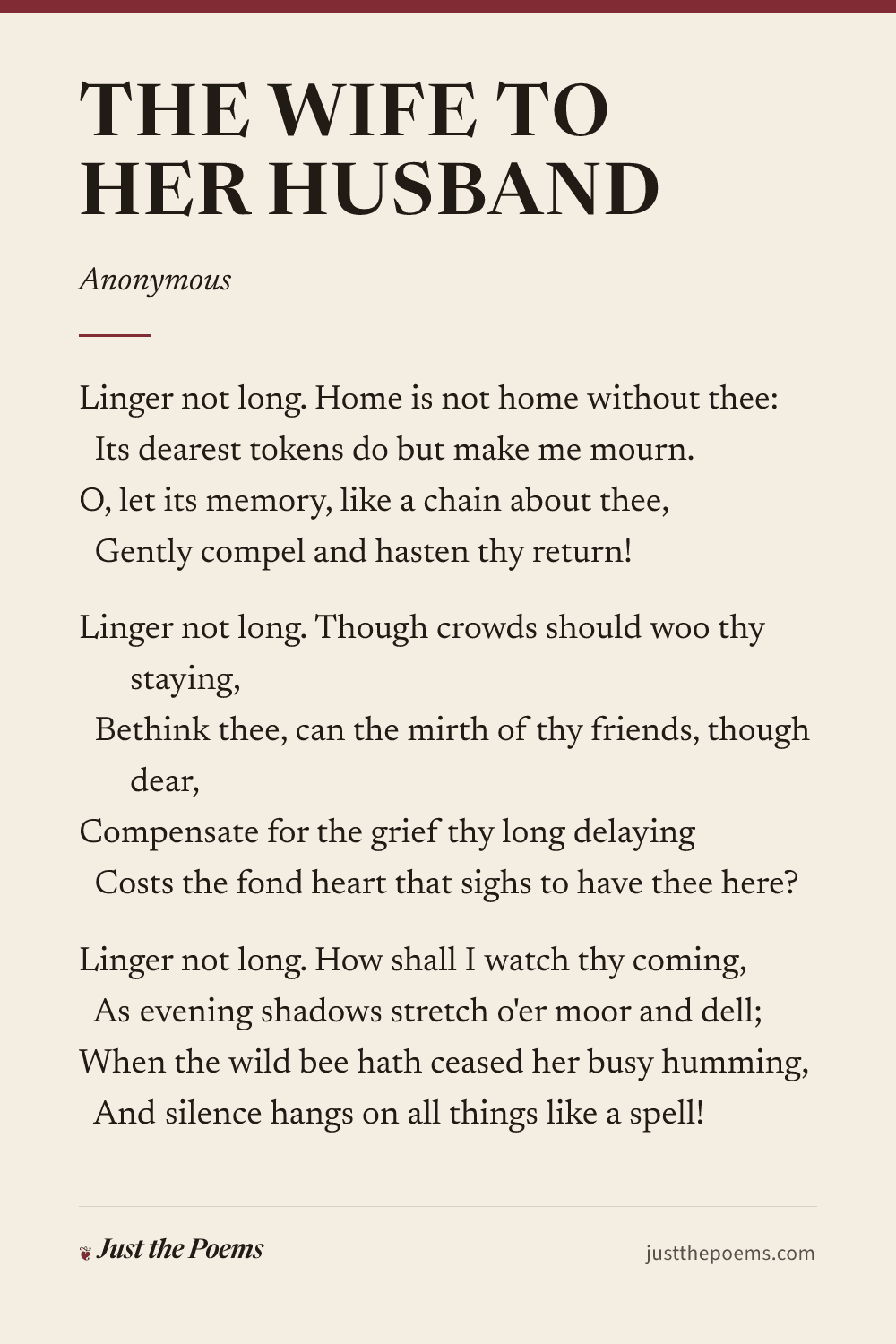
THE WIFE TO HER HUSBAND

Anonymous

In 0 Wikipedias 2 anthologies Poet in 0 Wikipedias

Linger not long. Home is not home without thee: Its dearest tokens do but make me mourn.O, let its memory, like a chain about thee, Gently compel and hasten thy return!

Linger not long. Though crowds should woo thy staying, Bethink thee, can the mirth of thy friends, though dear,Compensate for the grief thy long delaying Costs the fond heart that sighs to have thee here?

Linger not long. How shall I watch thy coming, As evening shadows stretch o'er moor and dell;When the wild bee hath ceased her busy humming, And silence hangs on all things like a spell!

How shall I watch for thee, when fears grow stronger,As night grows dark and darker on the hill!How shall I weep, when I can watch no longer! Ah! art thou absent, art thou absent still?

Yet I shall grieve not, though the eye that seeth me Gazeth through tears that makes its splendor dull;For oh! I sometimes fear when thou art with me, My cup of happiness is all too full.

Haste, haste thee home unto thy mountain dwelling, Haste, as a bird unto its peaceful nest!Haste, as a skiff, through tempests wide and swelling, Flies to its haven of securest rest!

Source

The World's Best Poetry, Vol. III, ed. Bliss Carman, 1904

Filed under
  • Named in the title

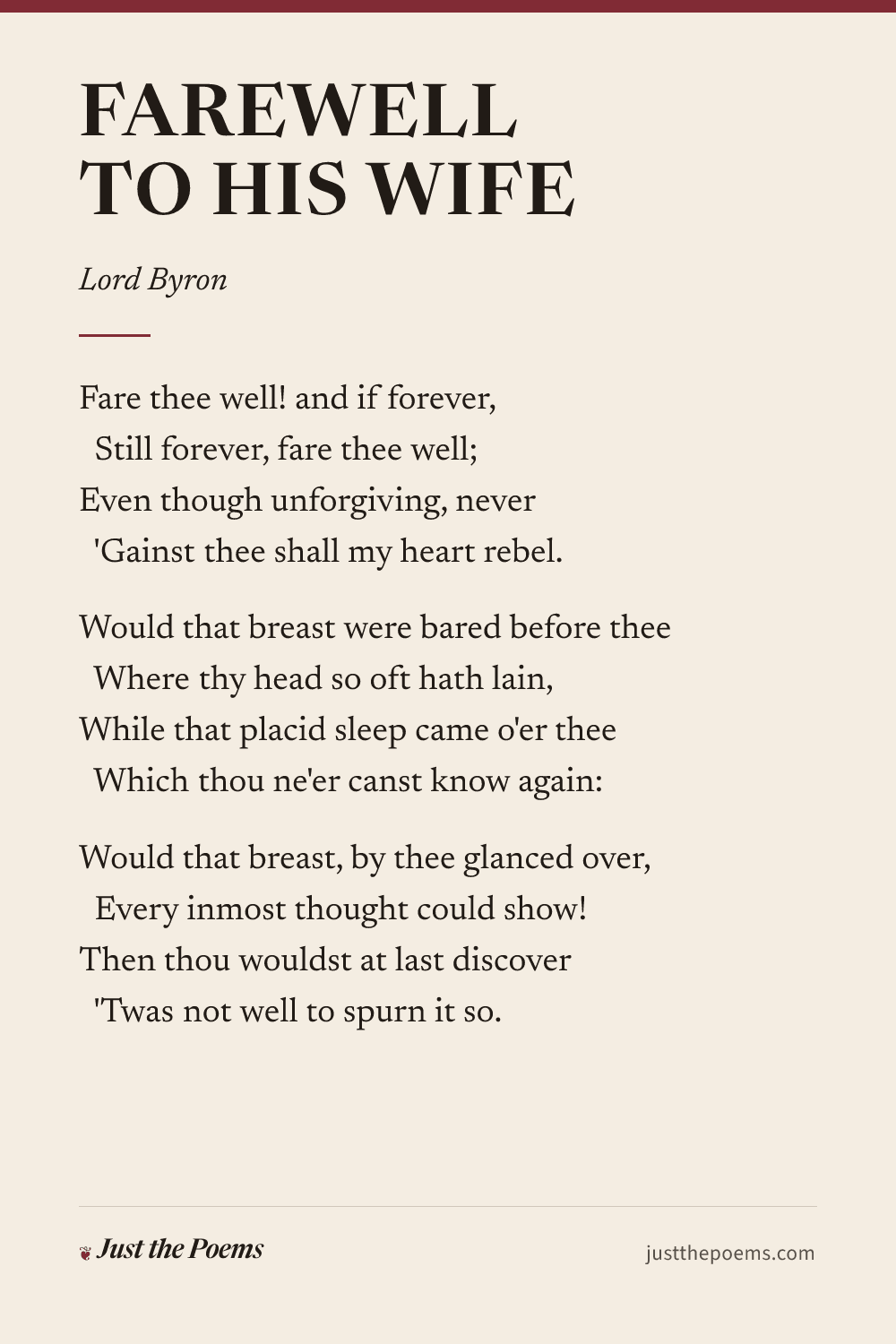
FAREWELL TO HIS WIFE

Lord Byron

In 0 Wikipedias 1 anthology Poet in 155 Wikipedias

Fare thee well! and if forever, Still forever, fare thee well;Even though unforgiving, never 'Gainst thee shall my heart rebel.

Would that breast were bared before thee Where thy head so oft hath lain,While that placid sleep came o'er thee Which thou ne'er canst know again:

Would that breast, by thee glanced over, Every inmost thought could show!Then thou wouldst at last discover 'Twas not well to spurn it so.

Show all 60 lines 48 more

Though the world for this commend thee,-- Though it smile upon the blow,Even its praises must offend thee, Founded on another's woe:

Though my many faults defaced me, Could no other arm be foundThan the one which once embraced me, To inflict a cureless wound?

Yet, O, yet thyself deceived not: Love may sink by slow decay;But by sudden wrench, believe not Hearts can thus be torn away:

Still thy own its life retaineth,-- Still must mine, though bleeding, beat;And the undying thought which paineth Is--that we no more may meet.

These are words of deeper sorrow Than the wail above the dead;Both shall live, but every morrow Wake us from a widowed bed.

And when thou wouldst solace gather, When our child's first accents flow,Wilt thou teach her to say "Father!" Though his care she must forego?

When her little hands shall press thee, When her lip to thine is pressed,Think of him whose prayer shall bless thee, Think of him thy love had blessed!

Should her lineaments resemble Those thou nevermore mayst see,Then thy heart will softly tremble With a pulse yet true to me.

All my faults perchance thou knowest, All my madness none can know;All my hopes, where'er thou goest, Wither, yet with thee they go.Every feeling hath been shaken; Pride, which not a world could bow,Bows to thee,--by thee forsaken, Even my soul forsakes me now;

But 't is done; all words are idle,-- Words from me are vainer still;But the thoughts we cannot bridle Force their way without the will.

Fare thee well!--thus disunited, Torn from every nearer tie,Seared in heart, and lone, and blighted, More than this I scarce can die.

Source

The World's Best Poetry, Vol. III, ed. Bliss Carman, 1904

Filed under
  • Named in the title

Advertisements

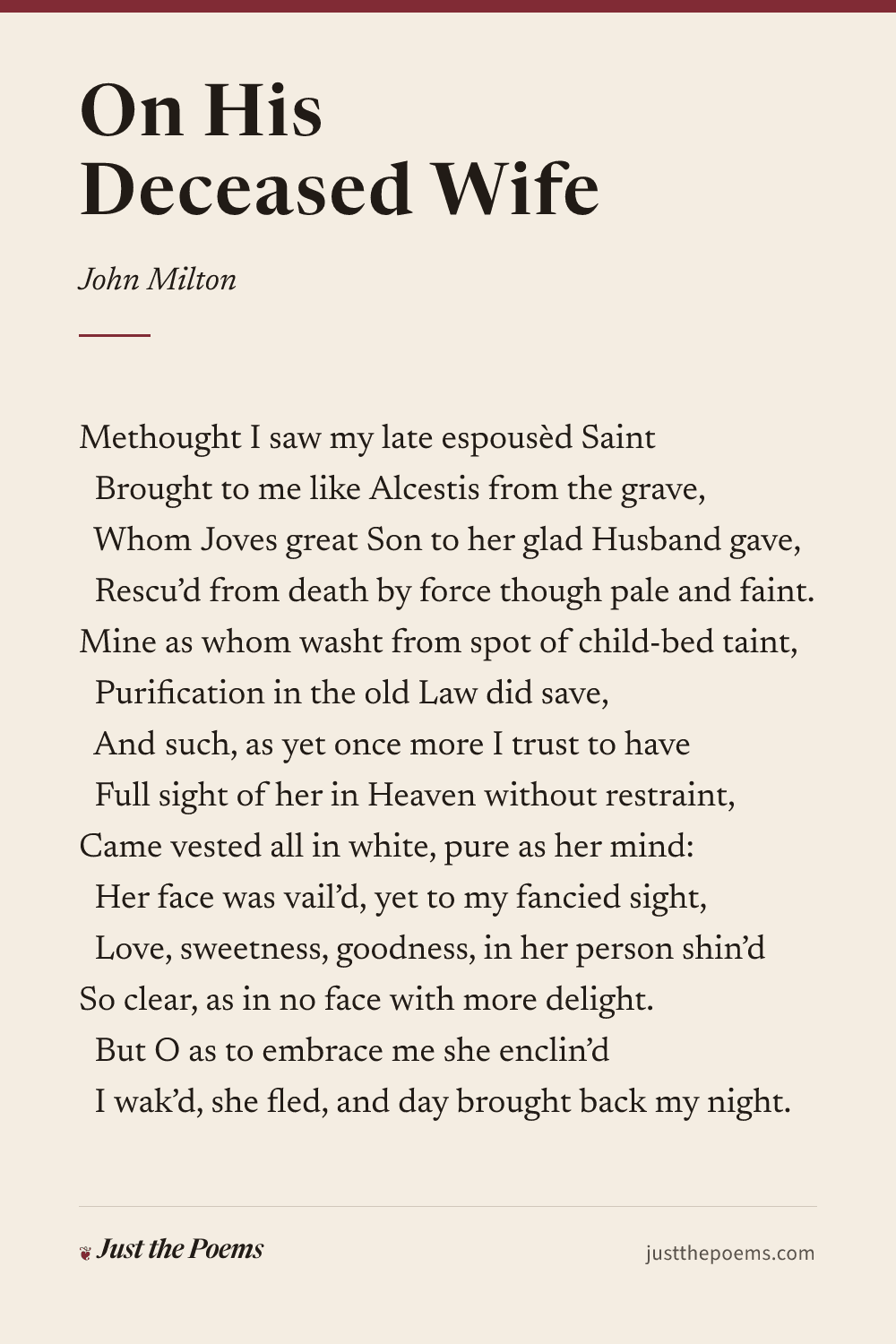
On His Deceased Wife

John Milton

In 0 Wikipedias 1 anthology Poet in 106 Wikipedias

Methought I saw my late espousèd Saint Brought to me like Alcestis from the grave, Whom Joves great Son to her glad Husband gave, Rescu’d from death by force though pale and faint.Mine as whom washt from spot of child-bed taint, Purification in the old Law did save, And such, as yet once more I trust to have Full sight of her in Heaven without restraint,Came vested all in white, pure as her mind: Her face was vail’d, yet to my fancied sight, Love, sweetness, goodness, in her person shin’dSo clear, as in no face with more delight. But O as to embrace me she enclin’d I wak’d, she fled, and day brought back my night.

Source

The Oxford Book of English Verse 1250–1900, 1900

Filed under
  • Named in the title

An Epitaph upon Husband and Wife

Richard Crashaw

In 0 Wikipedias 1 anthology Poet in 24 Wikipedias

To these whom death again did wedThis grave’s the second marriage-bed.For though the hand of Fate could force’Twixt soul and body a divorce,It could not sever man and wife,Because they both lived but one life.Peace, good reader, do not weep;Peace, the lovers are asleep.They, sweet turtles, folded lieIn the last knot that love could tie.Let them sleep, let them sleep on,Till the stormy night be gone,And the eternal morrow dawn;Then the curtains will be drawn,And they wake into a lightWhose day shall never die in night.

Source

The Oxford Book of English Verse 1250–1900, 1900

Filed under
  • Named in the title

THE SHEPHERD'S WIFE'S SONG

Robert Greene

In 0 Wikipedias 1 anthology Poet in 24 Wikipedias

Ah, what is love? It is a pretty thing,As sweet unto a shepherd as a king,And sweeter, too:For kings have cares that wait upon a crown,And cares can make the sweetest love to frown:Ah then, ah then,If country loves such sweet desires do gain,What lady would not love a shepherd swain?

His flocks are folded; he comes home at nightAs merry as a king in his delight,And merrier, too:For kings bethink them what the state require,

Show all 36 lines 24 more

Where shepherds, careless, carol by the fire:

He kisseth first, then sits as blithe to eatHis cream and curds, as doth a king his meat,And blither, too:For kings have often fears when they do sup,Where shepherds dread no poison in their cup:

To bed he goes, as wanton then, I ween,As is a king in dalliance with a queen;More wanton, too:For kings have many griefs, affects to move,Where shepherds have no greater grief than love:

Upon his couch of straw he sleeps as soundAs doth the king upon his bed of down;More sounder, too:For cares cause kings full oft their sleep to spill,Where weary shepherds lie and snort their fill:

Thus, with his wife, he spends the year as blitheAs doth the king at every tide or sithe,And blither, too:For kings have wars and broils to take in hand,Where shepherds laugh and love upon the land:Ah then, ah then,Since country loves such sweet desires do gain,What lady would not love a shepherd swain?

Source

The Home Book of Verse, ed. Burton Egbert Stevenson

Filed under
  • Named in the title

Upon the Death of Sir Albert Morton’s Wife

Sir Henry Wotton

In 0 Wikipedias 1 anthology Poet in 11 Wikipedias

He first deceased; she for a little triedTo live without him, liked it not, and died.

Source

The Oxford Book of English Verse 1250–1900, 1900

Filed under
  • Named in the title

THE IRISH WIFE

Thomas D'Arcy McGee

In 0 Wikipedias 1 anthology Poet in 10 Wikipedias

I would not give my Irish wifeFor all the dames of the Saxon land;I would not give my Irish wifeFor the Queen of France's hand;For she to me is dearerThan castles strong, or lands, or life.An outlaw - so I'm near herTo love till death my Irish wife.

O what would be this home of mine,A ruined, hermit-haunted place,But for the light that nightly shinesUpon its walls from Kathleen's face!

Show all 40 lines 28 more

What comfort in a mine of gold,What pleasure in a royal life,If the heart within lay dead and cold,If I could not wed my Irish wife?

I knew the law forbade the banns;I knew my king abhorred her race;Who never bent before their clansMust bow before their ladies' grace.Take all my forfeited domain,I cannot wage with kinsmen strife:Take knightly gear and noble name,And I will keep my Irish wife.

My Irish wife has clear blue eyes,My heaven by day, my stars by night;And twin-like truth and fondness liesWithin her swelling bosom white.My Irish wife has golden hair,Apollo's harp had once such strings,Apollo's self might pause to hearHer bird-like carol when she sings.

I would not give my Irish wifeFor all the dames of the Saxon land;I would not give my Irish wifeFor the Queen of France's hand;For she to me is dearerThan castles strong, or lands, or life:In death I would be near her,And rise beside my Irish wife.

Source

The Home Book of Verse, ed. Burton Egbert Stevenson

Filed under
  • Named in the title

Advertisements

THE POET'S SONG TO HIS WIFE

Bryan Waller Procter

In 0 Wikipedias 1 anthology Poet in 9 Wikipedias

How many summers, love,Have I been thine?How many days, thou dove,Hast thou been mine?Time, like the winged windWhen it bends the flowers,Hath left no mark behind,To count the hours.

Some weight of thought, though loth,On thee he leaves;Some lines of care round bothPerhaps he weaves;Some fears, - a soft regretFor joys scarce known;Sweet looks we half forget; -All else is flown!

Ah! - With what thankless heartI mourn and sing!Look, where our children start,Like sudden Spring!With tongues all sweet and low,Like a pleasant rhyme,They tell how much I oweTo thee and Time!

Source

The Home Book of Verse, ed. Burton Egbert Stevenson

Filed under
  • Named in the title

THE AULD WIFE.

Charles Stuart Calverley

In 0 Wikipedias 1 anthology Poet in 6 Wikipedias

The auld wife sat at her ivied door, (Butter and eggs and a pound of cheese)A thing she had frequently done before; And her spectacles lay on her aproned knees.

The piper he piped on the hill-top high, (Butter and eggs and a pound of cheese)Till the cow said "I die" and the goose asked "Why;" And the dog said nothing but searched for fleas.

The farmer he strode through the square farmyard; (Butter and eggs and a pound of cheese)His last brew of ale was a trifle hard, The connection of which with the plot one sees.

Show all 40 lines 28 more

The farmer's daughter hath frank blue eyes, (Butter and eggs and a pound of cheese)She hears the rooks caw in the windy skies, As she sits at her lattice and shells her peas.

The farmer's daughter hath ripe red lips; (Butter and eggs and a pound of cheese)If you try to approach her, away she skips Over tables and chairs with apparent ease.

The farmer's daughter hath soft brown hair; (Butter and eggs and a pound of cheese)And I met with a ballad, I can't say where, Which wholly consists of lines like these.

She sat with her hands 'neath her dimpled cheeks, (Butter and eggs and a pound of cheese)And spake not a word. While a lady speaks There is hope, but she didn't even sneeze.

She sat with her hands 'neath her crimson cheeks (Butter and eggs and a pound of cheese)She gave up mending her father's breeks, And let the cat roll in her best chemise.

She sat with her hands 'neath her crimson cheeks (Butter and eggs and a pound of cheese)And gazed at the piper for thirteen weeks; Then she followed him out o'er the misty leas.

Her sheep followed her as their tails did them (Butter and eggs and a pound of cheese)And this song is considered a perfect gem, And as to the meaning, it's what you please.

Source

The World's Best Poetry, Vol. IX, ed. Bliss Carman, 1904

Filed under
  • Named in the title

A WIFE'S SONG

William Cox Bennett

In 0 Wikipedias 1 anthology Poet in 2 Wikipedias

O well I love the Spring,When the sweet, sweet hawthorn blows;And well I love the Summer,And the coming of the rose;But dearer are the changing leaf,And the year upon the wane,For O, they bring the blessed timeThat brings him home again.

November may be dreary,December's days may beAs full of gloom to othersAs once they were to me;But O, to hear the tempestBeat loud against the pane!For the roaring wind and the blessed timeThat brings him home again.

Source

The Home Book of Verse, ed. Burton Egbert Stevenson

Filed under
  • Named in the title

THE SAILOR'S WIFE

William Julius Mickle

In 0 Wikipedias 1 anthology Poet in 2 Wikipedias

And are ye sure the news is true? And are ye sure he's weel?Is this a time to think o' wark? Ye jades, lay by your wheel;Is this the time to spin a thread, When Colin's at the door?Reach down my cloak, I'll to the quay And see him come ashore.For there's nae luck about the house, There's nae luck at a';There's little pleasure in the house When our gudeman's awa'.

Show all 56 lines 44 more

And gie to me my bigonet, My bishop's satin gown;For I maun tell the baillie's wife That Colin's in the town.My Turkey slippers maun gae on, My stockins pearly blue;It's a' to pleasure our gudeman, For he's baith leal and true.

Rise, lass, and mak a clean fireside, Put on the muckle pot;Gie little Kate her button gown And Jock his Sunday coat;And mak their shoon as black as slaes, Their hose as white as snaw;It's a' to please my ain gudeman, For he's been long awa.

There's twa fat hens upo' the coop Been fed this month and mair;Mak haste and thraw their necks about, That Colin weel may fare;And spread the table neat and clean, Gar ilka thing look braw,For wha can tell how Colin fared When he was far awa?

Sae true his heart, sae smooth his speech. His breath like caller air;His very foot has music in't As he comes up the stair--And will I see his face again? And will I hear him speak?I'm downright dizzy wi' the thought, In troth I'm like to greet!

If Colin's weel, and weel content, I hae nae mair to crave:And gin I live to keep him sae, I'm blest aboon the lave:And will I see his face again, And will I hear him speak?I'm downright dizzy wi' the thought, In troth I'm like to greet!

For there's nae luck about the house, There's nae luck at a';There's little pleasure in the house When our gudeman's awa.

Source

The Golden Treasury, ed. Francis Turner Palgrave

Filed under
  • Named in the title

MY AIN WIFE

Alexander Laing

In 0 Wikipedias 1 anthology Poet in 1 Wikipedia

I wadna gi'e my ain wifeFor ony wife I see;I wadna gi'e my ain wifeFor ony wife I see;A bonnier yet I've never seen,A better canna be -I wadna gi'e my ain wifeFor ony wife I see!

O couthie is my ingle-cheek,An' cheerie is my Jean;I never see her angry look,Nor hear her word on ane.She's gude wi' a' the neebors roun'An' aye gude wi' me -I wadna gi'e my ain wifeFor ony wife I see.

An' O her looks sae kindlie,They melt my heart outright,When o'er the baby at her breastShe hangs wi' fond delight;She looks intill its bonnie face,An' syne looks to me -I wadna gi'e my ain wifeFor ony wife I see.

Source

The Home Book of Verse, ed. Burton Egbert Stevenson

Filed under
  • Named in the title

Advertisements

THE WIFE

Theodosia Garrison

In 0 Wikipedias 1 anthology Poet in 1 Wikipedia

The little Dreams of Maidenhood--I put them all awayAs tenderly as mother wouldThe toys of yesterday,When little children grow to menToo over-wise for play.

The little dreams I put aside--I loved them every one,And yet since moon-blown buds must hideBefore the noon-day sun,I close them wistfully awayAnd give the key to none.

O little Dreams of Maidenhood--Lie quietly, nor careIf some day in an idle moodI, searching unawareThrough some closed corner of my heart,Should laugh to find you there.

Source

The Home Book of Verse, ed. Burton Egbert Stevenson

Filed under
  • Named in the title

The Wife of Usher’s Well

Anonymous

In 0 Wikipedias 1 anthology Poet in 0 Wikipedias

There lived a wife at Usher’s well, And a wealthy wife was she;She had three stout and stalwart sons, And sent them o’er the sea.

They hadna been a week from her, A week but barely ane,When word came to the carline wife That her three sons were gane.

They hadna been a week from her, A week but barely three,When word came to the carline wife That her sons she’d never see.

Show all 52 lines 40 more

‘I wish the wind may never cease. Nor fashes in the flood,Till my three sons come hame to me, In earthly flesh and blood!’

It fell about the Martinmas, When nights are lang and mirk,The carline wife’s three sons came hame, And their hats were o’ the birk.

It neither grew in syke nor ditch, Nor yet in ony sheugh;But at the gates o’ Paradise That birk grew fair eneugh.

‘Blow up the fire, my maidens! Bring water from the well!For a’ my house shall feast this night, Since my three sons are well.’

And she has made to them a bed, She’s made it large and wide;And she’s ta’en her mantle her about, Sat down at the bedside.

Up then crew the red, red cock, And up and crew the gray;The eldest to the youngest said. ‘’Tis time we were away.’

The cock he hadna craw’d but once, And clapp’d his wings at a’,When the youngest to the eldest said, ‘Brother, we must awa’.

‘The cock doth craw, the day doth daw, The channerin’ worm doth chide;Gin we be miss’d out o’ our place, A sair pain we maun bide.’

‘Lie still, lie still but a little wee while, Lie still but if we may;Gin my mother should miss us when she wakes, She’ll go mad ere it be day.’

‘Fare ye weel, my mother dear! Fareweel to barn and byre!And fare ye weel, the bonny lass That kindles my mother’s fire!’

Source

The Oxford Book of English Verse 1250–1900, 1900

Filed under
  • Named in the title

A WIFE AND ANOTHER

Thomas Hardy

In 0 Wikipedias 0 anthologies Poet in 91 Wikipedias

“WAR ends, and he’s returning Early; yea, The evening next to-morrow’s!”— —This I sayTo her, whom I suspiciously survey,

Holding my husband’s letter To her view.— She glanced at it but lightly, And I knewThat one from him that day had reached her too.

There was no time for scruple; Secretly

Show all 70 lines 58 more

I filched her missive, conned it, Learnt that heWould lodge with her ere he came home to me.

To reach the port before her, And, unscanned, There wait to intercept them Soon I planned:That, in her stead, I might before him stand.

So purposed, so effected; At the inn Assigned, I found her hidden:— O that sinShould bear what she bore when I entered in!

Her heavy lids grew laden With despairs, Her lips made soundless movements Unawares,While I peered at the chamber hired as theirs.

And as beside its doorway, Deadly hued, One inside, one withoutside We two stood,He came—my husband—as she knew he would.

No pleasurable triumph Was that sight! The ghastly disappointment Broke them quite.What love was theirs, to move them with such might!

“Madam, forgive me!” said she, Sorrow bent, “A child—I soon shall bear him . . . Yes—I meantTo tell you—that he won me ere he went.”

Then, as it were, within me Something snapped, As if my soul had largened: Conscience-capped,I saw myself the snarer—them the trapped.

“My hate dies, and I promise, Grace-beguiled,” I said, “to care for you, be Reconciled;And cherish, and take interest in the child.”

Without more words I pressed him Through the door Within which she stood, powerless To say more,And closed it on them, and downstairward bore.

“He joins his wife—my sister,” I, below, Remarked in going—lightly— Even as thoughAll had come right, and we had arranged it so . . .

As I, my road retracing, Left them free, The night alone embracing Childless me,I held I had not stirred God wrothfully.

Source

Time's Laughingstocks, and Other Verses, 1928

Filed under
  • Named in the title

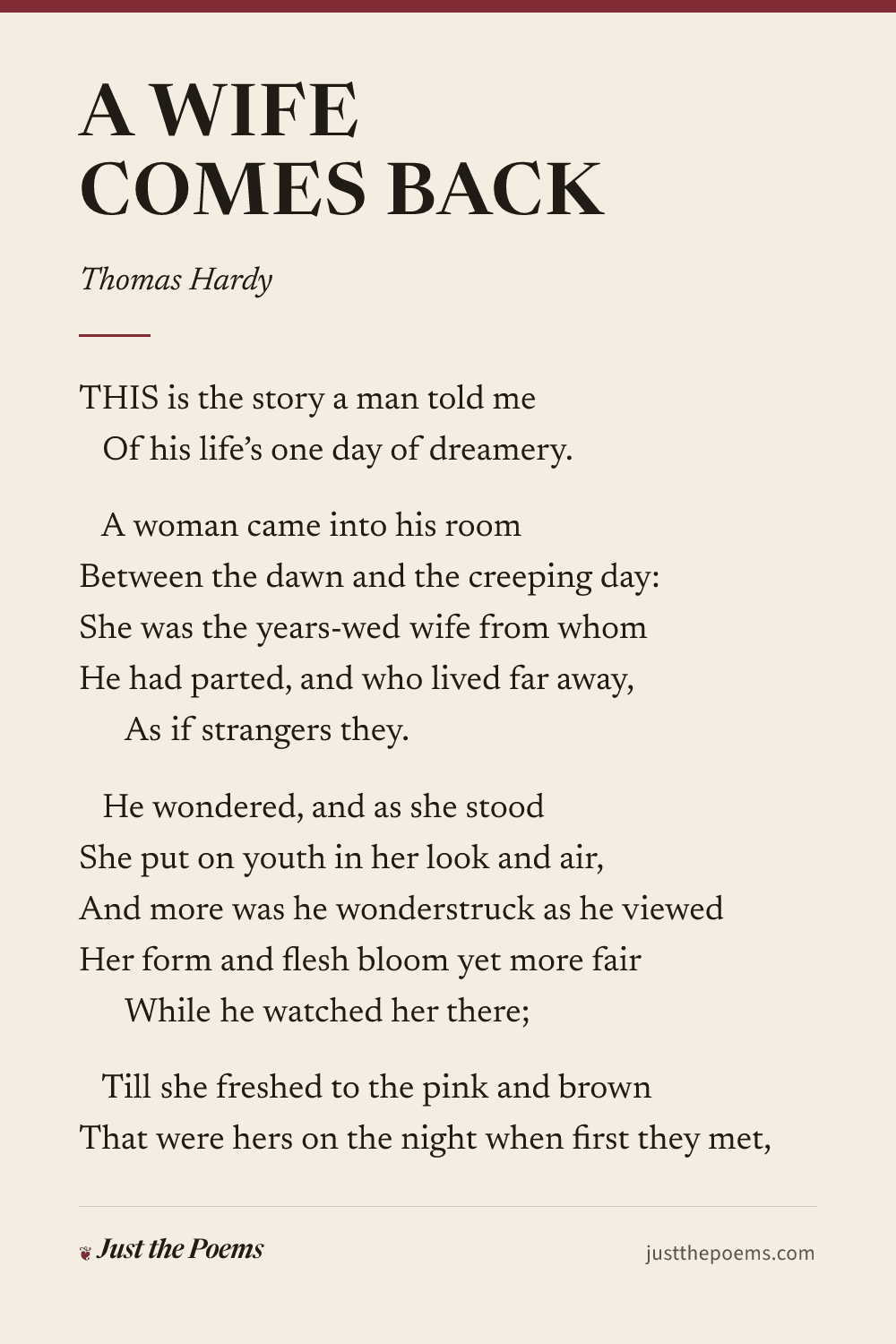
A WIFE COMES BACK

Thomas Hardy

In 0 Wikipedias 0 anthologies Poet in 91 Wikipedias

THIS is the story a man told me Of his life’s one day of dreamery.

A woman came into his roomBetween the dawn and the creeping day:She was the years-wed wife from whomHe had parted, and who lived far away, As if strangers they.

He wondered, and as she stoodShe put on youth in her look and air,And more was he wonderstruck as he viewedHer form and flesh bloom yet more fair While he watched her there;

Show all 42 lines 30 more

Till she freshed to the pink and brownThat were hers on the night when first they met,When she was the charm of the idle townAnd he the pick of the club-fire set . . . His eyes grew wet,

And he stretched his arms: “Stay—rest!—”He cried. “Abide with me so, my own!”But his arms closed in on his hard bare breast;She had vanished with all he had looked upon Of her beauty: gone.

He clothed, and drew downstairs,But she was not in the house, he found;And he passed out under the leafy pairsOf the avenue elms, and searched around To the park-pale bound.

He mounted, and rode till nightTo the city to which she had long withdrawn,The vision he bore all day in his sightBeing her young self as pondered on In the dim of dawn.

“—The lady here long ago—Is she now here?—young—or such age as she is?”“—She is still here.”—“Thank God. Let her know;She’ll pardon a comer so late as this Whom she’d fain not miss.”

She received him—an ancient dame,Who hemmed, with features frozen and numb,“How strange!—I’d almost forgotten your name!—A call just now—is troublesome; Why did you come?”

Source

Late Lyrics and Earlier, With Many Other Verses, 1922

Filed under
  • Named in the title

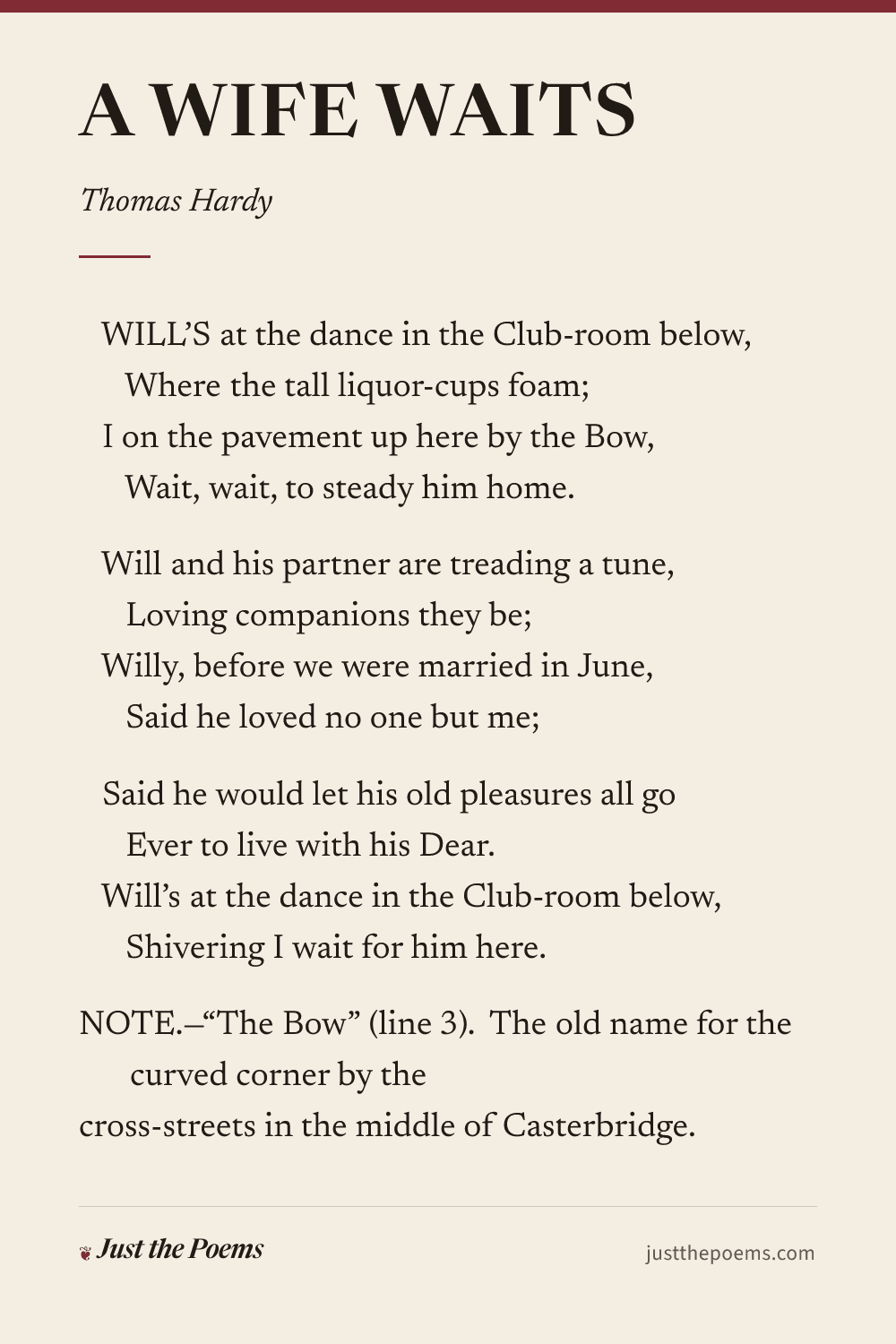
A WIFE WAITS

Thomas Hardy

In 0 Wikipedias 0 anthologies Poet in 91 Wikipedias

WILL’S at the dance in the Club-room below, Where the tall liquor-cups foam; I on the pavement up here by the Bow, Wait, wait, to steady him home.

Will and his partner are treading a tune, Loving companions they be; Willy, before we were married in June, Said he loved no one but me;

Said he would let his old pleasures all go Ever to live with his Dear. Will’s at the dance in the Club-room below, Shivering I wait for him here.

NOTE.—“The Bow” (line 3). The old name for the curved corner by thecross-streets in the middle of Casterbridge.

Source

Time's Laughingstocks, and Other Verses, 1928

Filed under
  • Named in the title

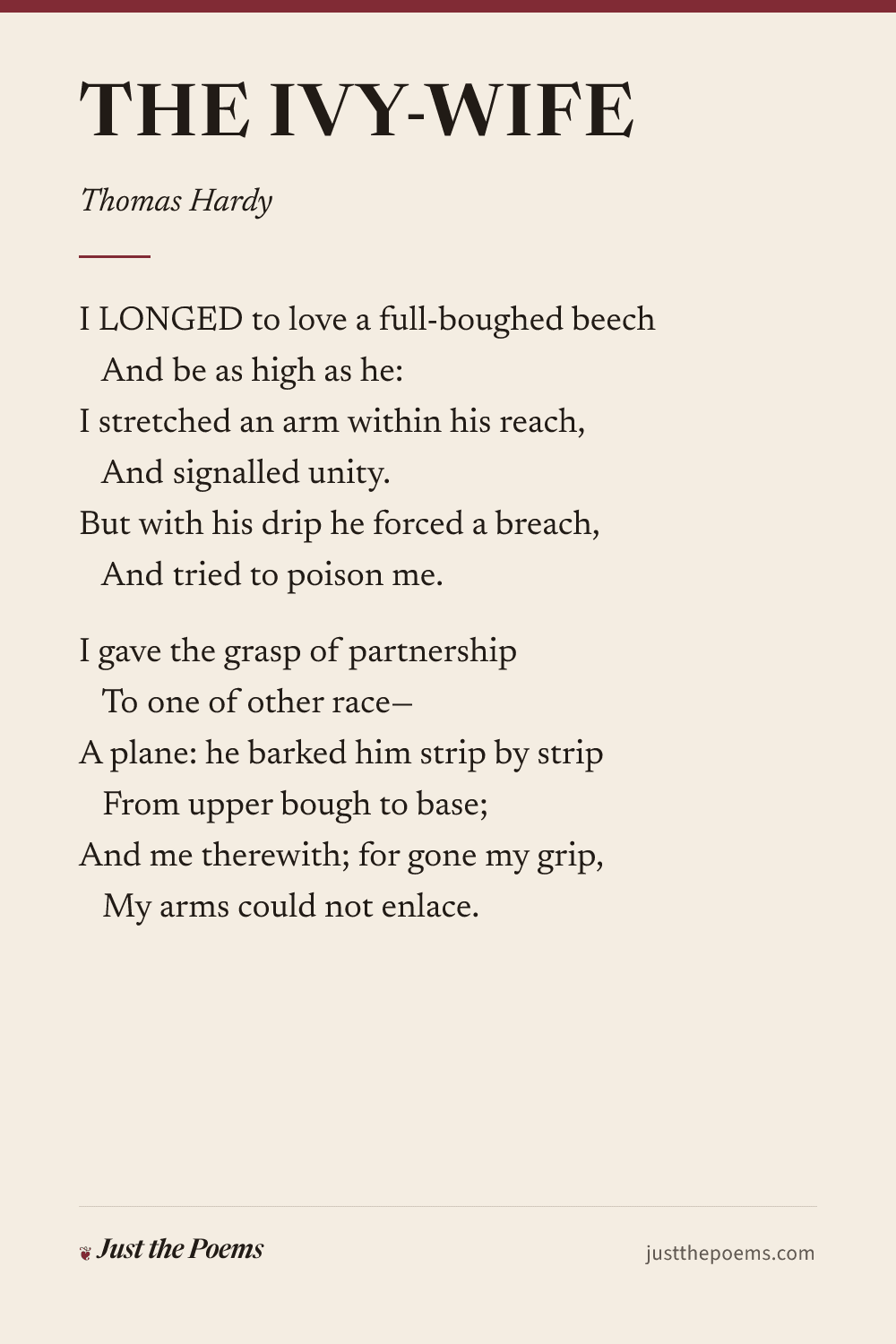
THE IVY-WIFE

Thomas Hardy

In 0 Wikipedias 0 anthologies Poet in 91 Wikipedias

I LONGED to love a full-boughed beech And be as high as he:I stretched an arm within his reach, And signalled unity.But with his drip he forced a breach, And tried to poison me.

I gave the grasp of partnership To one of other race—A plane: he barked him strip by strip From upper bough to base;And me therewith; for gone my grip, My arms could not enlace.

In new affection next I strove To coll an ash I saw,And he in trust received my love; Till with my soft green clawI cramped and bound him as I wove . . . Such was my love: ha-ha!

By this I gained his strength and height Without his rivalry.But in my triumph I lost sight Of afterhaps. Soon he,Being bark-bound, flagged, snapped, fell outright, And in his fall felled me!

Source

Wessex Poems and Other Verses, 1919

Filed under
  • Named in the title

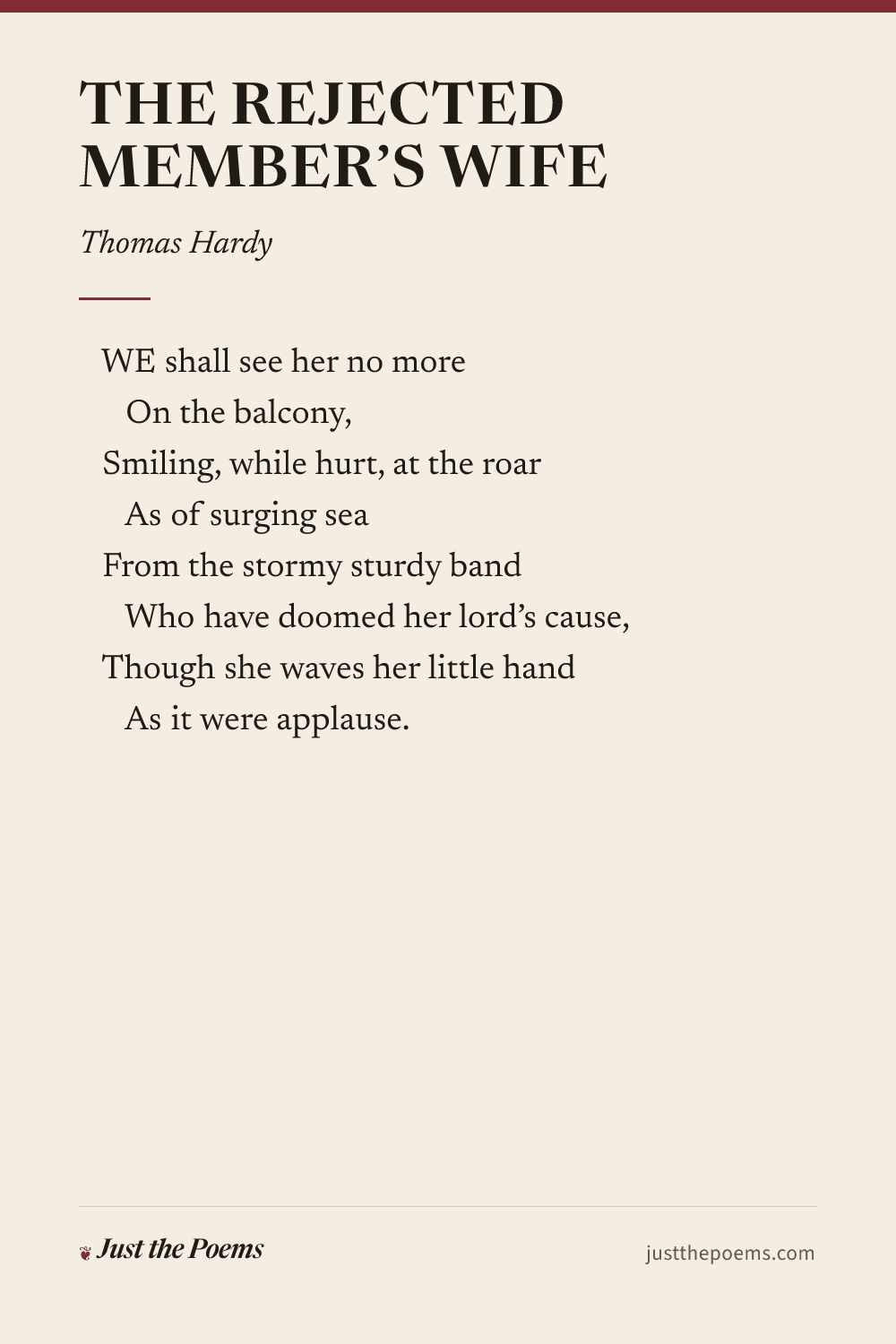
THE REJECTED MEMBER’S WIFE

Thomas Hardy

In 0 Wikipedias 0 anthologies Poet in 91 Wikipedias

WE shall see her no more On the balcony, Smiling, while hurt, at the roar As of surging sea From the stormy sturdy band Who have doomed her lord’s cause, Though she waves her little hand As it were applause.

Here will be candidates yet, And candidates’ wives, Fervid with zeal to set Their ideals on our lives:

Show all 25 lines 13 more

Here will come market-men On the market-days, Here will clash now and then More such party assays.

And the balcony will fill When such times are renewed, And the throng in the street will thrill With to-day’s mettled mood; But she will no more stand In the sunshine there, With that wave of her white-gloved hand, And that chestnut hair.

January 1906.

Source

Time's Laughingstocks, and Other Verses, 1928

Filed under
  • Named in the title

THE WIFE OF FLANDERS

Gilbert Keith Chesterton

In 0 Wikipedias 0 anthologies Poet in 70 Wikipedias

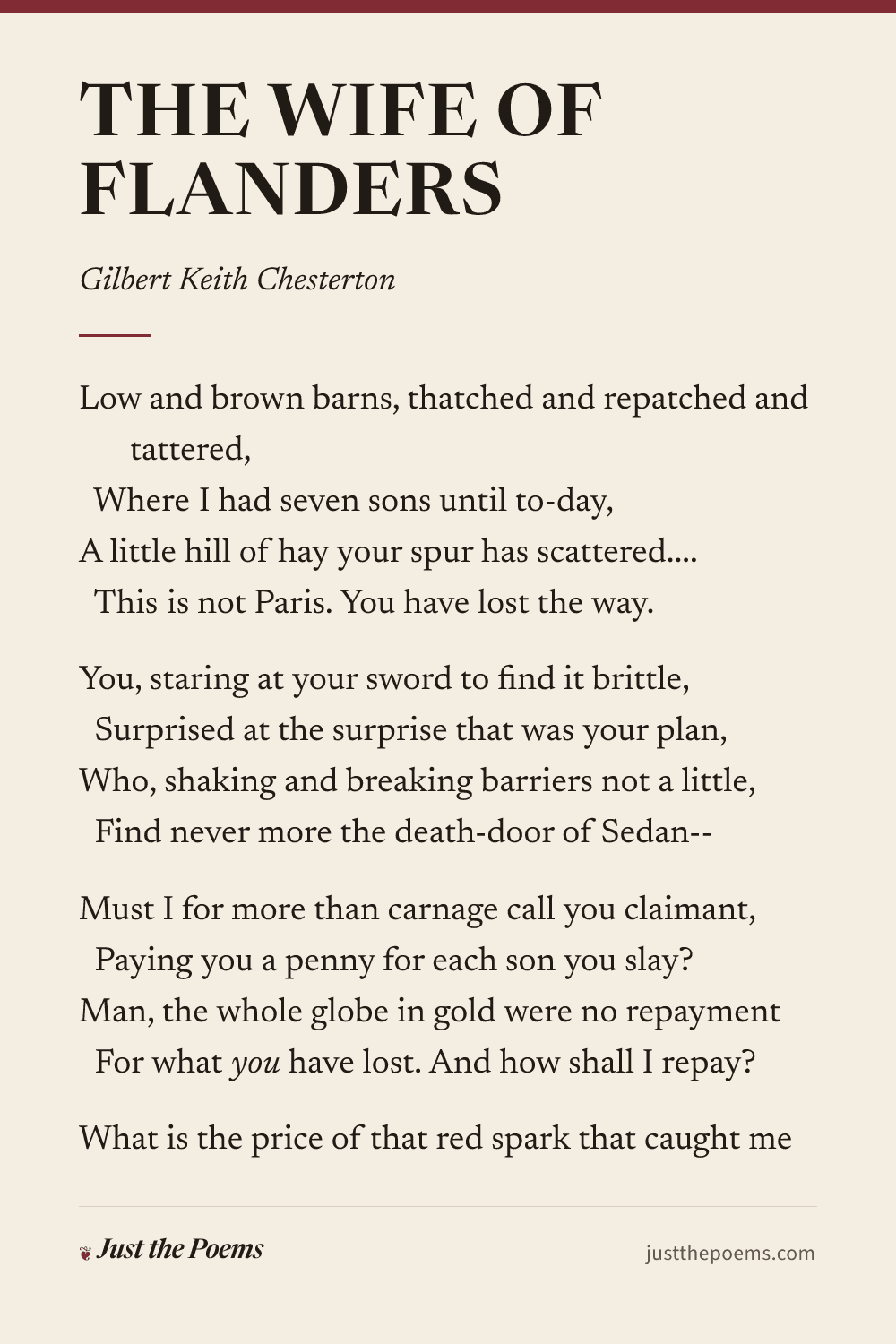
Low and brown barns, thatched and repatched and tattered, Where I had seven sons until to-day,A little hill of hay your spur has scattered.... This is not Paris. You have lost the way.

You, staring at your sword to find it brittle, Surprised at the surprise that was your plan,Who, shaking and breaking barriers not a little, Find never more the death-door of Sedan--

Must I for more than carnage call you claimant, Paying you a penny for each son you slay?Man, the whole globe in gold were no repayment For what you have lost. And how shall I repay?

Show all 28 lines 16 more

What is the price of that red spark that caught me From a kind farm that never had a name?What is the price of that dead man they brought me? For other dead men do not look the same.

How should I pay for one poor graven steeple Whereon you shattered what you shall not know?How should I pay you, miserable people? How should I pay you everything you owe?

Unhappy, can I give you back your honour? Though I forgave, would any man forget?While all the great green land has trampled on her The treason and terror of the night we met.

Not any more in vengeance or in pardon An old wife bargains for a bean that's hers.You have no word to break: no heart to harden. Ride on and prosper. You have lost your spurs.

Source

A Treasury of War Poetry: British and American Poems of the World War 1914-1917, ed. George Herbert Clarke

Filed under
  • Named in the title

LINES TO MY WIFE.

John S. Adams

In 0 Wikipedias 0 anthologies Poet in 0 Wikipedias

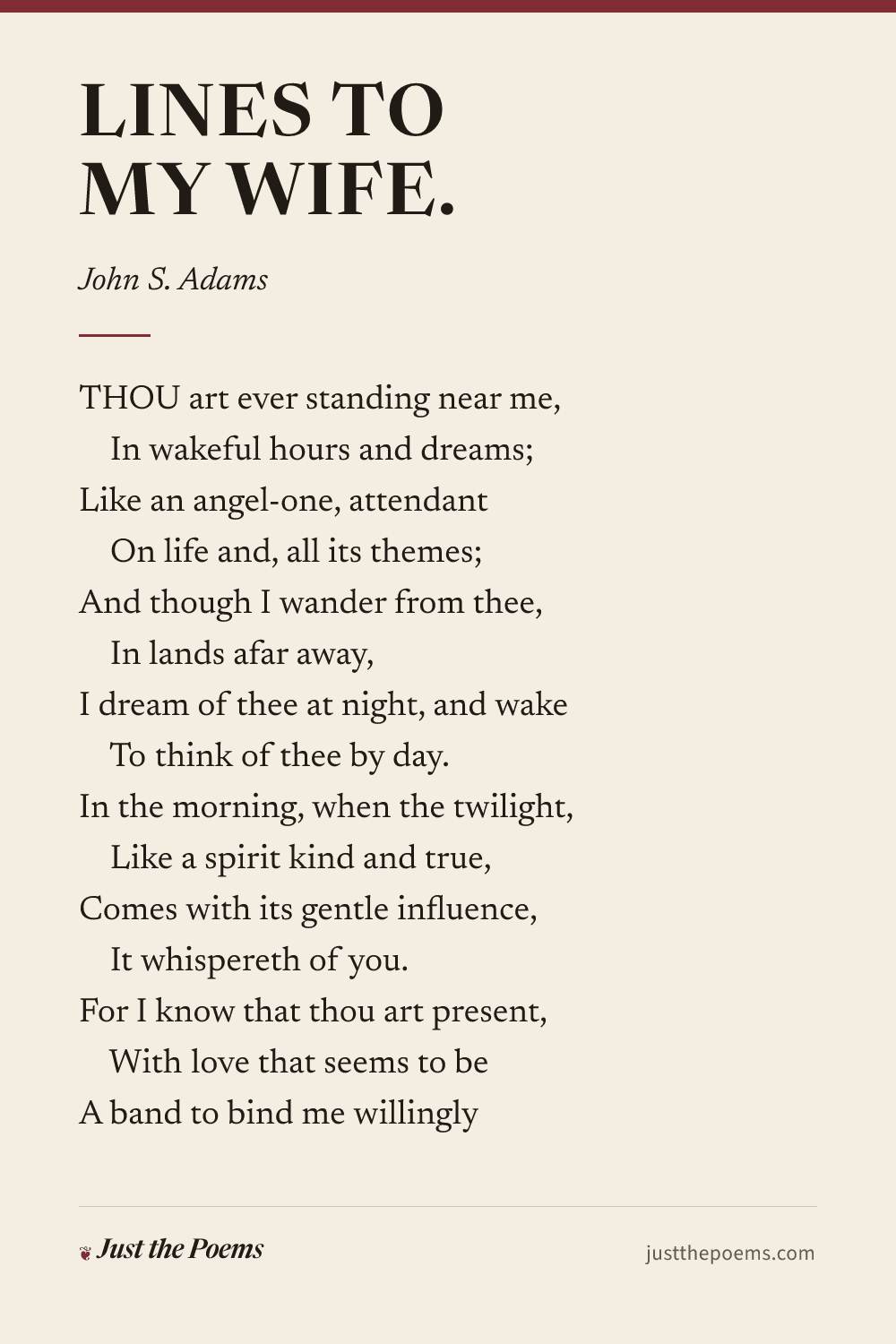
THOU art ever standing near me, In wakeful hours and dreams;Like an angel-one, attendant On life and, all its themes;And though I wander from thee, In lands afar away,I dream of thee at night, and wake To think of thee by day.In the morning, when the twilight, Like a spirit kind and true,Comes with its gentle influence, It whispereth of you.

Show all 56 lines 44 more

For I know that thou art present, With love that seems to beA band to bind me willingly To heaven and to thee.At noon-day, when the tumult and The din of life is heard,When in life's battle each heart is With various passions stirred,I turn me from the blazonry, The fickleness of life,And think of thee in earnest thought, My dearest one-my wife!When the daylight hath departed, And shadows of the nightBring forth the stars, as beacons fair For angels in their flight,I think of thee as ever mine, Of thee as ever best,And turn my heart unto thine own, To seek its wonted rest.Thus ever thou art round my path, And doubly dear thou artWhen, with my lips pressed to thine own, I feel thy beating heart.And through the many joys and griefs, The lights and shades of life,It will be joy to call thee by The holy name of "wife!"I love thee for thy gentleness, I love thee for thy truth;I love thee for thy joyousness, Thy buoyancy of youthI love thee for thy soul that soars Above earth's sordid pelf;And last, not least, above these all, I love thee for thyself.Now come to me, my dearest, Place thy hand in mine own;Look in mine eyes, and see how deep My love for thee hath grown;And I will press thee to my heart, Will call thee "my dear wife,"And own that thou art all my joy And happiness of life.

Source

Town and Country; Or, Life at Home and Abroad, Without and Within Us, 1855

Filed under
  • Named in the title

SOLILOQUY OVER THE GRAVE OF A WIFE.

John S. Adams

In 0 Wikipedias 0 anthologies Poet in 0 Wikipedias

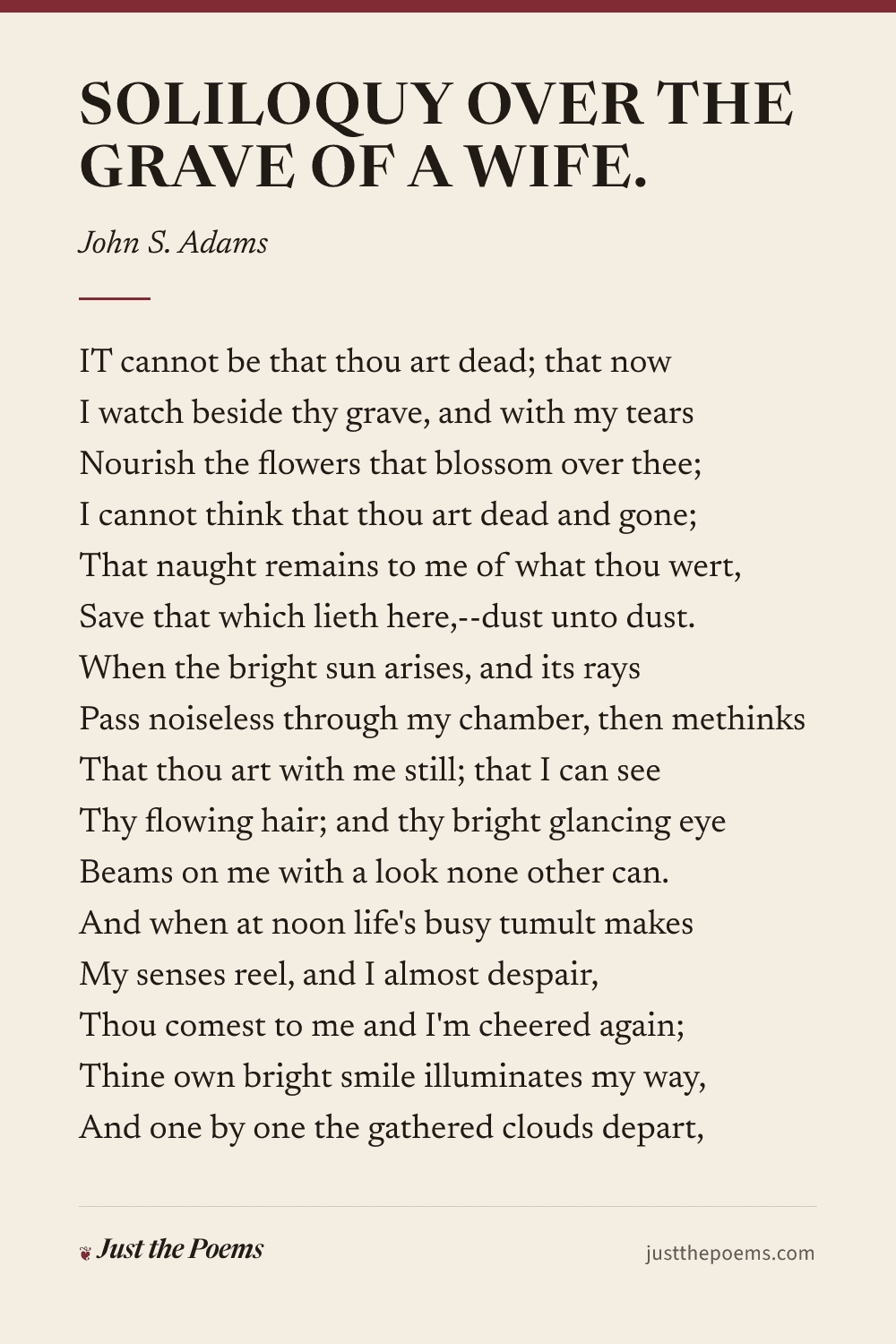
IT cannot be that thou art dead; that nowI watch beside thy grave, and with my tearsNourish the flowers that blossom over thee;I cannot think that thou art dead and gone;That naught remains to me of what thou wert,Save that which lieth here,--dust unto dust.When the bright sun arises, and its raysPass noiseless through my chamber, then methinksThat thou art with me still; that I can seeThy flowing hair; and thy bright glancing eyeBeams on me with a look none other can.And when at noon life's busy tumult makes

Show all 44 lines 32 more

My senses reel, and I almost despair,Thou comest to me and I'm cheered again;Thine own bright smile illuminates my way,And one by one the gathered clouds depart,Till not a shadow lies upon my path.Night, with its long and sombre shadows, treadsUpon the steps that morn and noon have trod;And, as our children gather round my knee,And lisp those evening prayers thy lips have taught,I cannot but believe that thou art near.But when they speak of "mother," when they say"'T is a long time since she hath left our side,"And when they ask, in their soft infant tones,When they again shall meet thee,--then I feelA sudden sadness o'er my spirit come:And when sleep holds them in its silken bandsI wander here, to this fair spot they callThy grave (as though this feeble earth could holdThee in its cold embrace), and weep and sigh;Yet, trusting, look above to yon bright sphere,And feel thou art not dead, but living there.It is not thou that fills this spot of earth,It is not thou o'er whom these branches wave,These blooming roses only mark the spotWhere but remaineth that thou couldst not wearAmid immortal scenes.Thou livest yet!Thy feet do tread the golden courts of heaven;Thy hands have touched the harps that angels use;Thy eyes have seen the glory of our Lord;Thy ears have listened to that song of praiseWhich angels utter, and which God accepts.

Source

Town and Country; Or, Life at Home and Abroad, Without and Within Us, 1855

Filed under
  • Named in the title

TO THE WIFE.

John S. Adams

In 0 Wikipedias 0 anthologies Poet in 0 Wikipedias

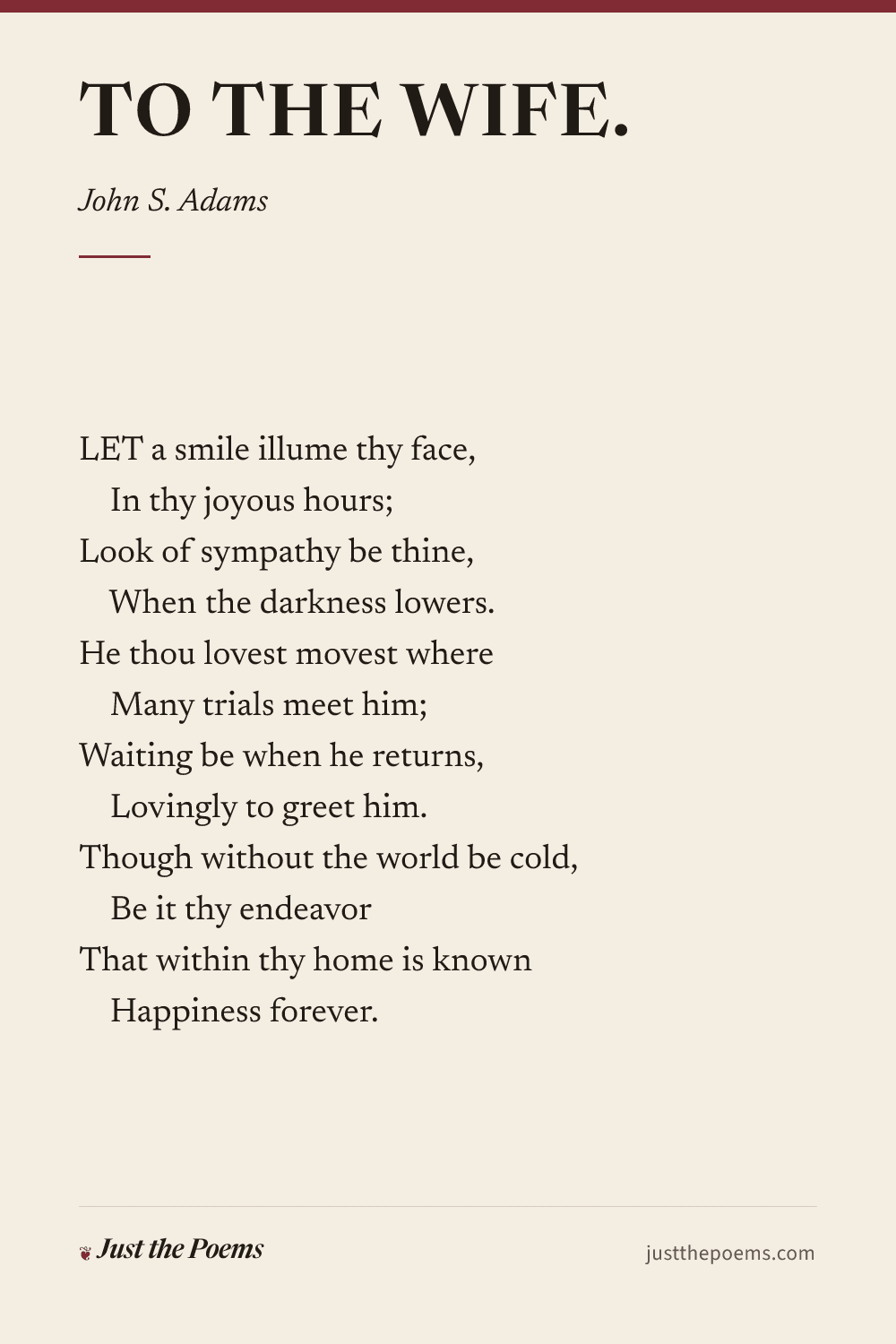
LET a smile illume thy face, In thy joyous hours;Look of sympathy be thine, When the darkness lowers.He thou lovest movest where Many trials meet him;Waiting be when he returns, Lovingly to greet him.Though without the world be cold, Be it thy endeavorThat within thy home is known Happiness forever.

Source

Town and Country; Or, Life at Home and Abroad, Without and Within Us, 1855

Filed under
  • Named in the title

24 poems for wife

16 poets

By poet's century of death (22 of 24)

CenturyPoems
16th1
17th4
18th1
19th9
20th7

Poets with more than one poem

PoetPoems
Thomas Hardy5
John S. Adams3