Poems About Inspiration

The 19 poems about inspiration, by 18 poets, ranked by third-party data. How poems are ranked

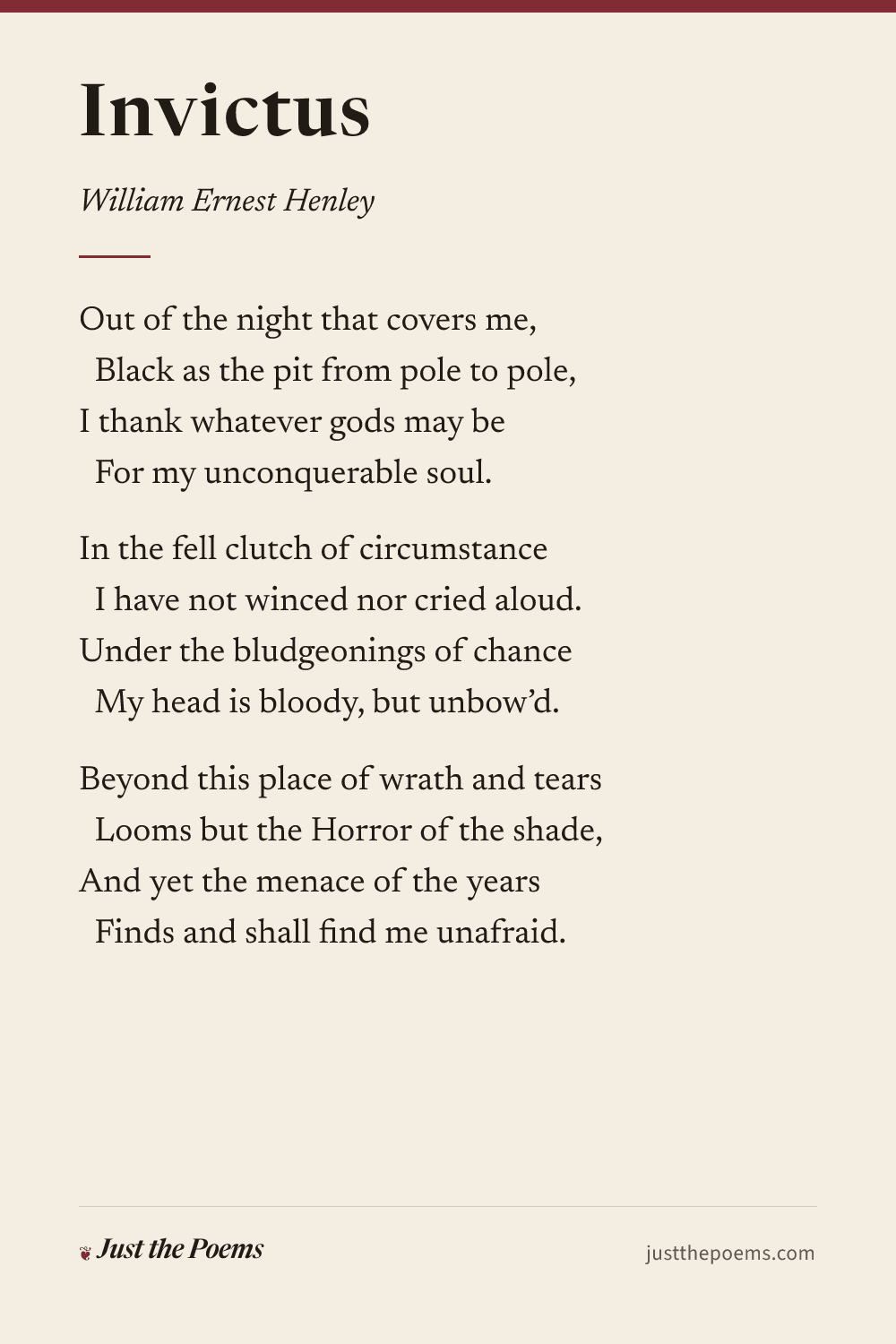
Invictus

William Ernest Henley

In 25 Wikipedias 4 anthologies Poet in 25 Wikipedias

Out of the night that covers me, Black as the pit from pole to pole,I thank whatever gods may be For my unconquerable soul.

In the fell clutch of circumstance I have not winced nor cried aloud.Under the bludgeonings of chance My head is bloody, but unbow’d.

Beyond this place of wrath and tears Looms but the Horror of the shade,And yet the menace of the years Finds and shall find me unafraid.

It matters not how strait the gate, How charged with punishments the scroll,I am the master of my fate: I am the captain of my soul.

Source

The Oxford Book of English Verse 1250–1900, 1900

Filed under
  • Section “COMFORT AND CHEER”, The World's Best Poetry

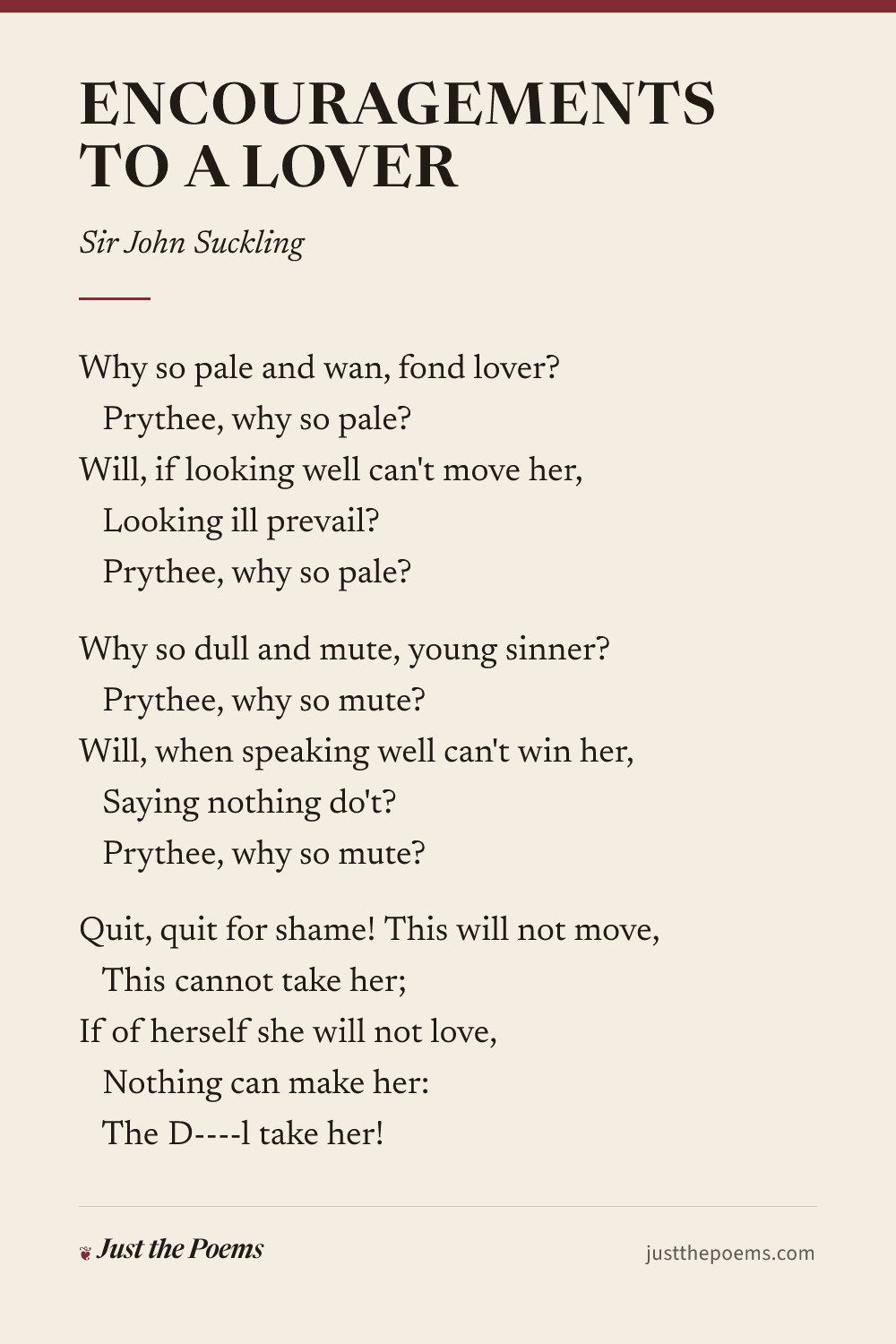
ENCOURAGEMENTS TO A LOVER

Sir John Suckling

In 0 Wikipedias 3 anthologies Poet in 16 Wikipedias

Why so pale and wan, fond lover? Prythee, why so pale?Will, if looking well can't move her, Looking ill prevail? Prythee, why so pale?

Why so dull and mute, young sinner? Prythee, why so mute?Will, when speaking well can't win her, Saying nothing do't? Prythee, why so mute?

Quit, quit for shame! This will not move, This cannot take her;If of herself she will not love, Nothing can make her: The D----l take her!

Source

The Golden Treasury, ed. Francis Turner Palgrave

Filed under
  • Named in the title

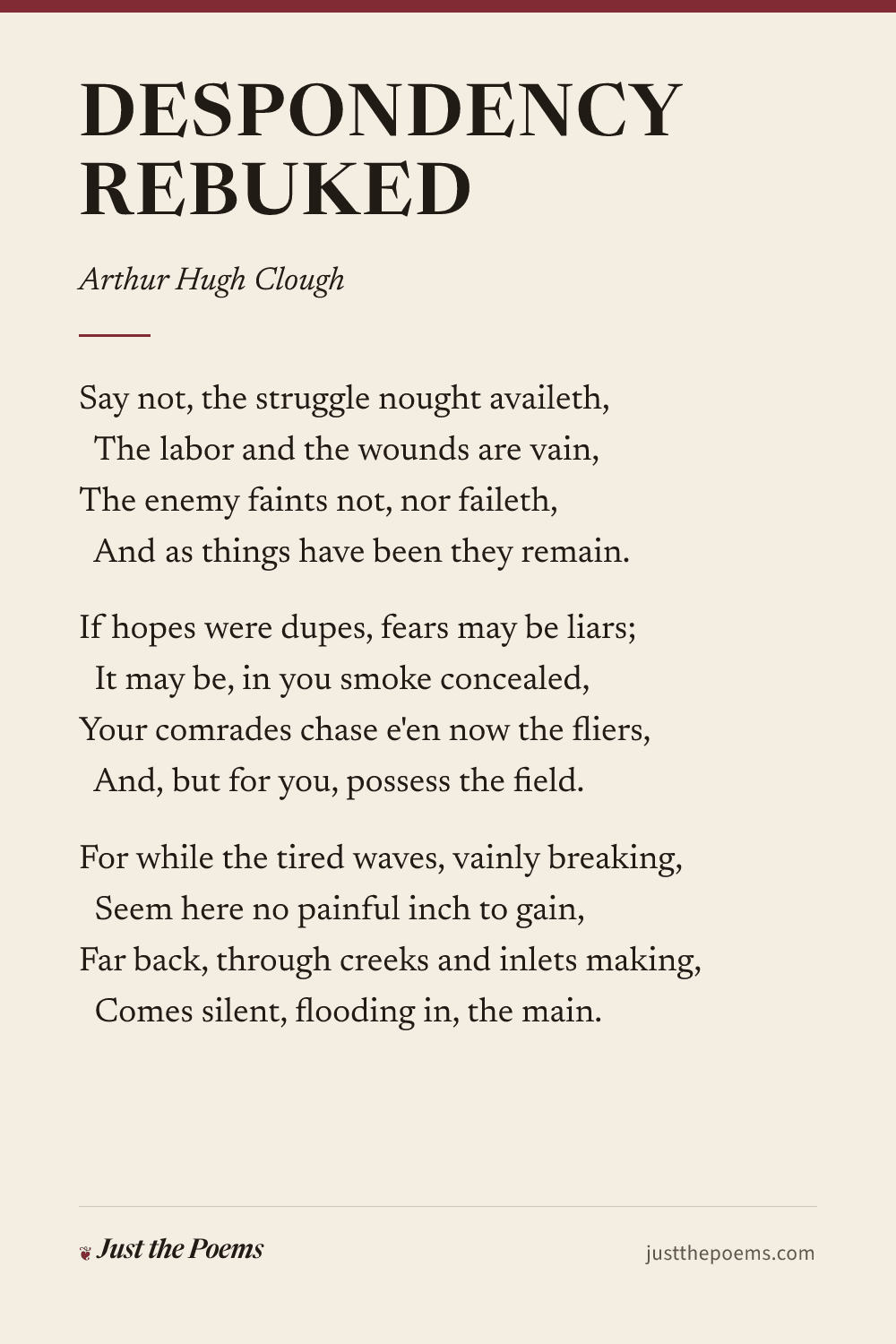
DESPONDENCY REBUKED

Arthur Hugh Clough

In 0 Wikipedias 3 anthologies Poet in 11 Wikipedias

Say not, the struggle nought availeth, The labor and the wounds are vain,The enemy faints not, nor faileth, And as things have been they remain.

If hopes were dupes, fears may be liars; It may be, in you smoke concealed,Your comrades chase e'en now the fliers, And, but for you, possess the field.

For while the tired waves, vainly breaking, Seem here no painful inch to gain,Far back, through creeks and inlets making, Comes silent, flooding in, the main.

And not by eastern windows only. When daylight comes, comes in the light;In front, the sun climbs slow, how slowly, But westward, look, the land is bright.

Source

The World's Best Poetry, Vol. III, ed. Bliss Carman, 1904

Filed under
  • Section “COMFORT AND CHEER”, The World's Best Poetry

Advertisements

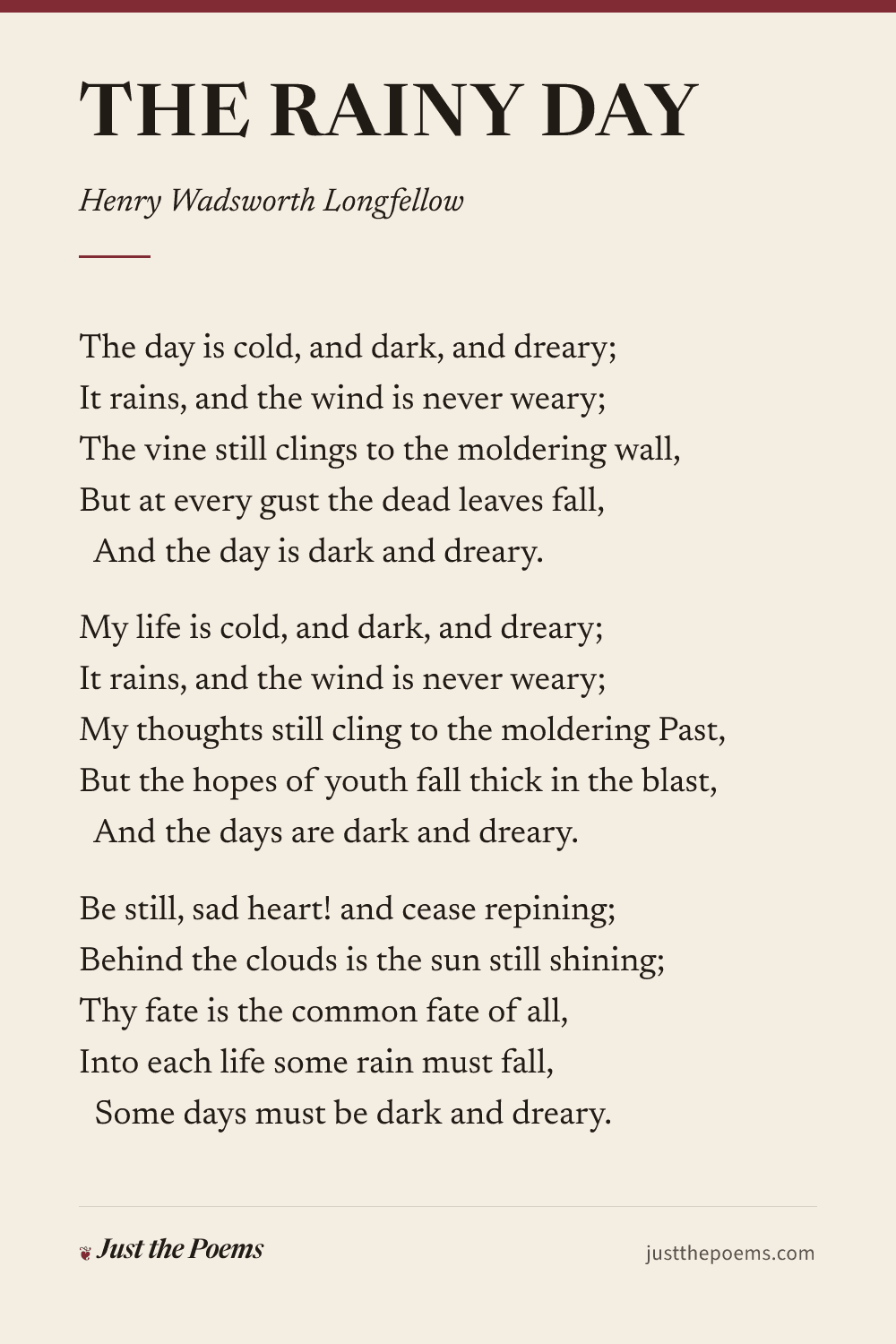
THE RAINY DAY

Henry Wadsworth Longfellow

In 0 Wikipedias 2 anthologies Poet in 71 Wikipedias

The day is cold, and dark, and dreary;It rains, and the wind is never weary;The vine still clings to the moldering wall,But at every gust the dead leaves fall, And the day is dark and dreary.

My life is cold, and dark, and dreary;It rains, and the wind is never weary;My thoughts still cling to the moldering Past,But the hopes of youth fall thick in the blast, And the days are dark and dreary.

Be still, sad heart! and cease repining;Behind the clouds is the sun still shining;Thy fate is the common fate of all,Into each life some rain must fall, Some days must be dark and dreary.

Source

The World's Best Poetry, Vol. III, ed. Bliss Carman, 1904

Filed under
  • Section “COMFORT AND CHEER”, The World's Best Poetry

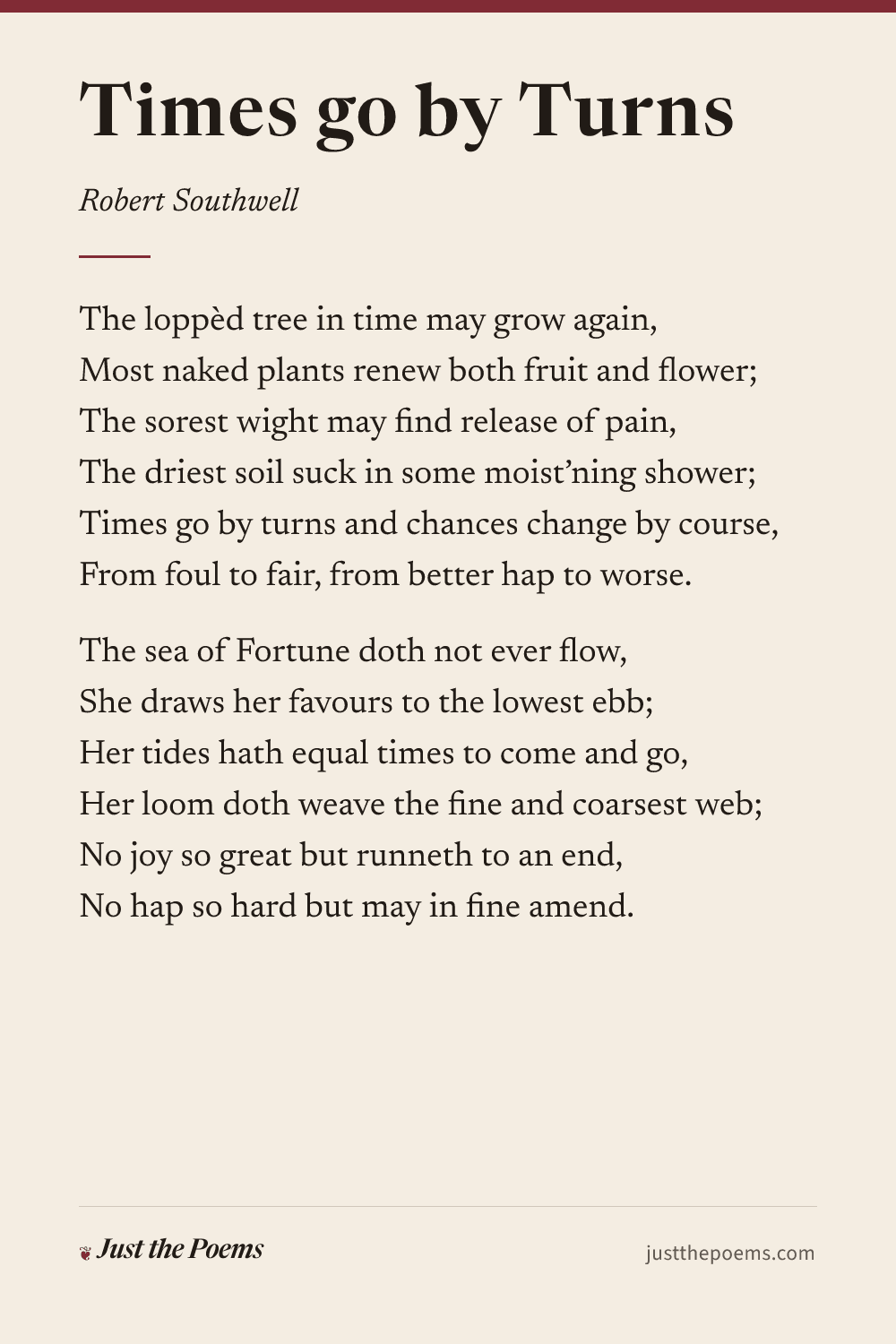
Times go by Turns

Robert Southwell

In 0 Wikipedias 2 anthologies Poet in 17 Wikipedias

The loppèd tree in time may grow again,Most naked plants renew both fruit and flower;The sorest wight may find release of pain,The driest soil suck in some moist’ning shower;Times go by turns and chances change by course,From foul to fair, from better hap to worse.

The sea of Fortune doth not ever flow,She draws her favours to the lowest ebb;Her tides hath equal times to come and go,Her loom doth weave the fine and coarsest web;No joy so great but runneth to an end,No hap so hard but may in fine amend.

Not always fall of leaf nor ever spring,No endless night yet not eternal day;The saddest birds a season find to sing,The roughest storm a calm may soon allay:Thus with succeeding turns God tempereth all,That man may hope to rise, yet fear to fall.

A chance may win that by mischance was lost;The net that holds no great, takes little fish;In some things all, in all things none are crost,Few all they need, but none have all they wish;Unmeddled joys here to no man befall:Who least, hath some; who most, hath never all.

Source

The Oxford Book of English Verse 1250–1900, 1900

Filed under
  • Section “COMFORT AND CHEER”, The World's Best Poetry

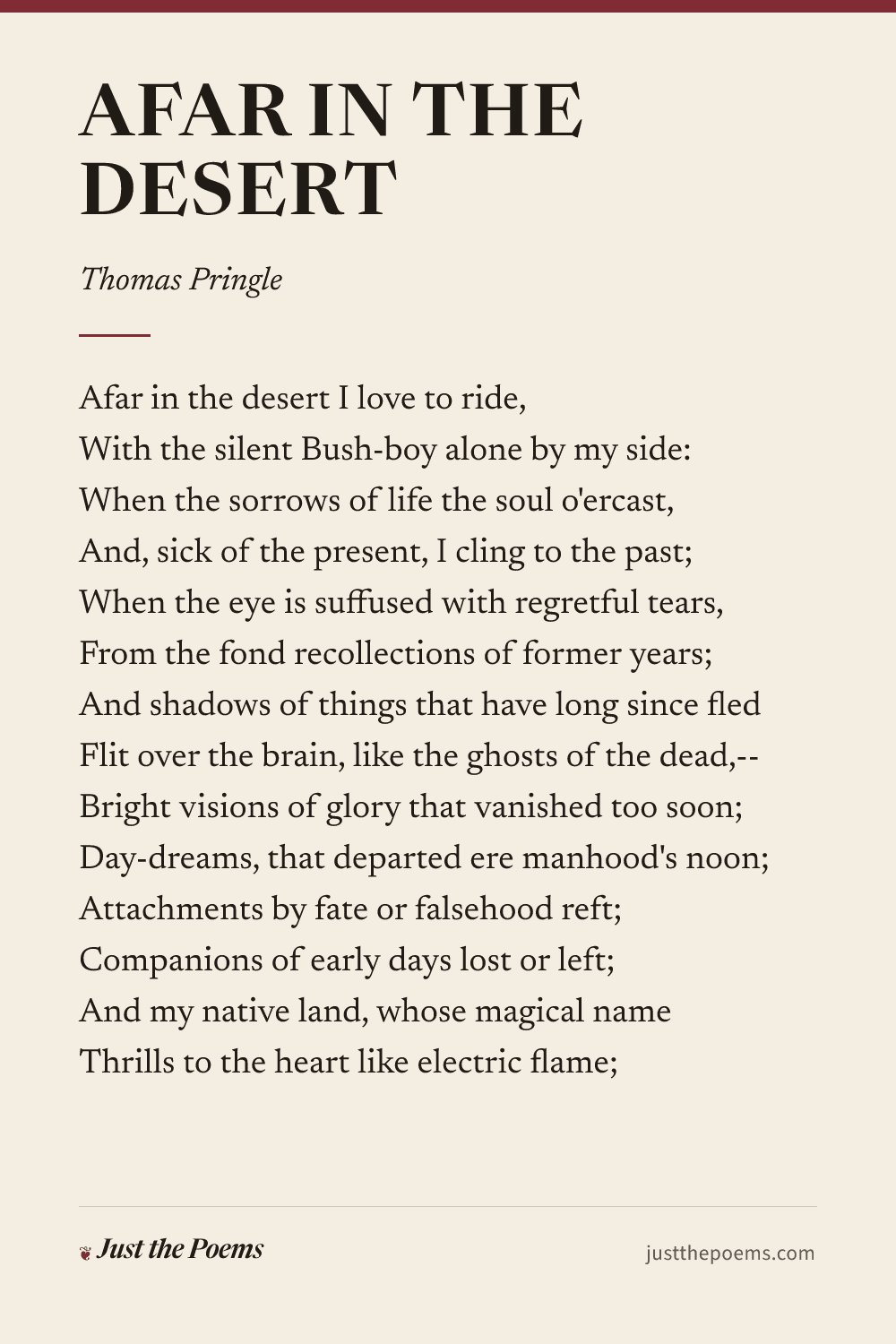
AFAR IN THE DESERT

Thomas Pringle

In 0 Wikipedias 2 anthologies Poet in 6 Wikipedias

Afar in the desert I love to ride,With the silent Bush-boy alone by my side:When the sorrows of life the soul o'ercast,And, sick of the present, I cling to the past;When the eye is suffused with regretful tears,From the fond recollections of former years;And shadows of things that have long since fledFlit over the brain, like the ghosts of the dead,--Bright visions of glory that vanished too soon;Day-dreams, that departed ere manhood's noon;Attachments by fate or falsehood reft;Companions of early days lost or left;

Show all 96 lines 84 more

And my native land, whose magical nameThrills to the heart like electric flame;The home of my childhood; the haunts of my prime;All the passions and scenes of that rapturous timeWhen the feelings were young, and the world was new,Like the fresh bowers of Eden unfolding to view;All, all now forsaken, forgotten, foregone!And I, a lone exile remembered of none,My high aims abandoned, my good acts undone,Aweary of all that is under the sun,With that sadness of heart which no stranger may scan,I fly to the desert afar from man.

Afar in the desert I love to ride,With the silent Bush-boy alone by my side!When the wild turmoil of this wearisome life,With its scenes of oppression, corruption, and strife,The proud man's frown, and the base man's fear,The scorner's laugh, and the sufferer's tear,And malice, and meanness, and falsehood, and folly,Dispose me to musing and dark melancholy;When my bosom is full, and my thoughts are high,And my soul is sick with the bondman's sigh,--O, then there is freedom, and joy, and pride,Afar in the desert alone to ride!There is rapture to vault on the champing steed,And to bound away with the eagle's speed,With the death-fraught firelock in my hand,--The only law of the Desert Land!

Afar in the desert I love to ride,With the silent Bush-boy alone by my side,Away, away from the dwellings of men,By the wild deer's haunt, by the buffalo's glen;By valleys remote where the oribi plays,Where the gnu, the gazelle, and the hartebeest graze,And the kudu and eland unhunted reclineBy the skirts of gray forest o'erhung with wild vine;Where the elephant browses at peace in his wood,And the river-horse gambols unscared in the flood,And the mighty rhinoceros wallows at willIn the fen where the wild ass is drinking his fill.

Afar in the desert I love to ride,With the silent Bush-boy alone by my side,O'er the brown karroo, where the bleating cryOf the springbok's fawn sounds plaintively;And the timorous quagga's shrill whistling neighIs heard by the fountain at twilight gray;Where the zebra wantonly tosses his mane.With wild hoof scouring the desolate plain;And the fleet-footed ostrich over the wasteSpeeds like a horseman who travels in haste,Hieing away to the home of her rest,Where she and her mate have scooped their nest,Far hid from the pitiless plunderer's viewIn the pathless depths of the parched karroo.

Afar in the desert I love to ride.With the silent Bush-boy alone by my side,Away, away, in the wilderness vastWhere the white man's foot hath never passed,And the quivered Coranna or BechuanHath rarely crossed with his roving clan,--A region of emptiness, howling and drear,Which man hath abandoned from famine and fear;Which the snake and the lizard inhabit alone,With the twilight bat from the yawning stone;Where grass, nor herb, nor shrub takes root,Save poisonous thorns that pierce the foot;And the bitter-melon, for food and drink,Is the pilgrim's fare by the salt lake's brink;A region of drought, where no river glides,Nor rippling brook with osiered sides;Where sedgy pool, nor bubbling fount,Nor tree, nor cloud, nor misty mount,Appears, to refresh the aching eye;But the barren earth and the burning sky,And the blank horizon, round and round,Spread,--void of living sight or sound.And here, while the night-winds round me sigh,And the stars burn bright in the midnight sky,As I sit apart by the desert stone,Like Elijah at Horeb's cave, alone,"A still small voice" comes through the wild(Like a father consoling his fretful child),Which banishes bitterness, wrath, and fear,Saying,--Man is distant, but God is near!
Source

The World's Best Poetry, Vol. III, ed. Bliss Carman, 1904

Filed under
  • Section “COMFORT AND CHEER”, The World's Best Poetry

SAD IS OUR YOUTH, FOR IT IS EVER GOING

Aubrey Thomas de Vere

In 0 Wikipedias 2 anthologies Poet in 6 Wikipedias

Sad is our youth, for it is ever going,Crumbling away beneath our very feet;Sad is our life, for onward it is flowingIn current unperceived, because so fleet;Sad are our hopes, for they were sweet in sowing,--But tares, self-sown, have overtopped the wheat;Sad are our joys, for they were sweet in blowing,And still, O, still their dying breath is sweet;And sweet is youth, although it hath bereft usOf that which made our childhood sweeter still;And sweet is middle life, for it hath left usA nearer good to cure an older ill;And sweet are all things, when we learn to prize them,Not for their sake, but His who grants them or denies them!

Source

The World's Best Poetry, Vol. III, ed. Bliss Carman, 1904

Filed under
  • Section “COMFORT AND CHEER”, The World's Best Poetry

WHEN MY SHIP COMES IN

Robert Jones Burdette

In 0 Wikipedias 2 anthologies Poet in 2 Wikipedias

Somewhere, out on the blue seas sailing, Where the winds dance and spin;Beyond the reach of my eager hailing, Over the breakers' din;Out where the dark storm-clouds are lifting,Out where the blinding fog is drifting,Out where the treacherous sand is shifting, My ship is coming in.

Oh, I have watched till my eyes were aching, Day after weary day;Oh, I have hoped till my heart was breaking, While the long nights ebbed away;

Show all 40 lines 28 more

Could I but know where the waves had tossed her,Could I but know what storms had crossed her,Could I but know where the winds had lost her, Out in the twilight gray!

But though the storms her course have altered, Surely the port she'll win;Never my faith in my ship has faltered, I know she is coming in.For through the restless ways of her roaming,Through the mad rush of the wild waves foaming,Through the white crest of the billows combing, My ship is coming in.

Breasting the tides where the gulls are flying, Swiftly she's coming in;Shallows and deeps and rocks defying, Bravely she's coming in;Precious the love she will bring to bless me,Snowy the arms she will bring to caress me,In the proud purple of kings she will dress me. My ship that is coming in.

White in the sunshine her sails will be gleaming, See, where my ship comes in;At mast-head and peak her colors streaming, Proudly she's sailing in;Love, hope, and joy on her decks are cheering.Music will welcome her glad appearing.And my heart will sing at her stately nearing, When my ship comes in.

Source

The World's Best Poetry, Vol. III, ed. Bliss Carman, 1904

Filed under
  • Section “COMFORT AND CHEER”, The World's Best Poetry

Advertisements

SONNET

John Milton

In 0 Wikipedias 1 anthology Poet in 106 Wikipedias

Cyriack, this three years' day, these eyes, though clear, To outward view, of blemish or of spot, Bereft of light, their seeing have forgot:Nor to their idle orbs doth sight appearOf sun, or moon, or stars, throughout the year, Or man or woman, yet I argue not Against Heaven's hand or will, nor bate a jotOf heart or hope; but still bear up and steerRight onward. What supports me, dost thou ask?The conscience, friend, to have lost them overpliedIn Liberty's defence, my noble task,Of which all Europe rings from side to side.This thought might lead me through the world's vain mask,Content, though blind, had I no better guide.

Source

The World's Best Poetry, Vol. III, ed. Bliss Carman, 1904

Filed under
  • Section “COMFORT AND CHEER”, The World's Best Poetry

THE GOOD GREAT MAN

Samuel Taylor Coleridge

In 0 Wikipedias 1 anthology Poet in 86 Wikipedias

How seldom, Friend! a good great man inherits Honor or wealth with all his worth and pains!It sounds like stories from the land of spirits.If any man obtain that which he merits, Or any merit that which he obtains.

For shame, dear Friend; renounce this canting strain!What wouldst thou have a good great man obtain?Place--titles--salary--a gilded chain--Or throne of corses which his sword has slain?Greatness and goodness are not means, but ends!

Hath he not always treasures, always friends,The good great man? three treasures,--love, and light,And calm thoughts, regular as infant's breath;And three firm friends, more sure than day and night--Himself, his Maker, and the angel Death.

Source

The World's Best Poetry, Vol. III, ed. Bliss Carman, 1904

Filed under
  • Section “COMFORT AND CHEER”, The World's Best Poetry

THE FLOWER

George Herbert

In 0 Wikipedias 1 anthology Poet in 37 Wikipedias

How fresh, O Lord, how sweet and cleanAre thy returns! even as the flowers in spring; To which, besides their own demean,The late-past frosts tributes of pleasure bring. Grief melts away Like snow in May, As if there were no such cold thing.

Who would have thought my shrivelled heartCould have recovered greenness? It was gone Quite underground; as flowers departTo see their mother root, when they have blown; Where they together

Show all 49 lines 37 more

All the hard weather, Dead to the world, keep house unknown.

These are thy wonders, Lord of power,Killing and quickning, bringing down to hell And up to heaven in an houre;Making a chiming of a passing-bell. We say amisse This or that is: Thy word is all, if we could spell.

O that I once past changing were,Fast in thy paradise, where no flower can wither! Many a spring I shoot up fair,Off'ring at heav'n, growing and groning thither; Nor doth my flower Want a spring-showre, My sinnes and I joining together.

But, while I grow in a straight line,Still upwards bent, as if heav'n were mine own, Thy anger comes, and I decline:What frost to that? what pole is not the zone Where all things burn, When thou dost turn, And the least frown of thine is shown?

And now in age I bud again;After so many deaths I live and write; I once more smell the dew and rain,And relish versing: O my only light, It cannot be That I am he On whom thy tempests fell all night!

These are thy wonders, Lord of love,To make us see we are but flowers that glide; Which when we once can finde and prove,Thou hast a garden for us where to bide. Who would be more, Swelling through store, Forfeit their paradise by their pride.

Source

The World's Best Poetry, Vol. III, ed. Bliss Carman, 1904

Filed under
  • Section “COMFORT AND CHEER”, The World's Best Poetry

Encouragement

Paul Laurence Dunbar

In 0 Wikipedias 1 anthology Poet in 25 Wikipedias

Who dat knockin' at de do'?Why, Ike Johnson--yes, fu' sho'!Come in, Ike. I's mighty gladYou come down. I t'ought you's madAt me 'bout de othah night,An' was stayin' 'way fu' spite.Say, now, was you mad fu' trueW'en I kin' o' laughed at you? Speak up, Ike, an' 'spress yo'se'f.

'Tain't no use a-lookin' sad,An' a-mekin' out you's mad;Ef you's gwine to be so glum,

Show all 54 lines 42 more

Wondah why you evah come.I don't lak nobidy 'roun'Dat jes' shet dey mouf an' frown--Oh, now, man, don't act a dunce!Cain't you talk? I tol' you once, Speak up, Ike, an' 'spress yo'se'f.

Wha'd you come hyeah fu' to-night?Body'd t'ink yo' haid ain't right.I's done all dat I kin do--Dressed perticler, jes' fu' you;Reckon I'd a' bettah wo'My ol' ragged calico.Aftah all de pains I's took,Cain't you tell me how I look? Speak up, Ike, an' 'spress yo'se'f.

Bless my soul! I 'mos' fu'gotTellin' you 'bout Tildy Scott.Don't you know, come Thu'sday night,She gwine ma'y Lucius White?Miss Lize say I allus wuhHeap sight laklier 'n huh;An' she'll git me somep'n new,Ef I wants to ma'y too. Speak up, Ike, an' 'spress yo'se'f.

I could ma'y in a week,If de man I wants 'ud speak.Tildy's presents 'll be fine,But dey wouldn't ekal mine.Him whut gits me fu' a wife'll be proud, you bet yo' life.I's had offers, some ain't quit;But I hasn't ma'ied yit! Speak up, Ike, an' 'spress yo'se'f.

Ike, I loves you--yes, I does;You's my choice, and allus was.Laffin' at you ain't no harm--Go 'way, dahky, whah's yo' arm?Hug me closer--dah, da's right!Wasn't you a awful sight,Havin' me to baig you so?Now ax whut you want to know-- Speak up, Ike, an' 'spress yo'se'f.

Source

Poems Teachers Ask For, Book Two

Filed under
  • Named in the title

WAITING

John Burroughs

In 0 Wikipedias 1 anthology Poet in 17 Wikipedias

Serene, I fold my hands and wait, Nor care for wind, or tide, or sea;I rave no more 'gainst time or fate, For, lo! my own shall come to me.

I stay my haste, I make delays, For what avails this eager pace?I stand amid the eternal ways, And what is mine shall know my face.

Asleep, awake, by night or day. The friends I seek are seeking me;No wind can drive my bark astray, Nor change the tide of destiny.

What matter if I stand alone? I wait with joy the coming years;My heart shall reap where it has sown, And garner up its fruit of tears.

The waters know their own and draw The brook that springs in yonder height;

So flows the good with equal law Unto the soul of pure delight.

The stars come nightly to the sky; The tidal wave unto the sea;Nor time, nor space, nor deep, nor high, Can keep my own away from me.

Source

The World's Best Poetry, Vol. III, ed. Bliss Carman, 1904

Filed under
  • Section “COMFORT AND CHEER”, The World's Best Poetry

Advertisements

SOMETHING BEYOND

Mary Clemmer Ames Hudson

In 0 Wikipedias 1 anthology Poet in 6 Wikipedias

Something beyond! though now, with joy unfound, The life-task falleth from thy weary hand,Be brave, be patient! In the fair beyond Thou'lt understand.

Thou'lt understand why our most royal hours Couch sorrowful slaves bound by low nature's greed;Why the celestial soul's a minion made To narrowest need.

In this pent sphere of being incomplete, The imperfect fragment of a beauteous whole,For yon rare regions, where the perfect meet, Sighs the lone soul.

Show all 28 lines 16 more

Sighs for the perfect! Far and fair it lies; It hath no half-fed friendships perishing fleet,No partial insights, no averted eyes, No loves unmeet.

Something beyond! Light for our clouded eyes! In this dark dwelling, in its shrouded beams,Our best waits masked, few pierce the soul's disguise; How sad it seems!

Something beyond! Ah, if it were not so, Darker would be thy face, O brief To-day;Earthward we 'd bow beneath life's smiting woe, Powerless to pray.

Something beyond! The immortal morning stands Above the night; clear shines her precious brow;The pendulous star in her transfigured hands Brightens the Now.

Source

The World's Best Poetry, Vol. III, ed. Bliss Carman, 1904

Filed under
  • Section “COMFORT AND CHEER”, The World's Best Poetry

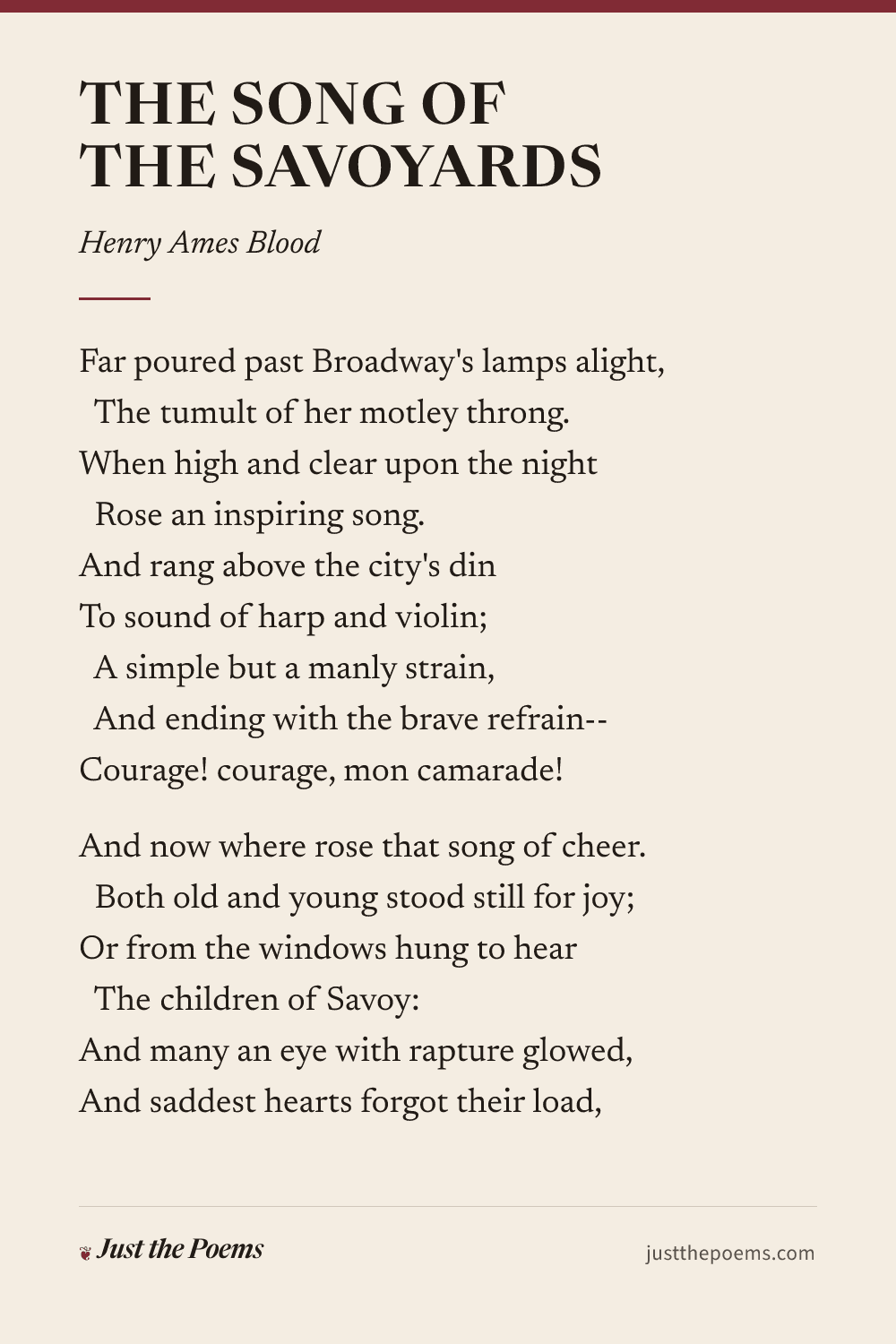
THE SONG OF THE SAVOYARDS

Henry Ames Blood

In 0 Wikipedias 1 anthology Poet in 5 Wikipedias

Far poured past Broadway's lamps alight, The tumult of her motley throng.When high and clear upon the night Rose an inspiring song.And rang above the city's dinTo sound of harp and violin; A simple but a manly strain, And ending with the brave refrain--Courage! courage, mon camarade!

And now where rose that song of cheer. Both old and young stood still for joy;Or from the windows hung to hear

Show all 72 lines 60 more

The children of Savoy:And many an eye with rapture glowed,And saddest hearts forgot their load, And feeble souls grew strong again, So stirring was the brave refrain--Courage! courage, mon camarade!

Alone, with only silence there, Awaiting his life's welcome close,A sick man lay, when on the air That clarion arose;So sweet the thrilling cadence rang,It seemed to him an angel sang, And sang to him; and he would fain Have died upon that heavenly strain--Courage! courage, mon camarade!

A sorrow-stricken man and wife, With nothing left them but to pray,Heard streaming over their sad life That grand, heroic lay:And through the mist of happy tearsThey saw the promise-laden years; And in their joy they sang again, And carolled high the fond refrain--Courage! courage, mon camarade!

Two artists, in the cloud of gloom Which hung upon their hopes deferred,Resounding through their garret-room That noble chanson heard;And as the night before the dayTheir weak misgivings fled away; And with the burden of the strain They made their studio ring again--Courage! courage, mon camarade!

Two poets, who in patience wrought The glory of an aftertime,--Lords of an age which knew them not, Heard rise that lofty rhyme;And on their hearts it fell, as fallsThe sunshine upon prison-walls; And one caught up the magic strain And to the other sang again--Courage! courage, mon camarade!

And unto one, who, tired of breath, And day and night and name and fame,Held to his lips a glass of death, That song a savior came;Beseeching him from his despair,As with the passion of a prayer; And kindling in his heart and brain The valor of its blest refrain--Courage! courage, mon camarade!

O thou, with earthly ills beset, Call to thy lips those words of joy,And never in thy life forget The brave song of Savoy!For those dear words may have the powerTo cheer thee in thy darkest hour; The memory of that loved refrain Bring gladness to thy heart again!--Courage! courage, mon camarade!

Source

The World's Best Poetry, Vol. III, ed. Bliss Carman, 1904

Filed under
  • Section “COMFORT AND CHEER”, The World's Best Poetry

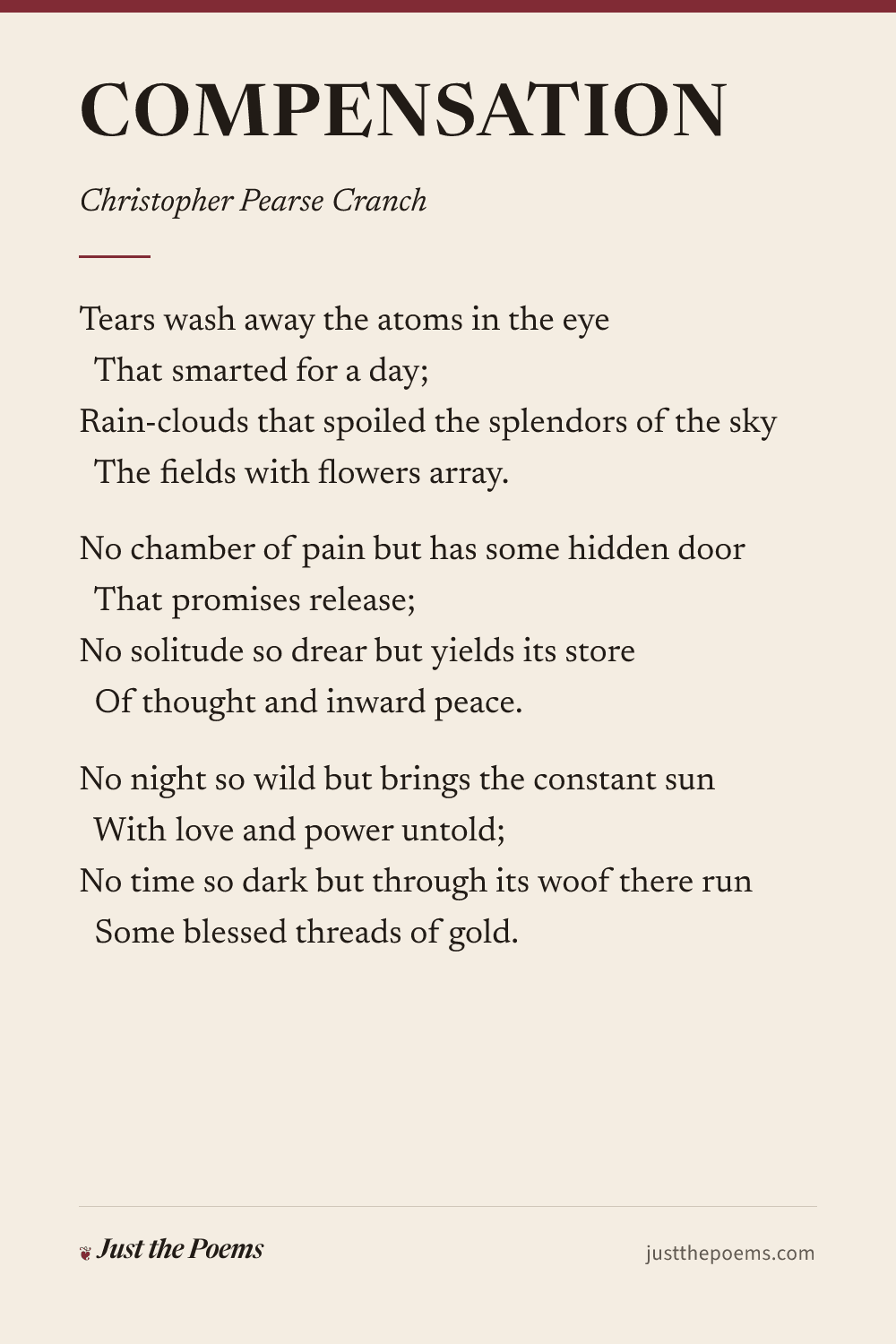
COMPENSATION

Christopher Pearse Cranch

In 0 Wikipedias 1 anthology Poet in 3 Wikipedias

Tears wash away the atoms in the eye That smarted for a day;Rain-clouds that spoiled the splendors of the sky The fields with flowers array.

No chamber of pain but has some hidden door That promises release;No solitude so drear but yields its store Of thought and inward peace.

No night so wild but brings the constant sun With love and power untold;No time so dark but through its woof there run Some blessed threads of gold.

Show all 40 lines 28 more

And through the long and storm-tost centuries burn In changing calm and strifeThe Pharos-lights of truth, where'er we turn,-- The unquenched lamps of life.

O Love supreme! O Providence divine! What self-adjusting springsOf law and life, what even scales, are thine, What sure-returning wings

Of hopes and joys, that flit like birds away, When chilling autumn blows,But come again, long ere the buds of May Their rosy lips unclose!

What wondrous play of mood and accident Through shifting days and years;What fresh returns of vigor overspent In feverish dreams and fears!

What wholesome air of conscience and of thought When doubts and forms oppress;What vistas opening to the gates we sought Beyond the wilderness;

Beyond the narrow cells, where self-involved, Like chrysalids, we waitThe unknown births, the mysteries unsolved Of death and change and fate!

O Light divine! we need no fuller test That all is ordered well;We know enough to trust that all is best Where love and wisdom dwell.

Source

The World's Best Poetry, Vol. III, ed. Bliss Carman, 1904

Filed under
  • Section “COMFORT AND CHEER”, The World's Best Poetry

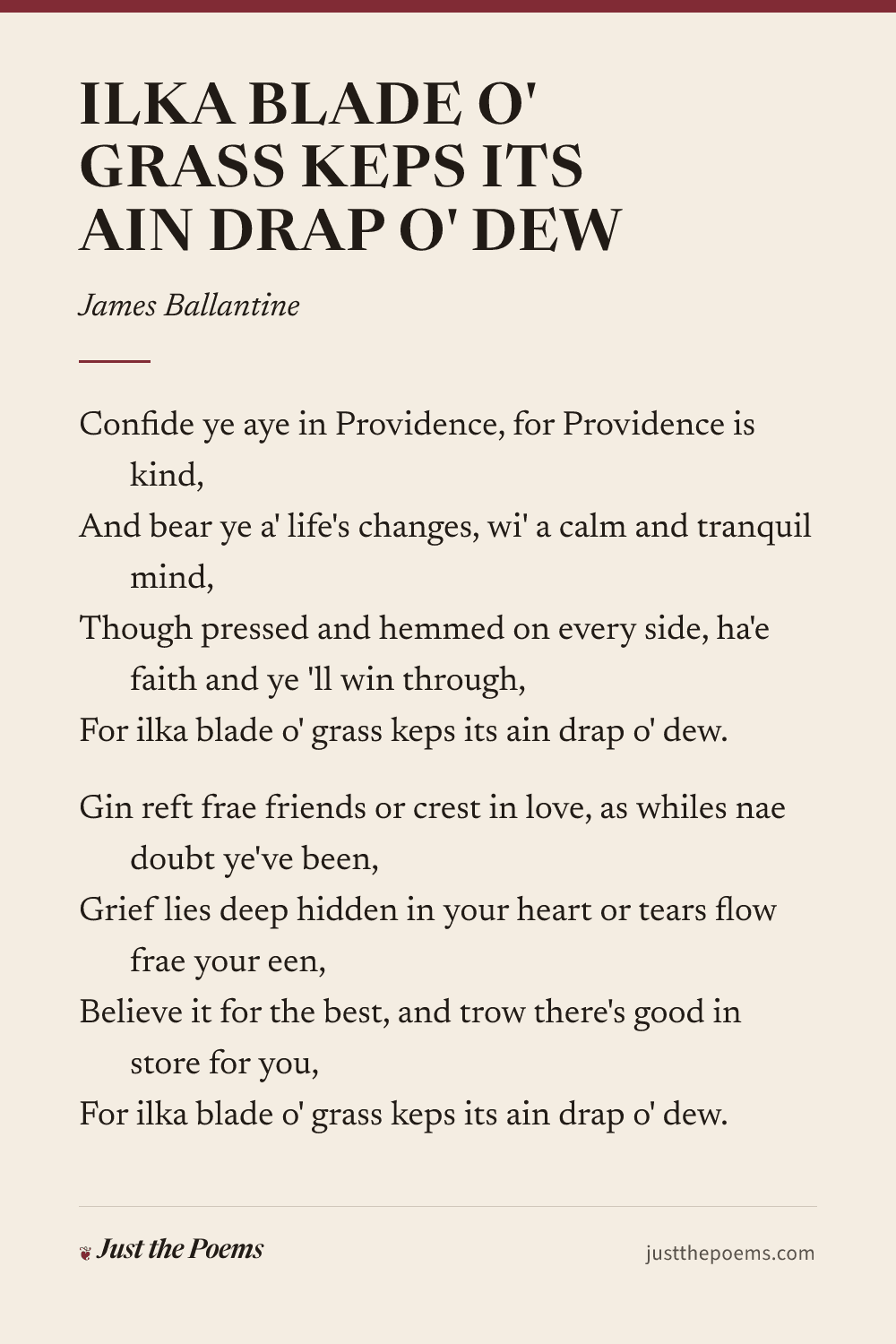
ILKA BLADE O' GRASS KEPS ITS AIN DRAP O' DEW

James Ballantine

In 0 Wikipedias 1 anthology Poet in 2 Wikipedias

Confide ye aye in Providence, for Providence is kind,And bear ye a' life's changes, wi' a calm and tranquil mind,Though pressed and hemmed on every side, ha'e faith and ye 'll win through,For ilka blade o' grass keps its ain drap o' dew.

Gin reft frae friends or crest in love, as whiles nae doubt ye've been,Grief lies deep hidden in your heart or tears flow frae your een,Believe it for the best, and trow there's good in store for you,For ilka blade o' grass keps its ain drap o' dew.

In lang, lang days o' simmer, when the clear and cloudless skyRefuses ae wee drap o' rain to nature parched and dry,The genial night, wi' balmy breath, gars verdure spring anew,And ilka blade o' grass keps its ain drap o' dew.

Sae, lest 'mid fortune's sunshine we should feel owre proud and hie,And in our pride forget to wipe the tear frae poortith's ee,Some wee dark clouds o' sorrow come, we ken na whence or hoo,But ilka blade o' grass keps its ain drap o' dew.

Source

The World's Best Poetry, Vol. III, ed. Bliss Carman, 1904

Filed under
  • Section “COMFORT AND CHEER”, The World's Best Poetry

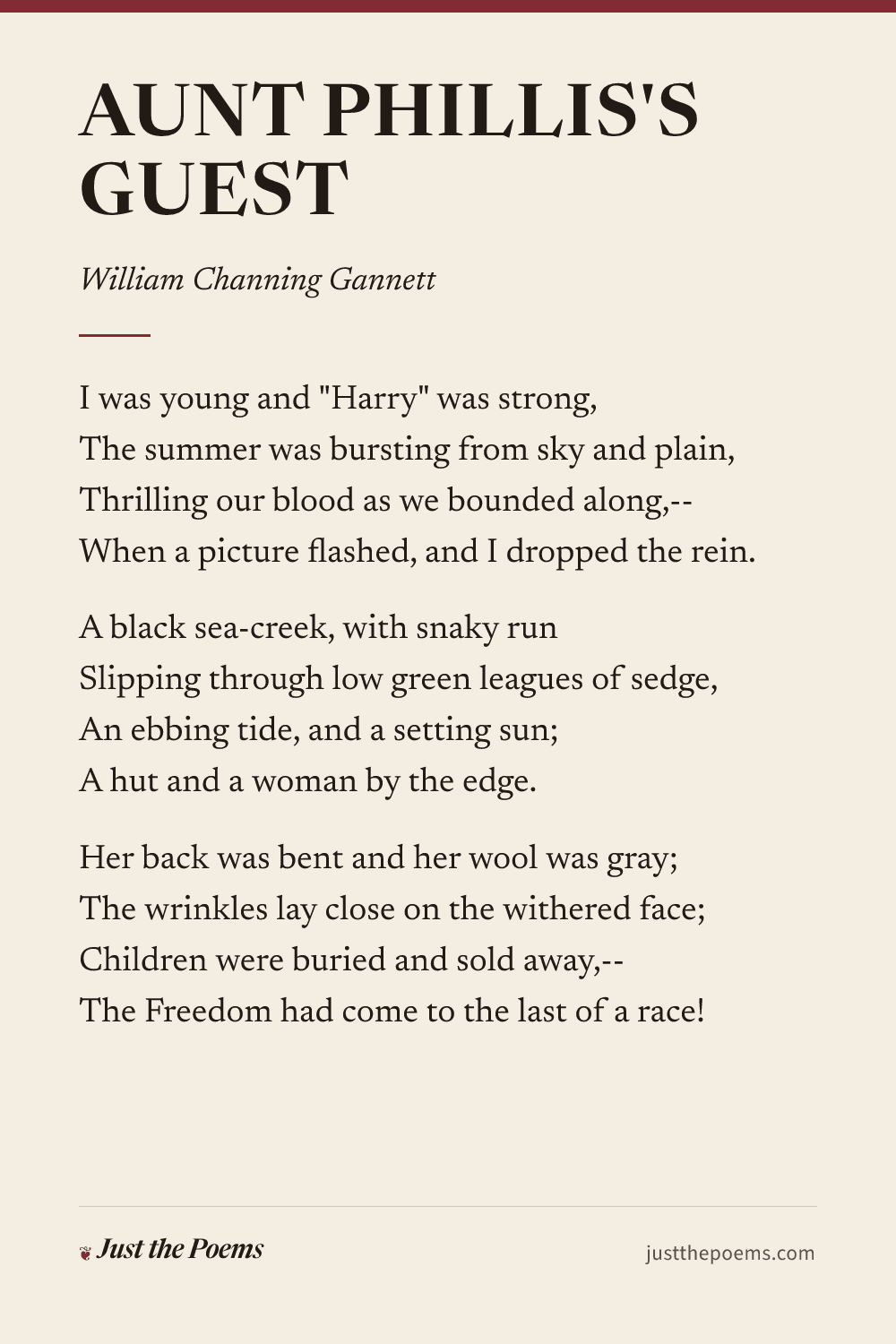
AUNT PHILLIS'S GUEST

William Channing Gannett

In 0 Wikipedias 1 anthology Poet in 1 Wikipedia

I was young and "Harry" was strong,The summer was bursting from sky and plain,Thrilling our blood as we bounded along,--When a picture flashed, and I dropped the rein.

A black sea-creek, with snaky runSlipping through low green leagues of sedge,An ebbing tide, and a setting sun;A hut and a woman by the edge.

Her back was bent and her wool was gray;The wrinkles lay close on the withered face;Children were buried and sold away,--The Freedom had come to the last of a race!

Show all 58 lines 46 more

She lived from a neighbor's hominy-pot;And praised the Lord, if "the pain" passed by;From the earthen floor the smoke curled outThrough shingles patched with the bright blue sky.

"Aunt Phillis, you live here all alone?"I asked, and pitied the gray old head;Sure as a child, in quiet tone,"Me and Jesus, Massa," she said.

I started, for all the place was aglowWith a presence I had not seen before;The air was full of a music low,And the Guest Divine stood at the door!

Ay, it was true that the Lord of Life,Who seeth the widow give her mite,Had watched this slave in her weary strife,And shown himself to her longing sight.

The hut and the dirt, the rags and the skin,The grovelling want and the darkened mind,--I looked on this; but the Lord, within:I would what he saw was in me to find!

A childlike soul, whose faith had forceTo see what the angels see in bliss:She lived, and the Lord lived; so, of course,They lived together,--she knew but this.

And the life that I had almost despisedAs something to pity, so poor and low,Had already borne fruit that the Lord so prizedHe loved to come near and see it grow.

No sorrow for her that life was done:A few more days of the hut's unrest,A little while longer to sit in the sun,--Then--He would be host, and she would be guest!

And up above, if an angel of lightShould stop on his errand of love some dayTo ask, "Who lives in the mansion bright?""Me and Jesus," Aunt Phillis will say.

A fancy, foolish and fond, does it seem?And things are not as Aunt Phillises dream?

Friend, surely so! For this I know,--That our faiths are foolish by falling below,Not coming above, what God will show;That his commonest thing hides a wonder vast,To whose beauty our eyes have never passed;That his face in the present, or in the to-be,Outshines the best that we think we see.

Source

The World's Best Poetry, Vol. III, ed. Bliss Carman, 1904

Filed under
  • Section “COMFORT AND CHEER”, The World's Best Poetry

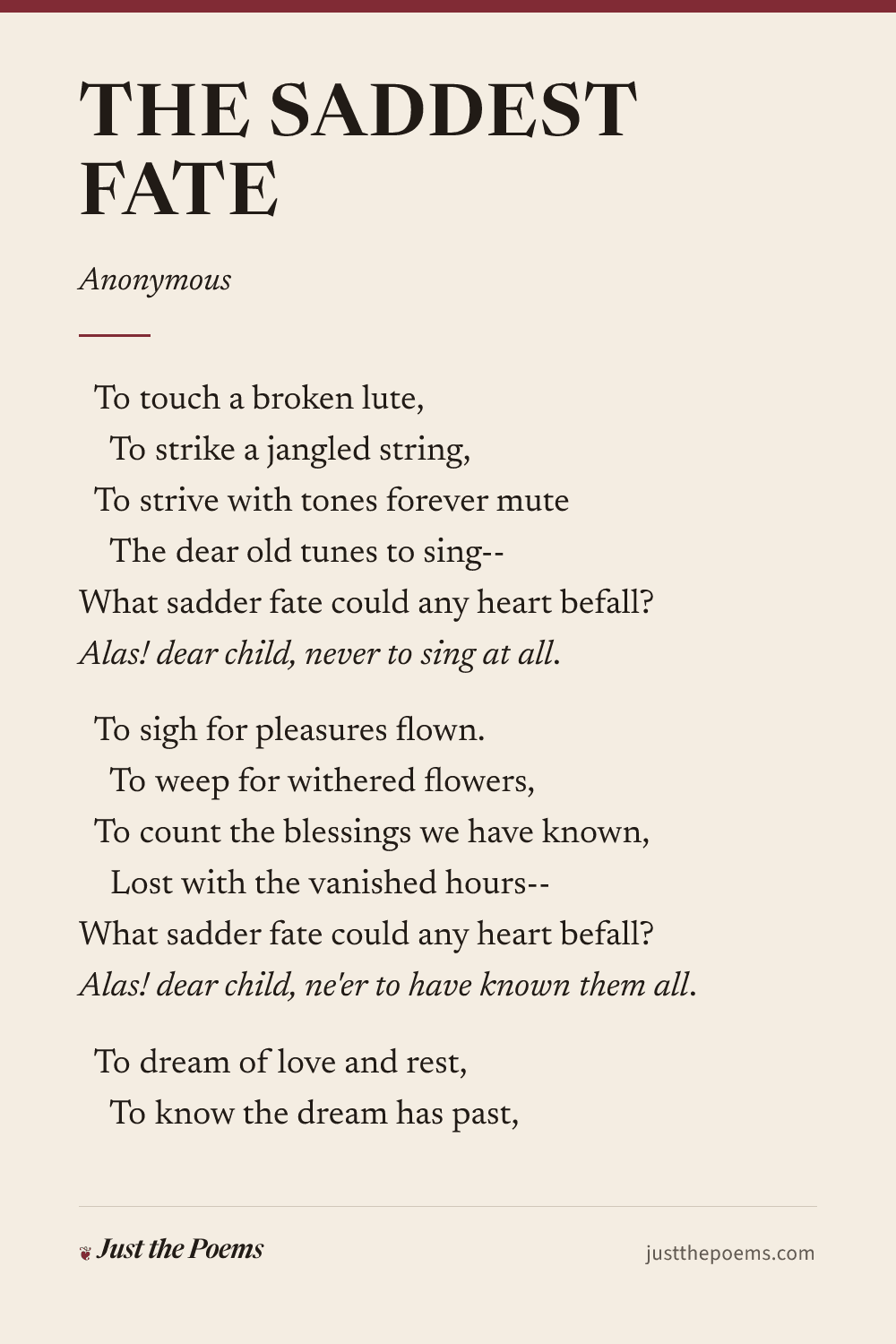
THE SADDEST FATE

Anonymous

In 0 Wikipedias 1 anthology Poet in 0 Wikipedias

To touch a broken lute, To strike a jangled string, To strive with tones forever mute The dear old tunes to sing--What sadder fate could any heart befall?Alas! dear child, never to sing at all.

To sigh for pleasures flown. To weep for withered flowers, To count the blessings we have known, Lost with the vanished hours--What sadder fate could any heart befall?Alas! dear child, ne'er to have known them all.

To dream of love and rest, To know the dream has past,To bear within an aching breast Only a void at last--What sadder fate could any heart befall?Alas! dear child, ne'er to have loved at all.

To trust an unknown good, To hope, but all in vain, Over a far-off bliss to brood, Only to find it pain--What sadder fate could any soul befall?Alas! dear child, never to hope at all.

Source

The World's Best Poetry, Vol. III, ed. Bliss Carman, 1904

Filed under
  • Section “COMFORT AND CHEER”, The World's Best Poetry

19 poems about inspiration

18 poets

By poet's century of death (18 of 19)

CenturyPoems
16th1
17th3
19th8
20th6