Poems About Flowers

The 23 poems about flowers, by 22 poets, ranked by third-party data. How poems are ranked

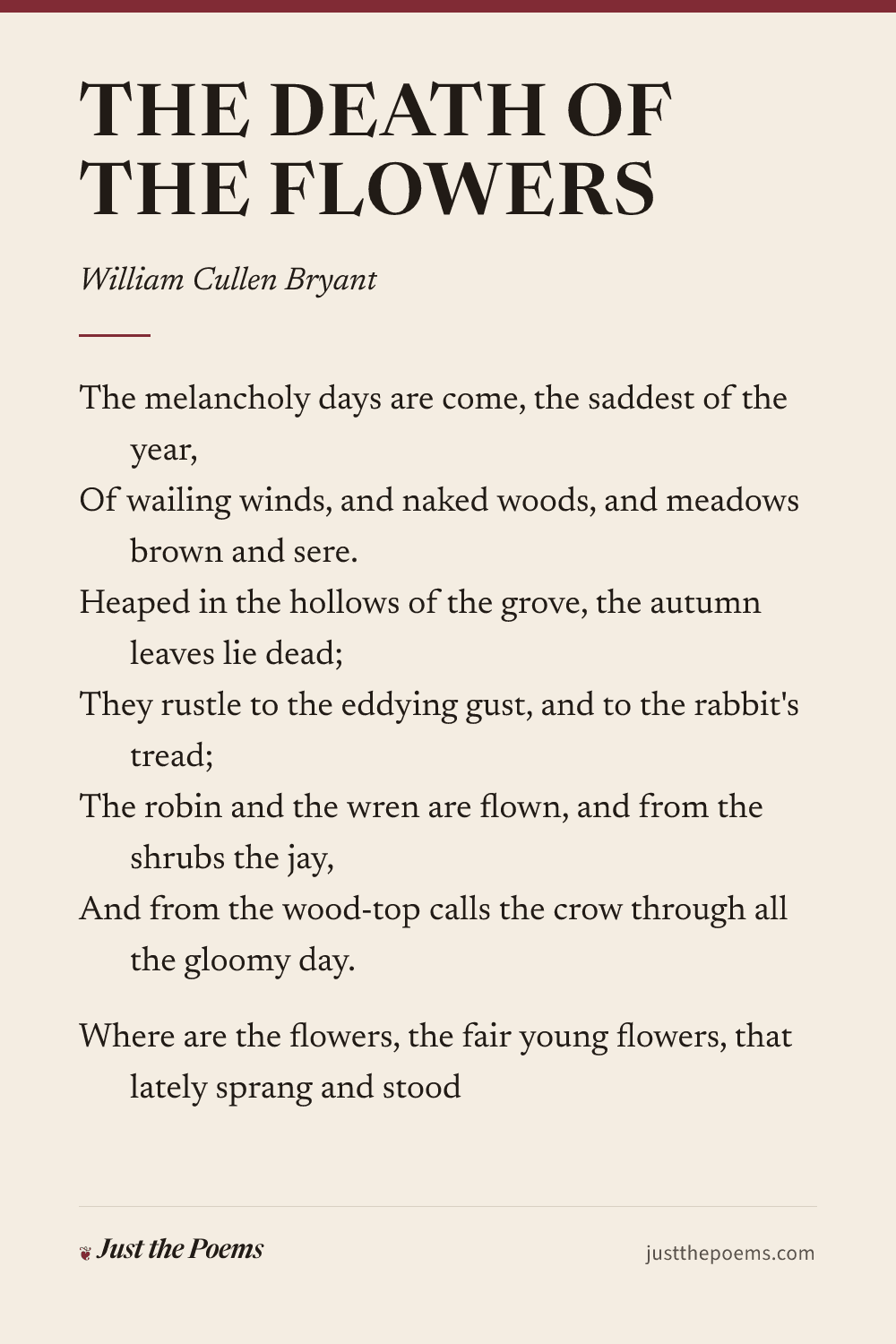
THE DEATH OF THE FLOWERS

William Cullen Bryant

In 1 Wikipedia 2 anthologies Poet in 28 Wikipedias

The melancholy days are come, the saddest of the year,Of wailing winds, and naked woods, and meadows brown and sere.Heaped in the hollows of the grove, the autumn leaves lie dead;They rustle to the eddying gust, and to the rabbit's tread;The robin and the wren are flown, and from the shrubs the jay,And from the wood-top calls the crow through all the gloomy day.

Where are the flowers, the fair young flowers, that lately sprang and stoodIn brighter light and softer airs, a beauteous sisterhood?Alas! they all are in their graves, the gentle race of flowersAre lying in their lowly beds, with the fair and good of ours.The rain is falling where they lie, but the cold November rainCalls not from out the gloomy earth the lovely ones again.

Show all 30 lines 18 more

The wind-flower and the violet, they perished long ago,And the brier-rose and the orchis died amid the summer glow;But on the hill the golden-rod, and the aster in the wood,And the yellow sun-flower by the brook, in autumn beauty stood,Till fell the frost from the clear cold heaven, as falls the plague on men,And the brightness of their smile was gone, from upland, glade, and glen.

And now, when comes the calm mild day, as still such days will come,To call the squirrel and the bee from out their winter home;When the sound of dropping nuts is heard, though all the trees are still,And twinkle in the smoky light the waters of the rill,The south wind searches for the flowers whose fragrance late he bore,And sighs to find them in the wood and by the stream no more.

And then I think of one who in her youthful beauty died,The fair meek blossom that grew up and faded by my side.In the cold moist earth we laid her, when the forest cast the leaf,And we wept that one so lovely should have a life so brief:Yet not unmeet it was that one like that young friend of ours,So gentle and so beautiful, should perish with the flowers.

Source

The Home Book of Verse, ed. Burton Egbert Stevenson

Filed under
  • Named in the title
  • Wikidata main subject: flower

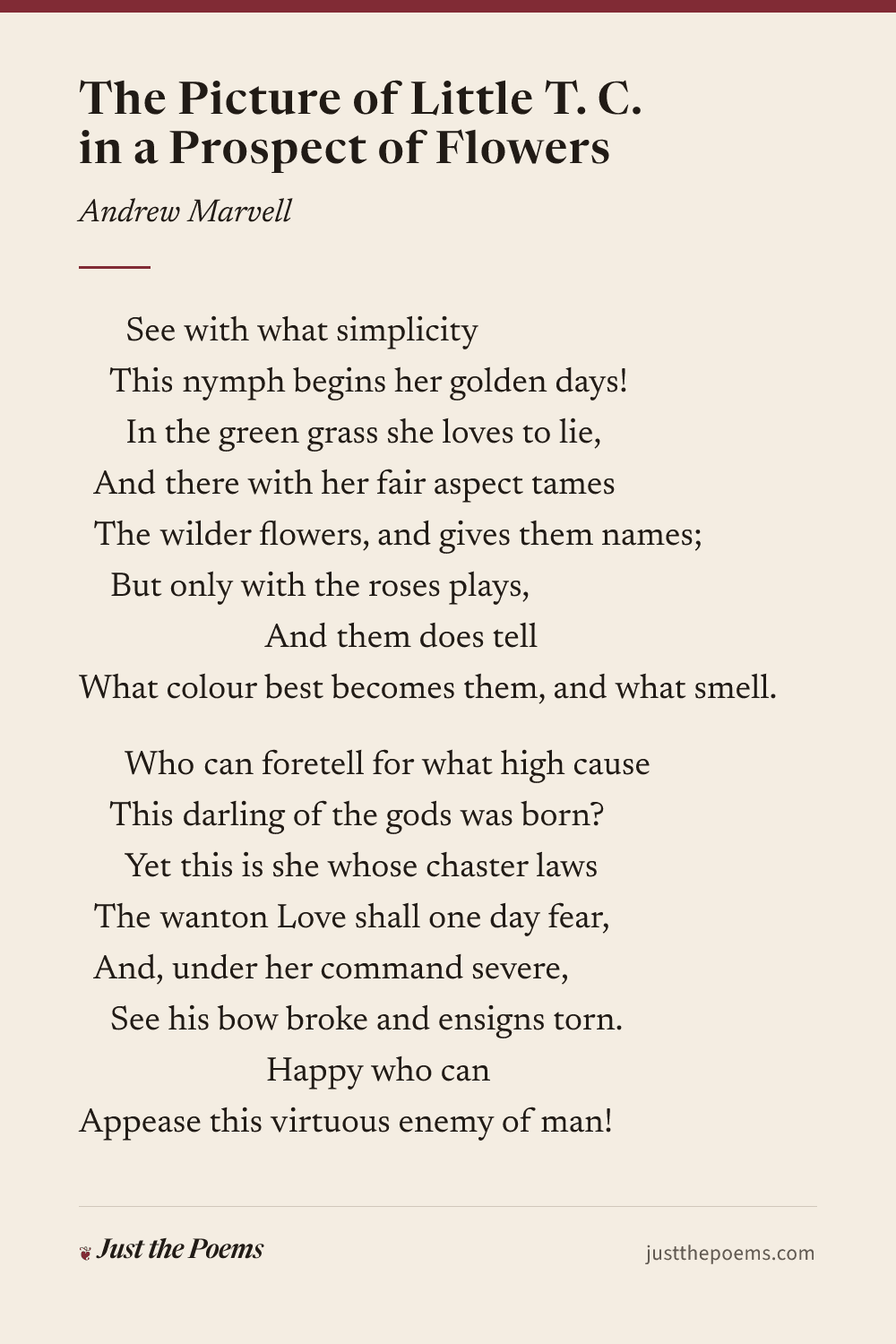
The Picture of Little T. C. in a Prospect of Flowers

Andrew Marvell

In 0 Wikipedias 2 anthologies Poet in 38 Wikipedias

See with what simplicity This nymph begins her golden days! In the green grass she loves to lie, And there with her fair aspect tames The wilder flowers, and gives them names; But only with the roses plays, And them does tellWhat colour best becomes them, and what smell.

Who can foretell for what high cause This darling of the gods was born? Yet this is she whose chaster laws The wanton Love shall one day fear,

Show all 40 lines 28 more

And, under her command severe, See his bow broke and ensigns torn. Happy who canAppease this virtuous enemy of man!

O then let me in time compound And parley with those conquering eyes, Ere they have tried their force to wound; Ere with their glancing wheels they drive In triumph over hearts that strive, And them that yield but more despise: Let me be laid,Where I may see the glories from some shade.

Meantime, whilst every verdant thing Itself does at thy beauty charm, Reform the errors of the Spring; Make that the tulips may have share Of sweetness, seeing they are fair, And roses of their thorns disarm; But most procureThat violets may a longer age endure.

But O, young beauty of the woods, Whom Nature courts with fruits and flowers, Gather the flowers, but spare the buds; Lest Flora, angry at thy crime To kill her infants in their prime, Do quickly make th’ example yours; And ere we see,Nip in the blossom all our hopes and thee.

Source

The Oxford Book of English Verse 1250–1900, 1900

Filed under
  • Named in the title

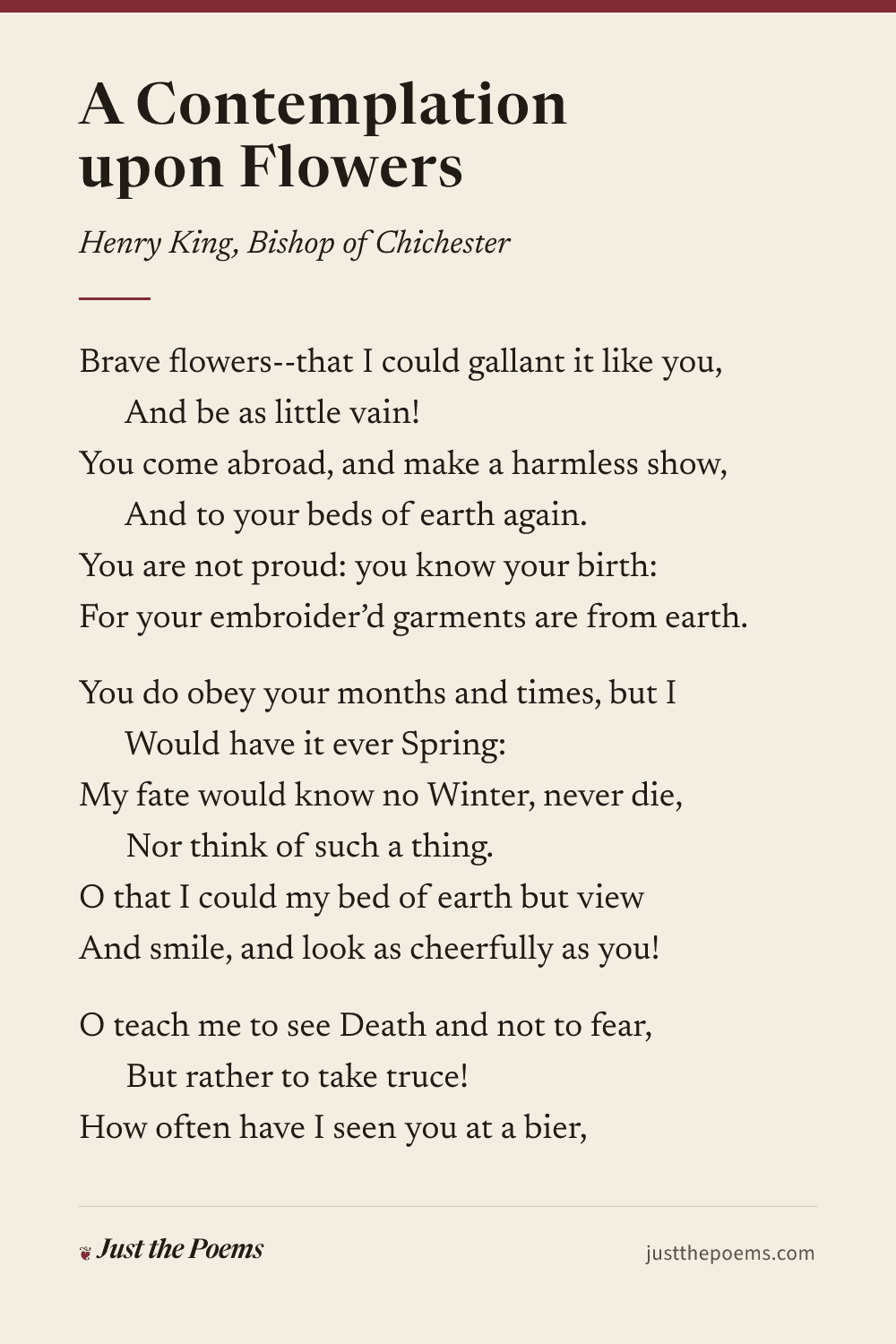
A Contemplation upon Flowers

Henry King, Bishop of Chichester

In 0 Wikipedias 2 anthologies Poet in 5 Wikipedias

Brave flowers--that I could gallant it like you, And be as little vain!You come abroad, and make a harmless show, And to your beds of earth again.You are not proud: you know your birth:For your embroider’d garments are from earth.

You do obey your months and times, but I Would have it ever Spring:My fate would know no Winter, never die, Nor think of such a thing.O that I could my bed of earth but viewAnd smile, and look as cheerfully as you!

O teach me to see Death and not to fear, But rather to take truce!How often have I seen you at a bier, And there look fresh and spruce!You fragrant flowers! then teach me, that my breathLike yours may sweeten and perfume my death.

Source

The Oxford Book of English Verse 1250–1900, 1900

Filed under
  • Named in the title

Advertisements

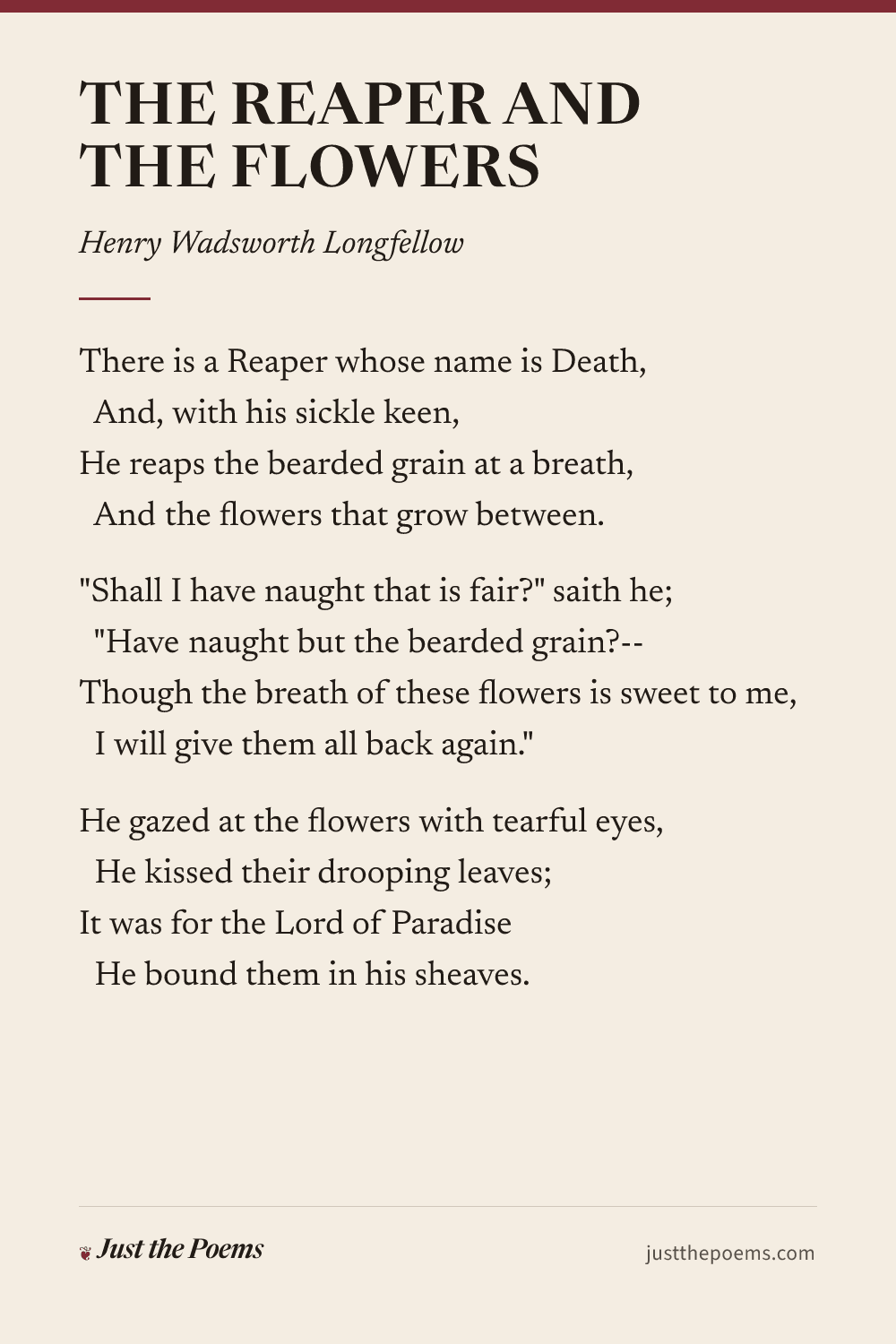
THE REAPER AND THE FLOWERS

Henry Wadsworth Longfellow

In 0 Wikipedias 1 anthology Poet in 71 Wikipedias

There is a Reaper whose name is Death, And, with his sickle keen,He reaps the bearded grain at a breath, And the flowers that grow between.

"Shall I have naught that is fair?" saith he; "Have naught but the bearded grain?--Though the breath of these flowers is sweet to me, I will give them all back again."

He gazed at the flowers with tearful eyes, He kissed their drooping leaves;It was for the Lord of Paradise He bound them in his sheaves.

Show all 28 lines 16 more

"My Lord has need of these flowerets gay," The Reaper said, and smiled;"Dear tokens of the earth are they, Where he was once a child.

"They shall all bloom in fields of light, Transplanted by my care,And saints, upon their garments white, These sacred blossoms wear."

And the mother gave, in tears and pain, The flowers she most did love;She knew she should find them all again In the fields of light above.

O, not in cruelty, not in wrath, The Reaper came that day;'Twas an angel visited the green earth, And took the flowers away.

Source

The World's Best Poetry, Vol. III, ed. Bliss Carman, 1904

Filed under
  • Named in the title

THE FLOWER'S NAME

Robert Browning

In 0 Wikipedias 1 anthology Poet in 57 Wikipedias

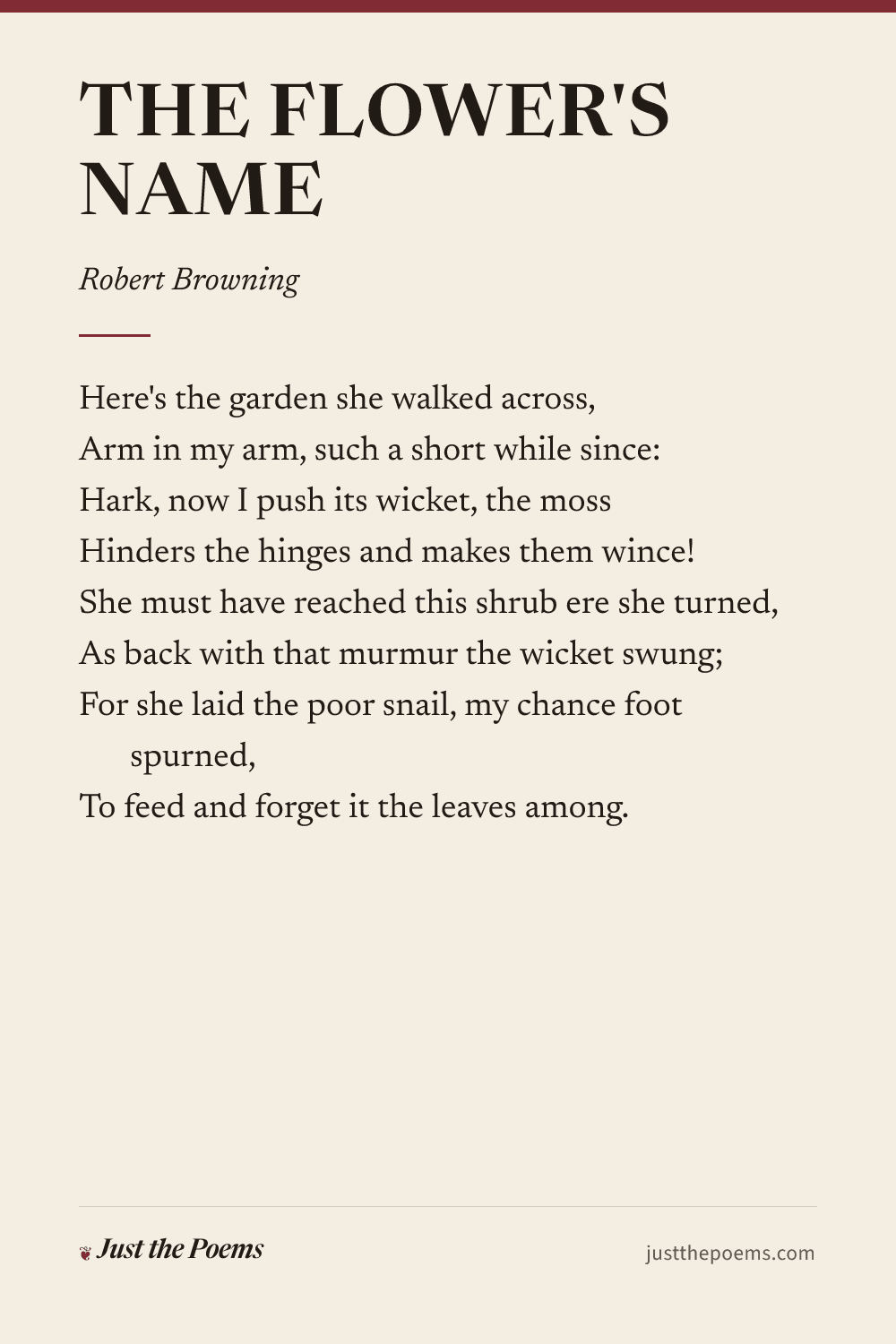
Here's the garden she walked across,Arm in my arm, such a short while since:Hark, now I push its wicket, the mossHinders the hinges and makes them wince!She must have reached this shrub ere she turned,As back with that murmur the wicket swung;For she laid the poor snail, my chance foot spurned,To feed and forget it the leaves among.

Down this side of the gravel-walkShe went while her robe's edge brushed the box:And here she paused in her gracious talkTo point me a moth on the milk-white phlox.

Show all 48 lines 36 more

Roses, ranged in valiant row,I will never think that she passed you by!She loves you, noble roses, I know;But yonder see where the rock-plants lie!

This flower she stopped at, finger on lip,Stooped over, in doubt, as settling its claim;Till she gave me, with pride to make no slip,Its soft meandering Spanish name:What a name! Was it love or praise?Speech half-asleep, or song half-awake?I must learn Spanish, one of these days,Only for that slow sweet name's sake.

Roses, if I live and do well,I may bring her, one of these days,To fix you fast with as fine a spell,Fit you each with his Spanish phrase:But do not detain me now; for she lingersThere, like sunshine over the ground,And ever I see her soft white fingersSearching after the bud she found.

Flower, you Spaniard, look that you grow not,Stay as you are and be loved forever!Bud, if I kiss you, 'tis that you blow not,Mind, the shut pink mouth opens never!For while it pouts, her fingers wrestle,Twinkling the audacious leaves between,Till round they turn, and down they nestle -Is not the dear mark still to be seen?

Where I find her not, beauties vanish;Whither I follow her, beauties flee;Is there no method to tell her in SpanishJune's twice June since she breathed it with me?Come, bud, show me the least of her traces,Treasure my lady's lightest footfall!- Ah, you may flout and turn up your faces, -Roses, you are not so fair after all!

Source

The Home Book of Verse, ed. Burton Egbert Stevenson

Filed under
  • Named in the title

FLOWERS WITHOUT FRUIT

John Henry Newman

In 0 Wikipedias 1 anthology Poet in 51 Wikipedias

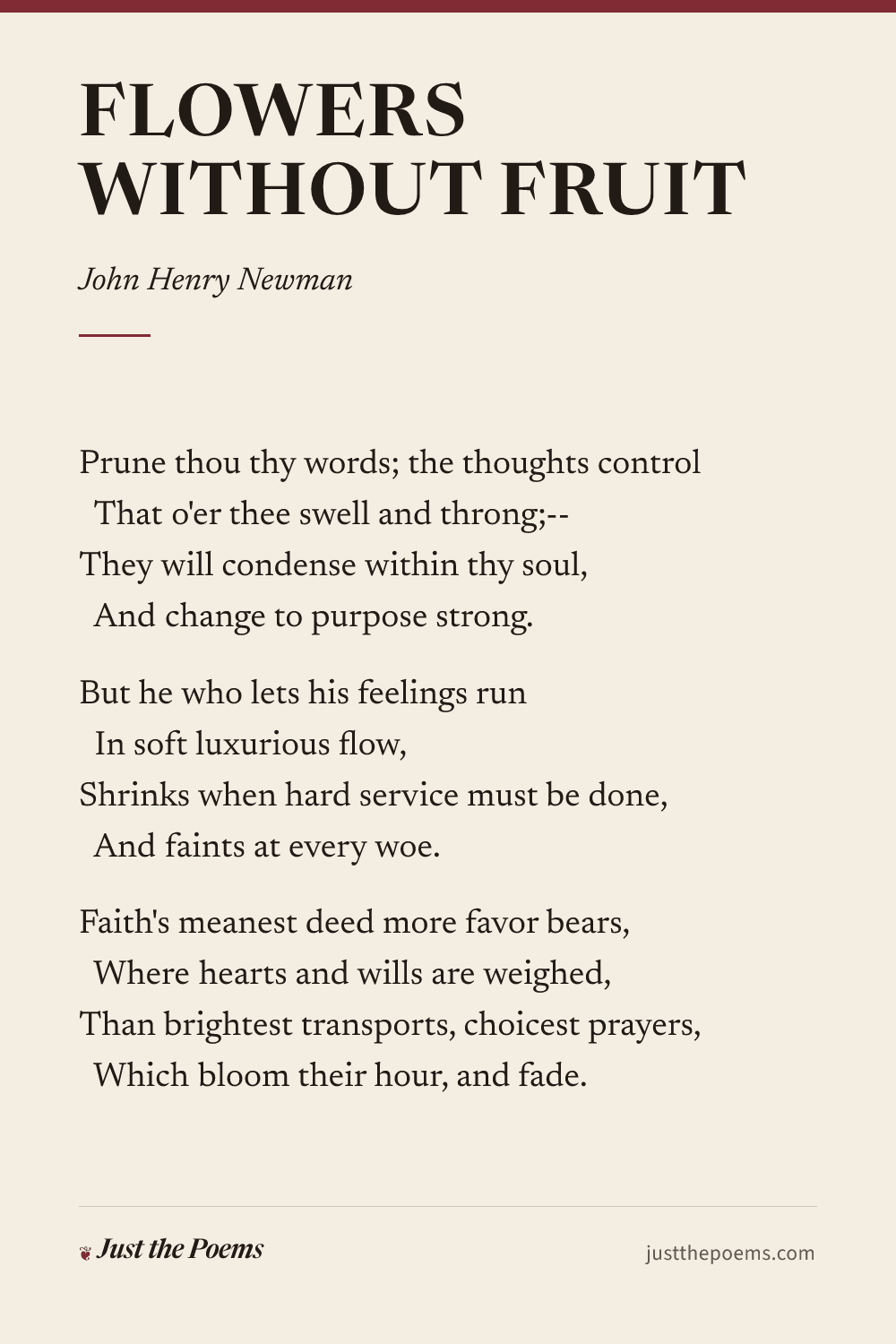
Prune thou thy words; the thoughts control That o'er thee swell and throng;--They will condense within thy soul, And change to purpose strong.

But he who lets his feelings run In soft luxurious flow,Shrinks when hard service must be done, And faints at every woe.

Faith's meanest deed more favor bears, Where hearts and wills are weighed,Than brightest transports, choicest prayers, Which bloom their hour, and fade.

Source

The World's Best Poetry, Vol. IV, ed. Bliss Carman, 1904

Filed under
  • Named in the title

THE FLOWER

George Herbert

In 0 Wikipedias 1 anthology Poet in 37 Wikipedias

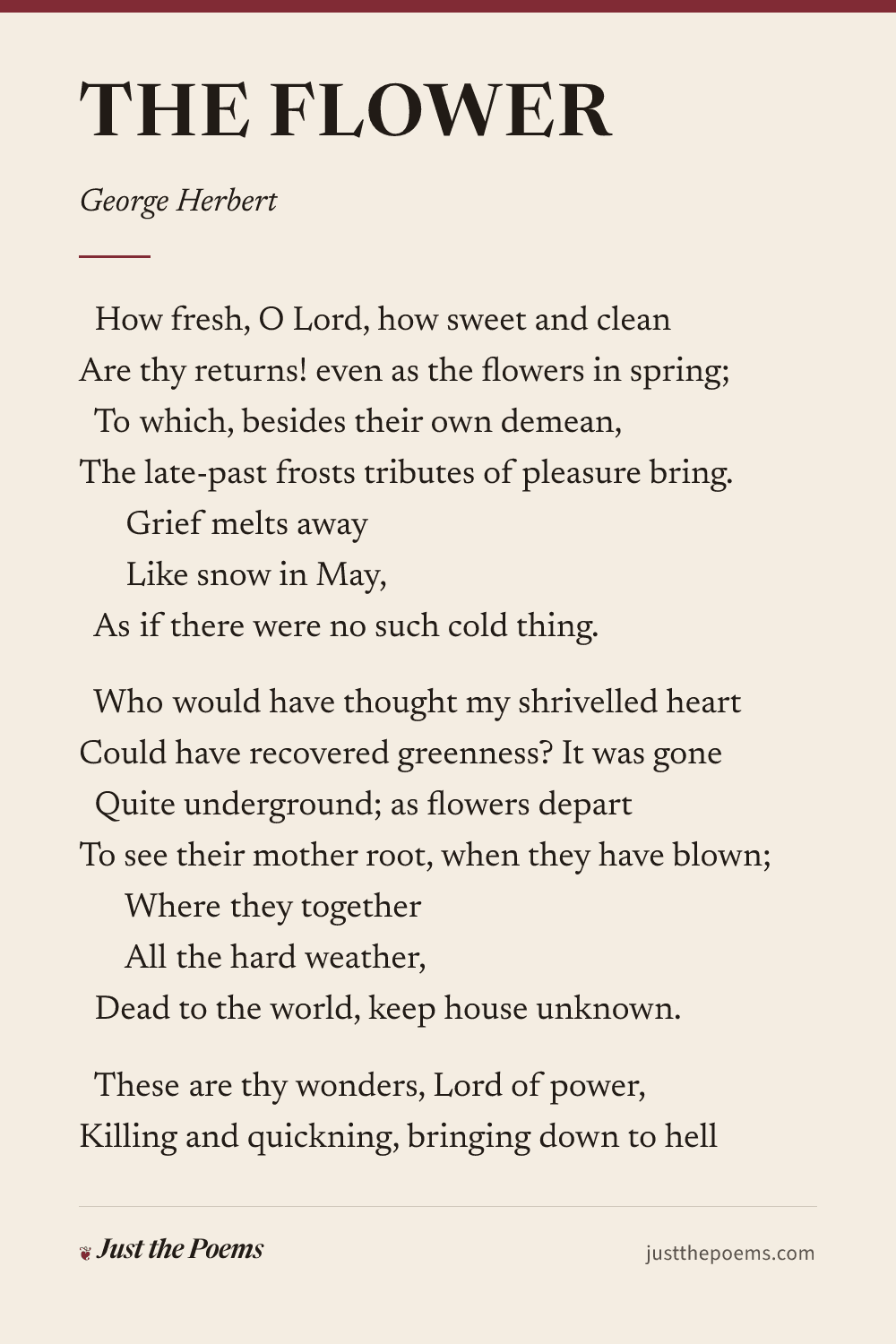
How fresh, O Lord, how sweet and cleanAre thy returns! even as the flowers in spring; To which, besides their own demean,The late-past frosts tributes of pleasure bring. Grief melts away Like snow in May, As if there were no such cold thing.

Who would have thought my shrivelled heartCould have recovered greenness? It was gone Quite underground; as flowers departTo see their mother root, when they have blown; Where they together

Show all 49 lines 37 more

All the hard weather, Dead to the world, keep house unknown.

These are thy wonders, Lord of power,Killing and quickning, bringing down to hell And up to heaven in an houre;Making a chiming of a passing-bell. We say amisse This or that is: Thy word is all, if we could spell.

O that I once past changing were,Fast in thy paradise, where no flower can wither! Many a spring I shoot up fair,Off'ring at heav'n, growing and groning thither; Nor doth my flower Want a spring-showre, My sinnes and I joining together.

But, while I grow in a straight line,Still upwards bent, as if heav'n were mine own, Thy anger comes, and I decline:What frost to that? what pole is not the zone Where all things burn, When thou dost turn, And the least frown of thine is shown?

And now in age I bud again;After so many deaths I live and write; I once more smell the dew and rain,And relish versing: O my only light, It cannot be That I am he On whom thy tempests fell all night!

These are thy wonders, Lord of love,To make us see we are but flowers that glide; Which when we once can finde and prove,Thou hast a garden for us where to bide. Who would be more, Swelling through store, Forfeit their paradise by their pride.

Source

The World's Best Poetry, Vol. III, ed. Bliss Carman, 1904

Filed under
  • Named in the title

The Flower of Liberty

Oliver Wendell Holmes

In 0 Wikipedias 1 anthology Poet in 37 Wikipedias

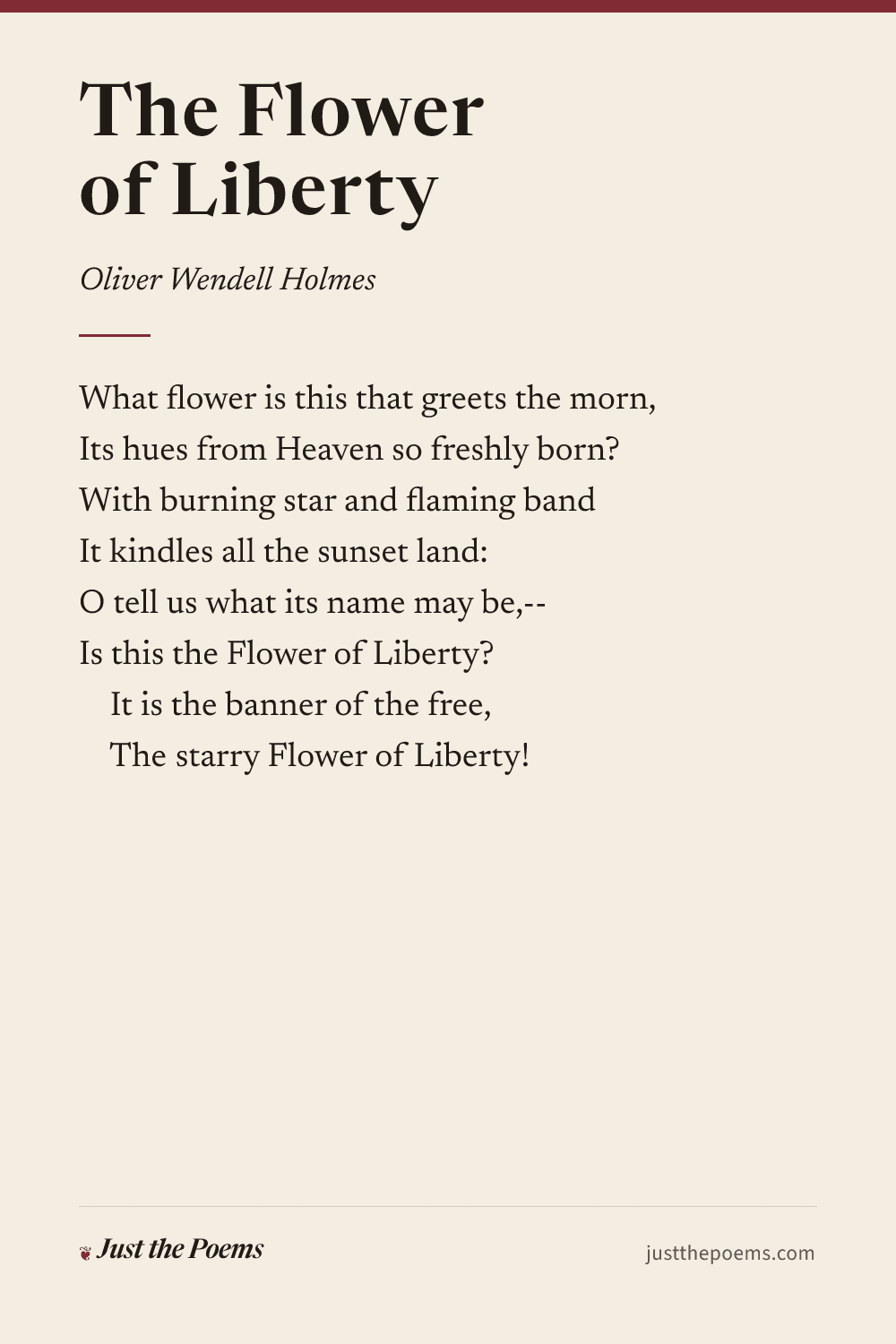
What flower is this that greets the morn,Its hues from Heaven so freshly born?With burning star and flaming bandIt kindles all the sunset land:O tell us what its name may be,--Is this the Flower of Liberty? It is the banner of the free, The starry Flower of Liberty!

In savage Nature's far abodeIts tender seed our fathers sowed;The storm-winds rocked its swelling bud,Its opening leaves were streaked with blood,

Show all 40 lines 28 more

Till lo! earth's tyrants shook to seeThe full-blown Flower of Liberty! Then hail the banner of the free, The starry Flower of Liberty!

Behold its streaming rays unite,One mingling flood of braided light--The red that fires the Southern rose,With spotless white from Northern snows,And, spangled o'er its azure, seeThe sister Stars of Liberty! Then hail the banner of the free, The starry Flower of Liberty!

The blades of heroes fence it round,Where'er it springs is holy ground;From tower and dome its glories spread;It waves where lonely sentries tread;It makes the land as ocean free,And plants an empire on the sea! Then hail the banner of the free, The starry Flower of Liberty!

Thy sacred leaves, fair Freedom's flower,Shall ever float on dome and tower,To all their heavenly colors true,In blackening frost or crimson dew,--And God love us as we love thee,Thrice holy Flower of Liberty! Then hail the banner of the free, The starry Flower of Liberty!

Source

Poems Teachers Ask For, Book Two

Filed under
  • Named in the title

Advertisements

FLOWERS

Thomas Hood

In 0 Wikipedias 1 anthology Poet in 20 Wikipedias

I will not have the mad Clytie,Whose head is turned by the sun;The tulip is a courtly quean,Whom, therefore, I will shun:The cowslip is a country wench,The violet is a nun;--But I will woo the dainty rose,The queen of every one.

The pea is but a wanton witch,In too much haste to wed,And clasps her rings on every hand;The wolfsbane I should dread;Nor will I dreary rosemarye,That always mourns the dead;But I will woo the dainty rose,With her cheeks of tender red.

The lily is all in white, like a saint,And so is no mate for me;And the daisy's cheek is tipped with a blush,She is of such low degree;Jasmine is sweet, and has many loves,And the broom's betrothed to the bee;--But I will plight with the dainty rose,For fairest of all is she.

Source

The Home Book of Verse, ed. Burton Egbert Stevenson

Filed under
  • Named in the title

THE BROOM FLOWER

Mary Howitt

In 0 Wikipedias 1 anthology Poet in 13 Wikipedias

Oh the Broom, the yellow Broom,The ancient poet sung it,And dear it is on summer daysTo lie at rest among it.

I know the realms where people sayThe flowers have not their fellow;I know where they shine out like suns,The crimson and the yellow.

I know where ladies live enchainedIn luxury's silken fetters,And flowers as bright as glittering gemsAre used for written letters.

Show all 36 lines 24 more

But ne'er was flower so fair as this,In modern days or olden;It groweth on its nodding stemLike to a garland golden.

And all about my mother's doorShine out its glittering bushes,And down the glen, where clear as lightThe mountain-water gushes.

Take all the rest; but give me this,And the bird that nestles in it;I love it, for it loves the Broom--The green and yellow linnet.

Well call the rose the queen of flowers,And boast of that of Sharon,Of lilies like to marble cups,And the golden rod of Aaron:

I care not how these flowers may beBeloved of man and woman;The Broom it is the flower for me,That groweth on the common.

Oh the Broom, the yellow Broom,The ancient poet sung it,And dear it is on summer daysTo lie at rest among it.

Source

The Home Book of Verse, ed. Burton Egbert Stevenson

Filed under
  • Named in the title

A FIELD FLOWER

James Montgomery

In 0 Wikipedias 1 anthology Poet in 10 Wikipedias

There is a flower, a little flowerWith silver crest and golden eye,That welcomes every changing hour,And weathers every sky.

The prouder beauties of the fieldIn gay but quick succession shine;Race after race their honors yield,They flourish and decline.

But this small flower, to Nature dear,While moons and stars their courses run,Wreathes the whole circle of the year,Companion of the Sun.

Show all 40 lines 28 more

It smiles upon the lap of May,To sultry August spreads its charms,Lights pale October on his way,And twines December's arms.

The purple heath and golden broomOn moory mountains catch the gale;O'er lawns the lily sheds perfume,The violet in the vale.

But this bold floweret climbs the hill,Hides in the forest, haunts the glen,Plays on the margin of the rill,Peeps round the fox's den.

Within the garden's cultured roundIt shares the sweet carnation's bed;And blooms on consecrated groundIn honor of the dead.

The lambkin crops its crimson gem;The wild bee murmurs on its breast;The blue-fly bends its pensile stemLight o'er the skylark's nest.

'Tis Flora's page,--in every place,In every season, fresh and fair;It opens with perennial grace,And blossoms everywhere.

On waste and woodland, rock and plain,Its humble buds unheeded rise;The Rose has but a summer reign;The Daisy never dies!

Source

The Home Book of Verse, ed. Burton Egbert Stevenson

Filed under
  • Named in the title

"FLOWERS I WOULD BRING"

Aubrey Thomas de Vere

In 0 Wikipedias 1 anthology Poet in 6 Wikipedias

Flowers I would bring if flowers could make thee fairer,And music, if the Muse were dear to thee;(For loving these would make thee love the bearer)But sweetest songs forget their melody,And loveliest flowers would but conceal the wearer: -A rose I marked, and might have plucked; but sheBlushed as she bent, imploring me to spare her,Nor spoil her beauty by such rivalry.Alas! and with what gifts shall I pursue thee,What offerings bring, what treasures lay before thee;When earth with all her floral train doth woo thee,And all old poets and old songs adore thee;And love to thee is naught; from passionate moodSecured by joy's complacent plenitude!

Source

The Home Book of Verse, ed. Burton Egbert Stevenson

Filed under
  • Named in the title

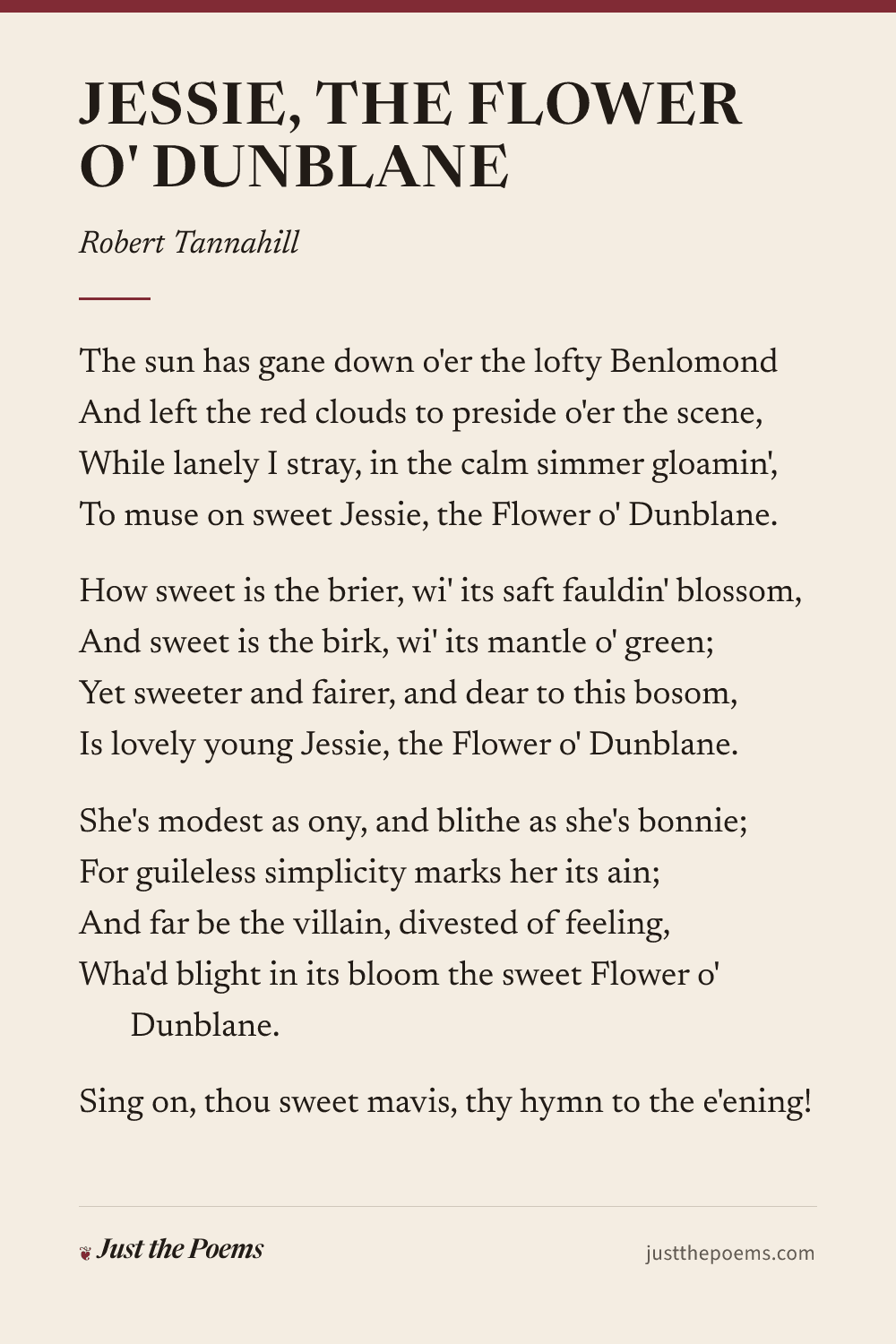
JESSIE, THE FLOWER O' DUNBLANE

Robert Tannahill

In 0 Wikipedias 1 anthology Poet in 6 Wikipedias

The sun has gane down o'er the lofty BenlomondAnd left the red clouds to preside o'er the scene,While lanely I stray, in the calm simmer gloamin',To muse on sweet Jessie, the Flower o' Dunblane.

How sweet is the brier, wi' its saft fauldin' blossom,And sweet is the birk, wi' its mantle o' green;Yet sweeter and fairer, and dear to this bosom,Is lovely young Jessie, the Flower o' Dunblane.

She's modest as ony, and blithe as she's bonnie;For guileless simplicity marks her its ain;And far be the villain, divested of feeling,Wha'd blight in its bloom the sweet Flower o' Dunblane.

Sing on, thou sweet mavis, thy hymn to the e'ening!Thou'rt dear to the echoes of Calderwood glen;Sae dear to this bosom, sae artless and winning,Is charming young Jessie, the Flower o' Dunblane.

How lost were my days till I met wi' my Jessie!The sports o' the city seemed foolish and vain;I ne'er saw a nymph I would ca' my dear lassieTill charmed wi' sweet Jessie, the Flower o' Dunblane.

Though mine were the station o' loftiest grandeur,Amidst its profusion I'd languish in pain,And reckon as naething the height o' its splendor,If wanting sweet Jessie, the Flower o' Dunblane.

Source

The Home Book of Verse, ed. Burton Egbert Stevenson

Filed under
  • Named in the title

Advertisements

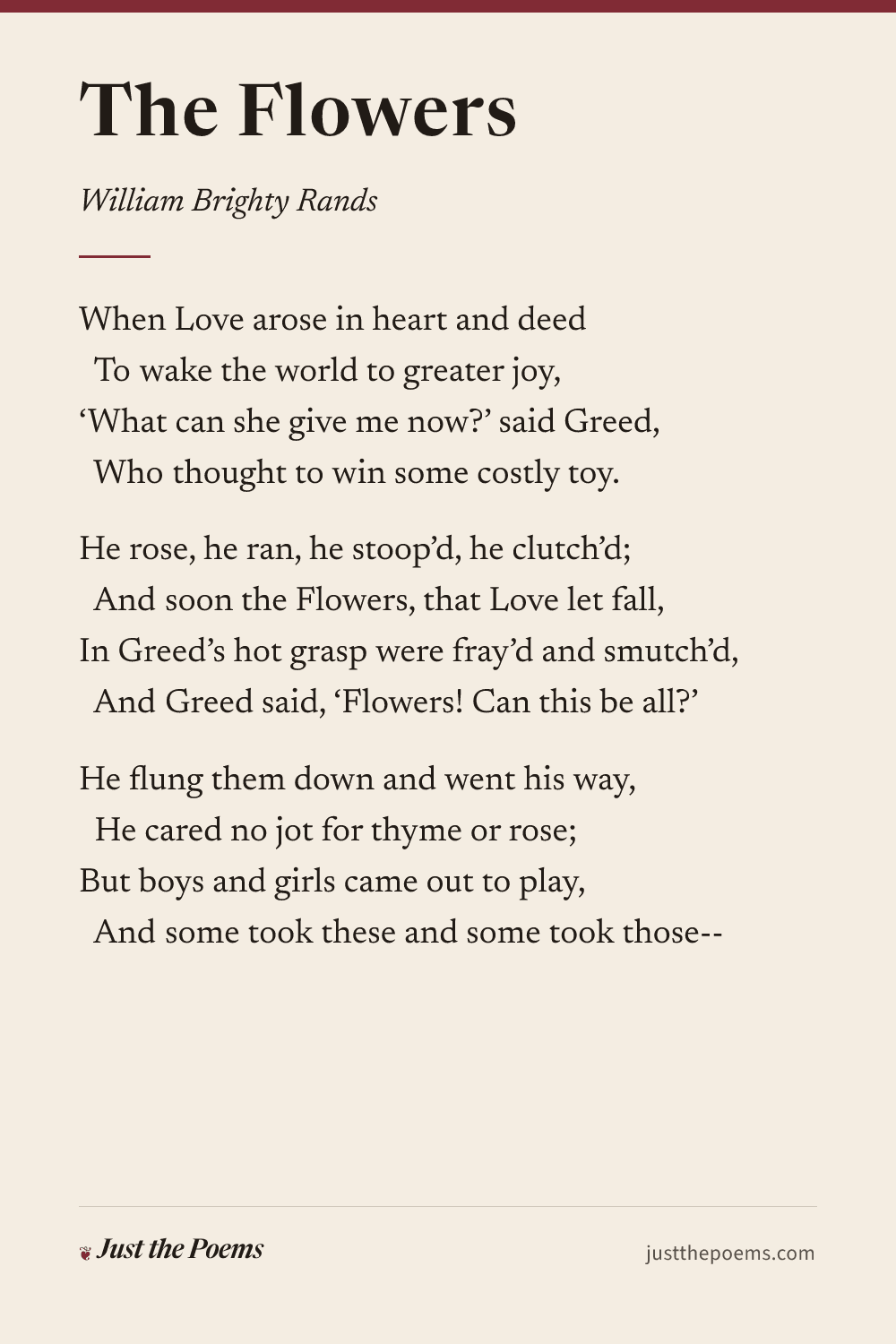
The Flowers

William Brighty Rands

In 0 Wikipedias 1 anthology Poet in 3 Wikipedias

When Love arose in heart and deed To wake the world to greater joy,‘What can she give me now?’ said Greed, Who thought to win some costly toy.

He rose, he ran, he stoop’d, he clutch’d; And soon the Flowers, that Love let fall,In Greed’s hot grasp were fray’d and smutch’d, And Greed said, ‘Flowers! Can this be all?’

He flung them down and went his way, He cared no jot for thyme or rose;But boys and girls came out to play, And some took these and some took those--

Red, blue, and white, and green and gold; And at their touch the dew return’d,And all the bloom a thousandfold-- So red, so ripe, the roses burn’d!

Source

The Oxford Book of English Verse 1250–1900, 1900

Filed under
  • Named in the title

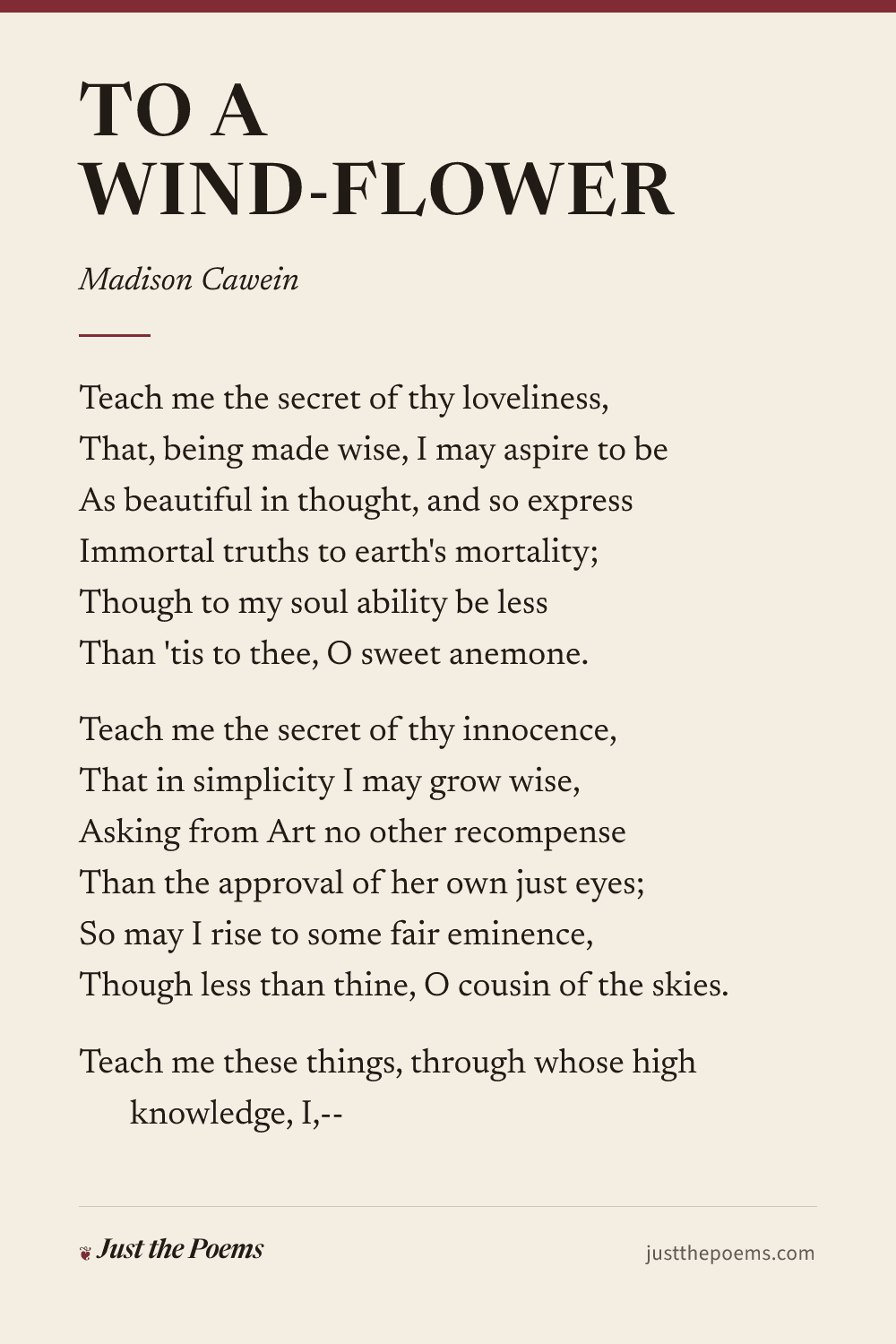
TO A WIND-FLOWER

Madison Cawein

In 0 Wikipedias 1 anthology Poet in 2 Wikipedias

Teach me the secret of thy loveliness,That, being made wise, I may aspire to beAs beautiful in thought, and so expressImmortal truths to earth's mortality;Though to my soul ability be lessThan 'tis to thee, O sweet anemone.

Teach me the secret of thy innocence,That in simplicity I may grow wise,Asking from Art no other recompenseThan the approval of her own just eyes;So may I rise to some fair eminence,Though less than thine, O cousin of the skies.

Teach me these things, through whose high knowledge, I,--When Death hath poured oblivion through my veins,And brought me home, as all are brought, to lieIn that vast house, common to serfs and thanes,--I shall not die, I shall not utterly die,For beauty born of beauty--that remains.

Source

The Home Book of Verse, ed. Burton Egbert Stevenson

Filed under
  • Named in the title

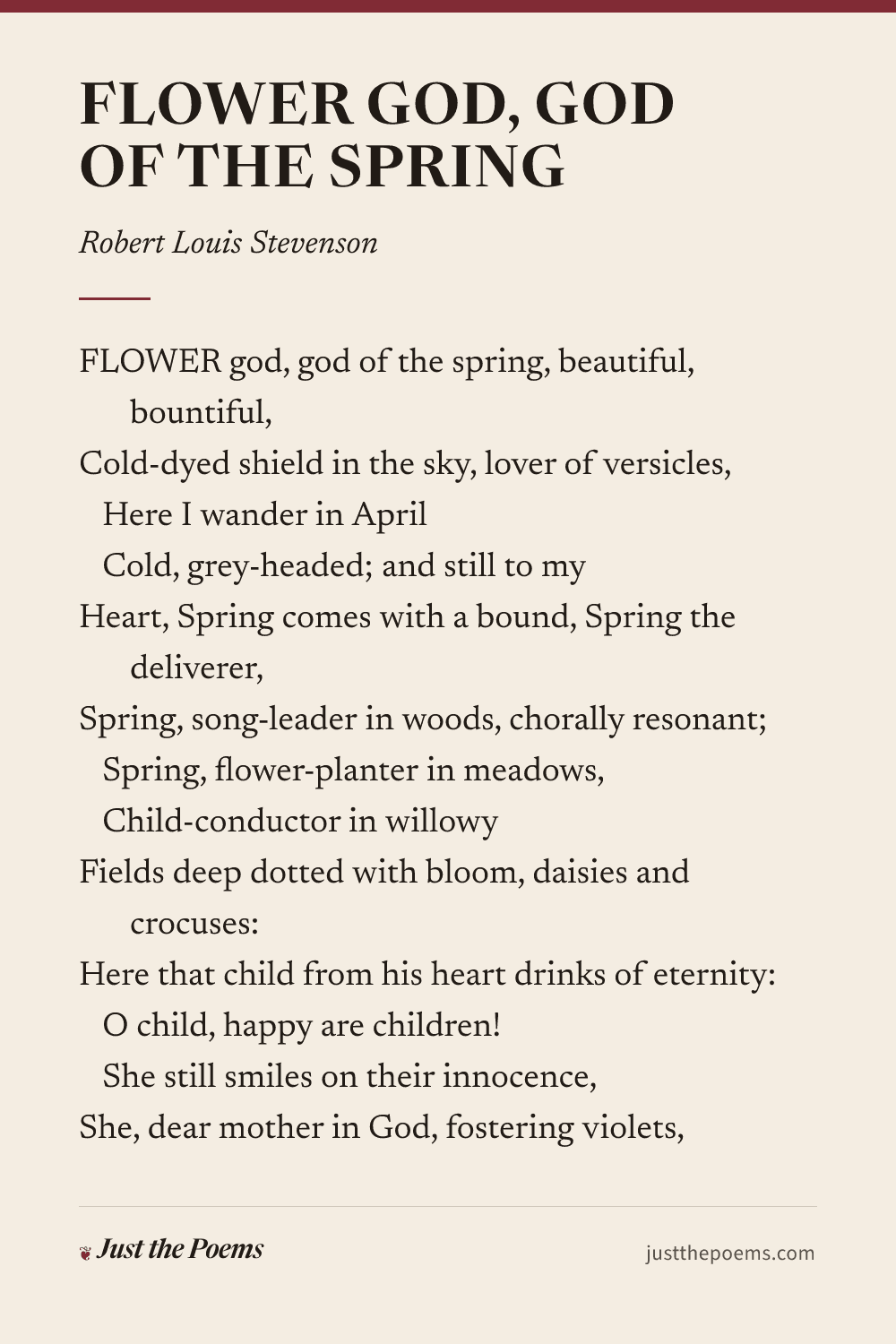
FLOWER GOD, GOD OF THE SPRING

Robert Louis Stevenson

In 0 Wikipedias 0 anthologies Poet in 101 Wikipedias

FLOWER god, god of the spring, beautiful, bountiful,Cold-dyed shield in the sky, lover of versicles, Here I wander in April Cold, grey-headed; and still to myHeart, Spring comes with a bound, Spring the deliverer,Spring, song-leader in woods, chorally resonant; Spring, flower-planter in meadows, Child-conductor in willowyFields deep dotted with bloom, daisies and crocuses:Here that child from his heart drinks of eternity: O child, happy are children! She still smiles on their innocence,She, dear mother in God, fostering violets,Fills earth full of her scents, voices and violins: Thus one cunning in music Wakes old chords in the memory:Thus fair earth in the Spring leads her performances.One more touch of the bow, smell of the virginal Green—one more, and my bosom Feels new life with an ecstasy.

Source

New Poems, and Variant Readings, 1918

Filed under
  • Named in the title

The Flowers

Robert Louis Stevenson

In 0 Wikipedias 0 anthologies Poet in 101 Wikipedias

All the names I know from nurse:Gardener's garters, Shepherd's purse,Bachelor's buttons, Lady's smock,And the Lady Hollyhock.

Fairy places, fairy things,Fairy woods where the wild bee wings,Tiny trees for tiny dames--These must all be fairy names!

Tiny woods below whose boughsShady fairies weave a house;Tiny tree-tops, rose or thyme,Where the braver fairies climb!

Fair are grown-up people's trees,But the fairest woods are these;Where, if I were not so tall,I should live for good and all.

Source

A Child's Garden of Verses

Filed under
  • Named in the title

TO FLOWERS FROM ITALY IN WINTER

Thomas Hardy

In 0 Wikipedias 0 anthologies Poet in 91 Wikipedias

SUNNED in the South, and here to-day; —If all organic thingsBe sentient, Flowers, as some men say, What are your ponderings?

How can you stay, nor vanish quite From this bleak spot of thorn,And birch, and fir, and frozen white Expanse of the forlorn?

Frail luckless exiles hither brought! Your dust will not regainOld sunny haunts of Classic thought When you shall waste and wane;

But mix with alien earth, be lit With frigid Boreal flame,And not a sign remain in it To tell men whence you came.

Source

Poems of the Past and the Present, 1919

Filed under
  • Named in the title

‘FLOWERS OF FRANCE’

Ella Wheeler Wilcox

In 0 Wikipedias 0 anthologies Poet in 18 Wikipedias

Flowers of France in the Spring,Your growth is a beautiful thing;But give us your fragrance and bloom—Yea, give us your lives in truth,Give us your sweetness and graceTo brighten the resting-placeOf the flower of manhood and youth,Gone into the dust of the tomb.

This is the vast stupendous hour of Time,When nothing counts but sacrifice and faith,Service and self-forgetfulness. SublimeAnd awful are these moments charged with death

Show all 82 lines 70 more

And red with slaughter. Yet God’s purpose thrivesIn all this holocaust of human lives.

I say God’s purpose thrives. Just in the measureThat men have flung away their lust for gain,Stopped in their mad pursuit of worldly pleasure,And boldly faced unprecedented painAnd dangers, without thinking of the cost,So thrives God’s purpose in the holocaust.

Death is a little thing: all men must die;But when ideals die, God grieves in Heaven.Therefore I think it was the reason whyThis Armageddon to the world was given.The Soul of man, forgetful of its birth,Was losing sight of everything but earth.

Up from these many million graves shall spring,A shining harvest for the coming race.An Army of Invisibles shall bringA glorified lost faith back to its place.And men shall know there is a higher goalThan earthly triumphs for the human soul.

They are not dead—they are not dead, I say,These men whose mortal forms are in the sod.A grand Advance-Guard marching on its way,Their Souls move upwards to salute their God!While to their comrades who are in the strifeThey cry, ‘Fight on! Death is the dawn of life.’

We had forgotten all the depth and beautyAnd lofty purport of that old true wordDeplaced by pleasure—that old good word duty.Now by its meaning is the whole world stirred.These men died for it; for it, now, we give,And sacrifice, and serve, and toil, and live.From out our hearts had gone a high devotionFor anything. It took a mighty wrath—Against great evil to wake strong emotion,And put us back upon the righteous path.It took a mingled stream of tears and bloodTo cut the channel through to Brotherhood.

That word meant nothing on our lips in peace:We had despoiled it by our castes and classes.But when this savage carnage finds surceaseA new ideal will unite the masses.And there shall be True Brotherhood with men—The Christly Spirit stirring earth again.

For this our men have suffered, fought, and died.And we who can but dimly see the endAre guarded by their spirits glorified,Who help us on our way, while they ascend.They are not dead—they are not dead, I say,These men whose graves we decorate to-day.

America and France walk hand in hand;As one, their hearts beat through the coming years:One is the aim and purpose of each land,Baptized with holy water of their tears.To-day they worship with one faith, and knowGrief’s first Communion in God’s House of Woe.

Great Liberty, the Goddess at our gates,And great Jeanne d’Arc, are fused into one soul:A host of Angels on that soul awaitsTo lead it up to triumph at the goal.Along the path of Victory they tread,Moves the majestic cortège of our dead.

Flowers of France in the Spring,Your growth is a beautiful thing;But give us your fragrance and bloom—Yea, give us your lives in truth, Give us your sweetness and grace To brighten the resting-place Of the flower of manhood and youth, Gone into the dust of the tomb.

Source

Hello, Boys!, 1919

Filed under
  • Named in the title

THE CACTUS FLOWER.

J. Wm. Lloyd

In 0 Wikipedias 0 anthologies Poet in 7 Wikipedias

She came to me brimming with love;The cup of a red cactus flower filled with dew,The heart of a woman wonderful with color and strength and passionate sweetness,

Without reserve,Unconditionally:

“All that I am of life and love is yours--take me!”Ah, the redness of the cactus flower!Ah, the heart of a woman!

Source

Songs of the unblind Cupid, 1899

Filed under
  • Named in the title

FLOWER ALONE

Hartley Burr Alexander

In 0 Wikipedias 0 anthologies Poet in 4 Wikipedias

A Santa Clara woman In Sant’ Domingo town,Her rights were less than human That day at red sundown,----They made her less than dogs are made Within the stranger town.

Oh, she was wicked merry On Santa Clara street!Red-brown as a berry, Hale as ripened wheat;And he who came to woo her, He came on dancing feet.

Show all 78 lines 66 more

Round his raven locks a kerchief gay, His belt of the silver wrought,----From Sant’ Domingo all the way With none but her in thought:A braided scarf, a turquoise ring, These were the gifts he brought.

Why should she heed the old wives’ saw? “A bride should seek her bed“Within the pale of the village law “Wherein she hath been bred.”At old wives’ tales and old wives’ wails She shook a saucy head.

And so in Sant’ Domingo town She ground her daily corn;She drew her water at the well, And there her babe was born;And earthen pots she made to sell And quaintly did adorn.

A Santa Clara woman Within a stranger town,Its folk were more than human To hold her as their own:A saucy-head she had been bred, Should they not bring her down?

They mocked her for her outland ways, They jeered her kin and clan;They whispered evil of her days, They won away her man,----A saucy-head she had been bred, But, oh, her heart grew wan!

They babbled evil of her days And evil of her art;They mocked, they jeered, they came to gaze Where she bode with aching heart,----Where moody-eyed in her alien pride With her babe she sat apart.

A Santa Clara woman In Sant’ Domingo town,They made her less than human, And the hour was red sundownWhen from cut and gash of the plaited lash Crimson her blood ran down.

Crimson her blood as the setting sun, But never to blow or curseDid she open her lips till their work was done And they left her for better or worse,----Till they dragged her tied to a horse’s tail And left her for a corse.

She lay beside the beasts’ corral, Her body as the dead,And dimly she heard the tiny call Of her babe that would be fed,----Dimly she heard, and she did crawl To nurse it, while she bled.

A Santa Clara woman Within a stranger town;Her rights were less than human When redly the sun went down,----But the babe that was born of her body She nursed while the blood ran down.

With curious eyes I watched her at work Where she plied her potter’s artAnd creatures drew with cunning hand, Bright for the white man’s mart,----I wondered at the blood-red band Limned to each crimsoned heart.

Source

God's drum, and other cycles from Indian lore, 1927

Filed under
  • Named in the title

TO A WITHERED FLOWER!

John Castillo

In 0 Wikipedias 0 anthologies Poet in 1 Wikipedia

Withering Flower, upbraid me not!Why cast on me that look so pale?Why dost thou my attention court,To listen to thy mournful tale?Why bow thy head? Why bend thy neck?Why look so drooping, wan, and cold?To give my careless thoughts a check,--And tell me I am getting old!

Fading Flower, upbraid me not!Still nodding with the gentle breeze.Or dost thou think I have forgot,I too am wasting by degrees?

Show all 56 lines 44 more

For scarce can I believe my sight,Who lately saw thee fresh and gay;That beauty could so early blight,Or such fresh colours fade away!

Drooping Flower, upbraid me not!But turn to Sol's enlivening ray.I in some climate cold or hot,Must also sicken and decay!Nay, why dost thou shake off thy leaf,And show thy heart so fair and clean?But mine to smite with inward grief,--To feel the many plagues within.

Weeping Flower, upbraid me still!For half the conquest thou hast gain'd.Yes! listen to thy tale I will,Until its meaning be explain'd.Fair emblem thou of human life;In thee its changing tints are seen;Our visit here, so frail and brief,Is painted in those tints of thine!

When in thy bud so rich and gay,Thou did'st escape the spoiler's handThat would have reft thy charms away,'Twas pity check'd--and let thee stand!While cherish'd by the blushing fair,And waving on thy hardy stem,Thy fragrance rich, perfum'd the air,--Thou'rt blasted now to me and them!

Unlike to thee, whose task is done,When Man shall quit this vale of tears,After this life's short glass is run,Man shall exist in nobler spheres.All earthly glories fade away,So transient and so insecure;With us, alas, how short's their stay!Prefigur'd by a dying Flower!

Yet we have cause to bless the day,If weary of a life mispent,By this thy exit, any mayBe led to ponder, and repent.Thou transient teller of the truth,May he who bids, and thunders roll,Forgive the follies of my youth,And stamp thy lesson on My soul!

Source

Awd Isaac, The Steeple Chase, and Other Poems With a glossary of the Yorkshire Dialect, 1843

Filed under
  • Named in the title

FLOWERS, BRIGHT FLOWERS!

John S. Adams

In 0 Wikipedias 0 anthologies Poet in 0 Wikipedias

FLOWERS from the wild-wood, Flowers, bright flowers!Springing in desert spot,Where man dwelleth not,-- Flowers, bright flowers,Cheering the traveller's lot.Given to one and all, Flowers, bright flowers!When man neglecteth thee,When he rejecteth thee, Flowers, bright flowers,God's hand protecteth thee!

Show all 36 lines 24 more

Remnants of paradise, Flowers, bright flowers!Tinged with a heavenly hue,Reflecting its azure blue, Flowers, bright flowers,Brightest earth ever knew!Cheering the desolate, Flowers, bright flowers!Coming with fragrance fraught,From Heaven's own breezes caught, Flowers, bright flowers,Teachers of holy thought!Borne to the curtained room, Flowers, bright flowers!Where the sick longs for light,Then, for the shades of night, Flowers, bright flowers,Gladdening the wearied sight!High on the mountain-top, Flowers, bright flowers!Low in sequestered vale,On cliff, mid rock, in dale, Flowers, bright flowers,Ye do prevail!

Source

Town and Country; Or, Life at Home and Abroad, Without and Within Us, 1855

Filed under
  • Named in the title

23 poems about flowers

22 poets

By poet's century of death

CenturyPoems
17th3
19th14
20th6

Poets with more than one poem

PoetPoems
Robert Louis Stevenson2