Poems About Freedom

The first 30 of 36 poems about freedom, by 23 poets, ranked by third-party data. How poems are ranked

To Althea, from Prison

Richard Lovelace

In 1 Wikipedia 3 anthologies Poet in 21 Wikipedias

When Love with unconfinèd wings Hovers within my gates,And my divine Althea brings To whisper at the grates;When I lie tangled in her hair And fetter’d to her eye,The birds that wanton in the air Know no such liberty.

When flowing cups run swiftly round With no allaying Thames,Our careless heads with roses bound, Our hearts with loyal flames;

Show all 32 lines 20 more

When thirsty grief in wine we steep, When healths and draughts go free--Fishes that tipple in the deep Know no such liberty.

When, like committed linnets, I With shriller throat shall singThe sweetness, mercy, majesty, And glories of my King;When I shall voice aloud how good He is, how great should be,Enlargèd winds, that curl the flood, Know no such liberty.

Stone walls do not a prison make, Nor iron bars a cage;Minds innocent and quiet take That for an hermitage;If I have freedom in my love And in my soul am free,Angels alone, that soar above, Enjoy such liberty.

Source

The Oxford Book of English Verse 1250–1900, 1900

Filed under
  • Section “FREEDOM”, The World's Best Poetry

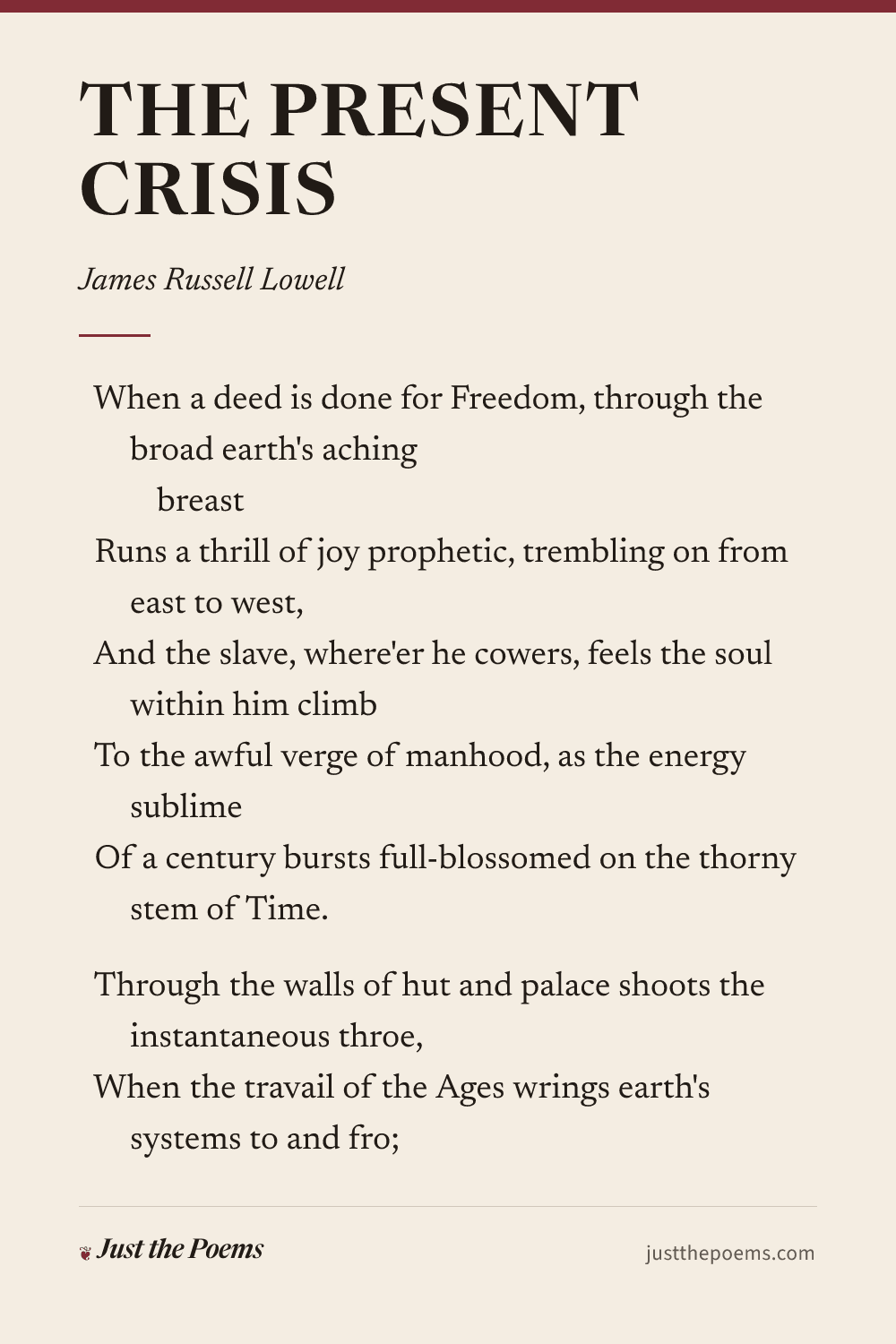
THE PRESENT CRISIS

James Russell Lowell

In 1 Wikipedia 1 anthology Poet in 31 Wikipedias

When a deed is done for Freedom, through the broad earth's aching breast Runs a thrill of joy prophetic, trembling on from east to west, And the slave, where'er he cowers, feels the soul within him climb To the awful verge of manhood, as the energy sublime Of a century bursts full-blossomed on the thorny stem of Time.

Through the walls of hut and palace shoots the instantaneous throe, When the travail of the Ages wrings earth's systems to and fro; At the birth of each new Era, with a recognizing start, Nation wildly looks at nation, standing with mute lips apart. And glad Truth's yet mightier man-child leaps beneath the Future's heart.

Show all 107 lines 95 more

So the Evil's triumph sendeth, with a terror and a chill, Under continent to continent, the sense of coming ill, And the slave, where'er he cowers, feels his sympathies with God In hot tear-drops ebbing earthward, to be drunk up by the sod, Till a corpse crawls round unburied, delving in the nobler clod.

For mankind are one in spirit, and an instinct bears along, Round the earth's electric circle, the swift flush of right or wrong; Whether conscious or unconscious, yet Humanity's vast frame Through its ocean-sundered fibres feels the gush of joy or shame;-- In the gain or loss of one race all the rest have equal claim.

Once to every man and nation comes the moment to decide, In the strife of Truth with Falsehood, for the good or evil side; Some great cause, God's new Messiah, offering each the bloom or blight, Parts the goats upon the left hand, and the sheep upon the right, And the choice goes by forever 'twixt that darkness and that light.

Hast thou chosen, O my people, on whose party thou shalt stand, Ere the Doom from its worn sandals shakes the dust against our land? Though the cause of Evil prosper, yet 'tis Truth alone is strong, And, albeit she wander outcast now, I see around her throng Troops of beautiful, tall angels, to enshield her from all wrong.

Backward look across the ages and the beacon-moments see, That, like peaks of some sunk continent, jut through Oblivion's sea; Not an ear in court or market for the low foreboding cry Of those Crises, God's stern winnowers, from whose feet earth's chaff must fly; Never shows the choice momentous till the judgment hath passed by.

Careless seems the great Avenger; history's pages but record One death-grapple in the darkness 'twixt old systems and the Word; Truth forever on the scaffold, Wrong forever on the throne,-- Yet that scaffold sways the Future, and, behind the dim unknown, Standeth God within the shadow, keeping watch above his own.

We see dimly in the Present what is small and what is great, Slow of faith, how weak an arm may turn the iron helm of fate, But the soul is still oracular; amid the market's din, List the ominous stern whisper from the Delphic cave within,-- "They enslave their children's children who make compromise with sin."

Slavery, the earthborn Cyclops, fellest of the giant brood, Sons of brutish Force and Darkness, who have drenched the earth with blood, Famished in his self-made desert, blinded by our purer day, Gropes in yet unblasted regions for his miserable prey;-- Shall we guide his gory fingers where our helpless children play?

Then to side with Truth is noble when we share her wretched crust, Ere her cause bring fame and profit, and 'tis prosperous to be just; Then it is the brave man chooses, while the coward stands aside, Doubting in his abject spirit, till his Lord is crucified, And the multitude make virtue of the faith they had denied.

Count me o'er earth's chosen heroes,--they were souls that stood alone, While the men they agonized for hurled the contumelious stone, Stood serene, and down the future saw the golden beam incline To the side of perfect justice, mastered by their faith divine, By one man's plain truth to manhood and to God's supreme design.

By the light of burning heretics Christ's bleeding feet I track, Toiling up new Calvaries ever with the cross that turns not back, And these mounts of anguish number how each generation learned One new word of that grand Credo which in prophet-hearts hath burned Since the first man stood God-conquered with his face to heaven upturned.

For Humanity sweeps onward: where to-day the martyr stands, On the morrow crouches Judas with the silver in his hands; Far in front the cross stands ready and the crackling fagots burn, While the hooting mob of yesterday in silent awe return To glean up the scattered ashes into History's golden urn.

'Tis as easy to be heroes as to sit the idle slaves Of a legendary virtue carved upon our fathers' graves, Worshippers of light ancestral make the present light a crime;-- Was the Mayflower launched by cowards, steered by men behind their time? Turn those tracks toward Past or Future, that make Plymouth rock sublime?

They were men of present valor, stalwart old iconoclasts, Unconvinced by axe or gibbet that all virtue was the Past's; But we make their truth our falsehood, thinking that hath made us free, Hoarding it in mouldy parchments, while our tender spirits flee The rude grasp of that Impulse which drove them across the sea.

They have rights who dare maintain them; we are traitors to our sires, Smothering in their holy ashes Freedom's new-lit altar-fires; Shall we make their creed our jailer? Shall we, in our haste to slay, From the tombs of the old prophets steal the funeral lamps away To light up the martyr-fagots round the prophets of to-day?

New occasions teach new duties; Time makes ancient good uncouth; They must upward still, and onward, who would keep abreast of Truth; Lo, before us gleam her camp-fires! we ourselves must Pilgrims be, Launch our Mayflower, and steer boldly through the desperate winter sea, Nor attempt the Future's portal with the Past's blood-rusted key.

December, 1845.
Source

The World's Best Poetry, Vol. VIII, ed. Bliss Carman, 1904

Filed under
  • Section “FREEDOM”, The World's Best Poetry

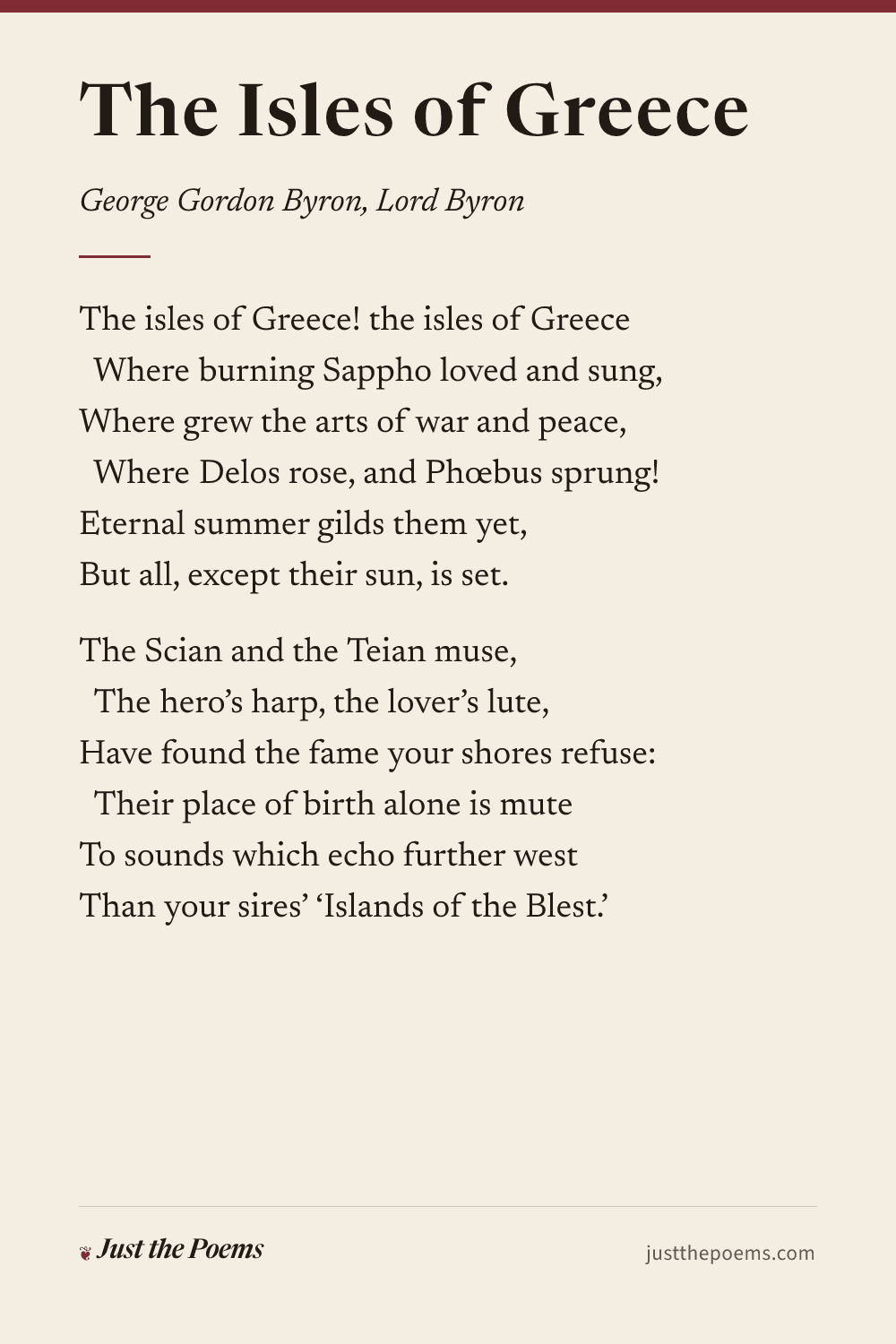
The Isles of Greece

George Gordon Byron, Lord Byron

In 0 Wikipedias 3 anthologies Poet in 155 Wikipedias

The isles of Greece! the isles of Greece Where burning Sappho loved and sung,Where grew the arts of war and peace, Where Delos rose, and Phœbus sprung!Eternal summer gilds them yet,But all, except their sun, is set.

The Scian and the Teian muse, The hero’s harp, the lover’s lute,Have found the fame your shores refuse: Their place of birth alone is muteTo sounds which echo further westThan your sires’ ‘Islands of the Blest.’

Show all 96 lines 84 more

The mountains look on Marathon-- And Marathon looks on the sea;And musing there an hour alone, I dream’d that Greece might still be free;For standing on the Persians’ grave,I could not deem myself a slave.

A king sate on the rocky brow Which looks o’er sea-born Salamis;And ships, by thousands, lay below, And men in nations;--all were his!He counted them at break of day--And when the sun set, where were they?

And where are they? and where art thou, My country? On thy voiceless shoreThe heroic lay is tuneless now-- The heroic bosom beats no more!And must thy lyre, so long divine,Degenerate into hands like mine?

’Tis something in the dearth of fame, Though link’d among a fetter’d race,To feel at least a patriot’s shame, Even as I sing, suffuse my face;For what is left the poet here?For Greeks a blush--for Greece a tear.

Must we but weep o’er days more blest? Must we but blush?--Our fathers bled.Earth! render back from out thy breast A remnant of our Spartan dead!Of the three hundred grant but three,To make a new Thermopylæ!

What, silent still? and silent all? Ah! no;--the voices of the deadSound like a distant torrent’s fall, And answer, ‘Let one living head,But one, arise,--we come, we come!’’Tis but the living who are dumb.

In vain--in vain: strike other chords; Fill high the cup with Samian wine!Leave battles to the Turkish hordes, And shed the blood of Scio’s vine!Hark! rising to the ignoble call--How answers each bold Bacchanal!

You have the Pyrrhic dance as yet; Where is the Pyrrhic phalanx gone?Of two such lessons, why forget The nobler and the manlier one?You have the letters Cadmus gave--Think ye he meant them for a slave?

Fill high the bowl with Samian wine! We will not think of themes like these!It made Anacreon’s song divine: He served--but served Polycrates--A tyrant; but our masters thenWere still, at least, our countrymen.

The tyrant of the Chersonese Was freedom’s best and bravest friend;That tyrant was Miltiades! O that the present hour would lendAnother despot of the kind!Such chains as his were sure to bind.

Fill high the bowl with Samian wine! On Suli’s rock, and Parga’s shore,Exists the remnant of a line Such as the Doric mothers bore;And there, perhaps, some seed is sown,The Heracleidan blood might own.

Trust not for freedom to the Franks-- They have a king who buys and sells;In native swords and native ranks The only hope of courage dwells:But Turkish force and Latin fraudWould break your shield, however broad.

Fill high the bowl with Samian wine! Our virgins dance beneath the shade--I see their glorious black eyes shine; But gazing on each glowing maid,My own the burning tear-drop laves,To think such breasts must suckle slaves.

Place me on Sunium’s marbled steep, Where nothing, save the waves and I,May hear our mutual murmurs sweep; There, swan-like, let me sing and die:A land of slaves shall ne’er be mine--Dash down yon cup of Samian wine!

Source

The Oxford Book of English Verse 1250–1900, 1900

Filed under
  • Section “FREEDOM”, The World's Best Poetry

Advertisements

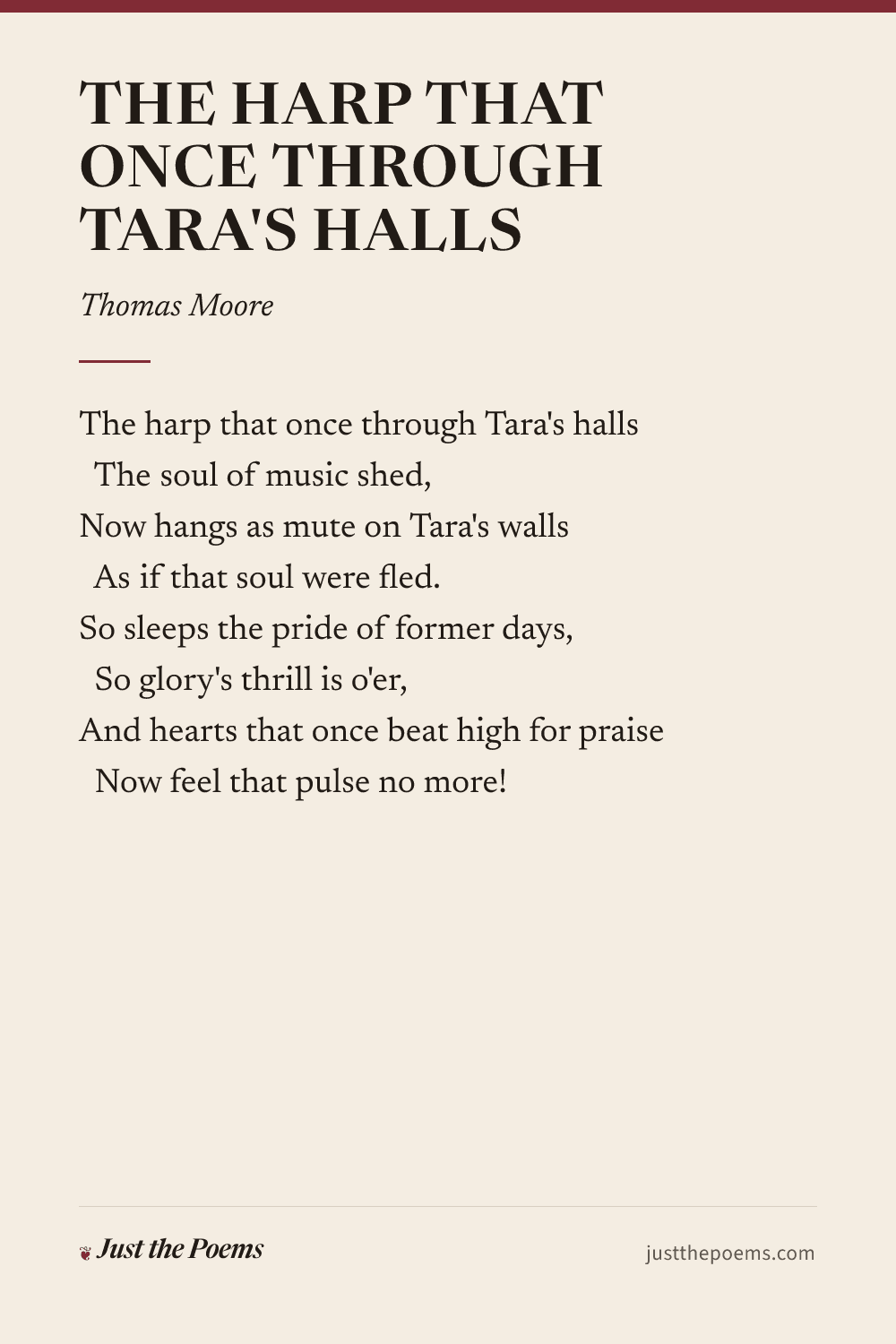
THE HARP THAT ONCE THROUGH TARA'S HALLS

Thomas Moore

In 0 Wikipedias 2 anthologies Poet in 43 Wikipedias

The harp that once through Tara's halls The soul of music shed,Now hangs as mute on Tara's walls As if that soul were fled.So sleeps the pride of former days, So glory's thrill is o'er,And hearts that once beat high for praise Now feel that pulse no more!

No more to chiefs and ladies bright The harp of Tara swells;The chord alone that breaks at night Its tale of ruin tells.Thus Freedom now so seldom wakes, The only throb she givesIs when some heart indignant breaks, To show that still she lives.

Source

The World's Best Poetry, Vol. VIII, ed. Bliss Carman, 1904

Filed under
  • Section “FREEDOM”, The World's Best Poetry

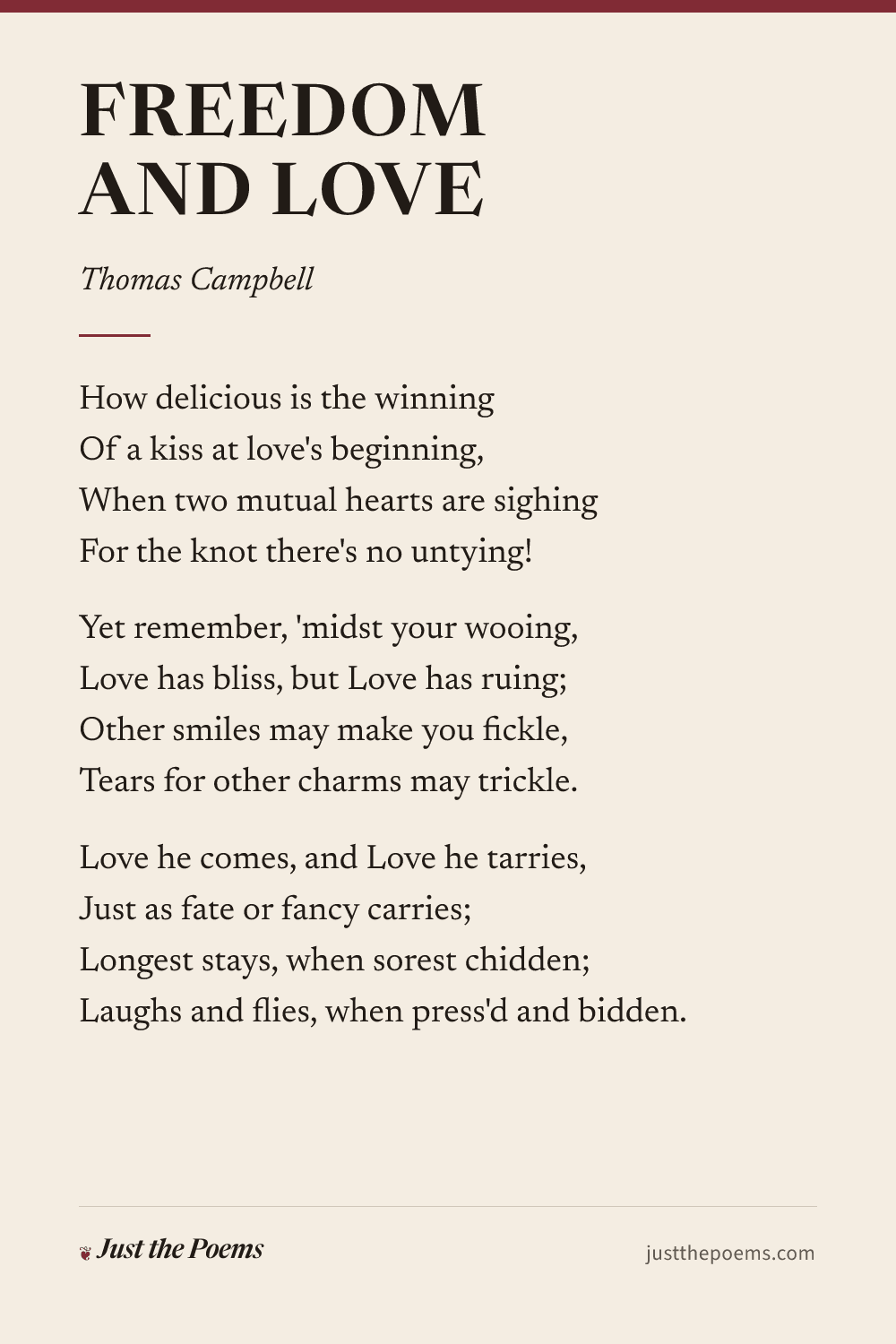
FREEDOM AND LOVE

Thomas Campbell

In 0 Wikipedias 2 anthologies Poet in 16 Wikipedias

How delicious is the winningOf a kiss at love's beginning,When two mutual hearts are sighingFor the knot there's no untying!

Yet remember, 'midst your wooing,Love has bliss, but Love has ruing;Other smiles may make you fickle,Tears for other charms may trickle.

Love he comes, and Love he tarries,Just as fate or fancy carries;Longest stays, when sorest chidden;Laughs and flies, when press'd and bidden.

Bind the sea to slumber stilly,Bind its odour to the lily,Bind the aspen ne'er to quiver,Then bind Love to last for ever.

Love's a fire that needs renewalOf fresh beauty for its fuel:Love's wing moults when caged and captured,Only free, he soars enraptured.

Can you keep the bee from rangingOr the ringdove's neck from changing?No! nor fetter'd Love from dyingIn the knot there's no untying.

Source

The Golden Treasury, ed. Francis Turner Palgrave

Filed under
  • Named in the title

THE AMERICAN FLAG

Joseph Rodman Drake

In 0 Wikipedias 2 anthologies Poet in 7 Wikipedias

When Freedom, from her mountain height, Unfurled her standard to the air,She tore the azure robe of night, And set the stars of glory there!She mingled with its gorgeous dyesThe milky baldric of the skies,And striped its pure, celestial whiteWith streakings of the morning light;Then, from his mansion in the sun,She called her eagle-bearer down,And gave into his mighty handThe symbol of her chosen land!

Show all 61 lines 49 more

Majestic monarch of the cloud! Who rear'st aloft thy regal form,To hear the tempest trumping loud,And see the lightning lances driven, When strive the warriors of the storm,And rolls the thunder-drum of heaven,--Child of the Sun! to thee 'tis given To guard the banner of the free,To hover in the sulphur smoke,To ward away the battle-stroke,And bid its blendings shine afar,Like rainbows on the cloud of war, The harbingers of victory!

Flag of the brave! thy folds shall fly,The sign of hope and triumph high!When speaks the signal-trumpet tone,And the long line comes gleaming on,Ere yet the life-blood, warm and wet,Has dimmed the glistening bayonet,Each soldier's eye shall brightly turnTo where thy sky-born glories burn,And, as his springing steps advance,Catch war and vengeance from the glance.

And when the cannon-mouthings loudHeave in wild wreaths the battle shroud,And gory sabres rise and fallLike shoots of flame on midnight's pall,Then shall thy meteor glances glow, And cowering foes shall shrink beneathEach gallant arm that strikes below That lovely messenger of death.

Flag of the seas! on ocean waveThy stars shall glitter o'er the brave;When death, careering on the gale,Sweeps darkly round the bellied sail,And frighted waves rush wildly backBefore the broadside's reeling rack,Each dying wanderer of the seaShall look at once to heaven and thee,And smile to see thy splendors flyIn triumph o'er his closing eye.

Flag of the free heart's hope and home, By angel hands to valor given!Thy stars have lit the welkin dome, And all thy hues were born in heaven.Forever float that standard sheet!Where breathes the foe but falls before us,With Freedom's soil beneath our feet, And Freedom's banner streaming o'er us!

Source

The World's Best Poetry, Vol. VIII, ed. Bliss Carman, 1904

Filed under
  • Section “FREEDOM”, The World's Best Poetry

FALLEN GREECE

Lord Byron

In 0 Wikipedias 1 anthology Poet in 155 Wikipedias

Clime of the unforgotten brave!Whose land, from plain to mountain-cave,Was Freedom's home or Glory's grave!Shrine of the mighty! can it beThat this is all remains of thee?Approach, thou craven, crouching slave; Say, is not this Thermopylae?These waters blue that round you lave, O servile offspring of the free,--Pronounce what sea, what shore is this?The gulf, the rock of Salamis!These scenes, their story not unknown,

Show all 50 lines 38 more

Arise, and make again your own;Snatch from the ashes of your siresThe embers of their former fires;And he who in the strife expiresWill add to theirs a name of fearThat Tyranny shall quake to hear,And leave his sons a hope, a fame,They too will rather die than shame;For Freedom's battle once begun,Bequeathed by bleeding sire to son,Though baffled oft is ever won.Hear witness, Greece, thy living page;Attest it, many a deathless age:While kings, in dusty darkness hid,Have left a nameless pyramid,Thy heroes, though the general doomHath swept the column from their tomb,A mightier monument command,The mountains of their native land!There points thy Muse to stranger's eyeThe graves of those that cannot die!'Twere long to tell, and sad to trace,Each step from splendor to disgrace:Enough,--no foreign foe could quellThy soul, till from itself it fell;Yes! self-abasement paved the wayTo villain-bonds and despot sway.

What can he tell who treads thy shore? No legend of thine olden time,No theme on which the Muse might soar,High as thine own in days of yore, When man was worthy of thy clime.The hearts within thy valleys bred,The fiery souls that might have led Thy sons to deeds sublime,Now crawl from cradle to the grave,Slaves--nay, the bondsmen of a slave, And callous save to crime.

Source

The World's Best Poetry, Vol. VIII, ed. Bliss Carman, 1904

Filed under
  • Section “FREEDOM”, The World's Best Poetry

GREECE ENSLAVED

Lord Byron

In 0 Wikipedias 1 anthology Poet in 155 Wikipedias

Fair Greece! sad relic of departed worth! Immortal, though no more; though fallen, great! Who now shall lead thy scattered children forth, And long-accustomed bondage uncreate? Not such thy sons who whilom did await, The hopeless warriors of a willing doom, In bleak Thermopylæ's sepulchral strait,-- O, who that gallant spirit shall resume,Leap from Eurotas' banks, and call thee from the tomb?

Spirit of Freedom! when on Phyle's brow Thou sat'st with Thrasybulus and his train, Couldst thou forebode the dismal hour which now

Show all 73 lines 61 more

Dims the green beauties of thine Attic plain? Not thirty tyrants now enforce the chain, But every earle can lord it o'er thy land; Nor rise thy sons, but idly rail in vain, Trembling beneath the scourge of Turkish hand,From birth till death enslaved; in word, in deed, unmanned.

In all save form alone, how changed! and who That marks the fire still sparkling in each eye, Who but would deem their bosoms burned anew With thy unquenched beam, lost liberty! And many dream withal the hour is nigh That gives them back their fathers' heritage; For foreign arms and aid they fondly sigh, Nor solely dare encounter hostile rage,Or tear their name defiled from Slavery's mournful page.

Hereditary bondsmen! know ye not, Who would be free themselves must strike the blow? By their right arms the conquest must be wrought? Will Gaul or Muscovite redress ye? No! True, they may lay your proud despoilers low, But not for you will Freedom's altars flame. Shades of the Helots! triumph o'er your foe! Greece! change thy lords, thy state is still the same;Thy glorious day is o'er, but not thy years of shame!

And yet how lovely in thine age of woe, Land of lost gods and godlike men, art thou! Thy vales of evergreen, thy hills of snow, Proclaim thee Nature's varied favorite now. Thy fanes, thy temples to thy surface bow, Commingling slowly with heroic earth. Broke by the share of every rustic plough: So perish monuments of mortal birth.So perish all in turn, save well-recorded worth;

Save where some solitary column mourns Above its prostrate brethren of the cave; Save where Tritonia's airy shrine adorns Colonna's cliff, and gleams along the wave; Save o'er some warrior's half-forgotten grave, Where the gray stones and long-neglected grass Ages, but not oblivion, feebly brave, While strangers only not regardless pass,Lingering like me, perchance, to gaze, and sigh "Alas!"

Yet are thy skies as blue, thy crags as wild, Sweet are thy groves, and verdant are thy fields, Thine olive ripe as when Minerva smiled, And still his honeyed wealth Hymettus yields; There the blithe bee his fragrant fortress builds, The free-born wanderer of thy mountain air; Apollo still thy long, long summer gilds, Still in his beam Mendeli's marbles glare:Art, Glory, Freedom fail, but Nature still is fair.

Where'er we tread, 'tis haunted, holy ground; No earth of thine is lost in vulgar mould, But one vast realm of wonder spreads around, And all the Muse's tales seem truly told, Till the sense aches with gazing to behold The scenes our earliest dreams have dwelt upon: Each hill and dale, each deepening glen and wold, Defies the power which crushed thy temples gone:Age shakes Athena's tower, but spares gray Marathon.

Source

The World's Best Poetry, Vol. VIII, ed. Bliss Carman, 1904

Filed under
  • Section “FREEDOM”, The World's Best Poetry

Advertisements

A COURT LADY

Elizabeth Barrett Browning

In 0 Wikipedias 1 anthology Poet in 60 Wikipedias

Her hair was tawny with gold, her eyes with purple were dark,Her cheeks' pale opal burnt with a red and restless spark.

Never was lady of Milan nobler in name and in race;Never was lady of Italy fairer to see in the face.

Never was lady on earth more true as woman and wife,Larger in judgment and instinct, prouder in manners and life.

She stood in the early morning, and said to her maidens, "BringThat silken robe made ready to wear at the court of the king.

"Bring me the clasps of diamonds, lucid, clear of the mote,Clasp me the large at the waist, and clasp me the small at the throat.

"Diamonds to fasten the hair, and diamonds to fasten the sleeves,Laces to drop from their rays, like a powder of snow from the eaves."

Show all 57 lines 45 more

Gorgeous she entered the sunlight which gathered her up in a flame,While straight, in her open carriage, she to the hospital came.

In she went at the door, and gazing, from end to end,"Many and low are the pallets, but each is the place of a friend."

Up she passed through the wards, and stood at a young man's bed:Bloody the band on his brow, and livid the droop of his head.

"Art thou a Lombard, my brother? Happy art thou!" she cried,And smiled like Italy on him: he dreamed in her face and died.

Pale with his passing soul, she went on still to a second:He was a grave, hard man, whose years by dungeons were reckoned.

Wounds in his body were sore, wounds in his life were sorer."Art thou a Romagnole?" Her eyes drove lightnings before her.

"Austrian and priest had joined to double and tighten the cordAble to bind thee, O strong one,--free by the stroke of a sword.

"Now be grave for the rest of us, using the life overcastTo ripen our wine of the present (too new) in glooms of the past."

Down she stepped to a pallet where lay a face like a girl's,Young, pathetic with dying,--a deep black hole in the curls.

"Art thou from Tuscany, brother? and seest thou, dreaming in pain,Thy mother stand in the piazza, searching the list of the slain?"

Kind as a mother herself, she touched his cheeks with her hands:"Blessèd is she who has borne thee, although she should weep as she stands."

On she passed to a Frenchman, his arm carried off by a ball:Kneeling,... "O more than my brother! how shall I thank thee for all?

"Each of the heroes round us has fought for his land and line,But thou hast fought for a stranger, in hate of a wrong not thine.

"Happy are all free peoples, too strong to be dispossessed;But blessèd are those among nations who dare to be strong for the rest!"

Ever she passed on her way, and came to a couch where pinedOne with a face from Venetia, white with a hope out of mind.

Long she stood and gazed, and twice she tried at the name,But two great crystal tears were all that faltered and came.

Only a tear for Venice?--she turned as in passion and loss,And stooped to his forehead and kissed it, as if she were kissing the cross.

Faint with that strain of heart, she moved on then to another,Stern and strong in his death. "And dost thou suffer, my brother?"

Holding his hands in hers:--"Out of the Piedmont lionCometh the sweetness of freedom! sweetest to live or to die on."

Holding his cold, rough hands,--"Well, O, well have ye doneIn noble, noble Piedmont, who would not be noble alone."

Back he fell while she spoke. She rose to her feet with a spring,--"That was a Piedmontese! and this is the Court of the King."

Source

The World's Best Poetry, Vol. VIII, ed. Bliss Carman, 1904

Filed under
  • Section “FREEDOM”, The World's Best Poetry

AS BY THE SHORE AT BREAK OF DAY

Thomas Moore

In 0 Wikipedias 1 anthology Poet in 43 Wikipedias

As by the shore, at break of day,A vanquished chief expiring lay,Upon the sands, with broken sword, He traced his farewell to the free;And there the last unfinished word He dying wrote, was "Liberty!"

At night a sea-bird shrieked the knellOf him who thus for freedom fell:The words he wrote, ere evening came, Were covered by the sounding sea;--So pass away the cause and name Of him who dies for liberty!

Source

The World's Best Poetry, Vol. VIII, ed. Bliss Carman, 1904

Filed under
  • Section “FREEDOM”, The World's Best Poetry

SLAVERY

William Cowper

In 0 Wikipedias 1 anthology Poet in 41 Wikipedias

O for a lodge in some vast wilderness,Some boundless contiguity of shade,Where rumor of oppression and deceit,Of unsuccessful or successful war,Might never reach me more! My ear is pained,My soul is sick, with every day's reportOf wrong and outrage with which earth is filled.There is no flush in man's obdurate heart;It does not feel for man; the natural bondOf brotherhood is served as the flax,That falls asunder at the touch of fire.He finds his fellow guilty of a skin

Show all 47 lines 35 more

Not colored like his own, and, having powerTo enforce the wrong, for such a worthy causeDooms and devotes him as his lawful prey.Lands intersected by a narrow frithAbhor each other. Mountains interposedMake enemies of nations, who had elseLike kindred drops been mingled into one.Thus man devotes his brother, and destroys;And, worse than all, and most to be deploredAs human nature's broadest, foulest blot,Chains him, and tasks him, and exacts his sweatWith stripes, that Mercy, with a bleeding heart,Weeps, when she sees inflicted on a beast.Then what is man? And what man, seeing this,And having human feelings, does not blush,And hang his head, to think himself a man?I would not have a slave to till my ground,To carry me, to fan me while I sleep,And tremble when I wake, for all the wealthThat sinews bought and sold have ever earned.No; dear as freedom is, and in my heart'sJust estimation prized above all price,I had much rather be myself the slave,And wear the bonds, than fasten them on him.We have no slaves at home.--Then why abroad?And they themselves, once ferried o'er the waveThat parts us, are emancipate and loosed.Slaves cannot breathe in England; if their lungsReceive our air, that moment they are free;They touch our country, and their shackles fall.That's noble, and bespeaks a nation proudAnd jealous of the blessing. Spread it then,And let it circulate through every veinOf all your empire; that, where Britain's powerIs felt, mankind may feel her mercy too.

Source

The World's Best Poetry, Vol. VIII, ed. Bliss Carman, 1904

Filed under
  • Section “FREEDOM”, The World's Best Poetry

The Flower of Liberty

Oliver Wendell Holmes

In 0 Wikipedias 1 anthology Poet in 37 Wikipedias

What flower is this that greets the morn,Its hues from Heaven so freshly born?With burning star and flaming bandIt kindles all the sunset land:O tell us what its name may be,--Is this the Flower of Liberty? It is the banner of the free, The starry Flower of Liberty!

In savage Nature's far abodeIts tender seed our fathers sowed;The storm-winds rocked its swelling bud,Its opening leaves were streaked with blood,

Show all 40 lines 28 more

Till lo! earth's tyrants shook to seeThe full-blown Flower of Liberty! Then hail the banner of the free, The starry Flower of Liberty!

Behold its streaming rays unite,One mingling flood of braided light--The red that fires the Southern rose,With spotless white from Northern snows,And, spangled o'er its azure, seeThe sister Stars of Liberty! Then hail the banner of the free, The starry Flower of Liberty!

The blades of heroes fence it round,Where'er it springs is holy ground;From tower and dome its glories spread;It waves where lonely sentries tread;It makes the land as ocean free,And plants an empire on the sea! Then hail the banner of the free, The starry Flower of Liberty!

Thy sacred leaves, fair Freedom's flower,Shall ever float on dome and tower,To all their heavenly colors true,In blackening frost or crimson dew,--And God love us as we love thee,Thrice holy Flower of Liberty! Then hail the banner of the free, The starry Flower of Liberty!

Source

Poems Teachers Ask For, Book Two

Filed under
  • Named in the title

FREEDOM OF THE MIND

William Lloyd Garrison

In 0 Wikipedias 1 anthology Poet in 36 Wikipedias

High walls and huge the body may confine, And iron gates obstruct the prisoner's gaze,And massive bolts may baffle his design, And vigilant keepers watch his devious ways;But scorns the immortal mind such base control: No chains can bind it and no cell enclose.Swifter than light it flies from pole to pole, And in a flash from earth to heaven it goes.It leaps from mount to mount; from vale to vale It wanders, plucking honeyed fruits and flowers;It visits home to hear the fireside tale And in sweet converse pass the joyous hours;'Tis up before the sun, roaming afar,And in its watches wearies every star.

Source

The World's Best Poetry, Vol. VIII, ed. Bliss Carman, 1904

Filed under
  • Section “FREEDOM”, The World's Best Poetry
  • Named in the title

Advertisements

JOHN CHARLES FRÉMONT.

John Greenleaf Whittier

In 0 Wikipedias 1 anthology Poet in 33 Wikipedias

Thy error, Frémont, simply was to actA brave man's part, without the statesman's tact,And, taking counsel but of common sense,To strike at cause as well as consequence.O, never yet since Roland wound his hornAt Roncesvalles has a blast been blownFar-heard, wide-echoed, startling as thine own,Heard from the van of freedom's hope forlorn!It had been safer, doubtless, for the time,To flatter treason, and avoid offenceTo that Dark Power whose underlying crimeHeaves upward its perpetual turbulence.

Show all 26 lines 14 more

But, if thine be the fate of all who breakThe ground for truth's seed, or forerun their yearsTill lost in distance, or with stout hearts makeA lane for freedom through the level spears,Still take thou courage! God has spoken through thee,Irrevocable, the mighty words, Be free!The land shakes with them, and the slave's dull earTurns from the rice-swamp stealthily to hear.Who would recall them now must first arrestThe winds that blow down from the free North-west,Ruffling the Gulf; or like a scroll roll backThe Mississippi to its upper springs.Such words fulfil their prophecy, and lackBut the full time to harden into things.

Source

The World's Best Poetry, Vol. VIII, ed. Bliss Carman, 1904

Filed under
  • Section “FREEDOM”, The World's Best Poetry

LAUS DEO!

John Greenleaf Whittier

In 0 Wikipedias 1 anthology Poet in 33 Wikipedias

It is done! Clang of bell and roar of gunSend the tidings up and down. How the belfries rock and reel! How the great guns, peal on peal,Fling the joy from town to town!

Ring, O bells! Every stroke exulting tellsOf the burial hour of crime. Loud and long, that all may hear, Ring for every listening earOf Eternity and Time!

Show all 60 lines 48 more

Let us kneel: God's own voice is in that peal,And this spot is holy ground. Lord, forgive us! What are we, That our eyes this glory see,That our ears have heard the sound!

For the Lord On the whirlwind is abroad;In the earthquake he has spoken; He has smitten with his thunder The iron walls asunder,And the gates of brass are broken!

Loud and long Lift the old exulting song;Sing with Miriam by the sea: He has cast the mighty down; Horse and rider sink and drown;He has triumphed gloriously!

Did we dare, In our agony of prayer,Ask for more than He has done? When was ever his right hand Over any time or landStretched as now beneath the sun?

How they pale, Ancient myth and song and tale,In this wonder of our days, When the cruel rod of war Blossoms white with righteous law,And the wrath of man is praise!

Blotted out! All within and all aboutShall a fresher life begin; Freer breathe the universe As it rolls its heavy curseOn the dead and buried sin.

It is done! In the circuit of the sunShall the sound thereof go forth. It shall bid the sad rejoice, It shall give the dumb a voice,It shall belt with joy the earth!

Ring and swing, Bells of joy! On morning's wingSend the song of praise abroad! With a sound of broken chains, Tell the nations that He reigns,Who alone is Lord and God!

Source

The World's Best Poetry, Vol. VIII, ed. Bliss Carman, 1904

Filed under
  • Section “FREEDOM”, The World's Best Poetry

LIBERTY

John Hay

In 0 Wikipedias 1 anthology Poet in 33 Wikipedias

What man is there so bold that he should say,"Thus, and thus only, would I have the Sea"?For whether lying calm and beautiful,Clasping the earth in love, and throwing backThe smile of Heaven from waves of amethyst;Or whether, freshened by the busy winds,It bears the trade and navies of the worldTo ends of use or stern activity;Or whether, lashed by tempests, it gives wayTo elemental fury, howls and roarsAt all its rocky barriers, in wild lustOf ruin drinks the blood of living things,

Show all 32 lines 20 more

And strews its wrecks o'er leagues of desolate shore,--Always it is the Sea, and men bow downBefore its vast and varied majesty.

So all in vain will timorous ones essayTo set the metes and bounds of Liberty.For Freedom is its own eternal law:It makes its own conditions, and in stormOr calm alike fulfils the unerring Will.Let us not then despise it when it liesStill as a sleeping lion, while a swarmOf gnat-like evils hover round its head;Nor doubt it when in mad, disjointed timesIt shakes the torch of terror, and its cryShrills o'er the quaking earth, and in the flameOf riot and war we see its awful formRise by the scaffold, where the crimson axeRings down its grooves the knell of shuddering kings.For ever in thine eyes, O Liberty,Shines that high light whereby the world is saved,And though thou slay us, we will trust in thee!

Source

The World's Best Poetry, Vol. VIII, ed. Bliss Carman, 1904

Filed under
  • Section “FREEDOM”, The World's Best Poetry
  • Named in the title

THE REFORMER

John Greenleaf Whittier

In 0 Wikipedias 1 anthology Poet in 33 Wikipedias

All grim and soiled and brown and tan, I saw a Strong One, in his wrath,Smiting the godless shrines of man Along his path.

The Church beneath her trembling dome Essayed in vain her ghostly charm:Wealth shook within his gilded home With strange alarm.

Fraud from his secret chambers fled Before the sunlight bursting in:Sloth drew her pillow o'er her head To drown the din.

Show all 96 lines 84 more

"Spare," Art implored, "yon holy pile; That grand old time-worn turret spare:"Meek Reverence, kneeling in the aisle Cried out, "Forbear!"

Gray-bearded Use, who, deaf and blind, Groped for his old accustomed stone,Leaned on his staff, and wept to find His seat o'erthrown.

Young Romance raised his dreamy eyes, O'erhung with paly locks of gold,--"Why smite," he asked in sad surprise, "The fair, the old?"

Yet louder rang the Strong One's stroke, Yet nearer flashed his axe's gleam;Shuddering and sick of heart I woke, As from a dream.

I looked: aside the dust-cloud rolled,-- The Waster seemed the Builder too;Upspringing from the ruined Old I saw the New.

'Twas but the ruin of the bad,-- The wasting of the wrong and ill;Whate'er of good the old time had Was living still.

Calm grew the brows of him I feared, The frown which awed me passed away,And left behind a smile which cheered Like breaking day.

The grain grew green on battle-plains, O'er swarded war-mounds grazed the cow;The slave stood forging from his chains The spade and plough.

Where frowned the fort, pavilions gay And cottage windows, flower-entwined,Looked out upon the peaceful bay And hills behind.

Through vine-wreathed cups with wine once red. The lights on brimming crystal fell,Drawn, sparkling, from the rivulet head And mossy well.

Through prison-walls, like Heaven-sent hope, Fresh breezes blew, and sunbeams strayed,And with the idle gallows-rope The young child played.

Where the doomed victim in his cell Had counted o'er the weary hours,Glad school-girls, answering to the bell, Came crowned with flowers.

Grown wiser for the lesson given, I fear no longer, for I knowThat where the share is deepest driven The best fruits grow.

The outworn rite, the old abuse, The pious fraud transparent grown,The good held captive in the use Of wrong alone,--

These wait their doom, from that great law Which makes the past time serve to-day;And fresher life the world shall draw From their decay.

O backward-looking son of time! The new is old, the old is new,The cycle of a change sublime Still sweeping through.

So wisely taught the Indian seer; Destroying Seva, forming Brahm,Who wake by turn Earth's love and fear, Are one, the same.

Idly as thou, in that old day Thou mournest, did thy sire repine;So, in his time, thy child grown gray Shall sigh for thine.

But life shall on and upward go; The eternal step of Progress beatsTo that great anthem, calm and slow, Which God repeats.

Take heart!--the Waster builds again,-- A charmèd life old Goodness hath;The tares may perish,--but the grain Is not for death.

God works in all things; all obey His first propulsion from the night:Wake thou and watch!--the world is gray With morning light!

Source

The World's Best Poetry, Vol. VIII, ed. Bliss Carman, 1904

Filed under
  • Section “FREEDOM”, The World's Best Poetry

BATTLE-HYMN OF THE REPUBLIC

Julia Ward Howe

In 0 Wikipedias 1 anthology Poet in 30 Wikipedias

Mine eyes have seen the glory of the coming of the Lord:He is trampling out the vintage where the grapes of wrath are stored;He hath loosed the fateful lightning of his terrible swift sword: His truth is marching on.

I have seen him in the watch-fires of a hundred circling camps;They have builded him an altar in the evening dews and damps;I can read his righteous sentence by the dim and flaring lamps: His day is marching on.

I have read a fiery gospel, writ in burnished rows of steel:"As ye deal with my contemners, so with you my grace shall deal;Let the Hero, born of woman, crush the serpent with his heel, Since God is marching on."

He has sounded forth the trumpet that shall never call retreat;He is sifting out the hearts of men before his judgment-seat:O, be swift, my soul, to answer him! be jubilant, my feet! Our God is marching on.

In the beauty of the lilies Christ was born across the sea,With a glory in his bosom that transfigures you and me;As he died to make men holy, let us die to make men free, While God is marching on.

Source

The World's Best Poetry, Vol. VIII, ed. Bliss Carman, 1904

Filed under
  • Section “FREEDOM”, The World's Best Poetry

THE ANTIQUITY OF FREEDOM

William Cullen Bryant

In 0 Wikipedias 1 anthology Poet in 28 Wikipedias

Here are old trees, tail oaks and gnarled pines,That stream with gray-green mosses; here the groundWas never trenched by spade, and flowers spring upUnsown, and die ungathered. It is sweetTo linger here, among the flitting birds,And leaping squirrels, wandering brooks, and windsThat shake the leaves, and scatter, as they pass,A fragrance from the cedars, thickly setWith pale blue berries. In these peaceful shades--Peaceful, unpruned, immeasurably old--My thoughts go up the long dim path of years,Back to the earliest days of liberty.

Show all 70 lines 58 more

Oh FREEDOM! thou art not, as poets dream,A fair young girl, with light and delicate limbs,And wavy tresses gushing from the capWith which the Roman master crowned his slaveWhen he took off the gyves. A bearded man,Armed to the teeth, art thou; one mailèd handGrasps the broad shield, and one the sword; thy brow,Glorious in beauty though it be, is scarredWith tokens of old wars; thy massive limbsAre strong with struggling. Power at thee has launchedHis bolts, and with his lightnings smitten thee;They could not quench the life thou hast from heaven.Merciless power has dug thy dungeon deep,And his swart armorers, by a thousand fires,Have forged thy chain; yet, while he deems thee bound,The links are shivered, and the prison wallsFall outward: terribly thou springest forth,As springs the flame above a burning pile,And shoutest to the nations, who returnThy shoutings, while the pale oppressor flies.

Thy birthright was not given by human hands:Thou wert twin-born with man. In pleasant fields,While yet our race was few, thou sat'st with him,To tend the quiet flock and watch the stars,And teach the reed to utter simple airs.Thou by his side, amid the tangled wood,Didst war upon the panther and the wolf,His only foes; and thou with him didst drawThe earliest furrows on the mountain side,Soft with the deluge. Tyranny himself,Thy enemy, although of reverend look,Hoary with many years, and far obeyed,Is later born than thou; and as he meetsThe grave defiance of thine elder eye,The usurper trembles in his fastnesses.

Thou shalt wax stronger with the lapse of years,But he shall fade into a feebler age;Feebler, yet subtler. He shall weave his snares,And spring them on thy careless steps, and clapHis withered hands, and from their ambush callHis hordes to fall upon thee. He shall sendQuaint maskers, forms of fair and gallant mien,To catch thy gaze, and uttering graceful wordsTo charm thy ear; while his sly imps, by stealth,Twine around thee threads of steel, light thread on thread,That grow to fetters; or bind down thy armsWith chains concealed in chaplets. Oh! not yetMay'st thou unbrace thy corselet, nor lay byThy sword; nor yet, O Freedom! close thy lidsIn slumber; for thine enemy never sleeps,And thou must watch and combat till the dayOf the new earth and heaven. But wouldst thou restAwhile from tumult and the frauds of men,These old and friendly solitudes inviteThy visit. They, while yet the forest treesWere young upon the unviolated earth,And yet the moss-stains on the rock were new,Beheld thy glorious childhood, and rejoiced.

Source

The World's Best Poetry, Vol. VIII, ed. Bliss Carman, 1904

Filed under
  • Section “FREEDOM”, The World's Best Poetry
  • Named in the title

Freedom

John Barbour

In 0 Wikipedias 1 anthology Poet in 17 Wikipedias

A! Fredome is a noble thing!Fredome mays man to haiff liking;Fredome all solace to man giffis,He levys at ese that frely levys!A noble hart may haiff nane ese,Na ellys nocht that may him plese,

Gyff fredome fail; for fre likingIs yarnyt our all othir thing.Na he that ay has levyt freMay nocht knaw weill the propyrtè,The angyr, na the wretchyt domeThat is couplyt to foule thyrldome.Bot gyff he had assayit it,Than all perquer he suld it wyt;And suld think fredome mar to priseThan all the gold in warld that is.Thus contrar thingis evirmarDiscoweryngis off the tothir ar.

Source

The Oxford Book of English Verse 1250–1900, 1900

Filed under
  • Named in the title

HALLOWED GROUND

Thomas Campbell

In 0 Wikipedias 1 anthology Poet in 16 Wikipedias

What's hallowed ground? Has earth a clodIts Maker meant not should be trodBy man, the image of his God, Erect and free,Unscourged by Superstition's rod To bow the knee?

That's hallowed ground where, mourned and missed,The lips repose our love has kissed;--But where's their memory's mansion? Is't Yon churchyard's bowers?No! in ourselves their souls exist, A part of ours.

Show all 96 lines 84 more

A kiss can consecrate the groundWhere mated hearts are mutual bound:The spot where love's first links were wound, That ne'er are riven,Is hallowed down to earth's profound, And up to heaven!

For time makes all but true love old;The burning thoughts that then were toldRun molten still in memory's mould; And will not coolUntil the heart itself be cold In Lethe's pool.

What hallows ground where heroes sleep?'Tis not the sculptured piles you heap!In dews that heavens far distant weep Their turf may bloom;Or Genii twine beneath the deep Their coral tomb.

But strew his ashes to the windWhose sword or voice has served mankind,--And is he dead, whose glorious mind Lifts thine on high?--To live in hearts we leave behind Is not to die.

Is't death to fall for Freedom's right?He's dead alone that lacks her light!And murder sullies in heaven's sight The sword he draws:--What can alone ennoble fight? A noble cause!

Give that,--and welcome War to braceHer drums, and rend heaven's reeking space!The colors planted face to face, The charging cheer,Though Death's pale horse lead on the chase, Shall still be dear.

And place our trophies where men kneelTo Heaven!--but Heaven rebukes my zeal!The cause of Truth and human weal, O God above!Transfer it from the sword's appeal To Peace and Love.

Peace, Love! the cherubim, that joinTheir spread wings o'er Devotion's shrine,Prayers sound in vain, and temples shine, Where they are not,--The heart alone can make divine Religion's spot.

To incantations dost thou trust,And pompous rites in domes august?See mouldering stones and metal's rust Belie the vaunt,That man can bless one pile of dust With chime or chant.

The ticking wood-worm mocks thee, man!Thy temples,--creeds themselves grow wan!But there's a dome of nobler span, A temple givenThy faith, that bigots dare not ban,-- Its space is heaven!

Its roof, star-pictured Nature's ceiling,Where, trancing the rapt spirit's feeling,And God himself to man revealing, The harmonious spheresMake music, though unheard their pealing By mortal ears.

Fair stars! are not your beings pure?Can sin, can death, your worlds obscure?Else why so swell the thoughts at your Aspect above?Ye must be heavens that make us sure Of heavenly love!

And in your harmony sublimeI read the doom of distant time;That man's regenerate soul from crime Shall yet be drawn,And reason on his mortal clime Immortal dawn.

What's hallowed ground? 'Tis what gives birthTo sacred thoughts in souls of worth!--Peace! Independence! Truth! go forth Earth's compass round;And your high-priesthood shall make earth All hallowed ground.

Source

The World's Best Poetry, Vol. VIII, ed. Bliss Carman, 1904

Filed under
  • Section “FREEDOM”, The World's Best Poetry

POLAND

Thomas Campbell

In 0 Wikipedias 1 anthology Poet in 16 Wikipedias

O sacred Truth! thy triumph ceased awhile,And Hope, thy sister, ceased with thee to smile,When leagued Oppression poured to Northern warsHer whiskered pandours and her fierce hussars,Waved her dread standard to the breeze of morn,Pealed her loud drum, and twanged her trumpet horn;Tumultuous horror brooded o'er her van,Presaging wrath to Poland--and to man! Warsaw's last champion from her height surveyed,Wide o'er the fields, a waste of ruin laid;"O Heaven!" he cried, "my bleeding country save!--Is there no hand on high to shield the brave?

Show all 34 lines 22 more

Yet, though destruction sweep these lovely plains,Rise, fellow-men! our country yet remains!By that dread name, we wave the sword on high,And swear for her to live--with her to die!" He said, and on the rampart-heights arrayedHis trusty warriors, few, but undismayed;Firm-paced and slow, a horrid front they form,Still as the breeze, but dreadful as the storm;Low murmuring sounds along their banners fly,Revenge, or death,--the watchword and reply;Then pealed the notes, omnipotent to charm,And the loud tocsin tolled their last alarm!-- In vain, alas! in vain, ye gallant few!From rank to rank your volleyed thunder flew:--O, bloodiest picture in the book of Time!Sarmatia fell, unwept, without a crime;Found not a generous friend, a pitying foe,Strength in her arms, nor mercy in her woe!Dropped from her nerveless grasp the shattered spear,Closed her bright eye, and curbed her high career;Hope, for a season, bade the world farewell,And Freedom shrieked--as Kosciusko fell!

Source

The World's Best Poetry, Vol. VIII, ed. Bliss Carman, 1904

Filed under
  • Section “FREEDOM”, The World's Best Poetry

RIENZI TO THE ROMANS

Mary Russell Mitford

In 0 Wikipedias 1 anthology Poet in 16 Wikipedias

Friends!I come not here to talk. Ye know too wellThe story of our thraldom. We are slaves!The bright sun rises to his course, and lightsA race of slaves! he sets, and his last beamFalls on a slave! Not such as, swept alongBy the full tide of power, the conqueror leadsTo crimson glory and undying fame,But base, ignoble slaves!--slaves to a hordeOf petty tyrants, feudal despots; lordsRich in some dozen paltry villages,Strong in some hundred spearmen, only great

Show all 49 lines 37 more

In that strange spell,--a name! Each hour, dark fraud,Or open rapine, or protected murder,Cries out against them. But this very dayAn honest man, my neighbor (pointing to PAOLO), --there he stands,--Was struck--struck like a dog--by one who woreThe badge of Ursini! because, forsooth,He tossed not high his ready cap in air,Nor lifted up his voice in servile shouts,At sight of that great ruffian! Be we men,And suffer such dishonor? men, and wash notThe stain away in blood? Such shames are common.I have known deeper wrongs. I, that speak to ye,I had a brother once, a gracious boy,Full of all gentleness, of calmest hope,Of sweet and quiet joy; there was the lookOf Heaven upon his face which limners giveTo the beloved disciple. How I lovedThat gracious boy! younger by fifteen years,Brother at once and son! He left my side;A summer bloom on his fair cheeks, a smileParting his innocent lips. In one short hourThe pretty, harmless boy was slain! I sawThe corse, the mangled corse, and then I criedFor vengeance! Rouse ye, Romans! Rouse ye, slaves!Have ye brave sons?--Look in the next fierce brawlTo see them die! Have ye fair daughters?--LookTo see them live, torn from your arms, distained.Dishonored; and, if ye dare call for justice,Be answered by the lash! Yet this is Rome,That sat on her seven hills, and from her throneOf beauty ruled the world! Yet we are Romans!Why, in that elder day, to be a RomanWas greater than a king! And once again--Hear me, ye walls, that echoed to the treadOf either Brutus!--once again, I swear,The eternal city shall be free; her sons shall walk with princes.

Source

The World's Best Poetry, Vol. VIII, ed. Bliss Carman, 1904

Filed under
  • Section “FREEDOM”, The World's Best Poetry

MAKE WAY FOR LIBERTY!

James Montgomery

In 0 Wikipedias 1 anthology Poet in 10 Wikipedias

"Make way for Liberty!"--he cried;Made way for Liberty, and died! In arms the Austrian phalanx stood,A living wall, a human wood!A wall, where every conscious stoneSeemed to its kindred thousands grown;A rampart all assaults to bear,Till time to dust their frames should wear;A wood like that enchanted groveIn which with fiends Rinaldo strove,Where every silent tree possessedA spirit prisoned in its breast,

Show all 96 lines 84 more

Which the first stroke of coming strifeWould startle into hideous life:So dense, so still, the Austrians stood,A living wall, a human wood!Impregnable their front appears,All horrent with projected spears,Whose polished points before them shine,From flank to flank, one brilliant line,Bright as the breakers' splendors runAlong the billows to the sun.

Opposed to these, a hovering bandContended for their native land:Peasants, whose new-found strength had brokeFrom manly necks the ignoble yoke,And forged their fetters into swords,On equal terms to fight their lords,And what insurgent rage had gainedIn many a mortal fray maintained:Marshalled once more at Freedom's call,They came to conquer or to fall,Where he who conquered, he who fell,Was deemed a dead, or living, Tell!Such virtues had that patriot breathed,So to the soil his soul bequeathed,That wheresoe'er his arrows flewHeroes in his own likeness grew,And warriors sprang from every sodWhich his awakening footstep trod.

And now the work of life and deathHung on the passing of a breath;The fire of conflict burned within,The battle trembled to begin:Yet, while the Austrians held their ground,Point for attack was nowhere found;Where'er the impatient Switzers gazed,The unbroken line of lances blazed:That line 'twere suicide to meet,And perish at their tyrants' feet,--How could they rest within their graves,And leave their homes the homes of slaves?Would they not feel their children treadWith clanging chains above their head?

It must not be: this day, this hour,Annihilates the oppressor's power;All Switzerland is in the field,She will not fly, she cannot yield,--She must not fall; her better fateHere gives her an immortal date.Few were the numbers she could boast;But every freeman was a host,And felt as though himself were heOn whose sole arm hung victory.

It did depend on one indeed;Behold him,--Arnold Winkelried!There sounds not to the trump of fameThe echo of a nobler name.

Unmarked he stood amid the throng,In rumination deep and long,Till you might see, with sudden grace,The very thought come o'er his face,And by the motion of his formAnticipate the bursting storm,And by the uplifting of his browTell where the bolt would strike, and how.

But ' twas no sooner thought than done,The field was in a moment won:--

"Make way for Liberty!" he cried,Then ran, with arms extended wide,As if his dearest friend to clasp;Ten spears he swept within his grasp.

"Make way for Liberty!" he cried;Their keen points met from side to side;He bowed amongst them like a tree,And thus made way for Liberty.

Swift to the breach his comrades fly;"Make way for Liberty!" they cry,And through the Austrian phalanx dart,As rushed the spears through Arnold's heart;While, instantaneous as his fall,Rout, ruin, panic, scattered all:An earthquake could not overthrowA city with a surer blow.

Thus Switzerland again was free;Thus Death made way for Liberty!

Source

The World's Best Poetry, Vol. VIII, ed. Bliss Carman, 1904

Filed under
  • Section “FREEDOM”, The World's Best Poetry
  • Named in the title

PATIENCE

William James Linton

In 0 Wikipedias 1 anthology Poet in 8 Wikipedias

Be patient, O be patient! Put your ear against the earth;Listen there how noiselessly the germ o' the seed has birth;How noiselessly and gently it upheaves its little wayTill it parts the scarcely-broken ground, and the blade stands up in the day.

Be patient, O be patient! the germs of mighty thoughtMust have their silent undergrowth, must underground be wrought;But, as sure as ever there's a Power that makes the grass appear,Our land shall be green with Liberty, the blade-time shall be here.

Be patient, O be patient! go and watch the wheat-ears grow,So imperceptibly that ye can mark nor change nor throe:Day after day, day after day till the ear is fully grown;And then again day after day, till the ripened field is brown.

Be patient, O be patient! though yet our hopes are green,The harvest-field of Freedom shall be crowned with the sunny sheen.Be ripening, be ripening! mature your silent wayTill the whole broad land is tongued with fire on Freedom's harvest day.

Source

The World's Best Poetry, Vol. VIII, ed. Bliss Carman, 1904

Filed under
  • Section “FREEDOM”, The World's Best Poetry

SONG OF THE WESTERN MEN

Robert Stephen Hawker

In 0 Wikipedias 1 anthology Poet in 6 Wikipedias

A good sword and a trusty hand, A merry heart and true,King James's men shall understand What Cornish lads can do.And have they fixed the where and when, And shall Trelawney die?Then twenty thousand Cornish men Will know the reason why.What! will they scorn Tre, Pol, and Pen? And shall Trelawney die?Then twenty thousand under ground Will know the reason why.

Show all 36 lines 24 more

Out spake the captain brave and bold, A merry wight was he:"Though London's Tower were Michael's hold, We'll set Trelawney free.We'll cross the Tarnar hand to hand, The Exe shall be no stay;We'll side by side from strand to strand, And who shall bid us nay?What! will they scorn Tre, Pol, and Pen? And shall Trelawney die?Then twenty thousand Cornish men Will know the reason why.

"And when we come to London wall We'll shout with it in view,'Come forth, come forth, ye cowards all! We're better men than you!Trelawney, he's in keep and hold, Trelawney, he may die;But here's twenty thousand Cornish bold Will know the reason why!'What! will they scorn Tre, Pol, and Pen? And shall Trelawney die?Then twenty thousand under ground Will know the reason why."

Source

The World's Best Poetry, Vol. VIII, ed. Bliss Carman, 1904

Filed under
  • Section “FREEDOM”, The World's Best Poetry

SWITZERLAND

James Sheridan Knowles

In 0 Wikipedias 1 anthology Poet in 6 Wikipedias

Once Switzerland was free! With what a prideI used to walk these hills,--look up to heaven,And bless God that it was so! It was freeFrom end to end, from cliff to lake 'twas free!Free as our torrents are, that leap our rocks,And plough our valleys, without asking leave;Or as our peaks, that wear their caps of snowIn very presence of the regal sun!How happy was I in it then! I lovedIts very storms. Ay, often have I satIn my boat at night, when, midway o'er the lake,The stars went out, and down the mountain gorgeThe wind came roaring,--I have sat and eyedThe thunder breaking from his cloud, and smiledTo see him shake his lightnings o'er my head,And think--I had no master save his own!

Source

The World's Best Poetry, Vol. VIII, ed. Bliss Carman, 1904

Filed under
  • Section “FREEDOM”, The World's Best Poetry

WORDS FOR THE "HALLELUJAH CHORUS."

Henry Howard Brownell

In 0 Wikipedias 1 anthology Poet in 4 Wikipedias

John Brown's body lies a-moldering in the grave,John Brown's body lies slumbering in his grave--But John Brown's soul is marching with the brave, His soul is marching on.

Glory, glory, hallelujah! Glory, glory, hallelujah! Glory, glory, hallelujah! His soul is marching on.

He has gone to be a soldier in the Army of the Lord;He is sworn as a private in the ranks of the Lord,--He shall stand at Armageddon with his brave old sword, When Heaven is marching on.

Show all 28 lines 16 more

He shall file in front where the lines of battle form,He shall face to front when the squares of battle form--Time with the column, and charge in the storm, Where men are marching on.

Ah, foul Tyrants! do ye hear him where he comes?Ah, black traitor! do ye know him as he comes,In thunder of the cannon and roll of the drums, As we go marching on?

Men may die, and molder in the dust--Men may die, and arise again from dust,Shoulder to shoulder, in the ranks of the Just, When Heaven is marching on.

Glory, glory, hallelujah! Glory, glory, hallelujah! Glory, glory, hallelujah! His soul is marching on.

Source

The World's Best Poetry, Vol. VIII, ed. Bliss Carman, 1904

Filed under
  • Section “FREEDOM”, The World's Best Poetry

HEROES

Edna Dean Proctor

In 0 Wikipedias 1 anthology Poet in 3 Wikipedias

The winds that once the Argo bore Have died by Neptune's ruined shrines,And her hull is the drift of the deep-sea floor, Though shaped of Pelion's tallest pines.You may seek her crew on every isle Fair in the foam of Ægean seas,But out of their rest no charm can wile Jason and Orpheus and Hercules.

And Priam's wail is heard no more By windy Ilion's sea-built walls;Nor great Achilles, stained with gore, Shouts "O ye gods, 'tis Hector falls!"

Show all 40 lines 28 more

On Ida's mount is the shining snow, But Jove has gone from its brow away;And red on the plain the poppies grow Where the Greek and the Trojan fought that day.

Mother Earth, are the heroes dead? Do they thrill the soul of the years no more?Are the gleaming snows and the poppies red All that is left of the brave of yore?Are there none to fight as Theseus fought, Far in the young world's misty dawn?Or teach as gray-haired Nestor taught? Mother Earth, are the heroes gone?

Gone? In a grander form they rise. Dead? We may clasp their hands in ours,And catch the light of their clearer eyes, And wreathe their brows with immortal flowers.Wherever a noble deed is done, 'Tis the pulse of a hero's heart is stirred;Wherever Right has a triumph won, There are the heroes' voices heard.Their armor rings on a fairer field Than the Greek and the Trojan fiercely trod;For Freedom's sword is the blade they wield, And the gleam above is the smile of God.So, in his isle of calm delight, Jason may sleep the years away;For the heroes live, and the sky is bright, And the world is a braver world to-day.

Source

The World's Best Poetry, Vol. VIII, ed. Bliss Carman, 1904

Filed under
  • Section “FREEDOM”, The World's Best Poetry

A HOLY NATION

Richard Realf

In 0 Wikipedias 1 anthology Poet in 2 Wikipedias

Let Liberty run onward with the years,And circle with the seasons; let her breakThe tyrant's harshness, the oppressor's spears;Bring ripened recompenses that shall makeSupreme amends for sorrow's long arrears;Drop holy benison on hearts that ache;Put clearer radiance into human eyes,And set the glad earth singing to the skies.

Clean natures coin pure statutes. Let us cleanseThe hearts that beat within us; let us mowClear to the roots our falseness and pretence,Tread down our rank ambitions, overthrowOur braggart moods of puffed self-consequence,Plough up our hideous thistles which do growFaster than maize in May time, and strike deadThe base infections our low greeds have bred.

Source

The World's Best Poetry, Vol. VIII, ed. Bliss Carman, 1904

Filed under
  • Section “FREEDOM”, The World's Best Poetry

30 of 36 poems about freedom

23 poets

By poet's century of death

CenturyPoems
14th1
17th1
18th1
19th24
20th3

Poets with more than one poem

PoetPoems
George Gordon Byron, Lord Byron3
John Greenleaf Whittier3
Thomas Campbell3
Thomas Moore2