Poems About America

The first 30 of 70 poems about america, by 9 poets, ranked by third-party data. How poems are ranked

ON THE PROSPECT OF PLANTING ARTS AND LEARNING IN AMERICA

Bishop George Berkeley

In 0 Wikipedias 1 anthology Poet in 88 Wikipedias

The Muse, disgusted at an age and clime Barren of every glorious theme,In distant lands now waits a better time, Producing subjects worthy fame.

In happy climes, where from the genial sun And virgin earth such scenes ensue,The force of art by nature seems outdone, And fancied beauties by the true:

In happy climes, the seat of innocence, Where nature guides and virtue rules,Where men shall not impose for truth and sense The pedantry of courts and schools:

There shall be sung another golden age, The rise of empire and of arts,The good and great inspiring epic rage, The wisest heads and noblest hearts.

Not such as Europe breeds in her decay: Such as she bred when fresh and young,When heavenly flame did animate her clay, By future poets shall be sung.

Westward the course of empire takes its way; The first four acts already past,A fifth shall close the drama with the day; Time's noblest offspring is the last.

Source

The World's Best Poetry, Vol. VIII, ed. Bliss Carman, 1904

Filed under
  • Named in the title

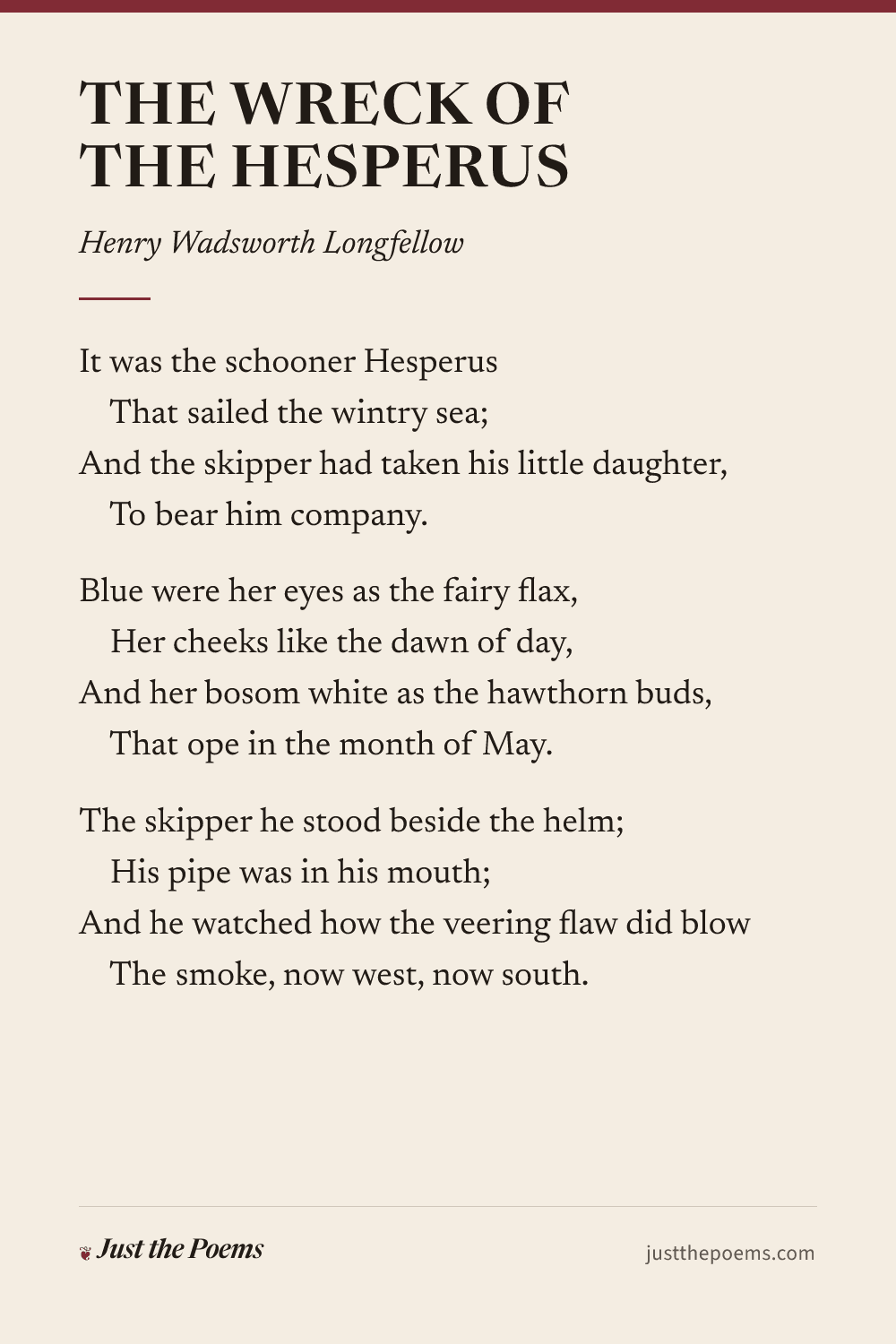
THE WRECK OF THE HESPERUS

Henry Wadsworth Longfellow

In 0 Wikipedias 1 anthology Poet in 71 Wikipedias

It was the schooner Hesperus That sailed the wintry sea;And the skipper had taken his little daughter, To bear him company.

Blue were her eyes as the fairy flax, Her cheeks like the dawn of day,And her bosom white as the hawthorn buds, That ope in the month of May.

The skipper he stood beside the helm; His pipe was in his mouth;And he watched how the veering flaw did blow The smoke, now west, now south.

Show all 88 lines 76 more

Then up and spake an old sailor, Had sailed the Spanish main:"I pray thee, put into yonder port, For I fear a hurricane.

"Last night the moon had a golden ring, And to-night no moon we see!"The skipper he blew a whiff from his pipe, And a scornful laugh laughed he.

Colder and louder blew the wind, A gale from the northeast;The snow fell hissing in the brine, And the billows frothed like yeast.

Down came the storm, and smote amain The vessel in its strength;She shuddered and paused like a frighted steed, Then leaped her cable's length.

"Come hither! come hither my little daughter, And do not tremble so;For I can weather the roughest gale That ever wind did blow."

He wrapped her warm in his seaman's coat Against the stinging blast;He cut a rope from a broken spar, And bound her to the mast.

"O father! I hear the church-bells ring; Oh say, what may it be?""'T is a fog-bell on a rock-bound coast!" And he steered for the open sea.

"O father! I hear the sound of guns; Oh say, what may it be?""Some ship in distress, that cannot live In such an angry sea!"

"O father! I see a gleaming light! Oh say, what may it be?"But the father answered never a word-- A frozen corpse was he.

Lashed to the helm, all stiff and stark, With his face turned to the skies,The lantern gleamed through the gleaming snow On his fixed and glassy eyes.

Then the maiden clasped her hands and prayed That savèd she might be!And she thought of Christ, who stilled the wave On the Lake of Galilee.

And fast through the midnight dark and drear, Through the whistling sleet and snow,Like a sheeted ghost, the vessel swept Towards the reef of Norman's Woe.

And ever, the fitful gusts between, A sound came from the land;It was the sound of the trampling surf On the rocks and the hard sea-sand.

The breakers were right beneath her bows; She drifted a dreary wreck;And a whooping billow swept the crew, Like icicles, from her deck.

She struck where the white and fleecy waves Looked soft as carded wool;But the cruel rocks they gored her side Like the horns of an angry bull.

Her rattling shrouds, all sheathed in ice, With the mast went by the board;Like a vessel of glass, she stove and sank-- Ho! ho! the breakers roared!

At daybreak, on the bleak sea-beach, A fisherman stood aghast,To see the form of a maiden fair, Lashed close to a drifting mast.

The salt sea was frozen on her breast, The salt tears in her eyes;And he saw her hair, like the brown sea-weed, On the billows fall and rise.

Such was the wreck of the Hesperus, In the midnight and the snow;Christ save us all from a death like this, On the reef of Norman's Woe!

Source

The World's Best Poetry, Vol. IX, ed. Bliss Carman, 1904

Filed under
  • Library subject “Indians of North America -- Poetry”, The Song of Hiawatha: An Epic Poem

AMERICA

James Russell Lowell

In 0 Wikipedias 1 anthology Poet in 31 Wikipedias

There are truths you Americans need to be told,And it never'll refute them to swagger and scold;John Bull, looking o'er the Atlantic, in choler,At your aptness for trade, says you worship the dollar;But to scorn i-dollar-try's what very few do,And John goes to that church as often as you do.No matter what John says, don't try to outcrow him,'Tis enough to go quietly on and outgrow him;Like most fathers, Bull hates to see Number OneDisplacing himself in the mind of his son,And detests the same faults in himself he'd neglectedWhen he sees them again in his child's glass reflected;

Show all 36 lines 24 more

To love one another you're too like by half,If he is a bull, you're a pretty stout calf,And tear your own pasture for naught but to showWhat a nice pair of horns you're beginning to grow.

There are one or two things I should just like to hint,For you don't often get the truth told you in print;The most of you (this is what strikes all beholders)Have a mental and physical stoop in the shoulders;Though you ought to be free as the winds and the waves,You've the gait and the manner of runaway slaves;Though you brag of your New World, you don't half believe in it;And as much of the Old as is possible weave in it;Your goddess of freedom, a tight, buxom girl,With lips like a cherry and teeth like a pearl,With eyes bold as Herë's, and hair floating free,And full of the sun as the spray of the sea,Who can sing at a husking or romp at a shearing,Who can trip through the forests alone without fearing,Who can drive home the cows with a song through the grass,Keeps glancing aside into Europe's cracked glass,Hides her red hands in gloves, pinches up her lithe waist,And makes herself wretched with transmarine taste;She loses her fresh country charm when she takesAny mirror except her own rivers and lakes.

Source

The World's Best Poetry, Vol. IX, ed. Bliss Carman, 1904

Filed under
  • Named in the title

Advertisements

AMERICA TO GREAT BRITAIN

Washington Allston

In 0 Wikipedias 1 anthology Poet in 29 Wikipedias

All hail; thou noble land, Our Fathers' native soil! O, stretch thy mighty hand, Gigantic grown by toil,O'er the vast Atlantic wave to our shore! For thou with magic might Canst reach to where the light Of Phoebus travels bright The world o'er!

The genius of our clime From his pine-embattled steep Shall hail the guest sublime;

Show all 45 lines 33 more

While the Tritons of the deepWith their conchs the kindred league shall proclaim. Then let the world combine,-- O'er the main our naval line Like the Milky Way shall shine Bright in flame!

Though ages long have passed Since our Fathers left their home, Their pilot in the blast, O'er untravelled seas to roam,Yet lives the blood of England in our veins! And shall we not proclaim That blood of honest fame Which no tyranny can tame By its chains?

While the language free and bold Which the Bard of Avon sung, In which our Milton told How the vault of heaven rungWhen Satan, blasted, fell with his host; While this, with reverence meet, Ten thousand echoes greet, From rock to rock repeat Round our coast;

While the manners, while the arts, That mould a nation's soul, Still cling around our hearts,-- Between let Ocean roll,Our joint communion breaking with the sun: Yet still from either beach The voice of blood shall reach, More audible than speech, "We are One."

Source

The World's Best Poetry, Vol. VIII, ed. Bliss Carman, 1904

Filed under
  • Named in the title

AMERICA

William Cullen Bryant

In 0 Wikipedias 1 anthology Poet in 28 Wikipedias

O mother of a mighty race,Yet lovely in thy youthful grace!The elder dames, thy haughty peers,Admire and hate thy blooming years; With words of shameAnd taunts of scorn they join thy name.

For on thy cheeks the glow is spreadThat tints thy morning hills with red;Thy step,--the wild deer's rustling feetWithin thy woods are not more fleet; Thy hopeful eyeIs bright as thine own sunny sky.

Show all 48 lines 36 more

Ay, let them rail, those haughty ones,While safe thou dwellest with thy sons.They do not know how loved thou art,How many a fond and fearless heart Would rise to throwIts life between thee and the foe.

They know not, in their hate and pride,What virtues with thy children bide,--How true, how good, thy graceful maidsMake bright, like flowers, the valley shades; What generous menSpring, like thine oaks, by hill and glen;

What cordial welcomes greet the guestBy thy lone rivers of the west;How faith is kept, and truth revered,And man is loved, and God is feared, In woodland homes,And where the ocean border foams.

There's freedom at thy gates, and restFor earth's down-trodden and opprest,A shelter for the hunted head,For the starved laborer toil and bread. Power, at thy bounds,Stops, and calls back his baffled hounds.

O fair young mother! on thy browShall sit a nobler grace than now.Deep in the brightness of thy skies,The thronging years in glory rise, And, as they fleet,Drop strength and riches at thy feet.

Thine eye, with every coming hour,Shall brighten, and thy form shall tower;And when thy sisters, elder born,Would brand thy name with words of scorn, Before thine eyeUpon their lips the taunt shall die.

Source

The World's Best Poetry, Vol. VIII, ed. Bliss Carman, 1904

Filed under
  • Named in the title

THE SONG MY PADDLE SINGS

E. Pauline Johnson

In 0 Wikipedias 1 anthology Poet in 18 Wikipedias

West wind, blow from your prairie nest,Blow from the mountains, blow from the west.The sail is idle, the sailor too;O wind of the west, we wait for you!Blow, blow!I have wooed you so,But never a favor you bestow.You rock your cradle the hills between,But scorn to notice my white lateen.

I stow the sail and unship the mast:I wooed you long, but my wooing's past;My paddle will lull you into rest:

Show all 33 lines 21 more

O drowsy wind of the drowsy west,Sleep, sleep!By your mountains steep,Or down where the prairie grasses sweep,Now fold in slumber your laggard wings,For soft is the song my paddle sings.

Be strong, O paddle! be brave, canoe!The reckless waves you must plunge into.Reel, reel,On your trembling keel,But never a fear my craft will feel.

We've raced the rapids; we're far ahead:The river slips through its silent bed.Sway, sway,As the bubbles sprayAnd fall in tinkling tunes away.

And up on the hills against the sky,A fir tree rocking its lullabySwings, swings,Its emerald wings,Swelling the song that my paddle sings.

Source

The Home Book of Verse, ed. Burton Egbert Stevenson

Filed under
  • Library subject “Indians of North America -- Canada -- Poetry”, The White Wampum

ENGLAND TO AMERICA

Sydney Dobell

In 0 Wikipedias 1 anthology Poet in 6 Wikipedias

Nor force nor fraud shall sunder us! O ye Who north or south, or east or western land, Native to noble sounds, say truth for truth,Freedom for freedom, love for love, and God For God; O ye who in eternal youth Speak with a living and creative flood This universal English, and do stand Its breathing book; live worthy of that grand Heroic utterance--parted, yet a whole, Far, yet unsevered,--children brave and free Of the great Mother tongue, and ye shall be Lords of an empire wide as Shakespeare's soul, Sublime as Milton's immemorial theme,And rich as Chaucer's speech, and fair as Spenser's dream.

Source

The World's Best Poetry, Vol. VIII, ed. Bliss Carman, 1904

Filed under
  • Named in the title

AN APPEAL TO AMERICA ON BEHALF OF THE BELGIAN DESTITUTE

Thomas Hardy

In 0 Wikipedias 0 anthologies Poet in 91 Wikipedias

SEVEN millions stand Emaciate, in that ancient Delta-land:— We here, full-charged with our own maimed and dead, And coiled in throbbing conflicts slow and sore, Can poorly soothe these ails unmerited Of souls forlorn upon the facing shore!— Where naked, gaunt, in endless band on band Seven millions stand.

No man can say To your great country that, with scant delay, You must, perforce, ease them in their loud need: We know that nearer first your duty lies; But—is it much to ask that you let plead Your lovingkindness with you—wooing-wise— Albeit that aught you owe, and must repay, No man can say?

December 1914.

Source

Moments of Vision and Miscellaneous Verses, 1929

Filed under
  • Named in the title

Advertisements

Hiawatha’s Childhood

Henry Wadsworth Longfellow

In 0 Wikipedias 0 anthologies Poet in 71 Wikipedias

Downward through the evening twilight,In the days that are forgotten,In the unremembered ages,From the full moon fell Nokomis,Fell the beautiful Nokomis,She a wife, but not a mother.

She was sporting with her women,Swinging in a swing of grape-vines,When her rival the rejected,Full of jealousy and hatred,Cut the leafy swing asunder,Cut in twain the twisted grape-vines,

Show all 235 lines 223 more

And Nokomis fell affrightedDownward through the evening twilight,On the Muskoday, the meadow,On the prairie full of blossoms.“See! a star falls!” said the people;“From the sky a star is falling!”

There among the ferns and mosses,There among the prairie lilies,On the Muskoday, the meadow,In the moonlight and the starlight,Fair Nokomis bore a daughter.And she called her name Wenonah,As the first-born of her daughters.And the daughter of NokomisGrew up like the prairie lilies,Grew a tall and slender maiden,With the beauty of the moonlight,With the beauty of the starlight.

And Nokomis warned her often,Saying oft, and oft repeating,“Oh, beware of Mudjekeewis,Of the West-Wind, Mudjekeewis;Listen not to what he tells you;Lie not down upon the meadow,Stoop not down among the lilies,Lest the West-Wind come and harm you!”

But she heeded not the warning,Heeded not those words of wisdom,And the West-Wind came at evening,Walking lightly o’er the prairie,Whispering to the leaves and blossoms,Bending low the flowers and grasses,Found the beautiful Wenonah,Lying there among the lilies,Wooed her with his words of sweetness,Wooed her with his soft caresses,Till she bore a son in sorrow,Bore a son of love and sorrow.

Thus was born my Hiawatha,Thus was born the child of wonder;But the daughter of Nokomis,Hiawatha’s gentle mother,In her anguish died desertedBy the West-Wind, false and faithless,By the heartless Mudjekeewis.

For her daughter long and loudlyWailed and wept the sad Nokomis;“Oh that I were dead!” she murmured,“Oh that I were dead, as thou art!No more work, and no more weeping,Wahonowin! Wahonowin!”

By the shores of Gitche Gumee,By the shining Big-Sea-Water,Stood the wigwam of Nokomis,Daughter of the Moon, Nokomis.Dark behind it rose the forest,Rose the black and gloomy pine-trees,Rose the firs with cones upon them;Bright before it beat the water,Beat the clear and sunny water,Beat the shining Big-Sea-Water.

There the wrinkled old NokomisNursed the little Hiawatha,Rocked him in his linden cradle,Bedded soft in moss and rushes,Safely bound with reindeer sinews;Stilled his fretful wail by saying,“Hush! the Naked Bear will hear thee!”Lulled him into slumber, singing,“Ewa-yea! my little owlet!Who is this, that lights the wigwam?With his great eyes lights the wigwam?Ewa-yea! my little owlet!”

Many things Nokomis taught himOf the stars that shine in heaven;Showed him Ishkoodah, the comet,Ishkoodah, with fiery tresses;Showed the Death-Dance of the spirits,Warriors with their plumes and war-clubs,Flaring far away to northwardIn the frosty nights of Winter;Showed the broad white road in heaven,Pathway of the ghosts, the shadows,Running straight across the heavens,Crowded with the ghosts, the shadows.

At the door on summer eveningsSat the little Hiawatha;Heard the whispering of the pine-trees,Heard the lapping of the waters,Sounds of music, words of wonder;“Minne-wawa!” said the Pine-trees,“Mudway-aushka!” said the water.

Saw the fire-fly, Wah-wah-taysee,Flitting through the dusk of evening,With the twinkle of its candleLighting up the brakes and bushes,And he sang the song of children,Sang the song Nokomis taught him:“Wah-wah-taysee, little fire-fly,Little, flitting, white-fire insect,Little, dancing, white-fire creature,Light me with your little candle,Ere upon my bed I lay me,Ere in sleep I close my eyelids!”

Saw the moon rise from the waterRippling, rounding from the water,Saw the flecks and shadows on it,Whispered, “What is that, Nokomis?”And the good Nokomis answered:“Once a warrior, very angry,Seized his grandmother, and threw herUp into the sky at midnight;Right against the moon he threw her;’T is her body that you see there.”

Saw the rainbow in the heaven,In the eastern sky, the rainbow,Whispered, “What is that, Nokomis?”And the good Nokomis answered:“’T is the heaven of flowers you see there;All the wild-flowers of the forest,All the lilies of the prairie,When on earth they fade and perish,Blossom in that heaven above us.”

When he heard the owls at midnight,Hooting, laughing in the forest,“What is that?” he cried in terror,“What is that,” he said, “Nokomis?”And the good Nokomis answered:“That is but the owl and owlet,Talking in their native language,Talking, scolding at each other.”

Then the little HiawathaLearned of every bird its language,Learned their names and all their secrets,How they built their nests in Summer,Where they hid themselves in Winter,Talked with them whene’er he met them,Called them “Hiawatha’s Chickens.”

Of all beasts he learned the language,Learned their names and all their secrets,How the beavers built their lodges,Where the squirrels hid their acorns,How the reindeer ran so swiftly,Why the rabbit was so timid,Talked with them whene’er he met them,Called them “Hiawatha’s Brothers.”

Then Iagoo, the great boaster,He the marvellous story-teller,He the traveller and the talker,He the friend of old Nokomis,Made a bow for Hiawatha;From a branch of ash he made it,From an oak-bough made the arrows,Tipped with flint, and winged with feathers,And the cord he made of deer-skin.

Then he said to Hiawatha:“Go, my son, into the forest,Where the red deer herd together,Kill for us a famous roebuck,Kill for us a deer with antlers!”

Forth into the forest straightwayAll alone walked HiawathaProudly, with his bow and arrows;And the birds sang round him, o’er him,“Do not shoot us, Hiawatha!”Sang the robin, the Opechee,Sang the bluebird, the Owaissa,“Do not shoot us, Hiawatha!”

Up the oak-tree, close beside him,Sprang the squirrel, Adjidaumo,In and out among the branches,Coughed and chattered from the oak-tree,Laughed, and said between his laughing,“Do not shoot me, Hiawatha!”

And the rabbit from his pathwayLeaped aside, and at a distanceSat erect upon his haunches,Half in fear and half in frolic,Saying to the little hunter,“Do not shoot me, Hiawatha!”

But he heeded not, nor heard them,For his thoughts were with the red deer;On their tracks his eyes were fastened,Leading downward to the river,To the ford across the river,And as one in slumber walked he.

Hidden in the alder-bushes,There he waited till the deer came,Till he saw two antlers lifted,Saw two eyes look from the thicket,Saw two nostrils point to windward,And a deer came down the pathway,Flecked with leafy light and shadow.And his heart within him fluttered,Trembled like the leaves above him,Like the birch-leaf palpitated,As the deer came down the pathway.

Then, upon one knee uprising,Hiawatha aimed an arrow;Scarce a twig moved with his motion,Scarce a leaf was stirred or rustled,But the wary roebuck started,Stamped with all his hoofs together,Listened with one foot uplifted,Leaped as if to meet the arrow;Ah! the singing, fatal arrow,Like a wasp it buzzed and stung him!

Dead he lay there in the forest,By the ford across the river;Beat his timid heart no longer,But the heart of HiawathaThrobbed and shouted and exulted,As he bore the red deer homeward,And Iagoo and NokomisHailed his coming with applauses.

From the red deer’s hide NokomisMade a cloak for Hiawatha,From the red deer’s flesh NokomisMade a banquet to his honor.All the village came and feasted,All the guests praised Hiawatha,Called him Strong-Heart, Soan-ge-taha!Called him Loon-Heart, Mahn-go-taysee!

Source

The Song of Hiawatha

Filed under
  • Library subject “Indians of North America -- Poetry”, The Song of Hiawatha
  • Library subject “Indians of North America -- Poetry”, The Song of Hiawatha: An Epic Poem

Hiawatha’s Departure

Henry Wadsworth Longfellow

In 0 Wikipedias 0 anthologies Poet in 71 Wikipedias

By the shore of Gitche Gumee,By the shining Big-Sea-Water,At the doorway of his wigwam,In the pleasant Summer morning,Hiawatha stood and waited.All the air was full of freshness,All the earth was bright and joyous,And before him, through the sunshine,Westward toward the neighboring forestPassed in golden swarms the Ahmo,Passed the bees, the honey-makers,Burning, singing in the sunshine.

Show all 247 lines 235 more

Bright above him shone the heavens,Level spread the lake before him;From its bosom leaped the sturgeon,Sparkling, flashing in the sunshine;On its margin the great forestStood reflected in the water,Every tree-top had its shadow,Motionless beneath the water.

From the brow of HiawathaGone was every trace of sorrow,As the fog from off the water,As the mist from off the meadow.With a smile of joy and triumph,With a look of exultation,As of one who in a visionSees what is to be, but is not,Stood and waited Hiawatha.

Toward the sun his hands were lifted,Both the palms spread out against it,And between the parted fingersFell the sunshine on his features,Flecked with light his naked shoulders,As it falls and flecks an oak-treeThrough the rifted leaves and branches.

O’er the water floating, flying,Something in the hazy distance,Something in the mists of morning,Loomed and lifted from the water,Now seemed floating, now seemed flying,Coming nearer, nearer, nearer.

Was it Shingebis the diver?Or the pelican, the Shada?Or the heron, the Shuh-shuh-gah?Or the white goose, Waw-be-wawa,With the water dripping, flashing,From its glossy neck and feathers?

It was neither goose nor diver,Neither pelican nor heron,O’er the water floating, flying,Through the shining mist of morning,But a birch canoe with paddles,Rising, sinking on the water,Dripping, flashing in the sunshine;And within it came a peopleFrom the distant land of Wabun,From the farthest realms of morningCame the Black-Robe chief, the Prophet,He the Priest of Prayer, the Pale-face,With his guides and his companions.

And the noble Hiawatha,With his hands aloft extended,Held aloft in sign of welcome,Waited, full of exultation,Till the birch canoe with paddlesGrated on the shining pebbles,Stranded on the sandy margin,Till the Black-Robe chief, the Pale-face,With the cross upon his bosom,Landed on the sandy margin.

Then the joyous HiawathaCried aloud and spake in this wise:“Beautiful is the sun, O strangers,When you come so far to see us!All our town in peace awaits you,All our doors stand open for you;You shall enter all our wigwams,For the heart’s right hand we give you.

“Never bloomed the earth so gayly,Never shone the sun so brightly,As to-day they shine and blossomWhen you come so far to see us!Never was our lake so tranquil,Nor so free from rocks, and sand-bars;For your birch canoe in passingHas removed both rock and sand-bar.“Never before had our tobaccoSuch a sweet and pleasant flavor,Never the broad leaves of our cornfieldsWere so beautiful to look on,As they seem to us this morning,When you come so far to see us!’

And the Black-Robe chief made answer,Stammered in his speech a little,Speaking words yet unfamiliar:“Peace be with you, Hiawatha,Peace be with you and your people,Peace of prayer, and peace of pardon,Peace of Christ, and joy of Mary!”

Then the generous HiawathaLed the strangers to his wigwam,Seated them on skins of bison,Seated them on skins of ermine,And the careful old NokomisBrought them food in bowls of basswood,Water brought in birchen dippers,And the calumet, the peace-pipe,Filled and lighted for their smoking.

All the old men of the village,All the warriors of the nation,All the Jossakeeds, the Prophets,The magicians, the Wabenos,And the Medicine-men, the Medas,Came to bid the strangers welcome;“It is well”, they said, “O brothers,That you come so far to see us!”

In a circle round the doorway,With their pipes they sat in silence,Waiting to behold the strangers,Waiting to receive their message;Till the Black-Robe chief, the Pale-face,From the wigwam came to greet them,Stammering in his speech a little,Speaking words yet unfamiliar;“It is well,” they said, “O brother,That you come so far to see us!”

Then the Black-Robe chief, the Prophet,Told his message to the people,Told the purport of his mission,Told them of the Virgin Mary,And her blessed Son, the Saviour,How in distant lands and agesHe had lived on earth as we do;How he fasted, prayed, and labored;How the Jews, the tribe accursed,Mocked him, scourged him, crucified him;How he rose from where they laid him,Walked again with his disciples,And ascended into heaven.

And the chiefs made answer, saying:“We have listened to your message,We have heard your words of wisdom,We will think on what you tell us.It is well for us, O brothers,That you come so far to see us!”

Then they rose up and departedEach one homeward to his wigwam,To the young men and the womenTold the story of the strangersWhom the Master of Life had sent themFrom the shining land of Wabun.

Heavy with the heat and silenceGrew the afternoon of Summer;With a drowsy sound the forestWhispered round the sultry wigwam,With a sound of sleep the waterRippled on the beach below it;From the cornfields shrill and ceaselessSang the grasshopper, Pah-puk-keena;And the guests of Hiawatha,Weary with the heat of Summer,Slumbered in the sultry wigwam.

Slowly o’er the simmering landscapeFell the evening’s dusk and coolness,And the long and level sunbeamsShot their spears into the forest,Breaking through its shields of shadow,Rushed into each secret ambush,Searched each thicket, dingle, hollow;Still the guests of HiawathaSlumbered in the silent wigwam.

From his place rose Hiawatha,Bade farewell to old Nokomis,Spake in whispers, spake in this wise,Did not wake the guests, that slumbered.

“I am going, O Nokomis,On a long and distant journey,To the portals of the Sunset.To the regions of the home-wind,Of the Northwest-Wind, Keewaydin.But these guests I leave behind me,In your watch and ward I leave them;See that never harm comes near them,See that never fear molests them,Never danger nor suspicion,Never want of food or shelter,In the lodge of Hiawatha!”

Forth into the village went he,Bade farewell to all the warriors,Bade farewell to all the young men,Spake persuading, spake in this wise:

“I am going, O my people,On a long and distant journey;Many moons and many wintersWill have come, and will have vanished,Ere I come again to see you.But my guests I leave behind me;Listen to their words of wisdom,Listen to the truth they tell you,For the Master of Life has sent themFrom the land of light and morning!”

On the shore stood Hiawatha,Turned and waved his hand at parting;On the clear and luminous waterLaunched his birch canoe for sailing,From the pebbles of the marginShoved it forth into the water;Whispered to it, “Westward! westward!”And with speed it darted forward.

And the evening sun descendingSet the clouds on fire with redness,Burned the broad sky, like a prairie,Left upon the level waterOne long track and trail of splendor,Down whose stream, as down a river,Westward, westward HiawathaSailed into the fiery sunset,Sailed into the purple vapors,Sailed into the dusk of evening:

And the people from the marginWatched him floating, rising, sinking,Till the birch canoe seemed liftedHigh into that sea of splendor,Till it sank into the vaporsLike the new moon slowly, slowlySinking in the purple distance.

And they said, “Farewell forever!”Said, “Farewell, O Hiawatha!”And the forests, dark and lonely,Moved through all their depths of darkness,Sighed, “Farewell, O Hiawatha!”And the waves upon the marginRising, rippling on the pebbles,Sobbed, “Farewell, O Hiawatha!”And the heron, the Shuh-shuh-gah,From her haunts among the fen-lands,Screamed, “Farewell, O Hiawatha!”

Thus departed Hiawatha,Hiawatha the Beloved,In the glory of the sunset,In the purple mists of evening,To the regions of the home-wind,Of the Northwest-Wind, Keewaydin,To the Islands of the Blessed,To the Kingdom of Ponemah,To the Land of the Hereafter!
Source

The Song of Hiawatha

Filed under
  • Library subject “Indians of North America -- Poetry”, The Song of Hiawatha
  • Library subject “Indians of North America -- Poetry”, The Song of Hiawatha: An Epic Poem

The White Man’s Foot

Henry Wadsworth Longfellow

In 0 Wikipedias 0 anthologies Poet in 71 Wikipedias

In his lodge beside a river,Close beside a frozen river,Sat an old man, sad and lonely.White his hair was as a snow-drift;Dull and low his fire was burning,And the old man shook and trembled,Folded in his Waubewyon,In his tattered white-skin-wrapper,Hearing nothing but the tempestAs it roared along the forest,Seeing nothing but the snow-storm,As it whirled and hissed and drifted.

Show all 230 lines 218 more

All the coals were white with ashes,And the fire was slowly dying,As a young man, walking lightly,At the open doorway entered.Red with blood of youth his cheeks were,Soft his eyes, as stars in Spring-time,Bound his forehead was with grasses;Bound and plumed with scented grasses,On his lips a smile of beauty,Filling all the lodge with sunshine,In his hand a bunch of blossomsFilling all the lodge with sweetness.

“Ah, my son!” exclaimed the old man,“Happy are my eyes to see you.Sit here on the mat beside me,Sit here by the dying embers,Let us pass the night together,Tell me of your strange adventures,Of the lands where you have travelled;I will tell you of my prowess,Of my many deeds of wonder.”

From his pouch he drew his peace-pipe,Very old and strangely fashioned;Made of red stone was the pipe-head,And the stem a reed with feathers;Filled the pipe with bark of willow,Placed a burning coal upon it,Gave it to his guest, the stranger,And began to speak in this wise:“When I blow my breath about me,When I breathe upon the landscape,Motionless are all the rivers,Hard as stone becomes the water!”

And the young man answered, smiling:“When I blow my breath about me,When I breathe upon the landscape,Flowers spring up o’er all the meadows,Singing, onward rush the rivers!”

“When I shake my hoary tresses,”Said the old man darkly frowning,“All the land with snow is covered;All the leaves from all the branchesFall and fade and die and wither,For I breathe, and lo! they are not.From the waters and the marshes,Rise the wild goose and the heron,Fly away to distant regions,For I speak, and lo! they are not.And where’er my footsteps wander,All the wild beasts of the forestHide themselves in holes and caverns,And the earth becomes as flintstone!”

“When I shake my flowing ringlets,”Said the young man, softly laughing,“Showers of rain fall warm and welcome,Plants lift up their heads rejoicing,Back unto their lakes and marshesCome the wild goose and the heron,Homeward shoots the arrowy swallow,Sing the bluebird and the robin,And where’er my footsteps wander,All the meadows wave with blossoms,All the woodlands ring with music,All the trees are dark with foliage!”

While they spake, the night departed:From the distant realms of Wabun,From his shining lodge of silver,Like a warrior robed and painted,Came the sun, and said, “Behold meGheezis, the great sun, behold me!”

Then the old man’s tongue was speechlessAnd the air grew warm and pleasant,And upon the wigwam sweetlySang the bluebird and the robin,And the stream began to murmur,And a scent of growing grassesThrough the lodge was gently wafted.

And Segwun, the youthful stranger,More distinctly in the daylightSaw the icy face before him;It was Peboan, the Winter!

From his eyes the tears were flowing,As from melting lakes the streamlets,And his body shrunk and dwindledAs the shouting sun ascended,Till into the air it faded,Till into the ground it vanished,And the young man saw before him,On the hearth-stone of the wigwam,Where the fire had smoked and smouldered,Saw the earliest flower of Spring-time,Saw the Beauty of the Spring-time,Saw the Miskodeed in blossom.

Thus it was that in the North-landAfter that unheard-of coldness,That intolerable Winter,Came the Spring with all its splendor,All its birds and all its blossoms,All its flowers and leaves and grasses.

Sailing on the wind to northward,Flying in great flocks, like arrows,Like huge arrows shot through heaven,Passed the swan, the Mahnahbezee,Speaking almost as a man speaks;And in long lines waving, bendingLike a bow-string snapped asunder,Came the white goose, Waw-be-wawa;And in pairs, or singly flying,Mahng the loon, with clangorous pinions,The blue heron, the Shuh-shuh-gah,And the grouse, the Mushkodasa.

In the thickets and the meadowsPiped the bluebird, the Owaissa,On the summit of the lodgesSang the robin, the Opechee,In the covert of the pine-treesCooed the pigeon, the Omemee;And the sorrowing Hiawatha,Speechless in his infinite sorrow,Heard their voices calling to him,Went forth from his gloomy doorway,Stood and gazed into the heaven,Gazed upon the earth and waters.

From his wanderings far to eastward,From the regions of the morning,From the shining land of Wabun,Homeward now returned Iagoo,The great traveller, the great boaster,Full of new and strange adventures,Marvels many and many wonders.

And the people of the villageListened to him as he told themOf his marvellous adventures,Laughing answered him in this wise:“Ugh! it is indeed Iagoo!No one else beholds such wonders!”

He had seen, he said, a waterBigger than the Big-Sea-Water,Broader than the Gitche Gumee,Bitter so that none could drink it!At each other looked the warriors,Looked the women at each other,Smiled, and said, “It cannot be so!”Kaw!” they said, “it cannot be so!”

O’er it, said he, o’er this waterCame a great canoe with pinions,A canoe with wings came flying,Bigger than a grove of pine-trees,Taller than the tallest tree-tops!And the old men and the womenLooked and tittered at each other;“Kaw!” they said, “we don’t believe it!”

From its mouth, he said, to greet him,Came Waywassimo, the lightning,Came the thunder, Annemeekee!And the warriors and the womenLaughed aloud at poor Iagoo;“Kaw!” they said, “what tales you tell us!”

In it, said he, came a people,In the great canoe with pinionsCame, he said, a hundred warriors;Painted white were all their facesAnd with hair their chins were covered!And the warriors and the womenLaughed and shouted in derision,Like the ravens on the tree-tops,Like the crows upon the hemlocks.“Kaw!” they said, “what lies you tell us!Do not think that we believe them!”

Only Hiawatha laughed not,But he gravely spake and answeredTo their jeering and their jesting:“True is all Iagoo tells us;I have seen it in a vision,Seen the great canoe with pinions,Seen the people with white faces,Seen the coming of this beardedPeople of the wooden vesselFrom the regions of the morning,From the shining land of Wabun.

“Gitche Manito, the Mighty,The Great Spirit, the Creator,Sends them hither on his errand.Sends them to us with his message.Wheresoe’er they move, before themSwarms the stinging fly, the Ahmo,Swarms the bee, the honey-maker;Wheresoe’er they tread, beneath themSprings a flower unknown among us,Springs the White-man’s Foot in blossom.

“Let us welcome, then, the strangers,Hail them as our friends and brothers,And the heart’s right hand of friendshipGive them when they come to see us.Gitche Manito, the Mighty,Said this to me in my vision.

“I beheld, too, in that visionAll the secrets of the future,Of the distant days that shall be.I beheld the westward marchesOf the unknown, crowded nations.All the land was full of people,Restless, struggling, toiling, striving,Speaking many tongues, yet feelingBut one heart-beat in their bosoms.In the woodlands rang their axes,Smoked their towns in all the valleys,Over all the lakes and riversRushed their great canoes of thunder.

“Then a darker, drearier visionPassed before me, vague and cloud-like;I beheld our nation scattered,All forgetful of my counsels,Weakened, warring with each other:Saw the remnants of our peopleSweeping westward, wild and woful,Like the cloud-rack of a tempest,Like the withered leaves of Autumn!”

Source

The Song of Hiawatha

Filed under
  • Library subject “Indians of North America -- Poetry”, The Song of Hiawatha
  • Library subject “Indians of North America -- Poetry”, The Song of Hiawatha: An Epic Poem

A LOCK OF HAIR

Hartley Burr Alexander

In 0 Wikipedias 0 anthologies Poet in 4 Wikipedias

It is only crying about myself that comes to me in song,It is only tears....

When the young men go by, happy,When the young girls go by, happy,I seem to see someone with them....

How lifelike is a lock of hair when all the body is decayed!

Source

God's drum, and other cycles from Indian lore, 1927

Filed under
  • Library subject “Indians of North America -- Poetry”, God's drum, and other cycles from Indian lore

BIRDS AND FROGS

Hartley Burr Alexander

In 0 Wikipedias 0 anthologies Poet in 4 Wikipedias

The birds that sing in the morning,Them I can understand:They call to one another proudly;Proudly they descant their songs;Proudly they look about, eager for response.

But the frogs that sing when it is evening;I cannot understand them:They sing all at once, each one attentive to himself;They stop all at once, none gives an answer;The frogs have voices, they have not ears.

Some men are like the birds;Some women are like the frogs.

Source

God's drum, and other cycles from Indian lore, 1927

Filed under
  • Library subject “Indians of North America -- Poetry”, God's drum, and other cycles from Indian lore

Advertisements

DAY AND NIGHT

Hartley Burr Alexander

In 0 Wikipedias 0 anthologies Poet in 4 Wikipedias

The Day is a blue Man with a burning heart;The bright clouds are his feather ornaments;The dark clouds are his spacious robes;The whole world is his rich possession,And the shining birds are the choirs that praise him:He is the Chieftain of all that live,And men call him ‘Father’....

The Night is a Woman with a changing heart,Which sometimes she reveals and sometimes she hides,And sometimes she sends palely, palely, after the Day;But her stars she keeps with her, always upon her bosom,For her stars are her little children that must be carried:Her stars are the spirits of all that die,And men call her ‘Mother’....

Source

God's drum, and other cycles from Indian lore, 1927

Filed under
  • Library subject “Indians of North America -- Poetry”, God's drum, and other cycles from Indian lore

DUST EDDIES

Hartley Burr Alexander

In 0 Wikipedias 0 anthologies Poet in 4 Wikipedias

Whirling dust-clouds dance on the prairies----Whirling the dust-clouds dance!

Her loosened hair swirls like a dust-cloud!Her lithe brown arms are tossing aloft!I see her white teeth flash as she smiles!

Ah, ah! I am a dust-cloud whirling!Ah, ah! I am a dancing warrior!I dance, dance, dance, on the prairies!

I dissolve....Into dust....

Source

God's drum, and other cycles from Indian lore, 1927

Filed under
  • Library subject “Indians of North America -- Poetry”, God's drum, and other cycles from Indian lore

EACH TIME I BEHOLD HER

Hartley Burr Alexander

In 0 Wikipedias 0 anthologies Poet in 4 Wikipedias

Each time I behold her again I am lost in wonder....Is her beauty but for a season, like that of the rose?Are we men but as the drunken butterflies?

A hundred comely women are in her eyes,Where she stands in the midst of life....She is the daughter of many tribes,She is the mother of many tribes....

Of what use to me are eyes?Ears only I need----For her voice I am listening.

Source

God's drum, and other cycles from Indian lore, 1927

Filed under
  • Library subject “Indians of North America -- Poetry”, God's drum, and other cycles from Indian lore

ESCHATOLOGY

Hartley Burr Alexander

In 0 Wikipedias 0 anthologies Poet in 4 Wikipedias

The Sick-Man-of-the-North,He lies upon a litter;There are four stars which are four Doctors who carry him;There are three stars which are three Doctors who follow singing;About the Star-which-Never-Moves they circle----So it has been,So it shall be, while the World lasts.

The Spirit-Star-of-the-South,He was not so high in the heavens when Life was created;His station was appointed him,It was lower in the heavens:He steals upward,He steals northward, as the World grows older.

The White-Pathway-of-Souls,It is like a bow laid athwart the night;The souls of the departed journey southward over it....

When the Doctors cease their singing,When the Spirit Star has reached a certain height, stealthily,Will not He-of-the-North journey as they have journeyed----Southward?

Then the Star-that-Never-Moves will be seen no more;Then men will be seen no more.

Source

God's drum, and other cycles from Indian lore, 1927

Filed under
  • Library subject “Indians of North America -- Poetry”, God's drum, and other cycles from Indian lore

FLOWER ALONE

Hartley Burr Alexander

In 0 Wikipedias 0 anthologies Poet in 4 Wikipedias

A Santa Clara woman In Sant’ Domingo town,Her rights were less than human That day at red sundown,----They made her less than dogs are made Within the stranger town.

Oh, she was wicked merry On Santa Clara street!Red-brown as a berry, Hale as ripened wheat;And he who came to woo her, He came on dancing feet.

Show all 78 lines 66 more

Round his raven locks a kerchief gay, His belt of the silver wrought,----From Sant’ Domingo all the way With none but her in thought:A braided scarf, a turquoise ring, These were the gifts he brought.

Why should she heed the old wives’ saw? “A bride should seek her bed“Within the pale of the village law “Wherein she hath been bred.”At old wives’ tales and old wives’ wails She shook a saucy head.

And so in Sant’ Domingo town She ground her daily corn;She drew her water at the well, And there her babe was born;And earthen pots she made to sell And quaintly did adorn.

A Santa Clara woman Within a stranger town,Its folk were more than human To hold her as their own:A saucy-head she had been bred, Should they not bring her down?

They mocked her for her outland ways, They jeered her kin and clan;They whispered evil of her days, They won away her man,----A saucy-head she had been bred, But, oh, her heart grew wan!

They babbled evil of her days And evil of her art;They mocked, they jeered, they came to gaze Where she bode with aching heart,----Where moody-eyed in her alien pride With her babe she sat apart.

A Santa Clara woman In Sant’ Domingo town,They made her less than human, And the hour was red sundownWhen from cut and gash of the plaited lash Crimson her blood ran down.

Crimson her blood as the setting sun, But never to blow or curseDid she open her lips till their work was done And they left her for better or worse,----Till they dragged her tied to a horse’s tail And left her for a corse.

She lay beside the beasts’ corral, Her body as the dead,And dimly she heard the tiny call Of her babe that would be fed,----Dimly she heard, and she did crawl To nurse it, while she bled.

A Santa Clara woman Within a stranger town;Her rights were less than human When redly the sun went down,----But the babe that was born of her body She nursed while the blood ran down.

With curious eyes I watched her at work Where she plied her potter’s artAnd creatures drew with cunning hand, Bright for the white man’s mart,----I wondered at the blood-red band Limned to each crimsoned heart.

Source

God's drum, and other cycles from Indian lore, 1927

Filed under
  • Library subject “Indians of North America -- Poetry”, God's drum, and other cycles from Indian lore

GOD’S DRUM

Hartley Burr Alexander

In 0 Wikipedias 0 anthologies Poet in 4 Wikipedias

The circle of the Earth is the head of a great drum;With the day, it moves upward--booming;With the night, it moves downward--booming;The day and the night are its song.

I am very small, as I dance upon the drum-head;I am like a particle of dust, as I dance upon the drum-head;Above me in the sky is the shining ball of the drum-stick.

I dance upward with the day;I dance downward with the night;Some day I shall dance afar into space like a particle of dust.

Who is the Drummer who beats upon the earth-drum?Who is the Drummer who makes me to dance his song?

Source

God's drum, and other cycles from Indian lore, 1927

Filed under
  • Library subject “Indians of North America -- Poetry”, God's drum, and other cycles from Indian lore

HER ROBE IS BROIDERED

Hartley Burr Alexander

In 0 Wikipedias 0 anthologies Poet in 4 Wikipedias

Her robe is broidered with white daisies;Her hair is braided with blue feathers;On her little feet are new moccasins.

Ah, she was near to me!Ah, she was dear to me!On her little feet are new moccasins.

The grass is broidered with white daisies;Bluebirds in the air are hovering low;Between earth and sky, the burial scaffold.On her little feet are new moccasins.

Source

God's drum, and other cycles from Indian lore, 1927

Filed under
  • Library subject “Indians of North America -- Poetry”, God's drum, and other cycles from Indian lore

I

Hartley Burr Alexander

In 0 Wikipedias 0 anthologies Poet in 4 Wikipedias

A valley with its ancient hills Deep-founded in earth’s adamantAnd crested dark with driven cloud, Like warrior’s trophies blown aslant:

With zenith-high a riven space, Whence royal from his azured zonesThe golden sun strikes sheer where lie The dead pueblo’s fallen stones:

A ruin upon the mesa top Above the scarred arroyo’s sands,Its ochres crimsoned by the glow, Mid rock-strewn solitudes it stands:

Show all 40 lines 28 more

Where citadelled as now with light Its ramparts stood a thousand years,The valley’s strong Acropolis Against the gathering murk of fears:

When Caesars held imperial sway Its dusky warriors manned their wall;Round council-fires its chieftains sate When Roland fell at Roncevalles:

What time the looms of Flanders wove, Its women spun their fleecy thread;They fashioned earthen burial jars While wailing mere mourned Arthur dead:

The dancers gathered to its feasts The while Columbus sailed the seas;At Coronado curious gazed Its children from their mothers’ knees:

And there where now is grass-grown nave, Walls summer-breached and winter-rent,To pray before a Christian saint Came many a dark-hued penitent:

But yesterday its people passed Into their silence and their night,Leaving their broken walls to glow Encrimsoned by the shafted light:

Leaving their valley’s purpled hills To gather glamours and to brood,Scornful of man and his phantom years, In vast and patient solitude.

Source

God's drum, and other cycles from Indian lore, 1927

Filed under
  • Library subject “Indians of North America -- Poetry”, God's drum, and other cycles from Indian lore

I

Hartley Burr Alexander

In 0 Wikipedias 0 anthologies Poet in 4 Wikipedias

A wild mother’s patterned fancy--white beads, green and blue,With here, like heart-stained arrows, scarlet zigzagged through,Thy lining furry rabbit, little shoe!

How joyously she wrought thee, the long blue sunny day,On the wind-stroked grass of the prairie, ’neath the willows’ shady sway,Singing the old song mothers sing alway:

Chaske, my little Chaske, Chaske my brave to be!Fleet shall he run as the stallion, stand tall as the tall pine tree,As the storm be mighty and valiant--Chaske, my chief to be!

Stringing the beads in patterns, zigzag red and blue;Sewing with thread of tendon the furry edges true;Singing the song of mothers the blue day through.

Source

God's drum, and other cycles from Indian lore, 1927

Filed under
  • Library subject “Indians of North America -- Poetry”, God's drum, and other cycles from Indian lore

I

Hartley Burr Alexander

In 0 Wikipedias 0 anthologies Poet in 4 Wikipedias

Four are the terraced Mountains that uphold the Heaven in that Land and Four are the Colors that pattern the Life of Man.

In that land where the stars of the night are ever near and burning, --eyes of spirit watchers through the Black pine forest; In that land where the azures of day are quivering and intense, --precious the blue turquoise in the womb of the treasure hill; In that land where the red-scarred mesas sunder and canyon the earth, --walls of jasper and sard ribboned with malachite; In that land whose corners are keyed by heaven-locking mountains,----

Glorieta, the Herald of Morn,

Show all 32 lines 20 more

Sandia, who purpleth the South, Jemez, the hearth-fire of Evening, And fourth, the Hills of the North,

The cloud-gloomed and crimson-flared Mountains of Bleeding Christ.... In that land doth the white cumulus froth unto the blue summit of Day, and the ochres and beryls of earth fade into violet Night; In that land do the terraced hills uphold the terracing clouds; In that land do the Weavers of Rain spin filaments many and delicate,

silvering horizons many, veiling with luminous veils, baptismal with blessing....

There also marcheth the Sun in the splendor of Beauty; There also wandereth the Moon in the softness of Beauty; There all the colors unite, patterned in Beauty; There all the cloud-forms assemble, vestured in Beauty; Daily in that land man walketh in Beauty; Nightly in that land man dreameth in Beauty.

Source

God's drum, and other cycles from Indian lore, 1927

Filed under
  • Library subject “Indians of North America -- Poetry”, God's drum, and other cycles from Indian lore

I AM RUNNING

Hartley Burr Alexander

In 0 Wikipedias 0 anthologies Poet in 4 Wikipedias

I am running a swift race:My body is painted with the symbols of swiftness;In my hair are the plumes of swift-flying birds;Tight-clasped, I hold in my hand a charm.

Who is he who is running beside me?His shadow is purple and very angry;His shadow is very swift;I dare not look about.

Something scarlet is bobbing before my eyes----Something which I should remember....Is it a beautiful flower?Or is it ... something which I should remember?

The goal is a gleaming mountain:Before I can touch itI must cross a dark canyon,I must cross the purple shadows of deep earth.

Source

God's drum, and other cycles from Indian lore, 1927

Filed under
  • Library subject “Indians of North America -- Poetry”, God's drum, and other cycles from Indian lore

II

Hartley Burr Alexander

In 0 Wikipedias 0 anthologies Poet in 4 Wikipedias

In the days of the Sires of the People Came the First-remembered of MenForth from the wombs of mothering Night,To seek their Sign and to find their Light,And to hew them homes mid the virgin loams, Then, as ever again.

Out of the mists of the past they marched, Children of Earth and of Sky,----The red-soil land was theirs to claim,The hill-born torrent their flood to tame,And avalanche-thrown was the quarry-stone For their houses builded high.

Show all 48 lines 36 more

They gathered them where the valleys smiled, They gathered them, tribe and clan,----They laid their walls through the sunny days;They broke their fields and they tilled their maize,And they sang them airs and chanted them prayers That come with the joy of man.

Till up from the glowing desert, And up from the wandering plain,The greased and painted warriors creptWith sudden whoop on them that slept----Like wolves in bands from the famished lands,---- And they left a bloody stain.

They ravaged the peaceful farmsteads, They shattered and scattered the folk,And they filled the land with a deathly spell,Where Apache stealth and Comanche yellAnd the treacherous blow of the Navaho Their nightly terrors woke.

Till the chieftains counselled in sorrow Mid the sound of women’s woe,And they swore to build them a fortress-keep,And to hold their lands, and to sow and reapWhere Sacred Earth had given them birth, Whatso might be their foe!

And they set the rocks of their citadel On the mesa’s granite crest,And their terraces rose till the barren spaceBecame a nation’s gathering place,And the red light shone from the stubborn stone Where the People dwelt at rest.

And a new Age dawned and their troubled Morn Passed into the splendid Day;And they sang from their roofs when their work was doneHigh-chanted hymns to the Fathering Sun;And their bows were strong and the arrow’s prong Kept the carrion tribes at bay.

Source

God's drum, and other cycles from Indian lore, 1927

Filed under
  • Library subject “Indians of North America -- Poetry”, God's drum, and other cycles from Indian lore

III

Hartley Burr Alexander

In 0 Wikipedias 0 anthologies Poet in 4 Wikipedias

There the Indian Man maketh him beads that are symbols of Earth’s Quarters and of the Place of Man’s Life, central in the World.

Behold, the Indian Man, where he drilleth and polisheth---- Where he maketh him beads of four significant colors, Talismans shapeth him, singing the Song of his Central Life!

White shell beads---- Are not the disks of Dawn faint-lustrous, as on the Eastern crests fall the earliest footfalls of Morning? Turquoise beads---- Broken are the shapes, irregular spaces of azure, where the white clouds part, to mottle and pattern the sky.... Talismans of crystal----

Show all 33 lines 21 more

Clear is the bubble of Day, zenith-high it is blown when all things are perfect!

So the Father and the Mother In their Night of Meditation First the lustre of the Dawn laid, Then the azure light of Morning, Touched them with translucent crystal, Touched, and lighted perfect Day!

Talismans of black stone---- Jet as the starless Night, as the cloud-enfolded Night.... Talismans of abalone---- Opalled as is Evening on the Western Sea, many-reflecting,---- These also shapeth he him, remembering....

For whither shall they pass, whose sun is in the West? And whither shall they pass, whose lodge is in the deep Earth? Theirs are the many reflections of the Sunset land! Theirs is the black unfathomed Night!

Behold, the Indian, where he sitteth beside his hearth, Making him beads of four significant colors; Singing the Song of his Central Life, Singing the Song of this Middle Place!

Source

God's drum, and other cycles from Indian lore, 1927

Filed under
  • Library subject “Indians of North America -- Poetry”, God's drum, and other cycles from Indian lore

III

Hartley Burr Alexander

In 0 Wikipedias 0 anthologies Poet in 4 Wikipedias

Time was kindly with this peopleIn the ancient Vale of Pecos,In their citadel enseatedHigh above the scarred arroyo,High upon the brunting mesa.

There within the storeyed housesBuilt about their dancing plaza,Walled against the foeman’s onslaught,Walled and towered and ever watchful,Safe and happy dwelt the people:

With their cornfields round about themIn the pleasant watered valleys,

Show all 88 lines 76 more

Fair with corn of many colorsSacred to the Guardian Mothers----White of Morn and blue of Zenith,Yellow for the burning Sunset,Speckled for the cloudy Northland:Earth and Sky have many colors,So the corn has colors manySacred to the Guardian Mothers:

With their cornfields and their beanfields,With their vines of squash and pumpkin,With their sunflowers and tobacco,Dwelt the olden folk of PecosRich and happy in their valley:

And the fires upon their hearth-stonesGlowed at dawn and glowed at twilight,And the wavering smoke ascendedQuiet into quiet heavens----Till the city seemed reflectedIn the vaporous blue of noonday,In the gleaming stars of night-time:

And the women at their grindingSang the Song of Fruitful Pollen;And the maidens at their spinningSang the Breath-song of the Cotton;And they wove their baskets singing,Singing modelled earthen vessels,Painted brown and black and yellowWith the symbols of the Cloud-Folk,Of the Mist-Folk and the Rain-Folk,And the sudden zig-zag Lightning----And they left the life-line brokenFor the spirit of the vesselThat it might not be imprisonedIn the moulded clay forever:

And the menfolk in the cornfieldsSang the Song of Winter Breaking,Sang the Springtime and the Seeding,Sang the Tasseling and Summer,Sang the Fruitfulness of Harvest,And the Life that stirs in all things:

And within their sacred Kivas,Where the Priests and Elders gatheredRound their Totems and their Altars,Underneath the painted symbolOf the Plumed and Crested Serpent,There they sang their Spirit AncientsAnd the deeds of mighty Heroes,Of the Brothers armed with sunbeamsWhere they slew the hateful monstersWhen the Primal People wanderedAnd the World was in its making:

And within the sacred KivasSaid the prayers their sires had taught them,That the tribe might live foreverFathered by the Shining Heaven,Mothered on Earth’s fruitful bosom,With the Winds forever breathingFourfold Life from out the QuartersOf the fourfold World man dwells in:

And the men and women gathered,And the young men and the maidens,And the children and the strangers,When above the Kivas flauntedBanners brilliant with bright feathersTelling of the coming feast-dayWith the dancing and the chantingAnd the altars set with prayer-plumes,Where the grave-faced Priests and EldersSmoked before the sacred emblemsOf the Powers that watched the nation:

In the ancient Vale of Pecos,In its days of peace and plenty,When the people lived securelyIn their citadel enseatedHigh above the scarred arroyo,High upon their granite mesa.

Source

God's drum, and other cycles from Indian lore, 1927

Filed under
  • Library subject “Indians of North America -- Poetry”, God's drum, and other cycles from Indian lore

IV

Hartley Burr Alexander

In 0 Wikipedias 0 anthologies Poet in 4 Wikipedias

Blessed is the martyr’s crown And valiant were they who woreIn Francis’ name the corded gown And to the heathen boreThe Cross of Christus crucified,With thorn-pressed brow and piercéd side And body wounded sore:

Like valiant soldiers they did come To preach their Gospel mildAnd find them sweetest martyrdom Within an heathen wild----St. Francis’ men, who turned to kiss

Show all 77 lines 65 more

The Crucifix, and met their bliss, And on their murderers smiled.

Bruit had come to the Pecos folk Of warrior-men from Heaven,Who strid strange beasts and in thunders spoke And armed them with red levin----Who bannered their hosts with new gods and dreadAnd shook the land with a terrible tread Where they searched for the Cities Seven:

And the Priests and the Elders wafted high The smoke of their questioning prayer,And they asked of Earth and they asked of the Sky And they asked of the Lords of the Air----And the signs breathed peace, and they were content,And unto the strangers their captains they sent With gifts and with covenants fair.

For why should they fear the stranger’s face When the Powers whom their sires had knownHad boded them well from the Sacred Place With its ancient divining stone?Why should men fear who through perilous pastBy their strong gods warded were mighty at last Into a nation grown?

So with flute and with drum and with gala cheer Forth they thronged them to greetThe steeled and glittering Cavalier And the Friar with way-worn feet----And the men of Spain found pleasant rest,And the ovens glowed, and each grateful guest Warm-scented the odors sweet:

Oh, the men of Spain in Pecos town Were welcomed with joyous array,Whose folk little dreamed as the dusk closed down That their Sun had ended that day----That an Age of the Red Man’s World was past,And down from their altars his gods were cast To silently vanish away!

Oh, who could the bitterness and the blood Of their lurid morrow know?Where the aged shaman sat grim with his brood Of the Spirits of long ago,And the lonely friar with his lifted signStood watching the riders in drifting line Pass out to the morning glow:

And who should rue his martyr’s crown To the valiant soul who woreIn Francis’ name the corded gown And to the heathen boreThe Cross of Christus crucified,With thorn-pressed brow and piercéd side And body wounded sore?

In after years they came again In corded robe and cowl,The army of St. Francis’ men, With book and adz and trowel----And they builded their church and their masses said,And they pastored the living and prayed for the dead, And succored them many a soul:

And the folk of the ancient citadel To Christian rites were born,And they harkened to a Christian bell, And they prayed to Christ each morn----And sometimes in the fading dayTheir olden altars, in decay, With plumes they did adorn.

Source

God's drum, and other cycles from Indian lore, 1927

Filed under
  • Library subject “Indians of North America -- Poetry”, God's drum, and other cycles from Indian lore

MIRAGE

Hartley Burr Alexander

In 0 Wikipedias 0 anthologies Poet in 4 Wikipedias

The footfalls of many feet are on the prairies,Treading softly, like the rustling of shaken grasses;In the air about me is a sound scarce audible,As of the wings of silent birds, low-flying....

What are they that move in the luminous mid-day,Invisibly, intangibly?...

It is hot and whisperingly still;I see only the quivering air there on the far horizon,And beyond it a lake of cool water lifted into the sky:Pleasant groves are growing beside it,Very distant I see them....

Are these men come out of the silence to walk beside me?Are these gods who flit with invisible wings?

Source

God's drum, and other cycles from Indian lore, 1927

Filed under
  • Library subject “Indians of North America -- Poetry”, God's drum, and other cycles from Indian lore

PALINGENESIS

Hartley Burr Alexander

In 0 Wikipedias 0 anthologies Poet in 4 Wikipedias

The lodge of Olelbis is very great and beautiful:Its pillars are the trunks of acorned oak-trees, upward growing;Its walls are interwoven with all the flowers of the world;In its midst there is a limpid poolFormed from the dews that glide downward from the laden petals----Who drinks thereof, he lives forever.

In the days of the First PeopleFire was under the wing of the Swift;Thence Flint stole it,And the World was enkindled.

From his lodge in the sky Olelbis gazed downwards:The hills were smoking,

Show all 48 lines 36 more

The tops of the trees were blazing,The rocks were consumed as burning brushAnd the earth, bursting, flew upward in furious sparks which clung to the vault of the sky,----The stars that glow by night are the embers of them.

Then Olelbis saw that the flames assailed the foundations of the heavens;The pillars of his lodge were shaking,The pillars of his lodge were burning,----And his voice sounded around the World.

The Woman of the Waters was the first to hear:Her hair is like the kelp which the waves spew forth in their tumult;Her hands are like the fins of huge whales;Her feet are like the tail-flukes of huge whales;When she thrashes amid the sea the foam of the billows washes the sky-floor.

The Man of the North Wind was the first to hear:His wings are like the wings of enormous bats,They are blacker than night is black;When he blows furiously his cheek feathers move up and down,Sweeping earth and sky.

Against mountains of fire arose mountains of water;They fought with one another,They consumed one another;Red smoke hung over all things;Black smoke hung over all things.

Then Olelbis, gazing downward, beheld only ashes;There was no earth where the earth had been;There was no sea where the sea had been;There was nought save the dusk of floating ashes.

From the walls of the lodge of OlelbisThe flowers descended like a many-colored snow;From the Pool of LifeThe round drops descended in a shining mist:Life was renewed where Life had been.

Source

God's drum, and other cycles from Indian lore, 1927

Filed under
  • Library subject “Indians of North America -- Poetry”, God's drum, and other cycles from Indian lore

30 of 70 poems about america

9 poets

By poet's century of death

CenturyPoems
18th1
19th8
20th21

Poets with more than one poem

PoetPoems
Hartley Burr Alexander19
Henry Wadsworth Longfellow4