Poems About England

The first 30 of 145 poems about england, by 15 poets, ranked by third-party data. How poems are ranked

TO AN ATHLETE DYING YOUNG

A. E. Housman

In 1 Wikipedia 0 anthologies Poet in 32 Wikipedias

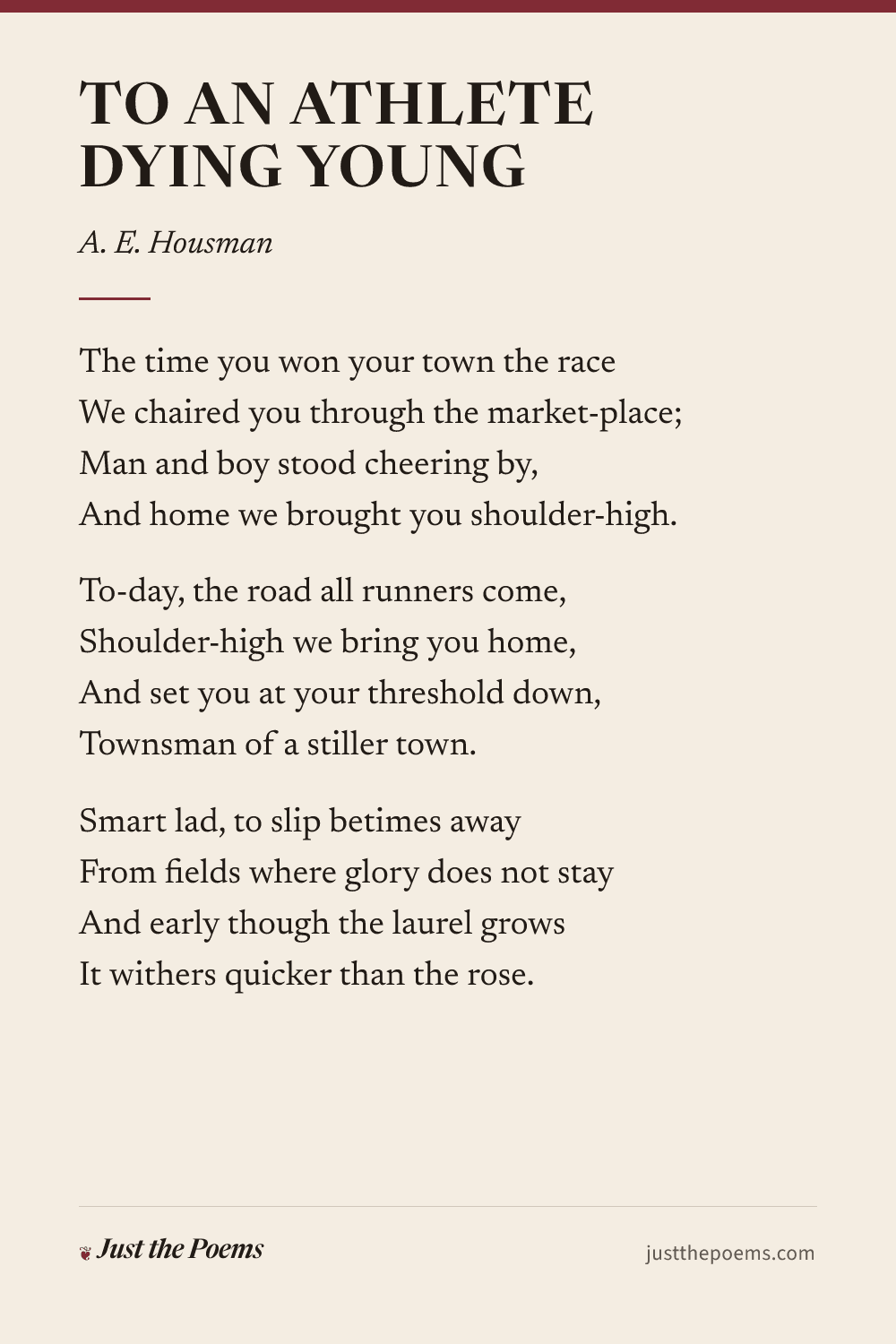
The time you won your town the raceWe chaired you through the market-place;Man and boy stood cheering by,And home we brought you shoulder-high.

To-day, the road all runners come,Shoulder-high we bring you home,And set you at your threshold down,Townsman of a stiller town.

Smart lad, to slip betimes awayFrom fields where glory does not stayAnd early though the laurel growsIt withers quicker than the rose.

Show all 28 lines 16 more

Eyes the shady night has shutCannot see the record cut,And silence sounds no worse than cheersAfter earth has stopped the ears:

Now you will not swell the routOf lads that wore their honours out,Runners whom renown outranAnd the name died before the man.

So set, before its echoes fade,The fleet foot on the sill of shade,And hold to the low lintel upThe still-defended challenge-cup.

And round that early-laurelled headWill flock to gaze the strengthless dead,And find unwithered on its curlsThe garland briefer than a girl's.

Source

A Shropshire Lad, 1919

Filed under
  • Library subject “Shropshire (England) -- Poetry”, A Shropshire Lad

ELIZABETH OF BOHEMIA

Sir Henry Wotton

In 0 Wikipedias 3 anthologies Poet in 11 Wikipedias

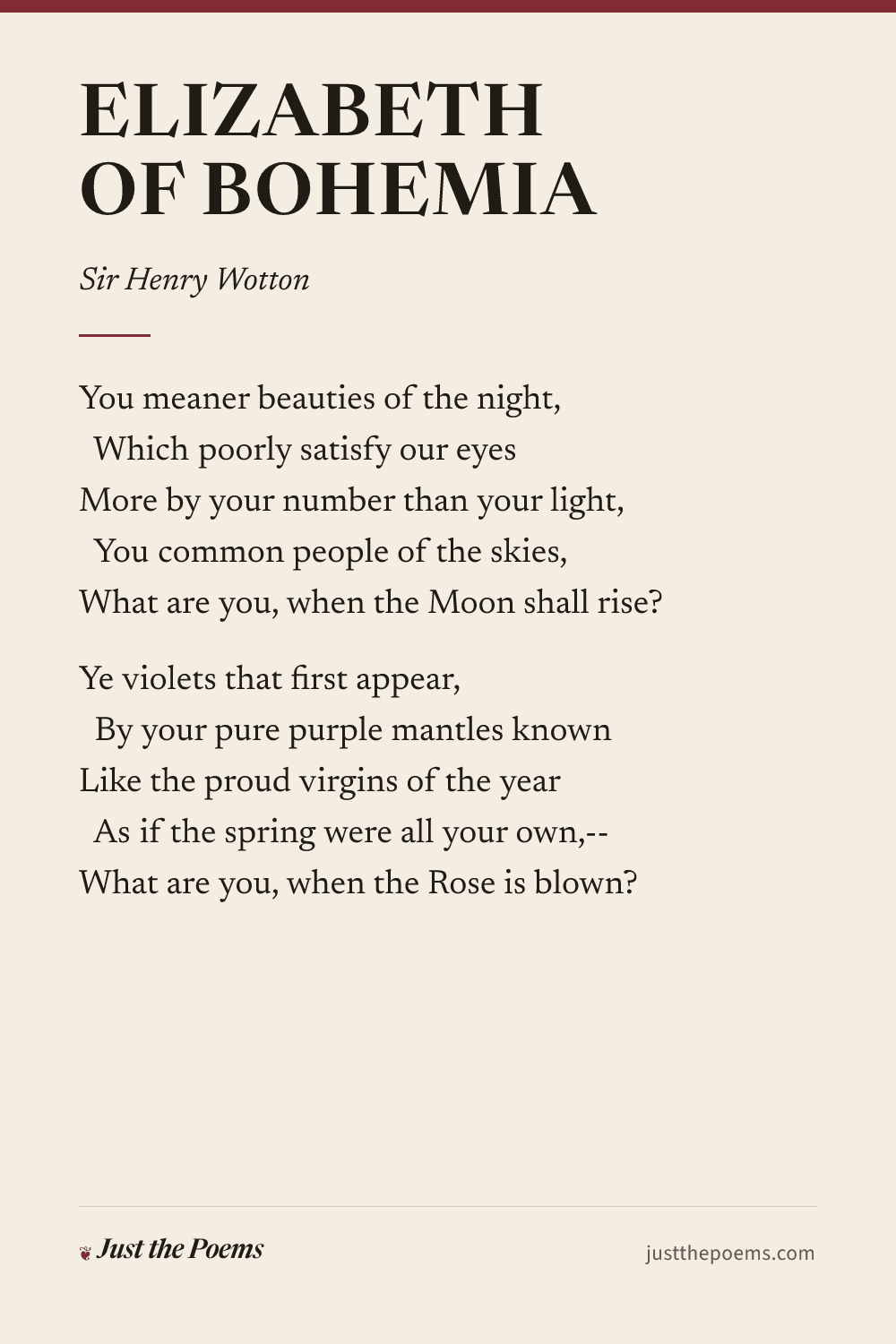
You meaner beauties of the night, Which poorly satisfy our eyesMore by your number than your light, You common people of the skies,What are you, when the Moon shall rise?

Ye violets that first appear, By your pure purple mantles knownLike the proud virgins of the year As if the spring were all your own,--What are you, when the Rose is blown?

You curious chanters of the wood That warble forth dame Nature's lays,Thinking your passions understood By your weak accents; what's your praiseWhen Philomel her voice doth raise?

So, when my Mistress shall be seen In sweetness of her looks and mind,By virtue first, then choice, a Queen, Tell me, if she were not design'dTh' eclipse and glory of her kind?

Source

The Golden Treasury, ed. Francis Turner Palgrave

Filed under
  • Wikidata main subject: Elizabeth Stuart, Queen of Bohemia

HORATIAN ODE UPON CROMWELL'S RETURN FROM IRELAND

Andrew Marvell

In 0 Wikipedias 2 anthologies Poet in 38 Wikipedias

The forward youth that would appear,Must now forsake his Muses dear, Nor in the shadows sing His numbers languishing.

'Tis time to leave the books in dust,And oil the unused armour's rust, Removing from the wall The corslet of the hall.

So restless Cromwell could not ceaseIn the inglorious arts of peace, But through adventurous war Urged his active star:

Show all 120 lines 108 more

And like the three-fork'd lightning firstBreaking the clouds where it was nurst, Did thorough his own side His fiery way divide:

For 'tis all one to courage highThe emulous, or enemy; And with such, to enclose Is more than to oppose;

Then burning through the air he wentAnd palaces and temples rent; And Caesar's head at last Did through his laurels blast.

'Tis madness to resist or blameThe face of angry heaven's flame; And if we would speak true, Much to the Man is due

Who, from his private gardens, whereHe lived reserved and austere (As if he his highest plot To plant the bergamot)

Could by industrious valour climbTo ruin the great work of time, And cast the Kingdoms old Into another mould.

Though Justice against Fate complain,And plead the ancient Rights in vain-- But those do hold or break As men are strong or weak;

Nature, that hateth emptiness,Allows of penetration less, And therefore must make room Where greater spirits come.

What field of all the civil warWhere his were not the deepest scar? And Hampton shows what part He had of wiser art,

Where, twining subtle fears with hope,He wove a net of such a scope That Charles himself might chase To Carisbrook's narrow case;

That thence the Royal actor borneThe tragic scaffold might adorn: While round the armed bands Did clap their bloody hands;

He nothing common did or meanUpon that memorable scene, But with his keener eye The axe's edge did try;

Nor call'd the Gods, with vulgar spite,To vindicate his helpless right; But bow'd his comely head Down, as upon a bed.

--This was that memorable hourWhich first assured the forced power: So when they did design The Capitol's first line,

A Bleeding Head, where they begun,Did fright the architects to run; And yet in that the State Foresaw its happy fate!

And now the Irish are ashamedTo see themselves in one year tamed: So much one man can do That does both act and know.

They can affirm his praises best,And have, though overcome, confest How good he is, how just And fit for highest trust;

Nor yet grown stiffer with command,But still in the Republic's hand-- How fit he is to sway That can so well obey!

He to the Commons' feet presentsA Kingdom for his first year's rents, And (what he may) forbears His fame, to make it theirs:

And has his sword and spoils ungirtTo lay them at the Public's skirt. So when the falcon high Falls heavy from the sky,

She, having kill'd, no more doth searchBut on the next green bough to perch, Where, when he first does lure, The falconer has her sure.

--What may not then our Isle presumeWhile victory his crest does plume? What may not others fear If thus he crowns each year!

As Caesar he, ere long, to Gaul,To Italy an Hannibal, And to all states not free Shall climacteric be.

The Pict no shelter now shall findWithin his parti-colour'd mind, But, from this valour, sad Shrink underneath the plaid--

Happy, if in the tufted brakeThe English hunter him mistake, Nor lay his hounds in near The Caledonian deer.

But Thou, the War's and Fortune's son,March indefatigably on; And for the last effect Still keep the sword erect:

Besides the force it has to frightThe spirits of the shady night, The same arts that did gain A power, must it maintain.

Source

The Golden Treasury, ed. Francis Turner Palgrave

Filed under
  • Wikidata main subject: Oliver Cromwell

Advertisements

Ye Mariners of England

Thomas Campbell

In 0 Wikipedias 2 anthologies Poet in 16 Wikipedias

Ye Mariners of EnglandThat guard our native seas!Whose flag has braved, a thousand yearsThe battle and the breeze!Your glorious standard launch againTo match another foe:And sweep through the deep,While the stormy winds do blow;While the battle rages loud and longAnd the stormy winds do blow.

The spirits of your fathersShall start from every wave--

Show all 40 lines 28 more

For the deck it was their field of fame,And Ocean was their grave:Where Blake and mighty Nelson fellYour manly hearts shall glow,As ye sweep through the deep,While the stormy winds do blow;While the battle rages loud and longAnd the stormy winds do blow.

Britannia needs no bulwarks,No towers along the steep;Her march is o'er the mountain waves,Her home is on the deep.With thunders from her native oakShe quells the floods below--As they roar on the shore,When the stormy winds do blow;When the battle rages loud and longAnd the stormy winds do blow.

The meteor flag of EnglandShall yet terrific burn;Till danger's troubled night departAnd the star of peace return.Then, then, ye ocean-warriors!Our song and feast shall flowTo the fame of your name,When the storm has ceased to blow;When the fiery fight is heard no more,And the storm has ceased to blow.

Source

The Golden Treasury, ed. Francis Turner Palgrave

Filed under
  • Named in the first line

THE IVY GREEN

Charles Dickens

In 0 Wikipedias 1 anthology Poet in 177 Wikipedias

Oh, a dainty plant is the Ivy green,That creepeth o'er ruins old!Of right choice food are his meals I ween,In his cell so lone and cold.The wall must be crumbled, the stone decayed,To pleasure his dainty whim;And the mouldering dust that years have madeIs a merry meal for him.Creeping where no life is seen,A rare old plant is the Ivy green.

Fast he stealeth on, though he wears no wings,And a staunch old heart has he.

Show all 30 lines 18 more

How closely he twineth, how tight he clingsTo his friend the huge Oak Tree!And slily he traileth along the ground,And his leaves he gently waves,As he joyously hugs and crawleth roundThe rich mould of dead men's graves.Creeping where grim death has been,A rare old plant is the Ivy green.

Whole ages have fled and their works decayed,And nations have scattered been;But the stout old Ivy shall never fade,From its hale and hearty green.The brave old plant, in its lonely days,Shall fatten upon the past:For the stateliest building man can raiseIs the Ivy's food at last.Creeping on, where time has been,A rare old plant is the Ivy green.

Source

The Home Book of Verse, ed. Burton Egbert Stevenson

Filed under
  • Library subject “England -- Social life and customs -- 19th century -- Poetry”, The Poems and Verses of Charles Dickens

Where shall the lover rest

Sir Walter Scott

In 0 Wikipedias 1 anthology Poet in 98 Wikipedias

Where shall the lover rest Whom the fates severFrom his true maiden's breast Parted for ever?Where, through groves deep and high Sounds the far billow,Where early violets die Under the willow. Eleu loro Soft shall be his pillow.

There, through the summer day Cool streams are laving:

Show all 40 lines 28 more

There, while the tempests sway, Scarce are boughs waving;There thy rest shalt thou take, Parted for ever,Never again to wake Never, O never! Eleu loro Never, O never!

Where shall the traitor rest, He, the deceiver,Who would win maiden's breast, Ruin, and leave her?In the lost battle, Borne down by the flying,Where mingles war's rattle With groans of the dying; Eleu loro There shall he be lying.

Her wing shall the eagle flap O'er the falsehearted;His warm blood the wolf shall lap Ere life be parted:Shame and dishonour sit By his grave ever;Blessing shall hallow it Never, O never! Eleu loro Never, O never!

Source

The Golden Treasury, ed. Francis Turner Palgrave

Filed under
  • Library subject “Flodden, Battle of, England, 1513 -- Poetry”, Marmion: A Tale Of Flodden Field

ENGLAND AND SWITZERLAND

William Wordsworth

In 0 Wikipedias 1 anthology Poet in 97 Wikipedias

Two Voices are there; one is of the Sea,One of the Mountains; each a mighty voice:In both from age to age thou didst rejoice,They were thy chosen music, Liberty!

There came a tyrant, and with holy gleeThou fought'st against him,--but hast vainly striven:Thou from thy Alpine holds at length are drivenWhere not a torrent murmurs heard by thee.

--Of one deep bliss thine ear hath been bereft;Then cleave, O cleave to that which still is left--For, high-soul'd Maid, what sorrow would it be

That Mountain floods should thunder as before,And Ocean bellow from his rocky shore,And neither awful Voice be heard by Thee!

Source

The Golden Treasury, ed. Francis Turner Palgrave

Filed under
  • Named in the title

ENGLAND

William Cowper

In 0 Wikipedias 1 anthology Poet in 41 Wikipedias

England, with all thy faults, I love thee still,--My country! and, while yet a nook is leftWhere English minds and manners may be found,Shall be constrained to love thee. Though thy climeBe fickle, and thy year most part deformedWith dripping rains, or withered by a frost,I would not yet exchange thy sullen skies,And fields without a flower, for warmer FranceWith all her vines; nor for Ausonia's grovesOf golden fruitage and her myrtle bowers.To shake thy senate, and from height sublimeOf patriot eloquence to flash down fire

Show all 33 lines 21 more

Upon thy foes, was never meant my task:But I can feel thy fortunes, and partakeThy joys and sorrows with as true a heartAs any thunderer there. And I can feelThy follies too; and with a just disdainFrown at effeminates whose very looksReflect dishonor on the land I love.How, in the name of soldiership and sense,Should England prosper, when such things, as smoothAnd tender as a girl, all essenced o'erWith odors, and as profligate as sweet,Who sell their laurel for a myrtle wreath,And love when they should fight,--when such as thesePresume to lay their hand upon the arkOf her magnificent and awful cause?Time was when it was praise and boast enoughIn every clime, and travel where we might,That we were born her children. Praise enoughTo fill the ambition of a private man,That Chatham's language was his mother tongue,And Wolfe's great name compatriot with his own.

Source

The World's Best Poetry, Vol. VIII, ed. Bliss Carman, 1904

Filed under
  • Named in the title

Advertisements

"ON WENLOCK EDGE"

Alfred Edward Housman

In 0 Wikipedias 1 anthology Poet in 32 Wikipedias

On Wenlock Edge the wood's in trouble;His forest fleece the Wrekin heaves;The gale, it plies the saplings double,And thick on Severn snow the leaves.

'Twould blow like this through holt and hangerWhen Uricon the city stood:'Tis the old wind in the old anger,But then it threshed another wood.

Then, 'twas before my time, the RomanAt yonder heaving hill would stare:The blood that warms an English yeoman,The thoughts that hurt him, they were there.

There, like the wind through woods in riot,Through him the gale of life blew high;The tree of man was never quiet:Then 'twas the Roman, now 'tis I.

The gale, it plies the saplings double,It blows so hard, 'twill soon be gone:To-day the Roman and his troubleAre ashes under Uricon.

Source

The Home Book of Verse, ed. Burton Egbert Stevenson

Filed under
  • Library subject “Shropshire (England) -- Poetry”, A Shropshire Lad

THE BLACKBIRD

Alfred Edward Housman

In 0 Wikipedias 1 anthology Poet in 32 Wikipedias

When smoke stood up from LudlowAnd mist blew off from Teme,And blithe afield to ploughingAgainst the morning beamI strode beside my team,

The blackbird in the coppiceLooked out to see me stride,And hearkened as I whistledThe trampling team beside,And fluted and replied:

"Lie down, lie down, young yeoman;What use to rise and rise?

Show all 30 lines 18 more

Rise man a thousand morningsYet down at last he lies,And then the man is wise."

I heard the tune he sang me,And spied his yellow bill;I picked a stone and aimed itAnd threw it with a will:Then the bird was still.

Then my soul within meTook up the blackbird's strain,And still beside the horsesAlong the dewy laneIt sang the song again:

"Lie down, lie down, young yeoman;The sun moves always west;The road one treads to laborWill lead one home to rest,And that will be the best."

Source

The Home Book of Verse, ed. Burton Egbert Stevenson

Filed under
  • Library subject “Shropshire (England) -- Poetry”, A Shropshire Lad

"WHEN I WAS ONE-AND-TWENTY"

Alfred Edward Housman

In 0 Wikipedias 1 anthology Poet in 32 Wikipedias

When I was one-and-twentyI heard a wise man say,"Give crowns and pounds and guineasBut not your heart away;Give pearls away and rubiesBut keep your fancy free."But I was one-and-twenty,No use to talk to me.

When I was one-and-twentyI heard him say again,"The heart out of the bosomWas never given in vain;'Tis paid with sighs a plentyAnd sold for endless rue."And I am two-and-twenty,And oh, 'tis true, 'tis true.

Source

The Home Book of Verse, ed. Burton Egbert Stevenson

Filed under
  • Library subject “Shropshire (England) -- Poetry”, A Shropshire Lad

England, My England

William Ernest Henley

In 0 Wikipedias 1 anthology Poet in 25 Wikipedias

What have I done for you, England, my England?What is there I would not do, England, my own?With your glorious eyes austere,As the Lord were walking near,Whispering terrible things and dear As the Song on your bugles blown, England--Round the world on your bugles blown?

Where shall the watchful sun, England, my England,

Show all 49 lines 37 more

Match the master-work you’ve done, England, my own?When shall he rejoice agenSuch a breed of mighty menAs come forward, one to ten, To the Song on your bugles blown, England-- Down the years on your bugles blown?

Ever the faith endures, England, my England:--‘Take and break us: we are yours, England, my own!Life is good, and joy runs highBetween English earth and sky:Death is death; but we shall die To the Song on your bugles blown, England-- To the stars on your bugles blown!’

They call you proud and hard, England, my England:You with worlds to watch and ward, England, my own!You whose mail’d hand keeps the keysOf such teeming destinies,You could know nor dread nor ease Were the Song on your bugles blown, England, Round the Pit on your bugles blown!

Mother of Ships whose might, England, my England,Is the fierce old Sea’s delight, England, my own,Chosen daughter of the Lord,Spouse-in-Chief of the ancient Sword,There’s the menace of the Word In the Song on your bugles blown, England-- Out of heaven on your bugles blown!

Source

The Oxford Book of English Verse 1250–1900, 1900

Filed under
  • Named in the title

THE BLACKBIRD

William Barnes

In 0 Wikipedias 1 anthology Poet in 12 Wikipedias

Ov all the birds upon the wingBetween the zunny showers o' spring,-Vor all the lark, a-swingen high,Mid zing below a cloudless sky,An' sparrows, clust'ren roun' the bough,Mid chatter to the men at plough,--The blackbird, whisslen in amongThe boughs, do zing the gayest zong.

Vor we do hear the blackbird zingHis sweetest ditties in the spring,When nippen win's noo mwore do blowVrom northern skies, wi' sleet or snow,

Show all 42 lines 30 more

But dreve light doust along betweenThe leane-zide hedges, thick an' green;An' zoo the blackbird in amongThe boughs do zing the gayest zong.

'Tis blithe, wi' newly-opened eyes,To zee the mornen's ruddy skies;Or, out a-haulen frith or lopsVrom new-pleshed hedge or new-velled copse,To rest at noon in primrwose bedsBelow the white-barked woak-trees' heads;But there's noo time, the whole day long,Lik' evenen wi' the blackbird's zong.

Vor when my work is all a-doneAvore the zetten o' the zun,Then blushen Jeane do walk alongThe hedge to meet me in the drong,An' stay till all is dim an' darkBezides the ashen tree's white bark;An' all bezides the blackbird's shrillAn' runnen evenen-whissle's still.

An' there in bwoyhood I did roveWi' pryen eyes along the droveTo vind the nest the blackbird meadeO' grass-stalks in the high bough's sheade;Or climb aloft, wi' clingen knees,Vor crows' aggs up in swayen trees,While frightened blackbirds down belowDid chatter o' their little foe.An' zoo there's noo pleace lik' the drong,Where I do hear the blackbird's zong.

Source

The Home Book of Verse, ed. Burton Egbert Stevenson

Filed under
  • Library subject “Dorset (England) -- Poetry”, Poems of Rural Life in the Dorset Dialect

Advertisements

"THE GIRT WOAK TREE THAT'S IN THE DELL"

William Barnes

In 0 Wikipedias 1 anthology Poet in 12 Wikipedias

The girt woak tree that's in the dell!There's noo tree I do love so well;Vor times an' times when I wer young,I there've a-climbed, an' there've a-zwung,An' picked the eacorns green, a-shedIn wrestlen storms vrom his broad head.An' down below's the cloty brookWhere I did vish with line an' hook,An' beat, in playsome dips and zwims,The foamy stream, wi' white-skinned lim's.An' there my mother nimbly shotHer knitten-needles, as she zot

Show all 56 lines 44 more

At evenen down below the wideWoak's head, wi' father at her zide.An' I've a-played wi' many a bwoy,That's now a man an' gone awoy;Zoo I do like noo tree so well'S the girt woak tree that's in the dell.

An' there, in leater years, I rovedWi' thik poor maid I fondly loved,--The maid too feair to die so soon,--When evenen twilight, or the moon,Cast light enough 'ithin the pleaceTo show the smiles upon her feace,Wi' eyes so clear's the glassy pool,An' lips an' cheaks so soft as wool.There han' in han', wi' bosoms warm,Wi' love that burned but thought noo harm,Below the wide-boughed tree we passedThe happy hours that went too vast;An' though she'll never be my wife,She's still my leaden star o' life.She's gone: an' she've a-left to meHer mem'ry in the girt woak tree;Zoo I do love noo tree so well'S the girt woak tree that's in the dell.

An' oh! mid never ax nor hookBe brought to spweil his steately look;Nor ever roun' his ribby zidesMid cattle rub ther heairy hides;Nor pigs rout up his turf, but keepHis lwonesome sheade vor harmless sheep;An' let en grow, an' let en spread,An' let en live when I be dead.But oh! if men should come an' vellThe girt woak tree that's in the dell,An' build his planks 'ithin the zideO' zome girt ship to plough the tide,Then, life or death! I'd goo to sea,A sailen wi' the girt woak tree:An' I upon his planks would stand,An' die a-fighten vor the land,--The land so dear,--the land so free,--The land that bore the girt woak tree;Vor I do love noo tree so well'S the girt woak tree that's in the dell.

Source

The Home Book of Verse, ed. Burton Egbert Stevenson

Filed under
  • Library subject “Dorset (England) -- Poetry”, Poems of Rural Life in the Dorset Dialect

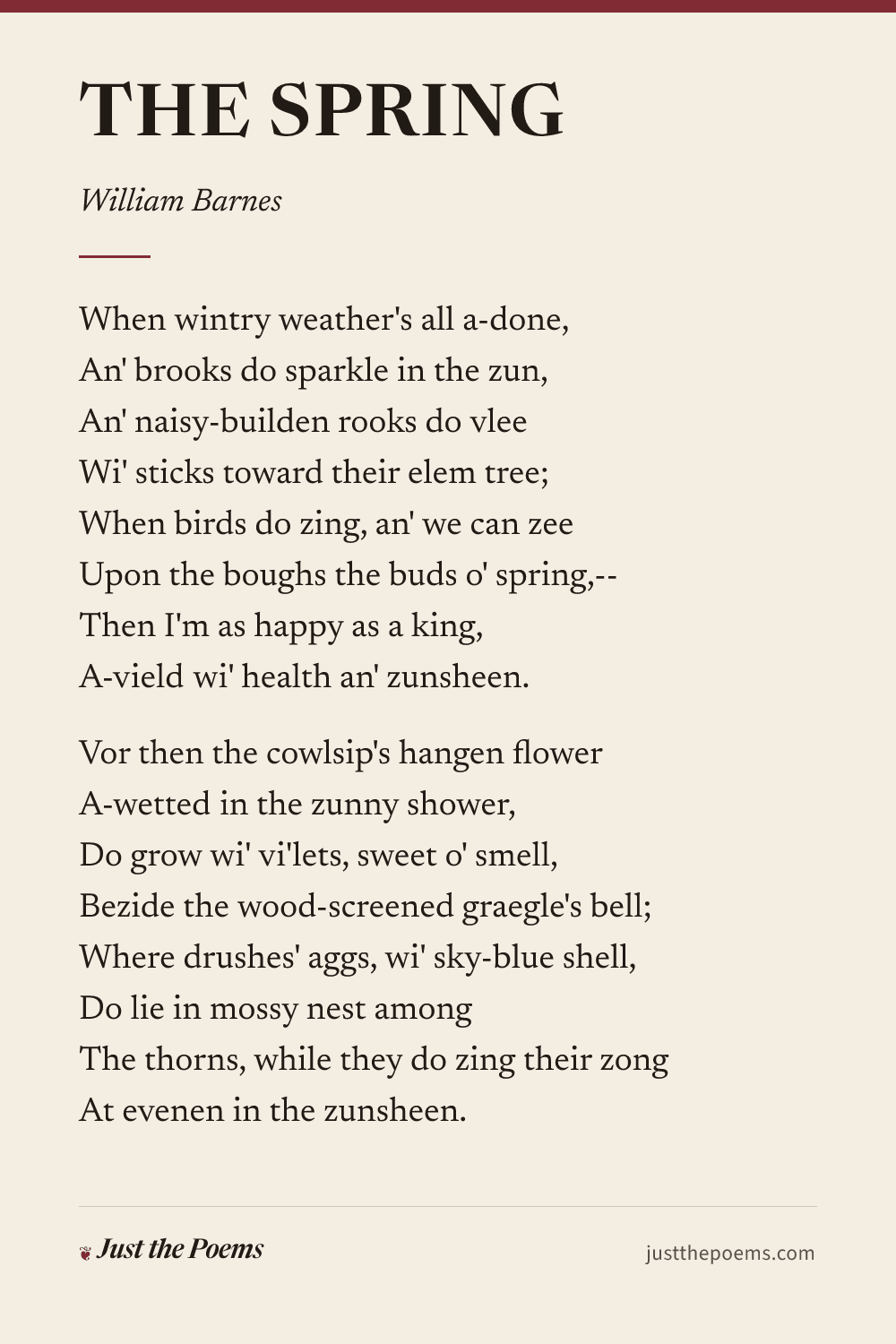
THE SPRING

William Barnes

In 0 Wikipedias 1 anthology Poet in 12 Wikipedias

When wintry weather's all a-done,An' brooks do sparkle in the zun,An' naisy-builden rooks do vleeWi' sticks toward their elem tree;When birds do zing, an' we can zeeUpon the boughs the buds o' spring,--Then I'm as happy as a king,A-vield wi' health an' zunsheen.

Vor then the cowlsip's hangen flowerA-wetted in the zunny shower,Do grow wi' vi'lets, sweet o' smell,Bezide the wood-screened graegle's bell;

Show all 32 lines 20 more

Where drushes' aggs, wi' sky-blue shell,Do lie in mossy nest amongThe thorns, while they do zing their zongAt evenen in the zunsheen.

An' God do meake his win' to blowAn' rain to vall vor high an' low,An' bid his mornen zun to riseVor all alike, an' groun' an' skiesHa' colors vor the poor man's eyes:An' in our trials He is near,To hear our mwoan an' zee our tear,An' turn our clouds to zunsheen.

An' many times when I do vindThings all goo wrong, an' v'ok unkind,To zee the happy veeden herds,An' hear the zingen o' the birds,Do soothe my sorrow mwore than words;Vor I do zee that 'tis our sinDo meake woone's soul so dark 'ithin,When God would gi'e woone zunsheen.

Source

The Home Book of Verse, ed. Burton Egbert Stevenson

Filed under
  • Library subject “Dorset (England) -- Poetry”, Poems of Rural Life in the Dorset Dialect

ENGLAND TO AMERICA

Sydney Dobell

In 0 Wikipedias 1 anthology Poet in 6 Wikipedias

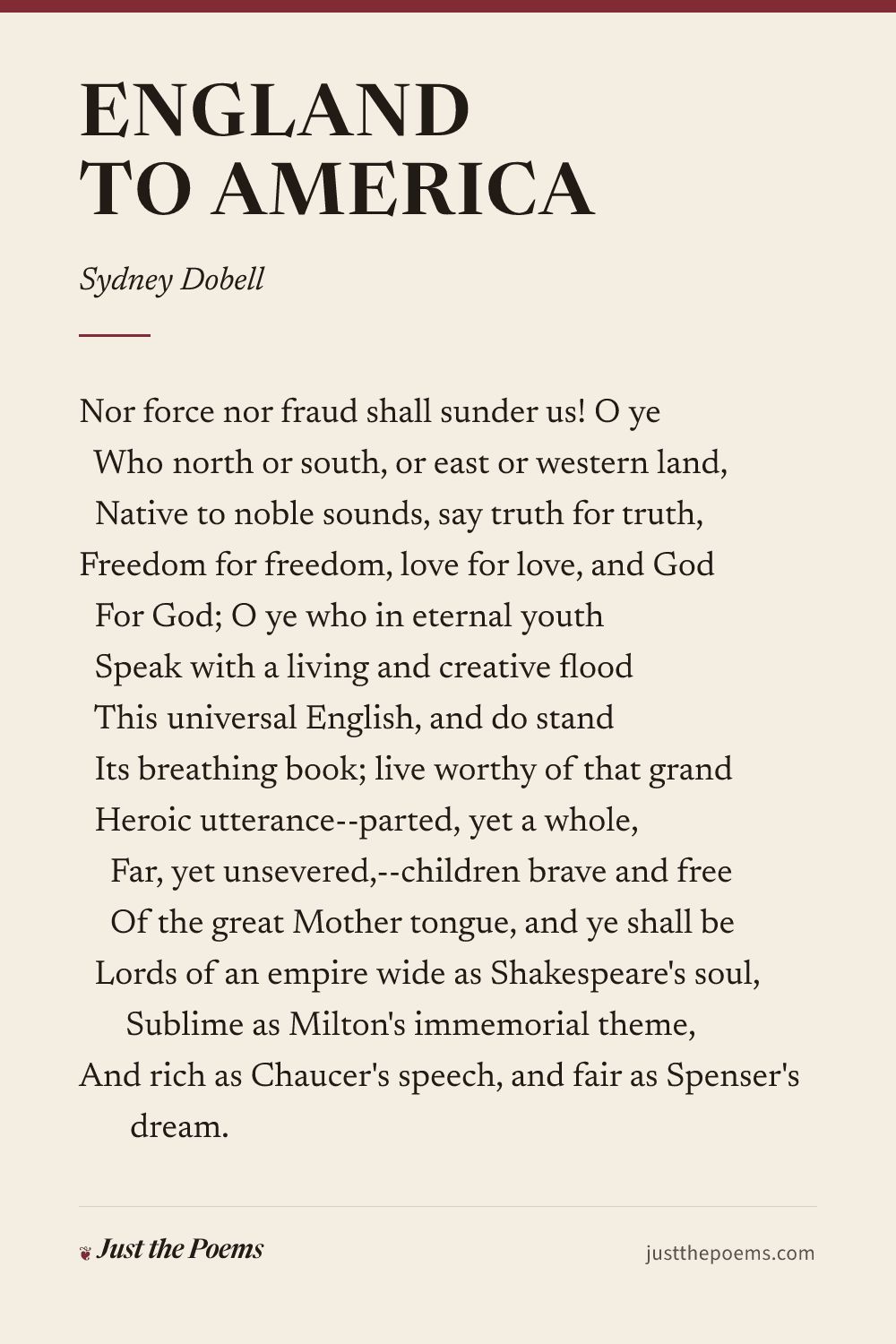
Nor force nor fraud shall sunder us! O ye Who north or south, or east or western land, Native to noble sounds, say truth for truth,Freedom for freedom, love for love, and God For God; O ye who in eternal youth Speak with a living and creative flood This universal English, and do stand Its breathing book; live worthy of that grand Heroic utterance--parted, yet a whole, Far, yet unsevered,--children brave and free Of the great Mother tongue, and ye shall be Lords of an empire wide as Shakespeare's soul, Sublime as Milton's immemorial theme,And rich as Chaucer's speech, and fair as Spenser's dream.

Source

The World's Best Poetry, Vol. VIII, ed. Bliss Carman, 1904

Filed under
  • Named in the title

ENGLAND AND HER COLONIES

William Watson

In 0 Wikipedias 1 anthology Poet in 3 Wikipedias

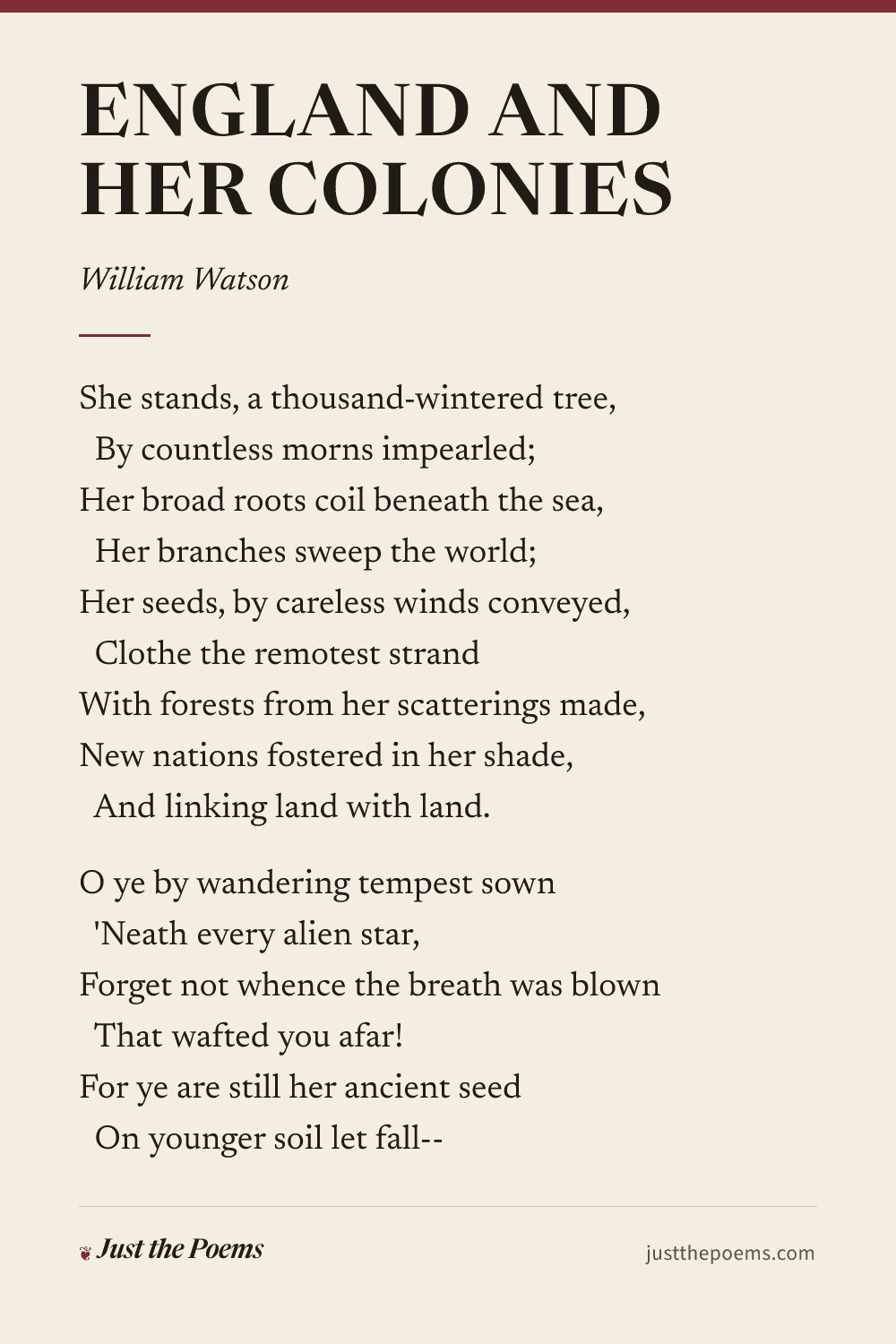
She stands, a thousand-wintered tree, By countless morns impearled;Her broad roots coil beneath the sea, Her branches sweep the world;Her seeds, by careless winds conveyed, Clothe the remotest strandWith forests from her scatterings made,New nations fostered in her shade, And linking land with land.

O ye by wandering tempest sown 'Neath every alien star,Forget not whence the breath was blown That wafted you afar!For ye are still her ancient seed On younger soil let fall--Children of Britain's island-breed,To whom the Mother in her need Perchance may one day call.

Source

The World's Best Poetry, Vol. VIII, ed. Bliss Carman, 1904

Filed under
  • Named in the title

A LETTER TO THE DEAN WHEN IN ENGLAND. 1726. BY DR. SHERIDAN

Jonathan Swift

In 0 Wikipedias 0 anthologies Poet in 101 Wikipedias

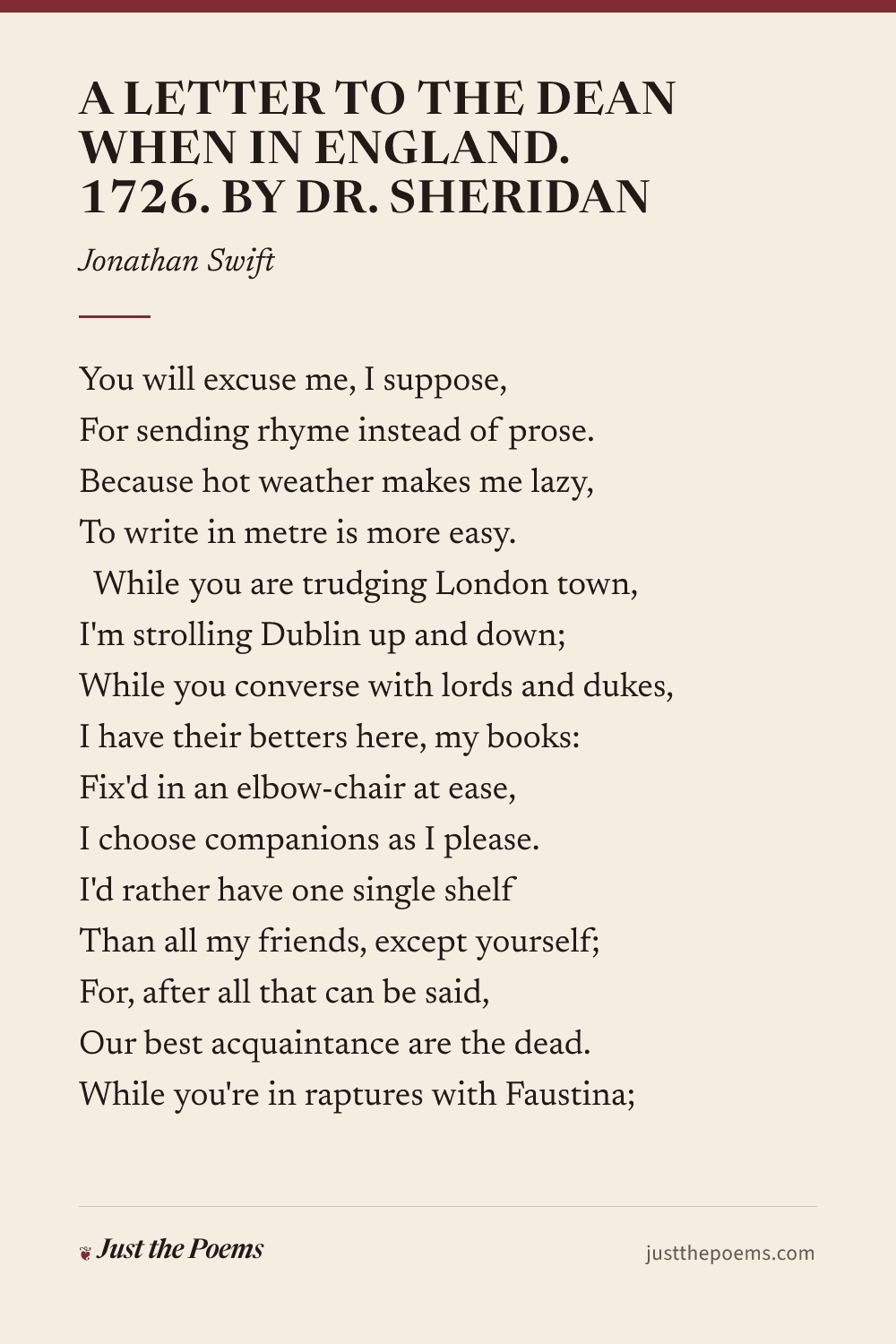
You will excuse me, I suppose,For sending rhyme instead of prose.Because hot weather makes me lazy,To write in metre is more easy. While you are trudging London town,I'm strolling Dublin up and down;While you converse with lords and dukes,I have their betters here, my books:Fix'd in an elbow-chair at ease,I choose companions as I please.I'd rather have one single shelfThan all my friends, except yourself;

Show all 64 lines 52 more

For, after all that can be said,Our best acquaintance are the dead.While you're in raptures with Faustina;I'm charm'd at home with our Sheelina.While you are starving there in state,I'm cramming here with butchers' meat.You say, when with those lords you dine,They treat you with the best of wine,Burgundy, Cyprus, and Tokay;Why, so can we, as well as they.No reason then, my dear good Dean,But you should travel home again.What though you mayn't in Ireland hopeTo find such folk as Gay and Pope;If you with rhymers here would shareBut half the wit that you can spare,I'd lay twelve eggs, that in twelve days,You'd make a dozen of Popes and Gays. Our weather’s good, our sky is clear;We've every joy, if you were here;So lofty and so bright a skyWas never seen by Ireland's eye!I think it fit to let you know,This week I shall to Quilca go;To see M'Faden's horny brothersFirst suck, and after bull their mothers;To see, alas! my wither'd trees!To see what all the country sees!My stunted quicks, my famish'd beeves,My servants such a pack of thieves;My shatter'd firs, my blasted oaks,My house in common to all folks,No cabbage for a single snail,My turnips, carrots, parsneps, fail;My no green peas, my few green sprouts;My mother always in the pouts;My horses rid, or gone astray;My fish all stolen or run away;My mutton lean, my pullets old,My poultry starved, the corn all sold.A man come now from Quilca says,"They've stolen the locks from all your keys;"But, what must fret and vex me more,He says, "They stole the keys before.They've stol'n the knives from all the forks;And half the cows from half the sturks."Nay more, the fellow swears and vows,"They've stol'n the sturks from half the cows:"With many more accounts of woe,Yet, though the devil be there, I'll go:'Twixt you and me, the reason's clear,Because I've more vexation here.

Source

The Poems of Jonathan Swift, D.D., Volume 2, 1910

Filed under
  • Named in the title

ENGLAND TO GERMANY IN 1914

Thomas Hardy

In 0 Wikipedias 0 anthologies Poet in 91 Wikipedias

“O ENGLAND, may God punish thee!” —Is it that Teuton genius flowers Only to breathe malignity Upon its friend of earlier hours? —We have eaten your bread, you have eaten ours, We have loved your burgs, your pines’ green moan, Fair Rhine-stream, and its storied towers; Your shining souls of deathless dowers Have won us as they were our own:

We have nursed no dreams to shed your blood, We have matched your might not rancorously, Save a flushed few whose blatant mood You heard and marked as well as we To tongue not in their country’s key; But yet you cry with face aflame, “O England, may God punish thee!” And foul in onward history, And present sight, your ancient name.

Autumn 1914.

Source

Moments of Vision and Miscellaneous Verses, 1929

Filed under
  • Named in the title

ARGUMENT OF EPISTLE I

Alexander Pope

In 0 Wikipedias 0 anthologies Poet in 78 Wikipedias

Of the Nature and State of Man, with respect to the UNIVERSE.

Of Man in the abstract.

I. v. 17 &c. That we can judge only with regard to our own system, being ignorant of the relations of systems and things.

II. v. 35, &c. That Man is not to be deemed imperfect, but a Being suited to his place and rank in the creation, agreeable to the general Order of things, and conformable to Ends and Relations to him unknown.

III. v. 77, &c. That it is partly upon his ignorance of future events, and partly upon the hope of a future state, that all his happiness in the present

Show all 41 lines 29 more

depends.

IV. v. 109, &c. The pride of aiming at more knowledge, and pretending to more Perfections, the cause of Man's error and misery. The impiety of putting himself in the place of God, and judging of the fitness or unfitness, perfection or imperfection, justice or injustice of his dispensations.

V. v. 131, &c. The absurdity of conceiting himself the final cause of the creation, or expecting that perfection in the moral world, which is not in the natural.

VI. v. 173, &c. The unreasonableness of his complaints against Providence, while on the one hand he demands the Perfections of the Angels, and on the other the bodily qualifications of the Brutes; though, to possess any of the sensitive faculties in a higher degree, would render him miserable.

VII. v. 207. That throughout the whole visible world, an universal order and gradation in the sensual and mental faculties is observed, which causes a subordination of creature to creature, and of all creatures to Man. The gradations of sense, instinct, thought, reflection, reason; that Reason alone countervails fill the other faculties.

VIII. v. 233. How much further this order and subordination of living creatures may extend, above and below us; were any part of which broken, not that part only, but the whole connected creation must be destroyed.

IX. v. 250. The extravagance, madness, and pride of such a desire.

Source

The Rape of the Lock, and Other Poems, 1906

Filed under
  • Library subject “Catholics -- England -- Poetry”, The Rape of the Lock, and Other Poems

EPISTLE I.

Alexander Pope

In 0 Wikipedias 0 anthologies Poet in 78 Wikipedias

Awake, my St. John! leave all meaner thingsTo low ambition, and the pride of kings.Let us (since life can little more supplyThan just to look about us and to die)Expatiate free o'er all this scene of man;A mighty maze! but not without a plan;A wild, where weeds and flowers promiscuous shoot;Or garden tempting with forbidden fruit.Together let us beat this ample field,Try what the open, what the covert yield;The latent tracts, the giddy heights, exploreOf all who blindly creep, or sightless soar;

Show all 294 lines 282 more

Eye Nature's walks, shoot Folly as it flies,And catch the manners living as they rise;Laugh where we must, be candid where we can;But vindicate the ways of God to man.

I. Say first, of God above, or man belowWhat can we reason, but from what we know?Of man, what see we but his station here,From which to reason, or to which refer?Through worlds unnumbered though the God be known,'Tis ours to trace Him only in our own.He, who through vast immensity can pierce,See worlds on worlds compose one universe,Observe how system into system runs,What other planets circle other suns,What varied being peoples every star,May tell why Heaven has made us as we are.But of this frame, the bearings, and the ties,The strong connections, nice dependencies,Gradations just, has thy pervading soulLooked through? or can a part contain the whole? Is the great chain, that draws all to agree,And drawn supports, upheld by God, or thee?

II. Presumptuous man! the reason wouldst thou find,Why formed so weak, so little, and so blind?First, if thou canst, the harder reason guess,Why formed no weaker, blinder, and no less;Ask of thy mother earth, why oaks are madeTaller or stronger than the weeds they shade?Or ask of yonder argent fields above,Why Jove's satellites are less than Jove? Of systems possible, if 'tis confestThat wisdom infinite must form the best,Where all must full or not coherent be,And all that rises, rise in due degree;Then in the scale of reasoning life, 'tis plain,There must be, somewhere, such a rank as man:And all the question (wrangle e'er so long)Is only this, if God has placed him wrong? Respecting man, whatever wrong we call,May, must be right, as relative to all.In human works, though laboured on with pain,A thousand movements scarce one purpose gain;In God's one single can its end produce;Yet serves to second too some other use.So man, who here seems principal alone,Perhaps acts second to some sphere unknown,Touches some wheel, or verges to some goal;'Tis but a part we see, and not a whole. When the proud steed shall know why man restrainsHis fiery course, or drives him o'er the plains:When the dull ox, why now he breaks the clod,Is now a victim, and now Egypt's god:Then shall man's pride and dulness comprehendHis actions', passions', being's, use and end;Why doing, suffering, checked, impelled; and whyThis hour a slave, the next a deity. Then say not man's imperfect, Heaven in fault;Say rather man's as perfect as he ought:His knowledge measured to his state and place;His time a moment, and a point his space.If to be perfect in a certain sphere,What matter, soon or late, or here or there?The blest to-day is as completely so,As who began a thousand years ago.

III. Heaven from all creatures hides the book of Fate,All but the page prescribed, their present state:From brutes what men, from men what spirits know:Or who could suffer being here below?The lamb thy riot dooms to bleed to-day,Had he thy reason, would he skip and play?Pleased to the last, he crops the flowery food,And licks the hand just raised to shed his blood.Oh, blindness to the future! kindly given,That each may fill the circle, marked by Heaven:Who sees with equal eye, as God of all,A hero perish, or a sparrow fall,Atoms or systems into ruin hurled,And now a bubble burst, and now a world. Hope humbly, then; with trembling pinions soar;Wait the great teacher Death; and God adore.What future bliss, He gives not thee to know,But gives that hope to be thy blessing now.Hope springs eternal in the human breast:Man never is, but always to be blest:The soul, uneasy and confined from home,Rests and expatiates in a life to come. Lo, the poor Indian! whose untutored mindSees God in clouds, or hears Him in the wind;His soul, proud science never taught to strayFar as the solar walk, or milky way;Yet simple Nature to his hope has given,Behind the cloud-topped hill, an humbler heaven;Some safer world in depth of woods embraced,Some happier island in the watery waste,Where slaves once more their native land behold,No fiends torment, no Christians thirst for gold.To be, contents his natural desire,He asks no angel's wing, no seraph's fire;But thinks, admitted to that equal sky,His faithful dog shall bear him company.

IV. Go, wiser thou! and, in thy scale of sense,Weigh thy opinion against providence;Call imperfection what thou fanciest such,Say, here He gives too little, there too much;Destroy all creatures for thy sport or gust,Yet cry, if man's unhappy, God's unjust;If man alone engross not Heaven's high care,Alone made perfect here, immortal there:Snatch from His hand the balance and the rod,Re-judge His justice, be the God of God.In pride, in reasoning pride, our error lies;All quit their sphere, and rush into the skies.Pride still is aiming at the blest abodes,Men would be angels, angels would be gods.Aspiring to be gods, if angels fell,Aspiring to be angels, men rebel:And who but wishes to invert the lawsOf order, sins against the Eternal Cause.

V. Ask for what end the heavenly bodies shine,Earth for whose use? Pride answers, "'Tis for mine:For me kind Nature wakes her genial power,Suckles each herb, and spreads out every flower;Annual for me, the grape, the rose renewThe juice nectareous, and the balmy dew;For me, the mine a thousand treasures brings;For me, health gushes from a thousand springs;Seas roll to waft me, suns to light me rise;My footstool earth, my canopy the skies." But errs not Nature from this gracious end,From burning suns when livid deaths descend,When earthquakes swallow, or when tempests sweepTowns to one grave, whole nations to the deep?"No, ('tis replied) the first Almighty CauseActs not by partial, but by general laws;The exceptions few; some change since all began;And what created perfect?"--Why then man?If the great end be human happiness,Then Nature deviates; and can man do less?As much that end a constant course requiresOf showers and sunshine, as of man's desires;As much eternal springs and cloudless skies,As men for ever temperate, calm, and wise.If plagues or earthquakes break not Heaven's design,Why then a Borgia, or a Catiline?Who knows but He, whose hand the lightning forms,Who heaves old ocean, and who wings the storms;Pours fierce ambition in a Caesar's mind,Or turns young Ammon loose to scourge mankind?From pride, from pride, our very reasoning springs;Account for moral, as for natural things:Why charge we heaven in those, in these acquit?In both, to reason right is to submit. Better for us, perhaps, it might appear,Were there all harmony, all virtue here;That never air or ocean felt the wind;That never passion discomposed the mind.But all subsists by elemental strife;And passions are the elements of life.The general order, since the whole began,Is kept in nature, and is kept in man.

VI. What would this man? Now upward will he soar,And little less than angel, would be more;Now looking downwards, just as grieved appearsTo want the strength of bulls, the fur of bearsMade for his use all creatures if he call,Say what their use, had he the powers of all?Nature to these, without profusion, kind,The proper organs, proper powers assigned;Each seeming want compensated of course,Here with degrees of swiftness, there of force;All in exact proportion to the state;Nothing to add, and nothing to abate.Each beast, each insect, happy in its own:Is Heaven unkind to man, and man alone?Shall he alone, whom rational we call,Be pleased with nothing, if not blessed with all? The bliss of man (could pride that blessing find)Is not to act or think beyond mankind;No powers of body or of soul to share,But what his nature and his state can bear.Why has not man a microscopic eye?For this plain reason, man is not a fly.Say what the use, were finer optics given,To inspect a mite, not comprehend the heaven?Or touch, if tremblingly alive all o'er,To smart and agonize at every pore?Or quick effluvia darting through the brain,Die of a rose in aromatic pain?If Nature thundered in his opening ears,And stunned him with the music of the spheres,How would he wish that Heaven had left him stillThe whispering zephyr, and the purling rill?Who finds not Providence all good and wise,Alike in what it gives, and what denies?

VII. Far as Creation's ample range extends,The scale of sensual, mental powers ascends:Mark how it mounts, to man's imperial race,From the green myriads in the peopled grass:What modes of sight betwixt each wide extreme,The mole's dim curtain, and the lynx's beam:Of smell, the headlong lioness between,And hound sagacious on the tainted green:Of hearing, from the life that fills the flood,To that which warbles through the vernal wood:The spider's touch, how exquisitely fine!Feels at each thread, and lives along the line:In the nice bee, what sense so subtly trueFrom poisonous herbs extracts the healing dew?How instinct varies in the grovelling swine,Compared, half-reasoning elephant, with thine!'Twixt that, and reason, what a nice barrier,For ever separate, yet for ever near!Remembrance and reflection how allayed;What thin partitions sense from thought divide:And middle natures, how they long to join,Yet never passed the insuperable line!Without this just gradation, could they beSubjected, these to those, or all to thee?The powers of all subdued by thee alone,Is not thy reason all these powers in one?

VIII. See, through this air, this ocean, and this earth,All matter quick, and bursting into birth.Above, how high, progressive life may go!Around, how wide! how deep extend below?Vast chain of being! which from God began,Natures ethereal, human, angel, man,Beast, bird, fish, insect, what no eye can see,No glass can reach; from Infinite to thee,From thee to nothing. On superior powersWere we to press, inferior might on ours:Or in the full creation leave a void,Where, one step broken, the great scale's destroyed:From Nature's chain whatever link you strike,Tenth or ten thousandth, breaks the chain alike. And, if each system in gradation rollAlike essential to the amazing whole,The least confusion but in one, not allThat system only, but the whole must fall.Let earth unbalanced from her orbit fly,Planets and suns run lawless through the sky;Let ruling angels from their spheres be hurled,Being on being wrecked, and world on world;Heaven's whole foundations to their centre nod,And nature tremble to the throne of God.All this dread order break--for whom? for thee?Vile worm!--Oh, madness! pride! impiety!

IX. What if the foot, ordained the dust to tread,Or hand, to toil, aspired to be the head?What if the head, the eye, or ear repinedTo serve mere engines to the ruling mind?Just as absurd for any part to claimTo be another, in this general frame:Just as absurd, to mourn the tasks or pains,The great directing Mind of All ordains. All are but parts of one stupendous whole,Whose body Nature is, and God the soul;That, changed through all, and yet in all the same;Great in the earth, as in the ethereal frame;Warms in the sun, refreshes in the breeze,Glows in the stars, and blossoms in the trees,Lives through all life, extends through all extent,Spreads undivided, operates unspent;Breathes in our soul, informs our mortal part,As full, as perfect, in a hair as heart:As full, as perfect, in vile man that mourns,As the rapt seraph that adores and burns:To him no high, no low, no great, no small;He fills, he bounds, connects, and equals all.

X. Cease, then, nor order imperfection name:Our proper bliss depends on what we blame.Know thy own point: this kind, this due degreeOf blindness, weakness, Heaven bestows on thee.Submit. In this, or any other sphere,Secure to be as blest as thou canst bear:Safe in the hand of one disposing Power,Or in the natal, or the mortal hour.All nature is but art, unknown to thee;All chance, direction, which thou canst not see;All discord, harmony not understood;All partial evil, universal good:And, spite of pride in erring reason's spite,One truth is clear, whatever is, is right.
Source

An Essay on Man; Moral Essays and Satires, ed. Henry Morley

Filed under
  • Library subject “Catholics -- England -- Poetry”, The Rape of the Lock, and Other Poems

XI. ON MR GAY, IN WESTMINSTER ABBEY, 1732.

Alexander Pope

In 0 Wikipedias 0 anthologies Poet in 78 Wikipedias

Of manners gentle, of affections mild;In wit, a man; simplicity, a child:With native humour tempering virtuous rage,Form'd to delight at once and lash the age:Above temptation in a low estate,And uncorrupted, even among the great:A safe companion, and an easy friend,Unblamed through life, lamented in thy end.These are thy honours! not that here thy bustIs mix'd with heroes, or with kings thy dust;But that the worthy and the good shall say,Striking their pensive bosoms--Here lies Gay.

Source

The Poetical Works of Alexander Pope, Volume 1

Filed under
  • Library subject “Catholics -- England -- Poetry”, The Rape of the Lock, and Other Poems

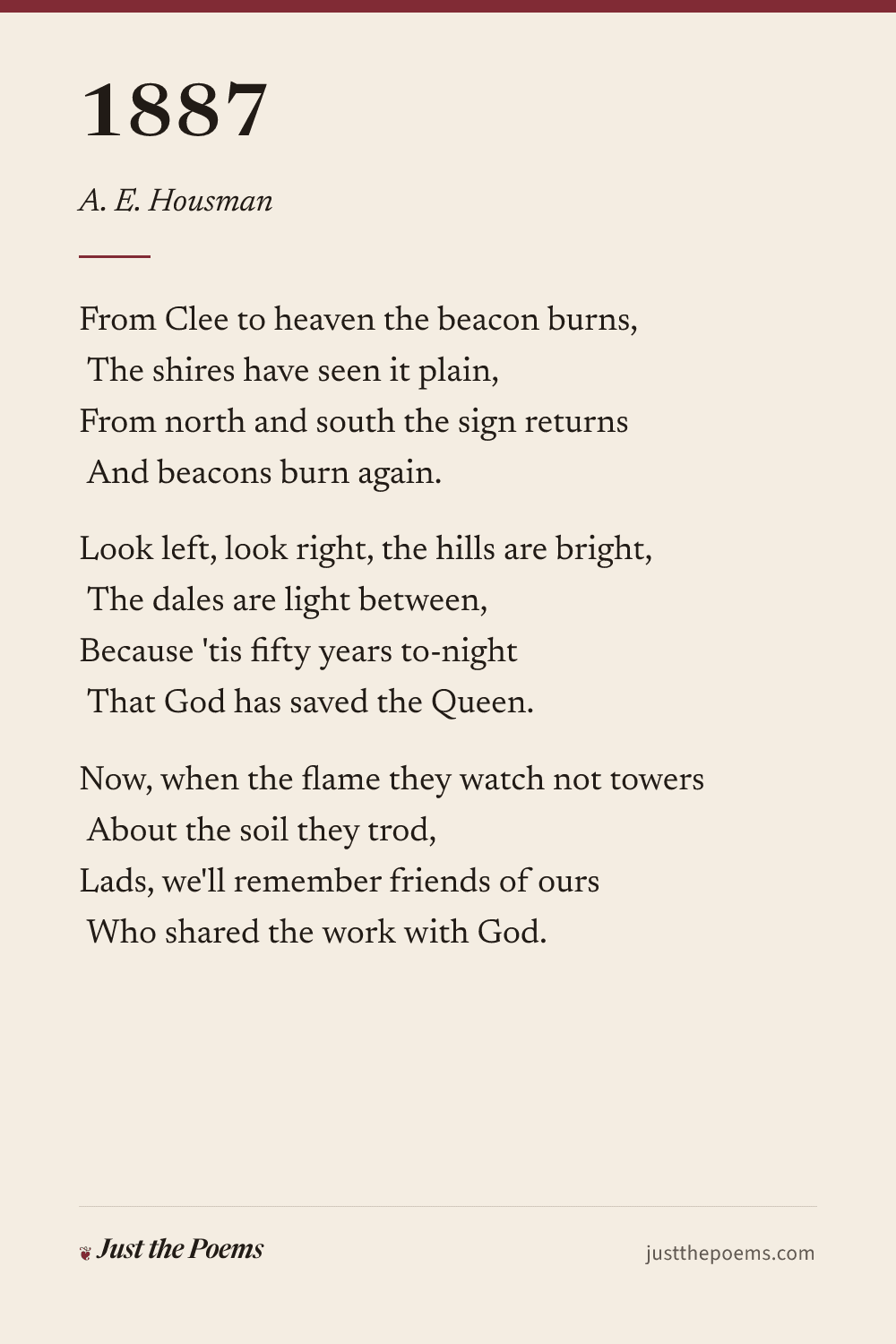
1887

A. E. Housman

In 0 Wikipedias 0 anthologies Poet in 32 Wikipedias

From Clee to heaven the beacon burns, The shires have seen it plain,From north and south the sign returns And beacons burn again.

Look left, look right, the hills are bright, The dales are light between,Because 'tis fifty years to-night That God has saved the Queen.

Now, when the flame they watch not towers About the soil they trod,Lads, we'll remember friends of ours Who shared the work with God.

Show all 32 lines 20 more

To skies that knit their heartstrings right, To fields that bred them brave,The saviours come not home to-night: Themselves they could not save.

It dawns in Asia, tombstones show And Shropshire names are read;And the Nile spills his overflow Beside the Severn's dead.

We pledge in peace by farm and town The Queen they served in war,And fire the beacons up and down The land they perished for.

"God Save the Queen" we living sing, From height to height 'tis heard;And with the rest your voices ring, Lads of the Fifty-third.

Oh, God will save her, fear you not: Be you the men you've been,Get you the sons your fathers got, And God will Save the Queen.

Source

A Shropshire Lad, 1919

Filed under
  • Library subject “Shropshire (England) -- Poetry”, A Shropshire Lad

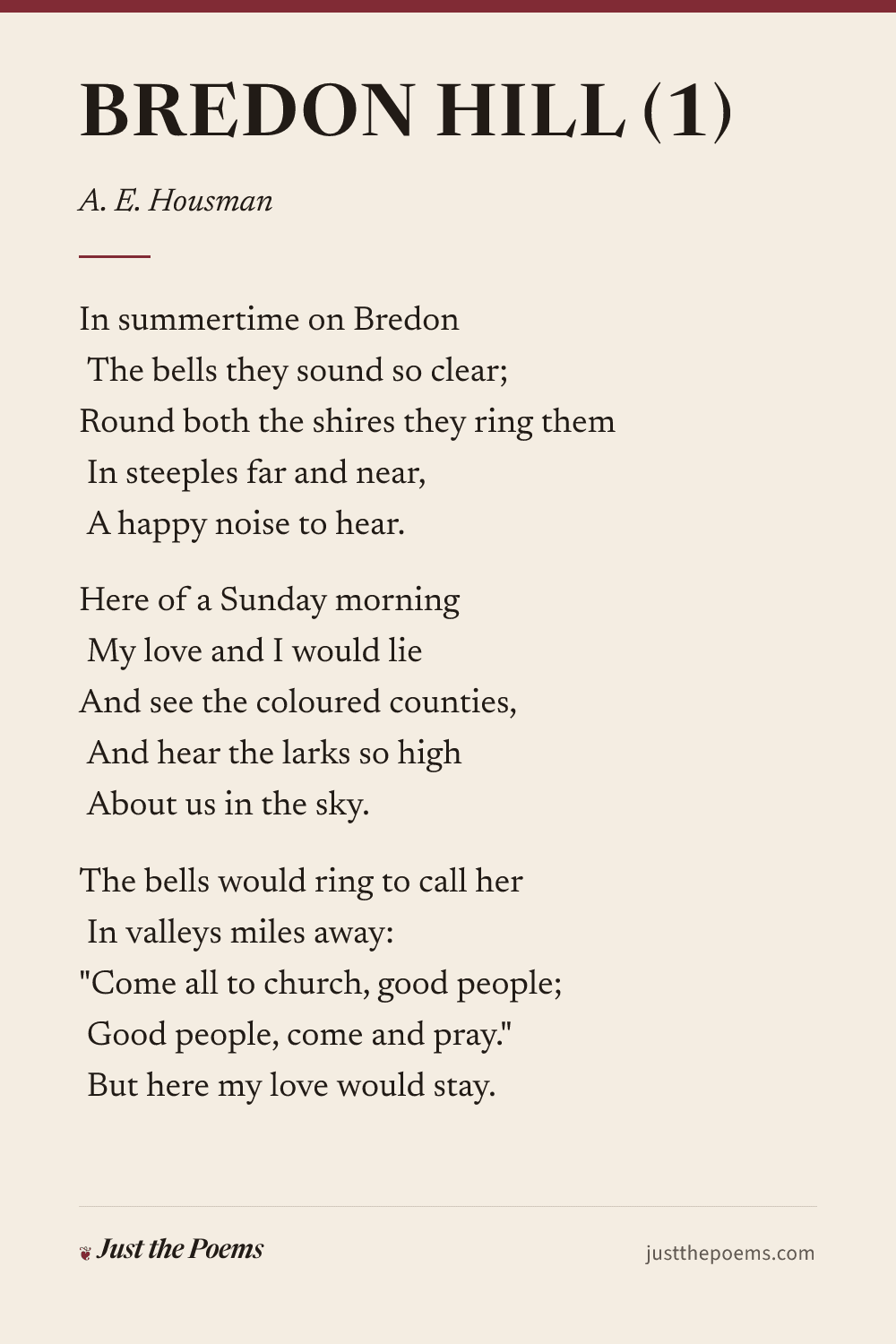
BREDON HILL (1)

A. E. Housman

In 0 Wikipedias 0 anthologies Poet in 32 Wikipedias

In summertime on Bredon The bells they sound so clear;Round both the shires they ring them In steeples far and near, A happy noise to hear.

Here of a Sunday morning My love and I would lieAnd see the coloured counties, And hear the larks so high About us in the sky.

The bells would ring to call her In valleys miles away:

Show all 35 lines 23 more

"Come all to church, good people; Good people, come and pray." But here my love would stay.

And I would turn and answer Among the springing thyme,"Oh, peal upon our wedding, And we will hear the chime, And come to church in time."

But when the snows at Christmas On Bredon top were strown,My love rose up so early And stole out unbeknown And went to church alone.

They tolled the one bell only, Groom there was none to see,The mourners followed after, And so to church went she, And would not wait for me.

The bells they sound on Bredon, And still the steeples hum."Come all to church, good people,"- Oh, noisy bells, be dumb; I hear you, I will come.

Source

A Shropshire Lad, 1919

Filed under
  • Library subject “Shropshire (England) -- Poetry”, A Shropshire Lad

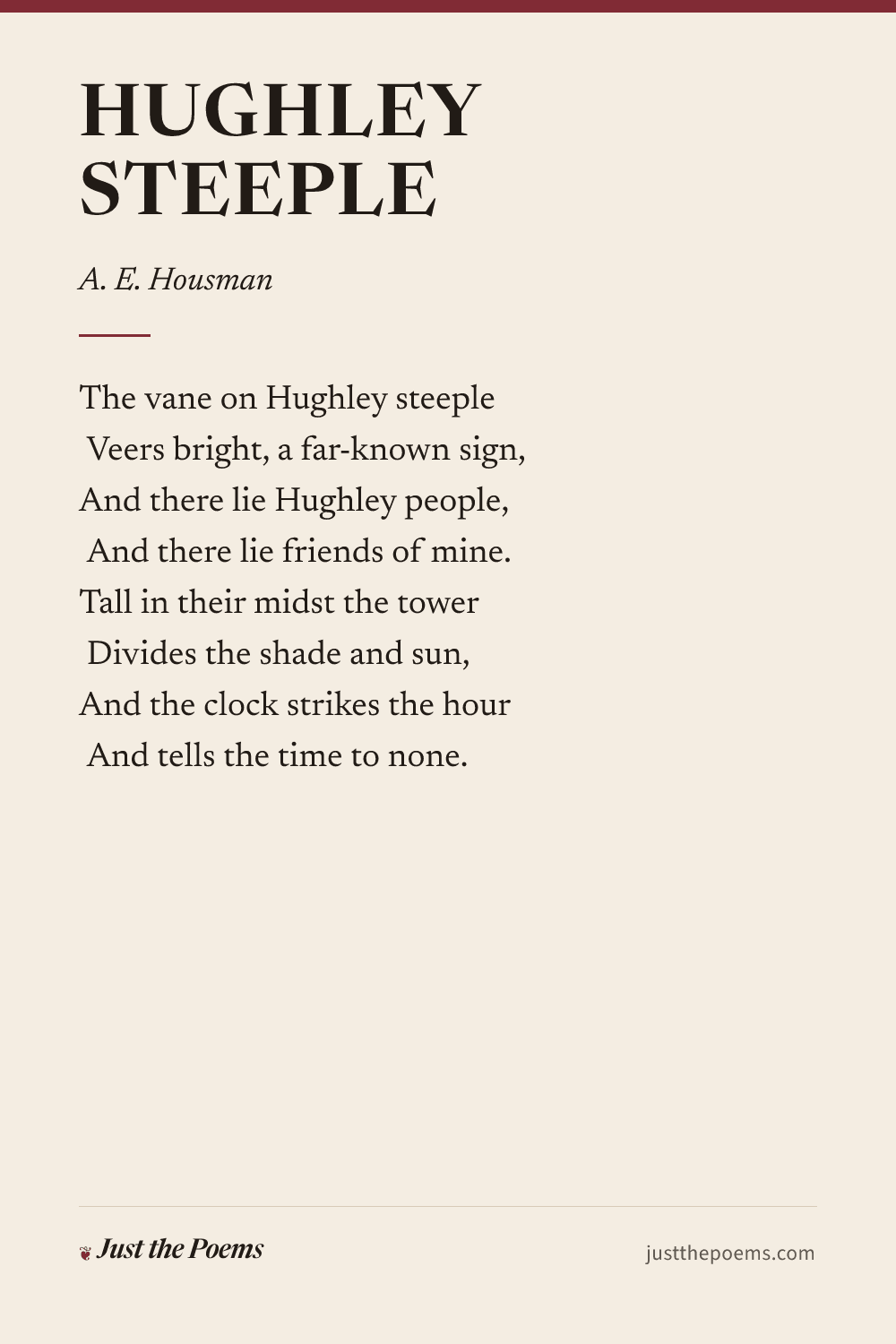
HUGHLEY STEEPLE

A. E. Housman

In 0 Wikipedias 0 anthologies Poet in 32 Wikipedias

The vane on Hughley steeple Veers bright, a far-known sign,And there lie Hughley people, And there lie friends of mine.Tall in their midst the tower Divides the shade and sun,And the clock strikes the hour And tells the time to none.

To south the headstones cluster, The sunny mounds lie thick;The dead are more in muster At Hughley than the quick.North, for a soon-told number, Chill graves the sexton delves,And steeple-shadowed slumber The slayers of themselves.

To north, to south, lie parted, With Hughley tower above,The kind, the single-hearted, The lads I used to love.And, south or north, 'tis only A choice of friends one knows,And I shall ne'er be lonely Asleep with these or those.

Source

A Shropshire Lad, 1919

Filed under
  • Library subject “Shropshire (England) -- Poetry”, A Shropshire Lad

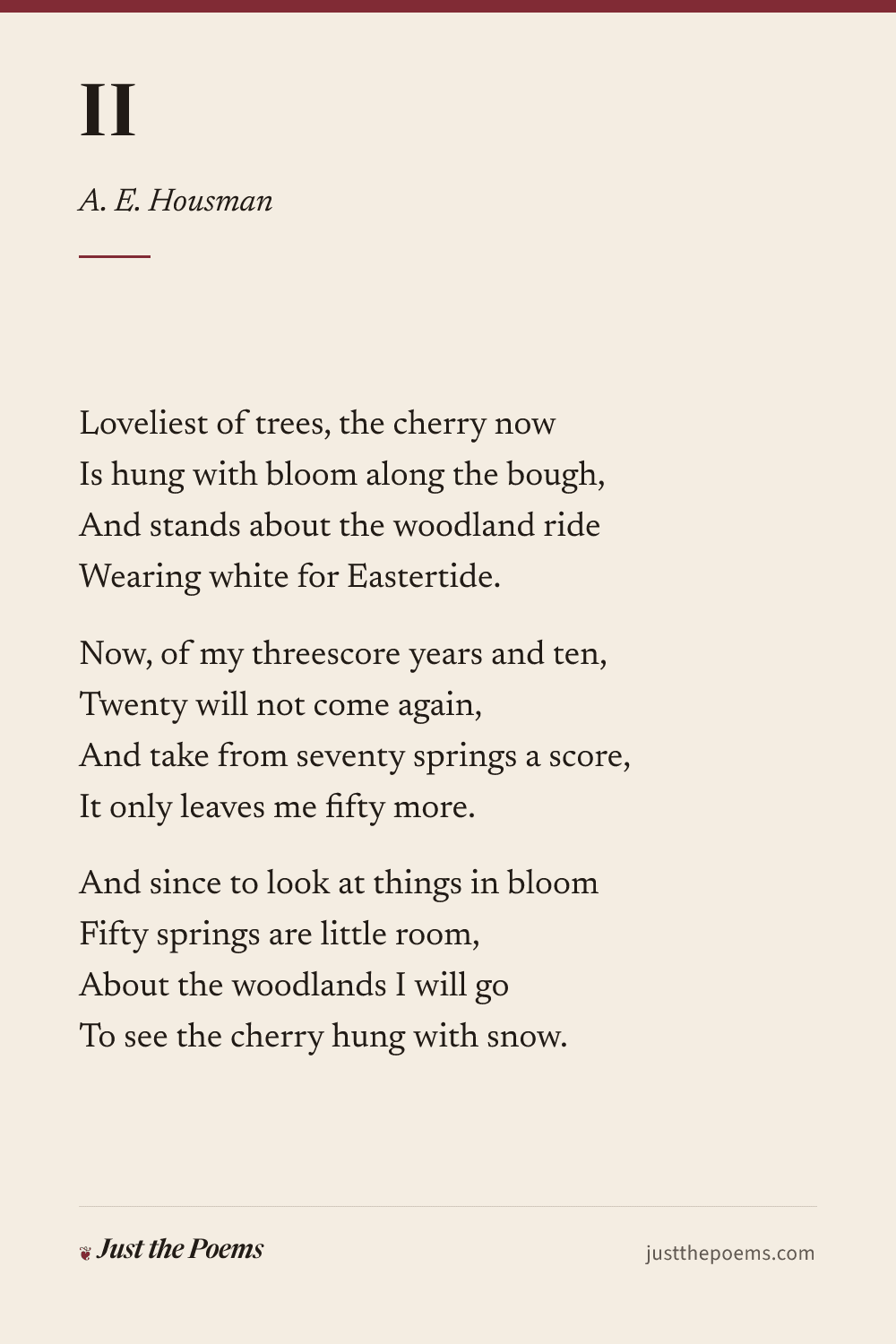
II

A. E. Housman

In 0 Wikipedias 0 anthologies Poet in 32 Wikipedias

Loveliest of trees, the cherry nowIs hung with bloom along the bough,And stands about the woodland rideWearing white for Eastertide.

Now, of my threescore years and ten,Twenty will not come again,And take from seventy springs a score,It only leaves me fifty more.

And since to look at things in bloomFifty springs are little room,About the woodlands I will goTo see the cherry hung with snow.

Source

A Shropshire Lad, 1919

Filed under
  • Library subject “Shropshire (England) -- Poetry”, A Shropshire Lad

IX

A. E. Housman

In 0 Wikipedias 0 anthologies Poet in 32 Wikipedias

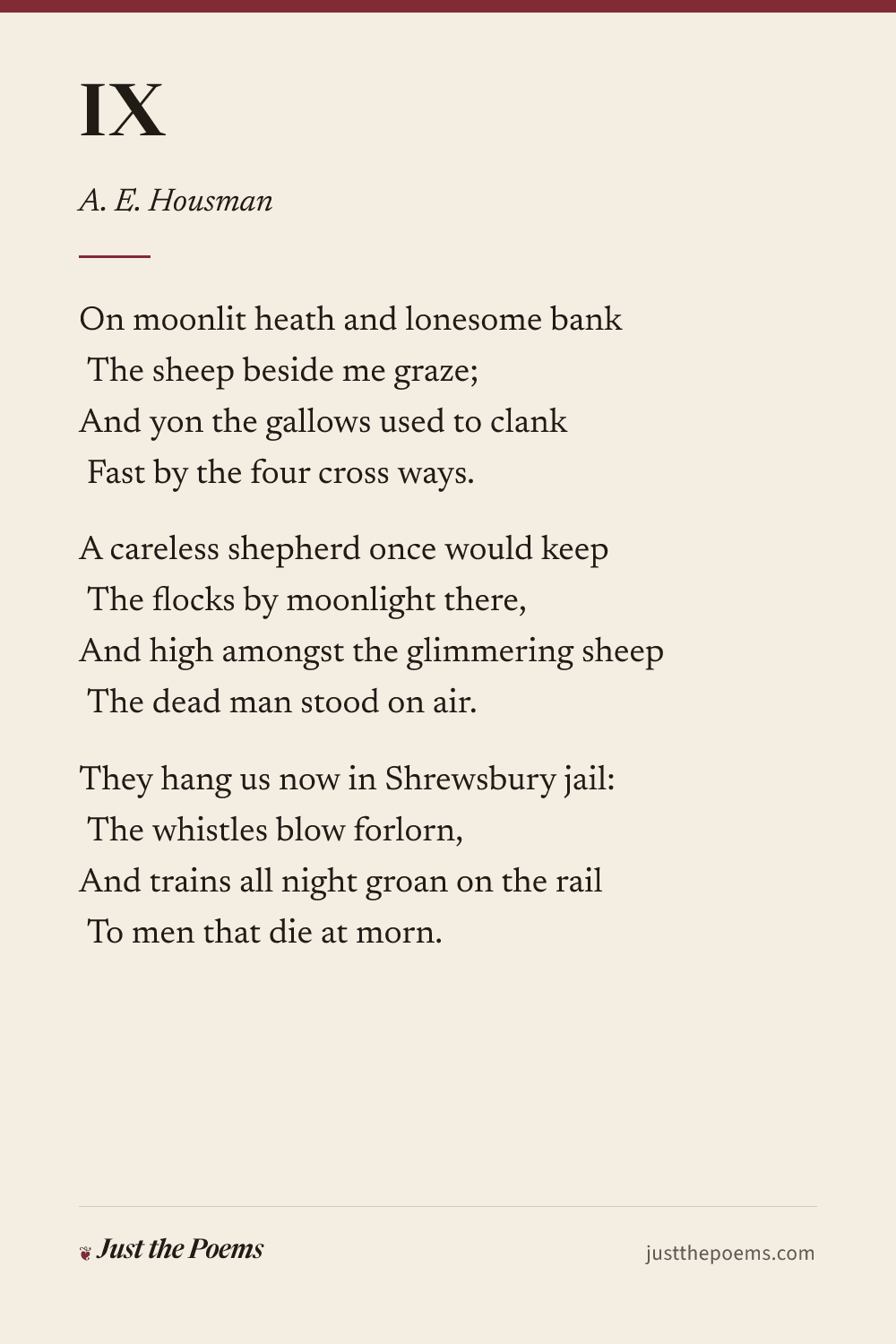
On moonlit heath and lonesome bank The sheep beside me graze;And yon the gallows used to clank Fast by the four cross ways.

A careless shepherd once would keep The flocks by moonlight there,And high amongst the glimmering sheep The dead man stood on air.

They hang us now in Shrewsbury jail: The whistles blow forlorn,And trains all night groan on the rail To men that die at morn.

Show all 32 lines 20 more

There sleeps in Shrewsbury jail to-night, Or wakes, as may betide,A better lad, if things went right, Than most that sleep outside.

And naked to the hangman's noose The morning clocks will ringA neck God made for other use Than strangling in a string.

And sharp the link of life will snap, And dead on air will standHeels that held up as straight a chap As treads upon the land.

So here I'll watch the night and wait To see the morning shine,When he will hear the stroke of eight And not the stroke of nine;

And wish my friend as sound a sleep As lads' I did not know,That shepherded the moonlit sheep A hundred years ago.

Source

A Shropshire Lad, 1919

Filed under
  • Library subject “Shropshire (England) -- Poetry”, A Shropshire Lad

L

A. E. Housman

In 0 Wikipedias 0 anthologies Poet in 32 Wikipedias

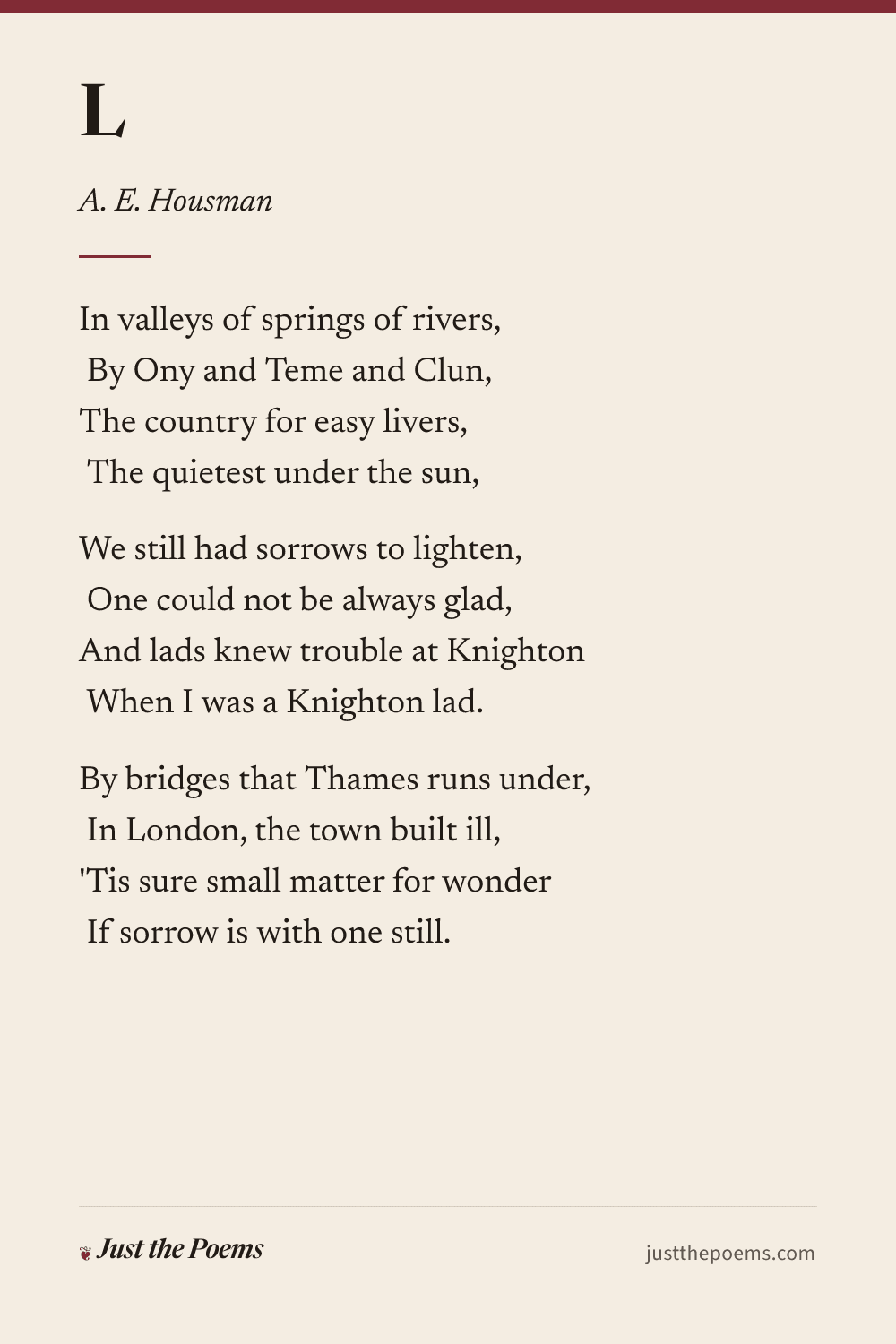
Clunton and Clunbury, Clungunford and Clun,Are the quietest places Under the sun.

In valleys of springs of rivers, By Ony and Teme and Clun,The country for easy livers, The quietest under the sun,

We still had sorrows to lighten, One could not be always glad,And lads knew trouble at Knighton When I was a Knighton lad.

By bridges that Thames runs under, In London, the town built ill,'Tis sure small matter for wonder If sorrow is with one still.

And if as a lad grows older The troubles he bears are more,He carries his griefs on a shoulder That handselled them long before.

Where shall one halt to deliver This luggage I'd lief set down?Not Thames, not Teme is the river, Nor London nor Knighton the town:

'Tis a long way further than Knighton, A quieter place than Clun,Where doomsday may thunder and lighten And little 'twill matter to one.

Source

A Shropshire Lad, 1919

Filed under
  • Library subject “Shropshire (England) -- Poetry”, A Shropshire Lad

LI

A. E. Housman

In 0 Wikipedias 0 anthologies Poet in 32 Wikipedias

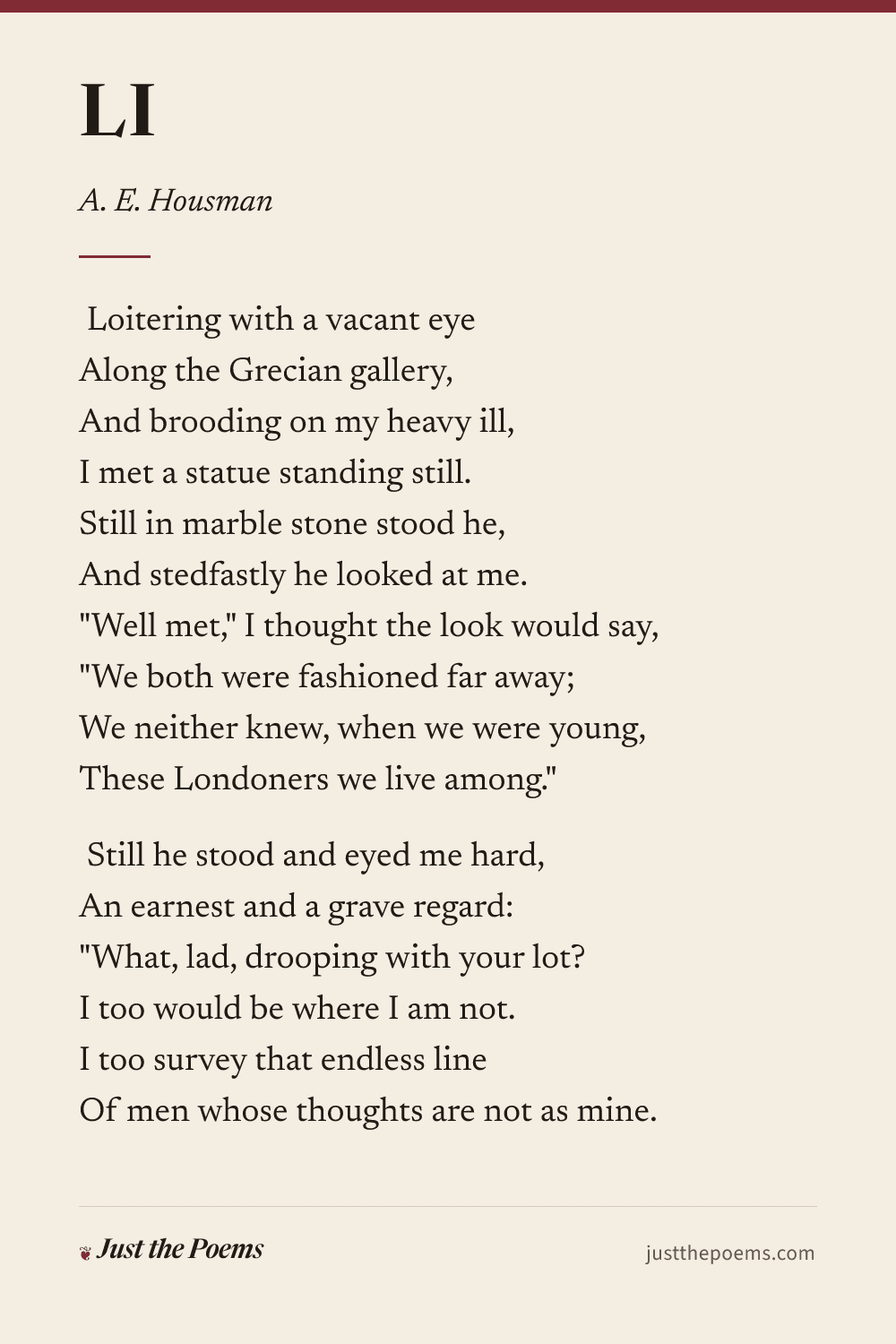
Loitering with a vacant eyeAlong the Grecian gallery,And brooding on my heavy ill,I met a statue standing still.Still in marble stone stood he,And stedfastly he looked at me."Well met," I thought the look would say,"We both were fashioned far away;We neither knew, when we were young,These Londoners we live among."

Still he stood and eyed me hard,An earnest and a grave regard:

Show all 26 lines 14 more

"What, lad, drooping with your lot?I too would be where I am not.I too survey that endless lineOf men whose thoughts are not as mine.Years, ere you stood up from rest,On my neck the collar prest;Years, when you lay down your ill,I shall stand and bear it still.Courage, lad, 'tis not for long:Stand, quit you like stone, be strong."So I thought his look would say;And light on me my trouble lay,And I slept out in flesh and boneManful like the man of stone.

Source

A Shropshire Lad, 1919

Filed under
  • Library subject “Shropshire (England) -- Poetry”, A Shropshire Lad

LII

A. E. Housman

In 0 Wikipedias 0 anthologies Poet in 32 Wikipedias

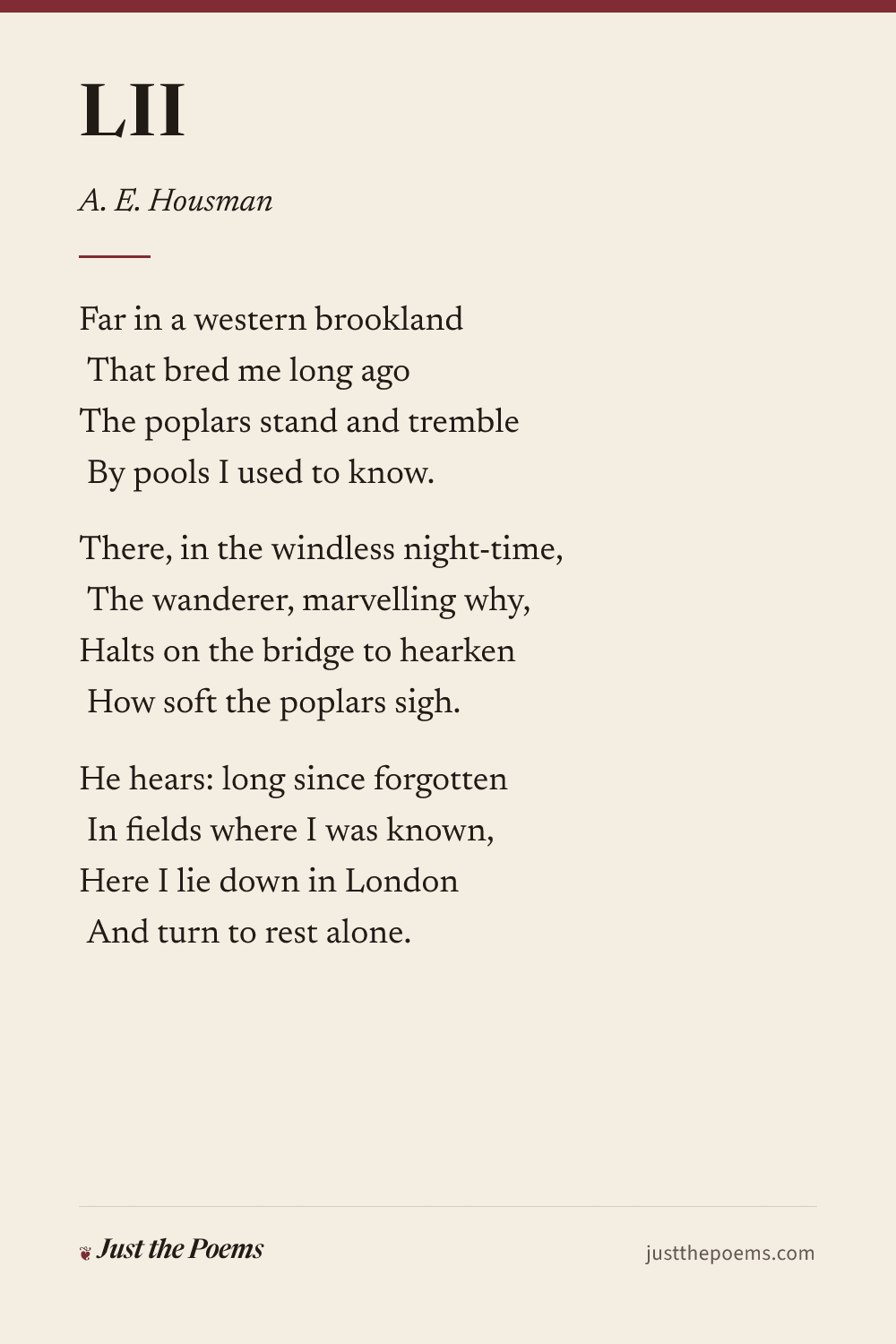
Far in a western brookland That bred me long agoThe poplars stand and tremble By pools I used to know.

There, in the windless night-time, The wanderer, marvelling why,Halts on the bridge to hearken How soft the poplars sigh.

He hears: long since forgotten In fields where I was known,Here I lie down in London And turn to rest alone.

There, by the starlit fences, The wanderer halts and hearsMy soul that lingers sighing About the glimmering weirs.

Source

A Shropshire Lad, 1919

Filed under
  • Library subject “Shropshire (England) -- Poetry”, A Shropshire Lad

30 of 145 poems about england

15 poets

By poet's century of death

CenturyPoems
17th2
18th5
19th8
20th15

Poets with more than one poem

PoetPoems
A. E. Housman12
Alexander Pope3
William Barnes3