Poems About Queens

The 12 poems about queens, by 9 poets, ranked by third-party data. How poems are ranked

ELIZABETH OF BOHEMIA

Sir Henry Wotton

In 0 Wikipedias 3 anthologies Poet in 11 Wikipedias

You meaner beauties of the night, Which poorly satisfy our eyesMore by your number than your light, You common people of the skies,What are you, when the Moon shall rise?

Ye violets that first appear, By your pure purple mantles knownLike the proud virgins of the year As if the spring were all your own,--What are you, when the Rose is blown?

You curious chanters of the wood That warble forth dame Nature's lays,Thinking your passions understood By your weak accents; what's your praiseWhen Philomel her voice doth raise?

So, when my Mistress shall be seen In sweetness of her looks and mind,By virtue first, then choice, a Queen, Tell me, if she were not design'dTh' eclipse and glory of her kind?

Source

The Golden Treasury, ed. Francis Turner Palgrave

Filed under
  • Wikidata main subject: Elizabeth Stuart, Queen of Bohemia

Dirge of the Three Queens

William Shakespeare

In 0 Wikipedias 1 anthology Poet in 237 Wikipedias

URNS and odours bring away! Vapours, sighs, darken the day!Our dole more deadly looks than dying; Balms and gums and heavy cheers, Sacred vials fill’d with tears,And clamours through the wild air flying!

Come, all sad and solemn shows, That are quick-eyed Pleasure’s foes! We convènt naught else but woes.

Source

The Oxford Book of English Verse 1250–1900, 1900

Filed under
  • Named in the title

QUEEN MAB

Ben Jonson

In 0 Wikipedias 1 anthology Poet in 63 Wikipedias

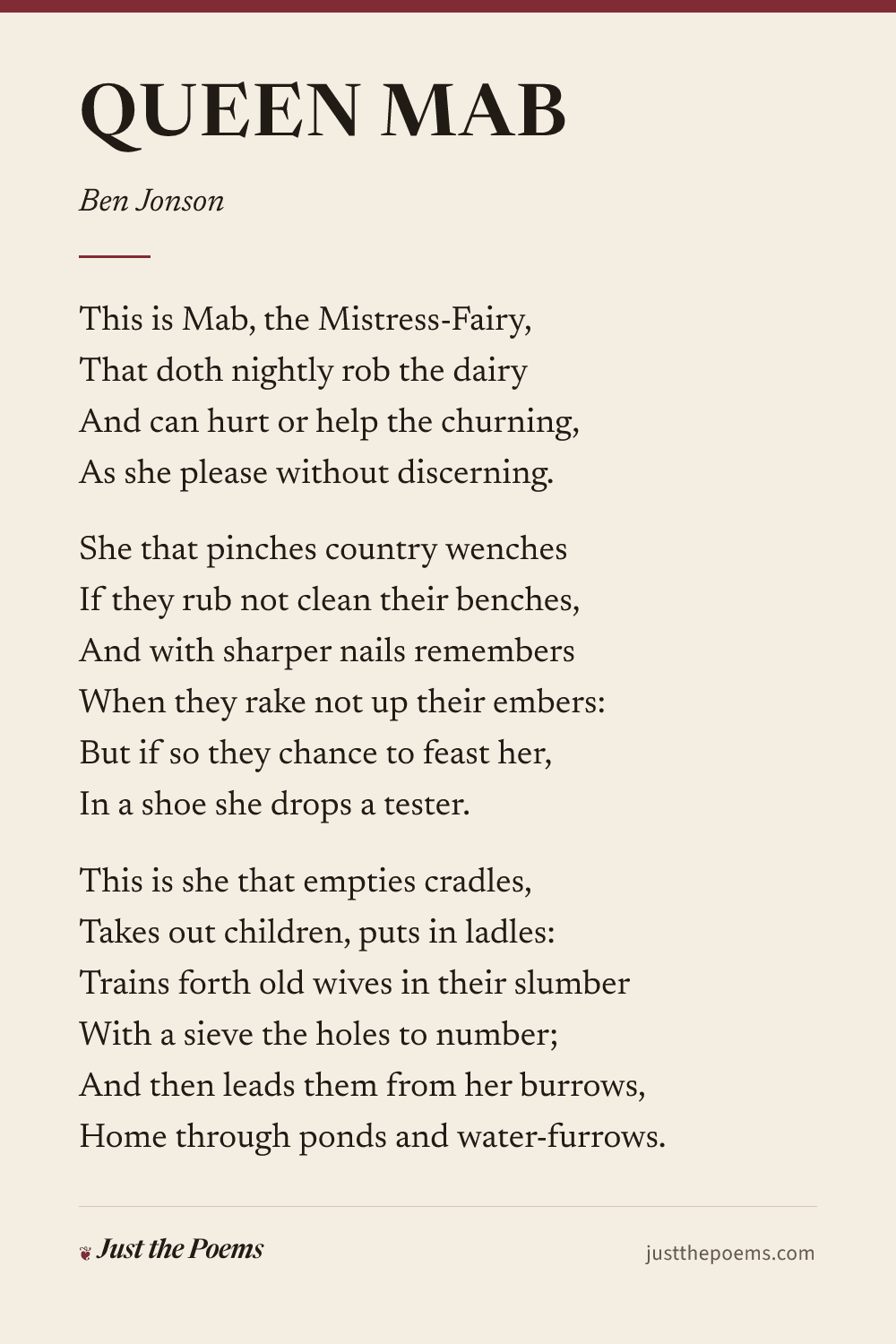
This is Mab, the Mistress-Fairy,That doth nightly rob the dairyAnd can hurt or help the churning,As she please without discerning.

She that pinches country wenchesIf they rub not clean their benches,And with sharper nails remembersWhen they rake not up their embers:But if so they chance to feast her,In a shoe she drops a tester.

This is she that empties cradles,Takes out children, puts in ladles:Trains forth old wives in their slumberWith a sieve the holes to number;And then leads them from her burrows,Home through ponds and water-furrows.

She can start our Franklins' daughters,In their sleep, with shrieks and laughters:And on sweet Saint Anna's nightFeed them with a promised sight,Some of husbands, some of lovers,Which an empty dream discovers.

Source

The Home Book of Verse, ed. Burton Egbert Stevenson

Filed under
  • Named in the title

Advertisements

QUEEN MAB

Thomas Hood

In 0 Wikipedias 1 anthology Poet in 20 Wikipedias

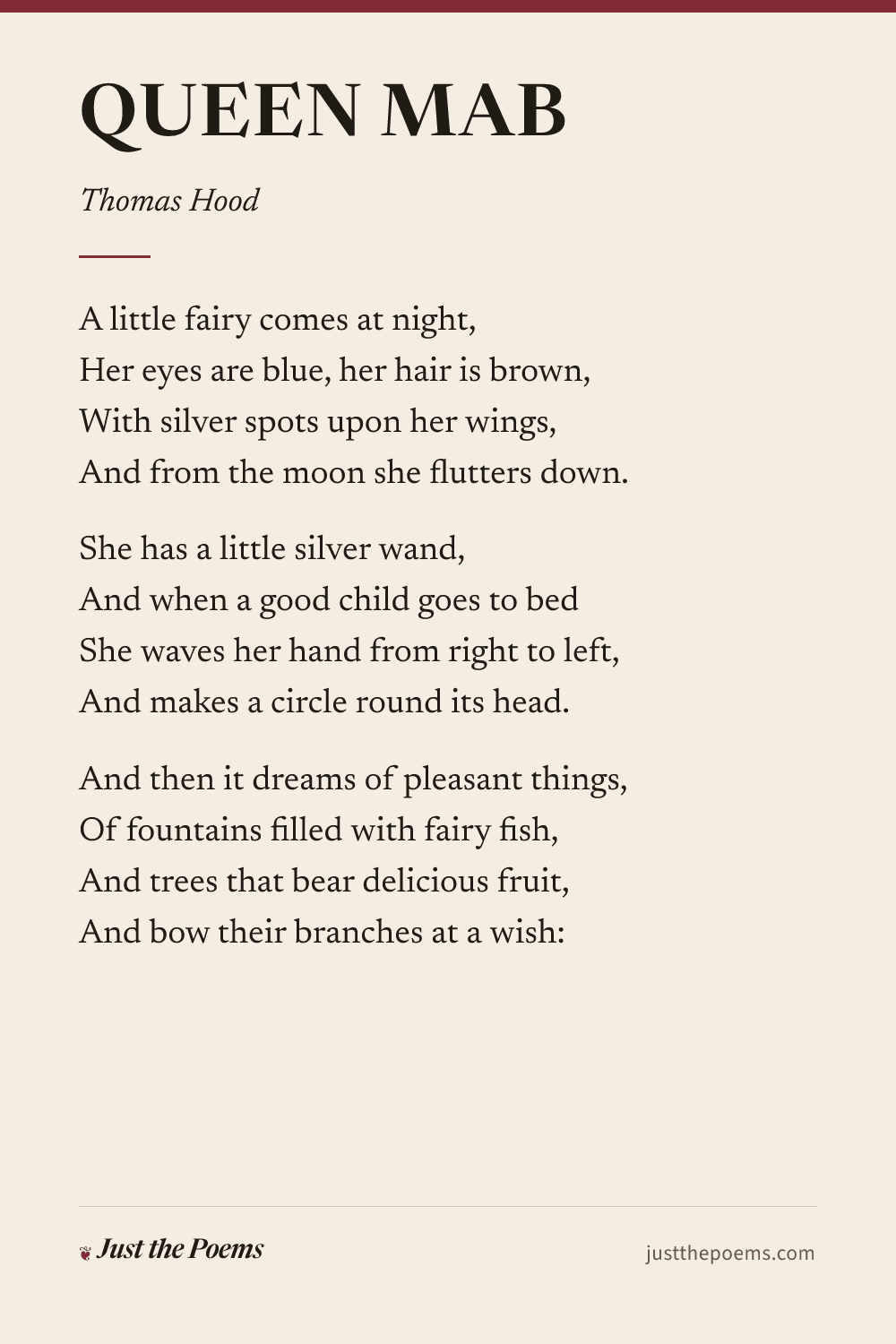
A little fairy comes at night,Her eyes are blue, her hair is brown,With silver spots upon her wings,And from the moon she flutters down.

She has a little silver wand,And when a good child goes to bedShe waves her hand from right to left,And makes a circle round its head.

And then it dreams of pleasant things,Of fountains filled with fairy fish,And trees that bear delicious fruit,And bow their branches at a wish:

Show all 36 lines 24 more

Of arbors filled with dainty scentsFrom lovely flowers that never fade;Bright flies that glitter in the sun,And glow-worms shining in the shade:

And talking birds with gifted tongues,For singing songs and telling tales,And pretty dwarfs to show the wayThrough fairy hills and fairy dales.

But when a bad child goes to bed,From left to right she weaves her rings,And then it dreams all through the nightOf only ugly horrid things!

Then lions come with glaring eyes,And tigers growl, a dreadful noise,And ogres draw their cruel knives,To shed the blood of girls and boys.

Then stormy waves rush on to drown,Or raging flames come scorching round,Fierce dragons hover in the air,And serpents crawl along the ground.

Then wicked children wake and weep,And wish the long black gloom away;But good ones love the dark, and findThe night as pleasant as the day.

Source

The Home Book of Verse, ed. Burton Egbert Stevenson

Filed under
  • Named in the title

On the Queen’s Return from the Low Countries

William Cartwright

In 0 Wikipedias 1 anthology Poet in 8 Wikipedias

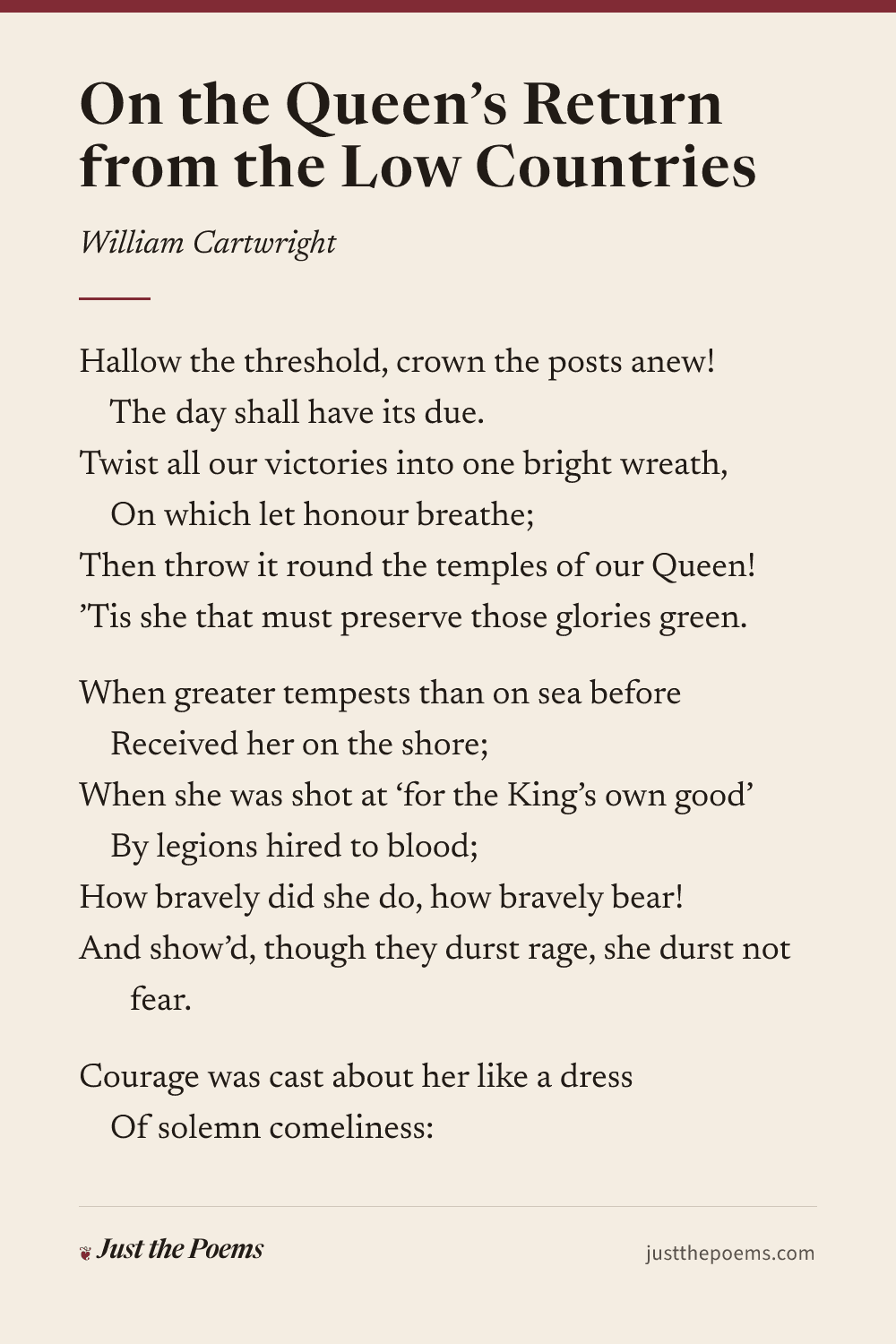
Hallow the threshold, crown the posts anew! The day shall have its due.Twist all our victories into one bright wreath, On which let honour breathe;Then throw it round the temples of our Queen!’Tis she that must preserve those glories green.

When greater tempests than on sea before Received her on the shore;When she was shot at ‘for the King’s own good’ By legions hired to blood;How bravely did she do, how bravely bear!And show’d, though they durst rage, she durst not fear.

Courage was cast about her like a dress Of solemn comeliness:A gathered mind and an untroubled face Did give her dangers grace:Thus, arm’d with innocence, secure they moveWhose highest ‘treason’ is but highest love.

Source

The Oxford Book of English Verse 1250–1900, 1900

Filed under
  • Named in the title

THE QUEEN

William Winter

In 0 Wikipedias 1 anthology Poet in 4 Wikipedias

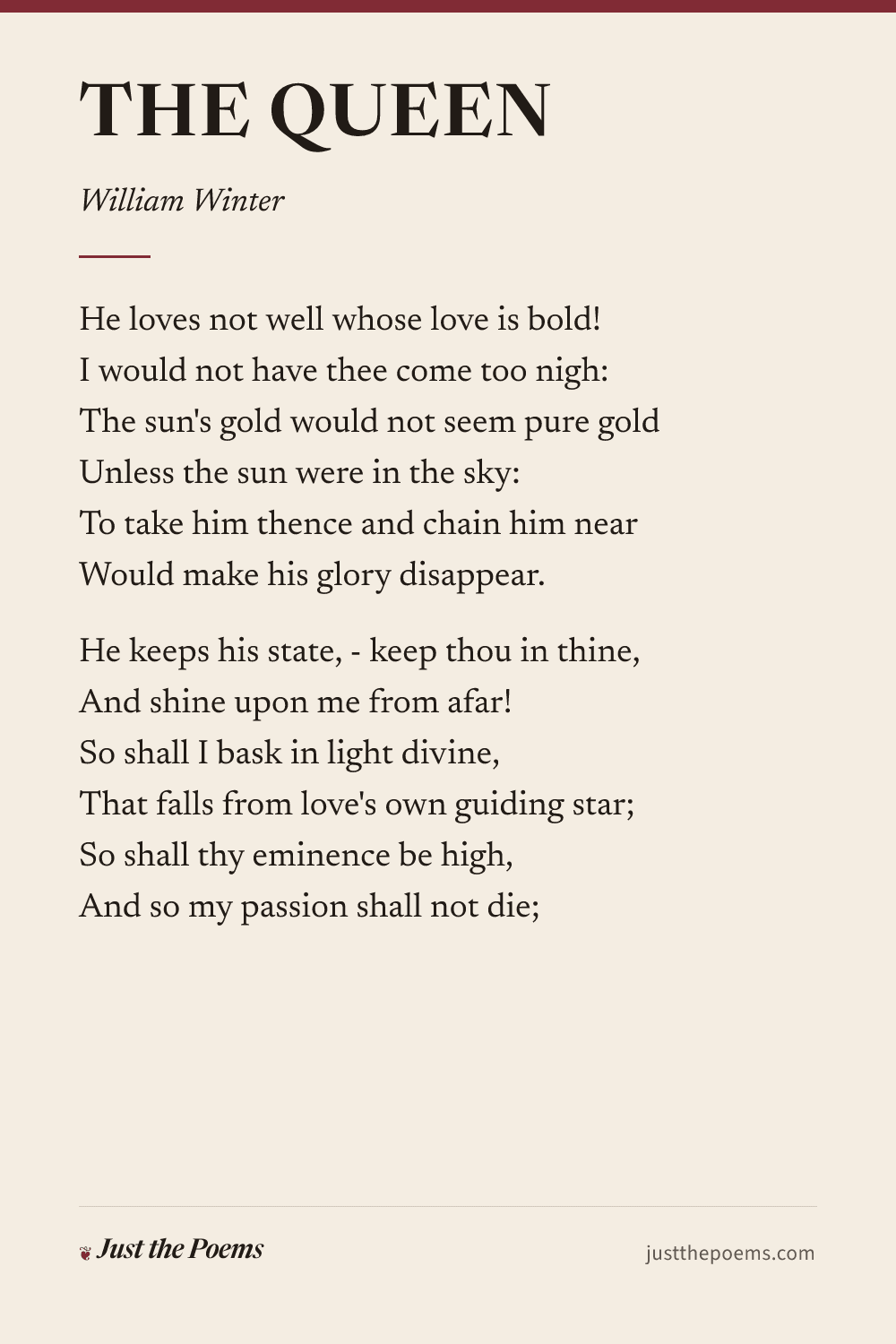
He loves not well whose love is bold!I would not have thee come too nigh:The sun's gold would not seem pure goldUnless the sun were in the sky:To take him thence and chain him nearWould make his glory disappear.

He keeps his state, - keep thou in thine,And shine upon me from afar!So shall I bask in light divine,That falls from love's own guiding star;So shall thy eminence be high,And so my passion shall not die;

Show all 30 lines 18 more

But all my life shall reach its handsOf lofty longing toward thy face,And be as one who, speechless, standsIn rapture at some perfect grace!My love, my hope, my all shall beTo look to heaven and look to thee!

Thy eyes shall be the heavenly lights,Thy voice the gentle summer breeze, -What time it sways, on moonlit nights,The murmuring tops of leafy trees;And I shall touch thy beauteous formIn June's red roses, rich and warm.

But thou thyself shall come not downFrom that pure region far above;But keep thy throne and wear thy crown,Queen of my heart and queen of love!A monarch in thy realm complete,And I a monarch - at thy feet!

Source

The Home Book of Verse, ed. Burton Egbert Stevenson

Filed under
  • Named in the title

MY QUEEN

Anonymous

In 0 Wikipedias 1 anthology Poet in 0 Wikipedias

When and how shall I earliest meet her?What are the words she first will say?By what name shall I learn to greet her?I know not now; it will come some day!With the selfsame sunlight shining upon her,Shining down on her ringlets' sheen,She is standing somewhere - she I shall honor,She that I wait for, my queen, my queen!

Whether her hair be golden or raven,Whether her eyes be hazel or blue,I know not now; but 'twill be engravenSome day hence as my loveliest hue.

Show all 32 lines 20 more

Many a girl I have loved for a minute,Worshipped many a face I have seen:Ever and aye there was something in it,Something that could not be hers, my queen!

I will not dream of her tall and stately,She that I love may be fairy light;I will not say she must move sedately, -Whatever she does it will then be right.She may be humble or proud, my lady,Or that sweet calm which is just between;And whenever she comes she will find me readyTo do her homage, my queen, my queen!

But she must be courteous, she must be holy,Pure in her spirit, this maiden I love;Whether her birth be noble or lowlyI care no more than the spirits above.But I'll give my heart to my lady's keeping,And ever her strength on mine shall lean;And the stars may fall, and the saints be weepingEre I cease to love her, my queen, my queen!

Source

The Home Book of Verse, ed. Burton Egbert Stevenson

Filed under
  • Named in the title

THE QUEEN OF HEARTS

Anonymous

In 0 Wikipedias 1 anthology Poet in 0 Wikipedias

The Queen of HeartsShe made some tarts,All on a summer's day;The Knave of HeartsHe stole those tarts,And with them ran away.

The King of HeartsCalled for the tarts,And beat the Knave full sore;The Knave of HeartsBrought back the tarts,And vowed he'd steal no more!

Source

The Home Book of Verse, ed. Burton Egbert Stevenson

Filed under
  • Named in the title

Advertisements

The Queen’s Marie

Anonymous

In 0 Wikipedias 1 anthology Poet in 0 Wikipedias

Marie Hamilton’s to the kirk gane, Wi’ ribbons in her hair;The King thought mair o’ Marie Hamilton Than ony that were there.

Marie Hamilton’s to the kirk gane Wi’ ribbons on her breast;The King thought mair o’ Marie Hamilton Than he listen’d to the priest.

Marie Hamilton’s to the kirk gane, Wi’ gloves upon her hands;The King thought mair o’ Marie Hamilton Than the Queen and a’ her lands.

Show all 104 lines 92 more

She hadna been about the King’s court A month, but barely one,Till she was beloved by a’ the King’s court And the King the only man.

She hadna been about the King’s court A month, but barely three,Till frae the King’s court Marie Hamilton, Marie Hamilton durstna be.

The King is to the Abbey gane, To pu’ the Abbey tree,To scale the babe frae Marie’s heart; But the thing it wadna be.

O she has row’d it in her apron, And set it on the sea--‘Gae sink ye or swim ye, bonny babe, Ye’se get nae mair o’ me.’

Word is to the kitchen gane, And word is to the ha’,And word is to the noble room Amang the ladies a’,That Marie Hamilton’s brought to bed, And the bonny babe’s miss’d and awa’.

Scarcely had she lain down again, And scarcely fa’en asleep,When up and started our gude Queen Just at her bed-feet;Saying--‘Marie Hamilton, where’s your babe? For I am sure I heard it greet.’

‘O no, O no, my noble Queen! Think no sic thing to be;’Twas but a stitch into my side, And sair it troubles me!’

‘Get up, get up, Marie Hamilton: Get up and follow me;For I am going to Edinburgh town, A rich wedding for to see.’

O slowly, slowly rase she up, And slowly put she on;And slowly rade she out the way Wi’ mony a weary groan.

The Queen was clad in scarlet, Her merry maids all in green;And every town that they cam to, They took Marie for the Queen.

‘Ride hooly, hooly, gentlemen, Ride hooly now wi’ me!For never, I am sure, a wearier burd Rade in your companie.’--

But little wist Marie Hamilton, When she rade on the brown,That she was gaen to Edinburgh town, And a’ to be put down.

‘Why weep ye so, ye burgess wives, Why look ye so on me?O I am going to Edinburgh town, A rich wedding to see.’

When she gaed up the tolbooth stairs, The corks frae her heels did flee;And lang or e’er she cam down again, She was condemn’d to die.

When she cam to the Netherbow port, She laugh’d loud laughters three;But when she came to the gallows foot The tears blinded her e’e.

‘Yestreen the Queen had four Maries, The night she’ll hae but three;There was Marie Seaton, and Marie Beaton, And Marie Carmichael, and me.

‘O often have I dress’d my Queen And put gowd upon her hair;But now I’ve gotten for my reward The gallows to be my share.

‘Often have I dress’d my Queen And often made her bed;But now I’ve gotten for my reward The gallows tree to tread.

‘I charge ye all, ye mariners, When ye sail owre the faem,Let neither my father nor mother get wit But that I’m coming hame.

‘I charge ye all, ye mariners, That sail upon the sea,That neither my father nor mother get wit The dog’s death I’m to die.

‘For if my father and mother got wit, And my bold brethren three,O mickle wad be the gude red blude This day wad be spilt for me!

‘O little did my mother ken, The day she cradled me,The lands I was to travel in Or the death I was to die!

Source

The Oxford Book of English Verse 1250–1900, 1900

Filed under
  • Named in the title

THE QUEEN'S MEN

Rudyard Kipling

In 0 Wikipedias 0 anthologies Poet in 126 Wikipedias

Valour and InnocenceHave latterly gone henceTo certain death by certain shame attended.Envy--ah! even to tears!--The fortune of their yearsWhich, though so few, yet so divinely ended.

Scarce had they lifted upLife's full and fiery cup,Than they had set it down untouched before them.Before their day aroseThey beckoned it to close--Close in confusion and destruction o'er them.

They did not stay to askWhat prize should crown their task,Well sure that prize was such as no man strives for;But passed into eclipse,Her kiss upon their lips--Even Belphoebe's, whom they gave their lives for!

Source

Songs from Books, 1914

Filed under
  • Named in the title

“HOW BEAUTIFUL THE QUEEN OF NIGHT, ON HIGH”

William Wordsworth

In 0 Wikipedias 0 anthologies Poet in 97 Wikipedias

How beautiful the Queen of Night, on highHer way pursuing among scattered clouds,Where, ever and anon, her head she shroudsHidden from view in dense obscurity.But look, and to the watchful eyeA brightening edge will indicate that soonWe shall behold the struggling MoonBreak forth,--again to walk the clear blue sky.

Source

The Poetical Works of William Wordsworth — Volume 8 (of 8), ed. William Angus Knight, 1896

Filed under
  • Named in the title

VICTORIAN ODE.

Francis Thompson

In 0 Wikipedias 0 anthologies Poet in 14 Wikipedias

Night; and the street a corpse beneath the moon,Upon the threshold of the jubilant dayThat was to follow soon;Thickened with inundating dark'Gainst which the drowning lamps kept struggle; poleAnd plank cast rigid shadows; 'twas a starkThing waiting for its soul,The bones of the preluded pomp. I sawIn the cloud-sullied moon a pale array,A lengthened apparition, slowly draw;And as it came,Brake all the street in phantom flame

Show all 246 lines 234 more

Of flag and flower and hanging, shadowy showOf the to-morrow's glories, as might suitA pageant of the dead; and spectral bruitI heard, where stood the dead to watch the dead,The long Victorian line that passed with printless tread.First went the holy poets, two on two,And music, sown along the hardened ground,Budded like frequence of glad daisies, whereThose sacred feet did fare;Arcadian pipe, and psaltery, around,And stringed viol, soundTo make for them melodious due.In the first twain of those great ranks of deathWent one, the impress recent on his hairWhere it was dinted by the laureate wreath:Who sang those goddesses with splendours bareOn Ida hill, before the Trojan boy;And many a lovely lay,Where Beauty did her beauties unarrayIn conscious song. I saw young Love his plumes deploy,And shake their shivering lustres, till the nightWas sprinkled and bedropt with starry playOf versicoloured light,To see that poet pass who sang him well;And I could hear his heartThrob like the after-vibrance of a bell.A Strength beside this Beauty, Browning went,With shrewd looks and intent,And meditating still some gnarled theme.Then came, somewhat apart,In a fastidious dream,Arnold, with a half-discontented calm,Binding up wounds, but pouring in no balm.The fervid breathing of ElizabethBroke on Christina's gentle-taken breath.Rossetti, whose heart stirred within his breastLike lightning in a cloud, a spirit without rest,Came on disranked; Song's hand was in his hair,Lest Art should have withdrawn him from the band,Save for her strong command;And in his eyes high Sadness made its lair.Last came a shadow tall, with drooping lid,Which yet not hidThe steel-like flashing of his armed glance;Alone he did advance,And all the throngs gave roomFor one that looked with such a captain's mien:A scornful smile lay keenOn lips that, living, prophesied of doom.His one hand held a lightning-bolt, the otherA cup of milk and honey blent with fire;It seemed as in that quireHe had not, nor desired not, any brother.A space his alien eye surveyed the prideOf meditated pomp, as one that muchDisdained the sight, methought; then at a touch,He turned the heel, and sought with shadowy strideHis station in the dim,Where the sole-thoughted Dante waited him.

What throngs illustrious next, of Art and Prose,Too long to tell; but other music roseWhen came the sabre's children: they who ledThe iron-throated harmonies of war,The march resounding of the armed line,And measured movement of battalia:Accompanied their treadNo harps, no pipes of soft Arcadia,But--borne to me afar--The tramp of squadrons, and the bursting mine,The shock of steel, the volleying rifle-crack,And echoes out of ancient battles dead.So Cawnpore unto Alma thundered back,And Delhi's cannon roared to Gujerat:Carnage through all those iron vents gave outHer thousand-mouthed shout.As balefire answering balefire is unfurled,From mountain-peaks, to tell the foe's approaches,So ran that battle-clangour round the world,From famous field to fieldSo that reverberated war was tossed;And--in the distance lost--Across the plains of France and hills of SpainIt swelled once more to birth,And broke on me again,The voice of England's glories girdling in the earth.

It caught like fire the main,Where rending planks were heard, and broadsides pealed,That shook were all the seas,Which feared, and thought on Nelson. For with themThat struck the Russ, that brake the Mutineer,And smote the stiff Sikh to his knee,--with theseCame they that kept our England's sea-swept hem,And held afar from her the foreign fear.After them cameThey who pushed back the ocean of the Unknown,And fenced some strand of knowledge for our ownAgainst the outgoing seaOf ebbing mystery;And on their banner "Science" blazoned shone.The rear were they that wore the statesman's fame,From Melbourne, toThe arcane face of the much-wrinkled Jew.

Lo, in this day we keep the yesterdays,And those great dead of the Victorian line.They passed, they passed, but cannot pass away,For England feels them in her blood like wine.She was their mother, and she is their daughter,This Lady of the water,And from their loins she draws the greatness which they were.And still their wisdom sways,Their power lives in her.Their thews it is, England, that lift thy sword,They are the splendour, England, in thy song,They sit unbidden at thy council-board,Their fame doth compass all thy coasts from wrong,And in thy sinews they are strong.Their absence is a presence and a guestIn this day's feast;This living feast is also of the dead,And this, O England, is thine All Souls' Day.And when thy cities flake the night with flames,Thy proudest torches yet shall be their names.

O royal England! happy childOf such a more than regal line;Be it saidFair right of jubilee is thine;And surely thou art unbeguiledIf thou keep with mirth and play,With dance, and jollity, and praise,Such a To-day which sums such Yesterdays.Pour to the joyless ones thy joy, thy oilAnd wine to such as faint and toil.And let thy vales make haste to be more greenThan any vales are seenIn less auspicious lands,And let thy trees clap all their leafy hands,And let thy flowers be gladder far of hueThan flowers of other regions may;Let the rose, with her fragrance sweetened through,Flush as young maidens do,With their own inward blissfulness at play.And let the sky twinkle an eagerer blueOver our English isleThan any otherwhere;Till strangers shall behold, and own that she is fair.Play up, play up, ye birds of minstrel June,Play up your reel, play up your giddiest spring,And trouble every tree with lusty tune,Whereto our hearts shall danceFor overmuch pleasance,And children's running make the earth to sing.And ye soft winds, and ye white-fingered beams,Aid ye her to invest,Our queenly England, in all circumstanceOf fair and feat adorning to be drest;Kirtled in jocund green,Which does befit a Queen,And like our spirits cast forth lively gleams:And let her robe be goodly garlandedWith store of florets white and florets red,With store of florets white and florets gold,A fair thing to behold;Intrailed with the white blossom and the blue,A seemly thing to view!And thereunto,Set over all a woof of lawny air,From her head wavering to her sea-shod feet,Which shall her lovely beauty well complete,And grace her much to wear.

Lo, she is dressed, and lo, she cometh forth,Our stately Lady of the North;Lo, how she doth advance,In her most sovereign eye regard of puissance,And tiar'd with conquest her prevailing brow,While nations to her bow.Come hither, proud and ancient East,Gather ye to this Lady of the North,And sit down with her at her solemn feast,Upon this culminant day of all her days;For ye have heard the thunder of her goings-forth,And wonder of her large imperial ways.Let India send her turbans, and JapanHer pictured vests from that remotest isleSeated in the antechambers of the Sun:And let her Western sisters for a whileRemit long envy and disunion,And take in peaceHer hand behind the buckler of her seas,'Gainst which their wrath has splintered; come, for sheHer hand ungauntlets in mild amity.Victoria! Queen, whose name is victory,Whose woman's nature sorteth best with peace,Bid thou the cloud of war to ceaseWhich ever round thy wide-girt emperyFumes, like to smoke about a burning brand,Telling the energies which keep withinThe light unquenched, as England's light shall be;And let this day hear only peaceful din.For, queenly woman, thou art more than woman;Thy name the often-struck barbarian shuns;Thou art the fear of England to her foemen,The love of England to her sons.And this thy glorious day is England's; whoCan separate the two?She joys thy joys and weeps thy tears,And she is one with all thy moods;Thy story is the tale of England's years,And big with all her ills, and all her stately goods.Now unto theeThe plenitude of the glories thou didst sowIs garnered up in prosperous memory;And, for the perfect evening of thy day,An untumultuous bliss, serenely gay,Sweetened with silence of the after-glow.

Nor does the joyous shoutWhich all our lips give outJar on that quietude; more than may doA radiant childish crew,With well-accordant discord fretting the soft hour,Whose hair is yellowed by the sinking blazeOver a low-mouthed sea. Exult, yet be not twirled,England, by gusts of mereBlind and insensate lightness; neither fearThe vastness of thy shadow on the world.If in the EastStill strains against its leash the unglutted beastOf War; if yet the cannon's lip be warm;Thou, whom these portents warn but not alarm,Feastest, but with thy hand upon the sword,As fits a warrior race.Not like the Saxon fools of olden days,With the mead dripping from the hairy mouth,While all the SouthFilled with the shaven faces of the Norman horde.
Source

Victorian Ode for Jubilee Day, 1897, 1897

Filed under
  • Library subject “Victoria, Queen of Great Britain, 1819-1901 -- Anniversaries, etc. -- Poetry”, Victorian Ode for Jubilee Day, 1897

12 poems about queens

9 poets

By poet's century of death (9 of 12)

CenturyPoems
17th4
19th2
20th3