Poems for Boys

The 29 poems for boys, by 24 poets, ranked by third-party data. How poems are ranked

The Little Black Boy

William Blake

In 3 Wikipedias 2 anthologies Poet in 101 Wikipedias

My mother bore me in the southern wild, And I am black, but O, my soul is white!White as an angel is the English child, But I am black, as if bereaved of light.

My mother taught me underneath a tree, And, sitting down before the heat of day,She took me on her lap and kissèd me, And, pointing to the East, began to say:

‘Look at the rising sun: there God does live, And gives His light, and gives His heat away,And flowers and trees and beasts and men receive Comfort in morning, joy in the noonday.

Show all 28 lines 16 more

‘And we are put on earth a little space, That we may learn to bear the beams of love;And these black bodies and this sunburnt face Are but a cloud, and like a shady grove.

‘For when our souls have learn’d the heat to bear, The cloud will vanish, we shall hear His voice,Saying, “Come out from the grove, my love and care, And round my golden tent like lambs rejoice.”’

Thus did my mother say, and kissèd me, And thus I say to little English boy.When I from black and he from white cloud free, And round the tent of God like lambs we joy,

I’ll shade him from the heat till he can bear To lean in joy upon our Father’s knee;And then I’ll stand and stroke his silver hair, And be like him, and he will then love me.

Source

The Oxford Book of English Verse 1250–1900, 1900

Filed under
  • Named in the title

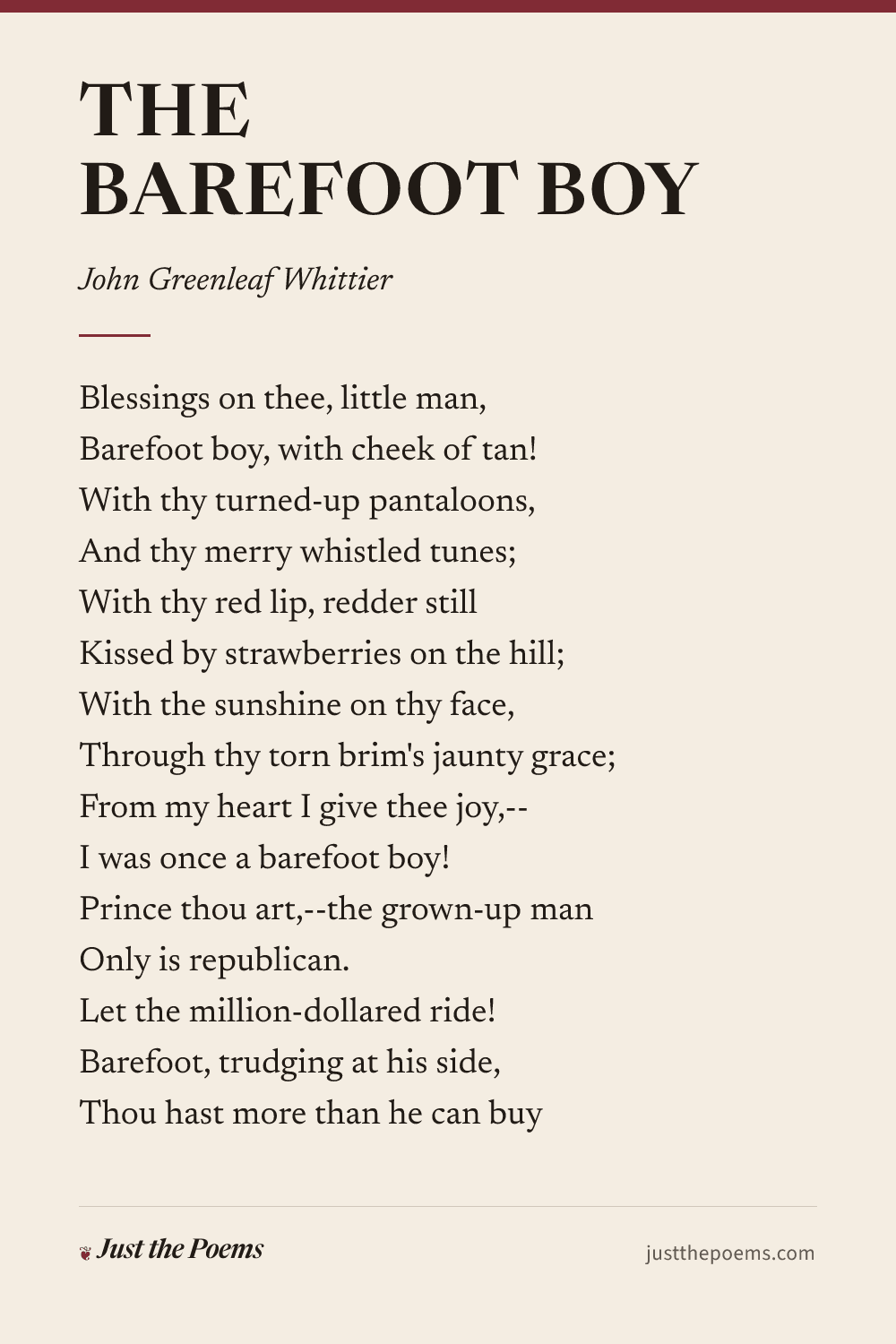
THE BAREFOOT BOY

John Greenleaf Whittier

In 1 Wikipedia 2 anthologies Poet in 33 Wikipedias

Blessings on thee, little man,Barefoot boy, with cheek of tan!With thy turned-up pantaloons,And thy merry whistled tunes;With thy red lip, redder stillKissed by strawberries on the hill;With the sunshine on thy face,Through thy torn brim's jaunty grace;From my heart I give thee joy,--I was once a barefoot boy!Prince thou art,--the grown-up manOnly is republican.

Show all 102 lines 90 more

Let the million-dollared ride!Barefoot, trudging at his side,Thou hast more than he can buyIn the reach of ear and eye,--Outward sunshine, inward joy:Blessings on thee, barefoot boy!

Oh for boyhood's painless play,Sleep that wakes in laughing day,Health that mocks the doctor's rules,Knowledge never learned of schools,Of the wild bee's morning chase,Of the wild flower's time and place,Flight of fowl and habitudeOf the tenants of the wood;How the tortoise bears his shell,How the woodchuck digs his cell,And the ground-mole sinks his well;How the robin feeds her young,How the oriole's nest is hung;Where the whitest lilies blow,Where the freshest berries grow,Where the ground-nut trails its vine,Where the wood-grape's clusters shine;Of the black wasp's cunning way,Mason of his walls of clay,And the architectural plansOf gray hornet artisans!For, eschewing books and tasks,Nature answers all he asks;Hand in hand with her he walks,Face to face with her he talks,Part and parcel of her joy,--Blessings on the barefoot boy!

Oh for boyhood's time of June,Crowding years in one brief moon,When all things I heard or saw,Me, their master, waited for.I was rich in flowers and trees,Humming-birds and honey-bees;For my sport the squirrel played,Plied the snouted mole his spade;For my taste the blackberry conePurpled over hedge and stone;Laughed the brook for my delightThrough the day and through the night,Whispering at the garden wall,Talked with me from fall to fall;Mine the sand-rimmed pickerel pondMine the walnut slopes beyond,Mine, on bending orchard trees,Apples of Hesperides!Still as my horizon grew,Larger grew my riches too;All the world I saw or knewSeemed a complex Chinese toy,Fashioned for a barefoot boy!

Oh for festal dainties spread,Like my bowl of milk and bread;Pewter spoon and bowl of wood,On the door-stone, gray and rude!O'er me, like a regal tent,Cloudy-ribbed, the sunset bent,Purple-curtained, fringed with gold,Looped in many a wind-swung fold;While for music came the playOf the pied frogs' orchestra;And, to light the noisy choir,Lit the fly his lamp of fire.I was monarch: pomp and joyWaited on the barefoot boy!

Cheerily, then, my little man,Live and laugh, as boyhood can!Though the flinty slopes be hard,Stubble-speared the new-mown sward,Every morn shall lead thee throughFresh baptisms of the dew;Every evening from thy feetShall the cool wind kiss the heat:All too soon these feet must hideIn the prison cells of pride,Lose the freedom of the sod,Like a colt's for work be shod,Made to tread the mills of toil,Up and down in ceaseless moil:Happy if their track be foundNever on forbidden ground;Happy if they sink not inQuick and treacherous sands of sin.Ah! that thou couldst know thy joy,Ere it passes, barefoot boy!

Source

The Home Book of Verse, ed. Burton Egbert Stevenson

Filed under
  • Named in the title

LITTLE BOY BLUE

Eugene Field

In 1 Wikipedia 2 anthologies Poet in 10 Wikipedias

The little toy dog is covered with dust,But sturdy and stanch he stands;And the little toy soldier is red with rust,And his musket moulds in his hands.Time was when the little toy dog was new,And the soldier was passing fair;And that was the time when our Little Boy BlueKissed them and put them there.

"Now, don't you go till I come," he said,"And don't you make any noise!"So, toddling off to his trundle-bed,He dreamt of the pretty toys;And, as he was dreaming, an angel songAwakened our Little Boy Blue--Oh! the years are many, the years are long,But the little toy friends are true!

Ay, faithful to Little Boy Blue they stand,Each in the same old place,Awaiting the touch of a little hand,The smile of a little face;And they wonder, as waiting the long years throughIn the dust of that little chair,What has become of our Little Boy Blue,Since he kissed them and put them there.

Source

The Home Book of Verse, ed. Burton Egbert Stevenson

Filed under
  • Named in the title

Advertisements

THE LITTLE BOY FOUND

William Blake

In 1 Wikipedia 0 anthologies Poet in 101 Wikipedias

The little boy lost in the lonely fen, Led by the wandering light,Began to cry, but God, ever nigh, Appeared like his father, in white.

He kissed the child, and by the hand led, And to his mother brought,Who in sorrow pale, through the lonely dale, The little boy weeping sought.

Source

Poems of William Blake

Filed under
  • Named in the title

THE LITTLE BOY LOST

William Blake

In 1 Wikipedia 0 anthologies Poet in 101 Wikipedias

"Father, father, where are you going? Oh do not walk so fast!Speak, father, speak to your little boy, Or else I shall be lost."

The night was dark, no father was there, The child was wet with dew;The mire was deep, and the child did weep, And away the vapour flew.

Source

Poems of William Blake

Filed under
  • Named in the title

A Boy’s Song

James Hogg

In 0 Wikipedias 3 anthologies Poet in 24 Wikipedias

Where the pools are bright and deep,Where the grey trout lies asleep,Up the river and over the lea,That’s the way for Billy and me.

Where the blackbird sings the latest,Where the hawthorn blooms the sweetest,Where the nestlings chirp and flee,That’s the way for Billy and me.

Where the mowers mow the cleanest,Where the hay lies thick and greenest,There to track the homeward bee,That’s the way for Billy and me.

Where the hazel bank is steepest,Where the shadow falls the deepest,Where the clustering nuts fall free,That’s the way for Billy and me.

Why the boys should drive awayLittle sweet maidens from the play,Or love to banter and fight so well,That’s the thing I never could tell.

But this I know, I love to playThrough the meadow, among the hay;Up the water and over the lea,That’s the way for Billy and me.

Source

The Oxford Book of English Verse 1250–1900, 1900

Filed under
  • Named in the title

THE BOYS

Oliver Wendell Holmes

In 0 Wikipedias 2 anthologies Poet in 37 Wikipedias

Has there any old fellow got mixed with the boys?If there has, take him out, without making a noise.Hang the Almanac's cheat and the Catalogue's spite!Old Time is a liar! We're twenty to-night!

We're twenty! We're twenty! Who, says we are more?He's tipsy,--young jackanapes!--show him the door!"Gray temples at twenty?"--Yes! white if we please!Where the snow-flakes fall thickest there's nothing can freeze!

Was it snowing I spoke of? Excuse the mistake!Look close,--you will not see a sign of a flake!We want some new garlands for those we have shed,--And these are white roses in place of the red.

Show all 44 lines 32 more

We've a trick, we young fellows, you may have been told,Of talking (in public) as if we were old:--That boy we call "Doctor," and this we call "Judge;"It's a neat little fiction,--of course it's all fudge.

That fellow's the "Speaker,"--the one on the right;"Mr. Mayor," my young one, how are you to-night?That's our "Member of Congress," we say when we chaff;There's the "Reverend" What's his name?--don't make me laugh.

That boy with the grave mathematical lookMade believe he had written a wonderful book,And the ROYAL SOCIETY thought it was true!So they chose him right in; a good joke it was, too!

There's a boy, we pretend, with a three-decker brain,That could harness a team with a logical chain;When he spoke for our manhood in syllabled fire,We called him "The Justice," but now he's "The Squire."

And there's a nice youngster of excellent pith,--Fate tried to conceal him by naming him Smith;But he shouted a song for the brave and the free,--Just read on his medal, "My country," "of thee!"

You hear that boy laughing?--You think he's all fun;But the angels laugh, too, at the good he has done;The children laugh loud as they troop to his call,And the poor man that knows him laughs loudest of all!

Yes, we're boys,--always playing with tongue or with pen,--And I sometimes have asked,--Shall we ever be men?Shall we always be youthful, and laughing, and gay,Till the last dear companion drops smiling away?

Then here's to our boyhood, its gold and its gray!The stars of its winter, the dews of its May!And when we have done with our life-lasting toys,Dear Father, take care of thy children, The Boys!

Source

The Home Book of Verse, ed. Burton Egbert Stevenson

Filed under
  • Named in the title

THE BLIND BOY

Colley Cibber

In 0 Wikipedias 2 anthologies Poet in 23 Wikipedias

O say what is that thing call'd Light, Which I must ne'er enjoy;What are the blessings of the sight, O tell your poor blind boy!

You talk of wondrous things you see, You say the sun shines bright;I feel him warm, but how can he Or make it day or night?

My day or night myself I make Whene'er I sleep or play;And could I ever keep awake With me 'twere always day.

With heavy sighs I often hear You mourn my hapless woe;But sure with patience I can bear A loss I ne'er can know.

Then let not what I cannot have My cheer of mind destroy:Whilst thus I sing, I am a king, Although a poor blind boy.

Source

The Golden Treasury, ed. Francis Turner Palgrave

Filed under
  • Named in the title

Advertisements

"WHEN THAT I WAS AND A LITTLE TINY BOY"

William Shakespeare

In 0 Wikipedias 1 anthology Poet in 237 Wikipedias

When that I was and a little tiny boy,With hey, ho, the wind and the rain,A foolish thing was but a toy,For the rain it raineth every day.

But when I came to man's estate,With hey, ho, the wind and the rain,'Gainst knaves and thieves men shut their gate,For the rain it raineth every day.

But when I came, alas! to wive,With hey, ho, the wind and the rain,By swaggering could I never thrive,For the rain it raineth every day.

But when I came unto my beds,With hey, ho, the wind and the rain,With toss-pots still had drunken heads;For the rain it raineth every day.

A great while ago the world begun,With hey, ho, the wind and the rain,But that's all one, our play is done,And we'll strive to please you every day.

Source

The Home Book of Verse, ed. Burton Egbert Stevenson

Filed under
  • Named in the title

There Was a Boy

William Wordsworth

In 0 Wikipedias 1 anthology Poet in 97 Wikipedias

There was a Boy; ye knew him well, ye cliffsAnd islands of Winander!--many a time,At evening, when the earliest stars beganTo move along the edges of the hills,Rising or setting, would he stand alone,Beneath the trees, or by the glimmering lake;And there, with fingers interwoven, both handsPressed closely palm to palm and to his mouthUplifted, he, as through an instrument,Blew mimic hootings to the silent owls,That they might answer him,--And they would shoutAcross the watery vale, and shout again,

Show all 34 lines 22 more

Responsive to his call,--with quivering peals,And long halloos, and screams, and echoes loudRedoubled and redoubled; concourse wildOf jocund din! and, when there came a pauseOf silence such as baffled his best skill,Then, sometimes, in that silence, while he hungListening, a gentle shock of mild surpriseHas carried far into his heart the voiceOf mountain-torrents; or the visible sceneWould enter unawares into his mindWith all its solemn imagery, its rocks,Its woods, and that uncertain heaven receivedInto the bosom of the steady lake.This boy was taken from his mates, and diedIn childhood, ere he was full twelve years old.Pre-eminent in beauty is the valeWhere he was born and bred: the church-yard hangsUpon a slope above the village-school;And through that church-yard when my way has ledOn Summer-evenings, I believe, that thereA long half-hour together I have stoodMute--looking at the grave in which he lies!

Source

Poems Teachers Ask For, Book Two

Filed under
  • Named in the title

The Shepherd Boy sings in the Valley of Humiliation

John Bunyan

In 0 Wikipedias 1 anthology Poet in 59 Wikipedias

He that is down needs fear no fall, He that is low, no pride;He that is humble ever shall Have God to be his guide.

I am content with what I have, Little be it or much:And, Lord, contentment still I crave, Because Thou savest such.

Fullness to such a burden is That go on pilgrimage:Here little, and hereafter bliss, Is best from age to age.

Source

The Oxford Book of English Verse 1250–1900, 1900

Filed under
  • Named in the title

The Minstrel-Boy

Thomas Moore

In 0 Wikipedias 1 anthology Poet in 43 Wikipedias

The Minstrel-Boy to the war is gone, In the ranks of death you'll find him;His father's sword he has girded on, And his wild harp slung behind him.--"Land of song!" said the warrior-bard, "Though all the world betrays thee,One sword, at least, thy rights shall guard, One faithful harp shall praise thee!"The Minstrel fell!--but the foeman's chain Could not bring his proud soul under;The harp he loved ne'er spoke again, For he tore its chords asunder;And said, "No chains shall sully thee, Thou soul of love and bravery!Thy songs were made for the pure and free, They shall never sound in slavery!"

Source

Poems Teachers Ask For, Book Two

Filed under
  • Named in the title

MEN AND BOYS

Karl Theodor Körner

In 0 Wikipedias 1 anthology Poet in 22 Wikipedias

The storm is out; the land is roused;Where is the coward who sits well housed?Fie on thee, boy, disguised in curls,Behind the stove, 'mong gluttons and girls! A graceless, worthless wight thou must be; No German maid desires thee, No German song inspires thee, No German Rhine-wine fires thee. Forth in the van, Man by man, Swing the battle-sword who can!

When we stand watching, the livelong night,

Show all 47 lines 35 more

Through piping storms, till morning light,Thou to thy downy bed canst creep,And there in dreams of rapture sleep. A graceless, worthless wight, etc.

When, hoarse and shrill, the trumpet's blast.Like the thunder of God, makes our heart beat fast,Thou in the theatre lov'st to appear,Where trills and quavers tickle the ear. A graceless, worthless wight, etc.

When the glare of noonday scorches the brain,When our parched lips seek water in vain,Thou canst make champagne corks flyAt the groaning tables of luxury. A graceless, worthless wight, etc.

When we, as we rush to the strangling fight,Send home to our true-loves a long "Good-night,"Thou canst hie thee where love is sold,And buy thy pleasure with paltry gold. A graceless, worthless wight, etc.

When lance and bullet come whistling by,And death in a thousand shapes draws nigh,Thou canst sit at thy cards, and killKing, queen, and knave with thy spadille. A graceless, worthless wight, etc.

If on the red field our bell should toll,Then welcome be death to the patriot's soul!Thy pampered flesh shall quake at its doom,And crawl in silk to a hopeless tomb. A pitiful exit thine shall be; No German maid shall weep for thee, No German song shall they sing for thee, No German goblets shall ring for thee. Forth in the van, Man for man, Swing the battle-sword who can!

Source

The World's Best Poetry, Vol. VIII, ed. Bliss Carman, 1904

Filed under
  • Named in the title

Advertisements

The Polish Boy

Ann S. Stephens

In 0 Wikipedias 1 anthology Poet in 8 Wikipedias

Whence come those shrieks so wild and shrill, That cut, like blades of steel, the air,Causing the creeping blood to chill With the sharp cadence of despair?

Again they come, as if a heart Were cleft in twain by one quick blow,And every string had voice apart To utter its peculiar woe.

Whence came they? From yon temple, whereAn altar, raised for private prayer,Now forms the warrior's marble bedWho Warsaw's gallant armies led.

Show all 127 lines 115 more

The dim funereal tapers throwA holy luster o'er his brow,And burnish with their rays of lightThe mass of curls that gather brightAbove the haughty brow and eyeOf a young boy that's kneeling by.

What hand is that, whose icy press Clings to the dead with death's own grasp,But meets no answering caress? No thrilling fingers seek its clasp.It is the hand of her whose cry Rang wildly, late, upon the air,When the dead warrior met her eye Outstretched upon the altar there.

With pallid lip and stony browShe murmurs forth her anguish now.But hark! the tramp of heavy feetIs heard along the bloody street;Nearer and nearer yet they come,With clanking arms and noiseless drum.Now whispered curses, low and deep,Around the holy temple creep;The gate is burst; a ruffian bandRush in, and savagely demand,With brutal voice and oath profane,The startled boy for exile's chain.

The mother sprang with gesture wild,And to her bosom clasped her child;Then, with pale cheek and flashing eye,Shouted with fearful energy,"Back, ruffians, back! nor dare to treadToo near the body of my dead;Nor touch the living boy; I standBetween him and your lawless band.Take me, and bind these arms--these hands,--With Russia's heaviest iron bands,And drag me to Siberia's wildTo perish, if 'twill save my child!"

"Peace, woman, peace!" the leader cried,Tearing the pale boy from her side,And in his ruffian grasp he boreHis victim to the temple door."One moment!" shrieked the mother; "one!Will land or gold redeem my son?Take heritage, take name, take all,But leave him free from Russian thrall!Take these!" and her white arms and handsShe stripped of rings and diamond bands,And tore from braids of long black hairThe gems that gleamed like starlight there;Her cross of blazing rubies, last,Down at the Russian's feet she cast.He stooped to seize the glittering store;--Up springing from the marble floor,The mother, with a cry of joy,Snatched to her leaping heart the boy.But no! the Russian's iron graspAgain undid the mother's clasp.Forward she fell, with one long cryOf more than mortal agony.

But the brave child is roused at length, And, breaking from the Russian's hold,He stands, a giant in the strength Of his young spirit, fierce and bold.Proudly he towers; his flashing eye, So blue, and yet so bright,Seems kindled from the eternal sky, So brilliant is its light.

His curling lips and crimson cheeksForetell the thought before he speaks;With a full voice of proud commandHe turned upon the wondering band.

"Ye hold me not! no! no, nor can;This hour has made the boy a man.I knelt before my slaughtered sire,Nor felt one throb of vengeful ire.I wept upon his marble brow,Yes, wept! I was a child; but nowMy noble mother, on her knee,Hath done the work of years for me!"

He drew aside his broidered vest,And there, like slumbering serpent's crest,The jeweled haft of poniard brightGlittered a moment on the sight."Ha! start ye back? Fool! coward! knave!Think ye my noble father's glaiveWould drink the life-blood of a slave?The pearls that on the handle flameWould blush to rubies in their shame;The blade would quiver in thy breastAshamed of such ignoble rest.No! thus I rend the tyrant's chain,And fling him back a boy's disdain!"

A moment, and the funeral lightFlashed on the jeweled weapon bright;Another, and his young heart's bloodLeaped to the floor, a crimson flood.Quick to his mother's side he sprang,And on the air his clear voice rang:"Up, mother, up! I'm free! I'm free!The choice was death or slavery.Up, mother, up! Look on thy son!His freedom is forever won;And now he waits one holy kissTo bear his father home in bliss;One last embrace, one blessing,--one!To prove thou knowest, approvest thy son.What! silent yet? Canst thou not feelMy warm blood o'er thy heart congeal?Speak, mother, speak! lift up thy head!What! silent still? Then art thou dead:--Great God, I thank thee! Mother, IRejoice with thee,--and thus--to die."One long, deep breath, and his pale headLay on his mother's bosom,--dead.
Source

Poems Teachers Ask For, Book Two

Filed under
  • Named in the title

THE BOY AND THE WOLF

John Hookham Frere

In 0 Wikipedias 1 anthology Poet in 7 Wikipedias

A little Boy was set to keepA little flock of goats or sheep;He thought the task too solitary,And took a strange perverse vagary:To call the people out of fun,To see them leave their work and run,He cried and screamed with all his might,--"Wolf! wolf!" in a pretended fright.Some people, working at a distance,Came running in to his assistance.They searched the fields and bushes round,The Wolf was nowhere to be found.

Show all 38 lines 26 more

The Boy, delighted with his game,A few days after did the same,And once again the people came.The trick was many times repeated,At last they found that they were cheated.One day the Wolf appeared in sight,The Boy was in a real fright,He cried, "Wolf! wolf!"--the neighbors heard,But not a single creature stirred."We need not go from our employ,--'Tis nothing but that idle boy."The little Boy cried out again,"Help, help! the Wolf!" he cried in vain.At last his master came to beat him.He came too late, the Wolf had eat him.

This shows the bad effect of lying,And likewise of continual crying.If I had heard you scream and roar,For nothing, twenty times before,Although you might have broke your arm,Or met with any serious harm,Your cries could give me no alarm;They would not make me move the faster,Nor apprehend the least disaster;I should be sorry when I came,But you yourself would be to blame.

Source

The Home Book of Verse, ed. Burton Egbert Stevenson

Filed under
  • Named in the title

"HOW'S MY BOY?"

Sydney Dobell

In 0 Wikipedias 1 anthology Poet in 6 Wikipedias

"Ho, sailor of the sea!How's my boy--my boy?""What's your boy's name, good wife,And in what good ship sailed he?"

"My boy John--He that went to sea--What care I for the ship, sailor?My boy's my boy to me.

"You come back from seaAnd not know my John?I might as well have asked some landsmanYonder down in the town.

Show all 43 lines 31 more

There's not an ass in all the parishBut he knows my John.

"How's my boy--my boy?And unless you let me know,I'll swear you are no sailor,Blue jacket or no,Brass button or no, sailor,Anchor and crown or no!Sure his ship was the Jolly Briton."--"Speak low, woman, speak low!"

"And why should I speak low, sailor,About my own boy John?If I was loud as I am proudI'd sing him o'er the town!Why should I speak low, sailor?""That good ship went down."

"How's my boy--my boy?What care I for the ship, sailor,I never was aboard her.Be she afloat, or be she aground,Sinking or swimming, I'll be bound,Her owners can afford her!I say, how's my John?""Every man on board went down,Every man aboard her."

"How's my boy--my boy?What care I for the men, sailor?I'm not their mother--How's my boy--my boy?Tell me of him and no other!How's my boy--my boy?"

Source

The Home Book of Verse, ed. Burton Egbert Stevenson

Filed under
  • Named in the title

The Water-Nymph and the Boy

Roden Berkeley Wriothesley Noel

In 0 Wikipedias 1 anthology Poet in 5 Wikipedias

I flung me round him,I drew him under;I clung, I drown’d him,My own white wonder!...

Father and mother, Weeping and wild, Came to the forest, Calling the child, Came from the palace, Down to the pool, Calling my darling, My beautiful!

Show all 45 lines 33 more

Under the water, Cold and so pale! Could it be love made Beauty to fail?

Ah me for mortals! In a few moons, If I had left him, After some Junes He would have faded, Faded away, He, the young monarch, whom All would obey, Fairer than day; Alien to springtime, Joyless and gray, He would have faded, Faded away, Moving a mockery, Scorn’d of the day! Now I have taken him All in his prime, Saved from slow poisoning Pitiless Time, Fill’d with his happiness, One with the prime, Saved from the cruel Dishonour of Time. Laid him, my beautiful, Laid him to rest, Loving, adorable, Softly to rest, Here in my crystalline, Here in my breast!

Source

The Oxford Book of English Verse 1250–1900, 1900

Filed under
  • Named in the title

The Blind Boy’s Pranks

William Thom

In 0 Wikipedias 1 anthology Poet in 3 Wikipedias

Men grew sae cauld, maids sae unkind, Love kentna whaur to stay:Wi’ fient an arrow, bow, or string--Wi’ droopin’ heart an’ drizzled wing, He faught his lonely way.

‘Is there nae mair in Garioch fair Ae spotless hame for me?Hae politics an’ corn an’ kyeIlk bosom stappit? Fie, O fie! I’ll swithe me o’er the sea.’

He launch’d a leaf o’ jessamine, On whilk he daur’d to swim,

Show all 56 lines 44 more

An’ pillow’d his head on a wee rosebud,Syne laithfu’, lanely, Love ’gan scud Down Ury’s waefu’ stream.

The birds sang bonnie as Love drew near, But dowie when he gaed by;Till lull’d wi’ the sough o’ monie a sang,He sleepit fu’ soun’ and sail’d alang ’Neath Heaven’s gowden sky.

’Twas just whaur creeping Ury greets Its mountain cousin Don,There wander’d forth a weelfaur’d dame,Wha listless gazed on the bonnie stream,As it flirted an’ play’d with a sunny beam That flicker’d its bosom upon.

Love happit his head, I trow, that time The jessamine bark drew nigh,The lassie espied the wee rosebud,An’ aye her heart gae thud for thud, An’ quiet it wadna lie.

‘O gin I but had yon wearie wee flower That floats on the Ury sae fair!’--She lootit her hand for the silly rose-leaf,But little wist she o’ the pawkie thief That was lurkin’ an’ laughin’ there!

Love glower’d when he saw her bonnie dark e’e, An’ swore by Heaven’s graceHe ne’er had seen nor thought to see,Since e’er he left the Paphian lea, Sae lovely a dwallin’-place.

Syne first of a’ in her blythesome breast He built a bower, I ween;An’ what did the waefu’ devilick neist?But kindled a gleam like the rosy east, That sparkled frae baith her e’en.

An’ then beneath ilk high e’e-bree He placed a quiver there;His bow? What but her shinin’ brow?An’ O sic deadly strings he drew Frae out her silken hair!

Guid be our guard! Sic deeds waur deen Roun’ a’ our countrie then;An’ monie a hangin’ lug was seen’Mang farmers fat, an’ lawyers lean, An’ herds o’ common men!

Source

The Oxford Book of English Verse 1250–1900, 1900

Filed under
  • Named in the title

Little Boy Blue, come blow up your horn,

Anonymous

In 0 Wikipedias 1 anthology Poet in 0 Wikipedias

Little Boy Blue, come blow up your horn,The sheep's in the meadow, the cow's in the corn;But where is the boy that looks after the sheep?He's under a hay-cock, fast asleep.Will you awake him? No, not I;For if I do, he'll be sure to cry.

Source

The Home Book of Verse, ed. Burton Egbert Stevenson

Filed under
  • Named in the first line

THE DRUMMER-BOY'S BURIAL

Anonymous

In 0 Wikipedias 1 anthology Poet in 0 Wikipedias

ALL day long the storm of battle through the startled valley swept;All night long the stars in heaven o'er the slain sad vigils kept.

O, the ghastly upturned faces gleaming whitely through the night!O, the heaps of mangled corses in that dim sepulchral light!

One by one the pale stars faded, and at length the morning broke;But not one of all the sleepers on that field of death awoke.

Slowly passed the golden hours of that long bright summer day,And upon that field of carnage still the dead unburied lay.

Lay there stark and cold, but pleading with a dumb, unceasing prayer,For a little dust to hide them from the staring sun and air.

But the foeman held possession of that hard-won battle-plain,In unholy wrath denying even burial to our slain.

Show all 54 lines 42 more

Once again the night dropped round them,--night so holy and so calmThat the moonbeams hushed the spirit, like the sound of prayer or psalm.

On a couch of trampled grasses, just apart from all the rest,Lay a fair young boy, with small hands meekly folded on his breast.

Death had touched him very gently, and he lay as if in sleep;Even his mother scarce had shuddered at that slumber calm and deep.

For a smile of wondrous sweetness lent a radiance to the face,And the hand of cunning sculptor could have added naught of grace

To the marble limbs so perfect in their passionless repose,Robbed of all save matchless purity by hard, unpitying foes.

And the broken drum beside him all his life's short story told:How he did his duty bravely till the death-tide o'er him rolled.

Midnight came with ebon garments and a diadem of stars,While right upward in the zenith hung the fiery planet Mars.

Hark! a sound of stealthy footsteps and of voices whispering low,Was it nothing but the young leaves, or the brooklet's murmuring flow?

Clinging closely to each other, striving never to look roundAs they passed with silent shudder the pale corses on the ground,

Came two little maidens,--sisters, with a light and hasty tread,And a look upon their faces, half of sorrow, half of dread.

And they did not pause nor falter till, with throbbing hearts, they stoodWhere the drummer-boy was lying in that partial solitude.

They had brought some simple garments from their wardrobe's scanty store,And two heavy iron shovels in their slender hands they bore.

Then they quickly knelt beside him, crushing back the pitying tears,For they had no time for weeping, nor for any girlish fears.

And they robed the icy body, while no glow of maiden shameChanged the pallor of their foreheads to a flush of lambent flame.

For their saintly hearts yearned o'er it in that hour of sorest need,And they felt that Death was holy, and it sanctified the deed.

But they smiled and kissed each other when their new strange task was o'er,And the form that lay before them its unwonted garments wore.

Then with slow and weary labor a small grave they hollowed out,And they lined it with the withered grass and leaves that lay about.

But the day was slowly breaking ere their holy work was done,And in crimson pomp the morning heralded again the sun.

Gently then those little maidens--they were children of our foes--Laid the body of our drummer-boy to undisturbed repose.

Source

The World's Best Poetry, Vol. IX, ed. Bliss Carman, 1904

Filed under
  • Named in the title

THE BEE BOY'S SONG

Rudyard Kipling

In 0 Wikipedias 0 anthologies Poet in 126 Wikipedias

Bees! Bees! Hark to your bees!'Hide from your neighbours as much as you please,But all that has happened, to us you must tell,Or else we will give you no honey to sell!'

A maiden in her glory, Upon her wedding-day,Must tell her Bees the story, Or else they'll fly away. Fly away--die away-- Dwindle down and leave you! But if you don't deceive your Bees, Your Bees will not deceive you.

Show all 28 lines 16 more

Marriage, birth or buryin', News across the seas,All you're sad or merry in, You must tell the Bees. Tell 'em coming in an' out, Where the Fanners fan, 'Cause the Bees are just about As curious as a man!

Don't you wait where trees are, When the lightnings play,Nor don't you hate where Bees are, Or else they'll pine away. Pine away--dwine away-- Anything to leave you! But if you never grieve your Bees, Your Bees'll never grieve you.

Source

Songs from Books, 1914

Filed under
  • Named in the title

A Good Boy

Robert Louis Stevenson

In 0 Wikipedias 0 anthologies Poet in 101 Wikipedias

I woke before the morning, I was happy all the day,I never said an ugly word, but smiled and stuck to play.

And now at last the sun is going down behind the wood,And I am very happy, for I know that I've been good.

My bed is waiting cool and fresh, with linen smooth and fair,And I must be off to sleepsin-by, and not forget my prayer.

I know that, till to-morrow I shall see the sun arise,No ugly dream shall fright my mind, no ugly sight my eyes.

But slumber hold me tightly till I waken in the dawn,And hear the thrushes singing in the lilacs round the lawn.

Source

A Child's Garden of Verses

Filed under
  • Named in the title

CARTHY KNOCKED OUT SOME TEETH FROM HIS NEWS-BOY

Jonathan Swift

In 0 Wikipedias 0 anthologies Poet in 101 Wikipedias

I must confess that I was somewhat warm,I broke his teeth, but where's the mighty harm?My work he said could ne'er afford him meat,And teeth are useless where there's nought to eat!

Source

The Poems of Jonathan Swift, D.D., Volume 2, 1910

Filed under
  • Named in the title

A LITTLE BOY’S DREAM

Katherine Mansfield

In 0 Wikipedias 0 anthologies Poet in 53 Wikipedias

To and fro, to and froIn my little boat I goSailing far across the seaAll alone, just little me.And the sea is big and strongAnd the journey very long.To and fro, to and froIn my little boat I go.

Sea and sky, sea and sky,Quietly on the deck I lie,Having just a little rest.I have really done my best

Show all 28 lines 16 more

In an awful pirate fight,But we captured them all right.Sea and sky, sea and sky,Quietly on the deck I lie

Far away, far awayFrom my home and from my play,On a journey without endOnly with the sea for friendAnd the fishes in the sea.But they swim away from meFar away, far awayFrom my home and from my play.

Then he cried “O Mother dear.”And he woke and sat upright,They were in the rocking chair,Mother’s arms around him--tight.

Source

Poems, 1923

Filed under
  • Named in the title

AMERICAN BOYS, HELLO!

Ella Wheeler Wilcox

In 0 Wikipedias 0 anthologies Poet in 18 Wikipedias

Oh! we love all the French, and we speak in FrenchAs along through France we go.But the moments to us that are keen and sweetAre the ones when our khaki boys we meet,Stalwart and handsome and trim and neat;And we call to them—‘Boys, hello!’‘Hello, American boys,Luck to you, and life’s best joys!American boys, hello!’

We couldn’t do that if we were at home—It never would do, you know!For there you must wait till you’re told who’s who,

Show all 27 lines 15 more

And to meet in the way that nice folks do.Though you knew his name, and your name he knew—You never would say ‘Hello, hello, American boy!’But here it’s just a joy,As we pass along in the stranger throng,To call out, ‘Boys, hello!’

For each is a brother away from home;And this we are sure is so,There’s a lonesome spot in his heart somewhere,And we want him to feel there are friends right thereIn this foreign land, and so we dareTo call out ‘Boys, hello!’‘Hello, American boys,Luck to you, and life’s best joys!American boys, hello!’

Source

Hello, Boys!, 1919

Filed under
  • Named in the title

THE KHAKI BOYS WHO WERE NOT AT THE FRONT

Ella Wheeler Wilcox

In 0 Wikipedias 0 anthologies Poet in 18 Wikipedias

Oh! it is not just the men who face the guns,Not the fighters at the Front alone, to-dayWho will bring the longed-for close to the bloody fray, for thoseCould not carry on that fray without the onesWho are working at war’s problems far away.

You are all our splendid heroes in the strife,And we class you with the warriors maimed and scarred,Though you never have been near enough the battle din to hear,While you laboured in the dull routine of lifeIn your khaki suits with sleeves that are not barred.

You have offered up yourselves to save the world;You have felt the abnegation of the Christ:And whatever work you do is a noble work and true;Though it be not done with banners all unfurled,You will find it has, in sight of God, sufficed.

While you carry back no medals when you go,Not without you had the fighters borne war’s brunt:So just lift your heads uncowed, for your country will be proudAnd its lasting love and honour will bestowOn the khaki boys who were not at the Front.

Source

Hello, Boys!, 1919

Filed under
  • Named in the title

ROBIN, THE SEA-BOY

R. C. Lehmann

In 0 Wikipedias 0 anthologies Poet in 4 Wikipedias

Ho, ruddy-cheeked boys and curly maids,Who deftly ply your pails and spades,All you who sturdily take your standOn your pebble-buttressed forts of sand, And thence defy With a fearless eyeAnd a burst of rollicking high-pitched laughterThe stealthy trickling waves that lap youAnd the crested breakers that tumble afterTo souse and batter you, sting and sap you--All you roll-about rackety little folk,Down-again, up-again, not-a-bit brittle folk,

Show all 91 lines 79 more

Attend, attend, And let each girl and boy Join in a loud "Ahoy!"For, lo, he comes, your tricksy little friend,From the clear caverns of his crystal homeBeyond the tossing ridges of the foam:Planner of sandy romps and wet delights,Robin the Sea-boy, prince of ocean-sprites,Is come, is come to lead you in your playAnd fill your hearts with mirth and jocund sport to-day!

What! Can't you see him? There he standsOn a sheer rock and lifts his hands,A little lad not three feet high,With dancing mischief in his eye.His body gleams against the light,A clear-cut shape of dazzling whiteSet off and topped by golden hairThat streams and tosses in the air.A moment poised, he dares the leapAnd cuts the wind and cleaves the deep.Down through the emerald vaults self-hurledThat roof the sea-god's awful world.Another moment sees him riseAnd beat the salt spray from his eyes.He breasts the waves, he spurns their blows;Then, like a rocket, up he goes,Up, up to where the gusty windWith all its wrath is left behind;Still up he soars and high and highA speck of light that dots the sky.Then watch him as he slowly droopsWhere the great sea-birds wheel their troops.Three broad-winged gulls, himself their lord,He hitches to a silken cord,Bits them and bridles them with skillAnd bids them draw him where he will.Above the tumult of the shoresHe floats, he stoops, he darts, he soars;From near and far he calls the restAnd waves them forward for a quest;Then straight, without a check, he speedsAcross the azure tracts and leadsWith apt reproof and cheering wordsAs on a chase his cry of birds.

And when he has finished his airy funAnd all his flights and his swoops are doneHe will drop to the shore and lend a handIn building a castle of weed and sand.He will cover with flints its frowning faceTo keep the tide in its proper place,And the waves shall employ their utmost damp artIn vain to abolish your moated rampart.And nobody's nurse shall make a fuss,As is far too often the case with us;Instead of the usual how-de-doShe will give us praise when we get wet through;In fact she will smile and think it betterWhen we get as wet as we like and wetter.As for eating too much, you can safely risk itWith chocolate, lollipop, cake, and biscuit,And your mother will revel with high delightIn the state of her own one's appetite.Great shells there shall be of a rainbow hueTo be found and gathered by me and you;Wonderful nets for the joy of making 'em.And scores of shrimps for the trouble of taking 'em;In fact it isn't half bad--now is it?--When Robin the Sea-boy pays his visit.And perhaps he will tire of his shape and habitAnd change and turn to a frisky rabbit,A plump young gadabout cheerful fellowWith a twitching nose and a coat of yellow,And never the smallest trace of fearFrom his flashing scut to his flattened ear.

But, lo, there's a hint of coming rain,So, presto, Robin is back again.He lifts his head and he cocks his eyeAnd waves his hand and prepares to fly--"Good-bye, Robin, good-bye, good-bye!"

Source

The Vagabond and Other Poems from Punch, 1918

Filed under
  • Named in the title

THE PRINCE AND THE WHIPPING-BOY

Edith Matilda Thomas

In 0 Wikipedias 0 anthologies Poet in 3 Wikipedias

Upon a day of olden days, A royal lad at school,In mischief apt, with many a prank, Defied the good dame's rule.

But England's prince no rod might strike, Though rich was his desert;Another must the penance bear, Another feel the hurt!

The "whipping-boy" stood forth to take The blows he had not earned;Full meek he stood; no sense of wrong Within his bosom burned.

Show all 28 lines 16 more

Young Edward saw the rod upraised, His "whipping-boy" to smite;And suddenly his princely soul Revolted at the sight.

The shame, the shame, the tingling shame No blood of kings could brook!Forward he sprung, the falling rod In his own hand he took:

"Mine is the blame--be mine the shame For what I only wrought;Let none but me endure the pain My deed alone has brought!"

Thus on a day of days, it chanced, A royal schoolboy learnedThat noble hearts in every age A coward's shield have spurned.

Source

Children of Christmas, and Others, 1907

Filed under
  • Named in the title

THE SMALL BOY EXPLAINS

Everard Jack Appleton

In 0 Wikipedias 0 anthologies Poet in 0 Wikipedias

Some people say the sky is blue Acause it's warshed by rains up there;I dunno if 'at's so, do you? And I don't care--and I don't care!

I ain't no sky, an' I don't like To have my face warshed, anyhow;My nurse says I'm a "naughty tike To run away" or raise a row.

But ef she daubed mud on like this A-purpose, so's the boys would playWith her--and not call her a "sis," She'd hate to warsh it all away!

That's why the blue sky'll never mean A in-spi-ra-tion er a "joy";A-course it can be nice an' clean-- It won't be called a "sissy-boy."

Source

With the Colors Songs of the American Service, 1917

Filed under
  • Named in the title

29 poems for boys

24 poets

By poet's century of death (27 of 29)

CenturyPoems
17th2
18th2
19th16
20th7

Poets with more than one poem

PoetPoems
William Blake3
Ella Wheeler Wilcox2