Poems About Ocean

The first 30 of 64 poems about ocean, by 23 poets, ranked by third-party data. How poems are ranked

Since brass, nor stone, nor earth, nor boundless sea,

William Shakespeare

In 6 Wikipedias 1 anthology Poet in 237 Wikipedias

Since brass, nor stone, nor earth, nor boundless sea,But sad mortality o'ersways their power,How with this rage shall beauty hold a plea,Whose action is no stronger than a flower?

O how shall summer's honey breath hold out,Against the wreckful siege of battering days,When rocks impregnable are not so stout,Nor gates of steel so strong but time decays?

O fearful meditation, where, alack!Shall Time's best jewel from Time's chest lie hid?Or what strong hand can hold his swift foot back,Or who his spoil of beauty can forbid?

O! none, unless this miracle have might,That in black ink my love may still shine bright.

Source

The Golden Treasury, ed. Francis Turner Palgrave

Filed under
  • Named in the first line

"A LIFE ON THE OCEAN WAVE"

Epes Sargent

In 1 Wikipedia 1 anthology Poet in 4 Wikipedias

A life on the ocean wave,A home on the rolling deep,Where the scattered waters rave,And the winds their revels keep!Like an eagle caged, I pineOn this dull, unchanging shore:Oh! give me the flashing brine,The spray and the tempest's roar!

Once more on the deck I standOf my own swift-gliding craft:Set sail! farewell to the land!The gale follows fair abaft.We shoot through the sparkling foamLike an ocean-bird set free;--Like the ocean-bird, our homeWe'll find far out on the sea.

The land is no longer in view,The clouds have begun to frown;But with a stout vessel and crew,We'll say, Let the storm come down!And the song of our hearts shall be,While the winds and the waters rave,A home on the rolling sea!A life on the ocean wave!

Source

The Home Book of Verse, ed. Burton Egbert Stevenson

Filed under
  • Section “THE SEA”, The Home Book of Verse
  • Named in the title

A SEA DIRGE

William Shakespeare

In 0 Wikipedias 3 anthologies Poet in 237 Wikipedias

Full fathom five thy father lies: Of his bones are coral made;Those are pearls that were his eyes: Nothing of him that doth fade,But doth suffer a sea-changeInto something rich and strange;Sea-nymphs hourly ring his knell:Hark! now I hear them,-- Ding, dong, Bell.

Source

The Golden Treasury, ed. Francis Turner Palgrave

Filed under
  • Named in the title

Advertisements

BY THE SEA

William Wordsworth

In 0 Wikipedias 3 anthologies Poet in 97 Wikipedias

It is a beauteous evening, calm and free;The holy time is quiet as a nunBreathless with adoration; the broad sunIs sinking down in its tranquillity;

The gentleness of heaven is on the Sea:Listen! the mighty being is awake,And doth with his eternal motion makeA sound like thunder--everlastingly.

Dear child! dear girl! that walkest with me here,If thou appear untouch'd by solemn thoughtThy nature is not therefore less divine:

Thou liest in Abraham's bosom all the year;And worshipp'st at the Temple's inner shrine,God being with thee when we know it not.

Source

The Golden Treasury, ed. Francis Turner Palgrave

Filed under
  • Named in the title

The Sands of Dee

Charles Kingsley

In 0 Wikipedias 3 anthologies Poet in 35 Wikipedias

‘O Mary, go and call the cattle home, And call the cattle home, And call the cattle home, Across the sands of Dee.’The western wind was wild and dark with foam, And all alone went she.

The western tide crept up along the sand, And o’er and o’er the sand, And round and round the sand, As far as eye could see.The rolling mist came down and hid the land: And never home came she.

‘O is it weed, or fish, or floating hair-- A tress of golden hair, A drownèd maiden’s hair, Above the nets at sea?’Was never salmon yet that shone so fair Among the stakes of Dee.

They row’d her in across the rolling foam, The cruel crawling foam, The cruel hungry foam, To her grave beside the sea.But still the boatmen hear her call the cattle home, Across the sands of Dee.

Source

The Oxford Book of English Verse 1250–1900, 1900

Filed under
  • Section “THE SEA”, The Home Book of Verse

To Lucasta, going beyond the Seas

Richard Lovelace

In 0 Wikipedias 3 anthologies Poet in 21 Wikipedias

If to be absent were to be Away from thee; Or that when I am gone You or I were alone; Then, my Lucasta, might I cravePity from blustering wind or swallowing wave.

But I’ll not sigh one blast or gale To swell my sail, Or pay a tear to ’suage The foaming blue god’s rage; For whether he will let me passOr no, I’m still as happy as I was.

Though seas and land betwixt us both, Our faith and troth, Like separated souls, All time and space controls: Above the highest sphere we meetUnseen, unknown; and greet as Angels greet.

So then we do anticipate Our after-fate, And are alive i’ the skies, If thus our lips and eyes Can speak like spirits unconfinedIn Heaven, their earthy bodies left behind.

Source

The Oxford Book of English Verse 1250–1900, 1900

Filed under
  • Named in the title

A wet sheet and a flowing sea,

Allan Cunningham

In 0 Wikipedias 3 anthologies Poet in 11 Wikipedias

A wet sheet and a flowing sea, A wind that follows fastAnd fills the white and rustling sail And bends the gallant mast;And bends the gallant mast, my boys, While like the eagle freeAway the good ship flies, and leaves Old England on the lee.

O for a soft and gentle wind! I heard a fair one cry;But give to me the snoring breeze And white waves heaving high;And white waves heaving high, my lads, The good ship tight and free--The world of waters is our home, And merry men are we.

There's tempest in yon horned moon, And lightning in yon cloud;But hark the music, mariners! The wind is piping loud;The wind is piping loud, my boys, The lightning flashes free--While the hollow oak our palace is, Our heritage the sea.

Source

The Golden Treasury, ed. Francis Turner Palgrave

Filed under
  • Section “THE SEA”, The Home Book of Verse
  • Named in the first line

THE THREE FISHERS

Charles Kingsley

In 0 Wikipedias 2 anthologies Poet in 35 Wikipedias

Three fishers went sailing out into the west,-- Out into the west as the sun went down;Each thought of the woman who loved him the best, And the children stood watching them out of the town;For men must work, and women must weep;And there's little to earn, and many to keep, Though the harbor bar be moaning.

Three wives sat up in the light-house tower, And trimmed the lamps as the sun went down;And they looked at the squall, and they looked at the shower, And the rack it came rolling up, ragged and brown;But men must work, and women must weep,Though storms be sudden, and waters deep, And the harbor bar be moaning.

Three corpses lay out on the shining sands In the morning gleam as the tide went down,And the women are watching and wringing their hands. For those who will never come back to the town;For men must work, and women must weep,--And the sooner it's over, the sooner to sleep,-- And good-bye to the bar and its moaning.

Source

The World's Best Poetry, Vol. IX, ed. Bliss Carman, 1904

Filed under
  • Section “THE SEA”, The Home Book of Verse

Advertisements

ROCKED IN THE CRADLE OF THE DEEP

Emma Hart Willard

In 0 Wikipedias 2 anthologies Poet in 22 Wikipedias

Rocked in the cradle of the deepI lay me down in peace to sleep;Secure I rest upon the wave,For thou, O Lord! hast power to save.I know thou wilt not slight my call,For thou dost mark the sparrow's fall;And calm and peaceful shall I sleep,Rocked in the cradle of the deep.

When in the dead of night I lieAnd gaze upon the trackless sky,The star-bespangled heavenly scroll,The boundless waters as they roll,--I feel thy wondrous power to saveFrom perils of the stormy wave:Rocked in the cradle of the deep,I calmly rest and soundly sleep.

And such the trust that still were mine,Though stormy winds swept o'er the brine,Or though the tempest's fiery breathRoused me from sleep to wreck and death.In ocean cave, still safe with TheeThe germ of immortality!And calm and peaceful shall I sleep,Rocked in the cradle of the deep.

Source

The World's Best Poetry, Vol. IV, ed. Bliss Carman, 1904

Filed under
  • Section “THE SEA”, The Home Book of Verse

A Passer-by

Robert Bridges

In 0 Wikipedias 2 anthologies Poet in 19 Wikipedias

Whither, O splendid ship, thy white sails crowding, Leaning across the bosom of the urgent West,That fearest nor sea rising, nor sky clouding, Whither away, fair rover, and what thy quest? Ah! soon, when Winter has all our vales opprest,When skies are cold and misty, and hail is hurling, Wilt thoù glìde on the blue Pacific, or restIn a summer haven asleep, thy white sails furling.

I there before thee, in the country that well thou knowest, Already arrived am inhaling the odorous air:I watch thee enter unerringly where thou goest, And anchor queen of the strange shipping there, Thy sails for awnings spread, thy masts bare:Nor is aught from the foaming reef to the snow-capp’d grandest Peak, that is over the feathery palms, more fairThan thou, so upright, so stately and still thou standest.

And yet, O splendid ship, unhail’d and nameless, I know not if, aiming a fancy, I rightly divineThat thou hast a purpose joyful, a courage blameless, Thy port assured in a happier land than mine.But for all I have given thee, beauty enough is thine, As thou, aslant with trim tackle and shrouding,From the proud nostril curve of a prow’s line In the offing scatterest foam, thy white sails crowding.

Source

The Oxford Book of English Verse 1250–1900, 1900

Filed under
  • Section “THE SEA”, The Home Book of Verse

THE SEA

George Gordon Byron

In 0 Wikipedias 1 anthology Poet in 155 Wikipedias

There is a pleasure in the pathless woods,There is a rapture on the lonely shore,There is society where none intrudesBy the deep Sea, and music in its roar:I love not Man the less, but Nature more,From these our interviews, in which I stealFrom all I may be, or have been before,To mingle with the Universe, and feelWhat I can ne'er express, yet can not all conceal.

Roll on, thou deep and dark blue Ocean, roll!Ten thousand fleets sweep over thee in vain;Man marks the earth with ruin, his control

Show all 63 lines 51 more

Stops with the shore; upon the watery plainThe wrecks are all thy deed, nor doth remainA shadow of man's ravage, save his own,When, for a moment, like a drop of rain,He sinks into thy depths with bubbling groan,Without a grave, unknelled, uncoffined, and unknown.

His steps are not upon thy paths, thy fieldsAre not a spoil for him,--thou dost ariseAnd shake him from thee; the vile strength he wieldsFor earth's destruction thou dost all despise,Spurning him from thy bosom to the skies,And send'st him, shivering in thy playful sprayAnd howling, to his Gods, where haply liesHis petty hope in some near port or bay,And dashest him again to earth:--there let him lay.

The armaments which thunderstrike the wallsOf rock-built cities, bidding nations quakeAnd monarchs tremble in their capitals,The oak leviathans, whose huge ribs makeTheir clay creator the vain title takeOf lord of thee and arbiter of war,--These are thy toys, and, as the snowy flake,They melt into thy yeast of waves, which marAlike the Armada's pride or spoils of Trafalgar.

Thy shores are empires, changed in all save thee;--Assyria, Greece, Rome, Carthage, what are they?Thy waters washed them power while they were free,And many a tyrant since; their shores obeyThe stranger, slave, or savage; their decayHas dried up realms to deserts:--not so thou;Unchangeable save to thy wild waves' play,Time writes no wrinkle on thine azure brow;Such as creation's dawn beheld, thou rollest now.

Thou glorious mirror, where the Almighty's formGlasses itself in tempests; in all time,Calm or convulsed,--in breeze, or gale, or storm,Icing the pole, or in the torrid climeDark-heaving;--boundless, endless, and sublime,--The image of Eternity,--the throneOf the Invisible; even from out thy slimeThe monsters of the deep are made; each zoneObeys thee; thou goest forth, dread, fathomless, alone.

And I have loved thee, Ocean! and my joyOf youthful sports was on thy breast to beBorne, like thy bubbles, onward. From a boyI wantoned with thy breakers,--they to meWere a delight; and if the freshening seaMade them a terror, 'twas a pleasing fear;For I was as it were a child of thee,And trusted to thy billows far and near,And laid my hand upon thy mane,--as I do here.
Source

The Home Book of Verse, ed. Burton Egbert Stevenson

Filed under
  • Section “THE SEA”, The Home Book of Verse
  • Named in the title

SONG FOR ALL SEAS, ALL SHIPS

Walt Whitman

In 0 Wikipedias 1 anthology Poet in 105 Wikipedias

To-day a rude brief recitative,Of ships sailing the seas, each with its special flag or ship-signal,Of unnamed heroes in the ships--of waves spreading and spreading far as the eye can reach,Of dashing spray, and the winds piping and blowing,And out of these a chant for the sailors of all nations, Fitful, like a surge.

Of sea-captains young or old, and the mates, and of all intrepid sailors,Of the few, very choice, taciturn, whom fate can never surprise nor death dismay,Picked sparingly without noise by thee, old ocean, chosen by thee,Thou sea that pickest and cullest the race in time, and unitest nations,

Show all 27 lines 15 more

Suckled by thee, old husky nurse, embodying thee,Indomitable, untamed as thee.

(Ever the heroes on water or on land, by ones or twos appearing,Ever the stock preserved and never lost, though rare, enough for seed preserved.)

Flaunt out, O sea, your separate flags of nations!Flaunt out visible as ever the various ship-signals!But do you reserve especially for yourself and for the soul of man one flag above all the rest,A spiritual woven signal for all nations, emblem of man elate above death,Token of all brave captains and all intrepid sailors and mates,And all that went down doing their duty,Reminiscent of them, twined from all intrepid captains young or old,A pennant universal, subtly waving all time, o'er all brave sailors,All seas, all ships.

Source

The Home Book of Verse, ed. Burton Egbert Stevenson

Filed under
  • Section “THE SEA”, The Home Book of Verse
  • Named in the title

CHRISTMAS AT SEA

Robert Louis Stevenson

In 0 Wikipedias 1 anthology Poet in 101 Wikipedias

The sheets were frozen hard, and they cut the naked hand;The decks were like a slide, where a seaman scarce could stand;The wind was a nor'-wester, blowing squally off the sea;And cliffs and spouting breakers were the only things a-lee.

They heard the surf a-roaring before the break of day;But 'twas only with the peep of light we saw how ill we lay.We tumbled every hand on deck instanter, with a shout,And we gave her the maintops'l, and stood by to go about.

All day we tacked and tacked between the South Head and the North;All day we hauled the frozen sheets, and got no further forth;All day as cold as charity, in bitter pain and dread,For very life and nature we tacked from head to head.

Show all 44 lines 32 more

We gave the South a wider berth, for there the tide-race roared;But every tack we made brought the North Head close aboard;So's we saw the cliffs and houses, and the breakers running high,And the coastguard in his garden, with his glass against his eye.

The frost was on the village roofs as white as ocean foam;The good red fires were burning bright in every 'longshore home;The windows sparkled clear, and the chimneys volleyed out;And I vow we sniffed the victuals as the vessel went about.

The bells upon the church were rung with a mighty jovial cheer;For it's just that I should tell you how (of all days in the year)This day of our adversity was blessed Christmas morn,And the house above the coastguard's was the house where I was born.

O well I saw the pleasant room, the pleasant faces there,My mother's silver spectacles, my father's silver hair;And well I saw the firelight, like a flight of homely elves,Go dancing round the china-plates that stand upon the shelves.

And well I knew the talk they had, the talk that was of me,Of the shadow on the household and the son that went to sea;And O the wicked fool I seemed, in every kind of way,To be here and hauling frozen ropes on blessed Christmas Day.

They lit the high sea-light, and the dark began to fall."All hands to loose topgallant sails," I heard the captain call."By the Lord, she'll never stand it," our first mate, Jackson, cried."It's the one way or the other, Mr. Jackson," he replied.

She staggered to her bearings, but the sails were new and good,And the ship smelt up to windward, just as though she understood.As the winter's day was ending, in the entry of the night,We cleared the weary headland, and passed below the light.

And they heaved a mighty breath, every soul on board but me,As they saw her nose again pointing handsome out to sea;But all that I could think of, in the darkness and the cold,Was just that I was leaving home and my folks were growing old.

Source

The Home Book of Verse, ed. Burton Egbert Stevenson

Filed under
  • Section “THE SEA”, The Home Book of Verse
  • Named in the title

Advertisements

ON THE SEA

John Keats

In 0 Wikipedias 1 anthology Poet in 97 Wikipedias

It keeps eternal whisperings aroundDesolate shores, and with its mighty swellGluts twice ten thousand caverns, till the spellOf Hecate leaves them their old shadowy sound.Often 'tis in such gentle temper found,That scarcely will the very smallest shellBe moved for days from whence it sometime fell,When last the winds of heaven were unbound.Oh ye! who have your eye-balls vexed and tired,Feast them upon the wideness of the Sea;Oh ye! whose ears are dinned with uproar rude,Or fed too much with cloying melody,--Sit ye near some old cavern's mouth, and broodUntil ye start, as if the sea-nymphs quired!

Source

The Home Book of Verse, ed. Burton Egbert Stevenson

Filed under
  • Section “THE SEA”, The Home Book of Verse
  • Named in the title

"WITH SHIPS THE SEA WAS SPRINKLED"

William Wordsworth

In 0 Wikipedias 1 anthology Poet in 97 Wikipedias

With ships the sea was sprinkled far and nigh,Like stars in heaven, and joyously it showed;Some lying fast at anchor in the road,Some veering up and down, one knew not why.A goodly vessel did I then espyCome like a giant from a haven broad;And lustily along the bay she strode,Her tackling rich, and of apparel high.This ship was naught to me, nor I to her,Yet I pursued her with a lover's look;This ship to all the rest did I prefer:When will she turn, and whither? She will brookNo tarrying; where she comes the winds must stir:On went she,--and due north her journey took.

Source

The Home Book of Verse, ed. Burton Egbert Stevenson

Filed under
  • Section “THE SEA”, The Home Book of Verse
  • Named in the title

THE SEA-MEW

Elizabeth Barrett Browning

In 0 Wikipedias 1 anthology Poet in 60 Wikipedias

How joyously the young sea-mewLay dreaming on the waters blue,Whereon our little bark had thrownA little shade, the only one,--But shadows ever man pursue.

Familiar with the waves and freeAs if their own white foam were he,His heart upon the heart of oceanLay learning all its mystic motion,And throbbing to the throbbing sea.

And such a brightness in his eye,As if the ocean and the sky

Show all 45 lines 33 more

Within him had lit up and nursedA soul God gave him not at firstTo comprehend their majesty.

We were not cruel, yet did sunderHis white wing from the blue waves under,And bound it, while his fearless eyesShone up to ours in calm surprise,As deeming us some ocean wonder!

We bore our ocean bird untoA grassy place, where he might viewThe flowers that curtsey to the bees,The waving of the tall green trees,The falling of the silver dew.

But flowers of earth were pale to himWho had seen the rainbow fishes swim;And when earth's dew around him layHe thought of ocean's winged spray,And his eye waxed sad and dim.

The green trees round him only madeA prison with their darksome shade;And dropped his wing, and mourned heFor his own boundless glittering sea--Albeit he knew not they could fade.

Then One her gladsome face did bring,Her gentle voice's murmuring,In ocean's stead his heart to moveAnd teach him what was human love:He thought it a strange, mournful thing.

He lay down in his grief to die(First looking to the sea-like skyThat hath no waves!), because, alas!Our human touch did on him pass,And, with our touch, our agony.

Source

The Home Book of Verse, ed. Burton Egbert Stevenson

Filed under
  • Named in the title

THE LAST BUCCANEER

Thomas Babington Macaulay

In 0 Wikipedias 1 anthology Poet in 48 Wikipedias

The winds were yelling, the waves were swelling,The sky was black and drear,When the crew with eyes of flame brought the ship without a nameAlongside the last Buccaneer.

"Whence flies your sloop full sail before so fierce a gale,When all others drive bare on the seas?Say, come ye from the shore of the holy Salvador,Or the gulf of the rich Caribbees?"

"From a shore no search hath found, from a gull no line can sound,Without rudder or needle we steer;Above, below our bark dies the sea-fowl and the shark,As we fly by the last Buccaneer.

"To-night there shall be heard on the rocks of Cape de VerdeA loud crash and a louder roar;And to-morrow shall the deep with a heavy moaning sweepThe corpses and wreck to the shore."

The stately ship of Clyde securely now may rideIn the breath of the citron shades;And Severn's towering mast securely now hies fast,Through the seas of the balmy Trades.

From St. Jago's wealthy port, from Havannah's royal fort,The seaman goes forth without fear;For since that stormy night not a mortal hath had sightOf the flag of the last Buccaneer.

Source

The Home Book of Verse, ed. Burton Egbert Stevenson

Filed under
  • Section “THE SEA”, The Home Book of Verse

THE INCHCAPE ROCK

Robert Southey

In 0 Wikipedias 1 anthology Poet in 44 Wikipedias

No stir in the air, no stir in the sea,The ship was still as she could be;Her sails from Heaven received no motion,Her keel was steady in the ocean.

Without either sign or sound of their shock,The waves flowed over the Inchcape Rock;So little they rose, so little they fell,They did not move the Inchcape Bell.

The holy Abbot of AberbrothokHad placed that bell on the Inchcape Rock;On a buoy in the storm it floated and swung,And over the waves its warning rung.

Show all 68 lines 56 more

When the rock was hid by the surges' swell,The mariners heard the warning bell;And then they knew the perilous Rock,And blessed the Abbot of Aberbrothok.

The Sun in heaven was shining gay,All things were joyful on that day;The sea-birds screamed as they wheeled around,And there was joyance in their sound.

The buoy of the Inchcape Bell was seen,A darker speck on the ocean green;Sir Ralph, the Rover, walked his deck,And he fixed his eye on the darker speck.

He felt the cheering power of spring,It made him whistle, it made him sing;His heart was mirthful to excess;But the Rover's mirth was wickedness.

His eye was on the Inchcape float;Quoth he, "My men, put out the boat;And row me to the Inchcape Rock,And I'll plague the Abbot of Aberbrothok."

The boat is lowered, the boatmen row,And to the Inchcape Rock they go;Sir Ralph bent over from the boat,And cut the Bell from the Inchcape float.

Down sank the Bell with a gurgling sound;The bubbles rose, and burst around.Quoth Sir Ralph, "The next who comes to the RockWill not bless the Abbot of Aberbrothok."

Sir Ralph, the Rover, sailed away,He scoured the seas for many a day;And now, grown rich with plundered store,He steers his course for Scotland's shore.

So thick a haze o'erspreads the skyThey cannot see the Sun on high;The wind hath blown a gale all day;At evening it hath died away.

On the deck the Rover takes his stand;So dark it is they see no land.Quoth Sir Ralph, "It will be lighter soon,For there is the dawn of the rising Moon."

"Canst hear," said one, "the breakers roar?For yonder, methinks, should be the shore.""Now where we are I cannot tell,But I wish we could hear the Inchcape Bell."

They hear no sound; the swell is strong;Though the wind hath fallen, they drift along,Till the vessel strikes with a shivering shock,--"O Christ! it is the Inchcape Rock."

Sir Ralph, the Rover, tore his hair;He cursed himself in his despair.The waves rush in on every side;The ship is sinking beneath the tide.

But, even in his dying fear,One dreadful sound he seemed to hear,--A sound as if, with the Inchcape Bell,The Devil below was ringing his knell.

Source

The Home Book of Verse, ed. Burton Egbert Stevenson

Filed under
  • Section “THE SEA”, The Home Book of Verse

LOVE AT SEA

Algernon Charles Swinburne

In 0 Wikipedias 1 anthology Poet in 42 Wikipedias

We are in love's land to-day;Where shall we go?Love, shall we start or stay,Or sail or row?There's many a wind and way,And never a May but May;We are in love's hand to-day;Where shall we go?

Our land-wind is the breathOf sorrows kissed to deathAnd joys that were;Our ballast is a rose;

Show all 35 lines 23 more

Our way lies where God knowsAnd love knows where.We are in love's hand to-day -

Our seamen are fledged Loves,Our masts are bills of doves,Our decks fine gold;Our ropes are dead maids' hair,Our stores are love-shafts fairAnd manifold.We are in love's land to-day -

Where shall we land you, sweet?On fields of strange men's feet,Or fields near home?Or where the fire-flowers blow,Or where the flowers of snowOr flowers of foam?We are in love's hand to-day -

Land me, she says, where loveShows but one shaft, one dove,One heart, one hand, -A shore like that, my dear,Lies where no man will steer,No maiden land.

Source

The Home Book of Verse, ed. Burton Egbert Stevenson

Filed under
  • Named in the title

STANZAS

Algernon Charles Swinburne

In 0 Wikipedias 1 anthology Poet in 42 Wikipedias

I will go back to the great sweet mother,--Mother and lover of men, the Sea.I will go down to her, I and none other,Close with her, kiss her, and mix her with me;Cling to her, strive with her, hold her fast;O fair white mother, in days long pastBorn without sister, born without brother,Set free my soul as thy soul is free.

O fair green-girdled mother of mine,Sea, that art clothed with the sun and the rain,Thy sweet hard kisses are strong like wine,Thy large embraces are keen like pain.

Show all 48 lines 36 more

Save me and hide me with all thy waves,Find me one grave of thy thousand graves,Those pure cold populous graves of thine,Wrought without hand in a world without stain.

I shall sleep, and move with the moving ships,Change as the winds change, veer in the tide;My lips will feast on the foam of thy lips,I shall rise with thy rising, with thee subside;Sleep, and not know if she be, if she were,Filled full with life to the eyes and hair.As a rose is fulfilled to the rose-leaf tipsWith splendid summer and perfume and pride.

This woven raiment of nights and days,Were it once cast off and unwound from me,Naked and glad would I walk in thy ways,Alive and aware of thy waves and thee;Clear of the whole world, hidden at home,Clothed with the green, and crowned with the foam,A pulse of the life of thy straits and bays,A vein in the heart of the streams of the Sea.

Fair mother, fed with the lives of men,Thou art subtle and cruel of heart, men say;Thou hast taken, and shalt not render again;Thou art full of thy dead, and cold as they.But death is the worst that comes of thee;Thou art fed with our dead, O Mother, O Sea,But when hast thou fed on our hearts? or whenHaving given us love, hast thou taken away?

O tender-hearted, O perfect lover,Thy lips are bitter, and sweet thine heart.The hopes that hurt and the dreams that hover,Shall they not vanish away and apart?But thou, thou art sure, thou art older than earth;Thou art strong for death and fruitful of birth;Thy depths conceal and thy gulfs discover;From the first thou wert; in the end thou art.

Source

The Home Book of Verse, ed. Burton Egbert Stevenson

Filed under
  • Section “THE SEA”, The Home Book of Verse

Complaint of the Absence of Her Lover being upon the Sea

Henry Howard, Earl of Surrey

In 0 Wikipedias 1 anthology Poet in 25 Wikipedias

O happy dames! that may embrace The fruit of your delight,Help to bewail the woful case And eke the heavy plightOf me, that wonted to rejoiceThe fortune of my pleasant choice:Good ladies, help to fill my mourning voice.

In ship, freight with rememberance Of thoughts and pleasures past,He sails that hath in governance My life while it will last:With scalding sighs, for lack of gale,

Show all 42 lines 30 more

Furthering his hope, that is his sail,Toward me, the swete port of his avail,

Alas! how oft in dreams I see Those eyes that were my food;Which sometime so delighted me, That yet they do me good:Wherewith I wake with his returnWhose absent flame did make me burn:But when I find the lack, Lord! how I mourn!

When other lovers in arms across Rejoice their chief delight,Drownèd in tears, to mourn my loss I stand the bitter nightIn my window where I may seeBefore the winds how the clouds flee:Lo! what a mariner love hath made me!

And in green waves when the salt flood Doth rise by rage of wind,A thousand fancies in that mood Assail my restless mind.Alas! now drencheth my sweet foe,That with the spoil of my heart did go,And left me; but alas! why did he so?

And when the seas wax calm again To chase fro me annoy,My doubtful hope doth cause me plain; So dread cuts off my joy.Thus is my wealth mingled with woeAnd of each thought a doubt doth grow;--Now he comes! Will he come? Alas! no, no.

Source

The Oxford Book of English Verse 1250–1900, 1900

Filed under
  • Named in the title

IN OUR BOAT

Dinah Maria Mulock Craik

In 0 Wikipedias 1 anthology Poet in 19 Wikipedias

Stars trembling o'er us and sunset before us,Mountains in shadow and forests asleep;Down the dim river we float on forever,Speak not, ah, breathe not--there's peace on the deep.

Come not, pale sorrow, flee till to-morrow;Rest softly falling o'er eyelids that weep;While down the river we float on forever,Speak not, ah, breathe not--there's peace on the deep.

As the waves cover the depths we glide over,So let the past in forgetfulness sleep,While down the river we float on forever,Speak not, ah, breathe not--there's peace on the deep.

Heaven shine above us, bless all that love us;All whom we love in thy tenderness keep!While down the river we float on forever,Speak not, ah, breathe not--there's peace on the deep.

Source

The Home Book of Verse, ed. Burton Egbert Stevenson

Filed under
  • Section “THE SEA”, The Home Book of Verse

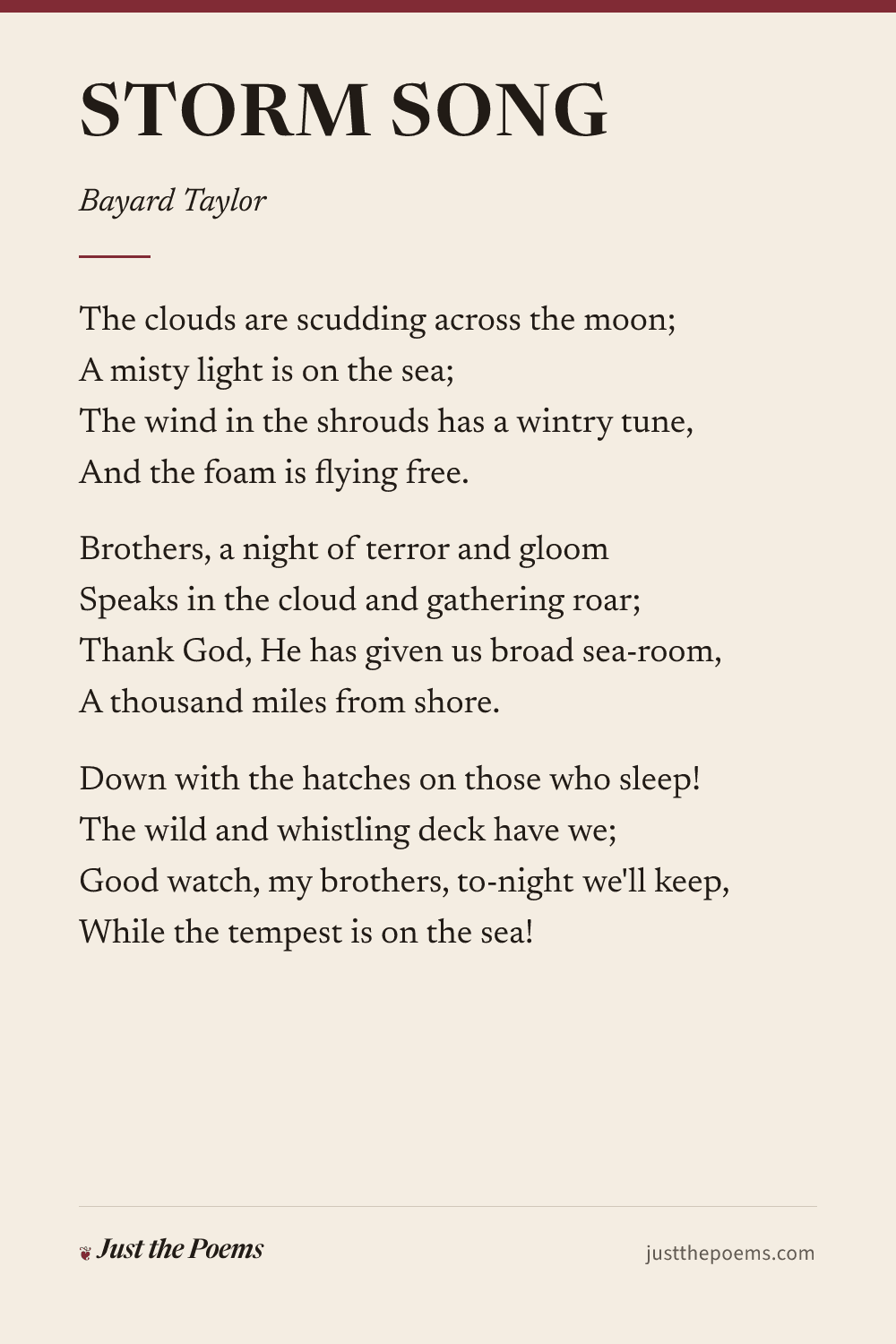
STORM SONG

Bayard Taylor

In 0 Wikipedias 1 anthology Poet in 17 Wikipedias

The clouds are scudding across the moon;A misty light is on the sea;The wind in the shrouds has a wintry tune,And the foam is flying free.

Brothers, a night of terror and gloomSpeaks in the cloud and gathering roar;Thank God, He has given us broad sea-room,A thousand miles from shore.

Down with the hatches on those who sleep!The wild and whistling deck have we;Good watch, my brothers, to-night we'll keep,While the tempest is on the sea!

Though the rigging shriek in his terrible grip,And the naked spars be snapped away,Lashed to the helm, we'll drive our shipIn the teeth of the whelming spray!

Hark! how the surges o'erleap the deck!Hark! how the pitiless tempest raves!Ah, daylight will look upon many a wreckDrifting over the desert waves.

Yet, courage, brothers! we trust the wave,With God above us, our guiding chart.So, whether to harbor or ocean-grave,Be it still with a cheery heart!

Source

The Home Book of Verse, ed. Burton Egbert Stevenson

Filed under
  • Section “THE SEA”, The Home Book of Verse

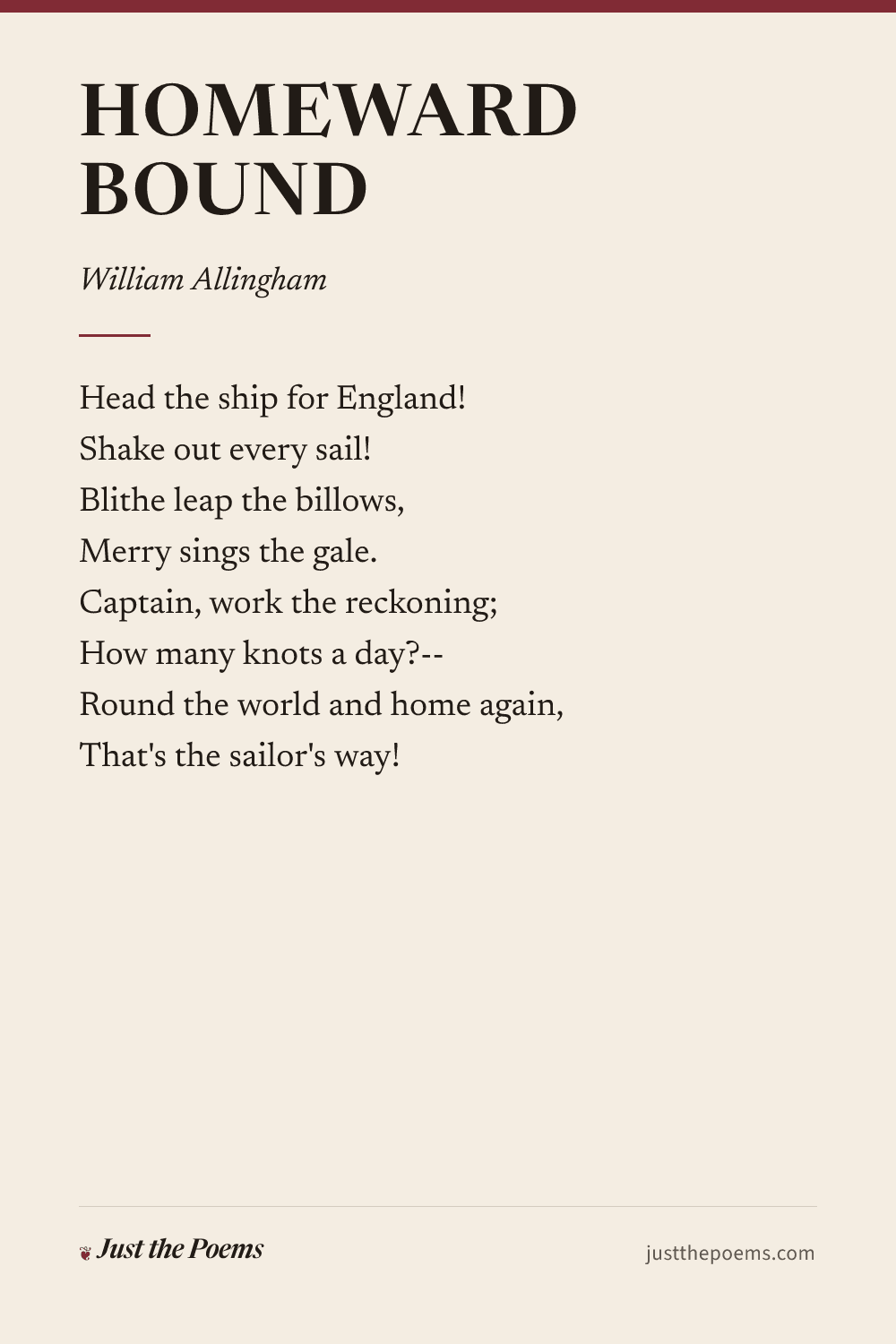
HOMEWARD BOUND

William Allingham

In 0 Wikipedias 1 anthology Poet in 16 Wikipedias

Head the ship for England!Shake out every sail!Blithe leap the billows,Merry sings the gale.Captain, work the reckoning;How many knots a day?--Round the world and home again,That's the sailor's way!

We've traded with the Yankees,Brazilians and Chinese;We've laughed with dusky beautiesIn shade of tall palm-trees;

Show all 32 lines 20 more

Across the line and Gulf-Stream--Round by Table Bay--Everywhere and home again,That's the sailor's way!

Nightly stands the North StarHigher on our bow;Straight we run for England;Our thoughts are in it now.Jolly times with friends ashore,When we've drawn our pay!--All about and home again,That's the sailor's way!

Tom will to his parents,Jack will to his dear,Joe to wife and children,Bob to pipes and beer;Dicky to the dancing-room,To hear the fiddles play;--Round the world and home again,That's the sailor's way!

Source

The Home Book of Verse, ed. Burton Egbert Stevenson

Filed under
  • Section “THE SEA”, The Home Book of Verse

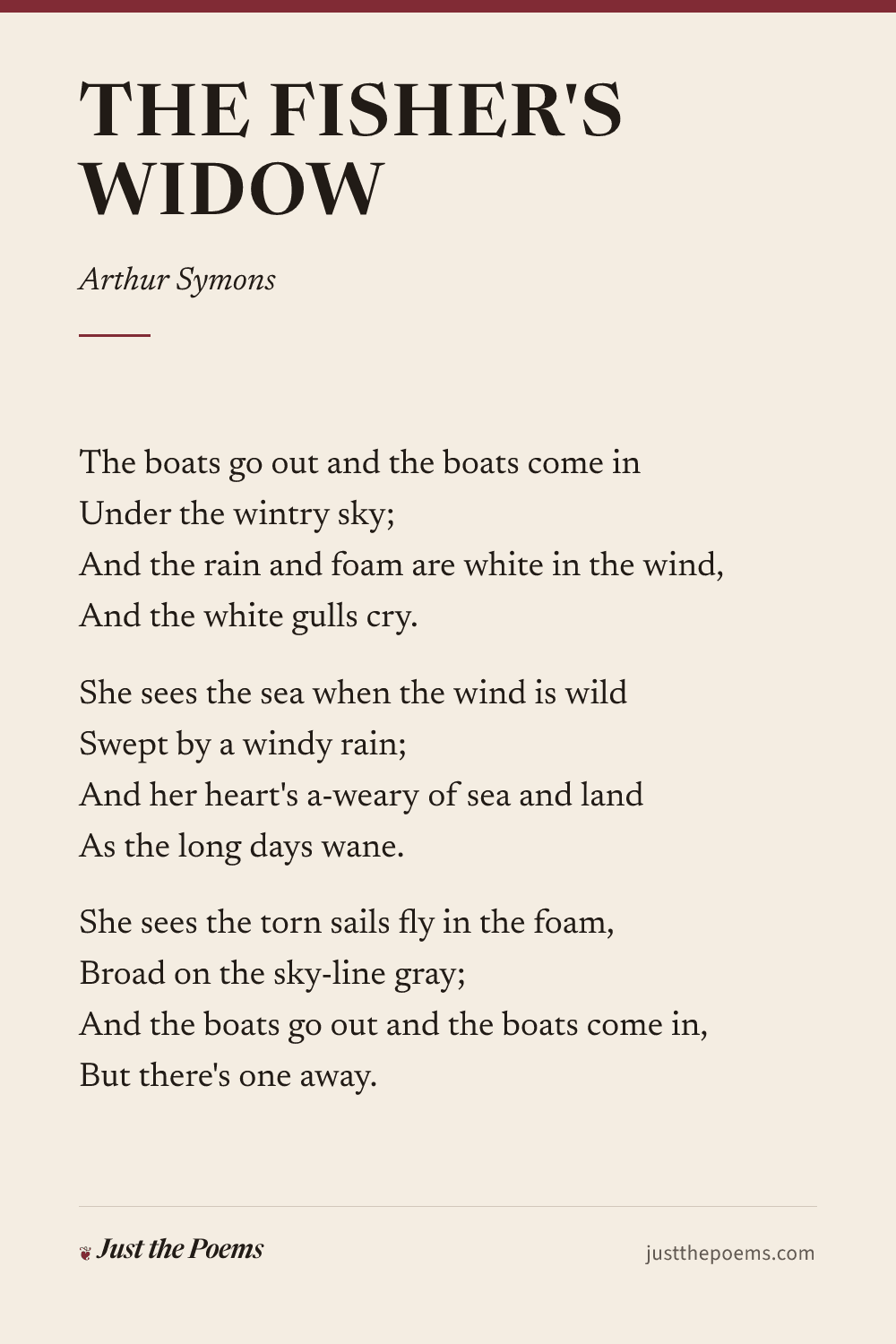
THE FISHER'S WIDOW

Arthur Symons

In 0 Wikipedias 1 anthology Poet in 16 Wikipedias

The boats go out and the boats come inUnder the wintry sky;And the rain and foam are white in the wind,And the white gulls cry.

She sees the sea when the wind is wildSwept by a windy rain;And her heart's a-weary of sea and landAs the long days wane.

She sees the torn sails fly in the foam,Broad on the sky-line gray;And the boats go out and the boats come in,But there's one away.

Source

The Home Book of Verse, ed. Burton Egbert Stevenson

Filed under
  • Section “THE SEA”, The Home Book of Verse

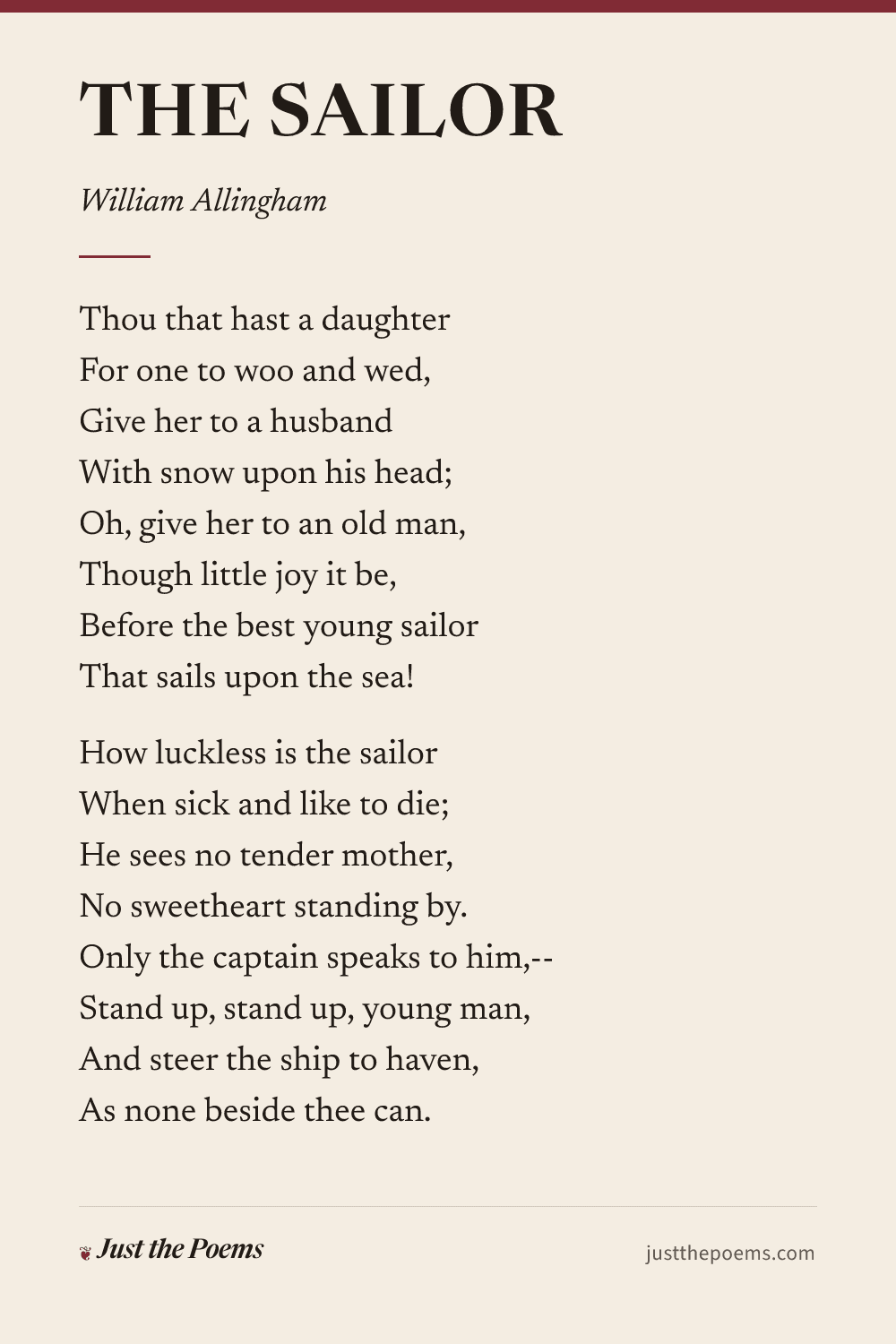
THE SAILOR

William Allingham

In 0 Wikipedias 1 anthology Poet in 16 Wikipedias

Thou that hast a daughterFor one to woo and wed,Give her to a husbandWith snow upon his head;Oh, give her to an old man,Though little joy it be,Before the best young sailorThat sails upon the sea!

How luckless is the sailorWhen sick and like to die;He sees no tender mother,No sweetheart standing by.

Show all 48 lines 36 more

Only the captain speaks to him,--Stand up, stand up, young man,And steer the ship to haven,As none beside thee can.

Thou says't to me, "Stand, stand up";I say to thee, take hold,Lift me a little from the deck,My hands and feet are cold.And let my head, I pray thee,With handkerchiefs be bound;There, take my love's gold handkerchief,And tie it tightly round.

Now bring the chart, the doleful chart;See, where these mountains meet--The clouds are thick around their head,The mists around their feet:Cast anchor here; 'tis deep and safeWithin the rocky cleft;The little anchor on the right,The great one on the left.

And now to thee, O captain,Most earnestly I pray,That they may never bury meIn church or cloister gray;--But on the windy sea-beach,At the ending of the land,All on the surly sea-beach,Deep down into the sand.

For there will come the sailors,Their voices I shall hear,And at casting of the anchorThe yo-ho loud and clear;And at hauling of the anchorThe yo-ho and the cheer,--Farewell, my love, for to thy bayI never more may steer!

Source

The Home Book of Verse, ed. Burton Egbert Stevenson

Filed under
  • Section “THE SEA”, The Home Book of Verse

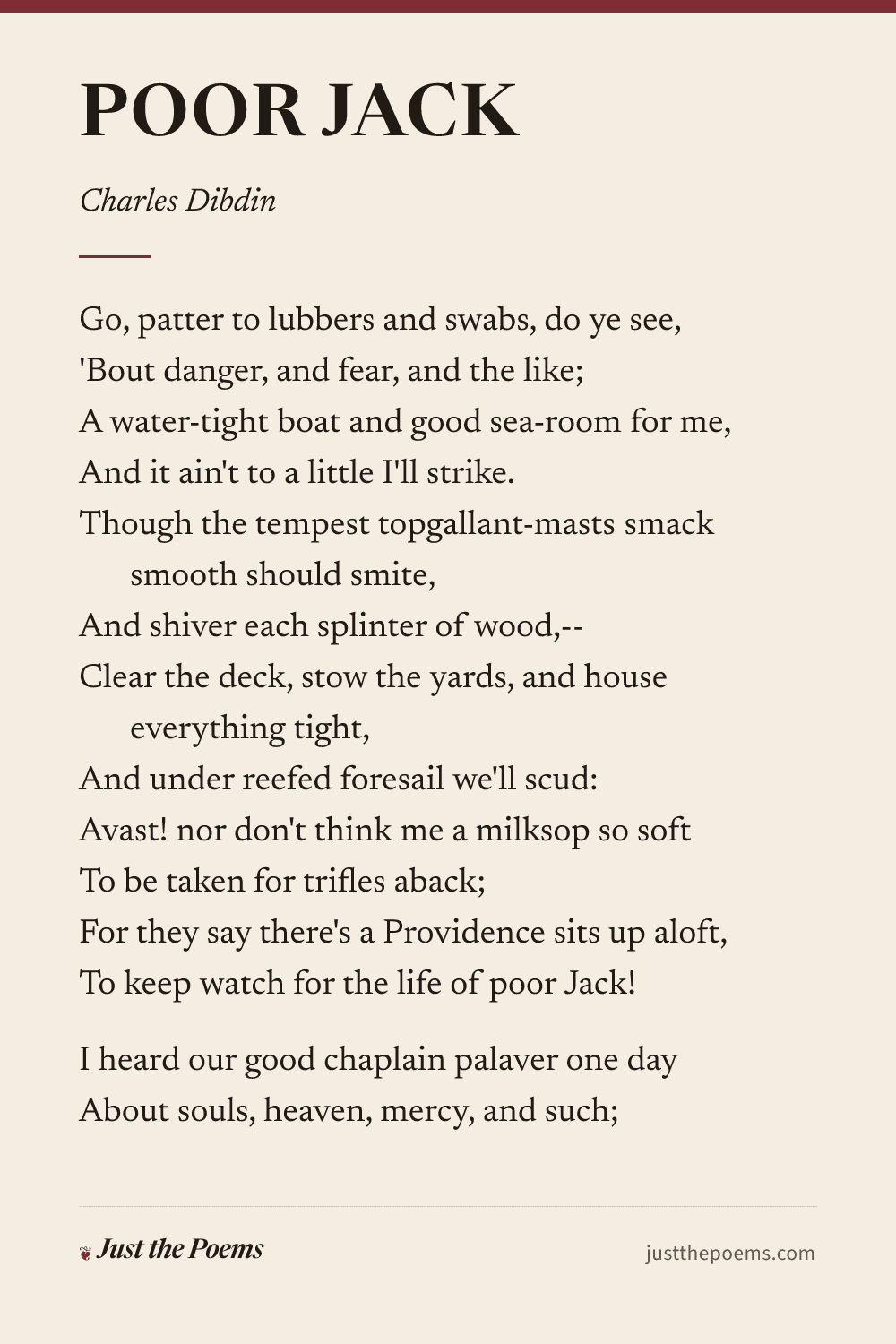
POOR JACK

Charles Dibdin

In 0 Wikipedias 1 anthology Poet in 13 Wikipedias

Go, patter to lubbers and swabs, do ye see,'Bout danger, and fear, and the like;A water-tight boat and good sea-room for me,And it ain't to a little I'll strike.Though the tempest topgallant-masts smack smooth should smite,And shiver each splinter of wood,--Clear the deck, stow the yards, and house everything tight,And under reefed foresail we'll scud:Avast! nor don't think me a milksop so softTo be taken for trifles aback;For they say there's a Providence sits up aloft,To keep watch for the life of poor Jack!

Show all 48 lines 36 more

I heard our good chaplain palaver one dayAbout souls, heaven, mercy, and such;And, my timbers! what lingo he'd coil and belay;Why, 'twas just all as one as High Dutch;For he said how a sparrow can't founder, d'ye see,Without orders that come down below;And a many fine things that proved clearly to meThat Providence takes us in tow:"For," says he, "do you mind me, let storms e'er so oftTake the topsails of sailors aback,There's a sweet little cherub that sits up aloft,To keep watch for the life of poor Jack!"

I said to our Poll,--for, d'ye see, she would cry,When last we weighed anchor for sea,--"What argufies sniveling and piping your eye?Why, what a blamed fool you must be!Can't you see, the world's wide, and there's room for us all,Both for seamen and lubbers ashore?And if to old Davy I should go, friend Poll,You never will hear of me more.What then? All's a hazard: come, don't be so soft:Perhaps I may laughing come back;For, d'ye see, there's a cherub sits smiling aloft,To keep watch for the life of poor Jack!"

D'ye mind me, a sailor should be every inchAll as one as a piece of the ship,And with her brave the world, without offering to flinchFrom the moment the anchor's a-trip.As for me, in all weathers, all times, sides, and ends,Naught's a trouble from duty that springs,For my heart is my Poll's, and my rhino's my friend's,And as for my will, 'tis the king's.Even when my time comes, ne'er believe me so softAs for grief to be taken aback;For the same little cherub that sits up aloftWill look out a good berth for poor Jack!

Source

The Home Book of Verse, ed. Burton Egbert Stevenson

Filed under
  • Section “THE SEA”, The Home Book of Verse

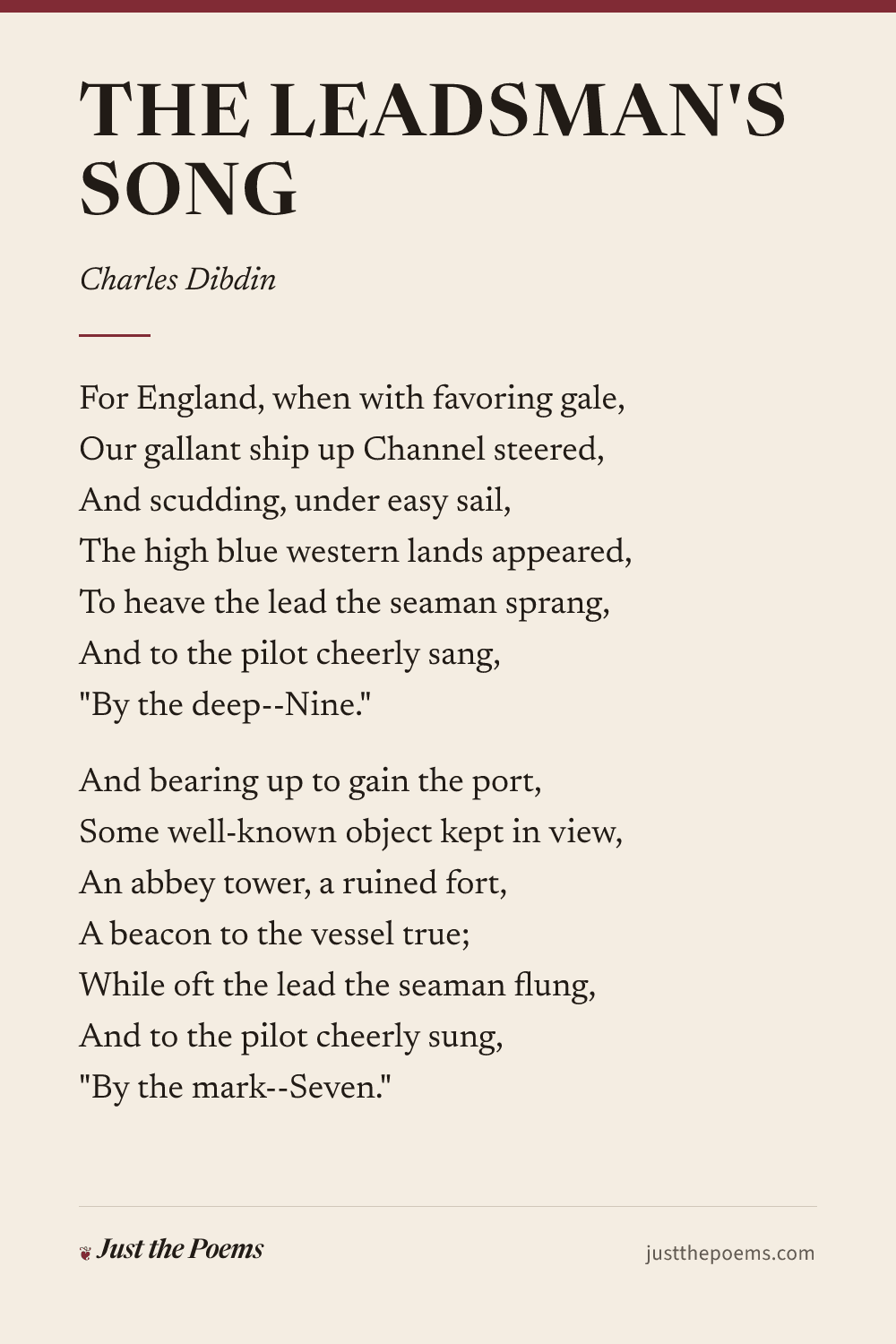
THE LEADSMAN'S SONG

Charles Dibdin

In 0 Wikipedias 1 anthology Poet in 13 Wikipedias

For England, when with favoring gale,Our gallant ship up Channel steered,And scudding, under easy sail,The high blue western lands appeared,To heave the lead the seaman sprang,And to the pilot cheerly sang,"By the deep--Nine."

And bearing up to gain the port,Some well-known object kept in view,An abbey tower, a ruined fort,A beacon to the vessel true;While oft the lead the seaman flung,

Show all 28 lines 16 more

And to the pilot cheerly sung,"By the mark--Seven."

And as the much-loved shore we near,With transport we behold the roofWhere dwelt a friend or partner dear,Of faith and love and matchless proof.The lead once more the seaman flung,And to the watchful pilot sung,"Quarter less--Five."

Now to her berth the ship draws nigh,With slackened sail she feels the tide,Stand clear the cable is the cry,The anchor's gone, we safely ride.The watch is set, and through the night,We hear the seaman with delightProclaim--"All's well."

Source

The Home Book of Verse, ed. Burton Egbert Stevenson

Filed under
  • Section “THE SEA”, The Home Book of Verse

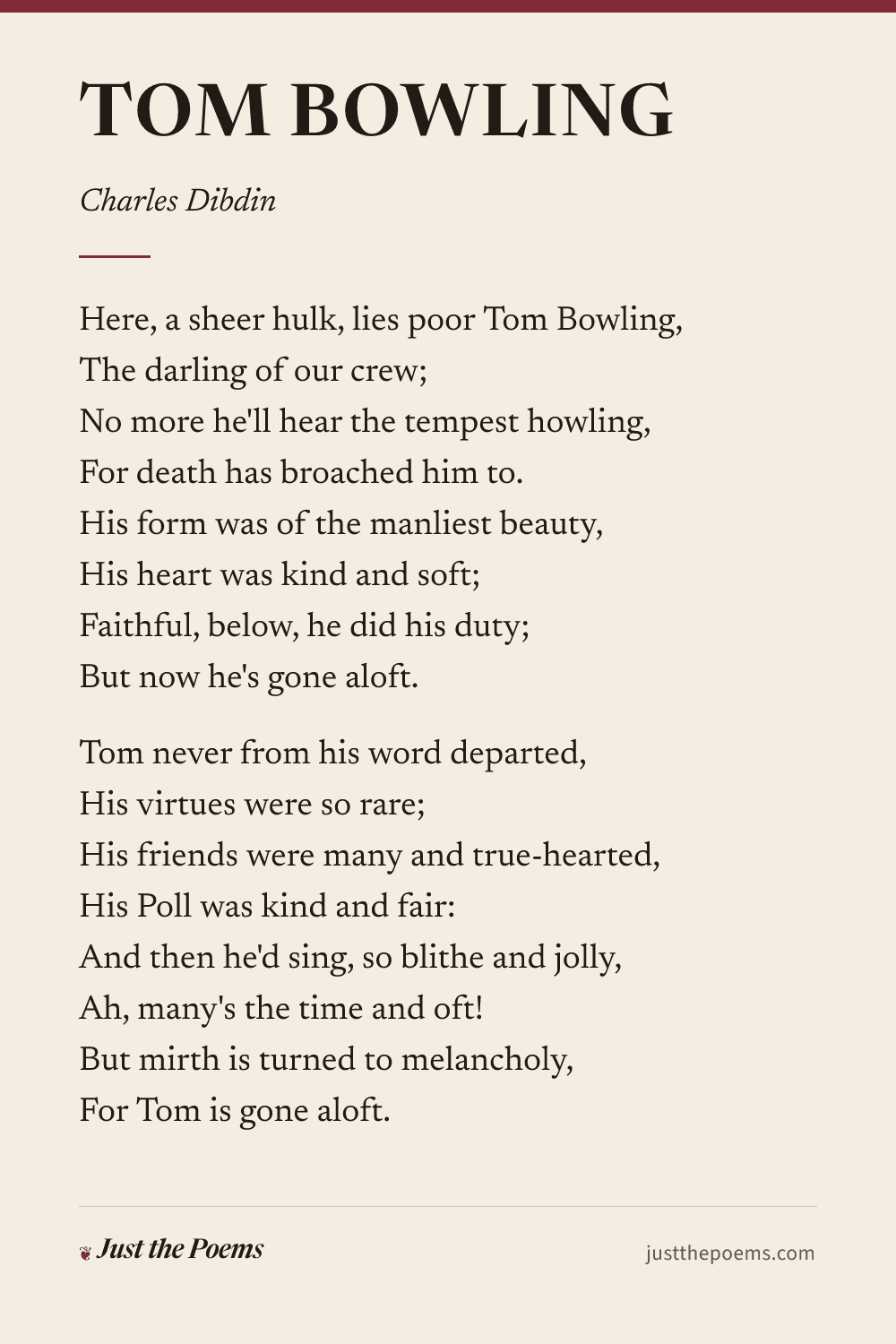
TOM BOWLING

Charles Dibdin

In 0 Wikipedias 1 anthology Poet in 13 Wikipedias

Here, a sheer hulk, lies poor Tom Bowling,The darling of our crew;No more he'll hear the tempest howling,For death has broached him to.His form was of the manliest beauty,His heart was kind and soft;Faithful, below, he did his duty;But now he's gone aloft.

Tom never from his word departed,His virtues were so rare;His friends were many and true-hearted,His Poll was kind and fair:And then he'd sing, so blithe and jolly,Ah, many's the time and oft!But mirth is turned to melancholy,For Tom is gone aloft.

Yet shall poor Tom find pleasant weather,When He, who all commands,Shall give, to call Life's crew together,The word to "pipe all hands."Thus Death, who Kings and Tars despatches,In vain Tom's life has doffed;For, though his body's under hatches,His soul is gone aloft.

Source

The Home Book of Verse, ed. Burton Egbert Stevenson

Filed under
  • Section “THE SEA”, The Home Book of Verse

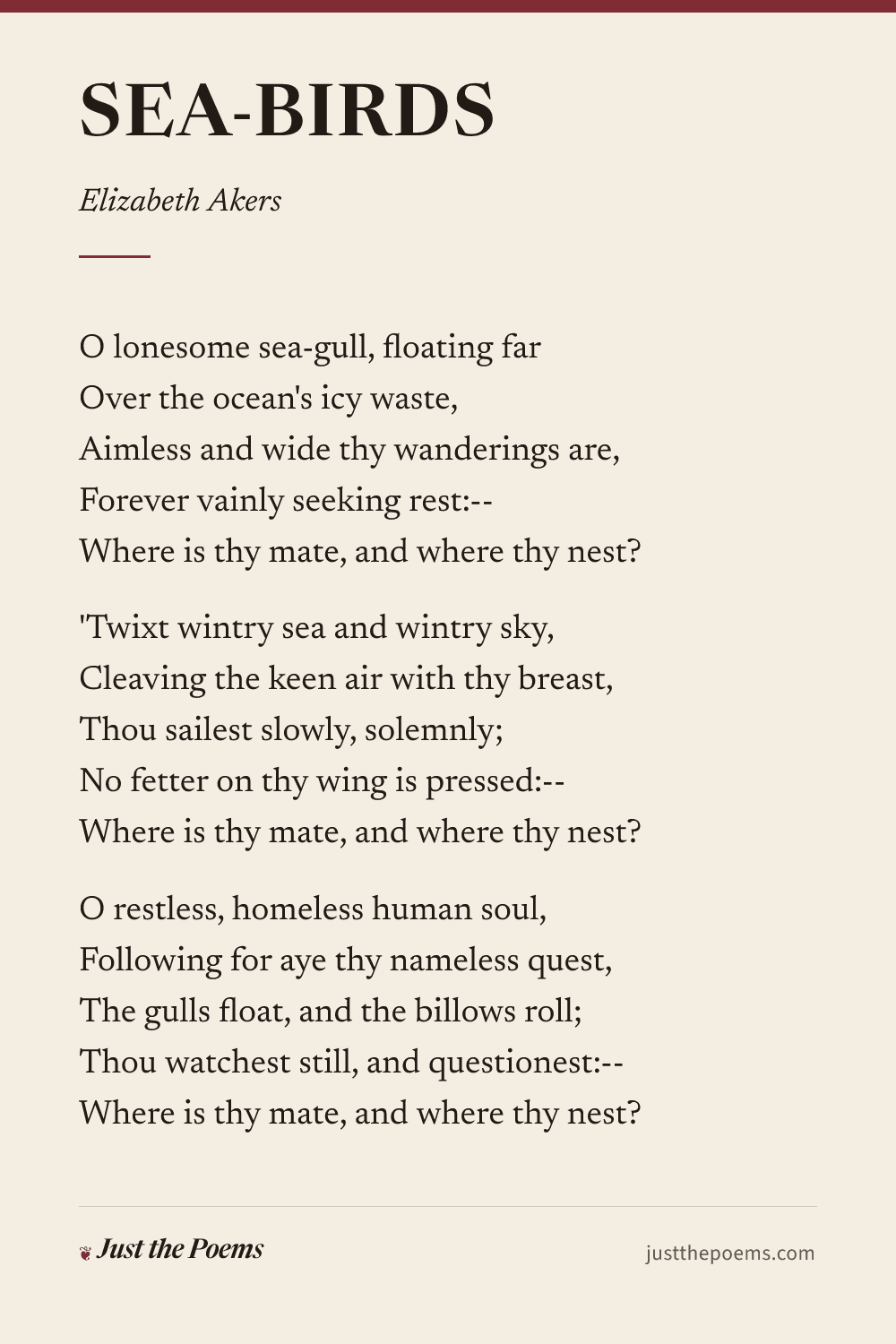
SEA-BIRDS

Elizabeth Akers

In 0 Wikipedias 1 anthology Poet in 11 Wikipedias

O lonesome sea-gull, floating farOver the ocean's icy waste,Aimless and wide thy wanderings are,Forever vainly seeking rest:--Where is thy mate, and where thy nest?

'Twixt wintry sea and wintry sky,Cleaving the keen air with thy breast,Thou sailest slowly, solemnly;No fetter on thy wing is pressed:--Where is thy mate, and where thy nest?

O restless, homeless human soul,Following for aye thy nameless quest,The gulls float, and the billows roll;Thou watchest still, and questionest:--Where is thy mate, and where thy nest?

Source

The Home Book of Verse, ed. Burton Egbert Stevenson

Filed under
  • Named in the title

30 of 64 poems about ocean

23 poets

By poet's century of death

CenturyPoems
16th1
17th3
19th21
20th5

Poets with more than one poem

PoetPoems
Charles Dibdin3
Algernon Charles Swinburne2
Charles Kingsley2
William Allingham2
William Shakespeare2
William Wordsworth2