Poems for Women

The first 30 of 116 poems for women, by 25 poets, ranked by third-party data. How poems are ranked

She walks in beauty, like the night

Lord Byron

In 0 Wikipedias 5 anthologies Poet in 155 Wikipedias

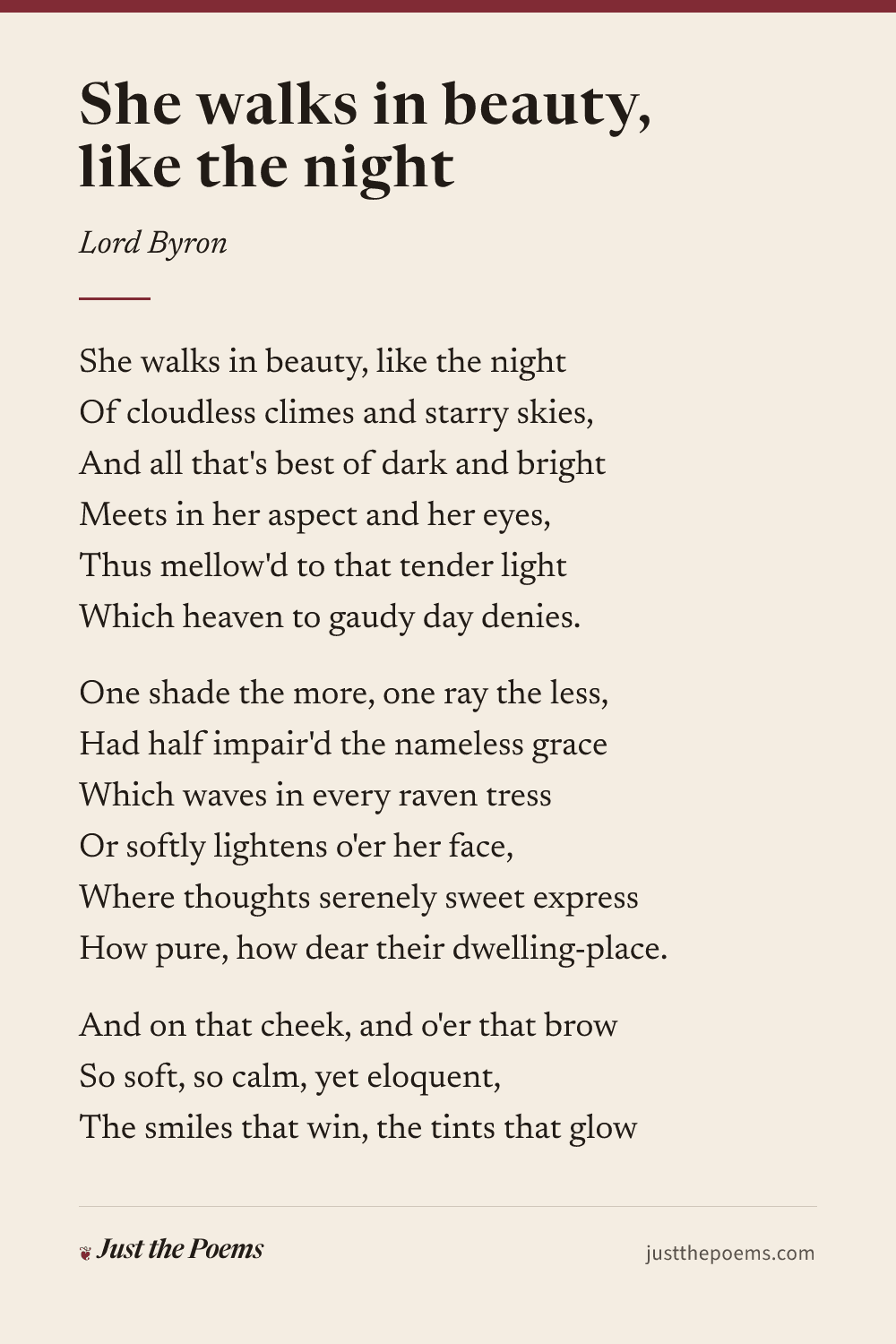
She walks in beauty, like the nightOf cloudless climes and starry skies,And all that's best of dark and brightMeets in her aspect and her eyes,Thus mellow'd to that tender lightWhich heaven to gaudy day denies.

One shade the more, one ray the less,Had half impair'd the nameless graceWhich waves in every raven tressOr softly lightens o'er her face,Where thoughts serenely sweet expressHow pure, how dear their dwelling-place.

And on that cheek, and o'er that browSo soft, so calm, yet eloquent,The smiles that win, the tints that glowBut tell of days in goodness spent,--A mind at peace with all below,A heart whose love is innocent.

Source

The Golden Treasury, ed. Francis Turner Palgrave

Filed under
  • Section “THE WOMAN”, The Home Book of Verse

She was a phantom of delight

William Wordsworth

In 0 Wikipedias 5 anthologies Poet in 97 Wikipedias

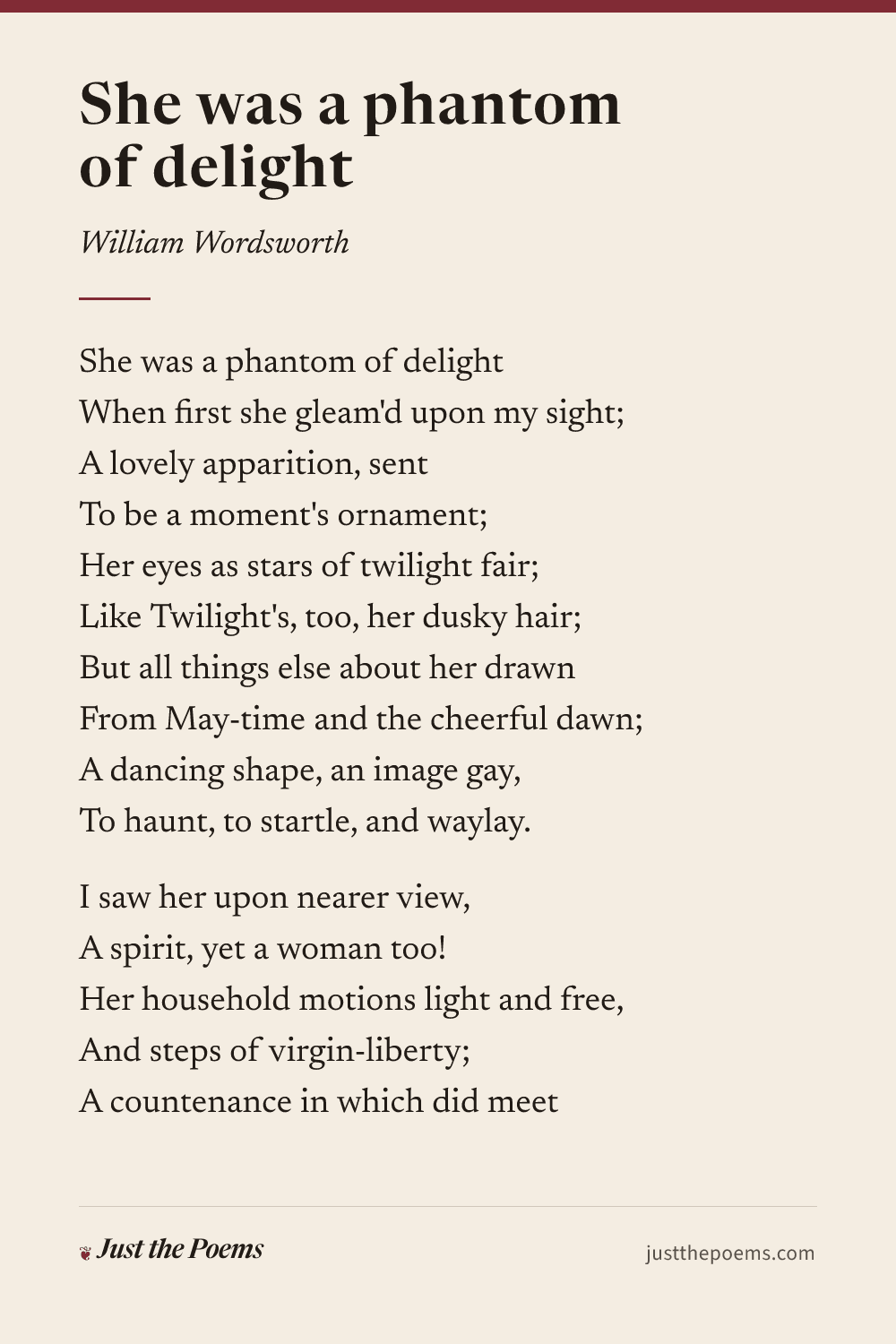
She was a phantom of delightWhen first she gleam'd upon my sight;A lovely apparition, sentTo be a moment's ornament;Her eyes as stars of twilight fair;Like Twilight's, too, her dusky hair;But all things else about her drawnFrom May-time and the cheerful dawn;A dancing shape, an image gay,To haunt, to startle, and waylay.

I saw her upon nearer view,A spirit, yet a woman too!

Show all 30 lines 18 more

Her household motions light and free,And steps of virgin-liberty;A countenance in which did meetSweet records, promises as sweet;A creature not too bright or goodFor human nature's daily food,For transient sorrows, simple wiles,Praise, blame, love, kisses, tears, and smiles.

And now I see with eye sereneThe very pulse of the machine;A being breathing thoughtful breath,A traveller between life and death:The reason firm, the temperate will,Endurance, foresight, strength, and skill;A perfect woman, nobly plann'd,To warn, to comfort, and command;And yet a Spirit still, and brightWith something of an angel-light.

Source

The Golden Treasury, ed. Francis Turner Palgrave

Filed under
  • Section “THE WOMAN”, The Home Book of Verse

When lovely woman stoops to folly

Oliver Goldsmith

In 0 Wikipedias 3 anthologies Poet in 51 Wikipedias

When lovely woman stoops to follyAnd finds too late that men betray,--What charm can soothe her melancholy,What art can wash her guilt away?

The only art her guilt to cover,To hide her shame from every eye,To give repentance to her loverAnd wring his bosom, is--to die.

Source

The Golden Treasury, ed. Francis Turner Palgrave

Filed under
  • Named in the first line

Advertisements

THE POETRY OF DRESS

Robert Herrick

In 0 Wikipedias 3 anthologies Poet in 26 Wikipedias

A sweet disorder in the dressKindles in clothes a wantonness:--A lawn about the shoulders thrownInto a fine distraction,--An erring lace, which here and thereEnthrals the crimson stomacher,--A cuff neglectful, and therebyRibbands to flow confusedly,--A winning wave, deserving note,In the tempestuous petticoat,--A careless shoe-string, in whose tieI see a wild civility;--Do more bewitch me, than when artIs too precise in every part.

Source

The Golden Treasury, ed. Francis Turner Palgrave

Filed under
  • Section “THE WOMAN”, The Home Book of Verse

SORROWS OF WERTHER

William Makepeace Thackeray

In 0 Wikipedias 2 anthologies Poet in 70 Wikipedias

Werther had a love for Charlotte Such as words could never utter;Would you know how first he met her? She was cutting bread and butter.

Charlotte was a married lady, And a moral man was Werther,And for all the wealth of Indies Would do nothing for to hurt her.

So he sighed and pined and ogled, And his passion boiled and bubbled,Till he blew his silly brains out, And no more was by it troubled.

Charlotte, having seen his body Borne before her on a shutter,Like a well-conducted person, Went on cutting bread and butter.

Source

The World's Best Poetry, Vol. IX, ed. Bliss Carman, 1904

Filed under
  • Section “WOMAN”, The World's Best Poetry

Simplex Munditiis

Ben Jonson

In 0 Wikipedias 2 anthologies Poet in 63 Wikipedias

Still to be neat, still to be drest,As you were going to a feast;Still to be powder’d, still perfumed:Lady, it is to be presumed,Though art’s hid causes are not found,All is not sweet, all is not sound.

Give me a look, give me a faceThat makes simplicity a grace;Robes loosely flowing, hair as free:Such sweet neglect more taketh meThan all th’ adulteries of art;They strike mine eyes, but not my heart.

Source

The Oxford Book of English Verse 1250–1900, 1900

Filed under
  • Section “THE WOMAN”, The Home Book of Verse

A WOMAN'S LOVE

John Hay

In 0 Wikipedias 2 anthologies Poet in 33 Wikipedias

A sentinel angel, sitting high in glory,Heard this shrill wail ring out from Purgatory:"Have mercy, mighty angel, hear my story!

"I loved,--and, blind with passionate love, I fell.Love brought me down to death, and death to Hell;For God is just, and death for sin is well.

"I do not rage against his high decree,Nor for myself do ask that grace shall be;But for my love on earth who mourns for me.

"Great Spirit! Let me see my love againAnd comfort him one hour, and I were fainTo pay a thousand years of fire and pain."

Show all 33 lines 21 more

Then said the pitying angel, "Nay, repentThat wild vow! Look, the dial-finger's bentDown to the last hour of thy punishment!"

But still she wailed, "I pray thee, let me go!I cannot rise to peace and leave him so.O, let me soothe him in his bitter woe!"

The brazen gates ground sullenly ajar,And upwards, joyous, like a rising star,She rose and vanished in the ether far.

But soon adown the dying sunset sailing,And like a wounded bird her pinions trailing,She fluttered back, with broken-hearted wailing.

She sobbed, "I found him by the summer seaReclined, his head upon a maiden's knee,--She curled his hair and kissed him. Woe is me!"

She wept, "Now let my punishment begin!I have been fond and foolish. Let me inTo expiate my sorrow and my sin."

The angel answered, "Nay, sad soul, go higher!To be deceived in your true heart's desireWas bitterer than a thousand years of fire!"

Source

The World's Best Poetry, Vol. III, ed. Bliss Carman, 1904

Filed under
  • Named in the title

THE WOMEN FO'K.

James Hogg

In 0 Wikipedias 2 anthologies Poet in 24 Wikipedias

O, sairly may I rue the day I fancied first the womenkind;For aye sinsyne I ne'er can hae Ae quiet thought or peace o' mind!They hae plagued my heart an' pleased my e'e, An' teased an' flattered me at will,But aye for a' their witcherye, The pawky things I lo'e them still.

O the women fo'k! O the women fo'k! But they hae been the wreck o' me;O weary fa' the women fo'k, For they winna let a body be!

Show all 42 lines 30 more

I hae thought an' thought, but darena tell, I've studied them wi' a' my skill,I've lo'd them better than mysell, I've tried again to like them ill.Wha sairest strives, will sairest rue, To comprehend what nae man can;When he has done what man can do, He'll end at last where he began. O the women fo'k, etc.

That they hae gentle forms an' meet, A man wi' half a look may see;An gracefu' airs, an' faces sweet, An' waving curls aboon the bree;An' smiles as soft as the young rosebud, And een sae pawky, bright, an' rare,Wad lure the laverock frae the cludd,-- But, laddie, seek to ken nae mair! O the women fo'k, etc.

Even but this night nae farther gane, The date is neither lost nor lang,I tak ye witness ilka ane, How fell they fought, and fairly dang.Their point they've carried right or wrang, Without a reason, rhyme, or law,An' forced a man to sing a sang, That ne'er could sing a verse ava.

O the women fo'k! O the women fo'k! But they hae been the wreck o' me;O weary fa' the women fo'k, For they winna let a body be!

Source

The World's Best Poetry, Vol. IX, ed. Bliss Carman, 1904

Filed under
  • Section “WOMAN”, The World's Best Poetry
  • Named in the title

Advertisements

A Farewell

Coventry Patmore

In 0 Wikipedias 2 anthologies Poet in 16 Wikipedias

With all my will, but much against my heart,We two now part.My Very Dear,Our solace is, the sad road lies so clear.It needs no art,With faint, averted feetAnd many a tear,In our opposèd paths to persevere.Go thou to East, I West.We will not sayThere’s any hope, it is so far away.But, O, my Best,

Show all 25 lines 13 more

When the one darling of our widowhead,The nursling Grief,Is dead,And no dews blur our eyesTo see the peach-bloom come in evening skies,Perchance we may,Where now this night is day,And even through faith of still averted feet,Making full circle of our banishment,Amazèd meet;The bitter journey to the bourne so sweetSeasoning the termless feast of our contentWith tears of recognition never dry.

Source

The Oxford Book of English Verse 1250–1900, 1900

Filed under
  • Library subject “Man-woman relationships -- Poetry”, The Victories of Love, and Other Poems

Departure

Coventry Patmore

In 0 Wikipedias 2 anthologies Poet in 16 Wikipedias

It was not like your great and gracious ways!Do you, that have naught other to lament,Never, my Love, repentOf how, that July afternoon,You went,With sudden, unintelligible phrase,And frighten’d eye,Upon your journey of so many daysWithout a single kiss, or a good-bye?I knew, indeed, that you were parting soon;And so we sate, within the low sun’s rays,You whispering to me, for your voice was weak,

Show all 32 lines 20 more

Your harrowing praise.Well, it was wellTo hear you such things speak,And I could tellWhat made your eyes a growing gloom of love,As a warm South-wind sombres a March grove.And it was like your great and gracious waysTo turn your talk on daily things, my Dear,Lifting the luminous, pathetic lashTo let the laughter flash,Whilst I drew near,Because you spoke so low that I could scarcely hear.But all at once to leave me at the last,More at the wonder than the loss aghast,With huddled, unintelligible phrase,And frighten’d eye,And go your journey of all daysWith not one kiss, or a good-bye,And the only loveless look the look with which you pass’d:’Twas all unlike your great and gracious ways.

Source

The Oxford Book of English Verse 1250–1900, 1900

Filed under
  • Library subject “Man-woman relationships -- Poetry”, The Victories of Love, and Other Poems

‘If I were dead’

Coventry Patmore

In 0 Wikipedias 2 anthologies Poet in 16 Wikipedias

‘If I were dead, you’d sometimes say, Poor Child!’The dear lips quiver’d as they spake,And the tears brakeFrom eyes which, not to grieve me, brightly smiled.Poor Child, poor Child!I seem to hear your laugh, your talk, your song.It is not true that Love will do no wrong.Poor Child!And did you think, when you so cried and smiled,How I, in lonely nights, should lie awake,And of those words your full avengers make?Poor Child, poor Child!And now, unless it beThat sweet amends thrice told are come to thee,O God, have Thou no mercy upon me!Poor Child!

Source

The Oxford Book of English Verse 1250–1900, 1900

Filed under
  • Library subject “Man-woman relationships -- Poetry”, The Victories of Love, and Other Poems

The Toys

Coventry Patmore

In 0 Wikipedias 2 anthologies Poet in 16 Wikipedias

My little Son, who look’d from thoughtful eyesAnd moved and spoke in quiet grown-up wise,Having my law the seventh time disobey’d,I struck him, and dismissedWith hard words and unkiss’d,--His Mother, who was patient, being dead.Then, fearing lest his grief should hinder sleep,I visited his bed,But found him slumbering deep,With darkened eyelids, and their lashes yetFrom his late sobbing wet.And I, with moan,

Show all 33 lines 21 more

Kissing away his tears, left others of my own;For, on a table drawn beside his head,He had put, within his reach,A box of counters and a red-vein’d stone,A piece of glass abraded by the beach,And six or seven shells,A bottle with bluebells,And two French copper coins, ranged there with careful art,To comfort his sad heart.So when that night I pray’dTo God, I wept, and said:Ah, when at last we lie with trancèd breath,Not vexing Thee in death,And Thou rememberest of what toysWe made our joys,How weakly understoodThy great commanded good,Then, fatherly not lessThan I whom Thou hast moulded from the clay,Thou’lt leave Thy wrath, and say,‘I will be sorry for their childishness.’

Source

The Oxford Book of English Verse 1250–1900, 1900

Filed under
  • Library subject “Man-woman relationships -- Poetry”, The Victories of Love, and Other Poems

The Lady of the Lambs

Alice Meynell

In 0 Wikipedias 2 anthologies Poet in 12 Wikipedias

She walks--the lady of my delight-- A shepherdess of sheep.Her flocks are thoughts. She keeps them white; She guards them from the steep.She feeds them on the fragrant height And folds them in for sleep.

She roams maternal hills and bright, Dark valleys safe and deep.Her dreams are innocent at night; The chastest stars may peep.She walks--the lady of my delight-- A shepherdess of sheep.

She holds her little thoughts in sight, Though gay they run and leap.She is so circumspect and right; She has her soul to keep.She walks--the lady of my delight-- A shepherdess of sheep.

Source

The Oxford Book of English Verse 1250–1900, 1900

Filed under
  • Section “THE WOMAN”, The Home Book of Verse

Advertisements

The Solitary-Hearted

Hartley Coleridge

In 0 Wikipedias 2 anthologies Poet in 7 Wikipedias

She was a queen of noble Nature’s crowning,A smile of hers was like an act of grace;She had no winsome looks, no pretty frowning,Like daily beauties of the vulgar race:But if she smiled, a light was on her face,A clear, cool kindliness, a lunar beamOf peaceful radiance, silvering o’er the streamOf human thought with unabiding glory;Not quite a waking truth, not quite a dream,A visitation, bright and transitory.

But she is changed,--hath felt the touch of sorrow,No love hath she, no understanding friend;

Show all 40 lines 28 more

O grief! when Heaven is forced of earth to borrowWhat the poor niggard earth has not to lend;But when the stalk is snapt, the rose must bend.The tallest flower that skyward rears its headGrows from the common ground, and there must shedIts delicate petals. Cruel fate, too surely,That they should find so base a bridal bed,Who lived in virgin pride, so sweet and purely.

She had a brother, and a tender father,And she was loved, but not as others areFrom whom we ask return of love,--but ratherAs one might love a dream; a phantom fairOf something exquisitely strange and rare,Which all were glad to look on, men and maids,Yet no one claim’d--as oft, in dewy glades,The peering primrose, like a sudden gladness,Gleams on the soul, yet unregarded fades;--The joy is ours, but all its own the sadness.

’Tis vain to say--her worst of grief is onlyThe common lot, which all the world have known;To her ’tis more, because her heart is lonely,And yet she hath no strength to stand alone,--Once she had playmates, fancies of her own,And she did love them. They are past awayAs Fairies vanish at the break of day;And like a spectre of an age departed,Or unsphered Angel wofully astray,She glides along--the solitary-hearted.

Source

The Oxford Book of English Verse 1250–1900, 1900

Filed under
  • Section “THE WOMAN”, The Home Book of Verse

BELLE OF THE BALL

Winthrop Mackworth Praed

In 0 Wikipedias 2 anthologies Poet in 5 Wikipedias

Years, years ago, ere yet my dreams Had been of being wise or witty,Ere I had done with writing themes, Or yawned o'er this infernal Chitty,--Years, years ago, while all my joys Were in my fowling-piece and filly;In short, while I was yet a boy, I fell in love with Laura Lilly.

I saw her at the county ball; There, when the sounds of flute and fiddleGave signal sweet in that old hall Of hands across and down the middle,

Show all 104 lines 92 more

Hers was the subtlest spell by far Of all that sets young hearts romancing:She was our queen, our rose, our star; And then she danced,--O Heaven! her dancing.

Dark was her hair; her hand was white; Her voice was exquisitely tender;Her eyes were full of liquid light; I never saw a waist so slender;Her every look, her every smile, Shot right and left a score of arrows:I thought 'twas Venus from her isle, And wondered where she'd left her sparrows.

She talked of politics or prayers, Of Southey's prose or Wordsworth's sonnets,Of danglers or of dancing bears, Of battles or the last new bonnets;By candle-light, at twelve o'clock,-- To me it mattered not a tittle,--If those bright lips had quoted Locke, I might have thought they murmured Little.

Through sunny May, through sultry June, I loved her with a love eternal;I spoke her praises to the moon, I wrote them to the Sunday Journal.My mother laughed; I soon found out That ancient ladies have no feeling:My father frowned; but how should gout See any happiness in kneeling?

She was the daughter of a dean,-- Rich, fat, and rather apoplectic;She had one brother just thirteen, Whose color was extremely hectic;Her grandmother for many a year Had fed the parish with her bounty;Her second cousin was a peer, And lord-lieutenant of the county.

But titles and the three-per-cents, And mortgages, and great relations,And India bonds, and tithes and rents, O, what are they to love's sensations?Black eyes, fair forehead, clustering locks,-- Such wealth, such honors Cupid chooses;He cares as little for the stocks As Baron Rothschild for the muses.

She sketched; the vale, the wood, the beach, Grew lovelier from her pencil's shading:She botanized; I envied each Young blossom in her boudoir fading:She warbled Handel; it was grand,-- She made the Catilina jealous:She touched the organ; I could stand For hours and hours to blow the bellows.

She kept an album too, at home, Well filled with all an album's glories,--Paintings of butterflies and Rome, Patterns for trimmings, Persian stories,Soft songs to Julia's cockatoo, Fierce odes to famine and to slaughter,And autographs of Prince Leeboo, And recipes for elder-water.

And she was flattered, worshipped, bored; Her steps were watched, her dress was noted;Her poodle-dog was quite adored; Her sayings were extremely quoted.She laughed,--and every heart was glad, As if the taxes were abolished;She frowned,--and every look was sad, As if the opera were demolished.

She smiled on many just for fun,-- I knew that there was nothing in it;I was the first, the only one, Her heart had thought of for a minute.I knew it, for she told me so, In phrase which was divinely moulded;She wrote a charming hand,--and O, How sweetly all her notes were folded!

Our love was most like other loves,-- A little glow, a little shiver,A rosebud and a pair of gloves, And "Fly Not Yet," upon the river;Some jealousy of some one's heir, Some hopes of dying broken-hearted;A miniature, a lock of hair, The usual vows,--and then we parted.

We parted: months and years rolled by; We met again four summers after.Our parting was all sob and sigh, Our meeting was all mirth and laughter!For in my heart's most secret cell There had been many other lodgers;And she was not the ball-room's belle, But only Mrs.--Something--Rogers!
Source

The World's Best Poetry, Vol. IX, ed. Bliss Carman, 1904

Filed under
  • Section “WOMAN”, The World's Best Poetry

THE ROSE OF THE WORLD

William Butler Yeats

In 0 Wikipedias 1 anthology Poet in 113 Wikipedias

Who dreamed that beauty passes like a dream?For these red lips, with all their mournful pride,Mournful that no new wonder may betide,Troy passed away in one high funeral gleam,And Usna's children died.

We and the laboring world are passing by:Amid men's souls, that waver and give place,Like the pale waters in their wintry race,Under the passing stars, foam of the sky,Lives on this lonely face.

Bow down, archangels, in your dim abode:Before you were, or any hearts to beat,Weary and kind one lingered by His seat;He made the world to be a grassy roadBefore her wandering feet.

Source

The Home Book of Verse, ed. Burton Egbert Stevenson

Filed under
  • Section “THE WOMAN”, The Home Book of Verse

"TRUSTY, DUSKY, VIVID, TRUE"

Robert Louis Stevenson

In 0 Wikipedias 1 anthology Poet in 101 Wikipedias

Trusty, dusky, vivid, true,With eyes of gold and bramble-dew,Steel true and blade straightThe great Artificer made my mate.

Honor, anger, valor, fire,A love that life could never tire,Death quench, or evil stir,The mighty Master gave to her.

Teacher, tender comrade, wife,A fellow-farer true through life,Heart-whole and soul-free,The August Father gave to me.

Source

The Home Book of Verse, ed. Burton Egbert Stevenson

Filed under
  • Section “THE WOMAN”, The Home Book of Verse

WOMEN'S CHORUS

Aristophanes

In 0 Wikipedias 1 anthology Poet in 100 Wikipedias

They're always abusing the women, As a terrible plague to men:They say we're the root of all evil, And repeat it again and again;Of war, and quarrels, and bloodshed, All mischief, be what it may!And pray, then, why do you marry us, If we're all the plagues you say?And why do you take such care of us, And keep us so safe at home,And are never easy a moment If ever we chance to roam?When you ought to be thanking heaven That your Plague is out of the way,You all keep fussing and fretting-- "Where is my Plague to-day?"If a Plague peeps out of the window, Up go the eyes of men;If she hides, then they all keep staring Until she looks out again.

Source

The World's Best Poetry, Vol. IX, ed. Bliss Carman, 1904

Filed under
  • Section “WOMAN”, The World's Best Poetry

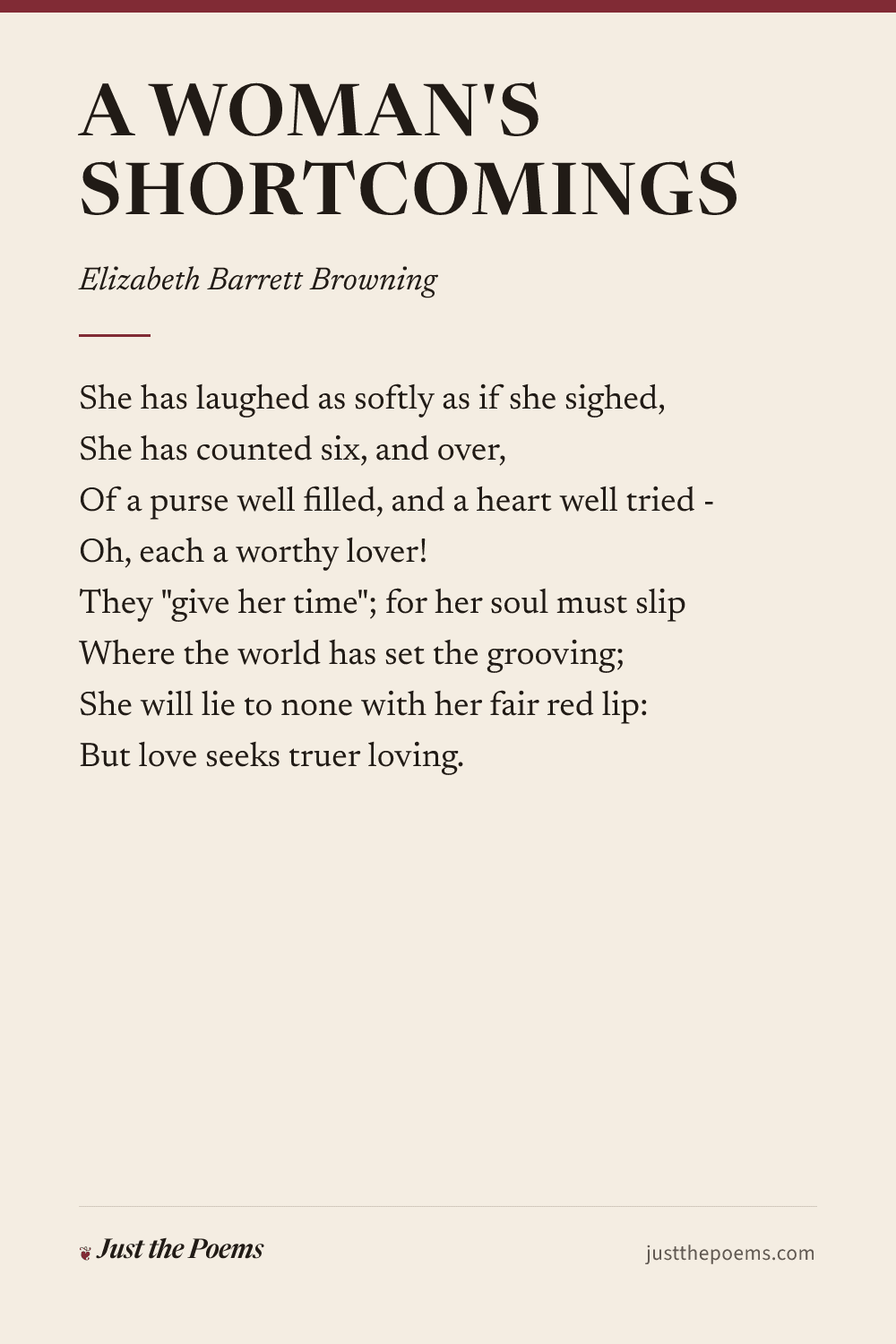
A WOMAN'S SHORTCOMINGS

Elizabeth Barrett Browning

In 0 Wikipedias 1 anthology Poet in 60 Wikipedias

She has laughed as softly as if she sighed,She has counted six, and over,Of a purse well filled, and a heart well tried -Oh, each a worthy lover!They "give her time"; for her soul must slipWhere the world has set the grooving;She will lie to none with her fair red lip:But love seeks truer loving.

She trembles her fan in a sweetness dumb,As her thoughts were beyond recalling;With a glance for one, and a glance for some,From her eyelids rising and falling;

Show all 40 lines 28 more

Speaks common words with a blushful air,Hears bold words, unreproving;But her silence says - what she never will swear -And love seeks better loving.

Go, lady! lean to the night-guitar,And drop a smile to the bringer;Then smile as sweetly, when he is far,At the voice of an in-door singer.Bask tenderly beneath tender eyes;Glance lightly, on their removing;And join new vows to old perjuries -But dare not call it loving!

Unless you can think, when the song is done,No other is soft in the rhythm;Unless you can feel, when left by One,That all men else go with him;Unless you can know, when unpraised by his breath,That your beauty itself wants proving;Unless you can swear "For life, for death!" -Oh, fear to call it loving!

Unless you can muse in a crowd all dayOn the absent face that fixed you;Unless you can love, as the angels may,With the breadth of heaven betwixt you;Unless you can dream that his faith is fast,Through behoving and unbehoving;Unless you can die when the dream is past -Oh, never call it loving!

Source

The Home Book of Verse, ed. Burton Egbert Stevenson

Filed under
  • Named in the title

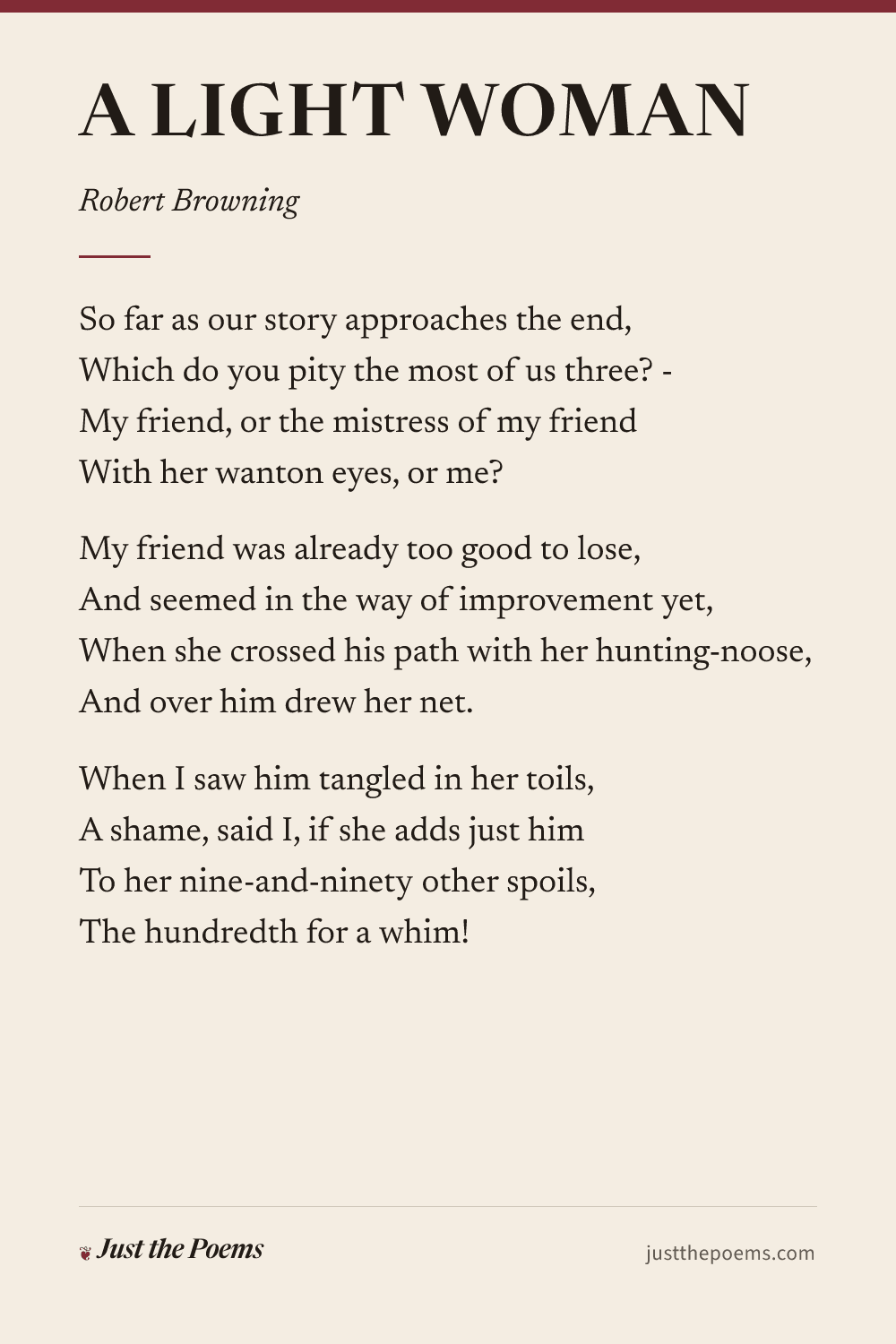
A LIGHT WOMAN

Robert Browning

In 0 Wikipedias 1 anthology Poet in 57 Wikipedias

So far as our story approaches the end,Which do you pity the most of us three? -My friend, or the mistress of my friendWith her wanton eyes, or me?

My friend was already too good to lose,And seemed in the way of improvement yet,When she crossed his path with her hunting-noose,And over him drew her net.

When I saw him tangled in her toils,A shame, said I, if she adds just himTo her nine-and-ninety other spoils,The hundredth for a whim!

Show all 56 lines 44 more

And before my friend be wholly hers,How easy to prove to him, I said,An eagle's the game her pride prefers,Though she snaps at a wren instead!

So, I gave her eyes my own eyes to take,My hand sought hers as in earnest need,And round she turned for my noble sake,And gave me herself indeed.

The eagle am I, with my fame in the world,The wren is he, with his maiden face.- You look away and your lip is curled?Patience, a moment's space!

For see, my friend goes shaking and white;He eyes me as the basilisk:I have turned, it appears, his day to night,Eclipsing his sun's disk.

And I did it, he thinks, as a very thief:"Though I love her - that, he comprehends -One should master one's passions, (love, in chief)And be loyal to one's friends!"

And she, - she lies in my hand as tameAs a pear late basking over a wall;Just a touch to try and off it came;'Tis mine, - can I let it fall?

With no mind to eat it, that's the worst!Were it thrown in the road, would the case assist?'Twas quenching a dozen blue-flies' thirstWhen I gave its stalk a twist.

And I, - what I seem to my friend, you see:What I soon shall seem to his love, you guess:What I seem to myself, do you ask of me?No hero I confess.

'Tis an awkward thing to play with souls,And matter enough to save one's own:Yet think of my friend, and the burning coalsHe played with for bits of stone!

One likes to show the truth for the truth;That the woman was light is very true:But suppose she says, - Never mind that youth!What wrong have I done to you?

Well, anyhow, here the story stays,So far at least as I understand;And, Robert Browning, you writer of plays,Here's a subject made to your hand!

Source

The Home Book of Verse, ed. Burton Egbert Stevenson

Filed under
  • Named in the title

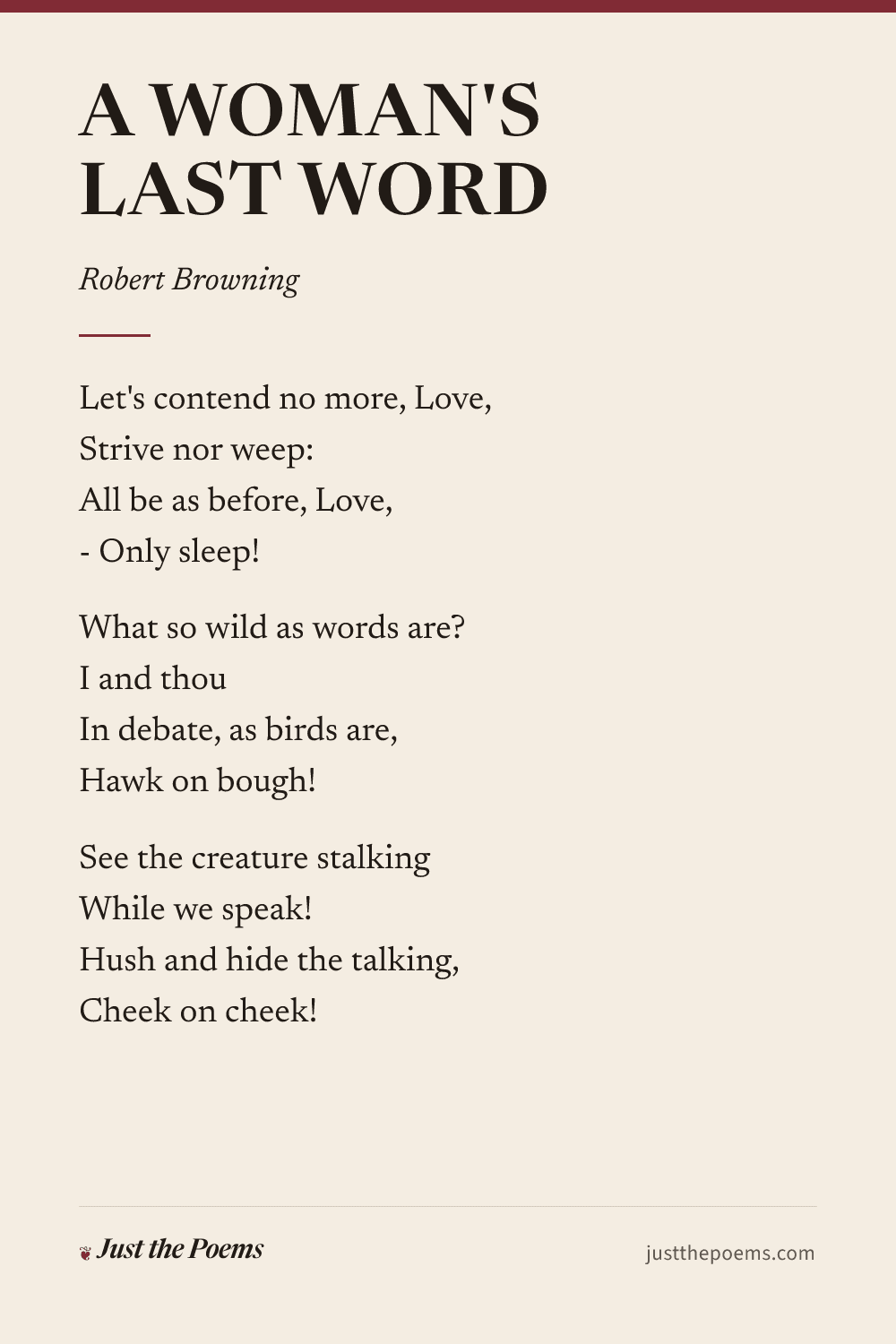
A WOMAN'S LAST WORD

Robert Browning

In 0 Wikipedias 1 anthology Poet in 57 Wikipedias

Let's contend no more, Love,Strive nor weep:All be as before, Love,- Only sleep!

What so wild as words are?I and thouIn debate, as birds are,Hawk on bough!

See the creature stalkingWhile we speak!Hush and hide the talking,Cheek on cheek!

Show all 40 lines 28 more

What so false as truth is,False to thee?Where the serpent's tooth isShun the tree -

Where the apple reddensNever pry -Lest we lose our Edens,Eve and I!

Be a god and hold meWith a charm!Be a man and fold meWith thine arm!

Teach me, only teach, Love!As I oughtI will speak thy speech, Love,Think thy thought -

Meet, if thou require it,Both demands,Laying flesh and spiritIn thy hands.

That shall be to-morrowNot to-night:I must bury sorrowOut of sight:

- Must a little weep, Love.(Foolish me!)And so fall asleep, LoveLoved by thee.

Source

The Home Book of Verse, ed. Burton Egbert Stevenson

Filed under
  • Named in the title

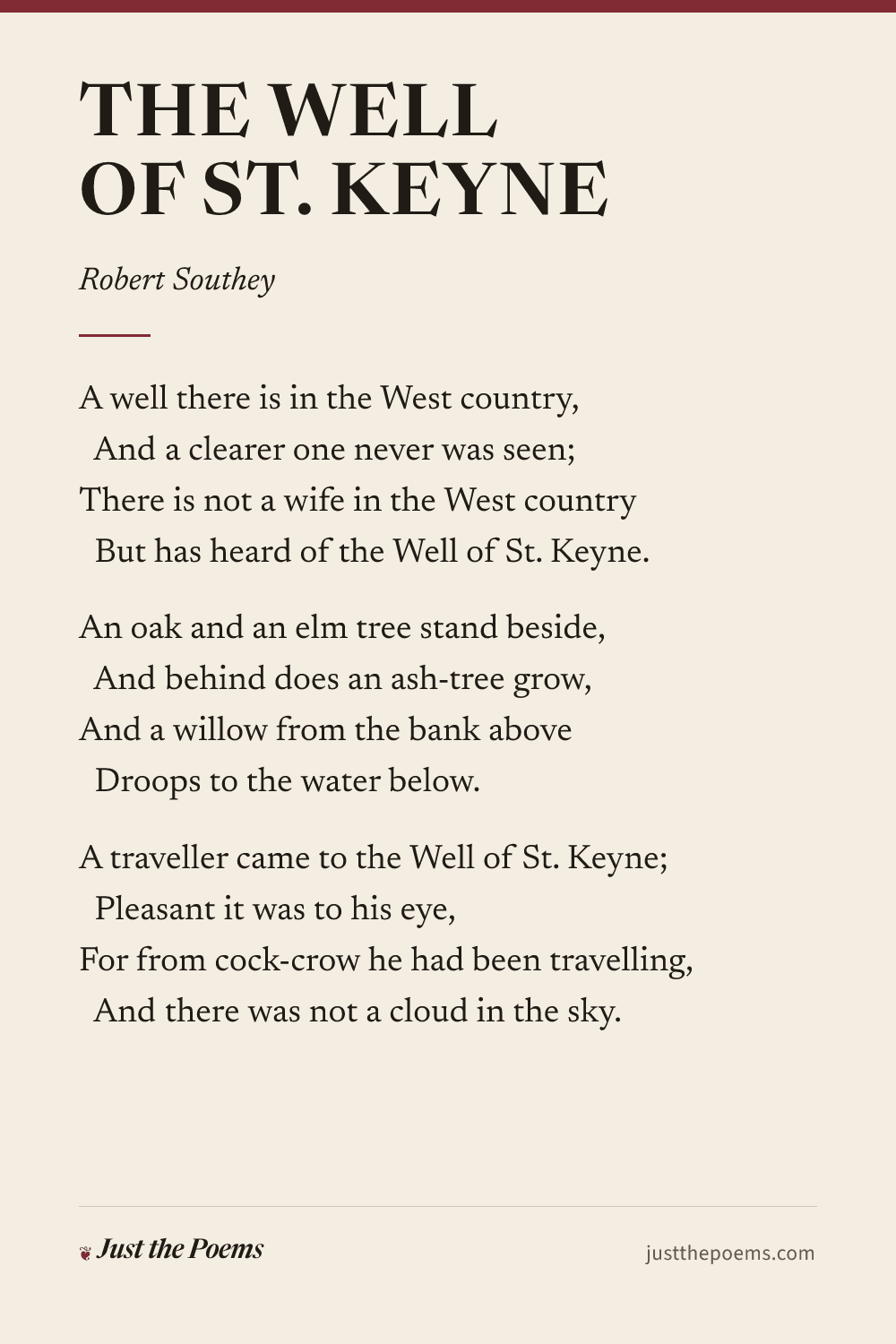
THE WELL OF ST. KEYNE

Robert Southey

In 0 Wikipedias 1 anthology Poet in 44 Wikipedias

"In the parish of St. Neots, Cornwall, is a well arched over with the robes of four kinds of trees,--withy, oak, elm, and ash,--and dedicated to St. Keyne. The reported virtue of the water is this, that, whether husband or wife first drink thereof, they get the mastery thereby."--FULLER.

A well there is in the West country, And a clearer one never was seen;There is not a wife in the West country But has heard of the Well of St. Keyne.

An oak and an elm tree stand beside, And behind does an ash-tree grow,And a willow from the bank above Droops to the water below.

A traveller came to the Well of St. Keyne; Pleasant it was to his eye,For from cock-crow he had been travelling, And there was not a cloud in the sky.

Show all 52 lines 40 more

He drank of the water so cool and clear, For thirsty and hot was he,And he sat down upon the bank, Under the willow-tree.

There came a man from the neighboring town At the well to fill his pail,On the well-side he rested it, And bade the stranger hail.

"Now art thou a bachelor, stranger?" quoth he, "For an if thou hast a wife,The happiest draught thou hast drank this day That ever thou didst in thy life.

"Or has your good woman, if one you have, In Cornwall ever been?For an if she have, I'll venture my life She has drunk of the Well of St. Keyne."

"I have left a good woman who never was here," The stranger he made reply;"But that my draught should be better for that, I pray you answer me why."

"St. Keyne," quoth the countryman, "many a time Drank of this crystal well,And before the angel summoned her She laid on the water a spell.

"If the husband of this gifted well Shall drink before his wife,A happy man thenceforth is he, For he shall be master for life.

"But if the wife should drink of it first, Heaven help the husband then!"The stranger stooped to the Well of St. Keyne, And drank of the waters again.

"You drank of the well, I warrant, betimes?" He to the countryman said.But the countryman smiled as the stranger spake, And sheepishly shook his head.

"I hastened, as soon as the wedding was done, And left my wife in the porch.But i' faith, she had been wiser than me, For she took a bottle to church."

Source

The World's Best Poetry, Vol. IX, ed. Bliss Carman, 1904

Filed under
  • Section “WOMAN”, The World's Best Poetry

THERE'S WISDOM IN WOMEN

Rupert Brooke

In 0 Wikipedias 1 anthology Poet in 37 Wikipedias

"On love is fair, and love is rare;" my dear one she said,"But love goes lightly over." I bowed her foolish head,And kissed her hair and laughed at her. Such a child was she;So new to love, so true to love, and she spoke so bitterly.

But there's wisdom in women, of more than they have known,And thoughts go blowing through them, are wiser than their own,Or how should my dear one, being ignorant and young,Have cried on love so bitterly, with so true a tongue?

Source

The Home Book of Verse, ed. Burton Egbert Stevenson

Filed under
  • Named in the title

THE WIVES OF WEINSBERG

Gottfried Augüst Bürger

In 0 Wikipedias 1 anthology Poet in 27 Wikipedias

Which way to Weinsberg? neighbor, say! 'Tis sure a famous city:It must have cradled, in its day,Full many a maid of noble clay, And matrons wise and witty;And if ever marriage should happen to me,A Weinsberg dame my wife shall be.

King Conrad once, historians say, Fell out with this good city;So down he came, one luckless day,--Horse, foot, dragoons,--in stern array,-- And cannon,--more's the pity!

Show all 91 lines 79 more

Around the walls the artillery roared,And bursting bombs their fury poured.

But naught the little town could scare; Then, red with indignation,He bade the herald straight repairUp to the gates, and thunder there The following proclamation:--"Rascals! when I your town do take,No living thing shall save its neck!"

Now, when the herald's trumpet sent These tidings through the city,To every house a death knell went;Such murder-cries the hot air rent Might move the stones to pity.Then bread grew dear, but good adviceCould not be had for any price.

Then, "Woe is me!" "O misery!" What shrieks of lamentation!And "Kyrie Eleison!" criedThe pastors, and the flock replied, "Lord! save us from starvation!""Oh, woe is me, poor Corydon--My neck,--my neck! I'm gone,--I'm gone!"

Yet oft, when counsel, deed, and prayer Had all proved unavailing,When hope hung trembling on a hair,How oft has woman's wit been there!-- A refuge never failing;For woman's wit and Papal fraud,Of olden time, were famed abroad.

A youthful dame, praised be her name!-- Last night had seen her plighted,--Whether in waking hour or dream,Conceived a rare and novel scheme, Which all the town delighted;Which you, if you think otherwise,Have leave to laugh at and despise.

At midnight hour, when culverin And gun and bomb were sleeping,Before the camp with mournful mien,The loveliest embassy were seen, All kneeling low and weeping.So sweetly, plaintively they prayed,But no reply save this was made:--

"The women have free leave to go, Each with her choicest treasure;But let the knaves their husbands knowThat unto them the King will show The weight of his displeasure."With these sad terms the lovely trainStole weeping from the camp again.

But when the morning gilt the sky, What happened? Give attention:--The city gates wide open fly,And all the wives come trudging by, Each bearing--need I mention?--Her own dear husband on her back,All snugly seated in a sack!

Full many a sprig of court, the joke Not relishing, protested,And urged the King; but Conrad spoke:--"A monarch's word must not be broke!" And here the matter rested."Bravo!" he cried, "Ha, ha! Bravo!Our lady guessed it would be so."

He pardoned all, and gave a ball That night at royal quarters.The fiddles squeaked, the trumpets blew,And up and down the dancers flew, Court sprigs with city daughters.The mayor's wife--O rarest sight!--Danced with the shoemaker that night!

Ah, where is Weinsberg, sir, I pray? 'Tis sure a famous city:It must have cradled in its dayFull many a maid of noble clay, And matrons wise and witty;And if ever marriage should happen to me,A Weinsberg dame my wife shall be.

Source

The World's Best Poetry, Vol. IX, ed. Bliss Carman, 1904

Filed under
  • Section “WOMAN”, The World's Best Poetry

"NO FAULT IN WOMEN"

Robert Herrick

In 0 Wikipedias 1 anthology Poet in 26 Wikipedias

No fault in women to refuseThe offer which they most would choose:No fault in women to confessHow tedious they are in their dress:No fault in women to lay onThe tincture of vermilion,And there to give the cheek a dyeOf white, where Nature doth deny:No fault in women to make showOf largeness, when they're nothing so;When, true it is, the outside swellsWith inward buckram, little else:No fault in women, though they beBut seldom from suspicion free:No fault in womankind at all,If they but slip, and never fall.

Source

The Home Book of Verse, ed. Burton Egbert Stevenson

Filed under
  • Named in the title

"AS LIKE THE WOMAN AS YOU CAN"

William Ernest Henley

In 0 Wikipedias 1 anthology Poet in 25 Wikipedias

"As like the Woman as you can"--(Thus the New Adam was beguiled)--"So shall you touch the Perfect Man"--(God in the Garden heard and smiled)."Your father perished with his day:A clot of passions fierce and blind,He fought, he hacked, he crushed his way:Your muscles, Child, must be of mind.

"The Brute that lurks and irks within,How, till you have him gagged and bound,Escape the foulest form of Sin?"(God in the Garden laughed and frowned).

Show all 32 lines 20 more

"So vile, so rank, the bestial moodIn which the race is bid to be,It wrecks the Rarer Womanhood:Live, therefore, you, for Purity!

"Take for your mate no gallant croup,No girl all grace and natural will:To work her mission were to stoop,Maybe to lapse, from Well to Ill.Choose one of whom your grosser make"--(God in the Garden laughed outright)--"The true refining touch may take,Till both attain to Life's last height.

"There, equal, purged of soul and sense,Beneficent, high-thinking, just,Beyond the appeal of Violence,Incapable of common Lust,In mental Marriage still prevail"--(God in the Garden hid His face)--"Till you achieve that Female-MaleIn which shall culminate the race."

Source

The Home Book of Verse, ed. Burton Egbert Stevenson

Filed under
  • Named in the title

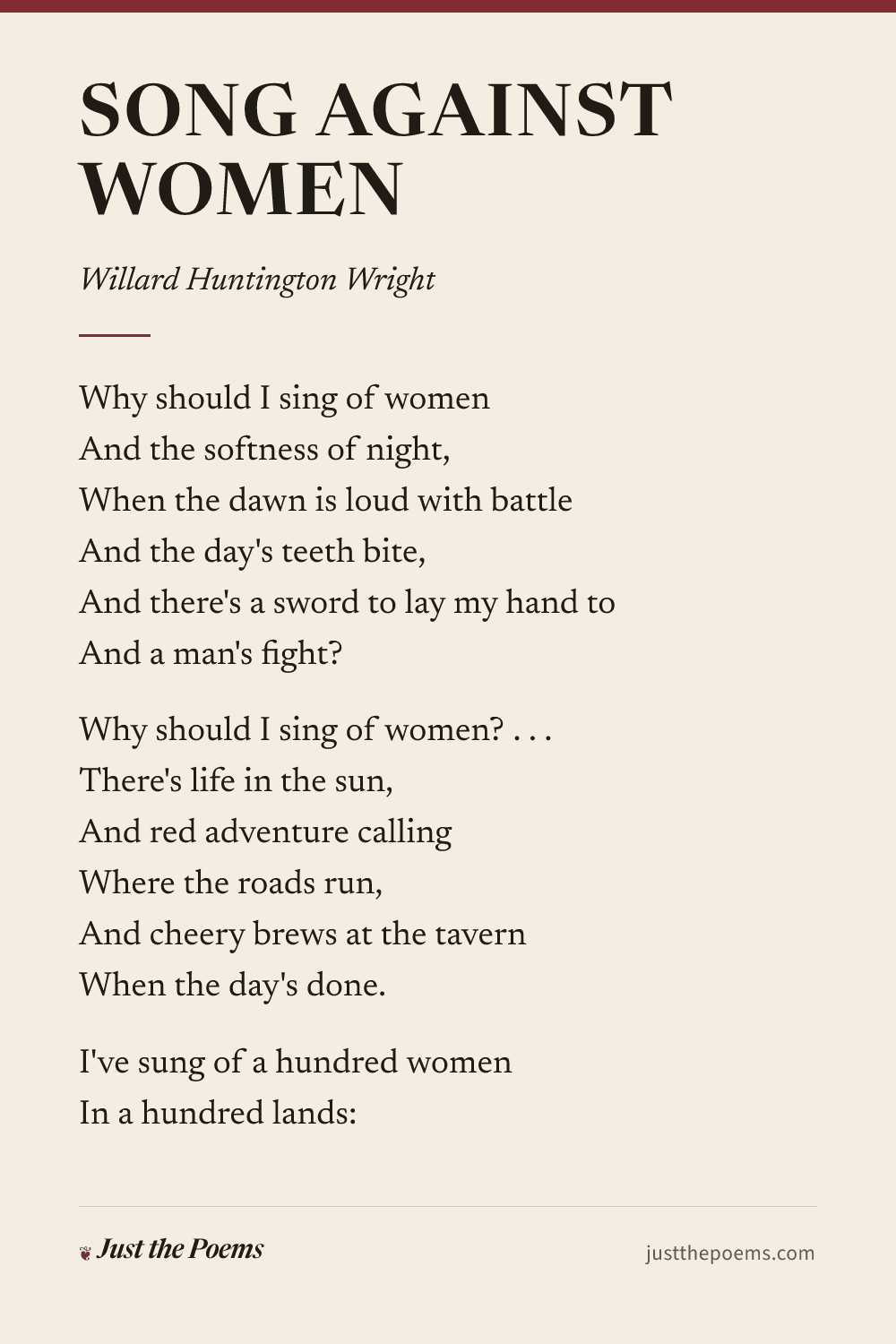
SONG AGAINST WOMEN

Willard Huntington Wright

In 0 Wikipedias 1 anthology Poet in 22 Wikipedias

Why should I sing of womenAnd the softness of night,When the dawn is loud with battleAnd the day's teeth bite,And there's a sword to lay my hand toAnd a man's fight?

Why should I sing of women? . . .There's life in the sun,And red adventure callingWhere the roads run,And cheery brews at the tavernWhen the day's done.

Show all 36 lines 24 more

I've sung of a hundred womenIn a hundred lands:But all their love is nothingBut drifting sands.I'm sick of their tears and kissesAnd their pale hands.

I've sung of a hundred womenAnd their bought lips;But out on the clean horizonI can hear the whipsOf the white waves lashing the bulwarksOf great, strong ships:

And the trails that run to the westwardAre shot with fire,And the winds hurl from the headlandWith ancient ire;And all my body itchesWith an old desire.

So I'll deal no more in womenAnd the softness of night,But I'll follow the red adventureAnd the wind's flight;And I'll sing of the sea and of battleAnd of men's might.

Source

The Home Book of Verse, ed. Burton Egbert Stevenson

Filed under
  • Named in the title

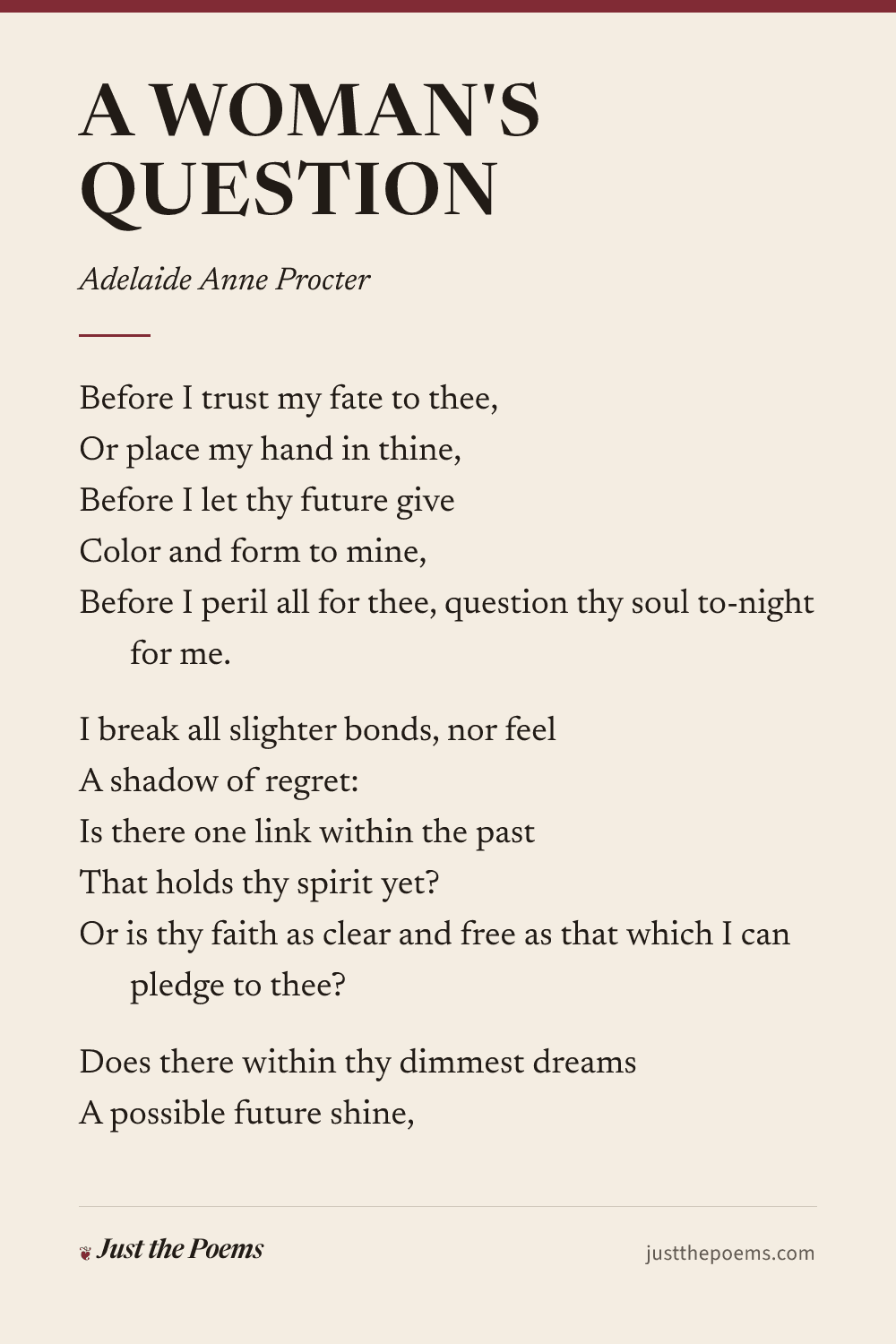
A WOMAN'S QUESTION

Adelaide Anne Procter

In 0 Wikipedias 1 anthology Poet in 21 Wikipedias

Before I trust my fate to thee,Or place my hand in thine,Before I let thy future giveColor and form to mine,Before I peril all for thee, question thy soul to-night for me.

I break all slighter bonds, nor feelA shadow of regret:Is there one link within the pastThat holds thy spirit yet?Or is thy faith as clear and free as that which I can pledge to thee?

Does there within thy dimmest dreamsA possible future shine,

Show all 40 lines 28 more

Wherein thy life could henceforth breathe,Untouched, unshared by mine?If so, at any pain or cost, O, tell me before all is lost.

Look deeper still. If thou canst feel,Within thy inmost soul,That thou hast kept a portion back,While I have staked the whole,Let no false pity spare the blow, but in true mercy tell me so.

Is there within thy heart a needThat mine cannot fulfil?One chord that any other handCould better wake or still?Speak now - lest at some future day my whole life wither and decay.

Lives there within thy nature hidThe demon-spirit change,Shedding a passing glory stillOn all things new and strange?It may not be thy fault alone, - but shield my heart against thy own.

Couldst thou withdraw thy hand one dayAnd answer to my claim,That Fate, and that to-day's mistake -Not thou - had been to blame?Some soothe their conscience thus; but thou wilt surely warn and save me now.

Nay, answer not, - I dare not hear,The words would come too late;Yet I would spare thee all remorse,So, comfort thee, my Fate, -Whatever on my heart may fall - remember, I would risk it all!

Source

The Home Book of Verse, ed. Burton Egbert Stevenson

Filed under
  • Named in the title

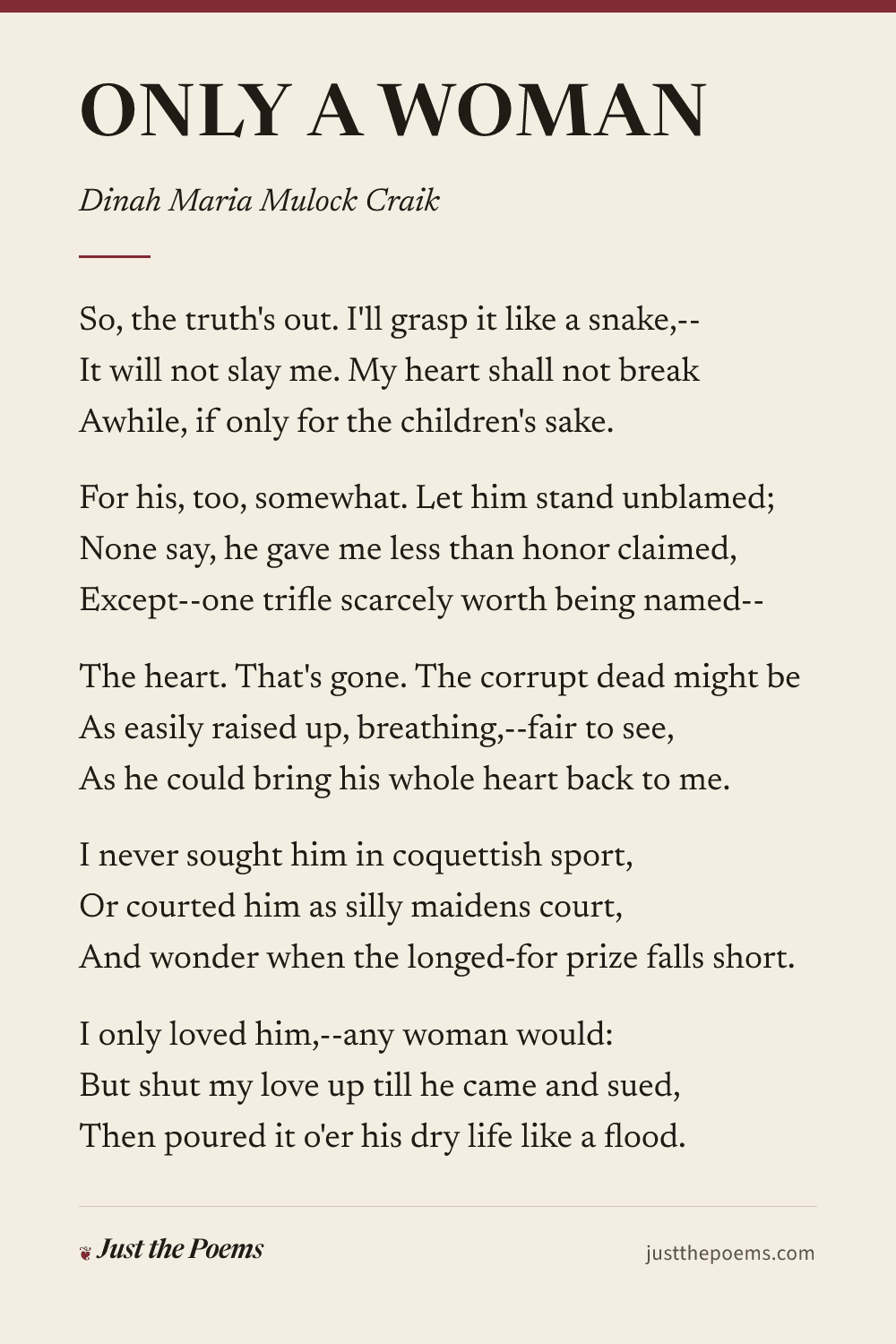
ONLY A WOMAN

Dinah Maria Mulock Craik

In 0 Wikipedias 1 anthology Poet in 19 Wikipedias

"She loves with love that cannot tire: And if, ah, woe! she loves alone, Through passionate duty love flames higher, As grass grows taller round a stone." --COVENTRY PATMORE.

So, the truth's out. I'll grasp it like a snake,--It will not slay me. My heart shall not breakAwhile, if only for the children's sake.

For his, too, somewhat. Let him stand unblamed;None say, he gave me less than honor claimed,Except--one trifle scarcely worth being named--

The heart. That's gone. The corrupt dead might beAs easily raised up, breathing,--fair to see,As he could bring his whole heart back to me.

I never sought him in coquettish sport,Or courted him as silly maidens court,And wonder when the longed-for prize falls short.

Show all 69 lines 57 more

I only loved him,--any woman would:But shut my love up till he came and sued,Then poured it o'er his dry life like a flood.

I was so happy I could make him blest!--So happy that I was his first and best,As he mine,--when he took me to his breast.

Ah me! if only then he had been true!If for one little year, a month or two,He had given me love for love, as was my due!

Or had he told me, ere the deed was done,He only raised me to his heart's dear throne--Poor substitute--because the queen was gone!

O, had he whispered, when his sweetest kissWas warm upon my mouth in fancied bliss,He had kissed another woman even as this,--

It were less bitter! Sometimes I could weepTo be thus cheated, like a child asleep;--Were not my anguish far too dry and deep.

So I built my house upon another's ground;Mocked with a heart just caught at the rebound,--A cankered thing that looked so firm and sound.

And when that heart grew colder,--colder still,I, ignorant, tried all duties to fulfil,Blaming my foolish pain, exacting will,

All,--anything but him. It was to beThe full draught others drink up carelesslyWas made this bitter Tantalus-cup for me.

I say again,--he gives me all I claimed,I and my children never shall be shamed:He is a just man,--he will live unblamed.

Only--O God, O God, to cry for bread.And get a stone! Daily to lay my headUpon a bosom where the old love's dead!

Dead?--Fool! It never lived. It only stirredGalvanic, like an hour-cold corpse. None heard:So let me bury it without a word.

He'll keep that other woman from my sight.I know not if her face be foul or bright;I only know that it was his delight--

As his was mine; I only know he standsPale, at the touch of their long-severed hands,Then to a flickering smile his lips commands,

Lest I should grieve, or jealous anger show.He need not. When the ship's gone down, I trow,We little reck whatever wind may blow.

And so my silent moan begins and ends,No world's laugh or world's taunt, no pity of friendsOr sneer of foes, with this my torment blends.

None knows,--none heeds. I have a little pride;Enough to stand up, wifelike, by his side,With the same smile as when I was his bride.

And I shall take his children to my arms;They will not miss these fading, worthless charms;Their kiss--ah! unlike his--all pain disarms.

And haply as the solemn years go by,He will think sometimes, with regretful sigh,The other woman was less true than I.

Source

The World's Best Poetry, Vol. III, ed. Bliss Carman, 1904

Filed under
  • Named in the title

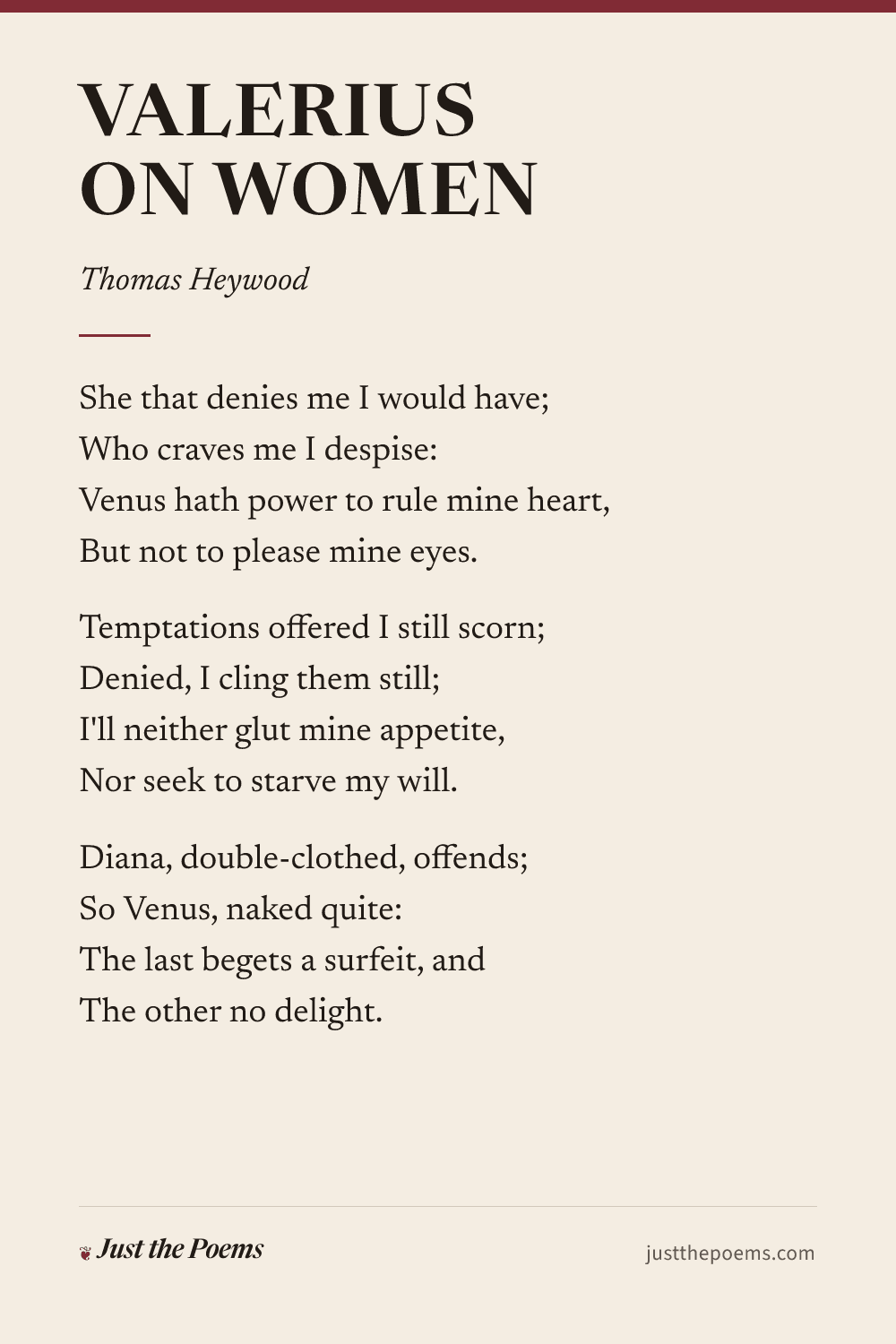
VALERIUS ON WOMEN

Thomas Heywood

In 0 Wikipedias 1 anthology Poet in 18 Wikipedias

She that denies me I would have;Who craves me I despise:Venus hath power to rule mine heart,But not to please mine eyes.

Temptations offered I still scorn;Denied, I cling them still;I'll neither glut mine appetite,Nor seek to starve my will.

Diana, double-clothed, offends;So Venus, naked quite:The last begets a surfeit, andThe other no delight.

That crafty girl shall please me best,That no, for yea, can say;And every wanton willing kissCan season with a nay.

Source

The Home Book of Verse, ed. Burton Egbert Stevenson

Filed under
  • Named in the title

30 of 116 poems for women

25 poets

By poet's century of death (29 of 30)

CenturyPoems
17th4
18th2
19th17
20th6

Poets with more than one poem

PoetPoems
Coventry Patmore4
Robert Browning2
Robert Herrick2