Poems About Night

The first 30 of 60 poems about night, by 29 poets, ranked by third-party data. How poems are ranked

Night

William Blake

In 1 Wikipedia 2 anthologies Poet in 101 Wikipedias

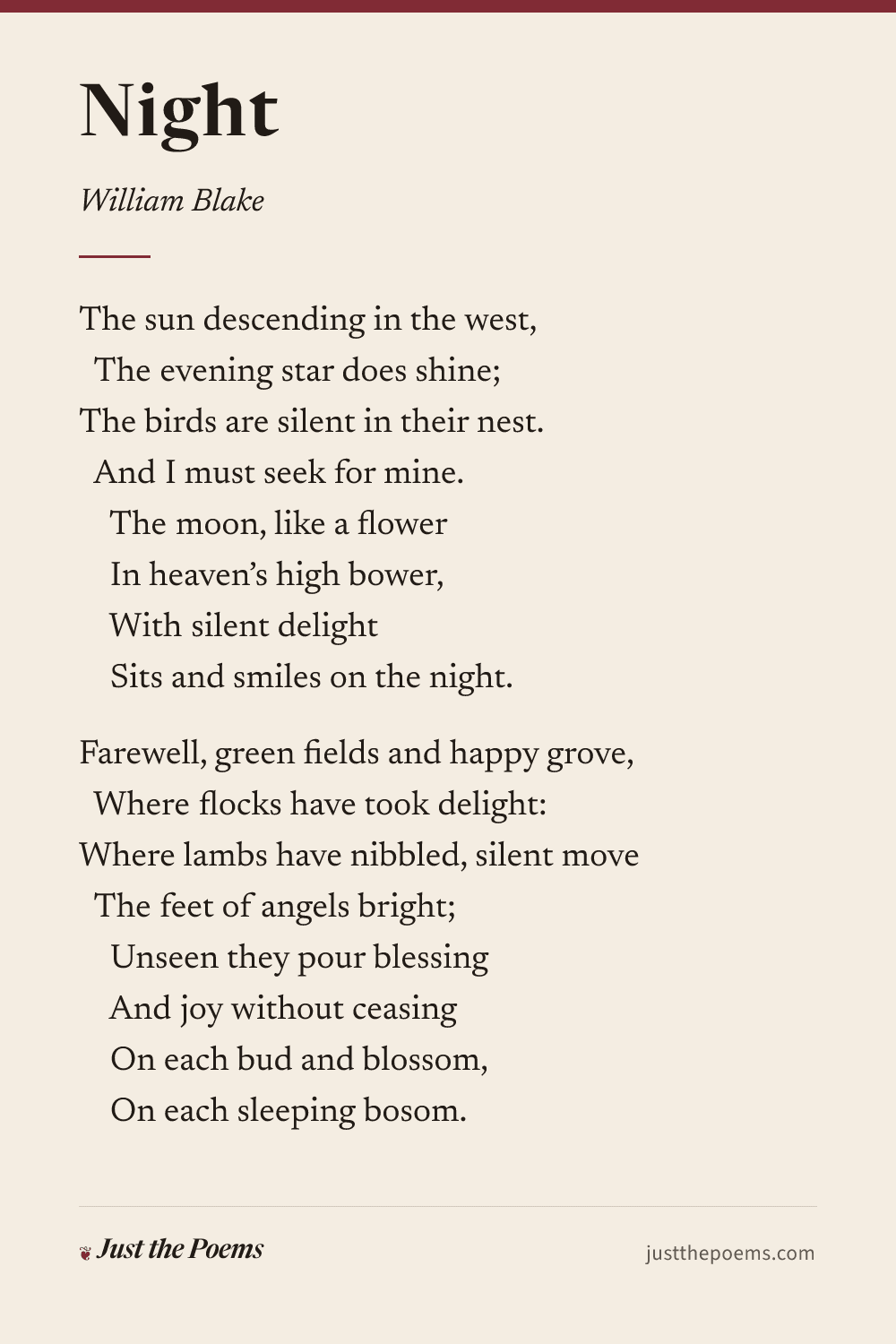
The sun descending in the west, The evening star does shine;The birds are silent in their nest. And I must seek for mine. The moon, like a flower In heaven’s high bower, With silent delight Sits and smiles on the night.

Farewell, green fields and happy grove, Where flocks have took delight:Where lambs have nibbled, silent move The feet of angels bright;

Show all 48 lines 36 more

Unseen they pour blessing And joy without ceasing On each bud and blossom, On each sleeping bosom.

They look in every thoughtless nest Where birds are cover’d warm;They visit caves of every beast, To keep them all from harm: If they see any weeping That should have been sleeping, They pour sleep on their head, And sit down by their bed.

When wolves and tigers howl for prey, They pitying stand and weep,Seeking to drive their thirst away And keep them from the sheep. But, if they rush dreadful, The angels, most heedful, Receive each mild spirit, New worlds to inherit.

And there the lion’s ruddy eyes Shall flow with tears of gold:And pitying the tender cries, And walking round the fold: Saying, ‘Wrath by His meekness, And, by His health, sickness, Are driven away From our immortal day.

‘And now beside thee, bleating lamb, I can lie down and sleep,Or think on Him who bore thy name, Graze after thee, and weep. For, wash’d in life’s river, My bright mane for ever Shall shine like the gold As I guard o’er the fold.’

Source

The Oxford Book of English Verse 1250–1900, 1900

Filed under
  • Named in the title

She walks in beauty, like the night

Lord Byron

In 0 Wikipedias 5 anthologies Poet in 155 Wikipedias

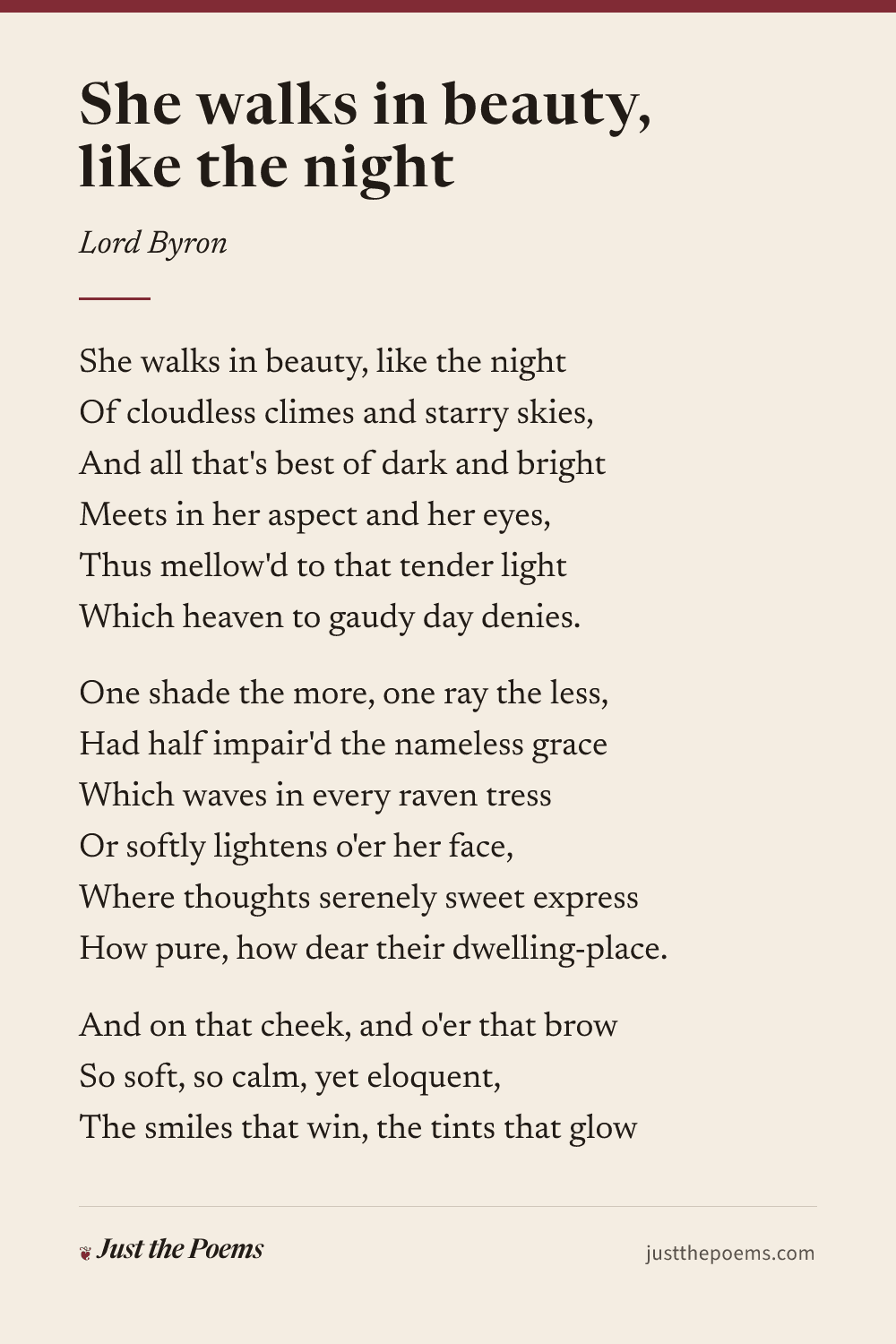
She walks in beauty, like the nightOf cloudless climes and starry skies,And all that's best of dark and brightMeets in her aspect and her eyes,Thus mellow'd to that tender lightWhich heaven to gaudy day denies.

One shade the more, one ray the less,Had half impair'd the nameless graceWhich waves in every raven tressOr softly lightens o'er her face,Where thoughts serenely sweet expressHow pure, how dear their dwelling-place.

And on that cheek, and o'er that browSo soft, so calm, yet eloquent,The smiles that win, the tints that glowBut tell of days in goodness spent,--A mind at peace with all below,A heart whose love is innocent.

Source

The Golden Treasury, ed. Francis Turner Palgrave

Filed under
  • Named in the first line

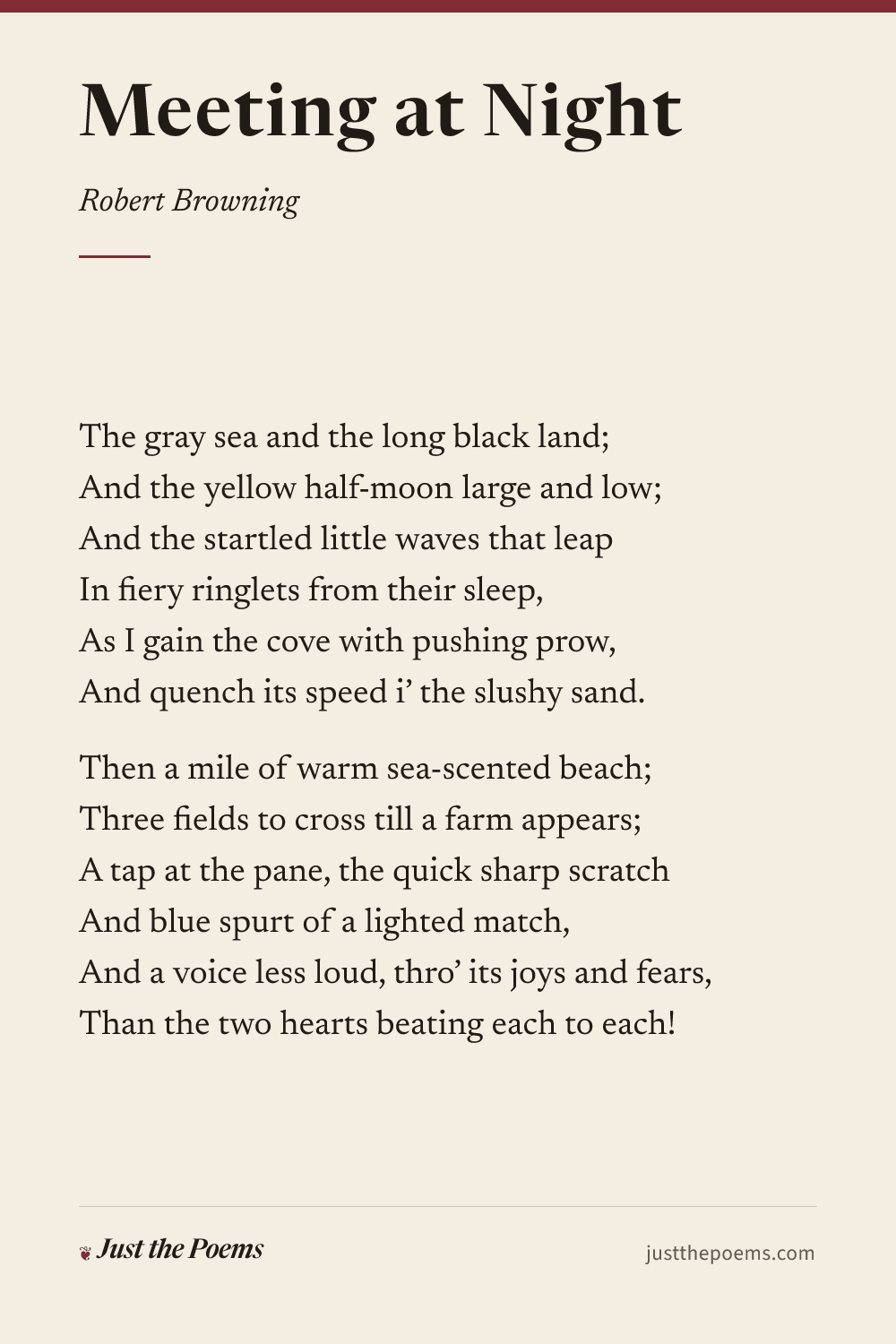
Meeting at Night

Robert Browning

In 0 Wikipedias 2 anthologies Poet in 57 Wikipedias

The gray sea and the long black land;And the yellow half-moon large and low;And the startled little waves that leapIn fiery ringlets from their sleep,As I gain the cove with pushing prow,And quench its speed i’ the slushy sand.

Then a mile of warm sea-scented beach;Three fields to cross till a farm appears;A tap at the pane, the quick sharp scratchAnd blue spurt of a lighted match,And a voice less loud, thro’ its joys and fears,Than the two hearts beating each to each!

Source

The Oxford Book of English Verse 1250–1900, 1900

Filed under
  • Named in the title

Advertisements

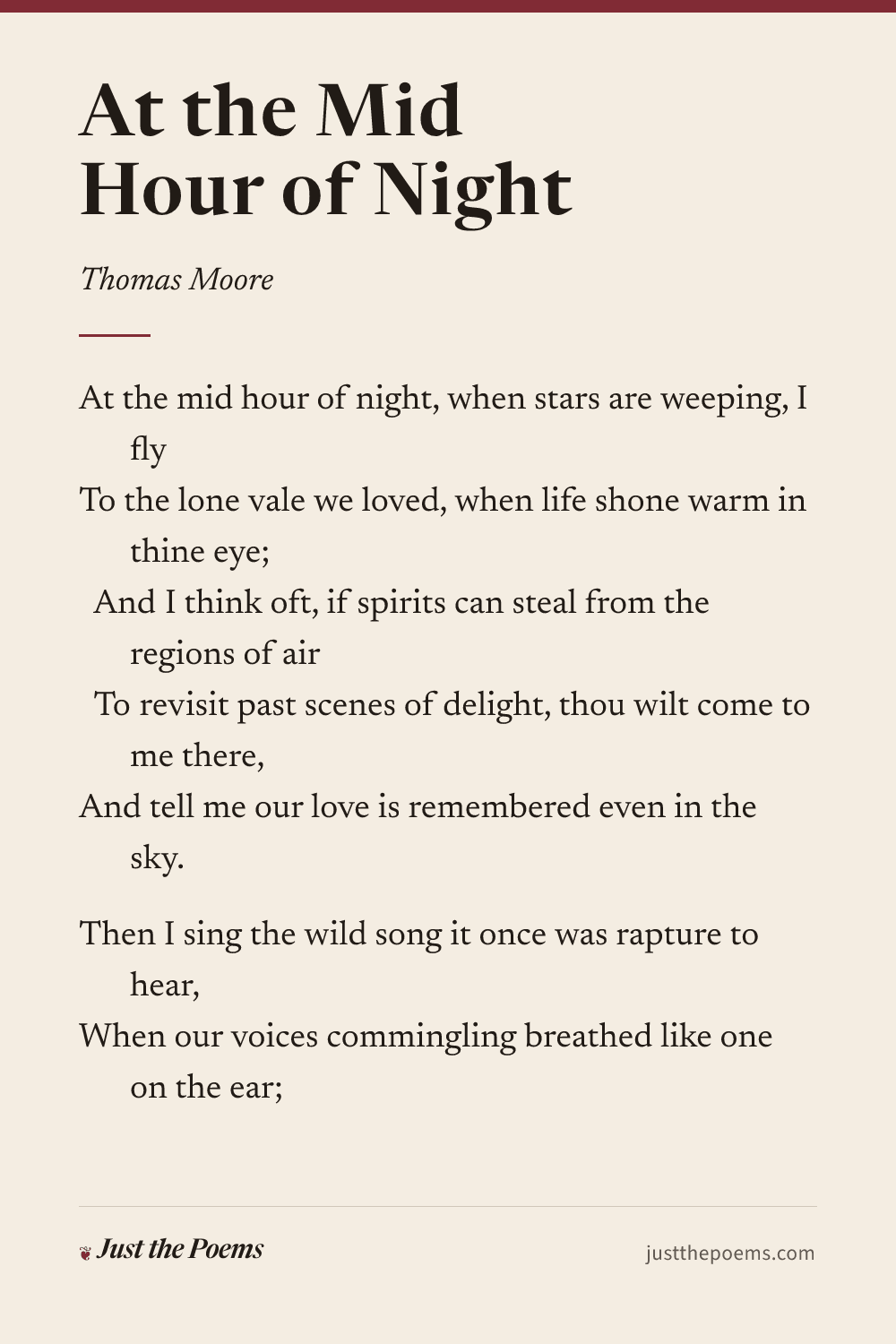
At the Mid Hour of Night

Thomas Moore

In 0 Wikipedias 2 anthologies Poet in 43 Wikipedias

At the mid hour of night, when stars are weeping, I flyTo the lone vale we loved, when life shone warm in thine eye; And I think oft, if spirits can steal from the regions of air To revisit past scenes of delight, thou wilt come to me there,And tell me our love is remembered even in the sky.

Then I sing the wild song it once was rapture to hear,When our voices commingling breathed like one on the ear; And as Echo far off through the vale my sad orison rolls, I think, O my love! ’tis thy voice from the Kingdom of SoulsFaintly answering still the notes that once were so dear.

Source

The Oxford Book of English Verse 1250–1900, 1900

Filed under
  • Named in the title

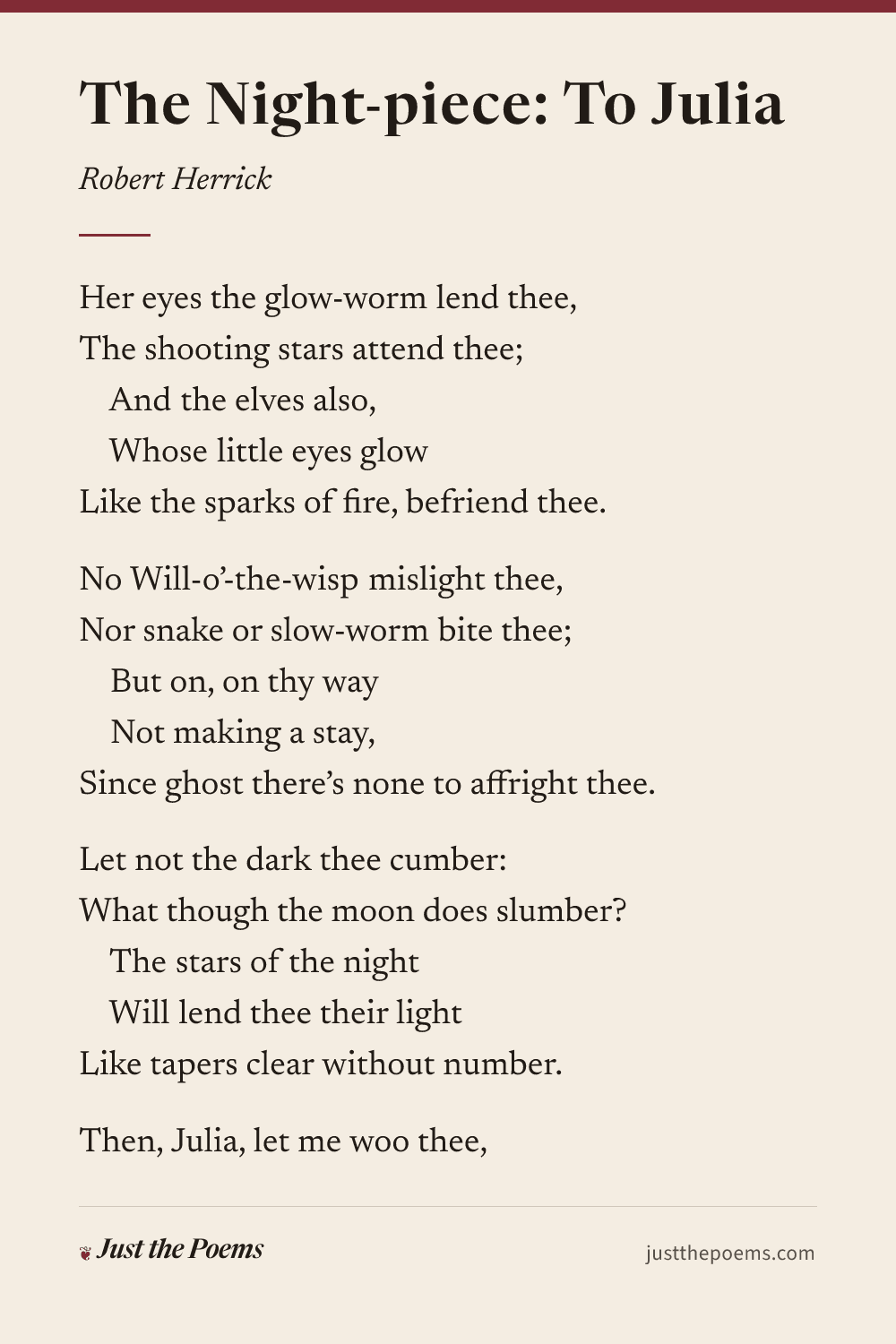
The Night-piece: To Julia

Robert Herrick

In 0 Wikipedias 2 anthologies Poet in 26 Wikipedias

Her eyes the glow-worm lend thee,The shooting stars attend thee; And the elves also, Whose little eyes glowLike the sparks of fire, befriend thee.

No Will-o’-the-wisp mislight thee,Nor snake or slow-worm bite thee; But on, on thy way Not making a stay,Since ghost there’s none to affright thee.

Let not the dark thee cumber:What though the moon does slumber? The stars of the night Will lend thee their lightLike tapers clear without number.

Then, Julia, let me woo thee,Thus, thus to come unto me; And when I shall meet Thy silv’ry feet,My soul I’ll pour into thee.

Source

The Oxford Book of English Verse 1250–1900, 1900

Filed under
  • Named in the title

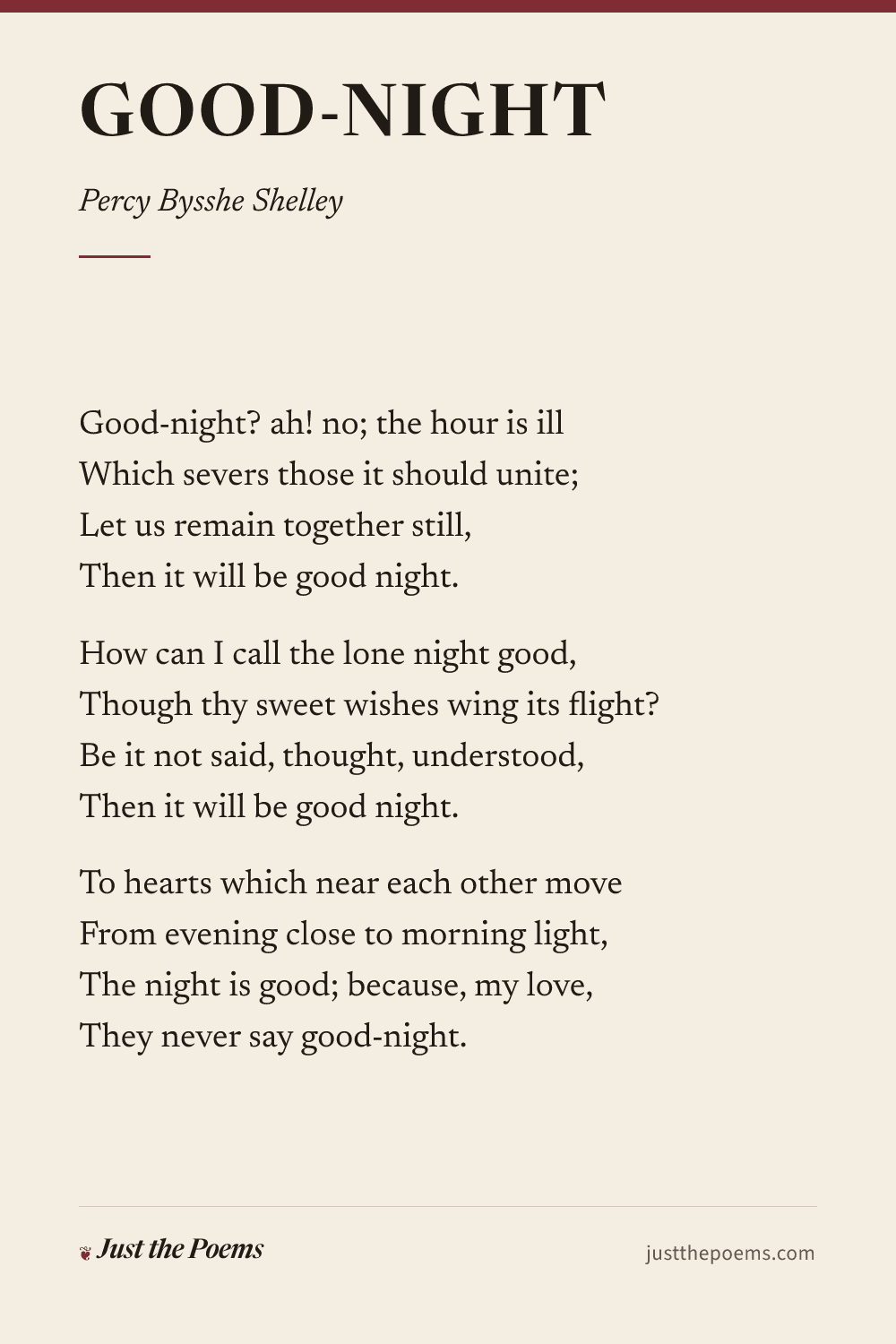
GOOD-NIGHT

Percy Bysshe Shelley

In 0 Wikipedias 1 anthology Poet in 91 Wikipedias

Good-night? ah! no; the hour is illWhich severs those it should unite;Let us remain together still,Then it will be good night.

How can I call the lone night good,Though thy sweet wishes wing its flight?Be it not said, thought, understood,Then it will be good night.

To hearts which near each other moveFrom evening close to morning light,The night is good; because, my love,They never say good-night.

Source

The Home Book of Verse, ed. Burton Egbert Stevenson

Filed under
  • Named in the title

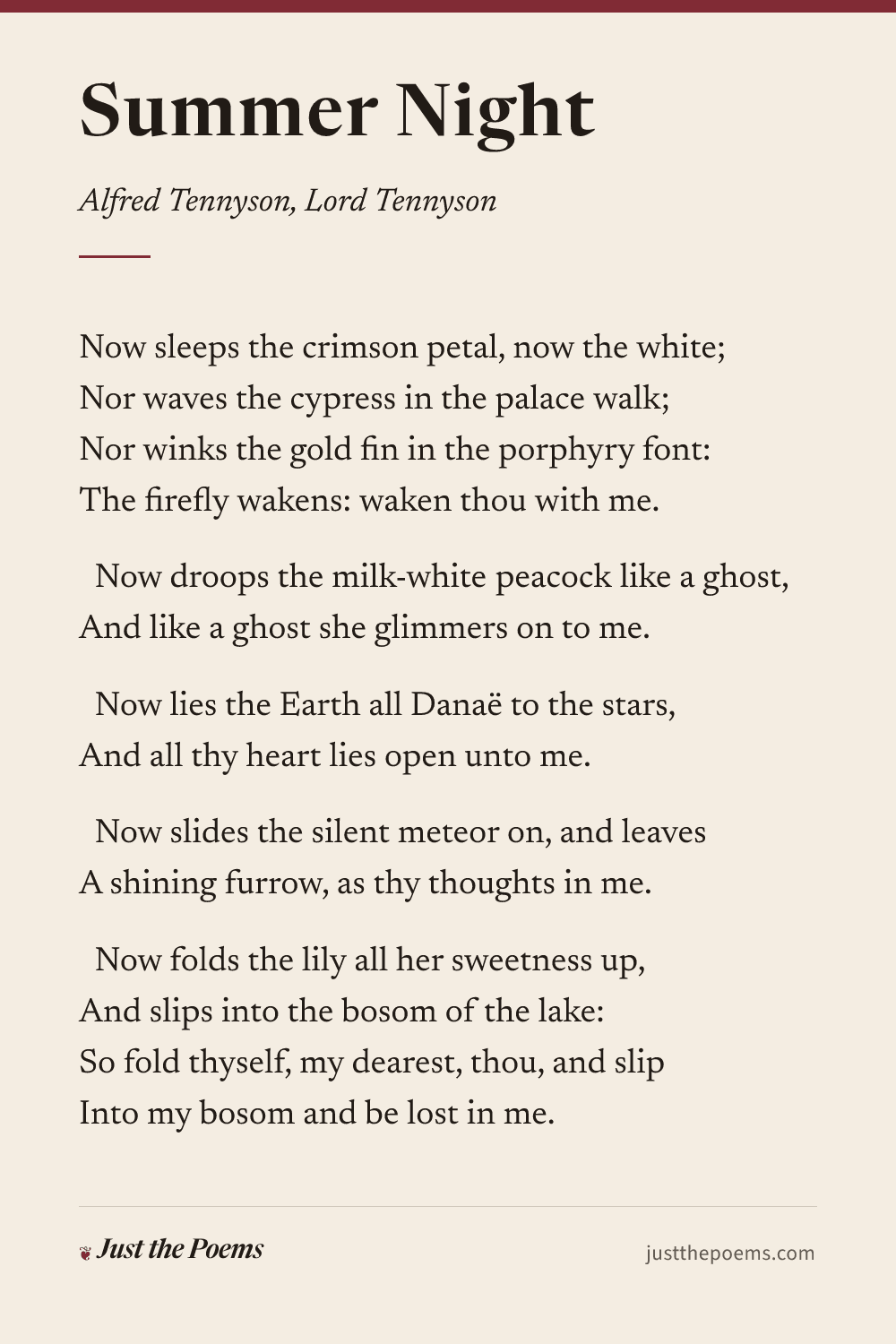
Summer Night

Alfred Tennyson, Lord Tennyson

In 0 Wikipedias 1 anthology Poet in 72 Wikipedias

Now sleeps the crimson petal, now the white;Nor waves the cypress in the palace walk;Nor winks the gold fin in the porphyry font:The firefly wakens: waken thou with me.

Now droops the milk-white peacock like a ghost,And like a ghost she glimmers on to me.

Now lies the Earth all Danaë to the stars,And all thy heart lies open unto me.

Now slides the silent meteor on, and leavesA shining furrow, as thy thoughts in me.

Now folds the lily all her sweetness up,And slips into the bosom of the lake:So fold thyself, my dearest, thou, and slipInto my bosom and be lost in me.

Source

The Oxford Book of English Verse 1250–1900, 1900

Filed under
  • Named in the title

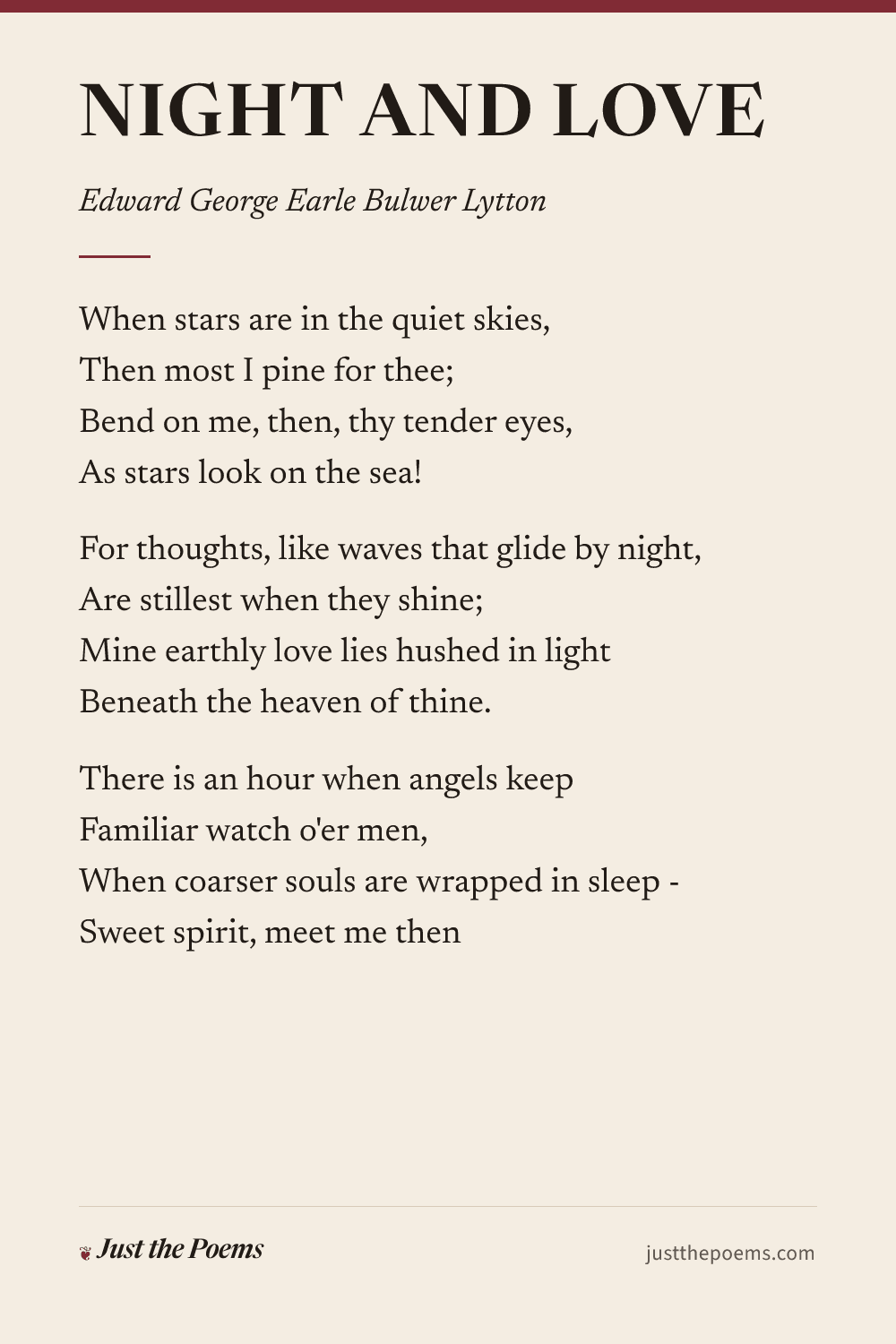
NIGHT AND LOVE

Edward George Earle Bulwer Lytton

In 0 Wikipedias 1 anthology Poet in 44 Wikipedias

When stars are in the quiet skies,Then most I pine for thee;Bend on me, then, thy tender eyes,As stars look on the sea!

For thoughts, like waves that glide by night,Are stillest when they shine;Mine earthly love lies hushed in lightBeneath the heaven of thine.

There is an hour when angels keepFamiliar watch o'er men,When coarser souls are wrapped in sleep -Sweet spirit, meet me then

There is an hour when holy dreamsThrough slumber fairest glide;And in that mystic hour it seemsThou shouldst be by my side.

My thoughts of thee too sacred areFor daylight's common beam:I can but know thee as my star,My angel and my dream!

Source

The Home Book of Verse, ed. Burton Egbert Stevenson

Filed under
  • Named in the title

Advertisements

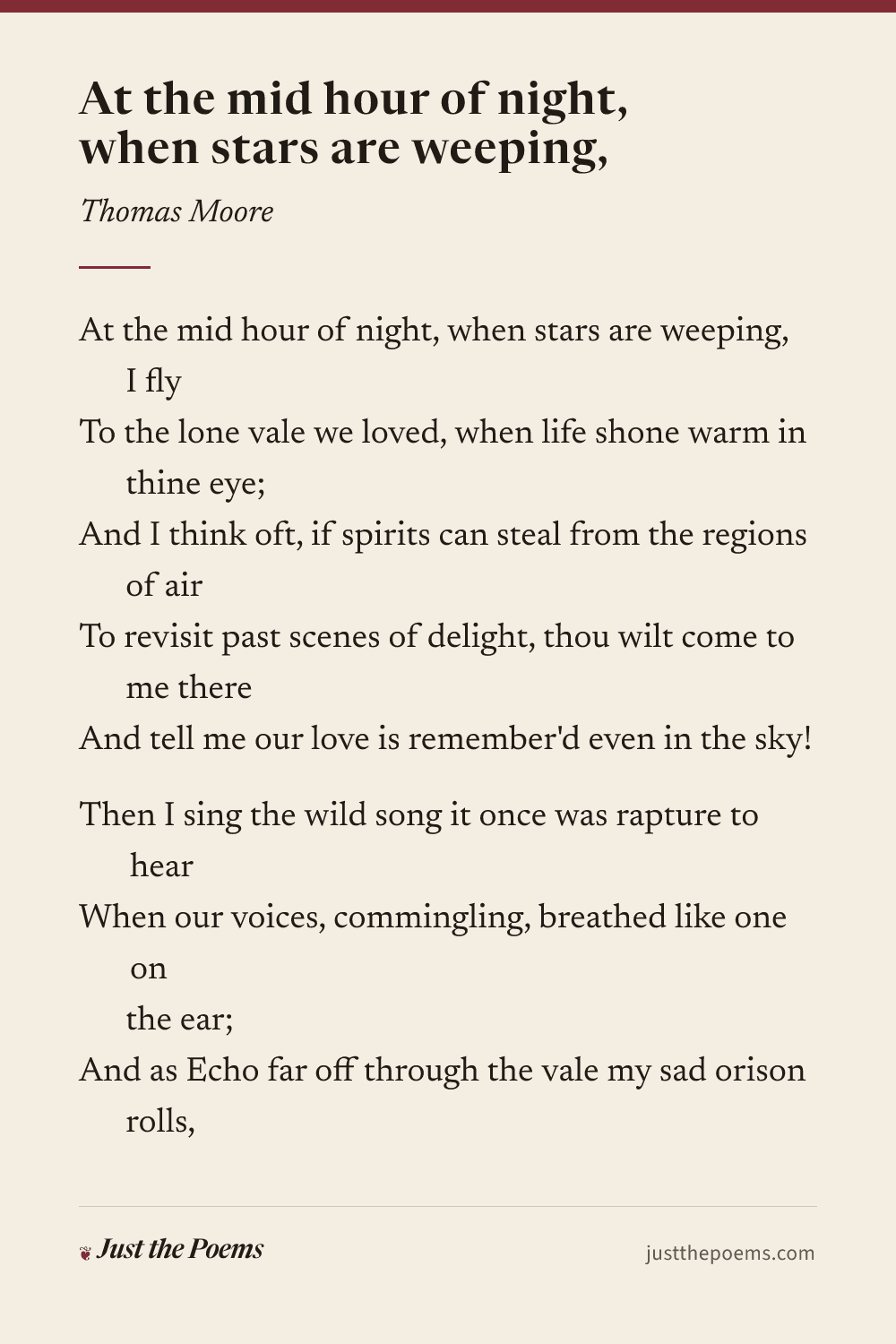
At the mid hour of night, when stars are weeping,

Thomas Moore

In 0 Wikipedias 1 anthology Poet in 43 Wikipedias

At the mid hour of night, when stars are weeping, I flyTo the lone vale we loved, when life shone warm in thine eye;And I think oft, if spirits can steal from the regions of airTo revisit past scenes of delight, thou wilt come to me thereAnd tell me our love is remember'd even in the sky!

Then I sing the wild song it once was rapture to hearWhen our voices, commingling, breathed like one on the ear;And as Echo far off through the vale my sad orison rolls,I think, O my love! 'tis thy voice, from the Kingdom of SoulsFaintly answering still the notes that once were so dear.

Source

The Golden Treasury, ed. Francis Turner Palgrave

Filed under
  • Named in the first line

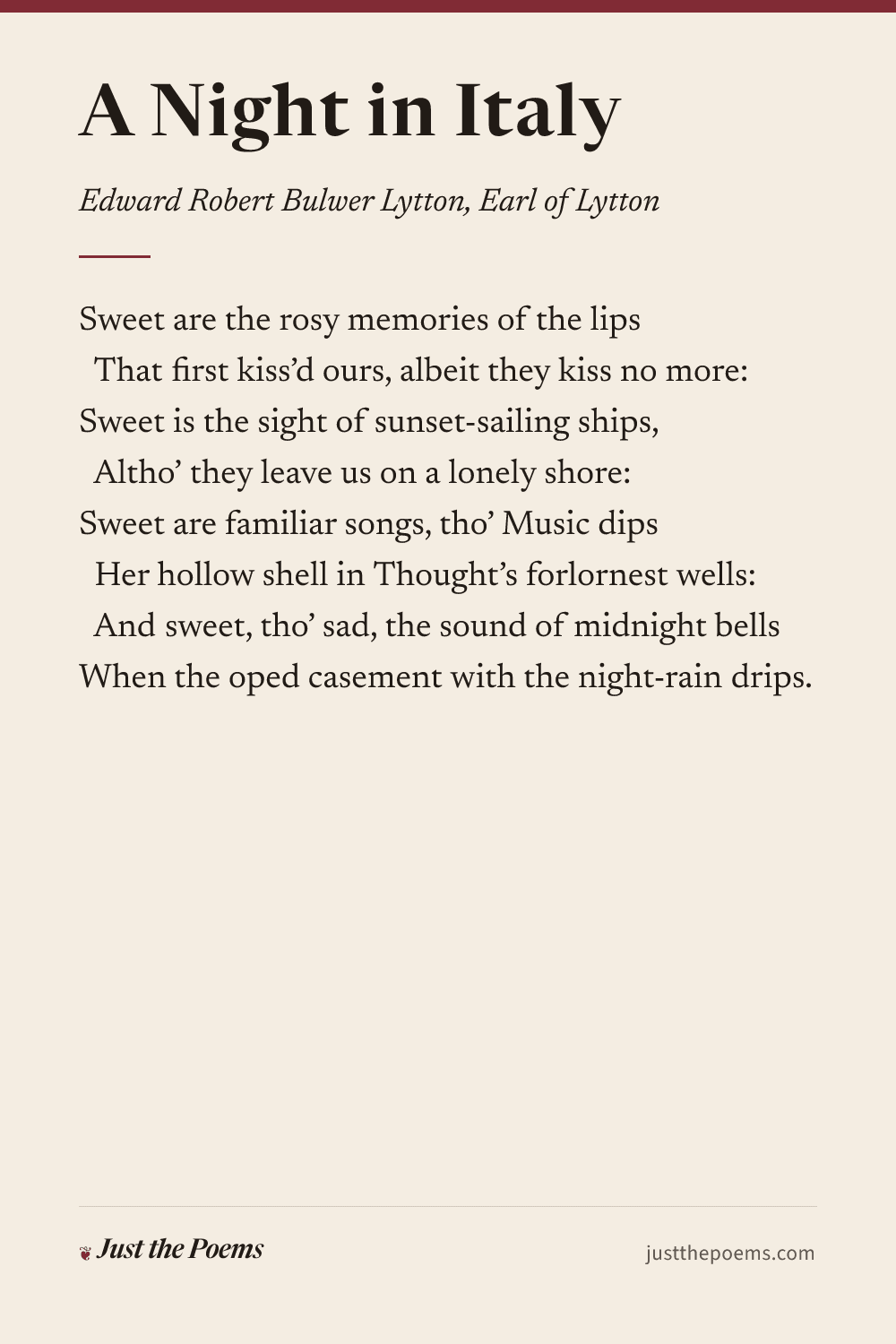
A Night in Italy

Edward Robert Bulwer Lytton, Earl of Lytton

In 0 Wikipedias 1 anthology Poet in 25 Wikipedias

Sweet are the rosy memories of the lips That first kiss’d ours, albeit they kiss no more:Sweet is the sight of sunset-sailing ships, Altho’ they leave us on a lonely shore:Sweet are familiar songs, tho’ Music dips Her hollow shell in Thought’s forlornest wells: And sweet, tho’ sad, the sound of midnight bellsWhen the oped casement with the night-rain drips.

There is a pleasure which is born of pain: The grave of all things hath its violet.Else why, thro’ days which never come again, Roams Hope with that strange longing, like Regret?

Show all 168 lines 156 more

Why put the posy in the cold dead hand? Why plant the rose above the lonely grave? Why bring the corpse across the salt sea-wave?Why deem the dead more near in native land?

Thy name hath been a silence in my life So long, it falters upon language now,O more to me than sister or than wife, Once ... and now--nothing! It is hard to knowThat such things have been, and are not; and yet Life loiters, keeps a pulse at even measure, And goes upon its business and its pleasure,And knows not all the depths of its regret....

Ah, could the memory cast her spots, as do The snake’s brood theirs in spring! and be once moreWholly renew’d, to dwell i’ the time that’s new, With no reiterance of those pangs of yore.Peace, peace! My wild song will go wandering Too wantonly, down paths a private pain Hath trodden bare. What was it jarr’d the strain?Some crush’d illusion, left with crumpled wing

Tangled in Music’s web of twinèd strings-- That started that false note, and crack’d the tuneIn its beginning. Ah, forgotten things Stumble back strangely! and the ghost of JuneStands by December’s fire, cold, cold! and puts The last spark out.--How could I sing aright With those old airs haunting me all the nightAnd those old steps that sound when daylight shuts?

For back she comes, and moves reproachfully, The mistress of my moods, and looks bereft(Cruel to the last!) as tho’ ’twere I, not she, That did the wrong, and broke the spell, and leftMemory comfortless.--Away! away! Phantoms, about whose brows the bindweed clings, Hopeless regret! In thinking of these thingsSome men have lost their minds, and others may.

Yet, O for one deep draught in this dull hour! One deep, deep draught of the departed time!O for one brief strong pulse of ancient power, To beat and breathe thro’ all the valves of rhyme!Thou, Memory, with thy downward eyes, that art The cup-bearer of gods, pour deep and long, Brim all the vacant chalices of songWith health! Droop down thine urn. I hold my heartOne draught of what I shall not taste again Save when my brain with thy dark wine is brimm’d,--One draught! and then straight onward, spite of pain, And spite of all things changed, with gaze undimm’d,Love’s footsteps thro’ the waning Past to explore Undaunted; and to carve in the wan light Of Hope’s last outposts, on Song’s utmost height,The sad resemblance of an hour or more.

Midnight, and love, and youth, and Italy! Love in the land where love most lovely seems!Land of my love, tho’ I be far from thee, Lend, for love’s sake, the light of thy moonbeams,The spirit of thy cypress-groves and all Thy dark-eyed beauty for a little while To my desire. Yet once more let her smileFall o’er me: o’er me let her long hair fall....

Under the blessèd darkness unreproved We were alone, in that best hour of timeWhich first reveal’d to us how much we loved, ’Neath the thick starlight. The young night sublimeHung trembling o’er us. At her feet I knelt, And gazed up from her feet into her eyes. Her face was bow’d: we breathed each other’s sighs:We did not speak: not move: we look’d: we felt.

The night said not a word. The breeze was dead. The leaf lay without whispering on the tree,As I lay at her feet. Droop’d was her head: One hand in mine: and one still pensivelyWent wandering through my hair. We were together. How? Where? What matter? Somewhere in a dream, Drifting, slow drifting down a wizard stream:Whither? Together: then what matter whither?

It was enough for me to clasp her hand: To blend with her love-looks my own: no more.Enough (with thoughts like ships that cannot land, Blown by faint winds about a magic shore)To realize, in each mysterious feeling, The droop of the warm cheek so near my own: The cool white arm about my shoulder thrown:Those exquisite fair feet where I was kneeling.

How little know they life’s divinest bliss, That know not to possess and yet refrain!Let the young Psyche roam, a fleeting kiss: Grasp it--a few poor grains of dust remain.See how those floating flowers, the butterflies, Hover the garden thro’, and take no root! Desire for ever hath a flying foot:Free pleasure comes and goes beneath the skies.

Close not thy hand upon the innocent joy That trusts itself within thy reach. It may,Or may not, linger. Thou canst but destroy The wingèd wanderer. Let it go or stay.Love thou the rose, yet leave it on its stem. Think! Midas starved by turning all to gold. Blessèd are those that spare, and that withhold;Because the whole world shall be trusted them.

The foolish Faun pursues the unwilling Nymph That culls her flowers beside the precipiceOr dips her shining ankles in the lymph: But, just when she must perish or be his,Heaven puts an arm out. She is safe. The shore Gains some new fountain; or the lilied lawn A rarer sort of rose: but ah, poor Faun!To thee she shall be changed for evermore.

Chase not too close the fading rapture. Leave To Love his long auroras, slowly seen.Be ready to release as to receive. Deem those the nearest, soul to soul, betweenWhose lips yet lingers reverence on a sigh. Judge what thy sense can reach not, most thine own, If once thy soul hath seized it. The unknownIs life to love, religion, poetry.

The moon had set. There was not any light, Save of the lonely legion’d watch-stars paleIn outer air, and what by fits made bright Hot oleanders in a rosy valeSearched by the lamping fly, whose little spark Went in and out, like passion’s bashful hope. Meanwhile the sleepy globe began to slopeA ponderous shoulder sunward thro’ the dark.

And the night pass’d in beauty like a dream. Aloof in those dark heavens paused Destiny,With her last star descending in the gleam Of the cold morrow, from the emptied sky.The hour, the distance from her old self, all The novelty and loneness of the place Had left a lovely awe on that fair face,And all the land grew strange and magical.

As droops some billowy cloud to the crouch’d hill, Heavy with all heaven’s tears, for all earth’s care,She droop’d unto me, without force or will, And sank upon my bosom, murmuring thereA woman’s inarticulate passionate words. O moment of all moments upon earth! O life’s supreme! How worth, how wildly worth,Whole worlds of flame, to know this world affords.

What even Eternity can not restore! When all the ends of life take hands and meetRound centres of sweet fire. Ah, never more, Ah never, shall the bitter with the sweetBe mingled so in the pale after-years! One hour of life immortal spirits possess. This drains the world, and leaves but weariness,And parching passion, and perplexing tears.

Sad is it, that we cannot even keep That hour to sweeten life’s last toil: but YouthGrasps all, and leaves us: and when we would weep, We dare not let our tears fall, lest, in truth,They fall upon our work which must be done. And so we bind up our torn hearts from breaking: Our eyes from weeping, and our brows from aching:And follow the long pathway all alone.
Source

The Oxford Book of English Verse 1250–1900, 1900

Filed under
  • Named in the title

Winter Nights

Thomas Campion

In 0 Wikipedias 1 anthology Poet in 25 Wikipedias

Now winter nights enlarge The number of their hours, And clouds their storms discharge Upon the airy towers. Let now the chimneys blaze And cups o’erflow with wine; Let well-tuned words amaze With harmony divine. Now yellow waxen lights Shall wait on honey love,While youthful revels, masques, and courtly sights Sleep’s leaden spells remove.

This time doth well dispense With lovers’ long discourse; Much speech hath some defence Though beauty no remorse. All do not all things well; Some measures comely tread, Some knotted riddles tell, Some poems smoothly read. The summer hath his joys, And winter his delights;Though love and all his pleasures are but toys, They shorten tedious nights.

Source

The Oxford Book of English Verse 1250–1900, 1900

Filed under
  • Named in the title

"WHILE SHEPHERDS WATCHED THEIR FLOCKS BY NIGHT"

Nahum Tate

In 0 Wikipedias 1 anthology Poet in 20 Wikipedias

While shepherds watched their flocks by night,All seated on the ground,The angel of the Lord came down,And glory shone around.

"Fear not," said he, for mighty dreadHad seized their troubled mind;"Glad tidings of great joy I bringTo you and all mankind.

"To you, in David's town, this dayIs born, of David's line,The Saviour, who is Christ the Lord,And this shall be the sign:

"The heavenly babe you there shall findTo human view displayed,All meanly wrapped in swaddling bands,And in a manger laid."

Thus spake the seraph; and forthwithAppeared a shining throngOf angels, praising God, who thusAddressed their joyful song:

"All glory be to God on high,And to the earth be peace;Good will henceforth from Heaven to menBegin and never cease."

Source

The Home Book of Verse, ed. Burton Egbert Stevenson

Filed under
  • Named in the title

Care-charmer Sleep, son of the sable Night,

Samuel Daniel

In 0 Wikipedias 1 anthology Poet in 17 Wikipedias

Care-charmer Sleep, son of the sable Night,Brother to Death, in silent darkness born,Relieve my anguish, and restore the light;With dark forgetting of my care return.

And let the day be time enough to mournThe shipwreck of my ill adventured youth:Let waking eyes suffice to wail their scorn,Without the torment of the night's untruth.

Cease, dreams, the images of day-desires,To model forth the passions of the morrow;Never let rising Sun approve you liarsTo add more grief to aggravate my sorrow:

Still let me sleep, embracing clouds in vain,And never wake to feel the day's disdain.

Source

The Golden Treasury, ed. Francis Turner Palgrave

Filed under
  • Named in the first line

Advertisements

NIGHT

John Addington Symonds

In 0 Wikipedias 1 anthology Poet in 17 Wikipedias

Mysterious night! Spread wide thy silvery plume!Soft as swan's down, brood o'er the sapphirineBreadth of still shadowy waters dark as wine;Smooth out the liquid heavens that stars illume!Come with fresh airs breathing the faint perfumeOf deep-walled gardens, groves of whispering pine;Scatter soft dews, waft pure sea-scent of brine;In sweet repose man's pain, man's love resume!Deep-bosomed night! Not here where down the margeMarble with palaces those lamps of earthTremble on trembling blackness; nay, far hence,There on the lake where space is lone and large,And man's life lost in broad indifference,Lilt thou the soul to spheres that gave her birth!

Source

The Home Book of Verse, ed. Burton Egbert Stevenson

Filed under
  • Named in the title

GOOD-NIGHT

Jane Taylor

In 0 Wikipedias 1 anthology Poet in 16 Wikipedias

Little baby, lay your headOn your pretty cradle-bed;Shut your eye-peeps, now the dayAnd the light are gone away;All the clothes are tucked in tight;Little baby dear, good-night.

Yes, my darling, well I knowHow the bitter wind doth blow;And the winter's snow and rainPatter on the window-pane:But they cannot come in here,To my little baby dear;

For the window shutteth fast,Till the stormy night is past;And the curtains warm are spreadRound about her cradle bed:So till morning shineth bright,Little baby dear, good-night.

Source

The Home Book of Verse, ed. Burton Egbert Stevenson

Filed under
  • Named in the title

"ALL LAST NIGHT"

Lascelles Abercrombie

In 0 Wikipedias 1 anthology Poet in 15 Wikipedias

All last night I had quietIn a fragrant dream and warm:She had become my Sabbath,And round my neck, her arm.

I knew the warmth in my dreaming;The fragrance, I suppose,Was her hair about me,Or else she wore a rose.

Her hair, I think; for likestWoodruffe 'twas, when SpringLoitering down wet woodwaysTreads it sauntering.

No light, nor any speaking;Fragrant only and warm.Enough to know my lodging,The white Sabbath of her arm.

Source

The Home Book of Verse, ed. Burton Egbert Stevenson

Filed under
  • Named in the title

TO NIGHT

Joseph Blanco White

In 0 Wikipedias 1 anthology Poet in 14 Wikipedias

Mysterious Night! when our first parent knewThee from report divine, and heard thy name,Did he not tremble for this lovely frame,This glorious canopy of light and blue?Yet 'neath the curtain of translucent dew,Bathed in the rays of the great setting flame,Hesperus with the host of heaven came,And lo! creation widened on man's view.Who could have thought such darkness lay concealedWithin thy beams, O Sun! or who could find,While fly, and leaf, and insect stood revealed,That to such countless orbs thou mad'st us blind!Why do we, then, shun Death with anxious strife?--If Light can thus deceive, wherefore not Life?

Source

The Home Book of Verse, ed. Burton Egbert Stevenson

Filed under
  • Named in the title

AT NIGHT

Alice Meynell

In 0 Wikipedias 1 anthology Poet in 12 Wikipedias

Home, home from the horizon far and clear,Hither the soft wings sweep;Flocks of the memories of the day draw nearThe dovecote doors of sleep.

Oh which are they that come through sweetest lightOf all these homing birds?Which with the straightest and the swiftest flight?Your words to me, your words!

Source

The Home Book of Verse, ed. Burton Egbert Stevenson

Filed under
  • Named in the title

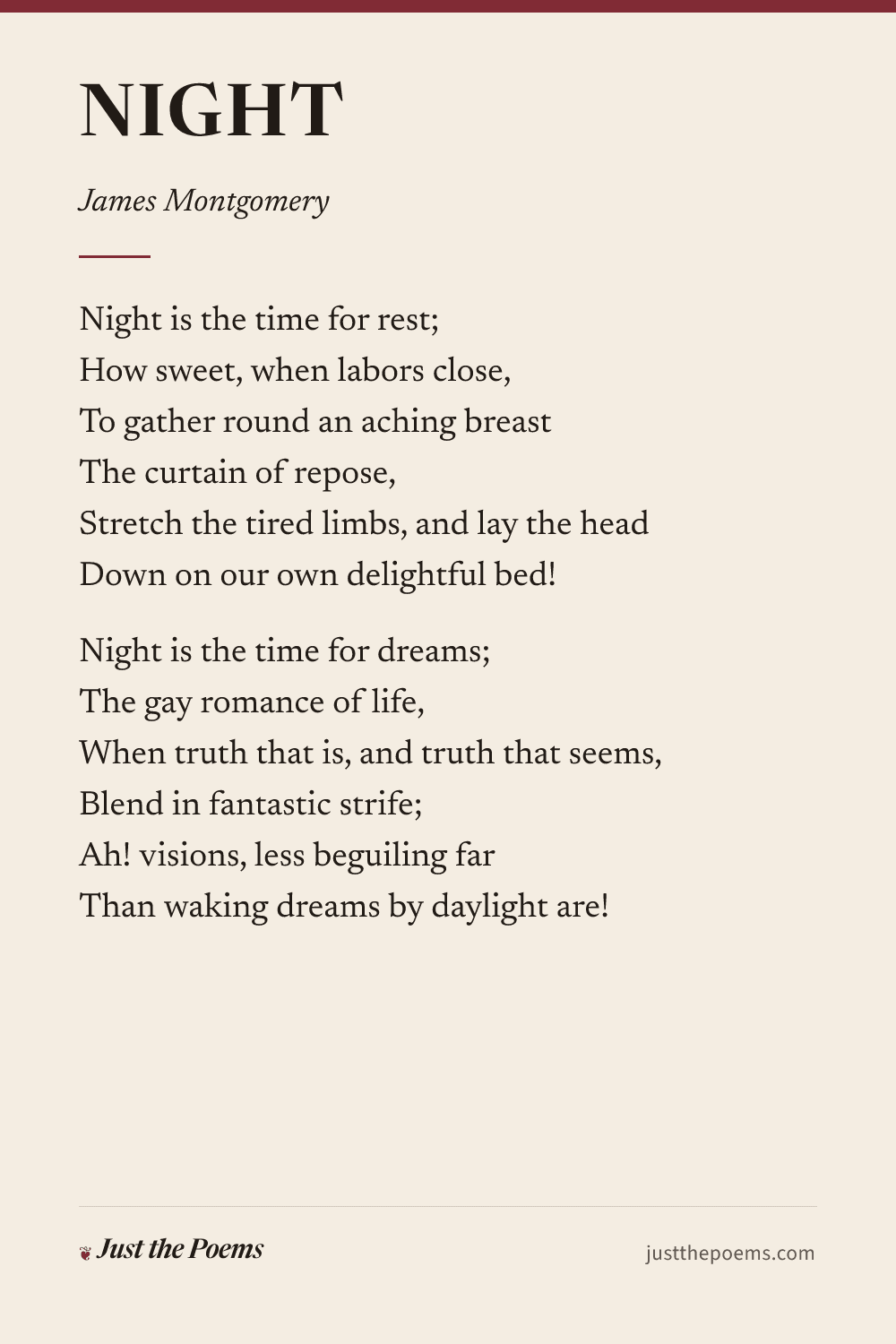
NIGHT

James Montgomery

In 0 Wikipedias 1 anthology Poet in 10 Wikipedias

Night is the time for rest;How sweet, when labors close,To gather round an aching breastThe curtain of repose,Stretch the tired limbs, and lay the headDown on our own delightful bed!

Night is the time for dreams;The gay romance of life,When truth that is, and truth that seems,Blend in fantastic strife;Ah! visions, less beguiling farThan waking dreams by daylight are!

Show all 54 lines 42 more

Night is the time for toil;To plough the classic field,Intent to find the buried spoilIts wealthy furrows yield;Till all is ours that sages taught,That poets sang, or heroes wrought.

Night is the time to weep;To wet with unseen tearsThose graves of Memory, where sleepThe joys of other years;Hopes, that were Angels at their birth,But perished young, like things of earth.

Night is the time to watch;O'er ocean's dark expanse,To hail the Pleiades, or catchThe full moon's earliest glance,That brings into the homesick mindAll we have loved and left behind.

Night is the time for care;Brooding on hours misspent,To see the spectre of DespairCome to our lonely tent;Like Brutus, 'midst his slumbering host,Summoned to die by Caesar's ghost.

Night is the time to think;When, from the eye, the soulTakes flight; and, on the utmost brink,Of yonder starry poleDescries beyond the abyss of nightThe dawn of uncreated light.

Night is the time to pray;Our Saviour oft withdrewTo desert mountains far away;So will his followers do,--Steal from the throng to haunts untrod,And hold communion there with God.

Night is the time for Death;When all around is peace,Calmly to yield the weary breath,From sin and suffering cease,Think of heaven's bliss, and give the signTo parting friends;--such death be mine!

Source

The Home Book of Verse, ed. Burton Egbert Stevenson

Filed under
  • Named in the title

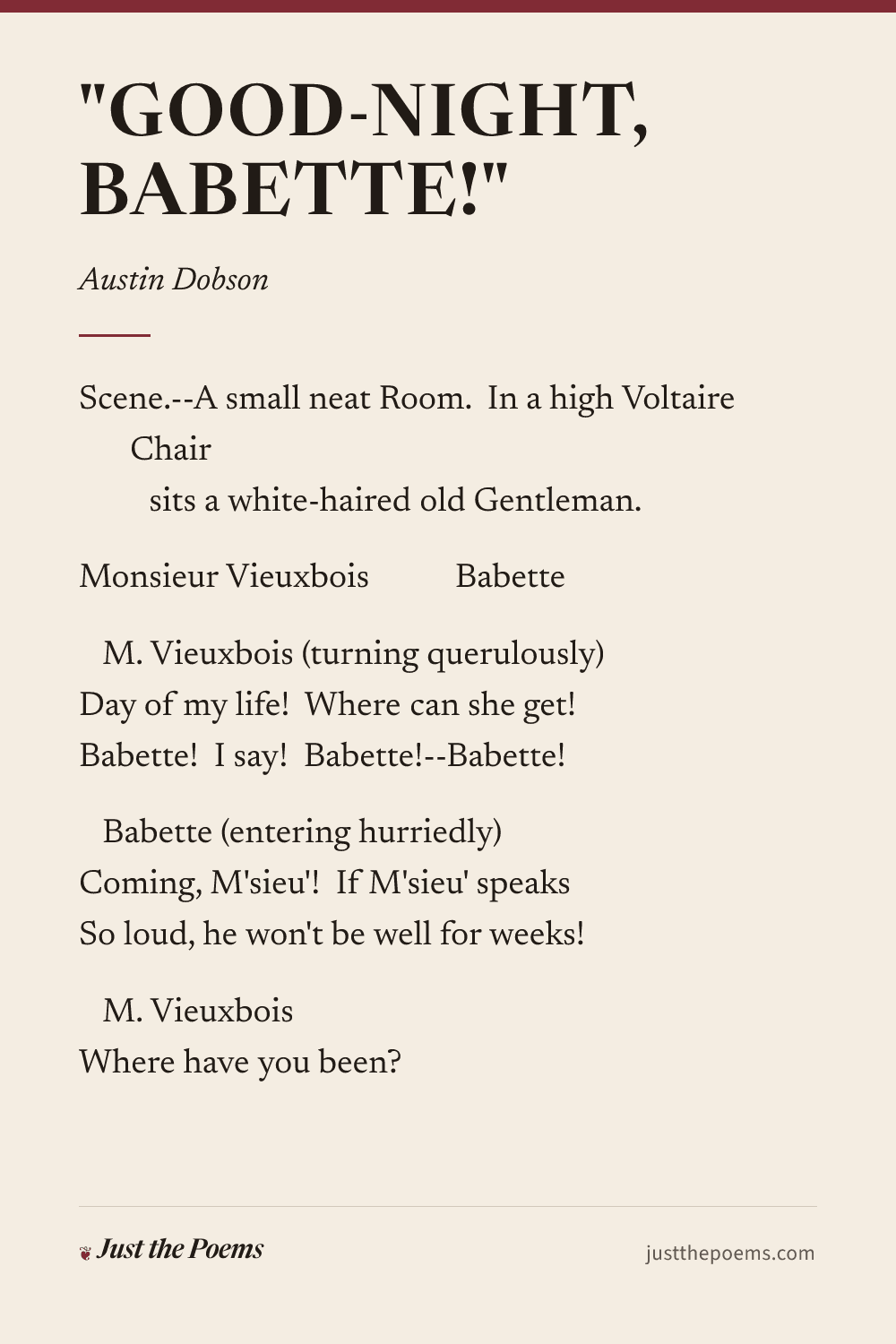
"GOOD-NIGHT, BABETTE!"

Austin Dobson

In 0 Wikipedias 1 anthology Poet in 7 Wikipedias

Scene.--A small neat Room. In a high Voltaire Chair sits a white-haired old Gentleman.

Monsieur Vieuxbois Babette

M. Vieuxbois (turning querulously)Day of my life! Where can she get!Babette! I say! Babette!--Babette!

Babette (entering hurriedly)Coming, M'sieu'! If M'sieu' speaksSo loud, he won't be well for weeks!

M. VieuxboisWhere have you been?

Babette

Show all 72 lines 60 more

Why M'sieu' knows:--April!... Ville d'Avray!... Ma'am'selle Rose!

M. VieuxboisAh! I am old,--and I forget.Was the place growing green, Babette?

BabetteBut of a greenness!--yes, M'sieu'!And then the sky so blue!--so blue!And when I dropped my immortelle,How the birds sang!(Lifting her apron to her eyes)This poor Ma'am'selle!

M. VieuxboisYou're a good girl, Babette, but she,--She was an Angel, verily.Sometimes I think I see her yetStand smiling by the cabinet;And once, I know, she peeped and laughedBetwixt the curtains...Where's the draught?(She gives him a cup)Now I shall sleep, I think, Babette;--Sing me your Norman chansonnette.

Babette (sings)"Once at the Angelus,(Ere I was dead),Angels all gloriousCame to my bed;Angels in blue and whiteCrowned on the Head."

M. Vieuxbois (drowsily)"She was an Angel"... "Once she laughed"...What, was I dreaming?Where's the draught?

Babette (showing the empty cup)The draught, M'sieu'?

M. VieuxboisHow I forget!I am so old! But sing, Babette!

Babette (sings)"One was the Friend I leftStark in the Snow;One was the Wife that diedLong,--long ago;One was the Love I lost...How could she know?"

M. Vieuxbois (murmuring)Ah, Paul!... old Paul!... Eulalie too!And Rose... And O! "the sky so blue!"

Babette (sings)"One had my Mother's eyes,Wistful and mild;One had my Father's face;One was a Child:All of them bent to me,--Bent down and smiled!"(He is asleep!)

M. Vieuxbois (almost inaudibly)"How I forget!""I am so old!"... "Good-night, Babette!"

Source

The Home Book of Verse, ed. Burton Egbert Stevenson

Filed under
  • Named in the title

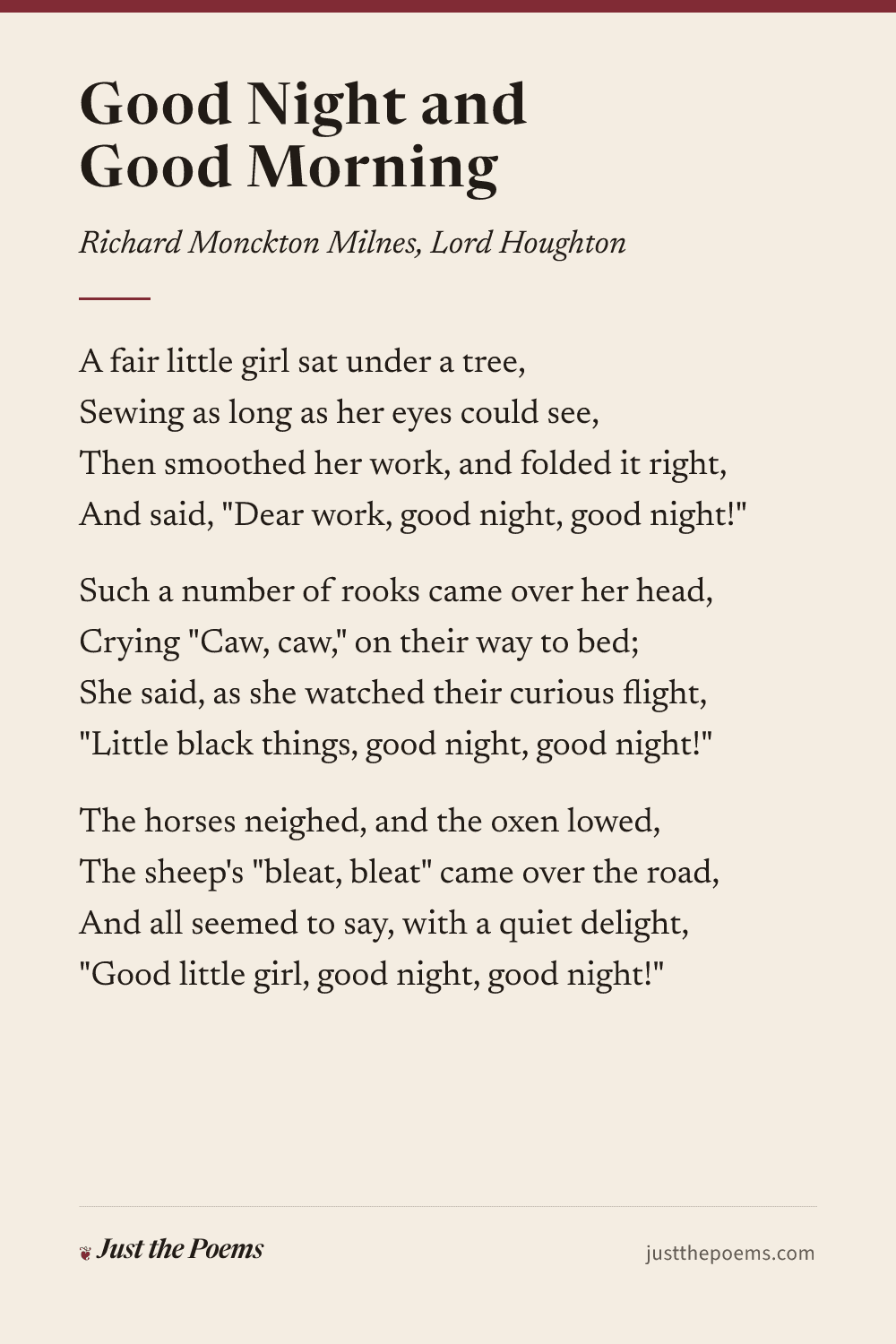
Good Night and Good Morning

Richard Monckton Milnes, Lord Houghton

In 0 Wikipedias 1 anthology Poet in 6 Wikipedias

A fair little girl sat under a tree,Sewing as long as her eyes could see,Then smoothed her work, and folded it right,And said, "Dear work, good night, good night!"

Such a number of rooks came over her head,Crying "Caw, caw," on their way to bed;She said, as she watched their curious flight,"Little black things, good night, good night!"

The horses neighed, and the oxen lowed,The sheep's "bleat, bleat" came over the road,And all seemed to say, with a quiet delight,"Good little girl, good night, good night!"

She did not say to the sun "Good night,"Tho' she saw him there like a ball of light;For she knew he had God's own time to keepAll over the world, and never could sleep.

The tall pink foxglove bowed his head,The violets curtseyed and went to bed;And good little Lucy tied up her hair,And said, on her knees, her favorite prayer.

And, while on her pillow she softly lay,She knew nothing more till again it was day;And all things said to the beautiful sun,"Good morning, good morning, our work is begun!"

Source

Poems Teachers Ask For

Filed under
  • Named in the title

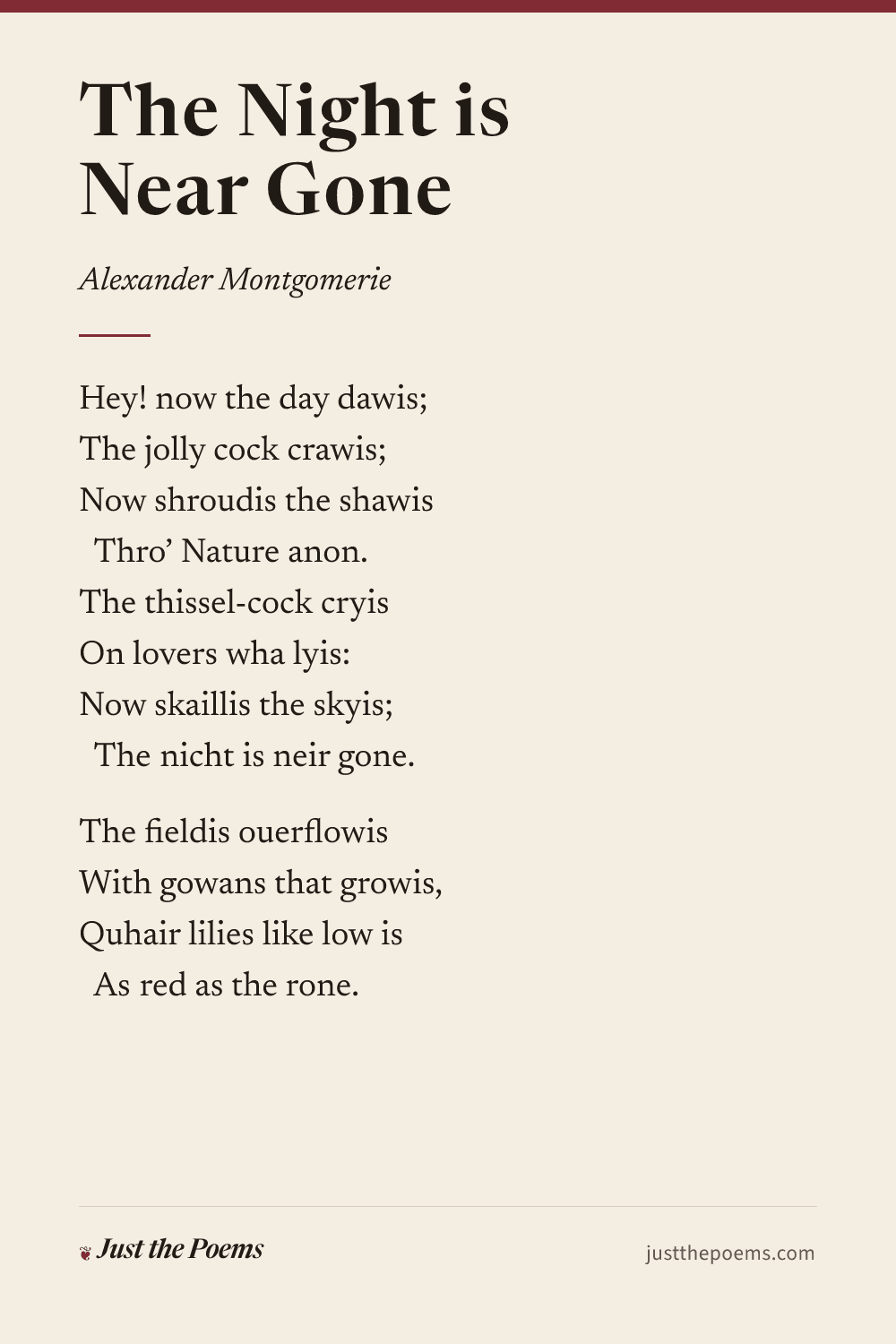
The Night is Near Gone

Alexander Montgomerie

In 0 Wikipedias 1 anthology Poet in 6 Wikipedias

Hey! now the day dawis;The jolly cock crawis;Now shroudis the shawis Thro’ Nature anon.The thissel-cock cryisOn lovers wha lyis:Now skaillis the skyis; The nicht is neir gone.

The fieldis ouerflowisWith gowans that growis,Quhair lilies like low is As red as the rone.

Show all 56 lines 44 more

The turtle that true is,With notes that renewis,Her pairty pursuis: The nicht is neir gone.

Now hairtis with hindisConform to their kindis,Hie tursis their tyndis On ground quhair they grone.Now hurchonis, with hairis,Aye passis in pairis;Quhilk duly declaris The nicht is neir gone.

The season excellisThrough sweetness that smellis;Now Cupid compellis Our hairtis echoneOn Venus wha waikis,To muse on our maikis,Syne sing for their saikis-- ‘The nicht is neir gone!’

All courageous knichtisAganis the day dichtisThe breist-plate that bright is To fight with their fone.The stonèd steed stampisThrough courage, and crampis,Syne on the land lampis: The nicht is neir gone.

The freikis on feildisThat wight wapins weildisWith shyning bright shieldis At Titan in trone;Stiff speiris in reistisOuer corseris crestisAre broke on their breistis: The nicht is neir gone.

So hard are their hittis,Some sweyis, some sittis,And some perforce flittis On ground quhile they grone.Syne groomis that gay isOn blonkis that brayisWith swordis assayis:-- The nicht is neir gone.

Source

The Oxford Book of English Verse 1250–1900, 1900

Filed under
  • Named in the title

LAST NIGHT

George Darley

In 0 Wikipedias 1 anthology Poet in 4 Wikipedias

I sat with one I love last night,She sang to me an olden strain;In former times it woke delight,Last night - but pain.

Last night we saw the stars arise,But clouds soon dimmed the ether blue:And when we sought each other's eyesTears dimmed them too!

We paced along our favorite walk,But paced in silence broken-hearted:Of old we used to smile and talk;Last night - we parted.

Source

The Home Book of Verse, ed. Burton Egbert Stevenson

Filed under
  • Named in the title

Curfew Must Not Ring To-night

Rose Hartwick Thorpe

In 0 Wikipedias 1 anthology Poet in 3 Wikipedias

Slowly England's sun was setting o'er the hilltops far away,Filling all the land with beauty at the close of one sad day,And the last rays kissed the forehead of a man and maiden fair,--He with footsteps slow and weary, she with sunny floating hair;He with bowed head, sad and thoughtful, she with lips all cold and white,Struggling to keep back the murmur, "Curfew must not ring to-night."

"Sexton," Bessie's white lips faltered, pointing to the prison old,With its turrets tall and gloomy, with its walls dark, damp and cold,"I've a lover in that prison, doomed this very night to dieAt the ringing of the curfew, and no earthly help is nigh;Cromwell will not come till sunset," and her lips grew strangely whiteAs she breathed the husky whisper: "Curfew must not ring to-night."

Show all 61 lines 49 more

"Bessie," calmly spoke the sexton--every word pierced her young heartLike the piercing of an arrow, like a deadly poisoned dart,--"Long, long years I've rung the curfew from that gloomy shadowed tower;Every evening, just at sunset, it has told the twilight hour;I have done my duty ever, tried to do it just and right;Now I'm old I will not falter,--curfew, it must ring to-night."

Wild her eyes and pale her features, stern and white her thoughtful brow.As within her secret bosom Bessie made a solemn vow.She had listened while the judges read without a tear or sigh:"At the ringing of the curfew, Basil Underwood must die."And her breath came fast and faster, and her eyes grew large and bright;In an undertone she murmured, "Curfew must not ring to-night."

With quick step she bounded forward, sprung within the old church door,Left the old man treading slowly paths so oft he'd trod before;Not one moment paused the maiden, but with eye and cheek aglowMounted up the gloomy tower, where the bell swung to and fro,--As she climbed the dusty ladder on which fell no ray of light,Up and up,--her white lips saying: "Curfew must not ring to-night."

She has reached the topmost ladder; o'er her hangs the great, dark bell;Awful is the gloom beneath her, like the pathway down to hell.Lo, the ponderous tongue is swinging--'tis the hour of curfew now,And the sight has chilled her bosom, stopped her breath and paled her brow.Shall she let it ring? No, never! flash her eyes with sudden light,As she springs and grasps it firmly--"Curfew shall not ring to-night!"

Out she swung--far out; the city seemed a speck of light below,There 'twixt heaven and earth suspended as the bell swung to and fro;And the sexton at the bell-rope, old and deaf, heard not the bell,Sadly thought, "That twilight curfew rang young Basil's funeral knell."Still the maiden clung more firmly, and with trembling lips so white,Said, to hush her heart's wild throbbing: "Curfew shall not ring to-night."

It was o'er; the bell ceased swaying, and the maiden stepped once moreFirmly on the dark old ladder where, for hundred years beforeHuman foot had not been planted. The brave deed that she had doneShould be told long ages after; as the rays of setting sunCrimson all the sky with beauty, aged sires with heads of white,Tell the eager, listening children, "Curfew did not ring that night."

O'er the distant hills came Cromwell; Bessie sees him, and her brow,Lately white with fear and anguish, has no anxious traces now.At his feet she tells her story, shows her hands all bruised and torn;And her face so sweet and pleading, yet with sorrow pale and worn,Touched his heart with sudden pity, lit his eyes with misty light:"Go! your lover lives," said Cromwell, "Curfew shall not ring to-night."

Wide they flung the massive portal; led the prisoner forth to die,--All his bright young life before him. 'Neath the darkening English skyBessie comes with flying footsteps, eyes aglow with love-light sweet;Kneeling on the turf beside him, lays his pardon at his feet.In his brave, strong arms he clasped her, kissed the face upturned and white,Whispered, "Darling, you have saved me--curfew will not ring to-night."

Source

Poems Teachers Ask For

Filed under
  • Named in the title

"IF I SHOULD DIE TO-NIGHT"

Ben King

In 0 Wikipedias 1 anthology Poet in 3 Wikipedias

If I should die to-nightAnd you should come to my cold corpse and say,Weeping and heartsick o'er my lifeless clay--If I should die to-night,And you should come in deepest grief and woe--And say: "Here's that ten dollars that I owe,"I might arise in my large white cravatAnd say, "What's that?"

If I should die to-nightAnd you should come to my cold corpse and, kneel,Clasping my bier to show the grief you feel,I say, if I should die to-nightAnd you should come to me, and there and thenJust even hint at paying me that ten,I might arise the while,But I'd drop dead again.

Source

The Home Book of Verse, ed. Burton Egbert Stevenson

Filed under
  • Named in the title

"THE NIGHT HAS A THOUSAND EYES"

Francis William Bourdillon

In 0 Wikipedias 1 anthology Poet in 3 Wikipedias

The night has a thousand eyes,And the day but one;Yet the light of the bright world diesWith the dying sun.

The mind has a thousand eyes,And the heart but one;Yet the light of a whole life diesWhen love is done.

Source

The Home Book of Verse, ed. Burton Egbert Stevenson

Filed under
  • Named in the title

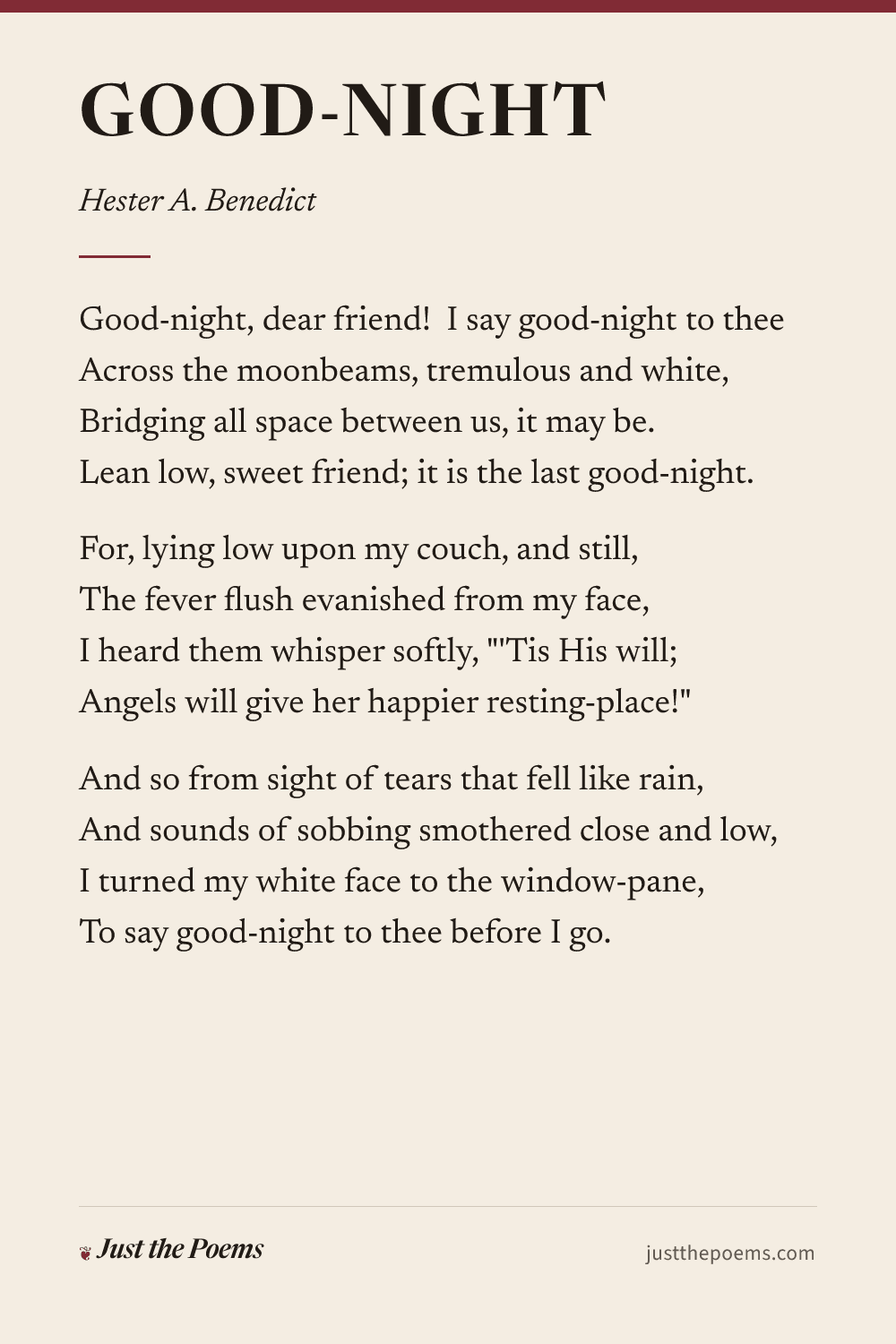
GOOD-NIGHT

Hester A. Benedict

In 0 Wikipedias 1 anthology Poet in 1 Wikipedia

Good-night, dear friend! I say good-night to theeAcross the moonbeams, tremulous and white,Bridging all space between us, it may be.Lean low, sweet friend; it is the last good-night.

For, lying low upon my couch, and still,The fever flush evanished from my face,I heard them whisper softly, "'Tis His will;Angels will give her happier resting-place!"

And so from sight of tears that fell like rain,And sounds of sobbing smothered close and low,I turned my white face to the window-pane,To say good-night to thee before I go.

Show all 32 lines 20 more

Good-night! good-night! I do not fear the end,The conflict with the billows dark and high;And yet, if I could touch thy hand, my friend,I think it would be easier to die;

If I could feel through all the quiet wavesOf my deep hair thy tender breath a-thrill,I could go downward to the place of gravesWith eyes a-shine and pale lips smiling still;

Or it may be that, if through all the strifeAnd pain of parting I should hear thy call,I would come singing back to sweet, sweet life,And know no mystery of death at all.

It may not be. Good-night, dear friend, good-night!And when you see the violets again,And hear, through boughs with swollen buds a-white,The gentle falling of the April rain,

Remember her whose young life held thy nameWith all things holy, in its outward flight,And turn sometimes from busy haunts of menTo hear again her low good-night! good-night!

Source

The Home Book of Verse, ed. Burton Egbert Stevenson

Filed under
  • Named in the title

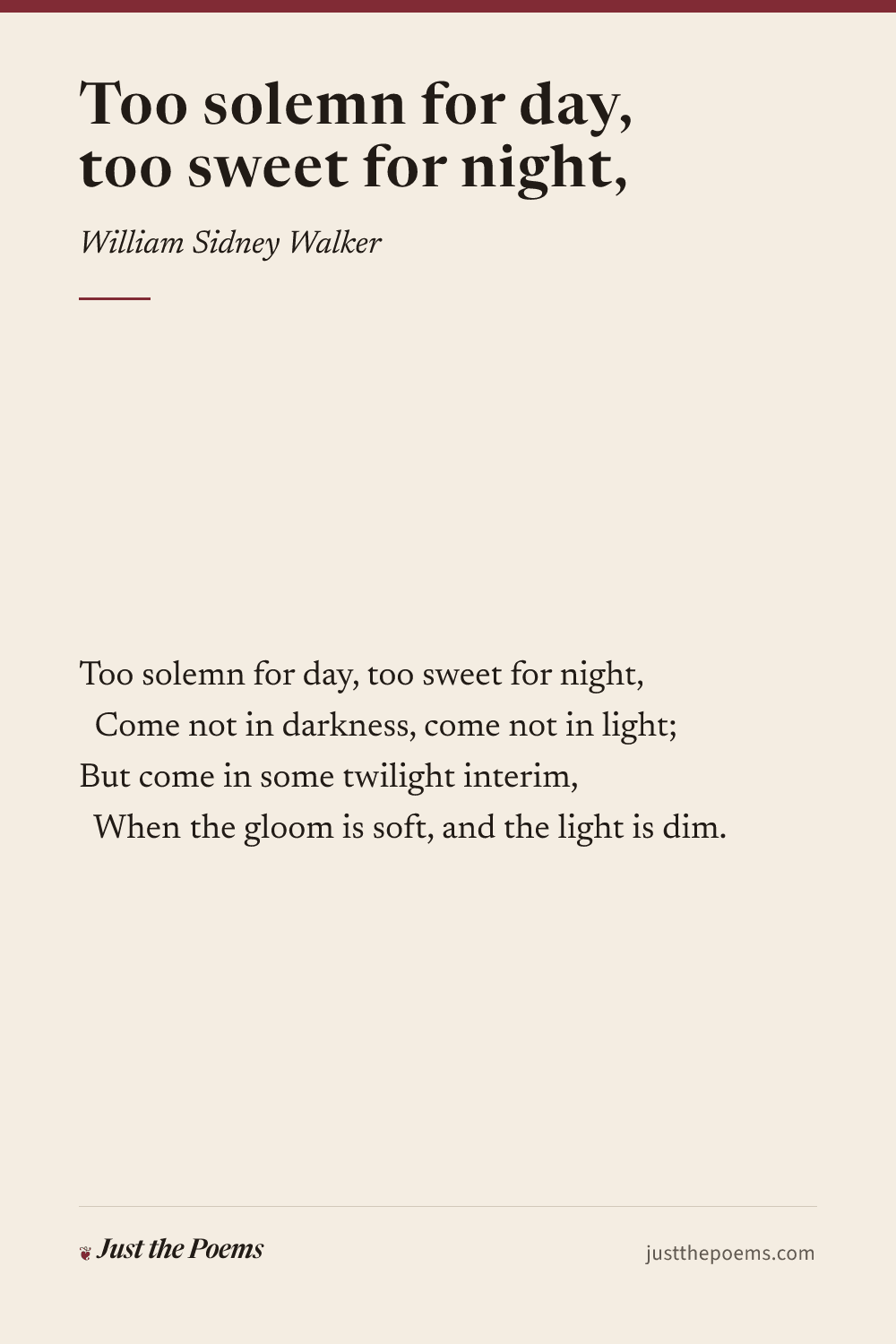
Too solemn for day, too sweet for night,

William Sidney Walker

In 0 Wikipedias 1 anthology Poet in 1 Wikipedia

Too solemn for day, too sweet for night, Come not in darkness, come not in light;But come in some twilight interim, When the gloom is soft, and the light is dim.

Source

The Oxford Book of English Verse 1250–1900, 1900

Filed under
  • Named in the first line

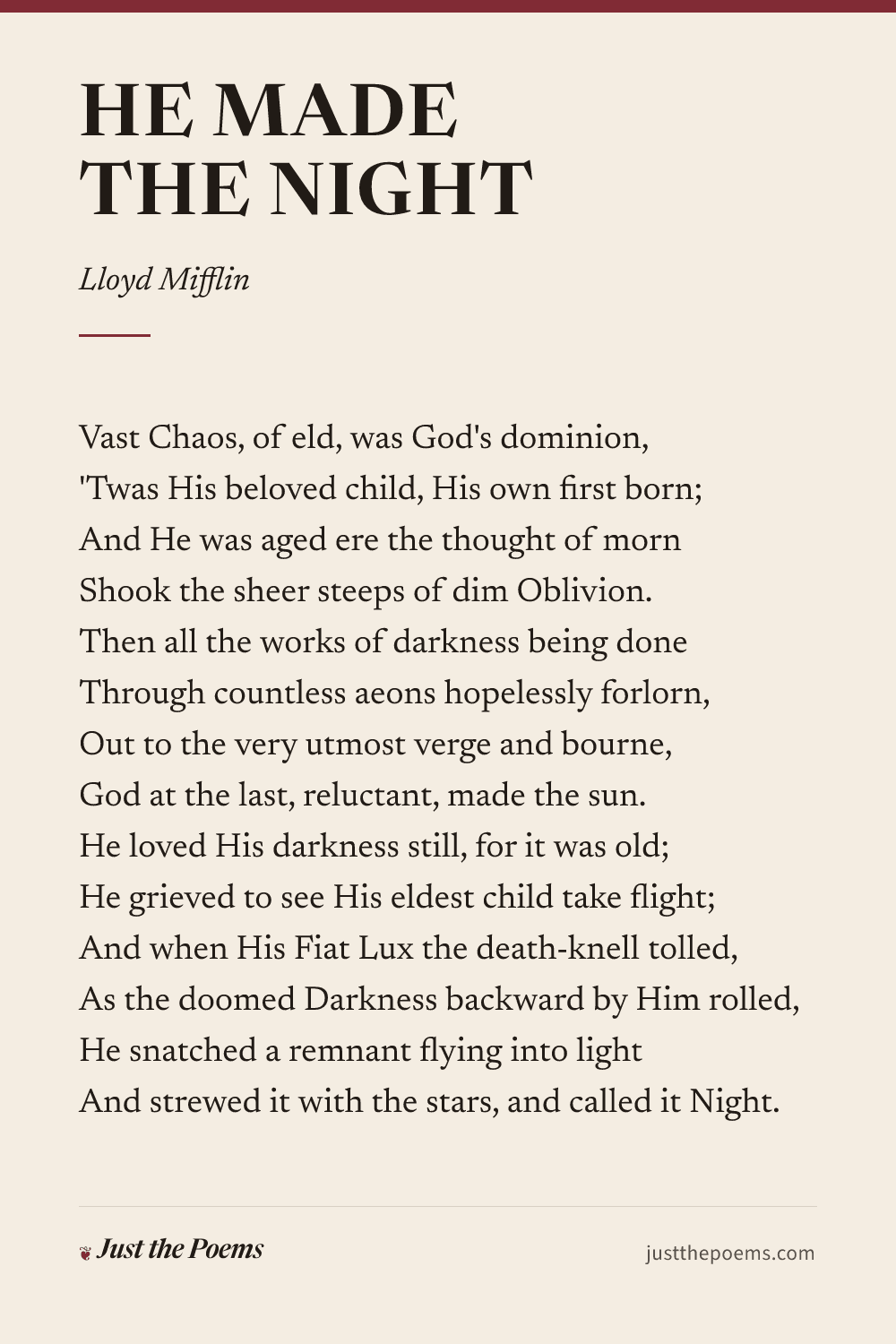
HE MADE THE NIGHT

Lloyd Mifflin

In 0 Wikipedias 1 anthology Poet in 0 Wikipedias

Vast Chaos, of eld, was God's dominion,'Twas His beloved child, His own first born;And He was aged ere the thought of mornShook the sheer steeps of dim Oblivion.Then all the works of darkness being doneThrough countless aeons hopelessly forlorn,Out to the very utmost verge and bourne,God at the last, reluctant, made the sun.He loved His darkness still, for it was old;He grieved to see His eldest child take flight;And when His Fiat Lux the death-knell tolled,As the doomed Darkness backward by Him rolled,He snatched a remnant flying into lightAnd strewed it with the stars, and called it Night.

Source

The Home Book of Verse, ed. Burton Egbert Stevenson

Filed under
  • Named in the title

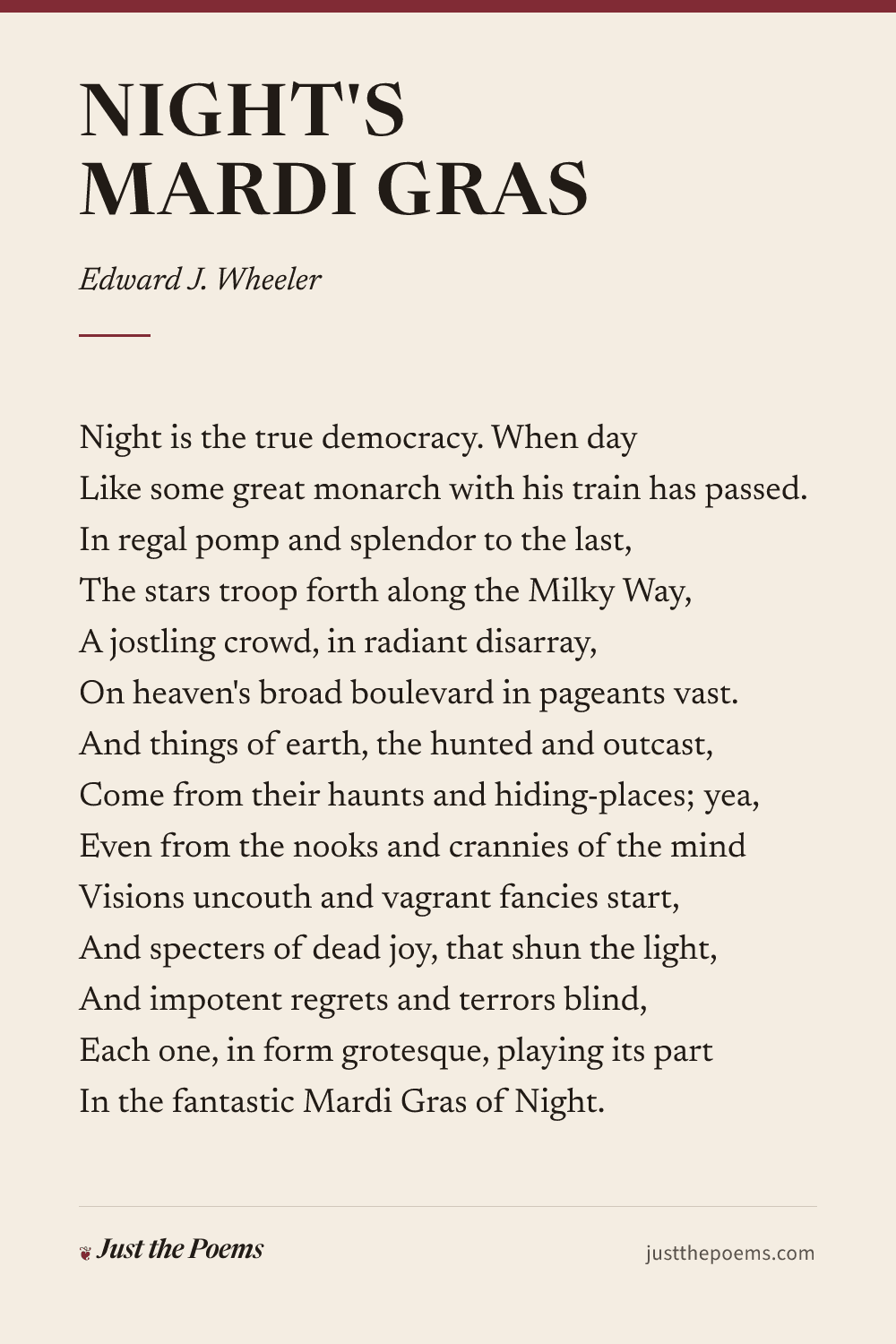
NIGHT'S MARDI GRAS

Edward J. Wheeler

In 0 Wikipedias 1 anthology Poet in 0 Wikipedias

Night is the true democracy. When dayLike some great monarch with his train has passed.In regal pomp and splendor to the last,The stars troop forth along the Milky Way,A jostling crowd, in radiant disarray,On heaven's broad boulevard in pageants vast.And things of earth, the hunted and outcast,Come from their haunts and hiding-places; yea,Even from the nooks and crannies of the mindVisions uncouth and vagrant fancies start,And specters of dead joy, that shun the light,And impotent regrets and terrors blind,Each one, in form grotesque, playing its partIn the fantastic Mardi Gras of Night.

Source

The Home Book of Verse, ed. Burton Egbert Stevenson

Filed under
  • Named in the title

30 of 60 poems about night

29 poets

By poet's century of death

CenturyPoems
16th1
17th3
18th1
19th17
20th8

Poets with more than one poem

PoetPoems
Thomas Moore2