Poems About Moon

Updated · How this page is checked

The 12 poems about moon, by 11 poets, ranked by third-party data. How poems are ranked

Overview

These twelve poems about the moon come from eleven poets: Thomas Hardy has two of them and every other poet one. Ten run to 24 lines or fewer, so most of them are short moon poems that can be read in a minute. William Wordsworth's The Crescent-moon, the Star of Love has five lines and Percy Bysshe Shelley's To the Moon has six; George Macdonald's The Wind and the Moon is the longest, at 66.

Read moreShow less

Four are poems to the moon, spoken to her directly. Shelley asks whether her lonely climb has tired her, Henry Rowe sings to the Moon at nightfall, Wordsworth asks the crescent moon and the evening star which of them is the queen, and in Hardy's To the Moon the moon answers back.

Five are moon poems for children. The Wind tries to blow the Moon out in Macdonald's poem, a child questions Lady Moon in Lord Houghton's, Matthias Barr's child wonders where the moon hides by day, Robert Louis Stevenson's moon lights up the harbours while the night animals roam and children sleep, and in Jonathan Swift's lines the moon describes itself.

Three set the moon beside love and memory: Thomas Moore's lover out under the young May moon, Charles Best's sonnet on the tide that follows the moon, and Hardy's Shut Out That Moon, in which the moonlight brings back the past.

Poems to read aloud, send and write in a card

Poems to the moon

TO THE MOON

Percy Bysshe Shelley

In 0 Wikipedias 2 anthologies Poet in 91 Wikipedias

A speaker asks the moon whether she is tired of climbing the sky and looking down at the world, alone among stars unlike her and always changing. Written in 1820. Mary Shelley brought it out in Posthumous Poems in 1824. For someone who feels alone.

Art thou pale for weariness Of climbing heaven, and gazing on the earth, Wandering companionless Among the stars that have a different birth,--And ever-changing, like a joyless eyeThat finds no object worth its constancy?

Source

The Golden Treasury, ed. Francis Turner Palgrave

Filed under
  • Named in the title

Moon

Henry Rowe

In 0 Wikipedias 1 anthology Poet in 20 Wikipedias

A speaker sings to the Moon at nightfall, sipping wine among the flowers in her light. For a summer evening in the garden.

Thee too, modest tressèd maid, When thy fallen stars appear;When in lawn of fire array’d Sov’reign of yon powder’d sphere;To thee I chant at close of day,Beneath, O maiden Moon! thy ray.

Throned in sapphired ring supreme, Pregnant with celestial juice,On silver wing thy diamond stream Gives what summer hours produce;While view’d impearl’d earth’s rich inlay,Beneath, O maiden Moon! thy ray.

Glad, pale Cynthian wine I sip, Breathed the flow’ry leaves among;Draughts delicious wet my lip; Drown’d in nectar drunk my song;While tuned to Philomel the lay,Beneath, O maiden Moon! thy ray.

Dew, that od’rous ointment yields, Sweets, that western winds disclose,Bathing spring’s more purpled fields, Soft’s the band that winds the rose;While o’er thy myrtled lawns I strayBeneath, O maiden Moon! thy ray.

Source

The Oxford Book of English Verse 1250–1900, 1900

Filed under
  • Named in the title

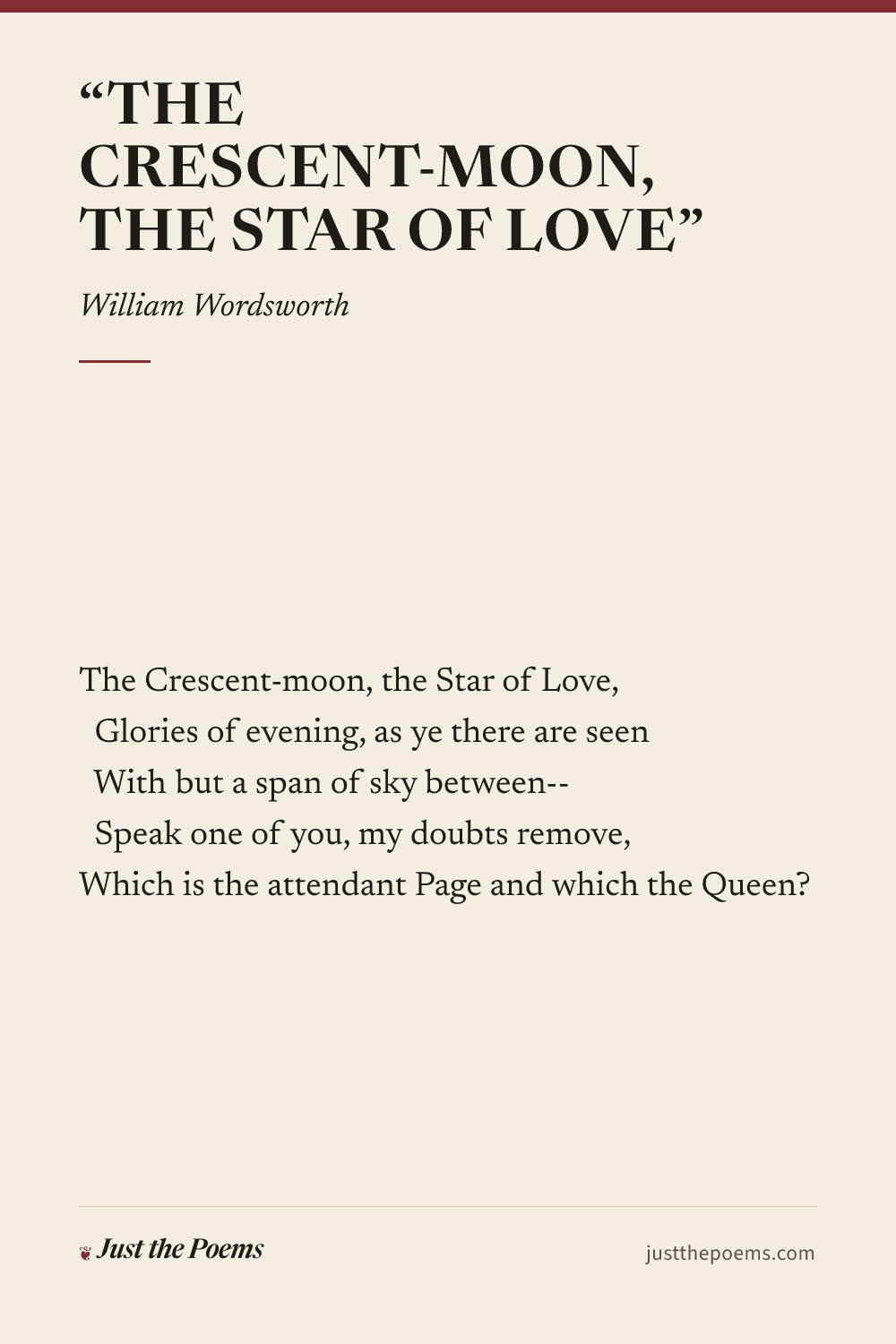
THE CRESCENT-MOON, THE STAR OF LOVE

William Wordsworth

In 0 Wikipedias 0 anthologies Poet in 97 Wikipedias

A speaker sees the crescent moon and the evening star with only a little sky between them, and asks them to say which of the two rules and which serves. It appeared in 1842 and is one of the Evening Voluntaries. For someone who loves to watch the evening sky.

The Crescent-moon, the Star of Love, Glories of evening, as ye there are seen With but a span of sky between-- Speak one of you, my doubts remove,Which is the attendant Page and which the Queen?

Source

The Poetical Works of William Wordsworth — Volume 8 (of 8), ed. William Angus Knight, 1896

Filed under
  • Named in the title

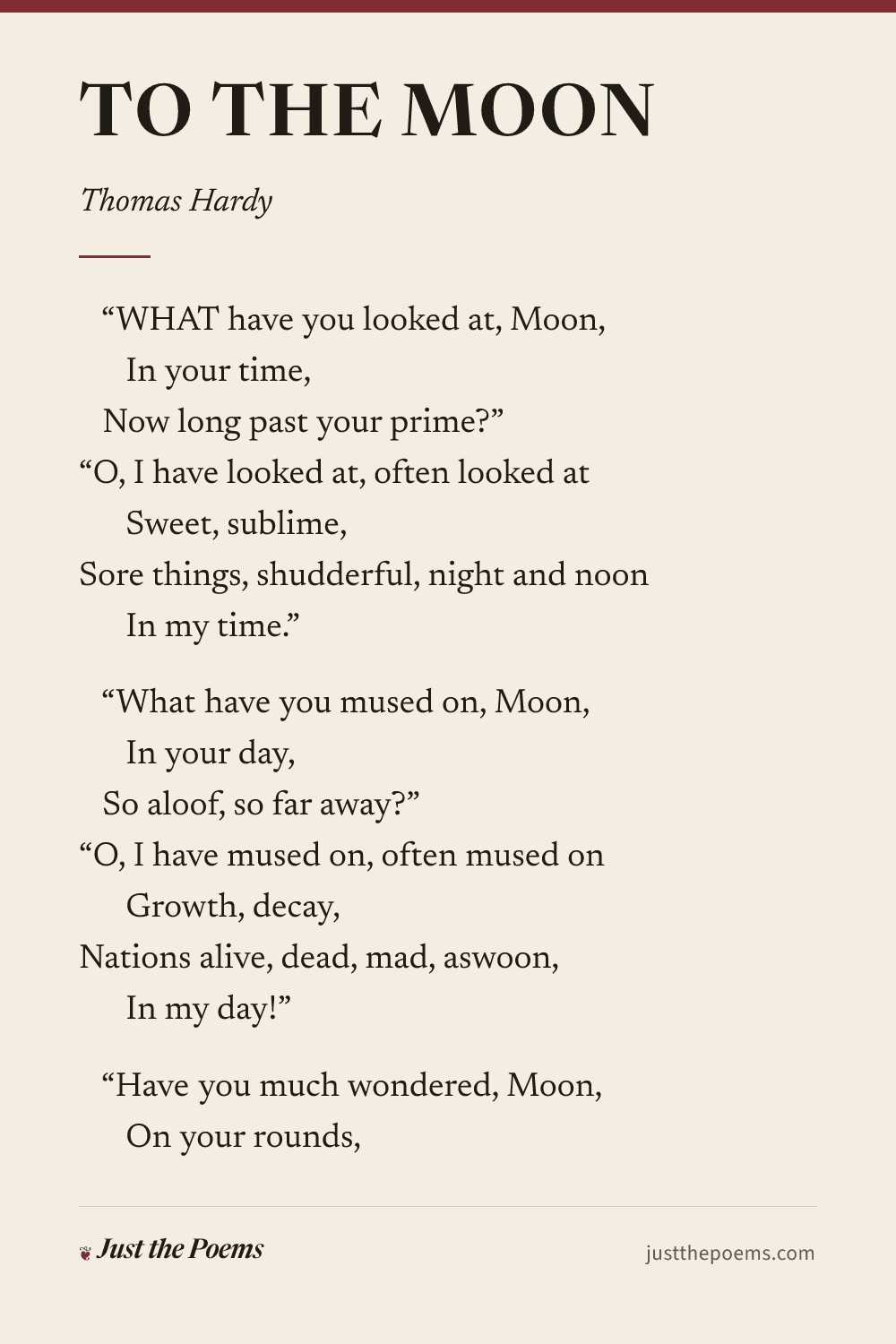
TO THE MOON

Thomas Hardy

In 0 Wikipedias 0 anthologies Poet in 91 Wikipedias

A speaker questions the moon about everything she has watched over the ages, and the moon replies that human life looks to her like a spectacle that God should bring to an end before long. It appeared in Moments of Vision in 1917. For a sleepless night.

“WHAT have you looked at, Moon, In your time, Now long past your prime?”“O, I have looked at, often looked at Sweet, sublime,Sore things, shudderful, night and noon In my time.”

“What have you mused on, Moon, In your day, So aloof, so far away?”“O, I have mused on, often mused on Growth, decay,

Show all 28 lines 16 more

Nations alive, dead, mad, aswoon, In my day!”

“Have you much wondered, Moon, On your rounds, Self-wrapt, beyond Earth’s bounds?”“Yea, I have wondered, often wondered At the soundsReaching me of the human tune On my rounds.”

“What do you think of it, Moon, As you go? Is Life much, or no?”“O, I think of it, often think of it As a showGod ought surely to shut up soon, As I go.”

Source

Moments of Vision and Miscellaneous Verses, 1929

Filed under
  • Named in the title

Moon poems for children

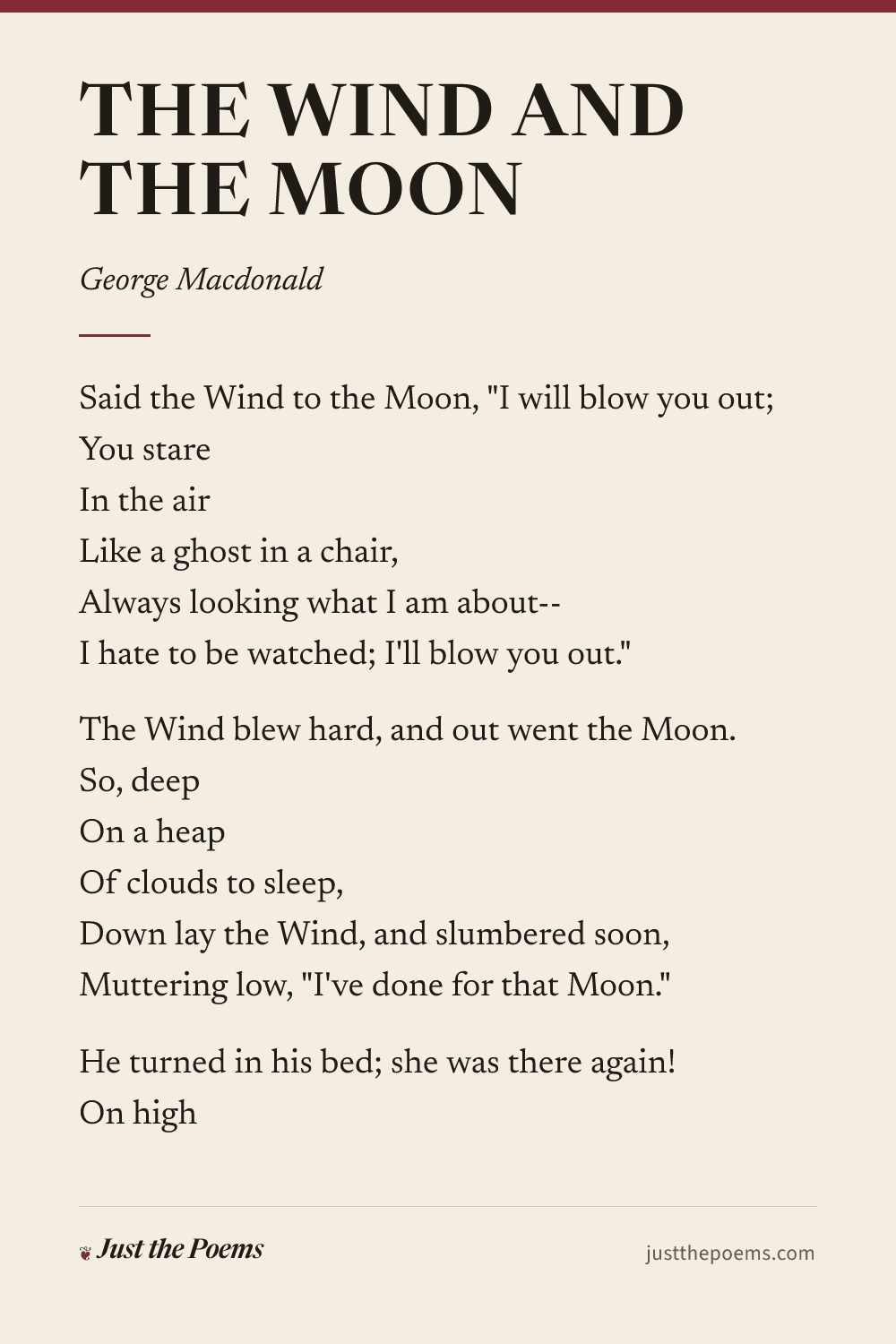
THE WIND AND THE MOON

George Macdonald

In 0 Wikipedias 2 anthologies Poet in 40 Wikipedias

The Wind tries again and again to blow out the Moon, is sure he has done it when she vanishes, and boasts of his power when she grows full again, though the Moon never noticed him at all. For an older child who asks why the moon changes shape.

Said the Wind to the Moon, "I will blow you out;You stareIn the airLike a ghost in a chair,Always looking what I am about--I hate to be watched; I'll blow you out."

The Wind blew hard, and out went the Moon.So, deepOn a heapOf clouds to sleep,Down lay the Wind, and slumbered soon,Muttering low, "I've done for that Moon."

Show all 66 lines 54 more

He turned in his bed; she was there again!On highIn the sky,With her one ghost eye,The Moon shone white and alive and plain.Said the Wind, "I will blow you out again."

The Wind blew hard, and the Moon grew dim."With my sledge,And my wedge,I have knocked off her edge!If only I blow right fierce and grim,The creature will soon be dimmer than dim."

He blew and he blew, and she thinned to a thread."One puffMore's enoughTo blow her to snuff!One good puff more where the last was bred,And glimmer, glimmer, glum will go the thread."

He blew a great blast, and the thread was gone.In the airNowhereWas a moonbeam bare;Far off and harmless the shy stars shone--Sure and certain the Moon was gone!

The Wind he took to his revels once more;On down,In town,Like a merry-mad clown,He leaped and halloed with whistle and roar--"What's that?" The glimmering thread once more!

He flew in a rage--he danced and blew;But in vainWas the painOf his bursting brain;For still the broader the Moon-scrap grew,The broader he swelled his big cheeks and blew.

Slowly she grew--till she filled the night,And shoneOn her throneIn the sky alone,A matchless, wonderful silvery light,Radiant and lovely, the queen of the night.

Said the Wind: "What a marvel of power am I!With my breath,Good faith!I blew her to death--First blew her away right out of the sky--Then blew her in; what strength have I!

But the Moon she knew nothing about the affair;For highIn the sky,With her one white eye,Motionless, miles above the air,She had never heard the great Wind blare.
Source

The Home Book of Verse, ed. Burton Egbert Stevenson

Filed under
  • Named in the title

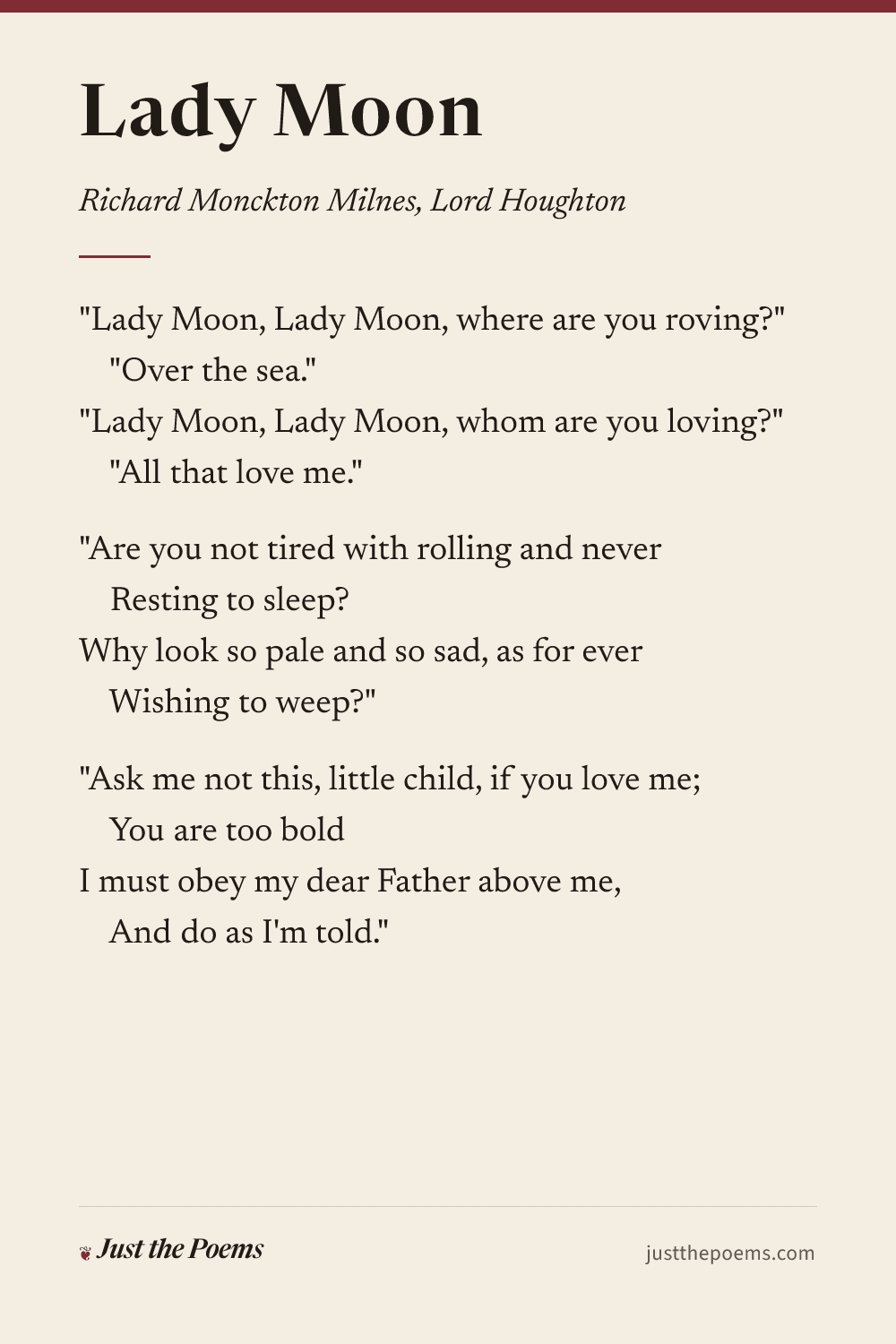
Lady Moon

Richard Monckton Milnes, Lord Houghton

In 0 Wikipedias 1 anthology Poet in 6 Wikipedias

A child asks Lady Moon where she wanders and why she looks so sad, and the Moon replies that she does what God her Father tells her. For reading aloud with a small child.

"Lady Moon, Lady Moon, where are you roving?" "Over the sea.""Lady Moon, Lady Moon, whom are you loving?" "All that love me."

"Are you not tired with rolling and never Resting to sleep?Why look so pale and so sad, as for ever Wishing to weep?"

"Ask me not this, little child, if you love me; You are too boldI must obey my dear Father above me, And do as I'm told."

"Lady Moon, Lady Moon, where are you roving?" "Over the sea.""Lady Moon, Lady Moon, whom are you loving?" "All that love me."

Source

Poems Teachers Ask For

Filed under
  • Named in the title

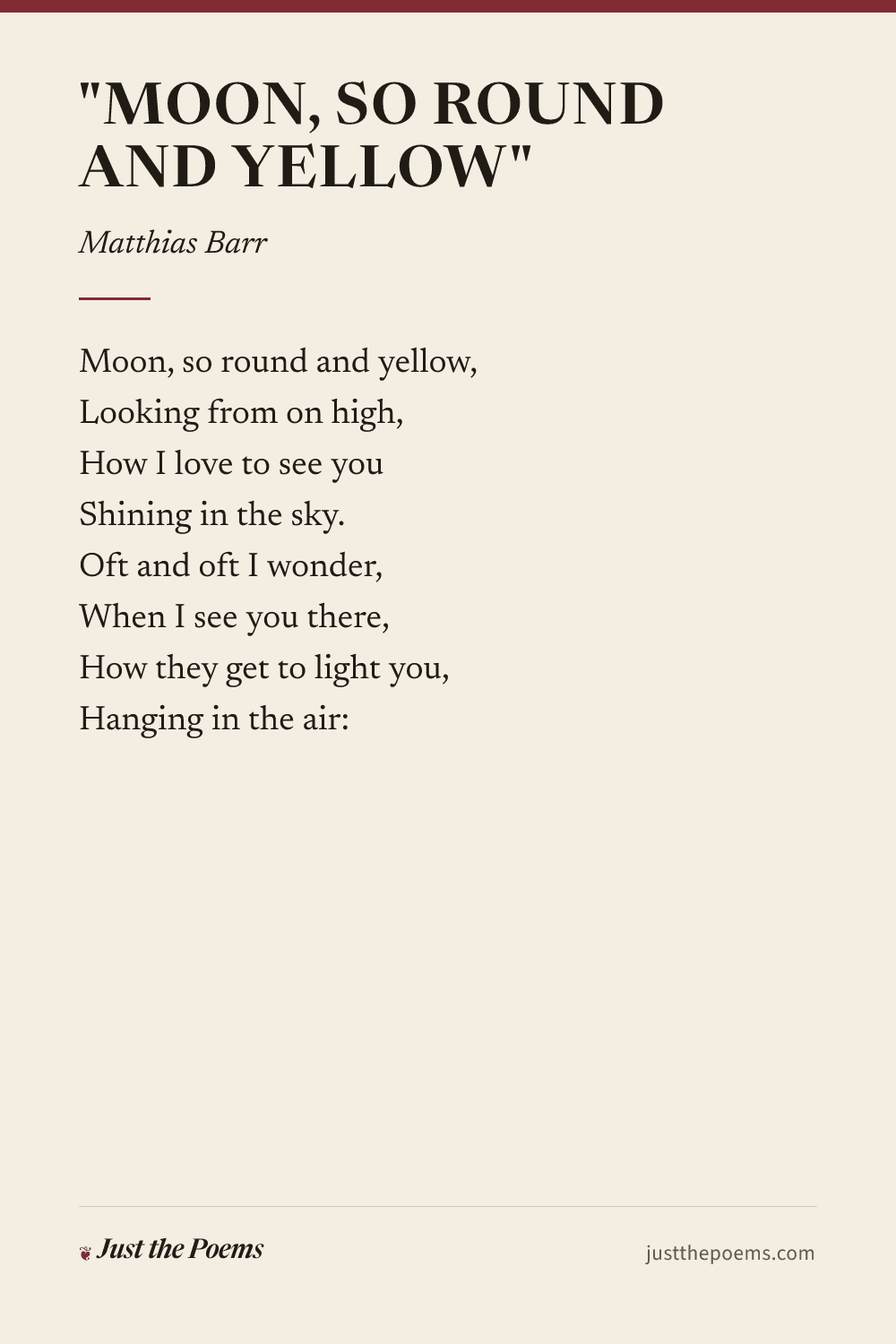
MOON, SO ROUND AND YELLOW

Matthias Barr

In 0 Wikipedias 1 anthology Poet in 1 Wikipedia

A child delights in the round yellow moon, wonders who lights it and where it hides when day comes, and plans to watch it secretly one night from bed. For a child who wants to stay up to see the moon.

Moon, so round and yellow,Looking from on high,How I love to see youShining in the sky.Oft and oft I wonder,When I see you there,How they get to light you,Hanging in the air:

Where you go at morning,When the night is past,And the sun comes peepingO'er the hills at last.Sometime I will watch youSlyly overhead,When you think I'm sleepingSnugly in my bed.

Source

The Home Book of Verse, ed. Burton Egbert Stevenson

Filed under
  • Named in the title

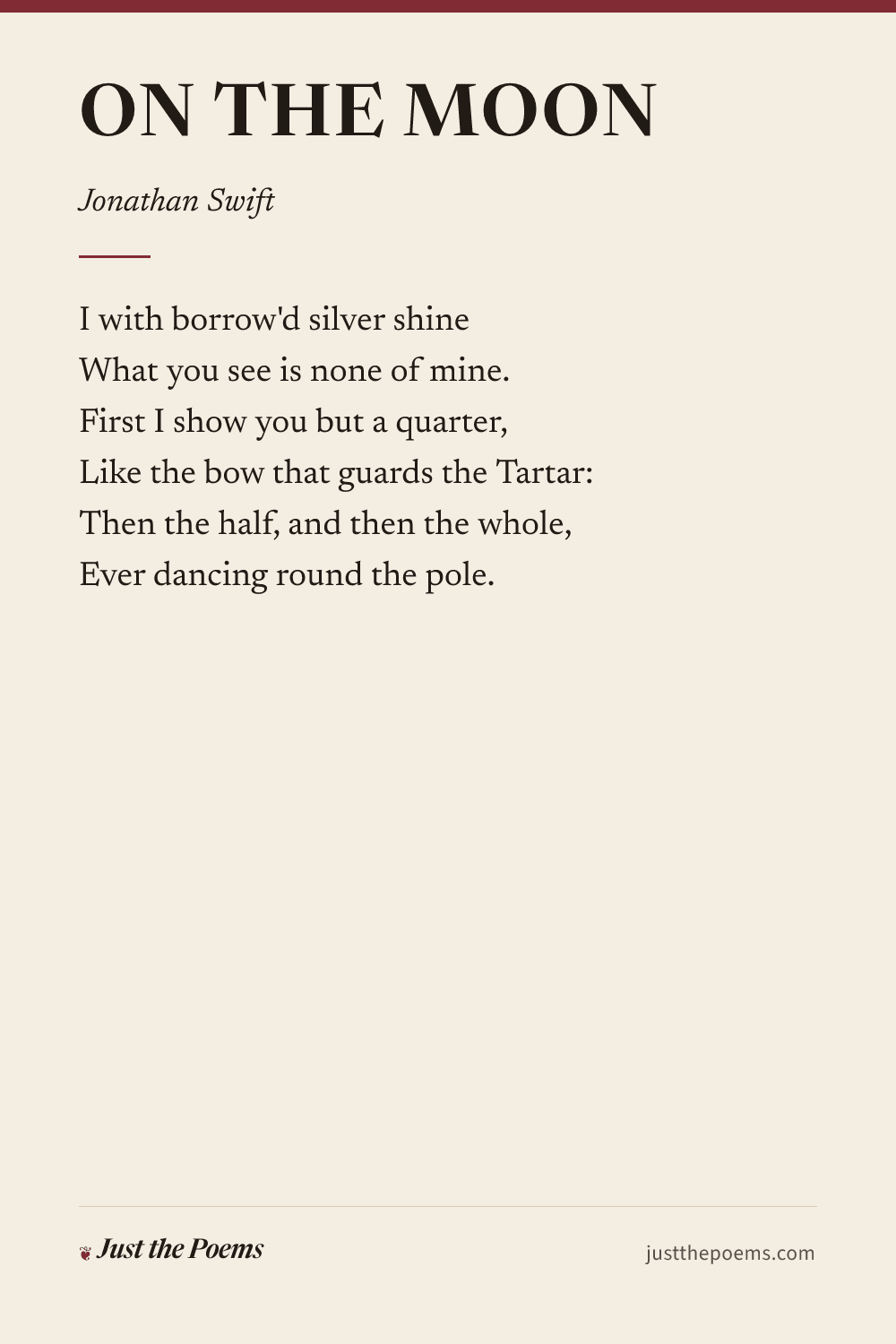
ON THE MOON

Jonathan Swift

In 0 Wikipedias 0 anthologies Poet in 101 Wikipedias

The moon speaks: its light is not its own, it waxes from a sliver to full, and people see many figures in it, though it is not any of them. For a child who has just learnt that moonlight is reflected sunlight.

I with borrow'd silver shineWhat you see is none of mine.First I show you but a quarter,Like the bow that guards the Tartar:Then the half, and then the whole,Ever dancing round the pole.

What will raise your admiration,I am not one of God's creation,But sprung, (and I this truth maintain,)Like Pallas, from my father's brain.And after all, I chiefly oweMy beauty to the shades below.Most wondrous forms you see me wear,A man, a woman, lion, bear,A fish, a fowl, a cloud, a field,All figures Heaven or earth can yield;Like Daphne sometimes in a tree;Yet am not one of all you see.

Source

The Poems of Jonathan Swift, D.D., Volume 2, 1910

Filed under
  • Named in the title

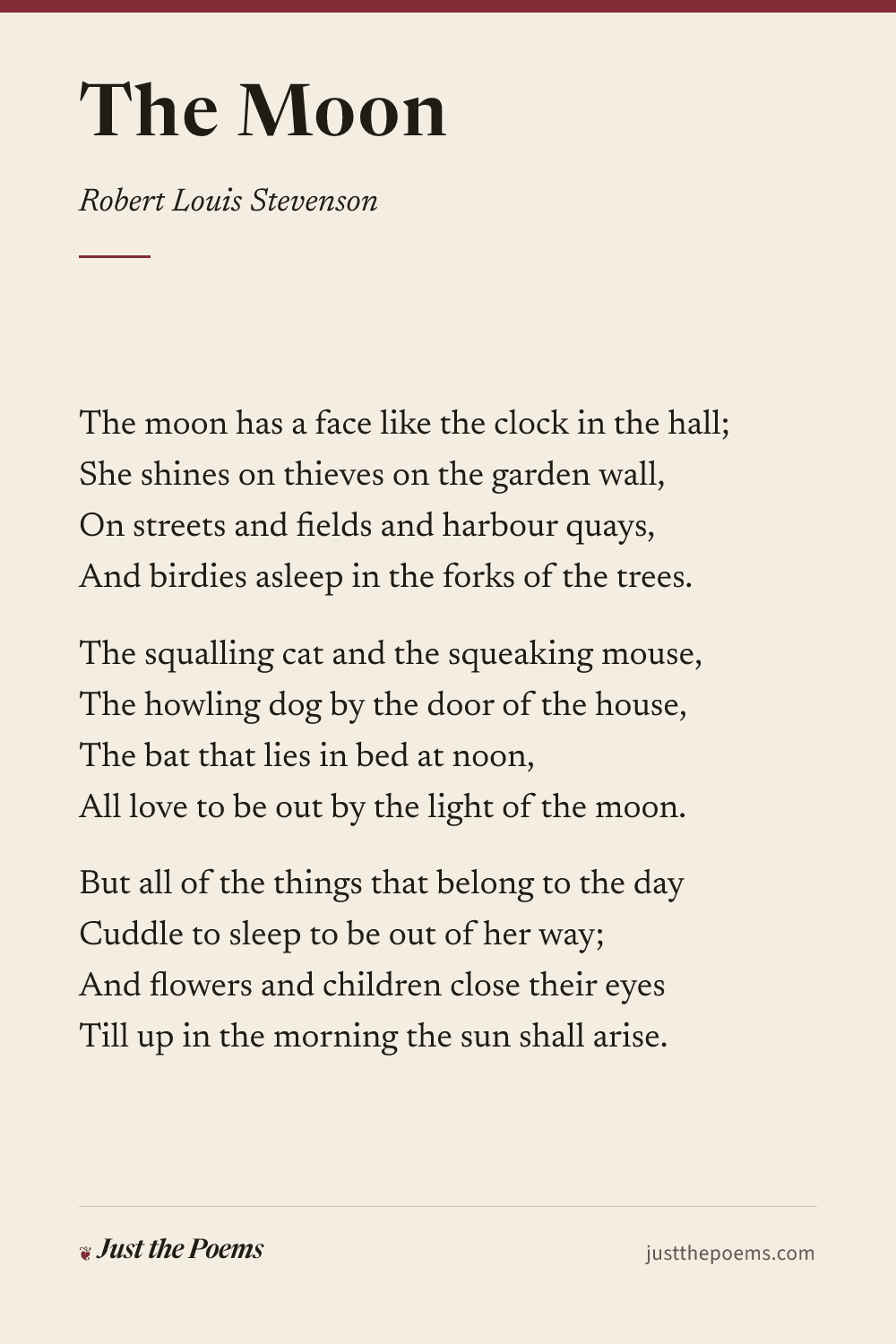
The Moon

Robert Louis Stevenson

In 0 Wikipedias 0 anthologies Poet in 101 Wikipedias

At night the moon lights up walls, streets, fields and quays, and cats, dogs, mice and bats roam about, while everything that lives by day, children too, sleeps until morning. It belongs to A Child's Garden of Verses. For reading aloud to a child at bedtime.

The moon has a face like the clock in the hall;She shines on thieves on the garden wall,On streets and fields and harbour quays,And birdies asleep in the forks of the trees.

The squalling cat and the squeaking mouse,The howling dog by the door of the house,The bat that lies in bed at noon,All love to be out by the light of the moon.

But all of the things that belong to the dayCuddle to sleep to be out of her way;And flowers and children close their eyesTill up in the morning the sun shall arise.

Source

A Child's Garden of Verses

Filed under
  • Named in the title

The moon, love and memory

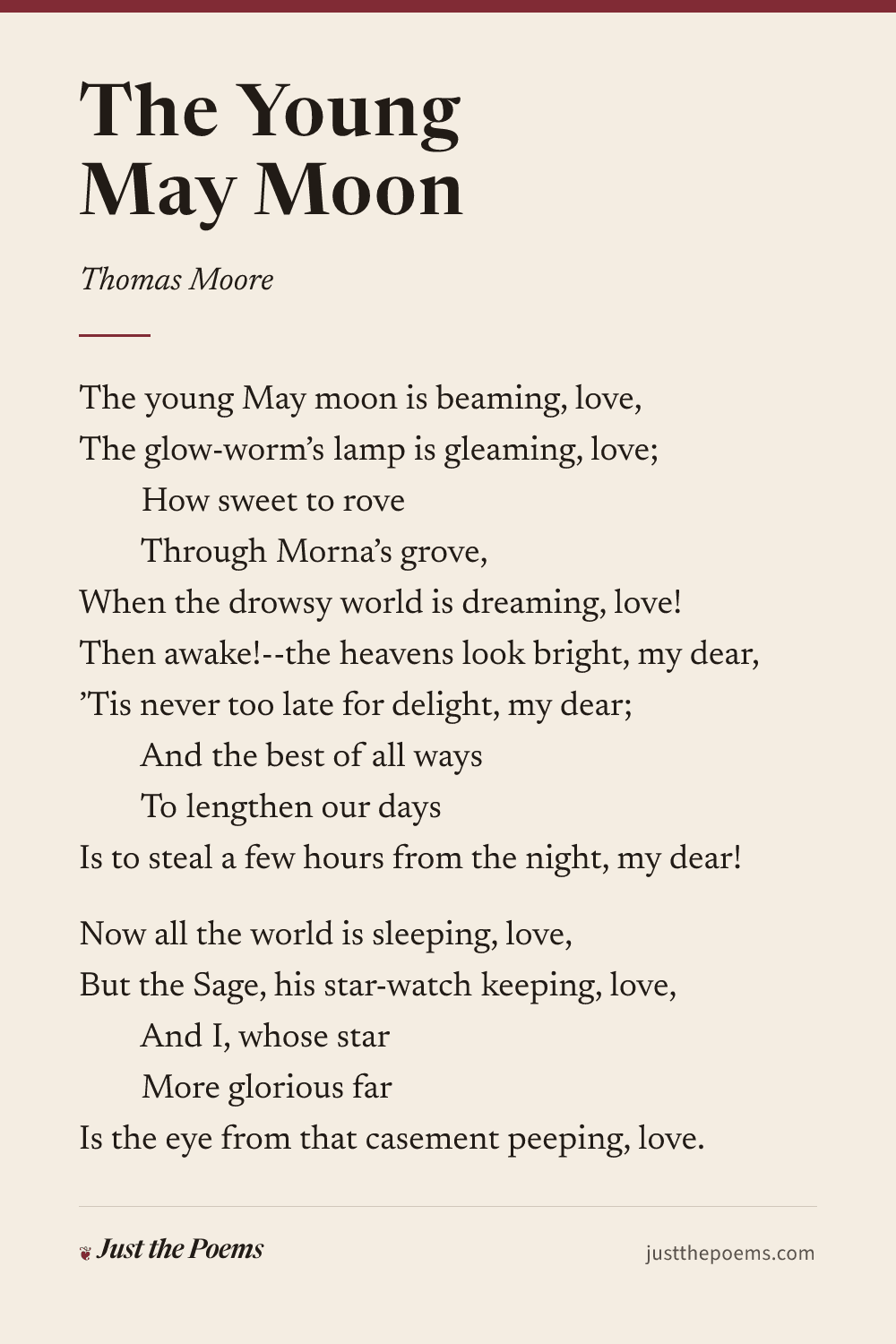
The Young May Moon

Thomas Moore

In 0 Wikipedias 2 anthologies Poet in 43 Wikipedias

A lover calls his dear out under the May moon while the world sleeps, and jokes that the Sage at his telescope might mistake her for a star. For a spring evening with someone you love.

The young May moon is beaming, love,The glow-worm’s lamp is gleaming, love; How sweet to rove Through Morna’s grove,When the drowsy world is dreaming, love!Then awake!--the heavens look bright, my dear,’Tis never too late for delight, my dear; And the best of all ways To lengthen our daysIs to steal a few hours from the night, my dear!

Now all the world is sleeping, love,But the Sage, his star-watch keeping, love, And I, whose star More glorious farIs the eye from that casement peeping, love.Then awake!--till rise of sun, my dear,The Sage’s glass we’ll shun, my dear, Or in watching the flight Of bodies of lightHe might happen to take thee for one, my dear!

Source

The Oxford Book of English Verse 1250–1900, 1900

Filed under
  • Named in the title

A SONNET OF THE MOON

Charles Best

In 0 Wikipedias 1 anthology Poet in 4 Wikipedias

A speaker compares the sea, which rises with the moon and ebbs when she is gone, to his own joys when his beloved comes and goes. For someone whose partner is often away.

Look how the pale Queen of the silent nightDoth cause the ocean to attend upon her,And he, as long as she is in his sight,With his full tide is ready her to honor:But when the silver wagon of the MoonIs mounted up so high he cannot follow,The sea calls home his crystal waves to moan,And with low ebb doth manifest his sorrow.So you that are the sovereign of my heart,Have all my joys attending on your will,My joys low-ebbing when you do depart,When you return, their tide my heart doth fill.So as you come, and as you do depart,Joys ebb and flow within my tender heart.

Source

The Home Book of Verse, ed. Burton Egbert Stevenson

Filed under
  • Named in the title

SHUT OUT THAT MOON

Thomas Hardy

In 0 Wikipedias 0 anthologies Poet in 91 Wikipedias

A speaker asks for the window to be covered against the moon and the stars, which bring back the years before loss, and chooses to stay indoors among ordinary things. Dated 1904. It appeared in Time's Laughingstocks in 1909. For someone grieving who finds the night sky hard to look at.

CLOSE up the casement, draw the blind, Shut out that stealing moon,She wears too much the guise she wore Before our lutes were strewnWith years-deep dust, and names we read On a white stone were hewn.

Step not out on the dew-dashed lawn To view the Lady’s Chair,Immense Orion’s glittering form, The Less and Greater Bear:Stay in; to such sights we were drawn When faded ones were fair.

Brush not the bough for midnight scents That come forth lingeringly,And wake the same sweet sentiments They breathed to you and meWhen living seemed a laugh, and love All it was said to be.

Within the common lamp-lit room Prison my eyes and thought;Let dingy details crudely loom, Mechanic speech be wrought:Too fragrant was Life’s early bloom, Too tart the fruit it brought!

Source

Time's Laughingstocks, and Other Verses, 1928

Filed under
  • Named in the title

12 poems about moon

11 poets

By poet's century of death

CenturyPoems
17th1
18th1
19th6
20th4

Poets with more than one poem

PoetPoems
Thomas Hardy2