Poems for Nurses

The 18 poems for nurses, by 3 poets, ranked by third-party data. How poems are ranked

NURSE'S SONG

William Blake

In 0 Wikipedias 1 anthology Poet in 101 Wikipedias

When the voices of children are heard on the greenAnd laughing is heard on the hill,My heart is at rest within my breast,And everything else is still.

"Then come home, my children, the sun is gone down,And the dews of the night arise;Come, come, leave off play, and let us awayTill the morning appears in the skies."

"No, no, let us play, for it is yet day,And we cannot go to sleep;Besides in the sky the little birds fly,And the hills are all covered with sheep."

"Well, well, go and play till the light fades away,And then go home to bed."The little ones leaped and shouted and laughed;And all the hills echoed.

Source

The Home Book of Verse, ed. Burton Egbert Stevenson

Filed under
  • Named in the title

THE NURSING SISTER

Rudyard Kipling

In 0 Wikipedias 0 anthologies Poet in 126 Wikipedias

Our sister sayeth such and such.And we must bow to her behests;Our sister toileth overmuch,Our little maid that hath no breasts.

A field untilled, a web unwove,A flower withheld from sun or bee,An alien in the courts of Love,And--teacher unto such as we!

We love her, but we laugh the while,We laugh, but sobs are mixed with laughter;Our sister hath no time to smile,She knows not what must follow after.

Wind of the South, arise and blow,From beds of spice thy locks shake free;Breathe on her heart that she may know,Breathe on her eyes that she may see.

Alas! we vex her with our mirth,And maze her with most tender scorn,Who stands beside the gates of Birth,Herself a child--a child unborn!

Our sister sayeth such and such,And we must bow to her behests;Our sister toileth overmuch,Our little maid that hath no breasts.

Source

Songs from Books, 1914

Filed under
  • Named in the title

1

Brookes More

In 0 Wikipedias 0 anthologies Poet in 0 Wikipedias

A cold mist was silently falling, One morning not far from the Marne, On a field where a battered old barn Was haunted by garrulous crows--Insistent--unceasingly calling-- Persistent as everyone knows;-- But always more ghostly and weirdThe silence increased with their calling!-- And ever more ghastly appearedThe mist as a mystery falling,Unholy, unearthly, appalling.

Source

Songs of a Red Cross nurse, 1918

Filed under
  • Library subject “Nurses -- Poetry”, Songs of a Red Cross nurse

Advertisements

2

Brookes More

In 0 Wikipedias 0 anthologies Poet in 0 Wikipedias

A heavy white fog--from the clouds-- Was held in that mist--God wist!-- Or was it the ravelling shrouds Of spirits like shadows uprist? Of shadowy phantoms around Sad bodies on meadow and mound,All sodden and rotten, forgotten, Where glory swept over the ground?

Source

Songs of a Red Cross nurse, 1918

Filed under
  • Library subject “Nurses -- Poetry”, Songs of a Red Cross nurse

3

Brookes More

In 0 Wikipedias 0 anthologies Poet in 0 Wikipedias

So many they were that not any Could rise through the mist o’er the plain,But gathered as fog where the fenny Reeds wept in the reek and the rain.-- So many the multitudes slain,The bravest endeavour might never A single soul liberty gain.--Alas, to be reeking forever;In misty confusion to lie on Each other, forgotten, forlorn;Sad spirits, unbodied, to sigh on That heavy-held fog of the morn.

Source

Songs of a Red Cross nurse, 1918

Filed under
  • Library subject “Nurses -- Poetry”, Songs of a Red Cross nurse

4

Brookes More

In 0 Wikipedias 0 anthologies Poet in 0 Wikipedias

And so the black crow, the foul vulture, That hovers or covers that field--Ah pity the peasant shall culture That field for a bountiful yield!--The crow and the vulture sepulture Not only the flesh that is rent,But even the air they are breathing, The misty air winnowed with wings,-- All seething with spirit-forms pent!--

The air they are breathing is seething With many a phantom that clingsTo the carrion crow or the vulture, From misty winds winnowed with wings.

Source

Songs of a Red Cross nurse, 1918

Filed under
  • Library subject “Nurses -- Poetry”, Songs of a Red Cross nurse

5

Brookes More

In 0 Wikipedias 0 anthologies Poet in 0 Wikipedias

Oh hark to the call of the crows! O’er the field by the battered old barn, The battle-scarred barn where the Marne In reedy weeds wandering flows!Oh hear you not weeping and wailing, An undertone wafted from thereBy the birds that are calling and sailing, On sluggard wings over that air--An undertone, always persistent, In the call of the haunted black crows,Heard plainly, distinct and insistent, In the call of the garrulous crows?

Source

Songs of a Red Cross nurse, 1918

Filed under
  • Library subject “Nurses -- Poetry”, Songs of a Red Cross nurse

A BELGIAN HERO

Brookes More

In 0 Wikipedias 0 anthologies Poet in 0 Wikipedias

The drums were rolling the reveille, But the Belgian dozed in his trench;A Turco yelled in his ear, “Away, The Huns are whipping the French.”

The Turco’s shout was like the last trump, And our soldier jumped to his feet--“Lead on,” he cried, and brandished his gun-- “A charge boys, never defeat!”

The Turco grinned, his white teeth shone, The French around him guffahed;--Our Belgian hero, clutched in a dream, Waved cap in the air,--and hurrahed.

Show all 104 lines 92 more

He flourished his gun, and with the butt end Laid the Turco flat on the ground;And while he shouted, “A-bas le Boche!” King Albert happened around.

“What ails you, my man?” the brave king said, And our wild-eyed hero replied,“In that deep ditch my dear wife’s corpse, And her infant dead at her side.--

“My God, I cannot begin to tell The horrors I saw that night--Those brutes caught my wife and our dear child And slaughtered them in my sight.

“And that was not all; I stood there bound, To sharpen their brutal fun;And while I raved my captor laughed And prodded me with his gun.

“Oh, see you not there in that foul ditch, That beautiful woman lies?That poor, poor clay is my dear wife, And Death looks up from her eyes.”

“Enough, my good man,” the brave king said, “’Tis not the end of this war.”And the laughter was hushed, and stern and grim Were they who had laughed before.

Then up from the ground the Turco rose, Majestic in six foot three;He swore a great oath as dark as himself, And his eyes were as green as the sea.

Two strides--he stood by the grief-struck man, Who had nearly broken his head,And standing there, like a bronze statue, Saluted the king and said:

“Together we fight, my comrade he, We give-a the Boches hell.”--As he walked away with a panther’s step, You could see the great muscles swell.

Hot coffee was passed along the ranks, And the soldiers gave a cheer;Before they could eat the cannons roared, As would make the arch-devil fear.

Destruction rained from the east and the west, Hot sheets of flame shot out,And a multitude of German lungs Broke forth in a mighty shout.

An order was given to charge the guns, And “Vive la France” went the round--O Christ! what a glorious sight to see Those men on the shot-swept ground!

Ahead of the line our Belgian ran, A frenzy rolled in his eye;Around him they fell but his life was charmed, He had no reason to die.

Now at them! his vengeance three-fold fierce, He lunged in reckless hate;His bayonet dripped with Teuton blood; It seemed he could play with fate.

And always beside him the Turco fought, Superb in his six foot three;To right, to left, he guarded his friend,-- Too blind in his rage to see.

A rout, a rout! the German host Scattered like chaff on the plain;--But the French fell back, for the multitude Of foes that rallied again.

And as they retreated our Belgian fell; He would not take the alarm;But the Turco gently picked him up, And tucked him under his arm.

He cocked a bright plume above his right ear; He swaggered as if on parade;The petrified Germans halted pursuit, Astonished, not whipped or afraid.

No halo of mist, as the poets tell, Nor angel nor saint appeared,But the rattle of arms was stopped a while, As the soldiers shouted and cheered.

’Twas only a small man crazed with wrong, Whose vengeance caused the deed;’Twas only a dark man reckless of life, When a friend of his had need.

With never a look back he crossed that field, And went where the good king stood,And laid on the ground, with never a word, The mangled man covered with blood.

King Albert knelt to the shattered form, And felt his pulse with care,And a holy dew welled in his eyes When he knew that life was there.

And when he got up he said a few words That a thousand thoughts revealed--“The man is not dead, the war is not done, There’s a God of the battle field.”

Source

Songs of a Red Cross nurse, 1918

Filed under
  • Library subject “Nurses -- Poetry”, Songs of a Red Cross nurse

Advertisements

A DREAM IN THE TRENCHES

Brookes More

In 0 Wikipedias 0 anthologies Poet in 0 Wikipedias

Now this is me tale;--aw now Mickey forget it, Ye tyke! not the least tail o’ me;But the tale I’m a telling.--The weather was awful, That nasty you never did see.

The Huns had been shelling us (snug in our trenches) Their mortyars kept booming a wake;And what wit’ the charges and sniping around us, No slape and no rest could I take.

Saint Pathrick (or something) took care of the Irish, The Proossians were caught at their tricks;They crept, in the midnight, to ketch us a-slapeing, And gotta good fill of the Micks.

Show all 80 lines 68 more

We caught them betwixt and betchune the two ditches, And gave them a dose of cold steel;’Twas like a pig-sticking, me arms got that weary, For numbness I hardly could feel.

Well, when it was over, the dead men were lively Compared with the likes of meself;--Begobs we were safe, till the dawn o’ the morning,-- I took a big snore on me shelf.

Holy Moses! the night-mares that galloped around me! Till dawn of the morning was gray,I thought I was walking through miles of deep trenches That twisted like snakes the wrong way.

And then I was lost in the thick of a forest, And shells were the fruit of the trees;They busted and killed such a plenty of Boches I waded in blood to my knees.

I stood on an old stump, surrounded by soldiers; They grew from the trees and the stones;I handed the biggest a jab of my bay’net, I felt it go grit in his bones.

The bay’net stuck in him; I tried to unloose it, To get at the rest of my foes;It would not come out, and I could not unhand it, Be dad! to the gun I was froze.--

Now Mickey quit winkin’ and japein’ that foolish, Suppose ye were in such a fix;Ye’d call it great sport, and the Proossians around you? I say, like the Huns, “aber nix.”

“’Tis the divil’s own tale ye are after the telling, Remember this, Phelim O’Toole,Ye said ye were froze to the holt of your musket, Explain, if ye’re not a big fool.”

“Aw Mickey! I saw in the light of me drameing, And all was too dark for to see;But now, an ye listen, I’ll tell you what happened When sunlight was shining on me.

“Of course, what I’m after the telling was nightmares But now I’m awake in me tale,And when I’m awake I’m that wonderful truthful,-- A lie! whist, to tell it I’d fail.”--

Now when I awoke, in the midst of me right mind, On me left I was lying stretched out;And the Huns be the hundred were scatthered around me; Stark dead they were litthered about.

And their blood! ’twas a lake of it, frozen and brittle, And there I was held in that ice;And the musket that filled Mickey’s head with a wonder, Was held in me grip like a vice.

And from it red icicles shone in the sunlight, Belave it or not, I don’t care;But the worst of it was, I was held like a prisoner, And no one could pull me from there.

’Twas a sight for the Irish! alive as the divil, And held by a Proossian that’s dead!--“Whist! Phelim O’Toole, ’tis a taffy you give us, There’s nothing but lies in your head.”--

“Now Mickey, what for do ye so interrupt me, In coorse I got out of me fix;Just wait a bit, faith, and ye’ll have to belave me, Both you and the rest of the Micks.”--

A Parlevoo came to the rescue of Erin-- He grabbed up some fresh dinnymite,--He placed it, and parlevooed, begged of me pardon,-- And touched it off, biff!--out of sight

Sails I in the air like a scout on an airship!-- Comes I to me camp, to me friends!--Faith, Mickey O’More, be the saints, I have proved it; The tail of me narrative ends.

Source

Songs of a Red Cross nurse, 1918

Filed under
  • Library subject “Nurses -- Poetry”, Songs of a Red Cross nurse

EDITH CAVELL AND MAGGIE McGEE

Brookes More

In 0 Wikipedias 0 anthologies Poet in 0 Wikipedias

“Come out with it, Mickey, and tell us What happened when Maggie McGeeDonated her tongue to Von Bissing-- Come Mickey, we’re waiting on ye.”

And is it meself ye are teasing? Me, puffing a snipe and no light?--Me wind-pipe’s that dry,--I’m a desert; I’ll bark it, not spake, if I try it.--

Well then--gloog-loog-loog! I feel better-- And now,--poof, poof, poof--a grand stogie;So kind are ye, I will endayvour To show up Von Bissing.--That rogue! he

Show all 108 lines 96 more

Had already signed the death-warrant Of Edith Cavell, when a slyOuld fox of a German said, “Maggie For helping Miss Edith should die.”

And troth was it so? She had helped me, And others, to fade from their clutches;--No matter,--to murther a good nurse Is nobody’s right but the Deutches.

They slaughtered Miss Cavell that same night.-- Von Bissing the next morning gaveTo each of his henchmen a tin cross-- A sooveneer, “fit for the brave.”

And while that ould mummy still felt good, He sent for sweet Maggie McGee,Determined to make her confess all, Before he would let her go free.

“So Meggie,” said he, “Yust inform me How you und Miss Kevell us fool;A child you was, so I not hurt you-- So young, yet, und yust out of school.”

Then Maggie looked daggers and scorned him; “Is it me, ye would like to cajole?A serpent ye are, I advise you, Go wriggle away to your hole.”

A big-fisted soldier then caught her, And, shaking her, hissed in her ear,“How dare you insult, yet, his highness? Good reason I gif you to fear.”

A classic performance that started:-- As when the wild-cat, in attack,Encounters a wolf:--Her eyes blazing, She crouches--she arches her back--

And, swift as a ball to the wicket, Leaps straight at the neck of her foe;--She yells, and she scratches and bites him, Escapes his great teeth, till a blow

Of her claws rips a gash in his white throat;-- So, Maggie, her eyes in a blaze,Dug deep with the nails of her fingers Red lines on the German’s face:

She grabbed at his hair with her two hands, Jerked out a big hank by the roots;And biting and scratching and yelling, Kicked out with her French-heeled boots.

Compared with that little she-tiger, That mountain of strength was no use;A map of ould Ireland his face was, When she had repaid his abuse.

That over, she threw at ould Bissing A bottle or two of his beer;Books, papers and weights, swords, pistols, Just anything handy or near;

Kicked over the chairs, broke a mirrour, And screeching and yelling blue murther,Began to tear off a few garments-- Old Bissing afraid of,--what further?

Ran out of the room in a panic, And managed to call, in his fright,An army or so, “to the rescue,” Who thinking a turrible fight,--

Perhaps a surprise--came a-running To rescue that cold-blooded Nero;By which, I’ll record to the whole world, They certainly saved a great hero.

By cannons, guns, sabres and brave deeds, They captured sweet Maggie McGee--Great glory they won--I have heard tell The mix-up was awful to see.

A danger she was to their Impire, They had to confine her in jail;--The logical Baron Von Bissing Wrote William a luminous tale.--

So back comes a note from Got-William Promoting that vigilant boss,And tons of ould junk in small pieces, Profaning the shape of the cross.

Now, everything ready for Maggie, Ould Bissing made up a reportTo fool the dense world with a story, How Maggie was tried in fair court;

But while he was scheming that wild tale, The world gave a palpable hintAbout the sly murther of women By Kaisers conceited of flint.

That hard was the hint it would break through The hide of a rhinoceros;Small doubt of it, since the Got-Kaiser, To prove that he loved the Red Cross,

Gave orders to pardon all nurses, By which the blame went to Von Bissing,The glory, as always, to William Whom Satan not long will be missing.

And just for that reason sweet Maggie Remained there, a Red Cross Nurse;And she it was saved our brave Phelim-- Thank Heaven! it might have been worse.

Source

Songs of a Red Cross nurse, 1918

Filed under
  • Library subject “Nurses -- Poetry”, Songs of a Red Cross nurse

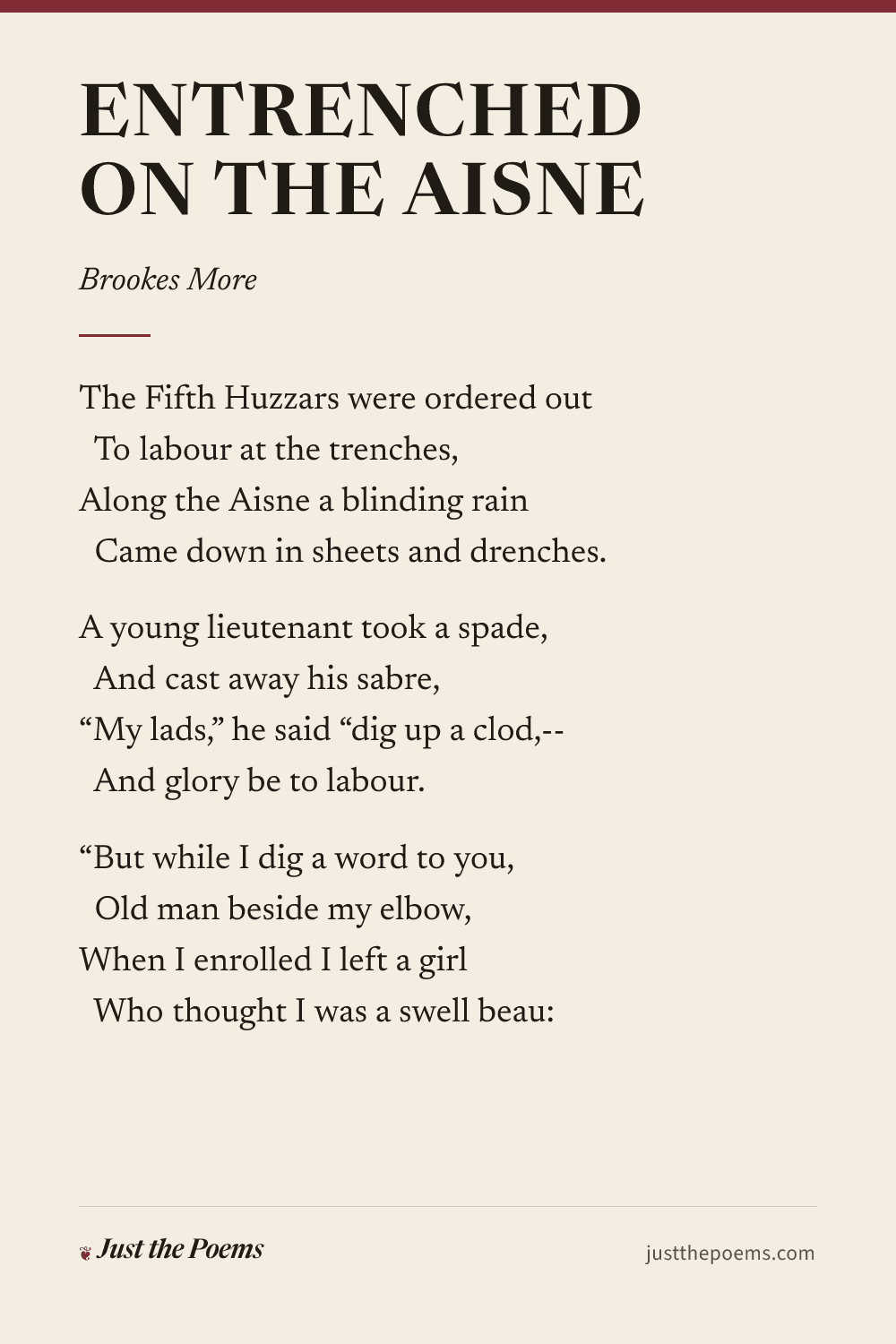
ENTRENCHED ON THE AISNE

Brookes More

In 0 Wikipedias 0 anthologies Poet in 0 Wikipedias

The Fifth Huzzars were ordered out To labour at the trenches,Along the Aisne a blinding rain Came down in sheets and drenches.

A young lieutenant took a spade, And cast away his sabre,“My lads,” he said “dig up a clod,-- And glory be to labour.

“But while I dig a word to you, Old man beside my elbow,When I enrolled I left a girl Who thought I was a swell beau:

Show all 52 lines 40 more

“Laugh not, old man, for I can talk; In moonlight like another;But now, I want to talk to you As if you were my brother.”

With this he took a picture out And flashed it at the old man;“She’s sweeter than the smile you see, And worth her weight in gold, man.”

“Young man,” he said, “I’m not so old, But I might be her father;I have a picture I might show, If it were not a bother.”

And all the while they bantered thus, The shells were bursting ’round them,And the downpour in the trenches ran, Small wonder if it drowned them.

No doubt the youth was edging up To tell a sober story,A message for the girl if he Should fall in trenches gory.

The Germans now had got the range, Their cannonade was furious;“I say, old man, the way those shells Go skyting round is curious.”

And at the word a bursting shell, Filled with a hellish mixture,Tore from its roots the poor lad’s arm That held the sweetheart’s picture.

Another dreadful fragment struck The old man on the forehead--And, just to use plain English now, The mess was something horrid.

And there they lay with glassy eyes Until the night was starry,Sad magnets for the birds of prey That hunt their mangled quarry.

The youth’s torn limb not far from him, Still clutched the dear love-token;The old man had a duplicate, Though stained with blood and broken.

Source

Songs of a Red Cross nurse, 1918

Filed under
  • Library subject “Nurses -- Poetry”, Songs of a Red Cross nurse

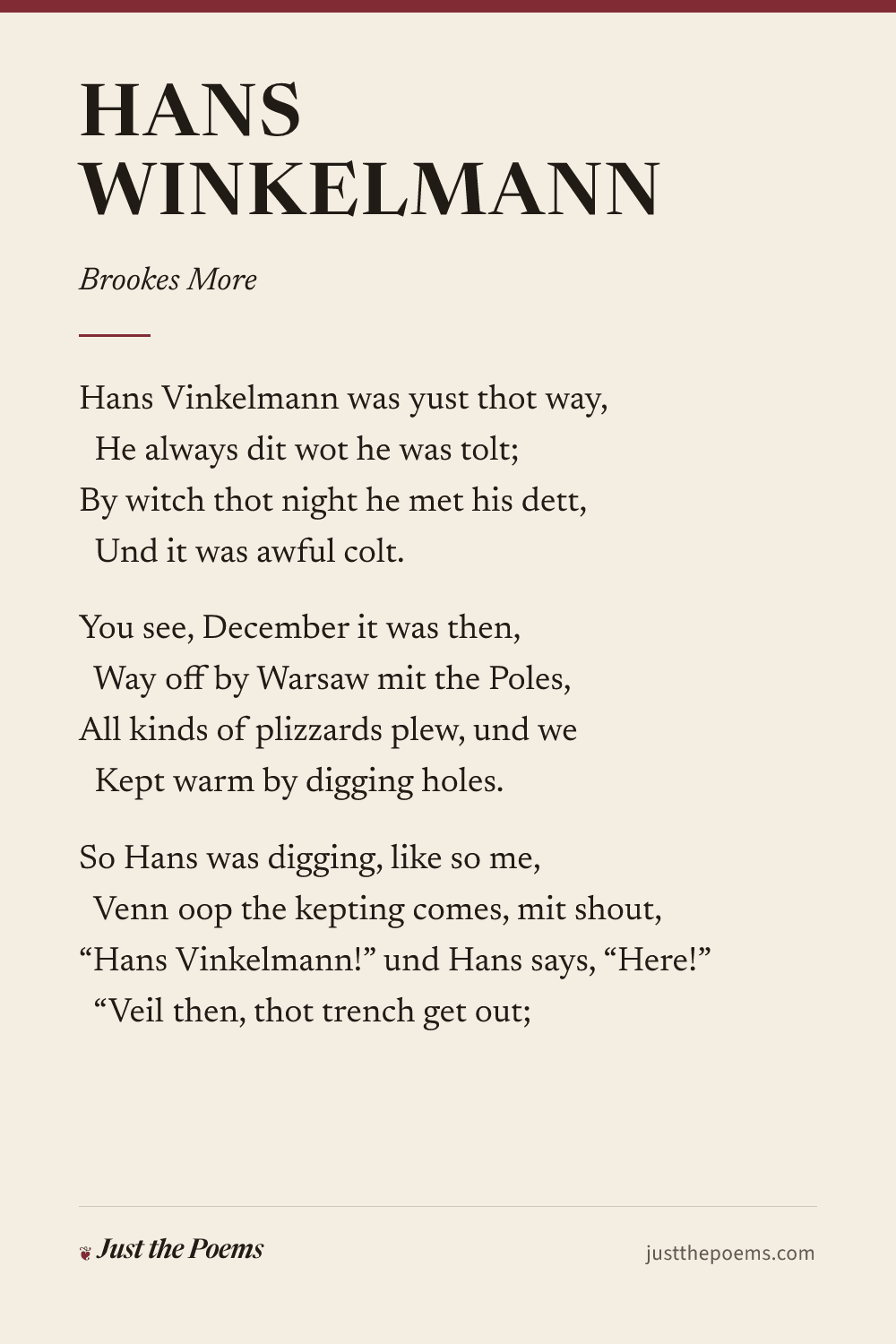
HANS WINKELMANN

Brookes More

In 0 Wikipedias 0 anthologies Poet in 0 Wikipedias

Hans Vinkelmann was yust thot way, He always dit wot he was tolt;By witch thot night he met his dett, Und it was awful colt.

You see, December it was then, Way off by Warsaw mit the Poles,All kinds of plizzards plew, und we Kept warm by digging holes.

So Hans was digging, like so me, Venn oop the kepting comes, mit shout,“Hans Vinkelmann!” und Hans says, “Here!” “Veil then, thot trench get out;

Show all 56 lines 44 more

Und come by me, we need a man Off yonder by thot picket line;You must not leef mitout my wort,-- Relief will be at nine.”

Vell venn a sentry vent the rount, Perhaps by eight o’clock, or so,He met poor Hans half dett mit colt, Und standing in the snow;

Und Hans, he said, “My comrade Yake, I feel mit shivers, colt as ice,I wish you giff the kepting this For Yennie if I dies.”

So Yake comes pack und tells it all-- Up yoomped the kepting, und he swore,“Py Tamm! if he is scairt of colt, Vot vill he do in vore?”

Yust then a thousand Rooshians yelt, Like hell-fire tyefulls, or wot not;Und wile we fought to safe our lifes, Poor Hans was all forgot.

The other sentries hurried in, Und choined us mit the Rooshian fight;I tell you wot, we licked ’em goot, Und kept it oop all night.

Veil howso thot, venn morning comes, We looks arount und counts our men;The kepting calls our names, und calls, “Hans Vinkelmann!” again.

No answer comes, und ware is Hans? He is not on the ploody grount;Und any ware we looks for him, No sign of him is fount.

But Yakey was a cunning Yew, Und said, “Py Yim, I bet I know,Hans Vinkelmann is keeping guart, Und standing in the snow!”

Vee didn’t vait for leef at all-- The morning light was werry dim,But pretty soon we fount poor Hans, Or wot was left of him.

We fount two dett wolfs on the snow, A gun, some pones, a uniform;Goot Gott! this Rooshian vore is colt,-- Perhaps, yet, Hans is warm.

Source

Songs of a Red Cross nurse, 1918

Filed under
  • Library subject “Nurses -- Poetry”, Songs of a Red Cross nurse

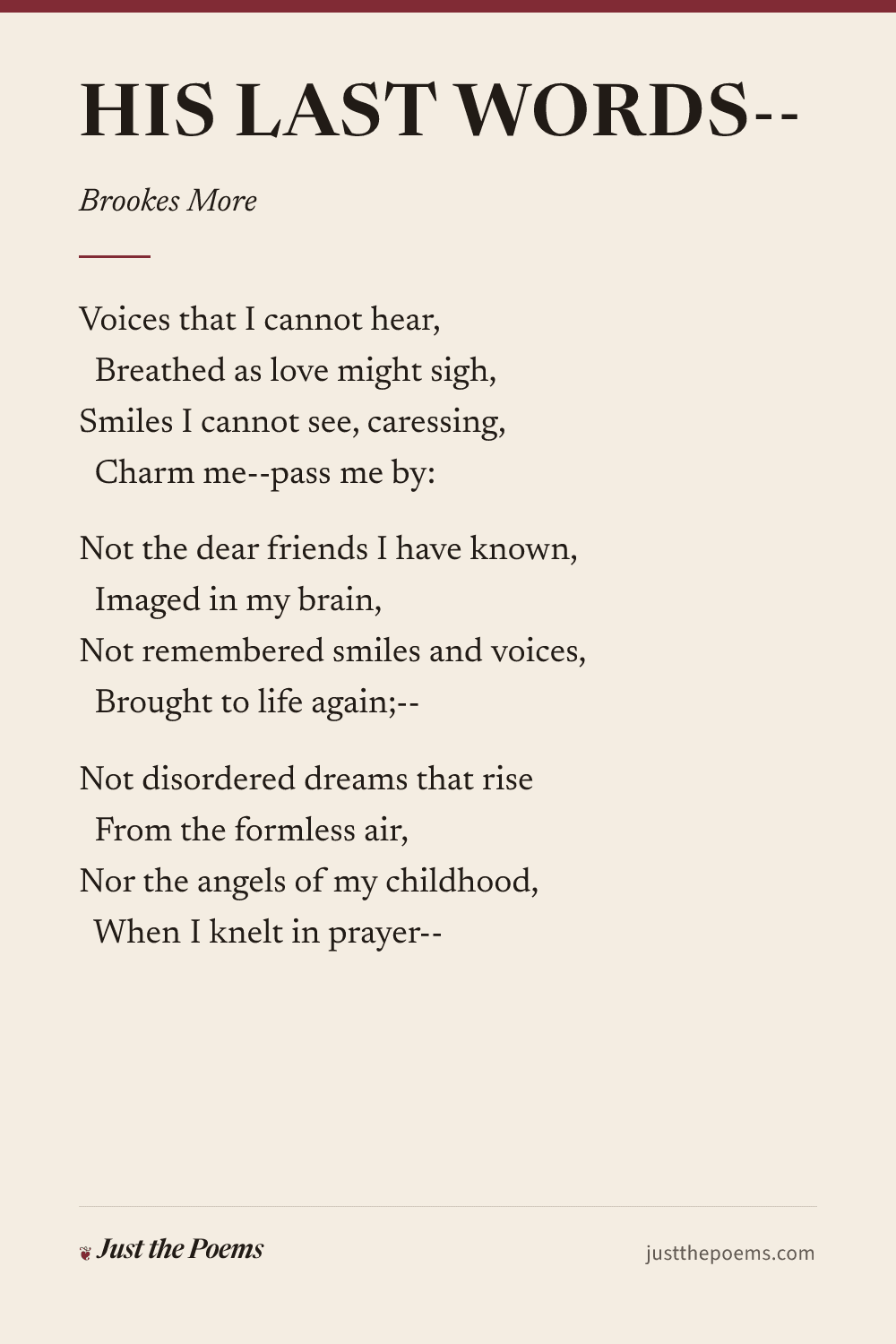
HIS LAST WORDS--

Brookes More

In 0 Wikipedias 0 anthologies Poet in 0 Wikipedias

Voices that I cannot hear, Breathed as love might sigh,Smiles I cannot see, caressing, Charm me--pass me by:

Not the dear friends I have known, Imaged in my brain,Not remembered smiles and voices, Brought to life again;--

Not disordered dreams that rise From the formless air,Nor the angels of my childhood, When I knelt in prayer--

Ah! sweet nurse, ’tis you,--stoop down, For the night grows dark--I thought it was my mother-- Did you hear that?--Hark!

Source

Songs of a Red Cross nurse, 1918

Filed under
  • Library subject “Nurses -- Poetry”, Songs of a Red Cross nurse

Advertisements

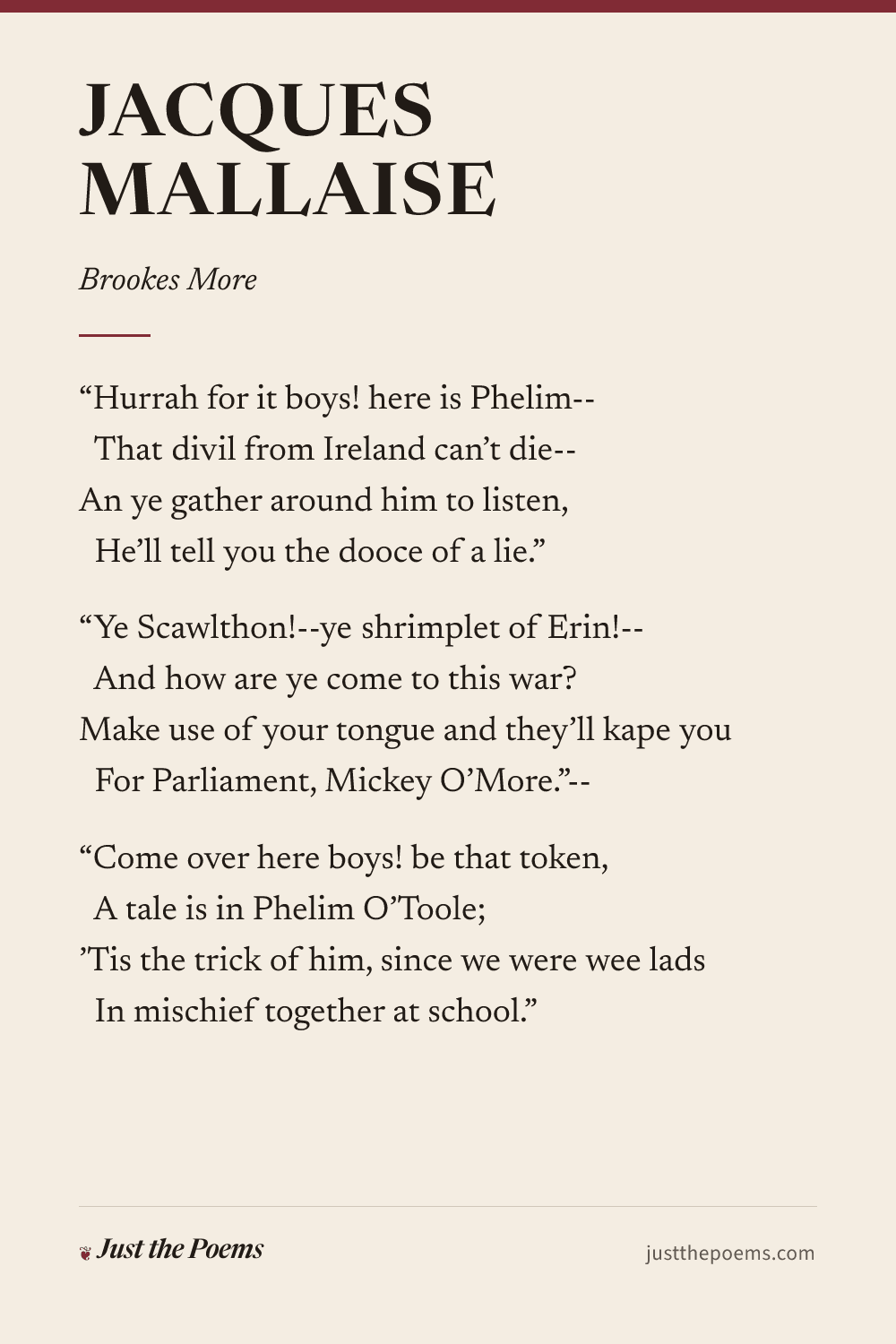
JACQUES MALLAISE

Brookes More

In 0 Wikipedias 0 anthologies Poet in 0 Wikipedias

“Hurrah for it boys! here is Phelim-- That divil from Ireland can’t die--An ye gather around him to listen, He’ll tell you the dooce of a lie.”

“Ye Scawlthon!--ye shrimplet of Erin!-- And how are ye come to this war?Make use of your tongue and they’ll kape you For Parliament, Mickey O’More.”--

“Come over here boys! be that token, A tale is in Phelim O’Toole;’Tis the trick of him, since we were wee lads In mischief together at school.”

Show all 136 lines 124 more

“Well, Mickey O’More, for that reason, I’ll tell them what happened for fearIf you are not stopped of your jabbers You’ll shame all the Irish that’s here.”

You know I was called by the general To get him a special report,And now there’s no cause to be secret I’ll blab it to kape up your sport.

Says he to me, “Phelim, the Proossians Most surely are tapping the wire;I know it because our maneuvers Are always delayed by their fire.

“And now there’s an urgent occasion For us to get word to the French,Of doings by far too important To chance the tapped wires from the trench.

“Take this to them over at Dixmude, And while ye run over the way,Examine the wire through the forest; And travel be light of the day.”

At once I set off on my gray horse, That message hid under his tail,Besides a false note in my pocket, To fool them in case I should fail.

Well, while I was riding I felt sure I saw through the leaves of a tree,The glint of a rifle that hinted A Proossian was looking at me.

Good angels take care of the Irish! I dropped the false note on the ground;And the yokel hid up in those branches, Bamboozled, made never a sound.

No doubt he made sure ’twas important, So divil the trigger he pulled;While Phelim rode forward, rejoicing, In love wit’ the Proossian he fooled.

I well knew the wires had been tapped there, Yet innocent-like I rode by;And so, (be the trick of it) lately That German was shot for a spy.

In due time, I got to the French camp, And gave the right note to the general;That tickled he was, when he read it, He chuckled, “We’ll lick ’em my men or I’ll

“Eat anny old mud in the trenches:-- Tomorrow, boys, three in the morning,Be ready to charge wit’ the bay’net,-- Be careful, don’t give ’em a warning.”

That word went the rounds, and our Frenchmen Were merry as truants from school--They made up a song with a chorus That ended with Phelim O’Toole!

At three in the morning, away then, They rushed up the hill for the Dutch--God give me the French or the Irish!-- Hurrah! and a charge! hurrah!--Such

Was the craze and the fury,--they kept on, Although they were caught in a hellWhere cannons were belching out murther With solid ball, shrapnel and shell.

A thousand, at least, were destroyed there, Not far from the enemy’s trench,And the Boches, blood-lusting for slaughter, Were shouting, “God punish the French!”

But while they were yelling their lungs out, A wounded man, Jacques Mallaise,From the midst of the dead and the dying Sang bravely the French Marseillaise!

Imagine! betwixt the two armies, Where mangled men covered the ground,One living and singing defiance, While bullets were whistling around.

His voice, a rich baritone, grandly Swelled over the discord of hate;--The soldiers stopped fighting and listened, Amazed as he mocked at his fate.

But when he had silenced that clamour, He stopped in the midst of his song,And called to the French, who were held back And wild to retrieve their wrong:

“Ho, comrades, my ankle is fractured, But never you dream about me;Shoot, comrades! shoot low at the Boches, Have at them,--for victory!”

Good God! as they looked through the gray dawn, And saw that the torn bodies moved,No Frenchman could shoot at the Germans Across the brave comrade he loved.

Not so with the long line of Proossians, Their cruel guns rattled, spit, spats;Swept over the field where the wounded Were writhing like tortured rats.

And again from the din of the battle Rang out the deep-voiced Mallaise;But instead of the song he was cursing, In various and horrible ways:

“Shoot, comrades! shoot low at the Boches! Forget me, consider me slain;For what in the hell does it matter; Remember the sack of Louvain!”

Oh, then it is something most awful; The tears spurting forth from their eyes,Ten thousand brave soldiers are sobbing,-- He, cursing, his own death defies!--

Ten thousand! a host out of bedlam, They shoot with a frenzy to kill--With never a word from a captain They rush up the death-strewn hill.

And I am as crazy as they are-- We charge with a reckless wild yell;And where a man falls there are ten more To jump for the spot where he fell.

No son of a woman can stand up Against that wild shock undismayed;Like rabbits they run from their trenches, Demoralized, whipped and afraid.

Red Slaughter runs mad in the gray dawn, The Frenchmen are shouting “Louvain!”And often the word, “Lusitania!” Is echoing over the plain.--

Holy Virgin! I’m back wut the Irish, They fight for the Glory of God!But the Proossians are foul,--in a mix-up, Savage,--for the lust of hot blood.
Source

Songs of a Red Cross nurse, 1918

Filed under
  • Library subject “Nurses -- Poetry”, Songs of a Red Cross nurse

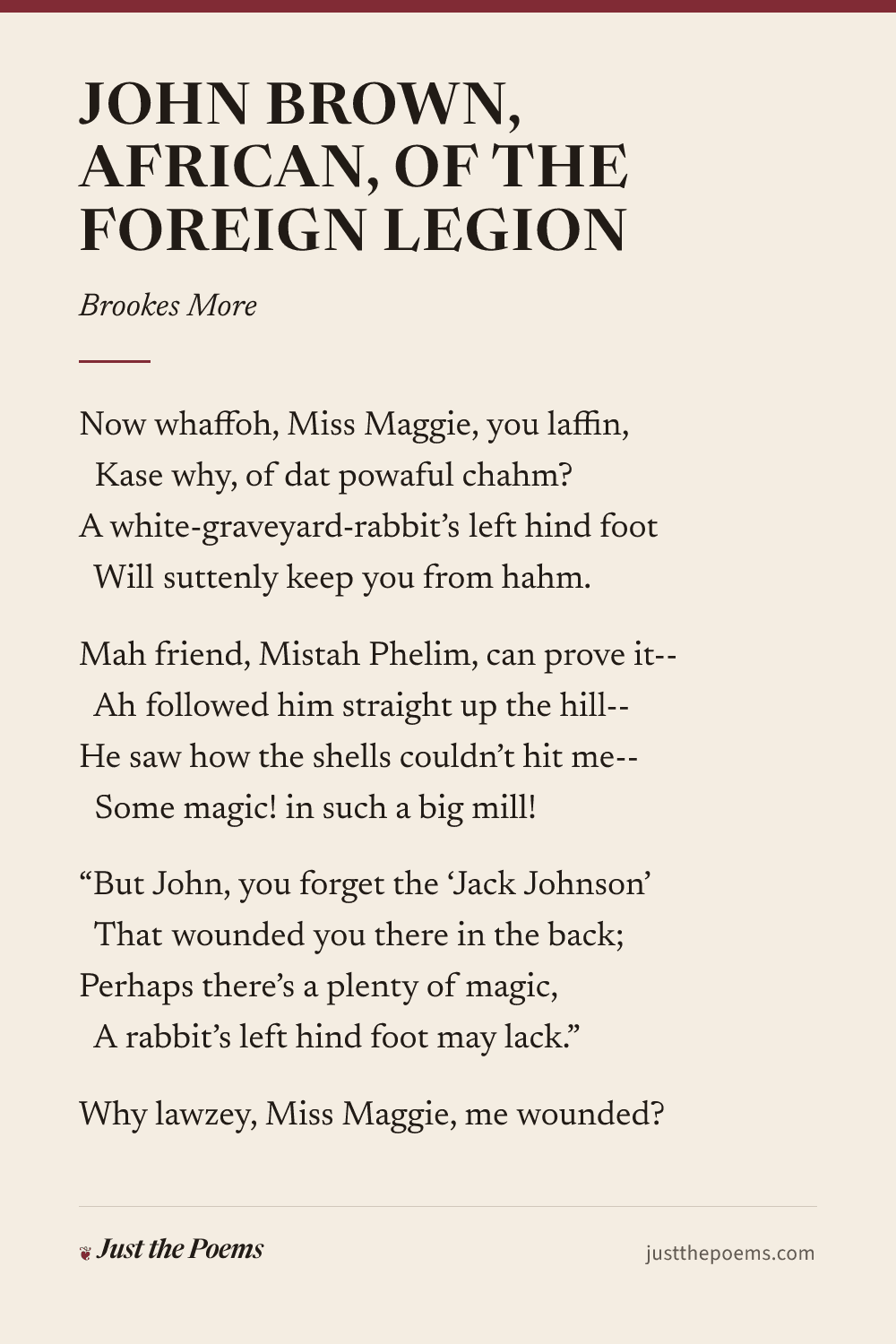
JOHN BROWN, AFRICAN, OF THE FOREIGN LEGION

Brookes More

In 0 Wikipedias 0 anthologies Poet in 0 Wikipedias

Now whaffoh, Miss Maggie, you laffin, Kase why, of dat powaful chahm?A white-graveyard-rabbit’s left hind foot Will suttenly keep you from hahm.

Mah friend, Mistah Phelim, can prove it-- Ah followed him straight up the hill--He saw how the shells couldn’t hit me-- Some magic! in such a big mill!

“But John, you forget the ‘Jack Johnson’ That wounded you there in the back;Perhaps there’s a plenty of magic, A rabbit’s left hind foot may lack.”

Show all 120 lines 108 more

Why lawzey, Miss Maggie, me wounded? And me in mah bed, paralyzed!--Ah thought all mah troubles was ovah And wobbled around and capsized.

But only for this little hind foot-- It saved me and Phelim O’Toole--That big shell had hustled our shadows To sizzle where wintah’s not cool.

“I wish you would tell me about it;” Chimed in little Maggie McGee,“Strange is it a man of your colour From Boston, and over the sea;

“For why should you leave that great country, Where even the naygurs get rich,A-picking gold off of the mountains, Or cotton and prayties and sich.

“For why did you come to this bad war, Where Kaisers are swimming in blood,And leave your great mansions of marble, To wallow in trenches of mud.”

Why lawzey, Miss Maggie, quoth John Brown, Ah guess Ah most always might haveQu-ossity mo’ than right judgment;-- It was not because Ah was brave;

But some of mah friends had war-fevah, And made up a “legion” to fightFor France, and they needed a cook, so Ah joined them account of their plight.

And so Ah have followed this ahmy, And fed them and fought for them too,And Ah would be dead like the othahs Except fo’ mah little hoo-doo.

’Twas Sattaday mawnin’, we stahted To chahge like the Germans,--you know,Bunched up in a reg’lah fo’mation-- And that worried all of us--so,

Ah said kind of loud, with intention The captain would heah what Ah said,“Why doan’ that man tell us to spread out Befo’ we gets laid out fo’ dead?”

He didn’t pay no least attention-- Whaffoh should he listen to me?--We went that-a-way till the captain Got ready a-plenty, says he,

“Spread out and to kuvvah, heads down boys”-- He had a good reason by that--Our heads a-most natchally sag down-- Ah dodge like a rabbit or cat.

And a-shootin’ away from the hill-top An ahsenal, robbed of its guns,Keeps pumpin’ all kinds of fired bullets, Invented by bahberous Huns.

We stops, and we rush, and again rush, We gets to the top of the hill;The Germans get skeered and bend backwahd; Ah ’spicion they sho’ got their fill.

But chasing them we got surrounded, Machine guns in front and around.And shells in the middle a-bustin’-- Ah thought Ah was heavenly bound.

They tole us to lay on our stummicks, To dodge their machinery pills;--You simply cain’t duck them love-tokens, No mo’ than your grocery bills.

And while Ah was huggin’ the ground close, Jack Johnson slid ovah mah back;“O Lawdy,” Ah says to mahself, sir, “Ah’m smashed lak a railroad track.

“Ah guess Ah’m a-earnin’ mah wages, About a whole penny a day,But somehow the future looks gloomy And dahk if Ah keeps dis-a-way.”

“How many days lasted that battle?” Astonished, said Maggie McGee;--“Why just a small po’tion of one day, And that was enough to hold me.”

“And who went with you besides Phelim?” Said Maggie, perhaps with some pride:He answered, “They kept me too busy, But Phelim was close at mah side.”

While Maggie was dreaming of glory, Another nurse came with his food;“Oh lawzey, jes’ whiff at the bacon, Ah tell you it sho’ly am good.

“If Joffrey would listen to mah plan, This wah would not last half a day;Ah’d set out a million of rashahs, All crispy and hot dis-a-way;

“And scattah them out on the trenches-- As soon as the Huns got a smellThey’d jump from their holes and surrendah-- Too glad to escape from their----well,

“That minds me again of mah good luck, Account of mah rabbit-foot chahm;Fo’ why does Ah know it’s the rabbit?-- Why heah Ah is cuddled from hahm.”

“But where then is Phelim,” said Maggie, “Ah, tell me for better or worse--’Tis me that came over from Ireland, In case he might need for a nurse.”

“And do you know Phelim, Miss Maggie? They found him nigh dead on that hill,And toted him, captive to Belgium-- Perhaps he is up there still.”

“My Phelim among those blood-robbers? Oh, tell me how may I go there!Thank God for this badge of the Red Cross, A passport that’s good everywhere.”

Source

Songs of a Red Cross nurse, 1918

Filed under
  • Library subject “Nurses -- Poetry”, Songs of a Red Cross nurse

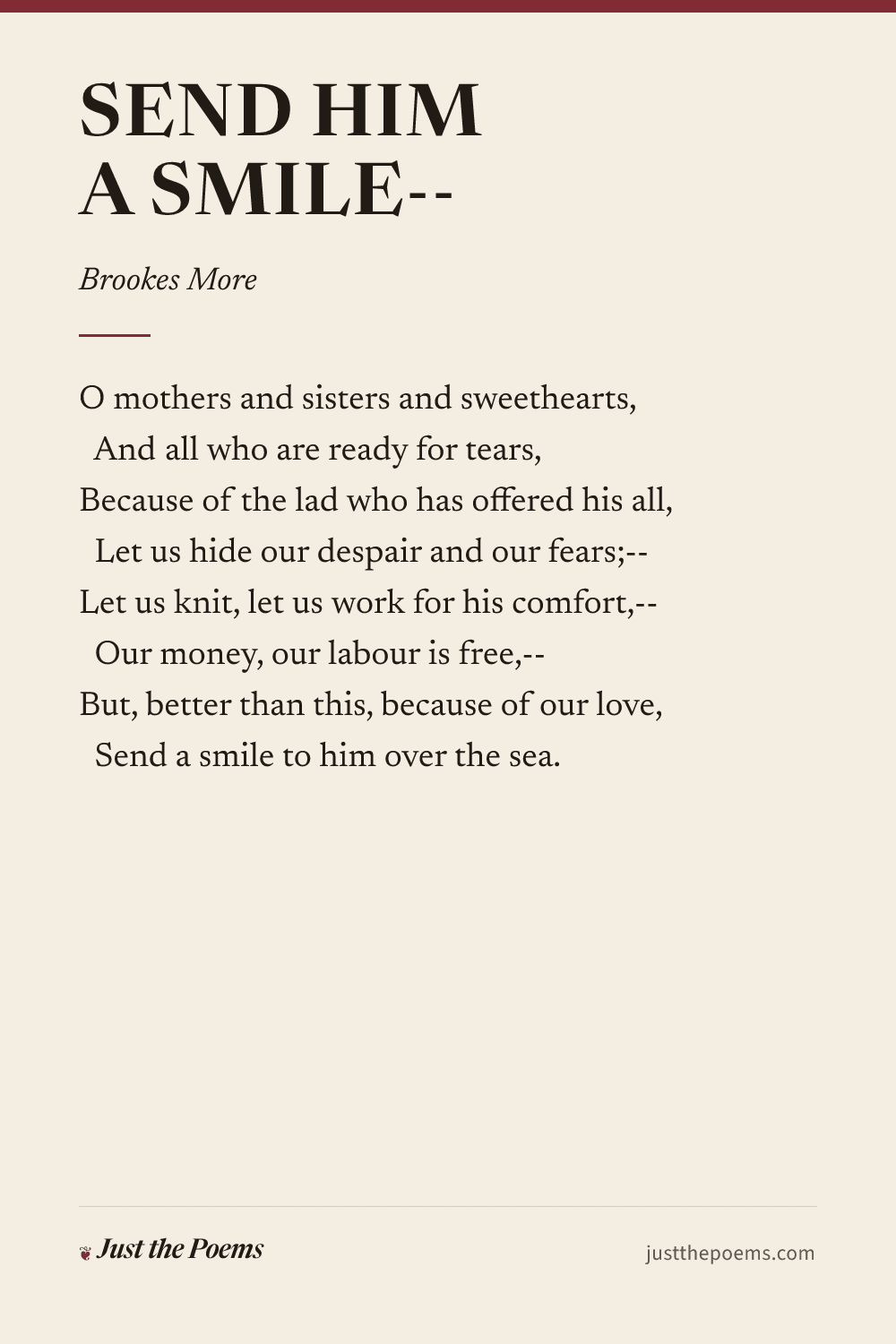
SEND HIM A SMILE--

Brookes More

In 0 Wikipedias 0 anthologies Poet in 0 Wikipedias

O mothers and sisters and sweethearts, And all who are ready for tears,Because of the lad who has offered his all, Let us hide our despair and our fears;--Let us knit, let us work for his comfort,-- Our money, our labour is free,--But, better than this, because of our love, Send a smile to him over the sea.

For he will encourage his comrades, By singing the songs of the day;With the boys over there he will sing the home songs To chase a sad moment away:But when that excitement is over He will ask, “Is she thinking of me?”Ah yes! but instead of our sighs,--every one, Send a smile to him over the sea.

Source

Songs of a Red Cross nurse, 1918

Filed under
  • Library subject “Nurses -- Poetry”, Songs of a Red Cross nurse

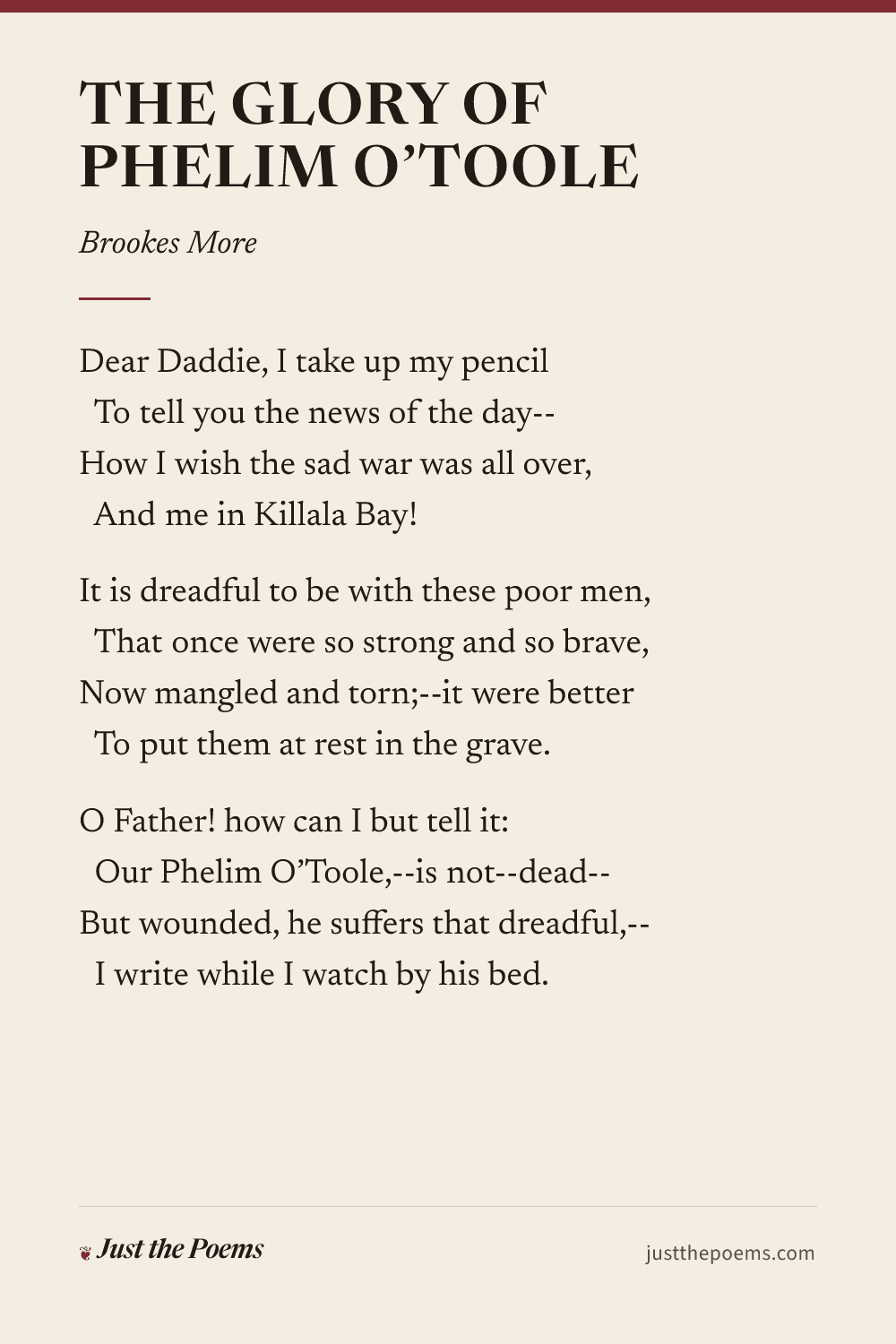
THE GLORY OF PHELIM O’TOOLE

Brookes More

In 0 Wikipedias 0 anthologies Poet in 0 Wikipedias

Dear Daddie, I take up my pencil To tell you the news of the day--How I wish the sad war was all over, And me in Killala Bay!

It is dreadful to be with these poor men, That once were so strong and so brave,Now mangled and torn;--it were better To put them at rest in the grave.

O Father! how can I but tell it: Our Phelim O’Toole,--is not--dead--But wounded, he suffers that dreadful,-- I write while I watch by his bed.

Show all 128 lines 116 more

They brought him here, maimed and delirious,-- He doesn’t know I am his nurse;And the doctor has said we will lose him, If ever his fever gets worse.

Near dead am I watching the nights through, With never a minute of sleep;Small use have I now for these sad eyes, Excepting to watch and to weep.

And Mickey O’More it was brought him,-- Ye mind him, that small freckled lad?His blue eyes of laughter? God bless him!-- He took on for Phelim so bad.

He told me how Phelim got hurted, The glory he did in that war:I’ll tell it ye here on this paper, Be the language of Mickey O’More:--

Says Mickey, “Ah Maggie, I seen him In the hot of it, time and again!I’ll never forget in that wild charge So grand was he, leading his men.--

“You see, it was this way, the Boches Outnumbered us twenty to one,And now they had planned a great effort, To whip us and force us to run.

“For one of them spied out our trouble,-- What was it? Our powder was low!--A cartridge! ’twas worth a goold guinea!-- Our gun-fire was feeble and slow.

“Of course, if we once got to running, They’d follow with bay’net and shot;And few of the English and Irish Would ever return from that spot.

“The General (wise to their tactics) Gave orders to Phelim O’Toole;Says he, ‘It is often the best plan For wise men to hazard the fool;

“‘Get out your brigade of brave Irish And charge up that hill, on the right--The Proossians will argue we done it To bring on a general fight;

“‘By which they will guess re-enforcements,-- Perhaps a reserve in the rear,--And that will delay their maneuvers, Until we can get out of here.

“‘Stick to it, my lad, till you scare them; Destroy all the guns that you can:Come back when we feint to support you-- God help you, my brave Irish man.’

“‘Come back,’ says I, ‘Sure with the angels!’ But Phelim swore, ‘Devils in pitch!Come on my boys! Charge! To the Dutchmen! Ho! Follow me! Out of the ditch!’

“Those divils from Ireland! God bless them! They follow him up to the hill,Flat down on their bellies they’re crawling-- On! upward! they struggle until

“The long line of blood that’s behind them Gives pause to the bravest man there;--But, just as they waver, up Phelim Jumps, swinging his gun in the air;

“A target for thousands of Boches, He stands on the top of a stone,And shouts like a god in that wild din, ‘Come on, boys! I charge ’em alone!’

“Oh then, you can see a strange glitter A-light in the eyes of his men;No torment of grim death can stop them-- They follow their leader again.”

O Daddy! I knew what was coming-- Your Maggie fell down in a swoon;And Mickey took on like a wild man, For fright of it--luckily, soon,

I came to myself, but my head swam; A dizzy feel blinded my eyes;And, while I was foolish, I moaned out, “Don’t tell it me! tell me no lies!”

What for did I get to my right mind? ’Tis sorrow we love here, not mirth;We pluck the sweet flower from the green stem, Smile on it, and crush it to earth.--

“O Mickey, o’chone, ye must tell it!-- Hush Mickey, ye’ll murther me dead!”And so I wailed under my sorrow, Too wild-like to know what I said.

And when I was worn out with weeping, Again, I could listen to him;And oh, what he told of those Germans! Bed cess to the nation of thim.--

But guess now, dear Father, what happened? While writing you this, by his bed,And while I was teeming with anger, He opened his eyes, and he said:

“What dream is this? is it a vision? Or is it a dear ghost I see?I thought I was kilt on that steep hill; God help me! that’s Maggie McGee!

“Are you, too, my colleen, a spirit? Your sweet life put out in that war?Dear God! must they slaughter such children, To humour that crazed Emperor?”

His words were that strange, but his clear eyes With nothing of madness shone;And when I leaned over and kissed him, I knew that his fever had gone.

That good news broke into the sad tale Our poor little Mickey had told.--And he’s to the war, such a small man, With his big heart of purified gold.

And, O my dear Father! the doctor Assures me that Phelim will live;And when he gets well we will come back,-- And your little Maggie will give

The strength of her two arms to Phelim,-- My darling, brave, one-armed boy!--And do ye remember that cottage That’s close by the banks of the Moy?

Source

Songs of a Red Cross nurse, 1918

Filed under
  • Library subject “Nurses -- Poetry”, Songs of a Red Cross nurse

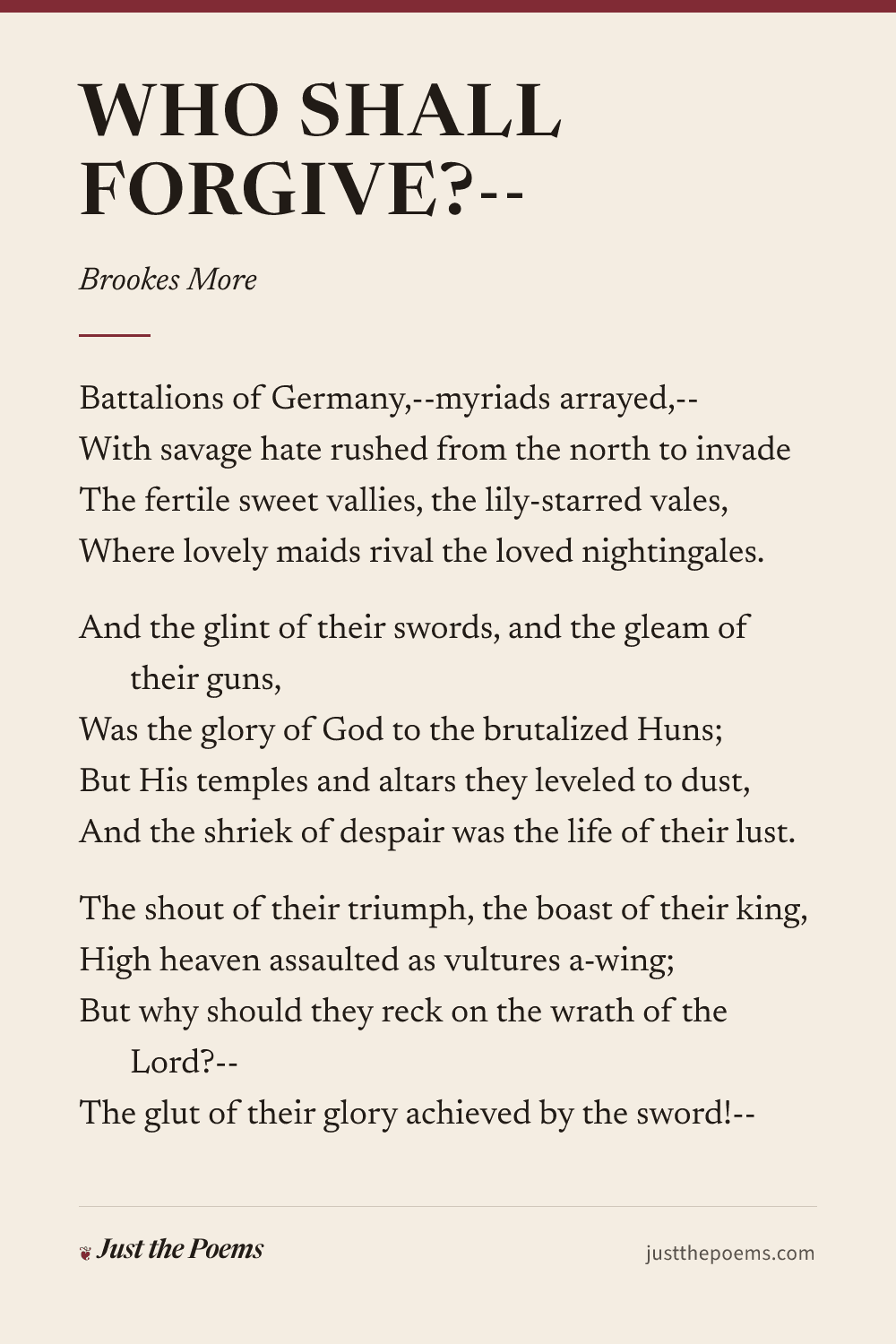
WHO SHALL FORGIVE?--

Brookes More

In 0 Wikipedias 0 anthologies Poet in 0 Wikipedias

Battalions of Germany,--myriads arrayed,--With savage hate rushed from the north to invadeThe fertile sweet vallies, the lily-starred vales,Where lovely maids rival the loved nightingales.

And the glint of their swords, and the gleam of their guns,Was the glory of God to the brutalized Huns;But His temples and altars they leveled to dust,And the shriek of despair was the life of their lust.

The shout of their triumph, the boast of their king,High heaven assaulted as vultures a-wing;But why should they reck on the wrath of the Lord?--The glut of their glory achieved by the sword!--

The Spirit of God breathed over the world,And far to the west a proud banner unfurled;And the Army of Liberty crossed the wide sea,That woman might worship and man might be free.

And the hosts of the Huns are dismayed and perplexed,Their blasphemous king in his vaunting is vexed;For where is the pity for those who had none,And who shall forgive what the dastard has done?--

Their bodies are strewn by the Marne on the plainWhere the hordes of Attila were routed and slain;And the fate of the past that dishonoured the HunsIs the doom of defeated, degenerate sons.

Source

Songs of a Red Cross nurse, 1918

Filed under
  • Library subject “Nurses -- Poetry”, Songs of a Red Cross nurse

18 poems for nurses

3 poets

By poet's century of death

CenturyPoems
19th1
20th17

Poets with more than one poem

PoetPoems
Brookes More16