Poems for Church

The 19 poems for church, by 13 poets, ranked by third-party data. How poems are ranked

ELEGY WRITTEN IN A COUNTRY CHURCH-YARD

Thomas Gray

In 0 Wikipedias 4 anthologies Poet in 40 Wikipedias

The curfew tolls the knell of parting day,The lowing herd wind slowly o'er the lea,The ploughman homeward plods his weary way,And leaves the world to darkness and to me.

Now fades the glimmering landscape on the sight,And all the air a solemn stillness holds,Save where the beetle wheels his droning flight,And drowsy tinklings lull the distant folds:

Save that from yonder ivy-mantled towerThe moping owl does to the moon complainOf such as, wandering near her secret bower,Molest her ancient solitary reign.

Show all 129 lines 117 more

Beneath those rugged elms, that yew-tree's shade,Where heaves the turf in many a mouldering heap,Each in his narrow cell for ever laid,The rude Forefathers of the hamlet sleep.

The breezy call of incense-breathing morn,The swallow twittering from the straw-built shed,The cock's shrill clarion, or the echoing horn,No more shall rouse them from their lowly bed.

For them no more the blazing hearth shall burnOr busy housewife ply her evening care:No children run to lisp their sire's return,Or climb his knees the envied kiss to share.

Oft did the harvest to their sickle yield,Their furrow oft the stubborn glebe has broke;How jocund did they drive their team afield!How bow'd the woods beneath their sturdy stroke!

Let not Ambition mock their useful toil,Their homely joys, and destiny obscure;Nor Grandeur hear with a disdainful smileThe short and simple annals of the Poor.

The boast of heraldry, the pomp of power,And all that beauty, all that wealth e'er gave,Await alike th' inevitable hour:--The paths of glory lead but to the grave.

Nor you, ye Proud, impute to these the faultIf Memory o'er their tomb no trophies raise,Where through the long-drawn aisle and fretted vault,The pealing anthem swells the note of praise.

Can storied urn or animated bustBack to its mansion call the fleeting breath?Can Honour's voice provoke the silent dust,Or Flattery soothe the dull cold ear of Death?

Perhaps in this neglected spot is laidSome heart once pregnant with celestial fire;Hands, that the rod of empire might have sway'd,Or waked to ecstasy the living lyre:

But Knowledge to their eyes her ample pageRich with the spoils of time, did ne'er unroll;Chill Penury repress'd their noble rage,And froze the genial current of the soul.

Full many a gem of purest ray sereneThe dark unfathom'd caves of ocean bear:Full many a flower is born to blush unseen,And waste its sweetness on the desert air.

Some village-Hampden, that with dauntless breastThe little tyrant of his fields withstood,Some mute inglorious Milton here may rest,Some Cromwell, guiltless of his country's blood.

Th' applause of listening senates to command,The threats of pain and ruin to despise,To scatter plenty o'er a smiling land,And read their history in a nation's eyes

Their lot forbad; nor circumscribed aloneTheir growing virtues, but their crimes confined;Forbad to wade through slaughter to a throne,And shut the gates of mercy on mankind;

The struggling pangs of conscious truth to hide,To quench the blushes of ingenuous shame,Or heap the shrine of Luxury and PrideWith incense kindled at the Muse's flame.

Far from the madding crowd's ignoble strifeTheir sober wishes never learn'd to stray;Along the cool sequester'd vale of lifeThey kept the noiseless tenour of their way.

Yet e'en these bones from insult to protectSome frail memorial still erected nigh,With uncouth rhymes and shapeless sculpture deck'd,Implores the passing tribute of a sigh.

Their name, their years, spelt by the unletter'd Muse,The place of fame and elegy supply:And many a holy text around she strews,That teach the rustic moralist to die.

For who, to dumb forgetfulness a prey,This pleasing anxious being e'er resign'd,Left the warm precincts of the cheerful day,Nor cast one longing, lingering look behind?

On some fond breast the parting soul relies,Some pious drops the closing eye requires;E'en from the tomb the voice of Nature cries,E'en in our ashes live their wonted fires.

For thee, who, mindful of th' unhonour'd dead,Dost in those lines their artless tale relate;If chance, by lonely Contemplation led,Some kindred spirit shall inquire thy fate,--

Haply some hoary-headed swain may say,Oft have we seen him at the peep of dawn,Brushing with hasty steps the dews away,To meet the sun upon the upland lawn;

There, at the foot of yonder nodding beechThat wreathes its old fantastic roots so high,His listless length at noon-tide would he stretch,And pore upon the brook that babbles by.

Hard by yon wood, now smiling as in scorn,Muttering his wayward fancies he would rove;Now drooping, woeful-wan, like one forlorn,Or crazed with care, or cross'd in hopeless love.

One morn I miss'd him on the custom'd hill,Along the heath, and near his favourite tree;Another came; nor yet beside the rill,Nor up the lawn, nor at the wood was he;

The next with dirges due in sad array,Slow through the church-way path we saw him borne,--Approach, and read (for thou canst read) the layGraved on the stone beneath yon aged thorn.

THE EPITAPH.

Here rests his head upon the lap of EarthA Youth, to Fortune and to Fame unknown;Fair Science frown'd not on his humble birth,And Melancholy mark'd him for her own.

Large was his bounty, and his soul sincere;Heaven did a recompense as largely send:He gave to Misery all he had, a tear,He gain'd from Heaven, 'twas all he wish'd, a friend.

No farther seek his merits to disclose,Or draw his frailties from their dread abode,(There they alike in trembling hope repose),The bosom of his Father and his God.

Source

The Golden Treasury, ed. Francis Turner Palgrave

Filed under
  • Named in the title

AT THE CHURCH GATE

William Makepeace Thackeray

In 0 Wikipedias 1 anthology Poet in 70 Wikipedias

Although I enter not,Yet round about the spotOfttimes I hover;And near the sacred gate,With longing eyes I wait,Expectant of her.

The Minster bell tolls outAbove the city's rout,And noise and humming;They've hushed the Minster bell:The organ 'gins to swell;She's coming, she's coming!

Show all 30 lines 18 more

My lady comes at last,Timid, and stepping fastAnd hastening hither,With modest eyes downcast;She comes - she's here - she's past!May heaven go with her!

Kneel undisturbed, fair Saint!Pour out your praise or plaintMeekly and duly;I will not enter there,To sully your pure prayerWith thoughts unruly.

But suffer me to paceRound the forbidden place,Lingering a minute,Like outcast spirits, who wait,And see, through heaven's gate,Angels within it.

Source

The Home Book of Verse, ed. Burton Egbert Stevenson

Filed under
  • Named in the title

THE BISHOP ORDERS HIS TOMB AT SAINT PRAXED'S CHURCH

Robert Browning

In 0 Wikipedias 1 anthology Poet in 57 Wikipedias

Vanity, saith the preacher, vanity!Draw round my bed: is Anselm keeping back?Nephews--sons mine.. ah God, I know not! Well--She, men would have to be your mother once,Old Gandolf envied me, so fair she was!What's done is done, and she is dead beside,Dead long ago, and I am Bishop since,And as she died so must we die ourselves,And thence ye may perceive the world's a dream.Life, how and what is it? As here I lieIn this state-chamber, dying by degrees,Hours and long hours in the dead night, I ask

Show all 125 lines 113 more

"Do I live, am I dead?" Peace, peace seems all.Saint Praxed's ever was the church for peace;And so, about this tomb of mine. I foughtWith tooth and nail to save my niche, ye know:--Old Gandolf cozened me, despite my care;Shrewd was that snatch from out the corner SouthHe graced his carrion with, God curse the same!Yet still my niche is not so cramped, but thenceOne sees the pulpit o' the epistle-side,And somewhat of the choir, those silent seats,And up into the aery dome where liveThe angels, and a sunbeam's sure to lurk:And I shall fill my slab of basalt there,And 'neath my tabernacle take my rest,With those nine columns round me, two and two,The odd one at my feet where Anselm stands:Peach-blossom marble all, the rare, the ripeAs fresh-poured red wine of a mighty pulse.--Old Gandolf with his paltry onion-stone,Put me where I may look at him! True peach,Rosy and flawless: how I earned the prize!Draw close: that conflagration of my church--What then? So much was saved if aught were missed!My sons, ye would not be my death? Go digThe white-grape vineyard where the oil-press stood,Drop water gently till the surface sink,And if ye-find... Ah God, I know not, I!...Bedded in store of rotten fig-leaves soft,And corded up in a tight olive-frail,Some lump, ah God, of lapis lazuli,Big as a Jew's head cut off at the nape,Blue as a vein o'er the Madonna's breast...Sons, all have I bequeathed you, villas, all,That brave Frascati villa with its bath,So, let the blue lump poise between my knees,Like God the Father's globe on both his handsYe worship in the Jesu Church so gay,For Gandolf shall not choose but see and burst!Swift as a weaver's shuttle fleet our years:Man goeth to the grave, and where is he?Did I say basalt for my slab, sons? Black--'T was ever antique-black I meant! How elseShall ye contrast my frieze to come beneath?--The bas-relief in bronze ye promised me,Those Pans and Nymphs ye wot of, and perchanceSome tripod, thyrsus, with a vase or so,The Saviour at his sermon on the mount,Saint Praxed in a glory, and one PanReady to twitch the Nymph's last garment off,And Moses with the tables... but I knowYe mark me not! What do they whisper thee,Child of my bowels, Anselm? Ah, ye hopeTo revel down my villas while I gaspBricked o'er with beggar's mouldy travertineWhich Gandolf from his tomb-top chuckles at!Nay, boys, ye love me--all of jasper, then!'T is jasper ye stand pledged to, lest I grieveMy bath must needs be left behind, alas!One block, pure green as a pistachio-nut,There's plenty jasper somewhere in the world--And have I not Saint Praxed's ear to prayHorses for ye, and brown Greek manuscripts,And mistresses with great smooth marbly limbs?--That's if ye carve my epitaph aright,Choice Latin, picked phrase, Tully's every word,No gaudy ware like Gandolf's second line--Tully, my masters? Ulpian serves his need!And then how I shall lie through centuries,And hear the blessed mutter of the mass,And see God made and eaten all day long,And feel the steady candle-flame, and tasteGood strong thick stupefying incense-smoke!For as I lie here, hours of the dead night,Dying in state and by such slow degrees,I fold my arms as if they clasped a crook,And stretch my feet forth straight as stone can point,And let the bedclothes, for a mortcloth, dropInto great laps and folds of sculptor's-work:And as yon tapers dwindle, and strange thoughtsGrow, with a certain humming in my ears,About the life before I lived this life,And this life too, popes, cardinals and priests,Saint Praxed at his sermon on the mount,Your tall pale mother with her talking eyes,And new-found agate urns as fresh as day,And marble's language, Latin pure, discreet,--Aha, ELUCESCEBAT quoth our friend?--No Tully, said I, Ulpian at the best!Evil and brief hath been my pilgrimage.All lapis, all, sons! Else I give the PopeMy villas! Will ye ever eat my heart?Ever your eyes were as a lizard's quick,They glitter like your mother's for my soul,Or ye would heighten my impoverished frieze,Piece out its starved design, and fill my vaseWith grapes, and add a visor and a Term,And to the tripod ye would tie a lynxThat in his struggle throws the thyrsus down,To comfort me on my entablatureWhereon I am to lie till I must ask"Do I live, am I dead?" There, leave me, there!For ye have stabbed me with ingratitudeTo death--ye wish it--God, ye wish it! Stone--Gritstone, a-crumble! Clammy squares which sweatAs if the corpse they keep were oozing through--And no more lapis to delight the world!Well, go! I bless ye. Fewer tapers there,But in a row: and, going, turn your backs--Ay, like departing altar-ministrants,And leave me in my church, the church for peace,That I may watch at leisure if he leers--Old Gandolf--at me, from his onion-stone,As still he envied me, so fair she was!

Source

The Home Book of Verse, ed. Burton Egbert Stevenson

Filed under
  • Named in the title

Advertisements

FROM "THE CHURCH PORCH."

George Herbert

In 0 Wikipedias 1 anthology Poet in 37 Wikipedias

Thou whose sweet youth and early hopes enhanceThy rate and price, and mark thee for a treasure.Hearken unto a Verser, who may chanceRhyme thee to good, and make a bait of pleasure: A verse may find him who a sermon flies And turn delight into a sacrifice.

When thou dost purpose aught (within thy power),Be sure to doe it, though it be but small;Constancie knits the bones, and make us stowre,When wanton pleasures beckon us to thrall. Who breaks his own bond, forfeiteth himself: What nature made a ship, he makes a shelf.

Show all 42 lines 30 more

By all means use sometimes to be alone.Salute thyself: see what thy soul doth wear.Dare to look in thy chest; for 't is thine own;And tumble up and down what thou find'st there. Who cannot rest till he good fellows finde, He breaks up house, turns out of doores his minde.

In clothes, cheap handsomenesse doth bear the bell.Wisdome's a trimmer thing than shop e'er gave.Say not then, This with that lace will do well;But, This with my discretion will be brave. Much curiousnesse is a perpetual wooing; Nothing, with labor; folly, long a doing.

When once thy foot enters the church, be bare.God is more there than thou; for thou art thereOnly by his permission. Then beware,And make thyself all reverence and fear. Kneeling ne'er spoiled silk stockings; quit thy state; All equal are within the church's gate.

Resort to sermons, but to prayers most:Praying's the end of preaching. O, be drest!Stay not for th' other pin: why thou hast lostA joy for it worth worlds. Thus hell doth jest Away thy blessings, and extremely flout thee, Thy clothes being fast, but thy soul loose about thee.

Judge not the preacher; for he is thy judge:If thou mislike him, thou conceiv'st him not.God calleth preaching folly. Do not grudgeTo pick out treasures from an earthen pot. The worst speak something good: if all want sense, God takes a text, and preacheth Pa-ti-ence.

Source

The World's Best Poetry, Vol. IV, ed. Bliss Carman, 1904

Filed under
  • Named in the title

TO. . . IN CHURCH

Alan Seeger

In 0 Wikipedias 1 anthology Poet in 14 Wikipedias

If I was drawn here from a distant place,'Twas not to pray nor hear our friend's address,But, gazing once more on your winsome face,To worship there Ideal Loveliness.On that pure shrine that has too long ignoredThe gifts that once I brought so frequentlyI lay this votive offering, to recordHow sweet your quiet beauty seemed to me.Enchanting girl, my faith is not a thingBy futile prayers and vapid psalm-singingTo vent in crowded nave and public pew.My creed is simple: that the world is fair,And beauty the best thing to worship there,And I confess it by adoring you.

Source

The Home Book of Verse, ed. Burton Egbert Stevenson

Filed under
  • Named in the title

LONDON CHURCHES

Richard Monckton Milnes

In 0 Wikipedias 1 anthology Poet in 6 Wikipedias

I stood, one Sunday morning,Before a large church door,The congregation gathered,And carriages a score,--From one out stepped a ladyI oft had seen before.

Her hand was on a prayer-book,And held a vinaigrette;The sign of man's redemptionClear on the book was set,--But above the cross there glistenedA golden Coronet.

Show all 30 lines 18 more

For her the obsequious beadleThe inner door flung wide;Lightly, as up a ball-room,Her footsteps seemed to glide,--There might be good thoughts in her,For all her evil pride.

But after her a womanPeeped wistfully within,On whose wan face was gravenLife's hardest discipline,--The trace of the sad trinityOf weakness, pain, and sin.

The few free-seats were crowdedWhere she could rest and pray;With her worn garb contrastedEach side in fair array,--"God's house holds no poor sinners,"She sighed, and crept away.

Source

The World's Best Poetry, Vol. III, ed. Bliss Carman, 1904

Filed under
  • Named in the title

MIMNERMUS IN CHURCH

William Johnson-Cory

In 0 Wikipedias 1 anthology Poet in 6 Wikipedias

You promise heavens free from strife,Pure truth, and perfect change of will;But sweet, sweet is this human life,So sweet, I fain would breathe it still:Your chilly stars I can forego,This warm kind world is all I know.

You say there is no substance here,One great reality above:Back from that void I shrink in fear,And child-like hide myself in love:Show me what angels feel. Till thenI cling, a mere weak man, to men.

You bid me lift my mean desiresFrom faltering lips and fitful veinsTo sexless souls, ideal choirs,Unwearied voices, wordless strains:My mind with fonder welcome ownsOne dear dead friend's remembered tones.

Forsooth the present we must giveTo that which cannot pass away;All beauteous things for which we liveBy laws of time and space decay.But oh, the very reason whyI clasp them, is because they die.

Source

The Home Book of Verse, ed. Burton Egbert Stevenson

Filed under
  • Named in the title

A POEM ON HIGH CHURCH

Jonathan Swift

In 0 Wikipedias 0 anthologies Poet in 101 Wikipedias

High Church is undone,As sure as a gun, For old Peter Patch is departed;And Eyres and Delaune,And the rest of that spawn, Are tacking about broken-hearted.

For strong Gill of Sarum,That decoctum amarum, Has prescribed a dose of cant-fail;Which will make them resignTheir flasks of French wine, And spice up their Nottingham ale.

It purges the spleenOf dislike to the queen, And has one effect that is odder;When easement they use,They always will chuse The Conformity Bill for bumfodder.

Source

The Poems of Jonathan Swift, D.D., Volume 2, 1910

Filed under
  • Named in the title

Advertisements

EPITAPH IN BERKELEY CHURCH-YARD, GLOUCESTERSHIRE

Jonathan Swift

In 0 Wikipedias 0 anthologies Poet in 101 Wikipedias

Here lies the Earl of Suffolk's fool, Men call'd him Dicky Pearce;His folly served to make folks laugh, When wit and mirth were scarce.

Poor Dick, alas! is dead and gone, What signifies to cry?Dickies enough are still behind, To laugh at by and by.

Buried, June 18, 1728, aged 63.

Source

The Poems of Jonathan Swift, D.D., Volume 2, 1910

Filed under
  • Named in the title

ON THE CHURCH'S DANGER

Jonathan Swift

In 0 Wikipedias 0 anthologies Poet in 101 Wikipedias

Good Halifax and pious Wharton cry,The Church has vapours; there's no danger nigh.In those we love not, we no danger see,And were they hang'd, there would no danger be.But we must silent be, amidst our fears,And not believe our senses, but the Peers.So ravishers, that know no sense of shame,First stop her mouth, and then debauch the dame.

Source

The Poems of Jonathan Swift, D.D., Volume 2, 1910

Filed under
  • Named in the title

A CHURCH ROMANCE (MELLSTOCK circa 1835)

Thomas Hardy

In 0 Wikipedias 0 anthologies Poet in 91 Wikipedias

SHE turned in the high pew, until her sightSwept the west gallery, and caught its rowOf music-men with viol, book, and bowAgainst the sinking sad tower-window light.

She turned again; and in her pride’s despiteOne strenuous viol’s inspirer seemed to throwA message from his string to her below,Which said: “I claim thee as my own forthright!”

Thus their hearts’ bond began, in due time signed.And long years thence, when Age had scared Romance,At some old attitude of his or glanceThat gallery-scene would break upon her mind,With him as minstrel, ardent, young, and trim,Bowing “New Sabbath” or “Mount Ephraim.”

Source

Time's Laughingstocks, and Other Verses, 1928

Filed under
  • Named in the title

DRAWING DETAILS IN AN OLD CHURCH

Thomas Hardy

In 0 Wikipedias 0 anthologies Poet in 91 Wikipedias

I HEAR the bell-rope sawing,And the oil-less axle grind,As I sit alone here drawingWhat some Gothic brain designed;And I catch the toll that follows From the lagging bell,Ere it spreads to hills and hollowsWhere the parish people dwell.

I ask not whom it tolls for,Incurious who he be;So, some morrow, when those knolls forOne unguessed, sound out for me,A stranger, loitering under In nave or choir,May think, too, “Whose, I wonder?”But care not to inquire.

Source

Late Lyrics and Earlier, With Many Other Verses, 1922

Filed under
  • Named in the title

HER DILEMMA (IN — CHURCH)

Thomas Hardy

In 0 Wikipedias 0 anthologies Poet in 91 Wikipedias

THE two were silent in a sunless church,Whose mildewed walls, uneven paving-stones,And wasted carvings passed antique research;And nothing broke the clock’s dull monotones.

Leaning against a wormy poppy-head,So wan and worn that he could scarcely stand,—For he was soon to die,—he softly said,“Tell me you love me!”—holding hard her hand.

She would have given a world to breathe “yes” truly,So much his life seemed handing on her mind,And hence she lied, her heart persuaded throughly’Twas worth her soul to be a moment kind.

But the sad need thereof, his nearing death,So mocked humanity that she shamed to prizeA world conditioned thus, or care for breathWhere Nature such dilemmas could devise.

Source

Wessex Poems and Other Verses, 1919

Filed under
  • Named in the title

Advertisements

SHE REVISITS ALONE THE CHURCH OF HER MARRIAGE

Thomas Hardy

In 0 Wikipedias 0 anthologies Poet in 91 Wikipedias

I HAVE come to the church and chancel, Where all’s the same!—Brighter and larger in my dreamsTruly it shaped than now, meseems, Is its substantial frame.But, anyhow, I made my vow, Whether for praise or blame,Here in this church and chancel Where all’s the same.

Where touched the check-floored chancel My knees and his?The step looks shyly at the sun,

Show all 36 lines 24 more

And says, “’Twas here the thing was done, For bale or else for bliss!”Of all those there I least was ware Would it be that or thisWhen touched the check-floored chancel My knees and his!

Here in this fateful chancel Where all’s the same,I thought the culminant crest of lifeWas reached when I went forth the wife I was not when I came.Each commonplace one of my race, Some say, has such an aim—To go from a fateful chancel As not the same.

Here, through this hoary chancel Where all’s the same,A thrill, a gaiety even, rangedThat morning when it seemed I changed My nature with my name.Though now not fair, though gray my hair, He loved me, past proclaim,Here in this hoary chancel, Where all’s the same.

Source

Late Lyrics and Earlier, With Many Other Verses, 1922

Filed under
  • Named in the title

WHILE DRAWING IN A CHURCH-YARD

Thomas Hardy

In 0 Wikipedias 0 anthologies Poet in 91 Wikipedias

“IT is sad that so many of worth, Still in the flesh,” soughed the yew,“Misjudge their lot whom kindly earth Secludes from view.

“They ride their diurnal round Each day-span’s sum of hoursIn peerless ease, without jolt or bound Or ache like ours.

“If the living could but hear What is heard by my roots as they creepRound the restful flock, and the things said there, No one would weep.”

“‘Now set among the wise,’ They say: ‘Enlarged in scope,That no God trumpet us to rise We truly hope.’”

I listened to his strange tale In the mood that stillness brings,And I grew to accept as the day wore pale That show of things.

Source

Moments of Vision and Miscellaneous Verses, 1929

Filed under
  • Named in the title

IN STRETHAM CHURCH.

Samuel Johnson

In 0 Wikipedias 0 anthologies Poet in 79 Wikipedias

Juxta sepulta est HESTERA MARIA,Thomae Cotton de Combermere, baronetti Cestriensis,filia,Johannis Salusbury, armigeri Flintiensis, uxor,Forma felix, felix ingenio;Omnibus jucunda, suorum amantissima.Linguis artibusque ita exeulta,Ut loquenti nunquam deessentSermonis nitor, sententiarum flosculi,Sapientiae gravitas, leporum gratia:Modum servandi adeo perita,Ut domestica inter negotia literis oblectaretur;Literarum inter delicias, rem familiarem sedulo curaret.Multis illi multos annos precantibusdiri carcinomatis venene contabuit,nexibusque vitae paulatim resolutis,e terris, meliora sperans, emigravit.Nata 1707. Nupta 1739. Obijt 1773.

Source

Dr. Johnson's Works: Life, Poems, and Tales, Volume 1 The Works of Samuel Johnson, LL.D., in Nine Volumes, 1825

Filed under
  • Named in the title

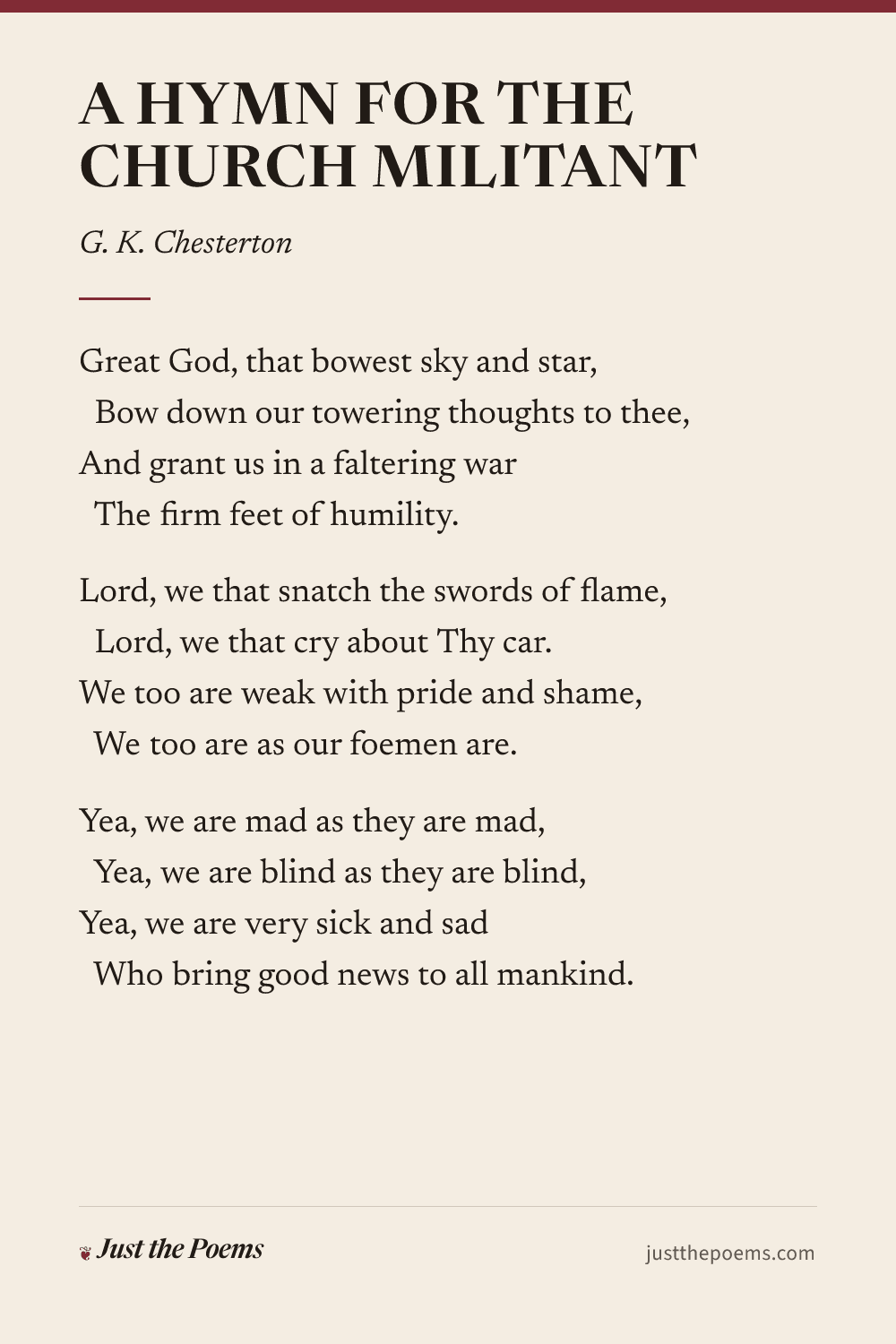
A HYMN FOR THE CHURCH MILITANT

G. K. Chesterton

In 0 Wikipedias 0 anthologies Poet in 70 Wikipedias

Great God, that bowest sky and star, Bow down our towering thoughts to thee,And grant us in a faltering war The firm feet of humility.

Lord, we that snatch the swords of flame, Lord, we that cry about Thy car.We too are weak with pride and shame, We too are as our foemen are.

Yea, we are mad as they are mad, Yea, we are blind as they are blind,Yea, we are very sick and sad Who bring good news to all mankind.

The dreadful joy Thy Son has sent Is heavier than any care;We find, as Cain his punishment, Our pardon more than we can bear.

Lord, when we cry Thee far and near And thunder through all lands unknownThe gospel into every ear, Lord, let us not forget our own.

Cleanse us from ire of creed or class, The anger of the idle tings;Sow in our souls, like living grass, The laughter of all lowly things.

Source

Poems, 1916

Filed under
  • Named in the title

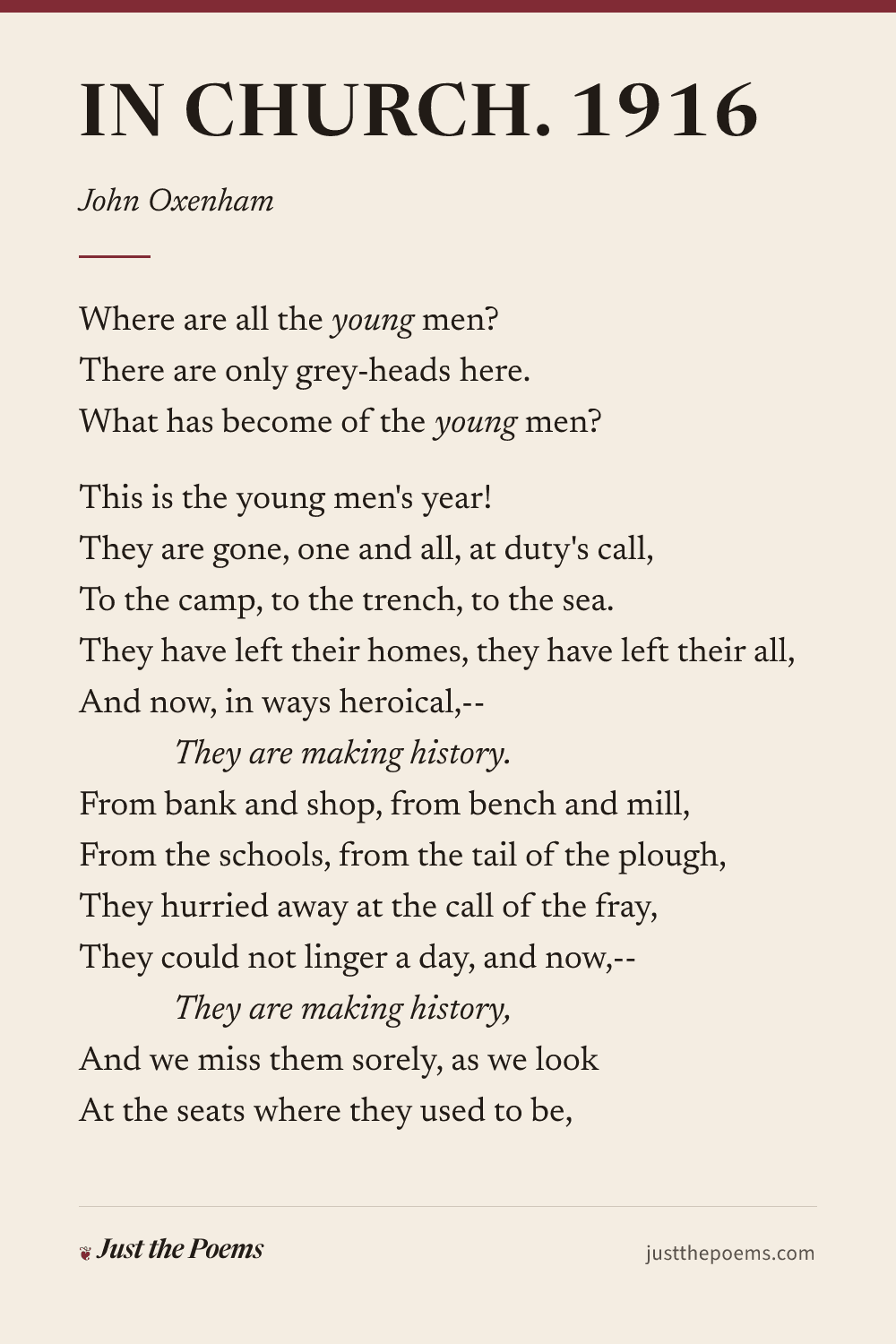
IN CHURCH. 1916

John Oxenham

In 0 Wikipedias 0 anthologies Poet in 4 Wikipedias

Where are all the young men?There are only grey-heads here.What has become of the young men?

This is the young men's year!They are gone, one and all, at duty's call,To the camp, to the trench, to the sea.They have left their homes, they have left their all,And now, in ways heroical,-- They are making history.From bank and shop, from bench and mill,From the schools, from the tail of the plough,They hurried away at the call of the fray,

Show all 32 lines 20 more

They could not linger a day, and now,-- They are making history,And we miss them sorely, as we lookAt the seats where they used to be,And try to picture them as they are,--Then hastily drop the vail:--for, you see,-- They are making history.

And history, in these dread days,Is sore sore sad in the making;We are building the future with our dead,We are binding it sure with the brave blood shed,Though our hearts are well-nigh breaking.We can but pray that the coming dayWill reap, of our red sowing,The harvest meet of a world completeWith the peace of God's bestowing.So, with quiet heart, we do our partIn the travail of this mystery,We give of our best, and we leave the rest To Him Who maketh history.

Source

'All's Well!', 1916

Filed under
  • Named in the title

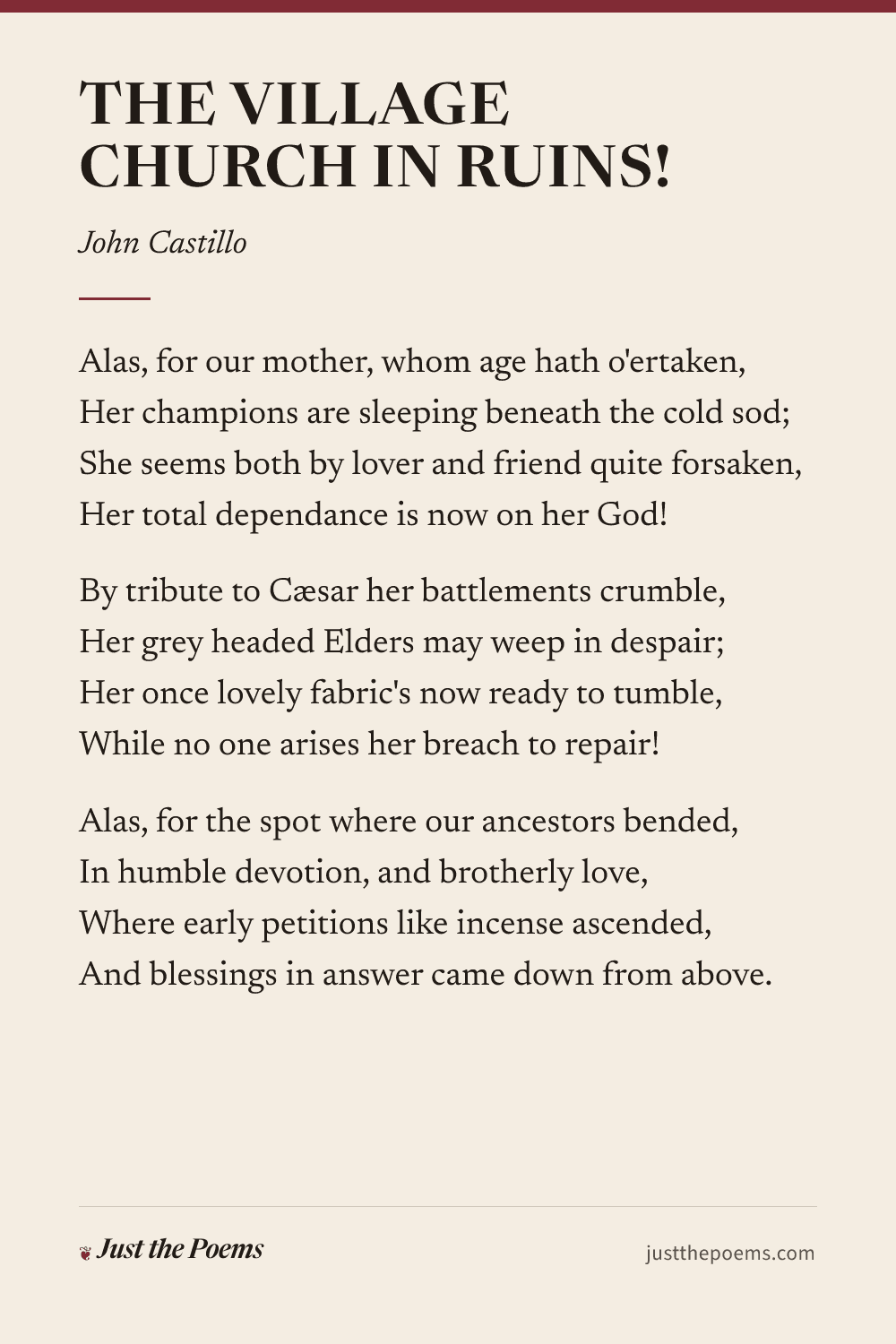
THE VILLAGE CHURCH IN RUINS!

John Castillo

In 0 Wikipedias 0 anthologies Poet in 1 Wikipedia

Alas, for our mother, whom age hath o'ertaken,Her champions are sleeping beneath the cold sod;She seems both by lover and friend quite forsaken,Her total dependance is now on her God!

By tribute to Cæsar her battlements crumble,Her grey headed Elders may weep in despair;Her once lovely fabric's now ready to tumble,While no one arises her breach to repair!

Alas, for the spot where our ancestors bended,In humble devotion, and brotherly love,Where early petitions like incense ascended,And blessings in answer came down from above.

Show all 40 lines 28 more

Alas, for that spot where our tribes did assemble,In youthful succession, both healthy and gay,Which then did the Temple of Zion resemble,--But briers and thorns have now choked up the way.

The voice of her Elders in prayer seems to falter,And her bells ring dolefully over her dead,Her priest may lament from the porch to the altar,Her pews are deserted, her virgins are fled.

Among her old timber, the hollow winds whistle,And carve out a track for the frost or the snow;Her walls, while they preach her departing epistle,Are cover'd with gloom, both above and below.

Dim through her old windows the daylight is peeping,The damp floor hath driven the hearers away;A drop through the roof seems as if it were weeping,To think how her beauty is gone to decay.

Of her milk and her honey she still might have boasted,And offer'd to all in abundance, and free,But her funds by the drones are now nearly exhausted,In craftily clipping the wings of the Bee.

Still thanks be to God, the Gospel is publish'd,With precept on precept, and line upon line;Still Ten there are found, who come to be furnish'd,With heav'nly instruction, in lectures divine.

The Minister boldly the tidings reported,And wisely distinguish'd the bad from the good;Of the present or absent who die unconverted,That worm eaten pulpit is clear of their blood!

Source

Awd Isaac, The Steeple Chase, and Other Poems With a glossary of the Yorkshire Dialect, 1843

Filed under
  • Named in the title

19 poems for church

13 poets

By poet's century of death

CenturyPoems
17th1
18th5
19th5
20th8

Poets with more than one poem

PoetPoems
Thomas Hardy5
Jonathan Swift3