Poems for a Friend

The 22 poems for a friend, by 16 poets, ranked by third-party data. How poems are ranked

To me, fair Friend, you never can be old,

William Shakespeare

In 7 Wikipedias 2 anthologies Poet in 237 Wikipedias

To me, fair Friend, you never can be old,For as you were when first your eye I eyedSuch seems your beauty still. Three winters coldHave from the forests shook three summers' pride;

Three beauteous springs to yellow autumn turn'd,In process of the seasons have I seen,Three April perfumes in three hot Junes burn'd,Since first I saw you fresh which yet are green.

Ah! yet doth beauty, like a dial hand,Steal from his figure, and no pace perceived;So your sweet hue, which methinks still doth stand,Hath motion, and mine eye may be deceived:

For fear of which, hear this, thou age unbred,--Ere you were born, was beauty's summer dead.

Source

The Golden Treasury, ed. Francis Turner Palgrave

Filed under
  • Named in the first line

TO A DISTANT FRIEND

William Wordsworth

In 0 Wikipedias 3 anthologies Poet in 97 Wikipedias

Why art thou silent! Is thy love a plantOf such weak fibre that the treacherous airOf absence withers what was once so fair?Is there no debt to pay, no boon to grant?

Yet have my thoughts for thee been vigilant,Bound to thy service with unceasing care--The mind's least generous wish a mendicantFor nought but what thy happiness could spare.

Speak!--though this soft warm heart, once free to holdA thousand tender pleasures, thine and mine,Be left more desolate, more dreary coldThan a forsaken bird's-nest fill'd with snow'Mid its own bush of leafless eglantine--Speak, that my torturing doubts their end may know!

Source

The Golden Treasury, ed. Francis Turner Palgrave

Filed under
  • Named in the title

THE FRIEND OF HUMANITY AND THE KNIFE-GRINDER.

George Canning

In 0 Wikipedias 2 anthologies Poet in 57 Wikipedias

Needy knife-grinder! whither are you going?Rough is the road; your wheel is out of order.Bleak blows the blast;--your hat has got a hole in't; So have your breeches!

Weary knife-grinder! little think the proud ones,Who in their coaches roll along the turnpike-Road, what hard work 't is crying all day, "Knives and Scissors to grind O!"

Tell me, knife-grinder, how came you to grind knives?Did some rich man tyrannically use you?Was it the squire? or parson of the parish? Or the attorney?

Show all 41 lines 29 more

Was it the squire for killing of his game? orCovetous parson for his tithes distraining?Or roguish lawyer made you lose your little All in a lawsuit?

(Have you not read the Rights of Man, by Tom Paine?)Drops of compassion tremble on my eyelids,Ready to fall as soon as you have told your Pitiful story.

KNIFE-GRINDER.

Story! God bless you! I have none to tell, sir;Only, last night, a-drinking at the Chequers,This poor old hat and breeches, as you see, were Torn in a scuffle.

Constables came up for to take me intoCustody; they took me before the justice;Justice Oldmixon put me into the parish Stocks for a vagrant.

I should be glad to drink your honor's health inA pot of beer, if you will give me sixpence;But for my part, I never love to meddle With politics, sir.

FRIEND OF HUMANITY.

I give thee sixpence! I will see thee damned first,--Wretch! whom no sense of wrongs can rouse to vengeance,--Sordid, unfeeling, reprobate, degraded, Spiritless outcast!

(Kicks the knife-grinder, overturns his wheel, andexit in a transport of republican enthusiasmand universal philanthropy.)

Source

The World's Best Poetry, Vol. IX, ed. Bliss Carman, 1904

Filed under
  • Named in the title

Advertisements

Friends Departed

Henry Vaughan

In 0 Wikipedias 2 anthologies Poet in 19 Wikipedias

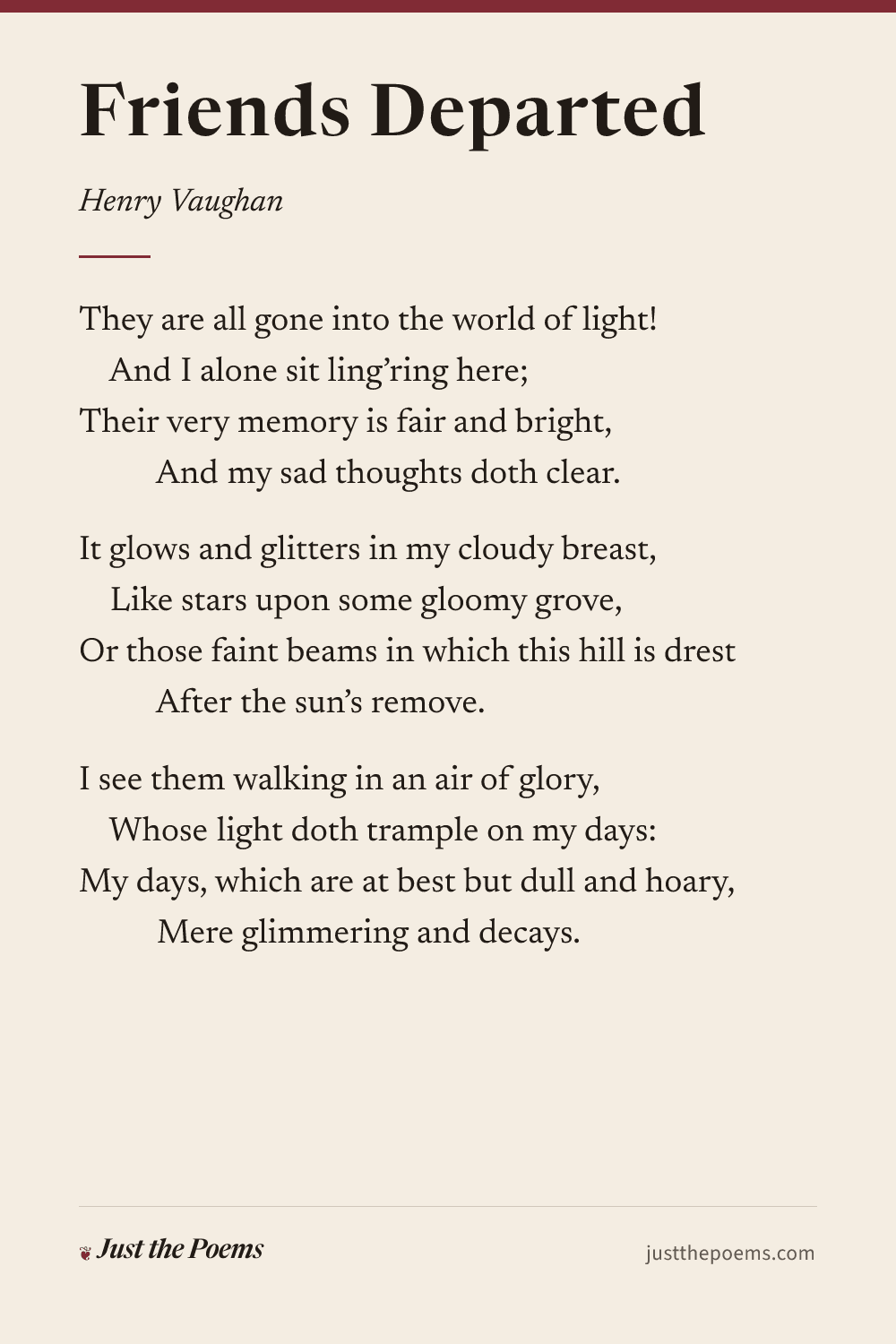
They are all gone into the world of light! And I alone sit ling’ring here;Their very memory is fair and bright, And my sad thoughts doth clear.

It glows and glitters in my cloudy breast, Like stars upon some gloomy grove,Or those faint beams in which this hill is drest After the sun’s remove.

I see them walking in an air of glory, Whose light doth trample on my days:My days, which are at best but dull and hoary, Mere glimmering and decays.

Show all 40 lines 28 more

O holy Hope! and high Humility, High as the heavens above!These are your walks, and you have show’d them me, To kindle my cold love.

Dear, beauteous Death! the jewel of the Just, Shining nowhere, but in the dark;What mysteries do lie beyond thy dust, Could man outlook that mark!

He that hath found some fledg’d bird’s nest may know, At first sight, if the bird be flown;But what fair well or grove he sings in now, That is to him unknown.

And yet as Angels in some brighter dreams Call to the soul, when man doth sleep:So some strange thoughts transcend our wonted themes, And into glory peep.

If a star were confin’d into a tomb, Her captive flames must needs burn there;But when the hand that lock’d her up gives room, She’ll shine through all the sphere.

O Father of eternal life, and all Created glories under Thee!Resume Thy spirit from this world of thrall Into true liberty.

Either disperse these mists, which blot and fill My perspective still as they pass:Or else remove me hence unto that hill, Where I shall need no glass.

Source

The Oxford Book of English Verse 1250–1900, 1900

Filed under
  • Named in the title

A TEMPLE TO FRIENDSHIP

Thomas Moore

In 0 Wikipedias 1 anthology Poet in 43 Wikipedias

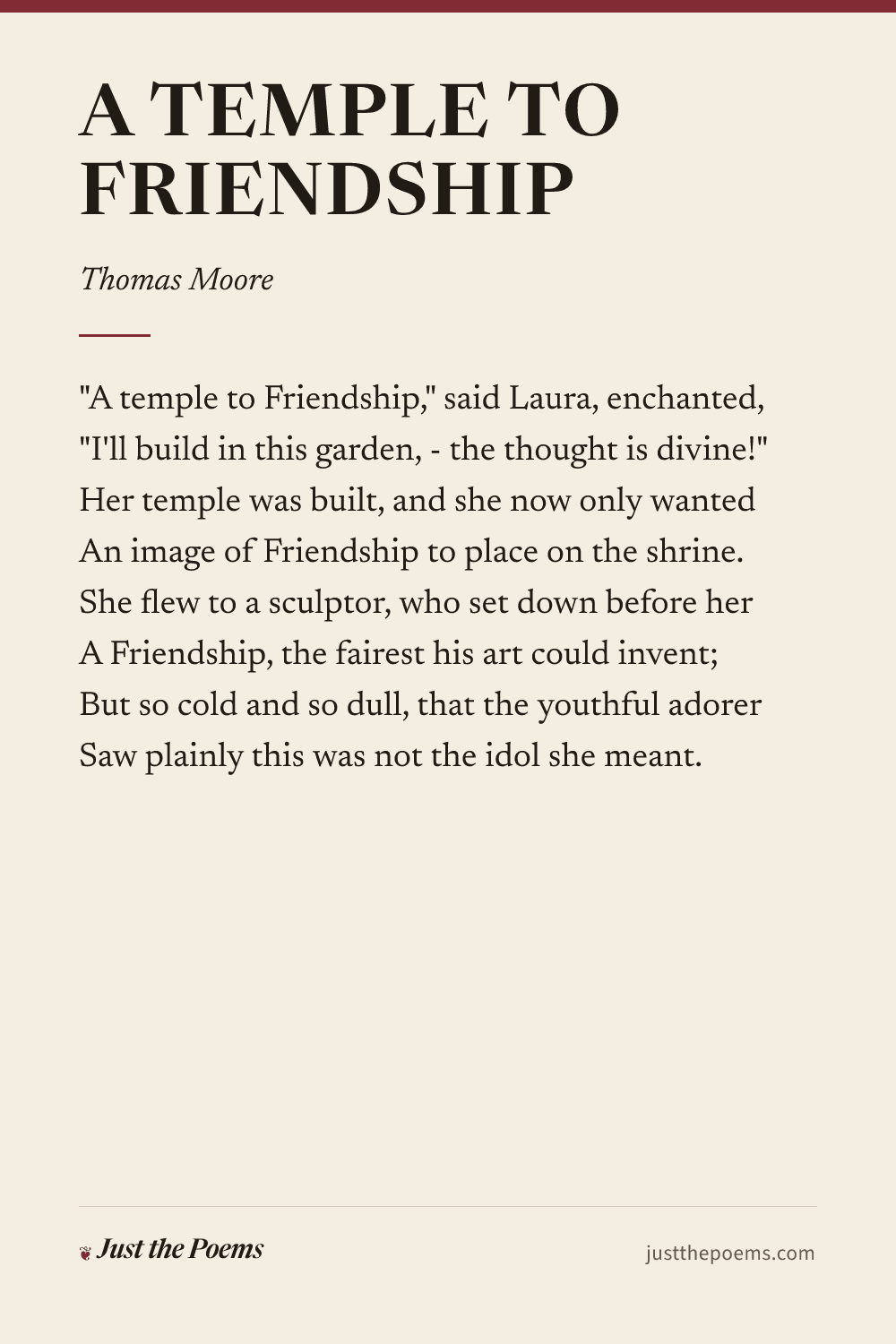
"A temple to Friendship," said Laura, enchanted,"I'll build in this garden, - the thought is divine!"Her temple was built, and she now only wantedAn image of Friendship to place on the shrine.She flew to a sculptor, who set down before herA Friendship, the fairest his art could invent;But so cold and so dull, that the youthful adorerSaw plainly this was not the idol she meant.

"O never," she cried, "could I think of enshriningAn image whose looks are so joyless and dim: -But yon little god, upon roses reclining,We'll make, if you please, sir, a Friendship of him."So the bargain was struck. With the little god ladenShe joyfully flew to her shrine in the grove:"Farewell," said the sculptor, "you're not the first maidenWho came but for Friendship and took away Love!"

Source

The Home Book of Verse, ed. Burton Egbert Stevenson

Filed under
  • Named in the title

THE HARE WITH MANY FRIENDS

John Gay

In 0 Wikipedias 1 anthology Poet in 34 Wikipedias

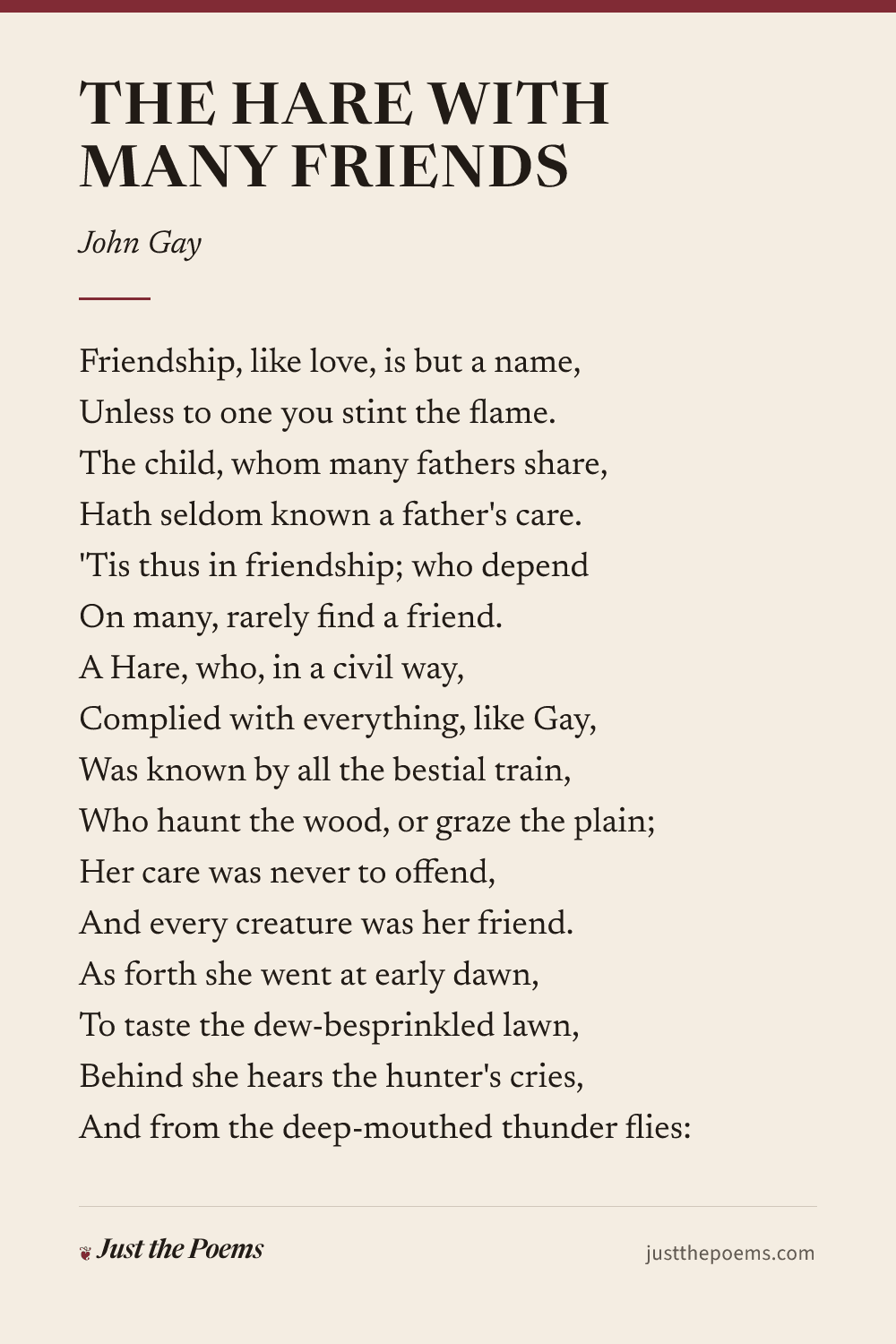
Friendship, like love, is but a name,Unless to one you stint the flame.The child, whom many fathers share,Hath seldom known a father's care.'Tis thus in friendship; who dependOn many, rarely find a friend.A Hare, who, in a civil way,Complied with everything, like Gay,Was known by all the bestial train,Who haunt the wood, or graze the plain;Her care was never to offend,And every creature was her friend.

Show all 64 lines 52 more

As forth she went at early dawn,To taste the dew-besprinkled lawn,Behind she hears the hunter's cries,And from the deep-mouthed thunder flies:She starts, she stops, she pants for breath;She hears the near advance of death;She doubles, to mislead the hound,And measures back her mazy round:Till, fainting in the public way,Half dead with fear she gasping lay.What transport in her bosom grew,When first the Horse appeared in view!"Let me," says she, "your back ascend,And owe my safety to a friend.You know my feet betray my flight:To friendship every burden's light."The Horse replied: "Poor honest Puss,It grieves my heart to see thee thus;Be comforted; relief is near,For all your friends are in the rear."She next the stately Bull implored;And thus replied the mighty lord:"Since every beast alive can tellThat I sincerely wish you well,I may, without offence, pretend,To take the freedom of a friend.Love calls me hence; a favorite cowExpects me near yon barley-mow;And when a lady's in the case,You know, all other things give place.To leave you thus might seem unkind;But see, the Goat is just behind."The Goat remarked her pulse was high,Her languid head, her heavy eye;"My back," says he, "may do you harm;The Sheep's at hand, and wool is warm."The Sheep was feeble, and complainedHis sides a load of wool sustained:Said he was slow, confessed his fears,For hounds eat sheep as well as Hares.She now the trotting Calf addressed,To save from death a friend distressed."Shall I," says he, "of tender age,In this important care engage?Older and abler passed you by;How strong are those, how weak am I!Should I presume to bear you hence,Those friends of mine may take offence.Excuse me, then. You know my heart;But dearest friends, alas! must part.How shall we all lament! Adieu!For see, the hounds are just in view."

Source

The Home Book of Verse, ed. Burton Egbert Stevenson

Filed under
  • Named in the title

On the Death of a particular Friend

James Thomson

In 0 Wikipedias 1 anthology Poet in 16 Wikipedias

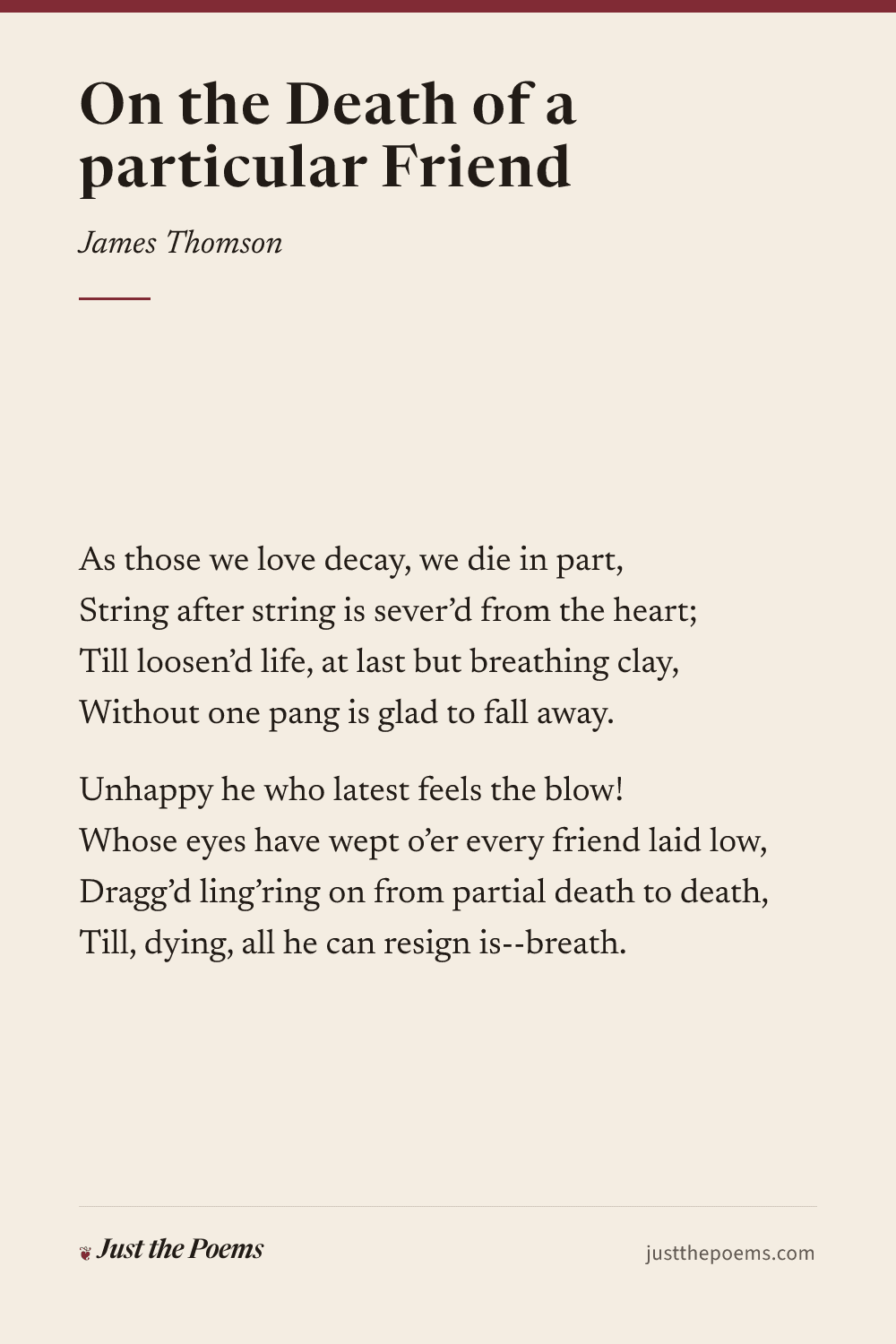
As those we love decay, we die in part,String after string is sever’d from the heart;Till loosen’d life, at last but breathing clay,Without one pang is glad to fall away.

Unhappy he who latest feels the blow!Whose eyes have wept o’er every friend laid low,Dragg’d ling’ring on from partial death to death,Till, dying, all he can resign is--breath.

Source

The Oxford Book of English Verse 1250–1900, 1900

Filed under
  • Named in the title

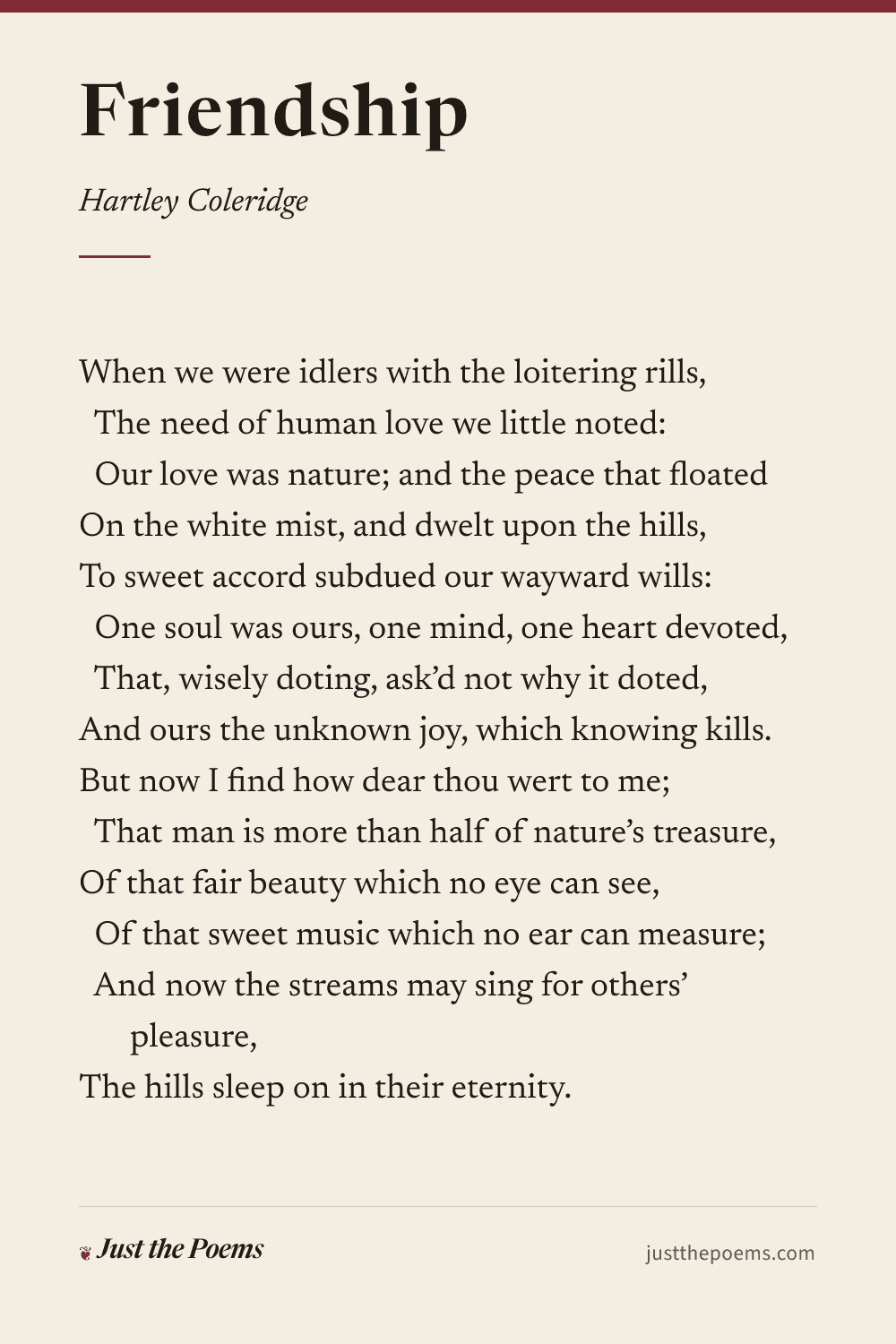
Friendship

Hartley Coleridge

In 0 Wikipedias 1 anthology Poet in 7 Wikipedias

When we were idlers with the loitering rills, The need of human love we little noted: Our love was nature; and the peace that floatedOn the white mist, and dwelt upon the hills,To sweet accord subdued our wayward wills: One soul was ours, one mind, one heart devoted, That, wisely doting, ask’d not why it doted,And ours the unknown joy, which knowing kills.But now I find how dear thou wert to me; That man is more than half of nature’s treasure,Of that fair beauty which no eye can see, Of that sweet music which no ear can measure; And now the streams may sing for others’ pleasure,The hills sleep on in their eternity.

Source

The Oxford Book of English Verse 1250–1900, 1900

Filed under
  • Named in the title

Advertisements

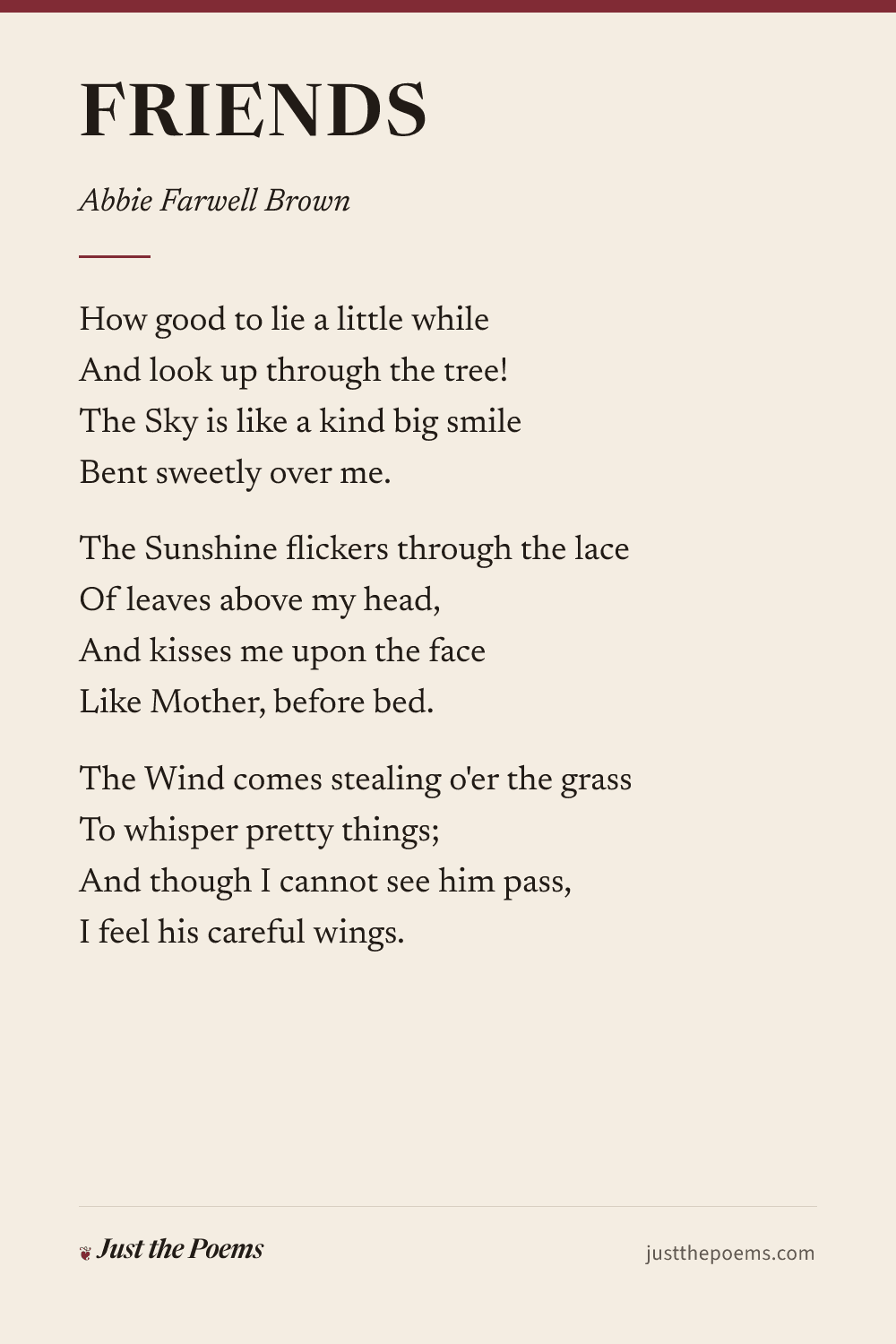
FRIENDS

Abbie Farwell Brown

In 0 Wikipedias 1 anthology Poet in 2 Wikipedias

How good to lie a little whileAnd look up through the tree!The Sky is like a kind big smileBent sweetly over me.

The Sunshine flickers through the laceOf leaves above my head,And kisses me upon the faceLike Mother, before bed.

The Wind comes stealing o'er the grassTo whisper pretty things;And though I cannot see him pass,I feel his careful wings.

So many gentle Friends are nearWhom one can scarcely see,A child should never feel a fear,Wherever he may be.

Source

The Home Book of Verse, ed. Burton Egbert Stevenson

Filed under
  • Named in the title

FRIEND AND LOVER

Mary Ainge de Vere

In 0 Wikipedias 1 anthology Poet in 0 Wikipedias

When Psyche's friend becomes her lover,How sweetly these conditions blend!But, oh, what anguish to discoverHer lover has become - her friend!

Source

The Home Book of Verse, ed. Burton Egbert Stevenson

Filed under
  • Named in the title

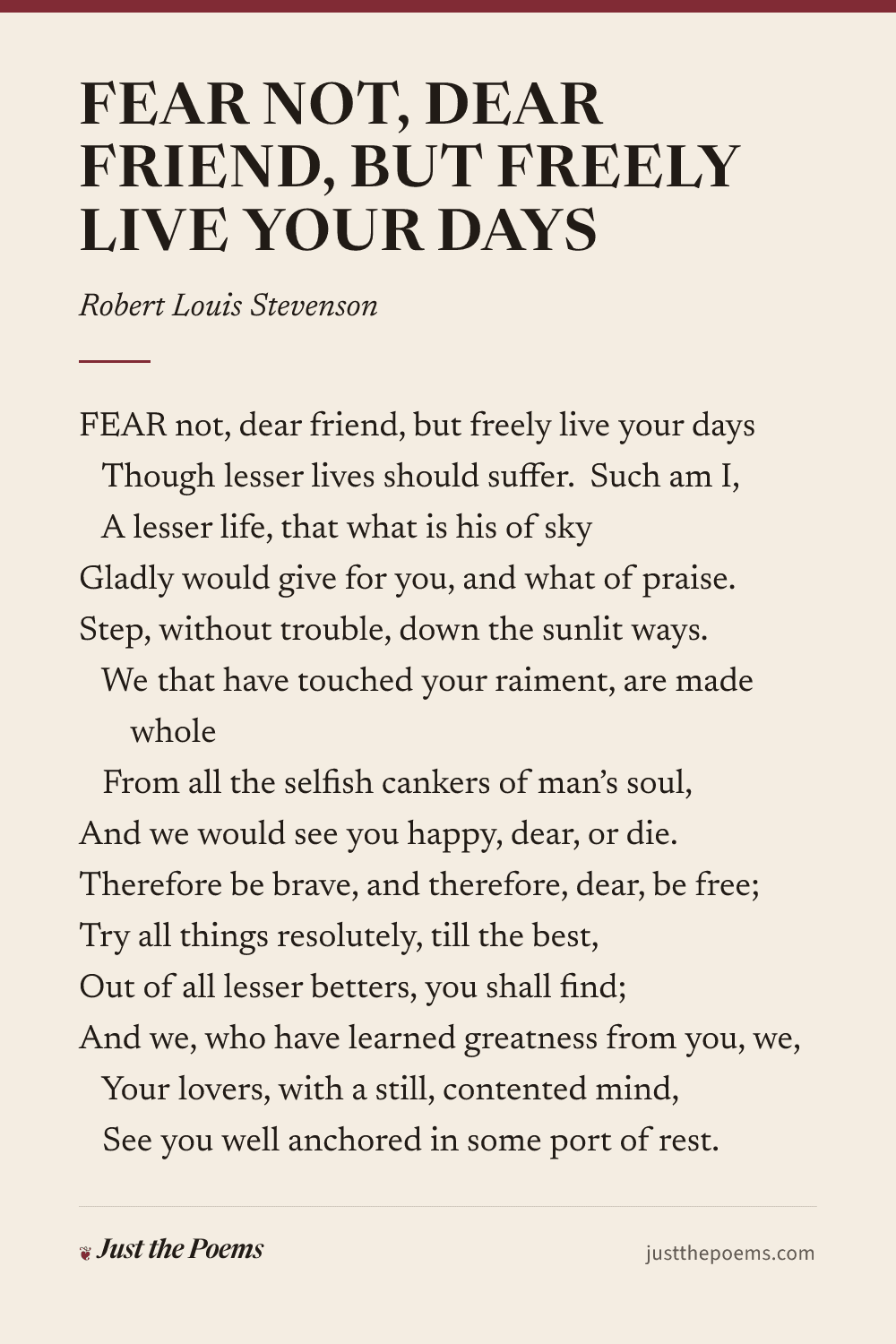
FEAR NOT, DEAR FRIEND, BUT FREELY LIVE YOUR DAYS

Robert Louis Stevenson

In 0 Wikipedias 0 anthologies Poet in 101 Wikipedias

FEAR not, dear friend, but freely live your days Though lesser lives should suffer. Such am I, A lesser life, that what is his of skyGladly would give for you, and what of praise.Step, without trouble, down the sunlit ways. We that have touched your raiment, are made whole From all the selfish cankers of man’s soul,And we would see you happy, dear, or die.Therefore be brave, and therefore, dear, be free;Try all things resolutely, till the best,Out of all lesser betters, you shall find;And we, who have learned greatness from you, we, Your lovers, with a still, contented mind, See you well anchored in some port of rest.

Source

New Poems, and Variant Readings, 1918

Filed under
  • Named in the title

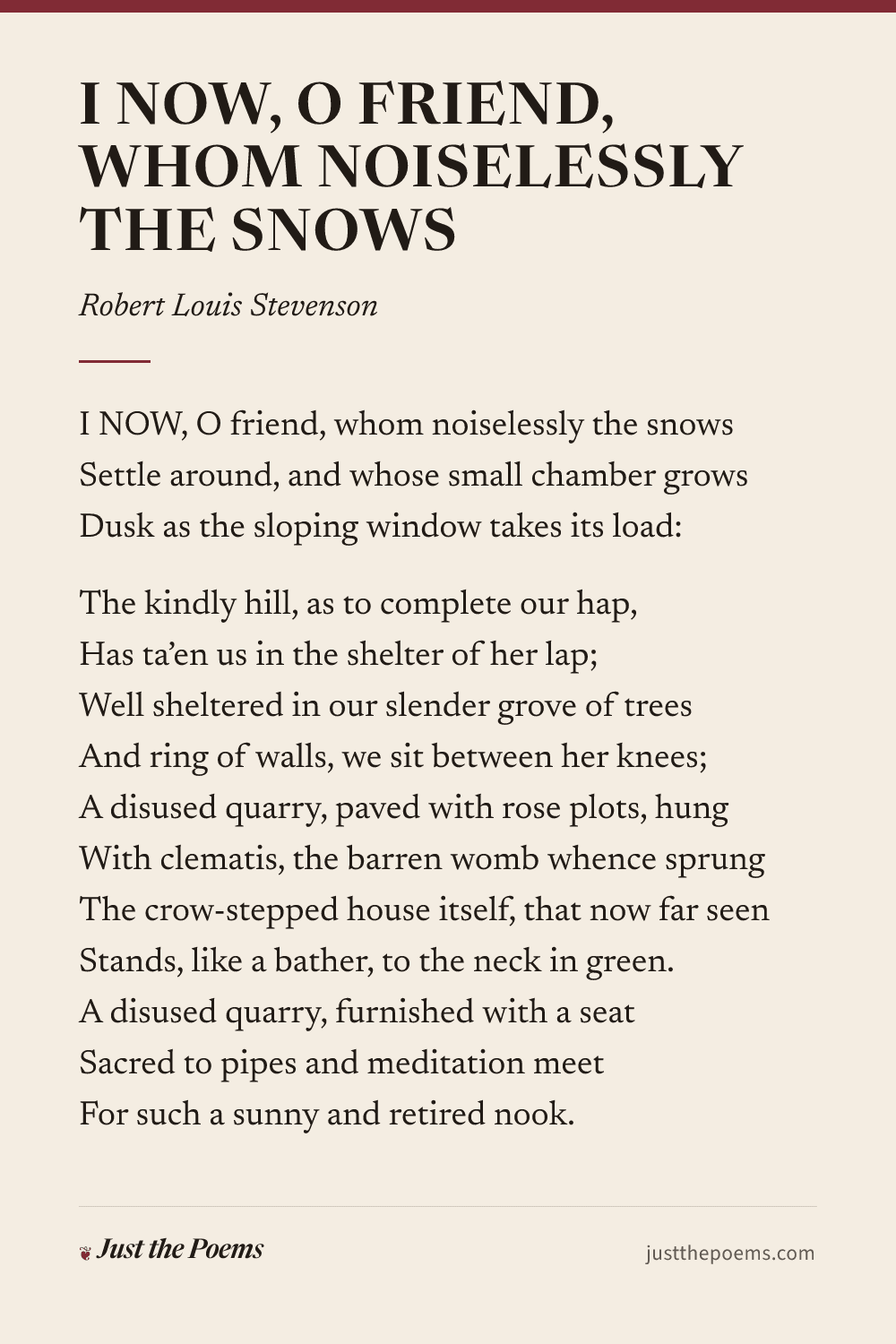
I NOW, O FRIEND, WHOM NOISELESSLY THE SNOWS

Robert Louis Stevenson

In 0 Wikipedias 0 anthologies Poet in 101 Wikipedias

I NOW, O friend, whom noiselessly the snowsSettle around, and whose small chamber growsDusk as the sloping window takes its load:

The kindly hill, as to complete our hap,Has ta’en us in the shelter of her lap;Well sheltered in our slender grove of treesAnd ring of walls, we sit between her knees;A disused quarry, paved with rose plots, hungWith clematis, the barren womb whence sprungThe crow-stepped house itself, that now far seenStands, like a bather, to the neck in green.A disused quarry, furnished with a seat

Show all 76 lines 64 more

Sacred to pipes and meditation meetFor such a sunny and retired nook.There in the clear, warm mornings many a bookHas vied with the fair prospect of the hillsThat, vale on vale, rough brae on brae, upfillsHalfway to the zenith all the vacant skyTo keep my loose attention. . . .Horace has sat with me whole mornings through:And Montaigne gossiped, fairly false and true;And chattering Pepys, and a few besideThat suit the easy vein, the quiet tide,The calm and certain stay of garden-life,Far sunk from all the thunderous roar of strife.There is about the small secluded placeA garnish of old times; a certain graceOf pensive memories lays about the braes:The old chestnuts gossip tales of bygone days.Here, where some wandering preacher, blest Lazil,Perhaps, or Peden, on the middle hillHad made his secret church, in rain or snow,He cheers the chosen residue from woe.All night the doors stood open, come who might,The hounded kebbock mat the mud all night.Nor are there wanting later tales; of howPrince Charlie’s Highlanders . . .

I have had talents, too. In life’s first hourGod crowned with benefits my childish head.Flower after flower, I plucked them; flower by flowerCast them behind me, ruined, withered, dead.Full many a shining godhead disappeared.From the bright rank that once adorned her browThe old child’s Olympus

Gone are the fair old dreams, and one by one,As, one by one, the means to reach them went,As, one by one, the stars in riot and disgrace,I squandered what . . .

There shut the door, alas! on many a hopeToo many;My face is set to the autumnal slope,Where the loud winds shall . . .

There shut the door, alas! on many a hope,And yet some hopes remain that shall decideMy rest of years and down the autumnal slope.

Gone are the quiet twilight dreams that ILoved, as all men have loved them; gone!I have great dreams, and still they stir my soul on high—Dreams of the knight’s stout heart and tempered will.Not in Elysian lands they take their way;Not as of yore across the gay champaign,Towards some dream city, towered . . .and my . . .The path winds forth before me, sweet and plain,Not now; but though beneath a stone-grey skyNovember’s russet woodlands toss and wail,Still the white road goes thro’ them, still may I,Strong in new purpose, God, may still prevail.

I and my like, improvident sailors!

At whose light fall awaking, all my heartGrew populous with gracious, favoured thought,And all night long thereafter, hour by hour,The pageant of dead love before my eyesWent proudly, and old hopes with downcast headFollowed like Kings, subdued in Rome’s imperial hour,Followed the car; and I . . .

Source

New Poems, and Variant Readings, 1918

Filed under
  • Named in the title

SOON OUR FRIENDS PERISH

Robert Louis Stevenson

In 0 Wikipedias 0 anthologies Poet in 101 Wikipedias

SOON our friends perish, Soon all we cherishFades as days darken—goes as flowers go. Soon in December Over an ember,Lonely we hearken, as loud winds blow.

Source

New Poems, and Variant Readings, 1918

Filed under
  • Named in the title

Advertisements

TO FRIENDS AT HOME

Robert Louis Stevenson

In 0 Wikipedias 0 anthologies Poet in 101 Wikipedias

TO friends at home, the lone, the admired, the lostThe gracious old, the lovely young, to May The fair, December the beloved,These from my blue horizon and green isles,These from this pinnacle of distances I, The unforgetful, dedicate.

Source

New Poems, and Variant Readings, 1918

Filed under
  • Named in the title

A CONFESSION TO A FRIEND IN TROUBLE

Thomas Hardy

In 0 Wikipedias 0 anthologies Poet in 91 Wikipedias

YOUR troubles shrink not, though I feel them lessHere, far away, than when I tarried near;I even smile old smiles—with listlessness—Yet smiles they are, not ghastly mockeries mere.

A thought too strange to house within my brainHaunting its outer precincts I discern:—That I will not show zeal again to learnYour griefs, and sharing them, renew my pain . . .

It goes, like murky bird or buccaneerThat shapes its lawless figure on the main,And each new impulse tends to make outfleeThe unseemly instinct that had lodgment here;Yet, comrade old, can bitterer knowledge beThan that, though banned, such instinct was in me!

Source

Wessex Poems and Other Verses, 1919

Filed under
  • Named in the title

FRIENDS BEYOND

Thomas Hardy

In 0 Wikipedias 0 anthologies Poet in 91 Wikipedias

WILLIAM DEWY, Tranter Reuben, Farmer Ledlow late at plough, Robert’s kin, and John’s, and Ned’s,And the Squire, and Lady Susan, lie in Mellstock churchyard now!

“Gone,” I call them, gone for good, that group of local hearts andheads; Yet at mothy curfew-tide,And at midnight when the noon-heat breathes it back from walls andleads,

They’ve a way of whispering to me—fellow-wight who yet abide— In the muted, measured noteOf a ripple under archways, or a lone cave’s stillicide:

“We have triumphed: this achievement turns the bane to antidote,

Show all 41 lines 29 more

Unsuccesses to success,—Many thought-worn eves and morrows to a morrow free of thought.

“No more need we corn and clothing, feel of old terrestrial stress; Chill detraction stirs no sigh;Fear of death has even bygone us: death gave all that we possess.”

W. D.—“Ye mid burn the wold bass-viol that I set such vallie by.” Squire.—“You may hold the manse in fee,You may wed my spouse, my children’s memory of me may decry.”

Lady.—“You may have my rich brocades, my laces; take each householdkey; Ransack coffer, desk, bureau;Quiz the few poor treasures hid there, con the letters kept by me.”

Far.—“Ye mid zell my favourite heifer, ye mid let the charlock grow, Foul the grinterns, give up thrift.”Wife.—“If ye break my best blue china, children, I shan’t care orho.”

All. —“We’ve no wish to hear the tidings, how the people’s fortunesshift; What your daily doings are;Who are wedded, born, divided; if your lives beat slow or swift.

“Curious not the least are we if our intents you make or mar, If you quire to our old tune,If the City stage still passes, if the weirs still roar afar.”

—Thus, with very gods’ composure, freed those crosses late and soon Which, in life, the Trine allow(Why, none witteth), and ignoring all that haps beneath the moon,

William Dewy, Tranter Reuben, Farmer Ledlow late at plough, Robert’s kin, and John’s, and Ned’s,And the Squire, and Lady Susan, murmur mildly to me now.

Source

Wessex Poems and Other Verses, 1919

Filed under
  • Named in the title

LAST WORDS TO A DUMB FRIEND

Thomas Hardy

In 0 Wikipedias 0 anthologies Poet in 91 Wikipedias

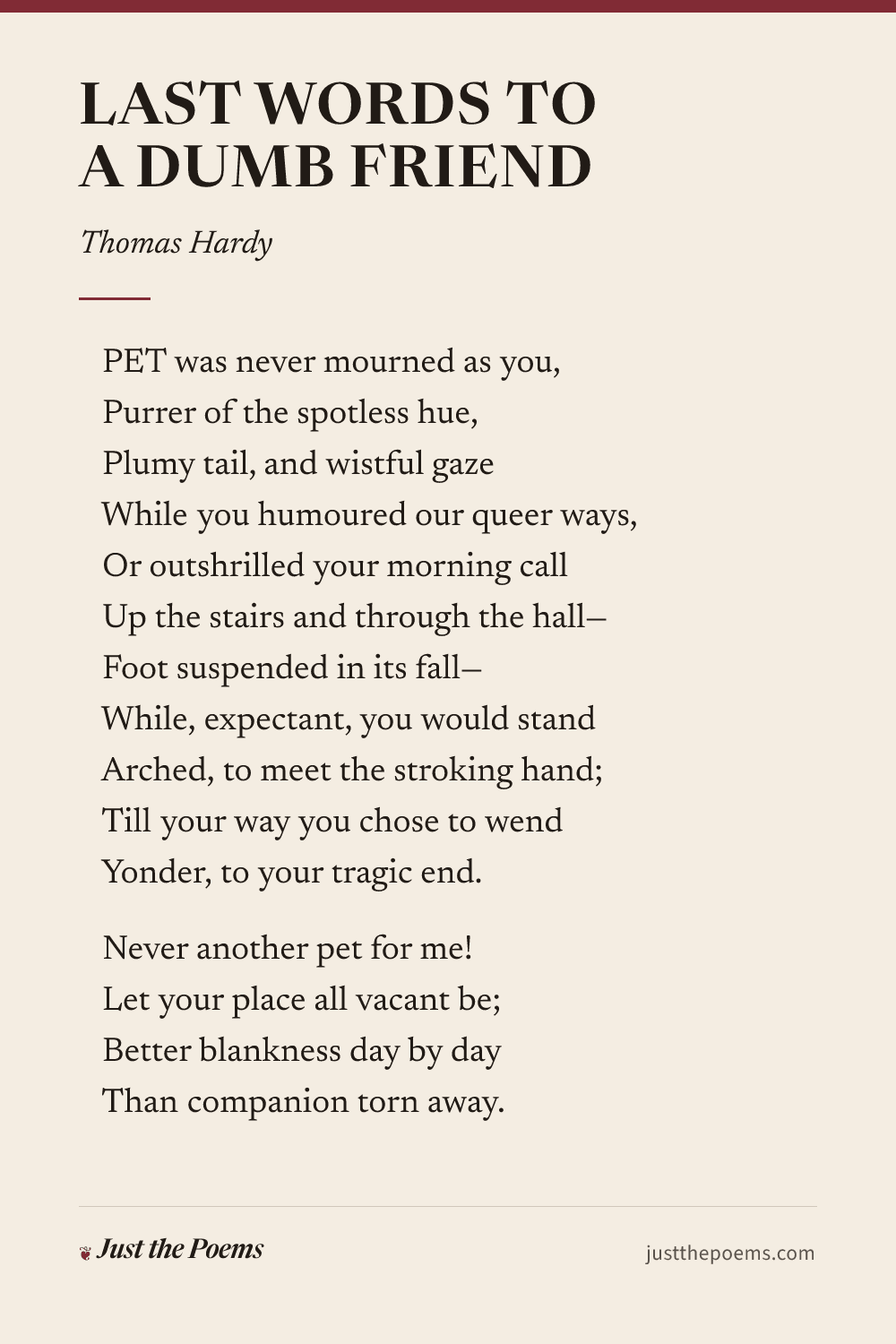
PET was never mourned as you, Purrer of the spotless hue, Plumy tail, and wistful gaze While you humoured our queer ways, Or outshrilled your morning call Up the stairs and through the hall— Foot suspended in its fall— While, expectant, you would stand Arched, to meet the stroking hand; Till your way you chose to wend Yonder, to your tragic end.

Never another pet for me!

Show all 57 lines 45 more

Let your place all vacant be; Better blankness day by day Than companion torn away. Better bid his memory fade, Better blot each mark he made, Selfishly escape distress By contrived forgetfulness, Than preserve his prints to make Every morn and eve an ache.

From the chair whereon he sat Sweep his fur, nor wince thereat; Rake his little pathways out Mid the bushes roundabout; Smooth away his talons’ mark From the claw-worn pine-tree bark, Where he climbed as dusk embrowned, Waiting us who loitered round.

Strange it is this speechless thing, Subject to our mastering, Subject for his life and food To our gift, and time, and mood; Timid pensioner of us Powers, His existence ruled by ours, Should—by crossing at a breath Into safe and shielded death, By the merely taking hence Of his insignificance— Loom as largened to the sense, Shape as part, above man’s will, Of the Imperturbable.

As a prisoner, flight debarred, Exercising in a yard, Still retain I, troubled, shaken, Mean estate, by him forsaken; And this home, which scarcely took Impress from his little look, By his faring to the Dim Grows all eloquent of him.

Housemate, I can think you still Bounding to the window-sill, Over which I vaguely see Your small mound beneath the tree, Showing in the autumn shade That you moulder where you played.

October 2, 1904.

Source

Late Lyrics and Earlier, With Many Other Verses, 1922

Filed under
  • Named in the title

TO A FRIEND.

Samuel Johnson

In 0 Wikipedias 0 anthologies Poet in 79 Wikipedias

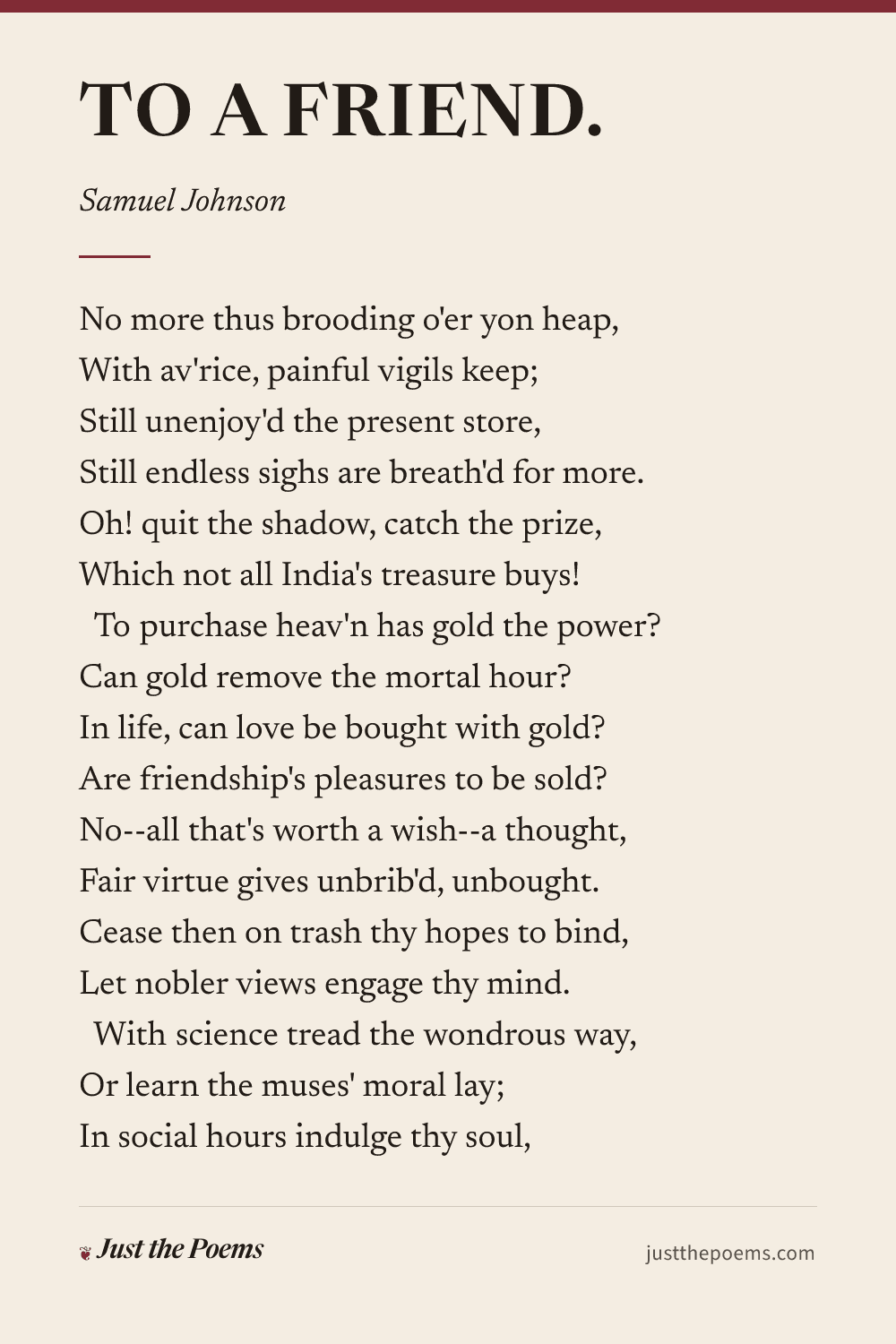
No more thus brooding o'er yon heap,With av'rice, painful vigils keep;Still unenjoy'd the present store,Still endless sighs are breath'd for more.Oh! quit the shadow, catch the prize,Which not all India's treasure buys! To purchase heav'n has gold the power?Can gold remove the mortal hour?In life, can love be bought with gold?Are friendship's pleasures to be sold?No--all that's worth a wish--a thought,Fair virtue gives unbrib'd, unbought.

Show all 28 lines 16 more

Cease then on trash thy hopes to bind,Let nobler views engage thy mind. With science tread the wondrous way,Or learn the muses' moral lay;In social hours indulge thy soul,Where mirth and temp'rance mix the bowl;To virtuous love resign thy breast,And be, by blessing beauty--blest. Thus taste the feast, by nature spread,Ere youth, and all its joys are fled;Come, taste with me the balm of life,Secure from pomp, and wealth, and strife.I boast whate'er for man was meant,In health, and Stella, and content;And scorn! oh! let that scorn be thine!Mere things of clay that dig the mine.

Source

Dr. Johnson's Works: Life, Poems, and Tales, Volume 1 The Works of Samuel Johnson, LL.D., in Nine Volumes, 1825

Filed under
  • Named in the title

Hiawatha’s Friends

Henry Wadsworth Longfellow

In 0 Wikipedias 0 anthologies Poet in 71 Wikipedias

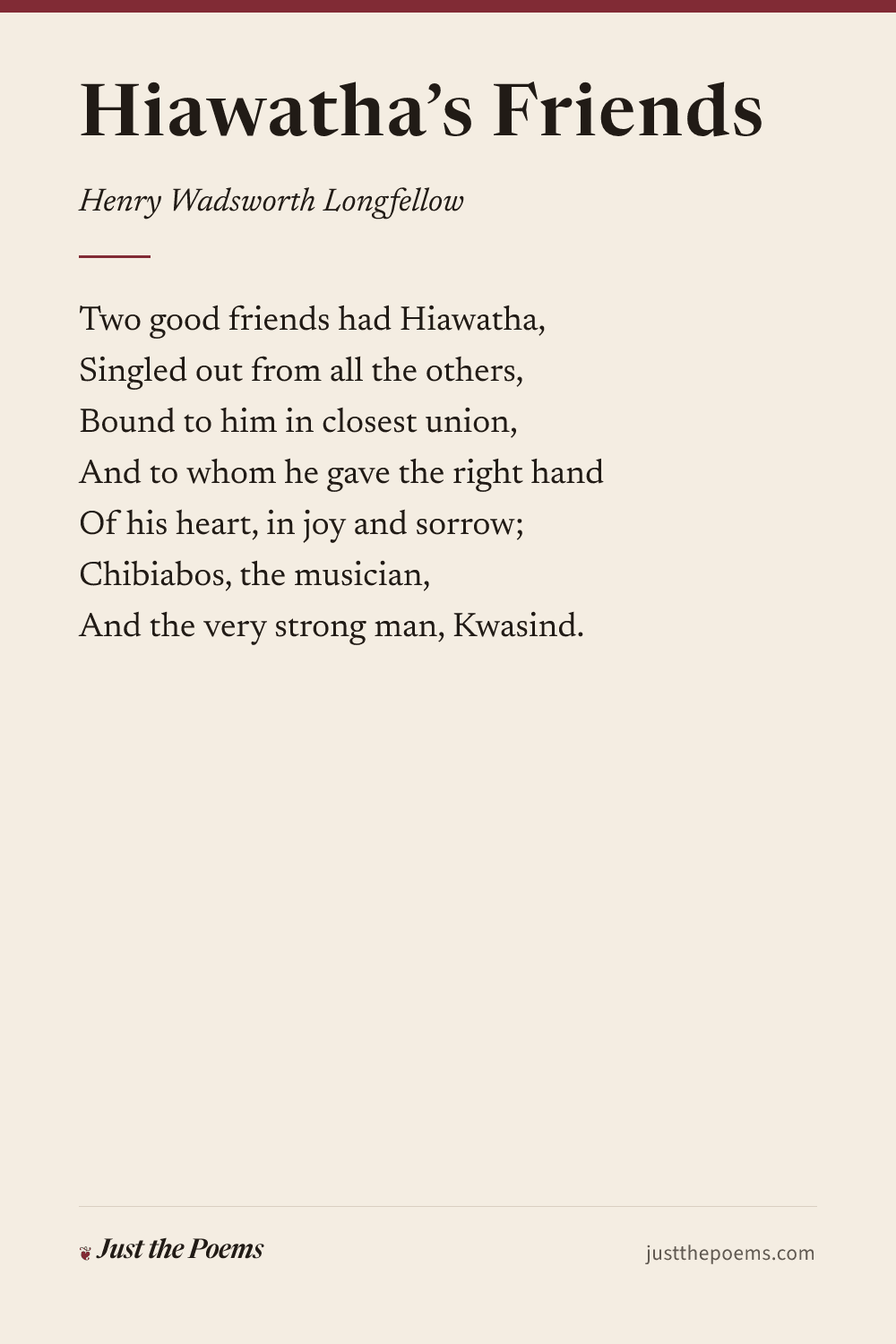
Two good friends had Hiawatha,Singled out from all the others,Bound to him in closest union,And to whom he gave the right handOf his heart, in joy and sorrow;Chibiabos, the musician,And the very strong man, Kwasind.

Straight between them ran the pathway,Never grew the grass upon it;Singing birds, that utter falsehoods,Story-tellers, mischief-makers,Found no eager ear to listen,

Show all 177 lines 165 more

Could not breed ill-will between them,For they kept each other’s counsel,Spake with naked hearts together,Pondering much and much contrivingHow the tribes of men might prosper.
Most beloved by HiawathaWas the gentle Chibiabos,He the best of all musicians,He the sweetest of all singers.Beautiful and childlike was he,Brave as man is, soft as woman,Pliant as a wand of willow,Stately as a deer with antlers.

When he sang, the village listened;All the warriors gathered round him,All the women came to hear him;Now he stirred their souls to passion,Now he melted them to pity.

From the hollow reeds he fashionedFlutes so musical and mellow,That the brook, the Sebowisha,Ceased to murmur in the woodland,That the wood-birds ceased from singing,And the squirrel, Adjidaumo,Ceased his chatter in the oak-tree,And the rabbit, the Wabasso,Sat upright to look and listen.

Yes, the brook, the Sebowisha,Pausing, said, “O Chibiabos,Teach my waves to flow in music,Softly as your words in singing!”

Yes, the bluebird, the Owaissa,Envious, said, “O Chibiabos,Teach me tones as wild and wayward,Teach me songs as full of frenzy!”

Yes, the robin, the Opechee,Joyous, said, “O Chibiabos,Teach me tones as sweet and tender,Teach me songs as full of gladness!”

And the whippoorwill, Wawonaissa,Sobbing, said, “O Chibiabos,Teach me tones as melancholy,Teach me songs as full of sadness!”

All the many sounds of natureBorrowed sweetness from his singing;All the hearts of men were softenedBy the pathos of his music;For he sang of peace and freedom,Sang of beauty, love, and longing;Sang of death, and life undyingIn the Islands of the Blessed,In the kingdom of Ponemah,In the land of the Hereafter.

Very dear to HiawathaWas the gentle Chibiabos,He the best of all musicians,He the sweetest of all singers;For his gentleness he loved him,And the magic of his singing.

Dear, too, unto HiawathaWas the very strong man, Kwasind,He the strongest of all mortals,He the mightiest among many;For his very strength he loved him,For his strength allied to goodness.

Idle in his youth was Kwasind,Very listless, dull, and dreamy,Never played with other children,Never fished and never hunted,Not like other children was he;But they saw that much he fasted,Much his Manito entreated,Much besought his Guardian Spirit.

“Lazy Kwasind!” said his mother,“In my work you never help me!In the Summer you are roamingIdly in the fields and forests;In the Winter you are coweringO’er the firebrands in the wigwam!In the coldest days of WinterI must break the ice for fishing;With my nets you never help me!At the door my nets are hanging,Dripping, freezing with the water;Go and wring them, Yenadizze!Go and dry them in the sunshine!”

Slowly, from the ashes, KwasindRose, but made no angry answer;From the lodge went forth in silence,Took the nets, that hung together,Dripping, freezing at the doorway;Like a wisp of straw he wrung them,Like a wisp of straw he broke them,Could not wring them without breaking,Such the strength was in his fingers.

“Lazy Kwasind!” said his father,“In the hunt you never help me;Every bow you touch is broken,Snapped asunder every arrow;Yet come with me to the forest,You shall bring the hunting homeward.”

Down a narrow pass they wandered,Where a brooklet led them onward,Where the trail of deer and bisonMarked the soft mud on the margin,Till they found all further passageShut against them, barred securelyBy the trunks of trees uprooted,Lying lengthwise, lying crosswise,And forbidding further passage.

“We must go back,” said the old man,“O’er these logs we cannot clamber;Not a woodchuck could get through them,Not a squirrel clamber o’er them!”And straightway his pipe he lighted,And sat down to smoke and ponder.But before his pipe was finished,Lo! the path was cleared before him;All the trunks had Kwasind lifted,To the right hand, to the left hand,Shot the pine-trees swift as arrows,Hurled the cedars light as lances.

“Lazy Kwasind!” said the young men,As they sported in the meadow:“Why stand idly looking at us,Leaning on the rock behind you?Come and wrestle with the others,Let us pitch the quoit together!”

Lazy Kwasind made no answer,To their challenge made no answer,Only rose, and slowly turning,Seized the huge rock in his fingers,Tore it from its deep foundation,Poised it in the air a moment,Pitched it sheer into the river,Sheer into the swift Pauwating,Where it still is seen in Summer.

Once as down that foaming river,Down the rapids of Pauwating,Kwasind sailed with his companions,In the stream he saw a beaver,Saw Ahmeek, the King of Beavers,Struggling with the rushing currents,Rising, sinking in the water.

Without speaking, without pausing,Kwasind leaped into the river,Plunged beneath the bubbling surface,Through the whirlpools chased the beaver,Followed him among the islands,Stayed so long beneath the water,That his terrified companionsCried, “Alas! good-by to Kwasind!We shall never more see Kwasind!”But he reappeared triumphant,And upon his shining shouldersBrought the beaver, dead and dripping,Brought the King of all the Beavers.

And these two, as I have told you,Were the friends of Hiawatha,Chibiabos, the musician,And the very strong man, Kwasind.Long they lived in peace together,Spake with naked hearts together,Pondering much and much contrivingHow the tribes of men might prosper.
Source

The Song of Hiawatha

Filed under
  • Named in the title

LOVE AND FRIENDSHIP

Henry Wadsworth Longfellow

In 0 Wikipedias 0 anthologies Poet in 71 Wikipedias

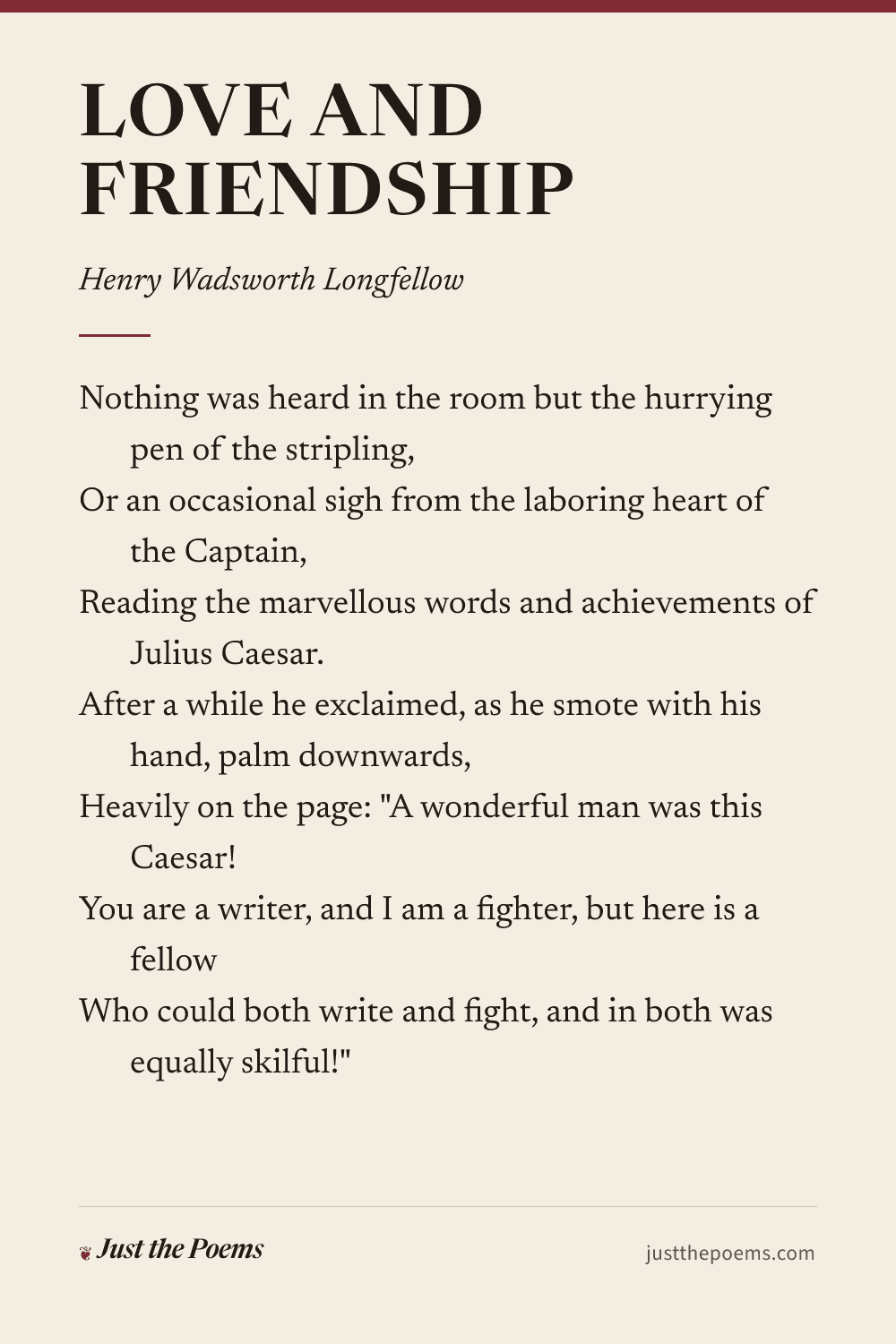
Nothing was heard in the room but the hurrying pen of the stripling,Or an occasional sigh from the laboring heart of the Captain,Reading the marvellous words and achievements of Julius Caesar.After a while he exclaimed, as he smote with his hand, palm downwards,Heavily on the page: "A wonderful man was this Caesar!You are a writer, and I am a fighter, but here is a fellowWho could both write and fight, and in both was equally skilful!"Straightway answered and spake John Alden, the comely, the youthful:"Yes, he was equally skilled, as you say, with his pen and his weapons.Somewhere have I read, but where I forget, he could dictateSeven letters at once, at the same time writing his memoirs.""Truly," continued the Captain, not heeding or hearing the other,

Show all 98 lines 86 more

"Truly a wonderful man was Caius Julius Caesar!Better be first, he said, in a little Iberian village,Than be second in Rome, and I think he was right when he said it.Twice was he married before he was twenty, and many times after;Battles five hundred he fought, and a thousand cities he conquered;He, too, fought in Flanders, as he himself has recorded;Finally he was stabbed by his friend, the orator Brutus!Now, do you know what he did on a certain occasion in Flanders,When the rear-guard of his army retreated, the front giving way too,And the immortal Twelfth Legion was crowded so closely togetherThere was no room for their swords? Why, he seized a shield from a soldier,Put himself straight at the head of his troops, and commanded the captains,Calling on each by his name, to order forward the ensigns;Then to widen the ranks, and give more room for their weapons;So he won the day, the battle of something-or-other.That's what I always say; if you wish a thing to be well done,You must do it yourself, you must not leave it to others!"

All was silent again; the Captain continued his reading.Nothing was heard in the room but the hurrying pen of the striplingWriting epistles important to go next day by the Mayflower,Filled with the name and the fame of the Puritan maiden Priscilla;Every sentence began or closed with the name of Priscilla,Till the treacherous pen, to which he confided the secret,Strove to betray it by singing and shouting the name of Priscilla!Finally closing his book, with a bang of the ponderous cover,Sudden and loud as the sound of a soldier grounding his musket,Thus to the young man spake Miles Standish the Captain of Plymouth:"When you have finished your work, I have something important to tell you.Be not however in haste; I can wait; I shall not be impatient!"Straightway Alden replied, as he folded the last of his letters,Pushing his papers aside, and giving respectful attention:"Speak; for whenever you speak, I am always ready to listen,Always ready to hear whatever pertains to Miles Standish."Thereupon answered the Captain, embarrassed, and culling his phrases:"'T is not good for a man to be alone, say the Scriptures.This I have said before, and again and again I repeat it;Every hour in the day, I think it, and feel it, and say it.Since Rose Standish died, my life has been weary and dreary;Sick at heart have I been, beyond the healing of friendship.Oft in my lonely hours have I thought of the maiden Priscilla.She is alone in the world; her father and mother and brotherDied in the winter together; I saw her going and coming,Now to the grave of the dead, and now to the bed of the dying,Patient, courageous, and strong, and said to myself, that if everThere were angels on earth, as there are angels in heaven,Two have I seen and known; and the angel whose name is PriscillaHolds in my desolate life the place which the other abandoned.Long have I cherished the thought, but never have dared to reveal it,Being a coward in this, though valiant enough for the most part.Go to the damsel Priscilla, the loveliest maiden of Plymouth,Say that a blunt old Captain, a man not of words but of actions,Offers his hand and his heart, the hand and heart of a soldier.Not in these words, you know, but this in short is my meaning;I am a maker of war, and not a maker of phrases.You, who are bred as a scholar, can say it in elegant language,Such as you read in your books of the pleadings and wooings of lovers,Such as you think best adapted to win the heart of a maiden."

When he had spoken, John Alden, the fair-haired, taciturn stripling,All aghast at his words, surprised, embarrassed, bewildered,Trying to mask his dismay by treating the subject with lightness,Trying to smile, and yet feeling his heart stand still in his bosom,Just as a timepiece stops in a house that is stricken by lightning,Thus made answer and spake, or rather stammered than answered:"Such a message as that, I am sure I should mangle and mar it;If you would have it well done,--I am only repeating your maxim,--You must do it yourself, you must not leave it to others!"But with the air of a man whom nothing can turn from his purpose,Gravely shaking his head, made answer the Captain of Plymouth:"Truly the maxim is good, and I do not mean to gainsay it;But we must use it discreetly, and not waste powder for nothing.Now, as I said before, I was never a maker of phrases.I can march up to a fortress and summon the place to surrender,But march up to a woman with such a proposal, I dare not.I'm not afraid of bullets, nor shot from the mouth of a cannon,But of a thundering "No!" point-blank from the mouth of a woman,That I confess I'm afraid of, nor am I ashamed to confess it!So you must grant my request, for you are an elegant scholar,Having the graces of speech, and skill in the turning of phrases."Taking the hand of his friend, who still was reluctant and doubtful,Holding it long in his own, and pressing it kindly, he added:"Though I have spoken thus lightly, yet deep is the feeling that prompts me;Surely you cannot refuse what I ask in the name of our friendship!"Then made answer John Alden: "The name of friendship is sacred;What you demand in that name, I have not the power to deny you!"So the strong will prevailed, subduing and moulding the gentler,Friendship prevailed over love, and Alden went on his errand.

Source

The Complete Poetical Works of Henry Wadsworth Longfellow

Filed under
  • Named in the title

REFLECTIONS ON ABSENT FRIENDS, GONE TO AMERICA.

John Castillo

In 0 Wikipedias 0 anthologies Poet in 1 Wikipedia

The sun had gone down o'er yon lofty mountain, The last golden streamer had left the tall tree;The dwelling below seemed forsaken and gloomy, Its inmates were tossing upon the wide sea.

The rose tree was nodding the lasses had nourish'd, Which oft had supplied them with Sunday's perfume;The wall-flower in sorrowful modesty flourish'd, And wept o'er the beautiful daisy in bloom!

In the track by the river the green grass is springing, On whose flowery bank they were oft wont to stray;No more the still grove with sweet echoes is ringing, To the voice of the milk maid, or children at play.

Show all 32 lines 20 more

The dog in the night time now howls discontented, Of its master and mistress but lately bereft;I listen'd and look'd to the place they frequented, Of them not a sigh, nor a whisper is left.

How strong the emotions of friendship were glowing, When towed by the steamer the ocean they braved;Their force was evinced by the tears that were flowing, As the hat, or the hand, or the handkerchief waved.

From the shores of old England we anxiously view'd them, A cargo most precious, and dear to our sight;Far o'er the blue surface affection pursued them, Till the ship was conceal'd by the curtain of night.

They have left us,--their absence wakes mournful reflection, As the fast sailing Arundel bears them away;We can only consign them to heavenly protection, To Him, whom the winds and the waters obey.

He who roves through the wood may quickly discover, Their affection in tokens which there he will see;Where with sorrowful heart each friend or each lover, May sigh o'er their names in the bark of the tree.

Source

Awd Isaac, The Steeple Chase, and Other Poems With a glossary of the Yorkshire Dialect, 1843

Filed under
  • Named in the title

THE TEST OF FRIENDSHIP.

John S. Adams

In 0 Wikipedias 0 anthologies Poet in 0 Wikipedias

BRIGHTEST shine the stars above When the night is darkest round us;Those the friends we dearest love Who were near when sorrow bound us.When no clouds o'ercast our sky, When no evil doth attend us,Then will many gather nigh, Ever ready to befriend us.But when darkness shades our path, When misfortune hath its hour,When we lie beneath its wrath, Some will leave us to its power.

Show all 28 lines 16 more

Often have we seen at night, When the clouds have gathered o'er us,One lone star send forth its light, Marking out the path before us.Like that star some friendly eye Will beam on us in our sorrow;And, though clouded be our sky, We know there'll be a better morrow.We know that all will not depart, That some will, gather round to cheer us:Know we, in our inmost heart, Tried and faithful friends are near us.Brother, those who do not go May be deem‚d friends forever;Love them, trust them, have them know Nothing can your friendship sever.

Source

Town and Country; Or, Life at Home and Abroad, Without and Within Us, 1855

Filed under
  • Named in the title

22 poems for a friend

16 poets

By poet's century of death

CenturyPoems
17th2
18th2
19th13
20th5

Poets with more than one poem

PoetPoems
Robert Louis Stevenson4
Thomas Hardy3
Henry Wadsworth Longfellow2